
The Peaceful Parenting Podcast
Sarah Rosensweet
0
The Peaceful Parenting Podcast, hosted by Sarah Rosensweet, offers tools, strategies, and support to help parents end yelling and power struggles, encouraging kids to listen and cooperate. Each week features guest interviews, personal insights, and live coaching sessions. The podcast aims to make parenting more peaceful and enjoyable for families.
Epizode
-
 Feeding Kids with Ease, Health and Joy: Episode 230 11.08.2026 45minIn this episode of The Peaceful Parenting Podcast, Jennifer Anderson, registered dietitian and founder of Kids Eat in Color, shares how parents can help kids develop a healthy relationship with food and their bodies—without shame, restriction, or diet culture. Plus, practical tips for school lunches and making family meals easier and more affordable.Know someone who might appreciate this episode? Share it with them!And if you love the podcast, FREE ways to help us out:1- Rate and review the podcast in your podcast player app2- “Like” this post by tapping the heart icon ♥️3- Share this with a friend. THANK YOU!You can listen wherever you get your podcasts or check out the fully edited transcript of our interview at the bottom of this post.We talk about:03:00 What does a healthy relationship with food and our bodies look like?05:00 Protecting kids from body image and weight concerns07:00 Boys, body image, and the pressure to look “ripped”09:00 Talking to kids who are worried about being in a bigger body12:00 Helping kids develop a healthy relationship with food14:00 Treats, limits, and avoiding shame or moralizing around food21:00 Can kids really regulate how much they eat?24:00 Neurodivergence, interoception, and mindful eating30:00 Emotional eating, comfort, and food as connection32:00 Simple strategies for packing school lunches37:00 Feeding a family when time, money, and energy are limited39:00 Why simple dinners are good enough42:00 Jennifer’s book and pre-order bonuses44:00 The parenting advice Jennifer wishes she’d known earlierResources mentioned in this episode:* Jennifer’s Book Feed Them Well: A Guide to Raising Healthy, Confident Eaters* Search “Kids Eat in Color” to find Jennifer on all social media platformsConnect with Sarah Rosensweet:* Instagram* Facebook Group* YouTube* Website* Join us on Substack* Newsletter* Book a short consult or coaching session callxx Sarah and CoreyYour peaceful parenting team- click here for a free short consult or a coaching sessionVisit our website for free resources, podcast, coaching, membership and more!>> Please support us!!! Please consider becoming a supporter to help support our free content, including The Peaceful Parenting Podcast, our free parenting support Facebook group, and our weekly parenting emails, “Weekend Reflections” and “Weekend Support” - plus our Flourish With Your Complex Child Summit (coming back in the fall for the 3rd year!) All of this free support for you takes a lot of time and energy from me and my team. If it has been helpful or meaningful for you, your support would help us to continue to provide support for free, for you and for others.In addition to knowing you are supporting our mission to support parents and children, you get the podcast ad free and access to a monthly ‘ask me anything’ session.Sarah: Hey everyone. Welcome back to another episode of the Peaceful Parenting Podcast. Today’s guest is Jennifer Anderson, nutritionist and founder of Kids Eat in Color. Jennifer has a new book coming out all about helping kids develop a good relationship with food and with their bodies. That’s what we’re talking about in today’s episode.Along the way, we also touched on some great tips for packing school lunches and making meals easier and more affordable. There’s so much conflicting information out there about feeding kids, and with their physical and mental health at risk, knowing what to do can be very stressful for parents. I love Jennifer’s common-sense and relaxed approach to eating and feeding, and I hope you do as well.If you like this episode, please share it with a friend so more parents can learn about peaceful parenting. If you’re a fan of the podcast, you can help us out not only by sharing it, but by leaving a review and a five-star rating in your podcast player app. While you’re there, don’t forget to follow the show so you don’t miss an episode. If you’d like to support us even more, you can become a supporter on Substack to help us offset the cost of making the show. We’ll put a link in the show notes.Okay, let’s meet Jennifer.Hey, Jennifer. Welcome back to the podcast. This is your second time with us.Jennifer: Thank you so much for having me.Sarah: Yeah, I’m so excited. You have a new book coming out, so maybe you could introduce yourself and then tell us about your new book, which is available for pre-order and coming out in September. We will link to that in the show notes, but tell us a little bit about who you are and about your new book.Jennifer: Sure. I’m a registered dietitian. I have two kids who have not been easy to feed, and I’m the founder of Kids Eat in Color and the CEO of Better Bites. I’m so excited to have this book coming out. It’s called Feed Them Well: A Guide to Raising Healthy, Confident Eaters for Life. I just cannot wait for parents to have this resource.Sarah: Amazing. You were telling me before we started that the focus of your book is having kids have a healthy relationship not only with food, but with their bodies. Maybe we could start out by talking about—obviously, this could be a very long conversation—but some of the top things you’ve found that are really helpful, sort of dos and don’ts, in terms of having kids have that healthy relationship with food.And also, what do you mean when you talk about a healthy relationship with their bodies? Maybe that’s a two-part question.Jennifer: Yeah. I love that you framed it as a two-part question, because it is kind of a two-part question, but I feel like that’s only because in English we don’t have a way to describe the fact that these things are deeply connected in us.When I think about a healthy relationship with food, I want to make sure kids know how to take care of their bodies. They know what a balanced diet looks like. They’re able to enjoy food, whatever kind of food it is. And also, we want kids to be able to really appreciate and live in their bodies, experience life through their bodies, and not have this deep what’s called internalized weight bias, where thin is the ideal. Thin is what everybody is shooting for. You should either be worried about how thin you are or trying to get thinner. That is a soul-sucking way of living when we’re so focused on weight and diet culture.So we want to give kids another option. We want to give kids the ability to really appreciate their bodies, and yet we also want to do so in a way that they’re still able to care about the health of their bodies in a way that’s healthy, as opposed to just diet culture.What I call this is embodied independence, where kids are independent. They know all the things they need to do, and they’re also embodied. They’re living in and experiencing their bodies.When we think about what we want to do and what we want to not do, we want to model what we want kids to do, ideally, and this is in every single area of parenting, including eating. That’s where the independence comes from. We’re modeling, and we’re also providing the boundaries and opportunities for them.I always tell parents, “You are in charge of your restaurant at home. You’re the head chef. You’re going to set when your restaurant hours are, you’re going to set what’s on the menu, you’re going to set all these things.” As you’re doing that, you are teaching your child what is part of a healthy lifestyle.On the other side, we’re thinking about their relationship with their body. We want to minimize internalized weight bias, and that means we’re not discussing body sizes or body shapes. We’re not weighing ourselves in front of our kids. One of the most powerful things you can do as a parent is to not discuss your body size or shape and not discuss any weight-loss attempts at any point, if that’s something you ever engage in. Those two things are huge risk factors for disordered eating and eating disorders. If we could just not do that, that would actually be huge.Sarah: I feel like that’s actually a real gift my mother gave me. She never talked about her weight or diets or her body, really, at all. And I feel like I’m one of the few people I know who—I’ll say at least until perimenopause recently—had no body-image issues for my whole adult life. I think that really did stem from being raised without that being a thing that people were talking about.Jennifer: Yeah, absolutely. It was discussed in the groups that I grew up in. At the same time, my parents were like, “No, you are not allowed to look at beauty magazines or teen magazines.” I don’t remember really pushing back on that as a teenager, but now I am so grateful because, whether it’s social media now or teen magazines or so many other things, so many of them are focused on body image: how thin you are, how to get thin, how to stay thin, all this stuff. And that stuff is just toxic.Sarah: Yeah, and it used to just be for girls, right? And now boys are—I have so many clients who’ve said their son wants a six-pack, and they’re eight or nine years old and won’t take off their shirt to go swimming.Jennifer: My kids are right now into parkour, and it’s interesting to watch because we’ve been very careful about what we’ve said about them. They’ve recently started talking about six-packs and strong cores and all that because, in reality, my son is like, “I need a stronger core because that will help me flip better.” And he’s 100% right that his core strength is going to determine his success in this sport in a lot of ways.At the same time, getting ripped is not the phrasing that I would really prefer because so much of that is focused on image, right? And yet this is what they’re hearing. My kids are 11 and 13, but it really started last year, when they were 10 and 12, where they’re just kind of being exposed to these ideas of fitness.So when we think about kids understanding this, yeah, we have to have them understand their physical fitness, and then we also have to help them understand that it’s not about looks. It is about how we feel. It’s about what we can do. It’s about how we can serve people. It’s about so much more than just how we look.So as I think about my kids getting ready to do these things and doing these things, I’m going to continue to focus on, “This will help you flip,” not, “This will help you look ripped.”Sarah: Talk a little bit more about some of the dos and don’ts about the healthy relationship. We’ve sort of focused on our bodies. Actually, you know what? Before you do, I want to ask you about something else first, so we’ll stay on that for another second.If you have a child who is in a bigger body and they’re concerned to obsessed about being in a bigger body and feeling like that’s, quote, “bad,” how do you talk to them about that?Jennifer: So I think the first thing is—and I have a framework in the book that, even though it’s kind of cheesy, I call the LOVE framework—we want to listen. We really want to listen, and then we want to validate. Because if a kid is coming to us and saying, “I’m fat. I want to lose weight,” one, we don’t really know what they mean by that. We don’t know where that came from. Are they being teased? Did they hear something? Are their friends all trying to lose weight? We have to listen and understand.And then we have to say, “Yeah, you feel like you want to lose weight. You’re feeling bad right now. You’re telling me that your body is rounder than your friends’.” As we validate, we want to use neutral, factual language. If they’re describing their body in negative terms, we don’t want to say, “Oh no, you’re wrong,” because that’s not right, and it’s also not bad to be in a bigger body. And so if we’re like, “Oh, no, no, no, you’re not fat,” that’s not helpful because we’re just invalidating their whole experience, and we’re also reinforcing the idea that fat is bad.Instead, we want to be like, “Oh yeah, you’re right. I’ve noticed that in our family, we all have softer tummies. We all have rounder tummies.” When we’re using basic descriptive language that’s not negative, we help them reinterpret their body in a way that is more neutral, where we can then eventually move away from this judgment of body size and shape to an acceptance of body size and shape, where that’s just not part of what we’re talking about. It’s just like, “Oh, it’s neutral. This is just a body,” and let’s move on to something more interesting.And then, after we’ve listened and validated, we really want to see if there’s something that we need to take action on. We’re saying, “Okay, do I need to help my child learn coping skills for being bullied? Do I need to talk to the school? Do I need to talk to their friend’s parents? What is my role now in figuring out what needs to happen? Is my child showing signs of having disordered eating? Have they put themselves on a diet?”Those are the sorts of things where you want to take it seriously. If they’re restricting themselves from different foods or they’re doing things to try to change the size of their body, then is the time to involve a professional. Whether it’s a counselor, an eating disorder therapist, their doctor, whoever it is, that is the time. I know it’s hard when we think, “Oh my gosh, my kid potentially has disordered eating or an eating disorder.” That can fill parents with a lot of guilt and fear and shame and all that sort of thing. Don’t let that stop you from getting your child help as soon as possible.Sarah: Yeah, this is not a DIY project.Jennifer: Yeah, it’s not. Now, of course, you can be DIY-ing it all the way up to that point, but at the point where you see a big red flag, go bring somebody else in.Sarah: So what are some tips for helping kids have a healthy relationship with food?Jennifer: I love to talk about food factually, the same way we would talk about bodies. It’s like, “Oh, these are the names of foods. They’re hard, they’re crunchy, they’re savory, they’re sweet, they’re delicious,” as opposed to this sort of, “These are healthy foods, and these are not healthy foods.”It adds a level of complication that is too simple and also contributes to a very rigid perspective of food and eating. Potentially, that can even leak over into how people think of their bodies.Sarah: Yeah, because it just occurred to me—I was reflecting before, when I was thinking of questions to ask you—that I do know someone who talks to their child about, “We have to eat healthy food before we eat the unhealthy food.” And why would you ever want to tell your child that you’re giving them something unhealthy anyway? “Have this dangerous toy.” You know?Jennifer: Yeah. “Don’t play with the dangerous toy until you’ve played with the safe toy.” I completely agree with that, and I think it comes from a very well-meaning place where, again, we’re wanting to pass on this information that empowers kids to nurture their bodies for the rest of their life.So it’s all coming from a good place. We just have to think that kids will internalize this sort of, “Wait a second. You’re giving me all this healthy food, but then we have this unhealthy food. Why are you giving me unhealthy food? And also, am I bad if I eat this unhealthy food? Should I feel guilty? Should I feel afraid of it?” There are a lot of things that kids can take from these conversations.Now, it doesn’t mean that if you’re using this language, you have ruined your child or you have given your child an eating disorder. I am telling you, kids are not that easy to ruin. And you can give them new skills, though, which is just to understand every food does something different in your body, and we can listen to our body to find out what’s right for us. Because let’s say you have an allergy. Yeah, there are some foods that are truly unhealthy. You’re going to have a really bad reaction. And there are also foods where, if you eat too much of them—and this is truly just about every food, including water—if you eat too much of it, you can also become unhealthy.You can’t just live on broccoli. I promise you. That’s not healthy. And we see this in people who become really obsessed with healthy eating. They become very unhealthy. They’re unable to maintain their physical and mental health and social health. It affects all their relationships. So I like to get away from this unhealthy/healthy thinking.And it is so healthy to be able to sit down and enjoy a bowl of ice cream. We’re visiting my parents right now, and my two kids had these big bowls of ice cream, and also the two baby cousins, who are two and not even quite one yet, my mom was giving them ice cream too. I was like, “This is such a grandma move right now.”But here they are, they’re all together enjoying their ice cream, and the two-year-old had sprinkles for the first time. It was just this really amazing bonding moment. I don’t want my kids, in the back of their heads, to think, “Oh my gosh, I shouldn’t have eaten that much ice cream,” or, “I shouldn’t have eaten that ice cream,” or, “That was unhealthy for me.” I just don’t want that for them.Sarah: Yeah. You want to enjoy the food that you’re eating, no matter what the food is. So how do you talk about it then? I’ve heard some people say “sometimes food,” like, “This is food that we don’t eat every day.” How do you talk about or differentiate?Jennifer: You can model that, and I like to do what’s called predictable parenting, where you’re just going to be really consistent about whatever you’re going to do, and you’re going to help your kid get in touch with their hunger and fullness cues. So you’re going to serve them meals, but you’re also going to be like, “Sorry, you can’t have a snack right now because dinner’s in 30 minutes.”You’re going to have a really predictable routine of meals, and that has the purpose of developing their embodiment, which is actually being able to tune in and listen: What is going on inside of my body? What does it need? How do I respond to it? One thing you do is just have an eating routine. That actually goes a really long way in helping kids have a good relationship with food.Then you want to talk about food neutrally, and you want to model what a balanced diet looks like. If you really own your role as the restaurant owner, you’re not going to be making multiple meals. You’re going to be making one meal for the family, in most cases, and you’re always going to make sure there’s at least one food on there that your child’s comfortable with. It doesn’t have to be their absolute favorite food, but it’s got to be something that they’re comfortable with.Sarah: Something they’ll eat.Jennifer: Yeah, something they’ll eat, in most cases. Although kids are eating eggs several times a week for their whole life, and then one day my son’s like, “I don’t like eggs. I’ve never liked eggs.” I’m like, “That’s just so not true.” So you never know, which is why I say something they’re comfortable with, something that they almost always eat.Then you can model what a balanced diet looks like. You’re probably not going to serve candy for meals. Maybe you add a little candy onto a meal or snack, and that’s a strategy people often use, and that’s fine. But you’re going to show that every single meal—or most meals—has a fruit or a vegetable. I like to think of it in terms of a protein food that also has fat, an energy food, which is a carbohydrate-rich source, and then also color, which is fruits and/or vegetables. That’s kind of how I think of a balanced meal.We want to model that for kids for most of their meals and most of their snacks. They will absorb what that means. And so without saying anything, without being like, “Oh, this is a sometimes food. This is an always food,” you’re going to show them that it’s only there sometimes.Sarah: Right.Jennifer: And you’re also going to show them that other foods are there all the time. Now, as kids go out, they’re going to get hyped up on candy and sweets. It’s not like these are going to be, quote, “neutral foods.” They’re not. Maybe when they’re in preschool, but by the time they’re six and in school, with friends and parties, they know that these other foods are different. They know.On social media, I’ve heard, “Oh, we can never restrict kids. We can never say anything that suggests they’re different.” I’m sorry. Hyper-palatable food—meaning candy, things with added sodium and sugar and fat—they are so different.Sarah: Right. Your brain knows they’re different.Jennifer: Yeah. The kids know they’re different. So we don’t have to hide the fact that we know they’re different. We can also set some limits, but we just want to be consistent about them. Like, “Oh, you can have two cookies.” Sometimes we might want to give kids more cookies. You might even say, “Hey, I want my kid to be able to choose how many cookies they have.” That’s all totally fine, and it’s all within the bounds of something that’s going to help kids have a healthy relationship with food and their bodies.Sarah: I mean, I guess it depends, too, on the access, right? Like you were saying, you’re the executive chef of your restaurant. What we did, which I think worked pretty well, was we only occasionally had—I’d buy ice cream once in a while, and we’d eat it until it was gone. Or we’d have chips once in a while, or we’d make cookies once in a while. They sort of had, not 100% free access, but everybody would eat it, and then it would be gone, and then we wouldn’t have that stuff in the house anymore.But the funny thing is—I mentioned to you before that two out of my three kids have been moved out of the house for a while—and I figure now my 19-year-old, I can buy chips and she can decide to eat them or not. So they come home and they’re like, “When did we become a chips household?” I feel like at a certain point you can just have in your house whatever you want and your kids are adults. But it’s hilarious because they’re like, “And bacon? When did you start buying bacon regularly?”Jennifer: Right. And I think ultimately they’re going to grow up. They’re going to decide what they have in their house, and you’re going to decide what’s in your house. We just want to kind of get them to that point where they can enjoy all foods without any guilt.Like, yeah, you made cookies and you enjoyed them together, and then that was that, and then you didn’t have them around for a while. You weren’t sitting there saying, “Oh, well, cookies are bad for you, and so we only have them sometimes.” No, cookies aren’t bad for you. They’re only bad for you if you’re eating so many cookies that it’s pushing out all the other food that you need.Sarah: Yeah. So that reminds me of why I brought that up, which was that you can’t really ask kids to self-regulate, in my opinion—tell me what you think—if that food is available all the time in your house. Most kids, I think, would have cookies all the time if the cookies were just freely available 24/7. So I don’t know. Tell me what you think about that.Jennifer: Yeah, this is a great question. If you go on social media these days, you’ll see people who are like, “Kids can totally regulate. Kids know when they’re hungry and full. Kids can listen to their hunger and fullness cues.” After doing so much research for this book and also having parented—I don’t have as much experience as you, but I’m at 13 years—I agree some kids can regulate, but a lot of kids cannot.And here’s the reason. It’s because, again, that hyper-palatable food has a different effect on their brain than other foods. And if it was an ultra-processed food, meaning it’s a food that was kind of created in a factory or the recipe was designed by a multinational snack corporation, they have done so much research to find out the exact recipe that’s going to make people eat the most of it, override their hunger and fullness cues, and therefore buy more of it.Sarah: Or even their enjoyment cues. Like people eating things and eating, and they’re not even really enjoying it anymore.Jennifer: They are overriding their body, and I think it’s unfair to ask children to try to regulate that and to put that on them. Again, some kids are good at this, and if that’s one of your kids and that’s just how they work, fine. That’s fine. You don’t have to set limits.The key, whether we’re letting kids eat as much as they want or we’re setting limits, isn’t whether we’re setting limits or not. It’s how we’re setting the limits. So if I want to set a limit on cookies, what I want to say is, “We’re all having two cookies today,” and that’s it. I’m not saying, “Because it’s a sometimes food,” or, “Because it’s bad for you,” or, “Because if you eat too much you’re going to gain weight,” or, “Because you don’t have self-control.” I’m not saying any of those things.What the research has shown, and what’s just been observed, is that kids who have a higher weight hear more of these qualifications from their parents: “Because of this,” “Because you...” “Because that’s just too much.” That part is where you’re adding on guilt, shame, and worry, and that’s what we want to avoid. So when we just say, “Hey, everybody’s having two cookies,” that’s just the facts. I’m going to enforce it, but I’m not adding anything to it. It’s in the addition that we run across problems.Sarah: Right. More like moralizing. That makes so much sense. I like how you said some kids can regulate and some kids can’t, in terms of the amount that they’re eating and the kinds of food that they’re eating, because I really did follow all of that sort of intuitive feeding advice for kids. And I did have one child who really had a hard time regulating whether they’d eaten enough, or eating past the point of fullness, and the things that they wanted to eat.It wasn’t until I discovered through some research the connection between ADHD and feeding and found that there are some kids where you can sort of let them more intuitively know what their body needs and wants, and other kids you have to teach mindful eating, which is what we found really solved the issue. Because I was afraid to say anything, you know, because I didn’t want to make this kid feel bad about themselves or their body. But as soon as we had a way to talk about it that was about mindfulness rather than that sort of intuitiveness—I don’t know if you see those two things as different, but that’s sort of how I came to think about it.Jennifer: Yeah. So here’s the thing with intuitive eating. It was a model, and it’s the name of a book. It was a model designed for adults—a very specific group of women, in fact—to come out of diet culture and to get back in touch with their bodies. Of course, that’s a huge simplification, but it was never designed for children.And you may have heard of the division of responsibility in child feeding. That was also designed by a dietitian and eating disorder therapist for the purpose of helping private-practice eating disorder clients—children. But the thing is, that’s a very specific group of people in both cases. So to take a model that was designed for a specific group and now say this is applicable to all children, I don’t think is fair. It’s not evidence-based, and it’s something that I’ve really had to do a lot of thinking about over the past two years.Also, seeing so many kids grow up over the years and helping so many families in the Better Bites programs and things, I’ve been thinking, yeah, this model of always letting your child decide how much to eat, or how much to eat of what foods, actually is not great for many kids.Sarah: Yeah, it wasn’t great for one of mine.Jennifer: Neurodivergent kids especially, whether it’s ADHD or autism or something else, sometimes don’t have as strong of a sense of interoception. And this is true even of some neurotypical kids.Sarah: Yeah.Jennifer: So the interoceptive sense is the ability to tell: Am I hungry? Am I full? Do I have to go to the bathroom? Am I hot? What is going on inside of my body, and do I know how to respond to it? Do I know how to make sense of that experience?Some people describe being anxious as being very, very hot. Like, what do you do if you’re very, very hot? They have to learn over time, “Oh, that also means I’m anxious. Therefore something is worrying me. Therefore I need to address the thing.”So for a lot of kids, we have to walk them through that experience. One of the most powerful ways we can do that is by narrating our internal experience, where we’re saying, “Oh, I’m cold. You see these goosebumps on my arm? That’s telling me I’m cold, and I’m kind of shivering. I’m going to put on something else. Oh, that makes me feel warm.”Or, “I hear my stomach grumbling, and I feel empty, and I feel kind of grumpy. That’s telling me I’m hungry, and so I’m going to plan to eat a snack. I have snack in 15 minutes,” or, “It’s time for a snack right now.” And then as I’m sitting at the table, saying, “Oh, you know, I’m starting to feel my tummy fill up.” At some point you’re like, “Ah, I’m feeling full now. I’m going to stop eating.”But like you’re saying, for some kids, we actually have to teach them explicitly. Some of these kids are going to have a harder time potty training. They may have a harder time learning a lot of things and how to respond to their body because they have to be taught explicitly.Fortunately or unfortunately, that kind of falls to us to help them because we’re the ones who are with them so much of the time, and they’re most likely to be relaxed around us and able to learn. The more we can narrate our experiences—although that can be exhausting, I know—the more they can start to make those connections.Sarah: That makes a lot of sense. And I think also the interoception thing that you mentioned is really a big part of it. Then there’s also that eating can be very regulating in terms of the chewing action and being able to differentiate hunger from boredom. There are so many things that some people or children just know, and some people or children need to be, as you said, explicitly taught those things.Jennifer: Yeah. It’s just something that they don’t know, and their body doesn’t automatically make those connections. And that’s so true, especially with chewing.If you find your child is eating a lot when they’re bored or when they’re lonely or when they have negative feelings or hard feelings, one of the things you can really fall back on is your eating routine, where you’re like, “Okay, we’re going to eat our meals at these times. We’re going to eat our snacks at these times.” It kind of keeps everybody on the same page in terms of when we’re eating.And then it’s a little bit harder to say, “Oh, I’m going to use food to help my kids soothe themselves,” because that’s really tempting when we know, “Hey, if I just give them a snack, they’re going to calm down.” I’m definitely a big fan of occasionally using food as a pick-me-up because what a great tool. We could be feeling bad, and then we can eat something, and all of a sudden we can feel so much better.Sarah: My daughter this morning had to have some blood work done, and she texted me, “The blood work hurt my arm so much. My arm is just killing me, and so I bought myself an almond croissant to feel better.”Jennifer: Ah.Sarah: I said, “Great self-care.”Jennifer: Yes. Great self-care. At the same time, if that’s our only tool, then we’re in trouble. And so I think we have to kind of help our kids. I’m never down on somebody, or myself, for eating just for the purpose of feeling better or just for the purpose of enjoyment. We think about receiving meals from people in tricky times in our lives, or eating something that someone gives us even when we’re not hungry. It can still build connection and be such an uplifting experience.Sarah: Well, and food is so nurturing, too. Again, before we started our recording, I was telling you how my 22- and 25-year-olds, who don’t live at home anymore, I really use food as a way to show my care and love for them when they no longer, quote, “need it,” right? Like making them food.Once last year, I made a lasagna and took a picture of it and sent it to them and called it “son bait.”Jennifer: That’s right.Sarah: So yeah, food really is nurturing. And I think what I’ve come to think about it is, as long as you just don’t do that all the time, right? Have seconds when you’re not hungry because it’s your favorite food, as long as you don’t do that every single time you eat.Jennifer: Yeah. I think having the ability to be flexible goes so far in our well-being. When we’re really inflexible, sometimes our life circumstances call for inflexibility. If we have very tight deadlines for when we can eat and when we can’t eat, or maybe we’re working through a health issue or something like that where we just really have to be a little bit more mindful of what we’re eating, maybe we have a little bit less flexibility.But if we’re out of that season, we’re in a different time, then we can be more flexible during that time. I think the key is we’re not over-moralizing this experience. Instead, we’re enjoying it, we’re participating in it, and we’re learning to connect to real life, not just eating away all of our hard times or avoiding all of our hard emotions or things like that.Sarah: That makes so much sense. Okay, let’s shift gears a little bit. I’m talking to you—I know school has already started in some parts of the country, and it’s starting in the next few weeks in other parts of the country. And with school comes packed school lunches.Jennifer: Right.Sarah: And I think every parent out there is like, “Oh, I’ve got to start making lunches again.” So do you have any sort of hot tips for things that you find—are there ways to cut corners to pack lunches that kids will eat, that are healthy and nutritious, and also don’t take a ton of time or money to do?Jennifer: Sure. So when I’m packing lunches, first I just kind of start with the same formula, which is a protein food, an energy food—which is what I call a higher-starchy carbohydrate food—and then the color, the fruits or vegetables.If you want to really cut corners, get yourself a lunchbox that only has three containers. That’s one of my big tips. A lot of these fancy bento lunches have four, five, six containers of food, and then often people feel pressured to fill it with six different kinds of foods. That’s just a lot for you to think about. I have all the different lunchboxes because it’s part of my job, and we often send ones that have a few more compartments, but that can be stressful. I’ve definitely felt that, where I’m like, “Just give me three containers.”Also think, “Is there something that I can use from dinner or another meal that I made earlier in the week in this lunchbox?” The more you can incorporate that, the better. Or, if you can’t, see if you can make it during your dinner meal. When you’re already in the kitchen, things are already a mess. It might look like a bomb went off in your kitchen, where there’s a half-made lunchbox, there’s a half-made dinner, but if you’re the sort of person who can kind of manage that chaos, then do it then, because then you only have to clean up once. It’s already chaos; you’re just adding a little bit more chaos.And you can also train your kids to help you, depending on your kids, of course. That can be a way for them to help save time for you. And then also kind of lean into maybe a baby carrot or a cucumber that you just chop, chop, or stuff where you’re cutting it up but it doesn’t feel that hard for you.I think so much of what’s hard and easy—I was kind of talking to my Instagram audience about this recently—is individual. Making meatballs to me is a bridge too far. That just feels so hard and tedious. And a lot of people are like, “Oh my gosh, it feels so easy to me.” So I think a lot of this is what feels hard and what feels easy to you, and kind of run with that. Don’t compare your child’s lunchbox to everybody else’s.If your kid is going to eat a peanut butter and jelly sandwich every day, if you can send peanuts, or a sunflower seed butter and jelly sandwich every day, go ahead. Send them with the same lunch every day if they’re the kind of kid who just needs the same lunch every day. If your kid needs a different lunch every day, obviously that’s a little trickier.But also, if you can say, “Okay, can I use something from dinner?” that can really help. My kids have also learned that they kind of like soup at lunch, and I freeze it in one-cup segments, little portions. They know how to take it out of the freezer, put it in the microwave, heat it up, and put it in the thermos. That’s something that I was able to train them to do.So any prep that you can do outside of it, when you’re already doing something else, is just going to save you a little time. And then if you can also save time with cleanup by doing it at the same time as dinner, that can be really helpful. We have a whole bunch of under-15-minute lunches in my Everyday Lunches e-book, as well as mix-and-match guides.Sarah: Okay, nice.Jennifer: And they can be really fun. I think engaging your kids, too—finding out what are they going to actually eat, asking them questions. “Does this lunch look okay?” If it comes back uneaten, ask them what was wrong with it so that you can kind of iterate on lunches as well.Sarah: I once accidentally sent a thermos full of hot water with one of my kids to school. I forgot—I think it was probably macaroni and cheese that I was putting in it—and I forgot to put the macaroni and cheese in.Jennifer: Oh my gosh. There are so many times that I’ve messed up on lunches in one way or another. You do the best you can, you know?Sarah: Yeah. I mentioned before when we were talking about lunches that making food—and I’m somebody who cooks a lot, and I’ve made a lot of food for 25 or 26 years now with kids—it does take a lot of time and money and energy to make, I’m going to say, “nice food,” whatever that means to you. But the food you feel good about serving your family.If you’re short on time, money, energy, or one, two, or three of those things, what’s the best use of resources, do you think, for feeding families if you’re short on some of that stuff?Jennifer: First, go for frozen fruits and veggies. Just go right there, because that is no compromise whatsoever. It’s just a different form of the same food.Sarah: They’re often cheaper too, I find. Especially frozen fruit is a lot cheaper than fresh fruit.Jennifer: Yeah. Lean into that first. Also, find some cooking methods that are easy. The other day I put a bunch of chicken thighs in the Crock-Pot and poured some salsa over it. It was delicious at the end of the day. It took me five minutes, if that. I’m trying to think of what I served with it. I think it was leftover rice or something that was already leftover, something I could just quickly heat up in the microwave.I can’t remember what we did for veggies, but I could have also added on the side of that just a couple bags of frozen peas, and we would’ve been good, right? So some bread and some frozen peas. I had a meal that took me maybe 15 minutes to make, very economical. It’s really kind of looking for those time-saving prep methods and then saying, “Okay, what can we do?”Sarah: Yeah. One thing I always talk to overwhelmed parents about is trying to just really, really simplify dinner. Coming home, daycare pickup, everyone’s tired, blah, blah, blah. And I always have this funny story. Once when I was pregnant with my third, and my other two were two and five, my husband had an out-of-town job for four months, and I was in school full-time.Jennifer: Oh my God.Sarah: It was exhausting. And I would make eggs for dinner a lot.Jennifer: Oh my goodness, yes.Sarah: Eggs and baby carrots and toast were the go-to dinner, to the point where one Saturday morning I said to my sons, “Who wants some fried eggs for breakfast?” And my two-year-old said, “Silly Mommy, fried eggs are for dinner.”Jennifer: I love that. Oh my gosh, we went through years and years and years where at least once a week we had eggs and toast and baby carrots, or some microwave peas or something from the freezer.Canned soup is an okay dinner. There are so many things that I think people are feeling kind of hard on themselves about. Don’t listen to other people’s rules. What is working for you right now? Go with that.Sarah: Yeah, like pesto pasta and jarred spaghetti sauce and noodles and apple slices. And I think sometimes it’s hard for parents, too, because they like to cook and they want to make nice food for themselves, right? But something has to go.Jennifer: Yeah. Something’s gotta go, man. Making something nice for yourself—do it when you have a chance, but otherwise it’s okay to let that go for now. You’ll get it back.That’s the other thing. We feel like, “Oh, I don’t want to give up this part of myself.” You’re not giving it up. You’re just saying, “Hey, I’m not going to do that. I’m going to do other things right now, and then at a different stage I will do that again.” I’m actually cooking a lot better now that my kids aren’t holding onto my feet and fighting while I’m trying to cook.Well, they still do that, but they’re not really getting in the way of cooking. It’s so hard to cook with little kids around.Sarah: Totally.Jennifer: I always say I would notoriously let my kids make a huge mess while I was making dinner, and I call it a “time loan.” They’re making a huge mess, but I was able to actually get dinner on the table. I got that time, and then, yeah, I’ll have to pay it back. I’ll have to clean up their mess when they were really little, but it’s worth it.And I will also say, if you’re having a really hard time budget-wise, but you still have some time to cook, I have a meal plan that’s specifically designed to save money. It’s all about making the most of the food, using up all leftovers and preventing waste and all that, so that you can really spend significantly less—Sarah: Yeah, I think I saw that a few years ago. We’ll link to that. You’ve had it for a while, right? It’s called Affordable Flavors.Yeah, we’ll link to that in the show notes. One thing I’m just remembering that we did when my kids were little is there was another family—this woman who had kids around the same age—and we lived a few blocks away. Once a week, we would make double dinner and give it to the other one.Jennifer: I love that.Sarah: Yeah. She was Japanese and a really nice Japanese cook, and my kids actually, to be totally honest, weren’t huge fans of her dinners, but my husband and I certainly were.Jennifer: Oh, that’s great.Sarah: Yeah. But it was really nice. Once a week, you didn’t have to make anything because somebody gave you dinner. And it’s not very hard to make double of your own dinner. So if anyone has a neighbor that they could do that with, it was really a nice thing to do.Jennifer: Yeah. That’s a great idea.Sarah: Well, thank you so much. Tell us about your book launch. We’ll put any links in the show notes, but you told me before that you had some prizes and things for the pre-order.Jennifer: Yeah. So there are a bunch of pre-order bonuses. As soon as you buy the book, you can upload either your receipt or, let’s say you requested it from the library, you can upload just proof of that request. I have some printables—how to talk to kids about red foods, orange foods, yellow foods—that are super popular. I usually sell it, but I’m giving that away as a pre-order bonus.There are also mealtime conversation cards coming. There is a live call with my mom that I’m going to be doing that’s also recorded, so depending on when you hear this, it’s still available. There are also conversations like, what do you say if your kid comes back and says, “I’m fat”? What are some scripts? There are some scripts for that. There’s also my bedtime snack chart. There are a lot of tools where you’re like, “Okay, I want to make some improvements in different areas.” There are pre-order bonuses that give you tools for almost every area that you could want to apply.And then I’m also doing a really fun book tour where I’m meeting with child feeding and food specialists from all over the United States over time, and I’m going to be posting my interviews online for everybody to see. It’s almost like a short-term podcast kind of demo. It’s going to be a lot of fun for people to follow along.Sarah: Great. Well, thank you so much for coming on. One last question, which I ask all my guests—and I’ve asked you this before, so I can go back and compare and see if you answer it the same way—which is: If you could go back in time to your younger parent self, what advice would you give yourself? It can be about anything. It doesn’t have to be about food or feeding.Jennifer: Sure. So now that I’m 13 years in, I think the one thing that would’ve been so helpful for me to know is: It’s not my job to make my kid happy. It sounds so simple now, but I’m like, no, it wasn’t my job to try to make them stop crying. It was my job to just hold a boundary and be there.And when I stopped, when I just kind of let go of that idea of trying to make them happy, oh my gosh, the weight, the drama—it just went away. It’s like, “Oh, it’s okay for you to be unhappy. That’s you and your feelings over there, and I’m here to support. I’m here for you.” And also, it’s not my job to fix that.Sarah: Yeah. Great. Well, thank you so much. Best place for folks to go and find out more about you and what you do?Jennifer: Kids Eat in Color, whether that’s kidsincolor.com or on your favorite social media. I’m there.Sarah: All right. Thank you so much, Jennifer.Jennifer: Thank you so much for having me. This is a public episode. If you'd like to discuss this with other subscribers or get access to bonus episodes, visit sarahrosensweet.substack.com/subscribe
 -
 🎉 Celebrating 7 Years (+ A Special Anniversary Offer) 🎂 29.07.2026 3minSeven years ago, I started the Peaceful Parenting Membership to create a place where parents could keep learning and growing together. In this special episode, I reflect on what I've learned after supporting thousands of families and why peaceful parenting isn't about perfection—it's about practice. If you've ever thought, "I know what to do, I just can't seem to do it in the moment," this episode is for you. I also share a special anniversary offer to celebrate seven years of this incredible community.Learn more here: https://reimaginepeacefulparenting.com/sevenyearsOffer ends Saturday Aug 1. This is a public episode. If you'd like to discuss this with other subscribers or get access to bonus episodes, visit sarahrosensweet.substack.com/subscribe
 -
 Emotionally Immature Parents with Morgan Pommells: Episode 229 24.07.2026 38minIn this episode of The Peaceful Parenting Podcast, my guest is therapist Morgan Pommells. We explore the lasting impact of having an emotionally immature parent (EIP), including how to begin healing and how we can break the cycle with our own kids. We also talk about boundaries with our EIP parent, why children's big emotions aren't personal attacks, and what every child truly needs to thrive.Know someone who might appreciate this episode? Share it with them!And if you love the podcast, FREE ways to help us out:1- Rate and review the podcast in your podcast player app2- “Like” this post by tapping the heart icon ♥️3- Share this with a friend. THANK YOU!You can listen wherever you get your podcasts or check out the fully edited transcript of our interview at the bottom of this post.We talk about:00:00 – Introduction to Morgan Pommells02:30 – What is an emotionally immature parent?07:15 – Emotional immaturity vs. narcissism: What’s the difference?09:00 – Why emotionally immature parents are often critical10:30 – The biggest impact on children: Growing up without a strong sense of self12:00 – How childhood with an EIP affects adult relationships and self-worth, and our own parenting15:30 – Healing from emotionally immature parenting18:30 – Why your child’s big emotions are actually a sign of safety19:00 – Navigating relationships with emotionally immature parents as an adult27:00 – Teaching children that feelings aren’t dangerous27:45 – Emotionally immature grandparents: Do the patterns continue?29:15 – The power of delighting in your child32:45 – What if your parenting partner is emotionally immature?35:00 – The parenting mistake we all make: Taking children’s emotions personally36:00 – Morgan’s advice for every parent: Heal your own wounds before they parent your children38:00 – Where to find Morgan and closing thoughtsResources mentioned in this episode:* Morgan’s Masterclass Protect Your Peace * Morgan’s IG @morganpommellsConnect with Sarah Rosensweet:* Instagram* Facebook Group* YouTube* Website* Join us on Substack* Newsletter* Book a short consult or coaching session callxx Sarah and CoreyYour peaceful parenting team- click here for a free short consult or a coaching sessionVisit our website for free resources, podcast, coaching, membership and more!>> Please support us!!! Please consider becoming a supporter to help support our free content, including The Peaceful Parenting Podcast, our free parenting support Facebook group, and our weekly parenting emails, “Weekend Reflections” and “Weekend Support” - plus our Flourish With Your Complex Child Summit (coming back in the fall for the 3rd year!) All of this free support for you takes a lot of time and energy from me and my team. If it has been helpful or meaningful for you, your support would help us to continue to provide support for free, for you and for others.In addition to knowing you are supporting our mission to support parents and children, you get the podcast ad free and access to a monthly ‘ask me anything’ session.Sarah: Hey everyone. Welcome back to another episode of the Peaceful Parenting Podcast.Today’s guest is Morgan Pommells. Morgan is a therapist and coach who helps the adult children of emotionally immature parents stop seeing themselves through their parents’ eyes and finally come home to who they really are.Morgan and I discuss what an emotionally immature parent is, how that is—and isn’t—different from narcissism, and how people grow up to parent this way. Morgan also shares how having an emotionally immature parent affects us as children, how it continues to affect us once we’ve grown up, and how we can heal from having been raised by an emotionally immature parent.We also talk about the opposite of emotionally immature parenting and what our kids need in order to grow up whole and healthy.Morgan has so much wisdom, and so much of our work overlaps. I think you’re going to learn a lot from this conversation, and I think you’re really going to enjoy it.If you like this episode, please share it with a friend so more parents can learn about peaceful parenting. If you’re a fan of the podcast, you can also help us out by leaving a five-star rating and review in your podcast app. While you’re there, don’t forget to follow the show so you don’t miss an episode.Let’s meet Morgan.Sarah: Hi, Morgan. Welcome to the podcast.Morgan: Hi! Thank you for having me.Sarah: I’m so glad to have you on. We’ve been trying to schedule this for a while, and I think this is such an important topic for parents. I’m so glad we finally got to sit down and have this conversation.Morgan: Me too. It’s a super important topic for parents.Sarah: Tell us a little about who you are and what you do.Morgan: I’m a therapist and coach in Ontario, Canada, and I specialize exclusively in working with the adult children of emotionally immature parents. Whether that’s through workshops or one-to-one work, everything I do revolves around helping people heal from having emotionally immature parents.Sarah: So tell us: what is an emotionally immature parent?Morgan: Great question.An emotionally immature parent is someone who really struggles to manage their own painful internal emotions. Those emotions tend to spill out onto everyone around them instead of being worked through internally. These are parents who might struggle with shame, rage, or fear of abandonment, and instead of taking responsibility for those feelings and working through them themselves, they become everyone else’s problem.They take those emotions out on their children. They may recruit their children into never leaving them because they’re terrified of being abandoned. The child becomes responsible for soothing and managing the parent’s anxiety, which is really the opposite of what a healthy parent-child relationship is meant to be.Sarah: Yeah.What causes somebody... I guess you don’t become emotionally immature—you just never emotionally mature. What causes that lack of emotional maturation? How does somebody become an emotionally immature parent?Morgan: There are a couple of different pathways.A lot of emotionally immature parents have their own relational trauma. If we experience something deeply overwhelming at a young age and don’t have the capacity to metabolize it at the time, we can become emotionally stuck there. Our biological age keeps moving forward, but our emotional development doesn’t necessarily come with us. Our emotional defenses stay frozen at that younger age.In other cases, someone may have had the capacity to become emotionally mature, but emotional immaturity was all that was ever modeled for them. They don’t have another template. They don’t know a different kind of parenting exists because they’re simply working from the script they inherited.Sarah: So far we’ve been talking about this in psychological terms, but what does that actually look like in real life?Let’s focus on an adult child. What would a familiar interaction look like between an emotionally immature parent and their grown child?Morgan: One of the biggest dynamics is fear of abandonment.When their child grows up, goes away to university, finds a partner, or simply starts building their own life, emotionally immature parents can become very controlling. They can become very mean. They can use shame to pull their child back toward them and keep them emotionally close because they’re so afraid of being abandoned.When children are younger, it usually looks like a lot of control. That parent has a tremendous amount of fear and anxiety, but instead of working through it themselves, they try to control their child. As a result, the parent feels safer, but the child feels controlled and suffocated.Sarah: So they’re almost externalizing their own feelings?They feel scared, so they make their child feel scared? Or is that too simplified?Morgan: No, in some cases that’s exactly what’s happening.If you have a parent who’s very anxious or very fearful, it can actually feel safer if everyone around them is afraid too. You don’t want to be the only person who’s scared of the big, bad threat you believe is coming. So if you can get everyone else to be afraid, at least you have company in that fear.When children are younger, though, it often looks a little different. A parent might be deeply worried about how their child is doing at school or how they’re perceived by other people, so they try to control what the child says, wears, or does because that helps soothe the parent’s own fear.Sarah: So that’s because they’re worried about what people think of their child because it reflects back on them?Morgan: Yes, that’s certainly part of it.There can be a real element of impression management with emotionally immature parents. Many of them are very concerned with how they appear to other people. Sometimes they experienced a genuine threat in their own childhood because some important family rule was broken. As a result, they become determined that their own child will never break that same rule because they believe that’s what keeps both of them safe.Sarah: I also think it’s about attachment.If people don’t think well of you, then you don’t get your needs met.Morgan: Exactly.If someone doesn’t think well of you, if they see you as a threat, or if they see you as different, that can feel incredibly dangerous.Emotionally immature parents tend to like sameness. They want their children to think the same way they do and view the world the same way they do. They often use different techniques to influence their child’s thinking because differences feel threatening.Ultimately, we’re talking about people who are acting from a deep desire to feel emotionally and psychologically safe. The tragedy is that the methods they use to create that safety can be profoundly damaging to their children.Sarah: How is this different from narcissism—or is it?Morgan: That’s a huge question.You can absolutely have an emotionally immature parent who is also quite narcissistic, but you can also have an emotionally immature parent who isn’t narcissistic at all.A narcissistic personality structure is just one presentation. Another emotionally immature parent might be incredibly anxious. There are different expressions of emotional immaturity, so it isn’t an either-or situation.It’s also important to remember that emotional immaturity exists on a spectrum. You can have very mild emotional immaturity—and, honestly, all of us demonstrate emotional immaturity at certain moments in our lives. Then, at the more severe end of the spectrum, you might see something like narcissistic personality disorder, where someone relies heavily on emotionally immature defenses.So it isn’t that emotional immaturity and narcissism are the same thing. Narcissism is one possible way emotional immaturity can present, but it’s certainly not the only one.Sarah: Are there people who are emotionally immature all the time?Morgan: Yes. When we talk about EIPs—emotionally immature parents—we’re talking about people for whom emotional immaturity is the rule rather than the exception.All of us are going to have emotionally immature moments. Usually, those happen when something feels very threatening because we’re trying to keep ourselves safe. We want control in that moment. One very common emotionally immature defense is denial. Think about hearing that someone has passed away. One of the first things people often say is, “No.” That’s denial. We’re trying to metabolize something incredibly painful.But those are moments. They’re moments we can eventually reflect on, learn from, and grow through. We can become more emotionally mature if we choose to do that. With emotionally immature parents, though, emotional immaturity isn’t just a reaction to certain situations—it’s their baseline, regardless of the context or the type of threat they’re facing.Sarah: That makes sense.One thing you talk about is emotionally immature parents being critical. Tell me about the critical parent.Morgan: There are really two different versions of that.One type of emotionally immature parent is highly critical because they’re deeply afraid that their child won’t be okay if they don’t follow the parent’s rules. They believe, “You need to get into a really good university. You need a really good job. You need perfect manners because otherwise people will be mean to you. They won’t give you opportunities.” Underneath all of that criticism is genuine terror and, in many cases, genuine love for their child. The problem is that the way they’re trying to soothe that fear creates rupture and disconnection in the relationship.Then there’s another group of emotionally immature parents who have internalized a tremendous amount of self-hatred through their own trauma. They don’t know how to metabolize that pain because growing up hating yourself is incredibly painful. Instead, they project it onto their child.They might notice a quality in their child that reminds them of something they’ve decided is ugly or unacceptable in themselves. It can actually feel satisfying to try to eliminate that quality in their child through criticism or shame—to make sure their child never becomes that way. In those cases, the criticism is really an expression of their own self-hatred.Sarah: What are the effects on a child growing up with an emotionally immature parent?Morgan: By far, the biggest effect is a lack of sense of self.These are children who never really had the opportunity to discover who they are because they didn’t have a parent who was deeply curious about them. They didn’t have a parent who took a genuine interest in them, asked meaningful questions, or reflected their inner world back to them.As children, we develop our identity in relationship with another person. We need someone to act as a mirror. But for the adult children of emotionally immature parents, you don’t receive a mirror—you receive a distortion.Instead of hearing, “Tell me about yourself,” or, “I want to understand you,” you hear messages like, “There’s something wrong with you,” “I’m not interested in you,” or, “Your thoughts are weird, wrong, or shameful.” Over time, your sense of self becomes organized around those messages.Sometimes the experience isn’t criticism so much as neglect. In those cases, it’s not even that you grow up believing you’re bad or shameful. You grow up feeling like you barely exist. Like you aren’t even a full person.At the core of this wound is not really knowing who you are.Sarah: Obviously that’s painful in and of itself, but how does that affect someone’s adult life?How does it show up in the choices we make, the relationships we enter into, or the partners we choose? And maybe that’s actually a separate question, but I’m also curious about how growing up with an emotionally immature parent affects the way we parent our own children.Morgan: They’re really connected.The first thing is that when you reach adulthood without a solid sense of self, there’s almost this hunger inside you—a hunger that never feels fully satisfied. You don’t really know what you want. Sometimes you think you know what you want, and then you finally achieve it, only to discover it doesn’t feel the way you expected because something more fundamental is missing.There’s this constant sense of never quite arriving.Without a strong sense of self, it’s also much easier to end up in unhealthy or even abusive relationships. If you don’t know who you are, how do you know what you want? How do you know what’s safe? How do you know what your needs are? How do you stay connected to yourself?Instead, many people become what we often call codependent. They become incredibly focused on making sure everyone else is okay. They’re wonderful caretakers, but meanwhile, none of their own needs are being met. Their own joy, happiness, and sense of aliveness get left behind.There’s a deep emptiness because there’s nothing inside that feels solid enough to connect with.Sarah: What about parenting? How does this affect the way we parent our own children?Morgan: Growing up with an emotionally immature parent affects parenting in so many different ways.For one thing, if you don’t have a strong sense of self, it’s easy to make parenting your entire identity. It becomes, “I’m just a mom,” or, “I’m just a dad,” as though there’s nothing else to you beyond that role.But another really important piece is that emotionally immature parents tend to have very rigid rules. They hold strong expectations, and they genuinely believe terrible things will happen if those rules are broken.If you grow up in that environment—especially without a strong sense of self—you internalize those rules. You come to believe that’s simply how the world works.Then you become a parent, your children start doing what children naturally do, and they break those rules. They talk back. They get angry. They push limits. Those are completely developmentally appropriate behaviors, but they activate tremendous fear inside you.You don’t necessarily realize that’s what’s happening. You may even feel your reactions are completely justified. But underneath those reactions is the terror you learned as a child. Because those behaviors weren’t allowed in your own home, seeing your children do them feels profoundly threatening.Without realizing it, you begin responding to your child as though they’re doing something terribly wrong.Sarah: I see that all the time with the parents I work with.If your child does something that would have been dangerous for you to do as a child—whether literally dangerous or emotionally dangerous—it becomes a huge trigger.Your five-year-old self is saying, “Kids aren’t allowed to do that. Kids shouldn’t do that. If you do that, you’re not going to get the love you need.”Morgan: Exactly.Your nervous system remembers, “Bad things happen when this happens.”Another piece of this wound is that we often don’t realize we’ve grown up. A part of us still feels eight years old.So when your own child is screaming, getting angry, or breaking the rules, part of your body reacts as though you’re the child who’s about to get in trouble. It says, “We’re not allowed to do this. Last time this happened, I got hurt. You need to stop. You need to be quiet.”The difference is that now we’re the adult. We’re bigger. We’re more powerful. So we may respond with that same power to shut our child down.For many parents, that reaction comes from a very real place of, “I get hurt when people scream. I get hurt when these rules are broken. This has to stop.”Sarah: Yeah. Shut it down.How does someone heal from having been raised by an emotionally immature parent? I realize that’s your life’s work, so it’s not a simple question, but where does healing begin?Morgan: The biggest thing to understand is that this is a relational trauma, so it has to heal in the context of relationship.As a therapist, I’m obviously biased toward therapy, but healing can happen through a coaching relationship, a healthy romantic relationship, or any relationship that offers consistent corrective experiences.We need experiences where we express our emotions and someone stays. We need experiences where we express a need and someone genuinely wants to meet that need.We have to update the template.Insight alone isn’t enough. Reading about it isn’t enough. We actually have to experience someone caring about us.Sarah: So it’s almost like reprogramming.Morgan: Exactly.It’s a real reprogramming process.Our children can certainly be part of that healing journey, but they can’t become the people who heal us. We have to be very careful not to recruit them into that role.Sarah: Can we heal ourselves by being a different parent to our children than we had? Do you know what I mean? Can it work in that direction? Could that be part of the healing process?Morgan: Absolutely. There is something deeply healing about getting down on your child’s level and offering them the validation that you never received yourself.At the same time, we have to be very careful not to parent our children as though they needed the parent that we needed.Sarah: Because they’re their own people.Morgan: Exactly. They’re their own people. They need the parent they need.If we get caught in the idea that, “I just need to give my children what I never had,” we actually end up missing a lot about who our child is. We stop learning about them because we’ve already decided what they need. We think, “They’re crying because of this,” or, “They’re upset with me because of that,” or, “They’re struggling in school because of this. I know exactly what’s happening because this is what I didn’t get, so I’ll just keep doing the opposite.”Meanwhile, our children are giving us a million different communications about who they are, what they’re feeling, and what’s actually going on for them, and we’re missing all of it because we’re so committed to this one version of parenting.Sarah: I also find it can make parents pretty reactive.I work with a lot of parents who grew up with neglect. They’re actually wonderful parents, but then their child behaves like a perfectly typical five-year-old and, internally, they’re thinking, “Wait a minute. I’m giving you everything I never got. How can you still be crying, yelling, and telling me I’m the worst mother in the world?”Their own experience of believing, “If only I’d had this...” creates an unrealistic expectation of how their child should behave.Morgan: Totally.Where there’s been a lot of neglect, there’s often an internalized rule that says, “Don’t be seen. Don’t be heard. Be quiet. Take up as little space as possible.”So when your own child takes up a lot of space—expressing big emotions, having big reactions—that can feel incredibly frightening.What we don’t realize in those moments is that your child’s willingness to express their feelings, even to tell you they hate you, is actually a sign that they feel safe enough to do that.It’s not your job to talk them out of their feelings. It’s your job to help them metabolize those feelings—to help make those emotions digestible for them—rather than trying to change them or shame them out of having them. They don’t need you to erase their feelings. They need you to help them move through them.Sarah: In peaceful parenting, we talk about welcoming feelings.What about maintaining a relationship with an emotionally immature parent? I actually kind of know the answer because I’ve taken your masterclass. What’s it called again?Morgan: Protect Your Peace.Sarah: Protect Your Peace. Yes. It’s wonderful. We’ll link to it because I recommend it for everyone.But how do you think about having—or not having—a relationship with an emotionally immature parent?Morgan: It really depends on whether you genuinely want that relationship.Emotionally immature parents often raise their children using obligation and guilt, so you grow up without even realizing that you have choices. You’re recruited into following their expectations, and then one day you become an adult and realize you actually don’t enjoy this relationship with your parent—or maybe you don’t even want one—but it doesn’t feel like that’s an option.So the first step is taking it up with yourself.Do I actually want this relationship? And if I do, why?Not from a place of pressure or with some hidden agenda. Even when people come to work with me one-on-one, unless someone is experiencing ongoing abuse, I don’t have an opinion about whether they should stay in contact with their parent. The healing work is learning to reconnect with your own sense of self, your own needs, and your own desires. I’m not going to become another authority figure telling someone what they should do.Instead, I encourage people to ask themselves, “If I do want this relationship, what do I want it to look like?”Boundaries don’t really exist in emotionally immature family systems. If you grew up with an emotionally immature parent, chances are you struggle with boundaries. So I ask people to imagine what it would look like if they actually got to customize this relationship.Would you call as often as you do now? Would you attend every family gathering? Would you have a separate phone number just for them? What would you put in place to protect yourself while still maintaining the relationship, if that’s what you genuinely wanted?Sarah: Because there may be reasons to continue the relationship.Maybe you have a wonderful relationship with your other parent and you want to preserve that. I can imagine there are very thoughtful—not in a negative sense, but very intentional—reasons someone might choose to stay in a relationship they otherwise wouldn’t.Morgan: One hundred percent.And sometimes people don’t really have a choice. They may still be living with their parents. There may be financial realities to consider.There’s also a very real psychological cost to going no-contact with a parent. It’s not an easy decision, even though a lot of online conversations make it sound simple. For the adult children of emotionally immature parents, that decision is often something they’ve wrestled with internally for years before they even consider it.Most people don’t want to jump straight to no contact.Instead, they’ll often begin by saying, “Let me see what happens if I put some boundaries in place first. If I’m going to have this relationship, here’s what I need it to look like.”Sarah: Can you give an example of what one of those boundaries or parameters might look like?Morgan: Sure.It might be something like, “I’ll have one twenty-minute phone call every Sunday.” Or, “I don’t answer the phone during my workday because I’m working.”Some people even block their parent’s number and only unblock it when they’re ready to call. Others use a second phone line app where all of their parent’s texts and calls go, but they turn off the notifications so they only check it when they choose to.Boundaries can also involve where you go and what you participate in. Do you attend every wedding? Every Christmas dinner? Every family event?Or they might involve what happens when you’re together. Maybe you’ve decided that if a certain topic comes up, you’ll say, “I don’t want to talk about that.” If your parent continues, you might say, “If we’re going to keep talking about this, I’m going to leave.” And if they continue, you actually leave.That’s what makes it a boundary—you follow through.Ultimately, it comes back to recognizing that this is someone you don’t feel emotionally or psychologically safe around. Once you accept that, it becomes much easier to ask yourself what you need in order to protect your peace.People start realizing things like, “I don’t want to discuss this topic,” or, “I don’t want to stay on the phone for an hour because all they do is talk at me,” or, “I can’t answer calls in the middle of my workday.” Once you start giving yourself permission to prioritize your own safety, those answers often become surprisingly clear.Sarah: And just to be clear, I know this is what you mean, but for anyone listening, a boundary is something you do. It’s not something you make another person do.Morgan: Exactly.A boundary is really an if-then statement.“If you continue criticizing my body, then I’m going to leave.”Sarah: Right. The boundary isn’t, “You’re not allowed to criticize my body,” because you can’t control another person. You can only decide what you’re going to do if they continue.Morgan: Exactly. We have zero control over another person’s behavior.Once we reconnect with ourselves, we stop asking, “How do I make my parent stop doing this?” and start asking, “Given that I can’t control them, what control do I actually have?”I can hang up the phone. I can leave. I can tell them I didn’t appreciate what they said. I can choose not to attend the next family event. I can change the subject.It’s always about what I’m going to do rather than trying to control someone else.Sarah: Do you ever see emotionally immature parents genuinely change?Morgan: Is it common? No.Does it happen? Absolutely.I’ve seen it happen in my own practice, and I’ve had clients tell me about meaningful changes they’ve experienced with their parents.If someone is on the milder end of emotional immaturity and they truly realize they’re at risk of losing their relationship with their children, some parents do choose to go to therapy. They do the work. They genuinely try to repair.But, in my experience, they’re the minority.It takes an enormous amount of self-awareness. It requires being willing to recognize that you’ve caused harm.Sarah: Which is exactly what’s so difficult in the first place, right? That lack of self-awareness is part of what created the problem.Morgan: Exactly.It’s a lack of self-awareness, but it’s also a lack of capacity to tolerate being the “bad guy.”Emotionally immature parents often play a game of trying to identify who the bad person is, and somehow it’s always someone else.When their adult child says, “You really hurt me when you did this,” or, “I’m still struggling because of the way you treated me growing up,” some parents become incredibly skilled at finding explanations for why it wasn’t actually their fault—why circumstances made them do it, or why the child was really the problem.Those are parents who, at least in that moment, aren’t able to repair because they simply can’t tolerate the idea that they’ve done something wrong.There can be an enormous amount of shame underneath that, especially if they’re already carrying years of unresolved shame from their own childhood experiences.It takes a tremendous amount of emotional capacity to stay present with that and choose repair instead.Sarah: One thing I saw on your Instagram really caught my attention. You were talking about how people often say, “Well, I was doing the best I could,” and you took issue with that.I always teach that people are doing the best they can. That’s genuinely a philosophy I hold. But I would add, “Sometimes your best still wasn’t good enough.”Would you agree with that?Morgan: One hundred percent.The issue I take with the phrase, “They were doing the best they could,” or, “I was doing the best I could,” is that, all of a sudden, we’ve left the adult child’s experience and shifted entirely into the parent’s experience.The child has just brought you mountains of pain about things you’ve done, and suddenly the conversation becomes a justification. It becomes a rationalization. We’re no longer learning anything about the child’s experience because the conversation has been shut down by the statement, “I was doing the best I could.”In that moment, it isn’t actually helpful. It’s functioning to protect the parent, which is exactly what that family system has always been organized around.At its core, it’s almost a semantic argument. What does “doing your best” actually mean? Is it Olympic-level effort every single day? That’s not really the point.The point is that we’ve once again centered the parent’s experience and stopped being curious about the child’s.Sarah: Right. I think if a parent could say, “I did the best I could, and I realize it wasn’t good enough,” that could actually be very healing for everyone involved.Morgan: Totally.As long as the next sentence is, “Tell me more... and I can take it.”That’s really the crucial part.More than anything else, children need to know that their parent can survive their feelings. Whether a parent is emotionally immature or not, if a child grows up believing, “My parent can handle my emotions,” that child is much more likely to become emotionally healthy.Too often, though, emotionally immature parents experience their child’s feelings as personal attacks. The child learns that their parent can’t survive those feelings.And if Mom can’t survive my anger, or Dad can’t survive my frustration, then how am I supposed to survive these enormous feelings?Sarah: That makes so much sense.That’s exactly what we teach in peaceful parenting, too—that by staying grounded when our children have big emotions, we’re teaching them that feelings aren’t emergencies. They learn emotional regulation by watching us not become overwhelmed by their feelings.Tell me about emotionally immature parents as grandparents. Do you see the same patterns showing up, or is the relationship with grandchildren different?Morgan: In my experience, emotionally immature parents often try much harder with their grandchildren.Sometimes I think that’s still connected to image management. They want to be seen as the wonderful grandparent. But they’re also older by that stage, and grandchildren represent something of a fresh start.Here’s someone who doesn’t yet have years of hurt or disappointment with them. Here’s another opportunity to be liked, to be admired, to build a relationship. So I often see them showing up with more effort and a little more tolerance than they had with their own children. They also tend to feel less threatened because these aren’t their children to raise.That said, many adult children become very protective of their own kids. They may decide, “Even if you’re somewhat better than you used to be, you still aren’t emotionally safe for my child.”Sarah: Right. They’re still centering themselves.Morgan: Exactly.It’s still coming from a place of wanting to be seen as a certain kind of grandparent. Sometimes grandchildren become another bargaining chip—another thing the adult child supposedly owes them. Access to the grandchildren becomes another arena where the family drama can play out.Sarah: Yeah. Holy heck.You and I both talk about delighting in your child.When I teach it, I explain that children learn to see themselves through our eyes, and delight is also such a powerful way to build connection. For anyone listening who hasn’t heard either of us talk about it, I describe it as letting the love you already feel in your heart actually show on your face.Talk to me about the role delight plays in your work.Morgan: This is something that the adult children of emotionally immature parents yearn for more than almost anything else—to simply be delighted in.For me, delight looks like a parent who genuinely wonders about their child. A parent who lets themselves be amazed by who their child is, especially in the places where that child is different from them.Imagine an incredibly athletic parent raising a deeply artistic child. Instead of trying to change them, that parent watches with curiosity and wonder. They’re moved by who their child naturally is.That communicates something incredibly powerful: You matter to me exactly as you are.There’s no agenda. There’s no performance required. Your authentic, messy, imperfect self moves me.Every child needs that experience because it’s permission to keep exploring who they are. It’s permission to feel worthy of love, connection, and care. It creates this deeply rooted sense of, “I belong here. I exist. Who I am is good enough for this world.”That’s the template we want our children growing up with.For emotionally immature parents, that kind of delight can feel threatening because it requires surrendering control. But it’s really the sweetest part of parenting. It’s what children are longing for at their core.Sarah: It’s the best.There’s a quote—I think it’s from Pam Leo—that says every child needs to know there’s one person who thinks they’re the sun, the moon, and the stars all wrapped up into one wonderful human being.Sometimes parents ask me, “Shouldn’t my child have a more realistic understanding of how the world works?”And I always tell them, “The world will teach them that. You don’t have to.”Morgan: Exactly.The world is going to be hard enough. Your child doesn’t need you to prepare them by becoming another source of that hardness.They’re going to encounter disappointment, rejection, and criticism out in the world. What they need is a safe place to come back to.Knowing there’s always someone in their corner allows them to face that big, scary world much more confidently. Eventually, it isn’t even a conscious thought of, “If everything falls apart, I can always go home.”Instead, it becomes a felt sense.“I’ll be okay.”That feeling becomes woven into who they are because, throughout their life, someone consistently had their back.Sarah: I’ve interviewed several adults on the podcast who were bullied as children.One man told me, “My parents loved me so much. I always knew they liked me. They genuinely thought I was wonderful.”He said he was bullied terribly, especially in middle school, but it never really damaged his self-esteem because he always had that foundation at home. His parents carried him through those experiences, and they didn’t leave lasting scars.Morgan: That gives me goosebumps.I work with so many childhood trauma survivors and adult children of emotionally immature parents who say something very different. They’ll tell me, “I know my parent loved me, but I never felt like they liked me.”They felt looked at with disgust, contempt, disappointment, or criticism. They didn’t feel enjoyed.Being liked by your parent is profoundly different from simply being loved by them.I completely agree with your guest. There really is something deeply protective—almost insulating—about growing up knowing your parent genuinely likes who you are.Sarah: What if you recognize that your partner is an emotionally immature parent?Morgan: The first step is to honestly assess the capacity for communication within the relationship.Like we’ve talked about, all of us have emotionally immature moments. That’s why these conversations are worth having. You want to be on the same page about parenting. How are we going to respond when our child has big emotions? What are we going to do when discipline is needed? Can we agree on the kind of parents we want to be?The way your partner responds to those conversations gives you important information.If you’re consistently met with defensiveness, denial, minimization, or ridicule, that may be a sign that couples therapy would be helpful, assuming you’re continuing the relationship.At the same time, your responsibility is to protect your child. You want to make sure that, regardless of what’s happening elsewhere, your child feels emotionally safe with you.It always begins with trying to have those conversations and seeing whether your partner demonstrates a willingness to grow in emotional maturity—or whether you’re continually running into defenses and distortions that make genuine change very difficult.Sarah: Is it possible for one parent’s influence to be enough to protect a child from the other parent’s influence?Morgan: “Enough” is an interesting word because I’d want to know what metric we’re using.Is one emotionally healthy parent better than none? Absolutely. Without question.If a child has even one safe base, that alone provides an incredible amount of protection. It creates a buffer. It creates insulation.That doesn’t mean the other parent’s emotional immaturity won’t affect them. It certainly can.But we also know that one of the biggest factors in whether a painful experience becomes traumatic isn’t just what happened—it’s whether there’s anyone afterward to help you process it. Trauma isn’t only about going through something painful. It’s also about having no one afterward to help you make sense of it, regulate it, or feel supported through it.So if a child has one parent who can help them process what happened, who can reconnect with them after those difficult moments, they’re in a much better position.Sarah: Yeah, absolutely.Okay, what should I have asked you that I didn’t? Is there anything important we missed?Morgan: One thing I’m often talking about is helping parents stop taking their child’s emotions as personal attacks.Parents frequently make these automatic connections: My child is angry, therefore they’re being disrespectful. Or, My child is shutting down, therefore I’m a bad mom or dad.The reality is that children have a million different reasons for feeling what they’re feeling.It’s incredibly helpful if, in those moments, you can temporarily remove yourself from the equation. Instead of immediately assuming it’s about you, get curious. Stay with your child. Ask questions. Try to understand what’s happening in their world before creating a story about what’s happening in yours.We often assume we already know why our child feels the way they do, but we usually don’t.Step into their world with curiosity instead.If it is about you, and you’re a safe parent, they’ll tell you.Then you can take that information up with yourself, talk about it together, and repair if necessary. But first, we have to give children the freedom to have their feelings.That’s incredibly important.Sarah: That’s beautiful.Our work is so aligned. I’m really grateful you came on the podcast today. I’m sure parents are going to learn a lot from this conversation and want to learn more.Where’s the best place for people to find you and your work?Morgan: You can find me on Instagram at @morganpommells. My last name is spelled P-O-M-M-E-L-L-S.Come on over. We talk about emotionally immature parents all the time.Sarah: We’ll put all the links in the show notes, including your masterclass.Is that available all the time now?Morgan: Yes. Protect Your Peace is available anytime.Sarah: Perfect.Okay, final question.What’s one thing you wish every parent knew?Morgan: I wish every parent knew that they need to work their own s**t out, or else their s**t is going to raise their kids.More often than not, the reaction you’re having, the story you’re telling yourself, the urgency you feel to immediately fix or stop something—that’s about your stuff.Before turning toward your child, pause and turn toward yourself first.Ask yourself, What just happened inside me? Why is this particular behavior so triggering? Why is this reaction bringing up something so intense?That’s incredibly important data about you. In that moment, it’s usually much more about you than it is about your child.Sarah: It’s so hard because I think a lot of people believe they’ve already done a tremendous amount of personal work before they have kids.But in my own experience, and from years of coaching parents, there’s a whole layer you simply can’t access until you become a parent.My husband and I were talking about this the other day. We had our first child when we were thirty, and we’ve often joked that if we’d started younger, maybe we would’ve had more children.He said, “I don’t know. I probably needed more time to work on my stuff.”And I said, “I don’t actually think your stuff would’ve shown up. Whether we’d had kids at twenty-five, thirty-five, or forty, there’s a whole layer that simply doesn’t emerge until you become a parent.”Morgan: Exactly.The portal hasn’t been unlocked yet.Parenthood opens an entirely different window into yourself. It activates parts of you that often stay completely dormant until you have children.There are aspects of yourself that may never become activated at all if you don’t become a parent. Parenting has a unique way of bringing those hidden parts to the surface.Sarah: Think of all those blissfully happy people out there without children who don’t even know what their issues are.Morgan: They’re living a very blissful life.Sarah: Well, thank you so much, Morgan. It’s been such a pleasure.We’ll put links to all of your work in the show notes, and thank you so much for coming on the podcast. This is a public episode. If you'd like to discuss this with other subscribers or get access to bonus episodes, visit sarahrosensweet.substack.com/subscribe
 -
 Dopamine Kids with Michaeleen Doucleff: Episode 228 12.07.2026 1h 2minYou can listen wherever you get your podcasts or check out the fully edited transcript of our interview at the bottom of this post.In this episode of The Peaceful Parenting Podcast, Michaeleen Doucleff and I talk about her new book Dopamine Kids: A Science-Based Plan to Rewire Your Child’s Brain and Take You’re your Family in the Age of Screens and Ultraprocessed Foods. Michaeleen’s position is not that screens and ultra-processed food are “bad.” Rather, Michaeleen explains how they can take the place of things that truly bring us joy and pleasure, leaving us with an empty feeling of "what's next?" and an endless cycle of wanting. We focus on how dopamine has been misunderstood and how it actually works, how magnets like screens and ultraprocessed foods keep us stuck, and small changes you can make to start shifting things in your home.Know someone who might appreciate this episode? Share it with them!And if you love the podcast, FREE ways to help us out:1- Rate and review the podcast in your podcast player app2- “Like” this post by tapping the heart icon ♥️3- Share this with a friend. THANK YOU!We talk about:* 00:00 Introduction to Dopamine Kids and why our understanding of dopamine is outdated* 02:15 Michaeleen’s journey from NPR science journalist to parenting author* 05:00 Dopamine isn’t pleasure—it’s wanting: the neuroscience that changes everything* 07:20 Why kids say they’d rather play with friends than be on screens* 08:00 The difference between dopamine, serotonin, and real satisfaction* 13:30 How apps and ultra-processed foods hijack the brain’s reward system* 16:45 Why endless scrolling never feels satisfying* 18:30 “Bottomlessness”—one of the biggest design tricks keeping us hooked* 20:30 Why we want activities for our kids with a clear purpose and a clear endpoint* 22:00 The veggie straw experiment that changed Michaeleen’s thinking about food* 26:50 Magnets and cues: how screens become automatic habits* 32:00 Why removing screens isn’t enough—you have to replace them* 33:30 Helping kids meet their real need for adventure and autonomy* 36:00 Small, permanent changes vs. temporary screen detoxes* 37:30 Why the car is a great place to start reducing screens* 38:00 Is reducing screens really more work?* 40:15 Why laws and regulations haven’t caught up with technology* 43:00 Why this isn’t a willpower problem* 46:30 Can kids ever use screens in moderation?* 49:00 Paid video games vs. free games* 51:30 This isn’t about screens being “bad”* 53:00 Helping kids gradually learn to use technology well* 54:00 School Chromebooks and why parents have more influence than they realize* 58:00 Advice Michaeleen would give her younger parenting self* 1:00:00 Why kids have to experience offline joy before they’ll want it* 1:01:00 Sarah’s client who removed the TV—and what happened next* 1:02:30 Final thoughts and where to find MichaeleenResources mentioned in this episode:* Michaeleen’s website* Dopamine Kids: A Science-Based Plan to Rewire Your Child’s Brain and Take You’re your Family in the Age of Screens and Ultraprocessed Foods* How to Stop Fighting About Video Games with Scott Novis * The Peaceful Parenting MembershipConnect with Sarah Rosensweet:* Instagram* Facebook Group* YouTube* Website* Join us on Substack* Newsletter* Book a short consult or coaching session callxx Sarah and CoreyYour peaceful parenting team- click here for a free short consult or a coaching sessionVisit our website for free resources, podcast, coaching, membership and more!>> Please support us!!! Please consider becoming a supporter to help support our free content, including The Peaceful Parenting Podcast, our free parenting support Facebook group, and our weekly parenting emails, “Weekend Reflections” and “Weekend Support” - plus our Flourish With Your Complex Child Summit (coming back in the fall for the 3rd year!) All of this free support for you takes a lot of time and energy from me and my team. If it has been helpful or meaningful for you, your support would help us to continue to provide support for free, for you and for others.In addition to knowing you are supporting our mission to support parents and children, you get the podcast ad free and access to a monthly ‘ask me anything’ session.Sarah: Hey everyone. Welcome back to another episode of the Peaceful Parenting Podcast.Today’s guest is journalist Michaeleen Doucleff. She is the author of the book Hunt, Gather, Parent and now has a new book out called Dopamine Kids: A Science-Based Plan to Rewire Your Child’s Brain and Take Back Your Family in the Age of Screens and Ultra-Processed Food.Michaeleen’s first book is one of our favorite parenting books, and now we can add this one to the list. She walks us through how screens and ultra-processed food hook us and keep our brains stuck in a hijacked wanting cycle without giving us actual rewards and pleasure.We eventually get around to discussing this, but I want to stress right here at the beginning that Michaeleen isn’t saying that screens and ultra-processed food are evil or that they have no place in our lives. Rather, they can take the place of things that truly bring us joy and pleasure, leaving us with an empty feeling of “what’s next?” and an endless cycle of wanting.I learned so much from this book. I’d been wanting to make some changes in my own life with my relationship with my phone, and this book helped me understand why it was so hard and what I could do. A hint: as it turns out, we don’t understand dopamine correctly at all. Our cultural shorthand about what dopamine is and what role it plays in the motivation and pleasure cycle is totally outdated.If you’re interested in making some positive shifts in your child’s life, in your family, and in your own life, you’re going to love this interview and Michaeleen’s book.If you like this episode, please share it with a friend so more parents can learn about peaceful parenting. If you’re a fan of the podcast, you can help us out not only by sharing it, but by leaving a review and a five-star rating in your podcast player app. While you’re there, don’t forget to follow the show so you don’t miss an episode.If you’d like to support us even more, you can become a supporter on Substack to help us offset the cost of making the show. We’ll put a link in the show notes.Let’s meet Michaeleen. I hope you enjoy this conversation and get as much out of her insights as I did.Sarah: Hi, Michaeleen. Welcome back to the podcast.Michaeleen: Thank you so much for having me.Sarah: When we had you on a few years ago to talk about your first parenting book, Hunt, Gather, Parent—we’ll link to it in the show notes—it ended up being one of our favorite podcasts out of the 200-some episodes we’ve done. I’m so excited to have you back to talk about your new book.Michaeleen: Thank you so much. That’s so nice. It’s an honor to come back.Sarah: I’m so happy to have you. Tell us a little bit about who you are and what you do.Michaeleen: I was—or I still am—a science journalist. I’ve been one now for about 16 years, and I spent 13 or 14 years as a radio correspondent at NPR. I’m still there covering children’s health, global health, neuroscience, and psychology.Before that, I was trained as a chemist. I have a PhD in chemistry.Five years ago, I wrote the parenting book Hunt, Gather, Parent, and I had no idea I’d ever become a parenting expert. That definitely wasn’t on my life bingo card.When I had my daughter Rosie almost 11 years ago, I had no clue what I was doing. It just seemed like an impossible task. Then I started studying parenting around the world, and I realized there was an easier way to do things. That’s what Hunt, Gather, Parent is about.More recently, about six years ago, I was really trying to fix my own screen problem—my own addiction to my phone. I was so obsessed with it. As I investigated neuroscience, psychology, and behavioral psychology, I started to realize, “Oh gosh, we’re really getting a lot of things wrong when it comes to screens and our kids.”That led me to write this next book, Dopamine Kids, to clarify a bunch of myths but also update the advice because it’s really old. A lot of the advice out there is based on psychology from 20, 30, even 40 years ago.Sarah: Or even more.Michaeleen: Exactly.Sarah: Exactly. And I’m going to ask you about that. So tell us, what’s the central idea behind your new book, Dopamine Kids?Michaeleen: One of the biggest ideas is that we’re thinking about screens wrong. We think they’re these endless sources of pleasure. We think dopamine is this molecule that brings us pleasure and that the more we have, the happier we are.But that’s really old neuroscience.What dopamine actually gives us is the feeling of desire, wanting, and craving. It makes us obsessed.So what screens are doing is cranking that system up. They’re increasing motivation, craving, and wanting. But if you look at what happens over time, they actually rob us of pleasure and reduce the amount of pleasure we experience in our lives.So this idea that screens—video games and social media—are treats and rewards for kids is wrong. It’s all wrong.What is actually most rewarding and pleasurable for kids are things in the real world because real-world experiences don’t just give us desire and wanting. They also give us satisfaction, joy, and long-lasting pleasure.So Dopamine Kids is really a reset of what actually brings our kids pleasure in life. It also provides a toolset to retrain your kids’ brains so they naturally want and reach for offline activities and foods that make them feel good—foods that really nourish them and bring satisfaction.It’s about rethinking our idea of pleasure. What does pleasure actually look like?I think the media, marketing, and corporations have taught us that pleasure and wanting are basically the same thing—that we want things because they bring us pleasure.But if you actually look at the science and the data, there are so many things out there that drive our wanting while robbing us of pleasure.Social media is a really good example. Kids use it because they want a sense of belonging. They want to feel connected. But over the long run, social media does the opposite. It makes them feel lonelier, and yet they still want it.I see this book as an operating manual for shaping and changing your kids’ habits into the ones you want for them as a parent, but also habits that nourish kids and bring joy, happiness, and pleasure to the whole family.We often think limiting screens is about depriving kids of pleasure.It’s actually the opposite.It’s about reclaiming pleasure.Sarah: I had Lenore Skenazy on the podcast. Do you know her work?Michaeleen: Yeah, we’re friends.Sarah: She was on the podcast a few months ago, and she was talking about how, if you ask kids what they want—would they rather be on screens or play with their friends?—by far the number one answer is playing with their friends, not being on screens.Michaeleen: Yeah. I think it’s almost double.Sarah: Exactly. And yet I don’t think most parents realize that.Michaeleen: Right. I didn’t realize that either. I think it’s because we confuse begging, screaming, and tantruming for the screen with joy and pleasure.Sarah: Okay, so tell us about that, because what I learned from your book is that everyone thinks dopamine is, “Ah, I just got a hit of dopamine and I feel so good.”Michaeleen: Yeah.Sarah: But it’s not dopamine that makes you feel good. It’s serotonin and, I think, endorphins that make you feel good.You go into this in much more detail in the book, and I highly recommend it. It was excellent. I have to tell you, I was on an office hours call with my membership before I even knew you had written a new book, and one of my members said, “I’m reading this parenting book called Dopamine Kids, and it’s a page-turner.”She said, “I’ve never had a parenting book that’s a page-turner, but you’ve got to get your hands on this.”Then I looked it up and realized it was your book, and I was so excited to get it and read it.Can you explain the basic idea? I know it’s too much detail to go into fully, but what’s the difference? What does dopamine actually do, and why isn’t it what we think it is?Michaeleen: For a long time—really since the 1950s—neuroscientists thought we do things over and over again because they’re pleasurable.Neuroscientists have been obsessed with getting people and animals to press buttons for over a hundred years. Rats, mice, apes, pigeons—they’ve all been part of these experiments. It’s almost like an iPad. Press, press, press, tap.For a long time, researchers could stimulate one region of the brain—the dopamine center—and the animals would go crazy pressing the button all day long. They wouldn’t even stop to go to the bathroom. It makes you think of someone playing video games for hours. They’re just obsessed with pressing the button.Researchers believed that because this was the dopamine center of the brain, dopamine made you press the button because it felt good and brought you pleasure. They even conducted similar experiments with people, and that very simple explanation stood for a long time.Then, about 30 years ago, a couple of scientists came along and asked, “Wait a second. Is this really true? Do we always act because something is pleasurable?”They designed better experiments, and what they found was astonishing. Dopamine doesn’t do that at all.Dopamine makes us want.It makes you want something, and it makes you want to do something over and over again. It’s like a “do it again” button in the brain.Do it again.Do it again.Whenever you can, do it again.The way the system is supposed to work is that first you want something, and dopamine motivates you to work for it. Then, when you get what you wanted, the pleasure center starts to light up.Those are different neurotransmitters. That’s where endorphins—the body’s natural opioids—and serotonin come in.Serotonin allows you to appreciate what you have. It’s what lets you say, “Oh, I got what I wanted. I feel really good. Ah... I can stop now. I can take a break.”In many ways, pleasure is the opposite of dopamine because it gives you satisfaction, and satisfaction stops wanting.There are a couple of classic examples. One is sex, which is probably the R-rated version. But another is thirst.Imagine you’re running on a hot day. You’ve run out of water, and after half an hour or an hour, you really want something to drink.That’s dopamine. That’s your dopamine hit—that strong feeling of desire.Wanting can actually feel good. If I fall in love and I want to be with my partner, the wanting feels good.But wanting can also become frustrating. If you want something for too long and don’t get it, that feeling turns into frustration.So you’re out running on this hot day thinking, “Oh my gosh, I want water so badly.”That’s dopamine.That’s not pleasure yet.Then you see a glass of water, or you get one and take a drink, and you think, “Ah, that feels so good.”That’s the pleasure system.Sarah: That’s where you get the serotonin and the endorphins.Michaeleen: Exactly. And the endocannabinoids too—the body’s natural cannabinoids. A whole bunch of things kick in.The wonderful thing about this pleasure response is that it can last a long time. It lingers. It makes you feel optimistic and gives your life a kind of glow because you’ve gotten what you need to survive.I remember being really upset as a kid, and my mom would come over and hug me. I’d bury my face into her, and it felt so good. It was just this feeling that everything was okay again.That’s what these pleasure molecules do.Dopamine is saying, “Everything is not okay. I need this before things can be okay.”They’re very different.Sarah: Okay. This is the part I still feel like I’m only beginning to understand.How do the makers of apps and video games—and we’ve mostly been talking about screens, but you also write a lot about ultra-processed foods—how do they get us stuck in the dopamine cycle?What I took away from your book is that these things are so powerful because they keep us trapped in that cycle of wanting...Sarah: What I understood from your book is that these things are so powerful because they keep us stuck in the dopamine cycle. It’s just wanting, wanting, wanting.You said something in the book about how they’ve figured out a way to hack a weakness in our brain circuitry. Forgive me if that’s not the exact wording, but they’ve essentially hacked a weakness in the brain to keep us stuck in dopamine without ever giving us a real reward.How does that work?Michaeleen: First of all, both the tech industry and the food industry have admitted this for a long time. This isn’t something I’ve come up with. They’ve openly admitted it. Even the food industry says, “We want to make something you can’t stop eating.”Sarah: Right. You read all these interviews with industry insiders, and they’re very open about it. Everybody knows they’ve admitted it. But how does it actually work?Michaeleen: There are a lot of tricks.Let’s start with screens because a lot of these techniques actually came from the gambling industry. In the ‘80s and ‘90s, casinos started replacing mechanical slot machines and poker machines with video versions—basically gambling apps on giant touchscreens.They explicitly asked, “What can we do to this game to keep people playing for as long as possible?” Some people would play for 24 or even 48 hours straight. They ran massive A/B tests to figure out exactly how they could tweak the games to send people into this dopamine loop—this wanting loop—where people actually stopped wanting to win because winning took them out of the loop.So it’s very empirical. They’ve simply tested what keeps people there.In the book, I describe it as a kind of recipe parents can use to recognize whether an app is doing this to their child. Psychologists even have a name for this state. It’s called dark flow, where you lose track of time and where you are. We’ve all experienced it while scrolling social media. Twenty or thirty minutes go by and you think, “What just happened?” You’re in this loop of wanting because, if you actually experienced pleasure and satisfaction, you would stop. You’d stop wanting.One of the biggest tricks is speed. The faster the cycle runs, the more it traps you. If you think about videos and video games, they’ve become faster and faster. Even children’s iPad games are just question, answer, question, answer, question, answer over and over again. That’s driving up dopamine.But where’s the satisfaction? What’s the reward? Basically, it’s just a light on the screen.Another trick is promising something fundamental. The dopamine system evolved to help us fulfill our basic human needs—water, food, social support, adventure, creation. These are things we needed to survive, so kids are naturally highly motivated to pursue them.These apps promise they’ll meet those needs. Social media, for example, promises belonging. It says, “Get on here and you’ll finally feel connected. You’ll finally feel like you belong.” The problem is that it never actually fulfills that promise.If you look at some of the leaked internal documents, you can see the algorithms intentionally withhold what people actually want. One neuroscientist explained it this way: they figure out what you’re looking for and why you’re on social media, then they give you something that’s close to what you want. Maybe on the next click they give you something a little closer. Then a little closer.This does several things. First, you never actually receive the reward because you never get what you really need. Second, you develop this feeling of making progress—as though you’re getting closer and closer. “Maybe one more comment. Maybe five more likes. Then I’ll finally get it.”What most people don’t realize is that we produce the most dopamine not when we get what we want, or even when we think we’re about to get it, but when we feel like we’re making progress.That’s one of the biggest tricks.Video games are a perfect example. Kids always feel like they’re making a little more progress. A little more. A little more. By the time they reach the next level, they’re already making progress toward another one.There are all these different tricks designed to crank up wanting while dialing down satisfaction and pleasure because satisfaction is what gets you off the game. You think, “Okay, I’m done.”The same thing applies to social media. If social media actually gave me what I was looking for, I’d be finished. I’d think, “I got what I needed. I’m done.”But it never gives it to you.It can’t.Sarah: I started feeling kind of gross about how much time I was spending on Instagram and Facebook—really just on my phone in general. I’d think, “Oh, I need a five-minute break,” and immediately pick up my phone.Actually, I did this before I started reading your book, but now I realize it fits perfectly with what you’re talking about. I downloaded the New York Times Games app.Now, when I feel like I need a little break, I’ll do Wordle or the Mini Crossword or Connections. What’s nice is that it’s limited. You get one crossword, one mini crossword, one Wordle, and one Connections each day.I’m almost never on Facebook or Instagram anymore because of it. It actually feels like a real reward. I finish the crossword and think, “Oh, I did the Mini in one minute and 38 seconds.”There’s an ending to it. It really does feel like I accomplished something, which is very different.Michaeleen: Exactly. And you’ve actually stumbled onto one of the biggest tricks: bottomlessness.This is huge.TV didn’t used to be bottomless.Michaeleen: TV didn’t used to be bottomless. You had a handful of channels, and eventually the content ended or it got bad enough that you simply stopped watching.Now everything is endless. There’s always another news story, another level in a game, another post, another video. That endlessness is what keeps us trapped in the cycle.You actually did so many things right with the New York Times Games app. You found something that takes a little more effort, but it also has a clear stopping point. You finish it, and then you’re done. You created a bottom.That’s exactly what I want to do with my own kids. I want to help them find activities that have a clear purpose and a clear ending. When you’re done, you’re done, and you turn it off.Compare that with scrolling Instagram for 30 minutes. What’s the purpose? What are you actually doing? What are you looking for? There’s always more content. It never ends, and it’s incredibly fast.I think it’s Chapter 4 of the book where I talk about figuring out how to use these technologies—if you’re going to use them at all—in ways that don’t manipulate you into these loops but instead feel genuinely satisfying.People often ask, “How do you know it’s a real reward?” Your brain tells you. You feel better afterward than you did before. You feel done. You feel full. You think, “I’m ready to stop.”If, instead, you’re thinking, “What’s next? One more. One more,” then you’re still stuck in the loop.For a lot of people—for a lot of kids, and certainly for me—that loop is frustrating and deeply unsatisfying. It just makes life feel gray and gloomy.Sarah: I noticed something a while ago. One of my favorite activities in the world is reading, and I realized I can’t read if my phone is in the same room with me.When I was reading your book, I thought, “This is something I absolutely love doing, but it doesn’t create that same dopamine loop.”Reading doesn’t do that.I actually have to keep my phone in another room because reading takes more effort than scrolling Instagram.Michaeleen: Exactly. It takes more work, and that’s part of why it’s more satisfying.We’re made to work. Human beings are actually very good at working, and that effort is part of what creates satisfaction. If something is too easy, it’s much easier to get trapped in the wanting loop.Sarah: You also say in the book that, evolutionarily, our brains are designed to look for the easy way out.Back when life was hard, that made perfect sense.But now that everything comes to us so easily, it doesn’t make sense anymore.Michaeleen: That’s exactly right. These products are exploiting that tendency.Food is probably where you can see it most clearly.Our brains evolved to look for the foods with the most calories per bite. Why would you eat something with fewer calories per bite, especially when food was scarce? That’s how we evolved.We also evolved to look for calories that our bodies could use quickly. A refined white-flour cracker gives you calories much faster than a carrot does. You’d have to eat carrots for much longer to get the same energy.Our brains are completely designed to choose the cracker.You’d never touch the carrot. It doesn’t make evolutionary sense.That’s especially true for kids, who are eating much more instinctively. But honestly, I’d argue that adults have the same problem. If the crackers are sitting there beside the carrots, most adults are going to have a hard time choosing the carrot.Sarah: Tell the story about the strawberries and the veggie straws.Michaeleen: This was when I really understood what was happening.Rosie was about eight years old, and we went to the pool with one of her friends. I packed raw edamame and strawberries. The girls were tired and hungry, and they were happily eating them. They were enjoying them.Then I pulled out a bag of veggie straws—which, by the way, aren’t really veggies and aren’t really straws. They’re basically highly processed potato starch.Sarah: I think it’s extruded potato starch.Michaeleen: You’re right. Extruded potato starch.The starch is chemically extracted from the potato, so there’s really nothing potato-like left except the starch. It’s heated at a very high temperature, pushed through machinery, then sprayed with fat or basically fried and covered with salt.If you really look at the research, your body treats it almost like sugar. It practically dissolves in your mouth. There’s almost no digestion required. It moves into your gut and into your bloodstream incredibly quickly.So even though the package says “veggie” and even though it says “potato,” what you’re really getting are extremely fast calories, much like sugar.The moment I put those veggie straws on the table, those two girls ate the entire bag.One after another.You want to talk about dopamine?“Do it again. Do it again. Do it again. Do it again.”They didn’t stop until every single veggie straw was gone.And then they completely forgot about the strawberries and the edamame.That was the moment I realized that if any ultra-processed food is available, kids simply won’t choose the whole foods.Sarah: You asked Rosie afterward which she actually liked better, and she said, “Oh, the strawberries.”Michaeleen: Exactly. Even though she genuinely likes strawberries better—they taste better—her brain, and all of our brains, are designed to choose the veggie straws because they’re such a dense source of fast calories.That realization led me to start doing little experiments. I’d make homemade meals with whole foods, then put one ultra-processed starch on the table—a dinner roll or some corn chips. I’d sit there and watch my husband and Rosie eat all of the ultra-processed food first. Then my husband might eat some of the whole foods, but Rosie wouldn’t touch them.It wasn’t her fault. It wasn’t my fault. This is simply how our brains are designed. It makes perfect sense from an evolutionary perspective, and the food industry is explicitly taking advantage of that. If you look at the calorie density of ultra-processed foods, it’s gone up and up over time. What really surprised me, though, is that it isn’t just about sugar. Sugar clearly triggers dopamine—”Do it again. Do it again.” But highly refined potato starch, corn starch, and white flour are just as powerful, and in some studies they’re actually more addictive than foods with added sugar.I recently read a study describing almost the exact recipe you mentioned: extruded starch that’s fried or sprayed with a little fat and loaded with salt. That combination is incredibly addictive. The moment you see it, you want it, and then you eat it. The dopamine hit actually happens before you eat it. It’s, “Oh, I see the bag. I want the bag.” That’s the dopamine.Then there’s almost no satisfaction or pleasure because satisfaction comes from protein and fiber—and, to a lesser extent, fat. Those are the things that make you feel, “Ah, I’ve had enough. I’m done.” Ultra-processed foods have stripped away almost everything that creates that feeling of satisfaction. That’s what pleasure actually is.I really believe we can learn to tell the difference between wanting and genuine pleasure. Just like you did with the New York Times games, you replaced endless scrolling—which kept you wanting more—with something that actually makes you feel good every day.Sarah: Can you talk a little bit about what you call “magnets” and “cues”?I finished your book last week—it really was a page-turner—and I’m already putting some of your ideas into practice. One of the simplest suggestions was to stop carrying your phone around everywhere. I wore a watch to a baseball game the other night because I didn’t want to keep taking out my phone just to check the time.Then this morning I went for a walk with my daughter and left my phone at home. When I got back, I made something to eat and did a couple of other things before I suddenly realized, “Oh—I left my phone upstairs for two hours.”Just the act of not taking it with me on the walk and leaving it in another room made it disappear from my mind. It was amazing.Michaeleen: I love that. That’s beautiful.I call phones, video games, iPads, and ultra-processed foods magnets because neuroscientists actually use the term motivational magnets, and that’s where I borrowed it from. They work through space, and they create what we call cues.Let’s use screens instead of veggie straws. Imagine Rosie comes home every day after school and plays Toca Boca World on the iPad.Sarah: My daughter used to play those hairdressing games—and even vacuuming games. I never understood the appeal until I read your book and realized she was basically getting dopamine-mined.Michaeleen: Exactly. If you look at what keeps young children on those apps, it’s the repetition. They’re doing essentially the same thing over and over again, which is actually very unsatisfying.At first, what keeps Rosie playing are those little dopamine hits—”Do it again. Do it again.” But over time, something fascinating happens: the dopamine hit moves backward in time. Eventually, just seeing the iPad triggers dopamine. Simply seeing it creates desire and makes her really want it. Dopamine doesn’t just make us want things—it motivates us to work to get them.So she sees the iPad, and suddenly she wants it. If it’s sitting there, good luck getting her interested in anything else because her brain has already triggered that powerful feeling of, “I need this to survive.” She’ll be pulled toward it like a magnet. That’s where the term comes from. You don’t just want it—you physically move toward it. You want to pick it up. You want to hold it. You want to touch it.Even if it’s hidden away in a drawer or a closet, if she knows it’s there, those magnets work through walls. She’ll go looking for it.Sarah: Have you seen that study where students either had their phone on their desk, in their backpack, or in another room? Just having it in the backpack was almost as distracting as having it sitting on the desk.Michaeleen: That’s exactly right, because they know it’s accessible. Over time, these cues become so deeply wired into our brains that we don’t even have to see the object anymore. We just have to know it’s there.What’s often triggering the habit isn’t even the phone itself—it’s an emotion. For example, when I’m writing and I get a little frustrated, that feeling becomes the cue: “Go check the news.” That used to be mine. Then it became, “Go check your email.” Now I’ve stopped checking the news, so mine has become, “Go check the weather.”Sarah: At least that can only last so long unless you’re checking the weather around the world.Michaeleen: Exactly. It’s much less sticky.But that’s the point. If the phone is in the backpack, the brain knows it’s available. These magnets work through walls. They work through bags. To really make those cues disappear, you have to do exactly what you did. You leave it at home. Your brain knows, “I can’t get it. I’m not walking all the way back home for it,” so it lets go.As parents, we have to make these things completely disappear within a particular context. That’s another really important piece of this: magnets and cues work in contexts.Every day after school is a context for Rosie’s brain. Every day after school, in our house, she plays Toca Boca World. So when she walks into the living room at four o’clock, her brain already knows what time it is, even without a watch. Human brains are incredibly good at tracking those patterns.That context triggers dopamine. It triggers the desire for Toca Boca World.What we want to do instead is use that same context to trigger a desire for something that actually fills her up. Maybe after school in the living room becomes the cue for making art, riding her bike, or going outside.That’s really what Dopamine Kids is about: using dopamine to get your kids excited about the real world and training their brains accordingly.Sarah: Can I back you up a little bit there? Because one thing you say in your book is that it doesn’t work to simply take the screens away and say, “Let them be bored. They’ll figure it out.”That’s really the only other advice I’ve seen out there: just take the screens away and let kids be bored.But you did a lot of work to create opportunities for dopamine from other things. You didn’t just tell Rosie, “No more Toca Boca World.”Can you talk about that? I think a lot of parents try the approach of saying, “Okay, we’re just not doing screens anymore.” Then they end up with weeks—or maybe months—of crying and begging: “Can I just play a little?”Michaeleen: I think that approach can sometimes work with very little kids, but even then I don’t think it lasts. These things are like weeds. The screens will come back unless you replace them with something else.Behavioral psychology is actually very clear on this. It’s much easier to create a new habit than it is to break an old one. It’s much easier to replace a behavior than simply remove it.For example, while I was writing Dopamine Kids, I decided I wanted to stop drinking as much. I had gotten into the habit of having a glass of wine every night, and I realized it just wasn’t working for me anymore.I didn’t simply take it away. I bought non-alcoholic beer. I replaced it with something.Kids are the same way.If you just take away the iPad—especially if they’ve been using it for a long time—their brain has come to believe it’s something they need to survive. That’s what these products have tricked the brain into believing. So when you take it away, it genuinely feels awful.But if you give them another activity that’s exciting, interesting, and something they genuinely want to do, taking the screen away doesn’t feel nearly as difficult. Over time, you can actually help them discover activities that make them feel even better than the iPad does.That’s what creates a permanent habit instead of a temporary one.Behavioral psychology is pretty clear that kids are using these things because they’re trying to meet a need.Rosie wasn’t obsessed with Toca Boca World or cartoons because she wanted screens. She wanted adventure.Adventure is a fundamental human need for kids. You could also call it autonomy, but I like the word adventure because I think it’s easier to understand. Kids need to explore, learn, and take little risks. They need that in order to feel good.I think a lot of kids are using screens to try to fill that need.So instead of simply taking screens away and leaving that need unmet, you have to backfill it.I said to Rosie, “Tonight we’re not going to watch Netflix. We’re going to take a break. Instead, we’re going to do something you’ve been dying to do that I just haven’t made time for yet. You’re going to ride your bike to the market by yourself.”I would even say to her, “Instead of watching cartoon characters have adventures, you’re going to have a real adventure yourself.”That’s the difference.You’re taking something that was trying—but ultimately failing—to meet a real human need and replacing it with something that actually does.When you do that, it’s not nearly as hard.It goes back to what you mentioned earlier about kids saying they’d rather be with their friends than on screens. That same research also found that kids would rather be outside playing than watching screens. So you’re giving them the opportunity to do the thing they actually want to do.That’s really the process: figure out a replacement activity—or a replacement food—and then gradually begin taking the old thing away.The result is that your child isn’t angry at you all the time. Your relationship is better because they have something wonderful replacing what they lost.More importantly, it creates a lasting habit because they’re not simply complying with a rule. They’re building a hobby, a skill, or a way of living that genuinely brings them pleasure and meets their needs.One of my biggest concerns with a lot of the screen advice that’s out there is that it isn’t permanent.Real change comes from making small but permanent changes.It’s not, “We’re doing a 30-day screen detox.”It’s, “We don’t use screens after dinner anymore,” or, “We don’t use screens on Saturdays.”And that’s just how our family does things now.That’s how you train the brain.If you keep bringing the old habit back, you undo the learning and go right back to where you started.So I always encourage people to think small—but think permanent.Sarah: One suggestion you make is starting with something simple, like, “We don’t do screens in the car.”Michaeleen: Yes.Sarah: I think that’s such a great place to start. Your book is full of practical little ideas like that, so the whole thing doesn’t feel overwhelming.We’ve been talking about some of the bigger concepts, but the book is incredibly practical.I’m working on a book myself right now, so I know how much work goes into something like this. I just want to say you did a really beautiful job balancing the theory with concrete things families can actually do.I really, really recommend it.Michaeleen: Thank you.The car is a great place to start because it’s such a clear context for a child’s brain.They get into the car and their brain thinks, “Screen time.”Instead, you can make the car mean, “Reading time,” or “Journaling time,” or even “Bored time.”It’s a really useful place to begin because they’re already somewhat contained, so it’s easier to establish a new routine.Sarah: I love that.The one thing I want to ask about—and I hope you don’t take this as criticism—is that some of what you’ve done takes a lot of time and energy privilege.Michaeleen: Yes. I think it’s very similar to what I found with Hunt, Gather, Parent. There is some work up front, but I also think we dramatically underestimate how much work we’re already doing when we rely on screens as babysitters or pacifiers.We tend to think that’s the easy route, but even in the short term, I don’t think it actually is.Sarah: That’s a really good point because the fighting itself takes a lot of energy.Michaeleen: Exactly. That’s ultimately what made me change and what made me want to write this book. I was just tired of arguing with Rosie about screens. I hated policing her.It’s very similar to what I found with Hunt, Gather, Parent. Recently, one parent gave me some feedback that I actually thought was really insightful. She said, “I think you could have been clearer that having daily screen time—or unlimited screen time—is actually a lot of work.”And she’s right.The parent is managing it every single day, moment by moment. There’s constant fighting, negotiating, and policing.I’ll tell you something else. Once we got ultra-processed foods out of our house, the amount of work I do around food dropped to about one-tenth of what it had been before. We actually spend less money because we’re eating less.People don’t realize that ultra-processed food makes you eat more. That’s very well documented. Kids snack constantly when those foods are around. Rosie now eats two or three real meals a day when she’s eating whole foods.So I’m actually doing much less work because those foods aren’t in the house.I do agree there’s some work at the beginning. Teaching Rosie to ride her bike to the market took time. But now she’s 10, and she rides her bike everywhere. She bikes to piano lessons. She bikes all over town.That investment keeps paying dividends.Sarah: That’s a really fair point.I had just been telling you before we started recording that, over the years, I’ve noticed more and more parents coming to coaching specifically because of challenges around screen time.The fights about screens, getting kids off screens—it has become such a common struggle.They just need to read your book and get some strategies.Michaeleen: I’m really just trying to encourage people that if they have that gut feeling—that sense of, “This just isn’t working for our family”—it’s okay to say no.There is a way to do it that doesn’t require an enormous amount of ongoing work.Really, what you’re doing is setting up the environment so the default becomes these other activities. You’re designing things so you’re not constantly policing or managing every moment.That’s my biggest pushback against the idea that this approach is more work.It took a lot of work for me to figure all of this out and understand how it works—Sarah: And you did that for us.Michaeleen: Exactly.I also think the court system—and society more broadly—is slowly starting to catch up. The regulations around screen content are so far behind the technology.If you think about it, 20 years ago Rosie wouldn’t have been able to walk into a movie like Jaws without a parent. There were very clear rules about what children could and couldn’t see.Now I can hand her a device that gives her access to some of the most extreme content imaginable.One scientist told me that a child today can see, in about ten minutes, more pornography than our grandparents’ generation would have encountered in an entire lifetime.Something is clearly out of balance.Either society has changed dramatically, or our regulations simply haven’t kept pace.When you look at child exploitation, trafficking, and abuse online, it’s obvious that regulation is behind.Sarah: Big Tech has so much money and so much influence that I think that’s part of why the laws have fallen so far behind.Michaeleen: It absolutely is. But I also think there’s this persistent myth that kids need these technologies and that they’re doing so much good.One of my hopes for this book—and for the work many other researchers are doing—is that people will begin to understand that kids genuinely need help regulating this stuff.They cannot regulate it on their own.Right now, that entire burden falls on parents, and that’s a tremendous amount of work.Sarah: We can’t regulate it on our own, and we’re grown-ups.Michaeleen: Exactly.When I first started researching this book, I interviewed a famous economist at Stanford—someone in his forties who will probably win a Nobel Prize someday. He spent our entire conversation telling me all the systems he had to build so he wouldn’t look at the news while he was working.He had blocked it at the router. He’d blocked it on his computer. He’d blocked it in multiple other ways.I remember sitting there thinking, “If he has to do all of that, how is a thirteen-year-old supposed to do her homework?”That’s one of the central messages of the book.This isn’t about willpower.It’s not about teaching kids to resist temptation through self-control.It’s about teaching them to build environments where they aren’t constantly tempted in the first place.That’s exactly what you described earlier when you left your phone at home.You create spaces in your life where the temptation simply isn’t there.That’s the key to living a happier, healthier life—not relying on willpower, but learning to avoid unnecessary temptation and building habits that don’t require you to fight yourself every day.Ironically, that’s what ends up making life much easier.Sarah: That was another really interesting thing you talked about in your book—willpower.Michaeleen: One of the really interesting findings about willpower is that people with fewer bad habits don’t actually have more willpower. They’ve simply arranged their lives so they’re exposed to fewer temptations.Sarah: That’s right. A great place to start might be something like what you did with food. You talked about not eating food on the go.Michaeleen: Exactly. No food on the go.Sarah: Baby steps.Michaeleen: Right. Or parents will tell me things like, “We don’t have ultra-processed foods at breakfast.” Breakfast is actually an easy place to start. You have oatmeal. You have eggs. There are lots of simple whole-food options. So you make that one meal your starting point.That’s really the idea. Start with something small.I think the same principle applies to parenting. Parenting actually becomes easier when the temptations simply aren’t there. You’re not constantly managing them.Sarah: When my kids were growing up—and thankfully they mostly missed all of this because my youngest is 19, so there wasn’t Netflix and everything else that’s available now—we had a simple family rule: no screens Monday through Thursday.Back then it was television, but they just knew that was how our family worked. If they asked, I’d simply say, “Remember, it’s Wednesday. We’ll watch TV on the weekend.”It was actually very easy.Michaeleen: Exactly. And that’s the dopamine system at work.Their brains know what day of the week it is. We’re remarkably good at keeping track of time and routines. They knew they were in your house, after school, and that there wasn’t going to be TV.It’s like a smoker on an airplane. Eventually the smoker’s brain learns, “I’m on a plane. I can’t smoke.” The craving relaxes because the brain understands the context.The same thing happens with family routines.In Israel, for example, many families observe a digital Sabbath where they unplug for a full 24 hours every week. Parents tell me their kids love it because they know that’s the time they play board games, spend time outside, and do other things together.Their brains learn that weekly rhythm.Our brains naturally work this way, so we can use that tendency to make family life calmer and more peaceful.Honestly, one of my favorite outcomes is that when nine o’clock comes around, my daughter is calm and actually wants to go to bed. Whatever effort it took to establish those habits at the beginning has been completely worth it. It’s peaceful now, and hopefully those routines will stay with her for years.Ironically, it was much harder for me to stop scrolling before bed than it was for her.Sarah: Do you think there’s any place for moderation?For example, could Rosie ever pick up Toca Boca again and play it for a little while? Or is it more a case of, once it’s gone, it’s gone?Michaeleen: That’s a really good question.I think there are a couple of ways to think about it.The first is simply asking whether a particular technology is worth it. Does Toca Boca actually give us something valuable enough that it’s worth the possibility of bringing back arguments and struggles? Or is there something else that gives us the same benefit without those downsides?One of the goals of the book is to help parents start asking that question about technology in general: Is this actually worth it?The second question is whether your child can handle it.I use YouTube for work. I’ll watch scientists explaining research, informational videos, or sometimes I’ll listen to music. I also know all the tricks YouTube is playing on me, so I can use it pretty intentionally.But Rosie at ten years old?No way.YouTube is far too sophisticated for her to use purposefully.Maybe when she’s sixteen, seventeen, or eighteen. Maybe fifteen. I don’t know.But I’m not going to intentionally introduce it.If it becomes necessary because of school or something else, then we’ll try it and see how she handles it. If she can use it well, maybe we’ll continue. If she can’t, then we won’t.I think a lot of this is really about figuring out what your own child can handle.We don’t give children alcohol or tobacco because they can’t handle them. We don’t give them pornography for the same reason.These technologies have entered our lives so quickly that we’re all trying to answer entirely new questions.One of the most important things parents can watch is what happens afterward.How does your child behave? What’s their mood like? Is it immediately, “One more. One more. One more”?If that’s what’s happening, then they’re probably not ready for it.Sarah: Right. It’s not restorative.This reminds me of a guest I had on the podcast a year or two ago. He was a former video game developer, and the episode was called How to Stop Fighting With Your Kid About Video Games.Sarah: This reminds me of something another guest said on the podcast, and I think it fits perfectly with what you’re talking about.He was a former video game developer, and he said something I’ve never forgotten. He said, “If you’re going to let your kids play video games, don’t let them play anything that’s free.”He said there are lots of amazing games that you actually buy because they’re designed with a real story arc, real challenges, and an ending. As I was reading your book, I kept thinking about that because those paid games are designed to give you an actual reward at the end. You complete levels, you build skills, and then you finish.He wasn’t talking about buying things inside free games. He meant games that you purchase outright. I remember my husband used to play The Legend of Zelda. It was a game you started and eventually finished.Michaeleen: I love that. There’s so much I love about it because the business model is completely different.With free games, the longer you stay on them, the more money the company makes through advertising and in-game purchases. Their entire goal is to keep you there for as long as possible. They’re holding the child inside that loop.But with purchased games, they actually want you to finish because then they hope you’ll buy another game. It’s almost like movies used to be. They wanted you to enjoy the experience, reach the end, and then come back for the next one.You’re exactly right—they’re designed to end.I think that’s really beautiful advice because it highlights how much the business model shapes the experience.Sarah: That’s what he said. In the free games, the commodity is your child’s attention.Michaeleen: Exactly.Whereas with a purchased game, you’re paying for an experience that has a beginning and an end.We’ve actually done something similar with movies and television. We got rid of all of our subscriptions, and honestly, we’ve saved a lot of money. Now, if we want to watch a movie, we buy it.We’re much more intentional. We stop and ask ourselves, “Do we really want to watch this? Is it worth it?”Then, when the movie ends, we’re done.I think that simple change does so much to keep you out of the wanting cycle we talked about earlier. Paying for something slows the whole process down. It makes you think about your choice, and the design itself is completely different. It’s designed to leave you feeling satisfied—to let you say, “I finished it.”Sarah: It’s an experience. It’s an adventure. There’s a reward.Michaeleen: Exactly. I love that idea. I wish I’d put it in the book. It’s really good. Honestly, I didn’t even realize there were that many games designed that way.Sarah: I’ll send you his contact if you ever want to talk with him.I could honestly talk to you about this all day.I’m just trying to think if there’s anything else I really wanted to ask, but I do want to highlight something for anyone who’s still listening.This isn’t a moral argument about screens or ultra-processed foods being “bad.” You make that very clear throughout the book.It’s really about bringing more joy and fun back into your life because getting trapped in this cycle of wanting without ever feeling rewarded is making all of us kind of miserable.Michaeleen: That’s exactly right.The first thing I hope parents take away is that this isn’t their fault.This has happened incredibly quickly, and most of us don’t even understand what we’re up against. These products are intentionally designed by multibillion-dollar companies to capture and hold our children’s attention. That’s what we’re competing with, and for a long time we simply haven’t had the right tools.The second thing is that this isn’t about taking everything away. That’s a fantasy. It’s not going to work.It’s about figuring out what actually brings joy to you and your family, keeping those things, and letting go of the things that don’t.We’ve also moved beyond the old idea that kids will somehow fall behind or be left out if they don’t have all these technologies. There’s so much evidence now showing that giving kids a phone or social media doesn’t suddenly make them feel accepted or like they belong.In fact, it often does the opposite.So we can let go of that fear.Instead, we can ask, “What actually works for our family?” Then we can build the skills to get there and help our kids gradually adopt these technologies in healthy ways because they’re going to be part of their lives.Almost everyone will eventually have a phone. Most kids will eventually use some form of social media, whether that’s YouTube, Instagram, or whatever comes next.The question isn’t whether they’ll ever use it.The question is: When are they ready?And how do we help them use it in a way that still allows them to be productive?For me, that’s one of the essential parenting skills of the twenty-first century: helping kids set up their environments—their computers, their workspaces, their routines—so they aren’t constantly fighting temptation.Sarah: You also talk specifically about having kids work where a parent can see them because I think that’s becoming a huge challenge now that so many students are issued Chromebooks at school.Sarah: You also mention having kids work where a parent can see them, because I think that’s becoming a huge challenge now that so many students are issued Chromebooks at school.Everyone I’ve talked to—and maybe there are exceptions out there—says you can’t put parental controls on school-issued devices. Kids need YouTube to watch something for school, and suddenly you’ve opened the door to all kinds of temptation.Every parent I know whose child has a school-issued Chromebook struggles with it.Michaeleen: Yes, and I think this is an area that’s really in flux.From what I’m learning, parents are starting to push back—not only on schools issuing Chromebooks in the first place, but also on not being allowed to set them up in ways that remove things like YouTube. I think parents actually have more power than I realized.Some schools will work with families if parents speak up. You can go to the teacher or the principal and say, “This is what I want for my child’s Chromebook. I don’t want them to have access to YouTube,” or, “I want these restrictions in place.”Parents have more rights than I think most of us realize.I’ve talked with parents who are trying to get Chromebooks out of kindergarten through Grade 2 altogether. Others are asking for more limited internet access or different settings during school hours. There’s really a whole spectrum of possibilities.I honestly think this is going to be one of the defining parenting issues of the next decade—the school-issued Chromebook, the school-issued iPad.For me, it just makes those screen-free gaps in the day even more important. If your child has spent the day doing schoolwork on a device, then after dinner becomes even more valuable as a screen-free time.You need a break. I need a break. We all need a break.Creating what I call sanctuaries becomes increasingly important as more of school moves onto screens. Kids need opportunities to move their bodies, relax their brains, and experience activities that are genuinely restorative.I also think there are resources available for parents who want more control over that digital space. It does take work, but as parents we sometimes hand over more authority to schools than we actually have to. We have more rights than we often realize.In fact, a lot of this is being challenged legally. There are lawsuits against school districts because some software has been given to children in ways that violate privacy protections and collect data improperly.So I think this whole area is changing, and I’m hopeful we’ll eventually reach a place where, even if students are working on computers, they’ll have better protections against unnecessary distractions.That’s exactly how I work. I turn on an app blocker so I can’t wander around the internet while I’m working. Otherwise, I’d be distracted constantly.I have a colleague who says she can’t work for more than a couple of minutes before she finds herself checking something online.Sarah: I struggle with that too.It’s getting easier the more I practice, but the pull—that feeling of wanting—is incredibly strong.Michaeleen: It really is. It’s become a habit, and eventually you’re barely even thinking about it.I remember when I first installed an app blocker. It felt so uncomfortable. I kept thinking, “But I want to check this. I want to check that.”Then it faded.It actually faded pretty quickly.Sarah: Thank you so much—not just for being here, but for writing this book. It’s really remarkable.Even though I’m past the most active stage of parenting, I keep noticing the ideas from the book working their way into my own life.I have to tell you, the last couple of nights I’ve made brown rice instead of white rice because of something I read in the book. I love white rice, but I know I need more fiber. Honestly, once you start eating brown rice regularly, you hardly notice the difference.You’ve gotten me wearing a watch, eating brown rice, and leaving my phone at home when I take the dog for a walk.Michaeleen: I love that.It lets your brain relax because you’re not constantly multitasking anymore.I have my watch on too. Rosie and I actually wear the same watch. To me, it’s become a little symbol of this more digitally minimalist way of thinking.I was doing exactly the same thing—checking my phone every time I wanted to know the time. Eventually I thought, “Why am I using this little computer just to tell the time?”Sarah: Exactly.Well, thank you so much.Michaeleen: Thank you.Sarah: Before I let you go, I have one question that I ask every guest. It’ll be interesting because I can compare your answer to what you said the last time you were on.If you could go back in time to your younger parent self, what advice would you give yourself?Michaeleen: Which age?Sarah: Any age. Go back to brand-new-mom Michaeleen. What would you tell yourself?Michaeleen: I’ll give you two answers.For the baby stage, I would tell myself, “Michaeleen, just carry her all the time. Put her in the carrier and carry her. Don’t worry so much about putting her down.”She was so happy whenever I carried her, and that’s how so many cultures do it. The baby is simply on someone’s back or on their front while life goes on. I really wish I’d done more of that because I think it would have made both of our lives much easier.For the older years, I’d tell myself to stop worrying so much that taking away the screens was going to be hard.I built it up in my mind as this enormous thing. I thought, “It’s going to be so difficult to take away Netflix at night. It’s going to be so difficult to take away Toca Boca.”But it wasn’t.It really wasn’t.Our lives became so much easier afterward, and I wish I’d been able to see that ahead of time.Sarah: Well, how could you have known?What you were seeing was the outward expression of all that wanting—the crying, the begging, the desperation. It would be so easy to mistake that for, “I’m denying my child something that brings them enormous pleasure.”I think that’s an important distinction for parents.Just because your child is crying and screaming that they want something doesn’t actually mean that it’s bringing them pleasure or that it’s good for them.Michaeleen: Exactly.Someone said something to me that I think made it into the book. A child can desperately want to spend another hour playing a video game while actually getting very little pleasure—or no pleasure—from it.That’s really where the trick is.That’s the hijacking.I also think Lenore’s work is right. Kids really do want the offline world.They just have to experience it first.I didn’t fully appreciate this before, but you can’t really want something until you’ve experienced the joy of it yourself. Maybe you can see someone else enjoying it, but to actually build that dopamine pathway, you have to get out there and feel it yourself.You have to think, “Oh, this is wonderful. I love this.”Then your brain starts wanting more of that.Sarah: I was thinking about one family I work with. They have five kids, they run their own business, and they’re incredibly busy.Their five-year-old son was having constant meltdowns and aggression, so I suggested they start tracking what happened right before those moments.When they came back, they realized that about 90 percent of the incidents were connected to screens. He was trying to get one of his parents’ phones. He was trying to grab the remote from his sisters. He wanted the TV turned on or wanted it to stay on.This was actually before I read your book, so I probably could have given them even better advice afterward.But I suggested they experiment with going screen-free for a while and see whether it changed the aggression.The next time I talked to them, the dad told me that, out of pure frustration, he’d picked up the television and put it out in the garage. He basically announced, “No more TV for the rest of the summer.”The following week, the mom started texting me pictures.“Here’s the girls sleeping in a fort they built on the trampoline.”“Here’s our five-year-old playing with his trucks.”Picture after picture.She said, “I think this is going to be the best summer ever without TV.”Michaeleen: I love that story.I really do.And it’s easier.It’s easier.All he did was move the TV into the garage.That’s amazing.That’s exactly the advice I’d give myself.Just do it. Trust your instincts. Do it.Sarah: Do it.Well, thank you so much. I really appreciate you coming back on the podcast.As always, it’s been such a pleasure talking with you, and you’ve written another wonderful book to add to the parenting canon.Michaeleen: Thank you so much for having me. It was truly a pleasure to come back.Sarah: Thanks so much.We’ll put links to everything we talked about in the show notes, along with your website. This is a public episode. If you'd like to discuss this with other subscribers or get access to bonus episodes, visit sarahrosensweet.substack.com/subscribe
 -
 FREE Peaceful Parenting Reset 12.06.2026 4minBetween end-of-school-year chaos, summer transitions, and the general heaviness of life right now, it can be easy to drift away from the peaceful parenting practices that help us feel grounded and connected with our kids.In this short bonus episode, Corey and I talk about the *free* Peaceful Parenting Reset — a free 5-day experience designed to help you get back to basics with simple, manageable tools that can make a real difference in your home. Plus, this time we’re including a special Summer Planning Workshop to help you head into summer feeling intentional and prepared.It’s free, it starts Monday June 15, and I’d love for you to join us.Sign up here:Reimagine Peaceful Parenting Reset This is a public episode. If you'd like to discuss this with other subscribers or get access to bonus episodes, visit sarahrosensweet.substack.com/subscribe
 -
 All About Meltdowns: Episode 227 10.06.2026 46minYou can listen wherever you get your podcasts or check out the fully edited transcript of our interview at the bottom of this post.In this episode of The Peaceful Parenting Podcast, I interviewed Hayden Ahlbrandt, a certified Synergetic Play Therapist. Hayden shares some really helpful thoughts and strategies on both how we can prevent meltdowns and how best to support our child—and ourselves—once we find ourselves with a meltdown on our hands. We focus on connection, co-regulation, mindfulness, and creating safety.Know someone who might appreciate this episode? Share it with them!And if you love the podcast, FREE ways to help us out:1- Rate and review the podcast in your podcast player app2- “Like” this post by tapping the heart icon ♥️3- Share this with a friend. THANK YOU!We talk about:* 00:00 – Sarah introduces Hayden Ahlbrandt, certified Synergetic Play Therapist. Overview of meltdowns, regulation, and co-regulation* 05:25 – Viewing behavior through a nervous system lens* 10:30 – Understanding Meltdowns Through the “Pop Bottle” Analogy* 12:00 – Why some days kids can handle more than others* 1:00 – “Regulation Is Connection to Self” - Helping kids discover what naturally regulates them* 20:00 – Why Regulation Tools Need to be Practiced Outside Meltdowns* 22:00 – Preventing Meltdowns* 24:00 – The Three Rs: Regulate, Relate, Reason* 30:00 – Mindfulness and Co-Regulation* 32:30 – The Parent’s Nervous System* 36:00 – Aggression During Meltdowns* 38:30 – Making the Environment Feel Safer* 42:00 – Parenting Advice Hayden Wishes He’d Known EarlierResources mentioned in this episode:* Hayden’s website * Hayden’s IG @lowtideplaytherapist* Synergetic Play Therapy Institute* Yoto Screen Free Audio Book Player* The Peaceful Parenting Membership* Evelyn & Bobbie brasConnect with Sarah Rosensweet:* Instagram* Facebook Group* YouTube* Website* Join us on Substack* Newsletter* Book a short consult or coaching session callxx Sarah and CoreyYour peaceful parenting team- click here for a free short consult or a coaching sessionVisit our website for free resources, podcast, coaching, membership and more!>> Please support us!!! Please consider becoming a supporter to help support our free content, including The Peaceful Parenting Podcast, our free parenting support Facebook group, and our weekly parenting emails, “Weekend Reflections” and “Weekend Support” - plus our Flourish With Your Complex Child Summit (coming back in the fall for the 3rd year!) All of this free support for you takes a lot of time and energy from me and my team. If it has been helpful or meaningful for you, your support would help us to continue to provide support for free, for you and for others.In addition to knowing you are supporting our mission to support parents and children, you get the podcast ad free and access to a monthly ‘ask me anything’ session.Our sponsors:YOTO: YOTO is a screen free audio book player that lets your kids listen to audiobooks, music, podcasts and more without screens, and without being connected to the internet. No one listening or watching and they can’t go where you don’t want them to go and they aren’t watching screens. BUT they are being entertained or kept company with audio that you can buy from YOTO or create yourself on one of their blank cards. Check them out HEREEvelyn & Bobbie bras: If underwires make you want to rip your bra off by noon, Evelyn & Bobbie is for you. These bras are wire-free, ultra-soft, and seriously supportive—designed to hold you comfortably all day without pinching, poking, or constant adjusting. Check them out HERESarah: Hey everyone. Welcome back to another episode of the Peaceful Parenting Podcast.Today’s guest is Hayden Ahlbrandt. Hayden is a certified Synergetic Play Therapist who lights up at any opportunity to teach, educate, and support adults in how they can best support the children in their lives.He specializes in meltdowns, and that’s what we’re going to be talking about today. Hayden shares some really helpful thoughts and strategies on both how we can prevent meltdowns and how best to support our child—and ourselves—once we find ourselves with a meltdown on our hands.I think you’re going to find this episode really useful, no matter how old your child is. One thing I really appreciate is that Hayden sees meltdowns through the lens of the nervous system and in terms of regulation, dysregulation, and co-regulation.I’m definitely going to be thinking about a phrase he shared: “Regulation is connection to self.”If you like this episode, please share it with a friend. Word of mouth is the best way to get more eyes and ears on the podcast.If you’re a fan of the podcast, you can help us out not only by sharing it, but by leaving a review and a five-star rating in your podcast player app. While you’re there, don’t forget to follow the show so you don’t miss an episode.If you’d like to support us even more, you can become a supporter on Substack to help us offset the cost of making the show.You can also check out our sponsors: Yoto Audio Players for Kids, a screen-free alternative that makes listening, learning, and entertainment easy with no screens, and Evelyn & Bobbie Bras, the most comfortable and flattering bra I’ve ever worn.Links are in the show notes.Okay, let’s meet Hayden.Sarah: Hi, Hayden. Welcome to the podcast.Hayden: Thank you so much. I’m excited to be here.Sarah: Yeah, I’m excited to have you. I found you on Instagram, and I love all the reels that you make. I love your energy and how you show up for parents so they can show up for their kids. So I’m really glad to have you on the podcast.Hayden: I appreciate that.Sarah: Tell us about who you are and what you do.Hayden: Yeah. Well, obviously, my name’s Hayden.I’m a certified Synergetic Play Therapist, and I have my own play therapy practice. Like you mentioned, my Instagram has become something I’ve had a lot of fun doing. It’s really given me an avenue to work with adults and support them in how we support kids.So I kind of have a two-pronged approach right now. I work with kids in my play therapy practice, but I also do a lot of speaking, presenting, workshops, and that kind of thing—giving parents the tools from the training I have so they can better support kids.My specialization has really become focused on big behaviors and meltdowns. I also work with a lot of anxiety.So that’s the quick elevator speech.Sarah: Yeah, it makes sense because you have the kids for maybe an hour a week—or whatever your typical amount is—but then they’re off with their parents for all of the rest of the days and hours of the week.If parents don’t know how to support them during that time, it probably makes your job not work as well, right?Hayden: Yeah, definitely.I always explain it as wraparound support. I think we can do so much in our time together and in our work during sessions, but things are just going to move so much quicker when parents are involved.Ultimately, that’s how I view my work as a play therapist. We’re not trying to make drastic changes or fix things. We’re trying to help the child feel better because, typically, when they’re coming in, it’s because something in their world feels really big, really hard, or really challenging, and that’s coming out as behaviors.Sarah: Right.Hayden: I kind of view it that way. We’re trying to help the child feel better, which is going to help the whole family system feel better.Typically, with the kinds of things I mentioned—if a child is having really big, intense meltdowns that are above and beyond what’s developmentally appropriate—it can be really hard on the entire family system: siblings, parents, whoever it might be.I talk about it as creating as much wraparound support as possible because it’s going to help the child work through whatever feels clogged for them in that moment.Sarah: What’s a Synergetic Play Therapist?Hayden: Yeah. Synergetic Play Therapy is a modality, an approach—a specific type of play therapy.The way I typically explain it is that we’re really working through the lens of nervous system regulation.That’s one of the core tenets of Synergetic Play Therapy: viewing the behaviors we’re seeing as symptoms of nervous system activation.So when we’re talking about anxiety, meltdowns, or big behaviors, we’re viewing those as symptoms that the nervous system is activating.Sarah: Yeah, that’s really aligned with the work that I do, too, teaching parents about their kids’ big behaviors.You mentioned before we started recording that your oldest child is six. Were you a play therapist before you had kids?Hayden: Yes, briefly.I actually started out in schools. I was working as an elementary school counselor when I finished my graduate program in counseling.The opportunity to explore Synergetic Play Therapy kind of fell into my lap while I was doing that.There’s now something called the Synergetic Education Institute, and their whole approach is bringing neuroscience and nervous system understanding into school settings.We were one of what I would call the pilot programs for that. As they were figuring out what worked, what didn’t work, and how they wanted to implement it, we started bringing these ideas into our school setting to change the school culture and ask, “How do we support the behaviors we’re seeing?”In my school counseling role, I was given the opportunity to start learning more about this.As I did, I thought, This is magic. I love doing this.Sarah: That’s so cool.Hayden: Talk about fate.So it was one of those things where I liked working in schools, but doing this in a private practice setting and working one-on-one with a child felt like what I was meant to do.I just loved it.I still enjoy the adult piece. I mentioned that earlier. I like supporting educators, and that’s something I bring into my Instagram content sometimes—helping classroom teachers think about how to bring these ideas into the school setting.Ultimately, though, I found that I really enjoy being in the role of working one-on-one with the child.That’s what my school opportunity allowed me to do, and it’s how I got to where I am now and what I feel I specialize in.I was being called in to support behaviors, so I really learned how to implement this one-on-one while supporting a child.I always say I have the utmost admiration for teachers who are trying to learn this, do this, and implement this with 25 or 30 kids in a classroom.Sarah: Seriously.Hayden: That is a whole different beast than sitting one-on-one with a child and co-regulating.Sarah: It’s so needed, though.I find, through the clients I work with, that when kids are having trouble at school, most teachers and administrators are not very aware of the nervous system and how that factors into behavior.So it’s great that there are people out there trying to bring that understanding into schools.Just as an aside, do you have any resources for parents who are listening and want their school to be more nervous-system informed? Do you have any resources we could share in the show notes?Hayden: Yeah.My free resources page has some templates and tools that start creating that understanding.Honestly, I think my Instagram is a great place to start because what I try to do there is take these big topics and make them really simple. We’re trying to fit them into one-minute videos, so my goal is to give people a little bit of the understanding in a really accessible way.Another resource is the Synergetic Education Institute.Sarah: Great.Hayden: That’s their entire focus: bringing this into districts and schools. I’m always happy to share them as a resource because that’s exactly what they’re doing.Sarah: Perfect. We’ll share those in the show notes.Okay, so you’ve mentioned meltdowns a couple of times and that a lot of your work centers around helping parents and kids when meltdowns and big behaviors are an issue. One of the reels I saw when I was preparing for this interview was the one where you were using the pop bottle analogy. And I think some people may have heard about that, but maybe you could explain the pop bottle analogy and how that relates to meltdowns.Then we’ll talk about what we can do preventively. What I always say to parents is that when you have meltdowns, there’s what you do in the moment, but there’s also everything that was leading up to the moment.You can be preventative about meltdowns, and sometimes that really helps a lot. Other times, you try, but you still find yourself in that meltdown space.What I’d like to get from you today is both the preventative piece and the in-the-moment piece.But back to the pop bottle. Maybe you could explain that analogy and then talk about how it factors into thinking about prevention.Hayden: Yeah, definitely.The one you’re referring to, I’ve previously explained to families I work with as almost like a pressure gauge.Things are building and building, and the pop bottle came to mind because if you’re shaking up a bottle of pop and you open it all at once, it’s going to explode everywhere.The picture I was trying to create is: can we open it a little bit and close it, then open it a little bit and close it? Can we let a little bit of steam off throughout the course of the day?Going back to the pressure gauge analogy, how do we let a little bit off so it’s not ready to explode at any given moment?That’s how I think about the preventative side. How do we bring in little bits of regulation throughout the day so we can let off some of that steam?I think there are a couple of ideas that help this make sense. One is the concept of the window of tolerance. The window of tolerance is basically how much stress your nervous system can tolerate before you become dysregulated.It’s that same idea: as the pressure builds, that window gets smaller and smaller.Sarah: And if I could just jump in, bringing that back to the pop bottle analogy: if you imagine your child as a bottle of pop, some kids can take 25 shakes of the bottle and not have much pressure build up, while other kids might only take one or two shakes before the pressure starts building.That’s the window of tolerance, right? How many stressors can your nervous system deal with before you move outside that window of tolerance?Hayden: Exactly. And the thing I always add when I’m talking to people about this is that our window of tolerance is not static. Some days I might be able to handle 20 shakes. Other days it might be one or two. It’s going to depend on things like whether I’m hungry. We’ve all heard the term hangry, right? You’re quicker to frustration if your body is hungry. Or tired. Having little kids, right? The nights I sleep less—Sarah: Yeah.Hayden: —I’m just easier to frustrate.Sarah: Totally.Hayden: So it’s this idea that it’s not static. It’s not like your child operates at one fixed level.They may have a general baseline, but there are things that will widen or narrow that window. Maybe I did something today that I’m really proud of, and that widens my window. I can take on a little bit more because I’m feeling good about myself.Or maybe I skipped breakfast and I’m a little hangry, so I’m quicker to frustration. It’s both-and.The other piece I was going to tie in here is the way I’ve come to think about regulation, which really comes from my training in Synergetic Play Therapy. Lisa Dion, who created this modality, explains regulation as connection to self.The way I like to explain that is this: In adult language, we’ve all heard people say, “I was so mad I blacked out,” or, “I was so mad I was seeing red.”The idea is that the emotion overwhelmed you and you kind of disconnected from yourself.When we think about regulation, it’s not just take a deep breath. Sometimes that might be what I need in the moment, but sometimes it isn’t what helps me come back to myself when things feel really big or overwhelming.One of the things I like to do when I’m working with families is figure out how their child naturally regulates already. Do they like proprioceptive input? Do they like deep pressure? Do they like to jump and crash into things?Sarah: Can you explain proprioceptive input?Hayden: Yeah. Really, it’s our sensory system’s way of figuring out where our body is in space. The examples I just mentioned are ways kids get proprioceptive input. That deep pressure gives the sensation of, My body is right here. Jumping and crashing into things does the same thing.A lot of times, parents describe their kids as being like a bull in a china shop. They’re bumping into things and seem to have a hard time figuring out where their body is in space. Whenever I talk about this, I always say that my understanding of it really comes more from the occupational therapy world. I know enough to talk about it, but it’s not my primary area of expertise.What I focus on is asking: if we see that’s the way our child regulates, how do we intentionally bring more of it in? For adults, when I think about regulating myself, sometimes I feel like I need to give myself a little massage, or rub my head, or apply some pressure. We all do that thing where we go, ugh, or rub our hands against our cheeks when we’re overwhelmed.That’s proprioceptive input. Sometimes that kind of input is really regulating.Other examples might be movement or heavy work—pushing and pulling activities. If we see our kids doing some of these things instinctively or intuitively, how do we meet that and bring it into those moments so it becomes a regulatory tool? All of that comes back to the idea that if we can give children little bits of regulation throughout the course of the day, it’s not a magic fix, but it lets a little steam out of the pop bottle.The goal is to create more capacity and help widen that window of tolerance so they aren’t right on the edge of exploding all the time. I always like to add that caveat: it’s not the magic fix.Doing these things doesn’t mean there will never be another meltdown. What I really try to teach adults is: how do we help children have these experiences and learn how to do these things? Because what we’re really doing is laying the groundwork for them to eventually be able to do these things on their own.Above all else, I don’t want parents to think they’re failing if their child is still having meltdowns. It doesn’t mean it’s not working. We’re helping them discover what helps them in those moments so they build templates they can keep returning to over and over again.Sarah: What are some other things that parents might notice their kids do that, after listening to this conversation, they might think, Ah, that’s my child instinctively knowing what regulates them?I’m thinking of my nine-year-old niece. She finds jumping very regulating, so she uses a trampoline and jump rope. My sister eventually realized, “Oh, she seems a lot calmer after she’s been doing those things.”What are some other things parents might notice that are instinctively regulating?Hayden: Going back to the idea that regulation is connection to self, I’ve come to talk about it as something that can almost be anything.What do you notice your child doing that seems to genuinely help them? The examples you mentioned are great ones. Jumping. Spinning. Those are common.As you were talking, I was thinking back to a training I did with Lisa Dion.She talked about these umbrella categories—not necessarily saying they are regulation, but that they can help us generate ideas. One category was stillness. Like you mentioned: lying down, being quiet, reading a book.Another category was movement, which is the opposite end of the spectrum—jumping, spinning, stomping. Then there’s the proprioceptive input we talked about before: deep pressure, giving yourself a massage.And the last one was breath. Breathwork can absolutely be a fantastic tool.But I think we often get sucked into this idea that here’s a regulation strategy—use it and it’ll help.Sarah: Right.Hayden: But when we think about our own experience, I think we often approach it from the mindset of, Here’s a strategy to give my kid, and they’ll use it and feel better. I think about my own experience. Through this work, I’ve realized how anxious I was as a kid, so working on my anxiety has been a long process for me. And when I’m feeling anxious, doing a breathing exercise for 10 seconds doesn’t make the anxiety disappear. It might not be what I need in that moment. I might need to get up and burn some energy. I might need to go for a run.The real question is: what do I need in that moment to help move that energy and help me come back to myself?Sarah: Right. And as you point out, if regulation is connection to self, it’s different for everybody. I think you’re right that the thing parents hear most often is, “Just take a deep breath.” There are all these strategies—pretend you’re blowing on hot chocolate and all of that. Maybe that works for some kids, but for other kids it won’t help at all.Hayden: Definitely. And to build on that, before I learned a lot of this—and what I hear from parents all the time—is: “My kid won’t do any of these strategies.”Even if we have a toolbox and say, “Here’s 20 ideas, let’s figure out which one works,” their child won’t do any of them in the moment. Because they’re dysregulated.Absolutely. You’re right that Part 3 drifted back into a transcript layout with too many short paragraphs.Here’s the same section in the publishing-ready style you’ve asked for: bold speaker names, no content removed, no summarizing, but with natural paragraphs and cleaner flow.Sarah: Yeah.Hayden: And I think we can get into all the science-y reasons why that makes sense, but the bigger picture is this: what I try to do on my Instagram is ask, How can we make this fun and playful? How can we make it something kids actually want to do?You mentioned things like blowing on hot chocolate. One of the things I really try to do is help people build a toolbox of ways to make regulation fun and playful. Thinking about our own adult experience, if I’m frustrated and my partner comes in and tells me, “Calm down,” or, “Take a deep breath,” my response is probably going to be, “Absolutely not.” It just makes me more frustrated.So how do we make it a fun and playful invitation rather than saying, “I’m telling you to do this because I’m noticing you’re upset”?Some of those breathing activities can become games. One of the things I talk about is practicing these things in regulated moments so that when your child is dysregulated and you bring them in, they think, Oh, I know what’s happening. We play this all the time.Again, none of this means it’s going to work every single time, but it gives us—Sarah: I just want to highlight what you said because I think it’s really important. If you’re only using these strategies when your child is dysregulated, they’re going to develop a negative association with them. Partly, I think they’ll feel manipulated. They’ll think, Oh, my parent is just trying to get me to calm down.And they’ll be resistant because they associate those strategies with negative feelings and experiences. So I love that you’re saying to do these regulating things at other times too and make them positive experiences that you can draw on later rather than just tools you pull out to end a meltdown.Hayden: Definitely.And just to tie in some of the science behind it, when we think about this from a nervous system lens, dysregulation is our body sounding the alarm bells and saying, There’s something happening here that requires activation.When we’re talking about meltdowns, that’s typically the nervous system escalating into a fight-or-flight response. If we think about fight-or-flight biologically, its primary goal is to keep us alive. That’s why we move into that state.So if we’re trying to get our child to do anything in that moment, it makes sense that we’d get an immediate response of, I’m not trusting anything right now because my goal is survival.Sarah: Mm-hmm.Hayden: When we practice these things during regulated moments—when they’re not in those big emotional states—it becomes familiar. It’s not, I’ve never tried that before. I don’t know if it’ll work. It’s, Oh, we do that all the time. That’s fun. That’s familiar. I know that.Again, it doesn’t mean they’re necessarily going to jump right into it, but it gives us a much better chance than saying, “Hey, here’s this thing we’ve never done before. I know your body is biologically trying to stay alive right now, but trust me and try it.”Because the biological response would be, “Absolutely not.”Sarah: Right. That makes sense.We’ve drifted a little into what to do in the moment of a meltdown, which is great, but is there anything else you wanted to add about prevention? You mentioned making sure resources are high—things like hunger, tiredness, and those sorts of factors. You talked about opening the pressure valve throughout the day with regulating activities.Is there anything else you’ve noticed that helps when a child is having a lot of meltdowns?Hayden: Yeah. I think those are some of the biggest things.My whole approach is rooted in connection as well. A lot of times, parents tell me that sometimes they can catch it—they can see the signs that a meltdown is coming—and other times it feels like things go from zero to 100.If we’re able to notice those signs that things are building, that our child seems more on edge or more hypervigilant, that becomes a great time to bring in some of these strategies. But tying it back to what we’ve already talked about, I want to do that from a place of connection.It’s, Hey, I’m right here with you. Let’s do this together.Not, Here’s a strategy. Go do it by yourself.Because connection itself is incredibly regulating.Sarah: So the whole co-regulation piece.Hayden: Exactly. It’s kind of a both-and situation. We can use connection before the meltdown, and we can use it as we’re moving into one.I wanted to bring that in because connection itself can be a regulatory tool. And it also ties into your next question.Sarah: What about empathy? You were talking a lot about connection, and to me they go hand in hand. Do you find yourself talking about empathy very much with parents?Hayden: Yes. Typically, we talk about it more in the moment, although it fits into both areas.One of the reasons we focus on it during the moment is because I teach parents about Bruce Perry’s Three Rs: Regulate, Relate, Reason.I really like this framework because it helps us understand where a child is in their brain and how we should meet them there.If they’re operating from their brainstem—the lowest, survival-oriented part of the brain—we meet them with regulation.Sarah: That’s the fight-or-flight part.Hayden: Typically, yes.Then the next level up is the limbic system, which is our emotional control center.Sarah: Mm-hmm.Hayden: There we meet them through relating, or what parents often hear called validation.Then, when they’re operating from the cortex—the highest part of the brain—we can reason with them.The reason I’m bringing this up is that empathy really lives in that relating stage. That’s where we’re saying, I’m in this with you. This feels frustrating. This feels overwhelming. This feels scary.That’s where empathy naturally fits.So if I’m noticing my child starting to become emotional and I sense that we’re moving toward a bigger meltdown, that’s a great opportunity to step into that relating and validating stage and connect empathetically.Sarah: Okay, nice. So reason is when they’re not really losing it yet? That’s when we might explain why they can’t climb the bookshelf or something like that?Hayden: Right. Reasoning is when they’re logical and rational.Sarah: Thinking clearly.Hayden: Exactly.That’s when logical conversations make sense.One question I get a lot is, “How do I know where my child is?” And the truth is, you probably don’t always know. It’s a bit of feeling out the situation.You might notice that you’re trying to be logical and rational, but it’s not landing. That’s your clue.Sarah: Right.Hayden: At that point, we drop down a level and try validating or relating. Or maybe we’re supporting a big meltdown and we’re regulating, and then we try saying, I get it. This feels really frustrating, and it only gets bigger.Okay, that didn’t land. Let’s drop back down and spend more time regulating.Sarah: Right.Hayden: It’s an ebb and flow. We’re trying things and seeing what works.Sarah: I love that framework. It’s really helpful to think about what to do when something isn’t landing.I saw you talking about that on Instagram, and it reminded me of Larry Cohen’s work. In The Opposite of Worry, he says that if reassurance doesn’t work within 20 seconds, it’s not going to work. When a child is anxious, they’re not operating from the reasoning part of their brain.And I think the same thing probably applies here. If your child is moving into a meltdown and your explanation doesn’t work within 20 seconds, it’s probably not going to work.Hayden: Definitely. You can talk until you’re blue in the face, but if it’s not landing, it’s not suddenly going to start landing.And it gives us the opposite lesson too. When we’re supporting a meltdown, we so often want to fix it. We want to move right into being logical and rational. Or sometimes we jump to consequences. We’re giving consequences in the middle of the meltdown.None of that is going to land.Working in schools, I saw this all the time. “You’ll have to finish your homework at home,” or taking away recess. The child doesn’t care because they’re not operating from the part of the brain that cares about those things in that moment.Sarah: Mm-hmm.Hayden: All of those conversations—making amends, talking about what happened, figuring out solutions—can absolutely happen. But they need to happen when the brain is ready for them.Sarah: Right. Not during the meltdown.Hayden: Exactly.Sarah: What else do you want parents to know about those meltdown moments?Hayden: My approach is very co-regulatory. The Three Rs are a great foundation because they help us understand that first step of regulation, then relating, then reasoning.There are lots of things we can do within that framework.One thing I hear from parents all the time is, “So am I just supposed to sit here with my child for an hour while they melt down? I can only keep my cool for so long.”And my response is: I totally get that. That’s valid.Co-regulation doesn’t mean sitting there forever doing nothing. Yes, a big part of our goal is allowing them to have their emotional experience rather than shutting it down. But another big part of our goal is teaching them how to regulate when things feel overwhelming.So I like to bring in little invitations. They’re probably not going to do exactly what I tell them to do, but I can offer invitations back to themselves.One of my favorite ways to do that is mindfulness.And when I say mindfulness, I don’t necessarily mean trying to get my child to do something. Instead, I’m having a mindful experience myself and offering it as a gentle invitation.For example, if we’re sitting together and I’m regulating myself, I might say, “Oh, there’s a squirrel in the tree outside.”It’s just an observation. I’m not telling them they have to look.But as they start moving up through the brain and through that Three Rs framework, sometimes they’ll suddenly say, “Oh, I want to see the squirrel.”Or I might notice, “The air from the fan feels cool on my face.”It’s just an observation. I’m not directing them. I’m simply staying present and offering little invitations back into the present moment.Sometimes they don’t care. Sometimes it even escalates them. But I’m making those observations for myself first.As I’m keeping myself regulated, I’m giving them opportunities to join me in the present moment.Going back to regulation as connection to self, they’re disconnected from themselves in those moments. They’re overwhelmed by emotion.So the goal of mindfulness is to gently invite them back into the present moment with me. If you’re in the present moment, you’re here. You’re noticing what’s around you.That’s why I like to bring mindfulness into these conversations. Because no, you don’t have to sit there doing nothing while waiting for it to end. There are things we can do to help bring our children back to the present moment.First, by keeping ourselves regulated. If I’m staying mindful and present, it keeps me from losing myself.Second, it teaches them what it looks like to come back when things feel overwhelming.Sarah: That makes a lot of sense.What do you find gets in the way of parents being able to do that? Are there common stories they’re telling themselves? Fears they have?In my work, I hear things like, If they’re like this at five, what are they going to be like at fifteen? Or, Nobody else’s kid acts like this.Things like that.Hayden: Absolutely.My answer to both of those is usually the same: our own dysregulation.I talk about this from the theoretical soapbox of Here’s the ideal model. But I tell every family I work with: this is the water I swim in every day, and I still don’t get it right every time.I’m a human being. I have my own activation.When I hear examples like the ones you mentioned, those are usually signs of dysregulation. If my mind is spiraling into the future, that’s a clue that I’m no longer present. I’m worried about something else.So none of this is to say that staying regulated is easy. It’s completely natural to become dysregulated when we’re around dysregulation.At the same time, the more we practice it, the easier it becomes. It’s like yoga. The more we practice, the more accessible it gets.I think one of the biggest challenges is the guilt and shame parents feel. They think, But I get dysregulated. And my response is: that’s okay.When we’re supporting a meltdown, it might look like staying regulated the whole time. But more often, it looks like a dance. I regulate. I notice I’m getting dysregulated. I come back to myself. Then I regulate again.That cycle happens throughout the experience. It doesn’t mean you have to stay perfectly regulated from beginning to end. And honestly, there’s benefit in both versions. If I stay regulated, I’m creating a calm space. But if I become dysregulated and then regulate myself again, I’m also modeling something really powerful.I’m showing my child:“I disconnected, and now I’m back.”“I disconnected, and now I’m back.”We so often think we have to teach children by telling them what to do. But there is tremendous power in modeling it. Simply showing them what regulation looks like when things feel really big and overwhelming is teaching them.Here’s Part 4 cleaned up in the same publishing-ready style as the revised Part 3: all content preserved, no summarizing, no omissions, bold speaker names, and natural paragraphs rather than one-line transcript formatting.Sarah: Options.Hayden: It might not be that they turn around and do these things immediately, but we are showing them, “Look, I’m right here with you. I get overwhelmed. I get dysregulated.”And one last thought within that: so often I hear this from the kids I work with—“Nobody else is like this. I’m the only one who feels this way. I’m the only one who gets so overwhelmed by my anger.”Sarah: Aw.Hayden: So I think there’s so much normalization in naming our own experience. Maybe it’s naming our own experience, but maybe it’s even just showing them: “Ah, I got really frustrated, and now I’m coming back and regulating myself. I’m making repair. I’m taking accountability for it.”All of those pieces matter. There’s power in all of them, I think, and that’s something I hope I get across to the families I work with. I think there’s often this guilt or shame of, “I’m not doing a good job at this.”And it’s like, there’s value in all of these things when you can bring some intentionality to them.Sarah: I love that.I’m kind of springing this on you, and I don’t know if I’ve seen you talk about this specifically in your reels, but do you have any specific strategies for aggression that comes with a meltdown?Hayden: Yeah.I think the thing that’s really tricky with aggression is that, especially when we’re talking on social media, I’m not there. I don’t know your kid. So it’s really hard for me to tell you exactly how to support them in the moment.I always start with a very generic statement: we have to create safety first.I can’t tell you exactly what that’s going to look like because every situation is different. But you have to make sure you’re safe, your child is safe, their siblings are safe, their friends are safe—whoever is around needs to be safe.We have to create physical safety first and foremost.Then, from there, I think it’s helpful to understand that the fight-or-flight response is what’s happening. It would make sense that we’ve reached a level where things have gotten so big that the child is now fighting. That’s the response that’s happening.In that moment, we’re really trying to communicate, “This isn’t warranted right now. You don’t need to be in a fight response.”The ways we do that include the co-regulation we’ve already talked about, but also being very aware of how we’re presenting ourselves.How are we appearing? Are we cornering them? Are we standing high above them? Can we get down to their level?Those subtle things can send the message: “Everything is activated. The alarm bells are going off. There’s this thing hovering over me. I’m cornered in my room, so I have to fight my way out.”Can we bring just a little bit of awareness to those dynamics, as best we’re able, once we’ve created safety?Some of those pieces can be really difficult because we’re trying to keep our kids safe. We may need to be in their personal space to prevent them from hurting themselves.But once we get to a place where they’re no longer actively hurting themselves, can we begin sending signals that—Sarah: That they’re safe and that you’re not a threat.Hayden: Exactly.And it’s not even necessarily that you are the threat. It’s more about asking, What can we do to help simmer things down a little bit?One of the other things that comes to mind is talking less and keeping things really simple.If they’re in that level of activation, it’s not the time to reason. It’s probably not the time to talk about how frustrating the situation is for them.Sarah: Right.Hayden: It might simply be:“I’m right here.”Sarah: Yeah.Hayden: “I’m right here.”Just a steady presence. Keeping it calm, quiet, and simple.“You are safe.”Really short, simple phrases.I think another idea that comes to mind is thinking about the activation in the body. When we’re talking about nervous system activation and fight or flight, things are escalating. Things are speeding up. That energy is getting big.It makes sense that it’s coming out through the extremities—through hitting, kicking, biting, screaming. The energy is trying to get out of the body.So if our child is hitting, can we find a way for them to move that energy through their hands?Maybe I have a pillow and I’m letting them push against it.Again, this has to be balanced with safety. I can’t tell every parent, “This is what you should do every time.” But with some children—especially smaller children—if their arms are flying around, I might be able to create a situation where they can push against a pillow.If they’re kicking and their legs are flailing, can we do something similar where their feet are pushing against something?We’re giving some proprioceptive input while simultaneously allowing the energy to move through the part of the body that’s already showing us where that energy wants to go.Sarah: That makes sense.When you were talking about creating safety through your physical presence when someone’s having a meltdown, I was reminded of something.It’s funny—I don’t know if you find this in your work—but sometimes I use an analogy or example for years and then kind of forget about it.I was reminded that I used to talk to parents about pretending they’d just come across a wild dog that was acting aggressively. I’d ask them, “What would you do to get past this wild dog?”They’re always saying things like, “Well, I’d talk softly. I’d get lower. I’d...”Instinctively, we all seem to have a sense of how to demonstrate to another creature that we’re not a threat.And then I’d say, “Okay. Do that with your kid. Do that with your kid.”What you were saying reminded me of that.Hayden: Absolutely.I think that visual of a cornered animal is a really powerful one because it makes sense.As you were talking, I was thinking about a book by Dr. Stuart Brown about play. One of the things he talked about was how animals have this moment of uncertainty when they encounter each other.It’s almost like they’re asking, “Are you a threat or not?”If two dogs are approaching each other, there’s this moment where they’re feeling each other out. We don’t know which direction it’s going to go until they determine things are okay. Then their tails start wagging, and they begin jumping around and playing.But first there’s that period of interaction where they’re assessing the situation.Sarah: Mm-hmm.Hayden: That’s the idea we’re talking about here.One of the things I discuss is using playfulness as a strategy to support regulation—even sometimes during meltdowns. This is a little different from the aggression question, but it connects.If I come in trying to be playful when a child’s brain is trying to figure out what’s happening, they may think, “Wait, what is going on? I don’t understand this.”It can almost feel like an uncertain threat.Sarah: Or, “Are they making fun of me?”Hayden: Exactly.And so it’s the same principle we’ve been talking about throughout this conversation.We’re trying to lay a foundation. When I talk about co-regulation, we’re really trying to co-regulate the environment.It’s not necessarily about getting our child to do something. It’s about decreasing the intensity of the environment.Whether we’re talking about aggression or anything else, can we be intentional about helping the environment feel a little less intense?Can we help our child feel safe enough to move out of that fight-or-flight state?Sarah: Fantastic. This has been so helpful, Hayden.Before I let you go, there’s one question I ask all my guests. If you could go back in time—and for you it’s not that far back because your kids are still little—and tell your younger parent self something, what advice would you give yourself?Hayden: I think—and this may be a controversial one—but I would tell myself to take myself less seriously.There are so many stressors. There are so many things we think we have to do. We have to be on time. We have to present ourselves a certain way. We have to manage all these responsibilities.Just have some fun.Take yourself a little less seriously and bring in more silliness, fun, and playfulness.That’s something I really try to communicate now. It’s why I bring playful strategies into my work.When I think about the beginning of parenthood and how overwhelming it was—having little kids, trying to balance everything, coming out of COVID when everything felt weird—I wish I had remembered to enjoy it more.And that’s not to say it’s always fun, enjoyable, or easy.But it also doesn’t need to feel stressful all the time.Sarah: I got you.And if that’s controversial, it shouldn’t be.It reminds me of when I worked in early childhood education before I had kids. I used to go home and say to my husband, “Oh my God, parents are crazy.”I shouldn’t use ableist language, but I didn’t know another way to describe it at the time. I couldn’t understand how parents could get so upset about things.Then I became a parent and thought, “Oh my gosh, I totally get it.”But it’s that reminder that things aren’t all-or-nothing.When I look back now—and I’m in a very different stage of parenting—I think about things that felt like a huge deal when my kids were little. Things I worried about endlessly.And now I think, “I wish I hadn’t taken that so seriously.”I wish I could have remembered that they were all eventually going to sleep through the night.Hayden: Mm-hmm.My partner has brought in this language that I really love:“You are more important than whatever.”Sarah: Mm-hmm.Hayden: So, “You are more important than us being on time to this event.”Or, “You are more important than the glass of milk that got knocked over.”Sarah: That’s beautiful.Hayden: It’s just a reframe.Yes, that thing happened. But you are more important than that thing.Sarah: That’s beautiful. I love that.Hayden: Yeah.Sarah: We’ll put links in the show notes, but if you want to give a shout-out to your Instagram account, it sounds like that’s probably the best place for people to learn more about you and what you do.Hayden: Yeah, I think that’s a great place to start because it gives people a little more of what I do.My Instagram is Low Tide Play Therapist, and that’s probably the best landing spot.Then the more business-focused side is lowtidecoaching.com.Sarah: Great.What’s the story behind Low Tide?Hayden: It’s actually how I named my play therapy practice.At the time, we were living in Wilmington, North Carolina. We only had one child, and I was wrestling with what I wanted to call the practice.Our child was very young, and suddenly the ocean felt a little intimidating. That was a new experience for me because it hadn’t felt that way before.One day we went to the beach during low tide. There were little tide pools everywhere, and it felt very safe and non-threatening.And ultimately, I think that’s what play is.It’s a space where we can explore things that feel big, challenging, or overwhelming in an environment where there aren’t huge stakes attached to them.As I watched my child playing in those tide pools—with no giant waves, no threat—I thought:“That’s it. That’s the name.”Low Tide Play Therapy.Sarah: I’m glad I asked because that’s a great story.Hayden: Yeah.Sarah: Well, thank you so much.Hayden: Thank you. I appreciate it. This is a public episode. If you'd like to discuss this with other subscribers or get access to bonus episodes, visit sarahrosensweet.substack.com/subscribe
 -
 The Psychology of Peaceful Parenting with Dr. Justin Coulson: Episode 226 22.05.2026 57minYou can listen wherever you get your podcasts or check out the fully edited transcript of our interview at the bottom of this post.In this episode of The Peaceful Parenting Podcast, my guest is Dr. Justin Coulson, an Australian parenting expert and father of 6 who has his PhD in psychology and is the author of 10 books on parenting and the co-host of the Happy Families podcast with his wife, Kylie. We discuss the psychology behind peaceful parenting, including how self-determination theory explains kids’ challenging behavior. Dr. Justin also shared his three E’s of discipline.Know someone who might appreciate this episode? Share it with them!And if you love the podcast, FREE ways to help us out:1- Rate and review the podcast in your podcast player app2- “Like” this post by tapping the heart icon ♥️3- Share this with a friend. THANK YOU!We talk about:* 1:45 – Introduction to Dr. Justin Coulson and his personal parenting turning pointHow struggles with anger and discipline led him to rethink everything and study psychology.* 08:20 – Learning to regulate ourselves, practicing repair, and growing over time.* 15:50 – Why peaceful parenting starts with the parent’s self-awareness and regulation.* 19:50 – Understanding behavior through compassion and curiosity.* 20:50 – The HALTS frameworkHow hunger, anger, loneliness, tiredness, and stress impact children’s behavior.* 23:00 – Self-determination theory and parenting* 33:00 – The 3 E’s of Effective Discipline* 41:50 – How to use the 3 E’s in everyday parenting moments.Real-life examples: screens, sibling conflict & collaboration* 49:00 – Building trust and the “goodwill bank” with kidsWhy collaborative parenting pays off when tough limits are needed.* 53:30 – Advice to his younger parenting self: “soft eyes”A powerful reflection on kindness, connection, and showing up with compassion.* 56:30 – Where to find Dr. Justin CoulsonHis podcast, books, and upcoming work on boys and healthy masculinity.Resources mentioned in this episode:* Dr. Justin’s website and podcast* Yoto Screen Free Audio Book Player* The Peaceful Parenting Membership* Evelyn & Bobbie brasConnect with Sarah Rosensweet:* Instagram* Facebook Group* YouTube* Website* Join us on Substack* Newsletter* Book a short consult or coaching session callxx Sarah and CoreyYour peaceful parenting team- click here for a free short consult or a coaching sessionVisit our website for free resources, podcast, coaching, membership and more!>> Please support us!!! Please consider becoming a supporter to help support our free content, including The Peaceful Parenting Podcast, our free parenting support Facebook group, and our weekly parenting emails, “Weekend Reflections” and “Weekend Support” - plus our Flourish With Your Complex Child Summit (coming back in the summer for the 3rd year!) All of this free support for you takes a lot of time and energy from me and my team. If it has been helpful or meaningful for you, your support would help us to continue to provide support for free, for you and for others.In addition to knowing you are supporting our mission to support parents and children, you get the podcast ad free and access to a monthly ‘ask me anything’ session.Our sponsors:YOTO: YOTO is a screen free audio book player that lets your kids listen to audiobooks, music, podcasts and more without screens, and without being connected to the internet. No one listening or watching and they can’t go where you don’t want them to go and they aren’t watching screens. BUT they are being entertained or kept company with audio that you can buy from YOTO or create yourself on one of their blank cards. Check them out HEREEvelyn & Bobbie bras: If underwires make you want to rip your bra off by noon, Evelyn & Bobbie is for you. These bras are wire-free, ultra-soft, and seriously supportive—designed to hold you comfortably all day without pinching, poking, or constant adjusting. Check them out HERESarah: Hey, everyone. Welcome back to another episode of the Peaceful Parenting Podcast. Today’s guest is Dr. Justin Coulson. He’s an Australian parenting expert with a PhD in psychology, the author of 10 books on parenting, the co-host of the Happy Families podcast with his wife, Kylie, the father of six children, and, last but not least, grandfather of one.We discuss the psychology behind peaceful parenting, including how self-determination theory explains kids’ challenging behavior. Dr. Justin also shared his three E’s of discipline, which I just loved.If you like this episode, please share it with a friend so more parents can learn about peaceful parenting. If you’re a fan of the podcast, you can help us out not only by sharing it, but by leaving a review and a five-star rating in your podcast player app. While you’re there, don’t forget to follow the show so you don’t miss an episode.If you’d like to support us even more, you can become a supporter on Substack to help us offset the cost of making the show. We’ll put a link in the show notes.Let’s meet Dr. Justin. I hope you enjoy this conversation and get as much out of his insights as I did.Sarah: Hello, Dr. Justin, and welcome to the podcast.Dr. Justin: Sarah, I’m so glad to be with you. Thanks for having me on.Sarah: Yeah, and it’s morning for you, evening for me—nice—and I’m just glad that we could make this time to talk to each other. I really appreciate it. Thank you. So, could you just tell us a little bit about who you are and what you do?Dr. Justin: Sure. I grew up on the east coast of Australia, about an hour north of Sydney. Geographically, that kind of locates where I was. I was the teenage boy that every parent hopes they will not have. I don’t think I was a particularly bad kid, but I certainly wasn’t a good kid.My parents were spending a small fortune—I’m a 1975 baby, I turned 50 last year—but this was in the late ’80s and early ’90s. My parents were spending so much money to send me to a private school. Because we were on the coast—a very quintessentially Australian thing—I was wagging school.Do you say “wagging school” in Canada? Is that a term Canadians use?Sarah: No, but I think we get the context. I think it means not going to school.Dr. Justin: Yeah, I was truant. They thought I was there, but I wasn’t.Sarah: We say skipping.Dr. Justin: I was skipping school. Okay, yeah. We call it a school wag.So I would go to school in the morning and get my name marked off in roll call. Then I would sneak out of the school. Across the road from the school, there were bushes—kind of a forest, or whatever you might call it in Canada and America. I would get changed out of my tie, long pants, and black school shoes, throw on some board shorts and a T-shirt.My surfboard was stashed in the bush, and I’d grab it from the hiding place. Then I’d jump on a bus, go to the beach, and surf all day. Afterward, I’d get a bus back to school in the afternoon, change back into my uniform, and race into the school just in time to get my name marked off, looking like I’d been at school all day.This was in the days before schools communicated with parents via email and text, because none of that existed. I was able to get away with it.So I finished high school. I scored in the bottom 15%—Sarah: Goodness.Dr. Justin: Not just my class, but of the entire state of New South Wales. My parents were devastated.I didn’t care. I wanted to have a media career. I wanted to be a radio announcer. So I got into radio. If you’ve ever listened to the radio—and no offense to radio people—you know you don’t have to do well at school to be good at radio. You just have to be able to sit on the microphone and say things that make sense.I knew I could do that, so school didn’t matter to me. I didn’t care about it. That’s what I did.But this is where it intersects with parenting.About 10 years into my radio career, my wife and I were having some challenges, particularly around my parenting. We had a threenager and a newborn baby.That three-year-old—I had always held the opinion that my children would do as they were told, and if they didn’t, I would make sure they understood that I was the father and that their job was to do as I said.So I was very punitive. I basically made all of the parenting mistakes you can imagine when I would get angry, frustrated, and ill-tempered. It’s not that I was a bad father—I spent a lot of high-quality time loving my kids—but I was also really short-fused and highly aggressive.Frankly, I went from threatening to hitting really fast. You call it spanking; we would call it smacking. I was very, very quick to smack or spank my three-year-old, and it wasn’t working.After one particularly bad incident where things escalated, I really did lose control. I didn’t just spank her once. There were multiple spankings. This was like a 10-minute escalation session where it just got worse and worse and worse.My wife was out at the time. When she came home, I said to Kylie, “I’m a bad father. I’m not doing this well. I’m making a lot of mistakes, and here’s what happened while you were out.”Full confession: Kylie has always been this wonderfully supportive wife—very kind, gentle, compassionate, soft-spoken, thoughtful, considerate, empathic—all of those beautiful attributes that I prize and treasure in my good wife.She was none of those things that day.She had fire in her eyes and said, “You are not living up to the father that I hoped you would be, and you’re also not living up to the husband I need you to be.”And it took me back, because I was already feeling downcast. I felt like I was failing anyway, and she just—it was like she picked up a great big lump of wood and whacked me over the head with it and said, “No.”Of course, she didn’t actually do that, but that’s how it felt. It felt physical. Visceral. Like, Ow. This is serious.I left my radio career shortly thereafter.I was working at one of the biggest radio stations in Australia at the time, and I gave up all the backstage passes with global superstars and hanging out with record company executives at the best restaurants, eating their food so they could bribe me to play their music on the radio station. I went back to school.I became a full-time student. I worked part-time at three different jobs while studying full-time. I’d sleep under the desk at university so I could do the study and the work—Sarah: No surfing this time?Dr. Justin: No surfing this time, no. I was just so committed to it.After eight and a half years of full-time study, I graduated with a doctorate. I had to do a couple of other qualifications first, including a psychological science degree. I graduated with a doctorate in psychology and became a university lecturer.Along the way, Sarah, we went from having our two kids at that point to having our third child in my first year of study, our fourth child in my fifth year of study, and our fifth child while I was doing my doctorate. Shortly after I left the university setting, stopped lecturing, and started writing books and giving talks, we had our sixth child.So we’re the parents—Sarah: Amazing.Dr. Justin: —of six daughters. Today, they range in age from 12—the youngest—to the oldest, who is in her mid-to-late 20s. She and her husband have a baby now. They’ve been married for a few years.Sarah: Wow. You’re a grandpa.Dr. Justin: A grand—I’m a grandpa. We have a two-and-a-half-year-old grandbaby, four adult children, one in her teens, and a 12-year-old.So that’s kind of my very short version of the journey.Along the way, I’ve written a bunch of books. We’ve got a TV show in Australia called Parental Guidance. We’ve had three seasons of that show on primetime TV. I’ve got a website and all the things that you’d expect—a podcast and so on.Sarah: What did you do when you had that aha moment—that realization that you weren’t being the kind of dad you wanted to be, and your wife also agreed that you weren’t being the kind of dad she wanted you to be? What did you change?Because you just mentioned that you spent eight and a half years going back to school. I imagine that you made some changes before you had six kids. So what did you do right away, maybe for anyone listening who can relate to those feelings of rage and feeling triggered by your child?Dr. Justin: Sarah, the first thing I’d say is that there was no linear change, and there were no immediate changes, because I didn’t know what to do.I was unskilled. I was uneducated. I didn’t know anything about psychology, and I clearly didn’t know anything about parenting.But I found a mentor. I have a faith background, and there was a writer who wrote eloquently and compassionately. I just felt like he understood me, and he became a mentor to me.I also discovered a guy called Alfie Kohn. You might be familiar with Alfie Kohn.Sarah: Oh, Alfie Kohn was the first thing I ever read about parenting—Dr. Justin: Oh, great.Sarah: —before I even had kids. And he was on the podcast last year, which felt like a full-circle moment between how influential—I told him on the podcast, “You have probably had the biggest influence on me—not only in my parenting, but in my life’s direction—of any single person out there.”So, sorry, fan-girl moment. I’m right there with you with Alfie Kohn.Dr. Justin: Yeah. I’ve gotten to know Alfie over the years as my academic career advanced and I began to understand where he took his research from.I read his book Punished by Rewards—I think it was a 1993—Sarah: That was my first one too.Dr. Justin: Yeah, it’s a 1993 publication or something.Sarah, it was just so influential.What happened was, I was doing my university degree and learning things, and honestly, I’d be sitting there thinking, Hang on, the things they’re teaching me in these university courses seem to clash with what Alfie Kohn taught me in Punished by Rewards.So I spent a lot of time in the notes section at the back—you know, all the references nobody ever reads?Sarah: Mm-hmm.Dr. Justin: As I went through them, I discovered researchers named Edward Deci and Richard Ryan from the University of Rochester in upstate New York.They had developed a theory known as self-determination theory.A large portion of Alfie Kohn’s work is based on self-determination theory.So I really dug deep into that. I still love Alfie, but I moved very much into the academic side because I became a university lecturer and really got into the nitty-gritty of understanding the deepest depths of what self-determination theory is all about. That has become the foundation of the work that I do.And to your question: nothing is linear when you are trying to make improvements.Whether you’re trying to change your diet, exercise, get your finances in order, or improve your relationships, you have insights. You have moments where you think, Oh my goodness, this is what I need to do. I need to show up with warmth on my face and soft eyes.And then three hours later, one of your children does something, and you forget what soft eyes look and feel like. You look at them with hard eyes, frustration in your voice, and short, clipped sentences.Then half an hour later, you think, Oh, self-awareness. I missed that.So it’s this gradual process: two steps forward, one step back. Three steps forward, one step back. Four steps forward, three steps back. Eight steps forward, no steps back.Over the years, I had this beautiful experience—and maybe you’ve had a similar experience in your family as you’ve raised your kids.We were maybe in my third or fourth year of study. My wife has an early childhood background. She knows child development. She knows what kids need.She was a little skeptical about a lot of the things I was starting to talk about and discover as I went through university and got into the depths of what the research meant—comparing and contrasting it with what was mainstream, but actually not always quite right.We had some tension around how we should respond to the children. I was moving away from that authoritarian bent and developing ideas around exploring their world more.One night, I came home from university a little late. It was probably around 9:00 p.m. Our three children were still awake.As I drove into the driveway, all the lights in the house were on. The windows were open. Looking through the living room window, I could tell the house was—to put it politely—a mess.And as I stepped into the house, the kids—it was just awful.I walked over to Kylie and said, “Honey, it looks like it’s been a pretty tough day.”I was trying to be compassionate and empathic. I was really trying to do what psychology says is the right thing to do.Kylie looked at me without hesitation and said, “Don’t give me any of that psychology crap. I’ve had the worst day in the world.”Then she stormed out and said, “You fix it,” and walked into the bedroom and closed the door.Again, this is not how my wife usually is, but it had been a really rough day. The kids were feral. The house was a mess.I looked at my priorities. I sat down with the child who was struggling the most and worked with her for two or three minutes. She calmed down, I gave her a little food, and put her to bed.Within about 20 minutes, I had all three kids in bed, and I was so proud of myself.I stepped into the kitchen and started tidying up. I thought, I’ll just give Kylie some space.After another 30 or 40 minutes of tidying, I stepped into the living room and said, “Honey, I know you’re really upset. It’s been a pretty tough day. I wasn’t trying to be judgy or anything.”And she said, “It’s fine for you. You’re not dealing with it all day. You walk in and think you can just snap your fingers and everything’s fine.”Then she looked at me and said, “But tonight, you walked in and it feels like you snapped your fingers and everything’s fine.”And we had this beautiful conversation where she said, “I’ve been resenting the things you’ve been trying to tell me because it felt like you were telling me I was wrong.“But I’ve been watching, and I’m actually seeing that the things you’re doing are working, and our family is feeling better.”It took four or five years to get there, Sarah.It’s not like I had this epiphany—I’m a bad father, I need to change—and suddenly I was a good dad.There were many embarrassing, shameful moments after that epiphany where I still made terrible decisions and treated the children badly.Even today, I still lose my temper, say things I shouldn’t, and get frustrated, because kids are kids and we’re fallible humans.But we call parenting parenting because it’s about us. If it were about children, we’d call it childrening.Which sounds silly, right?Dr. Justin: But what I’ve really discovered is that if I can learn how to regulate myself—high emotions equal low intelligence—then I can regulate my emotions, turn them up or down appropriately for the context, and keep them in harmony with my long-term goals, which are to have loving, kind relationships with my children.If I can do that, I’m going to approach them with a tremendously different focus than I will if I’m looking for a short-term fix.And that is something—Anger is a habit. Yelling is a habit. Time-out is a habit. Reward charts are a habit.We can create other habits. We just have to understand the processes and principles behind those habits and then practice them, like we practice a song on the piano, until we finally get it right.Sarah: I love that.So you and Kylie really had a journey—a back-and-forth dance of your own processes and your own development.I do love how you say it’s really about us. Whenever I’m working with clients, after a couple of sessions they’ll say, “You know what? This isn’t even about my kid. This is just about me.”Dr. Justin: Yes. Yes.Sarah: Nobody wants to believe that at first, because it’s so much easier to think, I’ve just got to change them and what they’re doing.But it’s really all about what we’re bringing to the moment and what we’re bringing to the relationship.Dr. Justin: I get in trouble sometimes for being overly provocative and saying things that are insensitive, so a quick warning:I want to say what I’m about to say with all the compassion in the world and all the tenderness and care in the world, because I work with people every single day who are dealing with exactly the struggles you’re talking about.I want to step into the world of neurodiversity—ADHD, autism, trauma—those kinds of areas.What we’re talking about applies there as well. It’s just harder.Sarah: Mm-hmm.Dr. Justin: But ultimately, if I’m raising an ADHD child or a child who’s been through a traumatic experience, once again, parenting is not about them. It’s about how I show up for them.So I can say, “Well, my child’s like that,” or, “I’m like this because of the diagnosis,” or because of the label, or because of the trauma, or because of the neural networks doing what they’re doing.I can say all of those things, and many people do. It’s understandable, and I have all the compassion in the world for them when they do.But the key thing I want to highlight is that in spite of all of those challenges your child might be facing—or even that you might be facing—today begins now.It begins with what you put on your face and what you think in your mind.If we can soften our features and go to our children with kindness and compassion while still holding appropriate limits—or working with them to develop appropriate limits—then what we can say is:“Yes, that bad thing happened,” or, “Yes, we are dealing with this difficulty, so what are we going to do about it?”We can fall into the I can’t do anything way of thinking, which is really ineffective and doesn’t help at all.Or we can step into I have this incredible thing psychologists call agency, or self-efficacy, where I can make a decision now, and if we work on it, we can actually improve things.It might be a longer, harder road. There may be more obstacles to climb over than a typical family without those challenging circumstances.It may be harder.But we can always improve.I never want to be the person who puts limits on what kids can do or what parents can do.If we change our language, change our focus, and recognize that this is a long game—Sarah: Mm-hmm.Dr. Justin: —which requires sustained effort every single day, it’s extraordinary the progress we can make and the changes we can create in our home and our family.Sarah: For sure. Yeah.And unfortunately, it’s a long game, right? Because I think today we always want quick answers and solutions.Really, it’s just showing up every day as best you can and repairing when you don’t show up the way you wish you had.And I think another really important part of it—which you were talking around a little bit—is trying to understand our child’s experience and see things from their perspective.I was just talking to a client about that today:What’s the most emotionally generous explanation you can come up with for their behavior?Because we don’t actually know why anyone does anything, since we’re not in their brain.But we often jump to, They’re being rude on purpose, or They’re trying to annoy me.Really, if we can think, Well, I don’t know why they’re doing this, but there’s probably a reason, because kids want to be good. They want to be connected with us.And just reminding ourselves that they’re not giving us a hard time—they’re having a hard time.That actually makes it easier, I think, to show up as your best, most compassionate self—with, as you say, soft eyes and warm features.Dr. Justin: Yeah.No child wakes up in the morning thinking, Today’s the day. I’m just going to ruin everything.This is the perfect opportunity. My parents are tired and frazzled. There’s a cost-of-living crisis. There are all these challenges happening, and if ever there was a moment—it’s now. I’m going to do it today.They don’t wake up thinking that.Like you said—and you said it so perfectly—kids really do want to please us.I know some parents listening to me say that right now are thinking, No, no. My child does not want to please me.And so the question becomes: Why? Why are they struggling?And maybe this is a nice way for me to bring in some of the principles I learned as I went deeper into self-determination theory.There are a couple of times when children are almost guaranteed to be challenging, and this has nothing to do with self-determination theory. This is just general psychology and wellbeing.I always think of Germany. A police officer tells you to stop, but they don’t say the word stop because they’re German.In German, the word for stop is halt—H-A-L-T.So we add an S to the end, and the acronym becomes:Hungry, Angry, Lonely, Tired, or Stressed.Sarah: Mm-hmm.Dr. Justin: Those are the five times when you can all but guarantee your children are not going to be doing well.If they are hungry, get some food into them—ideally a little protein, because it’s satiating and helps them feel full quickly.If they’re angry, then we’ve got to remember: high emotions equal low intelligence.You can’t think straight in a high emotional state.So our job is to get curious, not furious, because if we fight fire with fire, we end up with a scorched-earth policy and everything gets burned.Dr. Justin: Lonely.I could be sitting right next to you, Sarah, and feel disconnected and lonely—Sarah: Mm-hmm.Dr. Justin: —even if we were very close.Our children are sometimes literally sitting at our kitchen bench, and they feel alone. They feel a little lost. Because of the way we’re responding to them—with hard commands, correction, and direction rather than connection—they feel lonely.Tired.I don’t even need to explain that.Even as adults, I don’t know any couple who, at the end of witching hour—or whatever you might call it in North America, that 5:00 to 7:00 p.m. stretch when the kids—Sarah: Yeah.Dr. Justin: —are just oof…It’s the end of that period, and you’re exhausted, the kids are exhausted, and you look at your husband or wife and say, “You know what? We are so tired. We’re shattered. But boy, are we nailing it tonight.”Nobody ever says that when they’re tired—Sarah: Yeah.Dr. Justin: —because you’re not nailing it. You’re just hanging in there.And it’s the same with kids.Then the S is for stressed, and that includes sickness, because sickness is a stress on the body as well.Those five indicators are going to let you know when your child is likely to be challenging, and I think they’re really good to watch out for.But if we go a little deeper and talk about self-determination theory, it says that each of us has these needs.You have them, Sarah, and I have them, and our children have them—even your mother-in-law has them.We have three basic psychological needs.When we’re in environments where those needs are supported, oh my goodness, we thrive. These are environments we’re drawn to and attracted to. We approach them with a smile on our face and can’t wait to be there.But if the environment is what researchers call need-thwarting or need-frustrating—meaning it frustrates and thwarts those needs—then we avoid it.Sarah: Mm-hmm.Dr. Justin: Or, if we’re in those environments, we act in ways that are challenging.So the basic psychological needs are:Number one: a sense of relationship, or relatedness. That’s the technical term they use.Relatedness is a sense of mutual belonging.Sarah: So would it be similar to mattering? Like you feel like you matter to somebody?Dr. Justin: Yeah. There’s been a lot of talk recently about mattering.But it’s reciprocal mattering. It’s not just one-way.It’s I matter to you, but you matter to me.Sarah: Yeah.Dr. Justin: Let me use Mother’s Day as an example.We just had Mother’s Day in Australia at the start of May.If I’ve got a great relationship with my mother-in-law, and it’s Mother’s Day, I’m probably going to spend the morning with my wife and family while my children celebrate their mum. Then maybe at lunchtime, we head over to the in-laws to celebrate my wife’s mum.If I feel like that relationship need is supported at my mother-in-law’s—meaning there’s mutual belonging, I matter to her, she matters to me, we enjoy one another’s company, and it feels good—I’m going to say:“Great. Let’s get in the car. Let’s go. What do we need to do?”But if I’m going to a need-frustrating environment—if there’s tension, antagonism, snide remarks, eye rolls, silence, defensiveness, or wounds from bad things that happened in the past—that environment doesn’t feel good to me.So I’m going to say to Kylie:“Honey, why don’t you take the kids to your mum’s? Have a great lunch. We’ve made a big mess this morning, and I think the best thing I can do for your Mother’s Day”—and I’ll frame it nicely, of course—“is stay home, tidy the house, clean up the kitchen, get everything ready, and put dinner on for tonight so you can have your perfect Mother’s Day dinner. I’ll see you in four hours.”And then I send her out the door.Why?Because my in-laws’ home has become a need-thwarting or need-frustrating environment. I just don’t want to be there.And if I am there, I’m going to be sullen and sulky. I might try my best for half an hour and then say, “Oh, this is too hard,” and retreat—Sarah: Or text. The adult version of misbehavior.Dr. Justin: Yes, exactly. Exactly.But if I’m a child in a need-thwarting or need-frustrating environment, I’m going to get into fights with the kids I don’t like.Or I’m going to say, “I don’t want to go to school because everyone picks on me because I don’t regulate my behavior properly because I’ve got ADHD.”Right?So school becomes a place I don’t want to go.Or maybe you have a faith background and your child doesn’t have any friends at church.Or you’ve signed them up for soccer, but they don’t know anyone on the team.And they’re saying, “Yeah, but I don’t want to go.”It all comes down to relationship.Relationship is the basic psychological need that’s being thwarted.Now, the second basic psychological need is competence.Competence, I would describe as feeling like I can do the thing I’m being asked to do.Sarah: Or that I want to do.Dr. Justin: Yeah. We’ll get to want to in just a second, because want-to is the third basic psychological need—autonomy.So stay with me on competence for a second.Competence is capability. Capacity.It’s not even necessarily about being able to do something—it’s about feeling like you’re making progress toward the goal.Let’s say I’m joining acrobatics and trying to learn how to do a handstand.That’s really tricky. It’s a tough skill.If I show up every week to acrobatics, even if I’ve got great friends there—so my relationship need is supported—and I love my coach, but every time I try to do a handstand my shoulders buckle, my elbows aren’t straight, my form is wrong, I fall over, or I can’t stay up…After four or five or six weeks, I’m going to say:“I don’t like this anymore. I’m out.”I had a daughter who wanted to come cycling with me.I’m a really keen cyclist. I ride on the road. I’m a middle-aged man in Lycra.But I also ride on the velodrome.You’ve seen those velodrome bikes at the Olympics—the indoor track where they go around and around and around.You might have noticed that after they finish the race, they keep pedaling and do another 10 laps.The reason is twofold.Number one: there are no brakes on those bikes.And second: they use what’s called a fixed gear, meaning that when the wheels are spinning, the pedals are spinning.If you stop pedaling, you’re going to get thrown over the handlebars because the wheels are still moving, which means the pedals are still moving, even if you try to stop them.So you just have to keep riding until the bike slows down.My daughter wanted to come to Friday night velodrome racing with me.We didn’t have the money, but we spent all this cash on a bike, the Lycra, the helmet, the special shoes—it cost a lot, and I was a poor university student.But my daughter wanted to cycle with me, and I wasn’t going to miss that opportunity. So we sacrificed and made it happen.Unfortunately, she was competing against girls who had been riding for four, five, or six years.For the first few weeks, she gave it a good go, but she was losing by several laps every race.After about a month, she said:“Dad, I don’t want to do this anymore.”And my response was:“But I’ve spent all this money.”But what was really going on was that as much as she liked the girls and the atmosphere, she didn’t feel competent—Sarah: Mm-hmm.Dr. Justin: —and she didn’t see progress.She didn’t feel like she was ever going to master the activity, so her motivation and wellbeing plummeted.Cycling became a need-thwarting environment for her.Whether it’s piano, violin, rock climbing, cycling, swimming, math, PE class—it doesn’t matter.If your kids don’t feel like they can do the thing, they’re going to push back.They’re going to say:“This is too hard. I don’t like it.”They won’t use these exact words, but what they’re really saying is:“This is a need-frustrating environment for me. I don’t like it. I don’t want to be there.”And then they start to act out.My mom got to the stage with me as a 13-year-old boy where she was physically holding me by the arm and dragging me into my piano lessons.Dr. Justin: Which brings me to my third and final basic psychological need, which is autonomy.A lot of people hear the word autonomy and think it means freedom—that kids can do whatever they want. They think it means independence.That’s not what autonomy means, certainly not in the strict scientific form we’re talking about within this theory.Rather, autonomy comes down to identifying the value of an activity and therefore endorsing the actions required to do the activity.See, if I, as a 12-year-old, looked at piano and thought:This is going to be a lifelong skill that will bring me joy, that I’ll be able to share with others, that I can use in service of my family and community. If I can play piano or keyboard, I could be in a band. I could do all of these things.If I identified the value in the activity, then I would endorse the work required to learn it.So autonomy is not about freedom and independence. It’s about choice based on values.That’s a lot when you’re thinking about three-, four-, and five-year-olds, but not necessarily—Sarah: No, I love that.We talk about that all the time in my communities—how important it is for kids to have autonomy.And I think you can have autonomy even when kids can’t be independent, right?Because you can’t have a four-year-old who’s independent, but you can have a four-year-old who can make decisions that matter.Dr. Justin: Yes, yes.And that decision goes well beyond, Do you want to wear the blue suit or the green one?Sarah: I’ll quote our friend Alfie Kohn. He says, “Kids should have the ability to make decisions that make adults gulp a little bit.”Dr. Justin: I love it. Yes. Beautiful.Let me give an adult version of this, and then I’ll swing it back into childhood, because sometimes parents hear this and think, This isn’t quite computing for me.In Canada, you drive on the right-hand side of the road.Sarah: Mm-hmm.Dr. Justin: And it’s true that if you choose to drive on the left-hand side of the road, the authorities will probably get involved. You may cause harm to somebody. You could even end up in prison.But even in the middle of the night, when nobody’s on the road, I can’t imagine there are too many Canadians who get in the car and think:Tonight’s the night. Nobody’s watching. I’m gonna drive on the left.You are being absolutely controlled by the government and by the law. You’re driving on the right-hand side of the road.But because you identify the value in driving on the right-hand side of the road, nobody has to compel you to do it.You just do it because you endorse the idea that driving on the right is safer. It’s what you need to do.So our job with our children is twofold.First, when it comes to these basic psychological needs, we want to help them be in environments—or create environments—where those needs are supported.We want to send them to a school where they have good relationships, where somebody says, “Hey, come sit with us,” where teachers know them by name and smile when they see them and are excited to support them.A school where they’re able to experience progress—which might mean less emphasis on grades and more emphasis on developing capability.And a school where they feel like they have some say in where they’re going and what they’re doing.Rather than being forced to attend a school like I was when I was a teenager, they get to say:“No, I want to go to that school because that’s where my friends are.”Or:“That’s where the teachers help me feel good.”Or:“That’s where my interests lie.”That’s the basic psychological-needs concept.Now let’s bring that into discipline, which is what started this whole conversation.Based on this theory—and I guess it ties back to a lot of what Alfie Kohn has said as well—I developed a little model that’s really easy to memorize and even easier to enact.I call it the Three E’s of Effective Discipline.The Three E’s of Effective Discipline are need-supportive.If you look at the root of the word discipline, it comes from the idea that we teach, guide, and instruct—that we show the way to follow.Sarah: Mm-hmm.Dr. Justin: But if you look at the modern definition of discipline, the modern definition is punish.Punish means exact retribution. It means hurt. It means make someone pay a price.Sarah: Make people feel bad on purpose.Dr. Justin: Yeah. That’s exactly right.And I’m interested in disciplining our kids, not punishing our kids.Punishment is need-thwarting, right?If you make someone feel bad on purpose, there goes the relationship. They feel incompetent, and you’ve taken away their autonomy.So standard discipline strategies—whether it’s time-out, spanking, yelling, withdrawing privileges, taking away the iPad, bribery—all of those standard discipline practices trample over basic psychological needs.We’ve got to come up with something better.So I developed the Three E’s of Effective Discipline, which are basically this:On a beautiful bed of empathy, we explore, we explain, and we empower.Sarah: Ooh, I love that.Dr. Justin: Explore basically means I sit down with my child at an appropriate time.Because we always try to fix things right here, right now.Sometimes we need to, but often intervention simply to make sure people and property aren’t hurt—that’s all you need.Then you can say to your child:“We’ll have a chat about this later when nobody’s got a head full of steam.”Kick it down the road.You don’t have to fix things right here, right now. Most of the time, it’s just not necessary.So once everyone is calm, you explore.You say:“Hey, I’ve noticed there’s been a lot of tension in our home lately between you and your brother.”Or:“Have you noticed that for the last few weeks we’ve had so much conflict about screens?”And your child says, “Yeah.”And you say:“I just want to listen because parenting’s about parents, right? I must be getting something wrong here. Can you help me understand what I’m missing? Where am I going wrong? What’s the real problem from your perspective?”Now, there are three things that make this better.Number one: never do it with an audience.Kids always want to save face. They don’t feel competent when we start these conversations in front of other people.Number two: have some treats.Because once you’re feeding them, they’re like:“Oh, I’m not in trouble. We’re just chatting, and there are cookies,” or a thick shake, or something like that.And number three: take notes.When you’re trying to solve problems—and that’s really what discipline is—The Three E’s of Effective Discipline are about problem-solving.Discipline—meaning helping, teaching, guiding, instructing—is really about solving problems.So if I want to solve problems effectively in my home—if I want to discipline my children well—I’m trying to say:“Where are you coming from? What am I missing?”When you take notes on what your kids are saying, it’s amazing how much information they give you because they realize:You’re really listening to me.Sarah: Yeah. You’re taking me seriously. You’re writing down what I say.Dr. Justin: They’re blown away by it.So they’ll tell you a bunch of stuff.Now, every now and then they won’t. Sometimes they’ll shrug and say, “I don’t know.”And you can say:“Well, if you don’t know, that’s fine. But if you did know…”This drives kids crazy, but it’s my favorite sentence.“If you did know, what do you think the answer would be?”Sarah: Mm-hmm.Dr. Justin: And they roll their eyes.“Well, I don’t know. That’s what I said. If I knew, I’d tell you, but I don’t know.”And I say:“I know you don’t know, and I understand that if you did know, you would tell me. But if you did know, what would you tell me?”Sarah: I love that.Dr. Justin: They get this feeling—it’s like this horrible psychological trick where:I don’t know the answer, but if I had to come up with one, I guess I’d say this…And now the conversation starts.You get momentum.Sarah: You Jedi mind-trick them.Dr. Justin: Yeah. It’s beautiful.And you write it down.At no point are you allowed to interrupt.At no point are you allowed to tell them they’re wrong.At no point are you allowed to respond with your adult wisdom.You just listen.Sarah: Okay, and we’re still on explore?Still on the first E?Dr. Justin: We’re still on the first E.You make all these notes, and once it sounds like they’ve told you everything, you say:“All right. So what you’re telling me is…”And then you read the notes back.This is the oldest psychological strategy in the book—I’m not saying anything new here.If they say, “Yes, that’s what I’m saying,” you say:“All right. Great. I’ve got it.”If they say no, then you say:“Oh, what have I missed? How did I get this wrong? Clarify it for me.”And they give you more information.But there’s a really valuable question at the end.When they say, “Yes, that’s what I’m saying,” you ask:“Fantastic. Is there anything else?”Sarah: Mm-hmm.Dr. Justin: The power of asking that extra question is profound.It forces them to go deeper.Sometimes they’ll say, “No, that’s it.”But often, their first answers are shallow answers to get you off their back.They’re thinking:I’m telling you what I think you want to hear.But when you say:“Got it. You’re happy with this answer? Fantastic. Is there anything else going on?”That’s when they look at you and think:Oh—you’re actually serious about this. You really care.Sarah: And you’re really listening to me.Dr. Justin: Yeah.And it’s profound what children will give you after you ask, “Is there anything else?”Once you’ve got everything written down, confirmed, and you’re clear, the next step is explain.Dr. Justin: Now, there are a couple of things around explain.Explain is basically the part where you tell them what they need to know. This is the parent bit.But all too often, we step into lecturing, and the kids fall asleep. They’re like, “Oh, here we go again. I thought this was going to be different, but it’s no different after all.”So there are a couple of things we need to get right here.Number one: if you’re going to explain anything to your children, my recommendation is that you keep it to less than 20 seconds.Now, there’s no science around this. This is just my experience in talking with parents and kids in my own family. I find that if you talk for more than 10 to 20 seconds, kids really do tune out, and it goes back to the way things have always been.The second thing is that I always ask permission.“Now that I’ve listened to you, Sarah, there are just one or two things I’d love to run by you about what’s going on. Do you mind if I do that?”I want to make this absolutely clear: as a parent, you do not need your child’s permission to tell them things. I really, absolutely, honestly believe that. As the parent, you have the right to tell them stuff they need to know.But this isn’t about rights. This is about effectiveness.If I launch into, “Well, Sarah, now that I’ve listened to that, I get it, but I need to tell you these two things,” I’m already bringing defensiveness back into the relationship.Sarah: Mm-hmm.Dr. Justin: Barriers are coming up.Whereas if I say, “Sarah, this is so helpful. As I’ve listened to you, two things have come to mind. Do you mind if I share both of those with you?” Your instant response, even as I say it—I’m watching your face—Sarah: I’m nodding.Dr. Justin: And you’re going—Sarah: Yeah.Dr. Justin: Yeah. I actually want to know.You’re opening up your heart and mind to me, and we’re just role-playing this.Sarah: Yeah, yeah. Mm-hmm.Dr. Justin: And that’s what our kids do. They’re like, “Oh, okay.” Because we’ve given them the courtesy of listening—Sarah: Well, and you’re not trying to use your power over them.Dr. Justin: Exactly.This is a non-coercive, really supportive conversation.And I still haven’t had this happen. A lot of parents will say, “Well, what happens if they say no?”And I’m like, “I’ve raised six kids, and they’ve never actually looked at me and said, ‘Now that I think about it, no, I don’t need to know anything that you…’”They’ve just never done it.But even if they did—Sarah: Well, if they do, it’s probably that they’re—what did you say? When emotions are high, intelligence is low. Maybe it wasn’t the right time to have the conversation.If they’re saying no, then they’re probably still angry and holding onto whatever was going on for them.Dr. Justin: Exactly.But if they’re that angry, they’re probably not going to have explored nicely with you anyway.Sarah: Yes, exactly. So pick—Dr. Justin: A different time.You’re probably not even going to—Sarah: Get to that point. Yeah.Dr. Justin: So it’s very much: keep it really short, ask permission, and then share.Sarah: Okay. So give me examples.You said, “We’ve been fighting about screens,” was one example. You also gave the example of, “You’ve been fighting a lot with your brother.”So in the explain—10 to 20 seconds—choose one of those scenarios. After hearing your child, what would you say in that 10 to 20 seconds?Dr. Justin: I did this just the other day with my 16-year-old daughter, Lily, who is on social media more than she should be. There’s been some tension and conflict.I listened. She shared some ideas, and I said, “There are just a couple of things I want to run by you. Is that okay?”She said, “Sure, Dad.”I said, “Great. There are certain times when we’re trying to connect or have family time, and there are certain contexts where you’re on your device and we just can’t reach you.”She looked at me and said, “Yeah, I know.”I said, “Okay. The second thing I want to highlight is that we’ve noticed you’re sleeping in because, even though you’re not supposed to, you’ve been taking your phone into your bedroom at night and staying up late scrolling. Unless I’m reading it wrong, I’m pretty sure that’s what’s been happening.”And she said, “No, I have been, Dad. You’re right.”So it’s just two really succinct sentences where I’m stating what I’m seeing. I’m sharing my experience.Sarah: Mm-hmm.Dr. Justin: If it were the sibling fighting, I’d say, “Yeah, your brother is really annoying. I get what’s going on. Sometimes I wish he didn’t live in our house as well.”I might have a joke with them about the challenge associated with that.And then I might say, “So when this happens, can I just share how it feels for me? It breaks my heart. I love both of you so very much, and my dream is for our family to enjoy being in one another’s company and to look forward to conversations and jokes and doing the things we do. When this stuff is going on, it feels like that’s a pipe dream.“And secondly, psychologically—you know I’ve got this PhD in psychology—I know that there’s damage being done to the way your brother feels about himself. That’s what I’m worried about.”So I’ve had both of those little conversations on two different topics, sharing two different things, and both were about 10 seconds each.Sarah: Mm-hmm.Dr. Justin: Again, it’s conversational. It’s not lecture-style.Sarah: And it’s from the heart.I can feel it, even though this is just an example you’re giving. I can feel that it’s from your heart—that you’re really being open and sharing with your child what your true concerns are.You’re not trying to power over or control. You’re really sharing a heartfelt sentiment.Dr. Justin: Yeah. Thank you. That’s the goal.You won’t always do that, but that’s the goal.The reason there’s a problem is because your values are not being upheld in the home, and you’re trying to communicate that in a way that shows you honor them and that they’ve got a brain.Now, we’ve used two really grown-up versions—or teenage versions, I guess. But you can have the same conversations with three- and four-year-olds. It’s just shorter. It’s simpler.Usually, with those conversations, in a pretty tight timeframe—60 to 90 seconds—you’ve done the whole process.There is a higher-order—Sarah: Okay, so what’s the third part?Dr. Justin: Just before I get to that one, if you really want to do the advanced version of explain, what I’ll often do after I’ve explored with my child is say:“Okay, so this is the bit where I’d normally explain what’s going on from my point of view. I wonder if you can tell me what you think I’m going to say here.”Sarah: Ah.Dr. Justin: And so I get them to explain the explain to me.The reason that’s so effective is that whenever my mouth is the one that’s moving, my brain is the one that’s working.If I can get their mouth moving, their brain is doing the heavy lifting.Sarah: Love that.Dr. Justin: That’s really, really effective.And then the last one—Sarah: Is empower.And you’re also helping them see things and develop empathy, right? To see things from somebody else’s perspective.Dr. Justin: Yes. Powerful.The last one is empower.That’s literally as simple as saying, “Okay, so I get where you’re coming from. We’ve had that conversation very thoroughly. You know what my challenge is here. What do you think we should do?”“Where do we go from here? How do we solve this in a way that we can both feel good about?”It’s true that every now and then, your child will shrug their shoulders and say, “I don’t know.”Or they’ll shrug and say, “Well, we should just do what I want to do.”And as a parent, that’s where you step in and say my favorite line:“Don’t you just wish? Don’t you just wish we could?”Sarah: Mm-hmm.Dr. Justin: Because—well, let me ask you, Sarah. When I say, “Don’t you just wish,” or, “Wouldn’t it be good if we could?”—same thing—what have I actually said?Sarah: Total empathy. Heaps of empathy.Dr. Justin: Total empathy.But I’ve also said something else really clearly.Sarah: That that’s not going to work.Dr. Justin: Correct. The answer is no.But it’s a no with so much love, kindness, empathy, and gentleness in it—Sarah: Mm-hmm.Dr. Justin: —that your child goes, “Oh, yeah. I know.”And then you say, “So let’s see if we can come up with a solution that will work.”What else might work for you when it comes to your brother?What else might work for you when it comes to the party on Friday night that I’m not willing to let you go to?What else could work when it comes to our screen challenges? Because this is an ongoing issue for us, isn’t it?Every now and then, you won’t get an answer right away. You’ll say, “Well, let’s talk about it again tonight,” or, “Let’s talk about it again tomorrow once you’ve had some time to think about it.”But I’m big on deadlines.“We need to have this worked out by the end of the weekend, okay? I don’t want to go through another week of this. We’ve got to find a solution. If we haven’t had another chat by tomorrow night, we’re going to sit down and work it out then.”And I also don’t have a problem at this point—Laura Walker is a researcher at BYU in Utah, and she did a study published in the Journal of Adolescence where she found that parents who use these kinds of strategies—she’s not talking about the Three E’s of Effective Discipline, because that’s the thing I developed, but it’s based on the same sort of theory that she researches—Parents who use these kinds of strategies, even when they do have to step in and say, “All right, well, we haven’t come up with a solution, so it’s going to be my way,” kids are much more likely to be responsive and compliant—Sarah: Mm-hmm.Dr. Justin: —because we’ve been through a process with them that is not autocratic. It’s not authoritarian.They’ve felt like they had a voice. Their perspective has been seen and heard. They’ve had some input.And even though they don’t get what they want all the time—because we’re the parents, and sometimes the fact that we’ve climbed 47 rungs on the ladder of life and they’ve only climbed 13 is all we need.Sarah: That’s what I call in my work the goodwill bank.When your kids experience you as collaborative, non-coercive, and not power-tripping—when they know, over the period of their childhood, that they can trust you to take their preferences into account and be respectful of them—then when you do have to say no about something, even if they don’t like it, there’s this goodwill bank behind you and this level of trust.When you mentioned, “You can’t go to the party on Friday,” I never had that issue with my kids because everything was so collaborative.We’d have similar conversations. I didn’t have—I’m not very good at thinking of things like the Three E’s—but similar kinds of processes where they’d say why they wanted to go, I’d say what my concerns were, and then they’d invariably say, “Oh, yeah, you’re probably right.”It was never, “You can’t go.”It was, “These are my concerns. This is what I’ve been thinking about.”Because they experienced that whole process over years of parenting, you don’t get the pushback because they don’t feel like you’re power-tripping them.Dr. Justin: Yeah.Sarah, I had an experience with one of my adult children who was still living at home. I think she was maybe 19 or 20 when this happened.She wanted to go and do something, and I said to her, “You’re an adult. You do get to choose for yourself whether you will do this or not, but I’ve got some really big concerns about you doing it.“I actually think you’re putting yourself into a dangerous situation. There’s some history, some volatility, and some challenges if you go and involve yourself in this particular activity. Tell me why this is so important to you.”So she walked me through it, and I said, “Okay, I get it. How do my concerns stack up against your desire to be there?”And she said, “Dad, I get what you’re saying, but I want to go.”And I said, “Okay, so…”You used that beautiful term, the goodwill bank. I can’t remember exactly what my words were, but I’m going to use your term right now, because I essentially said:“I’m going to use the goodwill I’ve built up with you over the last however many years and step in really firmly and say you’re making a mistake.“As your dad, even though you’re an adult, I want to forbid you to go. That’s how strongly I feel about this. To the degree that I can, I forbid it.“Ultimately, you will choose because you are an adult, but I don’t want you there.”Sarah: I’m going on the record.Dr. Justin: Yeah, yeah.“I need you to trust that this is a bad idea. We can come up with any number of other activities you could do instead, with different people in a different location, but this is a bad idea, and you have none of my support should you go.“If you go and something goes wrong, you call me and I’ll come rescue you. But it is a bad idea, and I forbid it.”And I couldn’t believe I was saying those words. I’ve never said them in my life, and now I was saying them to an adult.But she looked at me and said, “Okay.”Sarah: Mm-hmm.Dr. Justin: She didn’t fight me. She didn’t say, “I can do what—”Sarah: No, because you built up the history with her of how she experienced you.Dr. Justin: Yeah. She was like, “Wow, this is serious. He’s never said that before. If he feels that strongly, maybe he’s right. Maybe I need to find an alternative.”So anyway, that’s the Three E’s of Effective Discipline.I feel like I’ve talked too much, Sarah. I wanted to be much more conversational, but I get carried away when we—Sarah: No, no. I love it.I feel like it’s very complementary to the things that I teach, and you’ve given me some new things to teach parents as well.I love having sort of snappy—the Three E’s of Discipline. I think that’s great. I love it. I’ll share it.Dr. Justin: Yeah, please. Absolutely.It’s helped so many millions of parents.Sarah: Yeah.Well, I love that we’ve connected across the world—from the other side of the world to each other—and I look forward to hopefully talking to you again in March of 2027 when your book Boys comes out.I figured we were going to talk about that, but we had such a lovely conversation about peaceful parenting, discipline, and—oh my God, it’s gone right out of my head—Dr. Justin: Self-determination theory.Sarah: Self-determination theory.I think it was a really great conversation, and I really appreciate you sharing all of your experience and wisdom.Dr. Justin: I loved the conversation.Like I said, it was too one-sided. I wish we’d been able to go backward and forward a bit more, but let’s do it again.Let’s chat again next year when the book comes out, and we’ll talk about boys and how to help them.There’s so much talk about toxic masculinity.Sarah: Mm-hmm.Dr. Justin: Wouldn’t it be great if we could give them a view of healthy masculinity—a model of that to follow?That’s what my book is all about: how we can guide boys into a healthy form of masculinity.Sarah: Well, for folks in Australia, your book is coming out in June 2026. For folks in North America, it’s not coming out until spring 2027.So I will definitely be ringing you up and having you come back on to talk about the book when you’ve got your North American release. I know we’re going to have a great conversation then.Before I let you go, though, I have a question that I ask all my podcast guests:If you had a time machine and you could go back and tell your younger parent self something, what advice would you give yourself?Dr. Justin: Jean-Jacques Rousseau said there is—I can’t remember the quote exactly—but: What wisdom is there that is greater than kindness?I’ve paraphrased it. It’s not perfect, but it’s something along those lines.Interestingly, Rousseau had, I think, five children—maybe six—and he put them all into orphanages somewhere in the first 18 months of their lives so he could spend more time writing and focusing on how to be a good person, which I just find criminal. I can’t believe it.So take it for what it’s worth, but “What wisdom is there that’s greater than kindness?” is what Rousseau said.I’ve mentioned this idea of soft eyes a couple of times. If I could go back, I would teach myself about kindness. I’d teach myself about many of the things we’ve talked about today.But I just want to quickly share the story of soft eyes.As an academic, I want everything I say to be evidence-based. There is no evidence that I’m aware of where people have done any kind of randomized controlled trial where parents are asked to interact with their children with soft eyes, neutral eyes, hard eyes, or anything like that.Soft eyes is this idea—I was giving a presentation at a public library one time, and an elderly lady stepped into the back of the room, sat down, and listened to the last 25 or 30 minutes of my presentation. She must have liked what she could hear from the corridor outside, and she stepped in to listen.After everybody had left, she walked over to me and said, “I really enjoyed what you shared. I’d love to tell you something my grandmother said to me.”So we’re going back into the early 1900s.Her grandmother said, “Whenever you’re talking to your children about matters of discipline, make sure you have soft eyes.”And I thought, I really like that.Because if you try to have a conversation with somebody and your eyes are soft, you just can’t say mean things. You can’t say harsh things. You can’t have harsh thoughts.If you soften your eyes, your face softens and your heart softens. You have this beautiful compassion and kindness, this ability to see the best in them rather than the worst in them, to assume positive intent.There’s something gorgeous about soft eyes.So I would go back and quote Rousseau better than I just quoted him to you, and I would tell my younger self that soft eyes will make a tremendous impact on all of my relationships.Sarah: Ah.There’s an American—I don’t know if you’ve heard of him in Australia—but he’s a pretty well-known marriage counselor, Terry Real.Dr. Justin: Oh, yeah. I quote him in my book.Sarah: Yeah, yeah. He does a lot of work about—well, he says something like, “There’s nothing that harshness can accomplish that kindness can’t accomplish better.”Dr. Justin: That’s so beautiful.Sarah: Mm-hmm.Dr. Justin: Thank you. That’s inspiring. I’m so glad you shared that.Sarah: Yeah. I love it.It’s hard to remember, but I think it is true. And I wish that—and I know the world needs a dose of that right now.Dr. Justin: Yeah. Yeah.Sarah: One hundred percent.Well, thank you so much.Where’s the best place for folks to go and find out more about you and what you do?Dr. Justin: Probably my podcast, the Happy Families Podcast. My wife and I drop a 15-minute nugget of parenting wisdom every day, five days a week.Sarah: Oh, wow!Dr. Justin: Yeah. It’s a lot of content, but it’s bite-sized chunks, and it’s entertaining. We’re fun. We get to do it together.And the Happy Families Podcast. I’ve got a website called happyfamilies.com.au, but basically, if you like what we’ve talked about—Sarah: We’ll link to all of that in the show notes. We’ll link to your website and your podcast, and I’m sure it’s easy to find you.Dr. Justin: That sounds great. Thanks, Sarah.Sarah: Thank you so much.Dr. Justin: What a great, great conversation. Lovely to be with you.Reimagine Peaceful Parenting with Sarah Rosensweet Substack is a reader-supported publication. To receive new posts and support my work, consider becoming a free or paid subscriber. This is a public episode. If you'd like to discuss this with other subscribers or get access to bonus episodes, visit sarahrosensweet.substack.com/subscribe
 -
 Teens, Tweens and Peaceful Parenting: Episode 225 02.05.2026 23min👉 PSST- Are you currently parenting teens? Before we get into the podcast, I want to make sure you know that my Peaceful Parenting in the Teen Years group coaching course starts on Tuesday, May 5. Learn more and how to join us HERE. Back to the podcast— You can listen wherever you get your podcasts or check out the fully edited transcript of our interview at the bottom of this post.In this episode of The Peaceful Parenting Podcast, Corey and I discuss peaceful parenting teens and tweens, including mindset shifts, connection strategies, sideways listening, and why the teen years can be joyful instead of scary.Know someone who might appreciate this episode? Share it with them!And if you love the podcast, FREE ways to help us out:1- Rate and review the podcast in your podcast player app2- “Like” this post by tapping the heart icon ♥️3- Share this with a friend. THANK YOU!We talk about:* 00:00 — Introduction: Peaceful parenting teens and tweens* 01:02 — Why the teen years don’t have to be scary* 02:39 — The importance of parents* 04:48 — Don’t take teen behavior personally* 06:32 — Responding to the feeling under the attitude* 08:42 — Remembering how hard the teen years can feel* 12:39 — Connection matters: “at what cost to the relationship?”* 14:12 — Tip: sideways listening* 15:41 — Tip: being a “potted plant”* 17:51 — Tip: connect on their terms and timeline* 21:17 — Why the teen years can be something to look forward toResources mentioned in this episode:* Peaceful Parenting in the Teen Years Course starting Tuesday, May 5th* Yoto Screen Free Audio Book Player* The Peaceful Parenting Membership* Evelyn & Bobbie brasConnect with Sarah Rosensweet:* Instagram* Facebook Group* YouTube* Website* Join us on Substack* Newsletter* Book a short consult or coaching session callxx Sarah and CoreyYour peaceful parenting team- click here for a free short consult or a coaching sessionVisit our website for free resources, podcast, coaching, membership and more!>> Please support us!!! Please consider becoming a supporter to help support our free content, including The Peaceful Parenting Podcast, our free parenting support Facebook group, and our weekly parenting emails, “Weekend Reflections” and “Weekend Support” - plus our Flourish With Your Complex Child Summit (coming back in the summer for the 3rd year!) All of this free support for you takes a lot of time and energy from me and my team. If it has been helpful or meaningful for you, your support would help us to continue to provide support for free, for you and for others.In addition to knowing you are supporting our mission to support parents and children, you get the podcast ad free and access to a monthly ‘ask me anything’ session.Our sponsors:YOTO: YOTO is a screen free audio book player that lets your kids listen to audiobooks, music, podcasts and more without screens, and without being connected to the internet. No one listening or watching and they can’t go where you don’t want them to go and they aren’t watching screens. BUT they are being entertained or kept company with audio that you can buy from YOTO or create yourself on one of their blank cards. Check them out HEREEvelyn & Bobbie bras: If underwires make you want to rip your bra off by noon, Evelyn & Bobbie is for you. These bras are wire-free, ultra-soft, and seriously supportive—designed to hold you comfortably all day without pinching, poking, or constant adjusting. Check them out HERESarah: Hey, everyone. Welcome back to another episode of the Peaceful Parenting Podcast. I have Corey here with me today, and we are going to be talking about peaceful parenting teens and tweens. Welcome, Corey.Corey: Thanks for having me.Sarah: All right, Corey, we were just reminiscing about how long we’ve known each other, and you have known me for eight years now. So you’ve seen me through all of the teen and tween years. How are you feeling about when your kids are getting closer to those ages?Corey: I actually feel really good about it, and I tell people this all the time. I think from watching you go through it and seeing how much you loved and enjoyed the teen years, I actually don’t feel nervous at all. I feel excited. I’m really enjoying watching my kids get older.Sarah: That’s so great. Yeah. I guess Maxine was 10, Asa was 13, and Lee was 16 when we met each other. So you really have seen me through all of those years. And Maxine, I can’t believe it, she’s going to be 19 soon, so I’m almost done with the teen years.And you know, it’s really interesting because when they were little, Jesse and I went, “Oh my gosh, we’re going to have three teenagers at the same time.” And teenagers get such a bad rap. Everyone’s always talking about, “Oh, just wait. Just wait until they’re teenagers.” And I thought teenagers were amazing. Those were some of our best years when they were teenagers, and really, it’s all because of peaceful parenting.I don’t think my kids are unusual. I mean, I think they’re great, but I think they were pretty typical teenagers, and I just think it’s peaceful parenting.Corey: Yeah. I can’t get over how often I hear that. All the time, everyone’s just being like, “What’s it going to be like when they’re teenagers?” It’s this fear. It’s this cultural thing where everyone’s terrified of them.Sarah: Yeah, yeah. And teenagers can have a hard time. It’s interesting: I was looking at some of this research the other day, and there’s a study—actually, I think my dad sent this to me—about how the most protective factor for a teenager not getting into trouble or having issues when they’re teenagers is a warm relationship with parents. That’s the number one protective factor for how teenagers do.So in peaceful parenting, it’s all about the relationship, right? It’s all about connection. Since we are talking about teens and tweens today, maybe we’ll talk about some of the mindset shifts that we need to make with teenagers and tweens, and then we’ll go over a couple of tips. How does that sound?Corey: That sounds great.Sarah: Great. And before we get too far into this, part of the reason we were talking about this is because I have a course coming up. It’s a small group coaching course. It’s part instruction, part coaching, about peaceful parenting teenagers. Because while the concepts are the same as peaceful parenting younger kids, there are some adjustments that we need to make for teenagers, and there are also special considerations for peaceful parenting teenagers.So if anyone’s interested in that, it starts on Tuesday, on the first Tuesday in May—whatever the date is. And it will be recorded if you can’t make it live. If anyone’s interested in signing up, it’s for six weeks starting on this coming Tuesday. We’ll put a link in the show notes for more information and for signing up.I only offer this once a year, and you really do need to have a teenager. Don’t sign up for this if your kid is 12 or 11. We’re really focusing on kids who are already teenagers. So check that out in the show notes if you’re interested in joining us.Let’s talk about teens and tweens.So, mindset. These are things that are really important to remember whether your kid is 4 or 14, but they’re especially important. I think peaceful parenting teenagers is like peaceful parenting on steroids.Corey: That’s a really good way to describe it.Sarah: Yeah. Everything that you need to do when your kid is younger, you need to do even more when they’re teenagers.One of the things that I always remind clients and people—and reminded myself when my kids were teenagers—is: don’t take it personally. It can be so hard, I think, because they’re bigger and they look like adults in some ways, right? Even parents who find it easy not to take it personally if a four-year-old is like, “You’re the meanest mommy, and you’re not invited to my birthday party”—it’s easier for us not to take it personally when they’re little. But when your 14-year-old says, “I hate you,” or whatever, it can be really hard not to take it personally because they are bigger and more mature, and they seem like adults in so many ways.Corey: And you’ve just invested so much time into that relationship.Sarah: Yeah. And we have to remember, though, that their brain development is more similar to 4 than 14, and that’s something we’re going to get into in the course. But the way that the brain is developing, they’ve got big feelings, and the rational part of their brain is not as strong as it will become one day.So really trying not to take it personally is so important when you’ve got a tween or a teen. And that brain transition that I was just talking about starts in the tween years, and then it continues on. My experience is that by around 15, kids are starting to smooth out a little bit with those big feelings.Related to that, just like you would when your kid is four, try to ignore the attitude. I always say with teenagers, the drama is real, but we really need to try to ignore the attitude and respond to whatever the feeling is underneath. Again, this is all stuff that we talk about in the younger years, but with teenagers it’s even more important.Corey: I’ve said to parents before, you know how you reacted so calmly when they said, “I want the blue cup, not the red cup,” or, “You cut my muffin wrong”? You sort of have to get back into that mentality, right? This is meaningful to them as teenagers.Sarah: Yeah. Totally. If their hair looks bad, or the jeans they wanted to wear are in the wash, or whatever, it can be hard to remind ourselves of that.The other big peaceful parenting idea that we really need to keep in mind, as much as we did when they were younger—and again, this is hard because they look mature. I think that’s one of the biggest things: they look mature, but they are not mature yet—is that they’re doing the best they can.Corey: Yeah, totally. It’s exactly like when they’re little. You have to remember they really are doing the best they can. And when you think about it, think about us when we’re having those really big feelings. We’re still doing the best we can. So we have to give them that same sort of benefit of the doubt.Sarah: Yeah, it’s hard. And it’s also hard because there’s probably in the back of the mind of most people who are listening and have teenagers this thought: “I can’t let them talk to me like this,” right? So that’s definitely something we’re going to go over in the course: how to respond.It’s not that we are letting it go in the same way that we are with a four-year-old, but there’s a different way to respond that’s not going to be the traditional, quote, “discipline way.” So really having those skills of how to respond when you do get those big feelings, and reminding yourself that they’re doing the best they can, but also thinking about how you are scaffolding them to manage those feelings. That’s really important too.I also think that we want to remember—I don’t know about you, but did you enjoy being 13 or 14?Corey: Oh gosh, no.Sarah: No, me either. Those were some of the most awful years. When everyone says, “Oh, to be young again,” I’m just like, “Thank goodness that I am through those years.” It was so hard to be a young teenager, or even an older teenager. So I think that when we have a teen or a tween, if we can remember how hard it can be to be that age, and just remember our own teen and tween years, that can really help.Corey: I remember my mom used to say to me when I was super upset as a teenager something like, “Honestly, I wouldn’t go back if I could. It was just such a hard time.” And I remember that was the most comforting thing. I felt like she really did get that it was hard. There’s so much pressure because everyone always talks about the high school years being the best years of your life. So having someone just be like, “Actually, yeah, it is really hard,” is such an important thing to hear.Sarah: When Maxine graduated from high school, she didn’t really like high school very much, and when she graduated, she said, “I’m glad I didn’t peak in high school.” I thought that was so funny.Parents will often say to me—I’m thinking of this one client who is worried all the time. She thinks her daughter doesn’t have good self-confidence because her daughter is so concerned with what everyone else thinks about her. And I’m like, you know what? Honestly, that is part of being this age.I remember once, one of my kids, when he was in, I think, grade nine, I bought these socks. They were from Winners, like the TJ Maxx/Winners type of store, and they were, I think, Nike socks with the little basketball player logo on them. Is that Nike? Anyway, whatever they were, they were plain white tube socks with the little Air Jordan basketball player logo on the ankle. They were just plain. Nothing special.I brought them home, and he was like, “I can’t wear those socks.”And I said, “Why not?”And he said, “Because everyone’s going to look at them, and they’re going to say, ‘Why are you wearing those socks? You don’t play basketball.’”And I was like, “Really? Are you kidding me?”I don’t think anyone really would have said that, but that was his perception of being so under a magnifying lens that everyone was going to notice this, and he was going to get called out. It was just wild to me. I always think of that example of how they really feel so self-conscious, like everyone’s looking at them and judging them.I don’t know. It’s actually making me feel a little anxious now, thinking about how I remember how hard that was. So I think really trying to remember our own teen and tween years is important. Maybe somebody listening had the best teen years ever, and more power to you if you did, but I think most of us can recall how difficult those years were.I love that your mom said that to you because I think sometimes we forget. That’s why I’m reminding people. We forget sometimes because we get the golden glow of the past. I know some parents might say to their kids, “These are the best years of your life,” and how horrible would that be to hear from your mom when you were talking about having a hard time?Corey: I often think about how I had to wear a uniform in high school, and I remember thinking that was the best thing ever because then you all looked the same, and it took off a level of pressure.Sarah: Yeah.Corey: For sure. So it really shows you that if they don’t have a uniform and they have to make all these choices, kids do seem to point out things about each other at this level of scrutiny that we just don’t have as adults.Sarah: I remember I had a diary where I wrote down the outfits that I wore so that I wouldn’t repeat an outfit.Corey: Oh my goodness.Sarah: I know. Isn’t that awful? I was worried that people would say, “Why are you wearing that? You wore that last week.” Now I wear the same thing every day and nobody cares.Corey: Me too. I actually realized I’ve gone back to a uniform because I found that so comforting in high school.Sarah: Yeah. It’s so hard.Okay, so let’s talk about some tips. There’s actually a lot more in mindset, but I want to get to some tips. In the course, we’re going to go over a lot more nuts and bolts about hygiene, diet, exercise, rules, guiding them, autonomy—there’s a lot that we’re going to talk about. Sex and drugs and alcohol. And because it’s a small group, I can also cater it to whatever people feel they need.It’s about half full right now as we’re taping it, but I would love to be able to work more deeply with whoever’s listening to this.So let’s go on to some tips. These are basically connection tips, and one thing that I repeat over and over again in the course is: at what cost to the relationship?I’ll tell the story again. I know you’ve heard it a million times, but when my oldest son was in high school, he said, “Mom, so many of my friends don’t answer their phones when their parents call, or they don’t tell their parents where they are. Some of them don’t even go home at night.”And then he said, sort of disdainfully, “You’re really lucky that I care what you and Dad think.”I realized that is so much of peaceful parenting, right? Peaceful parenting teenagers is that relationship.So let’s go over some tips for connection, and we’ll get to some nuts and bolts here.Have you ever heard of sideways listening?Corey: Yes. And you know what? I think this is actually one of the things I recommend to people the most after hearing you teach this, because I think it is the easiest.Sarah: Why don’t you explain it?Corey: Sideways listening is setting up an environment with your kid where they can talk to you and where there’s low pressure. You’re side by side. This could be driving somewhere in the car, going for a walk, sitting and playing video games with them, or doing dishes together. It’s any low-pressure environment where you don’t have to look each other in the face and feel the intensity of, “We’re having a big conversation now.” It just takes that whole level down.Or even just lying with them in bed, if they want to lie beside you in bed. Even teenagers still like to do that sometimes.Sarah: Yeah, for sure. I think that’s also probably a tip that works for anyone who’s not comfortable with eye contact.Corey: Oh gosh, that’s me.Sarah: Yeah. Some of our parents listening might have neurodivergent kids who aren’t comfortable with eye contact, and they’ve probably discovered that those situations where you’re not looking at someone are when kids tend to open up.And that’s also, I think, why with kids of all ages, you get the bedtime dump of what’s happened in their day, right?So sideways listening. Really setting up some opportunities for that can be great for teens and tweens.Okay. Next, I’ll do this like a quiz for you. Do you know what being a potted plant refers to?Corey: Okay, so I think this is what a parent I was working with recently talked about, where they said, “I feel like I’m not having a lot of connection with my child, but I just make sure I’m always around. I’m there in the morning when they’re getting ready. I’m there when they get home from school. I’m just around and available.”Sarah: Yeah. Basically, it’s being a presence that is not demanding. You’re there, and you’re sharing space. I like to think of it as sharing space.For us, it was pretty easy because our house isn’t very big and there were a lot of people in the same room as each other. It’s funny too, because when Jesse and I were mapping out how we wanted our family and our lives to be, and how we were going to work things out with working and stuff, we both talked about how we really wanted, if possible—and I’m not trying to make anyone feel bad if this isn’t what they’re doing—to have somebody there when kids came home from school.Our joke was, “Even if it’s just somebody for our teenagers to ignore.” That was our joke, even before they were teenagers. When they were still little, we were like, “We’ve got to have somebody around for them to ignore when they come home from school.”And that’s sort of how I think of the potted plant, right? You’re there. You’re sharing space. They can ignore you if they want, but that’s still important.I think a lot of parents of teens and tweens forget that because they think their kids don’t need them and don’t want them around, but they really do. The idea that teenagers don’t want you and don’t want to spend time with you is not true at all.If you have a good relationship, their friends are going to be important and their peers are important, but they do still need you and want you. Part of how we can let them know that we’re there, unobtrusively, is just being in the same room. Think of yourself as a potted plant.Credit goes to Lisa Damour, I think. I’m 99% sure, but we’ll double-check that. I think Lisa Damour is the one who coined that phrase, “Be a potted plant.”Corey: I love that because both those suggestions, the sideways listening and the potted plant, are both about not being a demanding presence. I love that.Sarah: Yeah. Unobtrusive.I keep wanting to give so many tips. We could do this for hours and hours, but we’ll keep it to two more.One thing that is really important to remember for connecting is: connect on their terms. Your kids are probably still in the age, or at least your younger one is probably still in the age, where they’re more demanding about wanting to show you something or tell you something. If you say, “Let me finish this thing first,” they’re going to come right back and want to show you their picture or whatever.Teenagers don’t do that. So if you have a teenager and they want to tell you something, and you say, “I’ve got to finish this email first,” then you go back to them and they’ll be like, “Never mind.”It’s really about connecting on their terms and on their timeline whenever possible. It might be impossible sometimes, but whenever you can, put down what you’re doing and connect on their terms.I remember once my middle son, he was probably 12 or 13, was really into snowboarding videos—watching snowboarding stuff on YouTube or whatever. He had it set up on the TV, and he was like, “Mom, come and watch these snowboarding videos with me.”That was really, honestly, the last thing I wanted to do: watch snowboarding videos. But I said, “Okay,” and I went and sat down on the couch. By half an hour later, he was snuggled up on me, Corey. He was holding my arm and had his head on my shoulder. My big, almost six-foot-tall 13-year-old was snuggled up watching the videos with me.That never would have happened if I had just thought, “Do I want to watch the snowboarding videos?” So that’s something that’s really helpful.Corey: That makes so much sense. I was talking about this with a client. They were saying that their child seems to be really into TV, but this client says they’re not a big TV watcher. Become one.Sarah: Yeah.Corey: Just sit down and, whatever it is that they’re watching, see if you can find a show that you can get really into with them. That’s the perfect way to connect, even if you’re not into that TV show. I was saying that I really notice that’s something you’ve done to connect with your teenage daughter. I was just telling you before we started about these shows.Sarah: Yeah. I was just telling you before we started taping that we’re working our way through, we’re on the end of season five of Gossip Girl.Corey: Ooh.Sarah: I hate to even start to think about how many hours we’ve spent watching that show. I have a little bit of, “Okay, maybe I don’t want to figure out how many hours we’ve spent watching that show.”But yeah, especially with my daughter, we’ve watched a lot of series together over the years, from Gilmore Girls to Sex Education. That’s definitely something that is, you know, finding that commonality is something that’s really great to do.So yes, really trying to connect on their terms. That’s the last tip that we’re going to talk about.I hope to be able to share more of this wisdom that I’ve had because honestly, my kids are so great. I know everybody thinks their kids are great, but I don’t think that people who raise their kids without peaceful parenting have the same kind of relationship that people do who raise them with peaceful parenting. Really, honestly, I think a lot of people are finding that if they didn’t raise them with peaceful parenting, maybe they don’t talk to them very much or see them very much.I just want to give a shout-out to this kind of parenting for what kind of relationship it helps you build with your kids.Corey: I think so too. It was interesting because I keep telling people that you have something to look forward to as they get older. Everyone just gets so sad and is constantly mourning each phase that they leave behind. I’m like, it’s totally normal to mourn that, but I think if you are peacefully parenting, you also can be excited about the future that you’re going to have, that this isn’t going to just end after 18 years.I think this is a beautiful window of time where a lot of parents think it’s their time to check out, but it’s their time to really check in.Sarah: Yeah. And there’s something on social media where people say, “You only have 18 summers.” But I think if you do peaceful parenting, you have way more than 18 summers.My kids go on vacations with us. My 21- and 25-year-old will take a week off of work in the summer and go on vacation with us, or go visit my dad in Florida. Granted, it’s Florida, but still, it’s not a big fancy anything. They want to spend time with us.I was just texting you the other day when I was sending you those videos of Asa and his bike race, and I think I said something like, “Honestly, how awesome my kids are as people and how much I enjoy them almost makes up for them growing up.” The fact that they’re cool, interesting grown-ups who actually give me advice and are “let’s meet for lunch” types of people almost makes up for them flying the nest.Corey: It’s true. It does feel hard, so just embracing this precious time, I guess.Sarah: Yeah. Okay. Well, again, we’ll put the link in the show notes if anyone wants to go deeper. Hopefully, you’ve got a great place to start with all of the things we talked about today, but if you want to go deeper and get some personal support inside the Peaceful Parenting with Teens course, we’ve got it linked in the show notes.Let us know if you have any questions. And if you don’t have teens or tweens yet, keep all this stuff in your back pocket and remind yourself of it when your kids get older.Thanks, Corey.Corey: Thank you for having me. And I’ll put in the show notes that you did write a blog post about this that I think is really great too, so I’ll make sure that’s in the show notes for everyone.Sarah: Awesome. Thanks, everyone. This is a public episode. If you'd like to discuss this with other subscribers or get access to bonus episodes, visit sarahrosensweet.substack.com/subscribe
 -
 You, Your Partner and Same Page Parenting with Martina Nova: Episode 224 16.04.2026 36min👉 PSST- Dealing with anxiety in your family? Or want to know what to do so it doesn’t become an issue? Before we get into the podcast, I want to make sure you know about the workshop I’m teaching How to Become an Anxiety-Resilient Family: What actually helps kids handle anxiety (and what unintentionally makes it worse) All the details are HEREBack to the podcast— You can listen wherever you get your podcasts or check out the fully edited transcript of our interview at the bottom of this post.In this episode of The Peaceful Parenting Podcast, Martina Nova, author of Same Page Parenting, talks about co-parenting, postpartum mental health, conflict, invisible labor, gender roles, and how couples can stay connected while raising kids.Know someone who might appreciate this episode? Share it with them!And if you love the podcast, FREE ways to help us out:1- Rate and review the podcast in your podcast player app2- “Like” this post by tapping the heart icon ♥️3- Share this with a friend. THANK YOU!We talk about:* 00:00 Introduction to Martina Nova and Same Page Parenting* 02:00 Why parenting conversations are about more than logistics* 04:00 Common issues couples do not realize they need to discuss* 06:00 Postpartum mental health for both parents* 08:00 How parenting brings up our own childhood patterns and trauma* 13:00 Why little kids can be so hard on relationships* 16:00 Feeling touched out, disconnected, and like roommates* 18:00 How to start rebuilding connection with your partner* 20:00 Conflict styles and how to handle conflict better* 23:00 Gender roles, invisible labor, and what kids learn from us* 29:00 Why involving kids in home life matters* 32:00 The deeper goal of the book: connection between co-parents* 34:00 Where to find Martina and her work* 35:00 Advice Martina would give her younger parent selfResources mentioned in this episode:* Martina’s website * Martina’s Book Same Page Parenting * Yoto Screen Free Audio Book Player* The Peaceful Parenting Membership* Evelyn & Bobbie brasConnect with Sarah Rosensweet:* Instagram* Facebook Group* YouTube* Website* Join us on Substack* Newsletter* Book a short consult or coaching session callxx Sarah and CoreyYour peaceful parenting team- click here for a free short consult or a coaching sessionVisit our website for free resources, podcast, coaching, membership and more!>> Please support us!!! Please consider becoming a supporter to help support our free content, including The Peaceful Parenting Podcast, our free parenting support Facebook group, and our weekly parenting emails, “Weekend Reflections” and “Weekend Support” - plus our Flourish With Your Complex Child Summit (coming back in the summer for the 3rd year!) All of this free support for you takes a lot of time and energy from me and my team. If it has been helpful or meaningful for you, your support would help us to continue to provide support for free, for you and for others.In addition to knowing you are supporting our mission to support parents and children, you get the podcast ad free and access to a monthly ‘ask me anything’ session.Our sponsors:YOTO: YOTO is a screen free audio book player that lets your kids listen to audiobooks, music, podcasts and more without screens, and without being connected to the internet. No one listening or watching and they can’t go where you don’t want them to go and they aren’t watching screens. BUT they are being entertained or kept company with audio that you can buy from YOTO or create yourself on one of their blank cards. Check them out HEREEvelyn & Bobbie bras: If underwires make you want to rip your bra off by noon, Evelyn & Bobbie is for you. These bras are wire-free, ultra-soft, and seriously supportive—designed to hold you comfortably all day without pinching, poking, or constant adjusting. Check them out HERESarah: Hey everyone. Welcome back to another episode of the Peaceful Parenting Podcast. Today’s guest is Martina Nova. She’s a clinical therapist and author of the new book Same Page Parenting: Align with Your Partner to Raise Happy, Confident, and Resilient Kids.Martina wrote this book because she realized, through her own experience as a parent and through her work with couples, that it can be really hard to find ways to talk about, and as she puts it, get on the same page with your partner about many of the issues that come up for us as we raise kids. We discussed some of these common issues, like how you connect after kids, how you handle conflict, and why relationships after kids can be so hard.We also discussed how we teach kids about these issues and others, such as gender roles, whether we mean to be teaching them or not. If you find this episode helpful, please share it with a friend.If you’re a fan of the podcast, please take a minute to rate and review us on your podcast player app. Remember, if you want the podcast ad-free, you can support us on Substack for less than $10 a month. Not only do you get the podcast ad-free, you get access to Q and As with me and discounts on workshops.You also get the satisfaction of knowing that you’re helping to support us as we change the world through peaceful parenting. We’ll put the link to support us on Substack right here in the show notes, or you can just search up my name and Substack and you’ll find us. Let’s go ahead and meet Martina.Hi Martina, welcome to the podcast.Martina: Hi Sarah. Thanks so much for having me.Sarah: Tell us a little bit about who you are and what you do, and then tell us about your new book.Martina: Of course. My name is Martina. I am a therapist in Vancouver, BC. I’m also a mom of two little ones, and I’m a co-parent as well.So I recently wrote a book called Same Page Parenting, which I started thinking about toward the end of my last pregnancy, and it kind of developed when my youngest was really little. But it’s a book that I wrote in order to help a lot of people have conversations about parenting that we don’t realize we need to have.It’s not just about how many diapers are we gonna go through, who’s gonna wake up for night feedings, what kind of onesies should we buy, but things about how do we understand how our upbringing influences so many different categories of parenting, how we show up emotionally for our children, how society shapes our views on certain things, how our own neurodiversity might come into play when we’re trying to regulate ourselves and be there for our kids, or even some views about gender roles or other assumed expectations that we don’t even know would be helpful to talk about before or during parenthood.Sarah: I’ve always said that there should be some sort of test, or some way to know how your partner will be as a parent and the things that will come up, because you really can’t know. A lot of stuff comes up after you have kids that you wouldn’t even have known to talk about, or how having children was gonna affect you and affect your relationship. So this, as far as I know, no one’s developed a test yet, but this is a good substitute.Probably everyone listening to this already has kids because it’s a parenting podcast. But this would be a great baby shower gift or something for someone, for them to talk with their partner about all of these things before, when they have maybe a little bit more leisure and time to sort of figure out how they’re gonna handle things.One thing I do like about your book—the way it’s structured, I’ll just tell people, is you have a topic and then you have a sort of a brainstorm of questions for each age of parenting. Like, if you’re pregnant, these are some questions you might think about. If you have preschoolers, or if you have middle schoolers, or if you have adult children. And so you kind of go through all the ages and how each of the topics that you’re talking about, the kind of questions that might come up around that.So it’s—and you said in your introduction you can skip around, go to the chapter that you need right now. It’s a very interesting and different parenting book. It’s not like any other parenting book that I’ve ever seen, which is a good thing. I think it will be very helpful for people. I imagine you are getting good feedback.Martina: Thank you, Sarah. I appreciate you saying that and talking about the format as well. Part of it is, as a clinical counselor, I work a lot with couples, and a lot of the time people come to therapy because they want the therapist to tell them what to do, or they want the books to tell them what to do.But one of the things that I wanted to try to steer away from in the book is actually telling people exactly what to do. Instead of telling them, “This is how you should parent,” it’s, “Ask your co-parent, your partner, your grandparents, your community—whoever you’re gonna raise your kids with—what’s your idea about this? How do you wanna do it?” as opposed to me telling you exactly what to do. So that’s also what makes it different, for sure.Sarah: Yeah. I think your next project, you should do some cards or something. Do a deck of cards.Martina: A lot.Sarah: Like the Fair Play—you mentioned Fair Play in your book. Eve Rodsky was on the podcast years ago, but she has that deck of cards that go along with her book. So you could put out cards and quick references for people—almost like a conversation starter.Martina: I love it. Such a great idea. I’ll quote you if that ends up happening.Sarah: Okay, good.What are some of the things—I mean, this probably roughly correlates to your chapter topics—but what are some of the things that are maybe the most overlooked issues that come up when people have kids that sort of become sticking points or issues in their relationship that you’ve seen and that you write about?Martina: Good question. The first thing that comes to my mind—because I’m a therapist and I heavily work with trauma, so I’m biased—is mental health.A lot of the time, I know from personal experience and from a lot of clients I work with, things like baby blues or postpartum depression are handed to you in a pamphlet right after you’ve just given birth, and you’re told to look out for these signs. But you’re not being followed up with. Even midwifery care is about, “How are we physically doing? How is the baby doing? How are your stitches healing up?”But postpartum mental health for both partners is so important. And so I think that’s a really overlooked part of it because it’s not only the hormonal fluctuations and changes; it’s the lifestyle changes, the isolation that you’re gonna experience. It could be trauma that comes up from your past about being somebody that someone has to depend on fully. Or it could be not getting support from your partner because your partner’s also struggling with their mental health, but nobody’s talking about it because we don’t know how to talk about it. We don’t know what to look out for.So that’s, I think, one of the biggest chapters, is postpartum mental health for both—especially if we’re in a heteronormative partnership where, a lot of the time, the man in the relationship, it’s, “Well, we’re all good,” and the kind of conversations we have with our buddies are just very surface level. And therefore we don’t even get to talking about how are we really doing, what are we feeling, how needed, et cetera.Sarah: Yeah. I think a lot of people aren’t aware that those sort of postpartum feelings can affect the dads as well as the moms. So that’s a good thing to be aware of and be talking about too—how everyone’s doing and their mental health.You have the chapter on mental health, and then you also have a chapter on trauma-informed parenting. My partner and I, the other day, were talking about when we had kids. We were 30 when we had kids, and I sort of wish we had had them earlier. And he said, “I could have used more time, actually, to work on myself before having kids.” And I was like, “You know what? I think that there are certain things that just, no matter how old you are and how much work you’ve done, there are things that come out when you have kids that would never have come out before you had kids.”I think some of that stuff, for us, it only comes up when we have kids, no matter how old we are when we have them. Why do you think that is? And is there anything that anyone can do to be better prepared for the things that do come up when you become a parent?Martina: Such a good question. I think a few reasons. When we have kids, it challenges so many parts of who we are. It challenges not only, physiologically, biologically, how much sleep we get, how our schedules are shortened, the types of social connections we are now having or needing to cut. It also starts to challenge our own parenting of how we were parented as kids.If we don’t do a lot of that reflection work beforehand—and unless you regularly go to therapy or read a lot of self-reflection books on early attachment experiences and things like that—we aren’t gonna really reflect and see, “Okay, well, why do I feel so irritated when my kid pushes away the food that I make for them, or is defiant against me, or doesn’t listen to what I say? Why is that in and of itself so infuriating?”Unless we’ve dug in or asked some of the right questions beforehand, we are gonna go to our default, or how we were parented as kids from our parents.I think, if you add on top of that neurodiversity as well—ADHD, I have it, and I’m quite certain one of my kids has it as well—we’re also already going to be stretched so thin. So some of this work as well, especially with so many late-diagnosed adults coming out with different types of neurodiversities, we’re like, “Okay, so this is why I’m so irritated when my kid does this, because I also have this within myself, and this is how it was treated by my parents. And it wasn’t treated with understanding or compassion or space or regulation or tools. It was treated with discipline and fear.”So I think part of that is we don’t know what we don’t know until we’re faced with it and we feel distress and annoyance. But some of the things that we could definitely do is, if we can go to therapy, even if there’s nothing inherently wrong right now, we can go to therapy to help somebody understand the roadmap of our life.What’s your relationship like with yourself? What’s your relationship like with your parents? How were you raised? Was there any emphasis on emotions and regulation? How does society systemically push us into gender roles and expectations and tell us what we should be doing with our bodies postpartum to look good, to feel good, to feel connected? So I think unless we go searching for some of this stuff, it’s not inherently in any of our baby prep courses or any pamphlets.Sarah: I still think, though—and I think your answer supports my thesis—I still think that even if you’d done a lot of therapy, you’d done a lot of work, I don’t think anyone can be prepared for how they get triggered by their kids and by their own past and their own stories until they’re actually in that.I’ve had people who I coach who are kindergarten teachers, and they’re like, “I’ve been working with little kids for 20 years and I’m really patient and great with kids, and I have never once felt the rage that I feel toward my kids, toward any of my most challenging students that I’ve had in 20 years of being a kindergarten teacher,” because I think it’s just different somehow. There’s something in our own kids that bring up all of those unresolved issues.I guess I was curious if you thought that there’s any way you can resolve them beforehand, but your answer sort of tells me that probably not.Martina: Not resolve them, but become more aware of them. I’m a therapist, I do my own therapy, I work with a lot of people, but this morning I was getting so agitated with both of my kids. I literally had to just close the bathroom and deep breathe and look at myself in the mirror and be like, “You are about to lose it, so take a deep breath because this is really hard right now.”And I felt rage and I felt annoyance and I was sensory overloaded and there was defiance happening. I’m a therapist. I could, in theory, use all my tools in the present moment and just know how to validate and regulate. But no, I don’t know how to do that either as a therapist.Sarah: We’re all human, even therapists.Martina: Totally.Sarah: You’ve got little kids still, and my husband and I often reflect—because I mentioned to you before we started that my kids are grown up—and we often reflect, “It’s amazing that we didn’t get divorced when our kids were little.” It was through sheer stubbornness, I think. Neither of us wanted to throw in the towel at the same time. We’re both really stubborn people, and I’m glad that we made it through to the other side.I’ve noticed, just anecdotally, that having little kids is really hard on a relationship, no matter how many years people have been together or how good their relationship is going in. Why do you think that is? With your experience, or with your experience working with couples, why do you think it is so hard to make that transition and not even just the transition—I would say transition plus then life with small humans?Martina: Every relationship is different before having kids. But what I found and noticed is, once we have kids, it’s less about, “What can we do for one another to make the other person happy?” or “How do we respond to each other’s bids for connection?” or “How do we plan the next fun thing that we’re going to do?” It’s not just, “How do we fuel our relationship?”Especially in those early postpartum years, there’s so much strain that comes into, now we are needing a lot of things from one another, and we are asking for support. Sometimes the conversations that used to be about, “What are our dreams and hopes for our relationship?” or “What are we gonna do?” become, “Okay, I’m gonna need you to do this, this, and this.” So we become transactional. It becomes a lot harder.And again, intentionality—unless we are very aware and we learn about some of these terms or learn about how kids do start to make an impact in our relationship—we are gonna fall into roles where we are gonna feel maybe more like roommates.Or we are gonna feel like we are now existing to serve our kids, as opposed to, who do we say hi to first that walks through the door?Sarah: It’s so hard because, as I was reading your book, I realized that through trying to meet the emotional connection—physical and emotional connection—needs of my kids when they were growing up, it also met a lot of my emotional needs. Not in a weird, creepy way, but you spend a lot of time connecting with someone and cuddling with someone, and you can’t help but fill your own needs for connection and cuddling.I think my husband probably felt left out a lot. He was a really good dad, but I think he felt left out from me. Not left out of his relationship with the kids, but I think he was probably like, “Hey, what happened to my wife that used to be so cuddly and sweet to me?” And I just didn’t feel like I had much left over after meeting the needs of three kids.I hear you saying being intentional, maybe recognizing that that’s what’s going on. But is there anything else that you’ve seen successful couples do that make it through that time period?Martina: Yes, Sarah. That’s so normal. In some spaces we call it being touched out. And touched out doesn’t always mean, “I’m so touched out, I can’t fathom another touch on my skin.” It is, “I’ve had my sensory needs met for the day, and now this feels like too much for me.”Some of the things that would be helpful is, the essence of the book really is: the more conversations we can have about things like the invisible mental load, about how are we feeling intimately with one another—there’s a whole chapter on intimacy postpartum in the book as well that talks about how if sex was the main way that you connected before having kids, and now whether it’s for timing or hormonal or physical healing or for whatever reasons, that gets in the way afterwards—if sex is taken off the table for 1, 2, 3, however many months, or just reduces, we’re also not gonna feel close to our partner.If we don’t have the words to share or have the questions to ask, like, “Hey, have you been feeling connected to me lately? How are you doing? What’s going on? Is there anything I can do for you that would make you feel really special? If you don’t wanna be touched, do you wanna just share one thing that we appreciate about each other today?” So it’s about being flexible and talking about why else am I overwhelmed at the end of the day? What do you have on your plate that I don’t? And therefore, how can I help you with that? So we’re still a team and we’re still talking about these things, as opposed to letting it just slowly drift away and waiting for the other person to bring something up.Sarah: If someone’s listening to this and they feel like, “Oh, that’s me”—a lot of couples I work with have sort of turned into that teammates-roommates thing, and they don’t feel that connected to their partner anymore—do you have any suggestions for how to get back to a place where you’re feeling connected with your partner?Martina: Good question. Two things I would say. Firstly, if someone listening to this is reflecting, “I’ve actually felt really disconnected from my partner lately,” instead of just right away saying to their partner that this is how they’re feeling, I would first say, have that person reflect on, “Well, what would connective feel like for you right now? What is it that you miss about your partner?”Is it acts of service? Do you wish your partner would support you with more things? Is it certain types of physical activities? So I would probably get that person to first reflect on what do they feel like they’re missing.Then, when we can come to our partners and frame it in a way not of, “You don’t touch me anymore. You don’t talk to me anymore”—not the “you”—but we keep it to the “I”: “I’ve been reflecting lately and I actually feel really lonely, and I miss you and I miss us.”If our partner says, “Well, what can I do?” then you say, “Well, I think what would be really helpful is...” and then we can list the things, whether it’s maybe at nighttime we can ask each other a couple questions before we go to bed each night. Like, what was your favorite thing about today? What’s something you’re proud of for today? What do you look forward to tomorrow? What’s something you appreciate that I did today?These small rituals of connection that the Gottmans talk about a lot can be helpful in that moment as well. So that’s what I would recommend.Sarah: Nice.One other thing—I mean, this is sort of the flip side of connection—is conflict. You do have a chapter in your book about conflict. I think when we have kids, it’s like everything feels like it’s in a pressure cooker and we don’t realize that maybe our conflict styles are a mismatch until we’ve already kind of gotten into it.What are some ways that you find work for couples to handle conflict better?Martina: I like that you brought up conflict style, because it really is a style. We don’t realize it, but we have a default setting on how we deal with conflict a lot of the time.Part of the essence of the book as well is, if we can recognize, how do I usually approach conflict? Do I shut down? Is that my freeze response? And shut down doesn’t mean stonewalling, where I’m intentionally pushing you out. It’s, am I so overwhelmed with the conflict that I freeze up and my mind is blank and I actually can’t think? Or do I fawn? Do I people-please in conflict? Whereby maybe I’ll say, “Hey, could you help with the dishes more?” My partner shuts me down and I go, “Okay, never mind. It wasn’t even a big deal. I don’t need anything.”So we just placate, we take over. Do we fight back immediately? Do we attack? Do we criticize? What do we usually do?Firstly, I would say, if you’re listening to this and you’re trying to figure out, “Well, what is my conflict style? What do I usually do?”—do I do any of those responses?—you can only control your side of the conflict. So we can’t say, “Help teach your partner how to listen to you better or how to respond better.”But if it’s, “I’m noticing that in conflict I tend to shut down,” I’m going to learn some regulation strategies, or I’m going to mention it to my partner in a time where we’re not in conflict. I’ll say, “Hey, I notice I shut down a lot when we have conflict. It’s not that I don’t care; I’m actually really overwhelmed. So in those moments, I’m gonna try my best to tell you, ‘Hey, I’m flooded right now and I need a minute,’ and I’m gonna go splash some cold water on my face or squeeze a stress ball or do some deep breaths. Just so you know, I’m working on this.”Vice versa, if the other person also shuts down or gets defensive or reactive, there are a lot of scripts and a lot of ways we can approach conflict in a more structured way. But for now, it would be addressing what’s our nervous system response to the conflict that then makes us more present to have conversations that we can then repair afterwards.Sarah: I love that.Okay. You have a chapter on looking at gender roles. My husband and I had pretty—even though we’re both feminists—we had pretty traditional gender roles. He worked, I stayed home for the first 12 years with my kids. I was always worried that they weren’t gonna see me as important or competent as their dad, who was going out with a briefcase every day.It was interesting because this came up with a couple that I coach, and the dad stays home and the mom works. He was talking about that the kids think that he doesn’t contribute—“Mom’s the one who makes the money,” and whatever. Their kids are older.I thought, well, that’s really interesting. Maybe it’s not as much of a gender issue. It’s gender combined with capitalism, not just gender stuff, but capitalism too. Whoever makes the money is the one that’s more valuable. Sorry, I just started to go on a rant.Anyhow, it was something that I grappled with, and something that I think a lot of people do grapple with. What are some suggestions that you have for—I guess I don’t think it is, I mean it can be a couple relationship issue—but what I’m interested in is your thoughts on how it affects our kids. I wanted them to grow up and think women can do anything men can do, and not like, moms should stay home and dads should work, if we’re talking about a heterosexual relationship. But if you’re not living that, what are some ways that you can still instill those kind of values?And I guess you could touch on the money thing too. Whether your gender roles are traditional staying home and working, or whether one parent makes a lot more money and the kids think that parent is the more important parent. They may be related or not, but I would love you to talk about both, if you can.Martina: Such a good question. I love that you bring up feminism.First of all, let’s go with the first part about how do we instill diversity in gender roles and expectations when maybe we do follow a more traditional structure of what typically we would see.First off, I think both parents have a part to play here because we can’t control what messages our kids are going to receive outside of our home. But we can control, as much as we try, what we show them on the inside. So what that might mean is not just showing what visible labor looks like in a home, such as dad’s coming home with a briefcase—if we’re talking about heteronormative partnerships—coming home with a briefcase, dad’s the one managing the finances, let’s say. We ask dad, “Can we buy this? Can we do this? Can we go here?” We start to maybe go deeper into how do we perpetuate those ideas.As opposed to maybe we have rounds of appreciation at home, or we say, “Dad, thank you so much for going to work and for making money. It’s really helpful because it allows us to buy X, Y, Z. Mom, thank you so much for being here and taking care of our home. And look how much work it is to take care of a home.”This could be led by the dad, where the dad talks about, “Here’s all the incredible things that your mom does for us. She cooks, and cooking isn’t just cooking. She goes through the fridge and looks at everything we have and sees what’s expired. What do I need to buy for this recipe? She goes to the store, she gets what you guys need.” If we’re talking really traditional gender norms here, she’s going to be the one who’s taking the time out of her day, making sure that nothing burns, being really attentive to the food, plating the food—breaking it down to see, whoa, this is actually a lot of work to even just get a meal on the table.Sarah: So making the invisible labor visible, basically, as you’re talking about.Martina: Exactly. And we can do this with our young kids as well, with our young boys. How do we instill what does actually invisible labor mean and teach them and say the invisible labor is often the labor in the home that is routinely done while you’re at school, while you’re sleeping, that you don’t see? Here’s what it takes to run a home. And do you know who usually does that in our home? This is the person who does that. Isn’t that a lot?So we’re already showing our young kids so that when they’re partners one day, to not just see on the outside visibly what we’re noticing, but breaking down the invisibleness that they’re not there to witness.Sarah: I think, too, Michaeleen Doucleff’s book Hunt, Gather, Parent—do you know that parenting book?Martina: Mm-hmm.Sarah: She was actually on the podcast too. One of the themes of her book is that we’ve gotten so far into adult world and kid world. Kid world is the science center and birthday parties and going to the playground, and the adult world is all the work that we have to do at home to get meals and laundry and cleaning and stuff. She really advocates for bringing the kids into the adult world more than people do typically. I’m completely paraphrasing her work.But it strikes me that that’s one of the things that—I mean, she talks about it in the context of having kids be more helpful, that we can’t just do all the things and then expect them to wanna help us when they’re older, when they haven’t been involved all along. And it strikes me that that’s part of the answer too, in terms of when you want everybody’s job in the family to be seen more as equally important, is involving the kids in what the stay-at-home parent, or the person who’s carrying more of the domestic load, is doing. So the kids don’t see it as just something that happens when we’re napping, or when we’re at school, or when we’re sleeping.Martina: Absolutely. Being really intentional about it.I’ll see it in my practice as well, where I have grown men having such demand avoidance to doing anything related to laundry. Nine times out of ten, when we talk about growing up—what chores did you have in the home? Did you do your own laundry? Did you help around the home?—it’s no, we didn’t.So it not only helps our kids see it, it helps them when they grow up and they’re older to fight against some of that demand avoidance of, “Don’t tell me what to do. I’ve never done this. I don’t understand it. It feels really big. It’s uncomfortable.” As opposed to, “This is just something that I’ve now been desensitized to doing, and I understand how to separate my laundry. I understand what kind of detergent to use on wool.” Things like that, that unless we show them, you’re a hundred percent right, or we intentionally do it when they’re sleeping or when they’re at school, they’re not even gonna know.Sarah: I still don’t let anyone do my laundry. I just don’t trust that they’re gonna do it right. Whether it’s my kids or my partner, I like to do my own laundry. Putting it away, though—that is another thing altogether.Was there anything that I didn’t ask you about that you were hoping I was gonna ask you, that you wanna share about what you learned writing this book, or what you think is really important for parents who are listening to know about?Martina: Good question. I think the most important thing with the book—and the takeaway I’m hoping—is, every parenting book will say nobody’s perfect and no parenting strategy is perfect. But with this one specifically, the goal of the book isn’t that you’re going to read it and you’re gonna be so ready for every single challenge that comes ahead, even before you have kids.It seems like it’s framed toward parenting and how to be the best parent to your kids, which it is. But a bigger part of the book is actually, how do I become more connected to my co-parent, to my partner, to my spouse? And you can use these questions to talk with your family—how you want your parents to show up for your kids even, which is a whole other can of worms.Sarah: Yeah.Martina: But I think that’s a big part of it: when we become parents, we can feel so lonely in our relationship when we are not asking each other questions. It can really disconnect us. And our kids are watching us on how we model connection and conflict and conversations.So if there are some of these questions that you’re like, “I really liked how this conversation went,” why don’t we actually in front of the kids—if you have a conflict but only do the repair behind closed doors, your kids are never gonna see what repair is like. So let’s reenact that repair in front of the kids. You can use some of these questions and, if it’s age appropriate, ask them in front of your kids. They can see, “Huh, my parents are asking each other a lot of really cool questions. Maybe one day in my partnership we could ask each other some of these cool questions too, and we’re not just living alongside one another.”Sarah: Love it. As I said, I think this would be just an awesome baby shower present, your book. A lot of people will ask me that, like, “My daughter’s having a baby. Do you know any parenting books I should give them?” And I’m like, well, you don’t really need a parenting book yet when you have a baby. But I think your book would be a great place to start for people to just have these conversations. So, well done.Where’s the best place for people to go and find out more about you and what you do? We’ll put links in the show notes, and we’ll also put a link to your book in the show notes.Martina: Absolutely. So I have an Instagram account, NovaCare Therapy. My website is novacaretherapy.ca. Both of those places have some free resources. I’ve curated a feminist postpartum support guide that’s free. There are links to purchasing Same Page Parenting, which could be through Amazon, Audible, Kindle, your local bookstore if it carries it, but also I think Barnes and Noble has it. So a lot of different resources are listed on those websites.Sarah: Great.A question that I’ll leave you with, which I ask all my guests, is—and for you, this will be interesting because you’re not that far away from your younger parent self. You’re still your younger parent self because your kids are little. But if you could go back in time to your parent self of four years ago, what advice would you give yourself?Martina: I would probably say: learn more about nervous system regulation so you don’t feel like it’s your job to always manage the mood, but instead be present with your kids.That was a big part of it for me. I always felt like I had to manage everybody to be okay, but it’s okay if we’re not okay and become more comfortable with that.Sarah: Nice. Thank you so much for coming on the podcast.Martina: Thank you, Sarah. I appreciate it. This is a public episode. If you'd like to discuss this with other subscribers or get access to bonus episodes, visit sarahrosensweet.substack.com/subscribe
 -
 Just Because You Can Doesn’t Mean You Should: Episode 223 01.04.2026 45minYou can listen wherever you get your podcasts or check out the fully edited transcript of our interview at the bottom of this post.In this episode of The Peaceful Parenting Podcast, Corey and I explore the pressure of intensive parenting and the idea that “just because you can doesn’t mean you should.” We discuss burnout, productivity culture, and how letting go of unrealistic or unnecessary expectations can help us be the parents we truly want to be.Know someone who might appreciate this episode? Share it with them!And if you love the podcast, FREE ways to help us out:1- Rate and review the podcast in your podcast player app 2- “Like” this post by tapping the heart icon ♥️ 3- Share this with a friend. THANK YOU!We talk about:* 00:00 — Intensive parenting and unrealistic expectations: “Just because you can doesn’t mean you should”* 03:00 — Cultural expectations and productivity mindset and the “perfect parent” standard* 06:00 — How parents get overwhelmed: Sports, activities, food, and overscheduling* 09:00 — Choosing what actually matters- “Does this spark joy?” and letting go of unnecessary tasks* 13:00 — Doing less to feel better* 15:00 — Productivity, burnout, and rest* 17:00 — Letting go of control and accepting help and why independence isn’t everything* 21:00 — Questioning parenting norms* 25:00 — Why care and interdependence matter* 30:00 — Corey’s injury story + the cost of overdoing it* 34:00 — The importance of receiving care* 36:00 — Rethinking what it means to be a “good parent”Resources mentioned in this episode:* Rejecting Impossible Parenting Standards: What Disability Teaches Us About Care and Community with Jessica Slice: Episode 220 * Ditch Special Time? Connecting with complex kids when connecting is hard: Episode 212 * Episode 60: Hunt, Gather, Parent with Michaeleen Doucleff * Yoto Screen Free Audio Book Player* The Peaceful Parenting Membership* Evelyn & Bobbie bras* Strong-Willed Kids WorkshopConnect with Sarah Rosensweet:* Instagram* Facebook Group* YouTube* Website* Join us on Substack* Newsletter* Book a short consult or coaching session callxx Sarah and CoreyYour peaceful parenting team- click here for a free short consult or a coaching sessionVisit our website for free resources, podcast, coaching, membership and more!>> Please support us!!! Please consider becoming a supporter to help support our free content, including The Peaceful Parenting Podcast, our free parenting support Facebook group, and our weekly parenting emails, “Weekend Reflections” and “Weekend Support” - plus our Flourish With Your Complex Child Summit (coming back in the summer for the 3rd year!) All of this free support for you takes a lot of time and energy from me and my team. If it has been helpful or meaningful for you, your support would help us to continue to provide support for free, for you and for others.In addition to knowing you are supporting our mission to support parents and children, you get the podcast ad free and access to a monthly ‘ask me anything’ session.Our sponsors:YOTO: YOTO is a screen free audio book player that lets your kids listen to audiobooks, music, podcasts and more without screens, and without being connected to the internet. No one listening or watching and they can’t go where you don’t want them to go and they aren’t watching screens. BUT they are being entertained or kept company with audio that you can buy from YOTO or create yourself on one of their blank cards. Check them out HEREEvelyn & Bobbie bras: If underwires make you want to rip your bra off by noon, Evelyn & Bobbie is for you. These bras are wire-free, ultra-soft, and seriously supportive—designed to hold you comfortably all day without pinching, poking, or constant adjusting. Check them out HERESarah: Hey everyone. Welcome back to another episode of the Peaceful Parenting Podcast. Today, Corey and I discuss an idea we’ve been thinking about a lot lately and talking to each other about: intensive parenting, the choices we make, and the impossibly high standards we’re up against, and how these things affect our mental and physical health as parents and as humans.After I interviewed Jessica Slice, disability activist and author of the book Unfit Parent, who talks about these things and what she’s learned from disability culture and being disabled herself, Corey captured all of these complicated ideas about productivity, care, and how we can sometimes drive ourselves too hard as: just because you can.I’m going to say that again: just because you can doesn’t mean you should.Listen in to our conversation about how this idea can inform the choices we make as parents and how we can make changes to make life feel easier and more connected and fun.If you find this episode useful, please share it with a friend. That’s actually only one of the no-cost ways you can support the podcast. You can also take a minute to rate and review the Peaceful Parenting Podcast on your favorite podcast player app. Sharing with friends and rating and reviewing us helps us reach more parents, and we all know that parents need all the love and support they can get these days.You can also support us by becoming a supporter on Substack. For the cost of a latte a month, you not only help us offset some of the costs of making this podcast, you can also get the podcast ad-free. Just search my name on Substack and you’ll find us.As we near our five-year podcast anniversary, we really appreciate the support and the love of our listeners.Here’s our conversation.Sarah: Hey Corey, welcome back to the podcast.Corey: Thanks for having me again.Sarah: Do you remember last year when that report came out from the U.S. Surgeon General that said that parents are suffering from intensive parenting?Corey: Yes.Sarah: Yeah, and I think people consider peaceful parenting intensive parenting, right? And we do often say this kind of parenting is a lot of work. It requires a lot of us. But I wouldn’t say that it necessarily has to be intensive parenting in all aspects.Corey: I agree so much. I had a lot of mixed feelings when that report came out.Sarah: Yeah, me too. I felt like writing some sort of a defense of peaceful parenting after I heard that.So let’s tease this apart a bit. We started talking about this after I interviewed Jessica Slice. If you all didn’t catch that, she is a disability activist, and she talked about disability culture and what it tells us about the impossible standards of parenting, and I guess the impossible standards of parenting in general, not just intensive parenting.And you said it reminded you of one of your favorite quotes. So tell us your favorite quote, and that’s the anchor of our episode today.Corey: One of my favorite quotes, though I’m not even sure if it’s technically a quote, is from one of my favorite movies, Jurassic Park. I recently actually read the book because I was talking so much about how I love the movie. The big theme is: just because you can doesn’t mean you should.Now, when you and I were talking about this, honestly, we could have a really long conversation about the way they were talking about it in the book, which was maybe questioning science and where we want to take that, but it actually applies really well to parenting.Sarah: Yeah. And the idea that Jessica Slice brought in, and we’re going to play a quote about this, is that there were things that she couldn’t do as a disabled parent, and she felt a lot of guilt about that.So let’s just take a second and listen to that quote.Jessica: Yeah. I do sometimes feel self-conscious when I see the way my peers parent, when I see them making these perfect little lunches and these divided-up lunch boxes or doing Elf on the Shelf, these kinds of versions of parenting that I just don’t have the energy or capacity to have as part of our lives.And I can feel like, are my kids missing out from this type of parenting? And maybe in some ways they are. Nothing is simple. But I know I would have done those things. The version of me in my twenties would have done those things, but she would’ve also been a lot less patient. She would’ve had a lot less time for just sort of wasting hours and being together.I have an ability to be present with my kids that I wouldn’t have had before.Sarah: Okay, so one thing that’s interesting to me in that quote is that she talks about how she probably would have done all the things if she could have, like herself when she was in her twenties. She didn’t become disabled until she was in her late twenties, and she said the person she was in her twenties probably would’ve turned into the mom that was trying to be the perfect mom.The example she used was the little bento box lunchboxes. And just to be fair, if that brings you joy, then that brings you joy, right? The bento box lunches. But if you’re doing it because you feel like you should do it, and you can do it, that doesn’t mean you should do it.So what are your thoughts on what she was saying?Corey: This really struck me because I think, gosh, I have made lunches that she would consider the little bento box ones, and not because it made me happy. I did feel like this is what I was supposed to be doing in order to be sending an appropriate lunch for my children because of that pressure.That really, really stood out to me, and I couldn’t help but just feel the weight of all those pressures we are handed as parents. And because, for most of my parenting journey, I have been able-bodied and can do endless amounts, I often find myself doing way more than I should because I feel like that’s what I’m supposed to be doing.And then when you take a step back and you try to question it, you just get crushed by the weight of those expectations of, well, what are the reasonable ones? What should I be doing? What is intensive parenting, and what is taking a step back?Sarah: I think also there’s so much value in our culture, and this is one thing that Jessica talks about in her book and in the podcast, is how much of what we do is informed by the values of capitalism. If we don’t feel that we’re being productive, and what’s one more thing? When is it enough? When can you just sit down and rest? Or when do you think, I’ve got to make those bento box lunches?Now I am done for the day, and I could go to sleep and get some rest, or I could read or watch a show with my partner or whatever, but I really should. So that’s a perfect example of I can, but should I? Where do you draw that line? How do you question yourself about what you should do, what you can do, and what you shouldn’t do, even if you could?Corey: Yeah, it’s true. And I think every stage that I’ve been through in parenting, and honestly any stage of life, whether you’re a parent or not, you’re going to be hit by this list of conflicting advice that’s coming at you for what you should be doing.I typed out a list of what I’m experiencing right now. I have a 7-year-old and a 10-year-old, and right now I’m getting this conflicting stuff coming at me, telling me what I should be doing. And it sounds something to the extent of: you should have your kids in sports because kids are on too many screens and not getting enough exercise, but don’t push them too hard because then they won’t love movement. Register them in music lessons or get them extra tutoring. They must have a second language, but not too much because after-school activities can drain your children and then they’re not getting enough free, unsupervised time. And don’t even get me started on food.With the whole bento box thing, I ended up there because of all the conflicting advice about not letting them have too much of this, but needing to have that, and you don’t want to give them an eating disorder. It’s just all of this. How do we find that line of what we should be doing and what is too much?Sarah: I think some of it is asking what actually brings joy. Sometimes it brings joy to you, and sometimes you’re willing to do it because it sparks joy in your child. So just looking at the sports thing: does it spark joy in your child to play hockey? Does it spark joy in you to be involved in that? Maybe this is one of those things you do for your kids because it sparks joy in them.But the whole idea of “you should do it because it’s good for kids to be in sports,” yes, that’s true. It is good for kids to be in sports. But that’s a perfect thing of just because you can doesn’t mean you should. You’ve got to look at your own life and how it fits into your life and what your kids want to do and what their interests are.Corey: That’s so true. And when you think about what we do when we’re coaching, almost always we have this discussion with our clients of, okay, what does your daily schedule look like? What does your week look like? And then we’re like, okay, now what can you take out?We’re almost always telling them this message of: just because you can manage all this doesn’t mean you should. What of this can you take out so that your life does feel less intense? I think this is something naturally that we do end up spending a lot of time coaching, because everyone does end up finding that they can’t find that line for themselves.Sarah: For sure. And there’s also the things that people think they need to do. One thing I hear parents talking about is arguments with their kids about putting their laundry away. You know, “I folded all their laundry and put it in their room, and all they have to do is put it in their drawer.” And my first thought is always, oh my gosh, why are you folding their laundry?And I don’t mean that in the sense that they should be folding their own laundry. I mean, who cares if the laundry’s folded? Maybe that’s your own personal thing, that you love a neat drawer, and okay, do that for yourself. But is it worth the battle to get into that with your kid? Plus, when they go and look for things to wear, they’re just going to be rooting through the clothes anyway and throwing them on the floor and unfolding them.Sometimes there are just these shortcuts that people feel really guilty about taking, and they think they’re not living up to the North American perfect family standard. Another good example of that is baths every night.Corey: Yes.Sarah: In the summer, maybe your kid needs a bath every day because they’ve got sunscreen and sand and they’re sweaty. But in the winter, at least where we live, it’s cold and kids don’t get that dirty. A bath a couple of nights a week is totally fine. But parents have this idea, well, shouldn’t I do the same thing every night because that’s part of the routine? Well, maybe that’s good. Maybe that works for you, or maybe you can let it go.Corey: Yes. And I’ve heard you say this so often too about food. Just because you can make these amazing, crazy meals doesn’t mean you should be. It’s totally acceptable to be eating scrambled eggs and baby carrots every night.Sarah: Yes, unless it sparks joy for you. And then you might want to do it. And even if it sparks joy sometimes, and you can do it, it doesn’t mean you should do it because it might make you too stressed.There were things that I had to give up when my kids were small that I really liked doing, that did spark joy, and that I could have done, but the tradeoff was too great because it would’ve made me too tired. So that’s another thing. Sometimes there is something that sparks joy that you could do, but then you think about the tradeoff: how is this going to make me show up as a parent? Can I be the parent that I want to be?An example I’m just thinking of now is I really wanted to homeschool my kids. Philosophically, that was super aligned for me, and I loved the idea of it in theory, of all of us learning together and doing all the things. But when it came down to it, I could have done it, but I decided not to do it because it wasn’t letting me show up as the kind of parent that I wanted to be. Being with my kids 24/7 was not good for me. I just thought, I shouldn’t do this because it is not making me show up as the kind of parent that I want to be.Corey: Yeah, exactly. I felt the exact same way about homeschooling. Hats off to people who find ways to make it work for themselves. It truly does work for some families. We just have to look at our individual resources, literally and figuratively, and what that is going to look like in practice for our family. And just because you can doesn’t mean you should.Sarah: Yes, and please check out our podcast that we did about how I decided to ditch special time.Corey: Yeah.Sarah: Because that’s also a really good example of this.Corey: I agree.Sarah: Of course I could do it. I just realized it wasn’t working for us, and instead I chose following what made my family feel joyful. We’ll put a link to all the episodes we mention in the show notes. So that’s a really good one if you want to hear practically how I followed what made my family feel joyful.Corey: Yeah, I love that.Sarah: So we talked about that sort of drive for productivity. The drive for productivity tries to convince us that if we can do something, we should do it—that more and more and more, like we’re always striving to get all the things done and check all the things off the to-do list.One thing that Amanda Diekman talks about—and she’s also been on the podcast; she talks about low-demand parenting, and she had a podcast where she talked about something she learned from what she called her superwoman self. And I think that’s what we’re talking about, like the push, push, go, go, go. “I can do it, I can do it, I can do it.” But can you? And should you?I’m going to read a quote from her. She says, “I’m newly trying to actively love on my amazing superwoman.” This is us appreciating, not beating ourselves up for that go-go-go part, but appreciating, you know, this has probably gotten me to where I am, and there’s a lot of life squeezed out of having those sorts of impulses to do more. But also it causes what she calls extreme exhaustion.So she says: “Because it turns out that superwoman holds both my vast trying and my extreme exhaustion. She’s trying to protect me from how very tired I am by hyping me up. But when I make her feel safe and tell her that she can let go, she can slow down, I can see how very tired she is and how long she’s been hustling to keep me safe. She melts into my arms. She’s my most hardworking part, and it turns out she needs a rest too.”Corey: While you were reading that, I got full-body goosebumps.Sarah: Yeah, I love that. So really appreciating that part of us that wants to do more and get stuff done, not villainizing it, but recognizing the good in it and also holding that part of us and recognizing how exhausted it makes us too.Corey: Yes.Sarah: I think there are some things that do exhaust us that we don’t feel we can let go of. I remember I was talking to a client, and she was saying how she was feeling so exhausted and sort of resentful by her 4-year-old’s bedtime routine. She said, “First I help him get his pajamas on and I brush his teeth, and then I read him stories, and then I lie with him, and it’s just so exhausting.”And I said, “Totally. That does sound exhausting. And you don’t have to do any of it.”She was like, “What? What do you mean?” I said, “You don’t have to do any of that stuff. You could just let him fall asleep on the couch whenever he falls asleep, without his pajamas on and without brushing his teeth. And you don’t have to lie with him, and you don’t have to read him stories.”And she was kind of like, “What are you saying?” And I said, “You don’t have to do any of it, but you’re choosing to do it because it’s important to you to do that nurturing in that bedtime routine.”So I think that’s another thing to think about too, is that when there are things that we’re doing, there’s this sorting mechanism: what am I doing because I feel like I have to do it, when I really could let go of it? What am I doing because the superwoman is driving me to do it because I’m trying to attain this impossible standard of parenting? And what am I doing that might still be hard, but it’s just really important to me?Maybe it doesn’t spark joy. Probably no one’s bedtime routine sparks joy, but maybe it’s just too important to let go of.An example of that for me, and I was just reminded of it this morning, is with my daughter. As you know, Maxine is now in college and she doesn’t have to be at school every morning at nine the way she used to. But when she was still in school, she had to get up at seven and get out the door by 7:45 to get to school on time.And I am not a morning person. I may have mentioned that before, but I really hate getting up early. Like, 7:00 a.m. is just way too early for me. But I got up every day of her high school years at 7:00 a.m., and I did with my sons as well.And all of them were like, “Mom, you don’t need to get up. We can get out the door on our own.” But I felt like it was supportive to get up, and it was important to me to be supportive of them. If they had to get up early, I wanted to be supportive and get up early with them.I make Maxine a cup of tea in the morning, and she pretty much gets her own lunch now, but I used to make lunch for them when they were in high school. I was doing it even though it felt intensive to get up early when I didn’t have to. But it felt important to me to show up and nurture like that.Corey: Yeah, that makes so much sense. It’s interesting—as you were saying that too, I was thinking about how every day when all the kids are getting off the bus, my son used to throw his backpack on the ground. Then instead I started just asking him, “I’ll take it.”And now, to this day, he would never throw it now because he’s not this tiny little kindergartner who can barely get himself back home again. But I still naturally love that moment of being able to be like, “Hand me your backpack.” I don’t know, something about it. I take it and I put it on my back, and I feel like I’m letting him know, you can let those weights go for the day.There are these moments where I’m choosing to do that, and I can, and I’m happy to do it. It’s very different than that feeling of resentment as I’m trudging along.Sarah: Yeah. It’s something you’re choosing to do because that nurturing of taking the load off of him, literally and figuratively, is important to you.I think the theme we’re coming to with “just because you can doesn’t mean you should” is looking at what are the outside forces that are making me think that I should do something—cultural forces or capitalist forces or the parents-next-door forces—that are making you feel like you should do something, and really questioning, what is the reason? What’s the drive underneath this thing? Is this something that I believe in and something that I can get behind?And sometimes there may be things that you look at and say, well, maybe I would drop this if it was just up to me, but it sparks joy in my child, or it’s a nurturing that I’m choosing to do, or it’s a way that I’m choosing to show up. Sometimes you might choose to do something because it does spark joy in your child, even if it doesn’t in you. That’s something where you have the resources to give them.So just not taking everything at face value of what a good North American bedtime routine looks like or what the other people are doing. I remember when my kids were little and there was always, are you putting them in soccer? Are you putting them in tennis? And I was like, I’m not putting anyone in anything. Partly because they didn’t want to, but partly because I didn’t want to. I didn’t feel like going to all those practices when people weren’t begging me, “Please, please, please, can I join a soccer team?” I’m fine with not doing that stuff.Corey: Yeah, that’s so true. This is all reminding me of—please go back and listen to one of my favorite podcast episodes you’ve ever done—with Michaeleen.Sarah: Oh yeah, yeah.Corey: Did I say her name properly? The Hunt, Gather, Parent one.Sarah: Doucleff.Corey: She’s the one I first learned about the idea of North American parents being weird.Sarah: Right.Corey: I can’t remember—do you remember what she meant by that?Sarah: That weird is Western, educated, industrialized, rich, and democratic. It’s sort of like we have all these ways of parenting that are very much the intensive parenting thing again.One thing she talks about is having your weekend organized around kid activities, going to the special science center and birthday parties and all that. She really encourages parents to live their lives and involve their kids in their lives. So instead of going to the science center, you might go to Home Depot and your kid helps you get the things you need for the little mini bathroom renovation you’re doing, and then they work with you.Which of course, in itself, is another way things can feel intensive, having a child helper. But she really talks a lot about the benefits of involving your child in your life. One benefit is that they turn out to be good helpers because you’ve let them help when they want to. But really, it’s about living your life as opposed to trying to arrange your life for your child.Corey: Yes. And if I’m honest, I didn’t necessarily agree with everything I read in that book, but I think it might be one of the most influential parenting books I’ve ever read in that it really fundamentally informed how I show up. I just decided that I don’t have to do what everyone else is doing.And I think that’s a big theme we’re saying here too. Look, if we’re peaceful parents, if we’re being honest, our listeners are already choosing to parent in a way that’s different than a lot of their society around them.Sarah: That’s true.Corey: So we’re basically saying, now take it a step further. Just keep questioning everything. You don’t have to do anything you don’t want to.Sarah: Yeah, for sure. Question everything. Is that like a sixties slogan?Corey: I don’t know, but I feel like I would’ve done really well living in the sixties.Sarah: “Question everything.” Okay, so another thing that came up from reading Jessica’s book and the interview with her was how, if someone is disabled, they often automatically need a level of care that a non-disabled person—and I was going to say doesn’t need, but I’m going to change that to doesn’t think they need.Yes, there is often physical care that a disabled person needs that a non-disabled person doesn’t need, if they have legs that can walk and so on. But the care part of caring for each other in community is something that Jessica talks about disability culture as being really good at, and that community care that we need to choose is in itself going against the sort of rabid individualism of capitalism that is encouraged around us.I think that’s why so many parents are so uncomfortable with doing things for their kids, because our culture is so hyper-focused on individualism and independence. Like, why should you carry Big C’s backpack if he can carry it for himself? Aren’t you just coddling him, and he’ll never learn to be independent if you carry his backpack for him?People have probably heard me tell this story before, but I had the same thing with Maxine when she was little, carrying her backpack. And now, when she’s 18, she won’t let me carry anything. We’ll be coming from getting groceries and coming from the car, and she’s carrying like five bags of groceries and I’m carrying nothing. I’m like, really? I can carry that. And she’s like, “No, Mom, I’ve got it. Let me carry that for you.”My middle son, the other day, offered to carry my purse for me. I was like, “It’s okay. I can carry my purse.” He was like, “Mom, do you want me to carry that?” I’m like, “No, it’s okay. I can carry it.”I got a little off the tangent there of care and hyper-individualism, but that’s one thing that Jessica said non-disabled parents can learn from disability community: that we all actually need care, no matter how much we try to convince ourselves that we don’t.Corey: Yes. And okay, I have a story I really want to tell about this. It just happened recently. Keep in mind, I had been planning this podcast with you. I had listened to this. I knew all of this academically.Last week—once again, we chose something that we really love. My son entered ski racing this year, and it has been the most joyful thing for everyone in our family. We’re like, wow, look at us in a big organized sport and loving it.So it’s been wonderful. And last Sunday was the last one of the season. My son had been off the entire week with the flu. I hadn’t slept properly in about seven days. And he still was sick on Saturday, but by Sunday morning was full of beans and like, “I can go do my last race.”This is the definition of just because you can doesn’t mean you should. It was also daylight savings time.Sarah: Oh goodness.Corey: So we lost an hour, or however it works. Daylight savings time should be banned as far as I’m concerned.That morning, as we’re all so exhausted and struggling, my husband goes, “Did you know more accidents happen on this day than any other day in the year?”Anyway, race days are chaotic. I had all these 7-year-olds all over the place. They were running out to go do their last run, and I realized in the chalet they’d left some garbage. I was like, I’m just going to clean up after them. I don’t want to leave this mess.I pick it all up, walk over to the garbage can, and suddenly I’m on the ground. It was a huge scene. Everyone stood up. People gasped. People ran over to me. I threw garbage in the air, almost had it land in the garbage can, which would’ve been amazing.It was just a total scene. I’m actually laughing because I didn’t realize anything serious had happened, but within a couple of minutes I realized that I was actually hurt.So after my son’s next—I still waited for him to finish his race—we went home, and I realized by that evening I had to be taken to the emergency department because I could not walk.Sarah: Oh my goodness. Before you get to the part you want to get to, do you think this all happened because you probably shouldn’t have gone to ski racing that morning?Corey: Yes.Sarah: Okay. So this is like a two-moral story. There are two morals to this story. The first moral is: just because you could go to ski racing with all those things that were happening doesn’t mean you should have gone, and maybe you wouldn’t have gotten hurt.Corey: Yes. And then part two. I could have not gone because we have a wonderful community there, and they all would’ve helped all those little 7-year-olds if I hadn’t been there. So I should have also just let people help me.After not sleeping for a week, and then at the emergency department, I could barely walk. I was limping everywhere, and every turn, someone was offering me a wheelchair, and I kept saying, “No. I’m fine. I’ve got this.”Sarah: Mm-hmm.Corey: By the time I had just been limping all over the place, a mom there with a teenager literally forced me into a wheelchair.Sarah: Mm.Corey: She was there with her sick child, and she was like, “You know what? You need this.” She got me in the chair and started pushing me around until a nurse noticed and was like, “Oh, I can do this.” The nurse had been offering all along. It wasn’t their fault, it was me. I would not accept help.And then while I was there, I was texting with a friend, being like, “I’m just sitting here bawling by myself in the emergency room because I’m really hurt. I’m supposed to be going on a ski trip next week.” Spoiler alert: it’s next week. I’m not on a ski trip.And she offered to come and be with me, and I told her, “No, I’m fine.” She offered to come pick me up at the end of the day. I told her, “No, I’m fine.” I just kept telling everyone I was fine, and I wasn’t. I could not accept anyone helping me.Sarah: So you didn’t end up letting her come or letting her pick you up or anything?Corey: No, nothing.Sarah: Aw. And she told me afterwards that she was like, “Corey, this is a sign that you need to slow down and accept more help in your life.”Well, and also ask for help. It’s really hard for a lot of us to ask for help. People listening have probably heard it said, we weren’t raised—people listening have probably heard it said that we didn’t evolve to raise children in the nuclear family. We evolved to raise children in a village, or at least in a small community of people—grandparents who could help, cousins, younger and older siblings helping with younger siblings.This hyper-independence, small family, nobody else helping, is such a recipe for burnout and exhaustion and all of the physical and mental health problems that people have. I think those things really could be healed if we did what we’re talking about in this episode: asking for help, accepting help, and not doing everything just because you can.Corey: Yes, and it’s interesting because we talk to people about self-care. Self-care is a big buzzword now, but I often think it gets turned into just another thing that we’re expected to do. Instead of what I think is at the heart of self-care, which means just being honest with yourself about capacity.Sarah: Mm-hmm.There was some research done about problem-solving, and I forget what book I read this in, but when there’s a problem, people often want to add things on—do this, add this, add that. There actually was research done about this, about what people tend to do when there’s a problem.What the research showed is that often the answer to a problem is to take something away or stop doing something. If anyone knows what that study is, shoot me an email, because I don’t know where I heard that. But actually, taking something away is often much more effective than adding something in.Corey: Yes, that makes so much sense. Honestly, until I sat down this morning to write some notes for this podcast, I didn’t even realize what I was doing.I couldn’t get over it. I’ve been going to physio now for a week, and I can walk right now, which is nice. But literally, she gave me a giant list of stuff, and I’m like, I will do all of this. I’m going to add all this in. I am going to be the best rehabbed-knee person that ever existed.Then I realized that’s actually probably what got me into this jam.Sarah: Yeah. And I think sometimes we like to be in control too, right? It makes us feel safe. It makes us feel it’s familiar. Especially if we grew up with that sort of push to be independent, not needing people is the safe alternative, or not letting people help.Just on Sunday, two days ago, my middle son and his girlfriend were over for dinner, and I had made this fancy dinner because it was her birthday, and I really had been cooking for the whole day. At the end of the dinner, I had piled all the dishes in the sink, and my son was like, “Let me do the dishes.”And I was like, “No, that’s okay. I’ll do them tomorrow.”And he was like, “Mom, I’ll do the dishes before I go. You’ve been cooking all day.”And I had to force myself to let him do the dishes, because I’m so used to “I’ve got it, I’ll do it, I can do everything.” And not necessarily in this case, because my kids are grown up and I could have done the dishes tomorrow or whatever, but I just noticed how uncomfortable it was in my body to let him do the dishes.And also I was really proud of him for insisting. I was like, oh, he’s such a nice boy. He’s such a sweetheart. And he did the dishes, and he did a good job, and I was grateful.Corey: Yeah.Sarah: Well, any last thoughts about this “just because you can doesn’t mean you should”?Corey: Go read Jurassic Park. It’s fascinating. It was a fascinating book. It made me think a lot about AI.But no, when it comes to this, definitely check out the podcast we did with Jessica. This would be another one of the landmark podcasts that I think you’ve done where I just can’t stop thinking about it. I really think what we need to start doing is realizing we just can’t do this all on our own.Do you have any last thoughts, Sarah?Sarah: Well, I was just thinking, I want to leave people with—maybe we’ll leave them with a quote from the Jessica Slice podcast.Again, if you haven’t heard it, go back and listen to it. We’ll put a link in the show notes. But we’ll let her close out with some thoughts about care.I think it’s just a really nice thing to think about, that aspect of care and what it means to be a good parent, and what it means to think about all of the things that we’ve just talked about.Corey: Absolutely. I think she’s the way to end this.And just in case anyone’s wondering, this week my children all cared for me without me ever asking them to. So many times when I got myself too low, they were coming over and helping get me back up again. They were running up and down everywhere in the house to get me everything.So just remember that you are modeling beautiful caregiving, and they’re going to just give it back to you, and they’re happy to give it back to you.Sarah: Yeah. And I just also want to say that I think this quote we’re going to end on from Jessica talks about how the care things that we’ve talked about don’t have to mean that we are living up to these impossible standards or doing the intensive parenting that leads to burnout.I think everything we’ve talked about in this episode are the antidotes to that burnout and intensive parenting and impossible standards. And I think the last piece of it is just giving yourself compassion for when that’s hard because you feel like people are judging you, or that people aren’t going to think you’re a good parent. So just giving yourself compassion around that.Thanks, Corey. We’ll let Jessica close it out.Jessica: I think for all parents there’s this sense that you should be able to provide what your kids need without assistance, and that there is a distinction between people who give care and people who need care. And that a mom, in particular, is a person who gives care and doesn’t need it.And I think what disability forces to the surface, particularly for those who have some care needs like me, is: I give care and I need care, and that is part of my daily life. Needing care does not hinder my ability to be a valuable member of my family or a good mom.I think it dispels that myth that you have to be one or the other. But I think if all parents could reject that binary of caregivers or care receivers, then it would mean that parenting didn’t feel as impossible or didn’t have such an impossible standard—that weakness were allowed, or dependence weren’t allowed, or interdependence.I think it would just change how we think about parenting in general, because there’s this feeling, I believe, that particularly moms have to be all-powerful and limitless and perfect, and that it is a failure in the very definition of what it is to be a parent to start to need support and care.Reimagine Peaceful Parenting with Sarah Rosensweet Substack is a reader-supported publication. To receive new posts and support my work, consider becoming a free or paid subscriber. This is a public episode. If you'd like to discuss this with other subscribers or get access to bonus episodes, visit sarahrosensweet.substack.com/subscribe
 -
 Teaching Kids Emotional Self-Regulation: Episode 222 21.03.2026 44minYou can listen wherever you get your podcasts or check out the fully edited transcript of our interview at the bottom of this post.In this episode of The Peaceful Parenting Podcast, I interview Kahlila Robinson and Sarah Gerstenzang about self-regulation, co-regulation, repair, and what realistic emotional expectations look like for children ages five to eight. We discuss why parent self-regulation matters so much, how to support kids through big feelings, and practical strategies families can use together.Know someone who might appreciate this episode? Share it with them!And if you love the podcast, FREE ways to help us out: 1- Rate and review the podcast in your podcast player app 2- “Like” this post by tapping the heart icon ♥️ 3- Share this with a friend. THANK YOU!We talk about:* 00:00 — Meet Kahlila Robinson and Sarah Gerstenzang* 03:00 — The book and self-regulation. What self-regulation is and why it starts with parents* 06:00 — What’s realistic for kids (ages 5–8) and why big emotions are normal at this age* 11:00 — Co-regulation: What it is and how parents support it* 15:00 — Supporting kids through big feelings: Why feelings shouldn’t be rushed or shut down* 20:00 — Revisiting hard moments and why conversations after the fact matter* 23:00 — Repair: How and why to repair after conflict* 29:00 — Practical tools and simple regulation strategies* 35:00 — When strategies don’t work: Why practice and flexibility matter* 38:00 — Where to find the guests* 39:00 — Final reflections: Advice to their younger parenting selvesResources mentioned in this episode:* The Self-Regulation Workbook for Ages 5-8* Kahlila’s website and IG @kahlilarobinson* Sarah G’s website * Yoto Screen Free Audio Book Player* The Peaceful Parenting Membership* Evelyn & Bobbie bras* Strong-Willed Kids WorkshopConnect with Sarah Rosensweet:* Instagram* Facebook Group* YouTube* Website* Join us on Substack* Newsletter* Book a short consult or coaching session callxx Sarah and CoreyYour peaceful parenting team- click here for a free short consult or a coaching sessionVisit our website for free resources, podcast, coaching, membership and more!>> Please support us!!! Please consider becoming a supporter to help support our free content, including The Peaceful Parenting Podcast, our free parenting support Facebook group, and our weekly parenting emails, “Weekend Reflections” and “Weekend Support” - plus our Flourish With Your Complex Child Summit (coming back in the summer for the 3rd year!) All of this free support for you takes a lot of time and energy from me and my team. If it has been helpful or meaningful for you, your support would help us to continue to provide support for free, for you and for others.In addition to knowing you are supporting our mission to support parents and children, you get the podcast ad free and access to a monthly ‘ask me anything’ session.Our sponsors:YOTO: YOTO is a screen free audio book player that lets your kids listen to audiobooks, music, podcasts and more without screens, and without being connected to the internet. No one listening or watching and they can’t go where you don’t want them to go and they aren’t watching screens. BUT they are being entertained or kept company with audio that you can buy from YOTO or create yourself on one of their blank cards. Check them out HEREEvelyn & Bobbie bras: If underwires make you want to rip your bra off by noon, Evelyn & Bobbie is for you. These bras are wire-free, ultra-soft, and seriously supportive—designed to hold you comfortably all day without pinching, poking, or constant adjusting. Check them out HEREWelcome back to another episode of the Peaceful Parenting Podcast. Today’s guests are Kahlila Robinson and Sarah Gerstenzang, who wrote The Self-Regulation Handbook for Kids ages five through eight. Although their book is aimed at parents of kids these ages, the truth is that so much of what we discussed applies to parents of kids of all ages, toddlers to teens.A lot of the themes we discuss today will be familiar to you as listeners because you’ve heard me talk a lot about self-regulation, co-regulation, and repair. Listen into our conversation to learn why these are important for us as parents and why they are so crucial for teaching kids self-regulation no matter what age they are.Let’s meet Kahlila and Sarah.Sarah R: Hi, Kahlila. Hi, Sarah. Welcome to the podcast.Kahlila: Thank you so much, Sarah. Thank you for having us.Sarah R: Yeah. We’re going to be talking about your book, The Self-Regulation Workbook for Children Ages Five to Eight. But before we dive in, maybe if you could each introduce yourselves and tell us a little bit about who you are and what you do.Kahlila: Sure. I’m Kahlila Robinson. I’m a licensed clinical psychologist based in New York City. I have a private practice where I see kids, families, and adults. I’m also a mom myself of two kids, and I’m very happy to be here talking about the book and sharing more about our process and some of the highlights from the book.Sarah G.: Yeah. Thank you. So I’m Sarah Gerstenzang. I’m a licensed clinical social worker here in Brooklyn, New York. I also have a private practice, which focuses on adoptive families and complex developmental trauma. I’m also the board chair of the Adoptive and Foster Family Coalition of New York, and the parent of three children, two by birth and one who we adopted through foster care.Sarah R: Welcome. Yesterday, when I was doing my preparation for this podcast, I came across an online copy of your book, Another Mother: Co-Parenting with the Foster Care System, and I started reading it, and I kept having to go, stop, stop, go back to the—it seems to—I kept it open on my laptop. I’m really looking forward to getting back to it. It seems really interesting. I grew up with some foster kids in my house when I was really young.Okay, so back to the book that we are here to talk about. Maybe just tell us a little bit about your book and, just while we’re all on the same page, what’s your definition of self-regulation?Kahlila: Our book is written for parents of kids age five through eight. So it’s called The Self-Regulation Workbook for Children, but it’s a slight misnomer. It’s more directly written for parents and focuses on the importance of parents being able to self-regulate so that they can be calm on behalf of their kids, and really teaching parents strategies for how to do that through really stormy times with their kids.Because what we’ve seen, time and time again, is when parents are able to remain calm, for the most part, it benefits the child. It provides a model for the child. It supports a child’s own self-regulation. So there’s a lot in there in terms of parent guidance on how to support themselves when their child is having a hard time or when they’re having a hard time. And then there’s also a lot of strategies in the book for kids and parents to use together to support self-regulation in both of them.So that’s the overview of the book.Sarah R: Yeah, it’s a really helpful book. I notice that just in my practice of coaching parents, parents always come with this idea of, in short, “fix my kid,” right? So we kind of talk about that as the inroad, but then after a session or two, parents always say to me, “This isn’t even about my kid. This is about me.” And I think that’s—yeah. Nobody, though, wants to come into it thinking that. They always want to come into it thinking, “Fix my kid.”Kahlila: Yeah.Sarah G.: It’s kind of confusing for them also, because most parents parent the way that they’ve been parented, and they can’t really take that bird’s-eye view and see, often, how they are impacting their own child’s sense of safety and calm and capacity to be in charge of their own emotions. So yeah, it’s confusing.Sarah R: So self-regulation—just give us a definition, what you think of as self-regulation, so we’re all on the same page.Kahlila: Yeah.Sarah G.: Throwing yourself.Kahlila: Yes. In short, yeah. It’s the ability to identify feelings that you have within yourself in terms of how they come through. They could come through physically, they can come through as thoughts and as emotions. So, being able to identify those feelings and then find ways to contain them within yourself so that they don’t end up spilling out and creating more disruptive experiences for yourself or others. So: identifying, managing, and containing your own emotions.Sarah R: Yeah. And that’s hard for kids, though. I guess that’s, you know—hence the book, right? It’s hard for kids, and it’s hard for adults too sometimes. I think that’s why you spent so much time on different—we’re going to get to that—but strategies for parents to use themselves for their own emotional self-regulation.Before we talk about sort of what we’re working toward, what do you think typical self-regulation in kids looks like? Because what I find is that the parents I work with have higher expectations than kids are capable of, you know, sort of—we’ll talk about the under-eight set—in terms of what is a realistic expectation for how kids can manage their feelings?Kahlila: Yeah. I think there can be a slight range, right, in terms of variability, as human beings. Five- through eight-year-olds are going to be expressing emotion. A lot of times it’s a full-body experience for them, right? So they’re sad, they’re mad—they’re going to feel the charge in their system, in their full physical system. It could come out in ways that are more physical than it would be for an adult. They actually feel the emotion physically in a way that I think is more powerful than adults.They also, like we were saying earlier, don’t necessarily have that perspective on what’s a big deal, what’s not a big deal, what can be fixed, what can’t be fixed, how to solve certain problems. Things can feel much more overwhelming to kids because they don’t have that experience and perspective on how to solve problems, why certain things are certain ways, much less of an understanding around things like time and how things function and all of that. So a lot less information on how things run. And because of that, they can have bigger, stronger reactions to things than adults.Sarah G.: And I would add to that, actually, that most children live in environments that are not very natural anymore. Kids five to eight—humans were meant to spend many, many hours, most of the day, outside in a natural environment, which is calming: walking, exercising, playing, learning from adults just by watching. So, number one, that would help their regulation. And if they did become dysregulated, I don’t know if you’ve ever been outside with a 6-year-old screaming, but it’s not nearly so terrible as it is with one in the grocery store.So, yeah, I think that also contributes to the misalignment of expectations and capacity.Sarah R: That makes sense. And I think it’s a tricky age too because, in my experience, both as a parent and a coach, I remember with all three of my kids, I think the hardest time for my husband with them was when they were around six. It was because they were so capable in so many other ways. They could learn how to play chess, they could talk to you about the stars, they could—you know, in some ways, intellectually, they’ve made a big leap and they seem so mature in some ways, but they also could have a meltdown where they’re a crying mess on the floor because they wanted to press the elevator button and you pressed it instead, right?So there’s, I find, especially in this five- to eight-year-old set, a real asynchronicity between how developed they are in some areas and how emotional regulation is still super tricky for them in other areas. And I find that hard for parents. It does raise their expectations for how regulated it’s possible for their child to be in those difficult moments.Sarah G.: Especially when HALT—hungry, angry, lonely, and tired—comes into play. I remember getting so annoyed at my husband. I had one child who’s super vulnerable to being hungry, and I’d be like, “What? You forgot the snack?” So they don’t have the capacity to overcome those things yet.Sarah R: Yeah, and I love how you brought that acronym in, and you talked about the “L” as being—the “L” for an adult might be lonely, but for kids as seeking connection or feeling a lack of connection. I think that is really important to think about.We’ve already talked a little bit about parental self-regulation. I want to just touch on that again, and also co-regulation. So self-regulation—when we can manage our own big feelings—can you talk about what co-regulation is? Listeners to this podcast hear me talk about it all the time, but because you do talk about that a lot in your book, if you could just talk about what co-regulation is, and also why parental self-regulation and co-regulation are so important in the context of kids’ self-regulation.Kahlila: Yeah. So co-regulation happens in infancy, right? When we are an infant and we are hungry or sleepy or need soothing of some kind, ideally a calm, available, consistent parent will meet that need for us, and we have a way of calming our body down. So that’s when we first learn that a high-arousal, really active, really uncomfortable bodily state can actually shift. It can actually shift to something calmer. We figure that out. We learn that over time as infants, and that’s our first experience of co-regulation. It comes from outside of us, and then we learn that’s something that our bodies and minds can actually do.Sarah R: So that’s like soothing a baby. That movement, holding them, making those calming noises. That’s something we do, I mean, a lot of us do that intuitively with babies. Maybe that’s not fair to say, but we’re—it’s easier for us, I think, to do it with an upset baby, a lot of the time, than it is with an upset five- to eight-year-old. Why do you think that is?Kahlila: I think it has a lot to do with what you just said, Sarah, about the asynchronous development, which is typical, right? We’re supposed to be asynchronous at five through eight, but I think it’s that false sense of, like, “They’ve got it.” They have these capacities. They are in school. They’re on a sports team. They’re learning how to read. They’re making friends. They’re doing all these things that you’re amazed by and that show this type of emotional maturity and growth and development. So maybe there’s a false security there around, “Well, they can do it themselves.” And so it can be frustrating, right?Sarah G.: Also, they can talk and babies can’t talk. There’s a great documentary called The Dark Matter of Love about some kids who are coming in from an orphanage into a family. Early in the film, there’s a lot of chaos, the kids acting out, but the dad can’t understand because they’re speaking in Russian. And you stay so calm—these kids are shouting—and they have the translation at the bottom of the film.And I think when you have a five- to eight-year-old, they seem bratty sometimes because of what they’re saying and the way they’re saying it.Sarah R: Mm-hmm.Sarah G.: Whereas a baby—we’re biologically programmed, I think, to have that—it makes the back of your neck feel uncomfortable when you hear a shrieking infant, right? “Somebody pick that baby up.” But with a five-, six-, seven-, or eight-year-old, it’s more like, “What’s that kid sounding so bratty?” Obviously they need stuff too. They need to be co-regulated, but—Sarah R: Yeah.Sarah G.: That’s part of our natural need to, as Kahlila was saying—it’s totally natural—our need to get these kids in order so they can be functional adults someday. But they also need to learn.Sarah R: I think that’s one of the reasons why every day I teach, “Kids are doing the best they can.” And I think it’s hard—it’s easy to remember that with a baby, but it’s harder to remember that with a five- to eight-year-old.So what does co-regulation look like for a five- to eight-year-old with a parent? What would you do to co-regulate with a kiddo? Because that’s how they also learn self-regulation, right? Through co-regulating with us.Kahlila: Yeah. So in our book, we talk about co-regulation starting with the ability to self-regulate as a parent. So if you notice yourself getting activated in relation to your kid, that’s fine. That happens. An awareness of that is really helpful—like, “I notice myself getting kind of frustrated right now,” or just a tightening of my chest right now, or a furrowed brow. Just being able to have some awareness of where you’re at, what your baseline is, is a good place to start so that then you can take care of yourself a little bit and keep yourself contained.That can be saying something to yourself like, “Okay, here we go. This is not a big deal. This is something we can do.” Or, “My only goal right now is to keep calm myself. Let me see if I can do that.” Or, “This is temporary. We’ll get through this.” So a little bit of self-talk you can do with yourself if you notice yourself getting a little bit heated and wanting to co-regulate.If you need something a little more than that in terms of self-regulation as a parent, you could do a little bit of deep breathing. If you practice breathing when you’re not upset, when you’re calm, it can be really helpful in those moments that are more intense. It can be a strategy that’s actually really effective if you take a couple nice deep breaths in.And if you have more time and you can do something else to calm yourself down in the moment, you can do many, many other things. Sarah talks a lot about strategies to use in the kitchen, right? Like washing dishes. If you have a window in your kitchen, or a window somewhere, staring outside—something sensory-based. Smelling something calm. We like to talk about sticking your head in the freezer, getting that blast of cool air, chewing on a piece of ice. Anything that you can do if you notice yourself getting a little too agitated to then engage with your child.Because if you’re trying to calm your child—think of a conversation you have with an adult when you’re upset, right? If you’re upset and you’re talking to an adult that’s annoyed with you for being upset, or that is upset themselves, that doesn’t tend to help calm you down. So you want to use that same model and idea for yourself: see if you can calm yourself down, make yourself feel as present and emotionally contained as possible on behalf of your child. So that’s kind of step one.After that—Sarah, do you want to add in anything about co-regulating?Sarah G.: Yeah. So step two would be really a variation on what we do with infants. It could be patting on the back: “Hey, what’s going on?” Or, “You need a minute? Do you want to go get your stuffy? Do you want to…” Just kind of calm down—what’s going on? But using that same body, as Kahlila said. You need to be in a calm place. No child’s going to calm down with their parent very agitated.Then I think just using your words. I make a lot of eye contact with my child who had the hardest time—I actually had two kids who had a very hard time regulating—so I’d say, “Look at me. Look at me.” And I’d start deep breathing and look in their eyes. I wasn’t angry, just like, “Let’s calm down together.” Around those ages, that was super effective for them.Sarah R: I love that. “Look at me” as a grounding technique, not as a “pay attention to me while I’m talking to you” sort of “look at me.”Sarah G.: Yeah, no. It was like, “Let’s get back together here.”Sarah R: Yeah.Kahlila: I think you also want to frame it a little bit—maybe we’ll talk more about this—the idea of co-regulation is to prevent as much as you can and contain a more disruptive, explosive thing. But it’s okay for the child to feel upset about something, right? It’s not like you want to say, “Stop, let me co-regulate this child so they can stop being upset because this is so annoying to me.” Maybe this is a very legitimate, healthy emotional expression that they’re having, and you’re just there to contain it and guide them and help them ride that wave of emotion.So I think that’s the other thing that gets a little tricky sometimes for parents. Co-regulation is not necessarily about stopping the child from feeling what they’re feeling and stopping the emotional expression. It’s more about containing it and supporting it so that it can actually flow out of the child, right? If there’s a legitimate hurt or upset feeling that the child’s feeling, you don’t want to co-regulate so that it goes away. You want to co-regulate so the child can actually have their full wave of feeling without it being super disruptive or overwhelming.Sarah R: Yeah, that’s a great point. Sorry, Sarah, did you want to say something?Sarah G.: I was just going to say what our point is—what I remember saying to my kids many times—is, “I want to hear what you have to say, but I can’t do that right now because of this.” There’s too much emotion going on.Exactly what Kahlila is saying. And I think we can use our words to co-regulate too. “Wow, you’re so angry right now, and I’m really sorry you’re so angry. I want to hear what you have to say. Let’s take a few minutes.” So acknowledging what they’re feeling—your words really do matter. “I want to hear what you have to say, but I can’t in this situation that we’re in.”Sarah R: Yeah, in Peaceful Parenting we call it welcoming feelings. You talk in the book about how that’s a really important part of kids learning self-regulation. Maybe you just mentioned it, but can you expand on that a little bit?Kahlila: Yeah. I think it’s very important to understand that in order for kids to learn self-regulation, they actually have to feel the full extent of their feelings. Kids age five through eight pretty much don’t have a chance—they don’t have a choice—but to feel their feelings fully, for the most part. And as parents, we can unintentionally sometimes cut them off from the full extent and breadth of their feeling because it’s annoying or disruptive or we don’t want to deal with it.In that way, they don’t necessarily get to learn how to fully contain it and understand it themselves. If they’re getting prematurely kind of cut off by a parent saying, “Stop,” or even just a parent that’s trying to use distraction—sometimes distraction is effective, but sometimes a parent that’s just like, “Look over here. Stop feeling what you’re feeling”—then it cuts off a little bit of learning for the child to say, “Oh, this is how deep the feeling goes. This is how long it lasts. Okay, this is what it starts to feel like when it starts to go down.”They get more of an internal knowing and understanding around what the intensity of the feeling feels like. So if you cut that off prematurely, then they don’t get the full extent of that kind of learning.Sarah R: Yeah. I think sometimes we don’t have the bandwidth for it as parents necessarily every single time they’re upset, but I always talk about thinking of that as an intention. Your intention is to always welcome the feelings, but sometimes you do have to distract because you’ve got to get out the door for work and you don’t have 15 minutes—or 45, or whatever—to sit with them while they go through the feelings. So I think it’s just, over time, our intention is to welcome feelings whenever possible.Sarah G.: And I think one thing we talk about in the book that I think is just crucial is revisiting. I always say to parents, Saturday morning’s a perfect time. You have pancake breakfast, whatever, if you can. Then you say, “Hey, on Wednesday, when you got so upset and we did get to school, but I was wondering—why were you so angry?” And just revisiting that time so you can understand what happened and then make different plans.I think that matters. It’s great if you can do it in the moment. That’s often very challenging. I have the same thought as you, Sarah. Time these days for parents is really, really rough. The pressures on them. But to actually go back and touch on that moment, that really matters.Sarah R: I love what you say about—you don’t have to address it in the moment. You can address it later. I often tell parents, you don’t have to address it in the moment, and often it’s not even as effective because kids are not in their learning brains or their thinking brains, and they can’t learn when you’re trying to address whatever the situation is.Another thing you talk about is repair, and that goes on the heels of what we were saying—addressing something that’s happened that’s difficult for you or for them or for both of you. Can you just talk a little bit about repair? Whether you’ve kind of messed up or you’ve had some conflict with your kids, why is it important? And what are some best practices around repair?Kahlila: Yeah. I think this is probably one of the most essential places to go as a parent. It’s such an important parenting tool, actually.And I think it can be foreign to a lot of parents, the idea of repairing with your child, because that wasn’t how you were raised. You didn’t have a mom or dad come to you after yelling or losing their temper and say, “Hey, you know what? I think I lost my cool.” So it’s kind of like, how do I do this? This doesn’t seem right, to apologize to your kid. There’s all this discomfort that parents can have around it.But I think it’s so powerful, and one of the reasons it’s so powerful is because we really have to acknowledge that our children are some of our most important attachment relationships, right? There’s a huge importance to how we are feeling about ourselves depending on how our relationship is going with our kids. So repairing is not only healthy and good for the relationship and for the child, but it’s also healthy and important and good for the parent to feel like, “I’ve done the best I could in repairing a situation with a child.”So we’ve all been there. We’ve lost our cool, overreacted, done something that we regret with our kids. And so when we talk about repair, the first thing that we suggest is just taking some moments of reflection for yourself and repairing with yourself. So that means whatever the shame or the guilt or embarrassment or sadness that you have around what happened, be with that. Be gentle with yourself. See if you can self-soothe a little bit. Parenting is a really hard job. I do the best that I can. Even good parents make mistakes. So really, again, that self-regulation around calming yourself down, trying to contain your emotions before you engage with your child.So the first repair is really with yourself.Then you want to be the, in terms of secure attachment, bigger, wiser model of things emotionally for your child. So you go to your child and you talk about it as simply and directly as you can. “Hey, I apologize for yelling. I actually think I overreacted. And I’m sorry that my voice got so loud.” And that’s pretty much it.Then you see how receptive your child is to that. If they’re open to a hug or a high five, that’s another way to affirm the repair. And then you see what it’s like to move on. But you try to handle it pretty directly.Again, in terms of the timing of things, it’s nice if you can handle it kind of the same day that it happened, shortly after the event happened. If that’s too hard for some reason, I think there’s no wrong time. There’s never too late to say, “Hey, I’ve been thinking about what happened to us last week, last month. It’s been on my mind, and I want to let you know that I apologize.”Sarah G.: Yeah. And I think then on the other side of that is that children make mistakes as well, right? And that we can give them—some kids are very natural, “Oh, I’m sorry, Mommy,” and explain whatever happened. But at this age, it’s also unusual for them to do that. And so what one can do is give them an opportunity.If they spilled, “Get the sponge.” Or say they had a big fit and the juice went everywhere—“Let’s get this cleaned up. You can help me by wiping up the floor.” Because we don’t want them to be stuck in that shame state of, “I’ve made this big mistake and my parent’s mad at me.” Even if you’re not yelling, you can be silently really angry. So you can just give them an opportunity to repair. If they’ve hurt another child, “Take this ice pack and go…” You can apologize by bringing over the ice pack, or drawing a picture, or something. I think it’s really helpful too to help them do it. It’s not like we just wait until they’re old enough to do it.Sarah R: Mm-hmm. I always say repair helps the kid—when you invite them to make a repair, it helps them feel like a good person again.And it’s an invitation because we’ve all heard that, “Say you’re sorry,” and then the kid’s just like, “Sorry,” and runs away. That’s not actually a repair. I always say, ask them, “What do you think you could do to help your brother feel better?” Which somehow is easier for kids, I think, than “Apologize” or “Tell them you’re sorry.”But I love that you highlighted that it makes the person doing the repair feel better too.And I just want to go back to what Kahlila said about doing your own repair with yourself first, because I think it’s really important that a parent making repair doesn’t turn into asking the child for forgiveness. That’s really what we have to do for ourselves first, because it’s not their job to say, “It’s okay, Mommy,” or whatever.Someone in my life, who shall remain nameless, still has a hard time with doing repair because his mother did the “I’m seeking forgiveness” kind of repairs, and he just feels they’re empty because of that.Kahlila: Yeah, yeah.Sarah R: So you talk about tools. A lot of your book is really practical. You share a lot of self-regulation strategies for both parents and kids. So maybe you’ve mentioned a few already, but what’s your favorite strategy for parents from the book—one that you haven’t mentioned yet?Kahlila: Yeah. I think my favorite strategy for parents—and this is kind of in the first half of the book, not in the strategies part, but you can think of it as a strategy—is actually playing with your kids most days when you can. It doesn’t have to be for a long time, but kids five through eight love to play, and it brings them so much joy and feels so good to them. I think it can be very regulating for kids, and I think it can be really supportive of the relationship.Even with my older child, yesterday we had a day where it was parent-teacher conferences, he had a half day from school, and afterwards we did errands and it was kind of more relaxed and we had more time to hang out and chat. We just had an easier time with each other and enjoyed each other’s company. The evening routine was really smooth, and there was a lot of goodness between us and connection. The rapport was made even more solid between us.I see that happen all the time when parents are able to devote even five minutes of undivided, no-screen, no-phone attention with their kid—playing with them, talking with them. It really builds this ease to the connection such that giving directives or following the routine just makes things smoother. So for me, an effective strategy is having a bit of play and fun connection time with your kid once a day, even if it’s only for five minutes. It really lubricates the whole system and makes things easier. It makes kids more motivated to keep that good feeling with you. So that’s one of my favorites.Sarah R: Your book is really practical, and you do have strategies that parents can teach kids—things they can use in the moment. So what’s your favorite strategy? We’ll just call one out for the podcast here.Sarah G.: Yeah, I would say, actually, taking a walk. Doing it with your child when—it’s a great way to regulate. Often once you’re calmer, you’re walking, you can repair. And it’s also something kids can really do themselves as they get older. It’s so simple. If things are really chaotic, it’s just like, let’s just start walking. Let’s walk around the—Sarah R: I love that.Sarah G.: Walk. Love that.Sarah R: And that calls back to your “getting outside.” Everything feels better outside.Sarah G.: Yes, exactly. And it’s funny—I just saw an article in the newspaper this morning about how now, having the phones that we have compared to not very long ago, landlines, people are actually spending so much more time on the phone. So if you can turn off that phone and take a walk—it’s really interrupting the parent-child relationship in a lot of ways. So we have to be very conscientious about doing that. So: a walk with no phone, I should say.Sarah R: Yeah. I’m so glad that we didn’t have phones when my kids were little because I think about those hours and hours spent at the playground where, frankly, it can get a little bit boring sometimes. And there was nothing to do but interact with the other people or watch your kids. There were no phones to pull out and see what’s going on on Facebook or whatever.Kahlila: Yeah. Can I have one more?Sarah R: Oh, sorry. Yes.Kahlila: Maybe for, you know, it’s a little harder for five-year-olds, but more for seven- or eight-year-olds: the idea of the child asking for a compromise when they are frustrated about something. You’re setting a limit and they’re not happy with the limit, and their response is frustration or anger.To really help kids practice this as a strategy—it’s like a parent-child strategy—they can feel a lot more empowered when they say, “Okay, well this is the limit, but may I have a compromise?” And you can have a conversation with your parent that often gets you more into the thinking and speaking part of your brain versus the emotional part of your brain. You’re engaging and you’re trying to collaborate with your parent. That in itself calms things down a little bit. Again, it can be empowering for kids to say, “Wait a minute, I have a right to speak here and see if I can ask for a compromise here and work with my mom or dad and talk it through.”So I really like that one too.And then it’s not exactly a strategy, but we have this section in our book where we have, I think, about eight kids talking about a time that was hard for them and how they dealt with it emotionally. Kids seeing other kids deal with big emotions and learning from how other kids do it is actually really helpful too. I’ve seen kids really want to absorb that and use it for themselves when they see another kid using a breathing exercise or pretending to blow bubbles or doing something. A lot of kids are learning calming strategies at their school, and so a parent could also say, “Well, what have you been learning at school that helps with you feeling calm at school?” and have the child teach the parent what that strategy is—another nice way of integrating self-regulation practices for kids.Sarah R: Yeah. I love that you brought up those calming strategies, like the ones that they’ve often learned at school these days, which is great—like blowing on a cup of hot chocolate, or pretending you’re doing that to do the deep breathing.I love that your book is really more focused on the parents and what the parents can do in terms of self-regulation and co-regulation, because what I hear over and over from parents is, “Yeah, my kid can tell me five calm-down strategies that they’ve learned at school, but in the heat of the moment, they’re not interested in using it.”So are there things that you suggest for parents when you have a kid who is resistant to those strategies that they know, maybe when they’re calm, they know they can use, but then when they’re upset they are refusing?Sarah G.: Practice. They need to practice ahead of time. Then the parents have to catch them doing it, even a small amount. Like, “Oh, I saw you started the breathing, but then I guess you got so overwhelmed. That was amazing.” And so—but also, you know, the stop, drop, and roll that they do in schools for fire—you need to do the same thing with these strategies.Sarah R: Mm-hmm.Sarah G.: Practice ahead of time. Talk about, “This is going to be a really hard day for you. You’re so tired and we have these events, and what are you going to do when you’re feeling so overwhelmed? What do you think is going to work for you?” So forth.Sarah R: Yeah, so prep ahead of time. And even afterwards, like, “Oh, that was so tough. You know, maybe next time we can try to do that calming strategy X that you learned at school when you’re feeling that way.” I think that probably reinforces some of the patterns too, just even talking about it later.Kahlila: Yeah. And if you feel like there’s something that’s not working for your child and it—don’t use it, right? Think outside of the box. Try new things. Do some trial and error. Every kid is unique, and something that may work for one child may not work for another. So discover that over the years and kind of accept the reality of what works for your child and what doesn’t.Some children may want a very tight bear hug. Other children might want to chew on a piece of gum or something like that, or take a walk. So be attuned to what is happening for your child and believe them when they say, “This doesn’t help.”Sarah R: Yeah. Love that.Thank you so much. This is really—I think your book is really great, and we’ll put a link to it in the show notes. Any place you want to send our listeners before we let you go? Any best place to learn more about you and what you do?Kahlila: I have a website. It’s kahlilarobinsonphd.com. So that’s my website. I have an Instagram account with the same name, Kahlila Robinson PhD. So you can find a little bit more about me and my practice there. We’d be excited to get feedback from people on the book and see how they’re using it and what’s been helpful. So we are so open to hearing back from people.Sarah R: Awesome. What about you, Sarah?Sarah G.: Yeah, so anyone can find me at sarahgerstenzang.com. And I echo Kahlila’s request. If people find something useful in the workbook, we just love to—we’re proud of the work, and we’d love to know how it feels to actually use it.Sarah R: Wonderful. We’ll put those links in the show notes.Before I let you go, there’s a question that I ask every guest at the end of the podcast. So maybe, Kahlila, you go first, and then I’ll ask you to answer the same question, Sarah. Which is: if you could give some advice to your younger parent self—go back in time and give yourself advice—what advice would you give yourself?Kahlila: I would probably say: enjoy it more. There’s something about the intensity and the demands of scheduling and routines and pressure and all that kind of stuff. See if you can not sweat the small stuff as much and be a little bit more relaxed about things and enjoy it more.Sarah R: I love that. That’s so important.Sarah G.: So we used to have very long dinner hours, and I was just thinking as we were talking about repair today: I should have done more repairs after some of those dinners didn’t go—sort of erupted. We had a nephew living with us for a while, so had four teenagers at a table. Anyway, lots of it was fabulous and wonderful, but also sometimes things happen. So yeah, I think, “Oh, I should have done more repairs after those dinners.”Sarah R: Well, take your own advice. It’s never too late.Kahlila: That’s right. That’s right.Sarah R: Let me know.Sarah G.: I’ve apologized for everything. Don’t worry.Sarah R: Oh, good, good.Well, thank you both so much for coming on. It was a pleasure to meet you, and thanks for all the support you’re giving parents out in the world.Kahlila: Thank you so much, Sarah. Thank you for having us. It was so nice to be here today.Sarah R: Thank you.Sarah G.: I really—Kahlila: Appreciate it.Reimagine Peaceful Parenting with Sarah Rosensweet Substack is a reader-supported publication. To support my work, consider becoming a free or paid subscriber. This is a public episode. If you'd like to discuss this with other subscribers or get access to bonus episodes, visit sarahrosensweet.substack.com/subscribe
 -
 Why Strong-Willed Kids Are So Hard to Parent (and Why They’re Amazing) 16.03.2026 8minStrong-willed kids can be some of the most challenging — and the most incredible — kids to parent.In this bonus mini-episode, Sarah and Corey talk about what makes strong-willed kids unique, why they can feel so hard to parent in everyday moments, and why their determination, honesty, and sense of justice are traits to be celebrated.They also discuss how small shifts in how we communicate with strong-willed kids can dramatically reduce power struggles while preserving connection.If you’re parenting a child who pushes back, refuses to be bossed around, and stands firmly in their beliefs, this conversation will help you see their strengths and learn how to work with their temperament instead of constantly fighting against it.Sarah also shares details about her upcoming workshop on parenting strong-willed kids. You can find the workshop at https://reimaginepeacefulparenting.com/workshop00:00 — Strong-willed kids: a blessing and a challengeWhy Sarah and Corey both love working with strong-willed kids.01:00 — What makes strong-willed kids specialTheir sense of justice, independence, and willingness to question authority.02:00 — Why strong-willed kids can make everyday parenting harderWhen kids won’t “just put their coat on.”03:00 — A real-life example of strong-willed determinationSarah’s story about her niece tying her shoes while holding a fidget spinner.05:00 — The nervous system reaction to being told what to doWhy strong-willed people resist being bossed around.06:00 — The surprising realization Sarah’s son had at age 13Why he thought one parent was “better.”07:00 — Power struggles and how to avoid themWhy connection matters so much with strong-willed kids.08:00 — Workshop announcementParenting Strong-Willed Kids: Tools to Reduce Power Struggles Without Crushing Their Spirit.Sarah: Hi, Corey.Corey: Hey, Sarah.Sarah: Let’s talk about strong-willed kids. Are your kids strong-willed?Corey: Absolutely.Sarah: Yeah, both. What about you?Corey: Both of them. And yes—the apple doesn’t fall far from the tree. I am extremely strong-willed.Sarah: Me too. And my kids— all three of my kids are strong-willed. And me and my husband. You should see us play board games together.It did make it harder to parent them. And I also love how I am, and I love how my kids were and are. What do you love about strong-willed kids?Corey: I love so much about strong-willed kids. I actually think some of my favorite clients to work with are those who have strong-willed kids.Sarah: For sure.Corey: Because these kids are just… what I love about them is they’re going to change the world. They’re not going to just go along with the crowd. They’re not going to just do things because you said so. They’re going to really think deeply about things. They have this deep sense of right and wrong.Sarah: Justice. Yeah.Corey: Yes—justice guiding who they are and what they want to do in the world.Sarah: Yeah. What I love about strong-willed kids is that they speak their truth. You know how they feel. They’re not afraid to speak their truth about what they like and what they don’t like.Corey: Yeah. You always know where you stand with them. There’s no guesswork involved with a strong-willed kid.Sarah: Yeah. And they’re so willing to stand up for what they believe in—even if it comes at a cost to them.I love how they won’t be bossed around. Because they’re little and they’re still learning, sometimes they don’t realize it’s at their own expense.Corey: Yes.Sarah: I think it’s something to be admired. And also, as a parent, it makes it tough sometimes to work with them.Corey: Absolutely. There have been so many times where I look at my kids, or I’m talking to clients, and we’re just like, “Why can’t they just go put their coat on now?”We have these busy schedules we’re trying to get through, and sometimes when you have these little strong-willed kids, you feel like you can’t get through the schedule because they won’t just go do what you ask them to do.Sarah: Yeah.One time when I was teaching a workshop on strong-willed kids—and another one’s coming up; we’ll get to that—I looked up the dictionary definition of strong-willed. It was something like: tends to do what one wants, even if others advise against it.And I love that.It reminds me of something that happened recently. As you know, I was visiting my sister and my niece, who’s eight. I was helping get my niece ready for school. She was tying her shoes, and she had a fidget spinner in one hand while trying to tie them.Of course, tying your shoes is already tricky when you’re still learning, and trying to do it with a fidget spinner makes it even harder.I casually said, “Let me hold that.”She said, “No.”I started laughing, and she looked at me.I said, “Have you ever heard the expression cut off your nose to spite your face?”She said no.I explained that it basically means making things harder for yourself just to prove a point. I told her, “I don’t care if you hold that fidget spinner while you tie your shoes, but it’s making life harder for you. I love that you don’t want to be bossed around, and I admit I kind of gave you an order to let me hold it. I love that you’re standing up for yourself and not letting anyone boss you around. But holding onto that fidget spinner while tying your shoes is making things harder for you.”She didn’t say anything.She finished tying her shoe with the fidget spinner still in her hand.Then when she moved to the next shoe, she handed it to me and said, “Will you hold this?”I said, “Sure.”And she tied her shoe without the fidget spinner.That’s such a good example of how strong-willed kids can be. If my husband tells me to do something I was already planning to do, I can feel my nervous system activate—like, He can’t tell me what to do.But because I’m a grown-up with experience, I don’t shout “No!” when that happens.So that little tweak can really make things easier for strong-willed kids—and for us.Corey: Absolutely.And we were saying off camera too—obviously you are also my boss, and you are the only person in my life who can tell me what to do, and I happily do it without that nervous system response.So all those tweaks that you’ve taught me over the years—how you manage me—show that there really is a way to work with strong-willed people, whether it’s a little kid or a grown-up, to make them feel empowered when you’re working together.Sarah: Totally.My middle son is extremely strong-willed. He’s 21 now, but growing up he absolutely would cut off his nose to spite his face so he wouldn’t feel bossed around.My husband tends to be a bit more traditional—still peaceful, but a little more direct and demanding.One time when my son was about 13, he said, “Dad’s a better parent than you are.”I said, “Really? Why do you say that?”He said, “Because I always do what he tells me to do.”I knew what he meant. My husband would say things like, “You have to do this,” and my son would comply.So I asked him, “Have I ever asked you to do something that you didn’t do?”He stopped and thought.Then he said, “No.”The difference was that he didn’t feel bossed around when I asked him to do something.And he usually did follow my husband too because he felt connected to him—which is another really important thing with strong-willed kids: connection.But it was funny watching his face as the realization landed. The ground shifted for him.He realized, “I do what my mom asks too. I just don’t notice that she’s telling me what to do.”I thought that was hilarious.Corey: That shows you worked with him so effectively that he didn’t even notice directions were happening.Sarah: Yeah, exactly.Well, there are so many fun things to talk about with strong-willed kids. I love them so much.But I also see parents every day—and I know you do too—who feel really stuck. They feel like they’re constantly battling and getting into power struggles.That’s why I’m teaching a workshop on this.It’s on Wednesday, March 18th at noon Eastern time. You can go to reimaginepeacefulparenting.com/workshop to sign up.If you have a strong-willed kiddo, this workshop is for you.If you’re in our membership, it’s included, so don’t sign up separately.It’s a live workshop on Zoom where we’ll talk about how to work with strong-willed kids so you can get through the day without feeling like you’re constantly fighting with them—while still preserving connection and getting the things done that need to get done.If you can’t make it live, you’ll get the replay and a cheat sheet afterward.If you’re listening to this on the podcast, we’ll put the link in the show notes.If you’re seeing this on Instagram, the link is in my bio.I hope to see everyone there.Thanks, Corey.Corey: Thank you. This is a public episode. If you'd like to discuss this with other subscribers or get access to bonus episodes, visit sarahrosensweet.substack.com/subscribe
 -
 Why Kids Need More Freedom (and Less Supervision) — with Lenore Skenazy: Episode 221 11.03.2026 57minYou can listen wherever you get your podcasts or check out the fully edited transcript of our interview at the bottom of this post.I am so excited I was able to interview a parenting thought leader I greatly admire. Lenore did not disappoint! So much wisdom, and so much fun! I think you’ll love this podcast episode.In this episode of The Peaceful Parenting Podcast, I interview Lenore Skenazy, author of “Free-Range Kids,” which grew into the Free-Range Kids movement. Now she is president of Let Grow, the national nonprofit that is making it easy, normal, and legal to give kids back independence. We talk about screens, anxiety, free play, and why childhood independence matters more than ever.👉 Also- just announced- I’m teaching a workshop next week: “Parenting Strong-Willed Kids: Tools to Reduce Power Struggles without Crushing Their Spirit.” All the details HERE.Know someone who might appreciate this episode? Share it with them! And if you love the podcast, FREE ways to help us out: 1- Rate and review the podcast in your podcast player app 2- “Like” this post by tapping the heart icon ♥️ 3- Share this with a friend. THANK YOU! We talk about:* 00:00 — Introduction to Lenore Skenazy* 03:00 — The disappearance of unstructured childhood and why kids need risk, boredom, and problem-solving* 06:00 — How independence builds confidence* 08:00 — The social pressure parents feel* 09:00 — How communities can bring back free play* 15:00 — What kids learn through unsupervised play* 19:00 — Why kids prefer real-world play to screens* 24:00 — How fear reshaped parenting* 29:00 — The rise of tracking and constant surveillance* 34:00 — Independence and mental health* 37:00 — The Let Grow Experience* 41:00 — Kids are not actually addicted to screens* 42:00 — Bringing back the teenage babysitter* 46:00 — How giving kids independence reduces the pressure of intensive parenting* 49:00 — The value of “kid world”* 50:00 — Lenore’s advice to her younger parent selfResources mentioned in this episode:* Lenore’s Book Free Range Kids * Two free independence-building programs for schools * The free “Four Weeks to a Let Grow Kid” program* Yoto Screen Free Audio Book Player* The Peaceful Parenting Membership* Evelyn & Bobbie bras* Strong-Willed Kids WorkshopConnect with Sarah Rosensweet:* Instagram* Facebook Group* YouTube* Website* Join us on Substack* Newsletter* Book a short consult or coaching session callxx Sarah and CoreyYour peaceful parenting team- click here for a free short consult or a coaching sessionVisit our website for free resources, podcast, coaching, membership and more!>> Please support us!!! Please consider becoming a supporter to help support our free content, including The Peaceful Parenting Podcast, our free parenting support Facebook group, and our weekly parenting emails, “Weekend Reflections” and “Weekend Support” - plus our Flourish With Your Complex Child Summit (coming back in the summer for the 3rd year!) All of this free support for you takes a lot of time and energy from me and my team. If it has been helpful or meaningful for you, your support would help us to continue to provide support for free, for you and for others.In addition to knowing you are supporting our mission to support parents and children, you get the podcast ad free and access to a monthly ‘ask me anything’ session.Our sponsors:YOTO: YOTO is a screen free audio book player that lets your kids listen to audiobooks, music, podcasts and more without screens, and without being connected to the internet. No one listening or watching and they can’t go where you don’t want them to go and they aren’t watching screens. BUT they are being entertained or kept company with audio that you can buy from YOTO or create yourself on one of their blank cards. Check them out HEREEvelyn & Bobbie bras: If underwires make you want to rip your bra off by noon, Evelyn & Bobbie is for you. These bras are wire-free, ultra-soft, and seriously supportive—designed to hold you comfortably all day without pinching, poking, or constant adjusting. Check them out HEREHey everyone. Welcome back to another episode of the Peaceful Parenting Podcast. Today’s guest is Lenore Skenazy. You might know her as the author of the book Free-Range Kids and the founder of the movement of the same name. Now she’s president of Let Grow, the national nonprofit she co-founded with Peter Gray, Daniel Shuchman, and Jonathan Haidt. Their mission: making it easy, normal, and legal to give kids back some old-fashioned independence.Lenore says our kids are smarter, safer, and stronger than our culture gives them credit for. If you’re worried about the ubiquitousness of screens in your child’s life and/or about the rise of childhood anxiety, you’re going to want to have a listen to this episode. Lenore and I discussed the importance of unstructured, unsupervised time in childhood, why it disappeared, how to bring it back, and what happens when we do or don’t.She was so much fun to speak with, and her message is one that all parents need to hear and that all kids want them to hear.I just loved this conversation with Lenore, and I know you will too. Okay. Let’s meet Lenore.Sarah: Hi, Lenore. Welcome to the podcast.Lenore: Thank you, Sarah. I am happy to be here, wherever here is.Sarah: Well, I’m so excited to talk to you. I’ve followed your work since you were called the Worst Mom in America, back in the beginning of your Free-Range Kids days. I’m so excited about your new project that you’ve been working on. So maybe, if you could just introduce yourself and tell us who you are and what you do.Lenore: Sure. I am Lenore Skenazy. I live in New York City. I have two grown kids—growing, grown, whatever you want to say. When are they done? I don’t know. But I wrote the book Free-Range Kids, and I am now president of Let Grow, which is the nonprofit that’s promoting childhood independence.Sarah: I love it. I was recently—this, I promise, is going to make sense when I get back to it—but I recently listened to the memoir of Patti Smith, the artist and musician, and she talked a lot about her childhood growing up in the fifties, and how unsupervised and unstructured it was, and all of that. She had really great memories of playing in the woods, and the games that she would make up with her brothers and all of the neighborhood kids and the things that they would do. And I really wondered: is that kind of childhood why she became such a creative person and, you know, a successful person in that way? And it made me feel sad for that kind of childhood that’s lost to kids today.So why don’t kids have that sort of unstructured, unsupervised play, like maybe you and I even grew up with? Because I know I did, for sure.Lenore: I did, for sure, too. And everybody did. Some people ended up being Patti Smith, and most of us didn’t. Nonetheless, I’m sorry to see it evaporating too.One of my recent analogies is that the rainforest was sort of disappearing, but we didn’t notice until we looked at pictures from before and after, from 1970 till now, and it’s like, oh my God, that’s the earth’s lungs, and look how small they’ve gotten. And I feel that same way about unsupervised time in childhood. It’s this natural resource. It’s something that all kids thrive on having, and we just keep shrinking it and replacing it with organized and supervised activities that we think are better, that we think, oh, now they’re learning chess, or they’ve made it to the travel lacrosse team—that has to be good. You’re up in Canada: made it to the travel hockey team. That’s gotta be good. More time in the luge—that’s wonderful, right?But in fact, what kids really need, and what their whole innards are programmed to expect, is all sorts of time when they’re making up their own games, when they’re dealing with some fears and some squabbles with their friends as they figure out, what are we gonna do today? And, you know, is that tree gonna be too hard to climb? Let me try.Without those everyday experiences of a little bit of fear, a little bit of risk, some exhilaration that nobody is there to give you credit for or a trophy for or a grade for, there’s something called the internal locus of control.Internal locus of control is when you feel you can handle things. Things will come at you and you’ll deal, because you are confident and competent enough. An external locus of control is when you feel others are both manipulating you and taking care of you, that your fate is in someone else’s hands.We’ve sort of swapped the internal locus of control of Patti Smith’s childhood and our childhoods for this external locus of control where somebody’s saying, okay, it’s three o’clock, I’m gonna pick you up, and then we get you to dance, and then we got Kumon, and then there’s homework, and then there’s dinnertime, and 20 minutes exactly of reading, because that’s how you’re gonna turn into a kid who loves reading. “Okay, start. Stop. I really love that. Really fell into that book.”What I’m trying to say is that Mother Nature expected kids to get all of this give and take and excitement and confusion, and when we take it out, kids end up drooping because it’s like they haven’t gotten something very necessary for their development, sort of like food, except it’s independence and it’s free play. And we keep looking around saying, oh, it must be COVID that’s making kids so depressed. It must be phones that are making kids so anxious. And I think it’s just the fact that they have this very strange childhood, unlike what the system expects. And when you’re missing something foundational, you droop.Sarah: Our mutual friend Ned Johnson, who’s a co-author of The Self-Driven Child—Lenore: Love it.Sarah: They talk a lot in that book about how we want our kids to be self-driven, but that self-drive and autonomy are correlated, in that when autonomy goes down, so does self-drive.Lenore: They are the same thing! It’s so funny because we say we want self-driven kids, and then we drive them. Literally drive them to the Kumon and the Jazzercise.Sarah: Yeah. It’s—I mean, I want to come back to, when kids have time on their own, they learn that they can figure it out. But just on a funny note about that self-driven and driving them places, it’s really hard to raise your kids this way—with unstructured, unsupervised time—when nobody else is doing it.I remember, I live in a big city, and from the age of 12, when my kids were—I thought 12 was a good age for them to start getting around the city by themselves. They did. And of course, it wasn’t just like, okay, all of a sudden you’re going on the subway by yourself, but we worked up to it. So by the time they were 12, they were capable.But I got so much judgment from other parents. My middle son played baseball, and he would get himself to practices and get himself home. And there were parents who would insist on giving him rides because they were concerned about him going on the subway by himself. And then I kind of had to give myself little reassurances, like, it’s okay, it’s okay if they’re judging you for having your kids be out and about by themselves. But how do you—maybe I’m getting ahead of myself, because we could talk about some ideas first—but when you are doing this on your own, say you’re letting your kids do things that you think are age-appropriate, developmentally appropriate, and then other people aren’t, what are some ways that parents can kind of give themselves some self-talk? What should I have told myself back then?Lenore: Okay, I’m not going to talk about self-talk. I’m going to talk about changing the culture that you’re in so that you’re not the only one sending your kid to the park. And then also what Let Grow, the nonprofit I run, suggests in terms of giving kids back an easy way to give kids back some of this free play that we’re talking about.First of all, if you want your kid to be playing outside, it’s no fun for them to play outside—whether people think you’re the worst mom or not—if they go outside to the park and, let’s see, I can keep going down the slide. That’s a lot of fun. You know, you need somebody to play tag with. You need somebody to talk to. You need somebody to swing next to or to push you.So how do you get that? You talk to some of the other parents in the neighborhood and you say, let’s set up Free Play Fridays, right? I know everybody’s really busy, but a Friday afternoon before the weekend begins—how about from three to five, we all let our kids just play at the park together?And I’ve heard about this working in many communities, including one 12-year-old who was so bored—I don’t know how he found out about it; I guess his mom must have known me or something—who went and put postcards in all the neighbors’ mailboxes, and he ended up with like 20 or 25 kids playing on Friday afternoons because he said, hey, let’s all meet, and parents, you don’t have to come. It’s not impossible to renormalize the idea of free play in a neighborhood.And if you can’t get a bunch of kids coming together at the park, another idea somebody once sent to Let Grow, which I love—she called it a friendship club or friendship camp because she did it during summer. And it was simply this: in your neighborhood, there are probably some families that also would like to see their kids playing more, especially during the summer perhaps. And so what she did is she sort of made a pact with three or four other families that, look, my kid can knock on your kid’s door, your kids can knock on my kid’s door, and if my kid’s available, then that’s it. They’ll play. I won’t supervise them. I’ll know that they’re there. They can play outside, inside.And that way you’ve sort of made it like the fifties. So now there’s kids going around the neighborhood knocking on each other’s doors, and that way you don’t have to worry about planning a play date, and you don’t have to have a phone involved. It’s just going door to door and finding these three or four friends who’s around.People have started swearing by the landlines that you can buy now, or these pseudo-landlines. There’s one called Tin Can. And so kids can call up each other and set up a play date without falling into a phone and then never coming out again.So those are all ways that you can sort of make free play happen again in your neighborhood. But what Let Grow recommends on top of all those is trying to get—we have something we call a Let Grow Play Club, but we might change the name for middle and high school because play sounds so babyish. And really what we’re talking about is the—Sarah: Hang club. Call it the Hang Club.Lenore: The Hanging Club. I was thinking of calling it the third—I can’t remember if it’s called a third space or a third place—but like when Starbucks started, everyone was excited because now there’s a third place. It’s not work and it’s not home. We can go and hang out.So this would be having schools stay open for mixed-age, no-phones free play.Sarah: Mm-hmm.Lenore: And it solves so many problems. First of all, if you send kids home to play, we just discussed that oftentimes they won’t end up at the park because there’s nobody else at the park. So they’ll be back in their room on a phone, or you’re paying a lot of money and spending a lot of time driving them someplace else to be on an organized team, league, whatever. But at school, all the kids are already there, right? So it’s just a question of them staying a little longer.If you’re in a very dangerous, scary neighborhood, you’re not sending them to the park. You’re just saying, you know, how about from three to five, four days a week, there could be a play club where there’s an adult supervising, but like a lifeguard.Sarah: Mm-hmm.Lenore: Right? So they’re not organizing games. They’re not solving the problems, the arguments. They’re just watching and they’re there in case of a shark or some other emergency.And then the kids—and then you leave some stuff out for the kids. And actually, you’ll see this particular idea recommended in The Anxious Generation by Jonathan Haidt, who’s one of my co-founders of Let Grow. And one of the coolest things I found out, because I was helping him on the chapter for schools, was if you’re having a Let Grow Play Club after school, you should always have some really big sandbags there for the kids to play with. And do you know why?Sarah: No.Lenore: Take a guess. What’s the good of a sandbag?Sarah: Like, how big are the sandbags you’re talking about?Lenore: Like the size of a pillow.Sarah: Okay.Lenore: Like a filled pillow.Sarah: For bases.Lenore: Yeah, that’s something you could definitely use for bases.Sarah: For some, any kind of markers and games.Lenore: Mm-hmm. Mm-hmm. And for building. And the sort of sneaky reason for having sandbags is that a kid can’t carry them by themself.Sarah: Oh, it involves cooperation.Lenore: It automatically creates cooperation, which is what playing in the woods does, which is what organizing a game of baseball does. And you want kids to have these easy ways of interacting and getting to know each other, the non-awkward ways.Sarah: Right.Lenore: And saying, hey, help me with this. Or like, look, we gotta bring this over here, it’s third base. Yeah, you’re doing something together and you’re automatically starting a relationship without any kind of like, “Will you be my friend?” Right. Or “I’m so lonely, Lily.” It’s not that.And that’s what play has always done. Who are your friends? As Peter Gray, who’s another one of my Let Grow co-founders and a professor of psychology, says: when you’re a kid, a friend is defined as a kid you play with.Sarah: Right.Lenore: You know, “I’m going to Julie’s house.” What are we gonna do? “We’re gonna play.” Okay. I’ll see you at seven.And so you want to have a bunch of stuff that—the technical term, I guess it’s not that technical, is loose parts.Sarah: Mm-hmm.Lenore: You want to have loose parts out there, and kids can bring them from home. And I’m talking remote-control cars and old suitcases and fabric and some rope or PVC pipe. Kids just figure out what to do with it. And so they’re being creative, and they’re explaining, “No, we’re gonna build it this way.” That’s communication. And then they’re cooperating.“We’re gonna drag this bag over here.” And all the social-emotional skills that kids are getting now in worksheets on the rug during their social-emotional-skills-building time, you know, or little cards that say, “Remember, you’re not alone. Remember, people like you. You are good. You’re kind.” It’s like all this sort of fallacious confidence and connection happens automatically through play.You play with the kids you like, and frankly, if you’re a total jerk and nobody wants to play with you, you start recognizing that and adjusting.We’ve seen this in a play club. My favorite story about a play club was a kid who—everybody was jumping into a leaf pile. It was down in South Carolina. And they’d jump in the middle, and it’d be really fun, or they’d do a cartwheel into the middle, whatever, and then they’d leave and then it’d be the next kids. And they were organizing themselves.And then one kid jumped into the middle of the leaf pile and would not budge. He was just there. And everyone’s like, “Hey, get out of the way. Hey, you’re in the way. Move already. Hey, it’s my turn.” And he was just like, “I can’t hear you.”And so finally the kids said, “Well, let’s just jump around him. There’s enough leaves.” And so they started doing that, and then the kid—the middle-of-the-leaf-pile kid—walked off.And what’s wonderful about this is that the kids saw a problem, tried a solution—move, move, move—that didn’t work, and then came up with another solution: ignore him.And had there been an adult who was jumping in to save them, to save the leaf-pile day, first of all, the kid would’ve gotten all the attention, because the other kids would just be waiting while the teacher says, “Now, you know, Aiden, we don’t sit in the middle of a leaf pile. There are other children. You see them there.” And then the kids—that would’ve been completely nothing. They just would’ve been waiting for an adult, as always, to solve the problem.And they wouldn’t have been creative and they wouldn’t have been working together to solve a problem. But instead they did. And so that’s why you need free play, so that all those skills come into play. And by the way, it’s fun and it’s what kids should be doing.But if you have a school starting a play club, all our materials are free, and they basically explain the philosophy behind why loose-parts free play is good and why it’s great to have different ages together because, you know, the older kids sort of are nicer to the younger kids.Peter Gray always says, if you have seven-year-olds trying to play a card game together, it’s a disaster. It cannot work. But if you have nine-year-olds with the seven-year-olds, the nine-year-olds are so cool that the seven-year-olds want to be like them. And then the nine-year-olds are saying, like, hold up your hand. We can see your cards. Don’t put the—you know, don’t put an ace down. And they take the ace and they put it back in the kid’s hand. You don’t throw the ace down until the end.And so it sounds like maybe some yelling or whining or complaining, and yet it’s education. And the older kids are learning how to explain a game, and the younger kids are learning how to be the older kids. And we keep segregating kids by age so that it’s only seven-year-olds against seven-year-olds in baseball or soccer or hockey, and all you know is who’s the fastest and who’s the best.Sarah: I love it. I was watching some of the videos on your website, and there was one, a free play after school video, and the loose parts in this video were cardboard.Lenore: Mm-hmm.Sarah: And it actually—it’s going to make me cry—it moved me to tears, watching these kids. And there was this one scene of all these little kids, the game was two kids hold up the cardboard and another kid runs through it. And there was this clip of them working out whose turn it was and who was going to go next. And then they’re just doing the activity, and all the other things they were doing with the cardboard. It was so—they were all so immersed and at times joyful, and it was just so great to see, like, so wonderful to see. I really think it’s so great what you are doing.And I think, you know, a lot of Jonathan Haidt’s book was about screens, and everyone’s worried about screens, and I think you talk about this too: the reason it becomes this vicious cycle, like a chicken and egg, is kids don’t have anything to do, parents don’t have anything for them to do, so they are on screens. And then they’re on screens and then they don’t get out and play. So it sounds like part of the answer here is doing the—getting the play going first.Lenore: Yeah. First of all, I love that video too. And what I love about that game they’re playing with the two kids holding a piece of cardboard, and they’re all arguing like, who’s gonna go first to punch the cardboard? Which doesn’t seem like the funnest game in the world, but they were so eager. It’s like, “You’ll go first, then I’ll go.” “No, no, he’ll go and then I’ll go and then you’ll go.” It is just such a beautiful thing to see. And it’s all the different ages, it’s all the different races, and it all seems to be boys because who’s stupid enough to—Sarah: The girls don’t want to punch cardboard. My kid one time was telling me about her two friends who were boys who were doing this thing as they were riding their bikes down the street, and they were spitting up into the air ahead of themselves and then trying to ride through the spit. And she was like, “Only boys would do that.”Lenore: That is just weird.Sarah: It works. It’s so much less waste in a milk bag.Lenore: It sounds really smart.Sarah: So anyways—Lenore: No, no, I did grow up here, but we also don’t have milk cartons. We have milk bags. That sounds really smart.Sarah: It works. It’s so much less waste in a milk bag. Everybody in—at least in Eastern Canada—we have like a plastic pitcher that’s got an open top, and the milk comes in a big bag with three smaller, like liter-and-a-half bags in it. Just picture a bag of milk.Lenore: A bag of bags.Sarah: You put your bag of milk in the pitcher and you snip a little hole in the corner. And then you pour it from the pitcher in the bag, and it’s far less waste than four gallons.Lenore: Be Canadians. What can I say? We’ve got it all.Sarah: So anyways, no, no, I did grow up in the US though, and we did have the pictures on the milk cartons.Lenore: Right. So those pictures on the milk cartons did a number on us because, first of all, they said, like, “Have you seen me?” or “Missing,” and they never had a little asterisk that says, “I was taken in a custodial dispute between my divorcing parents.”Sarah: Right.Lenore: Because that was the vast majority of the kids, or they were runaways. But it felt like, since nobody explained this, that these were all children who were kidnapped by strangers off the street while riding their bike or walking home.That’s also the era we got cable television, which gave us the 24-hour news cycle, which had never been part of anybody’s life until then.And then there was when Adam Walsh was taken—it was a horrible story—but his dad was John Walsh, and he started America’s Most Wanted, and he went around the country and in fact ended up testifying in front of Congress that 50,000 children are kidnapped and murdered every year, which was off by a factor of about 50,000. Because it’s extraordinarily rare.And so it just started seeming like, you know, you open the door and you let your kid outside and you’ll never see them again. Ann Landers or Dear Abby—or one of the advice columnists of the era—said that you better take, you know, try to write down or take a picture of your child before they leave for school, so you know what they’re wearing, because you won’t be able to give the information.There was just a lot of panic about something that is extraordinarily rare.Sarah: Mm-hmm.Lenore: And so it just became the norm to not let them out of our sight. And then a couple of other things happened in tandem with this. One is, of course, we’re in a litigious society, and so schools thinking like, well, what if something bad does happen, even though it probably won’t? We don’t want to be sued. Let’s just say that no kid can get off the bus, or that no kid can play on the monkey bars, or that we can’t have any swings.And then you have experts, and experts are always trying to tell you something really scary that they’re an expert in, that if you don’t do this, you know, something terrible will happen. Parents magazine would come—like, you gotta give it to those editors at Parents magazine—they had to come up with something terrifying every month.Sarah: Well, it sells, right? And headlines, you know, clicks today and headlines.Lenore: Right. And then there’s a marketplace, and the marketplace is always trying to figure out something that can sell, and sell a lot. And the best thing you can do is sell parents a product that’s going to save their kid from something horrible.I was just reading a study that was done about tracking devices, and I think at this point it was like 86% of parents track their kids. And, you know, some tell them that they’re being tracked and some don’t.There’s the Gizmo watch. If you buy it for your kid, it’s a tracking device and a phone. And if they don’t pick up the phone, what happens?Sarah: 911.Lenore: No, that’d be really terrible. I mean, I can—Sarah: I can picture it.Lenore: I could picture it too, but right now what happens is that it turns into a bugging device.Sarah: Oh gosh.Lenore: So that you can listen to see, is your kid like, “No, get away from me, stranger”? Or—you know—but it also allows parents to hear, like, “I hate my sister,” or “I’m mad at my teacher,” or “I ate a candy bar.” I mean, it just gives kids no life outside of constant surveillance, which is what we used to do with prisoners on work release. They had this kind of monitoring, right? They had an ankle monitor and you could see if the guy was going to work and then coming right back home. And even the prisoners knew that this was better than prison. Beats prison, right? But it’s not freedom.Sarah: Yeah.Lenore: What does a lack of freedom do to kids? I think the biggest thing is that it tells them two things. One is that the world is so scary and bad that you better not just be out there on your own, and also that your parents don’t think you can handle being out there on your own.And I’ve been trying to grapple with this for a while. I was talking to these teenagers, and it was about eight years ago at this point, because at that point not everybody was tracked yet. But one of the kids who was tracked said to me something really strange. He said, “I just wish that I”—he was over 16—“I wish I’d get pulled over for speeding.”I was like, that’s a very strange wish. Why?And he said, “Because I would have to deal with it myself.”He was longing—I mean, I think there’s this human longing to see what you’re made of and to prove to yourself and to the world that you can handle something on your own.And with the ability to always be tracked by your parents and always press a button and be connected to your parents, your parents are on call for you in a way that was never possible until just now.And it’s nice to help. You know, you want to help your kids. So if they call—my kids to this day, they’re in their twenties—if they call, they’re having a problem, I will help. But the instantaneousness of it means that without trying to figure out an answer, solve something on their own, kids can reach you and then you solve it. So you don’t know what they’re capable of and they don’t know what they’re capable of.And so then you answer the next time, and the next time, and the next time, and you track them. And nobody ever gets the peace of mind. You know, the tracking devices say they’ll provide peace of mind, but they provide the opposite because, yes, it’s nice to know they’re gonna be home in time for dinner, but you also don’t know that, like if they were on a trip or even walking home or riding their bike and their chain fell off their bike—it’s a point of pride if you make it home with a broken bike or if you fix the chain, and it’s not a point of pride if you call your dad and say, can you come help me?The dad feels proud, but he thinks, oh, my little girl can’t do anything yet. And the little girl thinks, oh, my dad—I can’t do anything yet.So I think it changes a lot about the parent-child relationship, and it changes the child’s relationship to themselves because it’s not just themself. It’s themself plus this squad.Sarah: I think it also reduces community. The example that you just gave—I could picture if that happened to one of my kids and they couldn’t figure out how to put the chain back on, they might stop somebody and say, can you help me with this? Or, you know, go into a garage and ask for a screwdriver from the mechanic to put their—you know—and just their interconnectedness that we all have with each other. I think if there’s just a direct line between parent and child, we lose out on that sense of community.Lenore: That is so true. And it reminds me of a piece I haven’t run yet about a mom whose kid was sort of radicalized online and ended up in a locked ward for a little while, and then came out and gradually got better through doing music and through having friends.And then he called her one day and he said, “Mom, the greatest thing—” Oh no, he came home and he said, “The greatest thing just happened to me.” And she’s like, what? Because she’s so grateful that he’s doing much, much better now. He’s in high school.And he said, “I got a flat tire on my bike.”She’s like, okay, that sounds just great. What do you mean?And he had done exactly what you just said. That’s why it reminded me. He had found a bike shop and he’d gone in there and asked for help, and they fixed it. And he got back on his bike, and they didn’t even charge him because he is a nice young man and they were helping, and everybody felt great.But for him it was so important to solve a problem, a real-world problem, on his own, that he regarded it as one of the highlights of his life to date.Sarah: Mm-hmm.Lenore: And his mom, in talking to me about the dire darkness that he’d been in and climbing back out to light, felt that this was one of the things that was crucial.And I know that we keep racing to help our kids, and we’re doing this out of love and wanting to help them, to provide for them. And it’s really hard to see that stepping back is also a gift.Sarah: Mm-hmm.Lenore: Right? You’re giving kids this gift of trust and independence and time when they can figure stuff out on their own. And I think it would go a long way to solving a lot of the anxiety crisis and the depression crisis that we see in young people because, of course, you feel depressed if you don’t think you can handle anything, and you’re anxious if you think, what’s gonna happen? I can’t handle it.So with us being there all the time, out of the goodness of our hearts, we’re really preventing some growth from happening.Sarah: Yeah. And you make a big—in your TED Talk and other things you’ve written—you make a big connection to that stuff and childhood anxiety, which you’ve mentioned a few times, but maybe you could speak directly to how you think that this is related to anxiety, which has certainly spiked in the last few years.Lenore: Well, it’s not just me noticing that anxiety is going up. I know that right now the focus is all on the phones, but the anxiety was going up for decades, long before there were phones. And so our colleague Peter Gray, who’s the psychology professor at Boston College, did a piece in the Journal of Pediatrics that came out now three years ago, and it just showed that over the decades—not just since COVID, not just since the iPhone—over the decades, as children’s independence and free play have waned, their anxiety and depression have been going up. And by the way, their creativity has also been going down.And it’s not just correlation, it’s causation, for all the reasons that we’ve just been discussing. It’s when you figure out what you like to do and you make it happen, and it doesn’t work, and then you work harder and you make it happen now—we all know that the triumph of like, oh my God, the cake didn’t rise, and now I made it and it did. That’s what kids need day after day after day.And instead they’re getting lessons. They’re getting school, and then after school they get more school that just happens to be school about lacrosse or school about chess.And so the antidote is more independence. And there are two things I’d like to say about that.One is that Let Grow has a free program for schools that’s really easy. It takes like 15 minutes twice a month, and it’s called the Let Grow Experience. If you go to letgrow.org, you click on it, there it is. And what it is, is it’s a homework assignment that teachers give their kids—or that a counselor can give the kids, whoever it is at the school—once a month that says, go home and do something new on your own with your parents’ permission, but without your parents.And each month there’s a slightly different tinge to it, like do something with a friend, or do something for your family, or do something out in the community. But the whole idea is for the kid to see that the world is their oyster. I can go to the store. I can bake the cake. I can climb the tree. And it’s for the parents to sit there shaking the whole time, yet their kid is getting the milk or whatever.And then have this burst of joy when their kid comes through the door. They brought the milk. Oh, and look, they also brought cookies. I didn’t say to get cookies. Okay, they brought cookies. And recognizing that their kid is growing up and competent and isn’t a baby anymore, is capable of being a real person.And that’s the joy that we keep taking out of parents’ lives by saying, you have to be with them every single second. Imagine if they came through the door: oh my God, you missed the home run. They get to tell you, it was a home run. You should have seen it. Everybody was cheering, and I thought I wasn’t gonna make it, and I did.You know, you don’t have to be there for every triumph of your kid’s life. They can tell you about it too. And you just feel this joy of recognizing there’s a person separate from you who’s going forth in the world and making it happen.Sarah: Mm-hmm.Lenore: So we really recommend the Let Grow Experience.And the other thing that I wanted to say originally about the importance of independence and being able to go around your neighborhood and be part of it is that we are all concerned about phones. And so over the summer, when we did that study about parents who think that their kids are going to be kidnapped, we also had the Harris Poll do a study of kids age eight to 12. And one of the questions they asked was: if you could play with your friends in any way, or you could hang out with your friends in any way, which way would you prefer? Either just free play, hanging out in the neighborhood, no adults, whatever, or in an organized activity—it could be knitting or hockey or chess—or online. And that could be playing video games or Snapchatting or just texting each other, whatever. Which would you prefer?And I realize that this is audio, so I’m going to show you a graph, but I will also explain it. There’s a giant part of the graph that’s what kids most prefer, and that is just hanging out, free play.Sarah: Mm-hmm. Mm-hmm.Lenore: Second choice is organized activity, and trailing far behind is phones, screen time, phones.And so we keep thinking that kids are addicted to their phones. But kids are addicted to each other, and when we don’t let them meet up one way or another in real life, they will go where they can. Okay, everybody’s at soccer or everybody’s online, but that’s not by choice.We keep thinking that kids are online by desire, but it’s by default. And default is ours. Sorry, that’s the first time I tried out that pun.Sarah: I like it.Lenore: But I would say that the fault is ours—and not individually. Culturally, we’ve just decided that kids can’t be roaming around the neighborhood and can’t be trusted with some free time. We think that they’re gonna fall behind or they’re gonna be—and that’s why we began this discussion with, well, if you want your kids to be outside, what can you do? You gather together with other friends and you make a pact. You send them to the park. Or you ask your school to keep the school open for the Let Grow Play Club. And then there they are.It’s just so fun to watch. You watch them and you just can’t believe how funny and creative and sometimes bored and sometimes mad, and then problem-solving, they are. Because the desire is to play, and they make it happen by hook or by crook.Sarah: I have another idea for you that is—Lenore: Oh, great. Let me hear.Sarah: Bring back the teenage babysitter.Lenore: Yes.Sarah: When I was growing up, everyone—myself and all my friends and my sister—we all had summer babysitting jobs. Because I think part of the reason why parents overschedule their kids and they’re in camp all summer in these activities is because they need childcare. Right, right. And even—I didn’t need childcare in the summers when my kids were little because I was a stay-at-home mom, but there were no other kids for them to play with. So I would actually tell other parents, hey, don’t put your kid in camp this week, and I’ll take care of them.But when I was a kid, the 14-, 15-, 16-year-olds would have their summer charges. And this could work for after school as well. And then we would get together with our friends at a park or the neighborhood pool or whatever who had the kids that they were babysitting for. And they would all play together.And even if you don’t have your teenage babysitter get together with other kids that are being babysat, they still have—they can still play instead of being in the organized activities. And honestly, I work with enough parents who have teenagers who—the teenagers say there aren’t any jobs. There’s no way for me to make money. And they don’t have anything to do either.And lots of teenagers love kids. My kids all loved babysitting. And that’s another thing too, though, is that a lot of parents are afraid to let their kids be babysat by teenagers because they think they’re not responsible, which is totally not true in most cases. So maybe in Let Grow you could talk about bringing back the teenage babysitters.Lenore: First of all, I think you should write a blog post for us about that, but you should probably just get it in the Globe and Mail. I mean, that’s just a great idea because it gives teens a job.And then I thought what you were gonna say is bring back the teen babysitter because unlike a professional nanny or a coach, who’s paid to really be assiduously watching every single second of them or teaching them a skill, a teen babysitter might be sitting on the couch eating Cheetos, which means that the kids do have to entertain themselves more.Sarah: Yeah.Lenore: Or a teenage babysitter might say, let’s go outside and we’ll play a game together, because they’re still of game-playing age, young enough they—Sarah: Wanna play. Yeah.Lenore: Yeah, yeah. No, I think that’s really great.And one of the things Peter says about a Let Grow Play Club is that you don’t have to have a professional teacher at however many dollars an hour running that. You can hire a teen or a couple of teens from the local high school.Sarah: Mm-hmm.Lenore: And then, like you said, they’ve got a job, and then the kids have somebody who’s supervising them who’s not inclined to micromanage—Sarah: Mm-hmm.Lenore: Or teach.Sarah: Mm-hmm.Lenore: So that’s a great idea.You know, I’ve spoken to parents who were teenage babysitters and would not hire a teenage babysitter now, and also wouldn’t even let their teen be a babysitter because of this wholesale undermining of our trust in what our kids are capable of.And when you say like, they’re not responsible enough—well, of course, if they have no responsibility, how can they even prove that they’re responsible? Which is sort of why I’m worried about phones and tracking. It’s like, how do you prove that you’re responsible when somebody can always check to see? I mean—Sarah: Yeah.Lenore: That’s—how do you prove I didn’t go to the party? I said I wasn’t gonna go to the party. I wouldn’t go to the party. Maybe you didn’t go to the party because you knew I could track you. It’s like, well, how do I ever prove to you how capable I am and how mature and responsible I—it’s hard.Sarah: Yeah. Yeah. This is such a great conversation. I love the work that you’re doing and that Let Grow is doing. And I love the title—in my mind I had a “let it” in there, and then today I was like, oh, it’s Let Grow, like let go.Lenore: That’s exactly—that was our original name, was Let Go and Let Grow. And then our executive director’s husband said, why don’t you just shorten it? And so we did. And it’s a terrible name in some ways—people think it is “let it go” or “let it grow” or “let’s go,” and “let grow” is a weird phrase. But that is the whole point.Sarah: I love it. I think it’s great, and I love the work that you’re doing. And I wish that—I hope this catches on.It’s interesting. I got interviewed for a radio piece the other day, and there was an article, and the article was about trending searches. And whoever wrote it seemed to think that the trend and the trending searches were about parents looking for ways to get their kids off screens, of course. But all the trending searches were adult-organized activities.Lenore: Yes.Sarah: You know what I mean? And so I said to the radio person, I was like, you know, these are all great, and maybe these are a really wonderful bridge from screens to being outside or doing creative play or whatever. But really, adults just need to get out of kids’ way. And that’s the key here, is that we need to get out of kids’ way and just let them do what they’re naturally predisposed to do.Lenore: And also it gives us back our lives.I mean, speaking of trends, the birthrate is plummeting and parents are stressed and some giant percent say they’re just barely getting through every day. And of course that’s the case.I was just—there was somebody on, I don’t know, Twitter or Instagram today saying, like, I can’t believe it. My kids are saying, “Where’s my Lego?” and “What can I eat?” and “What can I do?” And I’m like, those are all questions that could be answered by a kid and not by you.Sarah: Mm-hmm.Lenore: And then that would get them more engaged in life, and that would give you time to read a book or run away from home, which sounds like it’d be great for everyone.The whole point of my TED Talk was “I did it myself” is so important for kids, and it gives parents back their world too. Not everything has to be you watching them do something that you can see.Sarah: Yeah. It’s really the answer to making intensive parenting less intensive.And honestly, for me, a lot of the reason why my kids had so much of this unsupervised time was because I’m a bit lazy. Like, I remember this one time—I was thinking about this in terms of, like, the kids sometimes they’ll make mistakes and they won’t get it exactly right. I was bringing my daughter and her friend somewhere—they were probably eight—after dance class, I think I’d picked them up, and they were hungry, so I said, let’s get you each a piece of pizza.But living in a city, it’s hard to find a place to park to go into the pizza place. So I said, I’ll give you some money. I’m going to pull over here in the no-parking area, and you two go in and get yourself some pizza. And I’m sitting out there like, this is taking an awfully long time.And they came back with a medium pizza, like a whole pizza.Lenore: Oh, that’s so funny. Wow.Sarah: And they had somehow, instead of ordering two slices, somehow they had ordered a whole pizza. And they were a little surprised too. But I just laughed and I thought, how cool that they were doing this thing themselves and it didn’t go quite right, but also it was an experience, and they learned from it.Lenore: And a memory. A memory. What if instead you’d parked and run in and brought them two slices of pizza and they ate them in the back of the car while you drove home? That would be a day that you would never remember for the rest of your life. And instead, it’s the day that everybody came home with this giant pizza.Sarah: It was really funny. But that was purely because I was trying to cut some corners myself. I wasn’t thinking, gee, let’s let them experience going into a store on their own.Lenore: Right, right, right. I mean, that’s the beauty of being a human. Not every—you know, you’re not a servant. And everybody’s better off if—My friend once explained this to me, and then, of course, I’ve taken it as my own mantra as if I came up with it, but Chris Byrne told me that in the olden days there were three worlds, right? There’s the kid world, which is the riding their bikes and eating candy and chasing squirrels, whatever. And then there’s the adult world, which is boring. I remembered from when my parents were at the table, it’s like they’re discussing politics, they’re discussing who’s having an operation. It felt like you get to 50 and all it is is operations and politics. And then there’s family world when you are together, you know, at family dinner or on a vacation or church or synagogue or whatever.But now we mash them all together. And really, everybody likes it more when the kids—it’s like the kid table is more fun than the kids being at the adult table at Thanksgiving, right? So you separate them. It’s not that they’re never gonna spend time with grandma, it’s that they’re joking and becoming dearly close with their cousins, and you’re finding out who’s having an operation. So everybody wins.Sarah: That’s right. That’s right.Where’s—the two more quick questions before I let you go. Where’s the best place for folks to go and find out more about what you do? And we’ll put any links you mentioned in the show notes.Lenore: Great. So go to letgrow.org. And if you’re a school or at a school, there’s a section for schools, and you can get our free programs there. If you’re a parent, we have the same programs just for home use, and those are all free. Everything’s free. So you could click on the parent thing if you want to change the law where you live so that you’re—you know what, don’t even go into the law. So just press schools or parents. And then we’re all over all the different social media.Sarah: Wonderful. Okay. The last question is the question I ask all my guests, which is: if you could go back in time with a time machine, what advice would you give your younger parent self?Lenore: Oh, my younger parent self. I think I gave myself the advice, which was let your son ride the subway alone, because that was the inciting incident that started Free-Range Kids, is that I let my nine-year-old ride the subway alone, and I wrote a newspaper column about it.What I didn’t know then is that it would end up being a movement and my life’s work. But I would say, do it that weekend, because like a week later he was 10 and nobody would care. So hurry up. That’s great. You got five days left, Lenore. Get him on the subway.Sarah: Thank you for doing that, because it’s been—it’s really an important countercultural voice that you have and that your organization has.Lenore: Well, thank you, and thanks for having me. And I love the rat story, and I’m taking it as my own.Sarah: Oh, good. Please do.Lenore: Thanks! This is a public episode. If you'd like to discuss this with other subscribers or get access to bonus episodes, visit sarahrosensweet.substack.com/subscribe
 -
 The hardest part of parenting: Sarah and Corey on TRANSITIONS! 12.02.2026 4minTransitions — mornings, bedtime, leaving the house, stopping play — are some of the toughest moments for kids and parents. If these daily shifts often turn into power struggles, this live workshop is for you.Our workshop Transitions Without Battles: Guiding Kids Through Mornings, Bedtime, and Everything In Between will help you understand why transitions are so hard (especially for sensitive, strong-willed, and neurodivergent kids) and give you practical, respectful tools you can use right away.In this live training, you’ll learn:* Why transition moments trigger resistance* Simple & specific tools to make transitions smoother* How to stay regulated when things get tense* Reset and redo strategies when it falls apartDate: Wednesday February 18Time: 12 PM EasternCost: $27Replay included if you can’t make it liveFree for Peaceful Parenting MembersRegister here:reimaginedpeacefulparenting.com/workshop This is a public episode. If you'd like to discuss this with other subscribers or get access to bonus episodes, visit sarahrosensweet.substack.com/subscribe
 -
 Rejecting Impossible Parenting Standards: What Disability Teaches Us About Care and Community with Jessica Slice: Episode 220 12.02.2026 36minYou can listen wherever you get your podcasts or check out the fully edited transcript of our interview at the bottom of this post.In this episode of The Peaceful Parenting Podcast, I interview Jessica Slice, a disability activist and the author of Unfit Parent, a Disabled Mother Challenges an Inaccessible World. We discuss the effect of Jessica’s disability on her life and parenting, and what non-disabled parents can learn from her about parenting.Know someone who might appreciate this episode? Share it with them!📣 And PSSST- New workshop next week- Transitions without Battles: Helping Your Child Move From One Thing to the Next without Meltdowns, Power Struggles, or Yelling- Get all the details hereWe talk about:* 00:00 — Intro + Jessica Slice and her book* 00:02 — Jessica’s disability story and diagnoses* 00:05 — Wheelchair, identity shift, and living as disabled* 00:06 — The disability paradox explained* 00:08 — Perfectionism, capitalism, and happiness* 00:11 — Disability culture vs. hustle culture* 00:13 — Becoming a parent unexpectedly (foster → newborn)* 00:14 — Why early parenting can be easier for disabled parents* 00:18 — Skill overlap: disability + parenting* 00:20 — Myths about disabled parenting* 00:26 — Fear of care, aging, and needing help* 00:27 — Parenting and interdependence* 00:29 — Community support and parenting* 00:30 — Letting go of control and certainty* 00:32 — Everyone needs help* 00:34 — Advice to younger parent self* 00:35 — Where to find JessicaResources mentioned in this episode:* Yoto Screen Free Audio Book Player* The Peaceful Parenting Membership* Evelyn & Bobbie bras* Jessica’s books * Jessica’s Substack * Jessica on A Slight Change of Plans Connect with Sarah Rosensweet:* Instagram* Facebook Group* YouTube* Website* Join us on Substack* Newsletter* Book a short consult or coaching session callxx Sarah and CoreyYour peaceful parenting team-click here for a free short consult or a coaching sessionVisit our website for free resources, podcast, coaching, membership and more!>> Please support us!!! Please consider becoming a supporter to help support our free content, including The Peaceful Parenting Podcast, our free parenting support Facebook group, and our weekly parenting emails, “Weekend Reflections” and “Weekend Support” - plus our Flourish With Your Complex Child Summit (coming back in the summer for the 3rd year!) All of this free support for you takes a lot of time and energy from me and my team. If it has been helpful or meaningful for you, your support would help us to continue to provide support for free, for you and for others.In addition to knowing you are supporting our mission to support parents and children, you get the podcast ad free and access to a monthly ‘ask me anything’ session.Our sponsors:YOTO: YOTO is a screen free audio book player that lets your kids listen to audiobooks, music, podcasts and more without screens, and without being connected to the internet. No one listening or watching and they can’t go where you don’t want them to go and they aren’t watching screens. BUT they are being entertained or kept company with audio that you can buy from YOTO or create yourself on one of their blank cards. Check them out HEREEvelyn & Bobbie bras: If underwires make you want to rip your bra off by noon, Evelyn & Bobbie is for you. These bras are wire-free, ultra-soft, and seriously supportive—designed to hold you comfortably all day without pinching, poking, or constant adjusting. Check them out HEREPodcast Transcript:Sarah: Hey everyone. Welcome back to another episode of the Peaceful Parenting Podcast. Today’s guest is Jessica Slice. She is a mother, a writer, and a disability activist, and the author of Unfit Parent: A Disabled Mother Challenges an Inaccessible World. I love this book and I’ve been telling everyone about it. I highly recommend you pick up a copy. We will link to it in the show notes. Until then, have a listen to my interview with Jessica, where we talk about disability and parenting and what non-disabled parents can learn from her about parenting. Whether you are interested in learning more about disability culture, or want some new and somewhat startling answers to the question, “Why is parenting so hard?” I think you’ll have a lot to think about after listening to this episode. Let’s meet Jessica.Sarah: Hi Jessica. Welcome to the podcast.Jessica: Thanks so much for having me.Sarah: I’m so glad to have you here. If you wouldn’t mind just starting out by introducing yourself and telling us a little bit about who you are and what you do.Jessica: Of course. My name’s Jessica Slice, and I’m really happy to be here. I am an author and a speaker and just write in general about disability and perfectionism and our shared fragility. I live in Toronto with my two kids and my husband, and we have a dog named Honey Puppy, and I’m, yeah, really happy to be here.Sarah: It’s so good to have you here. So your book about parenthood and disability—I was so surprised that I know so little about disability. So maybe you could tell us about your disability and then your journey to becoming a parent.Jessica: Yeah, of course. So I became disabled at 28. And so I have this real before-and-after story, and I also feel like because I don’t have a congenital disability—or I didn’t have a disability until 28—that I have a perspective from that specific position. You know, I grew up having a body that was generally accepted, generally welcomed, that I didn’t have accommodation or accessibility issues.But when I was 28, I was on a hike. I developed heat exhaustion, and I just became extremely sick. So the day before the hike, I was active. I went for a seven-mile run. I was on vacation, and then the day after the hike, it was hard to even walk down the hallway. I just had this range of debilitating symptoms: extreme dizziness, nausea, this sense of kind of like floating above myself, unexplained fevers. My legs were going numb.And I saw doctors and, well, I assumed I just needed to recover from the heat exhaustion. But then I didn’t. And so I just started seeing doctors and no one knew what was wrong. They said maybe I was just stressed. And this went on, and I ended up not recovering ever. Like I still have many of those symptoms now.But about two years into that, I finally saw someone who diagnosed me with postural orthostatic tachycardia syndrome, or POTS, which—at that time, it was 2013 that I got diagnosed—it was not very well known. It’s better known now because it comes along with long COVID in a lot of patients, and so more people are talking about it.But then two years after that—or one year after that—my little sister developed the same symptoms that I had, and it seemed rare that two people would have this exact same sudden onset. And so our doctor at Duke sent us to a geneticist at Duke, and that geneticist diagnosed us with Ehlers-Danlos Syndrome, which is a genetic connective tissue disorder. And so that causes a lot of widespread pain, a lot of dislocations, some vascular issues—well, not as severe as certain types of EDS, but can cause POTS. And so I have, I sort of have two disabilities that are connected, and in a lot of people with EDS, they end up developing POTS.And then in 2018—so for a long time, for those first seven years I was disabled—I just sort of shrunk my life to fit my body’s needs, which I, which was okay. But I, I just didn’t go anywhere where I would need to stand or walk or be upright.And then seven years in, when my child—and I’ll, I’ll explain meeting her—but when she was one, I was like, I think I wanna go more places. And so then I got my first power wheelchair, and that made it so I could go on walks and go to stores and go to restaurants, or go to her ballet classes, or just be in the world a bit more.And so, and it was around that time that I really started identifying as disabled and not just sick. Mm-hmm. And that was a real transformation for me. It was a switch from feeling like I had this body that worked and stopped working to having a body that had switched from one identity to a different identity. What a trip that—yeah.Sarah: Yeah. Yeah. Because you had experienced life as both disabled and non-disabled, you have a particular insight into something that I, that you wrote about, which is the disability paradox. Mm-hmm. Can you talk about that? Because I think if somebody had been disabled their whole life, it might be harder for non-disabled people to believe that the disability paradox is true. But because you’ve been—no, I’m serious. Like, it is kind of funny, but because you’ve had both types—mm-hmm—of lives, can you explain what the disability paradox is and any—just any thoughts on what you think listeners should know about that?Jessica: Yeah, I mean, God, I could talk about this all day. I’ll try not to be too long-winded about it. But the disability paradox is this philosophical phenomenon where disabled people are far more satisfied with our lives than people would expect. And in fact, when you measure satisfaction, disabled people are equal to or more satisfied than non-disabled people. But that really goes against sort of our collective assumptions, which is that the very worst thing is to be disabled.You know, even from the time someone gets pregnant, you say, “Well, I don’t care if it’s a boy or girl, as long as it’s healthy.” And I don’t wanna, like, take away from how hard it is to have a sick child, but the irony is: being a disabled person doesn’t end up diminishing life satisfaction across the board.There are disabled people who don’t like their lives. There are non-disabled people who don’t like their lives. There are parts of disability that bring suffering. There are parts of kind of every person’s life that brings suffering. And so it’s not that disability never has hard parts, but it’s that it’s overly reductive. It overly flattens a person to say that being disabled is worse than non-disabled.In my experience, before I was disabled, I had this kind of overly shiny and successful life. I stumbled into a career in my twenties where I was making a ton of money. I was married to my high school sweetheart. I was out with friends every weekend. I sort of like, there were all these things you should try to achieve, and I was just like, I had done.Sarah: And you were on a cruise in Santorini when you got sick. Like, I mean, that’s like a perfect example of how shiny your life was, right?Jessica: Yeah, it was. And earlier that year I had been celebrated in Chicago for being one of the best realtors in the country. Like, I just had—It was like someone had, you know, set up these things that we’re told will make us happy, and I was checking them off. And I had this really deep sense of—it was dissatisfaction or suffering, or kind of like rottenness inside me. And it was because I felt like I never was getting to the place I needed to go. Like there was this level of perfection, this level of joy, enjoyment that I couldn’t quite access. Like every trip was not quite good enough. Every accomplishment was not quite enough. It was like I was so hard on myself.And I think part of that was being so proximate to what the world says we should be. And then when I became disabled—I mean, there were many excruciating years. There were the two years looking for a diagnosis, when I was getting sicker and sicker and sicker. There was the falling apart of my first marriage. There was losing an income. You know, I went for years without reliable income, living on very little a month. I mean, there was real suffering there.But what it also did: it took me off this track I had been on, and then I had to form something else there. And I was forced to be still with myself. I was forced to tell the truth to myself for the first time. I just had a lot of time like knocking around my own brain.And for me, once—especially once I was able to have money to live on and have a life, have a diagnosis, you know, have a life that felt like I could survive it—once I was there, it was wild, but I found myself so much happier than I had been before.And I think a lot of that was because I liked myself and knew myself for the first time. And I had just sort of jumped off the track. I had, like, leapt from—or been forced off, pushed off—the track from this thing that I was almost good enough at to whatever was true for just me in my life. And there was such honesty there that even the hard parts felt survivable. It was like I was knocking up against something—(I shouldn’t clap on the mic)—but I was knocking up against something solid in myself. And that felt like a way I could live.And so the disability paradox makes sense to me. Not that everyone has to have this wild change that I did or totally change their mindset, or I don’t mean to overly silver-line what can be a very difficult experience. But I think the real thing is: we do a very, very, very bad job of predicting what will make us happy. And the thing that often ends up working is just honesty and getting to know ourselves and being stuck with our own stillness. And that sometimes disability—or often disability—fosters a truthfulness that can feel like getting free.Sarah: I love that. In your book you talk a lot about—I mean, it would be so easy for me to go off on this tangent, but I’m not going to—about capitalism and our culture of individualism. And do you think that part of the disability paradox is that you step away when you’re disabled, you need to step away from that? You said you stepped off the track and I immediately thought of the rat race of getting more. Mm-hmm. Having more, producing more, and not needing anybody else—that is capitalism.Jessica: Absolutely. I mean, if we believe that more money and more purchases and more perfection in ourselves will bring happiness, then we never get there and we end up just spending a lot of money, which feeds a system that wants us to spend a lot of money. But disability culture as a whole fosters community, fosters creativity, fosters, you know, like a “crip time,” like a slower different pace of life. It’s like there’s all these kind of anti-capitalist sentiments inherent in disability culture, which I think really pushes against that. And I think that’s a huge part of it. I mean, as you know, my book—I sort of like, I say that over and over and over again. I think it’s massive. Yeah.Sarah: Yeah. Yeah. That’s a, it’s such an interesting—it’s a good segue, too, to talking about parenting. Because I think a lot of the things that make—and this is what your book is a lot about—a lot of the things that make parenting hard and not enjoyable also come from the same source of capitalist and individualist culture and society. Mm-hmm.And in your book you have a chapter called “The First Week.” You were a foster parent and you unexpectedly got a newborn who is now—Mm-hmm—your child now. But you weren’t expecting a newborn, so you weren’t prepared for a newborn, and you had to kind of scramble and get everything together in that first week. Mm-hmm. It was a bit of a shock and surprise, I think, for you.But even with that, you talked about how your first week was pretty relaxing and nesting and beautiful. And then as you started to talk to people—maybe you could take it up from here—you sort of talked to non-disabled people about their first week with their newborn and saw quite a contrast.Jessica: Yeah. You know, I started that chapter not knowing what I would find. I thought there might be a difference between the struggles of the first week between disabled and non-disabled people. And I mean, a major caveat is that each person has their own unique experience. Painting with too wide a brush is never great.But in my interviews, and what I have found since, is that in many cases disabled people have an easier time adjusting to parenthood than non-disabled people, at least at the beginning. And I think a lot of that is because the first week sort of brings to the surface realities that disability has already brought to the surface.When you—particularly people who give birth—so if you give birth and you suddenly have a fragile body for the first time, and you’re taking care of a fragile baby, and like the baby’s fragility is just so evident—I don’t know if you felt this way, but with both of my kids, it’s like you’re watching them breathe like a maniac. Like they breathe so fast and slow and pause and they turn color—beat through the top of their head.Sarah: Mm-hmm.Jessica: Oh, yeah. Horrifying. And you’re just sort of confronted with these bodies and how fragile we all are. And you’re also confronted with how much we need other people.And you know, one of my favorite disability scholars, Jennifer Fink, talks about how fear of disability is fear of needing care and/or fear of giving care. The first week is like: you need care. Particularly if you’ve given birth, you are giving constant care to this baby. And you’re sort of in—it’s like you are transported into this other world of fragility and interdependence and uncertainty.And if you’re disabled, that’s sort of where you’ve already been living because of your own body and because of navigating the world. And if you’re not disabled, I think it can feel particularly jarring. And it can feel like, “How will I ever survive this? How can I ever get to the other side of this? Who am I now? Will I ever find solid ground again?”And I think that disability is a protective factor there. I think it really helps you.Whether those changes—I know with my daughter, she had some health issues at the beginning and I just had this sense like, “She’ll be fine.” We also didn’t know if she was going to be a—like how long she would be with us. It could have been weeks or months, and I sort of found myself okay with that. At first it was this weird sense of: all I need to do is love her and be here. And I know that sounds overly shiny.And in the book I interview this woman who had volunteered to help us adjust. So I posted on the neighborhood listserv, said we needed supplies. This woman, Renee, replied and said, “I’m a doula in the neighborhood,” or a night nurse. “Can I come help you with your first night and help you get set up?” It’s—yeah—amazing.And so she came and set up a bottle station, and she came in. And then my husband’s mom ended up paying for a couple nights a week of Renee to come and help us for those first few months, which I know not everyone gets. But you still have a lot of nights without help. Yeah.But so she was there a lot during those early days. And so I interviewed her for the book and I was like, “Was it really as magical as I remember?” And I was sort of afraid she’d be like, “No, you were a disaster.” But she said, “No, I have never seen anything like it.” She said coming into your house was like just walking into—there was like—you were just like reading poems and so calm and happy and in love. And she said she really couldn’t wrap her mind around how different it was.And that made me feel good that my recollection had been accurate.Sarah: You weren’t rose-coloring it. You had a great quote on Maya Shanker’s podcast—which, what a great podcast to be on. That’s one of my favorite podcasts that I listen to.Jessica: Oh, she’s the best. We’ve become friends since.Sarah: Have you?Jessica: She’s really—Sarah: Oh, she seems lovely from listening to her podcast. We’ll put a link to the episode in the show notes for anyone who wants to listen to it. Great. But you said something on her podcast—so I’m gonna quote you back to you—that you said that you thought the first week, and parenting in general, was easier for—or could be. I know we’re making a lot of generalizations, but could be easier in general for disabled people because you said the bodies and minds of babies and kids are needy and unpredictable, and a disabled body and mind is also needy and unpredictable, and that you saw there was a practical overlap in skills. I thought that really distilled down the idea that you’re talking about just now.Jessica: Yeah, exactly. Exactly. I think it’s kind of like we’ve just been practicing for this without realizing it.Sarah: And I think that’s the thing that’s so hard: for parents, that needy and unpredictability is what makes the adjustment to parenting so hard for non-disabled people who aren’t used to—again, to the capitalist and individualistic structure—Mm-hmm. We think we can control everything. Mm-hmm. And perfectionism is another theme in your book too, right? Mm-hmm. Of like, we can control everything and we can make it all perfect. Mm-hmm. And if you’re disabled, you’ve probably had to let go of that idea of control and perfection.Jessica: I get maybe one email a week from a person whose parent was disabled, or is disabled. And the one I got this week said, “Everyone thinks their mom is the best. But, Jessica, if I may, my mom was the best. She was patient, kind, and smart. She would happily read to me or listen to silly stories or let me sit on her lap for as long as I wanted.” And then she said, “As an adult and mother, I have always had the feeling that my mom was a better mother somehow because of her disability, but I have also always felt guilty even thinking that, like I was somehow celebrating her having MS—a disease that took her from us. The way you describe disabled parenting and its creativity, resourcefulness, and necessary rejection of capitalist hustle reads at some points to me like a love letter to my own mom.”Sarah: Aw, that is so sweet. Incredible. So lovely. Yeah. That’s really lovely.Jessica: And it feels—’cause there’s this feeling writing the book of like, “What if my kids hate having a disabled mom?” And I’m like, “No, it’s actually great having me as a mom.” And getting these emails from people saying, “No, this is what I experienced,” mm-hmm, that there’s something in the way disability forces a rejection of hustle culture for many of us that allows us to be the kind of present and slow and flexible parents—or at least that I could have never been before.Sarah: Mm-hmm. There’s so much in your book too about the challenges with the medical system and Child Protective Services, that people who are disabled get their kids taken away at way higher rates than people who are not disabled, and have trouble accessing good medical care, reproductive services. You know, there’s a long list of things that are harder for disabled people. So I’m glad that there’s something that feels like you’ve got a boost in that, that you’ve—Yeah. It’s like a short circuit to things that I hope parents in our community slowly start to figure out in terms of the perfectionism, mm-hmm, and the slowing down. You were forced to do all of that.Jessica: Yeah. Yeah. I do sometimes feel self-conscious when I see the way my peers parent—when I see them making these perfect little lunches and these divided-up lunch boxes, or doing elf on the shelf, or these kind of versions of parenting that I just—I don’t have the energy or capacity to have as part of our lives. And I can feel like, “Are my kids missing out from this type of parenting?” And maybe in some ways they are. You know, nothing simple.But I know I would have done those things. The version of me in my twenties would have done those things, but she would’ve also been a lot less patient. She would’ve had a lot less time for just sort of wasting hours and being together. And I don’t know that there—I have an ability to be present with my kids that I wouldn’t have had before.Sarah: Mm-hmm. Yeah. I think you—I heard you say on Maya Shanker’s podcast that you and your husband one weekend were like, “Oh my gosh, it was such a busy weekend,” but then you realized that you had only gone to the park and met some friends or something. But I think that’s amazing. Like, I think that kids would trade more time with their parents and more connection time, whatever that looked like, for all of the activities and all of the stuff. Like, I really do.Jessica: Thanks. Yeah. We don’t do very much. Our kids are in no activities, and who knows what they’ll end up being mad about as adults.Sarah: So what myths about disabled parenting do you want to dispel? You said a lot of non-disabled parents think that disabled parenting would be like—they’re just who they are, but without being able to see, was an example you said in your book, right? And so—I don’t know—maybe in that direction: what do you—yeah.Jessica: Oh, that’s great. So yeah. And I found myself feeling this way. You know, when I interviewed blind parents for the book, I was imagining my life, but without vision. Mm-hmm. And when people imagine me as a wheelchair user, as a parent, they probably imagine their life, but just adding a wheelchair, and that’s not really how things work. We adapt based on who we are and our needs and our whole life is sort of built around that.And so there’s a level of creativity. There’s a level of building from the ground up. I think people really underestimate our ability as humans to build and to create and to problem-solve in community. You know, I have a lot of close relationships with other disabled parents and we problem-solve together, and I think that—I think it’s more possible than people imagine.I was watching a friend of mine, Jessica, do a reel recently where she went through her face cream nighttime routine, and she is a quadriplegic and so she has some use of her hands but can’t rotate in certain ways. And she was walking through which bottles she can open and that she puts them on her sink and then dips her thumb in and kind of puts it on her face and then—and it took a very long time.And I also—I don’t have a very complex face routine. So in that way it was like, I was like, “I would never do that.” But I thought, “Oh my gosh, she must be so tired doing that every night.” And I found myself thinking about her routine through my body. But then I thought, “No, I’m doing the thing.” It’s not her routine through my body; it’s her routine through her body, which she lives in.And we all just live in the bodies we have and get used to it. You know, like when you’re walking around your house, you’re not like, “This would be easier to clean up if I could fly,” or, “If I had wheels on my feet,” or whatever. We just live in our own bodies. And I think it’s a different way to think about disability.Sarah: Mm-hmm. I’m so glad I read your book because I didn’t know how much I didn’t think about disability. Do you know what I mean? And that just reminded me when you said, “We live in our own bodies,” and it’s so useful to be able to see the world in a different way through somebody else’s eyes a little bit.I was actually reading your book at a cafe yesterday and I got up to go to the bathroom and I realized that the bathroom had a handicap sign on the door, but it had a piece of furniture that was outside the doorway that was blocking the door. Yeah. So that somebody in a wheelchair wouldn’t have been able to get through the doorway.Jessica: Mm-hmm.Sarah: You know, I don’t know. It’s just stuff like that. It’s so good to—Jessica: Oh my gosh, that’s constant. Yeah.Sarah: Yeah.Jessica: Or you go into a bathroom like that and there it’s where they store all the supplies for the restaurant, so you can’t actually put your wheelchair inside.Sarah: Right. It’s too crowded. Yeah.Jessica: Yeah. And the thing about disability is it’s coming for us all. The only way you live a life without disability is if you die tragically one day. Otherwise your body—all of our bodies—change at some point. Yeah. And we, and our needs and capacity shift. I mean, you know, even you—like, I would imagine at this point your needs, your capacities are different than they were 20 years ago. And I think our discomfort with that ends up hurting ourselves too, because we have such fear of aging, such fear of need, such fear of all the ways we change, and that’s just part of being a human with a body.Sarah: Mm-hmm. Mm-hmm. And you talk about that fear of disability, and I think it’s the same with fear of aging, fear of care, right? Mm-hmm. Fear of needing care. Mm-hmm. And, mm-hmm, can you talk about the care aspect—talk a little bit about parenting and how you see non-disabled parenting as people are suffering because of that lack of care that we have?Jessica: Yeah. Yeah. I mean, I think for all parents there’s this sense that you should be able to provide what your kids need without assistance, and that there is a distinction between people who give care and people who need care. And that a mom in particular is a person who gives care and doesn’t need it.And I think what disability forces to the surface—particularly those who have some care needs like me—is: I give care and I need care, and that is part of my daily life. And needing care does not hinder my ability to be a valuable member of my family or a good mom. And I think it dispels that myth, I guess, that you have to be one or the other.But I think if all parents could reject that binary of caregivers or care receivers, then it would mean that parenting didn’t feel as impossible, or didn’t have such an impossible standard, that weakness were allowed, or dependence were allowed, or interdependence.And I think it would just change how we think about parenting in general because there’s this feeling, I believe, that particularly moms have to be all-powerful and limitless and perfect—and that it is a failure in the very definition of what it is to be a parent to start to need support and care.Sarah: That’s so true. I live in a community of about 700 people and our houses are all very close together and we all know way more about each other than perhaps you might want your neighbors knowing about you. Mm-hmm. But at the same time, it is a community of care.And I was reflecting on how my first week didn’t feel that hard, but I also had neighbors who organized dinners brought to us hot at six o’clock every night. And my in-laws lived down the street, and I had friends who lived nearby who could come over and help and hold the baby. What a difference it is to live in a community where people help each other.We lived temporarily in Vancouver for a year, and the night before we were moving back, we realized that we had gotten—in trouble—with being packed and ready for the moving truck to come and called the one person that we knew who was in town and said, “Can you come over and help us? Like, we’re in trouble. The packing—we’re really behind.” And he said, “Oh, I’m sorry. I’m watching a movie. I can’t come.”And I realized: back in our old community, I could have put something out on our E-group for our neighborhood, and I would’ve had 30 people—I kid you not—people who I don’t even really know very well who would’ve been like, “I’ll help you. I’ll help you.”For me, I don’t think that my motherhood was as lonely or as difficult because I live in a community. And people generally don’t live in a community like that anymore.Jessica: No. Oh, that’s an excellent point. I think disability forces interdependence. But I mean, the point I try to make with my book is you don’t have to be disabled to have these values of creativity and interdependence and rejection of hustle culture. And it sounds like those are some of your inherent values too.And yeah. I mean, community eases so many of those burdens. And not seeing the need for your neighbors as evidence that you’re not suited for motherhood, but just that you’re a person with limits.Sarah: Yeah. I would get, sometimes I would feel lonely and just go out with the baby in the baby carriage. Yeah. Find someone to talk to. Just—yeah. Yeah.And I think that can be one of the answers too: how to make non-disabled parenting easier is to try to find and make community if possible. But are there any other things that you can think of that you think would be helpful?Jessica: I think reckoning with your own fragility and the uncertainty of life is a huge part of it, I think. So much of parenting heartache comes from this feeling that there’s a way it should be with your kids, a way it should be with yourself. And then when you veer off of that, it feels intolerable.And you know, there’s kind of the early parts of it. Like you don’t know what your kids’ educational needs will be, or their physical needs, or their sleep needs, or their anything needs, or their food sensitivity. You know, you don’t know any of that. But then that keeps going all the way to what is very hard to swallow, which is: we don’t know that our kids will be okay, and we don’t know that we will be okay. And that is terrible. And it is also true.And I think so much of what we do in life and in parenthood is this desperate attempt to pretend that we’re not mortal and pretend that we’re not fragile. And to act like if we try hard enough, we can insulate our kids from suffering and from pain or from illness, or from, God forbid, death.And I think there are ways we protect ourselves and protect our kids, but a lot of it is not protection. A lot of it is like this desperate attempt to close our eyes to what is true. And I think one of the most important—and one of the hardest—things I’ve done is confront that. Confront how little I control in my kids’ lives. Mm-hmm.And there are ways we—and some of that’s just internal. Some of it’s poetry and journaling and just looking at it. And then some of it is actions we take.Sarah: Just before we close, I was looking at my notes just to make sure that I asked you everything that I wanted to ask you. And I came across this really beautiful quote from your book that I had written down that I think really encapsulates something that we’ve just been talking about. And you said: “The problem isn’t that disabled people need too much help to parent safely. The problem is that society refuses to admit that everybody does.”And I think that’s really beautiful to think: we all need help, and so many people are struggling because they think they should just be able to do it all themselves. And that we were not—we weren’t made to parent in isolation.Jessica: No. And we weren’t made to solve our parenting problems with purchases. Mm-hmm. Or just working harder, or sleeping less, or optimizing our days or being more efficient. Like that—there is no there, there when you’re looking for the answer down that path.Sarah: Yeah. And that’s what I mean—capitalism sells us that idea that if you have the—Jessica: Yeah.Sarah: You know, the perfect tool or stroller or whatever it is, then life is better and easier.So thank you for your book. It’s a question that I ask all my guests, which is: if you could go back in time to your younger parent self, what would you tell yourself? What piece of advice would you give yourself back in those early days?Jessica: It would be to get a wheelchair sooner. Yeah. Gosh, I missed that first year out in the world with her. Mm-hmm. And I wish I had had it sooner.Sarah: What made you not get it sooner?Jessica: I never considered it. Mm-hmm. Not once did I consider a wheelchair. I thought: whatever I could do with my own body was what I deserved to have access to.Sarah: So—Jessica: And I remember—yeah. And then I said to my husband at one point, “If only there was like a chair that I could be on that could recline and was cushioned and I could move around on it.” And he’s like, “I think that’s just literally a wheelchair.”Sarah: I love that. Yeah. So, yeah. So you were still holding onto the “I can do it all.” Even with your disability, you’re still holding onto “I can just do it and grit through it and”—Jessica: Well, no. So it wasn’t even—’cause I didn’t do any, like, I didn’t go places. Mm-hmm. I thought—not that I can do it all. I accepted my limitations, but then I made my life only as small as what I could handle with my own body. Right. I hadn’t considered that there are tools that would open up the world to me again.Sarah: Well, I’m glad you got a wheelchair. And, me too, I’m glad you wrote your book. I really recommend it to everyone. And where’s the best place for people to go and find out more about you and what you do?Jessica: My website is jessicaslice.com. I’m on Instagram and post when I can convince myself to. But I do write very regularly on my Substack, which you can find under my name, Jessica Slice, on Substack. And I write about parenting and about disability and about the poems I’m reading, and I really love that community there.Sarah: Do you write poetry?Jessica: No, I’ve never tried, but I read poetry every day and it’s a huge anchoring point in my day.Sarah: Maybe when you have more—when you’re not in the thick of parenting small children—you should give it a try.Jessica: Maybe. It sounds so daunting.Sarah: Well, I mean, you’re a wonderful writer, so I wouldn’t be surprised if there were poems in there also.Jessica: Thanks.Sarah: Thank you, Jessica.Jessica: Thank you. This is a public episode. If you'd like to discuss this with other subscribers or get access to bonus episodes, visit sarahrosensweet.substack.com/subscribe
 -
 Be the Person You Want Your Kids to Be: Episode 219 05.02.2026 50minYou can listen wherever you get your podcasts or check out the fully edited transcript of our interview at the bottom of this post.In this episode of The Peaceful Parenting Podcast, Corey and I talk about modeling the person you want your child to be—instead of trying to force them into having good character or good values. We discussed the difference between being a gardener or a carpenter parent, raising kind and helpful children, and how to trust the modeling process. We give lots of examples of what this has looked like for parents in our community as well as in our own homes.**If you’d like an ad-free version of the podcast, consider becoming a supporter on Substack! > > If you already ARE a supporter, the ad-free version is waiting for you in the Substack app or you can enter the private feed URL in the podcast player of your choice.Know someone who might appreciate this episode? Share it with them!We talk about:* 00:00 — Intro + main idea: be the person you want your child to be* 00:02 — How kids naturally model what we do (funny real-life stories)* 00:04 — When modeling goes wrong (rabbit poop + shovel story)* 00:06 — Not everything kids do is learned from us (fight/flight/freeze)* 00:08 — Gardener vs. carpenter parenting metaphor* 00:10 — Why “don’t do anything for your child” is flawed advice* 00:12 — Helping builds independence (adult example + kids stepping up)* 00:17 — Hunt, Gather, Parent: let kids help when they’re little* 00:19 — How to encourage helping without power struggles* 00:23 — Family team vs. rigid chores* 00:26 — Trust, faith, and “I’m sure you’ll do it next time”* 00:29 — Respecting kids like people (adultism)* 00:31 — Living values without preaching* 00:36 — It’s the small moments that shape kids* 00:38 — Don’t be a martyr: let some things go* 00:40 — When this works (and when it doesn’t)* 00:42 — Closing reflections on trust and nurturingResources mentioned in this episode:* Yoto Screen Free Audio Book Player * The Peaceful Parenting Membership * Hunt, Gather, Parent podcast episode* Evelyn & Bobbie brasConnect with Sarah Rosensweet:* Instagram* Facebook Group* YouTube* Website* Join us on Substack* Newsletter* Book a short consult or coaching session callxx Sarah and CoreyYour peaceful parenting team-click here for a free short consult or a coaching sessionVisit our website for free resources, podcast, coaching, membership and more!>> Please support us!!! Please consider becoming a supporter to help support our free content, including The Peaceful Parenting Podcast, our free parenting support Facebook group, and our weekly parenting emails, “Weekend Reflections” and “Weekend Support” - plus our Flourish With Your Complex Child Summit (coming back in the summer for the 3rd year!) All of this free support for you takes a lot of time and energy from me and my team. If it has been helpful or meaningful for you, your support would help us to continue to provide support for free, for you and for others.In addition to knowing you are supporting our mission to support parents and children, you get the podcast ad free and access to a monthly ‘ask me anything’ session.Our sponsors:YOTO: YOTO is a screen free audio book player that lets your kids listen to audiobooks, music, podcasts and more without screens, and without being connected to the internet. No one listening or watching and they can’t go where you don’t want them to go and they aren’t watching screens. BUT they are being entertained or kept company with audio that you can buy from YOTO or create yourself on one of their blank cards. Check them out HEREEvelyn & Bobbie bras: If underwires make you want to rip your bra off by noon, Evelyn & Bobbie is for you. These bras are wire-free, ultra-soft, and seriously supportive—designed to hold you comfortably all day without pinching, poking, or constant adjusting. Check them out HEREPodcast Transcript:Sarah: Hey, everyone. Welcome back to another episode of the Peaceful Parenting Podcast. I have Corey with me today. Hi, Corey.Corey: Hey, Sarah.Sarah: I’m so happy to be talking about what we’re going to be talking about today because it’s something that comes up a lot—both with our coaching clients and in our membership.Today we’re talking about modeling the person you want your child to be—being the person you want your child to be—instead of trying to force them into having good character or good values.Corey: This is one of my favorite topics because people don’t really think about it. There’s that phrase that’s so rampant: “Do as I say, not as I do.” And we’re actually saying: do the exact opposite of that.Sarah: Yeah. And I think if people did this, that phrase wouldn’t have to exist. Because if you’re being the person you want your child to be, then you really can just say, “Do as I do.”I guess that “Do what I say, not what I do” comes up when you’re not being the person you want your child to be. And it shows how powerful it is that kids naturally follow what we do, right?Corey: Yes.Sarah: Yeah. We both have some funny stories about this in action—times we didn’t necessarily think about it until we remembered or saw it reflected back. Do you want to share yours first? It’s so cute.Corey: Yeah. When I was a little girl, my favorite game to play was asking my mom if we could play “Mummy and her friend.” We did this all the time. My mom said she had to do it over and over and over with me.We’d both get a little coffee cup. I’d fill mine with water, and we’d pretend we were drinking tea or coffee. Then we would just sit and have a conversation—like I heard her having with her friend.And I’d always be like, “So, how are your kids?”—and ask the exact things I would hear my mom asking her friend.Sarah: That’s so cute. So you were pretending to be her?Corey: Yes.Sarah: That is so cute.I remember once when Lee was little—he was probably around three—he had a block, like a play block, a colored wooden block. And he had it pinched between his shoulder and his ear, and he was doing circles around the kitchen.I said, “What are you doing?” And he said, “I’m talking on the phone.”And I realized: oh my gosh. I walk around with the cordless phone pinched between my shoulder and my ear, and I walk around while I’m talking on the phone. So for him, that was like: this is how you talk on the phone.Corey: That’s such a funny reference, too. Now our kids would never—my kids would never do that, right?Sarah: No, because they never saw you with a phone like that.Corey: Right.Sarah: That is so funny. It’s definitely a dated reference.You also have a funny story, too, that’s sort of the opposite—less harmless things our kids copy us doing. Do you want to share your… I think it’s a rabbit poop story.Corey: It is. We’re just going to put it out there: it’s a rabbit poop story. This is how we accidentally model things we probably don’t want our kids doing.So, if you were listening this time last year, I got a new dog. She’s a lab, and her favorite thing is to eat everything—especially things she’s not supposed to eat, which I’m sure a lot of people can relate to.Our area is rampant with rabbits, so we have this problem with rabbit droppings. And my vet has informed me that despite the fact that dogs love it, you need to not let them eat it.So I’m always in the backyard—if you’re hearing this, it’s really silly—having to try and shovel these up so the dog’s not eating them.Listeners, we’re looking into a longer-term solution so rabbits aren’t getting into our backyard, but this is where we’re at right now.Whenever I noticed I’d be shoveling them up and I’d see her trying to eat something else I hadn’t shoveled yet, I’d say, “Leave it,” and then give her a treat to reward her.One day, my little guy—little C—who loves taking part in dog training and is so great with animals, he saw our dog eating something she shouldn’t. He ran and got his little sand shovel and went up to her holding it—kind of waving it at her—like, “Leave it.”And I was like, why are you shaking a shovel at the dog? Totally confused about what he was doing.And he’s like, “Well, this is how you do it, Mommy.”And I was like… oh. I shake a shovel at the dog. You just say, “Leave it,” and then you give her the treat—not the shovel.Not an hour later, I’m shoveling again, she’s trying to eat something she shouldn’t, and I’m like, “Leave it, leave it.” I look at my hand and I’m holding the shovel up while saying it to her.Sarah: Right?Corey: And I was like, “Oh, this is why he thinks that.” Because every time I’m saying this to her, I’m holding a shovel mid-scoop—trying to get on top of the problem.Sarah: That’s so funny. And when you told me that the first time, I got the impression you maybe weren’t being as gentle as you thought you were. Like you were frustrated with the dog, and little C was copying that.Corey: Yeah. Probably that too, right? Because it’s a frustrating problem. Anyone who’s tried to shovel rabbit droppings knows it’s an impossible, ridiculous task.So I definitely was a bit frustrated. He was picking up both on the frustration and on what I was physically doing.And I also think this is a good example to show parents: don’t beat yourself up. Sometimes we’re not even aware of the things we’re doing until we see it reflected back at us.Sarah: Totally.And now that you mentioned beating yourself up: I have a lot of parents I work with who will say, “I heard my kid yelling and shouting, and I know they pick that up from me—my bad habits of yelling and shouting.”I just want to say: there are some things kids do out of fight, flight, or freeze—like their nervous system has gotten activated—that they would do whether you shouted at them or not.It’s not that everything—every hard thing—can be traced back to us.Kids will get aggressive, and I’ve seen this: kids who are aggressive, who have not ever seen aggression. They’ve never seen anyone hitting; they’ve never been hit. But they will hit and kick and spit and scream because that’s the “fight” of fight, flight, or freeze.So it’s not that they learned it somewhere.And often parents will worry, “What are they being exposed to at school?” But that can just be a natural instinct to protect oneself when we get dysregulated.Also, kids will think of the worst thing they can say—and it’s not necessarily that they’ve heard it.I remember one time Asa got really mad at Lee. They were like three and six. And Asa said, “I’m going to chop your head off and bury you in the backyard.”Oh my goodness—if I hadn’t known it wasn’t necessarily something he learned, I would’ve been really worried. But it was just a reflection of that fight, flight, or freeze instinct that he had.So I guess it’s: yes, kids can learn things from us, and I’m not saying they can’t. Your example—with the dog, the rabbit poop, and the shovel—of course kids can pick up unsavory behavior from us.But that doesn’t mean that every single hard thing they do, they learned from us. And also, they have good natures. There are things that come from them that are good as well, that they didn’t learn from us.Corey: That’s right.Sarah: I want to ground this conversation in a great metaphor from a book by Allison Gopnik. I think the title is The Gardener and the Carpenter: What the New Science of Child Development Tells Us About the Relationship Between Parents and Children.To really embrace what we’re talking about—being the person you want your child to be—you have to believe in the gardener metaphor of parenting.The gardener metaphor is: your child is like a seed that has within it everything it needs to grow into a beautiful plant. You provide the water, sunlight, proper soil, and then the plant does the work of growing on its own.The carpenter metaphor is: you have to build your child—make your child into who they’re going to be.This idea we’re talking about—be the person you want your child to be—that’s the soil and the light and the water your child needs to grow into a beautiful plant, or a beautiful human being.It’s not that we’re doing things to them to turn them into good humans.And honestly, most parents, when you ask them what they wish for their child, they want their kid to be a good person when they grow up.I want to say to parents: it’s easier than you think. The most influential thing you can do to help your child grow up to be a good person is to be the person you want them to be.This goes up against a lot of common parenting advice.One phrase I wish did not exist—and I don’t know where it came from, but if anyone knows, let me know—is: “You should never do anything for your child that they can do for themselves.”Such a terrible way to think about relationships.Can you imagine if I said to your partner, “You should never do anything for Corey that she can do for herself”? It’s terrible.I make my husband coffee in the morning—not because he can’t make it himself, but as an act of love. For him to come downstairs, getting ready for work, and have a nice hot coffee ready. Of course he can make his own coffee. But human relationships are built on doing things for each other.Corey: Yes. I think that’s so profound.I think about how I was just telling you before we started recording how we’ve been spending our weekends skiing. When I first started skiing with my husband—even though I’d grown up skiing—I’d never done it as much as him. He helped me so much. He did so much of the process for me so I didn’t have too much to think about.Now that we do it all the time, he said to me the other day, “Look at how independent you’ve gotten with this. You can do so much of this yourself. You’re managing so much more on the hill.”He was so proud of me, and I was thinking: imagine if he hadn’t done that for me. If he had been like, “Just figure it out. We’re on the ski hill. You’re an adult.”I probably wouldn’t have enjoyed it very much. But he did lots of things for me that I could have done for myself, and that love and support helped nurture the shared love we had.Sarah: Yeah.And I think it’s tough because our culture is so individualistic. Hyper-individualistic—everyone should stand on their own two feet and do things without help and make it on their own. And that has really leaked into our parenting.One of the major fears I hear from parents is that their kid won’t be independent.So a lot of parents push kids to be independent—and what that ends up looking like is the opposite of what we’re talking about.Part of the reason there’s pressure for individualism is because we see it as a way for kids to turn into “good people.”But so many qualities of being a good person are about human interconnectedness: caring about other people, being kind, being helpful, being conscientious, thinking about what’s the right thing to do.All of that comes from how we’re modeling it—the gardener metaphor.But there’s always this tension: wanting your kid to be helpful, caring, kind, and thinking you have to make them be those things instead of letting that gardener process develop.I’m on the other side of this because my kids are grownups, so I’ve seen it develop. One of the things I realized a couple years ago is this progression I saw with Maxine.One time we were on our way out the door. My husband happened to be leaving for work at the same time we were leaving for the school bus. Maxine was probably around seven, and I was carrying her backpack for her.My husband—who also has that individualism thing—said, “Why are you carrying her backpack? She’s seven. She can carry her own backpack.”And I was like, “I know, but she likes me to carry it, and I don’t mind.”And I really knew that someday she would want to carry her own backpack.Sure enough, a couple years later, she’s carrying her own backpack, doesn’t ask me anymore. I didn’t think about it for a while.Then one day we were coming from the grocery store and had to walk a little ways with heavy groceries. She insisted on carrying all the groceries and wouldn’t let me carry anything.I was like, “I can carry some groceries, honey.” And she’s like, “No, Mom. I’ve got it.”She’s carrying all the heavy groceries by herself. This full-circle moment: not only was she helping, she wanted to do it for me. She didn’t want me to have to carry the heavy groceries.I just love that.Corey: Yeah. And I love when we have these conversations because sometimes it feels like a leap of faith—you don’t see this modeled in society very much. It’s a leap of faith to be like, “I can do these things for my children, and one day they will…”But it’s not as long as people think. I’m already seeing some of that blooming with my 10-year-old.Sarah: Yeah.And Sophie in our membership shared something on our Wednesday Wins. Her kids are around 10, eight or nine, and seven. She’s always followed this principle—modeling who you want your kid to be.She said she always worried, “They’re never going to help.” And whenever you hear “never” and “always,” there’s anxiety coming in.But she shared she had been sick and had to self-isolate. Her kids were making her food and bringing it to her. She would drive to the store, and they would go in and get the things needed.She was amazed at how they stepped up and helped her without her having to make them. They just saw that their mom needed help and were like, “We’re there, Mom. What do you need?”Corey: Oh—“What do you need?” That’s so sweet.Sarah: I love that.One more story: this fall, my kids are 20—Lee’s going to be 25 next week—21, and 18.My husband and I were going away for the weekend, leaving Maxine home by herself. It was fall, and we have a lot of really big trees around our house, so there was major eavestroughs—gutters—cleaning to do, getting leaves off the roof and bagging all the leaves in the yard. A full-day job.My husband had been like, “I have so much work to do. I don’t want to deal with that when I come home.”So I asked the boys if they could come over and the three of them could do the leaf-and-gutter job. And they were like, “Absolutely.”They surprised their dad. When we came home, they had done the entire thing. They spent a day doing all the leaves and gutter cleaning. None of them were like, “I don’t want to,” or “I’m busy.” They didn’t ask me to pay them—we didn’t pay them. They just were like, “Sure, we’ll help Dad. We know he has a lot of work right now.”I just love that.Corey: Oh, I love that. When they’re so little, they can’t really help take the burden off you. But knowing that one day they will—it’s such a nice thing to know.Although this brings us to that good point about Hunt, Gather, Parent.Sarah: Yeah. If people haven’t listened to that episode, we’ll link to it in the show notes.Let’s talk about some things you can do to actively practice what we’re talking about—modeling who we want our kids to be.One idea is really encapsulated by Michaeleen Doucleff, who wrote Hunt, Gather, Parent. She traveled in Mexico, spent time with Mayan people, and saw kids doing household stuff without being asked—helpful, cooking, cleaning, doing laundry, taking care of younger siblings in this beautiful way that was pretty unrecognizable by North American standards.She went down and lived with them and studied what they did. She found it started with letting kids help when they were little.The two- or three-year-old who wanted to help a parent make food or do things in the garden—rather than the parents doing it without the kid around, or giving them something fake to help with, or not letting them do it—those parents let kids do it.Even if it took longer, even if the parent had to redo it later (not in front of them). They let their kids be imperfect helpers and enthusiastic helpers.That’s an impulse we’ve all seen: kids want to help. And we often don’t let them because we say they’re too little or it takes too much time. And we end up thwarting that helping impulse.Then when we really want them to help—when they’re actually capable—they’ve learned, “Helping isn’t my role,” because it got shut down earlier.Corey: Exactly. And I really feel that for parents because schedules are so busy and we’re so rushed.But you don’t have to do this all the time. It’s okay if there are sometimes where there’s a crunch. Pick times when it’s a little more relaxed—maybe on weekends or when you have a bit more space.Sarah: Totally.And while we’re talking about helping: this comes up a lot with parents I work with and in our membership. Parents will say, “I asked my kid to set the table and they said, ‘Why do I always have to do it?’”This happened the other day with a client. I asked, “What was your child doing when you asked?” And she said, “He was snuggled up on the couch reading a book.”And I was like: I can see how that’s frustrating—you could use help getting the table ready. But let’s zoom out.Modeling might look like: “Okay, you’re tired. You’ve had a long day at school. You’re snuggled up reading. I’ll set the table right now.”Being gracious. Even if they refuse sometimes, it’s okay to do it. But also, in that specific helping piece, we can look at the times when they help without being asked.When I give parents the assignment to look for that, every parent says, “Oh, I won’t find any.” And then they come back and say, “Oh, I did find times.”So when they do help—carry groceries, help a sibling—how can you make them feel good about it?“Thank you. That saved so much time.” “I was going to help your brother but my hands were full—thank you.”Pro-social behavior is reinforced when it feels good.If you want them to help more, ask: “What would you like to do to help the family team?”Not, “This is your job forever.” More like, “I’ve noticed setting the table isn’t a great time for you. What are some other things you could take on?” And if they don’t have ideas, brainstorm what’s developmentally appropriate.Often there are things kids would like to do that you’ve just never thought of.Corey: It’s true. It’s kind of like how adults divide jobs at home—often according to who likes what. But with kids we think, “I should just tell them what to do, and they should just do it.”It makes sense to work with what they like.Sarah: And also the flow of the family and schedule.That’s why we never had chores in the strict sense. My kids helped out, but it was never “one person’s job” to do the dishwasher or take out the garbage.Because inevitably I’d need the dishwasher emptied and that person wasn’t home, or they were doing homework. And if I said, “Can you do the dishwasher?” someone could say, “That’s not my job—that’s my brother’s job.”So instead, if I needed something done, whoever was around: “Hey, can you take the garbage out?” I tried to keep it relatively equal, but it wasn’t a rigid assignment. And I think that helped create the family team idea.Corey: Yes.Sarah: And that “it’s someone’s job” thing is that individualism again.You hear this: “Can you clean that up?” and if you haven’t been modeling cleaning up messes that aren’t your own, you might hear, “Well, I didn’t make that mess.”But if you model: if they make a mess and you say, “Can you pick up your crayons?” and they’re like, “No,” then you can say, “Okay, sure, I’ll pick up the crayons for you,” and they have the experience of seeing someone clean up a mess that isn’t theirs.They’re more likely to absorb: “Oh, yeah, I can help with messes that aren’t mine.”Corey: I’ve really seen this play out in my house this winter. One child loves shoveling. The second there’s any snow, he’s like, “Time for me to shovel.” It doesn’t matter if it’s early morning or dark out—he’s out there shoveling.And I’ve been blown away, because first of all, I do not like shoveling. It’s genuinely helpful.But he’ll also be looking out for when the plow comes by—this doesn’t happen where you live on the island, but for lots of people: the plow makes a wall at the end of the driveway. Even if you already shoveled, you have a new wall.He’ll keep looking: “Just watching out for the plow.” Like a little old man. The second it happens, he’s out there so everyone can leave the house as needed.And he’s even admitted, “There are lots of jobs I don’t like, but I really love doing this. This is something I can do for everybody.”Sarah: That’s so great. That’s a perfect example of letting them choose something that helps the family.In terms of flexibility—doing things for them—how have you seen that play out? Because for me, when my kids were small, they did very little. We’d do “Let’s all tidy up,” but maybe they’d pick up three things and I’d pick up most of the things. We’d do a 10-minute tidy.Mostly I did dishes, setting and clearing the table, all of that. But then I found that as they got older, they just started doing it.And I never got into power struggles because, honestly, it was often easier to do it myself. Maybe that worked out because I didn’t have a grand vision—I just lived it, and then I saw them grow into doing a lot as they got older.What about you? How are you seeing that balance between what you do for them and how you see them growing?Corey: I’d say this is where you really have to have faith. Something that maybe wasn’t modeled for us.This comes up with clients all the time: they get anxious—“They’re never going to clean up, they’re never going to be helpful, they’ll be entitled.” They get stuck in “never” because it’s not happening right away.So when I tell people: invite them, and if they don’t want to do it, say something like, “You don’t want to do it this time. I’m sure you’ll do it next time.”But mean it—not passive-aggressive. Not “I’m sure you’ll do it next time” as a threat. Actually mean: “I’m sure you’ll do it next time,” and then go about it with trust that they will eventually do it.You’re holding space. You’re not being anxious about it.Sarah: Yes—holding space, having faith.Corey: And I think it’s giving ourselves—and the parents we work with—a permission slip.You can tidy up for them without being angry about it. If you’re doing this like, “No one helps me,” that’s not going to work.You have to truly trust the goodness of your children—that they’ll want to be like this.Sarah: Yeah.And I think some of it comes down to how we treat other adults.If your partner normally does the dishes and says, “I’m exhausted from work,” hopefully there’s give-and-take. You pick up slack when they’re tired.A lot of this is: how do you want to be treated? How do you treat other adults? And how can you work on treating kids the same way?So often we don’t treat kids the way we treat adults. And sometimes that’s appropriate. But often it’s just a lack of respect.I saw a comedy skit once where these moms were sitting around drinking wine, and at first it was normal, and then one goes to reach for the bottle and another slaps her hand: “You haven’t finished what you have in your glass. Finish what you have first.”Someone interrupts, and the other says, “I was still speaking. Wait until I’m done speaking.”And you’re like: oh my gosh, that’s what people do to kids all the time. If you see an adult do it to another adult, it’s funny—but it’s also jarring because it’s considered normal when people do it to kids.Kids aren’t always seen as having the same rights or deserving the same respect as adults.Corey: Yes. And I think Iris Chen talks about this. You did a podcast with her back in season one—adultism.Sarah: Yes, adultism—like racism or sexism, but adultism: prioritizing adults’ needs and rights over children’s.Corey: And that really stood out to me. If we treat them like the beautiful little people they are—not “just children,” but people—that goes a long way in what we’re talking about today.Sarah: Yeah.And the last big point is how this works with values.Corey: We hear this a lot: parents get worried about values. They really value the environment and worry their kids aren’t living those values.Like a parent who was upset their kids were buying candy made with palm oil because of how it’s harvested. “Why don’t my kids care?”If we get preachy—“We can’t buy candy with palm oil,” “We only buy thrifted clothes”—it can turn into, “You’re trying to control me,” and then kids push the other way.Versus if we live those values and give them room to play with them and figure out where they land, they tend to be more open—and more interested in the why.A strange example from this weekend: I don’t really like those disposable hand warmers because you can only use them once. I prefer things we can use multiple times.It was supposed to be really cold, so I was like, “Okay, I guess I’ll buy them.” I didn’t say anything weird about it. We used them.At the end of the day, he had to throw them out, and he goes, “I don’t feel great about this. It was helpful, but I don’t know if it was helpful enough that we have to throw this in the garbage now.”And I was like: that’s exactly how I feel. But I didn’t get preachy. He was able to think about it himself.So even with values, we live them. If kids aren’t agreeing with our values, sometimes we have to give space and pull back. When someone’s pushing something on you, you often feel like not complying.Sarah: Yeah. It becomes a power struggle.And I do think there’s a difference between pushing and educating. You can give them information in an age-appropriate way, and you can say, “You can buy that with your own money, but I don’t want to support that, so I’m not going to.”Not in a way that makes them feel terrible. Just: “These are my values.”I’ve said this to my kids. Maxine was maybe 14 and said, “My phone’s broken. I need a new phone.”I said, “What’s wrong?” She said, “My music library keeps going away and I have to download it.”I started laughing and said, “That’s not enough to get a new phone.” I said, “My values are we use electronics until they’re broken. We don’t get a new phone because of a little glitch.”You should see our minivan—it’s scraped up and old-looking. Maxine actually said we’re going somewhere with her boyfriend and his mom, and she said, “Can you please ask my boyfriend’s mother to drive?”I said, “Why?” And she said, “Our car is so embarrassing.”And I’m like, “It works great. We drive our cars into the ground.” That’s our family value.And then last year, Maxine’s phone screen actually broke. She wanted a new phone, and I said, “My values—because of e-waste—are that I’d get it fixed if I were you. But I promise I won’t judge you if you want a new phone. Do what feels right for you.”No guilt-tripping. And she chose to fix the screen instead of buying a new phone.So these are examples—like your hand warmers—where we can give the information without being heavy. And they usually absorb our values over time.Corey: Because it’s not just that moment—it’s hundreds of interactions.And that’s actually empowering: you don’t need one big conversation. You get to show them these little things throughout life.Sarah: Mm-hmm.Corey: I mean, if we’re talking about phones, goodness gracious—how long have I needed a new phone?Sarah: I know. I’ve been wanting you to get a new phone so you can post Reels for me.Corey: They’re like, “Corey, maybe you’ve taken this too far.” But I don’t know—the modeling I’ve given my children is that you can make a dead phone last for two extra years.Sarah: And I like your point: it’s all of these interactions over and over again.The opposite of what we’re talking about is you can’t tell your kids not to be materialistic if you go out and buy things you don’t need. You can’t tell them people are more important than phones if you’re on your phone all the time.You really have to think about it. That’s why that “Do as I say, not as I do” sometimes gets used—because it’s hard. It’s hard to be the person you want your kids to be.And it keeps us honest: who do we want to be? Who do we want them to be?Corey: I mean, it’s that moment when I stood there holding the shovel and I was like, “Ah. I see.”So we can see this as a beautiful thing for our own growth, too, because we’re going to keep realizing how much it matters.Caveat, though: I don’t want parents to listen and feel pressure—like every moment they’re being watched and they must be perfect.Because this is also a chance to model messing up and making repairs. So don’t take this as: you have to be perfect.Sarah: And the other thing: if you’re listening and you’re like, “Why do I have to do everything around here? Sarah and Corey are saying clean up your kids’ messes, carry things for them, do the chores…”I’m not saying every parent should be a martyr and never get help.Remember what I said: where can your kids help? What are they already doing? What could they choose?And I think I also let a lot of stuff go. My parents once came to visit and said, “Sarah, we really admire how you choose to spend time with your kids instead of cleaning up your house.”I was like, I think that was a backhanded compliment. And also them noticing it was kind of a mess.It wasn’t terrible or dirty. It was just: I didn’t have a perfect house, and I did everything myself.I did a lot myself, but I didn’t do all the things some people think they need to do.Corey: That totally makes sense. You’re basically saying: what can you let go of, too?Sarah: Yeah. For the sake of the relationship.And I think the last thing I wanted us to talk about is: does this ever not work?You and I were thinking about objections.If you’re living this way—gracious, helpful, flexible, modeling who you want them to be—you’re putting deposits in the Goodwill Bank. Your connection increases. They care what you think because that Goodwill Bank is nice and beefy.The only time you could say it wouldn’t work is if you didn’t have a good relationship. But if you’re doing all this, it builds relationship—so I don’t even think you can say, “This doesn’t work.”Nobody’s perfect. There were plenty of times I asked my kids to do things and they were grumpy, or I had to ask 10 times. It wasn’t like, “Of course, Mom, let me empty the dishwasher.” They were normal kids. But in general, if you trust the process and maturation, your kids move in that direction.Corey: I’d add one other thing: it wouldn’t work if this is all you’re doing, with nothing else.Sometimes people think peaceful parenting is passive, and what we’re saying can sound passive: “Just be who you want them to be.”But there are also times you need to do something. Like we said: if you’re being the person you want to be and they’re never helping, there’s also a conversation: “What do you like to do?” There are collaborative steps.This is the big philosophy—embodying who you want them to be—but there are also practical supports and conversations that help them be successful.Sarah: Totally.And the last thing is: remember this happens over time. Trust the growth process and maturation and brain development.Remember that when they’re little, their agenda is not your agenda. And as they get older, they start to see the benefits: “Oh yeah, it is nice when the living room’s tidied up.”When they’re little, they don’t have the same agenda as you. That’s a lot of why you get, “No, you do it.”And I actually can’t believe I didn’t say this earlier, but a lot of times when we’re doing things for kids, they feel it as nurturing.So sometimes when they don’t want to help, it’s their way of saying, “I want to make sure you’re taking care of me.” Sometimes that can look like refusal or not wanting to do things themselves.Corey: Yeah, absolutely.Sarah: Thanks, Corey.Corey: Thank you. This is a public episode. If you'd like to discuss this with other subscribers or get access to bonus episodes, visit sarahrosensweet.substack.com/subscribe
 -
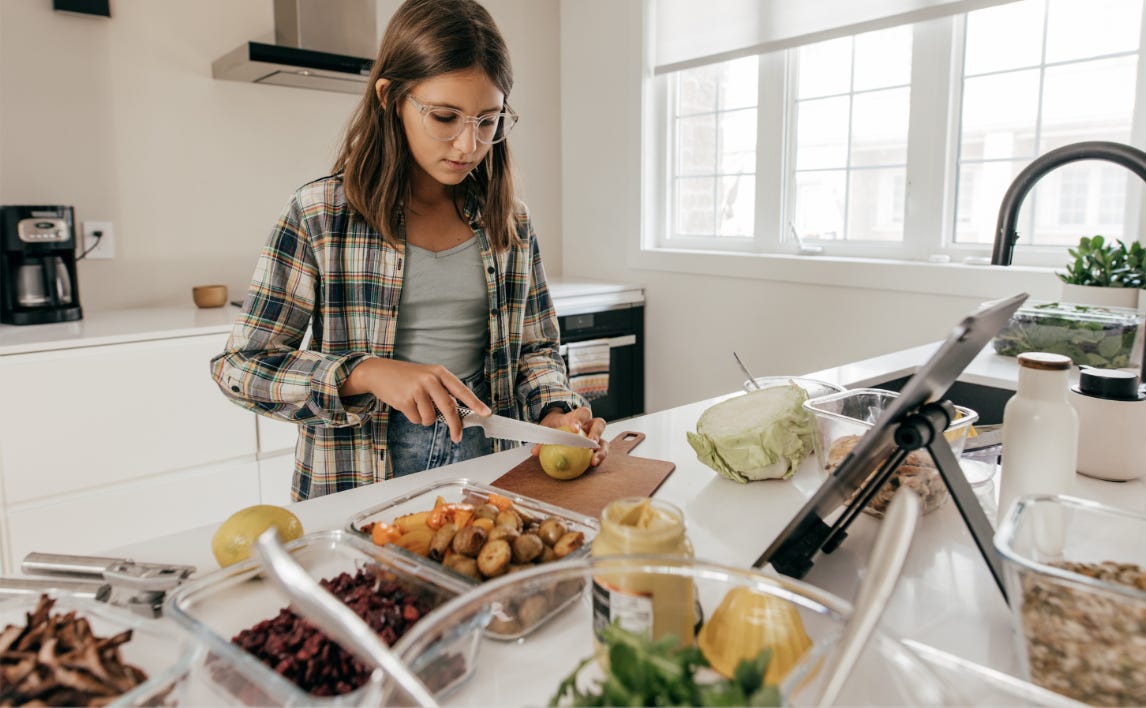 Raising Kids with Life Skills for Successful Independence with Katie Kimball: Ep 218 29.01.2026 47minYou can listen wherever you get your podcasts or check out the fully edited transcript of our interview at the bottom of this post.In this episode of The Peaceful Parenting Podcast, I speak with Katie Kimball of Raising Healthy Families. We discussed getting kids in the kitchen and getting them to love cooking, raising teenagers and why they are wonderful, managing screens at different ages, and what kind of skills kids need to become independent, well-rounded and self-sufficient once they leave our homes.Make sure to check out Katie’s course Teens Cook Real Food! **If you’d like an ad-free version of the podcast, consider becoming a supporter on Substack! > > If you already ARE a supporter, the ad-free version is waiting for you in the Substack app or you can enter the private feed URL in the podcast player of your choice.Know someone who might appreciate this episode? Share it with them!We talk about:* [00:00] Introduction to the episode and guest Katie Kimball; overview of topics (cooking, teens, life skills, screens)* [00:01] Katie’s background: former teacher, mom of four, and how her work evolved into teaching kids and teens to cook* [00:04] Why the teen years are actually great; what teens need developmentally (agency and autonomy)* [00:08] Beneficial risk and safe failure; how building competence early reduces anxiety later* [00:10] Getting kids into cooking: start small, build confidence, and let them cook food they enjoy* [00:16] Cooking as a life skill: budgeting, independence, and preparing for adulthood* [00:21] Screen time: focusing on quality (consumptive vs. creative vs. social) instead of just limits* [00:25] Practical screen strategies used in Katie’s family* [00:28] Motivating teens to cook: future-casting and real-life relevance (first apartment, food costs)* [00:33] Teens Cook Real Food course: what it teaches and why Katie created it* [00:37] Fun foods teens love making (pizza, tacos)* [00:39] Where to find Katie and closing reflectionsResources mentioned in this episode:* Teens Cook Real Food Course https://raisinghealthyfamilies.com/PeacefulParenting* Evelyn & Bobbie bras: https://reimaginepeacefulparenting.com/bra* Yoto Screen Free Audio Book Player https://reimaginepeacefulparenting.com/yoto* The Peaceful Parenting Membership https://reimaginepeacefulparenting.com/membership* How to Stop Fighting About Video Games with Scott Novis: Episode 201 https://reimaginepeacefulparenting.com/how-to-stop-fighting-about-video-games-with-scott-novis-episode-201/Connect with Sarah Rosensweet:* Instagram: https://www.instagram.com/sarahrosensweet/* Facebook Group: https://www.facebook.com/groups/peacefulparentingfreegroup* YouTube: Peaceful Parenting with Sarah Rosensweet @peacefulparentingwithsarah4194* Website: https://reimaginepeacefulparenting.com* Join us on Substack: https://substack.com/@sarahrosensweet* Newsletter: https://reimaginepeacefulparenting.com/newsletter* Book a short consult or coaching session call: https://book-with-sarah-rosensweet.as.me/schedule.phpxx Sarah and CoreyYour peaceful parenting team-click here for a free short consult or a coaching sessionVisit our website for free resources, podcast, coaching, membership and more!>> Please support us!!! Please consider becoming a supporter to help support our free content, including The Peaceful Parenting Podcast, our free parenting support Facebook group, and our weekly parenting emails, “Weekend Reflections” and “Weekend Support” - plus our Flourish With Your Complex Child Summit (coming back in the summer for the 3rd year!) All of this free support for you takes a lot of time and energy from me and my team. If it has been helpful or meaningful for you, your support would help us to continue to provide support for free, for you and for others.In addition to knowing you are supporting our mission to support parents and children, you get the podcast ad free and access to a monthly ‘ask me anything’ session.Our sponsors:YOTO: YOTO is a screen free audio book player that lets your kids listen to audiobooks, music, podcasts and more without screens, and without being connected to the internet. No one listening or watching and they can’t go where you don’t want them to go and they aren’t watching screens. BUT they are being entertained or kept company with audio that you can buy from YOTO or create yourself on one of their blank cards. Check them out HEREEvelyn & Bobbie bras: If underwires make you want to rip your bra off by noon, Evelyn & Bobbie is for you. These bras are wire-free, ultra-soft, and seriously supportive—designed to hold you comfortably all day without pinching, poking, or constant adjusting. Check them out HEREPodcast Transcript:Sarah: Hi everyone. Welcome back to another episode of the Peaceful Parenting Podcast. Today’s guest is Katie Kimball of Raising Healthy Families. She has been helping parents feed their kids and, more recently—in the past few years—teach their kids to cook. We had a great conversation about getting kids in the kitchen and getting them to love cooking, and also about raising teenagers and what kind of skills kids need to become independent. We also talked about screens, because any parent of a teenager who also supports other parents—I want to hear about what they do with getting kids to be less screen-focused and screen-dependent.Katie had some great tips in all of these areas, including cooking, feeding our families, and screens. In some ways, we’re just talking about how do we raise kids who are independent, well-rounded, and have the skills they need to live independently—and those things all come into play.I hope that you really enjoy this conversation with Katie as much as I did. Let’s meet Katie.Hi, Katie. Welcome to the podcast.Katie: Thank you so much, Sarah. I’m honored to talk to your audience.Sarah: I’m so excited to talk to you about teenagers, raising teenagers, life skills, screens—there are so many things to dive into. You seem like a very multifaceted person with all these different interests. Tell us about who you are and what you do.Katie: I do have a little bit of a squirrel brain, so I’m constantly doing something new in business. That means I can talk about a lot of things. I’ve been at the parenting game for 20 years and in the online business world for 17. I’m a teacher by trade and a teacher by heart, but I only taught in the classroom for about two years before I had my kids. I thought, “I can’t do both really, really well,” so I chose the family, left the classroom, and came home.But my brain was always in teacher mode. As I was navigating the path and the journey of, “How do I feed these tiny humans?”—where every bite counts so much—I was really walking that real-food journey and spending a lot of time at the cutting board. My brain was always going, “How can I help other moms make this path easier?” I made so many mistakes. I burned so much food. There’s so much tension around how you balance your budget with your time, with the nutrition, and with all the conflicting information that’s flying at us.So I felt like I wanted to stand in the middle of that chaos and tell moms, “Listen, there’s some stuff you can do that does it all—things that are healthy, save time, and save money.” That’s kind of where I started teaching online.Then I shifted to kids’ cooking. For the last 10 years, I’ve been sort of the kids’ cooking cheerleader of the world, trying to get all kids in the kitchen and building confidence. It’s really been a journey since then. My kids currently are 20, 17, 14, and 11, so I’m in the thick of it.Sarah: We have a very similar origin story: former teacher, then mom, and a brain that doesn’t want to stop working. I went with parent coaching, and you went with helping parents with food and cooking, so that’s exciting.I can tell from what I’ve learned about you offline that you love teenagers—and I love teenagers too. We have people in the audience who have teenagers and also people who have littler kids. I think the people with littler kids are like, “I don’t want my kids to grow up. I’ve heard such bad things about teenagers.” What do you want people to know about teenagers? What are some things that you’ve learned as the mom of younger kids and then teens?Katie: It’s such a devastating myth, Sarah, that teens are going to be the awful part of your parenting career—the time you’re not supposed to look forward to, the time you have to slog through, and it’s going to be so difficult.It’s all difficult, right? Don’t let anyone tell you parenting’s easy—they’re lying. But it’s so worth it, and it’s so great. I love parenting teens. I love conversing with them at such a much higher level than talking to my 11-year-old, and I love watching what they can do. You see those glimpses of what they’ll be like when they’re a dad, or when they’re running around an office, or managing people. It’s incredible to be so close. It’s like the graduation of parenting. It’s exciting.That’s what I would want to tell parents of kids younger than teens: look forward to it.I do think there are some things you can do to prepare for adolescence and to make it smoother for everyone. I like to talk about what teens need. We want to parent from a place of what teens developmentally need, and they really need agency and autonomy at that stage. They’re developmentally wired to be pushing away—to be starting to make the break with their adults, with that generation that we are in. Sometimes that’s really painful as the grown-up. It almost feels like they’re trying to hurt us, but what they’re really doing is trying to push us away so it doesn’t hurt them so badly when they know they need to leave.As parents, it helps to sit with the knowledge that this is not personal. They do not hate me. They’re attempting to figure out how to sever this relationship. So what can we do to allow them to do that so they don’t have to use a knife? If we can allow them to walk far enough away from us and still be a safe haven they can come home to, the relationship doesn’t have to be severed. It just gets more distant and longer apart.When they want independence and autonomy, we need to make sure we give it to them. My tip for parents of younger kids is that, especially around ages 8, 10, 11—depending on maturity level—where can we start providing some agency? My team will say, “Katie, don’t say agency. It sounds like you’re talking about the FBI or some government letters.” But it’s the best word, because agency isn’t just choices—it’s choices plus control, plus competence to be able to make change in your own life, in your own environment.We can’t have agency unless we give our kids skills to actually be able to do something. The choice between “Do you want the red cup or the blue cup?” is for toddlers. That’s not going to be enough once they’re in the stage where their mind is growing and they can critically think. We want to give our kids skills, responsibilities, choices, and some ownership over their lives. That starts in upper elementary school, and it gets bigger and bigger.Sarah: I would argue it starts even earlier. Toddlers can make the red cup or blue cup choice, and as they keep going, you can give them more and more agency.One of my favorite parenting people, Alfie Kohn, says that kids should have the power to make decisions that make us gulp a little bit.Katie: Oh, I love that.Sarah: I think that’s true. We come up against our own anxiety too: What if they make the wrong decision? But it’s incremental, so the decisions become bigger and bigger as they get older. That’s how they practice being able to make good decisions—through experience.Katie: We know statistically that anxiety right now is spiking massively that first year out of high school—where young adults are heading into the world, either to university or for a first job. One theory—one I would get behind—is that everything of adulthood, all the responsibilities, are crashing on their shoulders at once, and they haven’t experienced that level of responsibility. Sometimes they haven’t had opportunities to fail safely, and they don’t know what to do.Sometimes we think we’re pushing problems out of their way and that it’s helpful, but we’re really creating bigger problems down the road. So with that long-term perspective, I love that “gulp.” We’ve got to let them try and fail and hold back.Sarah: Do you know Lenore Skenazy, who started the Free Range Kids movement? She has a TED Talk that came out recently where she talks about how she attributes the rise in anxiety to the fact that kids never have any unwatched time by adults. They never have room and space to figure out their own way to make things work. Of course, I don’t think anyone’s saying we should inappropriately not supervise our kids, but they need more freedom. If they don’t have freedom to figure things out on their own, that’s where the anxiety comes in.Katie: For sure. When Lenore and I have interacted, she likes to call it “beneficial risk.” Climbing the tree is the classic example, but because I love to get kids and teens in the kitchen, we got to talk about the beneficial risk of using sharp knives and playing with fire—literally returning to our ancestral roots.The way I see it, and the way I’ve seen it played out in my own home: I taught my now 20-year-old to use a chef’s knife at age 10. He built competency. He took risks. He discovered how he wanted to navigate in the kitchen. So when he was 15 and getting his driver’s permit, I felt pretty peaceful. I thought, “He’s so mature. I’ve seen him make good decisions. He’s practiced taking beneficial risks.”I felt confident handing him the driver’s license. When it came time for him to get a cell phone—first a kid-safe phone and then a fully unlocked smartphone—I felt like we had been building up to it because of our work in the kitchen. I think he did better than his peers with taking appropriate risks driving a car and having a smartphone in his pocket, because he’d had practice.Sarah: And that was in the kitchen for your family.Katie: Yes.Sarah: Cooking is one of my special interests. I love to cook. My kids love baking. They were never that interested in cooking, although they all can cook and they do cook for themselves. My 21-year-old who has his own apartment has started sending me pictures of the food that he makes. He made some baked chicken thighs with mushrooms the other day, and a green salad. He sent me a picture and I said to my daughter, “Do you want to see a picture of Asa’s chicken?” And she said, “Asa got a chicken?” She was picturing it running around. We all laughed so hard because I wouldn’t put it past him, honestly.When my kids were younger, they weren’t that interested. Maybe I could have gotten them more interested in the cooking part, but I always felt like that was my thing. What tips do you have—for any ages—about how to get kids interested and involved? You said your son was using a chef’s knife at age 10. What are some ways to involve kids and get them interested in that skill?Katie: Knives are a great start because they’re scary and they’re fun—especially for guys. You get to use something dangerous. My second son, John, asked to learn to use a chef’s knife, so he learned to use a sharp paring knife at age four and asked to level up to a chef’s knife at age seven.For parents of kids who are still in that intrinsic motivation phase—“I want to help”—the good news is you don’t have to try. You just have to say yes. You just have to figure out what can my brain handle letting this little person do in the kitchen. If it’s “I’m going to teach them to measure a teaspoon of salt,” then do it. Don’t let cooking feel like this big to-do list item. It’s just one teaspoon of salt.Can I teach them to crack an egg? Can I teach them to flip a pancake? Think of it as one little skill at a time. That’s what cooking is: building blocks. If it’s something like measuring, you don’t have to have them in your elbow room. You can send them to the table; they can have a little spill bowl. Then you can build their motivation by complimenting the meal: “This meal tastes perfect. I think it’s the oregano—who measured the oregano?” That’s how we treat little ones.The medium-sized ones are a little tougher, and teens are tougher yet. For the medium-sized ones, the best way to get them involved is to create a chance for authentic praise that comes from outside the family—meaning it’s not you or your co-parent; it’s some other adult. If you’re going to a party or a potluck, or you’re having people over, figure out how to get that kid involved in one recipe. Then you say to the other adults, “Guess who made the guacamole?” That was our thing—our kids always made the guac when they were little. And other adults say, “What? Paul made the guacamole? That’s amazing. This is awesome.” The 10-year-old sees that and blooms with pride. It makes them more excited to come back in the kitchen, feel more of that, and build more competency.Sarah: I love that. That’s an invitation, and then it makes them want to do more because it feels good. We talk about that in peaceful parenting too: a nice invitation and then it becomes a prosocial behavior you want to do more of.I started cooking because I wanted to make food that I liked. I’m old enough that I took Home Ec in middle school, and it was my favorite class. I think about my Home Ec teacher, Mrs. Flanagan, my whole adult life because I learned more from her that I still use than from any other teacher. I remember figuring out how to make deep-fried egg rolls in grade seven because I loved egg rolls. You couldn’t just buy frozen egg rolls then. So I think food that kids like can be a good way in. Is that something you find too?Katie: One hundred percent. If you’re cooking things they don’t like, you get the pushback: “Mom, I don’t like…” So it’s like, “Okay, I would love to eat your meal. What do you want to eat?” And it’s not, “Tell me what you want and I’ll cook it.” If you meal plan, you get to make all the choices.My kids have been interviewed, and people often ask, “What’s your favorite thing about knowing how to cook?” My kids have gotten pretty good at saying, “We get to cook what we like.” It’s super motivating.Sarah: When I was growing up, my sister and I each had to make dinner one night a week starting when I was in grade five and she was in grade three. We could make anything we wanted, including boxed Kraft Dinner. I can’t remember what else we made at that young age, but it was definitely, “You are cooking dinner, and you get to make whatever you want.”Katie: Why didn’t you do that with your own kids, out of curiosity?Sarah: It just seemed like it would take too much organization. I think we tried it a couple times. Organization is not my strong suit. Often dinner at our house—there were lots of nights where people had cereal or eggs or different things for dinner. I love to cook, but I like to cook when the urge hits me and I have a recipe I want to try. I’m not seven nights a week making a lovely dinner.Also, dinner was often quite late at my house because things always take longer than I think. I’d start at six, thinking it would take an hour, and it would be 8:30 by the time dinner was ready. I remember one night my middle son was pouring himself cereal at 6:30. I said, “Why are you having cereal? Dinner’s almost ready.” He said, “Mom, it’s only 6:30.” He expected it later—that’s the time normal people eat dinner.My kids have a lot of freedom, but nobody was particularly interested in cooking. And, to be honest, it felt a bit too early as a responsibility when my sister and I had to do it. Even though I’m glad now that I had those early experiences, it was wanting to make egg rolls that made me into a cook more than being assigned dinner in grade five.Katie: That push and pull of how we were parented and how we apply it now is so hard.Sarah: Yes.Katie: I’m thinking of an encouraging story from one of the families who’s done our brand-new Teens Cook Real Food. The mom said it was kind of wild: here they were cooking all this real food and it felt intensive. Over the years she’d slid more into buying processed foods, and through the class, watching her teens go through it, she realized, “Oh my gosh, it’s actually not as hard as I remember. I have to coach myself.” They shifted into cooking with more real ingredients, and it wasn’t that hard—especially doing it together.Sarah: It’s not that hard. And you hear in the news that people are eating a lot of fast food and processed food. I’m not anti-fast food or processed food, but you don’t want that to be the only thing you’re eating. It’s actually really easy to cook some chicken and rice and broccoli, but you have to know how. That’s why it’s so sad Home Ec has gone by the wayside. And honestly, a whole chicken, some rice, and broccoli is going to be way cheaper than McDonald’s for a family of four. Cooking like that is cheaper, not very hard, and healthier than eating a lot of fast food or processed food.Katie: Conversations in the kitchen and learning to cook—it’s kind of the gateway life skill, because you end up with conversations about finances and budgeting and communication and thinking of others. So many life skills open up because you’re cooking.You just brought up food budget—that could be a great half-hour conversation with a 16- or 17-year-old: “You won’t have infinite money in a couple years when you move out. You’ll have to think about where you spend that money.” It’s powerful for kids to start thinking about what it will be like in their first apartment and how they’ll spend their time and money.Sarah: My oldest son is a musician, and he’s really rubbing his pennies together. He told me he makes a lot of soups and stews. He’ll make one and live off it for a couple days. He doesn’t follow a recipe—he makes it up. That’s great, because you can have a pretty budget-friendly grocery shop.I also don’t want to diss anyone who’s trying to keep it all together and, for them, stopping by McDonald’s is the only viable option at this moment. No judgment if you’re listening and can’t imagine having the capacity to cook chicken and rice and broccoli. Maybe someday, or maybe one day a week on the weekend, if you have more time and energy.Katie: The way I explain it to teens is that learning to cook and having the skills gives you freedom and choices. If you don’t have the skills at all, you’re shackled by convenience foods or fast food or DoorDash. But if you at least have the skills, you have many more choices. Teens want agency, autonomy, and freedom, so I speak that into their lives. Ideally, the younger you build the skills, the more time you have to practice, gain experience, and get better.There’s no way your older son could have been making up soups out of his head the first month he ever touched chicken—maybe he’s a musician, so maybe he could apply the blues scale to cooking quickly—but most people can’t.Sarah: As we’re speaking, I’m reflecting that my kids probably did get a lot of cooking instruction because we were together all the time. They would watch me and they’d do the standing on a chair and cutting things and stirring things. It just wasn’t super organized.That’s why I’m so glad you have courses that can help people learn how to teach their children or have their kids learn on their own.I promised we would talk about screens. I’m really curious. It sounds like your kids have a lot of life skills and pretty full lives. Something I get asked all the time is: with teens and screens, how do you avoid “my kid is on their phone or video games for six or seven hours a day”? What did you do in your family, and what thoughts might help other people?Katie: Absolutely. Parenting is always hard. It’s an ongoing battle. I think I’m staying on the right side of the numbers, if there are numbers. I feel like I’m launching kids into the world who aren’t addicted to their phones. That’s a score, and it’s tough because I work on screens. I’m telling parents, “Buy products to put your kids on screen,” so it’s like, “Wait.”I don’t look at screens as a dichotomy of good or bad, but as: how do we talk to our kids about the quality of their time on screens?Back in 2020, when the world shut down, my oldest, Paul, was a freshman. His freshman year got cut short. He went weeks with zero contact with friends, and he fell into a ton of YouTube time and some video games. We thought, “This is an unprecedented time, but we can’t let bad habits completely take over.”We sat down with him and said, “Listen, there are different kinds of screen time.” We qualified them as consumptive—everything is coming out of the screen at you—creative—you’re making something—and communicative—you’re socializing with other people.We asked him what ways he uses screens. We made a chart on a piece of paper and had him categorize his screen time. Then we asked what he thought he wanted his percentage of screen time to be in those areas—without evaluating his actual time yet. He assigned those times, and then we had him pay attention to what reality was. Reality was 90 to 95% consumptive. It was an amazing lightbulb moment. He realized that to be an agent of his own screen time, he had to make intentional choices.He started playing video games with a buddy through the headphones. That change completely changed his demeanor. That was a tough time.So that’s the basis of our conversation: what kind of screen time are you having?For my 11-year-old, he still has minute limits: he sets a timer and stops himself. But if he’s playing a game with someone, he gets double the time. That’s a quantitative way to show him it’s more valuable to be with someone than by yourself on a screen. A pretty simple rule.We’ll also say things like, “People over screens.” If a buddy comes over and you’re playing a video game, your friend is at the door.That’s also what I talk to parents about with our classes: this isn’t fully consumptive screen time. We highly edit things. We try to keep it engaging and fun so they’re on for a set number of minutes and then off, getting their fingers dirty and getting into the real world. We keep their brains and hands engaged beyond the screen. The only way I can get a chef into your home is through the screen—or you pay a thousand dollars.We can see our screen time as really high quality if we make the right choices. It’s got to be roundabout 10, 11, 12: pulling kids into the conversation about how we think about this time.Sarah: I love that. It sounds like you were giving your kids tools to look at their own screen time and how they felt about it, rather than you coming from on high and saying, “That’s enough. Get off.”Katie: Trying.Sarah: I approach it similarly, though not as organized. I did have limits for my daughter. My sons were older when screens became ubiquitous. For my daughter, we had a two-hour limit on her phone that didn’t include texting or anything social—just Instagram, YouTube, that kind of stuff. I think she appreciated it because she recognized it’s hard to turn it off.We would also talk about, “What else are you doing today?” Have you gone outside? Have you moved your body? Have you done any reading? All the other things. And how much screen time do you think is reasonable? Variety is a favorite word around here.Katie: Yes. So much so my 11-year-old will come to me and say, “I’ve played outside, I’ve read a book, my homework is done. Can I have some screen time?” He already knows what I’m going to ask. “Yes, Mom, I’ve had variety.” Then: “Okay, set a timer for 30 minutes.”I have a 14-year-old freshman right now. He does not own a phone.Sarah: Oh, wow. I love that.Katie: In modern America, he knows the pathway to get a phone—and he doesn’t want one.Sarah: That’s great. I hope we see that more and more. I worry about how much kids are on screens and how much less they’re talking to each other and doing things.I had a guest on my podcast who’s a retired video game developer. His thing is how to not fight with your kid about video games. One thing he recommends is—even more than playing online with someone else—get them in the same room together. Then they can play more. He has different time rules if you’re playing in person with kids in your living room than if you’re playing alone or playing online with someone else.Katie: Nice. Totally. My story was from COVID times.Sarah: Yes, that wasn’t an option then. Someone I heard say the other day: “Can we just live in some unprecedented times, please?”Katie: Yes, please.Sarah: You mentioned the intrinsic motivation of somebody admiring their guacamole. What are your tips for kids—especially teens—who think they’re too busy or just super uninterested in cooking?Katie: Teens are a tough species. Motivation is a dance. I really encourage parents to participate in future casting. Once they’re about 15, they’re old enough. Academically, they’re being future-casted all the time: “What are you going to be when you grow up?” They’re choosing courses based on university paths. But we need to future-cast about real life too.Ask your 15-year-old: “Have you ever thought about what it’ll be like to be in your first apartment?” Maybe they haven’t. That helps reduce that first-year-out-of-home anxiety—to have imagined it. Then they might realize they have gaps. “Would you be interested in making sure you can cook some basic stuff for those first years? When you’re cooking at home, it’s my money you waste if you screw up.” That can be motivating. “I’m here to help.”Sometimes it comes down to a dictate from above, which is not my favorite. Your sister and you were asked to cook at third and fifth grade. I agree that might be a little young for being assigned a full meal. We start around 12 in our house. But by high school, there’s really no reason—other than busy schedules. If they’re in a sport or extracurricular daily, that can be rough. So what could they do? Could they make a Sunday brunch? We come home from church every Sunday and my daughter—she’s 17, grade 12—she’s faster than I am now. She’ll have the eggs and sausage pretty much done. I’m like, “I’m going to go change out of my church clothes. Thanks.”If we’re creative, there’s always some time and space. We have to eat three times a day. Sometimes it might be: “You’re old enough. It’s important as a member of this household to contribute. I’m willing to work with you on really busy weeks, but from now on, you need to cook on Saturday nights.” I don’t think that has to be a massive power struggle—especially with the future casting conversation. If you can get them to have a tiny bit of motivation—tiny bit of thinking of, “Why do I need this?”—and the idea of “If I cook, I get to make what I want,” and the budget.Sarah: The budget too: if you’re living in your own apartment, how much do you think rent is? How much do you think you can eat for? It’s way more expensive to order out or get fast food than to cook your own food.Katie: I feel so proud as a fellow mom of your son, Asa, for making soups and stuff. In Teens Cook Real Food, we teach how to make homemade bone broth by taking the carcass of a chicken. It’s a very traditional skill. On camera, I asked the girls who did it with me to help me figure out what their dollar-per-hour pay rate was for making that, compared to an equal quality you buy in the store. Bone broth at the quality we can make is very expensive—like $5 a cup.They did the math and their hourly pay was over $70 an hour to make that bone broth. Then they have gallons of bone broth, and I call it the snowball effect: you have all this broth and you’re like, “I guess I’ll make soup.” Soup tends to be huge batches, you can freeze it, and it snowballs into many homemade, inexpensive, nourishing meals.Sarah: I love that. You’ve mentioned your course a couple times—Teens Cook Real Food. I’m picturing that as your kids grew up, your teaching audience grew up too. Were there other reasons you wanted to teach teens how to cook?Katie: Yes. We’ve had our kids’ cooking class for 10 years now. It just had its 10th birthday. The most often requested topic that’s not included in the kids’ class is meal planning and grocery shopping. It wasn’t something I felt like an eight-year-old needed.For 10 years I had that seed of, “How can I incorporate those important skills of meal planning and grocery shopping?” Then my teens got older, and I thought, “I’ve told parents of teens that our kids’ cooking class will work for them, but it’s not enough. It wasn’t sufficient.”It was so exciting to put this course together. Even just the thinking—the number of index cards I had on the floor with topics trying to figure out what a young adult needs in their first apartment, how to connect the skills, and how to make it engaging.We ended up with eight teens I hired from my local community—some with cooking experience, some with literally none. We had on-camera accidents and everything. But they learned to cook in my kitchen, and it’s all recorded for your teens to learn from.Sarah: I love that. What are some of the recipes that you teach in the course?Katie: We have over 35. We spent a whole day with a chef. He started talking about flavor and how seasonings work, and he taught us the mother sauces—like a basic white sauce, both gluten-free and dairy-free, a couple ways to do that, and a basic red sauce, and a couple ways to do that.My favorite cheeky segment title is “How to Boil Water.” We have a bunch of videos on how to boil water—meaning you can make pasta, rice, oatmeal, hard-boiled eggs, boiled potatoes. There’s a lot of stuff that goes in water.Then we built on that with “How to Eat Your Vegetables.” We teach sautéing, steaming, and roasting. The first big recipe they learn is a basic sheet pan dinner. We use pre-cooked sausage and vegetables of your choice, seasonings of your choice. It’s one of those meals where you’re like, “I don’t need a recipe. I can just make this up and put it in the oven.”Then, to go with pasta and red sauce, we teach homemade meatballs. We get them at the grill for steak and chicken and burgers. Of course we do French fries in a couple different ways.Choice is a huge element of this course. If we teach something, we probably teach it in two or three or four different ways, so teens can adapt to preferences, food sensitivities, and anything like that.We use the Instant Pot a lot in our “How to Eat Your Protein” segment. We do a pork roast and a beef roast and a whole chicken, and that broth I talked about, and we make a couple different soups with that.Sarah: You almost make me feel like I haven’t had lunch yet.Katie: I’m starving, actually.Sarah: I’m quite an adventurous eater and cook, but I’m going to ask you about my two favorite foods—because they’re like a child’s favorite foods, but my favorite foods are pizza and tacos. Do you do anything with pizza and tacos in your course?Katie: We do both pizza and tacos.Sarah: Good!Katie: Our chef taught us, with that homemade red sauce, to make homemade dough. He said, “I think we should teach them how to make a homemade brick oven and throw the pizzas into the oven.” Throwing means sliding the pizza off a pizza peel onto bricks in your oven. I was like, “We’re going to make such a mess,” but they did it. It’s awesome.Then we tested it at home: can you just make this in a normal pizza pan? Yes, you can—don’t worry. You don’t have to buy bricks, but you can. Again, there are different ways.Sarah: I think teenagers would love making pizza on bricks in the oven. For us we’re like, “That seems like so much work.” But teenagers are enthusiastic and creative and they have so much energy. They’re wonderful human beings. I can see how the brick oven pizza would be a great challenge for them.Katie: It’s so fun. My kids, Paul and John—20 and 14—they’ve both done it at home. As adults we’re like, “It’s such a mess,” but we’re boring people. Teenagers are not boring. So yes—definitely pizza.Sarah: That’s awesome. We’ll link to your course in the show notes. Before we let you go, where’s the best place for people to go and find out more about you and what you do?Katie: Definitely: raisinghealthyfamilies.com/peacefulparenting. We’re going to make sure there’s always something about teens at that link—whether it’s a free preview of the course or a parenting workshop from me. There will always be something exciting for parents there.Sarah: Amazing. It’s been such a pleasure. I thought maybe I didn’t do all this stuff, but considering how both of my sons who are independent cook for themselves all the time, I think I must have done okay—even if it was just by osmosis.Katie: That’s the great thing about keeping your kids near you. That was your peaceful parenting: they were in the kitchen and they were there, as opposed to you booting them out of the kitchen. There are lots of ways.Sarah: My daughter is an incredible baker. She makes the best chocolate chip cookies. I have this recipe for muffin-tin donuts that are amazing, and she’s a really great baker. She can find her way around a quesadilla, eggs, and ramen for herself. I think once she moves out, if she doesn’t have mom’s cooking anymore, she’ll probably also be able to cook.Katie: Yes. And so many parents need that bridge. They’re like, “My kids love to make cookies. They bake, but they won’t shift to cooking.” I would hope that future-casting conversation could be a good bridge.Sarah: Yeah. You can’t live on cookies—or you might think you can for a little while, but then you’d start to feel gross.Katie: Exactly.Sarah: Thanks a lot, Katie.Katie: Thank you so much, Sarah. This is a public episode. If you'd like to discuss this with other subscribers or get access to bonus episodes, visit sarahrosensweet.substack.com/subscribe
 -
 You’re On Fire, It’s Fine: Teens and Big Feelings: Episode 217 23.01.2026 41minYou can listen wherever you get your podcasts or check out the fully edited transcript of our interview at the bottom of this post.In this episode of The Peaceful Parenting Podcast, I speak with Katie K. May, a licensed therapist and author of the book You’re On Fire. It’s Fine: Effective Strategies for Parenting Teens With Self-Destructive Behaviors. We discussed children/teens who are “fire feelers”, why intense emotions can lead to risky behaviours, how to respond to self-harm urges, how to stay connected or rebuild your connection with your teen, and what parents of younger children can do now to prevent challenges in their teen years.**If you’d like an ad-free version of the podcast, consider becoming a supporter on Substack! > > If you already ARE a supporter, the ad-free version is waiting for you in the Substack app or you can enter the private feed URL in the podcast player of your choice.Know someone who might appreciate this episode? Share it with them!We talk about:* 00:05 — What Is a Fire Feeler?* 00:06 — What Emotional Dysregulation Really Means* 00:07 — Fire Feelers Often Have Fire-Feeler Parents- Genetic and Environmental Components* 00:10 — Why Teens Are So Easily Overwhelmed* 00:12 — What Fire Feelers Do When Overwhelmed* 00:20 — How Parents Should Respond to Self-Harm Urges* 00:22 — When to Get Professional Help* 00:24 — Why Depression Looks Different in Teens* 00:25 — Teens Still Need Their Parents* 00:26 — How to Stay Connected to Teens* 00:28 — Judgment vs Validation* 00:31 — How to Rebuild Connection When Things Are Broken- Katie’s Hierarchy of Connection* 00:34 — Sensitivity & Impulsivity* 00:35 — What Parents of Younger Kids Can Do Now* 00:37 — Why Control Works When Kids Are Young — and Fails Later* 00:38 — Why “Tough Love” Doesn’t WorkResources mentioned in this episode:* Evelyn & Bobbie bras* Yoto Player-Screen Free Audio Book Player* The Peaceful Parenting Membership* Get a free chapter of Katie’s book * Katie’s website Connect with Sarah Rosensweet:* Instagram* Facebook Group* YouTube* Website* Join us on Substack* Newsletter* Book a short consult or coaching session callxx Sarah and CoreyYour peaceful parenting team- click here for a free short consult or a coaching sessionVisit our website for free resources, podcast, coaching, membership and more!>> Please support us!!! Please consider becoming a supporter to help support our free content, including The Peaceful Parenting Podcast, our free parenting support Facebook group, and our weekly parenting emails, “Weekend Reflections” and “Weekend Support” - plus our Flourish With Your Complex Child Summit (coming back in the summer for the 3rd year!) All of this free support for you takes a lot of time and energy from me and my team. If it has been helpful or meaningful for you, your support would help us to continue to provide support for free, for you and for others.In addition to knowing you are supporting our mission to support parents and children, you get the podcast ad free and access to a monthly ‘ask me anything’ session.Our sponsors:YOTO: YOTO is a screen free audio book player that lets your kids listen to audiobooks, music, podcasts and more without screens, and without being connected to the internet. No one listening or watching and they can’t go where you don’t want them to go and they aren’t watching screens. BUT they are being entertained or kept company with audio that you can buy from YOTO or create yourself on one of their blank cards. Check them out HEREEvelyn & Bobbie bras: If underwires make you want to rip your bra off by noon, Evelyn & Bobbie is for you. These bras are wire-free, ultra-soft, and seriously supportive—designed to hold you comfortably all day without pinching, poking, or constant adjusting. Check them out HEREPodcast Transcript:Sarah: Hey everyone. Welcome back to another episode of the Peaceful Parenting Podcast. Today’s guest is Katie May. She’s a therapist and the author of You’re On Fire. It’s Fine: Effective Strategies for Parenting Teens With Self-Destructive Behaviors. We talked about why some teens are what she calls “fire feelers,” and about how best to support them—and ourselves—when emotional dysregulation is common, troubling, and can be destructive.If you don’t have a teen yet, but you have a kiddo with big feelings, have a listen, because Katie also talks about what she wishes parents of younger kids knew so they didn’t end up with these sorts of challenges down the road. Let’s meet Katie.Sarah: Hi, Katie. Welcome to the podcast.Katie: Hey, Sarah. I’m glad to be here. Excited to talk about teens and parenting today—stuff I’m jazzed to share.Sarah: Me too. Yeah. And I loved your book. I’ll ask you about that in a second—or maybe you can tell us who you are and what you do.Katie: Yeah. My name is Katie K. May. I’m a licensed therapist in Pennsylvania, and I lead a team of other therapists. We all specialize in working with high-risk teens and their parents. So every day, we’re in the trenches working with teenagers who are suicidal, self-harming, have eating disorders, are not going to school, and we’re helping them learn skills while also teaching their parents how to respond effectively—so the whole family is working together as a system in harmony.Sarah: And your book’s called You’re On Fire. It’s Fine. I like it. My book—Katie: Go ahead.Sarah: No, it’s a great title.Katie: Yeah. So I came to that title from this idea of biologically sensitive teens—or very sensitive teens—often feeling like they’re on fire with their own emotions. And I can dig into any part of that. But the idea is that parents who are well-meaning will many times say things like, “You’re fine. It’s okay. Go take a nap. Go get a snack.” And it feels like a little squirt gun trying to put out this big fire of emotion. So I thought that title captured those two points initially, to bring people into the framework that I teach.Sarah: I love that. And it’s funny—I had a different interpretation of the title, and my interpretation, now that you said what you meant it to be, I can totally see that. But my interpretation was more like, “You’re on fire. You can handle these big feelings. It’s fine.” Like, this is just—let’s get used to feeling the feelings. So I guess it could be read either way.Katie: I like both interpretations, and I think your interpretation speaks to probably how you support and parent. It’s nurturing and supportive of the process.Sarah: Yeah. So tell us: what is a fire feeler?Katie: A fire feeler is someone who is biologically sensitive. And what I mean by that is this is a kid who feels things very deeply. Their emotions are big and oftentimes overwhelming for them. And not just that—these are your zero-to-sixty-in-ten-seconds-flat kind of kids. They’re reactive, they’re easy to trigger, and when they’re triggered and they’re feeling their emotions in these very big ways, it also takes them a very long time to calm down or get back to their baseline.And this is important because if you think about that slow return to feeling settled or centered again, oftentimes they’re being triggered again before they get back to that place of calm. And so they have a nervous system that’s constantly in a state of dysregulation—constantly triggered and upset. And it is very hard to access safety or calm or feeling okay because of that.Sarah: And you mentioned emotional dysregulation, and in your book you have a very specific definition of emotional dysregulation. I thought it was a little more helpful and also a little bit more unusual. Can you give us your definition of emotional dysregulation?Katie: So when someone is emotionally dysregulated, when they are triggered, it sets off this chain of emotions for them. Again, we go back to this idea that they feel on fire with their emotions. They’re often at this skills-breakdown point where it’s difficult to access skills or to calm down. And when you’re feeling on fire with your emotions, it makes sense that your brain comes up with escape strategies—things like self-harm, suicidal ideation, substance use—because it’s so big and hard to hold that the brain would do anything to make those emotions go away.Sarah: I love that. And you also mentioned that people are biologically predisposed to be fire feelers, so I’m guessing that usually a teen’s one or both parents are also fire feelers, which would add a complication to the mix.Katie: I would say so. I often find myself telling parents: some kids are born naturally good at sports. Some kids are born naturally good at music or art. And some kids are born naturally good at emotions—which means they’re very attuned to emotional states or nuances in the emotions of others.And when we think about that as a genetic trait or a biological trait, it also makes sense that at least one of their parents carries this trait and is passing it down. And I think when I start to describe fire feelers—who they are and what it looks like—I regularly have at least one parent saying, “Oh, that’s me,” or “That’s you, honey.” They recognize it.Sarah: Totally. Yeah. So I guess that makes home more complicated too when you’ve got a fire feeler and a fire feeler trying to find their way together.Katie: It’s almost like if you yawn and it’s contagious—and the other person catches it. So if you have two people that are both biologically sensitive and they’re in the same room, one of them is triggered, one of them has a high state of emotional activation, it’s hard in general for another person in the room not to respond to that.So there’s something that I teach. It’s called the transactional model. So let’s say a teenager is boiling over with frustration, and they’re exhibiting it. They’re bawling their fists. They’re snapping back at their parent. The parent then absorbs that emotion and they’re snapping back: “Don’t talk to me like that,” or, “It’s not okay for you to say that,” or “Don’t walk away from me.” Which then influences how the teen responds. And then the teen will continue to push or yell back, which then influences how the parent responds.So we’re always looking at: How is it that I am influencing how you respond? How is it that you are influencing how I respond? And if everybody feels their emotions in these very big ways, it’s going to make that escalation that much bigger or faster because everyone’s overwhelmed in their emotions.Sarah: So hard. I’m sure a lot of people listening can relate even when their kids aren’t teenagers yet—because that happens with little kids too.Katie: Absolutely. It applies to all ages. I just happen to work with teenagers and parents.Sarah: Speaking of teens, you mentioned in your book that teenagers are more prone to overwhelm. Can you briefly explain why that is? Because I talk about that too. I always say, “The drama is real.”Katie: The drama is real. Thank you for saying that. So the way I look at it: teens are in this developmental state when so much is happening for them. They have unfully formed frontal lobes, which helps to regulate their emotions. They’re also dealing with hormonal changes, developmental changes, social stressors, peer stressors. They’re in school six hours a day, five days a week. There’s so much stress that’s placed on our teens.And so if we think about a stress cup holding stress, it’s oftentimes just this one little extra drop that makes them lose control or makes them feel overwhelmed in their emotions. And I would say that’s probably true for everyone—that we’re all holding a lot, and it only takes a little to push us over the edge—but I think it’s the brain development that makes it even more challenging.And then I’ll add to that the lack of control or agency over their own lives. They don’t have a lot of choice about what they do each day or what they have to do or who’s telling them what to do. So there’s a lot that’s outside of their control, and that makes it even harder to control or manage their emotions.Sarah: I’m so glad you work with teenagers. You have such an empathetic view of what it’s like to be a teenager, and I think a lot of people—just a little sidebar—teens get such a bad rap in our culture and they’re so wonderful. I love teenagers. And also, I would never in a million years choose to go back to those years.Katie: I wouldn’t either, but I do feel like I have a strong connection with the teen population. It’s interesting—we run parent groups at my center, and that’s a question that we’ll ask: Do you remember being a teenager?And I think it’s hard for a lot of adults to empathize with the teen experience. But being able to do so—being able to put yourself in a teenager’s shoes—is going to help you support them so much more. Which is one of the things that I talk about in my book and in my work often: acceptance or validation before change. We always want to be understanding of the experience before we’re trying to problem-solve or change that experience.Sarah: I want to ask you about validation a little bit later in our conversation, but before we get to that: what are some common reactions of fire feelers to overwhelm?Katie: Yeah. Some of those common reactions tend to be self-destructive because, again, if we think about this idea that fire feelers are overwhelmed with their emotions—the big, fiery, painful experience for them—it’s not a conscious decision, but they would do anything to make that fire go out.So this could be self-harm. This could be thinking about suicide. This could also be lashing out at parents. It could be numbing out in front of the TV or scrolling on social media for hours because it hurts too much to feel and I need to numb myself from that. It could be cutting themselves off from friends because the experience of relationships is so painful.So a fire feeler will have a strong attunement to nuance and facial expressions and tones of voice. And so what might feel okay for one person, for a fire feeler might be interpreted as rejection or might be interpreted as “I did something wrong,” or “There’s something wrong with me.” And so the natural response of a fire feeler is to do whatever it takes to protect themselves from being on fire.Sarah: I don’t even know if I totally understand it—but how do, and I know a lot of people don’t, how does self-harm bring relief to those feelings of overwhelm?Katie: So there’s a biological response to it: when you self-harm—when one engages in a self-harm or self-destructive behavior—there is short-term relief. So if you think about emotions rising, rising, rising, what happens is it either blocks the escalation of those emotions, or it makes the emotional state come down quickly. It’s body physiology.In addition to that, there are two parts to it. The first part is that it’s called negative reinforcement, and that doesn’t mean that something negative happens; it means it’s the removal of something that’s difficult. So that’s what I just described. You self-harm, you start thinking about suicide—it becomes an escape. It helps you to feel a sense of relief.The second part of that is positive reinforcement, and that’s the social piece. A parent finds out that I self-harmed, and all of a sudden I am given warmth. You’re sitting on my bed. We’re having a heart-to-heart. You’re emailing the teacher to say that I don’t have to go to school tomorrow.So there’s this one-two stack of: I feel better in the moment because it brings my body physiology back into a state of balance or regulation. And then on top of that, I’m getting my social needs met. And therefore it makes it really hard to break that cycle because there are all of these—this chain reaction of things that happen—that make me go from feeling awful to okay, and sometimes even more supported than before.Sarah: That was such an interesting thing to read about in your book because I thought, “Oh man.” If I were a parent and had a teen that was self-harming, it would be so hard not to do that second part—the positive, what you call the positive reinforcement. So how do you support a teen without making it, “I self-harm and then I get a lot of really lovely warmth and attention”?Katie: Yeah. So it’s not about removing the warmth and attention. It’s about changing where you put that warmth and attention. Instead of it being directly after self-harm, maybe it’s in structured and measured doses throughout the day.So maybe we’re having a heart-to-heart in the morning. Maybe we’re going out and spending time together or watching TV together just because—and not because I self-harmed.The other thing that I like to make sure that parents are familiar with and practiced with is how they respond when a teen shares an urge to self-harm or an urge for suicide. Because the way that it typically plays out—at least the first time a parent finds out about urges or that a behavior has happened—they’re crushed. Of course. Their face falls. They’re hurt. It hurts them to see that their child is hurting. They might cry. They might feel really anxious or helpless.But a teen that’s witnessing that is interpreting that as, “My parent can’t handle this information, and therefore I can’t go to them with this information again.”And so the practice for parents is minding your tone—being calm—minding your face, being more like, “Thank you for trusting me,” than, “I’m going to fall apart right now,” and minding your pace—staying calm and regulated and not rushing forward or feeling frantic.And when we do this, what we communicate to our teens is: “I can handle this information. Therefore, in the future, you can come to me when you’re having an urge and we can handle it together, rather than you taking care of it by acting on it—and then me finding out afterwards.”So that’s how we change the cycle: structured and measured warmth, consistent support, ongoing—not just after an event—and also being able to handle the information, even if you’re falling apart inside, because that is completely valid. But showing to your teen: “You’re not going to freak me out. I’m not going to fall apart if you tell me the hard stuff. I’m here for you. Come to me and we’ll handle it together.”Sarah: And find your own support elsewhere.Katie: One hundred percent. Yeah. Parents—I think any parent is going to need support, whether that’s their village, their people, their partner, their friend, a therapist. Parenting alone is tough stuff, and I wouldn’t recommend it.Sarah: And I should have asked you this earlier in the interview, but when—are there any signs? A parent finds out your kid is self-harming or telling you they have the urges—is it straightaway “get help,” or are there early stages you can handle it yourself as a parent? When is this 911 getting help, and when is it, “Okay, we’re going to figure this out”?Katie: It’s somewhere in the middle of “911” and “we’re going to figure this out.” The stance would be: if your teen has already self-harmed, they need to be in therapy. It’s beyond the point of handling it on your own.When you’re noticing—it’s such a tough line because on one hand there are these typical teen behaviors: “I’m going to spend more time in my room.” Teens are moodier. They’re more irritable. They want less to do with parents. They’re more private. They don’t want to talk to parents. And so I don’t want there to be an overreaction to typical teen behavior.But if we’re starting to see a duration, intensity, and frequency of that behavior that’s beyond typical—which, again, is going to look different depending on the child—my measure is usually: if my teen for two weeks is more tearful, more self-critical, more hopeless, not enjoying or engaging in activities that they used to—these are signs of depression. And that would be the point when I would want to engage more professional help to support in the process, because that’s where we’re going to start being proactive and head off escalation of crisis.What happens is—and especially for teenagers—the symptoms of depression can lead to self-harm because there’s an overwhelm of that emotion. There’s a sense of hopelessness. Suicidal thoughts are one of the descriptors of the diagnosis of depression. We don’t want it to get to that point. We want to put help in place sooner.Sarah: That makes sense. I read something the other day that in teenagers depression can look different than adults and sometimes it looks like irritability.Katie: It really depends on the person. So I always go back to—we’ve all heard “nature and nurture,” but I think of it as biology and environment. Same idea, different words. But for some people, their environment can feel really safe to be vulnerable. It can feel really natural to express emotions, to cry, to be in that more vulnerable state. And for others, it doesn’t.Or for others, they’ve learned that being vulnerable isn’t safe for them. It isn’t manly enough for them. It really depends on the culture and environment. And so it can come across as irritability. It can come across as anger—different dispositions as to whether someone internalizes their emotions or externalizes them or sends them outward to others.Sarah: That makes sense. I think it’s good for parents to have an eye on things that maybe look different than they expect, just to keep track.Katie: Yeah. And parents and teens don’t always express emotions the same way. I’m a very expressive and emotional person. I’m a therapist. I’ve also spent my whole life figuring out how to express my emotions. And I would say that my child is probably the opposite of that and doesn’t like being vulnerable in front of other people. So what you think makes sense may not make sense to the brain of another person.Sarah: You were talking before about warm connection with parents, and you mentioned that it is normal for teens to want to spend more time by themselves or with peers. But one thing I wonder—and I wonder if you come across this too—parents often think that means, “My kid doesn’t want to spend time with me anymore,” or, “My kid doesn’t need me.” And my experience with my kids as teenagers was that wasn’t true at all—that even as they were moving away and differentiating, they still did like to spend time with their parents, and they still did like to do stuff with us and be close to us. What are some ways that you find are helpful ways for parents to connect? And how do you assure them that, “Yeah, you still are important”?Katie: Yeah. As a child is growing and gaining more independence, it is such a natural experience for parents to feel grief and loss in that process because the relationship is changing. Teens do need parents less. Teens are more independent. They don’t want as much time spent with parents.And so it’s important, one, to recognize that as a developmental milestone, and two, to recognize that means the way that you interact and respond to your teen changes as well. And so you’re not expecting the same attention or response from them as you did before.But this is a grief process because you’re grieving the relationship as it used to be. You’re grieving your teen as they used to be. But you’re also—and this is the part we don’t think about—grieving yourself as you used to be because you have to become a new version of yourself to show up for your teen in a new way.And so all of that is to say that it requires a lot of flexibility, openness to evolving, willingness to change how you see, interact, and speak with your teen. And so in thinking about that, it’s helpful to think about: What is it that my teen needs from me now?They might not need me to cut up their food or call their teacher for them or set up their playdate for them. They might need me to drive them somewhere and listen to the music that they like and not be the one leading the conversation. They might need me to sit on the couch with them while they watch The Office and notice the parts they laugh at and just be there with them.And both of those examples really nicely illustrate that your teens need less from you, but they don’t not need you. They need you to be more of a partner and less of a doing-for.Sarah: When my husband and I both had pretty stable teenage years, we also had parents who were working a lot and not home when we were home. And I’m not saying this to make anyone feel guilty who isn’t home after school, but we really tried to structure our lives so that somebody would be home after school even when the kids were teenagers. Because our joke was: even if it’s just somebody who’s there that they can ignore.Katie: It’s so true. But they know that you’re there.Sarah: Yeah. Yeah. So you talked a little bit about validation before. Can you talk a little bit about validation and its opposite—judgment—maybe starting with judgment: what to avoid when our teens are having big feelings? I mentioned before that I often say the drama is real. I think that’s where some of the judgment comes in with parents sometimes. Like, “Oh, come on, you can’t be that upset that the jeans you were hoping to wear are still wet in the washing machine.” Where do parents make mistakes in terms of that judgment?Katie: For me, I see judgments as the fuel to the emotional fire. So when we are seeing our teen act in certain ways, judgments are our interpretation of their experience. One of those examples might be: a teen is having a hard time getting up and going to school because they’re really depressed, and they’ve been white-knuckling every single day, and today is just the day that they can’t. They can’t do it.And so judgments from a parent might look like, “Why can’t you just go? Everyone else is going. Just get up. Here’s the list of coping skills that your therapist gave us. Use your coping skills.”So it’s this judgment that they can, and they’re choosing not to.Other judgments that I hear regularly are: “They’re manipulative. They’re doing this on purpose to upset me. They’re attention-seeking.”Oftentimes our judgments are because if we weren’t judging and casting blame, we would be having to hold a really frustrating or painful reality. So if I’m not judging my teen and saying, “Why can’t you just get up and go to school? Just use your coping skills. It’s not this bad,” then what I’d be having to hold is: my teen is really struggling right now. My teen—the person that I love the most in the world—is thinking about wanting to die right now. And that’s awful for me.And so judgments are a way of pulling ourselves out of this emotional pain, but also shifting that blame to the other person. And instead of being able to hold their experience.And if we’re not judging, we’re able to first just notice and name and sit with the experience, which is kind of what I described: “My teen is in a lot of pain right now. They’re struggling to get out of bed and even function in their day, and that’s really hard.” And when I can name that, I can feel that for myself, and it feels really hard and painful and difficult.And then the outward version of that is validating them: being able to say, “I see how hard you’re struggling right now. I see the pain on your face. I hear the lack of energy. This is really hard for you right now.”So we can name the experience for ourselves with our notice-and-name, and then we can validate the experience for our teen by noticing and naming their experience.And when we do this, it does often make the emotion feel more painful because we’re naming it. I think a common experience of that is: if you’ve ever been struggling and then someone in your life, in passing, says, “What’s wrong? You look like you’re going to cry right now,” and then all of a sudden the tears come because someone has named the experience. The experience was there all along, but having someone see it—having someone tell you, “This is real, this makes sense,” or “I notice what you’re going through”—it makes it come to the surface.It’s actually a helpful experience, because if we don’t name what’s happening, we’re judging it, we’re stifling it, we’re ignoring it. And that’s like holding a beach ball under water. Eventually it’s going to pop out, but we can’t control what happens when it does. Someone’s going to get hit in the face.So we want to take ownership, we want to validate, we want to notice and name what we’re experiencing, and these are the ways that we move toward acceptance of what is, so we have an ability to move toward problem-solving.Sarah: Where would somebody start who’s listening to this and hearing all of the examples that you’re giving of communication—if they’re not even at a point where their teen is communicating with them? Like, things have gotten so fraught and feel so broken. Where would somebody start with that?Katie: It’s what I call my hierarchy of connection. Oftentimes there is this big rift in the relationship because it’s not just one time that something has happened—it’s years or multiple experiences that have gotten them to this point, of this rift in the relationship.So the hierarchy of connection is our blueprint and our path back to connection. It starts with parent and teen being in the same room together—not interacting, but also not criticizing, not having this tension or conflict happening.The example I give often is: I’m in the kitchen putting groceries away. Teen is sitting on the couch scrolling social media or watching YouTube. But I’m not saying, “Hey, did you do your homework? Did you take your medicine? Did you do this?” I’m just existing and they’re just existing. And we need to practice being in the same space together without that criticism or nagging happening.When that can happen, we can move into shared activities. This would be watching a movie together, watching TV together, driving somewhere, listening to music. Again: no tension, no conflict, no criticizing. Doing the same thing together without any of those things happening.And this could take a very long time. It’s not one, two, three. It could be six months of doing the same thing at the same time before you’re moving on.The final step is moving back to interactive activities. This could be something like playing a board game and talking to each other, having an actual conversation at the dinner table, or a deeper conversation about something that’s a bigger experience. It could be the ability to do this within the context of therapy, so you’re able to have some of those scarier conversations.But there needs to be a level of trust, and an ability not to act on urges to criticize or lead the conversation to nag or check off the to-dos. You have to be able to hold the space—to be in the space with your teen—before that can happen.Sarah: One thing that you mentioned in the book is that there’s a link between sensitivity and impulsivity. Can you talk about that? I found that really interesting. Why is that?Katie: When someone is more biologically sensitive—again, there’s this urge to make those emotions go away. And so when you are more overwhelmed with emotions, the idea of impulsivity makes more sense, because the desire and need for short-term relief is higher than it may be in others.And so when my emotions are really big, I also have really big urges to make those emotions go away, and it’s harder for me to hold these big emotions.Sarah: That was really helpful. If you could have the parents and teens that you work with currently—if you could have had them ten years ago, because a lot of people who listen to the podcast have younger kids and they don’t have teenagers—what would you like them to be practicing or working on? Is there anything preventive that you’ve noticed, that if people had an awareness earlier on, when their kids were younger, they might not get to this point with teenagers?Katie: Absolutely. What I find myself saying often is: parents go first. And what I mean by that is that it is a parent’s job to learn emotion regulation skills, to learn how to notice and name emotions, to learn how to validate—essentially to model all of the ways that we handle really big emotions.So that when our teen is having this experience—or our child growing into our teen is having this experience—we have the skills to manage our own emotions and we know how to respond to their emotions, because that validation helps the emotion go down more quickly.When I’m working with younger children—and I don’t anymore—but that is part of the process: we’re working with parents first for many weeks to give them the skills before we even start working with the child.So that would be my biggest piece of advice for parents of younger children: practice the skills, know how to manage your own emotions, have your own support.And I will add to that: if you had the experience of being parented in a way that was painful for you as a child, address those issues, because they’re going to show up in the teen years. In the opposite way, you’re going to feel like it’s karma, but it’s really just generational patterns continuing—and you want to be able to change those patterns and rewrite stories that were painful for you so they don’t repeat with your own teen.Sarah: I love that. It’s interesting because I think when kids are little, fire feelers don’t develop as teenagers, right? Like a fire feeler is a fire feeler whether they’re five or whether they’re fifteen. But a five-year-old—you can put them in their room and hold the door shut. Not that I’m advocating that. You can pick them up and move them places. I think parents probably—unless they’re more aware of emotions and being, in my brand, a peaceful parent—they probably rely on things that then, as their kids get older, just don’t work. But they maybe have missed opportunities to practice all the things that are effective as teenagers because they were relying more on external control when their kids were younger.Katie: I one hundred percent agree. I think coercive control is easier to implement when your child is younger. But practicing validation, direct communication, emotion regulation is going to pave the way for more success as a teen.And what I would say is: I think most parents recognize, when I talk about this idea of fire feelers, when they have a three-year-old. I have a sister who has two toddler girls, and she’ll say, “I think they’re fire feelers,” and they are.And so you know your kid. You know their disposition. You know when they’re more sensitive or they’re a deep feeler. And so knowing that now can help you pave the way for what’s to come.Sarah: Can you speak briefly on—when I was a teenager in the eighties, there was a “tough love” approach for teens who were having a hard time: drugs and alcohol, not going to school. And the approach was like: crack down. Kick them out if they don’t follow your rules. I’m pretty sure that’s not what you would advocate for.And I do think there has been a shift because people recognize that doesn’t work. So maybe if you could speak to that for a few minutes—why getting more strict and more controlling with a teenager who’s having a hard time isn’t going to be an effective strategy.Katie: I have two thoughts on that: one is about the teen, and one is about the relationship.So when we think about a teenager who’s struggling, who has these big emotions, if the message in the family is, “You’re too sensitive. Just suck it up. Just get it together. Why can’t you do this like your siblings can?”—what happens over time is they internalize that message as, “There must be something wrong with me, that everyone else around me can do this and I can’t.”And so they begin to lose trust in their own emotional experience, in their own emotion meter. And that is one of the contributors to self-harm behaviors, because then when an emotion shows up for them, their brain thinks, “Well, this must be wrong.” Everyone keeps telling me that my emotional state is the wrong thing or it’s too intense, so let’s make that go away quickly so that I can continue to function in my life.What I’ll say is: at my center, we see hundreds of kids every week—teens and families. A lot of them are these high-achieving, perfectionistic, private-school kids, and they’re self-harming and they’re suicidal. And one of the reasons is that that’s a strategy that keeps them going in this life that is expected of them.So I want to be really intentional about broadening the picture that we may have of the type of teen who engages in self-harm.The other side of that—the relational piece—is that when the parent is consistently giving this message of, “Just get it together. Suck it up and keep going,” it creates a rift in the relationship. The parent is no longer a safe person to come to when a teen is struggling, because they’re not going to get what they need.And so if it’s important for a parent to have a strong relationship with a teen—and I think that is for most parents—we need to learn the strategies that welcome open communication, that are able to hold that struggle, so that teens come to us with the little stuff and the big stuff.And I’ll add to that: so that teens want to stay connected to us after they leave home.Sarah: Yeah, that makes so much sense. Before I let you go, there’s a question I ask all my guests, which is: if you could go back in time to your younger parent self, what advice would you give yourself?Katie: To my younger parent self? I think what I would say is that it doesn’t have to be perfect. And that’s something that I learned through my own education and the theory of good-enough parenting: that you only really need to get it right twenty percent of the time, and the rest of the time it’s how you repair, how you respond, and how you keep moving forward in the most loving and compassionate way for both you and your child. So that would help take the pressure off—both for younger me and also for probably a lot of other parents out there—that you don’t have to get it right all the time. You just have to want to keep going and want to keep trying to get it right.Sarah: Nice. Where’s the best place for folks to go and find out more about you and what you do?Katie: Yeah. To grab a free chapter of my book, You’re On Fire. It’s Fine, you can go to youreonfireitsfine.com. And for a therapist or media listening, katiekmay.com has all of my other projects and my counseling center and endeavors there.Sarah: Wonderful. Thank you so much, Katie.Katie: Thank you This is a public episode. If you'd like to discuss this with other subscribers or get access to bonus episodes, visit sarahrosensweet.substack.com/subscribe
 -
 Big Feelings and Mindfulness with Hunter Clarke-Fields: Episode 216 16.01.2026 40min👉 Before we get started- On Wednesday, I’m hosting a live workshop called When You Know Better, but Still Yell, where we focus on understanding what happens in those moments and how to interrupt yelling and repair without shame. If that sounds supportive to you, you can find more information at reimaginepeacefulparenting.com/workshop.Now the episode!! You can listen wherever you get your podcasts or check out the fully edited transcript of our interview at the bottom of this post.In this episode of The Peaceful Parenting Podcast, I speak with Hunter Clarke-Fields, the host of the Mindful Mama Podcast and author of the book Raising Good Humans. We discussed taking care of difficult feelings including how blocking our feelings can backfire and the role mindfulness plays in accepting and working through our own and our children’s feelings.**If you’d like an ad-free version of the podcast, consider becoming a supporter on Substack! > > If you already ARE a supporter, the ad-free version is waiting for you in the Substack app or you can enter the private feed URL in the podcast player of your choice.Know someone who might appreciate this episode? Share it with them!We talk about:* 00:00:35 — Guest intro: Hunter Clarke-Fields (Raising Good Humans, Mindful Mama Podcast)* 00:01:00 — Big feelings as the root of so many parenting struggles + why willpower isn’t enough* 00:04:00 — Hunter’s background: mindfulness, sensitivity, and parenting an intense child* 00:10:00 — Two common coping patterns: blocking feelings vs flooding (and why both backfire)* 00:21:00 — Mindful acceptance: what it is + how allowing feelings helps them move through* 00:27:00 — Reflective listening + “name it to tame it” (why labeling feelings lowers intensity)* 00:31:40 — Co-regulation in action: a real-life story of staying steady with a dysregulated teen* 00:38:10 — Takeaways + where to find Hunter + workshop reminder + closingResources mentioned in this episode:* Workshop: When You Know Better but Still Yell Workshop* Evelyn & Bobbie bras* Yoto Player-Screen Free Audio Book Player* The Peaceful Parenting Membership* Hunter’s website* Raising Good HumansConnect with Sarah Rosensweet:* Instagram* Facebook Group* YouTube* Website* Join us on Substack* Newsletter* Book a short consult or coaching session callxx Sarah and CoreyYour peaceful parenting team- click here for a free short consult or a coaching sessionVisit our website for free resources, podcast, coaching, membership and more!>> Please support us!!! Please consider becoming a supporter to help support our free content, including The Peaceful Parenting Podcast, our free parenting support Facebook group, and our weekly parenting emails, “Weekend Reflections” and “Weekend Support” - plus our Flourish With Your Complex Child Summit (coming back in the spring for the 3rd year!) All of this free support for you takes a lot of time and energy from me and my team. If it has been helpful or meaningful for you, your support would help us to continue to provide support for free, for you and for others.In addition to knowing you are supporting our mission to support parents and children, you get the podcast ad free and access to a monthly ‘ask me anything’ session.Our sponsors:YOTO: YOTO is a screen free audio book player that lets your kids listen to audiobooks, music, podcasts and more without screens, and without being connected to the internet. No one listening or watching and they can’t go where you don’t want them to go and they aren’t watching screens. BUT they are being entertained or kept company with audio that you can buy from YOTO or create yourself on one of their blank cards. Check them out HEREEvelyn & Bobbie bras: If underwires make you want to rip your bra off by noon, Evelyn & Bobbie is for you. These bras are wire-free, ultra-soft, and seriously supportive—designed to hold you comfortably all day without pinching, poking, or constant adjusting. Check them out HEREPodcast transcript:Hey everyone. Welcome back to another episode of the Peaceful Parenting Podcast. Today’s guest is Hunter Clark Fields. She’s a mindfulness teacher and parenting expert, host of the Mindful Mama Podcast, and author of the book Raising Good Humans. We focused our conversation today around taking care of difficult feelings—both yours and your child’s.So often, big feelings are the cause of parenting challenges and friction in our families. Hunter shared some great strategies for how to make these moments that happen every day more tolerable, and even how our lives get better when we learn to accept our own feelings and our child’s feelings.And don’t worry if you’re like me and you sort of shut down when someone starts telling you that you should have a mindfulness practice. You can use Hunter’s suggestions even if you know that meditation isn’t necessarily in your future.Interestingly, one thing Hunter and I spoke about is that you can’t stay calm or not yell in difficult situations just by willpower. It’s not just a choice we make—how to react in difficult situations. If you’re listening to this and recognizing yourself, especially that gap between knowing what you want to do and what actually happens when things get intense, I want you to know that you’re not alone.On Wednesday, I’m teaching a live workshop called When You Know Better but Still Yell. We’ll focus on regulation and repair in real, everyday parenting moments—without shaming yourself or forcing calm. You can find the link in the show notes, or you can go to reimaginepeacefulparenting.com/workshop.Okay, let’s meet Hunter.Sarah: Hi, Hunter. Welcome to the podcast.Hunter: Thanks for having me, Sarah. I’m glad to be here.Sarah: It’s nice to connect. I loved your book, Raising Good Humans. I was going to hold up mine—yours is behind you there. There’s some really valuable stuff in it around being the peaceful parent that we want to be. Can you tell us a little bit about who you are and what you do before we get started?Hunter: Sure. I’m a mom of two daughters and a podcaster. I’ve been podcasting the Mindful Mama Podcast for a long time. I guess I like to talk, and I’m fascinated by people. I’ve been a student of mindfulness for many, many years, and a student of parenting because it was something I was very much struggling with.So that’s me in a nutshell. I’m also really passionate about Scottish country dance. We used to have paintings and galleries, and I was a passionate painter—so there are lots of different things happening.Sarah: I love that. Are you Scottish?Hunter: A little bit by heritage, yeah.Sarah: Yeah.Hunter: Hunter is actually a Scottish last name. My maternal grandfather’s maternal grandfather’s last name was Donald Hunter.Sarah: Oh, that’s cool. What came first—the mindfulness? Were you already a student of mindfulness when you became a parent, or did you turn to mindfulness when you found parenting to be challenging?Hunter: Both. I was already a student of mindfulness. I started reading about mindfulness when I was a teenager, because I’ve always been a highly sensitive person. So I would have big ups and downs, and corresponding pits that I would fall into. I started reading about mindfulness, and I kept reading and reading, and it did help to read.Then, maybe about ten years into my reading journey, I started an actual sitting meditation practice, and lo and behold, that helped a lot more than just reading about it. It really changed things for me. I used to fall into these pits of feeling like the world was overwhelming and feeling like I couldn’t handle life. That stopped happening. I had difficult feelings, but I wasn’t floored by them, grounded by them, or left incapacitated by them. That was a big change for me.That happened maybe two years before I got pregnant with my first child. I remember being pregnant with Maggie and sitting in a meditation group with my big pregnant belly, patting myself on the back and thinking, “Oh, this is going to be great. This child is going to be so calm. Everything is going to be so awesome because we’re doing this meditation practice.” And it’s like—ugh. Right. Life kind of slaps you in the face and says, “You think you know what’s going to happen? That’s right. No, you don’t.”Sarah: And the best parents are always the ones who don’t have kids, right? You always think, “This is how I’m going to do things when I’m a parent.” I remember when I was in my twenties, I was a Montessori assistant, and I remember thinking, “Oh my God, these parents are so crazy and intense.” I couldn’t understand it. And then I had my first kid and I was like, “Oh, I suddenly get it.” That love—and the triggering, too—that you probably never felt in any other ways.Hunter: Yeah. And there are so many other factors as well. I remember taking Maggie to her Montessori preschool and dropping her off with a teacher I’d become friends with and got to know and love. I would get her in the door, turn around, and just cry out of relief to have three hours where I wasn’t “on”—where I wasn’t there to take the intensity of this child.Sarah: For sure. So it sounds like at least your older daughter is on the more intense side of things.Hunter: Yeah. She’s a lot like me. She’s very highly sensitive. She was always very intense from the beginning. Her birth was intense. Her babyhood was intense. Everything is intense about her—very sensitive.And about a year and a half into her being born, I realized I needed something to help me weather this intensity: the anxiety, her emotional storms. I was getting myself to the YMCA, and I got her to tolerate—just barely—the YMCA childcare. But I was like, “I need more.” I needed to really turn to my mindfulness and bring it back, because it was so triggering for me.Sarah: Wow. I’m glad you found it, and that you’re sharing it with everybody else. When you were talking before about big feelings being a challenge in your life—managing the feelings, I guess is a fair thing to say—that was actually one of my favorite chapters of your book: “Taking Care of Difficult Feelings.”I was hoping we could focus on that today, because I think so much of our parenting struggles come from difficult feelings—either our child’s difficult feelings, or our own difficult feelings, or both. I love how you frame working with those feelings.You talk about two common responses to difficult feelings that are the flip side of the same coin: blocking and becoming flooded. Can you talk about those two responses—what they are, what they look like, and how we might notice if those things are happening? And to be clear upfront: those are the things you want to move away from—either blocking or becoming flooded by difficult feelings. So maybe ground us in what those are first.Hunter: Sure. I think blocking is something a lot of us are familiar with. That’s the “Don’t cry, go to your room,” right? It’s basically the instruction to not have those feelings. So we’re blocking those feelings out in some way.And like anything, it’s not completely black and white. Sometimes there are times in life where it’s helpful to block feelings temporarily. We know that. But in general, we try to avoid feeling our feelings, because difficult feelings are uncomfortable.So we block them. Blocking can include: I remember the chocolate stash in my pantry was pretty robust when Maggie was little. It can include drinking. It definitely includes the phone and the scrolling as a way of blocking our feelings. Anything we’re doing to distract ourselves or stuff down and not look at those feelings. Shopping. Doing things to distract ourselves.Sarah: Or being too busy, too.Hunter: Yeah. Over-busyness is certainly one—the endless to-do list. The sad thing about over-busyness is that we’re rewarded for that so much in our society. We’re rewarded for getting things done and productivity. And for women, it can be like being a good girl or being a strong independent woman is to get stuff done and to be busy.And yet it has this insidious side where, especially with our feelings, we’re pushing through. We’re not feeling our feelings. We’re training ourselves to not be present. We’re training ourselves to always be in the future.The sad side of that is: when we’re always in this to-do list—“I’m gonna go, I’m gonna do, I’m gonna go, I’m gonna do”—then we think, “Oh, I’m gonna get to our beach vacation and I’m gonna be really present with my kids.” And then you can’t, because you’ve trained your brain and your heart to always go and do. It feels unbearably restless to stop when you finally try to stop.So blocking can look like all of those things.And then the flip side is: the blocking builds up. You block and block and block. It becomes overwhelming. You have no tools to deal with and process these feelings. You’re just trying to push them away, and then suddenly they’re overwhelming. You drown in them. You’re completely flooded by them.Flooding can look like completely drowning in sadness, misery, shame. It can also look like anger—your temper. There’s a bunch of stuff coming out that you can’t stop, because you’re completely flooded by these feelings and you have no way to deal with them.A metaphor I like is that the feelings are like a big hamburger—a big juicy hamburger with cheese, and it’s gooey and disgusting. You’re eating this big emotional hamburger, but you have no digestive system because you’ve tried to shove it away. And then when you can’t, it becomes a big, disgusting mess. That’s my disgusting metaphor for not having the tools to digest and process those feelings.Sarah: Do you ever listen to Anderson Cooper’s podcast? I can’t remember the name of it now. I know who he is, but it’s about grief. He has a podcast about grief—it’s called All There Is. It’s a really wonderful podcast. He talks a lot about how he never processed the grief of his father dying, and then his brother dying. And then his mother died, and he realized he’d gone his whole life without processing any of this grief, and it had really robbed him of the ability to feel other things.Like joy. He’s a father with a couple of young kids, and it wasn’t until he started to process his grief that he was able to access the other, more beautiful emotions. And I think that’s— for people like me, where I admit I have a hard time feeling my feelings sometimes—I try to remind myself: you have to feel the hard things to also feel the good things.Hunter: Yeah, it’s true. There’s the research by Brené Brown, and it comes out pretty unequivocally that you can’t selectively numb. You’re either numbing everything, or you’re feeling your feelings. And if you’re feeling your feelings, you’ve got to be able to process it.For me, I was never unable to feel my feelings. I felt everything too much. I was never able to block out much. So I felt like I had no choice but to learn how to process these feelings. And when Maggie came along, the thing that was coming out for me was my temper.I felt very ashamed of it. This is exactly how I decided not to parent. My brain, my choice, my willpower was that I would be this peaceful parent, gentle—and I was not. I was scaring her. I was aggressive. I was loud. I could see I scared her multiple times, and it was exactly what I didn’t want.So I could really see: this isn’t like, “Pause and choose X, Y, Z instead.” It’s not that simple. I would say, “How do you pause?” It’s a process of changing bit by bit over time, and making a different kind of habit—energy in your body—learning how to tolerate the difficult things. It’s so much more than willpower.It gave me a lot of compassion for myself and for other people who struggle, especially moms who couldn’t even say they had any anger—who felt so ashamed of even having it. Because it isn’t a choice. Nobody listening to this podcast or my podcast is thinking, “I think I’ll wake up on Tuesday and scream at Joey.” That’s not happening.It’s much more than a choice. So I really had to understand it and understand how to be the parent that Maggie needed me to be. She clearly needed somebody steady—steadiness, a lot of steadiness, a lot of rhythm. She was not a go-with-the-flow kid, and I needed to become the parent she needed me to be.Sarah: I’m lucky—for all the parents you’ve helped out there—that you had that experience. If you had a really easy kid, you might not ever have had to learn all of these lessons that you now share with other people. So it’s a blessing for everyone else that you had to go through the hard time.Hunter: Yeah. Sometimes I joke that I had just the right amount of trauma: enough that I was able to deal with it in a way that I could break it down, understand it, and deal with it.But it is really helpful to understand: there’s so much more than, “Here’s how you respond to your kid.” Those skillful ways to respond are wonderful to know, but they go completely out the window as soon as you’re activated—when your stress response is triggered—because your brain is in limbic fight, flight, or freeze mode.It’s important to understand: this is a biological nervous system response. It’s not your fault. There’s not something wrong with you. This is innate—baked into every single human who is alive. There are tools to deal with it, but we have to stop shaming and blaming ourselves for it in order to take the necessary steps to study ourselves.Sarah: One of the necessary steps you talk about is that instead of blocking or becoming flooded, we can learn mindful acceptance when we have difficult feelings. Can you talk a bit about what mindful acceptance is for those difficult feelings?Hunter: Sure. This is really where a formal mindfulness practice shines. It gives us an incredible skill and tolerance, because as we sit—say we take up a sitting meditation practice—we sit there for five minutes or ten minutes. Our mind goes to other things. Our emotions happen. All this stuff happens. And we practice accepting it, observing it. We’re not really doing anything about it except accepting it and observing it. We watch it come, and we watch it go, because nothing stays around forever.This builds a muscle of non-reactivity. Normally, when we feel a feeling in our body—the tension in our throat, the tightness in our shoulders, the “I’ve gotta get outta here” feeling—we act from it. That’s what our nervous system designed us to do. We’re designed to act on a threat or anxiety. We’re designed to move forward.So it’s a weird, anti-evolutionary, slightly unnatural thing to sit and feel the thing you’re feeling. But paradoxically, as you sit with the “I’ve gotta get outta here” feeling, it lessens enormously and sometimes completely goes away.Mindful acceptance is what happens when, for me, I’m practicing my meditation practice on a daily level in little bits—when I’m not quite so activated. There are little bits of: “I’m accepting this thought. I’m accepting these feelings. I’m noticing what’s arising. I’m seeing there’s some anxiety today.” I’m accepting it, and I’m sitting with it.That means I’m not trying to push it away. I’m opening myself up. I’m saying, “Okay, yes, you are here. Yes, it’s okay that you’re here,” and I’m going to be curious about it.Instead of saying, “What’s wrong with me for having this feeling?” I’m going to say, “What does this feel like?” This feels like some tension right in the middle of my chest, underneath my collarbones. It feels like a tickly feeling and a little discomfort—maybe slight queasiness. I’m going to observe it with curiosity, as if I’m an alien beamed down into my body. Like, “What is this?” Just curious: “Okay, yes, this is here.”And as we say yes to this, we stop that instinctive blocking and pushing away.In the Mindful Parenting Teacher Training program, when we work on this, I invite people to think of a difficult feeling and first try to say no to it—say in their heads, “No, no, no, no, no.” You can watch their faces tighten and their bodies tense up. Then I invite them to say, “Yes, yes, yes, yes, yes.” And you can see everyone relax. You can see the unclenching. It’s paradoxical: as we accept, “Okay, this is here—this anger, this sadness, this anxiety, whatever it is,” it lessens enormously just with that acceptance, and often can go away completely.It loosens the grip to say yes—to open our arms wide and say yes to the difficult feelings, as much as we don’t want to.Sarah: I love that. And I just want to point out: if you’re listening and you’re like, “I’ve made it to this age and I’ve always intended to have a mindfulness practice, but I don’t”—like me, raising his hand—I think you can still use everything you just said, even if you’re not going to start a daily mindfulness practice. In the moment, accepting the feelings you’re having, and everything you were saying, sounds so helpful to say about your child’s feelings too.Hunter: Exactly. When we practice accepting our own feelings, then we can accept our child’s feelings. We want to accept their difficult feelings—maybe not the behavior, but the feelings. We may say the words out loud, but our bodies might tell a different story: that we’re not really accepting those feelings. Like, “Yes, it’s okay. I need to be mad at your brother.” And kids have incredible BS meters. They can see right through that.So for us to really accept them, we have to first accept ourselves. We have to be able to accept our own feelings in order to truly accept our kids’ feelings. Because if we’re secretly judging our own humanity—shaming ourselves for our difficulty—if we’re harsh and mean to ourselves, that’s eventually going to come out. It won’t stay hidden. Those parts of ourselves come out. We live with our kids for at least eighteen years, and it will come out. You can’t fake it. Kids will see the faking it, if we’re trying to—Sarah: One thing you talk about—I understood it as one of the practices you can put in place to move toward mindful acceptance—is that reflective listening piece with our children. That reflective listening is a tool to help you with more acceptance of feelings. Is that how you look at it, or how do you see those as related?Hunter: Yeah, they’re totally related. When we practice reflective listening—like, “I see you look really frustrated”—say our kid comes to us and they’re mad at their brother. Instead of saying, “You shouldn’t be hitting your brother,” or being defensive, or trying to make the problem go away, we say, “Oh, wow. You are really upset right now. I can see this was really important to you.” Then they say, “Yeah, because he did this,” and blah, blah, blah. “Oh my gosh. Okay. Wow. This was really upsetting for you. Hold on. I’m going to listen to your brother too.”As soon as we acknowledge those feelings in our kids, it takes the temperature down. It takes stress hormone levels down in the body—that’s what the research shows.It’s similar for us. As soon as we’re acknowledging—this is what Dr. Dan Siegel calls “name it to tame it”—when we name something, it’s like magic happens. The left brain and right brain come together. The verbal part of the brain helps take down the temperature in the emotional part of the brain just by recognizing out loud the feelings.In the same way we’re naming it with our children, we’re naming it with ourselves. That may be out loud with our children, or it may not be out loud within ourselves, but either way it provides release to name it.Sarah: In my coaching, I’ve heard lots of parents say, “When I do that, it makes my child more upset,” or “It makes them aggressive.” If I say, “I can see you’re really upset right now,” or “really mad at your brother,” do you think that’s because they’re not really acknowledging their child’s feelings and they’re just saying a script? Or is there something about having feelings acknowledged that makes a child go further into the feelings? Or neither, or both? What’s your experience with that?Hunter: It’s interesting, and it’s really hard to tell when we’re not there in the moment and we’re hearing from one parent’s point of view. I have heard that. And I think being acknowledged is helpful—but it depends on the form the acknowledgement takes.Maybe it’s, “Oh honey,” with your arms open—communicating acceptance: “I see you and I hear you,” with your body and your mind.Sometimes we can practice a tool like reflective listening with a script, but without congruence of mind and body—where inside we’re panicked: “The ship is going down and I’ve got to do something. I’m going to do that tool that Sarah and Hunter said to do.” We’re saying the words, but behind it is the panic of, “Oh my God, my kid’s out of control,” and our own nervous system is starting to freak out, like it’s an emergency.That’s an incongruent message between your mind and your body. It has to be honest and real, otherwise it can’t really work.That’s why foundation is so important. It can’t just be scripts on the outside. It has to be the foundation of some kind of practices, some kind of intention, that helps you steady and calm your nervous system on a daily basis—so you can access it in a moment like that.I was with my daughter Maggie not that long ago. She must have been sixteen. She was really mad at me and my husband for something. I think it had to do with swimming scheduling. I forget what it was. She was really mad at us, and she was saying this to us near our living room entryway area.At first I was listening, and I could feel the agitation in my body. So I got a broom and started to sweep the entryway while she was mad and upset with us. And I was like, “Oh, look at what I’m doing.” I could see myself. So I put it down. I sat down on the ottoman and practiced feeling what I was feeling—feeling the discomfort—without trying to say anything. I didn’t say anything. I was just there, practicing being present in myself with my sensations and my feelings, with what was going on, with this kind of verbal assault that was happening.Within about thirty seconds of me sitting down and practicing this, she also sat down right next to me on the ottoman and slumped her body against mine. She started to wind down. Nothing special or miraculous was said. It was just the practice of being present—being steady—listening to her, taking in what she was saying, feeling the feelings.Kids can feel that. We can feel when someone is congruent with what they’re feeling and doing and saying, and when someone isn’t.So I often encourage parents: reflective listening is an incredible tool and it really can help a lot. But with some kids it doesn’t mean you’re going to say a lot of words. It means you’re going to practice the number one thing about reflective listening: mindfully being present. “I am present in my body. I am seeing and hearing you.” And then offering empathy—whether it’s even just a sound that isn’t a word. It doesn’t have to be a ton of words.Sarah: I love that. The anecdote you shared with your daughter was a perfect example of co-regulation.Hunter: Yeah.Sarah: And being that nervous system anchor—you focused on your own nervous system, and it helped her too.Hunter: Exactly. I wish I could have figured that out when she was two, but at least I figured it out when she was sixteen.Sarah: So true. Was there anything you think would be helpful to add about taking care of difficult feelings that I haven’t asked you about? There’s so much great stuff in your book, but just for the sake of keeping the focus on what we’ve been talking about today.Hunter: It’s important to remember that we have a lot of resistance to doing the practices of taking care of difficult feelings. I offer the RAIN practice and different things for looking at our difficult feelings. We have a lot of resistance to that, and that’s very natural.But it really does help our kids. Just like in that anecdote I shared with Maggie, for us to model how to do that as a human. For every skill you want your kid to have in life, you have to do it first. You have to model it first. Kids are terrible at doing what we say, but they’re great at doing what we do. They’re great at imitating our behavior and seeing the way we live our lives as a model for how to live life.So regardless of how old your kid is, it’s an incredible practice for you to do. And it’s a two-for-one: you help yourself, and you help your kid. It makes things less scary. I have less negative anticipation of things because I practice being present most of the time—and because I know that when I get into the present moment of something, I’ll survive it.I’ve survived a lot of difficult feelings. I’ve felt a lot of difficult feelings, and I’ll be okay. I can tolerate a lot of different difficult things. And it makes me more present for the positive things. It makes me more able to fully feel joy and excitement, and to join in their joy and excitement. So it has a lot of benefits.Sarah: I love that. You were just talking about resilience—knowing that you can handle difficult feelings. A lot of parents mistake resilience for not getting upset, but I always tell parents: no, it’s not that you don’t get upset, it’s that you get upset and you recover. And the path to that is always going through the upset first.I love when you talk about reflective listening and the empathy piece. In peaceful parenting we always talk about welcoming feelings, and I think that’s the key to taking care of difficult feelings: welcoming them, and knowing that every time you survive it, you become a little bit more resilient.Hunter: Absolutely. There are a couple different ways to welcome them. One thing I want to point out—because I think it’s so beautiful—is that I studied mindfulness for many years, and my main teacher was the Zen Master Thich Nhat Hanh, who has since passed.What he used to say about difficult feelings is that we want to imagine ourselves holding them in our arms like a baby: “Oh, hello, my anger. I’m going to take care of you. It’s okay that you’re here. My anxiety, I’m going to take care of you. I’m here for you.”That’s such a beautiful image of how to accept and take care of our feelings. We’ve got to take care of these feelings. They’re kind of like toddlers tugging at our legs, and they’re not going to go away until they are seen and heard.So you’ve got to get some kind of process.Sarah: I love that. Thank you so much. There’s a question I ask all my podcast guests: if you could go back in time to your younger parent self, what would you tell yourself?Hunter: I would tell myself to slow down. I don’t have to get it all done. I can give myself time to figure out this experience, and not rush forward.Sarah: Love that. Where’s the best place for folks to go and find out more about you and what you do?Hunter: You can find Raising Good Humans anywhere books are sold, and the Mindful Mama Podcast wherever you listen to podcasts. I’m at mindfulmamamentor.com, and there are lots of freebies there, and podcasts and articles, et cetera.Sarah: Great. We’ll link to all those in the show notes. Thank you so much for joining us.Hunter: Thank you, Sarah. It’s been really fun.Sarah: If this episode brought up that familiar feeling of “I know what to do—why is it still so hard?” I want to pause and say that this struggle is incredibly common, and it doesn’t mean you’re failing. On Wednesday, I’m hosting a live workshop called When You Know Better, but Still Yell, where we focus on understanding what happens in those moments and how to interrupt yelling and repair without shame. If that sounds supportive to you, you can find more information in the show notes or go to reimaginepeacefulparenting.com/workshop. This is a public episode. If you'd like to discuss this with other subscribers or get access to bonus episodes, visit sarahrosensweet.substack.com/subscribe
 -
 Hot take on yelling: an announcement from me and Corey 15.01.2026 8minThis week’s episode is a conversational invitation rather than a full podcast episode. We’re talking about why yelling happens even when you know better — and why willpower alone isn’t the answer.If you’ve ever felt ashamed, frustrated, or confused about why old patterns show up under stress, you’re not alone. We also share details about a live workshop, When You Know Better but Still Yell, for parents who want support with regulation and repair in real-life moments. Happening on Weds. Jan 21Workshop details and registration are HEREor go to https://reimaginepeacefulparenting.com/workshop This is a public episode. If you'd like to discuss this with other subscribers or get access to bonus episodes, visit sarahrosensweet.substack.com/subscribe
Slični podcasti


Popularan u
Ovaj podcast pojavljuje se i na podcast ljestvicama ovih zemalja.
