
YaleCourses
YaleCourses
0
YaleCourses provides access to lectures and academic programs from Yale University, including complete sets from the Open Yale Courses initiative. The channel aims to train a broadly based, highly disciplined intellect without prescribing how it will be used. Students can also find complementary syllabi, transcripts, and other resources on the Open Yale Courses website. The podcast offers a window into the core of the university's classrooms and academic offerings.
Epizode
-
 19. Omega and the End of the Universe 20.09.2026 55minFrontiers/Controversies in Astrophysics (ASTR 160)Class begins with a review of the issues previously addressed about the origin and fate of the universe. The role of gravity in the expansion of the universe is discussed and given as the reason why the rate of expansion cannot remain constant and will eventually slow down. The actual density of the universe is calculated using various methods. Finally, the unsolved problem of dark matter is addressed and two explanatory hypotheses are proposed. One is that the universe is comprised of WIMPs (Weakly Interactive Massive Particles) that fulfill two requirements: they have mass and do not interact with light. The second hypothesis is that dark matter is made of MACHOs (Massive Astrophysical Compact Halo Objects), which scientists have attempted to identify through gravitational lenses.00:00 - Chapter 1. Review of Issues in Cosmology08:28 - Chapter 2. Determining Mass26:39 - Chapter 3. Dark Matter: WIMPs?37:30 - Chapter 4. Dark Matter: MACHOs?Complete course materials are available at the Open Yale Courses website: http://open.yale.edu/courses This course was recorded in Spring 2007. Learn more about your ad choices. Visit megaphone.fm/adchoices
 -
 4.6 | Mastering Medical Software Risk Management: Control and Evaluation — Medical Software Course 20.09.2026 8minHow do you ensure your medical software is not just functional, but also safe? In this lesson, we conclude our deep dive into the risk management process, focusing on the critical stages of risk evaluation and control. We'll explore how to determine acceptable risk levels, delve into the hierarchy of risk control techniques—eliminate, reduce, and warn—and understand the concept of residual risk, ultimately reinforcing why diligent risk management, though seemingly alarmist, is vital for long-term quality and trust.🎯 Learning Objectives• Define risk evaluation and its role in the risk management process.• Understand the concept of acceptable risk and its determination.• Describe the three fundamental risk control techniques: eliminate, reduce, and warn.• Explain what residual risk is and how it is re-evaluated.• Appreciate the strategic importance of proactive risk management in medical software development. Learn more about your ad choices. Visit megaphone.fm/adchoices
 -
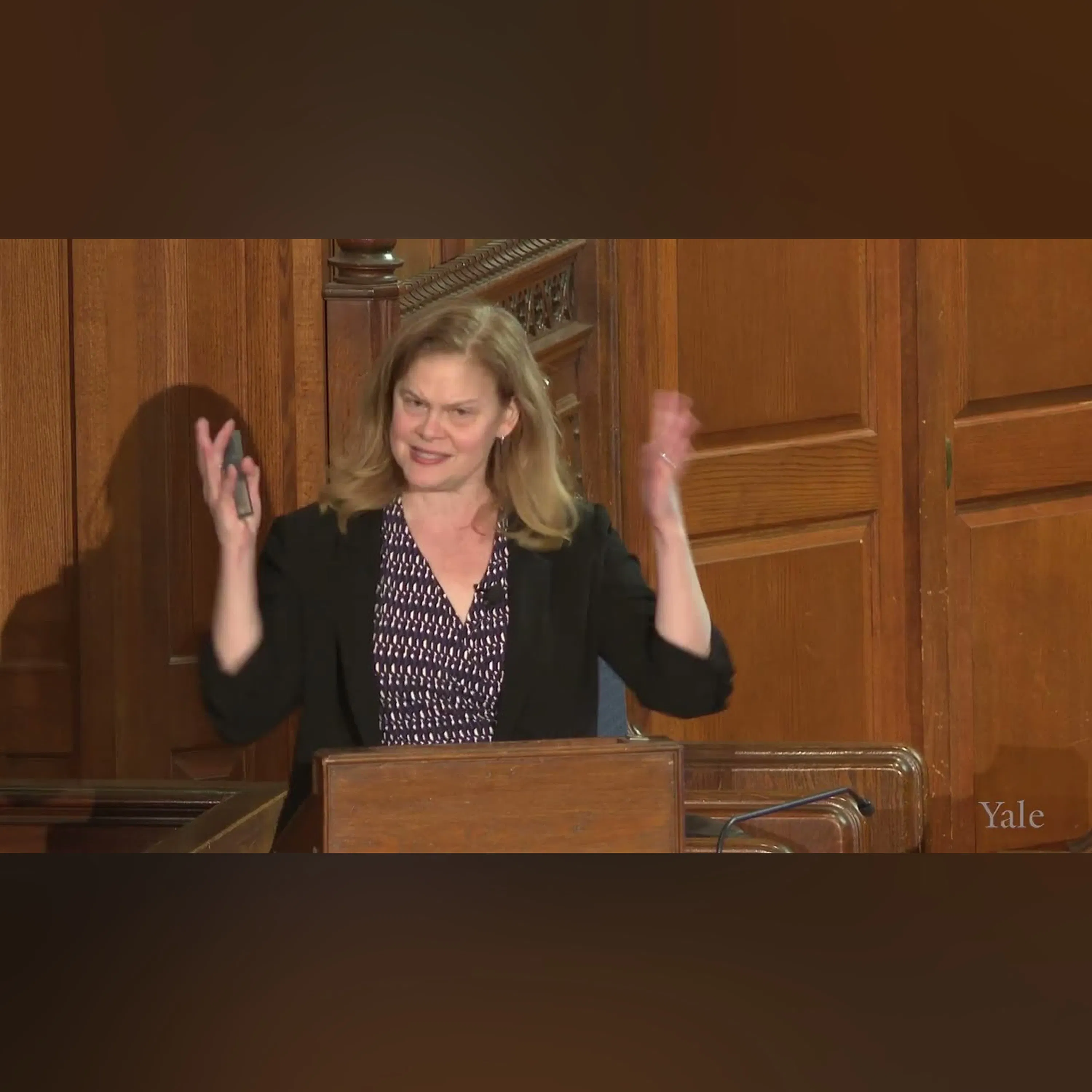 America at 250: A History, DeVane Lecture, Class 24 - Reagan’s America 20.09.2026 1hThe progress of the conservative movement in late 20th Century America is examined by Professor Beverly Gage in this lecture.Recorded in Yale’s Battell Chapel. This one-time-only course examines U.S. history from 1776 to the present, in advance of the nation’s semiquincentennial (or 250th birthday) in 2026. Taught jointly by Professors Joanne Freeman, David Blight, and Beverly Gage, the course emphasizes the history of the nation-state and the contested nature of American national identity. All three scholars will deliver the course’s first and final lectures together, as an introduction and a wrap-up. In between, they will each deliver eight lectures individually based on their areas of expertise. Joanne Freeman, the Alan Boles, Class of 1929 Professor of History and American Studies, and an expert in the revolutionary and early national periods of American history, will cover the period from the Revolution up through the 1830s, touching on such topics as the birth of party politics, the nature of “Jacksonian democracy,” and the rise of the reform and protest movements.David Blight, Sterling Professor of History and African American Studies and one of the country’s foremost authorities on the history of slavery and the Civil War, will cover the Civil War era up through Reconstruction and the emergence of the Jim Crow laws.Beverly Gage, John Lewis Gaddis Professor of History, who is currently writing a book on the nation’s past to mark the 250th anniversary of the signing of the Declaration of Independence, will pick up in the 1890s and continue through the end of the 20th century, addressing debates around immigration, wealth inequality, and the creation of the social welfare state. The course explores U.S. political history broadly conceived–not just as a realm of presidents and elections and wars (though there will be plenty of those) but as a conversation across time between citizens about what the United States is, was, and was meant to be. It proceeds from the premise that the American Revolution was the first but not the last radical act of national reimagining in U.S. history. The DeVane Lecture series was established in 1969 to honor William Clyde DeVane, dean of Yale College from 1939 to 1963. A copy of the course syllabus with required readings can be downloaded at the bottom of the page at this link: https://president.yale.edu/committees-programs/devane-lectures/america-at-250-a-history To view all the classes in the DeVane Lecture series, go to this playlist link: https://youtube.com/playlist?list=PLh9mgdi4rNezTQrY_6XMNBWaZqLRdgpoq&feature=shared Learn more about your ad choices. Visit megaphone.fm/adchoices
 -
 1.1 | Diving Into Medical Software: Your Course Introduction - Medical Software Course 20.09.2026 15minIn this introductory lesson, we welcome you to the Medical Software Course, where we lay the groundwork for understanding this specialized field. We explore the definition of medical software, delve into crucial regulatory considerations, and highlight the exciting opportunities within digital health. This session sets the stage for the comprehensive journey ahead, outlining the key areas we will cover in the coming weeks, from technical fundamentals to the intricate development lifecycle.🎯 Learning Objectives• Understand the regulatory process governing medical software.• Learn about the larger environment in which medical software operates, including clinical settings and data privacy.• Understand the organizational constraints inherent in medical software development, such as quality management systems.• Learn about critical technical background material from computer science, math, statistics, and machine learning.• Comprehend the detailed phases of the medical software life cycle. Learn more about your ad choices. Visit megaphone.fm/adchoices
 -
 15. The nature of death (cont.); Believing you will die 20.09.2026 50minDeath (PHIL 176)The lecture explores the question of the state of being dead. Even though the most logical claim seems to be that when a person stops P-functioning he or she is dead, a more careful consideration must allow for exceptions, such as when one is asleep or in a coma. Professor Kagan then suggests that on some level nobody believes that he or she is going to die. As a case in point, he takes Tolstoy's famous character Ivan Ilych.00:00 - Chapter 1. Introduction -- Accommodating Sleep in the Definition of Death 03:36 - Chapter 2. Specification: The Ability to Engage in P-Functioning 13:32 - Chapter 3. Nobody Believes that they will Die: An Analysis 27:49 - Chapter 4. Can Imagining Death Work? Flaws in Freud's Argument 36:11 - Chapter 5. Nobody Believes in Bodily Death: The Death of Ivan Ilyich Complete course materials are available at the Yale Online website: online.yale.eduThis course was recorded in Spring 2007. Learn more about your ad choices. Visit megaphone.fm/adchoices
 -
 15. Paradise Lost, Books V-VI 20.09.2026 59minMilton (ENGL 220)The description of human sexual hierarchy in Book Four of Paradise Lost is contrasted with the depiction of angelic hierarchy in Book Five. Both the Archangel Raphael's and Satan's accounts and theories of creation are examined. The poem's complex and vacillating endorsement of arbitrary decree, on the one hand, and egalitarian self-determination, on the other, is probed. The nature of matter and physical being in Heaven and Eden are explored with particular emphasis placed on the poem's monistic elements. Overall, Milton's willingness to question accepted religious, social, and political doctrine, even that which authorities in his own poem seem to express, is stressed.00:00 - Chapter 1. Men vs. Women: The Coexistence of Freedom and Social Hierarchy in "Paradise Lost" Book IV08:49 - Chapter 2. Angels vs. Humans: The Coexistence of Freedom and Social Hierarchy in "Paradise Lost" Book V40:34 - Chapter 3. Satan's Discussion with AbdielComplete course materials are available at the Open Yale Courses website: http://open.yale.edu/coursesThis course was recorded in Fall 2007. Learn more about your ad choices. Visit megaphone.fm/adchoices
 -
 1. Introductions: Why Does the Civil War Era Have a Hold on American Historical 20.09.2026 49minThe Civil War and Reconstruction (HIST 119)Professor Blight offers an introduction to the course. He summarizes some of the course readings, and discusses the organization of the course is discussed. Professor Blight offers some thoughts on the nature of history and the study of history, before moving into a discussion of the reasons for Americans' enduring fascination with the Civil War. The reasons include: the human passion for epics, Americans' fondness for redemption narratives, the Civil War as a moment of "racial reckoning," the fascination with loss and lost causes, interest in military history, and the search for the origins of the modern United States.00:00 - Chapter 1. Introduction03:09 - Chapter 2. Course Texts and Structure10:47 - Chapter 3. Martin Luther King Jr.'s "Promissory Note"15:31 - Chapter 4. Books and the Purpose of History22:00 - Chapter 5. Why Study the Civil War?38:46 - Chapter 6. Whitman's "Democracy" and ConclusionComplete course materials are available at the Open Yale Courses website: http://open.yale.edu/coursesThis course was recorded in Spring 2008. Learn more about your ad choices. Visit megaphone.fm/adchoices
 -
 801 | What is Social Financing? Funding Your Venture - Social Entrepreneurship Course 20.09.2026 4minIn this lesson, we delve into the world of social financing, exploring how funding serves as a crucial pathway to social change for both those seeking to create impact and those looking to fund it. We'll examine the full spectrum of social financing, from traditional charity to commerce-driven approaches, and see how it overlays with social entrepreneurship.🎯 Learning Objectives• Understand what social financing entails and its significance for driving social change.• Recognize the spectrum of social financing, mirroring the social entrepreneurship landscape.• Identify various funding sources and vehicles, including grants, donations, equity, loans, and bonds.• Explore different investment approaches such as philanthropy, venture philanthropy, and impact investing.📚 About the Course Have you ever wondered what it would be like to create real change? You don't have to start your own organization to make a difference in the world. Everyone can learn the social entrepreneurship mindset and skillset to build social impact. In this course, you will immerse yourself in a social or environmental challenge you want to tackle. You'll start by researching your topic of choice, talking to people, and ideating a potential solution that you can contribute. Then, you'll build a business model around that solution, understanding concepts like measuring social change, ensuring financial viability, funding and pitching. This course is a safe space to experiment and explore. You'll be guided by a ten stage framework to help structure your journey. Along the way, you'll hear from social entrepreneurs around the world through case studies and campus conversations. These include Yale alumni, members of the New Haven community, and global changemakers. Everyone is welcome to join this course! You can apply your lived, learned, or professional experience to discover how you're going to make a difference. 📺 Watch the full playlist on YouTube: https://www.youtube.com/playlist?list=PLh9mgdi4rNezbi0aRJeVnt99ynTVZG1PL🎓 Enroll on Coursera for assessments and a certificate: https://online.yale.edu/courses/creating-change-through-social-entrepreneurship🌐 Explore more learning opportunities on Yale Online: https://online.yale.edu/courses/creating-change-through-social-entrepreneurship#SocialEntrepreneurship #YaleCourse #Impact #Changemakers #BusinessPlan #DesignThinking Learn more about your ad choices. Visit megaphone.fm/adchoices
 -
 16. Hubble's Law and the Big Bang 20.09.2026 57minFrontiers/Controversies in Astrophysics (ASTR 160)The third and final part of the course begins, consisting of a series of lectures on cosmology. A brief history of how cosmology developed into a scientific subject is offered. The discovery of dark energy, along with dark matter, played a crucial role in the development of cosmology. The lecture then discusses the discovery of spiral nebulae in 1920, as well as the "Great Debate" over what they were. Hubble's famous redshift diagram is presented as the basis for Hubble's Constant and Big Bang cosmology. The difficulty of measuring distance of objects in space, and how to do it using the parallax method and the standard candle method, are discussed. Measure brightness using the magnitude scale is explained. Class ends with a review of logarithms.00:00 - Chapter 1. Introduction to Cosmology03:34 - Chapter 2. Spiral Nebulae and Hubble's Redshift Diagram17:35 - Chapter 3. Measuring the Distance of a Star: The Parallax Method25:13 - Chapter 4. Measuring Brightness: The Standard Candle Method38:06 - Chapter 5. Absolute and Apparent Magnitude48:04 - Chapter 6. ConclusionComplete course materials are available at the Open Yale Courses website: http://open.yale.edu/courses This course was recorded in Spring 2007. Learn more about your ad choices. Visit megaphone.fm/adchoices
 -
 23. Other Constraints: The Cosmic Microwave Background 20.09.2026 53minFrontiers/Controversies in Astrophysics (ASTR 160)Reasons for the expansion of the universe are addressed at the start of this lecture, focusing especially on the acceleration of dark energy. Supernovae were the first evidence for the existence of dark energy. Two other proofs are presented. The first is the Cosmic Microwave Background, which is a form of electromagnetic radiation that is perfectly smooth and equal in all directions. It firmly supports the Big Bang theory. Projects attempting to measure it, such as COBE and WMAP, are discussed. Secondly, Large-Scale Clustering is introduced: by measuring the degree of clustering, astronomers hope to advance their understanding of dark energy and dark matter. Computer simulations of the evolution of the universe are shown.00:00 - Chapter 1. Implications of Research on Supernovae05:28 - Chapter 2. The Cosmic Microwave Background11:27 - Chapter 3. COBE and WMAP: Measuring CMB24:40 - Chapter 4. Growth of Universe Structure: Large-Scale Clustering39:30 - Chapter 5. The Degree of Clustering and the Potential Fates of the UniverseComplete course materials are available at the Open Yale Courses website: http://open.yale.edu/courses This course was recorded in Spring 2007. Learn more about your ad choices. Visit megaphone.fm/adchoices
 -
 1103 | Play the Long Game: Future-Proofing Your Social Business - Social Entrepreneurship Course 20.09.2026 5minWhat are the big picture principles that will guide your journey in social entrepreneurship? This lesson goes beyond specific steps, offering essential do's and don'ts to ensure you stay grounded, impactful, and adaptable throughout your career.🎯 Learning Objectives• Understand the importance of handing off responsibilities and sharing knowledge for long-term impact.• Recognize that your role in social entrepreneurship will evolve over time, from direct service to framework change.• Learn to differentiate between substance and hype, avoiding "bubble" mentalities in the social entrepreneurship field.• Embrace humility by admitting failings, seeking collaboration, and continuously questioning assumptions.• Build upon existing knowledge and challenge conventional wisdom to collectively advance the field of social justice.📚 About the Course Have you ever wondered what it would be like to create real change? You don't have to start your own organization to make a difference in the world. Everyone can learn the social entrepreneurship mindset and skillset to build social impact. In this course, you will immerse yourself in a social or environmental challenge you want to tackle. You'll start by researching your topic of choice, talking to people, and ideating a potential solution that you can contribute. Then, you'll build a business model around that solution, understanding concepts like measuring social change, ensuring financial viability, funding and pitching. This course is a safe space to experiment and explore. You'll be guided by a ten stage framework to help structure your journey. Along the way, you'll hear from social entrepreneurs around the world through case studies and campus conversations. These include Yale alumni, members of the New Haven community, and global changemakers. Everyone is welcome to join this course! You can apply your lived, learned, or professional experience to discover how you're going to make a difference. 📺 Watch the full playlist on YouTube: https://www.youtube.com/playlist?list=PLh9mgdi4rNezbi0aRJeVnt99ynTVZG1PL 🎓 Enroll on Coursera for assessments and a certificate: https://online.yale.edu/courses/creating-change-through-social-entrepreneurship 🌐 Explore more learning opportunities on Yale Online: https://online.yale.edu/courses/creating-change-through-social-entrepreneurship #SocialEntrepreneurship #YaleCourse #Impact #Changemakers #BusinessPlan #DesignThinking Learn more about your ad choices. Visit megaphone.fm/adchoices
 -
 America at 250 Podcast Episode 7: Immigration and Its Discontents 20.09.2026 59minProfessors Beverly Gage and David Blight discuss Professor Gage's first lecture on the United States' identity crisis in the early 20th century. This podcast is also available on Apple: https://podcasts.apple.com/us/podcast/america-at-250-the-podcast/id1840422776 and Spotify: https://open.spotify.com/show/4C8qfQf21r4eO6mVUFguG2To view all the videos in this course or view and download a copy of the course syllabus with required readings please scroll through the page at this link: https://president.yale.edu/committees-programs/devane-lectures/america-at-250-a-history Learn more about your ad choices. Visit megaphone.fm/adchoices
 -
 20. Dark Matter 20.09.2026 56minFrontiers/Controversies in Astrophysics (ASTR 160)This lecture introduces an important concept related to the past and future of the universe: the Scale factor, which is a function of time. With reference to a graph whose coordinates are the Scale factor and time, the problem of dark matter is addressed again. Cosmological redshifts are measured to determine the scale of the universe. The discovery of the repulsive, anti-gravitational force of dark energy is explained. The lecture concludes with discussion of Einstein's biggest mistake: the invention of the cosmological constant to balance gravity.00:00 - Chapter 1. The Scale Factor04:41 - Chapter 2. Accounting for Dark Matter in Mass of Universe27:58 - Chapter 3. Discovery of Dark Energy42:06 - Chapter 4. Understanding Dark Energy and Einstein's Biggest MistakeComplete course materials are available at the Open Yale Courses website: http://open.yale.edu/courses This course was recorded in Spring 2007. Learn more about your ad choices. Visit megaphone.fm/adchoices
 -
 Low-Cost, High-Nutrition Eating for Graduate Students: Nutrition Basics 20.09.2026 18minIn this module, Dr. Nate Wood introduces the fundamentals of nutrition. Learn about the essential nutrients your body needs and how to incorporate them into your diet on a budget.Managing your finances as a student is challenging. Yale’s Graduate and Professional Student Senate collaborated with Dr. Nate Wood, Assistant Professor and Director of Culinary Medicine at the Yale School of Medicine, to create this video series aimed at helping our community to shop and eat affordably and nutritiously. According to a 2024 Senate report, 30% of Yale's graduate and professional students experience food insecurity. Our goal is to provide tangible support through practical tips, recipes, and strategies. For more resources or to share your thoughts, use our contact form!https://www.gpsenate.yale.edu/contact Learn more about your ad choices. Visit megaphone.fm/adchoices
 -
 17. The Popular Front 20.09.2026 54minFrance Since 1871 (HIST 276)A plethora of Far Right and fascist organizations emerged in the wake of World War I. Economic depression, nationalism, anti-Semitism and xenophobia all played a part in this upsurge. On the left, the tension between communist revolutionaries and socialist reformers was reconciled, for a time, in the Popular Front government of Leon Blum. While the Popular Front would eventually fall, it pioneered many of the reforms and progressive measures that French workers enjoy today.00:00 - Chapter 1. Rise of the Right in Interwar France11:54 - Chapter 2. Xenophobia and Anti-Semitism in France16:17 - Chapter 3. The Stavisky Affair28:22 - Chapter 4. The Reassertion of the Republic: The Victory of the Popular Front and Leon Blum41:19 - Chapter 5. Unraveling the Popular Front: The Depression and the Spanish Civil WarComplete course materials are available at the Open Yale Courses website: http://open.yale.edu/coursesThis course was recorded in Fall 2007. Learn more about your ad choices. Visit megaphone.fm/adchoices
 -
 Class 3: Capital Chapter 1: The Commodity, part 3 20.09.2026 56minHow does value arise in exchange? What is labor in the capital system? Some simple forms of value. A chapter by chapter study of Marx’s powerful analysis in Capital: Critique of Political Economy, Volume 1. This book from 1872 is still the best guide to the predatory economic and social system within which we live. The book solves five basic mysteries in our social world. The mysteries are: why social classes struggle against one another, why human beings are in the thrall of things, how a quantity of money turns into more money without seeming to add anything, why some people are forced to work and the more they work the less they make proportional to their effort, and finally, and why it is so hard to transform the system for the better. This course is taught by Paul North, Maurice Natanson Professor of German, Yale University. Prof. North is co-editor of the new English translation and critical edition of Capital Volume 1 by Karl Marx published in 2024 by Princeton University Press. https://press.princeton.edu/books/hardcover/9780691190075/capitalTo view other videos in this course, visit this link. https://youtube.com/playlist?list=PLh9mgdi4rNewd_0qe4c2lkzXZZQka_QnZ&si=CHOgjCcVD0K378kl Learn more about your ad choices. Visit megaphone.fm/adchoices
 -
 America at 250 Podcast Episode 11: The Politics of the 1980s, 1990s, and So Much More 20.09.2026 1h 9minProfessors Beverly Gage, David Blight and Joanne Freeman recap their final lectures on the late 20th century and reminisce about the Bicentennial. This podcast is also available on Apple: https://podcasts.apple.com/us/podcast/america-at-250-the-podcast/id1840422776 and Spotify: https://open.spotify.com/show/4C8qfQf21r4eO6mVUFguG2 Learn more about your ad choices. Visit megaphone.fm/adchoices
 -
 6. Arguments for the existence of the soul, Part IV; Plato, Part I 20.09.2026 42minDeath (PHIL 176)The lecture begins with a continued discussion of the Cartesian argument and its weaknesses. The lecture then turns to Plato's metaphysical views in the context of his work, Phaedo. The key point in the discussion is the idea that in addition to the ordinary empirical world that we are familiar with, we posit the existence of a second realm in which the Platonic forms exist. These forms are the abstract properties that we attribute to physical objects, such as beauty, justice, goodness and so on. Since it is the soul that conceives of these Platonic forms and ideas, Plato argues that the soul not only outlives the body but lasts forever. It is perfect, immaterial and indestructible.00:00 - Chapter 1. Summary of the Cartesian Argument 04:57 - Chapter 2. Refuting the Cartesian Argument: The Morning and Evening Stars 19:25 - Chapter 3. Platonic Forms and the Immortality of the Soul 31:27 - Chapter 4. Conclusion Complete course materials are available at the Yale Online website: online.yale.eduThis course was recorded in Spring 2007. Learn more about your ad choices. Visit megaphone.fm/adchoices
 -
 Class 1 Introduction, Capital Chapter 1: The Commodity 20.09.2026 1h 4minWhat is the capital system? Why could Marx write this book? What is a commodity?A chapter by chapter study of Marx’s powerful analysis in Capital: Critique of Political Economy, Volume 1. This book from 1872 is still the best guide to the predatory economic and social system within which we live. The book solves five basic mysteries in our social world. The mysteries are: why social classes struggle against one another, why human beings are in the thrall of things, how a quantity of money turns into more money without seeming to add anything, why some people are forced to work and the more they work the less they make proportional to their effort, and finally, and why it is so hard to transform the system for the better. This course is taught by Paul North, Maurice Natanson Professor of German, Yale University. Prof. North is co-editor of the new English translation and critical edition of Capital Volume 1 by Karl Marx published in 2024 by Princeton University Press. https://press.princeton.edu/books/hardcover/9780691190075/capitalTo view other videos in this course, visit this link. https://youtube.com/playlist?list=PLh9mgdi4rNewd_0qe4c2lkzXZZQka_QnZ&si=CHOgjCcVD0K378kl Learn more about your ad choices. Visit megaphone.fm/adchoices
 -
 America at 250: A History, DeVane Lecture, Class 26 - Meanings on the Eve of 2026 20.09.2026 1hThe final class in the course is presented by Professors Beverly Gage, David Blight, and Joanne Freeman with a recap of how we got to America at 250 and what we can all learn from the history.Recorded in Yale’s Battell Chapel. This one-time-only course examines U.S. history from 1776 to the present, in advance of the nation’s semiquincentennial (or 250th birthday) in 2026. Taught jointly by Professors Joanne Freeman, David Blight, and Beverly Gage, the course emphasizes the history of the nation-state and the contested nature of American national identity. All three scholars will deliver the course’s first and final lectures together, as an introduction and a wrap-up. In between, they will each deliver eight lectures individually based on their areas of expertise. Joanne Freeman, the Alan Boles, Class of 1929 Professor of History and American Studies, and an expert in the revolutionary and early national periods of American history, will cover the period from the Revolution up through the 1830s, touching on such topics as the birth of party politics, the nature of “Jacksonian democracy,” and the rise of the reform and protest movements.David Blight, Sterling Professor of History and African American Studies and one of the country’s foremost authorities on the history of slavery and the Civil War, will cover the Civil War era up through Reconstruction and the emergence of the Jim Crow laws.Beverly Gage, John Lewis Gaddis Professor of History, who is currently writing a book on the nation’s past to mark the 250th anniversary of the signing of the Declaration of Independence, will pick up in the 1890s and continue through the end of the 20th century, addressing debates around immigration, wealth inequality, and the creation of the social welfare state. The course explores U.S. political history broadly conceived–not just as a realm of presidents and elections and wars (though there will be plenty of those) but as a conversation across time between citizens about what the United States is, was, and was meant to be. It proceeds from the premise that the American Revolution was the first but not the last radical act of national reimagining in U.S. history. The DeVane Lecture series was established in 1969 to honor William Clyde DeVane, dean of Yale College from 1939 to 1963. A copy of the course syllabus with required readings can be downloaded at the bottom of the page at this link: https://president.yale.edu/committees-programs/devane-lectures/america-at-250-a-history To view all the classes in the DeVane Lecture series, go to this playlist link: https://youtube.com/playlist?list=PLh9mgdi4rNezTQrY_6XMNBWaZqLRdgpoq&feature=shared Learn more about your ad choices. Visit megaphone.fm/adchoices
Slični podcasti


Popularan u
Ovaj podcast pojavljuje se i na podcast ljestvicama ovih zemalja.

