
Kidney Commute
kidneycommute
0
The Kidney Commute Podcast seeks to enhance the work of the interprofessional kidney care team by providing connection through education and serving as an innovative opportunity to fulfill CE requirements.
Episode
-
 Pitstop: Renal Artery Stenosis: Rethinking Diagnosis and Treatment 18.09.2026 34mntJoin Drs. Osama El Shamy and Adina Voiculescu for a discussion on how the diagnosis and management of renal artery stenosis have evolved over time. The episode explores available imaging techniques, including the role of ultrasound, and reviews lessons from clinical trials. Listeners will also hear about current medical management, endovascular and surgical treatment options, expected outcomes, recurrence, and collaborative decision-making in patient care.
 -
 Pitstop: Updates in Kidney Transplantation 27.08.2026 41mntKidney transplantation continues to evolve. These advances bring new opportunities and questions for clinicians and patients. In this episode of Kidney Commute: Pit Stop, host Dr. Sam Kant is joined by Dr. Vineeta Kumar. Dr. Kumar is a tenured professor of medicine and the Robert and Cutessa Bourge Endowed Professor in Transplant Nephrology at the University of Alabama at Birmingham. They discuss the origins, current state, and future of xenotransplantation. The conversation addresses infection, rejection, and recent clinical advances. They also explore transplant tolerance, biomarkers, post-transplant weight gain, and strategies to improve living kidney donation. Tune in for a practical look at the innovations and challenges shaping the future of kidney transplantation.
 -
 Pitstop: Global Guidelines: U.S. Insights from KDOQI - Advancing Lupus Nephritis Management 14.08.2026 56mntThis episode features authors of the KDOQI US Commentary on the KDIGO 2024 Clinical Practice Guideline for the Management of Lupus Nephritis. Experts Dr. Gabriel Contreras and Dr. Sayna Norouzi joins host, Dr. Osama El Shamy to explore key guideline updates and how the recommendations can be applied in clinical practice. They discuss current approaches to diagnosis, newer therapies, treatment strategies based on disease class, and care for patients with a membranous component. The conversation also examines long-term complications, thrombotic microangiopathy, and practical challenges clinicians may encounter when implementing the updated recommendations. Please click here to access the commentary.
 -
 Urgent PD Starts in the ICU: Rethinking Acute Dialysis Care 13.08.2026 26mntPeritoneal dialysis (PD) is often overlooked when critically ill patients need urgent or emergent dialysis. This episode explores patient selection, contraindications, and how PD compares with continuous renal replacement therapy (CRRT). The panel also discusses informed consent, program challenges, and the transition from the hospital to home. Patient advocate Andreas Price shares his personal experience beginning PD and adjusting to treatment. Click here to claim CE credits.
 -
 Pitstop: From Red Flags to Rapid Response: Urgent Decision-Making in ANCA-Associated Vasculitis Care 14.07.2026 30mntANCA-associated vasculitis is a rare autoimmune disease that can rapidly damage the kidneys, lungs, and other organs. Early recognition and prompt treatment are essential. In this episode of Kidney Commute Pit Stop, host Dr. Osama El Shamy is joined by rheumatologist Dr. Anisha Dua, nephrologist Dr. Duvuru Geetha, and kidney transplant recipient Melissa Rubio. Together they explore common signs and clinical presentations, diagnostic challenges, the role of ANCA testing and kidney biopsy, and why timely treatment initiation is critical to preserving organ function. Melissa shares her inspiring journey from diagnosis at age 17 through dialysis, kidney transplantation, and recovery. Her story highlights the importance of patient education, family support, and multidisciplinary care. Whether you are a member of the nephrology or rheumatology care team, this episode provides practical insights to help recognize ANCA-associated vasculitis earlier, support timely diagnosis, and improve patient outcomes. This episode is supported by Amgen. Please click here, to view more information and resources on ANCA-Associated Vasculitis (AAV). Upon completion of this podcast, please complete the survey at https://nkf.jotform.com/261964216947872
 -
 Pitstop: Beyond Binders: Evolving the Hyperphosphatemia Playbook 25.06.2026 37mntHyperphosphatemia affects a significant proportion of patients receiving dialysis and remains a complex challenge for kidney care teams. In this episode of Kidney Commute Pit Stop, Anna Gaddy welcomes nephrologist Jessica Kendrick, clinical pharmacist Kimberly Holdener, and renal nutrition expert David St-Jules to explore what phosphorus management looks like in 2026.The panel discusses the evolution of the "renal diet," emerging evidence on phosphorus bioavailability, the impact of food additives and processing, and how individualized nutrition counseling can improve patient outcomes. They also review traditional phosphorus binders, challenges with adherence and pill burden, and the emerging role of tenapanor, a first-in-class phosphorus blocker. Listeners will gain practical insights for helping patients navigate phosphorus management while maintaining a balanced, patient-centered approach to nutrition and quality of life.This episode is supported by Ardelyx.Please click here, to view a clinical bulletin update on managing hyperphosphatemia in patients on dialysis.Upon completion of the podcast, please complete this short survey: https://nkf.jotform.com/261544521599868
 -
 Pitstop: Plant-based Enteral Formulas for People with CKD 16.06.2026 32mntDisclosure: The content and opinions of the podcast are those of the guests; these are not claims or recommendations for Kate Farms products. Plant-based nutrition has emerged as an important component of kidney care, but questions remain about how plant-based enteral formulas can best support people living with chronic kidney disease (CKD). In this episode of Kidney Commute: Pit Stop, host Dr. Raphy Rosen is joined by Brandon Kistler, PhD, RD, and Rachel Wontor, MS, RDN, CD, CNSC, to explore the growing role of plant-based enteral nutrition in clinical practice. The discussion examines the key features of plant-based formulas, including standard, renal-specific, peptide, and specialty options, and reviews how these products compare with traditional formulas in meeting nutritional needs. The panel also discusses when renal formulas may or may not be necessary, current evidence related to effectiveness and patient acceptance, insurance coverage considerations, and practical approaches for implementing plant-based enteral nutrition in healthcare settings. Clinicians will gain actionable insights to help support individualized nutrition care for people with CKD. After listening to the podcast, please take a moment to complete the quick survey at https://nkf.jotform.com/261534175734863
 -
 Hidden Phosphorus: Understanding Phosphate Additives in Food 29.05.2026 40mntPhosphate additives are commonly used in processed and convenience foods, yet many patients and healthcare professionals remain unaware of how significantly they contribute to phosphorus burden in chronic kidney disease (CKD). Elevated phosphorus levels can negatively impact bone, cardiovascular, and overall kidney health, making phosphorus management an important aspect of kidney care. In this episode of Kidney Commute, an interprofessional panel featuring a nephrologist, dietitian, policy expert, and patient advocate discusses the clinical impact of phosphate additives, the differences between naturally occurring phosphorus and additive-based phosphorus, and the practical challenges patients face when trying to identify hidden phosphorus sources in foods and medications. The discussion also explores socioeconomic barriers, food labeling limitations, and ongoing policy and advocacy efforts aimed at improving phosphorus transparency and patient education. Listeners will gain practical strategies and insights to better support phosphorus management in clinical practice and daily life.
 -
 Pitstop: Global Guidelines: U.S. Insights from KDOQI - Optimizing Management of IgAN and IgAV 08.05.2026 21mntIgA nephropathy and IgA vasculitis remain complex and evolving areas in nephrology care. In this episode, experts discuss key insights from the KDIGO guidelines and KDOQI commentary published in AJKD, focusing on updated approaches to risk stratification, disease progression, and treatment decision making. The conversation highlights the role of supportive care, immunosuppressive therapy considerations, and emerging therapeutic options, while addressing variability in clinical practice and patient management challenges. This episode provides practical, evidence based perspectives to help clinicians navigate the nuances of IgAN and IgAV care and apply guideline recommendations in real world settings. Please view the AJKD article here.
 -
 Pitstop: Global Guidelines: U.S. Insights from KDOQI - Improving Anemia Management in CKD 08.05.2026 39mntAnemia in chronic kidney disease remains common, complex, and rapidly evolving. In this episode, experts discuss key updates from the 2026 KDIGO Clinical Practice Guidelines and AJKD commentary, including a stronger focus on identifying and treating iron deficiency and refining treatment strategies. The conversation explores the clinical impact of anemia on cardiovascular risk and quality of life, reviews evidence supporting proactive IV iron use, and examines emerging therapies such as HIF stabilizers. The panel also addresses real world challenges in managing anemia, particularly in non dialysis CKD populations, where access, adherence, and care coordination play a critical role. This episode provides practical insights to support individualized, evidence based anemia care. Please click here to access the commentary.
 -
 Pitstop: Congress Cares about Kidneys: Unpacking the recent congressional hearing about kidney health 28.04.2026 34mntKidney care rarely takes center stage in Congress, but a recent hearing is bringing renewed attention to prevention, innovation, and patient access. In this episode, host Raphy Rosen is joined by Dr. Suzanne Watnick, who testified as a witness at the March 18 Ways and Means Health Subcommittee hearing, along with Dr. Dan Weiner. Together, they unpack key themes across CKD, dialysis, and transplantation, and explore what emerging legislative efforts could mean for patients and providers. Tune in for an inside look at how kidney care is shaping national health policy.
 -
 Pitstop: Global Guidelines: U.S. Insights from KDOQI: Optimizing ADPKD Evaluation and Treatment 31.03.2026 30mntIn this episode of Kidney Commute: Pitstop, we explore key insights from the KDIGO Commentary on the 2025 KDOQI Clinical Practice Guideline for autosomal dominant polycystic kidney disease (ADPKD). Host Anna Gaddy is joined by Dr. Neera Dahl and Dr. Terry Watnick to discuss how the updated recommendations differ from prior guidance and what they mean for real world practice in the United States. The conversation highlights advances in genetic testing, practical considerations for implementing tolvaptan therapy, and emerging therapies on the horizon. Tune in for actionable takeaways to support clinical decision making and improve care for patients with ADPKD. Access the commentary here: https://www.ajkd.org/article/S0272-6386(26)00003-X/fulltext
 -
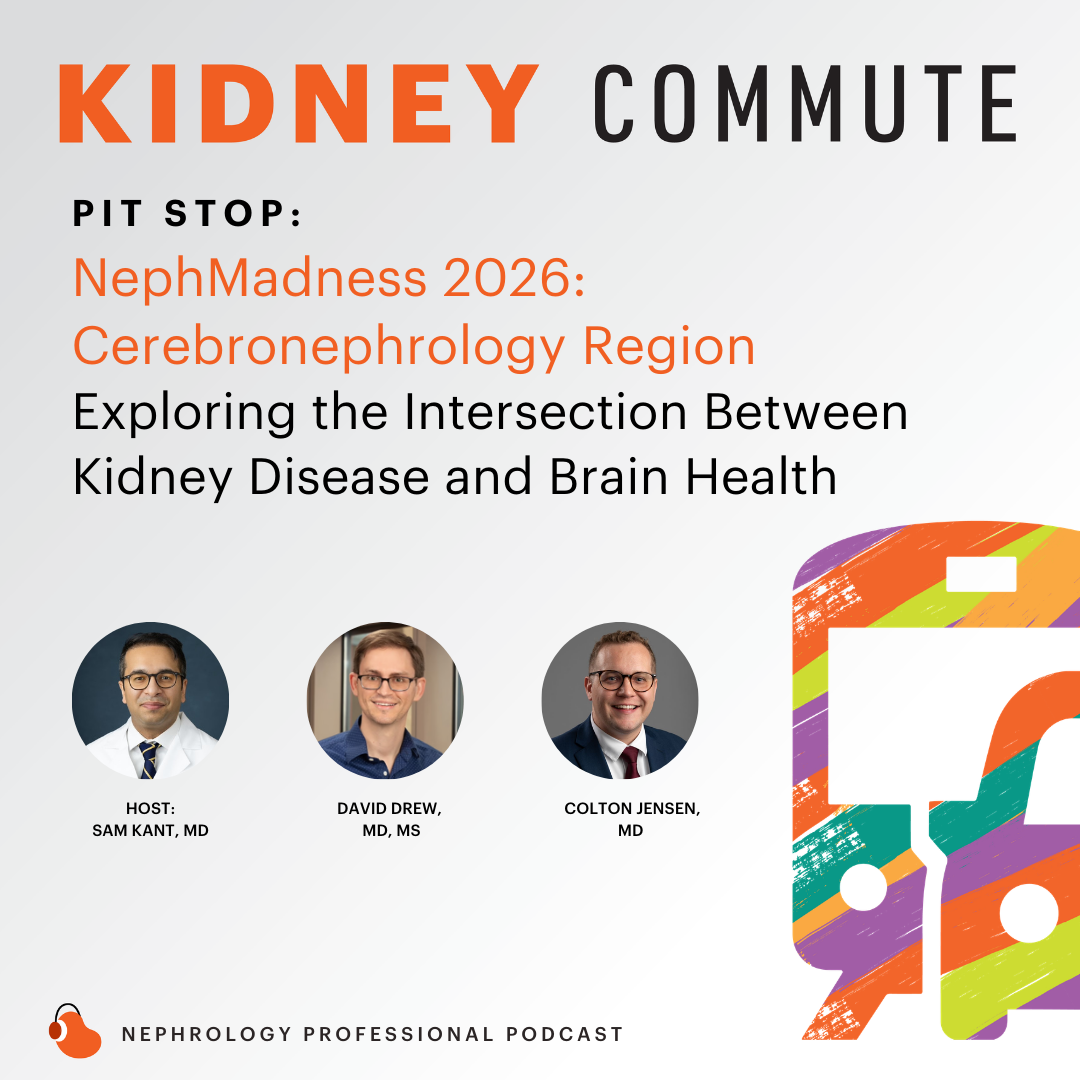 Pitstop: NephMadness 2026: Cerebronephrology Region: Exploring the Intersection Between Kidney Disease and Brain Health 19.03.2026 25mntHosted by Dr. Sam Kant, this Kidney Commute: Pit Stop episode explores the Cerebronephrology region of NephMadness 2026 and the emerging concept of the brain–kidney axis. Drs. David Drew and Colton Jensen examine how chronic kidney disease and ESKD with dialysis contribute to cognitive impairment—an underrecognized complication affecting a large proportion of patients. From early microvascular injury, albuminuria, and hypertension in CKD to cerebral hypoperfusion, ischemia, and structural brain changes during dialysis, this discussion highlights the bidirectional relationship between kidney and brain health. Join us as we unpack where brain injury begins and what this means for earlier recognition and improved patient care. For more information on the Cerebronephrology Region of NephMadness please go to: https://ajkdblog.org/2026/03/01/nephmadness-2026-cerebronephrology-region/
 -
 Optimizing Oral Health for Kidney Transplant Success 17.03.2026 30mntThis podcast explores the critical role of oral health in kidney transplant eligibility and outcomes. Through an interprofessional discussion, learners will examine how oral health impacts infection risk, transplant readiness, and long-term success. Notably, this episode features the valuable perspective of a dentist, highlighting the importance of integrating dental expertise into transplant care. Practical strategies for prevention, care coordination, and addressing access barriers will be highlighted to support patient-centered transplant care.
 -
 Pitstop: APOL1 and Kidney Disease: From Theory to Practice 05.03.2026 35mntAdvances in genetics have transformed how we understand kidney disease, and the discovery of APOL1 has been a major milestone. In this episode of Kidney Commute: Pitstop, host Dr. Osama El Shamy is joined by Meyeon Park, MD, MAS and Denay Richards, PhD to explore the role of APOL1 genetic variants in kidney disease development and progression. The discussion covers the epidemiology of APOL1, the interplay between genetic risk and environmental factors, and scenarios in which APOL1 genetic testing may be considered. Speakers also address how test results are communicated to patients and families, implications for disease management, emerging research into APOL1 targeted therapies, and the significance of newly introduced ICD 10 codes for APOL1 mediated kidney disease. After listening to the podcast, please complete the survey at https://kidneyforms.tfaforms.net/4728148. This educational episode is supported by Vertex Pharmaceuticals.
 -
 Pitstop: Legislation and Its Effect on Dialysis Patient Choice 19.02.2026 38mntLegislation has played a defining role in how dialysis care is delivered in the United States, directly influencing access, coverage, and patient choice. In this episode of Kidney Commute: Pitstop, host Osama El Shamy, MD, FASN, FNKF, is joined by Lauren Drew, JD, and Eugene Lin, MD, MS, FASN for an in depth discussion on the policy decisions that have shaped kidney care. The conversation traces key legislative milestones, including the creation of the ESRD benefit, the Medicare dialysis bundle, Medicare Advantage expansion, and the Advancing American Kidney Health Initiative. Speakers also examine the current legislative landscape, its impact on dialysis patient choice, and opportunities for professional advocacy in kidney care.
 -
 Pitstop: Is Dialysis Nephrology’s Original Sin? A Dialogue Inspired by a Recent AJKD Publication 23.01.2026 40mntIs dialysis nephrology’s greatest achievement or its original sin? In this Kidney Commute: Pit Stop episode, host Dr. Osama El Shamy, welcomes Dr. Andrew Cohen, to discuss a provocative question that challenges how the field of nephrology has evolved. Drawing from Dr. Cohen’s recent AJKD publication, the conversation explores key historical milestones, including early innovations, the 1972 Medicare amendment, and the rise of corporatized dialysis care. Together, they examine how these forces have shaped trainee perceptions, workforce recruitment, and the identity of nephrology today. The episode concludes with a forward-looking discussion on how the field can refocus priorities, embrace innovation, and chart a more balanced path beyond dialysis-centered care. AJKD Article: https://www.ajkd.org/article/S0272-6386(25)00711-5/abstract
 -
 Adolescence to Adult Care Transition 20.01.2026 31mntNavigating the transition from pediatric to adult kidney transplant care is one of the most pivotal and vulnerable periods for young patients. In this episode of the Kidney Commute, an interdisciplinary panel of nephrology, social work, nursing, pharmacy experts, and a kidney transplant recipient explore the medical, psychological, and social complexities that shape a successful transition. The discussion addresses readiness for independence, medication and insurance changes, adherence challenges, family dynamics, and coordinated handoffs between pediatric and adult teams. Through real-world insights and practical strategies, this episode highlights approaches to support continuity of care, protect graft survival, and empower young adults as they move into adult-centered transplant care. This episode is complemented by additional insights from a psychologist who was unable to join the discussion; related resources are available at this link.
 -
 Pitstop: Uromodulin 13.12.2025 32mntIn this Kidney Commute: Pitstop episode, host Anna Gaddy, MD, FASN, FNKF, is joined by Kaice LaFavers, PhD, and Pranav Garimella, MBBS, MPH, to explore uromodulin. They discuss its role in infection defense, immune modulation, AKI and sepsis, genetic insights, and evolving methods to study its multiple forms. A concise, science driven look at why uromodulin matters in kidney health.
 -
 Pitstop: Part 2: Obesity in the Nephrology Clinic – Treatment and Management Principles 01.12.2025 31mntEffective management of obesity in patients with CKD requires a holistic, interprofessional approach. In part 2 of this episode, the conversation continues with translating the evolving evidence into practical guidance for nephrology teams. Experts review the importance of a person-centered approach integrating lifestyle interventions, pharmacologic therapies, and surgical options with a focus on safety, efficacy, and kidney-related outcomes. The discussion emphasizes how members of the nephrology care team can collaborate to personalize treatment, address appetite and nutrition concerns, and help patients achieve meaningful weight loss without compromising kidney health. Tune in for actionable insights and strategies to translate emerging science into individualized, kidney-friendly, weight management strategies. Please be sure to visit the National Kidney Foundation's Obesity in the Nephrology Clinic page for additional information and access to an infographic designed to support clinical care for managing obesity in individuals living with CKD: https://www.kidney.org/professionals/tools/obesity-nephrology-clinic Supported by Novo Nordisk
Podcast serupa


Populer di
Podcast ini juga muncul di daftar podcast negara-negara ini.

