
The SafetyPro Podcast
Blaine J. Hoffmann, MS OHSM
0
The SafetyPro Podcast delivers practical workplace safety and health information that listeners can apply immediately. Hosted by Blaine J. Hoffmann, the show steers clear of management theory, platitudes, and guru speak. Instead, it focuses on actionable tips and real-world advice for improving safety on the job.
Episode
-
 Episode 201: Building Safety Capacity 12.08.2026 44mntWhat happens to safety performance when you're away? Discover the impact of leadership styles on safety outcomes in this insightful episode.Key takeaways:* Understand the effects of absence on safety performance.* Explore different leadership modes: Taskminder, Micromanager, and Strategic Leader.* Learn how to build capacity in your safety culture.Timestamps:00:00 Introduction00:39 What happens to safety performance when you're away?01:25 The importance of leadership in safety02:19 Different leadership modes explained05:11 The Taskminder vs. Micromanager10:32 The Strategic Leader's role20:06 Building capacity in safety30:43 Practical tips for safety leadersWhat's your biggest challenge with safety leadership? Drop it in the comments!Subscribe for weekly insights on safety management and leadership strategies!#SafetyLeadership #WorkplaceSafety #SafetyCulture
 -
Episode 200: AI in Safety - Smarter Tools, New Blind Spots 30.06.2026 39mntThe conversation delves into the hype and challenges of AI in safety, including the use of QR codes, AI-driven safety tools, predictive analytics, computer vision, psychosocial and ethical considerations, deskilling, overreliance on AI, data quality investments, and worker involvement.TakeawaysAI technology in safety has the potential to revolutionize safety programs, but it comes with challenges and ethical considerations.Investing in data quality and worker involvement is crucial for the successful implementation of AI technology in safety.Chapters00:00 The Hype of AI in Safety06:16 AI-Driven Safety Tools23:21 Psychosocial and Ethical Challenges28:41 Deskilling and Overreliance on AI
-
Episode 199: Dynamic Warm-Ups w/Lori Frederic 01.04.2026 36mntThis episode with Lori Frederic gets into workplace fitness, injury prevention, and the importance of understanding the 'why' behind movement and exercise. It explores the challenges of construction work in mission-critical projects, the transition to dynamic warm-ups, and the old vs. new approach to injury prevention and fitness. Also, we discuss the impact of attitude and trends in health and fitness, as well as advances in understanding human anatomy and the attitude towards health and fitness.Chapters00:00 Introduction and Swag Competition07:30 Transition to Dynamic Warm-ups and Functional Fitness17:30 The Impact of Attitude and Trends in Health and Fitness25:12 Advances in Understanding Human Anatomy and Attitude Towards Health and Fitness
-
Episode 198: The Metrics Dilemma w/Alex Paradies 01.04.2026 58mntSummaryThis episode with Blaine Hoffmann and Alex Paradies, from TapRoot gets into the value of metrics, the purpose of measuring, and the importance of understanding what to measure and what control we have over the results. They also talk about the challenges and limitations of leading and lagging indicators, the impact of gamifying measures, and the design fallacy in workplace metrics.Chapters* 00:00 The Value of Metrics* 07:37 Challenges of Leading and Lagging Indicators* 32:50 Proactive Measures vs. Leading Indicators* 46:26 Leadership and Accountability in Metric Adoption* 53:51 Cultural Shift for Successful Metric Implementation
-
Episode 197: Demystifying OSHA: A Conversation with David Keeling 11.03.2026 42mntIn this insightful interview, Blaine Hoffmann speaks with David Keeling, the Assistant Secretary of Labor for Occupational Safety and Health, about OSHA's strategic direction, safety culture, emerging trends like AI, and how safety professionals can demystify OSHA to foster collaboration and improve workplace safety.#OSHA #workplacesafety #safetyculture #safetymanagement #safetyprograms #VPP #safetyleadership #safetytrends #OSHApartnership
-
015: Chemical Safety Labels 25.09.2017 20mntLabels still create problems for many employers. Learn what is needed and listen to some examples of what to do and not do when it comes to labels in the workplace. Be sure to send email questions or topics for future episodes to [email protected].
-
010: BONUS - SMART Goals Part 2 19.08.2017 13mntI got a lot of responses from the last episode and noticed an odd trend each time I release a new one as well. I talk about those here in this bonus episode. Keep the emails coming! And hey, if you enjoy the info in the podcast please be sure to leave a ranking and review on Apple Podcasts or drop me a personal message using the email address above.
-
062: The Difference Between a Safety Inspection and Safety Audit 01.03.2019 26mntPowered by iReportSource Safety Inspection or Safety Audit? This issue has come up before, and I want to tackle it in this episode. So some coaching is going on in this episode. First, let's get the definitions out of the way: Inspection: Physical checks for acceptable conditions conducted at the direction of regulatory requirements, guidelines, policies, procedures, etc. outlined in your overall safety manual or as a part of a safety management system. Audit: An independent review of the effectiveness, implementation, and compliance with established regulatory requirements, guidelines, policies, procedures, etc. outlined in your overall safety manual or as a part of a safety management system. It is important to note that independent does not necessarily mean from an outside organization. Independence means not being responsible for the activity being audited or free of bias and conflict of interest, which means you cannot audit your own work. So think of an inspection as a specific physical check to see if a tool, vehicle, machine, etc. are in safe working condition. Like a forklift inspection; before each shift operators are required to conduct an inspection to ensure it is in a safe condition. Always provide adequate checklists to ensure consistency of inspections and to allow a trend analysis to be developed t look for areas of improvement during any program audits. An audit is a review to see if inspections are being done and to check the quality of the inspection results. Or, inspections are tactical, and audits are strategic. Most folks focus on the tactical activity of performing inspections. They have checklists, cards, etc. Our industry needs to place more emphasis on the strategic review of safety as well. I would encourage you to go one step further and apply a management system approach to these activities. To help illustrate the importance, I will use the ANSI Z-10 Standard for Occupational Safety and Health Management Systems (OHSMS) as an example. The OHSMS cycle ANSI lays out entails an initial planning process and implementation of the safety management system, followed by a process for checking the performance of these activities and taking appropriate corrective actions. The next step involves a management review of the system for suitability, adequacy, and effectiveness against its policy and this standard. At a high level, this is an audit of the OHSMS. It is worth noting that ANSI/AIHA® Z10 focuses primarily on the strategic levels of policy and the processes to ensure the policy is effectively carried out. The standard does not provide detailed procedures, job instructions, or documentation mechanisms. Each organization must design these according to their needs, such as inspections: what to inspect and how often. In a management system approach, there is an emphasis on continual improvement and systematically eliminating the underlying or root causes of deficiencies. For example, if an inspection finds an unguarded machine, not only would the unguarded machine be fixed, but there would also be a systematic process in place to discover and eliminate the underlying reason for the deficiency. This process might then lead to the goal of replacing the guards with an effective design, or to replacement of the machines themselves, so the hazard is eliminated. This systematic approach seeks a long-term solution rather than a one-time fix. To see if this is being done effectively, an audit must take place. You would review how many inspections are being done, the total number of inspections resulting in findings, number of outcomes resulting in root cause analysis, and corrective or preventative actions (CAPA). So I want to give you three criteria you need to use to conduct an audit of any aspect of your safety management system. I call it the 3 P's: Paper: Look at any written programs, instructions, policies, procedures, etc. and determine if they are adequate for the area they address. HAZCOM is an example; review the written program to ensure it meets the minimum OSHA requirements as well as the SDS index. Does the program check all the boxes? When was it last reviewed? Who has access to it? People: Interview workers to determine their level of understanding of the written programs, instructions, policies, procedures, etc. Which also tells you a bit about training effectiveness and retention. Sticking with the HAZCOM example, ask workers about chemicals in their work area, SDS location, labeling requirements, spill/clean-up, etc. Places: Go out to the job site or production floor and look for evidence that the written programs, instructions, policies, procedures, etc. are being followed. For HAZCOM, look for labels-are they worn, missing, are drums labeled? Are SDS books up to date? Are they placed in the proper location? What about spill kits? So you can see the benefit of the three P's when auditing your safety management system. Always extend your audit across all three P's: Paper, People, Places. Which will ensure you have done a proper and thorough audit. Let me know what you think. Send an email to [email protected] and share with me your thoughts about safety inspections or audits. Please let a freind or colleague know about the podcast. Also, you can find me on LinkedIn! Post a LinkedIn update, letting me know what you think of the podcast. Be sure to @ mention Blaine J. Hoffmann or The SafetyPro Podcast LinkedIn page. You can also find the podcast on Facebook, Instagram, and Twitter!
-
089: 5 OSHA Agenda Items to Watch 13.01.2020 15mntPowered by iReportSource OSHA has a decent list of regulatory agenda items. While I don't want to go through them all, I do want to highlight five that I think are particularly impactful. Safety professionals always need to be looking ahead at what is coming so we can prepare our employers, update any programs, which includes employee training and certifications that may be required. 1. Lock-Out/Tag-Out Update - Pre-Rule Stage Recent technological advancements that employ computer-based controls of hazardous energy (e.g., mechanical, electrical, pneumatic, chemical, and radiation) conflict with OSHA's existing lock-out/tag-out standard. The use of these computer-based controls has become more prevalent as equipment manufacturers modernize their designs. Additionally, there are national consensus standards and international standards harmonization that govern the design and use of computer-based controls. This approach of controlling hazardous energy is accepted in other nations, which raises issues of needing to harmonize U.S. standards with those of other countries. The Agency has recently seen an increase in requests for variances for these devices. This RFI will be useful in understanding the strengths and limitations of this new technology, as well as potential hazards to workers. The Agency may also hold a stakeholder meeting and open a public docket to explore the issue. 2. Emergency Response and Preparedness - Pre-Rule Stage OSHA currently regulates aspects of emergency response and preparedness; they promulgated some of these standards decades ago, and none as comprehensive emergency response standards. Consequently, they do not address the full range of hazards or concerns currently facing emergency responders, nor do they reflect significant changes in performance specifications for protective clothing and equipment. The Agency acknowledged that current OSHA standards also do not reflect all the considerable developments in safety and health practices that have already been accepted by the emergency response community and incorporated into industry consensus standards. OSHA is considering updating these standards with information gathered through an RFI and public meetings. 3. Mechanical Power Press Update - Pre-Rule Stage The current OSHA standard on mechanical power presses does not address the use of hydraulic or pneumatic power presses. Additionally, the existing standard is approximately 40 years old and does not address technological changes. OSHA previously published an ANPRM on Mechanical Power Presses (June 2007) in which it identified several options for updating this standard. The Agency would like to update the public record to determine how best to proceed. This project is under Executive Order 13777, which facilitates the review of existing regulations that may be outmoded, ineffective, insufficient, or excessively burdensome, and to modify, streamline, expand, or repeal them. 4. Powered Industrial Trucks - Pre-Rule Stage Powered Industrial Trucks (e.g., fork trucks, tractors, lift trucks, and motorized hand trucks) are ubiquitous in industrial (and many retail) worksites. The Agency's standard still relies upon ANSI standards from 1969. The Industrial Truck Association has been encouraging OSHA to update and expand the OSHA standard to account for the substantial revisions to ANSI standards on powered industrial trucks over the last 45 years. The current standard covers 11 types of vehicles, and there are now 19 types. Also, the standard itself incorporates an out-of-date consensus standard. OSHA will begin the process to develop a proposed rule updating the consensus standard referenced from the 1969 version of the American National Standard B56.1 to the 2016 version. This project is also under Executive Order 13777, which facilitates the review of existing regulations that may be outmoded, ineffective, insufficient, or excessively burdensome, and to modify, streamline, expand, or repeal them. 5. Tree Care Standard - Pre-Rule Stage There is no OSHA standard for tree care operations; the Agency currently applies a patchwork of standards to address the severe hazards in this industry. The tree care industry previously petitioned the Agency for rulemaking. Tree care continues to be a high-hazard industry. Wrapping it all up Again, these are just five of the agenda items to watch. How can you keep up on these proposed changes without sitting in front of your computer at www.reginfo.gov? Well, luckily, there is an app for that - RegInfo. With RegInfo Mobile, you can have information about upcoming federal regulations and forms at your fingertips. The White House Office of Management and Budget (OMB) and the General Services Administration (GSA) partnered to bring you a mobile version of Reginfo.gov, an online look into agency rulemakings that are on the books, planned, or under review by OMB's Office of Information and Regulatory Affairs (OIRA). RegInfo Mobile also provides information about forms and other information collections that OIRA has approved or is currently reviewing under the Paperwork Reduction Act (PRA). With RegInfo Mobile, you have access to all of this information, and more, to the palm of your hand! Some of the app features are as follows: Unified Agenda of Regulatory and Deregulatory Actions and the Regulatory Plan Current and historical information since Fall 1995 edition View detailed information about regulations, including regulation identifier number (RIN) title, abstract, effects on society and completed/planned actions for the next six months Timeline Chart - an interactive visualization of when proposed and final regulations are published, OIRA reviews of regulations, related information collections, and more! Regulatory Reviews View detailed information about OIRA's pending and concluded reviews of significant rulemakings Meetings with the Public Browse the log of past and scheduled public meetings about regulations under OIRA review Information regarding each meeting includes RIN, the title of the regulation, date, participants, and affiliations, and written materials submitted by the public Information Collection Requests under the PRA View detailed information on OIRA's pending and concluded reviews of agency information collection requests (ICRs), including OMB Control Number, expiration date, requested/approved burden on the public, supporting statements, forms, etc. Keyword search that returns results for matching RINs, regulatory reviews and ICRs Subscribe to a RIN and receive notifications when something happens Let me know on LinkedIn if you have used this app at all - be sure to @ mention Blaine J. Hoffmann or The SafetyPro Podcast LinkedIn page. You can also find the podcast on Facebook, Instagram, and Twitter.
-
079: 4 Types of Root Cause Evidence According to TapRooT 11.10.2019 21mntPowered by iReportSource When an incident occurs it is the investigator's main function to gather all relevant evidence in order to discover root causes and ultimately prevent a recurrence. The tricky part is that evidence isn't always what it seems. Witnesses accounts can be spotty, inconsistent, they may tell conflicting stories about the same incident, etc. Physical or even environmental conditions can change before the investigation process begins. Paperwork, such as a work instruction or JSA, may be misplaced or even changed in some way. With all of these variables and more, you want to make sure you collect the right types of evidence during your investigation. I want to share with you some information from TapRooT®, which is a systematic process and training for finding the real root causes and precursor incidents, for not only major accidents but minor mishaps and even near misses. According to TapRooT®, there are four types (or categories) of evidence to be evaluated. TapRooT® calls these categories 3 Ps and an R. This stands for: People evidence Paper evidence Physical evidence Recording evidence People Evidence Often, evidence collection starts with people evidence (a witness statement), and that evidence guides the investigator to collect paper, physical and recording evidence. Examples of people evidence include: Interviews Fatigue-related information Evidence of injuries, including cuts and scrapes, bruises, fractures, or sprains Information about medical conditions that may have influenced performance (refer to HR or corporate counsel for guidance on HIPPA) Where do you begin? First, determine who was involved. This includes those who planned the work, supervised the work and performed the work. Other considerations include a worker's capability, capacity, training, and qualification to perform his or her role. Inquire into the background of those involved. Determine if they have been involved in any previous incidents or if they have any related performance or conduct issues. Find out if those involved had any work restrictions such as an impairment, physical capability, or lapsed accreditation. Understand how the employees worked together. What were the dynamics of the team including supervision and team performance? Determine the context (such as environmental conditions, distractions or perspectives). Paper Evidence Paper evidence may include all sorts of things including: Regulatory paperwork Activity-specific paperwork Personnel paperwork Policy and procedure paperwork Equipment manuals What do you think the biggest mistake is when it comes to collecting paper evidence… given all of the paper that we have in our workplaces? Collecting too much paper not relevant to the investigation! You don't need to collect every piece of paper at your facility. How do you know what you don't need? By looking at the timeline of events that led to the incident. You need all the paper that supports your timeline of events and supports the facts. If you use TapRooT®, you can easily upload digital copies of this paperwork, and highlight relevant pages in your report to management. Don't make the mistake of collecting so much paper that what you need for evidence is somewhere at the bottom of the stack. Physical Evidence Physical evidence can range from a very large piece of machinery to a very small tool. It includes hardware and solid material related to the incident. You will gather physical evidence in one of two ways. You will collect it or you will record/document evidence that can't be collected (for example, it is too large to collect, or it is still in use). Types of physical evidence to collect: Broken equipment/parts Residue/debris Fluid samples Paint samples Fiber Hair, bloodstains, tissue or other DNA Types of physical evidence to record/document Evidence is recorded when it is impossible to collect or when it is still in use by the workforce. Following is a list of possible evidence to collect by recordings: Burn marks and flame patterns Tracks Indentations Handprints, Footprints, Fingerprints Tools Equipment Products in use Equipment status (fixed, portable or temporary?) Lights, noise, and temperature Confined space Obstructions Surface hazards Housekeeping Clarity of signs and labels Instructions Following are additional pieces of information you may want to collect: Failure history Modification/change of use Operator interface Maintenance records Installing/commissioning Storage/transportation Procurement Design/fabrication Recording Evidence Recording evidence, such as photography and video, should be captured as soon as possible after an incident to preserve the scene in images before it is altered in any way. It provides a documented overview of the entire scene. This may occur as soon as you or a qualified team member can obtain access to the scene. In addition to video and photography recorded by the investigator, recordings include: Video footage (examples: site security cameras, control room cameras, traffic cameras, etc.) Audio recordings (examples: audio of the noise level, voicemail recordings, videos - check State Laws; many prohibit the recording of sound by security cameras in the workplace and there may be restrictions around recording conversations by phone or other devices as well, so always consult an attorney) Photos (examples: wide shots, up-close shots, any pics taken by others, security pics, etc.) Computer data (example: magnetic swipe card system security data for entry doors, data logs from machines/vehicles, inspections completed in the past, previous hazards reported, etc.) Sketches of an incident scene, such as with traffic accidents. Side note, iReportSource has a cool feature that allows you to create a road diagram with different streets, intersections, add multiple vehicles, lights, signs, etc. A pretty cool feature for capturing this stuff accurately without relying on your artistic skills (or lack of) As you record the scene, ask "Am I recording the scene as it was in its original state or has it changed in any way?" If the scene has changed, make a note about what has changed including those involved and WHY! Be sure to capture that information. Identify fragile, perishable evidence and immediately document, photograph and collect it. Environmental conditions are a good example. Such as in the case of ice/snow and as the day progresses it melts, compounds, etc. Also, make a note of any transient evidence that can't be captured by a camera or video like steam, smoke/vapors, smells, and temperature, etc. Remember, the best way to collect unbiased evidence is to gather evidence from each of these four categories: people, physical, paper, and recordings. Each piece of evidence collected will help lead you to the root causes of the incident so that you can properly analyze them for effective corrective and preventative actions. Nothing is more frustrating than going through this process and determining what to fix only to learn that not only were you fixing the wrong things, but another incident has occurred that could have been prevented. Let me know what you think. Send an email to [email protected] and share with me the tools and techniques you use! If you think of it, find me on LinkedIn! Post a LinkedIn update letting me know what you think of the podcast. Be sure to @ mention Blaine J. Hoffmann or The SafetyPro Podcast LinkedIn page. You can also find the podcast on Facebook, Instagram, and Twitter!
-
035: Confined Spaces Pt 2 - Safety with Entry Permits 25.02.2018 29mntPowered by iReportSource Get a SAMPLE PERMIT TEMPLATE HERE This is part 2 in a series about confined space entry, the requirements including training and entry procedures and we will wrap the series up with some tips, interpretations, and examples written programs. If you remember from the last episode I covered the basic definition of a confined space: * Is large enough and so configured that an employee can bodily enter and perform assigned work * Has limited or restricted means for entry or exit (for example, tanks, vessels, silos, storage bins, hoppers, vaults, and pits are spaces that may have limited means of entry. AND (yes, it has to have all of these) * It is not designed for continuous employee occupancy. And we talked about what that means as well. And a "Permit-required confined space (permit space)" means a confined space that has one OR more of the following characteristics: 1. Contains or has a potential to contain a hazardous atmosphere 2. Contains a material that has the potential for engulfing an entrant 3. Has an internal configuration such that an entrant could be trapped or asphyxiated by inwardly converging walls or by a floor which slopes downward and tapers to a smaller cross-section OR 4. Contains any other recognized serious safety or health hazard Okay, we touched on just some of the training requirements as well. Not too much detail there, but I will go into rescue teams including in-house rescue and the training requirements in the next episode, so be listening for Part 3. For now, let's move into the actual permit and entry procedures. Let's begin with the actual space. Any time you remove covers to openings, especially at ground level, it has to be guarded immediately by a railing, temporary cover, or another temporary barrier that will prevent an accidental fall through the opening. You always want to address safety outside the space, before beginning work - addressing the space itself. This means identifying any potential hazards that may impact ground workers outside, but also those that may create hazards inside the space. For example, any generators or other combustion engines (like from service trucks) that may be running nearby and could create a carbon monoxide hazard entering the space. And of course, before any employee can enter the space, the internal atmosphere has to be tested. You do this with a calibrated direct-reading instrument, for oxygen content, for flammable gases and vapors, and for potential toxic air contaminants, in that order. Most multi-gas meters will test for all of these simultaneously. So no need to worry about the order in that case. Keep in mind, any employee who enters the space has to be provided an opportunity to observe the pre-entry testing directly. This avoids the whole "hey I checked, it's fine in there" type of scenario. A note on this one; anyone that witnesses the monitoring needs to be trained on monitoring as well. This means how to operate and read the results. This way they know what they are looking at. Plus, if continuous monitoring goes on, they know what the alarm sounds like and of course, if they take one in with them, they know how to operate it as well. If you plan to use forced air ventilation, be sure to set it up the right way. Notice I said "forced air". You cannot use negative pressure. That is, a fan pulling air OUT of the space. Some folks may think pulling "bad air" out is a better idea. It is not. Forcing fresh air is required. And testing has to be done with the forced air ventilation in place and operating. So what do you do with the test results? Well, it is all part of the permit system. According to OSHA, the employer must verify the space is safe for entry by way of a written certification that contains the date, the location of the space, and the signature of the person providing the certification. The certification must be made before entry and be made available to each employee entering the space. This is accomplished by using an entry permit. Let's get into what the permit looks like. Let's talk about the permit itself for a bit. The actual permit has to contain the following information: 1. The permit space to be entered: This can be a site name such as vault 2B, or autoclave oven # 4, something like that. 2. The purpose of the entry: This can say PM check of tank welds, changing O-rings, stuff like that. 3. The date and the authorized duration of the entry permit: If there are issues with extreme heat or cold, you may have placed a 15-minute time-limit on the entry. Or if using breathing air, like SCBA, you could place a time limit for the entrants. These are examples of authorized durations, as I get asked about this one frequently. Essentially, the duration of the permit cannot exceed the time required to complete the assigned task or job identified on the permit. 4. The authorized entrants: This can be done by listing their names or by using a roster or accountability log - For example, entrants check-in and out moving names on and off the log. The goal is that attendants can know who is inside at any given time. 5. The name of the attendant(s): This is needed especially if you will be rotating attendants, you can see who is authorized to do so. 6. The name of the entry supervisor: Remember, this is just the person supervising the entry process, not necessarily a work supervisor. The permit also has to have a space for the entry supervisor's signature. This authorizes the entry. 7. The permit has to also list the hazards of the space: These should be spelled out. I am not a fan of the checklist, that is, a list of typical hazards and a box next to it for you to check. It just adds to the length and visual clutter of the permit itself. I prefer to list the hazards that are present or likely to be present so those involved fully understand what they are protecting themselves from and what to look out for. This helps when communicating with entrants, looking for signs and symptoms of exposure. This requires that all involved be trained on such symptoms of different hazards as well. 8. This gets us to listing the measures taken to eliminate or control those hazards. Like blanking, purging, LOTO, etc. It also gives all involved something to check during the entire process. If you indicated a forced air blower, that is plugged into a generator, you know that you have to check the fuel level periodically, or you may have indicated CO as a potential hazard. Again, all this stuff is useful when you think about how you can use it to protect yourself and your co-workers. 9. You have to list acceptable entry procedures as well. This is key because you then have to continuously check conditions against this list. If there are any differences, that is a red flag. You may determine a condition improved, not worsened. But you still have to flag it and determine whether or not to evacuate the space and cancel the entry permit. 10. This also means you need a section for the initial and periodic test results. This helps us document ongoing monitoring activities. 11. A section for the rescue and emergency services that can be called and you have to detail HOW they will be called; such as the equipment to use and the numbers to call. 12. The communication procedures that are to be used by authorized entrants and attendants to maintain contact during the entry. Constant audible or vial contact must be maintained during the entire entry process. If at any time a specified communication device goes down, you have to pull entrants out until you establish another acceptable, an agreed-upon way of communicating, note this change on the permit, retest, and proceed again. 13. You also have to list all the equipment to be used, such as PPE, testing equipment, (again, communications equipment), alarm systems, and rescue equipment as well. This also tells us what types of pre-entry inspections are needed, based on what will be used. 14. Any additional info that would be pertinent especially additional permits like hot work, that you will rely on for the entry. I have a permit template available here as well as a written program template in case you want to compare it to the one you have, or if you are looking to create one altogether. Some points to consider in your program: The entry supervisor must terminate the entry (in writing on the permit) once operations have been completed and all personnel, materials, tools, etc have been accounted for and are out of the space. They also have to terminate the entry when a condition that is not allowed under the entry permit arises in or near the permit space. Again, not just the entry supervisor, but the attendant and any entrant can terminate the entry for this reason. But only the entry supervisor of record should sign and terminate the entry permit itself. OSHA requires that you keep each entry permit for at least 1 year to facilitate the review of the permit-required confined space program. So at least annually, go over all the entries that were made, look for issues discovered, reasons entries were terminated prematurely, hazards encountered that were not noted on the permit originally, etc. This is so you can improve the written permit-required confined space entry program, improve training, and so on. Not just for confined space entry, but all of your written safety programs; conduct an annual review to verify they are still adequate and do not need updating. This is a requirement! It is also a great way to use a safety committee; have the group go through a program and talk about how it applies, what needs to be added, what needs to be removed, and so on. This is a perfect place to stop and tease the next episode; we will get into training specifics and rescue teams; both in-house and external services. Then wrap it all up with some best practices and a template you can use to get started writing your own program. You can find me on LinkedIn! Post a LinkedIn update letting me know what you think of the podcast. Be sure to @ mention Blaine J. Hoffmann or The SafetyPro Podcast LinkedIn page. You can also find the podcast on Facebook, Instagram, and Twitter
-
047: Machine Guarding Safety in 5 Easy Steps 14.07.2018 38mntPowered by iReportSource In almost all industries, we may work with or around machinery. Moving machine parts have the potential to cause severe workplace injuries, such as crushed fingers or hands, amputations, burns, or blindness. Safeguards are essential for protecting workers from these preventable injuries. Any machine part, function, or process that may cause injury must be safeguarded. When the operation of a machine or accidental contact could injure the operator or others in the vicinity, the hazards must be eliminated or controlled. OSHA's machine guarding standards apply to employers having employees exposed to dangerous moving parts. 29 CFR 1910.212 — General requirements for all machinery. This is OSHA's general requirement for all machinery. It is a catch-all standard (like the General Duty Clause) requiring employers to protect employees from dangerous moving parts and to guard points of operation. OSHA also has some machine-specific standards, which you may need to know: 29 CFR 1910.213 — Woodworking machinery 29 CFR 1910.215 — Abrasive wheel machinery 29 CFR 1910.216 — Mills and calendars in the rubber and plastics industries 29 CFR 1910.217 — Mechanical power presses 29 CFR 1910.218 — Forging machinery 29 CFR 1910.219 — Mechanical power transmission apparatus Definitions you should know... Fixed guard: A fixed guard is a permanent part of the machine. It is not dependent upon moving parts to function. It may be constructed of sheet metal, screen, wire cloth, bars, plastic, or any other material that is substantial enough to withstand whatever impact it may receive and to endure prolonged use. This guard is usually preferable to all other types because of its relative simplicity. Interlock: When this type of guard is opened or removed, the tripping mechanism and/or power automatically shuts off or disengages, the moving parts of the machine are stopped, and the machine cannot cycle or be started until the guard is back in place. An interlocked guard may use electrical. mechanical, hydraulic, or pneumatic power or any combination of these. Interlocks should not prevent "inching" by remote control if required. Replacing the guard should not automatically restart the machine. To be effective, all removable guards should be interlocked to prevent occupational hazards. Photoelectric (light) device: The photoelectric (optical) presence-sensing device uses a system of light sources and controls which can interrupt the machine's operating cycle. If the light field is broken, the machine stops and will not cycle. This device must be used only on machines which can be stopped before the worker can reach the danger area. The design and placement of the guard depend upon the time it takes to stop the machine and the speed at which the employee's hand can reach across the distance from the guard to the danger zone. Point of operation: The point of equipment at which work, such as cutting, boring, or bending, is performed. With a few exceptions, the point of operation must be guarded. Power transmission apparatus/device: The power transmission apparatus is all components of the mechanical system which transmit energy to the part of the machine performing the work. These components include flywheels, pulleys, belts, connecting rods, couplings, cams, spindles, chains, cranks, and gears. Pullback: Pullback devices utilize a series of cables attached to the operator's hands, wrists, and/or arms. This type of device is primarily used on machines with stroking action. When the slide/ram is up between cycles, the operator is allowed access to the point of operation. When the slide/ram begins to cycle by starting its descent, a mechanical linkage automatically assures withdrawal of the hands from the point of operation. Restraint: The restraint (hold-back) device utilizes cables or straps that are attached to the operator's hands and a fixed point. The cables or straps must be adjusted to let the operator's hands travel within a predetermined safe area. There is no extending or retracting action involved. Consequently, hand-feeding tools are often necessary if the operation involves placing material into the danger area. Self-adjusting guard: The openings of these barriers are determined by the movement of the stock. As the operator moves the stock into the danger area, the guard is pushed away, providing an opening which is only large enough to admit the stock. After the stock is removed, the guard returns to the rest position. This guard protects the operator by placing a barrier between the danger area and the operator. The guards may be constructed of plastic, metal, or other substantial material. Self-adjusting guards offer different degrees of protection. Two-hand control: The two-hand control requires constant, concurrent pressure by the operator to activate the machine. This kind of control requires a part-revolution clutch, brake, and a brake monitor if used on a power press. With this type of device, the operator's hands are required to be at a safe location (on control buttons) and at a safe distance from the danger area while the machine completes its closing cycle. Two-hand trip: The two-hand trip requires the concurrent application of both the operator's control buttons to activate the machine cycle, after which the hands are free. This device is usually used with machines equipped with full-revolution clutches. The trips must be placed far enough from the point of operation to make it impossible for the operator to move his or her hands from the trip buttons or handles into the point of operation before the first half of the cycle is completed. The distance from the trip button depends upon the speed of the cycle and the band speed constant. Thus the operator's hands are kept far enough away to prevent them from being placed in the danger area prior to the slide/ram or blade reaching the full "down" position. To be effective, both two-hand controls and trips must be located so that the operator cannot use two hands or one hand and another part of his/her body to trip the machine. In general, you can use the following 5 steps to ensure safe machine operation in your workplace: Determine the types of machinery in the workplace. Then, determine if there is a machine-specific standard (e.g., 1910.213-.219), or if the equipment is covered under the "catch-all" guarding requirement of 1910.212. Follow the applicable standard. Provide one or more methods of machine guarding to protect the operator and other employees in the machine area from hazards such as those created by point of operation, ingoing nip points, rotating parts, flying chips, and sparks. Note: Some of the machine-specific standards prescribe specific safeguarding measures. Ensure the point of operation of machines is guarded. Ensure the necessary guards are affixed and secured. Anchor machines designed for a fixed location to prevent walking or moving. These basic steps will cover almost all of your machine guarding needs. Let me know what you think, send emails to [email protected]. Find the podcast also on LinkedIn, Facebook, Instagram, and Twitter
-
037: Safety for Tree Trimmers 12.03.2018 18mntPowered by iReportSource Get the freebies mentioned in this episode HERE As I get ready to head to the beach for Spring Break (I will already be there when this episode drops!) I was thinking about some of the seasonal work we need doing at our homes as well as at our businesses. And that got me thinking about tree trimmers. And it hit me - when it comes to workplace safety, it is easy to overlook the folks that do some of this work, either at our homes or when we hire these companies to help us maintain our facilities. Each year thousands of trees are uprooted by powerful winds from hurricanes, thunderstorms, etc. And usually taking power lines and transformers with them. I wanted to get a quick topic out about the safety needed for workers that come out and take care of these trees and help us improve our personal property as well as our businesses. Tree trimming is serious business. There are numerous SERIOUS safety hazards involved. Everything from falls to electrical hazards, these workers must be well-trained, well-equipped and focused to do this job safely. One of the more common hazards deals with power lines. Either downed lines from a storm or tree that fell or just trimming tress near power lines. The safest approach is ALWAYS ASSUME THAT POWER LINES ARE ENERGIZED! If clearing trees, contact the utility company to discuss de-energizing and grounding or shielding of power lines. This takes time, yes, but just search online for stories involving tree trimmers being shock or electrocuted on the job! Oh, and it often involves ground workers; yep, this can happen when a ladder or the boom of cherry picker unknowingly comes into contact with an energized lines and the operator is insulated in the basket, doesn't realize it and a ground worker walks up and grabs the metal door of the truck, reaches for a tool or something like that and becomes part of that circuit. It happens more than you think! These can all be avoided. One way to avoid disaster is to always perform a hazard assessment of the job in general as well as the work area prior to the start of work. So for electrical hazards, ask will you get closer than, say, 10 feet to your average power line? What about the stability of the ground for outriggers on the cherry picker? Is there traffic nearby or will you need to be in the roadway? What about clearance for your work, especially when removing or cutting down a tree? Let me say, to "fell a tree" means more than just cutting it down. Felling means to cut the tree in such a way that it falls in the desired direction and results in the least damage to the tree. To safely fell a tree, you must eliminate or minimize exposure to potential hazards found at the tree and in the surrounding area. This means BEFORE YOU BEGIN WORKING! Part of being prepared for your work means having the right equipment. Always use proper personal protective equipment as recommended by the manufacturer's operating manual, including eye, face, head, hand, and foot protection for tools and machinery. Chippers, shredders, chainsaws, etc. all have very specific safety requirements. And don't forget TRAINING! Your employees NEED to be trained on all the tools they will be using. Don't rely on the old "I have been using chainsaws for years" certification. Just look online for any number of manufacturer videos or literature on chainsaw safety. Or any other power tool. The Power Tool Institute has some good videos a well, so search for them too. By the way, I have an OSHA publication that covers the hazards of wood shippers as well. So be sure to hit that link! Broken or hanging branches, attached vines, or a dead tree that is leaning can be of concern. All of these hazards can cause injuries. So making sure employees are trained to spot these overhead hazards and stage work accordingly should also be covered. I have an OSHA publication that covers falls and falling objects hazards for tree care workers. Just hit the link in these show notes or on the website for this episode. What about working outdoors in general? There is extreme cold and heat concerns. This should all be a part of your employee training. How to spot poisonous plants, what about insect bites and stings? How about encounters with snakes or other wild animals? Basically, if it is a realistic hazard of the job, have a plan to educate workers on the hazards and to manage them! If you are not sure what to cover in any training. Just break the job down into stages: Getting ready for a job: utilities location/de-energization, insulating, etc., shop safety, vehicle safety, storing/transporting fuels, oils, etc. PPE inspections, things like that. Arriving on the job: staging, sizing up the scene (especially after a storm or downed tree event), nearest emergency room, 911 coverage (for rural areas) Working: Process safety. As an example: If the tree is broken and under pressure, make sure you know which way the pressure is going. If not sure, make small cuts to release some of the pressure before cutting up the section. Be careful of young trees that other trees have fallen against. They act like spring poles and can propel back. (Many professional loggers have been hurt in this manner.) A tree may have not fallen completely to the ground and be lodged against another tree. Extreme care must be taken to safely bring the trees to the ground. If possible, avoid felling into other trees or objects. Don't turn your back on the tree as it falls, and hide behind a standing tree if possible. As trees fall through other trees or objects, branches and objects may get thrown back towards workers. Look at other standards for guidance. You may not consider yourselves loggers, but the logging standard has some really good best practices on which to base your operations. Share facts about logging in general to drive a point: like more people are killed while felling trees than during any other logging activity. These accidents CAN be avoided! So when getting ready for the spring season and all the storms it brings, downed trees and power lines; remember safety starts well before the work begins! I hope I gave you some things to look for, some topics to research and begin training your workers on as well as started you all thinking about this work in general. If you hire these workers to help you maintain your facilities, be sure to ask for certifications for aerial lift training, if that applies, ask for a pre-job plan to include where they will stage their equipment, provide them a list of PPE they will need to wear while at your site. This can really start a conversation about safety and give you an idea on how proactive that contractor is and whether they are ready for this type of work. If you are a tree trimmer, either worker or company owner, this is a good time to start looking at safety as both an employee benefit as well as customer service. It is the right thing to do, it is good for business, it just makes sense. Share your tips for safety during these types of activities by sending me an email to [email protected] or by visiting thesafetypropodcast.com. You can find me on LinkedIn! Post a LinkedIn update letting me know what you think of the podcast. Be sure to @ mention Blaine J. Hoffmann or The SafetyPro Podcast LinkedIn page. You can also find the podcast on Facebook, Instagram, and Twitter
-
018: Fishbone Diagram for Safety Incident Reviews 12.10.2017 31mntGet your FREE Fishbone Diagram Template HERE One way to capture different ideas and stimulate the team's brainstorming on root causes is the cause and effect diagram, commonly called a fishbone. The fishbone will help to visually display the many potential causes for a specific problem or effect. Listen as I explain how it is used. Download the FREE template to follow along! Send email comments and topic requests to [email protected]
-
024: Aerial Lifts, Powered Platforms and Scissor Lifts 04.12.2017 36mntIn this episode, aerial lifts, powered platforms and scissor lifts - they all have slightly different requirements. Be sure to share your thoughts by sending a message to [email protected] Please visit our sponsors www.vppsimplified.com and the official floor marking and floor sign company of the podcast, www.mightylinetape.com/podcast
-
100: Celebrating ONE HUNDRED Episodes 08.04.2020 9mntPowered by iReportSource 100 Episodes! Thanks to all the listeners that helped make this happen - you are the reason I continue to produce this podcast. Here's to the next 100 episodes!
-
102: How to Audit Your Leadership Approach During COVID-19 03.05.2020 29mntPowered by iReportSource More than three weeks into the pandemic-driven cascade of cancelations, closings, and social distancing, U.S. workplaces are experiencing unprecedented disruption -- and it's measurable. Here's what has changed in a stunningly short period of time (comparing Gallup Panel surveys conducted March 13-16 vs. March 27-29): The percentage of full-time employees who say COVID-19 has disrupted their life "a great deal" or "a fair amount" has jumped from 58% to 81%. 40% of U.S. employees say their employer has frozen hiring, and 33% say their employer has reduced hours or shifts because of COVID-19 -- up from 33% and 27%, respectively. The percentage of full-time employees working from home because of COVID-19 closures has increased from 33% to 61%. The percentage of parents working full time who have kept their kids home from school because of COVID-19 has increased from less than half (44%) to everyone(100%). The combined effects of frightening uncertainty about physical and financial health in the near future and the pressures of required self-isolation have led to record levels of stress and worry that far surpass those recorded in past years. Compared with 2019, reports of daily worry have increased from 37% to 60% among the full-time working population. Daily stress has increased from 48% to 65%. On March 23, Gallup reported on five key elements that organizations can influence and measure to gauge their progress. They have been tracking how well organizations are doing on each of these five elements. *Reprinted with permission from Gallup. Listen to the whole episode to get my thoughts. I will post an update on this topic. Join the discussion on LinkedIn. Just be sure to @ mention Blaine J. Hoffmann or The SafetyPro Podcast LinkedIn page. You can also find the podcast on Facebook, Instagram, and Twitter.
-
011: VPP Element 1 - Leadership Commitment & Employee Involvement 25.08.2017 34mntANNOUNCEMENT: We are now offering the #1 safety and health management system review tool used to prepare companies for the partnership with OSHA. Now you can use the same tool I have used for years. But don't worry, staying true to my values and goals for this podcast, I explain it all in the next 4 episodes covering the VPP elements and sub-elements in detail. Take notes! A lot of info is packed into the 4-episode series on VPP! email me at [email protected]
-
017: 5-Why Problem Solving Tool for Safety 07.10.2017 24mntVisit our show sponsor here: www.vppsimplified.com **To get the free 5-Why template mentioned in this episode click HERE. Using 5-why for safety problem-solving will really help those looking for an easy yet effective tool to get to the root causes of issues. Be sure to subscribe and leave a rank/review so others can find us and so we can improve the podcast. [email protected]
-
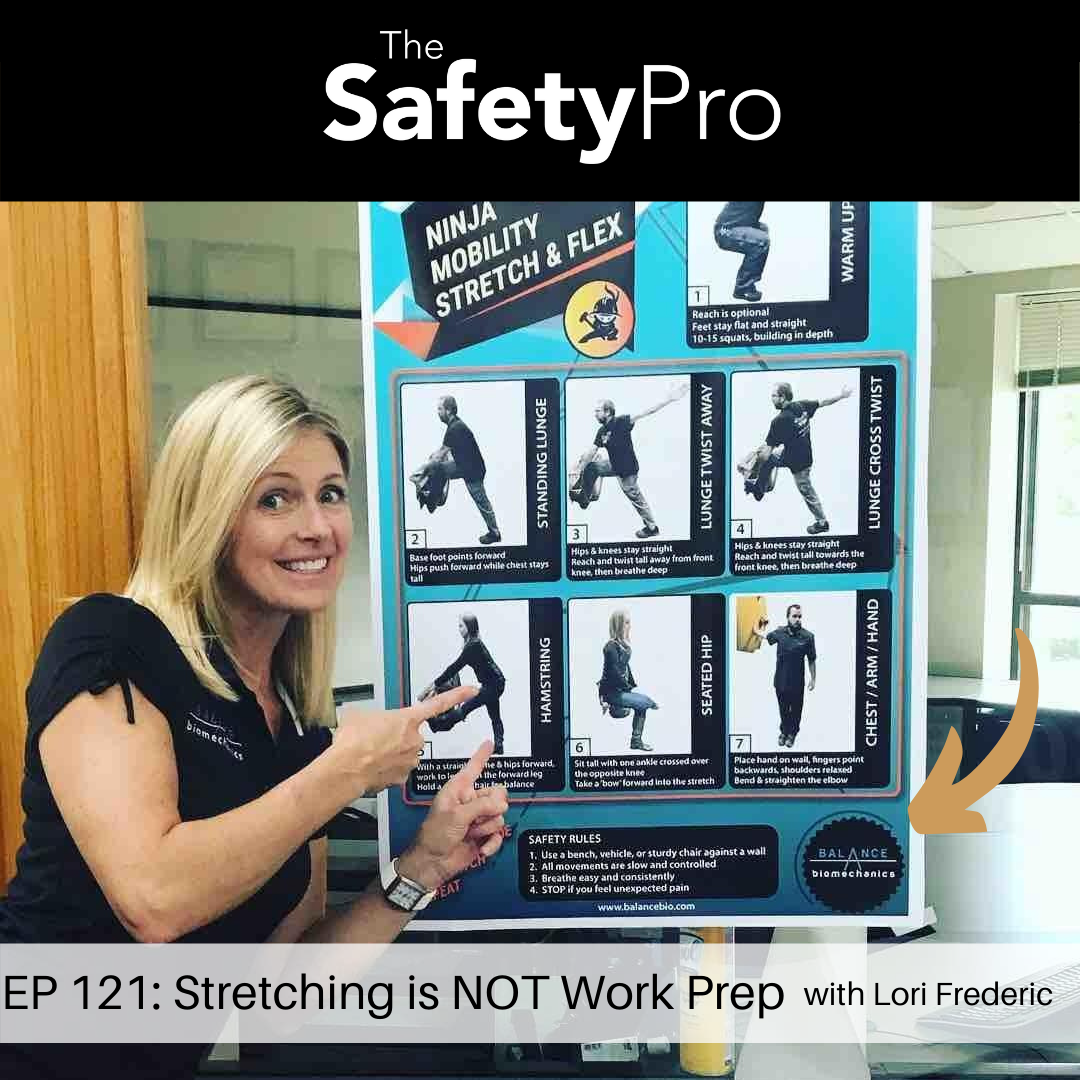 121: Stretching is NOT Work Prep w/Lori Frederic 18.01.2021 46mntJoin the Community of Safety Pros today! After having a private business providing sports massage therapy and strength coaching, Lori wanted to raise her game and reach more people. She quickly found a love and respect for the hard-working men and women that make this first-world country thrive. Her biomechanics and movement knowledge complement the world of safety & health to provide an unconventional approach to injury prevention. When Lori isn't inspiring blue-collar badasses, she's hanging with her husband, 3 kids, and 3 dogs. Lori is constantly disrupting, innovating, and inspiring as she speaks across the country to safety and management audiences. You can also catch her on the SafetyPro Community page as well! Please visit www.balancebio.com or www.themovementninja.com/safetypro to subscribe for a free stretch & flex course! **PREMIUM MEMBERS: All SafetyPro Podcast Community Premium Members get a BONUS - a code to unlock Lori's Low Back Pain - Triage course for FREE! A $99.00 value** To get access to premium content like bonus materials, downloads, live chats with the Safety Pro (coming soon) - become a PREMIUM member! Join the Community of Safety Pros today! **Visit MightyLine Tape** Get all your facility marking needs! Request a FREE sample for being a SafetyPro Podcast listener!
Podcast serupa


Populer di
Podcast ini juga muncul di daftar podcast negara-negara ini.
