
The Payments Shed
Grant Evans and Justin Hanna
0
The Payments Shed is a podcast about payments, fintech, and the ideas shaping the future of commerce. It features conversations with business and payments leaders, offering practical insights and strategies from people building the future of business. The hosts are Grant Evans, Justin Hanna, Sarah Stapp, Kara Parkey, Liam Gray, Jasmine Chana, Jason Heister, and Rogier Rouppe van der Voort. The team draws on leadership experience at companies including Global Payments, Worldpay, PayPal, Braintree, Aeropay, MX, Coast, AFT, VGS, Checkout.com, Plaid, and PCN.
Episode
-
 Ep. 121 - Local Payments, Global Scale: Why One Size Doesn’t Work in Payments, with PPRO 07.10.2026 45mntIn the latest episode of The Payments Shed Podcast, Jasmine Chana and Justin Hanna are joined by Nicole Asling, SVP Global Relationship Management at PPRO, for a conversation exploring why there is no such thing as a truly global payments strategy without understanding what customers actually want to use locally.Nicole takes us inside the changing European payments landscape, from the continued evolution of cards and local payment methods to the growth of account-to-account payments, open banking and BNPL. They explore where A2A is genuinely gaining ground, why Europe remains far from a single payments market, and how consumer expectations continue to differ significantly from country to country.The conversation then goes global, comparing Europe with markets across LATAM and the US. Nicole shares her perspective on why some markets have been able to leapfrog traditional payment infrastructure, whether alternative payment methods can genuinely challenge cards in the US, and whether global commerce is ultimately moving towards greater convergence or even more fragmentation.For merchants, that fragmentation creates real complexity. Jasmine, Justin and Nicole unpack what happens when businesses need to support different payment methods, providers and consumer preferences across multiple markets, why simply having access to a payment method isn't enough, and where PPRO fits into the global payments value chain by helping businesses connect to and manage local payment ecosystems at scale.They also step beyond the technology to discuss what it takes to build and lead commercial teams in a global payments business. Nicole shares what she looks for in strong commercial operators, why local market knowledge needs to work alongside a global strategy, and some of the mistakes businesses make when attempting to scale internationally.The conversation also explores Nicole's advocacy for women in payments and financial services, where she believes the industry has made progress and where more work remains. They discuss representation, support and progression into senior roles, as well as what male colleagues and leaders can do to help create more opportunities. Nicole also shares her advice for anyone looking to progress into senior commercial leadership and the importance of performance, visibility and relationships throughout a career.Plus, Nicole steps up for The Payments Shed's legendary Shelf of Shame to nominate one payments trend or industry narrative she'd happily banish forever.***The Payments Shed Podcast is sponsored by Cyclops.Cyclops helps payments companies offer crypto acceptance, stablecoin settlement and payouts through one unified infrastructure platform.Find out more: https://cyclops.finance/***The Payments Shed Podcast is sponsored by Salesloft.Salesloft uses agentic AI to turn buyer, conversation, deal and forecast data into clear actions that help revenue teams sell smarter.Find out more: https://www.salesloft.com***The Payments Shed Podcast is sponsored by Mastercard Open Finance.Mastercard Open Finance enables businesses to use consumer-permissioned financial data to create more connected and personalised financial experiences.Find out more: https://www.mastercard.com/global/en/business/open-finance.html***The Payments Shed Podcast is partnered with PCN.PCN is a global boutique recruitment agency connecting leading talent and businesses across fintech, cybersecurity, SaaS, e-commerce and Salesforce.Find out more: https://teampcn.com/***Disclaimer: Views expressed are those of The Payments Shed Podcast hosts and guests, not their respective employers. Nothing discussed constitutes investment, legal, tax or financial advice.
 -
 Ep. 120 - One Customer. One Revenue Record. Why HubSpot Is Bringing Payments Into the CRM. 05.10.2026 44mntIn the latest episode of The Payments Shed Podcast, Grant Evans and Justin Hanna are joined in New York City by Joe Perro, Group Product Manager, Payments at HubSpot, for a conversation exploring what happens when payments, billing and revenue data stop living outside the CRM and become part of the same system businesses use to manage their customers.Joe explains why fragmented revenue infrastructure creates much bigger problems than simply switching between systems. With quoting, contracts, billing and payments often sitting separately from the customer record, sales and finance teams can end up working from different versions of the truth. They explore why HubSpot sees this as a context problem, and what changes when the complete revenue journey can sit alongside the customer relationship.At the centre of the conversation is HubSpot's Revenue Hub, bringing quoting, contracts, billing and payments together within HubSpot. Joe takes Grant and Justin through the journey from quote to cash, how businesses can connect marketing activity through to paid and expanded ARR, and the deliberate line HubSpot is drawing between becoming the system for managing revenue and trying to replace the ERP.They also explore why payments are becoming part of the wider revenue workflow. Joe explains what it takes to convince businesses to move established quoting, invoicing and renewal processes into their CRM, what a great buyer experience should look like from initial quote through to payment, and why having payments connected to the customer record can change how businesses understand and manage revenue.The conversation then turns to AI and agentic workflows. If an AI agent is expected to take meaningful action across sales and revenue, it needs the right context. Joe explains what breaks when billing and payment information sits in separate systems, where humans still need to remain in the loop, the risks businesses need to consider, and what revenue tasks could become increasingly automated as the underlying data becomes more connected.Finally, Joe shares his own journey through Zapier, ezCater and Indigo to HubSpot, and what he's learned from building commerce and payments capabilities inside a platform used by businesses at huge scale. They discuss the challenges of introducing financial workflows into a CRM, the responsibility that comes with handling something as sensitive as billing and payments, and what has surprised him most about how customers use these capabilities.Plus, Joe steps up for The Payments Shed's legendary Shelf of Shame to nominate one habit, assumption or piece of jargon from the payments or SaaS world he'd happily banish forever.***The Payments Shed Podcast is sponsored by Cyclops.Cyclops helps payments companies offer crypto acceptance, stablecoin settlement and payouts through one unified infrastructure platform.Find out more: https://cyclops.finance/***The Payments Shed Podcast is sponsored by Salesloft.Salesloft uses agentic AI to turn buyer, conversation, deal and forecast data into clear actions that help revenue teams sell smarter.Find out more: https://www.salesloft.com***The Payments Shed Podcast is sponsored by Mastercard Open Finance.Mastercard Open Finance enables businesses to use consumer-permissioned financial data to create more connected and personalised financial experiences.Find out more: https://www.mastercard.com/global/en/business/open-finance.html***The Payments Shed Podcast is partnered with PCN.PCN is a global boutique recruitment agency connecting leading talent and businesses across fintech, cybersecurity, SaaS, e-commerce and Salesforce.Find out more: https://teampcn.com/***Disclaimer: Views expressed are those of The Payments Shed Podcast hosts and guests, not their respective employers. Nothing discussed constitutes investment, legal, tax or financial advice.
 -
 Ep. 119 - Sales Has Changed: Why Most Outbound Is Broken and What Actually Works Now, with Pareto Law 02.10.2026 43mntIn the latest episode of The Payments Shed Podcast, Grant Evans and Justin Hanna are joined by Mesha Wright, Sales Director at Pareto Law, for something a little different, stepping away from payments infrastructure to explore the thing that underpins the growth of almost every business in the industry: sales.Mesha brings a front-row view of how sales teams and talent are evolving across the UK and US. They explore the differences between the two markets, from culture and intensity to the balance between quality and quantity, and what genuinely separates high-performing salespeople and teams from the rest.The conversation then turns to why traditional outbound is struggling. Buyers are more informed, harder to reach and exposed to more sales messages than ever before, yet many businesses are still relying on the same tactics they used a decade ago. Mesha explains what has changed, why simply increasing activity isn't necessarily the answer, and what salespeople need to deliver in that crucial first interaction to actually earn someone's attention.They also get into what it will take to stand out in 2027. From personalisation and personal brand to creativity and relevance, Mesha shares what she's seeing from the strongest candidates and salespeople in the market, alongside the outreach approaches that are still genuinely cutting through.For those looking to break into sales, Mesha explains what Pareto looks for when hiring and developing people with little or no previous experience, what candidates can do before they even apply, and the mistakes that can quickly take someone out of the running. They also discuss how leaders identify genuine potential, develop high performers and create environments where their best people actually want to stay.The conversation also tackles the experience of women in sales. Mesha shares her own perspective on the challenges she's encountered, where the industry has made progress and where gaps remain, as well as what businesses and male colleagues can do to better support and empower women building careers in sales.Plus, Mesha steps up for The Payments Shed's legendary Shelf of Shame to nominate one sales trend or tactic she'd happily banish forever.***The Payments Shed Podcast is sponsored by Cyclops.Cyclops helps payments companies offer crypto acceptance, stablecoin settlement and payouts through one unified infrastructure platform.Find out more: https://cyclops.finance/***The Payments Shed Podcast is sponsored by Salesloft.Salesloft uses agentic AI to turn buyer, conversation, deal and forecast data into clear actions that help revenue teams sell smarter.Find out more: https://www.salesloft.com***The Payments Shed Podcast is sponsored by Mastercard Open Finance.Mastercard Open Finance enables businesses to use consumer-permissioned financial data to create more connected and personalised financial experiences.Find out more: https://www.mastercard.com/global/en/business/open-finance.html***The Payments Shed Podcast is partnered with PCN.PCN is a global boutique recruitment agency connecting leading talent and businesses across fintech, cybersecurity, SaaS, e-commerce and Salesforce.Find out more: https://teampcn.com/***Disclaimer: Views expressed are those of The Payments Shed Podcast hosts and guests, not their respective employers. Nothing discussed constitutes investment, legal, tax or financial advice.
 -
 Ep. 118 - Consent Is the Currency: Who Wins in the Open Finance Economy? - with Mastercard Open Finance 30.09.2026 30mntIn the latest episode of The Payments Shed Podcast, filmed live from New York City, Kara Parkey is joined by Jess Turner, EVP, Global Head of Open Finance & Developer Experience at Mastercard, for a conversation exploring why the future of open finance isn't simply about access to financial data, but about something far more fundamental: earning consumer trust and permission to use it.Drawing on nearly 20 years at Mastercard, Jess reflects on how the payments and financial services ecosystem has evolved, from traditional card infrastructure to a world increasingly shaped by connected data, personalisation and consumer control. They explore what has genuinely changed, how banks, fintechs and merchants are adapting, and why open finance represents a much bigger shift than simply introducing new technology.At the heart of the conversation is consent and the value exchange behind it. Kara and Jess unpack findings from Mastercard's 2026 State of Open Finance research, exploring why consumers are increasingly willing to share their financial data when they understand the benefits, and where providers continue to fall short. From user experience and brand trust to transparency and relevance, they discuss why designing for genuine consumer permission needs to go beyond simply meeting compliance requirements.The discussion also explores how open finance is reshaping credit decisioning, onboarding and customer relationships. Jess shares her perspective on the growing role of permissioned financial data alongside traditional credit reference agencies, and how different consumer attitudes towards data sharing should influence the way businesses design their propositions. They examine the opportunity to create a stronger relationship between consent, personalisation and ongoing customer value.The conversation then turns to AI and the emerging open finance control layer. As artificial intelligence increases the potential value of connected financial data, does consent become an even more important competitive differentiator? Kara and Jess explore the balance between innovation and transparency, who should control permissioned data, and whether AI will ultimately strengthen consumer trust through better financial experiences or introduce new challenges around accountability.Looking ahead, Jess shares what she believes will materially change in open finance over the next three to five years, where the industry may be getting ahead of itself, and what she would approach differently if building an open finance platform from scratch today.Plus, Jess steps up for The Payments Shed's legendary Shelf of Shame to nominate one payments or open finance narrative she'd happily banish forever.***The Payments Shed Podcast is sponsored by Cyclops.Cyclops helps payments companies offer crypto acceptance, stablecoin settlement and payouts through one unified infrastructure platform.Find out more: https://cyclops.finance/***The Payments Shed Podcast is sponsored by Salesloft.Salesloft uses agentic AI to turn buyer, conversation, deal and forecast data into clear actions that help revenue teams sell smarter.Find out more: https://www.salesloft.com***The Payments Shed Podcast is sponsored by Mastercard Open Finance.Mastercard Open Finance enables businesses to use consumer-permissioned financial data to create more connected and personalised financial experiences.Find out more: https://www.mastercard.com/global/en/business/open-finance.html***The Payments Shed Podcast is partnered with PCN.PCN is a global boutique recruitment agency connecting leading talent and businesses across fintech, cybersecurity, SaaS, e-commerce and Salesforce.Find out more: https://teampcn.com/***Disclaimer: Views expressed are those of The Payments Shed Podcast hosts and guests, not their respective employers. Nothing discussed constitutes investment, legal, tax or financial advice.
 -
 Ep. 117 - Better Borrowing Is Built, Not Born: Rewriting the Rules of Consumer Credit, with Loqbox 28.09.2026 49mntIn the latest episode of The Payments Shed Podcast, Grant Evans and Justin Hanna are joined by Tom Eyre, CEO and Co-Founder of Loqbox, for a conversation exploring why the traditional credit system continues to leave millions of consumers behind, and what needs to change if we want to build a fairer route into financial services.Tom takes us inside the story behind Loqbox and the problem the business originally set out to solve. From open banking and alternative data to new approaches to affordability and risk, they explore how much credit infrastructure has evolved, why progress still isn't reaching everyone, and just how difficult it is to change a system built around decades of established thinking.The conversation also tackles the challenge of reaching pre-prime and thin-file consumers before they actually need credit. Tom explains why many people only discover the importance of their credit history when they're rejected for something, and why financial education needs to become more practical, relevant and connected to the financial decisions people make in everyday life.Grant, Justin and Tom then explore whether credit needs to become less focused on someone's financial past and better at recognising behaviour, progress and future potential. They discuss how consumers with little or no traditional credit history can demonstrate financial reliability, what building trust should look like, and why renters, younger consumers and those with thin credit files can still struggle to access mainstream financial products.The discussion also looks at the commercial opportunity in serving these consumers earlier. Rather than simply avoiding customers who don't fit traditional risk models, could lenders build stronger long-term relationships by helping them develop their financial profile over time? Tom shares his perspective on where open banking and alternative data could take the industry next, and the roles fintechs, banks and regulators can play in reshaping consumer credit.Plus, Tom steps up for The Payments Shed's legendary Shelf of Shame to nominate one credit myth or industry assumption he'd happily banish forever.***The Payments Shed Podcast is sponsored by Cyclops.Cyclops helps payments companies offer crypto acceptance, stablecoin settlement and payouts through one unified infrastructure platform.Find out more: https://cyclops.finance/***The Payments Shed Podcast is sponsored by Salesloft.Salesloft uses agentic AI to turn buyer, conversation, deal and forecast data into clear actions that help revenue teams sell smarter.Find out more: https://www.salesloft.com***The Payments Shed Podcast is sponsored by Mastercard Open Finance.Mastercard Open Finance enables businesses to use consumer-permissioned financial data to create more connected and personalised financial experiences.Find out more: https://www.mastercard.com/global/en/business/open-finance.html***The Payments Shed Podcast is partnered with PCN.PCN is a global boutique recruitment agency connecting leading talent and businesses across fintech, cybersecurity, SaaS, e-commerce and Salesforce.Find out more: https://teampcn.com/***Disclaimer: Views expressed are those of The Payments Shed Podcast hosts and guests, not their respective employers. Nothing discussed constitutes investment, legal, tax or financial advice.
 -
 Ep. 116 - Owning the Payments Control Layer: Why Orchestration Is Becoming Mission-Critical, with Fexco payUnite 24.09.2026 42mntIn the latest episode of The Payments Shed Podcast, recorded in London, Grant Evans and Jasmine Chana are joined by Brian Cleary, CEO of payUnite, part of Fexco, for a conversation exploring why payments orchestration is moving from a specialist capability to a mission-critical part of the enterprise payments stack.Brian breaks down what orchestration actually solves and why more merchants are looking for a control layer above their existing payments infrastructure. They explore what happens as businesses outgrow fragmented integrations, multiple acquirers and payment methods, and why having greater control over routing, reporting and performance is becoming increasingly important as payment environments grow more complex.A major focus of the conversation is independence. Brian explains why payUnite's acquirer-agnostic approach matters, how embedded commercial interests can potentially influence routing decisions, and what good optimisation should actually consider across approval rates, cost, geography and customer experience. They also discuss the operational and reporting challenges that can emerge as merchants add more providers to their payments stack.The conversation then turns to FX, DCC and the commercial opportunity within orchestration. Drawing on Fexco's 45-year heritage in foreign exchange, Brian explains how multi-currency capabilities can go beyond reducing payment costs and potentially unlock additional revenue for merchants. They also tackle some of the misconceptions surrounding DCC and where businesses can miss opportunities when managing international payments.Grant and Jasmine also explore some of the complex environments where payUnite operates, including cruise, hospitality and retail. With payUnite powering more than 40% of global cruise payments, Brian explains what makes the sector such a demanding payments environment and how lessons learned there can translate into other large, international merchant verticals.Looking ahead, they discuss what a well-orchestrated payments stack should look like in 2026, the metrics merchants should be optimising, where consolidation and M&A could take the orchestration market, and Brian's ambitions for the next stage of payUnite's growth.Plus, Brian steps up for The Payments Shed's legendary Shelf of Shame to nominate one payments trend or piece of infrastructure he'd happily banish.***The Payments Shed Podcast is sponsored by Cyclops.Cyclops helps payments companies offer crypto acceptance, stablecoin settlement and payouts through one unified infrastructure platform.Find out more: https://cyclops.finance/***The Payments Shed Podcast is sponsored by Salesloft.Salesloft uses agentic AI to turn buyer, conversation, deal and forecast data into clear actions that help revenue teams sell smarter.Find out more: https://www.salesloft.com***The Payments Shed Podcast is sponsored by Mastercard Open Finance.Mastercard Open Finance enables businesses to use consumer-permissioned financial data to create more connected and personalised financial experiences.Find out more: https://www.mastercard.com/global/en/business/open-finance.html***The Payments Shed Podcast is partnered with PCN.PCN is a global boutique recruitment agency connecting leading talent and businesses across fintech, cybersecurity, SaaS, e-commerce and Salesforce.Find out more: https://teampcn.com/***Disclaimer: Views expressed are those of The Payments Shed Podcast hosts and guests, not their respective employers. Nothing discussed constitutes investment, legal, tax or financial advice.
 -
 Ep. 115 - America’s Payments Moment: The Exchange, Not The Processor, with Hello Clever 21.09.2026 45mntIn the latest episode of The Payments Shed Podcast, recorded live from New York City, host Kara Parkey is joined by Justin Grooms, President at Hello Clever, for a conversation exploring why the US could be approaching a major shift in how payments work, and why the future of checkout may be less about processing transactions and more about intelligently matching them to the right payment method, currency and rail.Fresh from his time at Bolt, Justin shares what brought him into the world of real-time payments and why he has joined Hello Clever to lead its US expansion. They explore why the timing matters, with infrastructure such as FedNow and RTP already established, and what still needs to happen for real-time payments and greater payment choice to translate into meaningful adoption at checkout.At the heart of the conversation is Hello Clever's idea of "the exchange, not the processor." Justin challenges the traditional view of payments as plumbing and explains what could change if the point of purchase behaves more like an exchange, dynamically matching transactions with different payment types and rails in real time. They unpack whether the limitations of today's model are driven by technology, incentives or a combination of both.Kara and Justin also get into Clever Connect, how it fits into this exchange model and what happens behind the scenes when payment routing becomes more intelligent. The discussion explores why checkout has arguably remained one of the less dynamic parts of digital commerce, the potential cost of that to merchants, and how data and infrastructure could create a more intelligent point of purchase.Looking ahead to 2031, Justin shares his view on what pay-by-bank at scale could look like in the US, why trust could become an increasingly important competitive differentiator, what greater routing choice could mean for existing payment rails, and where Hello Clever wants to sit as the market evolves.Plus, Justin steps up for The Payments Shed's legendary Shelf of Shame to nominate one payments habit or assumption he'd happily put straight on the shelf.***The Payments Shed Podcast is sponsored by Cyclops.Cyclops helps payments companies offer crypto acceptance, stablecoin settlement and payouts through one unified infrastructure platform.Find out more: https://cyclops.finance/***The Payments Shed Podcast is sponsored by Salesloft.Salesloft uses agentic AI to turn buyer, conversation, deal and forecast data into clear actions that help revenue teams sell smarter.Find out more: https://www.salesloft.com***The Payments Shed Podcast is sponsored by Mastercard Open Finance.Mastercard Open Finance enables businesses to use consumer-permissioned financial data to create more connected and personalised financial experiences.Find out more: https://www.mastercard.com/global/en/business/open-finance.html***The Payments Shed Podcast is partnered with PCN.PCN is a global boutique recruitment agency connecting leading talent and businesses across fintech, cybersecurity, SaaS, e-commerce and Salesforce.Find out more: https://teampcn.com/***Disclaimer: Views expressed are those of The Payments Shed Podcast hosts and guests, not their respective employers. Nothing discussed constitutes investment, legal, tax or financial advice.
 -
 Ep. 114 - Bootstrapped and Unapologetic: Building payments orchestration for different verticals, with Fyntek 17.09.2026 47mntIn the latest episode of The Payments Shed Podcast, recorded live from New York City, Grant Evans and Justin Hanna are joined by Alexander Rea, Founder and CEO of Fyntek, for a conversation exploring what it takes to build a bootstrapped payments orchestration business in one of the most complex corners of the US payments market.Alexander shares why he chose to build Fyntek in the US rather than follow a more traditional UK or European fintech path, and why he decided to do it without venture capital. They unpack the realities of bootstrapping in a category dominated by heavily funded competitors, the trade-offs that come with growing without a VC war chest, and how that decision has shaped everything from Fyntek's product roadmap to its sales strategy.The conversation then gets into the verticals Fyntek has chosen to specialise in, particularly iGaming and sweepstakes. Alexander explains why these businesses face fundamentally different payment challenges, from acceptance rates and chargebacks to cascading, alternative payment methods and banking relationships, and why a general-purpose orchestration platform isn't always built to handle the complexity.They also explore the differences between building payments infrastructure in the US and Europe, including ACH, state-by-state gaming regulation, banking relationships and the challenges international founders can face entering the US market. Alexander shares where regulation helps, where it creates friction, and what merchants themselves could be doing to push the industry forward.Finally, they discuss what it means to compete as a bootstrapped company against orchestration providers with significant outside funding, why Fyntek has prioritised solving specific vertical problems rather than trying to be everything to everyone, and why Alexander is now putting greater focus on visibility, storytelling and building his own profile alongside the business.Plus, Alexander steps up for The Payments Shed's legendary Shelf of Shame to tackle one assumption about building a payments company that raising a big VC round supposedly fixes.***The Payments Shed Podcast is sponsored by Cyclops.Cyclops helps payments companies offer crypto acceptance, stablecoin settlement and payouts through one unified infrastructure platform.Find out more: https://cyclops.finance/***The Payments Shed Podcast is sponsored by Salesloft.Salesloft uses agentic AI to turn buyer, conversation, deal and forecast data into clear actions that help revenue teams sell smarter.Find out more: https://www.salesloft.com***The Payments Shed Podcast is sponsored by Mastercard Open Finance.Mastercard Open Finance enables businesses to use consumer-permissioned financial data to create more connected and personalised financial experiences.Find out more: https://www.mastercard.com/global/en/business/open-finance.html***The Payments Shed Podcast is partnered with PCN.PCN is a global boutique recruitment agency connecting leading talent and businesses across fintech, cybersecurity, SaaS, e-commerce and Salesforce.Find out more: https://teampcn.com/***Disclaimer: Views expressed are those of The Payments Shed Podcast hosts and guests, not their respective employers. Nothing discussed constitutes investment, legal, tax or financial advice.
 -
 Ep. 113 - Cyclops’ Series A and Why Payments Companies Keep Getting Stablecoins Wrong 14.09.2026 49mntIn the latest episode of The Payments Shed Podcast, recorded live from New York City, Kara Parkey and Sarah Stapp are joined by Alex Wilson, Co-Founder and Co-CEO of Cyclops, for a conversation covering Cyclops’ Series A, the next phase of its growth and why Alex believes payments companies need to rethink how they approach stablecoin infrastructure.Alex takes us behind the Series A, including the thinking that goes into choosing investors who understand the payments industry and the difference between simply providing capital and becoming a genuinely strategic partner. They explore why having payments expertise around the table matters when your customers are PSPs, acquirers and processors, and why the wrong investment can sometimes create more friction than value.The conversation also goes back to the origins of Cyclops. Having previously built The Giving Block, sold it to Shift4 and then spent three years building crypto and stablecoin capabilities from inside a major payments company, Alex explains what that experience taught the founding team about the complexity of building this infrastructure yourself, and why they ultimately decided there needed to be a different approach.They unpack Cyclops’ focus on depth over breadth, from integrations across multiple infrastructure layers to global licensing coverage, redundancy and the ability to adapt as payments companies enter new markets. Alex explains why licensing, compliance and infrastructure resilience can quickly turn a seemingly straightforward stablecoin build into a much bigger undertaking, and why the build versus buy conversation is changing as the market matures.Looking ahead, Alex shares where he believes stablecoins in payments are heading over the next 24 months, how regulation and customer demand are shaping adoption, and how the new capital could help Cyclops expand its infrastructure, integrations and market reach.Plus, Alex steps up for The Payments Shed’s legendary Shelf of Shame to nominate one stablecoin promise he’d happily see disappear from the industry.***The Payments Shed Podcast is sponsored by Cyclops.Cyclops helps payments companies offer crypto acceptance, stablecoin settlement and payouts through one unified infrastructure platform.Find out more: https://cyclops.finance/***The Payments Shed Podcast is sponsored by Salesloft.Salesloft uses agentic AI to turn buyer, conversation, deal and forecast data into clear actions that help revenue teams sell smarter.Find out more: https://www.salesloft.com***The Payments Shed Podcast is sponsored by Mastercard Open Finance.Mastercard Open Finance enables businesses to use consumer-permissioned financial data to create more connected and personalised financial experiences.Find out more: https://www.mastercard.com/global/en/business/open-finance.html***The Payments Shed Podcast is partnered with PCN.PCN is a global boutique recruitment agency connecting leading talent and businesses across fintech, cybersecurity, SaaS, e-commerce and Salesforce.Find out more: https://teampcn.com/***Disclaimer: Views expressed are those of The Payments Shed Podcast hosts and guests, not their respective employers. Nothing discussed constitutes investment, legal, tax or financial advice.
 -
 Ep. 112 - Can Agents Do Business? How Blue Language Labs is Making Trust Programmable in the Agentic Economy 10.09.2026 36mntIn the latest episode of The Payments Shed Podcast, recorded live from New York City, Kara Parkey and Sarah Stapp are joined by Zor Gorelov, CEO of Blue Language Labs, for a conversation tackling one of the biggest questions emerging from the agentic economy: AI agents can take actions, but can they actually do business?Zor explains the important distinction between an agent completing a task and making a genuine commercial commitment. The discussion explores what happens when agents begin negotiating, agreeing terms and transacting on our behalf, and why payments alone don't solve the wider challenge of trust, authorisation and accountability between businesses.They unpack where Blue sits within the emerging agentic commerce stack. Rather than acting as another payment rail or processor, Blue connects identity, permissions, agreements, approvals, fulfilment evidence, settlement conditions and accountability into a verifiable commercial process. Zor explains how this complements payment infrastructure and emerging protocols such as AP2 and ACP, and why enabling an agent to pay is very different from enabling it to complete an entire deal.The conversation also gets into one of the biggest questions surrounding autonomous commerce: who authorised the agent? They explore how businesses can define what an agent is allowed to do, where humans should remain in the loop, and how verifiable timelines could provide greater trust when multiple parties and AI agents are working together.Looking ahead, Zor explains why this could unlock more than automation. If agents can safely coordinate complex transactions across multiple businesses, entirely new propositions could be assembled dynamically, potentially opening up opportunities for smaller businesses that today are excluded by the cost and complexity of multi-party commerce. They also discuss why Blue has open-sourced the BLUE protocol, and the case for making the coordination layer a shared standard for the agentic economy.Plus, Zor steps up for The Payments Shed's legendary Shelf of Shame to nominate one payments or fintech habit, assumption or piece of jargon he'd happily banish forever.***The Payments Shed Podcast is sponsored by Cyclops.Cyclops helps payments companies offer crypto acceptance, stablecoin settlement and payouts through one unified infrastructure platform.Find out more: https://cyclops.finance/***The Payments Shed Podcast is sponsored by Salesloft.Salesloft uses agentic AI to turn buyer, conversation, deal and forecast data into clear actions that help revenue teams sell smarter.Find out more: https://www.salesloft.com***The Payments Shed Podcast is sponsored by Mastercard Open Finance.Mastercard Open Finance enables businesses to use consumer-permissioned financial data to create more connected and personalised financial experiences.Find out more: https://www.mastercard.com/global/en/business/open-finance.html***The Payments Shed Podcast is partnered with PCN.PCN is a global boutique recruitment agency connecting leading talent and businesses across fintech, cybersecurity, SaaS, e-commerce and Salesforce.Find out more: https://teampcn.com/***Disclaimer: Views expressed are those of The Payments Shed Podcast hosts and guests, not their respective employers. Nothing discussed constitutes investment, legal, tax or financial advice.
 -
 Ep. 111 - Why Checkout.com is Doubling Down on the US: Growth, Licensing & What Comes Next 09.09.2026 50mntIn the latest episode of The Payments Shed Podcast, recorded live from New York City, Grant Evans and Justin Hanna are joined by Jordan Reynolds, MALPB CEO & Head of North America Banking at Checkout.com, for a conversation exploring why Checkout.com is making a major push into the US and what it takes to compete in one of the world's largest and most established payments markets.Jordan takes us inside Checkout.com's North American strategy, explaining why the US has become such an important growth market, what makes it fundamentally different from Europe and other regions, and how the expectations of US merchants are shaping the company's approach. They also explore why North America has become Checkout.com's fastest-growing region and the role Canada plays in its wider expansion plans.A major focus of the conversation is MALPB, what it is, why achieving the milestone matters, and what it unlocks for Checkout.com and its merchants. Jordan explains the regulatory and operational work behind building stronger banking and acquiring capabilities in the US, and why owning more of the payments stack can make a meaningful difference to performance, control and the merchant experience.The conversation then turns to Checkout.com's evolving US product proposition, including direct acquiring, platforms and issuing. They discuss why direct acquiring is such an important part of the strategy, how Checkout.com plans to differentiate itself in an already competitive market, and where platforms could fit into its next phase of North American growth.Looking ahead, Jordan shares what the next 12 to 24 months could hold for Checkout.com in North America, the opportunities the business is targeting, the challenges that come with scaling in the region, and what merchants should be thinking about as the US payments landscape continues to evolve.Plus, Jordan steps up for The Payments Shed's legendary Shelf of Shame to nominate one payments trend he'd happily banish forever.***The Payments Shed Podcast is sponsored by Cyclops.Cyclops helps payments companies offer crypto acceptance, stablecoin settlement and payouts through one unified infrastructure platform.Find out more: https://cyclops.finance/***The Payments Shed Podcast is sponsored by Salesloft.Salesloft uses agentic AI to turn buyer, conversation, deal and forecast data into clear actions that help revenue teams sell smarter.Find out more: https://www.salesloft.com***The Payments Shed Podcast is sponsored by Mastercard Open Finance.Mastercard Open Finance enables businesses to use consumer-permissioned financial data to create more connected and personalised financial experiences.Find out more: https://www.mastercard.com/global/en/business/open-finance.html***The Payments Shed Podcast is partnered with PCN.PCN is a global boutique recruitment agency connecting leading talent and businesses across fintech, cybersecurity, SaaS, e-commerce and Salesforce.Find out more: https://teampcn.com/***Disclaimer: Views expressed are those of The Payments Shed Podcast hosts and guests, not their respective employers. Nothing discussed constitutes investment, legal, tax or financial advice.
 -
 Ep. 110 - From Connector to Protector: How Plaid is Building the Trust Layer for Intelligent Finance 02.09.2026 42mntIn the latest episode of The Payments Shed Podcast, recorded live from New York City, Grant Evans and Justin Hanna are joined by Brian Dammeir, Head of Payments & Financial Management at Plaid, and Pedro Sanzovo, Head of Fraud at Plaid, for a conversation exploring how open banking is evolving into intelligent finance, and why trust, identity and fraud prevention are becoming increasingly important as AI enters the financial system.Brian takes us through the journey from open banking and account connectivity to a world where AI models can increasingly understand the "language of money", using transaction data, patterns and behaviours to power smarter financial experiences. The discussion explores how Plaid is building models across payments, credit, fraud and risk, how those capabilities intersect, and what it means to put commercial confidence behind that technology through products such as Plaid Guarantee.Pedro then takes us inside the rapidly changing fraud landscape. From first-party fraud and account takeovers to organised fraud rings, synthetic identities and deepfakes, they explore how AI is giving bad actors new tools to operate at scale. Pedro explains why network intelligence across a billion devices and more than 9,000 apps can help identify behaviours and connections that would be much harder to spot from within a single platform.The conversation then turns to the next major shift, agentic finance. As financial services companies introduce AI-powered products and AI platforms begin moving into financial experiences, they discuss what happens when the user interacting with financial infrastructure is no longer necessarily a human. How does identity work when an AI agent is acting on someone's behalf? How should permissions evolve? And how do you retain meaningful human oversight without removing the speed and convenience that makes agentic technology valuable in the first place?Finally, Brian explains why Plaid's role is evolving beyond connectivity towards becoming a broader trust layer for digital finance, and what that shift could mean as payments, data, identity, fraud prevention and AI increasingly converge.Plus, Brian and Pedro step up for The Payments Shed's legendary Shelf of Shame to nominate a payments or fintech industry habit, assumption or piece of jargon they'd happily banish forever.***The Payments Shed Podcast is sponsored by Cyclops.Cyclops helps payments companies offer crypto acceptance, stablecoin settlement and payouts through one unified infrastructure platform.Find out more: https://cyclops.finance/***The Payments Shed Podcast is sponsored by Salesloft.Salesloft uses agentic AI to turn buyer, conversation, deal and forecast data into clear actions that help revenue teams sell smarter.Find out more: https://www.salesloft.com***The Payments Shed Podcast is sponsored by Mastercard Open Finance.Mastercard Open Finance enables businesses to use consumer-permissioned financial data to create more connected and personalised financial experiences.Find out more: https://www.mastercard.com/global/en/business/open-finance.html***The Payments Shed Podcast is partnered with PCN.PCN is a global boutique recruitment agency connecting leading talent and businesses across fintech, cybersecurity, SaaS, e-commerce and Salesforce.Find out more: https://teampcn.com/***Disclaimer: Views expressed are those of The Payments Shed Podcast hosts and guests, not their respective employers. Nothing discussed constitutes investment, legal, tax or financial advice.
 -
 Ep. 109 - Beyond Cards: The Rise of Alternative Payments and Borderless Commerce, with Citcon 02.09.2026 42mntIn the latest episode of The Payments Shed Podcast, recorded in New York City, Grant Evans and Justin Hanna are joined by Casey Bullock, CEO of Citcon, for a conversation exploring how global commerce is moving beyond a card-first world and why alternative payment methods are becoming increasingly important for merchants looking to grow internationally.Casey shares how Citcon is helping merchants navigate an increasingly fragmented payments landscape, enabling access to more than 150 payment methods through a single integration. The discussion explores why the way consumers pay varies so significantly between markets, what merchants risk by relying too heavily on cards, and why offering the right local payment methods can have a direct impact on conversion and international growth.They also unpack the rise of digital wallets, BNPL, pay by bank and other alternative payment methods, including why options such as PIX, WeChat Pay and Naver Pay can unlock entirely new customer bases. Casey explains why payments are becoming an increasingly important part of market-entry strategy, and how merchants need to balance global infrastructure with genuinely local payment experiences.The conversation then moves beyond acceptance to the wider movement of money. Casey shares how payments platforms are evolving to support both pay-ins and payouts, alongside FX and treasury capabilities, and why the next generation of providers could play a much broader role across the entire money lifecycle.Looking ahead, they explore what borderless commerce could really look like, whether cards will remain the dominant global payment method, and why simplifying complexity behind the scenes could be key to making international expansion easier for merchants.Plus, Casey steps up for The Payments Shed's legendary Shelf of Shame to nominate one global payments trend he'd happily banish forever.***The Payments Shed Podcast is sponsored by Cyclops.Cyclops is a crypto and stablecoin infrastructure platform built for payments companies, enabling PSPs, acquirers and processors to offer crypto acceptance, stablecoin settlement and payouts without building their own blockchain stack. It provides a unified solution for pay-ins, pay-outs and fiat-to-digital asset conversion, with simple API or low-code integration.W: https://cyclops.finance/***The Payments Shed Podcast is sponsored by SalesloftPowered by agentic AI, Salesloft's Predictive Revenue System connects live signals from buyer engagement, conversations, deals, and forecast data, turning intelligence into clear, prioritized action. Trusted by more than 4,000 organizations including Adobe, 3M, IBM, and Zoom, Salesloft helps revenue teams move from guesswork to confidence, quarter after quarter.W: https://www.salesloft.com***The Payments Shed Podcast is sponsored by Mastercard Open FinanceMastercard Open Finance helps businesses and financial institutions securely access and use consumer-permissioned financial data to build more connected, personalisedfinancial experiences, spanning payments, account opening, credit decisioning and beyond.W: https://www.mastercard.com/global/en/business/open-finance.html ***The Payments Shed Podcast is partnered with PCN. PCN is a boutique recruitment agency rooted in Amsterdam, driven by a singular mission: connecting top talent with industry leaders. PCN specialises in five core pillars: Fintech, Cybersecurity, SaaS, E-Commerce, and Salesforce, backed by a global network across borders.W: https://teampcn.com/***Disclaimer: Any views or opinions referenced in this podcast episode are our own, or those of our respective guests, and they do not represent any views, opinions, or statements from our respective employers, or those of our guests. Additionally, any views expressed here are not intended as investment, legal, tax, or financial advice.
 -
 Ep. 108 - Payments Without Pause: How BNY Is Building for a 24/7 Financial World 27.08.2026 42mntIn the latest episode of The Payments Shed Podcast, Sarah Stapp and Kara Parkey are joined by Carl Slabicki, Head of Commercial, Global Payments & Trade at BNY, for a conversation exploring what happens when payments, liquidity and treasury move from traditional banking hours to a truly 24/7 financial world. With BNY moving between $3 trillion and $4 trillion in payments every day and safeguarding more than $60 trillion in assets, Carl brings an institutional perspective on one of the biggest infrastructure shifts happening across financial services. The conversation explores why real-time payments are only one piece of the puzzle, and why liquidity, FX, investment products, reconciliation and working capital all need to evolve alongside them.They unpack the shift from batch-based treasury towards continuous liquidity management, how much value can be lost when real-time payment rails sit on top of legacy treasury processes, and why the proliferation of instant payment networks, tokenised deposits and stablecoins could create greater fragmentation without interoperability.Carl also shares how BNY is approaching tokenised deposits and tokenised money market funds, where stablecoins could fit alongside traditional banking infrastructure, and why he believes these different forms of money are more likely to coexist than produce a single winner.The conversation then turns to AI and the operational reality of running financial infrastructure around the clock. Carl explains how BNY is already using AI across operations, engineering, client servicing, forecasting and payment optimisation, including digital employees and AI-assisted development, while retaining humans in the loop for critical decisions.Plus, Carl steps up for The Payments Shed's legendary Shelf of Shame, challenging the idea that innovation, 24/7 finance and greater speed must come at the expense of safety and security.***The Payments Shed Podcast is headline sponsored by Damisa.Damisa is a regulated cross-border payments and treasury infrastructure provider. Using a blend of traditional banking rails and stablecoin technology, Damisa helps businesses move money faster, cheaper, and more transparently across global markets. Its platform supports collections, settlements, disbursements, and liquidity management, while maintaining a strong compliance-first approach. Damisa is building the next generation of global payment infrastructure.Learn more at: https://www.damisa.xyz/***The Payments Shed Podcast is also sponsored by Cyclops.Cyclops is a crypto and stablecoin infrastructure platform built for payments companies, enabling PSPs, acquirers and processors to offer crypto acceptance, stablecoin settlement and payouts without building their own blockchain stack. It provides a unified solution for pay-ins, pay-outs and fiat-to-digital asset conversion, with simple API or low-code integration.Learn more at: https://cyclops.finance/***The Payments Shed Podcast is supported by PCN.PCN is a boutique recruitment agency rooted in Amsterdam, driven by a singular mission: connecting top talent with industry leaders. PCN specialises in five core pillars — Fintech, Cybersecurity, SaaS, E-Commerce, and Salesforce — backed by a global network across borders.Learn more at: https://teampcn.com/***Disclaimer: Any views or opinions referenced in this podcast episode are our own, or those of our respective guests, and they do not represent any views, opinions, or statements from our respective employers, or those of our guests. Additionally, any views expressed here are not intended as investment, legal, tax, or financial advice.
 -
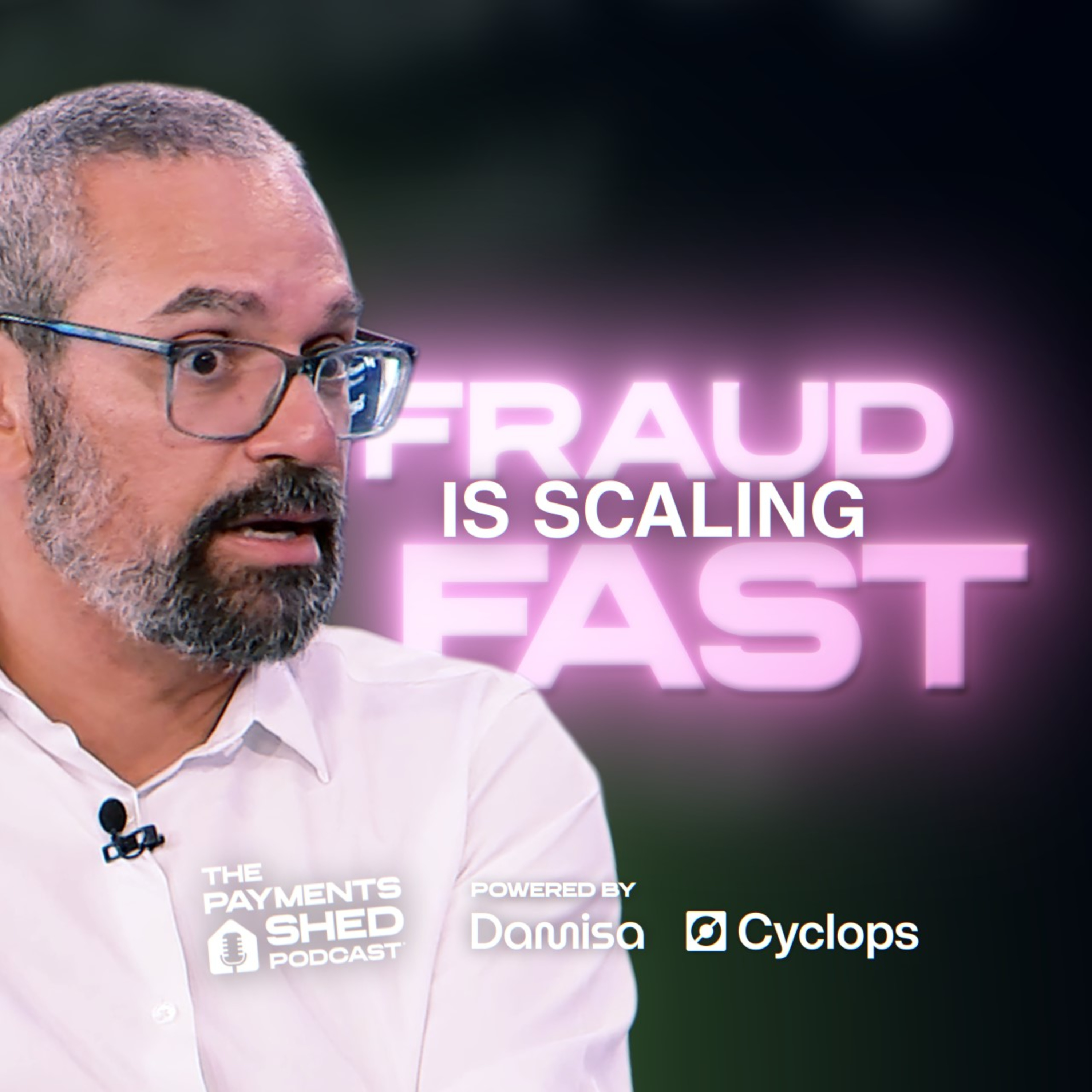 Ep. 107 - Fraud at Machine Speed: Building the Network Defense for the Agentic Payments Era, with Nasdaq Verafin 23.08.2026 47mntIn the latest episode of The Payments Shed Podcast, filmed live from the world famous Nasdaq MarketSite in New York City's Times Square, Grant Evans and Justin Hanna are joined by Mauriceo Castanheiro, VP and Head of International Payments Fraud at Nasdaq Verafin, for a conversation exploring how financial institutions can fight fraud as payments, scams and financial crime increasingly operate at machine speed.Drawing on more than 15 years of fraud prevention experience, including roles at RBC and BMO, Mau breaks down the changing financial crime landscape and why authorised fraud and scams are creating a very different challenge for banks. The discussion explores the growing role of AI on both sides of the equation, and whether financial services is entering an arms race between increasingly sophisticated fraudsters and AI-powered defence.They also unpack why fighting modern financial crime requires moving beyond institution-level rules towards collaborative, network-level intelligence. Mau explains the importance of understanding both sides of a transaction, how consortium data can expose risks that individual institutions cannot see alone, and why cross-border payments become particularly vulnerable as fraudsters search for the path of least resistance.The conversation then turns to the agentic era, including Nasdaq Verafin's Agentic AI Workforce and Agentic Fraud Analyst, how AI agents can support fraud and AML teams, and the entirely new risks created when legitimate AI agents begin initiating payments on behalf of customers. They also explore why national fraud strategies increasingly need collaboration beyond financial services, including technology platforms, social media and telecommunications.Plus, Mau steps up for The Payments Shed's legendary Shelf of Shame to nominate one payments or fraud trend he'd happily banish forever.***The Payments Shed Podcast is headline sponsored by Damisa.Damisa is a regulated cross-border payments and treasury infrastructure provider. Using a blend of traditional banking rails and stablecoin technology, Damisa helps businesses move money faster, cheaper, and more transparently across global markets. Its platform supports collections, settlements, disbursements, and liquidity management, while maintaining a strong compliance-first approach. Damisa is building the next generation of global payment infrastructure.Learn more at: https://www.damisa.xyz/***The Payments Shed Podcast is also sponsored by Cyclops.Cyclops is a crypto and stablecoin infrastructure platform built for payments companies, enabling PSPs, acquirers and processors to offer crypto acceptance, stablecoin settlement and payouts without building their own blockchain stack. It provides a unified solution for pay-ins, pay-outs and fiat-to-digital asset conversion, with simple API or low-code integration.Learn more at: https://cyclops.finance/***The Payments Shed Podcast is supported by PCN.PCN is a boutique recruitment agency rooted in Amsterdam, driven by a singular mission: connecting top talent with industry leaders. PCN specialises in five core pillars — Fintech, Cybersecurity, SaaS, E-Commerce, and Salesforce — backed by a global network across borders.Learn more at: https://teampcn.com/***Disclaimer: Any views or opinions referenced in this podcast episode are our own, or those of our respective guests, and they do not represent any views, opinions, or statements from our respective employers, or those of our guests. Additionally, any views expressed here are not intended as investment, legal, tax, or financial advice.
 -
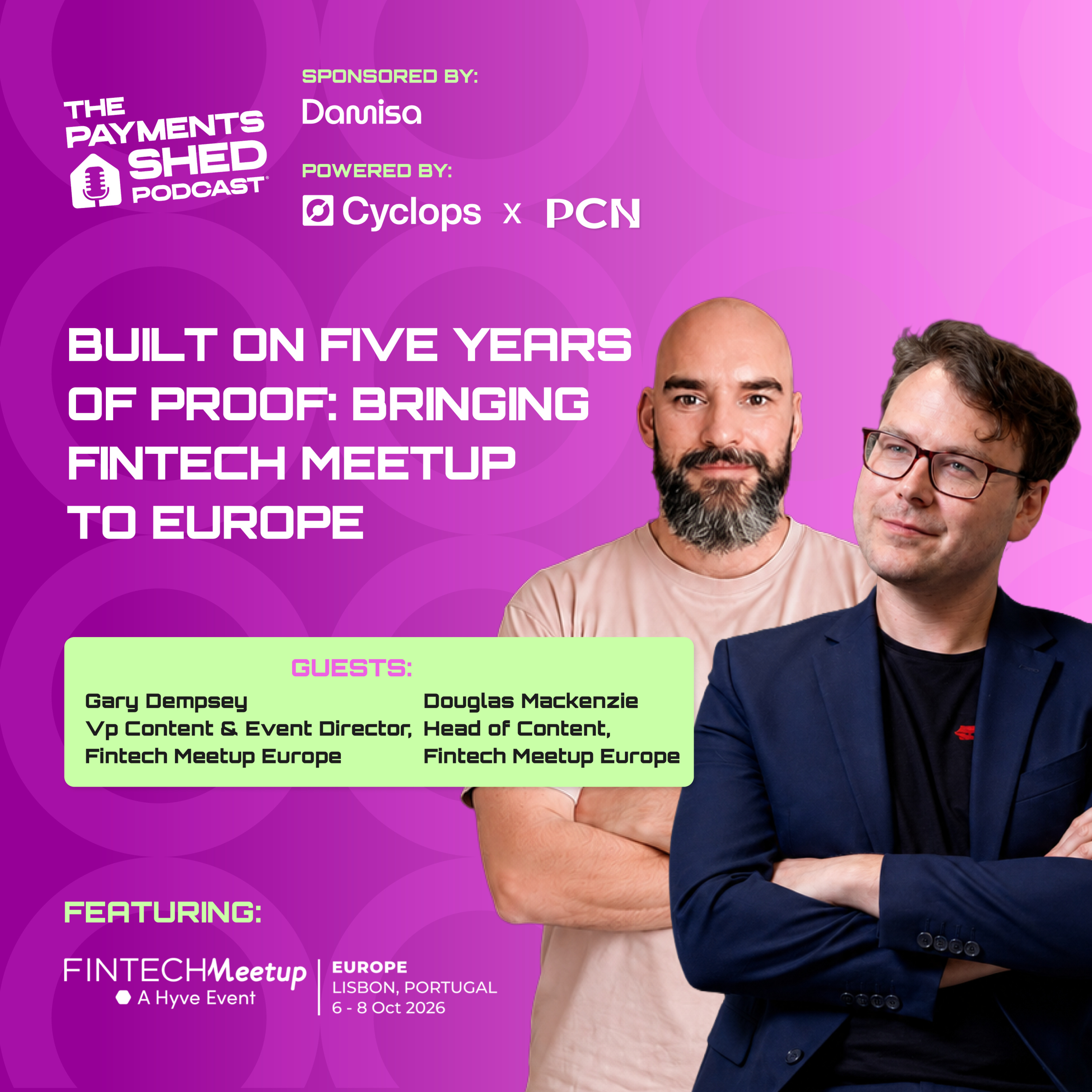 Ep. 106 - Built on Five Years of Proof: Bringing Fintech Meetup to Europe 23.08.2026 22mntIn the latest episode of The Payments Shed Podcast, Grant Evans and Justin Hanna are joined by Gary Dempsey, VP Content & Event Director and Douglas Mackenzie, Head of Content, at Fintech Meetup Europe, for a conversation exploring how one of the fintech industry's biggest meetings-led events is taking its proven US model to Europe.Gary and Douglas reflect on five years of Fintech Meetup in the US, including more than 50,000 meetings delivered and a 92% satisfaction rate, and share the lessons shaping the launch of its first European edition in Lisbon in October 2026. The discussion explores why now is the right time for the expansion, why Lisbon was chosen as its European home, and what needs to change when bringing a successful US event model into a very different fintech market.They also unpack what makes Fintech Meetup's meetings-first format different, including the technology and matchmaking behind more than 25,000 pre-scheduled, double opt-in meetings planned for Lisbon, and why creating meaningful connections between buyers, fintechs and industry leaders has become such an important part of the modern event experience.The conversation also goes behind the scenes of the content strategy, exploring how Gary and Douglas are building the European agenda, what attendees can expect from the speaker line-up, and how Fintech Meetup is balancing high-quality content with an event fundamentally designed to get people meeting, connecting and doing business.Plus, Gary and Douglas step up for The Payments Shed's legendary Shelf of Shame to nominate an events-industry habit, assumption or piece of jargon they'd happily banish forever.***The Payments Shed Podcast is headline sponsored by Damisa.Damisa is a regulated cross-border payments and treasury infrastructure provider. Using a blend of traditional banking rails and stablecoin technology, Damisa helps businesses move money faster, cheaper, and more transparently across global markets. Its platform supports collections, settlements, disbursements, and liquidity management, while maintaining a strong compliance-first approach. Damisa is building the next generation of global payment infrastructure.Learn more at: https://www.damisa.xyz/***The Payments Shed Podcast is also sponsored by Cyclops.Cyclops is a crypto and stablecoin infrastructure platform built for payments companies, enabling PSPs, acquirers and processors to offer crypto acceptance, stablecoin settlement and payouts without building their own blockchain stack. It provides a unified solution for pay-ins, pay-outs and fiat-to-digital asset conversion, with simple API or low-code integration.Learn more at: https://cyclops.finance/***The Payments Shed Podcast is supported by PCN.PCN is a boutique recruitment agency rooted in Amsterdam, driven by a singular mission: connecting top talent with industry leaders. PCN specialises in five core pillars — Fintech, Cybersecurity, SaaS, E-Commerce, and Salesforce — backed by a global network across borders.Learn more at: https://teampcn.com/***Disclaimer: Any views or opinions referenced in this podcast episode are our own, or those of our respective guests, and they do not represent any views, opinions, or statements from our respective employers, or those of our guests. Additionally, any views expressed here are not intended as investment, legal, tax, or financial advice.
 -
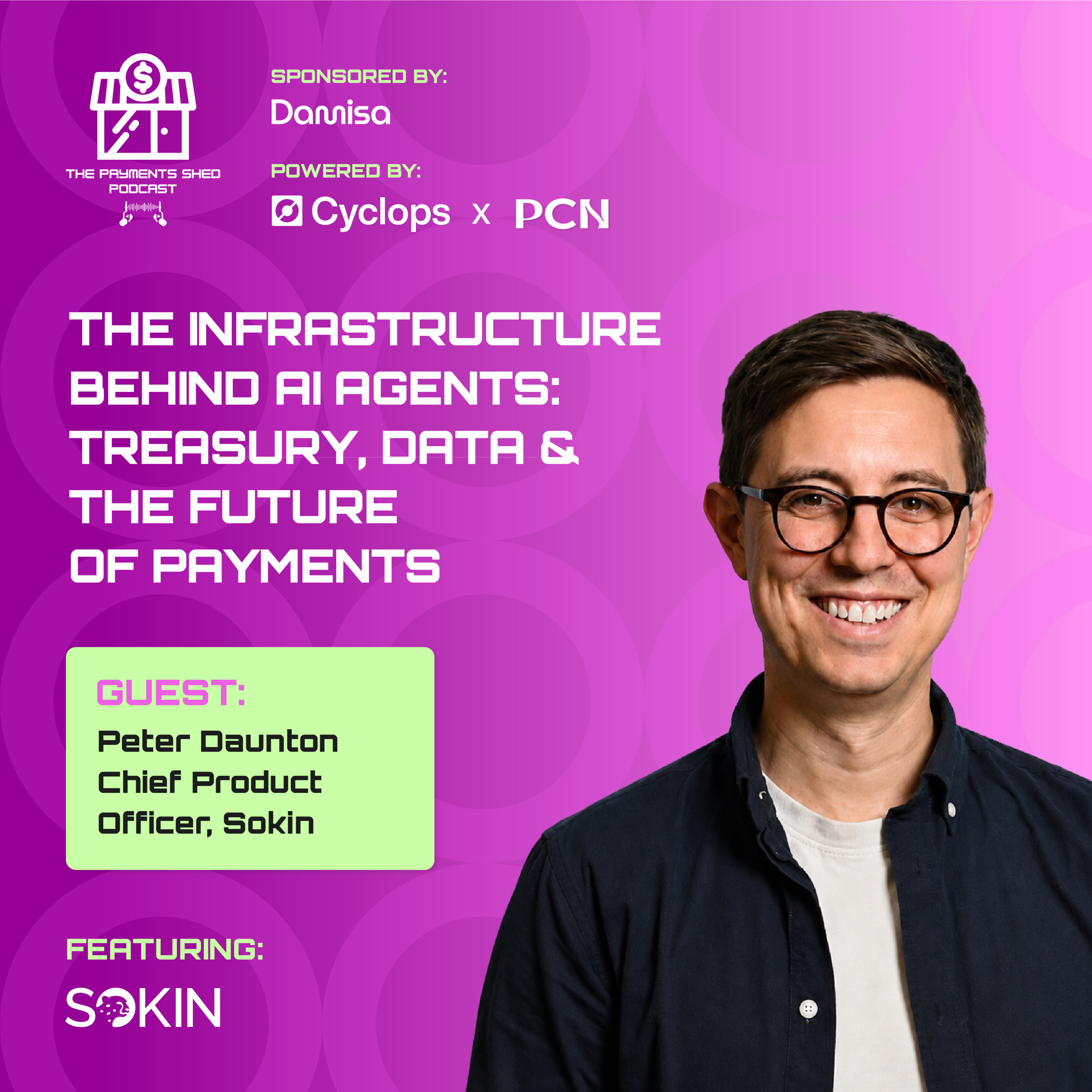 Ep. 105 - The Infrastructure Behind AI Agents: Treasury, Data & The Future of Payments, with Sokin 20.08.2026 46mntIn the latest episode of The Payments Shed Podcast, Grant Evans and Justin Hanna are joined by Peter Daunton, Chief Product Officer at Sokin, for a conversation exploring what happens when AI moves beyond productivity and starts actively running financial and treasury operations.Peter explains why much of today's agentic conversation is focused on the intelligence of the agent, while overlooking the payments, treasury and regulated infrastructure underneath it. The discussion explores what happens when AI agents need to move money autonomously, why infrastructure built around human operators may struggle in a machine-driven world, and what businesses should actually be looking for when choosing the financial rails their agents will run on.They also unpack the convergence of fiat and stablecoin infrastructure, the importance of APIs built for machine consumers, and why licensing, FX, liquidity, cash visibility and treasury capabilities become even more critical when transactions need to happen around the clock. Peter also shares how Sokin's partnerships and infrastructure strategy are helping the business build towards this next generation of global money movement.The conversation also explores Peter's own journey, from studying mechanical and electrical engineering at Oxford to roles at Currencycloud and Visa, before joining Sokin as Chief Product Officer, and how those experiences have shaped his approach to building payments products at scale.Looking ahead, Peter shares his vision for AI-driven treasury over the next three years, where stablecoins fit alongside traditional rails, and what global financial operations could look like when businesses increasingly hand execution over to intelligent systems.Plus, Peter steps up for The Payments Shed's legendary Shelf of Shame with his nomination for something he'd happily banish forever.***The Payments Shed Podcast is headline sponsored by Damisa.Damisa is a regulated cross-border payments and treasury infrastructure provider. Using a blend of traditional banking rails and stablecoin technology, Damisa helps businesses move money faster, cheaper, and more transparently across global markets. Its platform supports collections, settlements, disbursements, and liquidity management, while maintaining a strong compliance-first approach. Damisa is building the next generation of global payment infrastructure.Learn more at: https://www.damisa.xyz/***The Payments Shed Podcast is also sponsored by Cyclops.Cyclops is a crypto and stablecoin infrastructure platform built for payments companies, enabling PSPs, acquirers and processors to offer crypto acceptance, stablecoin settlement and payouts without building their own blockchain stack. It provides a unified solution for pay-ins, pay-outs and fiat-to-digital asset conversion, with simple API or low-code integration.Learn more at: https://cyclops.finance/***The Payments Shed Podcast is supported by PCN.PCN is a boutique recruitment agency rooted in Amsterdam, driven by a singular mission: connecting top talent with industry leaders. PCN specialises in five core pillars — Fintech, Cybersecurity, SaaS, E-Commerce, and Salesforce — backed by a global network across borders.Learn more at: https://teampcn.com/***Disclaimer: Any views or opinions referenced in this podcast episode are our own, or those of our respective guests, and they do not represent any views, opinions, or statements from our respective employers, or those of our guests. Additionally, any views expressed here are not intended as investment, legal, tax, or financial advice.
 -
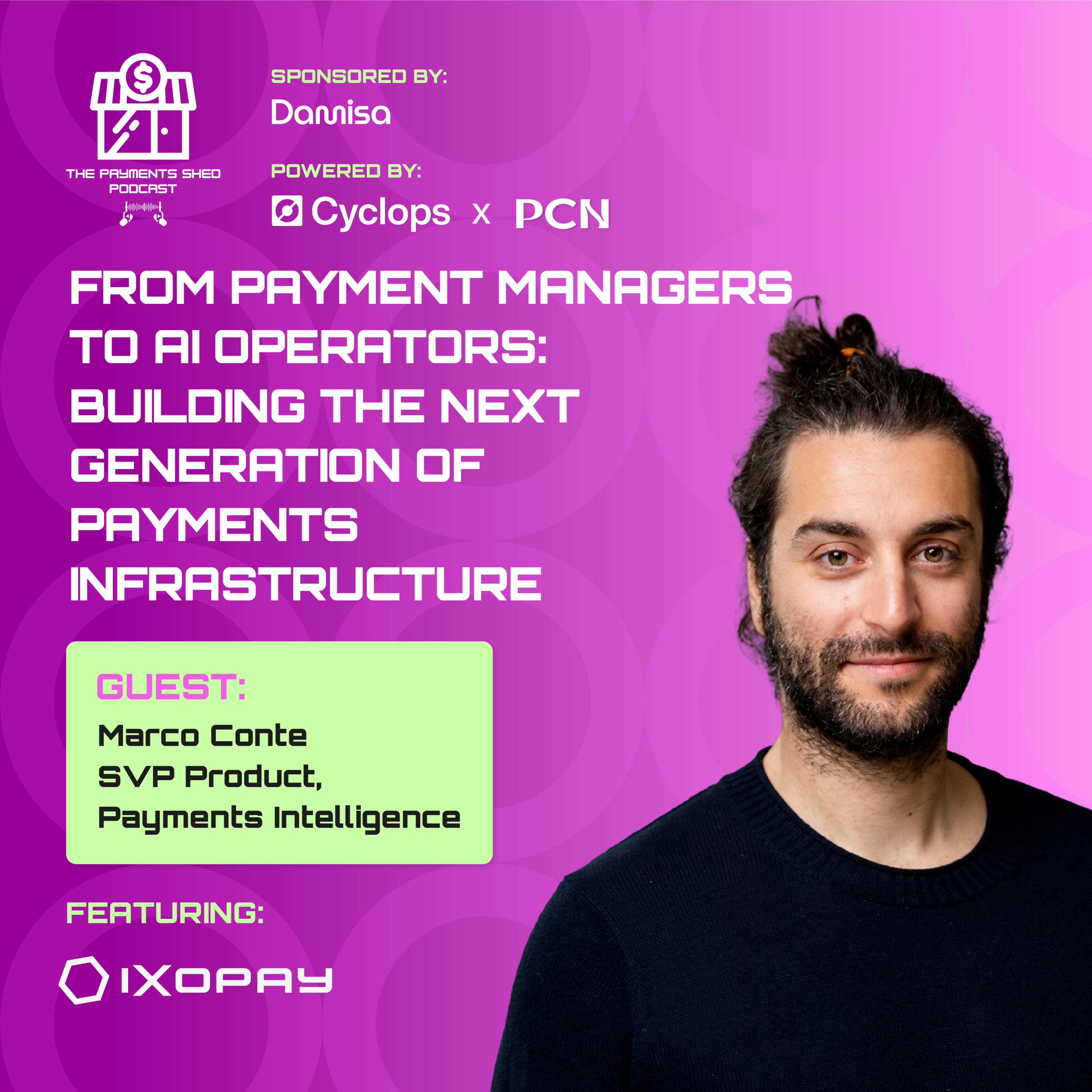 Ep. 104 - From Payment Managers to AI Operators: Building the Next Generation of Payments Infrastructure, with IXOPAY 17.08.2026 43mntIn the latest episode of The Payments Shed Podcast, Grant Evans is joined by Marco Conte, SVP Product, Payments Intelligence at IXOPAY, for a conversation exploring how AI could fundamentally change the way merchants build, manage and optimise their payments infrastructure.Marco breaks down the limitations of today's enterprise payment stacks, from static routing rules and retry logic to fragmented data and infrastructure that can leave revenue on the table. The discussion explores what happens when payments move from rule-based decisioning towards adaptive systems capable of continuously learning and optimising performance.They also unpack where LLMs and AI can genuinely deliver value in payments today, what an AI Payments Assistant could actually do for a large merchant, and why the role of the payment manager could look very different by 2030. Rather than manually operating payment systems, could the next generation of payments leaders become system designers, setting objectives and constraints while AI handles more of the execution?The conversation then turns to agentic commerce and machine-to-machine payments, including who controls payment decisions when AI agents transact autonomously, how risk changes when the buyer isn't human, and whether orchestration becomes more important, rather than less, as payments become increasingly intelligent.Plus, Marco steps up for The Payments Shed's legendary Shelf of Shame to nominate one thing in payments he'd happily banish forever.***The Payments Shed Podcast is headline sponsored by Damisa.Damisa is a regulated cross-border payments and treasury infrastructure provider. Using a blend of traditional banking rails and stablecoin technology, Damisa helps businesses move money faster, cheaper, and more transparently across global markets. Its platform supports collections, settlements, disbursements, and liquidity management, while maintaining a strong compliance-first approach. Damisa is building the next generation of global payment infrastructure.Learn more at: https://www.damisa.xyz/***The Payments Shed Podcast is also sponsored by Cyclops.Cyclops is a crypto and stablecoin infrastructure platform built for payments companies, enabling PSPs, acquirers and processors to offer crypto acceptance, stablecoin settlement and payouts without building their own blockchain stack. It provides a unified solution for pay-ins, pay-outs and fiat-to-digital asset conversion, with simple API or low-code integration.Learn more at: https://cyclops.finance/***The Payments Shed Podcast is supported by PCN.PCN is a boutique recruitment agency rooted in Amsterdam, driven by a singular mission: connecting top talent with industry leaders. PCN specialises in five core pillars — Fintech, Cybersecurity, SaaS, E-Commerce, and Salesforce — backed by a global network across borders.Learn more at: https://teampcn.com/***Disclaimer: Any views or opinions referenced in this podcast episode are our own, or those of our respective guests, and they do not represent any views, opinions, or statements from our respective employers, or those of our guests. Additionally, any views expressed here are not intended as investment, legal, tax, or financial advice.
 -
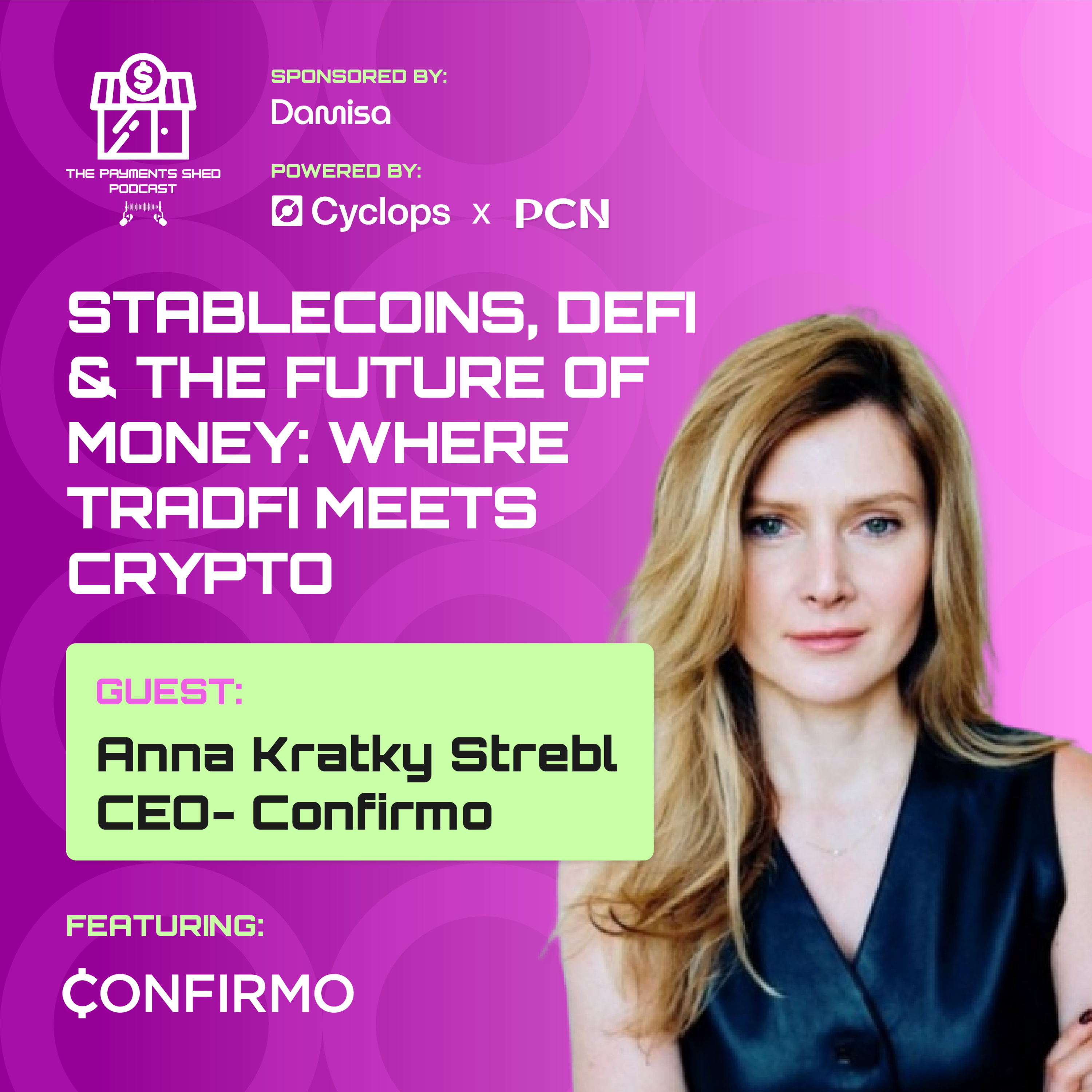 Ep. 103 - DEFI, Stablecoins & The Future of Money: Where TradFi meets Crypto, with Confirmo 13.08.2026 39mntIn the latest episode of The Payments Shed Podcast, Grant Evans and Justin Hanna are joined by Anna Kratky Strebl, CEO of Confirmo, for a conversation exploring the convergence of traditional finance and crypto, and what it means for the future of global money movement.Anna shares the story behind Confirmo and how the business has evolved alongside the crypto payments industry, from the earlier days of digital assets to a market increasingly focused on real-world utility. The discussion explores what is really driving adoption, the balance between regulation and innovation, and how approaches to digital assets continue to differ across Europe, the US and emerging markets.They also unpack the growing convergence between DeFi and traditional financial services, whether these two worlds will eventually become one interconnected ecosystem, and where banks and other established financial institutions fit into that transition.The conversation then turns to stablecoins, exploring where genuine adoption is happening today, why cross-border payments remain one of the biggest opportunities, and what still needs to change before stablecoin infrastructure becomes truly mainstream.Looking ahead, Anna shares what she believes the industry is overhyping, what it is underestimating, and whether crypto will eventually disappear into the background as simply another layer of global financial infrastructure.Plus, Anna steps up for The Payments Shed's legendary Shelf of Shame to nominate one crypto or payments trend she'd happily banish forever.***The Payments Shed Podcast is headline sponsored by Damisa.Damisa is a regulated cross-border payments and treasury infrastructure provider. Using a blend of traditional banking rails and stablecoin technology, Damisa helps businesses move money faster, cheaper, and more transparently across global markets. Its platform supports collections, settlements, disbursements, and liquidity management, while maintaining a strong compliance-first approach. Damisa is building the next generation of global payment infrastructure.Learn more at: https://www.damisa.xyz/***The Payments Shed Podcast is also sponsored by Cyclops.Cyclops is a crypto and stablecoin infrastructure platform built for payments companies, enabling PSPs, acquirers and processors to offer crypto acceptance, stablecoin settlement and payouts without building their own blockchain stack. It provides a unified solution for pay-ins, pay-outs and fiat-to-digital asset conversion, with simple API or low-code integration.Learn more at: https://cyclops.finance/***The Payments Shed Podcast is supported by PCN.PCN is a boutique recruitment agency rooted in Amsterdam, driven by a singular mission: connecting top talent with industry leaders. PCN specialises in five core pillars — Fintech, Cybersecurity, SaaS, E-Commerce, and Salesforce — backed by a global network across borders.Learn more at: https://teampcn.com/***Disclaimer: Any views or opinions referenced in this podcast episode are our own, or those of our respective guests, and they do not represent any views, opinions, or statements from our respective employers, or those of our guests. Additionally, any views expressed here are not intended as investment, legal, tax, or financial advice.
 -
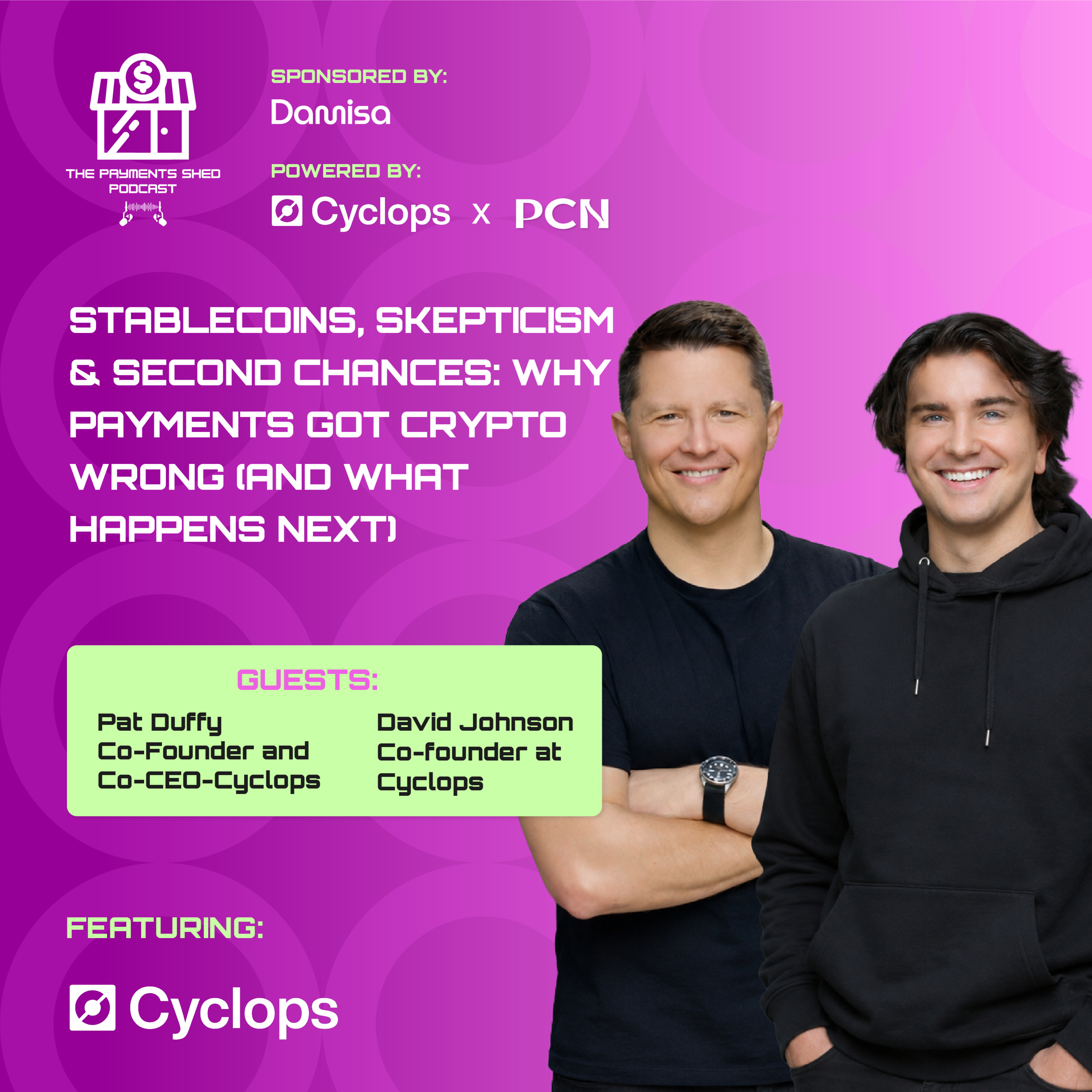 Ep. 102 - Stablecoins, Skepticism & Second Chances: Why Payments Got Crypto Wrong (and What Happens Next), with Cyclops 07.08.2026 50mntIn the latest episode of The Payments Shed Podcast, Grant Evans and Justin Hanna are joined by Pat Duffy and David Johnson, two of the co-founders of Cyclops, for a conversation exploring why the payments industry largely dismissed crypto the first time around, and why stablecoins are now forcing a fundamental rethink.Pat and David reflect on their time at The Giving Block, one of the earliest crypto payments platforms, right through to building Cyclops, sharing the lessons learned from years spent building digital asset infrastructure long before it became a mainstream payments conversation. The discussion explores why traditional payment companies were slow to embrace blockchain technology, how stablecoins have evolved from speculative assets into genuine payment rails, and why merchant demand is now accelerating adoption.They also unpack the role of major industry players, the challenges of integrating crypto into existing payment infrastructure, and why simplicity, compliance, and abstraction will determine which providers succeed over the next decade. Looking ahead, Pat explains where stablecoins deliver the greatest commercial value today, what the industry continues to overhype, and why payments may finally be ready to give crypto a second chance.Plus, Pat and David step up for The Payments Shed's legendary Shelf of Shame to nominate one crypto or payments trend they would happily banish forever.***The Payments Shed Podcast is headline sponsored by Damisa.Damisa is a regulated cross-border payments and treasury infrastructure provider. Using a blend of traditional banking rails and stablecoin technology, Damisa helps businesses move money faster, cheaper, and more transparently across global markets. Its platform supports collections, settlements, disbursements, and liquidity management, while maintaining a strong compliance-first approach. Damisa is building the next generation of global payment infrastructure.Learn more at: https://www.damisa.xyz/***The Payments Shed Podcast is also sponsored by Cyclops.Cyclops is a crypto and stablecoin infrastructure platform built for payments companies, enabling PSPs, acquirers and processors to offer crypto acceptance, stablecoin settlement and payouts without building their own blockchain stack. It provides a unified solution for pay-ins, pay-outs and fiat-to-digital asset conversion, with simple API or low-code integration.Learn more at: https://cyclops.finance/***The Payments Shed Podcast is supported by PCN.PCN is a boutique recruitment agency rooted in Amsterdam, driven by a singular mission: connecting top talent with industry leaders. PCN specialises in five core pillars — Fintech, Cybersecurity, SaaS, E-Commerce, and Salesforce — backed by a global network across borders.Learn more at: https://teampcn.com/***Disclaimer: Any views or opinions referenced in this podcast episode are our own, or those of our respective guests, and they do not represent any views, opinions, or statements from our respective employers, or those of our guests. Additionally, any views expressed here are not intended as investment, legal, tax, or financial advice.
Podcast serupa


Populer di
Podcast ini juga muncul di daftar podcast negara-negara ini.
