
The Sports MAP Network
The Sports Map Network | Nick Kane
0
The Sports MAP Network is a podcast focused on sports physiotherapy and rehabilitation education. Hosted by Nick Kane, it provides insights and knowledge for athletes, coaches, and healthcare professionals. The show covers topics related to injury prevention, treatment, and recovery in sports.
エピソード
-
 Integrated Rehabilitation Framework & the ‘Handover Hangover’ 10.09.2026Lindsay has a wealth of experience, having spent over a decade in the AFL, initially starting as a Rehab Physio and then progressing on to be the Head Physio for the Gold Coast Suns. Lindsay recently returned home from his role at Aspetar Hospital and is now consulting from Gold Coast with elite and sub-elite athletes. In addition, he’s worked with Championship side Bristol City FC and Nottinghamshire County Cricket Club in the UK as well as working as a physiotherapist at the 2012 London Olympic games. We chat with Lindsay to: How the article ‘The Handover Hangover’ came about and why. The Integrated Rehab Continuum and the three key principles of collegiality, alignment & concurrent engagement The Integrated Rehab Continuum in practice; what is looks like in real time. How to ensure all practitioners are on the same page. How to avoid falling into ‘silos’ as a high-performance team. Tissue loading decisions that were changed from insights from the strength team. How to build a strong communication network in the team. How do we best integrate new staff whilst still allowing them to bring their natural skills and expertise? Tips for those not working in elite sport to maintain strong rehab frameworks. The role of medical oversight in rehabilitation. The full article, ‘The Handover Hangover ’, can be found HERE https://www.youtube.com/watch?v=pQRRviV1D0s Do you want to go deeper with your rehabilitation skills? Explore the full library of practical sports physio and rehabilitation-based Masterclassesfor all your CPD/CEU needs with a free 7-day limited-access trial. Explore the Masterclasses Here
 -
 Achilles Tendinopathy in the NBA: A bottom-up approach 26.08.2026Achilles Tendinopathy in the NBA: A Bottom-Up Approach with NBA Physical Therapist Jarred Boyd Achilles tendinopathy is one of the most performance-limiting conditions in basketball — and one of the hardest to manage well across an 82-game NBA season. In this episode of the How I Rehab Podcast, host Nick Kane sits down with NBA Physical Therapist Jarred Boyd (Memphis Grizzlies) to unpack how elite NBA medical staff actually assess, load and progress Achilles and patellar tendon pain, from the first signs of irritability through to full return to play. Jarred holds a Doctor of Physical Therapy and has spent seven seasons working in the NBA, most recently as Director of Rehabilitation for the Memphis Grizzlies. His approach blends first-principles thinking, systems-based reasoning and tissue-specific loading science — aligning every intervention with an athlete's tissue ecology, impulse capacity and neuromechanical readiness. In this episode, Jarred and Nick discuss: How prevalent tendon pain really is in NBA basketball, and why the demands of the modern game are driving it To what extent tendon pain limits participation and performance, even before it stops an athlete playing The "bottom-up" approach to tissue health — building tendon stiffness through morphology and material adaptation, not chasing it directly Three key management principles built around strain: strain magnitude, strain tolerance and strain rate Practical prescription of loading — sets, reps, %1RM and %MVIC for isometric and isotonic tendon work Ideal positioning for tendon loading and adaptation, and why range matters as much as load What the seated calf raise and inner-range calf exercise actually do — and don't do — for Achilles tendinopathy What mechanical fatigue is, and how it shapes in-season load management decisions Addressing the real risk of Achilles tendon rupture, and the role of vertical integration in reducing it Addressing the fear of Achilles rupture in athletes who are managing tendon pain Want to take this from theory into your own clinical practice? Jarred's bottom-up framework blends with Colin Griffin’s Sports Map Masterclass, Athlete Profiling & Rehab for the Calf & Achilles Complex. Colin is a Lower-Limb Rehabilitation Specialist at UPMC Sports Surgery Clinic in Dublin, holds a PhD in Achilles tendon injury rehabilitation and lower limb biomechanics, and spent over 15 years in high performance sport. Colin walks you through objective calf assessment, isokinetic and horizontal jump testing, rehabilitation progressions for the calf and Achilles complex, and the coaching cues you…
 -
 Blister Prevention & Management 11.08.2026In this episode of the How I Rehab Podcast, we sit down with Rebecca Rushton, podiatrist and director of Esperance Podiatry, to dig into a real clinical case on blister prevention and management. Rebecca shares the practical strategies and clinical reasoning she uses to help patients avoid blisters and manage them effectively when they do occur. We chat to: What causes blisters and what is repetitive shear deformation? What are the 5 stages of blisters? Taping is a commonly used method to prevent blisters. Does it help reduce blisters? Should we shave/trimming a callous? Should I pierce or pop a fluid-filled blister? Can you measure shear to help prevent blisters? Prevention of blisters: What works? What does not? What does not work? https://www.youtube.com/watch?v=AoESNZurq90 Do you want to go deeper with your rehabilitation skills? Explore the full library of practical sports physios and rehabilitation-based masterclasses for all your CPD/ CEU needs with a free 7 day limited access trial. https://sportsmap.com.au/masterclasses/
 -
 Rehab Frameworks, Templates and Building Better Systems 27.07.2026In this episode, we sit down with Andy, a clinician working across both Physiotherapy and Strength & Conditioning, to unpack how he plans and progresses rehabilitation once the clinical picture is clear. Andy has over 15 years' experience working within the performance and sports medicine space. His career has spanned teams, individuals, and private-sector clients — ranging from developing youth and collegiate athletes through to Olympic/Paralympic and Professional levels. Andy has a passion for high-performance and sports medicine, with extended interests into leadership, marketing, and wider health and wellness. He thrives working in dynamic, forward-thinking MDT environments and enjoys contributing to the ambitions of athletes and organisations alike. We chat with Andy about: - How Andy plans out his rehabilitation once he has the required clinical information- What Andy means by "co-actives"- How to determine rehab objectives and the "ladder of loading"- How to avoid getting lost in Excel spreadsheets — collating information into an organised format- How to balance field and gym demands, and whose role that is- Working collaboratively across the medical and performance departments- Understanding pathology, and how to plan and adjust accordingly- Planning while staying flexible based on athlete response- Managing risk in rehabilitation — the return to high-speed or high-force demands- How much information to share with the athlete — thinking not "when" the athlete will be ready, but "how" the athlete will be ready- What Game Plan is, and how it can help clinicians Do you want to go deeper with your rehabilitation skills? Explore the full library of practical sports physios and rehabilitation-based masterclasses for all your CPD/ CEU needs with a free 7 day limited access trial. https://sportsmap.com.au/masterclass-library/ Watch the full podcast on YouTube: https://www.youtube.com/watch?v=1jEhmDDPReM
 -
 Integrative Planning for Performance and Rehabilitation 14.07.2026Toby Banfield is an accomplished performance practitioner across a number of sporting codes and elite environments. He is the current Head of Sport Science for Brentford FC in the English Premier League. In this episode, Toby discusses his philosophies and blueprints for performance planning, how his blueprint has allowed him to adapt to a wide range of diverse sporting situations, and the differences and parallels between season planning for a whole team and rehabilitation planning for an individual injured athlete. Topics The Six Step Blueprint for Effective Performance Planning. The Six Step Blueprint for Effective Rehabilitation Planning. How to Plan in an Appropriate Level of Detail and Avoid Common Pitfalls of “Too Much Detail”. “Vertical Integration” for Performance Planning. “Vertical Integration” for Rehabilitation Planning. Non-Invasive Athlete Testing “Everything is a Test”. Do you want to go deeper with your rehabilitation skills? Explore the full library of practical sports physios and rehabilitation-based masterclasses for all your CPD/ CEU needs with a free 7 day limited access trial. https://sportsmap.com.au/masterclasses/ Watch on YouTube https://www.youtube.com/watch?v=sX3YeEbRYdY
 -
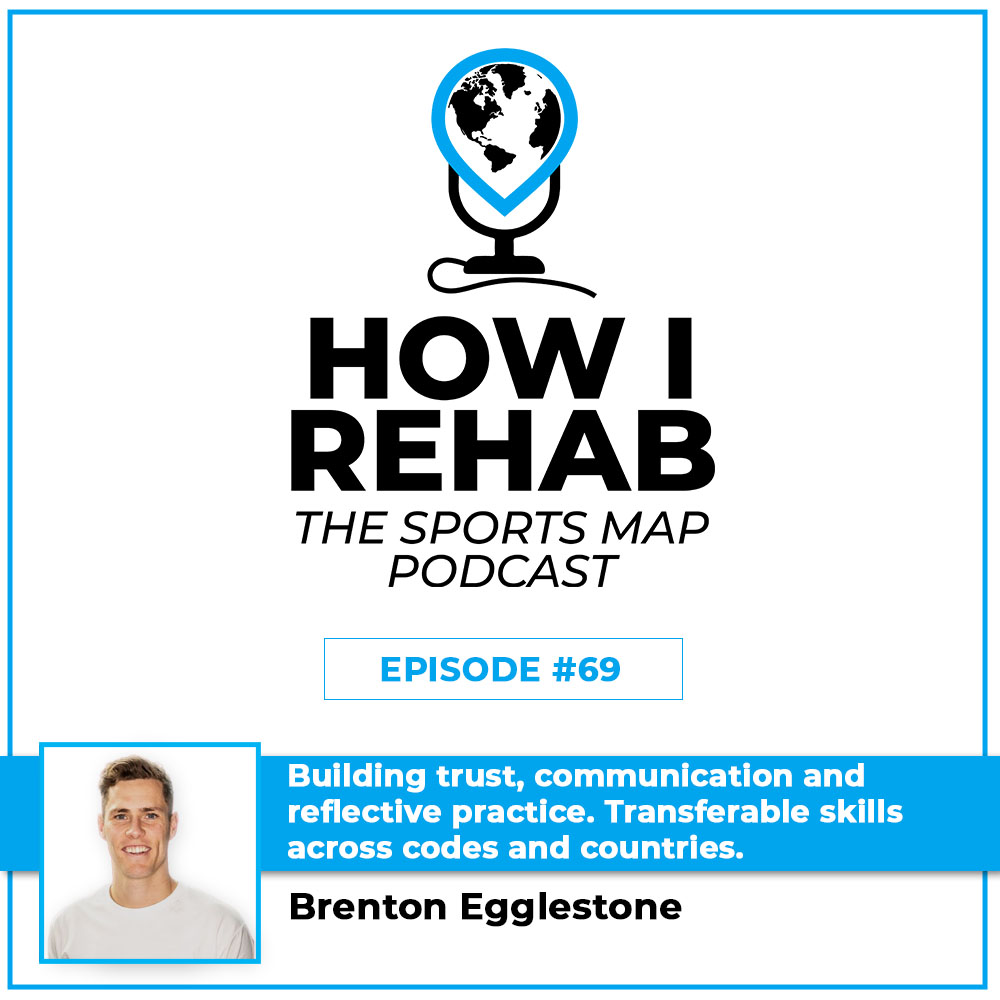 Building trust, communication and reflective practice. Transferable skills across codes and countries 25.06.2026Brenton is the lead performance therapist at the Brooklyn, having recently relocated from his role as head physio in the AFL with the North Melbourne Football Club. Brenton is a Sports Physiotherapist (Master’s in Sports PT) and has previously worked as the Rehabilitation Physio with the Melbourne FC (AFL) and Norwich FC. He has also been a co-founder of Enhance Sports Performance and Rehabilitation since Dec 2016. Topics: Transitioning between elite sports Working in different countries and sports- the cultural shift How to level up your communication & soft skills Building trust with athletes and staff Being reflective as a learning practice Not getting lost in the world of data for decision-making Fundamental rehabilitation principles Navigating High-performance environment pressures Brenton’s lessons, transferable to practitioners Watch on YouTube https://www.youtube.com/watch?v=Fp2kQ1wwos0 Do you want to go deeper with your rehabilitation skills? Explore the full library of practical sports physios and rehabilitation-based masterclasses for all your CPD/ CEU needs with a free 7 day limited access trial.
 -
 Data-Informed and Power-Based Rehabilitation in Sport 10.06.2026Darcy Norman is the current Director of Performance at Chicago Fire FC in the MLS. He is a multi-accredited and accomplished practitioner, especially in the world of soccer. Darcy’s roles have included Performance and Rehab Coach at Bayern Munich FC in the German Bundesliga and for the German national team, including their 2014 world cup winning campaign, the Director of Performance at AS Roma in the Italian Serie A, Head of Performance for the US Men’s National Soccer Team and the Lead Performance Strategist at Kitman Labs. Topics Darcy’s career journey, qualifications, mentors, and his pathway to elite sport and top-flight, international soccer. Data-informed vs. data-driven sports performance and medicine. Defining power. The six components of soccer-specific power. Technical advancements in measuring sport-specific power through GPS monitoring. The “vertical integration” model of injury rehabilitation. Using power as a key metric to guide rehabilitation. WATCH ON YOUTUBE https://www.youtube.com/watch?v=RIoNjY_g6Ck Do you want to go deeper with your rehabilitation skills? Explore the full library of practical sports physios and rehabilitation-based masterclasses for all your CPD/ CEU needs with a free 7 day limited access trial. References: GPS 3.0: https://martin-buchheit.net/wp-content/uploads/2026/02/SPSR280_Buchheit_Final.pdf
 -
 Rehabilitation Systems, Managing Density, Injury Risk & Return to Play 28.05.2026Ben Dixon is the current Head of Strength, Conditioning & Rehabilitation at Millwall Football Club. His prior experience includes roles with Watford FC, Head Performance Coach for the Chinese Olympic Committee, Head of Physical Performance for the Taiwan national football team and the English National Ballet. Topics: Ben fills us in on his post-doctorate to date and what we can expect moving forward. What is ‘match load’? What do we often overlook when it comes to match load? Ben talks about a framework to clarify the construct of match load. What is ‘density ' in practice? How accurate is the data we are getting? How do we include all this information in our rehab systems? Advice around rehabilitation for those without GPS units What do we mean by injury-specific metrics, and how might this be something that can be applied in practice moving forward? What are we missing in our current rehab RTP models in sport of recent times? Individual factors to account for the return to play process. Position demands and rolling windows. What is the post-rehabilitation phase and how can we minimise subsequent injury here? When does rehab actually stop (by definition)? One specific change Ben has made to his rehab system based on his research that other practitioners could implement tomorrow? WATCH ON YOUTUBE https://www.youtube.com/watch?v=W8WqG4C79Ws Do you want to go deeper with your rehabilitation skills? Explore the full library of practical sports physios and rehabilitation-based masterclasses for all your CPD/ CEU needs with a free 7 day limited access trial. References: Ben is undertaking a Professional Doctorate at the University of Central Lancashire, evaluating rehabilitation procedures in professional football. Ben Post Doc Papers: Match load as a construct in professional football: complexities and considerations Evaluating rehabilitation and return to play procedures in male professional football: A narrative review. Post Rehabilitation Phase’ in professional football: are we optimising player support after return to play? References mentioned: Mechanism of Injury of soft tissue injuries research paper summary Mitchell & Gimpel, 2024- A return to performance pathway in professional Soccer Zhang et al 2025. The time course of injury risk and return to Sport in Professional football. Chris Bramah - SMAS Dylan Harper: Assessment of Deceleration
 -
 Running Biomechanics and Return to Run Post ACL-R 13.05.2026In this episode, Dr Daniel Cobian discusses all things running post ACL reconstruction, specifically the research that he and the team at the University of Wisconsin have been looking at regarding running biomechanics changes in post-surgical recovery. How pervasive they are, how we can detect them in the clinical setting, their clinical relevance, and how we can tailor our rehab to address these changes with our athletes. Dr Cobian is an associate professor in the department of orthopedics and rehabilitation at the University of Wisconsin, a faculty member in their doctor of physical therapy program, a research scientist in their athletic performance lab, and works clinically with their student athletes. He has been at the University of Wisconsin for the past 10 years, since completing his PhD from the University of Iowa, focusing on neuromuscular function following knee injury and surgery. Topics: What changes in running biomechanics are observed in athletes after ACL reconstruction and how long post-surgery do these changes last? What are the implications of the athlete continuing to run with these altered biomechanics? How can we assess and detect these changes in a clinical setting without access to expensive 3D motion capture and biomechanical analysis equipment? What are the likely causes of these biomechanical changes? How can we tailor post-surgical rehabilitation to target these changes? WATCH ON YOUTUBE https://www.youtube.com/watch?v=uaYNynwvAqQ Do you want to go deeper with your rehabilitation skills? Explore the full library of practical sports physios and rehabilitation-based masterclasses for all your CPD/ CEU needs with a free 7 day limited access trial. References: Cobian, D. G., Joachim, M. R., Cornelius, J. R., Knurr, K. A., & Heiderscheit, B. C. (2025). Quadriceps Rate of Torque Development Is More Impaired Than Strength 4 to 12 Months Post-ACLR in Collegiate Athletes. Sports Health, 19417381251395745. Knurr, K. A., Cobian, D. G., Kliethermes, S. A., Joachim, M. R., & Heiderscheit, B. C. (2025). Influence of Running Speed and Time Postoperatively on Lower Extremity Work in Collegiate Athletes after Anterior Cruciate Ligament Reconstruction. Medicine and science in sports and exercise, 57(8), 1626–1635. Knurr, K. A., Kliethermes, S. A., Stiffler-Joachim, M. R., Cobian, D. G., Baer, G. S., & Heiderscheit, B. C. (2021). Running Biomechanics Before Injury and 1 Year After Anterior Cruciate Ligament Reconstruction in Division I Collegiate Athletes. The American journal of sports medicine, 49(10), 2607–2614. Knurr, K. A., Cobian, D. G., Kliethermes, S. A., Stiffler-Joachim, M. R., &…
 -
 Concussion and the Role of Physiotherapists 23.04.2026Katie Davies is a highly experienced neurophysiotherapist and Director of the Neuro Rehabilitation Group with a particular interest in concussion management and treatment. Katie holds an honorary appointment at the Murdoch Children's Research Institute (MCRI) as Physiotherapy Lead within a multidisciplinary team researching the management of persisting concussion symptoms in children. Kaite also holds an honorary position at the Turner Institute for Brain and Mental Health at Monash University, where she serves as Physiotherapy Lead on the iRecover study — a research program investigating concussion recovery in adults. Topics: How Katie became interested in concussion What is the role of a physiotherapist in the management of the rehabilitation of concussion? How to advise on graded exposure of exercise the four key systems. What are the recommendations we can educate athletes or families for that immediate period (24-48 hours) post-concussion? When and when not should manual therapy be utilised? How important is neck strength to concussion? When should we assess the autonomic, visual and vestibular system When and who to refer to for non-responding cases. When is an athlete ready to return to play and what compliance should be considered? https://www.youtube.com/watch?v=n3lbWpeC3tw Refences AIS Concussion Guidelines Vicki Anderson Concussion Podcast Anne Mucha VOMS Screening
 -
 Athlete Monitoring for Injury Risk Mitigation 13.04.2026Andrew Proctor is the Senior Physiotherapist at Birmingham FC. Previously, Andrew was the Head of Medical at Bristol Rovers FC, Bristol City FC and Head of Sports Science & Medical at Oxford United FC.Andrew is a Sports Physiotherapist and holds a Master's in Football Science and Rehabilitation. Topics: Andrew’s top priorities when it comes to athlete monitoring. What clinical testing does Andrew use for fatigue measures? What is the difference between the HRIG and Prone ISO testing for hamstring strength measures? What determines a ‘flag’ for an athlete? What is the process that happens if an athlete ‘flags’ on testing? How does the testing information inform practice? What metrics do Andrew & team use for their CMJ? How can we measure the success of our injury monitoring? What on pitch monitoring takes place? How does all this work in a congested schedule? https://www.youtube.com/watch?v=Wivpewm2Q6U
 -
 Integrating Injury Rehabilitation with Performance Data Outcomes 27.03.2026Carlos del Barrio is a Physical Therapist with further training in Strength & Conditioning and Sports Science. He has a strong interest in Sports Science & performance by integrating injury rehabilitation to performance outcomes. Topics: Carlos’ background as a PT and the reasons for adding the S&C and sports science credentials to his education. What is force application (RFD) and why is it important in rehab? How you might coach for RFD and how you can use technology for more clarity of information. What is power and velocity-based training and how it is different to RFD. Methods to training for power in the gym and on the pitch. What is reactivity and why is it important? The ‘go to’ test for reactive strength index (RSI) What to look for with the numbers, yet sometimes more importantly, the force trace. Change of direction profiling Grading deceleration demands. Vertical and horizontal-based velocity training & analysis. https://www.youtube.com/watch?v=kbpm220Ec40 References Chris Bramah - SMAShttps://pmc.ncbi.nlm.nih.gov/articles/PMC11064464/ Dylan Harper: Assessment of Deceleration https://www.researchgate.net/publication/398047566_Assessing_Deceleration_Performance_Methodological_and_Practical_Considerations_Assessing_Deceleration_PerformanceD_J_Harper_et_al
 -
 Career Series: The Transition out of High Performance Sport 06.03.2026We chat with: Fearghal Kerin - Consultant Physiotherapist @ Kerin Performance Kathleen Sakadjian - Sports Physiotherapist AFL Rohan Hattotuwa - Sports Physiotherapist AFL We talk to: The decision to leave working in HP Sports. Determining your value in your role and organization Was the role fulfilling one's original expectations? How to prepare for the transition. What are some hidden costs of working in HP sport? What advice would you pass on to your younger self? What skills, connections, or experiences can clinicians in HP Sport leverage? What are the fears about leaving a role in HP Sport? What clinicians miss from working in HP Sport https://www.youtube.com/watch?v=BkANFOzG4Vs
 -
 Career Series: Female Clinicians in High Performance Sport 26.02.2026We chat with: Stefanio Rizzo: NBA Physical Therapist Lauren Hanna: Sports Physiotherapist (AFL & Matildas) Sallie Cowan: Associate Professor, University of Melbourne We talk to: How did our guests land their first role within professional sport? How gender or sexual orientation can impact opportunities in high-performance sport Does having fewer women in the HP system currently limit future women entering it? What can early-career women do if they want to improve thier networks for future opportunities? Why the research shows female clinicians are more likely to work with women, rather than male athletes. How can mixed-gender staffing be improved? Gender harassment in sport. What does this look like? How can organisations better support female clinicians around pregnancy & caring responsibilities (and their partners)? One thing you would do to improve conditions for female clinicians, what would it be? https://www.youtube.com/watch?v=jwbLR5yGnkY References You have to work twice as hard as a woman to show that you are competent. Experiences, opportunities and workplace gender harassment for Sport and Exercise Medicine practitioners working in elite sport in Australia. Sallie M Cowan, Michael Girdwood, Melissa Haberfield, Andrea Britt Mosler, Andrea M Bruder, Kate Mahony, Kirsty Forsdike, Nicola McNeil, Kate A Beerworth, Miranda Menaspa, Phillipa Inge, Sue White, Rachel Harris, Adam Castricum, Kay M Crossley VIEW Article Women navigating the sports therapy playing field Lauren Hanna VIEW Article
 -
 Career Series: Career Longevity in Elite Sport 19.02.2026How to last a long time in Professional Sport? What does it take? What are the sacrifices? What are the rewards? Are you looking for career longevity working in Sport? Hear from our esteemed guests who are very open and share their learnings, vulnerabilities and experiences to help clinicians navigate their own career journey. A big thanks to our guests for joining us: Maggie Bryant: President for Performance Health & Wellness at the LA Clippers (NBA) Darren Burgess: Director of Performance at Juventus FC Byron Field: Head Physiotherapist at the Australian Wallabies Rugby https://www.youtube.com/watch?v=wANSLun0N8s
 -
 Career Series: How to Get a Job in High Performance Sport 11.02.2026In this first episode of our 4-part series, we get some great insights into how to get a job in High Performance Sport from our experts. Paula Peralta - Head of Medical Australian Opals Chris Bell - Head of Medical Western Bulldogs (AFL) David Clancy - Recruitment - Nxt Level Group https://www.youtube.com/watch?v=PvSn43hFBsY
 -
 Clinical Cases: Hamstring Tendinopathy in a Female Hockey Athlete 30.01.2026Aidan is an APA Sports and Exercise Physiotherapist with over 18 years’ experience working with sports medicine conditions. Aidan is a current PhD candidate (Physiotherapy for proximal hamstring tendinopathy). Aidan has a strong interest in endurance sports as a He lectures at Australian Physiotherapy Association courses and convenes the education program for Lifecare in Victoria. We chat extensively with Aidan about: Insights into Rich’s PhD on proximal hamstring tendinopathy (PHT) Case presentation Differential Diagnosis Contributing factors Education & psychological screening The use of Shockwave for PHT Early loading for PHT Where and why do isometrics fit? Balancing strength loading for both in-season and off-season management. Isotonic loading parameters How much influence do we put on the patient's pain rating (VAS) Counter augments to the ‘compression theory for tendons Addressing the kinetic chain Return to stretch-shorten cycle exercises. Graded return to sports participation Ongoing ‘prevention’ of PHT after a Return to sport. https://youtu.be/bx6oxwhVPb0 Additional References Treatment of Proximal Hamstring Tendinopathy with Individualized Physiotherapy: A Clinical Commentary Education, rapport and convenience are key to participants’ perceptions of receiving physiotherapy or shockwave for proximal hamstring tendinopathy: a qualitative study Physiotherapy Compared With Shockwave Therapy for the Treatment of Proximal Hamstring Tendinopathy: A Randomized Controlled Trial
 -
 The Female Athlete Reducing the Injury Risk 17.12.2025Mel Haberfield and Brooke Patterson are leading sports physiotherapists with expertise at the intersection of elite performance and cutting-edge research. Mel has worked extensively in elite sport across basketball, gymnastics, and the AFL, and is currently completing a PhD focused on knee injuries in athletes. Her work bridges high-performance sport and evidence-based injury prevention and rehabilitation. Brooke is an Australian Research Council Early Career Industry Research Fellow whose research is shaping the future of knee injury and concussion prevention in women’s Australian Football. Her PhD examined the long-term impact of ACL reconstruction on young adults, including early osteoarthritis, symptoms, and quality of life. A former elite Australian footballer and semi-professional basketball player, Brooke also brings firsthand experience as an elite-level coach, giving her a unique athlete-to-clinician perspective. In this episode of the How I Rehab podcast, Mel and Brooke share their initial motivation in dedicating their careers to improving female athlete health. As well as discussing: Gender bias in elite sport and actionable changes that are required to improve this moving forward. How clinicians can implement the Prep-to-Play program at a community and sub-elite level. What do women want when it comes to their knee health? What did the FAIR consensus tell us about modifiable risk factors for injury? Key considerations for female athlete rehabilitation post ACL Injury - the 7 key clusters. The TRAIL-W - Knee health, and associations with female-specific health, physical, psychological, and social-gendered factors in women runners. https://youtu.be/uFnVsz_ezAg Additional References Injury prevention for women and girls playing Australian Football: programme cocreation, dissemination and early adopter coach feedback. What Do Women (With Serious Knee Injury) Want to Know About Knee Health? Identifying Research Priorities with a Consumer Advisory Group Considerations for a women’s rehabilitation programme following anterior cruciate ligament reconstruction: a concept mapping approach to enhance women’s outcomes. Modifiable risk factors for lower-extremity injury: a systematic review and meta-analysis for the Female, woman and/or girl Athlete Injury prevention (FAIR) consensus Patterson et al (2024). Injury prevention for women and girls playing Australian Football: programme cocreation, dissemination and early adopter coach feedback. Patterson et al (2022). Evaluation of an injury prevention programme (Prep-to-Play) in women and girls playing Australian Football: design of a pragmatic, type III, hybrid implementation-effectiveness, stepped-wedge, cluster RCT. BMJ Open, 12(9), e062483 Prep to Play program resources
 -
 Scaphoid Fractures, TFCC & Scapholunate Injuries in Combat Sports 09.12.2025Ian Gatt is a highly experienced sports physiotherapist with over 25 years in elite performance environments. He spent a significant portion of his career leading the multidisciplinary services for the Great Britain Boxing Programme, supporting athletes through major international events, including multiple Olympic and Commonwealth Games. Ian is recognised as an Upper Limb Injury Specialist with the UK Sports Institute (UKSI), where he provides expert advisory support to Olympic and Paralympic sports. Ian is the current head of physiotherapy at Inspire Institute of Sport We explore three of the most common combat sport wrist injuries and expand on some of the key management principles, including: TFCC Injuries The Palmer Classification for TFCC injuries Why the location of the injury matters How diagnosis and function provide you with prognostic indicators When surgery may be indicated Scaphoid fractures and the importance of not missing them in your assessment. The importance of the site of fracture (Proximal, waist or distal) Preferred imaging modality When to refer for orthopaedic input Scapholunate ligament injuries & instability How to assess for and manage optimally Key tools to be objective during a rehab process. Strength training around the wrist https://youtu.be/6sqhoawyrbo
 -
 Tendon Loading for Adaptation, Injury Prevention & Performance. 20.11.2025Dr. Keith Baar is a professor and the head of the Functional Molecular Biology Laboratory at the University of California, Davis. He has a PhD in Physiology and Biophysics. Keith has dedicated his career to the study of muscle development and adaptation. His research focuses on understanding the molecular mechanisms behind muscle growth, repair, and the maintenance of muscle mass and function. In this episode, we chat with Keith about: Keith's background The theory of tendon stiffness relative to muscle strength and risk factors Benefits of measuring RFD as a measure of fatigue. Stress shielding and the influence of creep. How Isometric training can be used to load the tendon lesion. Can we apply this method of training for Injury prevention with respect to Achilles tendon ruptures? Why and when to choose yielding and overcoming isometrics in rehabilitation. Optimal loading for Patella tendinopathy. Ramping isometrics for Biceps Femoris IMT strain injuries. Dietary intake recommendations to complement your loading. And more! READ: Minimizing Injury and Maximizing Return to Play: Lessons from Engineered Ligaments READ: Using load to improve tendon/ligament tissue engineering and develop novel treatments for tendinopathy WATCH this episode on our YouTube channel
類似ポッドキャスト


人気の国
このポッドキャストはこれらの国のポッドキャストチャートにも登場します。


