
Learning Experience Design for Changemakers
Renee Koster
0
Most educators start with content. Renee Koster starts with the outcome. Learning Experience Design for Changemakers is a podcast for nonprofit leaders and heart-led entrepreneurs who want to design learning experiences that engage, transform, and last. No hustle culture. No quick fixes. Just purposeful design that serves your learners and scales your impact.
Epizodai
-
 Episode 016: How to Find the Data That's Already Hiding in Your Training Program - A monarch caterpillar count taught me exactly where to look for proof my content is working. 16.09.2026 10minWhat does a swamp milkweed plant have to do with your training program? Renee's backyard ran an accidental experiment this summer, and the results are exactly the kind of data you should be hunting for in your own learning program.In this episode:Why last year's “successful” milkweed patch went completely untouched this yearThe unplanned A/B test that played out in Renee's own backyardHow to spot when two parts of your program are doing the same job — and one is quietly winningWhy you don't need a dashboard or analytics platform to find your own version of this dataThe one question to ask before you copy what's workingHow “purposeful engagement” separates real results from busyworkThis week's homework: finding the milkweed hiding in your own learning ecosystemTimestamps:[0:00] The accidental experiment[1:00] Last year's baseline — one plant, four or five caterpillars[2:00] This year's expansion — swamp milkweed goes in[3:00] The mid-August turn[4:00] Sixteen caterpillars, chrysalises, and butterflies[5:00] Naming the data[6:00] One clear winner, one clear decision[7:00] Become an investigator inside your own business[8:00] Find the two things doing the same job in your program[9:00] The transferable element: purposeful engagement[10:00] “The data's usually loud”[11:00] This week's homework + closeResources & links mentioned:reneeKoster.com/podcast — book a callSubscribe and leave a review, and visit reneekoster.com/podcast to book a call if you want help finding your own version of this data.
 -
Episode 015: Why Your Training Program Keeps Breaking (And How to Fix It) — The one design mistake behind almost every training that falls apart. 09.09.2026 7minIf your training feels like a pile of patches wearing a training's clothes, this episode is your permission slip to stop white-knuckling it alone — and the design method that actually fixes it.In this episode:Why most trainings break down for one very fixable reason (hint: it was never redesigned, just added to)The “shovel test pit” method Renee learned on an archaeology crew — and how it applies to piloting any new trainingWhat learning experience design actually is, in plain termsWhat it looks like when a new hire's first week of training actually sticksThe system side of the fix: why a great training still falls apart without a sturdy place to keep itRenee's free next step for diagnosing where your training is patched instead of designedTimestamps[0:00] Permission to Stop Carrying It Alone[1:15] The Problem: Content-First Training[3:00] The Archaeology Method[4:20] What Is Learning Experience Design?[4:50] Picture This[6:45] Your Next StepResources mentionedFree printable “permission slip” Free 5-day email course on diagnosing patched vs. designed training Grab both at: www.reneekoster.com/podcastSubscribe and leave a review if this reframe landed for you — it helps other program leaders find the show.
-
Episode 014: 3 Behind the Work Highlights — The real roots behind a learning experience design career, straight from the source. 02.09.2026 14minYou know what I do — but do you know who I am underneath it? In this solo episode, I trade the usual teaching format for my own back-to-school exercise: sharing where my work in learning experience design actually comes from — a childhood love of one-room schoolhouses, an archaeology field crew, and the shovel test pits that taught me backwards design before I had a name for it.In this episode:Why I'm doing a "who am I" episode instead of teaching something todayThe one-room schoolhouse dream that's still the root of everything I designHow leading an archaeology field crew — down to shovel test pits — taught me backwards design before I had the term for itThe pivot from adjunct instructor to instructional designer, and the person who named it for meThe credential most people don't expect: I'm also a certified Automate Your Hustle CRM ConsultantThe Roots to Canopy Method, who I actually work with (and who I don't), and why "evergreen" beats "passive income"Timestamps:0:00 — Intro & hook0:45 — Guess my background2:30 — The one-room schoolhouse3:40 — From archaeology to learning design10:35 — How I work11:20 — Who I work with12:20 — More than a resume13:45 — Your turnResources & links mentioned:Newsletter — renekoster.com/newsletterCallback: Episode 13 (learning ecosystems / the gardener thread)
-
Episode 013: Build Your Learning Ecosystem Before It's Ready — How an evolving backyard garden reveals the real secret to organic audience growth. 26.08.2026 11minThree years ago, our backyard was one overgrown bed and a dying greenhouse. Today it's a full ecosystem — herbs, wildflowers, tomatoes, roses, blackberries, a grapevine-wrapped patio, and enough birds, bees, and butterflies to prove it. This episode is about what got us there, and what it teaches about building a learning ecosystem people actually stick around in.In this episode:Why "if you build it, they will come" doesn't mean it has to be finished firstThe one decision (no pesticides) that mattered more than anything we plantedWhat happened the first year — and why almost nothing showed upThe turning point: what we added, what we removed, and what we refused to introduceWhy an ecosystem — garden or business — is never "done," and why that's the pointHow to think about your own course, membership, or audience as something that evolves in seasons, not a launch you either nail or don'tTimestamps:[0:00] Intro — the garden as it looks today[2:30] Year one: the no-pesticides decision, the overgrown bed turned patio, and the quiet first year[4:20] Year two: tomatoes, peppers, and tearing out the greenhouse[5:20] What actually brought the visitors: what we added, removed, and refused[7:15] Present day — why the garden still isn't passive[8:30] The business parallel: building your own learning ecosystem[10:20] Closing — reflection questions + how to keep tendingResources mentioned: Learn more about the Roots to Canopy Method by signing up for the newsletter at www.reneekoster.com/newsletterCall to action: If this metaphor landed for you, subscribe and leave a review — it helps this reach the next multi-passionate coach who's afraid to launch before everything's perfect.
-
Episode 012: You Can't Prove It Worked If You Didn't Design For It — Why most program evaluation fails before the program even starts. 19.08.2026 12minMost of us find out we don't have real proof our program works right when we need it most — writing a report, walking into a renewal call, or facing a board. In this episode, Renee breaks down why that's a timing problem, not a talent problem, and walks through exactly how to fix it before your next program launches.In this episode:The one-sentence test that reveals whether you actually have evidence your program works (most people can't pass it)Why “afterthought” evaluation quietly produces thin data you can't hand to a funder or a boardThe reframe that changes everything: evaluation as a design commitment, not a measurement toolA real example of a program that documented a 50%+ jump in success — with a follow-up email sequence, not a research teamThe land-trust story that shows what happens when your objective and your evidence aren't built togetherHow the milestones you already run (weekly calls, check-ins) can double as evaluation checkpoints without adding new workTimestamps[0:00] Opening — the one-sentence test and why evaluation is a timing problem[1:00] The pattern: evaluation treated as the last step[2:00] The line to remember — you can't retroactively collect data on a transformation you didn't design for[3:00] The reframe: evaluation as a design commitment[5:00] Thin data vs. thick data, and a 50%+ documented success story[6:00] The land-trust example — an objective with no evidence architecture[8:00] Rebuilding a program backward from one observable behavior[9:00] The milestones you already have (weekly calls, check-ins)[10:00] Milestones as evaluation checkpoints — purposeful engagement[11:00] Recap and what's next for the seriesResources mentionedEpisode 6 — on designing milestones — referenced as a companion listen. [LINK TO EPISODE 6]Call to actionSend Renee your evaluation questions or the places you're getting stuck — email with “podcast share” in the subject line, or send a DM. Listener questions will help shape where the series goes next. [email protected] · www.linkedin.com/in/renee-koster
-
 Episode 011: How to Notice the Data You Didn't Plan to Measure — A five-minute habit that turns unplanned observations into your next big idea. 12.08.2026 5minA goldfinch landing on a basil plant isn't data — until it is. In this short one, Renee tells the story behind her most-requested tangent of the summer and what it taught her about the evaluation plans we build (and the ones we don't).In this episode:The true story of the goldfinches that showed up on Renee's basil plant for the first time everHow the story surfaced mid-training-call while teaching program evaluation — and why a participant told her to "cut that out and post it"The goldfinch metaphor: why the best data often shows up somewhere you never designed your program to lookA simple, no-pressure weekly habit for capturing unplanned observations before they disappearA first look at what's coming next on the show: the Evidence Architecture mini-series on program evaluationTimestamps[0:00] Intro — the goldfinch story[0:45] The turn — how a training-call tangent became this episode[1:45] The Goldfinch Metaphor — data you didn't design your program to catch[2:45] More "goldfinches" — coaching calls, content, patterns you almost miss[3:15] This Week's Habit — start your own list[4:00] What's coming — the Evidence Architecture series[4:30] Close — go plant some basilResources mentionedNewsletter: www.reneekoster.com/newsletterReply to any email from Renee with "podcast share" in the subject line — she reads every oneSubscribe to the show, and get on the newsletter for more between episodes. Reply with "podcast share" in the subject line to tell Renee what resonated.
 -
 Episode 010: Kindness Isn't a Skill You Teach — It's One You Model — Krista Spadt on raising empathetic kids one Smile Bag at a time. 05.08.2026 25minWhat if teaching kindness was as simple as a drop of food coloring in a glass of milk? In this episode, Renee sits down with Krista Spadt, founder of The Simple Gifts Project, to talk about how one nonprofit turns small gestures into hospital care packages — and how packing those bags changes the kids doing the packing just as much as the kids receiving them.In this episode:How a 501(c)(3) nonprofit grew out of a $100 candy cane fundraiser and one family's hospital stayWhat's actually inside a Smile Bag, Teen Bag, and Parent Bag — and why each is designed differentlyWhy teaching empathy to second graders is trickier than it sounds (and the one demo that finally makes it click)What happens when high schoolers ask "what else can I do?" after just one volunteer shiftWhy farmers markets and big events under-delivered compared to word-of-mouth and organic referralsThe neighborhood yard sale that turned into 320 donated care bagsKrista's simple answer for anyone who wants to bring more kindness into their own life this weekTimestamps:[0:00] Meet Krista Spadt & The Simple Gifts Project[1:00] Inside the care bags: Smile, Teen & Parent Bags[3:00] The hospitals they serve — and how the need has shifted[4:00] The origin story: candy canes, a hospital stay, and a 2017 leap[7:00] What packing a bag teaches kids about empathy[10:00] A shared memory: Girl Scouts and Meals on Wheels[13:00] The milk-and-food-coloring lesson that makes kindness visible[17:00] What actually gets people to say yes to partnering[22:00] Why small acts are the whole point[24:00] How to get involved with Simple Gifts ProjectGuest bio:Krista Spadt is the founder of The Simple Gifts Project, a 501(c)(3) nonprofit she launched in 2017 after 25 years in education. The organization fills and donates Smile Bags, Teen Bags, and Parent Bags to hospitals across the Philadelphia suburbs, partnering with schools, Scout troops, and families to spread kindness "one smile at a time."Learn more / get involved: simplegiftsproject.orgInstagram: https://www.instagram.com/simplegiftsproject | Facebook: https://www.facebook.com/simplegiftsprojResources mentioned:The Simple Gifts Project — simplegiftsproject.orgCHOP (Children's Hospital of Philadelphia)Doylestown, Grandview, and Abington HospitalsIf this episode resonated, subscribe to Learning Experience Design for Change Makers and leave a review — and go check out simplegiftsproject.org to get your school, troop, or family involved in packing a Smile Bag.
 -
 Episode 009: More Content Isn't Helping Your Students, It's Hurting Them — Why generosity without structure buries your best material instead of delivering it. 29.07.2026 13minYou’ve built the milestones. You’ve built the engagement. Now here’s the last piece of the puzzle: how much content actually belongs in your course — and it’s probably less than you think.In this episode:Why "more content feels safer" is actually avoidance dressed up as thoroughnessThe fuel analogy that shows exactly how much content each milestone needs (hint: it’s not the same amount every time)Why unused content isn’t wasted — it just belongs on a different tree in your ecosystemA real case study: how Teresa trimmed her "Becoming Her" membership without re-recording most of itThe five questions to run on any piece of content you’re not sure belongsHow this final piece completes the full Roots to Canopy frameworkTimestamps[00:00] Recap of the Roots to Canopy series + today’s topic: content[01:00] Content is fuel, not the vehicle — why "more" isn’t automatically better[02:00] The public speaking course example — how much content each milestone actually needs[04:00] Why leftover content isn’t lost — it belongs somewhere else in your ecosystem[06:00] Generosity without structure vs. milestones with direction[07:00] The "give each topic its own tree" principle[08:00] Meet Theresa and her "Becoming Her" membership[09:00] Theresa’s five questions, module by module[10:00] What Theresa ended up with — tighter, not bigger[11:00] Your turn: run one piece of content through the five questions[12:00] Closing thoughts + what’s nextLinks & Resources MentionedRoots to Canopy, Episode 6 — Roots: finding your one person Roots to Canopy, Episode 7 — Trunk: your A to B and milestones Roots to Canopy, Episode 8 — Purposeful engagement Newsletter signup: www.reneekoster.com/newsletterReply to any email with "podcast share" in the subject line to share your results running Teresa’s five questionsTeresa's Becoming Her Membership: https://shemanifestsmoney.com/Follow the show so you don’t miss what’s next. Reply to any email from Renee with "podcast share" in the subject line to share what you found. Not on the email list yet? Sign up at www.reneekoster.com/newsletter.
 -
 Episode 008: 3 Milestones To Make Trainings Actually Work — Two real rebuilds show what happens when every action ties to a milestone. 22.07.2026 13minEmoji drops and polls aren't purposeful engagement — they're decoration. In part 3 of the Roots to Canopy miniseries, Renee draws the line between engagement that just holds attention and engagement that actually reinforces what you're teaching, then rebuilds two real trainings live to prove it.In This Episode:Why "purposeful engagement" has to do two jobs at once — earn attention AND reinforce the milestone in front of itThe one-sentence test to run on every engagement moment you build, before you build itWhy saving all the "doing" for a final project or test backfires on learnersA full rebuild of a safety training, milestone by milestone, using a real near-miss scenarioA full rebuild of a nonprofit's seasonal volunteer onboarding using the same milestone approachWhy the most "boring" trainings — onboarding, safety, compliance — need this the mostTimestamps: [~0:00] Opening — the line between decorative and purposeful engagement[~1:00] Recap: roots, trunk, and where canopy picks up[~2:00] The two jobs of purposeful engagement + the one-sentence test[~3:00] Why back-loaded engagement fails learners[~4:00] Do this now — audit your own training[~5:00] Safety training scenario: the real problem in the room[~6:00] Rebuilding safety training as three action-based milestones[~9:00] Volunteer onboarding scenario: the nonprofit case[~10:00] Rebuilding onboarding as three action-based milestones[~12:00] The real test: fun without reinforcement is still decoration[~13:00] Closing — name the milestone, build the moment, what's nextResources & Links Mentinoed:Episode 6 — the root stage (finding "your one person") Episode 7 — the trunk stage (A-to-B journey and milestones) Newsletter signup — reneekoster.com/newsletter Follow the show so you don't miss part four. If this gave you something to rethink in your own training, reply to any email from Renee with "podcast share" in the subject line.
 -
Episode 007: Stop Teaching Everything: The A-to-B Rule Every Course Creator Needs — Why trying to teach it all is quietly sabotaging your learners. 15.07.2026 16minYou know your person and what you want to teach them — but do you know exactly where you're taking them? In this episode, Renee breaks down the second stage of the Roots to Canopy framework: turning your teaching sweet spot into one clear, reachable transformation, then mapping the milestones that get your learner there.In this episode:Why "teaching everything" (A to Z) exhausts you and your learner — and what to do insteadHow to define your "A to B": one specific, reachable transformation for this course or offerA simple exercise using your own journey to find your learner's next reachable pointWhat a milestone actually is, and how many your learner's journey needsA full walkthrough: 3 milestones for a public-speaking course, from mindset to practiceWhy action-taking (not passive content) is what makes learning "sticky"How milestones make your own content decisions easier when building or revising a courseTimestamps:0:00 — The mistake that happens right after the roots stage1:00 — Welcome back + recap of Episode 62:00 — A to B, not A to Z: why teaching everything backfires3:00 — Finding your own A to B (a reflection exercise)4:00 — What milestones are: the pit-stop metaphor5:00 — The map metaphor: plotting your learner's journey6:00 — The bridge-and-tunnel metaphor7:00 — Case study: a public-speaking course's 3 milestones9:00 — Why action beats passive learning ("sticky learning")11:00 — A note on accessibility: how to use this episode if you can't pause13:00 — Recap: A to B, milestones, and 10-minute chunking14:00 — What milestones do for you as the designer15:00 — Closing: what's next in the canopy + how to share your A to BResources mentioned:Episode 6 — the Roots stage (finding your teaching sweet spot and your one person)[LINK TO EPISODE 6]If this gave you a clearer next step, follow the show so you don't miss Part 3. Want to share the A-to-B journey you landed on? Reply to any email from Renee with "podcast share" in the subject line — she reads and responds to every one. Not on the newsletter yet? Go to www.reneekoster.com/newsletter and sign up!
-
Episode 006: How to Find Your Teaching Sweet Spot in 10 Minutes 08.07.2026 13minA live reflection exercise that turns everything you know into one clear starting point.You know you have something worth teaching — but the second someone asks what your course is actually about, everything comes out at once and it turns into noise. This episode walks you through the exact exercise Renee uses with clients to find the real starting point: the Roots stage of the Roots to Canopy Method.In this episode: Why "more expertise" isn't what's missing — and what actually isThe 2–3 year reflection exercise that instantly surfaces your teaching sweet spotWhy you don't need to be the leading expert, just a few steps aheadHow to name the one person your first offer is actually for (hint: it's not your whole audience)The "cafe test" for understanding how your audience actually consumes what you buildWhy published is better than perfect — and how to pick your first low-tech way to shareHow to tell whether your first piece should be free or paidTimestamps[0:00] Why everything you know isn't a course — it's noise[1:00] Welcome back + recap: backwards design and the birth of Roots to Canopy[2:00] The idea that takes the pressure off: no single offer has to do everything[3:00] The reflection: what would you tell yourself 2–3 years ago?[4:00] That gap is your teaching sweet spot — you don't need to be the leading expert[6:00] Naming the gap in your own words[7:00] Newsletter callout — reneeKoster.com/newsletter[8:00] Finding your one person — the cafe test[10:00] Turning the gap and the person into one small, shareable thing[12:00] Free vs. paid — it's about depth, not length[13:00] Recap: you've already done more than when you hit playResources MentionedNewsletter — reneekoster.com/newsletter (reply with "podcast share" in the subject line to share your reflection)
-
 Episode 005: How to Design a Learning Experience That Actually Transforms 01.07.2026 11minYou have something powerful to teach — but the moment you sit down to design it, the pull toward content takes over. You start listing everything you know, every story, every framework, every caveat. And suddenly it's a wall of water, not a river. This week, Renee shares the origin story of the Roots to Canopy Method: what backwards design gave her, where it left a gap, and the unexpected moment that changed how she designs everything.IN THIS EPISODE:Why even heart-led educators default to content-first design — and why it stalls the learner before they beginWhat Renee discovered in Understanding by Design (Wiggins & McTighe) and why it lit her upThe honest confession: she slid right back into content-first mode when building her own coursesThe gap backwards design doesn't fully solve for generous, heart-led leaders and foundersHow a summit freebie, a blank piece of paper, and a hand-drawn tree became the Roots to Canopy MethodWhat's coming in the next three episodes of this miniseriesYour 60-second listener action: one question to answer before next weekTIMESTAMPS[0:00] Opening — the crashing waves metaphor for content overload[0:45] Welcome and episode intro[1:30] The generous educator's trap: why starting with content fails learners[2:30] Backwards design: the framework that gave me direction[3:30] Understanding by Design — what my instructors taught, and what the book gave me[5:00] The honest confession: I slid back into content-first without realizing it[6:30] The gap: what backwards design doesn't account for[7:00] The summit freebie and the hand-drawn tree that changed everything[8:30] How Roots to Canopy extends, not replaces, backwards design[9:15] Miniseries preview: what's coming in Episodes 006, 007, 008[10:00] Your 60-second listener actionRESOURCES MENTIONEDUnderstanding by Design — Grant Wiggins & Jay McTigheRenee's newsletter: reneekoster.com/newsletterBook a free call: https://api.leadconnectorhq.com/widget/bookings/audience-outcomesSubscribe so you don't miss Episodes 006–008 of this miniseries. And if something in today's episode landed for you, share it with another heart-led educator who's been trying to design their way out of content overwhelm. Leave a review — it genuinely helps the show reach the people who need it most.
 -
Episode 004: 3 Things That Make Any Moment a Learning Experience (Podcast, Coaching, Courses) 24.06.2026 10minHave you ever called what you do a course, a program, or a membership — and felt like something was still slightly off? That feeling might be about more than the name. In this episode, Renee Koster gives you a clear, simple definition of a learning experience and explains why the distinction between learning experience design and instructional design actually changes what you build — not just how you label it.In this episode:Why Renee uses "learning experience" instead of "instructional design" — and what that choice reveals about how she designsA simple, one-sentence definition you can use immediatelyThe difference between passive instruction and active experience — with a medical school example that makes it concreteWhy your podcast, coaching sessions, and LinkedIn articles are already learning experiences (whether you've called them that or not)Where a learning experience designer fits in when you've already got the expertiseHow to know if your program is structured the way it should be — and where to get help when it isn'tTimestamps[0:00] Opening — the question Renee gets asked almost every week[1:30] The definition: what a learning experience actually is[2:45] Learning experience vs. instructional design — and why the difference isn't just semantic[4:00] The medical school example: instruction vs. active engagement[5:15] The shift from "what do I need to tell them?" to "what do I need them to do?"[6:00] Learning experiences beyond courses — podcast, video, articles, coaching[6:45] Shoutout to Kim Parkinson, Podcasting for Your Spiritual Business, Episode 65[7:30] Where learning experience designers fit in with subject matter experts[8:30] CTA and preview of Episode 005 — backwards design and the Roots to Canopy MethodResources & LinksNewsletter: reneekoster.com/newsletterKim Parkinson — Podcasting for Your Spiritual Business, Episode 65: https://podcasts.apple.com/us/podcast/podcasting-for-your-spiritual-business/id1814692686?i=1000771845510Episode 002 — Learning experience at the Philadelphia Zoo: https://podcasts.apple.com/us/podcast/learning-experience-design-for-changemakers/id1896864819?i=1000771981510If this episode is landing for you and you're looking at something you've already built wondering if it's structured the way it should be, that's exactly what Renee's newsletter is for. Get on the list at reneekoster.com/newsletter — she reads every reply.
-
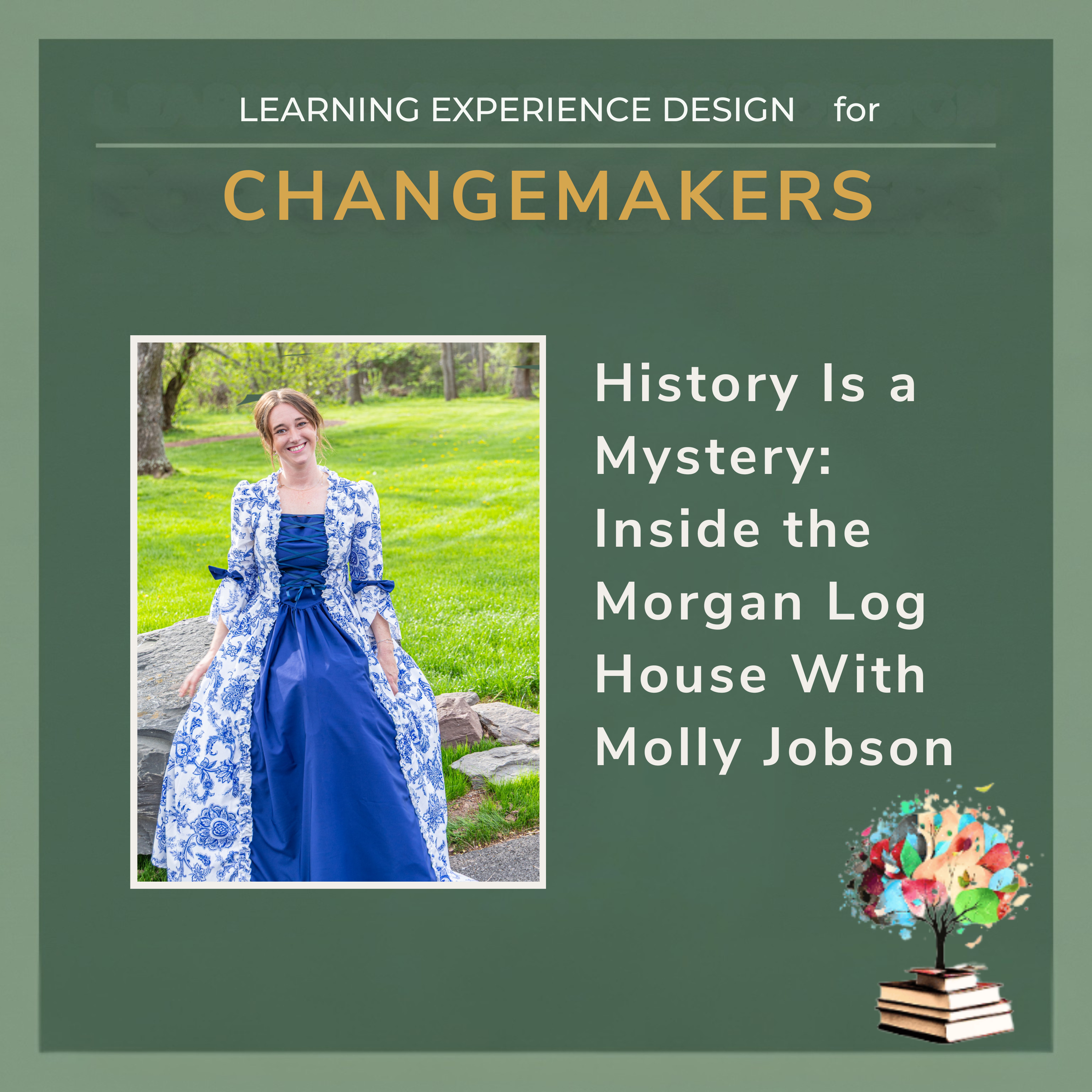 Episode 003: History Is a Mystery: Inside the Morgan Log House With Molly Jobson 17.06.2026 33minA 1774 home, a curious executive director, and the untold stories she's determined to unravel.What does it take to turn a 250-year-old log house into a living, breathing piece of its community? In this episode, Renee sits down with Molly Jobson, executive director of the Morgan Log House, to find out — from her winding path into museum leadership to the food drives and descendant volunteers that keep the house alive today.In this episode:Why Molly's Wisconsin childhood — and a museum called Old World Wisconsin — sparked a lifelong love of historyThe unconventional 15-year career path that took her from a $75-a-week internship to running her own museumHow a Mennonite family's pacifist history shaped Morgan Log House's approach to its own 250th-anniversary programmingWhy “history is a mystery” is more than a motto — it's how Molly gets kids (and skeptical adults) hookedThe food drives, Toys for Tots donations, and descendant volunteers that turn a museum into a true community hubThe rope bed story behind “sleep tight, don't let the bedbugs bite” — and other moments that make history click for visitorsTimestamps:[0:00] Introduction[2:30] Molly's Love of History[11:00] Career Journey to Morgan Log House[20:30] Morgan Log House & Community[28:30] Favorite A-Ha Moments[32:30] Visit & ConnectAbout the guest:Molly Jobson is the executive director of the Morgan Log House in Lansdale, Pennsylvania, a historic home museum interpreting life from 1774 to 1964. She holds a B.A. in history and anthropology from Ripon College and an M.A. in public and applied history from Southern New Hampshire University. Before joining Morgan Log House in 2023, she held roles at Grey Towers National Historic Site, the Harbor District in Milwaukee, and Historic Bethlehem.Website: www.morganloghouse.orgEmail: [email protected]: Facebook, Instagram, and LinkedIn — search “Morgan Log House”Resources & links mentioned:Old World Wisconsin (open-air museum) — https://oldworldwisconsin.wisconsinhistory.org/Grey Towers National Historic Site — https://www.fs.usda.gov/greytowersHistoric Bethlehem — https://www.historicbethlehem.org/Call to action:If this episode resonated, subscribe to Learning Experience Design for Change Makers and leave a review — it helps more change-makers like Molly find the show.
 -
 Episode 002: Immersive Learning: How to Design for Real Engagement 10.06.2026 14minWhat a tiger at the Philadelphia Zoo taught me about course designI stood in front of the big cat exhibit at the Philadelphia Zoo and had a full curriculum design realization — and this episode is about what I learned.The Philadelphia Zoo's Zoo360 is a network of trails that lets animals roam freely through the zoo. The day we visited, a tiger was walking past the lunch tables. Ten feet away. And it changed how I think about learning design.Because the zoo didn't have to do that. They could have put up a sign with facts about tiger behavior. Instead, they built an environment — and that's the shift I want you to make in your course, program, or training.In this episode we cover:The difference between an information panel and an immersive environmentWhy "purposeful engagement" is not a quiz bolted on at the endThree concrete ways to design contact into your existing contentA 10-minute engagement audit you can do on your last module todayThe goal isn't for your learners to finish your module. It's for their minds to make real contact with the material. That's when something actually changes.🎙️ Learning Experience Design for Changemakers is for coaches, educators, and nonprofit leaders who have a course, membership, or program out there — and know it can be better.👉 Want a thinking partner for your engagement audit? Book a free Audience & Outcomes call: https://api.leadconnectorhq.com/widget/bookings/audience-outcomes
 -
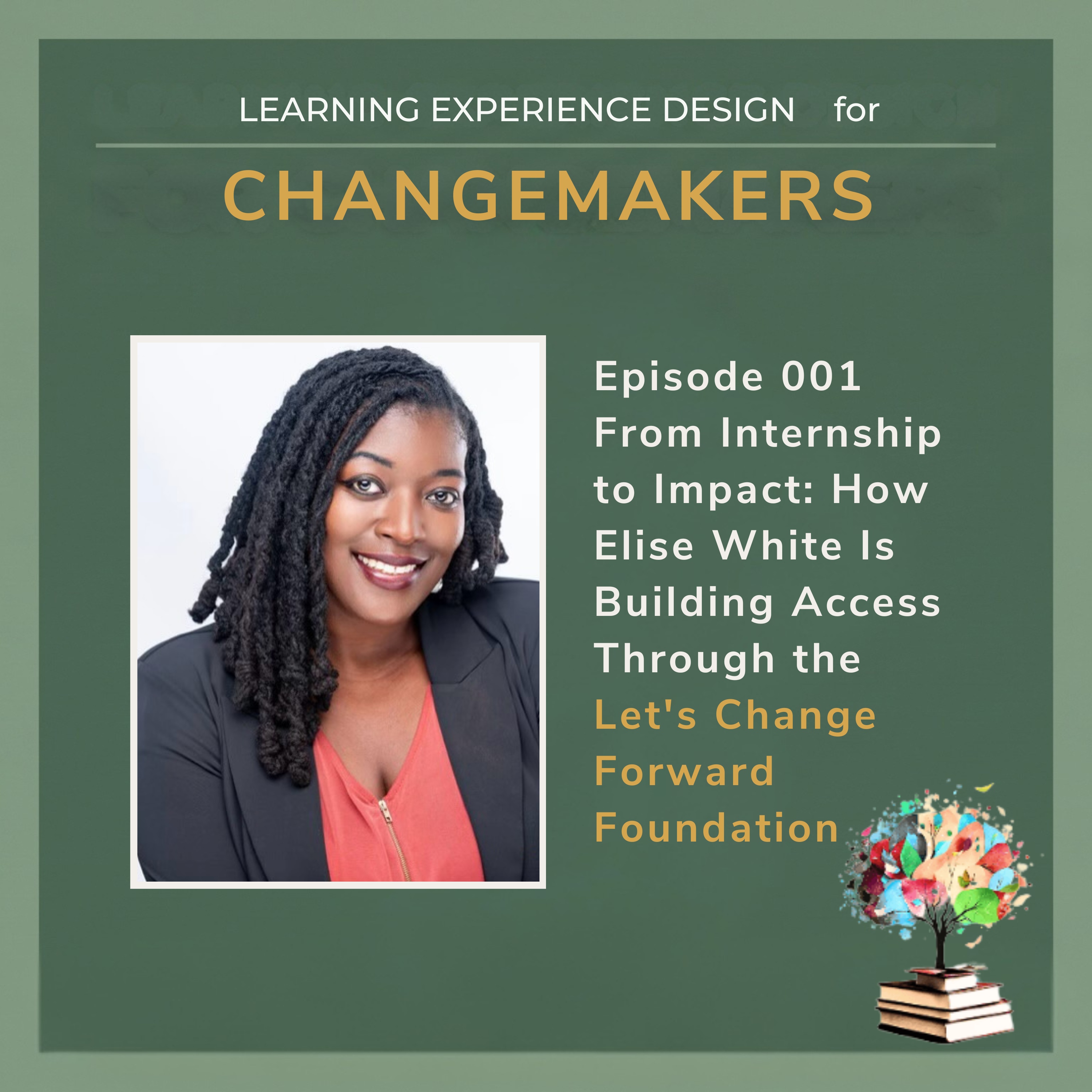 Episode 001: Internship to Impact: How Elise White Is Building Access Through the Let's Change Forward Foundation 02.06.2026 32minWhat does it look like when someone takes purposeful feedback, applies it in real time, and keeps building? In this inaugural episode of Learning Experience Design for Change Makers, Renee Koster sits down with Elise White — founder and executive director of the Let's Change Forward Foundation, workforce and wellness consultant, and co-host of the Queen Beauty Podcast.Elise shares how a five-day framework challenge sparked immediate, measurable outcomes in her career readiness internship program, what inspired her to launch a nonprofit built around access and connection, and how her Plugged In for Purpose assessment helps people discover their gifts — and actually use them.You'll also hear about the Connection Circle program launching this June, two community partnerships kicking off this month, and why Elise believes feedback isn't criticism — it's a gift.Learn more about the Let's Change Forward Foundation and take the Plugged In for Purpose assessment.
 -
Welcome to Learning Experience Design for Changemakers 01.06.2026 2minYou built something. You know your stuff. And somewhere between your expertise and your learner's transformation, something's getting lost. That's exactly why this podcast exists.In this intro episode, Renee Koster — Learning Experience Designer and Strategist — lays out exactly who this show is for, what makes it different, and what you can expect.This is not a podcast about building fast. It's not about passive income or hustle culture. It's about designing learning experiences that actually transform your learners — one clear milestone at a time.If you're a heart-led entrepreneur, coach, consultant, or nonprofit educator who already has a course, membership, or program out there and knows it could be better — you're in the right place.In this episode:Who this podcast is for (and who it's not)Renee's background and why it shapes a completely different approach to learning designThe core belief that drives every design decision: access to knowledge is a right, not a privilegeWhat's coming up on the showReady for a second set of eyes on your learning experience? Book a call with Renee: https://api.leadconnectorhq.com/widget/bookings/audience-outcomes
Panašios tinklalaidės


Populiari šalyje
Ši tinklalaidė taip pat patenka į šių šalių tinklalaidžių topus.

