
Radical Candor: Communication at Work
Kim Scott, Jason Rosoff & Amy Sandler
0
The Radical Candor podcast helps you love your job, crush career goals, and become a leader people want to work with. Host Amy Sandler and co-founders Kim Scott and Jason Rosoff break down how to Care Personally and Challenge Directly for building stronger teams and giving better feedback. Each episode offers real talk, relatable stories, and actionable tips for managers and team players. The podcast is based on Kim Scott's bestselling book Radical Candor.
Epizodai
-
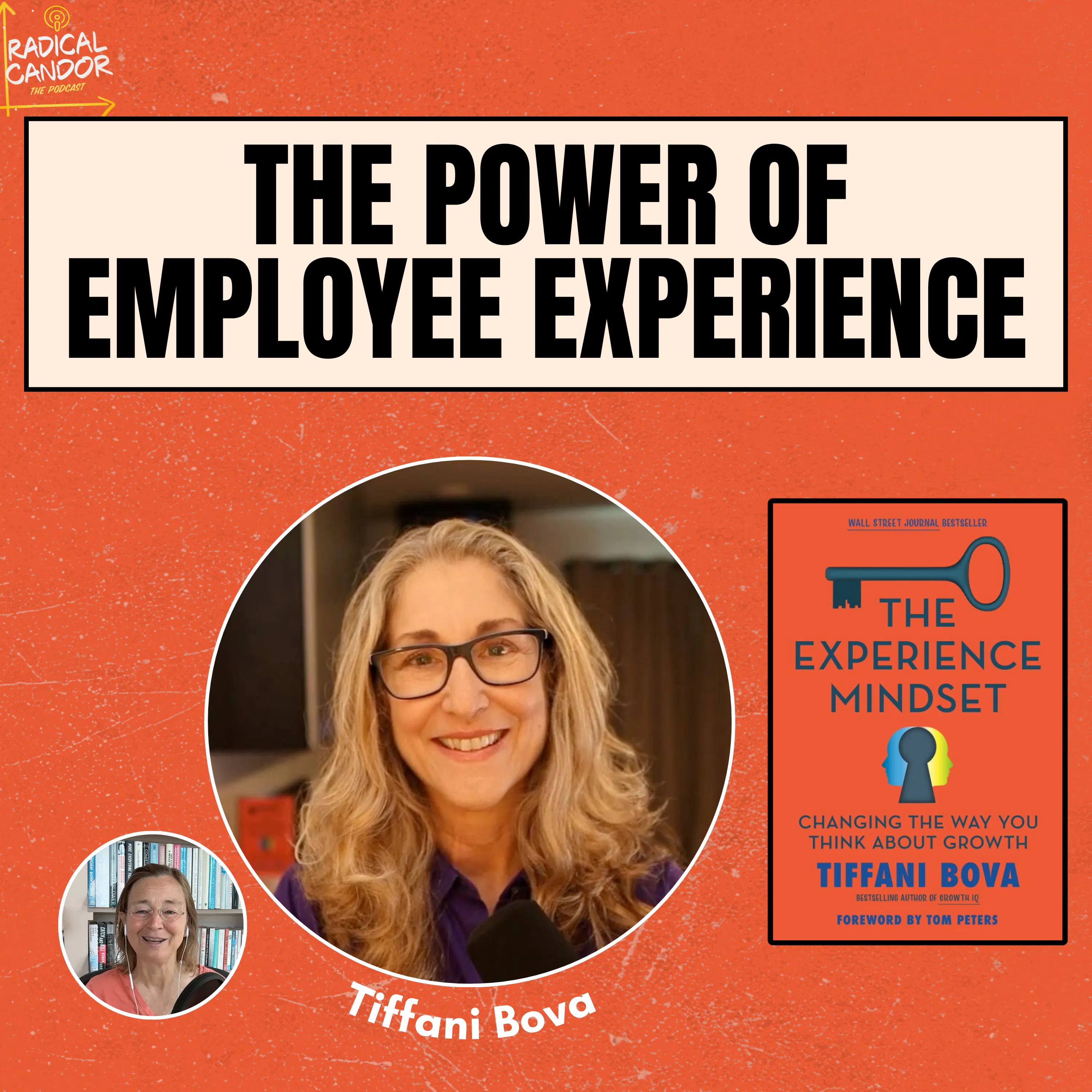 Fixing the Employee Experience (with Tiffani Bova) 22.09.2026 59minWhile the podcast team is taking a Radical Sabbatical, Kim is interviewing authors of the books that have had a big impact on her in the past two years. Today, employees working in organizations both large and small are faced with incredible pressure to integrate AI into their workflows both to save costs and to do more. But many of those same employees express fears, “am I just training robots to put me out of a job?!” While it can be tempting for leaders in the C-suites to use AI to “finally get the upper hand on these whiny/needy/entitled employees!”, they risk damaging their core mission, specifically providing value to their customers. In fairness, those same leaders in the C-suite are rightly under pressure to integrate these new tools or risk getting wiped out by more nimble competition. So, what’s the best way to go about this? In this episode, Kim Scott speaks with Tiffani Bova about her latest book The Experience Mindset. In this conversation, they explore the critical relationship between employee experience and customer experience, emphasizing the importance of self-reflection, effective feedback mechanisms, and the necessity of training employees. The discussion also highlights the disconnect between executives and employees regarding training and feedback, illustrated through real-world examples like the 'Undercover Boss' show. Ultimately, the conversation underscores the need for organizations to prioritize employee engagement and actionable feedback to foster a positive workplace culture and drive business success. They discuss specifics such as the importance of addressing workplace irritations, the need for effective management training, and the significance of streamlining processes to enhance productivity. Tiffani especially stresses the critical role of office culture in fostering open communication and the necessity of training managers to improve employee satisfaction. The discussion also highlights the impact of automation and technology in optimizing processes and the importance of aligning incentives to encourage growth and innovation. They explore the intersection of technology and human experience, particularly focusing on the role of AI in the workplace. They discuss the importance of understanding the human element in technology adoption, the balance between tech and human interaction, and the critical role of company culture in driving business success. The conversation highlights real-world examples of AI implementation, the challenges of technology overload, and the necessity of fostering a cohesive culture that aligns with organizational values. Guest Background: As both a practitioner and academic Tiffani Bova offers a unique perspective and has helped lead the tech industry through several evolutions over her nearly 30-year career as Salesforce’s former Growth and Innovation Evangelist, and previously as a Research Fellow at Gartner and a sales, marketing and customer service executive for start-ups and Fortune 500 companies. She is the author of two Wall Street Journal bestsellers: GrowthIQ and The Experience Mindset. At The Futurum Group, she runs the research and strategy organization, while working closely with the entire leadership team to develop and scale its data and intelligence platform and insights for its clients. She also leads the team’s efforts within the technology and telecom channels, demonstrating the power and performance of connected go-to-market strategies and alliances. While at Gartner, her forward-looking insights and guidance helped some of the largest technology companies in the world including Microsoft, Cisco, Salesforce, Hewlett-Packard, IBM, Oracle, SAP, AT&T, Dell, Amazon-AWS, expand their market share and grow their revenues. She was a trusted advisor to multiple senior executives who were responsible for shifting from on-premise to as-a-service business models resulting in new billion-dollar divisions. In the late 90’s and early 2000s she was a pioneer of cloud computing, she previously led direct and indirect sales, marketing and customer service for two of the largest web-based start-ups in the US and spearheaded a newly formed division of a Fortune 500 company to $300 million in revenue over two and a half years. Tiffani has been featured in Harvard Business Review, Fortune, Fast Company, Bloomberg, MSNBC-TV, Yahoo Finance, INC and Forbes. She is also the host of the podcast What’s Next! with Tiffani Bova. More info here: https://www.tiffanibova.com/ [links for YouTube description] (Bio) https://www.tiffanibova.com/biography/ (book: The Experience Mindset) https://www.tiffanibova.com/the-experience-mindset/ (how to contact) https://www.tiffanibova.com CHAPTERS (00:44) Introduction to the Experience Mindset (02:19) Self-Reflection and Critical Feedback (04:56) The Importance of Employee Experience (05:39) Understanding Employee Feedback (07:23) The Undercover Boss Example (11:25) The Value of Training Employees (15:29) Disconnect Between Executives and Employees (17:30) Real-World Application of Employee Feedback (20:05) Identifying and Fixing Workplace Irritations (24:31) The Importance of Management Training (27:58) Understanding Processes and Their Impact (36:36) Streamlining Processes for Productivity (41:51) Understanding the Human Element in Technology (44:33) AI: Triumphs and Disasters in Implementation (47:32) The Balance of Technology and Human Experience (50:17) Creating a Cohesive Company Culture (55:20) The Impact of Culture on Business Success Connect with the Radical Candor team: Website LinkedIn YouTube Learn more about your ad choices. Visit megaphone.fm/adchoices
 -
 The Science Behind High-Performing Teams (with Ron Friedman) 16.09.2026 54minWhile the podcast team is taking a Radical Sabbatical, Kim is interviewing authors whose books have had a big impact on her over the past two years. In this episode, Kim Scott speaks with Ron Friedman, PhD. Ron has written extensively about the sciences of building high-performing teams. Ron’s latest book is Superteams: The Science and Secrets of High-Performing Teams. They discuss the importance of the creative process, the role of restoration in productivity, and the key strengths that distinguish super teams from average teams. The conversation delves into effective meeting strategies, communication norms, and the significance of laughter in fostering team cohesion. Ultimately, they emphasize the need for customized approaches to team dynamics and the value of building supportive relationships within teams. They also explore the dynamics of effective teamwork, the importance of maintaining focus in a distracted world, and the role of hobbies in enhancing productivity. They discuss the attributes of great teammates, the significance of productive disagreement, and the necessity of effective feedback for continuous improvement. The dialogue emphasizes that super teams thrive on collaboration, shared goals, and a culture of open communication. Guest Background: Ron Friedman, PhD, is an award-winning psychologist who helps leaders build high-performing teams. He is the bestselling author of The Best Place to Work and Decoding Greatness, and the founder of Superteams, Inc., where he delivers keynotes, workshops, and executive advisory to senior leaders around the world. An expert on human motivation, Friedman has served on the faculties of the University of Rochester, Nazareth College, and Hobart and William Smith Colleges. He contributes regularly to Harvard Business Review, and his work has been featured in The New York Times, Financial Times, Bloomberg, NPR, CBS, FOX, NBC, Fast Company, The Washington Post, Forbes, and Inc. To learn more about his work, visit SuperteamsInc.com. CHAPTERS (00:41) Introduction to Super Teams (01:45) The Creative Process and Incubation (04:12) Restoration and Productivity (06:27) Research Behind Super Teams (07:50) Key Strengths of Super Teams (09:00) Meetings: The Double-Edged Sword (11:24) Effective Meeting Strategies (12:51) Customizing Team Dynamics (15:06) Communication Norms and Email Management (18:05) The Role of Laughter in Teams (20:57) Building Relationships Through Support (23:00) Navigating Humor and Inclusivity (26:52) Time Affluence and Productivity Strategies (30:08) Staying Focused in a Distracted World (32:51) The Power of Hobbies and Side Hustles (36:10) Attributes of Great Teammates (39:10) Building Effective Teams (41:40) The Importance of Productive Disagreement (45:02) Mastering Feedback for Improvement Connect with the Radical Candor team: Website LinkedIn YouTube Keywords Super Teams, productivity, creative process, meetings, team dynamics, communication, laughter, leadership, time management, workplace culture focus, hobbies, teamwork, feedback, productivity, super teams, attributes, disagreement, communication, leadership Learn more about your ad choices. Visit megaphone.fm/adchoices
 -
 Ways to Manage - Back by Brain Science (with Caroline Webb) 09.09.2026 52minWhile the podcast team is taking a Radical Sabbatical, Kim is interviewing authors whose books have had a big impact on her over the past two years. In this episode, Kim Scott speaks with Caroline Webb about her latest book, Leadership Intelligence. They explore the principles of effective leadership: the importance of widening perspectives; the role of cognitive load in decision-making; and the significance of intrinsic motivation through competence and connection. The conversation also delves into the dynamics of disagreement, the necessity of feedback, and practical strategies for fostering a collaborative team environment. They review effective feedback techniques and the significance of public praise. Caroline also emphasizes the role of gratitude and giving praise in building strong workplace relationships, the importance of understanding stress and resilience in leadership, and how leaders can foster team resilience through structured conversations and practices. The discussion culminates in the introduction of the five C's of team resilience, emphasizing the need for communication, clarity, calm, connection, and capacity in creating a supportive work environment. Guest Background: Caroline Webb is a leadership coach, economist, and speaker known for being one of the world's leading experts in using insights from behavioral science to improve professional life. She is the author of Leadership Intelligence and of How To Have A Good Day, a global bestseller published in 20 editions and over 60 countries. She is also a Senior Advisor to McKinsey, where she was previously a Partner. She has been rated one of the top 50 leadership and management thinkers by Inc. magazine, and one of Thinkers50's top 50 executive coaches in the world. CHAPTERS (00:38) Introduction to Leadership Intelligence (03:24) Deliberate Wisdom: Widening Perspectives (06:29) Causal Maps and Driver Trees (09:27) Navigating Disagreements in Leadership (12:30) The Importance of Turn-Taking in Discussions (15:22) Lightening Cognitive Load for Better Leadership (19:19) Intrinsic Inspiration: Competence and Connection (22:21) The Power of Feedback in Engagement (30:29) Effective Feedback and Praise Techniques (32:57) The Importance of Public Praise (37:01) Cultivating Gratitude and Appreciation (37:32) Understanding Stress and Resilience (44:45) Building Team Resilience with the Five C's Connect with the Radical Candor team: Website LinkedIn YouTube Learn more about your ad choices. Visit megaphone.fm/adchoices
 -
 Get Situated for Success (with Angela Duckworth) 01.09.2026 52minWhile the podcast team is taking a Radical Sabbatical, Kim is interviewing authors of the books that have had a big impact on her in the past two years. In this episode, Kim Scott speaks with Angela Duckworth. Her first book Grit: The Power of Passion and Perseverance, is a #1 New York Times bestseller. Her second book is Situated: Find the People and Places That Bring Out Your Best. In this conversation, Kim interviews Angela about her new book, 'Situated.' They explore a deceptively simple three-box model that explains all of human behavior. Angela emphasizes the power of environment in shaping our thoughts and leading us to–or away from–the results we want. She and Kim discuss the limitations of willpower. Angela describes the two key ingredients of a good situation: challenge and support. Kim and Angela explore why it is important to seek managers and peers who both challenge and support us. They discuss the importance of feedback and why Ruinous Empathy is so damaging to both personal and professional growth. If you’re looking for one thing you can control to get better situated, Angela shares some practical advice on curating your personal space to foster positive habits and growth. Guest Background: Prof. Angela Duckworth, PhD, is the Rosa Lee and Egbert Chang Professor at the University of Pennsylvania and faculty co-director of the Penn-Wharton Behavior Change for Good Initiative. Prior to her career in research, Angela founded an academic enrichment program for low-income children that was profiled as a Harvard Kennedy School case study and today serves hundreds of students each year. She has also been a McKinsey management consultant and a math and science teacher at public schools in New York City, San Francisco, and Philadelphia. Angela co-founded Character Lab, a nonprofit dedicated to advancing scientific insights that help children thrive. Angela completed her undergraduate degree in Advanced Studies Neurobiology at Harvard, graduating magna cum laude. With the support of a Marshall Scholarship, she completed an MSc with Distinction in Neuroscience from Oxford University. She completed her PhD in Psychology as a National Science Foundation Graduate Fellow at the University of Pennsylvania. Angela's TED talk is among the most viewed of all time. CHAPTERS (00:00) Introduction to Radical Sabbatical and Angela Duckworth's New Book (03:23) The Snorkeling Incident: A Metaphor for Situational Awareness (05:58) Finding Your Best Situations: The Power of Environment (08:31) The Three Boxes Model: Understanding Behavior and Thoughts (11:13) The Role of Situations in Shaping Our Thoughts (14:16) Changing Your Situation vs. Changing Your Thoughts (17:10) The Limitations of Willpower and Self-Control (20:13) The Quest for Control: Understanding Human Nature (23:15) Creating Supportive and Challenging Situations (27:11) Understanding Radical Candor (32:56) Navigating Ruinous Empathy (33:19) The Dilemma of Short-Term Comfort vs Long-Term Growth (34:30) Feeding the Good Wolf: A Metaphor for Growth (36:40) Economic Disparities and Their Impact (39:23) Agency and the Power of Choice (43:09) Curating Your Personal Space for Better Outcomes Connect with the Radical Candor team: Website LinkedIn YouTube Learn more about your ad choices. Visit megaphone.fm/adchoices
 -
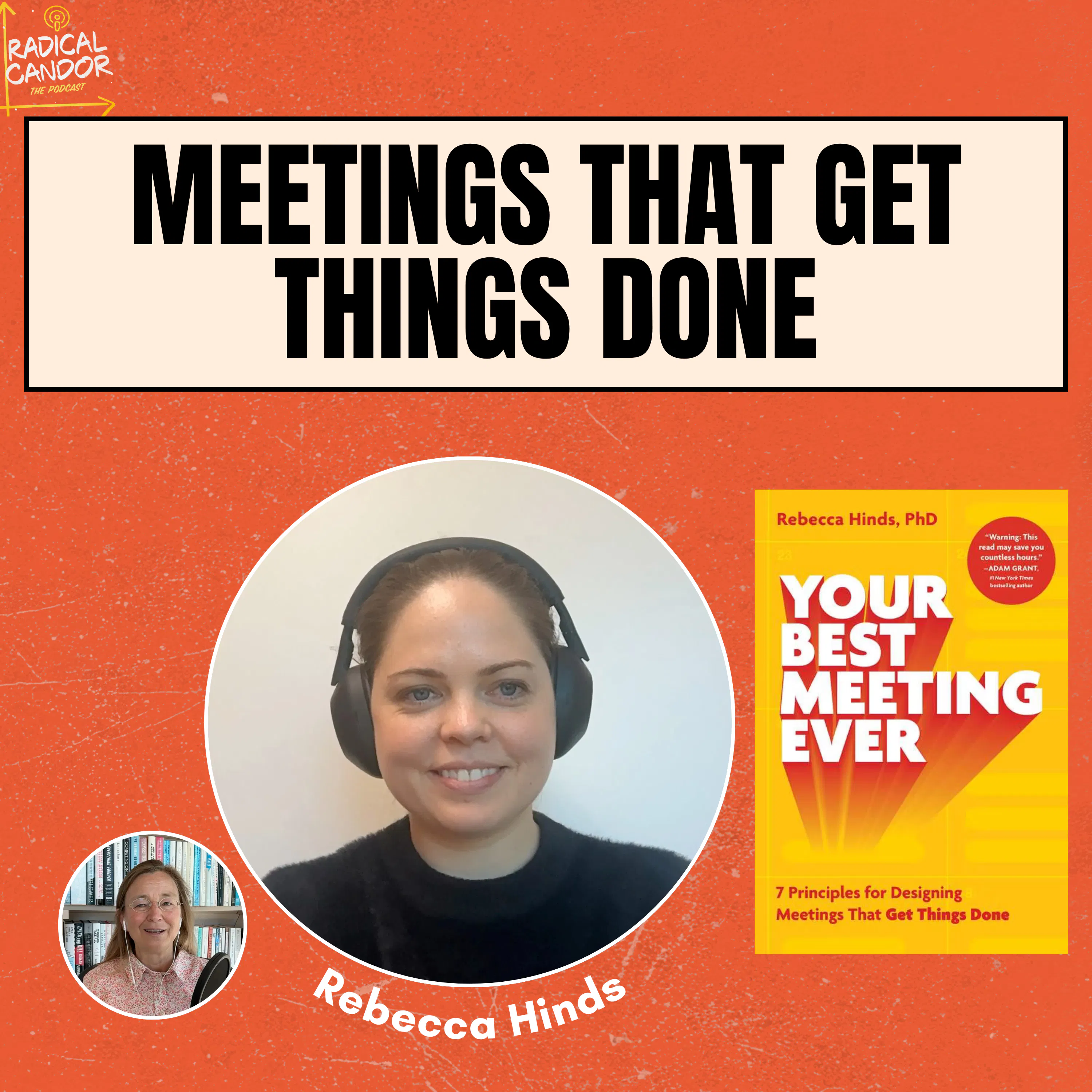 Revolutionizing Meetings: From Sabotage to Strategy (with Rebecca Hinds) 18.08.2026 48minWhile the podcast team is taking a Radical Sabbatical, Kim is interviewing authors of the books that have had a big impact on her in the past two years. In this episode, Kim speaks with Rebecca Hinds, the author of Your Best Meeting Ever: 7 Principles for Designing Meetings That Get Things Done. They explore the evolution of meetings from wartime sabotage tools to the challenges and strategies for improving meetings in today's technology-driven workplace. They discuss the increasing time spent in meetings, especially post-pandemic, and present seven solutions to eliminate unnecessary meetings and to redesign the necessary ones. They discuss the impact of distractions, the importance of effective meeting structures, and the need for a culture that encourages open disagreement. The conversation also highlights the significance of asynchronous communication, preparation, and technology's role in enhancing collaboration. Ultimately, they emphasize the need for meetings to be engaging and aligned with natural rhythms to foster productivity and creativity. Guest Background: Rebecca Hinds, PhD, is the author of Your Best Meeting Ever: 7 Principles for Designing Meetings That Get Things Done. She is a leading expert on organizational behavior and the future of work. For more than 15 years, she has helped organizations rethink how work gets done, challenging outdated management playbooks and offering leaders a more ambitious and more human vision for the future. Rebecca has founded and led two first-of-their-kind research institutes dedicated to reinventing work. In 2022, she launched the Work Innovation Lab at Asana, building it into an influential source of practical workplace research. In 2025, she founded the Work AI Institute at Glean to help organizations navigate the next transformation of work. CHAPTERS (00:00) The Origins of Meetings as Sabotage Tools (02:45) The Evolution of Meeting Culture (05:14) Radical Meeting Solutions (08:20) Measuring Meeting Effectiveness (11:05) The Minimalism Approach to Meetings (14:06) Optimizing Meeting Flow and Communication (16:56) The Role of Tools in Meeting Efficiency (23:40) Managing Distractions in a Tech-Heavy World (25:58) The Importance of Effective Meetings (28:58) Creating a Culture of Open Disagreement (29:49) Building Strong Asynchronous Communication (32:01) The Role of Preparation in Meetings (36:51) Designing Engaging Meetings (38:47) Timing and Rhythm in Meetings (41:31) Leveraging Technology for Better Meetings Connect with the Radical Candor team: Website LinkedIn YouTube Keywords meetings, productivity, communication, meeting culture, meeting effectiveness, meeting solutions, meeting minimalism, meeting flow, tools for meetings, workplace efficiency distractions, technology, meetings, asynchronous communication, open disagreement, engagement, timing, productivity, collaboration, AI Learn more about your ad choices. Visit megaphone.fm/adchoices
 -
 Why some leaders are incorruptible, many get corrupted by power/money (with Rob Lalka) 04.08.2026 45minWhile the podcast team is taking a Radical Sabbatical, Kim is interviewing authors of the books that have had a big impact on her in the past two years. In this episode, Kim speaks with Rob Lalka, the author of The Venture Alchemists - How Big Tech Turned Profits Into Power. In this episode of Radical Sabbatical, Kim sits down with Rob Lalka, author of Venture Alchemist, to study what the founders of Facebook, Google, and the “PayPal Mafia” were saying and writing before anyone was paying attention to them. They explore what separates the leaders who stayed grounded from the ones who didn't. They ask a hard question: does it matter if a leader got corrupted by too much money and power or if they started out bad to the bone? Every leader (indeed, every one of us) has good and bad inside. The one that wins is usually the one that gets fed. The question is whether the venture capital model feeds the good — or does it feed the bad, setting founders up to be corrupted by their own success? Kim and Rob explore the contrasting origins of major tech companies like Facebook and Google. They discuss the implications of Mark Zuckerberg's early actions (for example, an IM while in college with a friend who asked him how he got access to people’s personal information and he replied “they trusted me, the dumb f–ks;”). What does it mean that Google’s founders started out thinking Google would have to be a non-profit so that advertising wouldn’t bias information but wound up selling trillions of ads? The conversation also delves into the impact of the PayPal Mafia and the controversial book by Thiel and Sachs, The Diversity Myth. Rob discusses the complexities of free speech and the implications of outlier behavior. He emphasizes the importance of moral leadership in corporate culture and critiques the philosophical influences of figures like Ayn Rand and Milton Friedman on business ethics. Rob expresses hope for the future, particularly through the potential of his students to create positive change in society. Books & Articles mention by Rob: George Packer - article in The Atlantic - The Venture-Capital Populist https://www.theatlantic.com/magazine/2026/06/david-sacks-crypto-ai-venture-capital/686941/ Max Chafkin - The Contrarian: Peter Thiel and the Rise of the Silicon Valley Oligarchs https://elmstreetbooks.com/book/9781984878557 Jimi Soni - The Founders: The Story of Paypal and the Entrepreneurs Who Shaped Silicon Valley https://www.amazon.com/dp/1501197266?lv=shuf&channelId=500&plpRedirect=mhFallback Guest Background: Rob Lalka is the author of The Venture Alchemists - How Big Tech Turned Profits Into Power. He is also the Albert R. Lepage Professor in Business and executive director of the Albert Lepage Center for Entrepreneurship and Innovation at Tulane University. He is on the board of directors of Blue Cross and Blue Shield of Louisiana, Public Democracy, Inc., and Venture For America in New Orleans. Previously, he served on the U.S. Secretary of State’s policy planning staff and in the State Department’s Office of Global Partnerships, was a director at Village Capital, and was a senior advisor at the Howard G. Buffett Foundation. CHAPTERS (00:40) Introduction to Alchemy and Venture Capital (03:04) The Power Dynamics in Business Models (05:33) Zuckerberg's Origin Story and Its Implications (07:40) The Contrast with Google's Founding Philosophy (09:47) The Role of Advertising in Business Models (12:43) The Historical Context of Business Practices (14:59) The Golden Spike and Economic Inequality (14:59) The Impact of the PayPal Mafia and Diversity Myth (22:00) The Controversy of Free Speech and Homophobia (25:07) Outlier Behavior and Its Implications (28:03) The Rape Issue and Its Consequences (30:27) Moral Leadership and Corporate Culture (33:08) Philosophical Influences on Business Ethics (40:30) Hope for the Future and the Role of Education Connect with the Radical Candor team: Website LinkedIn YouTube Keywords venture capital, alchemy, business models, Zuckerberg, Google, advertising, economic inequality, PayPal Mafia, diversity myth, entrepreneurship free speech, outlier behavior, corporate culture, moral leadership, business ethics, philosophy, education, AI Learn more about your ad choices. Visit megaphone.fm/adchoices
 -
 How Great Leaders Make Everyone Better (with Liz Wiseman) 15.07.2026 1val 5minWhile the podcast team is taking a Radical Sabbatical, Kim is interviewing authors of the books that have had a big impact on her in the past two years. Building high-performance teams, especially in dynamic industries, can be one of the biggest challenges a leader faces. Sometimes passionate founders or senior leaders can go from passionate advocate to authoritarian autocrat. Left unchecked, this can lead to organizations underperforming in the long term and missed opportunities. So where is the balance? In this episode, Kim speaks with Liz Wiseman, the author of multiple New York Times bestsellers. Liz and Kim explore the pitfalls of authoritarian leadership, the power of multipliers, and how leaders can foster environments where everyone does the best work of their lives and builds the best relationships of their careers. Liz does point out that there are certain, limited instances where a top down, “command and control” approach is the right choice (for example, during an acute crisis), but these instances should be rare and targeted. They also discuss practical strategies for managing diminishing leaders and creating impact regardless of leadership style. They also talk about the importance of understanding power dynamics in leadership. Guest Background: Liz Wiseman is a researcher and executive advisor who teaches leadership to top organizations worldwide. She wrote the New York Times bestsellers Multipliers, The Multiplier Effect, and Wall Street Journal bestsellers Rookie Smarts and Impact Players. CHAPTERS (00:33) Introduction to Radical Sabbatical and Guest Liz Wiseman (02:06) The Flaws of Authoritarian Leadership (06:06) Diminishers vs. Multipliers: Leadership Styles (12:16) When Authoritarian Leadership is Necessary (20:27) The Balance of Command and Collaboration (23:36) The Impact of Leadership Styles (26:34) Navigating Innovation and Crisis (29:30) The Balance of Authority and Collaboration (32:35) Lessons from Great Leaders (36:38) Understanding Accidental Diminishers (45:03) The Impact of Perfectionism on Team Dynamics (46:09) Understanding Accidental and Intentional Diminishers (47:26) The Drive to Contribute: Empowering Impact Players (48:56) Leading Through Influence: The Role of Impact Players (51:06) Strategies for Thriving Under Diminishing Leadership (52:26) Multiplying Up: Turning Diminishment into Empowerment (55:47) The Power of Listening and Adapting (01:01:04) Leveraging Bosses' Strengths for Better Outcomes (01:03:01) Building Relationships on a Level Playing Field (01:03:55) Understanding and Sharing Power in Leadership Connect with the Radical Candor team: Website LinkedIn YouTube Learn more about your ad choices. Visit megaphone.fm/adchoices
 -
 How to Raise Emotionally Resilient Kids — and Lead the Same Way (with Dr. Becky Kennedy) 07.07.2026 56minWhile the podcast team is taking a Radical Sabbatical, Kim is interviewing authors of the books that have had a big impact on her in the past two years. How can parenting skills help us become better team members and leaders in the workplace? Sure, you can’t “ground” your direct report when they screw up an important project, but the lessons of good parenting can certainly help us all be better at building effective and healthy teams. In this episode, Kim speaks with Dr. Becky Kennedy, the author of Good Inside, a New York Times #1 bestseller. Dr. Becky’s background as a clinical psychologist and years of experience working with families give her valuable insights into navigating the stresses of raising kids amid a busy work schedule. She has developed a loyal following among parents. Kim and Dr. Becky talk about how these two worlds overlap and, in some cases, where they don’t. For example, they talk about how “repair” and taking responsibility for handling something poorly can play a key role in increasing connection among team members. Guest Background: Dr. Becky is the clinical psychologist and mom of three behind the breakthrough parenting company Good Inside. She specializes in helping parents become sturdy leaders in their homes by sharing the skills and strategies parents need to raise resilient kids. Dr. Becky is a #1 New York Times bestselling author, a TED speaker, and the host of the chart-topping podcast Good Inside with Dr. Becky, and has amassed a global following of millions of parents. Dr. Becky received a BA in Psychology and Human Development, Phi Beta Kappa and summa cum laude, from Duke University and a PhD in Clinical Psychology from Columbia University. She has a certificate in Relational Psychotherapy from the Steven Mitchell Center. CHAPTERS (00:00) Introduction to Radical Kindness and Good Inside (03:02) Balancing Boundaries and Connection in Parenting (05:56) The Impact of Unfinished Business from Childhood (08:54) Curiosity as a Tool for Effective Communication (12:02) Connection Capital: Building Relationships with Kids (14:55) The Importance of High-Impact Moments (17:53) Repairing Relationships After Mistakes (20:56) Modeling Accountability for Children (24:09) Changing the Narrative Around Parenting and Guilt (27:06) Compassionate Criticism in Parenting and Work (29:04) Understanding Anger and Setting Boundaries (29:59) Compassionate Discipline: Balancing Boundaries and Understanding (32:24) Two Truths: Boundaries and Emotions (34:38) The Power of Belief: Encouraging Better Behavior (36:01) Redefining 'Nice': The Importance of Respectful Communication (39:31) Emotions as Information: Listening to Our Feelings (41:27) The Role of Emotions in Leadership and Parenting (44:32) Curiosity Over Fury: Navigating Emotional Responses (52:04) Preventing Bullying: Safety and Intervention Strategies Connect with the Radical Candor team: Website LinkedIn YouTube Learn more about your ad choices. Visit megaphone.fm/adchoices
 -
 Why Racial Inequality Costs Everyone (with Heather McGhee) 10.06.2026 49minWhile the podcast team is taking a Radical Sabbatical, Kim is interviewing authors of the books that have had a big impact on her in the past two years. In this episode, Kim speaks with Heather McGhee, the author of The Sum of Us: What Racism Costs Everyone and How We Can Prosper Together, a New York Times bestseller. Heather takes Kim on a journey through US history, demonstrating how efforts to exclude some of us from public goods harm all of us, starting with public swimming pools in the United States. As Heather describes in The Sum of Us, “By World War II, the country’s two thousand pools were glittering symbols of a new commitment by local officials to the quality of life of their residents, allowing hundreds of thousands of people to socialize together for free…A Pennsylvania county recreation director said, “Let’s build bigger, better, and finer pools. That’s real democracy. Take away the sham and hypocrisy of clothes, don a swimsuit, and we’re all the same.” These swimming pools were remarkable public resources. The Fairground Park Pool had a sandy beach, elaborate diving boards, and a capacity of 10,000 people. However, when cities across the country were forced to integrate these pools, they chose to fill them in with dirt instead. Nobody got to swim–except people wealthy enough to join private clubs. Starting in the late 1960s, the same illogic was applied to more consequential areas of life than swimming pools. As the public began to perceive that government programs like welfare, healthcare, education, and infrastructure funding would benefit Black and Brown Americans, political support for these public goods collapsed. For example, when Texas rejected Obamacare, its rural hospitals began going bankrupt, resulting in medical deserts and economic devastation in rural Texas towns. Today, we have a choice: the solidarity dividend that results from public goods that benefit everyone; or the devastation for everyone that results from the kind of zero-sum thinking that would cause a community to destroy public goods rather than make them available to everyone. Guest Background: Heather McGhee designs and promotes solutions to inequality in America. The Sum of Us: What Racism Costs Everyone and How We Can Prosper Together spent 10 weeks on the New York Times bestseller list and was long-listed for the National Book Award and Carnegie Medal for Excellence in Nonfiction, among numerous other awards. In the summer of 2022, The Sum of Us was adapted into a Spotify podcast by Higher Ground, the production company of Barack and Michelle Obama. The Sum of Us was adapted into a young adult readers’ version by Random House Children’s in February 2023. The adaptation for middle and high-school students received starred reviews from School Library Journal and Booklist, and Kirkus named it a Best Young Adult Book of the Year. CHAPTERS (00:00) Introduction to Radical Sabbatical and Bacon's Rebellion (02:05) Bacon's Rebellion: A Historical Perspective on Race Relations (04:49) The Economic Impact of Racism on Society (06:34) The Race Class Narrative Project and Its Implications (16:30) Education: The Cost of Inequality (22:09) Healthcare: The Consequences of Drained Public Goods (24:37) Racialized Healthcare Politics (26:32) The Impact of Medicaid Expansion (28:38) The Mortgage Crisis and Racial Discrimination (31:24) The Canary in the Coal Mine (34:58) Unionization and Economic Power (38:54) Cross-Racial Solidarity in Labor Movements (42:18) Environmental Justice and Collective Action Connect with the Radical Candor team: Website LinkedIn YouTube Learn more about your ad choices. Visit megaphone.fm/adchoices
 -
 Where the World's Dirty Money Actually Goes (with Oliver Bullough) 03.06.2026 1valWhile the podcast team is taking a Radical Sabbatical, Kim is interviewing authors of the books that have had a big impact on her in the past two years. In this episode, Kim speaks with Oliver Bullough, journalist and author of the highly acclaimed books: Butler to the World: How Britain Helps the World's Worst People Launder Money, Commit Crimes, and Get Away with Anything and Moneyland: Why Thieves and Crooks Now Rule the World and How To Take It Back. Oliver’s new book is called Everybody Loves Our Dollars - How Money Laundering Won. Oliver describes a moment in his life that shaped each of these books. He was touring the palace of Yanukovych, the corrupt pro-Russian ex-President of Ukraine, horrified at the extravagant opulence, all stolen from the Ukrainian people. “How did you let him get away with this?” Oliver asked his friend. “Well, actually you’re technically in London, not Ukraine, right now,” his friend responded. Who is corrupt, the people who stole the money, or the lawyers, bankers, and accountants in countries that tout their lack of corruption? Oliver describes the systems in place to help the wealthy dodge taxes and the deeply corrupt to hide their theft. Kim and Oliver talk about the corrosive effect on our political institutions and our economy; and how we got here in the post-WWII era. Guest Background: Oliver Bullough is a journalist and author from Wales who writes about financial crime, the former Soviet Union, and offshore skulduggery. He lives near Hay-on-Wye, and has previously lived in London, Moscow, St Petersburg and Bishkek. When not working, he likes watching rugby, cooking pizzas, swimming in the river and walking in the hills. You can find him on Twitter at @oliverbullough. CHAPTERS (00:00) Introduction to Oliver Bullough and His Works (03:03) The Evolution of Offshore Finance (06:06) Naughty Money vs. Evil Money (09:01) Exploring Yanukovych's Palace and Corruption (12:11) Understanding Modern Corruption and Kleptocracy (15:03) The Role of Cryptocurrency in Financial Crime (18:14) The Dark World of Scams and Trafficking (21:03) The Banality of Evil in Financial Crimes (24:03) Legal Challenges in Exposing Corruption (27:04) Personal Fascination with Eastern Europe and Russia (29:42) The Allure of Russia: A Personal Journey (32:06) Putin's Rise: Observations from the Ground (34:17) The Impact of Neoliberalism on Eastern Europe (35:22) Bretton Woods: Lessons from History (40:21) The Corruption of Wealth: Offshore Finance's Role (44:22) AI and Corruption: A New Era (48:19) Reputation Laundering: The Case of Dmitry Firtash (55:19) The Future of Money Laundering: Insights from 'Everybody Loves Our Dollars' Connect with the Radical Candor team: Website LinkedIn YouTube Learn more about your ad choices. Visit megaphone.fm/adchoices
 -
 The Rise and Fall of the Neoliberal Order (with Prof Gary Gerstle) 27.05.2026 1val 2minWhile the podcast team is taking a Radical Sabbatical, Kim is interviewing authors of the books that have had a big impact on her in the past two years. In this episode, Kim speaks with Gary Gerstle, best-selling author of The Rise and Fall of the Neoliberal Order and ten other books. Kim said that after reading this book, she began to feel that when it comes to economic policy, we really have a one-party system. The architect of the New Deal Order was FDR, a Democrat, but its general contractor was Eisenhower, arguably the most progressive of all American presidents. The architect of the Neoliberal order was Reagan, but its general contractor was Clinton. Kim also said that reading this book made her realize that, time and again throughout her career, she thought she was working towards progressive ends, not understanding how neoliberalism had taken hold of the Democratic Party. Gerstle explains that “the phrase political order is meant to connote a constellation of ideologies, policies, and constituencies that shape American politics in ways that endure beyond the two-, four-, and six-year election cycles. In the last hundred years, America has had two political orders: the New Deal order that arose in the 1930s and 1940s, crested in the 1950s and 1960s, and fell in the 1970s; and the neoliberal order that arose in the 1970s and 1980s, crested in the 1990s and 2000s, and fell in the 2010s At the heart of each of these two political orders stood a distinctive program of political economy. The New Deal order was founded on the conviction that capitalism left to its own devices spelled economic disaster. It had to be managed by a strong central state able to govern the economic system in the public interest. The neoliberal order, by contrast, was grounded in the belief that market forces had to be liberated from government regulatory controls that were stymying growth, innovation, and freedom. The architects of the neoliberal order set out in the 1980s and 1990s to dismantle everything that the New Deal order had built across its forty-year span. Now it, too, is being dismantled. Alarmingly, there seems to be no coherent policy around whatever it is replacing the Neoliberal order–just a mad grab for wealth, leading to even greater disparities than those that led to the Gilded Age’s excesses and to the Great Depression. Guest Background: Gary Gerstle is Paul Mellon Professor of American History Emeritus and Paul Mellon Director of Research at the University of Cambridge. He is the author and editor of more than ten books, including two prizewinners, American Crucible (2017) and Liberty and Coercion (2015). He is a Guardian columnist and has also written for the Atlantic Monthly, the New Statesman, Dissent, The Nation, and Die Zeit, among others. He frequently appears on BBC Radio 4, BBC World Service, ITV 4, Talking Politics, and NPR. CHAPTERS (00:00) Introduction to Radical Sabbatical and Guest (03:03) Understanding Liberalism and Neoliberalism (06:11) The Evolution of Liberalism in America (09:06) The New Deal and Its Impact (12:10) Violence and Wealth Inequality in Capitalism (14:59) The Great Depression and Its Consequences (18:07) Defining Political Order (21:11) The Rise of the Neoliberal Order (24:05) Clinton's Role in Neoliberalism (26:58) The Gorky Automobile Factory and Communism's Appeal (31:19) The Rise of Soviet Communism as a Challenge to Capitalism (36:18) The Treaty of Detroit: Compromise Between Labor and Capital (41:43) Transition to Neoliberalism: The Powell Memo and Its Impact (49:13) Telecom Act of 1996: Deregulation and Its Consequences (54:16) The 2008 Financial Crisis: A Turning Point for Neoliberalism Connect with the Radical Candor team: Website LinkedIn YouTube Learn more about your ad choices. Visit megaphone.fm/adchoices
 -
 How a 19th-Century Bombing Shaped Modern Surveillance (with Steven Johnson) 20.05.2026 45minWhile the podcast team is taking a Radical Sabbatical, Kim is interviewing authors of the books that have had a big impact on her in the past two years. In this episode, Kim speaks with Steven Johnson, co-founder of Notebook LM, not about AI but about his book, The Infernal Machine: A True Story of Dynamite, Terror, and the Rise of the Modern Detective. They start with the story of how the Swiss dominated the watch industry for over a century, thanks to a highly decentralized network of cottage laborers in the Jura mountains. The culture of autonomy in the industry was so strong that it turned Swiss watchmakers into some of history's first anarchists, which in the 19th century simply meant self-organization. The movement became associated with disorder and violence after many anarchists adopted Nobel’s invention of dynamite as their weapon. The public outcry against their violent attacks on heads of state and industry led to many modern surveillance techniques, including wiretapping and fingerprinting.. Steven and Kim speculate that some approaches to company-building in Silicon Valley have embraced bottom-up self-organization principles of the Jura mountains. They explore how we might have a viable alternative to capitalism and socialism today if anarchists had not embraced dynamite. They agree it’s not too late to imagine that viable alternative–maybe one of them will write that book. Guest Background: Steven Johnson is the Co-Founder and Editorial Director, NotebookLM; Author of 14 books on science, technology, and innovation; co-creator and host of BBC/PBS series How We Got To Now and Extra Life. He is the host of the podcast The TED Interview and the author of the newsletter Adjacent Possible. He lives in Brooklyn, New York, and Marin County, California, with his wife and three sons. CHAPTERS (00:00) Introduction to Radical Sabbatical and Steven Johnson (03:02) The Relevance of History in Today's Context (06:02) The Evolution of Anarchism and Political Violence (09:03) Kropotkin and the Philosophy of Anarchism (12:06) The Watchmakers of Switzerland and Technological Innovation (15:02) The Irony of Kropotkin's Life and Legacy (18:05) The Influence of Anarchism on Modern Thought (21:01) Silicon Valley's Bottom-Up Ethos and Its Evolution (24:02) The Emergence of Google and Bottom-Up Systems (25:54) The Transformation of Pinkerton: From Idealism to Violence (30:27) Nobel and the Dual Nature of Dynamite (35:16) The Political Ramifications of Dynamite (40:34) The Ludlow Massacre and the Siege of Tarrytown (43:14) Lessons from History: Nonviolence vs. Violence Connect with the Radical Candor team: Website LinkedIn YouTube Learn more about your ad choices. Visit megaphone.fm/adchoices
 -
 Why You Want What Other People Want (with Luke Burgis) 13.05.2026 56minWhile the podcast team is taking a Radical Sabbatical, Kim is interviewing authors of the books that have had a big impact on her in the past two years. In this episode, she’s speaking with Luke Burgis about his new book, The One and the Ninety-Nine, Forging Identity in the Age of Social Contagion. Through stories ranging from the parable of the lost sheep to August Landmesser, the only person in a huge crowd to refuse to salute to Hitler, Luke describes the missing skill that makes real community possible: learning how to remain oneself while staying connected to others. He offers practical, tactical advice for how to recognize false belonging, escape coercive dynamics, and pass through the rites of passage that produce people with integrity and courage. This is a book that will help you figure out what YOU want, so that you can go get it rather than being distracted by what others want. Guest Background: Luke Burgis is the director of The Cluny Institute and a professor at The Catholic University of America, where he studies the invisible forces that shape human behavior. He is the author of Wanting: The Power of Mimetic Desire in Everyday Life. He lives in Washington, D.C., and Michigan with his wife, Claire, and their children. CHAPTERS (00:00) Introduction to the Radical Sabbatical and Luke Burgis' Book (02:09) The Meaning Behind 'The One and the 99' (03:24) Exploring the Parable of the Lost Sheep (06:05) August Landmesser: Standing Alone Against the Crowd (10:48) Family Dynamics and the Solid Self (17:55) Education and the Self: Navigating Expectations (22:37) The Role of Technology in Education (29:13) The Loss of Subtle Cues in Communication (31:37) The Evolution of Education and Rites of Passage (35:18) The Importance of Ownership in Learning (37:45) Mimetic Desire and Its Impact on Choices (40:44) Understanding Political Mimesis (46:20) The Tension of Relationships and Community (51:36) Finding Meaning in Tension and Discomfort Connect with the Radical Candor team: Website LinkedIn YouTube Learn more about your ad choices. Visit megaphone.fm/adchoices
 -
 How to Build Teams That Actually Flourish (with Daniel Coyle) 06.05.2026 46minWhile the podcast team is taking a Radical Sabbatical, Kim is interviewing authors of the books that have had a big impact on her in the past two years. In this episode, she’s speaking with Daniel Coyle about his new book, Flourish, The Art of Building Meaning, Joy and Fulfillment. What is a meaningful life, and how do we make one? How do certain communities foster closeness, fulfillment, happiness, and energy? Daniel Coyle has spent the last few years trying to crack this code. He talks about the transformation that happened during the famous story of the 33 miners trapped 2000 feet underground in a mine in Chile. It turns that the key to survival was a leader who was willing to let go of control. You can’t command and control your way to flourishing--or surviving in a crisis. Background on Daniel Coyle: Daniel is the New York Times bestselling author of The Culture Code, which was named Best Business Book of the Year by Bloomberg, BookPal, and Business Insider. Coyle has served as an advisor to many high-performing organizations, including the Navy SEALs, Microsoft, Google, and the Cleveland Guardians. His other books include The Talent Code, The Secret Race, The Little Book of Talent, and Hardball: A Season in the Projects, which was made into a movie starring Keanu Reeves. Coyle was raised in Anchorage, Alaska, and now lives in Cleveland Heights, Ohio, during the school year and in Homer, Alaska, during the summer with his wife, Jenny, and their four children. CHAPTERS (00:00) Introduction to Flourishing Leadership (03:03) The Distinction Between Living Systems and Machines (06:02) The Importance of Relationships in Leadership (09:02) The Miners in Chile: A Story of Brotherhood (12:06) Creating Space for Connection (15:06) The Role of Curiosity in Conversations (18:03) The Power of Community in Adversity (19:04) The Gottman Method and Relationship Dynamics (22:25) Personalized Criticism vs. Respectful Challenges (24:25) The Importance of Context in Relationships (27:19) Creating Self-Organizing Systems (30:39) Leadership as Design: Building Living Systems (32:36) Transformative Education: The Jigsaw Classroom (36:58) Reverent Leadership: The Kibera School for Girls (41:55) The Guardians: A New Approach to Coaching Connect with the Radical Candor team: Website LinkedIn YouTube Learn more about your ad choices. Visit megaphone.fm/adchoices
 -
 How Great Companies Stay Great (with Eric Ries) 29.04.2026 1valWhile the podcast team is taking a Radical Sabbatical, Kim is interviewing authors of the books that have had a big impact on her in the past two years. In this episode she’s speaking with Eric Ries about his new book, Incorruptible, Why Good Companies Go Bad... and How Great Companies Stay Great. All too often, founders start a company and hire an incredible team dedicated to building a company that will solve an important problem and leave the world better off. Then they get a taste of success and life is good. But all too often, the bankers and lawyers swoop in and the demands to “maximize shareholder value” set in. More often than not, the company succumbs to the gravitational pull of mediocrity–or worse. Compromises are made, rationalizations abound, and after a while people start to wonder “how did this happen?!” Eric has thought deeply about how to structure companies so that they can remain true to their purpose and achieve great financial results. In his interview with Kim, he shares his extensive research on companies, both contemporary and some many decades old, who have been able to make this work. Background on Eric Ries: Over the last two decades, Eric Ries’s ideas about continuous innovation, long-term thinking, governance, and market reform have reshaped company building and management practices. He is the creator of the Lean Startup method and the author of the New York Times bestseller The Lean Startup, The Leader’s Guide, and The Startup Way. As a founder, Eric has put his own ideas into practice with the Long-Term Stock Exchange (LTSE); Answer.AI, an AI R&D lab; Virgil, a legal services startup; and IMVU. On The Eric Ries Show, he talks with world-class technologists, thought leaders, and executives building for the long-term. He lives in the San Francisco Bay Area with his wife and three children. His new book, Incorruptible, will be released in May of 2026. CHAPTERS (00:00) Introduction to Eric Ries and His Work (01:31) The Motivation Behind 'Incorruptible' (04:28) The Dark Side of Business Practices (05:08) The Haunting Story of Vectura and Philip Morris (12:58) The Consequences of Corporate Governance (15:20) The Historical Context of Corporate Purpose (18:37) The Evolution of Corporate Purpose (22:07) The Impact of Purpose-Driven Companies (25:33) Understanding Financial Gravity (30:55) The Unconscious Forces in Corporations (34:43) Resisting the Pull of Mediocrity (39:14) Navigating Power Dynamics in Organizations (40:04) The Naivety of Value Creation (41:05) The Dilemma of Founder Control (42:34) Building Institutional Protections (43:36) Costco's Governance Fortress (45:57) The Cost of Governance Ratings (47:58) The Challenge of Public Companies (51:08) Taking Action for Ethical Leadership Connect with the Radical Candor team: Website LinkedIn YouTube Learn more about your ad choices. Visit megaphone.fm/adchoices
 -
 What is a Problem I Can Help Solve? (with Tom Rath) 22.04.2026 46minWhile the podcast team is taking a Radical Sabbatical, Kim is interviewing authors of the books that have had a big impact on her in the past two years. In this episode she’s speaking with Tom Rath about his new book What’s The Point. Graduation speeches are often filled with lofty advice for how to approach the upcoming transition from school to the real world–a topic that feels especially fraught at this moment of AI Anxiety. Speakers often urge newly minted graduates to “follow your passion.” But is that the best way to decide what type of work to focus on as a career? Perhaps a better approach is to figure out what the world needs and how you can best contribute. Tom Rath stresses the importance of surveying the landscape and identifying the big problems the world is facing. Then, identify your skills and develop them so that you can help address the issues that concern you. One fascinating point Tom makes is that 90% of people in the workforce fall into roughly 50 different occupations. However, most of us are only exposed to a handful of these 50, often only what their parents or parents’ friends do for a living. Wouldn’t it be better to give young adults exposure to a much wider range of careers before they pursue career goals? In fact, we could all benefit from this exposure. It’s never too late to change careers. Tom Rath’s CareerSight team brings together industry experts committed to helping people discover career possibilities and find purpose. Background on Tom Rath: Tom is an author and researcher who studies how careers impact health and well-being. He has written 12 books that have sold more than 10 million copies and made hundreds of appearances on global bestseller lists. Tom's first book, How Full Is Your Bucket?, was an instant #1 New York Times bestseller. His book StrengthFinder 2.0 was listed as Amazon's top-selling non-fiction book of all time. Tom's other bestsellers include Strengths Based Leadership, Wellbeing, Eat Move Sleep, and Are You Fully Charged? Tom is currently co-founder and CEO of CareerSight. He previously led Gallup's workplaces business and served as a Senior Scientist. Tom was also a Vice-Chair of the VHL cancer research organization. He is a graduate of the University of Michigan and the University of Pennsylvania, where he has also been a guest lecturer. CHAPTERS: (00:00) Introduction to Radical Sabbatical and Tom Rath's Book (01:52) The Problem with Passion (06:56) Purpose vs. Passion: Finding Meaning in Work (11:22) Job, Career, and Calling: Understanding the Differences (13:10) Shifting Focus: From What You Do to Who You Help (21:28) Skepticism About Childhood Dreams and Career Paths (24:29) Reevaluating Life Choices (28:01) Exploring Career Options (30:40) The Importance of Exploration (33:02) Navigating Career Pressures (34:40) The Evolution of Work (39:57) Understanding Comparison Detox (43:10) Finding Meaning in Daily Life Connect with the Radical Candor team: Website Instagram TikTok LinkedIn YouTube Bluesky Learn more about your ad choices. Visit megaphone.fm/adchoices
 -
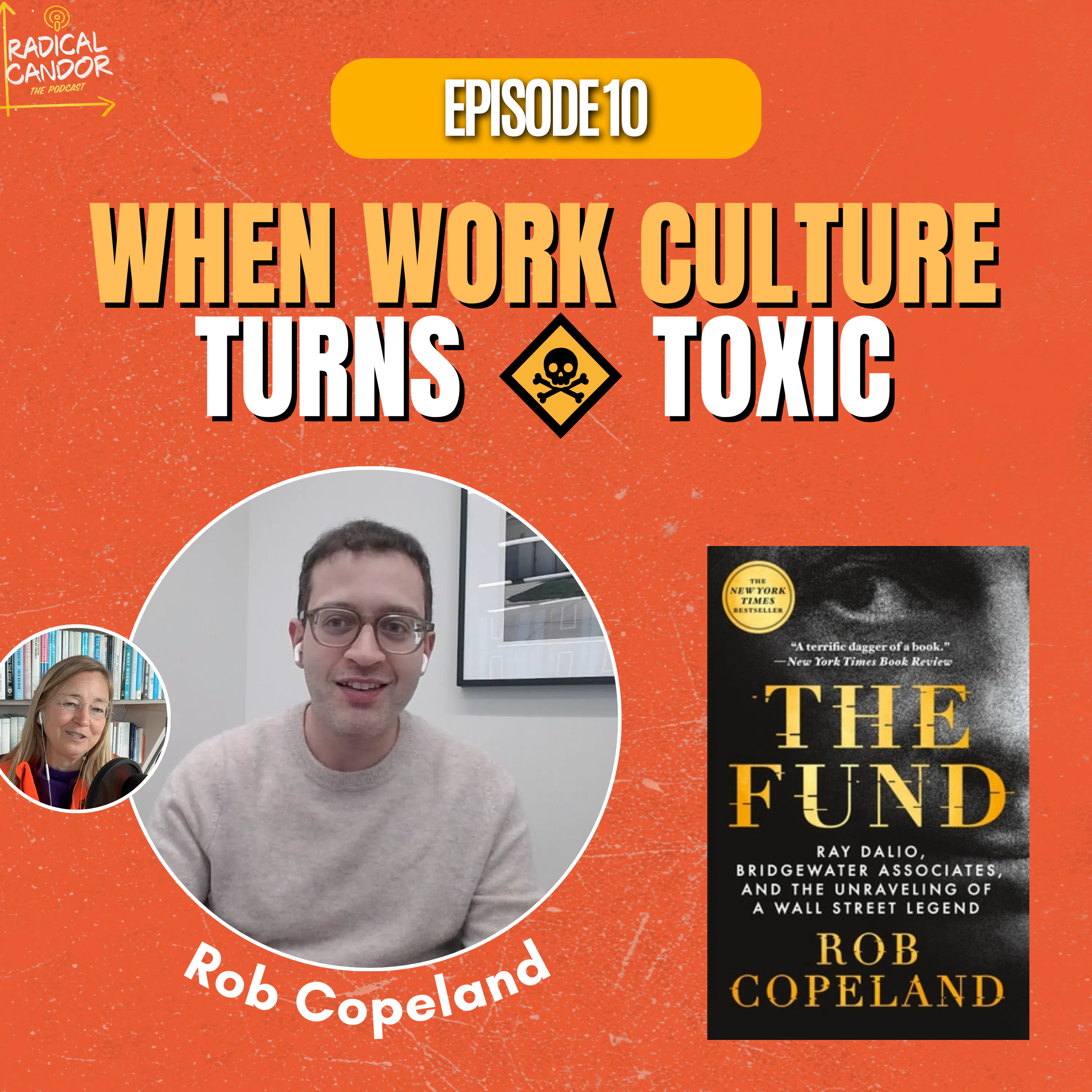 When Work Cultures Turn Toxic (with Rob Copeland) 15.04.2026 43minWhile the podcast team is taking a Radical Sabbatical, Kim is interviewing authors of the books that have had a big impact on her in the past two years. Office culture is a fascinating topic. It can be the special sauce that helps bring together team members to achieve excellence. But what happens when the company culture becomes a toxic mess? What happens when a very charismatic CEO becomes obsessed with both cataloging people’s weaknesses and then broadcasting them to the entire company? What happens when that same CEO mandates “internal reporting” on fellow co-workers, techniques that appear to be drawn directly from the playbook of the Stasi (the former East German secret police force, famous for deep surveillance to control and punish their citizens)? What happens when the CEO steadfastly refuses to hear criticism about himself? Why would people join and then remain at such an organization? Kim welcomes New York Times’ business reporter and author, Rob Copland, to talk about his fascinating, deeply researched, and best-selling book, The Fund: Ray Dalio, Bridgewater Associates and The Unraveling of a Wall Street Legend. Rob’s book dives deep on Ray Dalio, the iconic founder and leader of Bridgewater Associates and the culture he created there. Under Dalio, there is no disputing that Bridgewater Associates became one of the largest and most successful hedge funds in history. At the same time, Dalio appeared to use promises of vast riches to control and intimidate his employees. Rob shares some incredible stories to illustrate these points. When someone dared to push back on any of Dalio’s techniques or vision, he famously would shut them down with, “If you’re so smart, why aren’t you rich?!” Rob talks about what he learned in the years of research he did for this book. This conversation presents a cautionary tale of what can happen when a charismatic leader, flush with vast wealth decides his mission is also to dictate how people should live.Background on Rob Copeland: Rob Copeland is a New York Times finance reporter covering Wall Street, banks, and corporate power. He was previously the longtime hedge-fund beat reporter at The Wall Street Journal. He is best known for investigative, narrative-driven stories and is the author of the bestselling book, "The Fund: Ray Dalio, Bridgewater Associates and the Unraveling of a Wall Street Legend". CHAPTERS: (00:00) Introduction to Rob Copland (01:04) The Pissing Anecdote: A Lesson in Self-Awareness (05:11) Investigating the Absurd: Culture of Petty Conflicts (09:59) The Dark Side of Radical Transparency (12:04) The Pain of Reflection: A Closer Look at Confrontation (16:24) The Cost of Self-Improvement: Why People Endure (18:48) The Allure of Success: How Ray Dalio Captivates Minds (22:43) The Challenge of Self-Awareness (23:58) The Power Dynamics of Self-Knowledge (24:46) Cult Dynamics and Personal Freedom (25:52) The Role of Powerful Figures in Toxic Environments (26:38) Radical Transparency and Its Pitfalls (31:05) The Importance of External Tethers (33:28) Navigating Career Choices and Exit Strategies (37:38) The Journey of Self-Discovery and Feedback Connect with the Radical Candor team: Website Instagram TikTok LinkedIn YouTube Bluesky Learn more about your ad choices. Visit megaphone.fm/adchoices
 -
 How to Remake America S8 | E9 08.04.2026 45minWhile the podcast team is taking a Radical Sabbatical, Kim is interviewing authors of the books that have had a big impact on her in the past two years. Again we discuss the topic of wealth inequality and the accompanying concentration of political power. It is tempting to think that we live in an unprecedented era, and yet there are lessons to be learned from the past. Today, Kim talks to Professor John Witt of Yale Law School about his recent book, The Radical Fund. It is a fascinating story of The Garland Fund, established by Charles Garland in the early 1920s. The book takes us on a journey showing how the Garland Fund was able to lay the foundation for much less powerful groups in society to fight for their rights such as safe working conditions, free speech, and equal rights. And how those movements help drive the economic successes later in the 20th century. Kim and John discuss these lessons learned and how we can apply those lessons in our communities today. Background on John Watt: John Witt is the Allen H. Duffy class of 1960 professor of law at Yale Law School and a professor in the Yale history department. He is the author of a number of books, including Lincoln’s Code, which was awarded the Bancroft Prize and was a finalist for the Pulitzer Prize. His writing has appeared in The New York Times, The Wall Street Journal, The Washington Post, The Atlantic, The Nation, and The New Republic, among other publications. He lives with his family in Connecticut where he tends an orchard, watches baseball, and fishes in the Long Island Sound. Resources: CHAPTERS: (00:00) Introduction to the Radical Fund and Its Impact (03:04) Historical Context of Civil Rights and Labor Movements (06:12) The Role of the Foundation in Landmark Cases (09:09) Sidney Hillman's Vision for Industrial Democracy (12:04) The Evolution of Worker Participation in Capitalism (15:07) Building Solidarity Across Demographics (18:10) Lessons from History: The Importance of Unity (21:05) James Weldon Johnson and the Quest for Democracy (23:45) The Rise of W.E.B. Du Bois and the NAACP (24:33) Collaboration Between Black Leaders and White Labor Unions (26:02) The Power of Propaganda in Social Change (30:24) The Role of Money and Foundations in Social Justice (31:43) The Origins of the Garland Fund (35:15) The Debate on Philanthropy and the 'Dead Hand' Problem (37:27) Lessons from History: Economic Inequality and Social Change (40:09) The Future of Democracy and Social Justice Learn more about your ad choices. Visit megaphone.fm/adchoices
 -
 How the Ultra-Wealthy Captured American Democracy (with Prof David Gibbs) 01.04.2026 48minWhile the podcast team is taking a Radical Sabbatical, Kim is interviewing authors of the books that have had a big impact on her in the past two years. Wealth concentration in the United States is top of mind these days. While it’s tempting to see this as a recent trend, it is instructive to look at what was happening in American politics decades ago and see how many of these forces were set in motion in the 1970’s. Kim talks with Prof. David Gibbs about his book, Revolt of the Rich, How the Politics of the 1970s Widened America's Class Divide. Prof. Gibbs reviews decisions that were made during the Nixon and Carter administrations that continue to reverberate in our world today. For example, during the first oil shock in the early 1970s, President Nixon actively worked to keep oil prices high to support the Shah of Iran and to prop up the dollar. The result was financialization and deindustrialization. Later in the decade, President Carter was central to the trend of deregulation. The net effect of these decisions was an erosion of the foundations of the American middle class. Technical note: we had an issue with one of the microphones on this interview that affected the sound quality. Sorry if this affects your enjoyment of this episode. Background on David Gibbs: David N. Gibbs is professor of history at the University of Arizona, whose past research has emphasized political conflicts in Sub-Saharan Africa, Eastern Europe, and Afghanistan. He has published extensively in academic journals as well as the London Guardian, Los Angeles Times, Christian Science Monitor, Le Monde Diplomatique, Salon, and Jacobin. His third and most recent book is entitled: Revolt of the Rich: How the Politics of the 1970s Widened America’s Class Divide. His detailed personal website is at: https://dgibbs.arizona.edu/ Resources: Buy Revolt of the Rich on Bookshop.org (00:00) Introduction to the Radical Sabbatical Podcast (01:33) The Oil Crisis of the 1970s (04:46) Nixon's Role in the Oil Price Increase (09:59) Petrodollars and U.S. Economic Power (12:37) Financialization and Deindustrialization (15:05) Impact on Ordinary Americans (18:28) The Revolt of the Rich (21:34) The Shift in Economic Power (24:41) Political and Economic Alternatives (26:01) The Evolution of Taxation and Economic Policies (27:48) The Shift in Political Ideologies (30:18) Coalitions and the Rise of the Christian Right (32:30) Economic Conservatism and Social Issues (36:00 )Navigating Economic Uncertainty (40:43) Building Inclusive Economies (46:30) The Consequences of Inequality and Austerity Learn more about your ad choices. Visit megaphone.fm/adchoices
 -
 Your Privacy: Why You Should Care and Tools to Protect It 8 | 7 25.03.2026 23minWe all love the convenience of our digital devices and connected services. But what about our ever expanding pile of digital breadcrumbs we leave behind as we go about our day? These breadcrumbs can be swept up by private companies to learn quite about us and target us with specific goods and services. They can also be collected by government agencies who might use this information for legitimate police work or in some instances, political repression. So, many people are asking themselves, should I be doing more to protect my personal privacy and how should I go about this. Tech evangelist and prolific author Guy Kawasaki had asked that same question about a year ago. It started him on a journey to learn more about how to use some of the latest communications tools built from the ground up with personal privacy as its primary goal. This led Guy to install and use Signal, one of the most popular tools today for personal privacy protection. But as he started to put Signal into his communications work flow, he realized it was not obvious how to use Signal to its full potential. So, Guy collaborated with Madisun Nuismer to publish a “how to” book for using Signal, “Everybody Has Something to Hide” in January of 2026. In this episode of the Radical Candor Podcast, Kim and Guy have a wide ranging conversation about Guy’s concerns about privacy that inspired him to start using Signal and then to write the book. They discuss the centrality of privacy in a free and democratic society and how tools like Signal can enhance privacy. Kim also shares her experiences with privacy and censorship in her years working in the Soviet Union (and later Russia) in the early 1990s. They also debate how much we should all trust so much of our personal data with these large tech companies. As Guy mentions the old saying, “If you aren’t paying for the product, you ARE the product!”. In the media rollercoaster, tech’s reputation is at a low point right now. It’s worth remembering that there are a lot of idealistic people in tech who are working hard to solve problems with the goal of making the world a better place. That is part of why we want to highlight Guy’s messages and what Meredith Whitaker, Brian Acton, Moxie Marlinspike, and the whole team at Signal are doing. Background on Guy Kawasaki: Guy Kawasaki is the chief evangelist of Canva and the creator of Guy Kawasaki’s Remarkable People podcast. He is an executive fellow of the Haas School of Business (UC Berkeley), and adjunct professor of the University of New South Wales. He was the chief evangelist of Apple and a trustee of the Wikimedia Foundation. He has written Wise Guy, The Art of the Start 2.0, The Art of Social Media, Enchantment, and eleven other books. Kawasaki has a BA from Stanford University, an MBA from UCLA, and an honorary doctorate from Babson College. Resources: Electronic Freedom Foundation (EFF) information on how to use Signal. Interviews with Meredith Whittaker is the President of The Signal Foundation. Guy’s interview with Meredith Whittaker on his Remarkable People Podcast. Also an informative interview with Meredith on Scott Galloway’s Podcast. CHAPTERS: (00:00) Exploring the New Book: Everybody Has Something to Hide (00:51) The Importance of Signal and Privacy (06:46) Personal Experiences with Privacy and Censorship (11:57) Trust in Tech Companies and Data Privacy (14:27) The Idealistic Problem Solvers in Tech (15:01) Philanthropy vs. Government Aid (15:38) Universal Basic Income as an Experiment (17:02) The Importance of Privacy in Democracy (19:09) The Role of Technology in Privacy (21:04) Evangelizing Signal for Privacy Protection Connect with the Radical Candor team: Website Instagram TikTok LinkedIn YouTube Bluesky Learn more about your ad choices. Visit megaphone.fm/adchoices
Panašios tinklalaidės


Populiari šalyje
Ši tinklalaidė taip pat patenka į šių šalių tinklalaidžių topus.


