
New Books in Eastern European Studies
New Books Network
0
This podcast is a channel on the New Books Network, an academic audio library dedicated to public education. Each episode features scholars discussing their recently published research with another expert in their field. The podcast covers a wide range of topics in Eastern European studies. Listeners can explore over 150 channels and 28,000 episodes on the New Books Network website.
Epizodai
-
 Anna D. Jaroszyńska-Kirchmann, "Pierogi: An American Story of Polish Food" (Columbia UP, 2026) 18.09.2026 48minToday, pierogi are the most recognizable Polish food in the United States and a symbol of Polish American identity. How did this humble dish attain such lofty status? In Pierogi: An American Story of Polish Food (Columbia UP, 2026), Professor Anna D. Jaroszyńska-Kirchmann explores the surprising history of pierogi, tracing how Polish cuisine evolved in the multiethnic landscape of the United States. When Polish immigrants crossed the ocean, they brought with them their traditional cuisine, which came to signify enduring attachment to homeland, family, religion, and culture. In time, they as well as new generations and new immigrant waves gradually transformed Polish American culinary culture, reflecting food trends and changes in the United States, Poland, and the world. Pierogi takes readers into the kitchens where Polish American families, friends, and community organizations carry on the custom of cooking and eating together. Dr. Jaroszyńska-Kirchmann highlights small- and large-scale pierogi producers who adapted traditional dishes for the US market and food celebrities who mainstreamed them, and she traces the symbolic representation of pierogi in popular culture. She also shares personal stories, from her family’s resourcefulness in communist-era Poland facing near-constant food shortages to her experiences as an immigrant to the United States in the 1980s. Drawing on sources from historical and recent cookbooks to interviews with Polish American entrepreneurs and community members, this book offers new insights for anyone interested in East Central European and American foodways. This interview was conducted by Dr. Miranda Melcher whose book focuses on post-conflict military integration, understanding treaty negotiation and implementation in civil war contexts, with qualitative analysis of the Angolan and Mozambican civil wars. You can find Miranda’s interviews on New Books with Miranda Melcher, wherever you get your podcasts.
 -
Museums in Digital Age 18.09.2026 33minHow are museums adapting to the digital age, and what transformations are taking place in institutions we often consider to be highly conservative? In this episode, researcher Aya Kimura shares her fascination with museums in both Japan and Lithuania, as well as insights from her research and analysis over the past several years. For those who read Japanese, more details can be found in Aya Kimura’s book Museums of the Digital Age (デジタル時代の博物館), published by Kadensha. Aya Kimura is Associate Professor, Department of Human Sciences, Obihiro University of Agriculture and Veterinary Medicine The episode is hosted by Linas Didvalis, an Associate Professor at Centre for Asian Studies at Vytautas Magnus University (Kaunas, Lithuania). The Nordic Asia Podcast is a collaboration sharing expertise on Asia across the Nordic region, brought to you by the following academic partners: Asia Centre, University of Tartu (Estonia), Asian studies, University of Helsinki (Finland), Centre for Asian Studies, Vytautas Magnus University (Lithuania), Centre for East Asian Studies, University of Turku (Finland), Centre for East and South-East Asian Studies, Lund University (Sweden) and Centre for South Asian Democracy, University of Oslo (Norway). We aim to produce timely, topical and well-edited discussions of new research and developments about Asia. Host: Linas Didvalis Find the book here
-
Charlie Walker, "On Thin Ice: An Explorer's Memoir of Siberia, Surveillance and Survival" (Duckworth, 2026) 10.09.2026 48minIn February 2022, British explorer Charlie Walker flew to Siberia's Sakha Republic to walk a thousand miles up frozen rivers to the Arctic Ocean, through Earth's coldest inhabited region. Days later, Russia invaded Ukraine. Tamping down his concerns, he continued on his journey, meeting indigenous people and ice road truckers along the way. Yet his trip ended in fear and confusion, with an arrest and a month in a Yakutsk jail, the story of his new book, On Thin Ice: An Explorer's Memoir of Siberia, Surveillance and Survival (Duckworth, 2026) Charlie is an award-winning explorer, author and international keynote speaker. He has travelled over 60,000 miles by foot, horse, raft, bicycle, ski and dugout canoe, in places as varied as the Tibetan plateau, the Mongolian steppe, the Congolese jungle, the Arctic tundra, the highlands of New Guinea and the Sahara desert. He is an elected Fellow of the Royal Geographical Society, a Scientific Exploration Society Explorer Award winner, and the author of Through Sand & Snow (Nielsen UK: 2021) and On Roads That Echo (Nielsen UK: 2021) You can find more reviews, excerpts, interviews, and essays at The Asian Review of Books, including its review of On Thin Ice. Follow on Twitter at @BookReviewsAsia. Nicholas Gordon is an editor for a global magazine, and a reviewer for the Asian Review of Books. He can be found on Twitter at @nickrigordon. Support our show by becoming a premium member! https://newbooksnetwork.supportingcast.fm/eastern-european-studies
-
Daniela Gerson, "The Wanderers: A Story of Exile, Survival, and Unexpected Love in the Shadow of World War II" (Grand Central Publishing, 2026) 08.09.2026 1val 2minIn The Wanderers: A Story of Exile, Survival, and Unexpected Love in the Shadow of World War II (Grand Central Publishing, 2026), an immigration journalist and her wife trace their family’s intertwined past to unearth a history of how hundreds of thousands of Polish Jews survived Hitler’s Holocaust at the brutal hands of Stalin—a story that sheds light on the enduring power of hope and love.Daniela Gerson and her wife, Talia Inlender, met at a picnic in Los Angeles, not knowing that 75 years earlier, their grandparents had left homes only blocks away from each other in a small Polish town, and fled east to Ukraine. The Gersons and the Inlenders would go on parallel odysseys of 5,000 miles to survive the Holocaust—journeys that would, after a deceitful loyalty test from Stalin, put them on cattle cars to a Soviet Gulag, trap them for years in limbo in Central Asia, and would end, after a decade on the run, with new lives built on secrets and lies.For years, Daniela and Talia simply accepted this painful shared history as a sign that they were b’shert, meant to be. Their families’ refugee past fueled their work: Daniela as an immigration journalist; Talia an immigration attorney. But as Daniela uncovered more, she realized that their grandparents shared this escape path in the Soviet Union with most Polish Jews who survived; a group—sometimes collectively called “the Wanderers”—that is almost entirely absent from popular understanding of World War II. And unlike most Holocaust sagas that focus on the exceptionality of the Nazi genocide, theirs was also a universal story of refugees making impossible decisions when forced to seek safety, protect their children, and find new homes. Support our show by becoming a premium member! https://newbooksnetwork.supportingcast.fm/eastern-european-studies
-
Elizabeth Anne Davis, "Artifactual: Forensic and Documentary Knowing" (Duke UP, 2023) 02.09.2026 1val 2minIn Artifactual: Forensic and Documentary Knowing (Duke University Press, 2023), Elizabeth Anne Davis explores how Cypriot researchers, scientists, activists, and artists process and reckon with civil and state violence that led to the enduring division of the island, using forensic and documentary materials to retell and recontextualize conflicts between and within the Greek-Cypriot and Turkish-Cypriot communities. Davis follows forensic archaeologists and anthropologists who attempt to locate, identify, and return to relatives the remains of Cypriots killed in those conflicts. She turns to filmmakers who use archival photographs and footage to come to terms with political violence and its legacies. In both forensic science and documentary filmmaking, the dynamics of secrecy and revelation shape how material remains such as bones and archival images are given meaning. Throughout, Davis demonstrates how Cypriots navigate the tension between an ethics of knowledge, which valorizes truth as a prerequisite for recovery and reconciliation, and the politics of knowledge, which renders evidence as irremediably partial and perpetually falsifiable. Elizabeth Anne Davis is Professor of Anthropology at Princeton University. * This episode is part of a special collaboration between the New Books Network and the Society for the Anthropology of Europe, a section of the American Anthropological Association. Together, we’re highlighting exciting new work in Europeanist anthropology—featuring authors from across the field, including winners of the William A. Douglass Book Prize and contributors to the European Anthropology in Translation series published by Berghahn Books. Support our show by becoming a premium member! https://newbooksnetwork.supportingcast.fm/eastern-european-studies
-
Tom Trier, "Blue Sea, Black Gold, Red Banner: The South Caucasus and Scandinavia, 1880s–1920s" (Northern Illinois UP, 2026) 30.08.2026 1val 2minBlue Sea, Black Gold, Red Banner: The South Caucasus and Scandinavia, 1880s–1920s (Northern Illinois University Press, 2026) tells the story of the historical connections between two geographically distant and culturally distinct regions on the edges of Europe: Scandinavia and the South Caucasus. From the late nineteenth century, maritime trade fostered new commercial links and consular relations. Scandinavian merchants, particularly in Batumi and Baku, played key roles. The discovery of oil along the Caspian Sea shores attracted Scandinavian entrepreneurs, notably the Swedish Nobel family, helping to develop Baku into a booming industrial hub. Tom Trier focuses on the years of upheaval surrounding World War I and the collapse of the Russian Empire, when Georgia—along with Armenia and Azerbaijan—briefly emerged as an independent republic. The four-decade relationship ended abruptly during the Bolshevik Red Army's invasion of the South Caucasus from 1920 to 1921. Drawing on both Scandinavian and Georgian perspectives, Blue Sea, Black Gold, Red Banner examines how Nordic merchants, consuls, and diplomats navigated the shifting political landscape and how Georgia's social democratic leadership looked to neutral Scandinavia as a gateway to broader European political, diplomatic, and economic engagement. This interview was conducted by Dr. Miranda Melcher whose book focuses on post-conflict military integration, understanding treaty negotiation and implementation in civil war contexts, with qualitative analysis of the Angolan and Mozambican civil wars. You can find Miranda’s interviews on New Books with Miranda Melcher, wherever you get your podcasts. Support our show by becoming a premium member! https://newbooksnetwork.supportingcast.fm/eastern-european-studies
-
Educating for an Uncertain Future in Interwar Poland 29.08.2026 56minIn the two decades between the First and Second World Wars, Jewish parents in Poland faced a proliferation of choices when it came to educating their children. Each choice offered a vision of what future Polish Jews desired, what they expected, and the gap between the two. State schools taught in Polish (sometimes with a schedule to accommodate traditional religious observance), secularist Yiddish schools with strong ties to Jewish socialism and the labor movement, Hebraist schools promoting political and cultural Zionism, and religious schools that retained--or innovated upon--traditionalist educational models reflected different opinions for what Jewish children in interwar Poland would need in the present to secure their future. In this lecture, Elena Hoffenberg draws upon materials held by YIVO to explore how projections about the future in terms of work, culture, and politics guided parents, educational activists, and young people themselves. Choices as reflections of competing political and religious commitments, as well as material constraints, to better understand what Polish Jews expected for their individual and communal futures. This lecture originally took place on March 2, 2026. Support our show by becoming a premium member! https://newbooksnetwork.supportingcast.fm/eastern-european-studies
-
Ukrainian Men Fleeing Conscription: A Discussion with Writer Dan Storyev 27.08.2026 48minOur conversation focuses on a groundbreaking article by Dan Storyev recently published in The Nation: “Millions of Ukrainian Men Are Fleeing a Cruel Conscription System.” Storyev was on the ground in Odesa to report firsthand for this piece, drawing on encounters with Ukrainian men in flight from the officers of the Ukrainian state agency, known as TCR, in charge of mobilizing fighting-age men for the war in Ukraine against Russia’s invading army. It’s an important story, yet one, as he told me, that few outlets in the Western press want to publish. And as we note, Russia also is experiencing great difficulties in conscripting men for this war. Storyev is a Russian-American writer and the co-author, with Maria Kuznetsova, of the forthcoming book How to Survive Authoritarianism: A Russian’s Phrasebook for Everyday Live in America (W.W. Norton), to be published in September. Support our show by becoming a premium member! https://newbooksnetwork.supportingcast.fm/eastern-european-studies
-
After Putin: A Discussion with Political Scientist Julian G. Waller 25.08.2026 51minRussian leader Vladimir Putin, at 73 years old, is still very much alive, yet the “After Putin” conversation is an active one inside and outside of Russia. What could come next and how to think about that question? My guest is Julian G. Waller, a political scientist at George Washington University and author of a recent Foreign Affairs article “After Putin: Russia’s Coming Succession Crisis.” In our discussion, Waller anchors the “After Putin” question in historical context, as to how succession played out after Stalin’s death in the 1953. And we talk about how the current political environment in Moscow, shaped by Putin’s protracted war in Ukraine, is informing the “After Putin” discussion. Could a revolutionary scenario play out? How bodily safe is Putin? Waller is author of Autocrats Can't Always Get What They Want: State Institutions and Autonomy under Authoritarianism (University of Michigan Press, 2024). Support our show by becoming a premium member! https://newbooksnetwork.supportingcast.fm/eastern-european-studies
-
Denialism: Polish Style 22.08.2026 1val 9minHolocaust distortion in Poland involves reshaping or minimizing facts about the Holocaust, often emphasizing Polish victimhood while obscuring instances of local collaboration, participation, or indifference. It appears in political rhetoric, memory laws, public commemorations, and attacks on critical scholarship. YIVO’s Poland vs. Holocaust History series examines these dynamics and situates the Polish case within a broader European context. Elżbieta Janicka focuses on the case of the former German Nazi death camp Treblinka, the place of murder and (un)rest of nearly one million Jews from several European countries, the majority from Poland. While keeping in mind that “Treblinka” is as an umbrella term for the forced labor camp Treblinka I (1941-1944), the extermination camp Treblinka II (1942-1943), and a railway station at Treblinka the village, Janicka examines symbolic topography, such as the symbols and narratives that are imprinted into these sites under the auspices of the Treblinka Museum. Regarding the unrestricted Polish bottom-up and top-down fight to “conquer the space” of the Holocaust and make it symbolically profitable for Poland, Janicka raises the question: Why doesn’t the present Polish strategy of “promoting Polish martyrdom upon the Jewish one” trigger an international scandal and condemnation? Janicka argues that while Polish cultural institutions do not deny the Holocaust itself, they practice a form of denialism by obscuring the reality of Polish involvement in the Holocaust. This lecture fits into a broader debate about Polish public institutions that promote a counter-history of the Holocaust and have at their disposal extraordinary means of propaganda both within Poland and abroad. This lecture originally took place on February 19, 2026. Support our show by becoming a premium member! https://newbooksnetwork.supportingcast.fm/eastern-european-studies
-
Roderick Beaton, "Europe: A New History" (Allen Lane, 2026) 19.08.2026 1val 8minWhat do we talk about when we talk about Europe? Is it defined by geography? Or is it politics, or shared culture? In Europe: A New History (Allen Lane, 2026), award-winning historian Roderick Beaton tells the story of Europe as never before—as the history of an idea, and a collective identity. Since its dramatic birth in ancient Greece, 'Europe' has been defined, and redefined, by its people. Through this powerful lens, and with the narrative drive and scope of a novelist, Beaton deftly surveys Europe’s major historical developments: the rise and fall of Rome; the explosion of Christianity; the intellectual ferment of the Renaissance and the Enlightenment; the arrival of Europeans in the Americas; the violent upheavals of the nineteenth and twentieth centuries; and the uncertainties of the present. Throughout, original sources allow the voices of the past, from Tacitus to Thatcher, to speak for themselves. Grappling with the multilayered identities that have always come with being European, Europe places the Europe of today in a long arc of history stretching back more than 2,500 years. Roderick Beaton is Emeritus Koraes Professor of Modern Greek and Byzantine History, Language and Literature at King's College London and Chair of Trustees of the British School at Athens, an institute of advanced research. He is a four-time winner of the Runciman Award, for his books An Introduction to Modern Greek Literature, George Seferis: Waiting for the Angel: A Biography, Byron's War: Romantic Rebellion, Greek Revolution, and Greece: Biography of a Modern Nation, published by Penguin in 2019. He is also the author of The Greeks: A Global History. He is a Fellow of the British Academy, Commander of the Order of Honour of the Hellenic Republic, and an honorary citizen of Greece. He was knighted in 2025. Morteza Hajizadeh is a Ph.D. graduate in English from the University of Auckland in New Zealand. His research interests are Cultural Studies; Critical Theory; Environmental History; Medieval (Intellectual) History; Gothic Studies; 18th and 19th Century British Literature. Support our show by becoming a premium member! https://newbooksnetwork.supportingcast.fm/eastern-european-studies
-
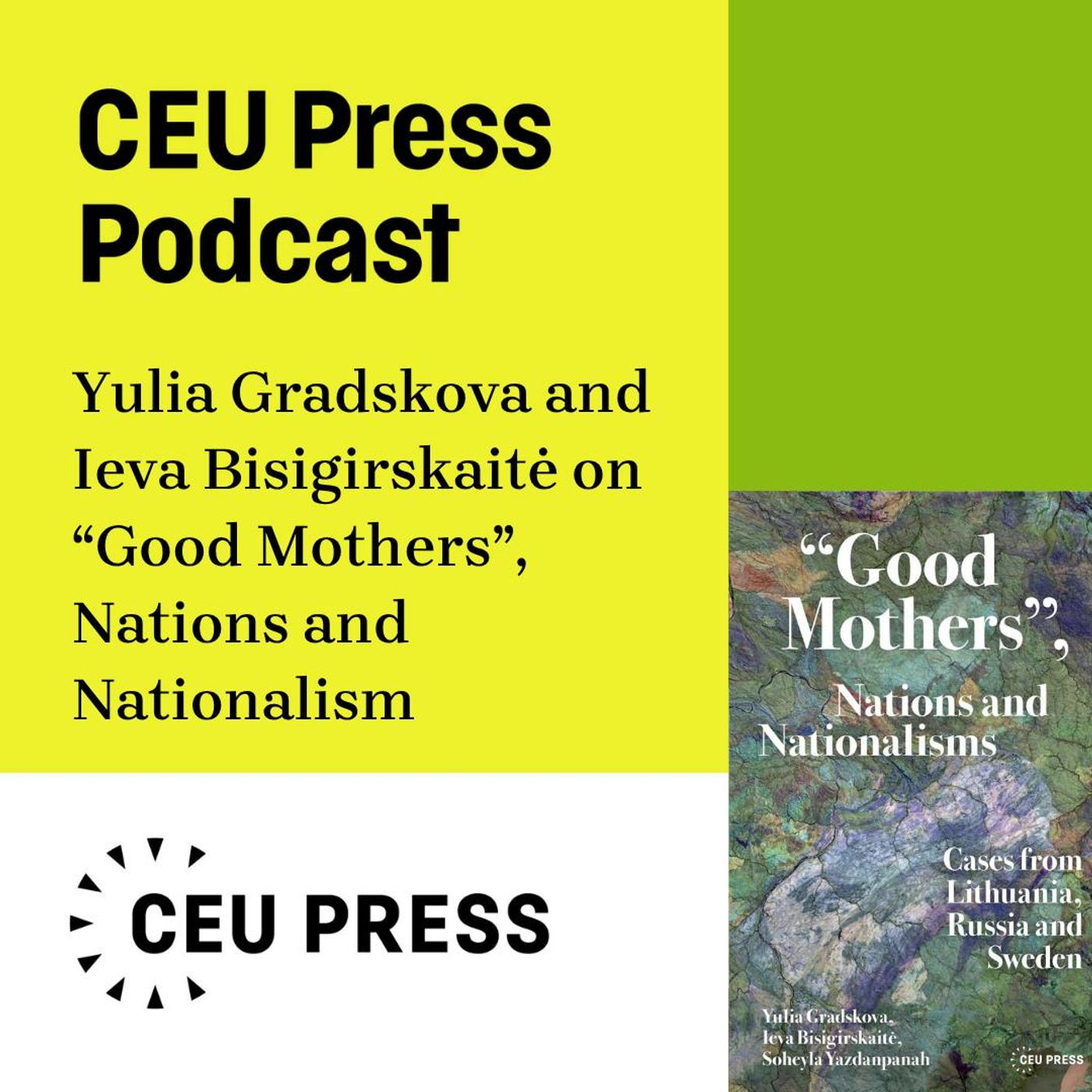 Yulia Gradskova et al., "Good Mothers, Nations and Nationalisms: Cases from Lithuania, Russia and Sweden" (CEU Press, 2026) 13.08.2026 54minIn this episode, host Andrea Talabér (CEU Press, 2026) talks with Yulia Gradskova and Ieva Bisigirskaitė, two of the three authors behind Good Mothers, Nations and Nationalisms: Cases from Lithuania, Russia and Sweden. Together with Soheyla Yazdanpanah, they explore what nationalists mean by "good mothers," demographic anxiety, and maternal activism in Lithuania, Russia and Sweden. You can purchase a copy here. The CEU Press Podcast delves into various aspects of the publishing process: from crafting a book proposal, finding a publisher, responding to peer review feedback on the manuscript, to the subsequent distribution, promotion and marketing of academic books. We also talk to series editors and authors, who will share their experiences of getting published and discuss their series or books. Interested in CEU Press’s publications? Click here to find out more: Stay tuned for future episodes and subscribe to our podcast to be the first to be notified. Support our show by becoming a premium member! https://newbooksnetwork.supportingcast.fm/eastern-european-studies
 -
In the Shadow of the Shtetl: Yiddish Memories of Small-Town Jewish Life in Ukraine 12.08.2026 59minDrawing from some four hundred Yiddish-language interviews conducted by the Archives of Historical and Ethnographic Yiddish Memories project, Jeffrey Veidlinger will explore how elderly Yiddish speakers in Ukraine described their memories of Jewish life in the Soviet shtetl, their stories of survival during the Holocaust, and their experiences living as Jews under Communism. This exploration will help us understand how despite Stalinist repressions, the Holocaust, and official antisemitism, these interviews infused with memories of family life, religious observance, education, and work testify to the survival of Jewish life, even within the shadow of the shtetl. This lecture originally took place on July 1, 2025. Support our show by becoming a premium member! https://newbooksnetwork.supportingcast.fm/eastern-european-studies
-
Christopher Campo-Bowen, "Visions of the Village: Ruralness, Identity, and Czech Opera" (Oxford UP, 2025) 10.08.2026 1val 13minThe Bartered Bride, a comic opera by Bedrich Smetana, premiered in Prague on March 30, 1866. Its pastoral love story and setting in a rural Czech village eventually became an enduring symbol of Czech nationalism. In Visions of the Village: Ruralness, Identity, and Czech Opera (Oxford University Press, 2025), Christopher Campo-Bowen examines how a particular image of the rural village in a set of Czech operas written between 1866 and 1904 became a powerful signifier for Czech ethnoracial and nationalist identity. He follows this conception of Czech identity and its entanglement with opera through the political changes in the years when the Czech lands were ruled by the Austro-Hungarian Empire and the upheaval that followed when the Empire collapsed in 1918 and the First Czechoslovak Republic was founded. In addition to composers and their operas, Campo-Bowen investigates the output of critics, administrators, and other urban intellectuals to understand the impact of village operas on public discourse. By setting his analysis within a discussion of how race was understood in nineteenth-century Europe, Campo-Bowen shows that this seemingly straightforward nationalist discourse was shot through with racialized essentialism and ideas about gender that were connected with larger political realities. He ends the book with a discussion of the resonances of this nineteenth-century conception of Czech identity in the current Czech Republic. Support our show by becoming a premium member! https://newbooksnetwork.supportingcast.fm/eastern-european-studies
-
Russia’s Jews in World War I 08.08.2026 57minWhen World War I began, the Russian Empire was home to more than 5.7 million Jews, the most densely settled Jewish population in the world. Thirty years later, by 1945, only remnants of this civilization remained. The years of World War I, from 1914 to 1918, launched nearly all the forces that led to this epic destruction. In A Nation of Refugees: Russia's Jews in World War I, Polly Zavadivker tells how Jewish civilians experienced that war and its epicenter of violence on the Eastern Front. World War I transformed the lives of East European Jews in ways that were second only to the Holocaust in their magnitude. State violence and forced migration determined many aspects of Jewish wartime and revolutionary experience. These policies not only destroyed much of traditional Jewish life but also inadvertently compelled a transformation of Jewish civil society. The collapse of Russian imperialism enabled the growth of an empire-wide humanitarian campaign to rescue the “nation of refugees,” whose plight embodied that of the Jewish nation itself. By exploring this history of Jewish humanitarianism during World War I, Zavadivker provides the origin stories of key leaders and public institutions that served East European Jewry in the interwar years and during the Holocaust. Join YIVO for a discussion with Zavadivker about this book, led by historian Eliyana Adler. Buy the book: here This book talk originally took place on February 25, 2025. Support our show by becoming a premium member! https://newbooksnetwork.supportingcast.fm/eastern-european-studies
-
Jewish Folk Medicine in Eastern Europe 25.07.2026 58minJews have been active participants in shaping the healing practices of the communities of Eastern Europe. Their approach largely combined the ideas of traditional Ashkenazi culture with the heritage of medieval and early modern medicine. Holy rabbis and faith healers, as well as Jewish barbers, innkeepers, and peddlers, all dispensed cures, purveyed folk remedies for different ailments, and gave hope to the sick and their families based on kabbalah, numerology, prayer, and magical Hebrew formulas. Nevertheless, as new sources of knowledge penetrated the traditional world, modern medical ideas gained widespread support. Jews became court physicians to the nobility, and when the universities were opened up to them, many also qualified as doctors. At every stage, medicine proved an important field for cross-cultural contacts. In A Frog Under the Tongue: Jewish Folk Medicine in Eastern Europe (Liverpool UP, 2024), Marek Tuszewicki studies manuscripts, printed publications, and memoirs to tease out therapeutic advice, recipes, magical incantations, kabbalistic methods, and practical techniques, together with the ethical considerations that such approaches entailed. His research fills a gap in the study of folk medicine in Eastern Europe, shedding light on little-known aspects of Ashkenazi culture, and on how the need to treat sickness brought Jews and their neighbors together. Join YIVO for a discussion with Tuszewicki about this book, led by cultural critic and playwright Rokhl Kafrissen. Buy the book here This book talk originally took place on November 11, 2024. Support our show by becoming a premium member! https://newbooksnetwork.supportingcast.fm/eastern-european-studies
-
Suzy Hansen, "From Life Itself: Turkey, Istanbul, and a Neighborhood in the Age of Erdoğan" (FSG, 2026) 21.07.2026 44minFrom Suzy Hansen, whose previous book, Notes on a Foreign Country, was a finalist for the Pulitzer Prize, From Life Itself: Turkey, Istanbul, and a Neighborhood in the Age of Erdoğan (Farrar, Straus & Giroux, 2026) is a story for a world out of joint. An absorbing account of one neighborhood in Istanbul that has seen profound change, it offers lessons for all of us who feel the pressure of the disorienting global forces remaking our lives. Karagümrük, a neighborhood once dominated by Ottoman-era homes, is now known for petty thieves, cheap apartment blocks, and an influx of Syrian refugees. It’s here that Hansen went looking for the truth behind the Turkish president Recep Tayyip Erdoğan’s authoritarian turn, a catastrophic regional war, and an accelerating geopolitical crisis. She asks: Was Turkey a harbinger of what would soon arise in other countries, the resurgence of authoritarianism? Or do the lives in this neighborhood, and the transformations of Erdoğan’s Turkey, reveal a more complex story? During a decade spent reporting from Karagümrük, Hansen discovered the neighborhood’s secrets and got to know some of its people: Ismail, the longtime muhtar, or neighborhood councilman; Huseyin, a loyalist in Erdoğan’s Islamic nationalist AK Party; and Ebru, a real estate agent and mother with ambitions to unseat Ismail. Through these local perspectives, Hansen connects the events unfolding in Karagümrük to the forces roiling Turkey, the Middle East, and the world, capturing the sweep of the last ten years in microcosm. Support our show by becoming a premium member! https://newbooksnetwork.supportingcast.fm/eastern-european-studies
-
Elana Resnick, "Refusing Sustainability: Race and Environmentalism in a Changing Europe" (Stanford UP, 2025) 19.07.2026 43minSustainability has become a touchstone for development worldwide, promising an antidote to environmental degradation and capitalism's excess: waste. Refusing Sustainability: Race and Environmentalism in a Changing Europe (Stanford University Press, 2025) presents a fundamentally different account of sustainability and waste itself by uncovering the intersections of international environmental reforms and racialized labor. In Bulgaria, Roma comprise the bulk of the country's waste workers, while anti-Roma racism casts them as socially disposable. Without their labor, however, the country cannot meet the sustainability targets required by the European Union. Drawing on fieldwork that spans twenty years, including eleven months working alongside Romani women street sweepers, and years embedded in waste organizations, political campaigns, Roma NGOs, and activist groups, Elana Resnick examines the power hierarchies that shape both waste management and European geopolitics. Instead of focusing on only environmental harms or toxic distributions, Refusing Sustainability approaches Romani life-worlds as spaces of creative production, and also tells several larger stories: of postsocialist racial capitalism, environmental progressivism, democratic failures, mutual aid, and the power of women's friendships. Through these stories, Resnick illuminates how ordinary people, racialized as discardable, resist systems that simultaneously rely on and exclude them. Support our show by becoming a premium member! https://newbooksnetwork.supportingcast.fm/eastern-european-studies
-
Anja Foerschner, "Female Art and Agency in Yugoslavia, 1971–2001" (Bloomsbury, 2024) 19.07.2026 48minIn Female Art and Agency in Yugoslavia, 1971–2001 (Bloomsbury, 2024), Anja Foerschner offers a compelling exploration of the women artists, curators, scholars, and activists who shaped the cultural landscape of Yugoslavia and its successor states. Drawing on both original research and existing scholarship, she traces the emergence of the New Art Practice of the late 1960s and 1970s, highlighting the pivotal role of Belgrade’s Student Cultural Centre, where women were instrumental in forging a progressive artistic and curatorial vision. Through insightful examinations of performance art, video art, and the development of feminist thought in Yugoslavia, Foerschner reveals how the region carved out a distinctive place within the international postwar avant-garde. Situating Yugoslav feminism in dialogue with Western and neighbouring contexts, she sheds new light on the complex intersections of art, politics, and social change. By exploring artistic responses to the breakup of Yugoslavia in the 1990s, and the enduring political dimensions of cultural production, this book invites readers to reconsider the legacies of activist art and their resonance in our present time. Support our show by becoming a premium member! https://newbooksnetwork.supportingcast.fm/eastern-european-studies
-
Jay Szpilka, "BDSM Practices in Contemporary Poland: Barbed Wire Floggings, Rope Orgasms, and the Problem with Desire" (Palgrave Macmillan, 2025) 07.07.2026 1val 3minIn BDSM Practices in Poland: Barbed Wire Floggings, Rope Orgasms, and the Problem with Desire (Palgrave Macmillan, 2025), cultural anthropologist and cultural studies scholar Jay Szpilka analyzes the way that BDSM is practiced in contemporary Poland. Based on extensive field research, she asks what social, cultural, and political conditions are necessary for BDSM to be possible to practice in the first place. Through a nuanced analysis of the way that practitioners navigate conflicting understandings and politics of kink, this book provides an alternative to Western-centric narratives of BDSM communities and challenges a number of long-standing notions about the status kink which circulate in sexuality and queer studies. Jay Szpilka is a visiting fellow at Edinburgh Napier University and an assistant professor at SWPS University in Poland. She is the author of BDSM Practices in Contemporary Poland, and her work has been published in the Feminist Review, TSQ: Transgender Studies Quarterly, Journal of Lesbian Studies, Teksty Drugie, and the Australian Feminist Studies. Atalia Israeli-Nevo is an anthropology PhD candidate at the University of Texas at Austin. Support our show by becoming a premium member! https://newbooksnetwork.supportingcast.fm/eastern-european-studies
Panašios tinklalaidės


Populiari šalyje
Ši tinklalaidė taip pat patenka į šių šalių tinklalaidžių topus.
