
NTSB News Talk – Aviation Accidents, Safety Investigations & Pilot Lessons
Max Trescott | Aviation News Talk Network
0
NTSB News Talk is a podcast that delves into aircraft accidents, safety investigations, and lessons for pilots. Hosted by aviation journalist Rob Mark and flight instructor Max Trescott, the show breaks down recent NTSB reports and analyzes accident causes. Each episode features expert commentary, real-world scenarios, and interviews with investigators and subject-matter experts. The podcast aims to inform pilots, instructors, and aviation enthusiasts about safety without sensationalism.
Epizodai
-
 Amazon Prime Air Boeing 767 Crash Update: 120-Knot Go-Around Attempt & More Accidents 23.09.2026 43minNew information from the NTSB is filling in the final seconds of the Amazon Prime Air Boeing 767 crash in Miami. The agency’s summary of the cockpit voice recorder shows repeated concerns about excessive speed, followed by touchdown and then, 16 seconds later, a call for a go-around. The brakes were released at a ground speed of 120 knots and go-around thrust was applied before the attempt was abandoned. Recorded data showed no indication that the speed brakes or thrust reversers were deployed.Max Trescott also revisits his ADS-B analysis of Flight 7598 and explains why he believes an automation surprise involving the Boeing 767’s vertical modes may have contributed to the airplane becoming high and fast.Then Max and Rob Mark examine the fatal KNBC AS350B2 helicopter crash in Los Angeles, including ADS-B evidence and reports of a possible low-rotor-RPM warning.Other accidents include N734ZK, a Cessna 172N crash at Montgomery-Gibbs Executive Airport, N9485P, a fatal Piper Comanche accident at a short Alaska runway, N93R, a Lockheed 12A that took off with full flaps, a fuel-exhaustion accident involving N413AW, a Pipistrel Alpha, and N188PC, a Pilatus PC-12 loss of control in IMC.The episode closes with a story from the NASA ASRS Callback newsletter about a Cirrus pilot’s successful recovery from a dangerous distraction in instrument conditions.
 -
 Amazon Prime Air Boeing 767 Crash in Miami: Flight 7598 ADS-B Analysis and More Accidents 06.09.2026 52minAn Amazon Prime Air Boeing 767 crashes after overrunning Runway 30 at Miami International Airport—and ADS-B data contains an important clue about how the approach became unstable.In this episode, we analyze the September 6 crash of Prime Air Flight 7598, operated by 21 Air with Boeing 767 N1997A. The flight from San Juan initially followed an almost perfect three-degree approach toward Miami. But approximately five miles from the runway, the aircraft unexpectedly leveled near 1,600 feet.The ADS-B data shows that 1,600 feet had been entered as the selected altitude much earlier in the descent. That raises the possibility of an automation surprise, although another possibility is that the crew leveled inadvertently after disconnecting the autopilot to hand-fly.The crew then attempted to recover using a descent approaching twice the normal glide angle. The 767 crossed the displaced threshold around 175 knots, apparently touched down near 160 knots, and was still traveling about 110 knots when it left the runway.We also examine a fatal PC-12 spatial-disorientation accident, new evidence of helicopter wake turbulence in a Cessna 150 collision, and a troubling student-pilot night CFIT accident involving a CFI cross-country endorsement.FAA No Go Over the Counter Medications List
 -
 Philadelphia Learjet 55 Crash: Spatial Disorientation Clues & Wrong-Runway Landings 25.08.2026 37minIn Episode 37 of NTSB News Talk, Max Trescott and Rob Mark examine new evidence from the fatal Learjet 55 air ambulance crash in Philadelphia and several other accidents with important lessons for pilots.Brought to you by AVEMCO aircraft insurance.Support Rob and Max by making a donation at Patreon.comThe Learjet 55 departed Northeast Philadelphia Airport at night into a roughly 400-foot overcast. Newly released NTSB docket material shows the aircraft initially beginning its assigned right turn before slowly rolling left. The exceptionally gradual roll raises the possibility of somatogyral illusion—a form of spatial disorientation in which the inner ear may fail to detect slow rotational movement. Investigators also examined somatogravic illusion, cockpit workload, pitch trim, and the captain’s previous training history. Both engines appeared to be producing takeoff power, making an engine failure less likely.Max and Rob also discuss two wrong-runway landings near Chicago that illustrate continuation bias and task saturation.Other accidents include a Cirrus Vision Jet striking a pipe across a closed portion of a runway at Driggs, Idaho; a fatal Cessna 150 collision with a Pennsylvania State Police helicopter; N1850N a Beechcraft Duchess accident during simulated single-engine training; and a photographer fatally struck by the wing of glider N8217W. Also, two wrong-runway landings near Chicago, N772MR (Envoy 3936) and N1128M Learjet 60.Those final incidents highlight a recurring human-factors problem: once pilots commit mentally to a plan, contradictory evidence can become surprisingly difficult to recognize.
 -
 Cirrus Takes a Swim, Aerostar Night Crash, Twin Comanche VMC Roll & More 11.08.2026 42minIn Episode 36 of NTSB News Talk, Max Trescott and Rob Mark examine a series of accidents that illustrate how quickly routine flights can unravel when pilots continue after the warning signs begin to accumulate.Brought to you by AVEMCO aircraft insurance.Support Rob and Max by making a donation at Patreon.comA Cessna 172, N1166F, crashes at night at Blackfoot, Idaho, after what appears to have been a go-around. A Cirrus SR22T, N625LK, crashes near Bend, Oregon, after remaining airborne for more than five hours in an unusual flight that authorities say ended intentionally. An Aerostar 601P, N800AA, barely climbs after a nighttime departure from Adirondack Regional Airport, raising the possibility of somatogravic illusion.They also discuss a Beech Baron, N202DK, lost after apparently continuing VFR into instrument weather, and a Piper Twin Comanche, N8154Y, that rolls inverted during a go-around following an earlier engine abnormality.Final reports include a Diamond DA42, N705JP, that lands long with a tailwind and insufficient runway remaining; an unregistered Piper PA-18 that stalls during a low-altitude predator-control flight; a Cirrus SR22T, N778WT damaged on an unfamiliar grass runway; and a Gulfstream G600, N600WE, that loses visual reference in heavy rain during landing.Plus, Rob reflects on the 45th anniversary of the PATCO strike and the warning he published shortly before it began. He talks about it on his Stories About Flying podcast.
 -
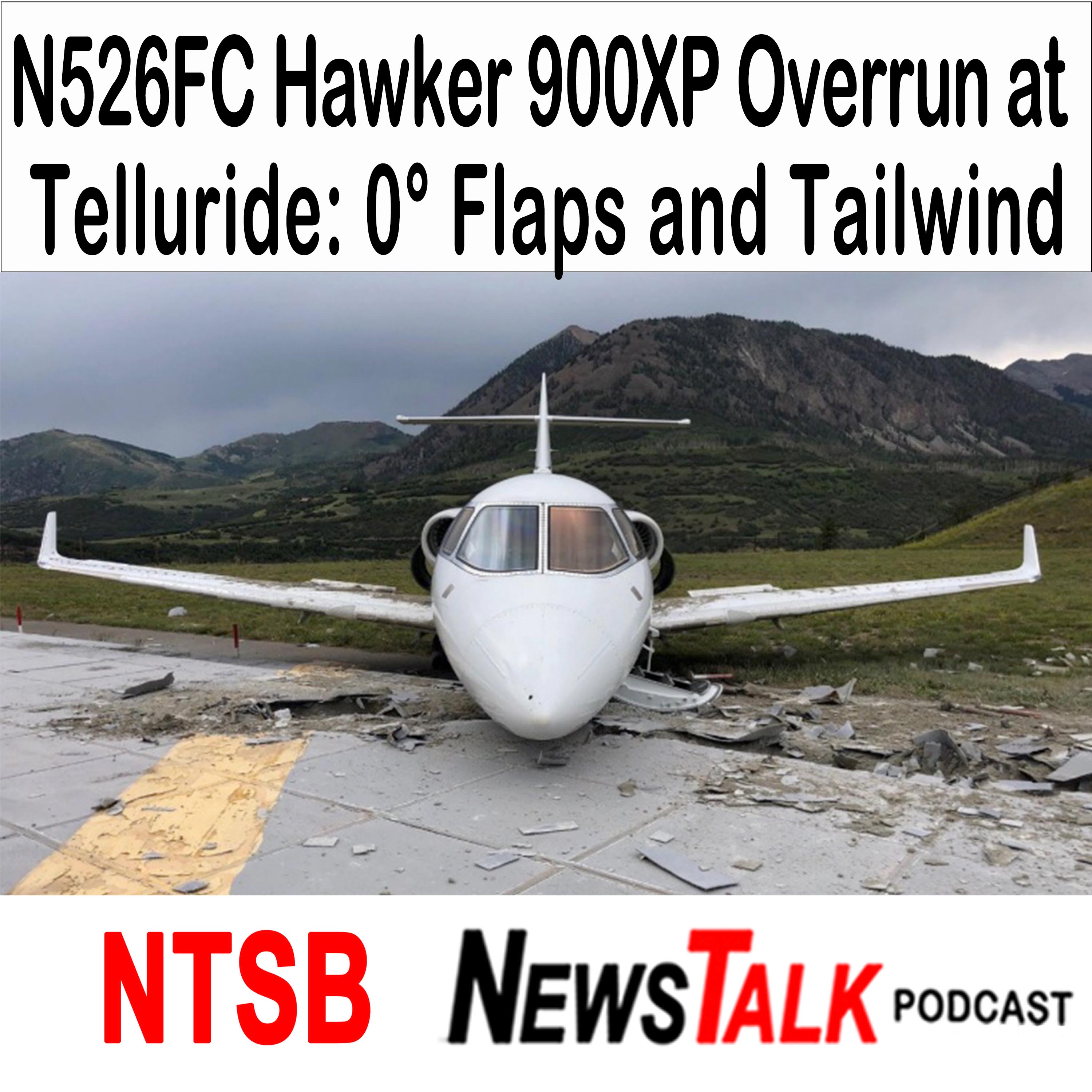 N526FC Hawker 900XP Overrun at Telluride: 0° Flaps and a Tailwind 28.07.2026 42minMax Trescott and Rob Mark examine the July 20, 2024 runway excursion of Hawker 900XP N526FC at Telluride Regional Airport. The crew planned a Runway 27 departure from an airport elevation of 9,069 feet, with density altitude above 11,200 feet and takeoff calculations using nearly all of the 7,111-foot runway. But the jet began its takeoff with the flaps retracted instead of set to the planned 15 degrees, while a gusty tailwind exceeded the airplane’s operating limitation. Here are Takeoff Videos One and Two.The aircraft never became airborne. After the crew rejected the takeoff, it ran through the engineered material arresting system and stopped beyond the runway. Both pilots escaped without injury, though the airplane sustained substantial damage and its engines continued running after impact.Max and Rob analyze the cockpit voice recorder summary, the absence of audible checklist use or takeoff briefing, the missed opportunities to verify flap position, and the hazards of operating with almost no performance margin. They also discuss fuel-loading decisions at mountain airports, the unusual arrival hold on Telluride’s RNAV approach, unofficial instrument procedures, discrepancies in the pilots’ NTSB forms, and the lesson: disciplined checklist use, crew communication, and attention to detail are essential when conditions leave no room for error.
 -
 Three Fuel Emergencies, a Boeing 737 Crash, and the Carb-Ice Myth 14.07.2026 36minMax Trescott and Rob Mark review a mysterious Boeing 737 cargo crash, several fuel-related accidents, loss of control, and a dangerous carb-ice misconception. K2 Airways Flight KTA1732, Boeing 737-400F AP-BOI, reported a navigation problem before plunging into the Arabian Sea. The hosts analyze Beechcraft 95-A55 Baron N7501S after an apparent dual-engine failure near Lancaster, South Carolina, following an 18-hour flying day, raising questions about fuel endurance, fatigue, and nighttime hypoxia.Preliminary reports include Cessna 150L N156KA, where the instructor tried to select a nonexistent right-tank position and investigators found a striking fuel imbalance; Cessna P210N N54CC, which stalled and spun above a 9,550-foot runway; Pacific Aerospace 750XL N221BN, whose engine was producing power before a fatal skydiving crash; and experimental Piper PA-20 N7635K, which struck mountainous terrain while flying toward instrument conditions with a suspended certificate and expired medical.Final reports cover Cessna 172M N4464R, whose seat slid aft during takeoff, and Cessna 182 N8580T, which lost power on final after the left tank ran dry despite fuel remaining in the right tank. Listener Sam Dawson closes with a warning that no carbureted airplane should be assumed immune from carb ice or what its POH may imply alone.
 -
 Runway Close Calls, Skydiving Crashes, Citation Latitude Fatal Crash & Cirrus Icing CAPS Pull 30.06.2026 41minMax Trescott and Rob Mark review a packed week of aviation safety events, beginning with two runway close calls. At Boston Logan, Delta Air Lines Flight 2351 went around after American Airlines Flight 3161 delayed its takeoff roll on an intersecting runway. At Miami, American Airlines Flight AA308, an Airbus A319, rejected takeoff after spotting NetJets Flight EJA434, an Embraer Phenom 300, N434QS, on the runway after an apparent clearance misunderstanding.The episode then turns to recent accidents, including the fatal Pilatus PC-6/B2-H4 Turbo Porter skydiving crash of D-FIPS in France, a fatal propeller accident involving a Cessna 208B Grand Caravan EX, N593EX, at Marana, AZ and the crash of a NetJets Cessna 680A Citation Latitude, N523QS, near Laredo after a reported emergency. Max also discusses a fatal night Piper Archer, N249WF, near Bowie, Maryland, where possible factors include engine failure, fuel exhaustion, or carburetor ice.Rob covers a float-equipped Cessna 195, N3877V, that struck unmarked power lines near Pasco, Washington. Final reports include a Cirrus SR22T, N285AH, seat-slide takeoff accident and a Cirrus SR20, N619AV, icing encounter that ended with a CAPS parachute deployment.
 -
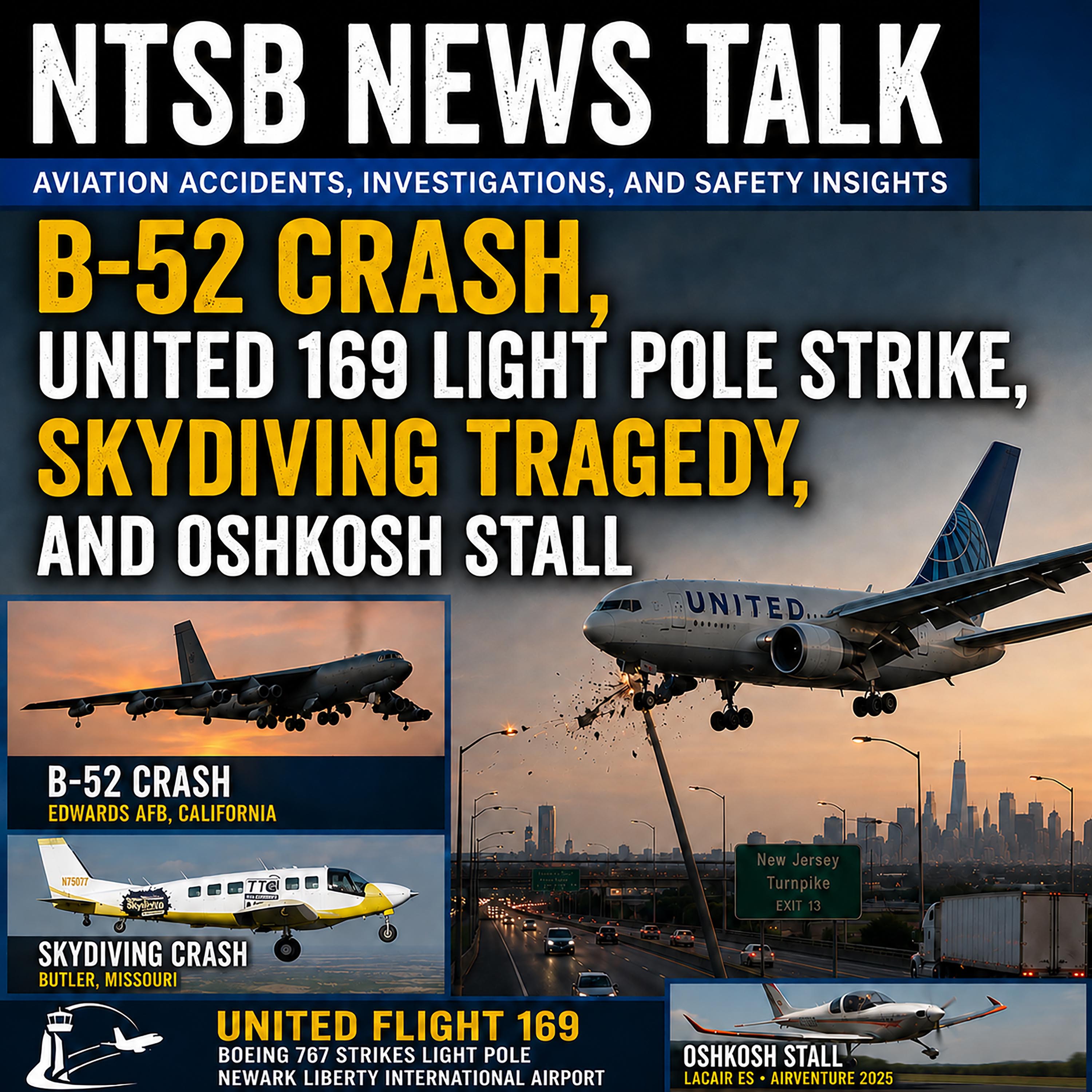 B-52 Crash, United 169 Light Pole Strike, Skydiving Tragedy, and Oshkosh Stall 16.06.2026 50minMax Trescott and Rob Mark review major recent aviation accidents and newly released NTSB reports, beginning with two breaking accidents: a U.S. Air Force B-52 crash shortly after takeoff from Edwards Air Force Base in California, and a fatal skydiving aircraft crash near Butler, Missouri, involving N221BN, a Pacific Aerospace 750XL/P-750 operated for Skydive Kansas City. That accident killed the pilot and 11 skydiving passengers and raises early questions about takeoff performance, low-altitude options, and the unique operational risks of jump aircraft.Brought to you by AVEMCO aircraft insurance.Support Rob and Max by making a donation at Patreon.comThey also discuss N318JF, a fatal Gulfstream G200 crash at La Romana in the Dominican Republic and N858SD, a Cirrus SR20 crash in Ohio, along with the pilot’s previous icing accident in in N406SR, a 2006 SR22.The preliminary report segment focuses on United Flight 169, a Boeing 767 arriving at Newark from Venice. After multiple runway changes, the crew flew the RNAV W Runway 29 approach, descended below the intended visual path, struck a light pole near the New Jersey Turnpike, and landed safely.Final reports include N4167G, a Cessna 402B in Puerto Rico with serious maintenance discrepancies, N18BG, a Lancair ES stall while maneuvering for spacing at Oshkosh AirVenture, N3464D, a Champion 7GCBC accident near Eatonville, N14137, a 1934 WACO that entered unexpected IMC, and N6310N, a Citabria training accident in California.
 -
 Piper PA-46 N85PG In-Flight Breakup, Westwind N1125A Crash + Other NTSB Reports 02.06.2026 49minMax Trescott and Rob Mark review a new NTSB recommendations for the FAA’s Runway Condition Assessment Matrix after wet-runway overruns showed that heavy rain can sharply reduce braking effectiveness.Brought to you by AVEMCO aircraft insurance.Support Rob and Max by making a donation at Patreon.comThe episode then turns to several recent and preliminary accidents, including a Piper PA-28 N7188W loss-of-control crash at Akron-Fulton Airport, a Piper PA-32 Saratoga N5802N accident southwest of Empire, Nevada, a Diamond DA40 N787PV crash west of Elko, Nevada, and a North American AT-6 N29678 formation-flight crash near Bronson, Florida.The final reports include three major lessons. In a Piper PA-28 N8438B crash at Muncie, Indiana, an instrument flight in an airplane not properly inspected for IFR ended in spatial disorientation after off-course maneuvering in IMC. In the IAI Westwind N1125A crash at Hot Springs, Virginia, the crew continued an unstabilized approach with altimeter, FMS, automation, and crew resource management problems. Finally, the Piper PA-46 N85PG in-flight breakup near Trout Creek, New York, shows the danger of continuing into convective weather, turbulence, and IMC while hand-flying.
 -
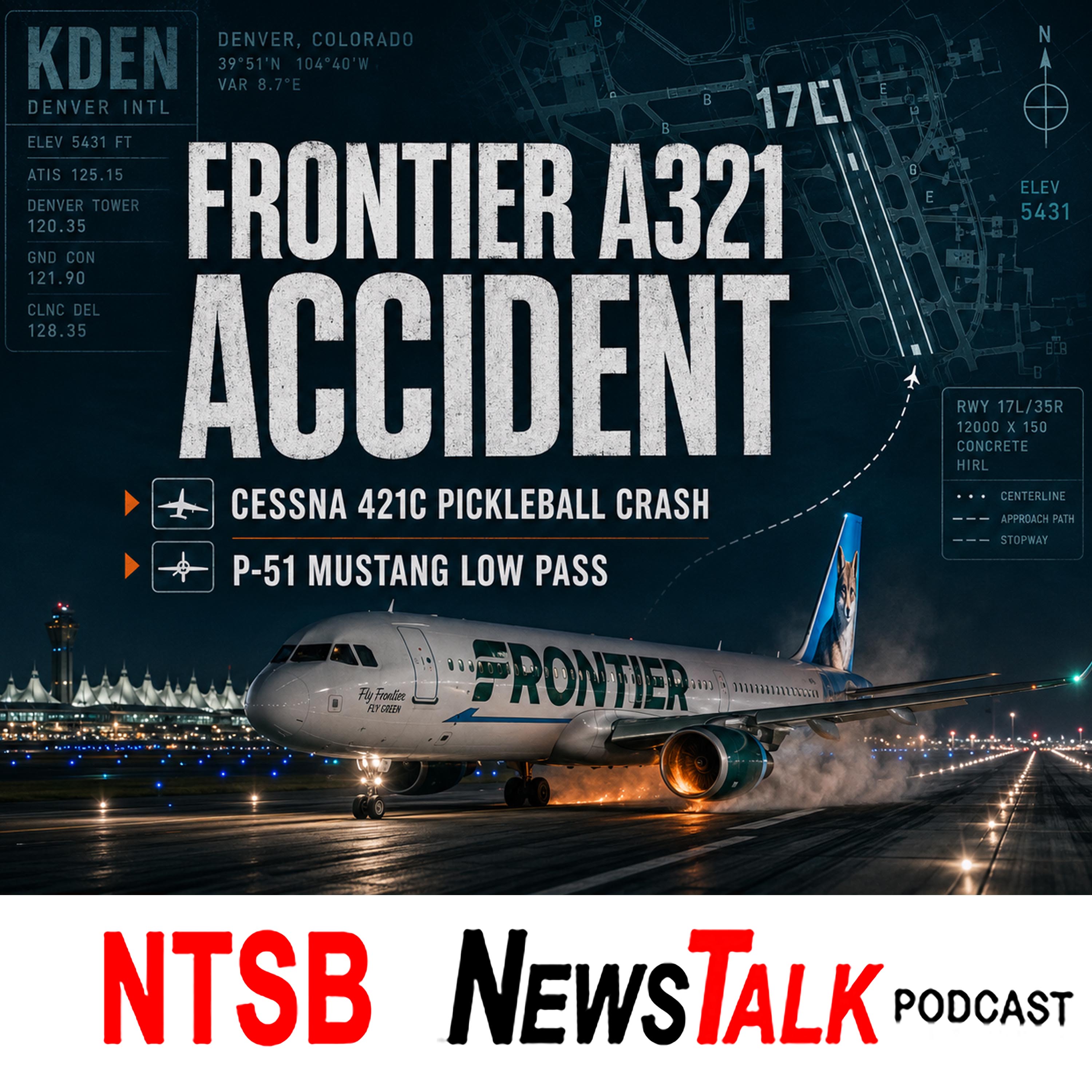 Frontier A321 Accident, Cessna 421C Pickleball Crash & More 18.05.2026 30minMax Trescott and Rob Mark discuss several recent aviation accidents and new NTSB reports, beginning with a tragic Frontier Airlines A321 accident at Denver International Airport, where a man entered the runway environment and was struck during takeoff. The crew rejected the takeoff at high speed, the right engine caught fire, and multiple passengers reported minor injuries.Brought to you by AVEMCO aircraft insurance.Support Rob and Max by making a donation at Patreon.comThe episode then examines the fatal crash of Cessna 421C N291AN near Wimberley, Texas. The aircraft was carrying people reportedly traveling to a pickleball tournament when it crashed at night in IMC with thunderstorms in the area. The pilot reportedly told ATC that the pitot heat had iced up, that the airplane was on backup gauges, and that pitot heat was not working.Max and Rob also discuss other accidents include Cirrus SR22 N39VF, which deployed CAPS and was later dragged by the parachute across fields, fences, and a highway; Cessna 401B N122AT, which crashed after takeoff before reaching blue line speed; Beech 58 Baron N2063G during an instrument proficiency check; a King Air 300 ditching in the Atlantic; a Quad City Challenger ultralight issue; and Cessna 152 N588BR fuel exhaustion.
 -
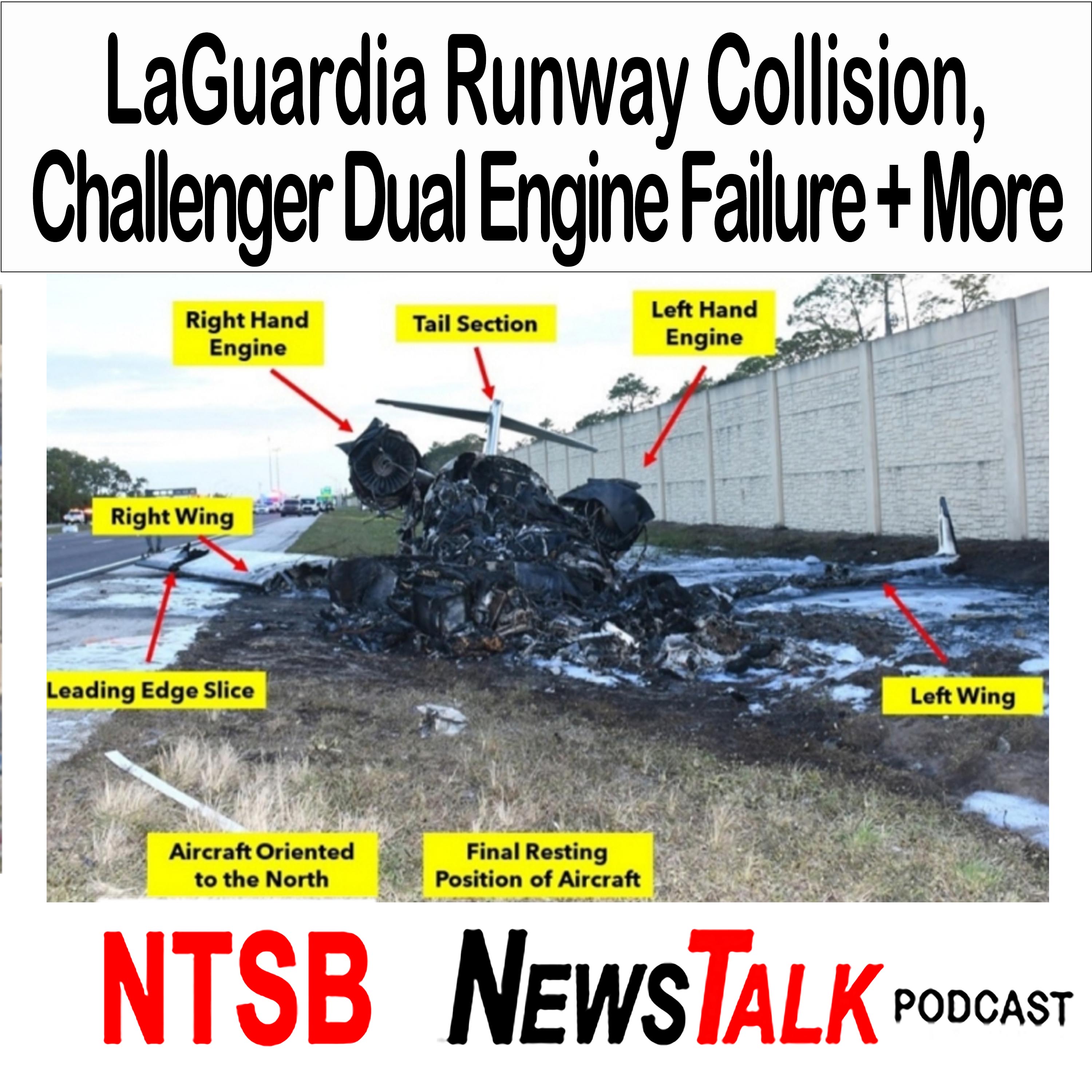 LaGuardia Runway Collision, Challenger 600 Dual Engine Flameout, and More NTSB Accident Reports 05.05.2026 45minMax Trescott and Rob Mark analyze the LaGuardia runway collision involving Jazz Flight 646 and an airport firetruck that was cleared to cross runway 4 shortly before the landing regional jet arrived. The discussion focuses on the timing of the crossing clearance, repeated stop instructions, the movement of the firetruck, and the runway entrance lights that extinguished just seconds before impact. Max explains how runway status lights, runway entrance lights, anticipated separation, and ASDE-X are intended to work, and why that design logic may have failed when a moving firetruck reached the runway edge.Brought to you by AVEMCO aircraft insurance.Support Rob and Max by making a donation at Patreon.comThe episode also examines the final report on Bombardier Challenger 600 N823KD, which crashed on Interstate 75 near Naples, Florida after both GE CF34-3B turbofan engines flamed out. The NTSB cited corrosion in the engines’ variable geometry systems, which led to near-simultaneous compressor stalls and loss of thrust.Additional accidents include Mooney M20J N1151H near Union County Airport, Mooney M20J N205MK near Ironton, Ohio, Beech F-33A Bonanza N8032X at Minneapolis Crystal Airport, Bell 206 N409AE in Tennessee, Beech A36 Bonanza N2882W near Olympic Valley, Beech Super King Air B200GT N886DS near Sharp, Louisiana, Globe GC-1B N2387B near Afton, MN and Extra 300L N22MW near Bandera, Washington. Finally, they talk about N2387B, a Globe GC-1B that crashed while in a flat spin.
 -
 Piper Seminole Crash, Cirrus SR22 Hard Landing, Mooney Door-Pop Spin 22.04.2026 42minMax talks with Rob Mark about a dense lineup of recent accidents and final reports, led by the Piper PA-44 Seminole N595ND crash in Fort Pierce, Florida, the Cirrus SR22 N124SP hard landing in St. Paul, Minnesota, and the Mooney M20K N4387W stall-spin in St. Augustine, Florida, after a cabin door popped open shortly after takeoff. They also examine the Beech 58 Baron N2063G crash in Tennessee, which appears consistent with a VMC demo that turned into a stall-spin, the Sling N166TW crash on Catalina Island after apparent low-level terrain maneuvering, and the Piper Saratoga N4190E runway overrun in Arizona after an excessively fast approach.Brought to you by AVEMCO aircraft insurance.Support Rob and Max by making a donation at Patreon.comIn the final-report segment, they break down how distraction likely contributed to the Mooney M20K N4387W crash, why the Piper PA-44 Seminole N595ND shows the danger of trying to salvage a one-engine go-around in a light twin, and how Cessna 172P N781FM likely lost power because of carb ice during a low-power descent. They close with one of the strangest cases in the episode: a damaged battery pack that later ignited and destroyed Mooney M20E N5632Q in Hornell, NY. A brief additional mention covers a separate Cirrus SR22 N285AH that departed the runway in Fullerton, California after the pilot seat slid back on takeoff.
 -
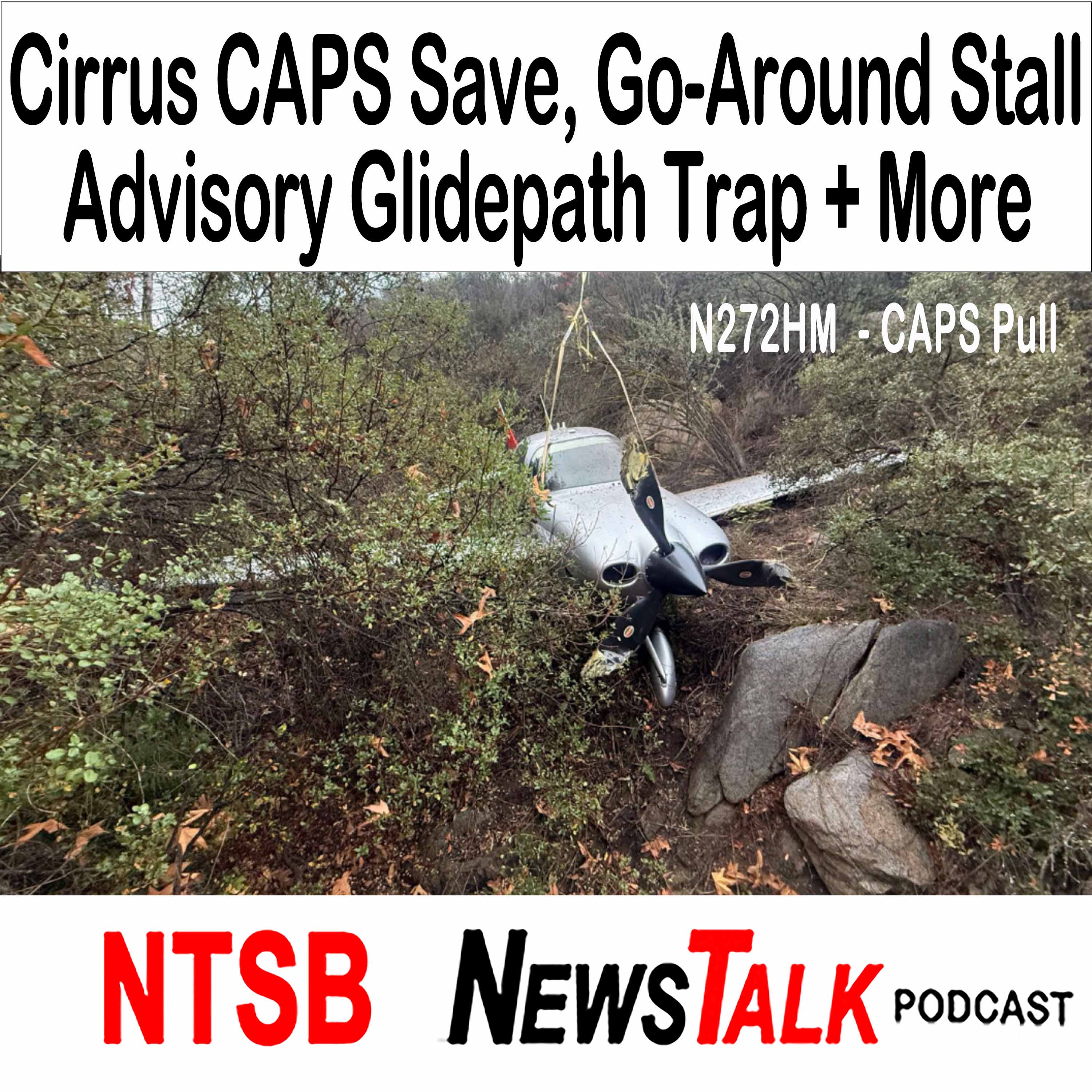 Cirrus CAPS Save, Go-Around Stall, Advisory Glidepath Trap 07.04.2026 41minMax Trescott and Rob Mark talk about how pilots get into trouble when they misunderstand instrument procedures, mishandle a go-around, or make shockingly poor decisions on the ground and in the air. They open with Max’s unusual call from the NTSB, which asked him to discuss advisory glidepath guidance, the “+V” vertical path shown on some nonprecision approaches. That leads to a sharp discussion of why advisory glidepaths can become traps when pilots confuse LNAV+V or LP+V with true precision-style guidance and fail to respect MDA limits. Garmin has also released a new Service Alert on +V glide paths.Brought to you by AVEMCO aircraft insurance.Support Rob and Max by making a donation at Patreon.comThe team first discusses a recent accident in which the pilot of N58544, a Cessna 182, took off from York, PA with at tow bar attached. Rob and Max share what they teach student pilots about the handling of tow bars to avoid these kinds of mishaps.They then examine two preliminary reports. In Gulf Shores, Alabama, Beech A36 Bonanza N66519 crashes on approach in weather near minimums after weak radio reception, missed vectors, and a breakdown during the final phase of flight. Near Hartsburg, Missouri, Piper PA-46 Malibu Mirage N451MA breaks up in severe weather after entering a steep descending turn.The final reports are just as revealing. Cirrus SR22 N272HM near Lake Elsinore, California becomes a success story when the pilot, task-saturated in IMC, wisely pulls CAPS and survives. Cirrus SR20 N1108T in Key Largo, Florida stalls during a go-around after the flaps are retracted too quickly. The episode also includes a drunk CFI’s VFR-into-IMC Cessna 150 crash, a hand-propping accident in N26AJ, an RV-9, and a runaway Bellanca, N8213R, left idling with a non-pilot onboard.
 -
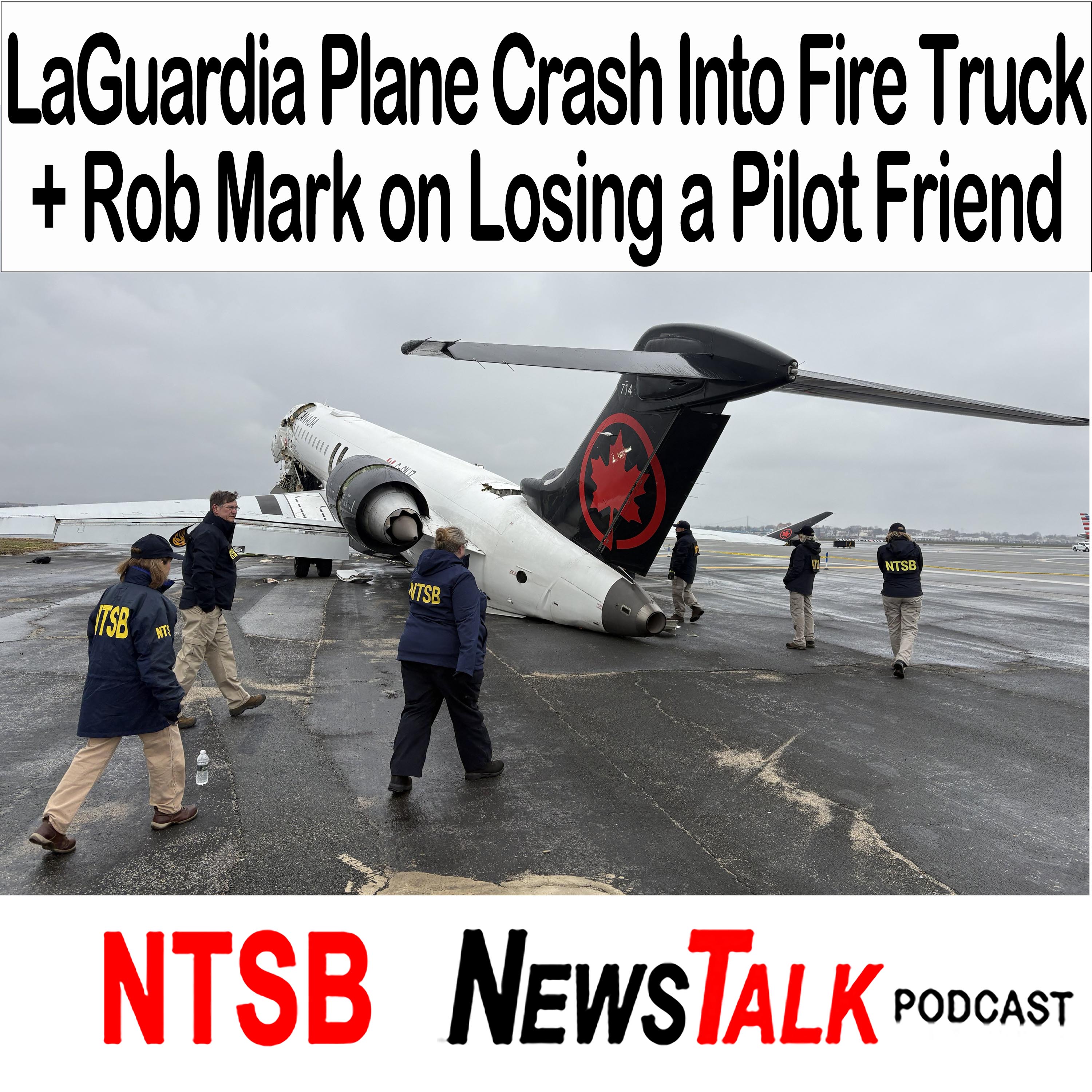 LaGuardia Plane Crash Into Fire Truck + Rob Mark on Losing a Pilot Friend 25.03.2026 47minMax Trescott and Rob Mark open with the crash at LaGuardia, where an Air Canada regional jet collided with a fire truck while landing. They examine how a separate emergency, possible controller overload, combined frequencies, and the loss of a second set of eyes may have lined up in a classic Swiss-cheese chain of events. It’s a sobering look at runway-incursion risk, situational overload, and why vehicles and airplanes can never safely share the same space without strong procedural barriers.Brought to you by AVEMCO aircraft insurance.Support Rob and Max by making a donation at Patreon.comThen the episode turns deeply personal. Rob talks about the fatal March 4 crash of Cessna T210M N19FB near Chicago Executive Airport, flown by a pilot he knew personally through the local aviation community and Civil Air Patrol. Using the preliminary report and additional ADS-B analysis, Max and Rob walk through the RNAV Runway 16 approach, the low-altitude alerts, the unstable descent profile, and the danger of pressing an instrument approach near or below minimums.What makes this episode stand out is its human side. Max and Rob talk candidly about what it feels like when a crash stops being abstract and becomes the loss of someone you knew, and how pilots can process that loss while turning it into safer decisions in their own flying.
 -
 TNFlyGirl Debonair Crash: Autopilot/Trim PIO + Icing & Night IMC 11.03.2026 36minIn episode 25 of NTSB News Talk, Max Trescott and Rob Mark break down seven NTSB reports with a common theme: the accident often starts long before the impact.Brought to you by AVEMCO aircraft insurance.Support Rob and Max by making a donation at Patreon.comThey begin with an experimental Carbon Cub (N126C) that appears to have struck power lines during very low flight along the Payette River near Montour, Idaho—another reminder that wires are nearly invisible until they aren’t. Next is a Cessna 310R (N252DL) that descended into terrain on an IFR flight after the pilot stopped responding to ATC, pointing toward possible pilot incapacitation amid icing concerns and other red-flag gaps.The episode then tackles the Beech 35-C33 Debonair crash (N5891J) near Pulaski, Tennessee, where ADS-B data showed worsening pitch oscillations consistent with an autopilot/trim misunderstanding and pilot-induced oscillations. Two more reports highlight night risk: a Zenith CH 701 (N4209W) lost to spatial disorientation after VFR flight into deteriorating conditions, and a Cozy Mk IV (N656TE) that departed Half Moon Bay into night IMC and went into the ocean.Finally, they cover a Cirrus SR22 (N253BC) overweight takeoff with distraction from alerts, and a Piper Saratoga (N4187Q) engine power loss at night IFR that left the pilot with few runway options.
 -
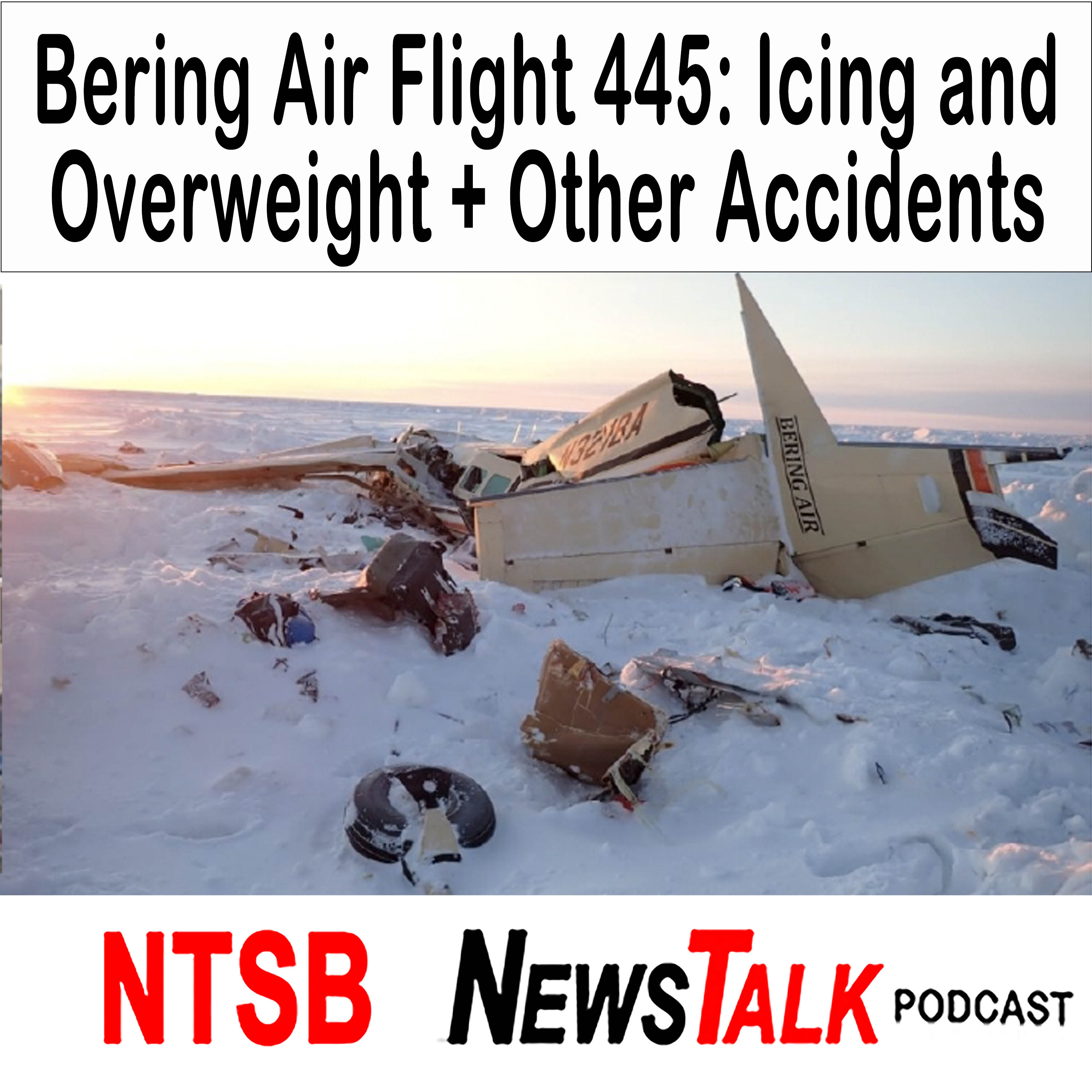 Bering Air Flight 445 Crash: Cessna 208B Caravan Icing and Overweight + Other Accidents 24.02.2026 39minMax Trescott talks with co-host Rob Mark about new docket details on Bering Air Flight 445—a Part 135 Cessna 208B Grand Caravan, N321BA—that crashed near Nome, Alaska after a troubling sequence of weight, icing, and airspeed issues. They discuss how overweight loading, Alaska-specific operating allowances, and confusing “minimum speed in ice” guidance can combine to erase stall margin fast. The Preliminary Report is here. Brought to you by AVEMCO aircraft insurance.Support Rob and Max by making a donation at Patreon.comThey also touch on the Epic E1000 crash of N98FK near Steamboat Springs, Colorado, a night RNAV (GPS) approach where LNAV+V advisory glidepath guidance may have lured the airplane below MDA into terrain—a reminder that LNAV+V can look like LPV but provides no obstacle protection below MDA.Plus: an experimental Lancair IV-P, N163BR, suffers an apparent engine failure near Savannah, Georgia, and the occupants survive thanks to a ballistic-parachute deployment. Two final reports round out the episode: a Cessna 182P, N14YY, in Mississippi where a non-venting fuel cap contributed to fuel-starvation symptoms and a loss of control on landing, and a turbocharged Beech A36 Bonanza, N347M, in Pennsylvania where a door-open startle after takeoff, combined with an overweight condition, ended in a stall and crash.
 -
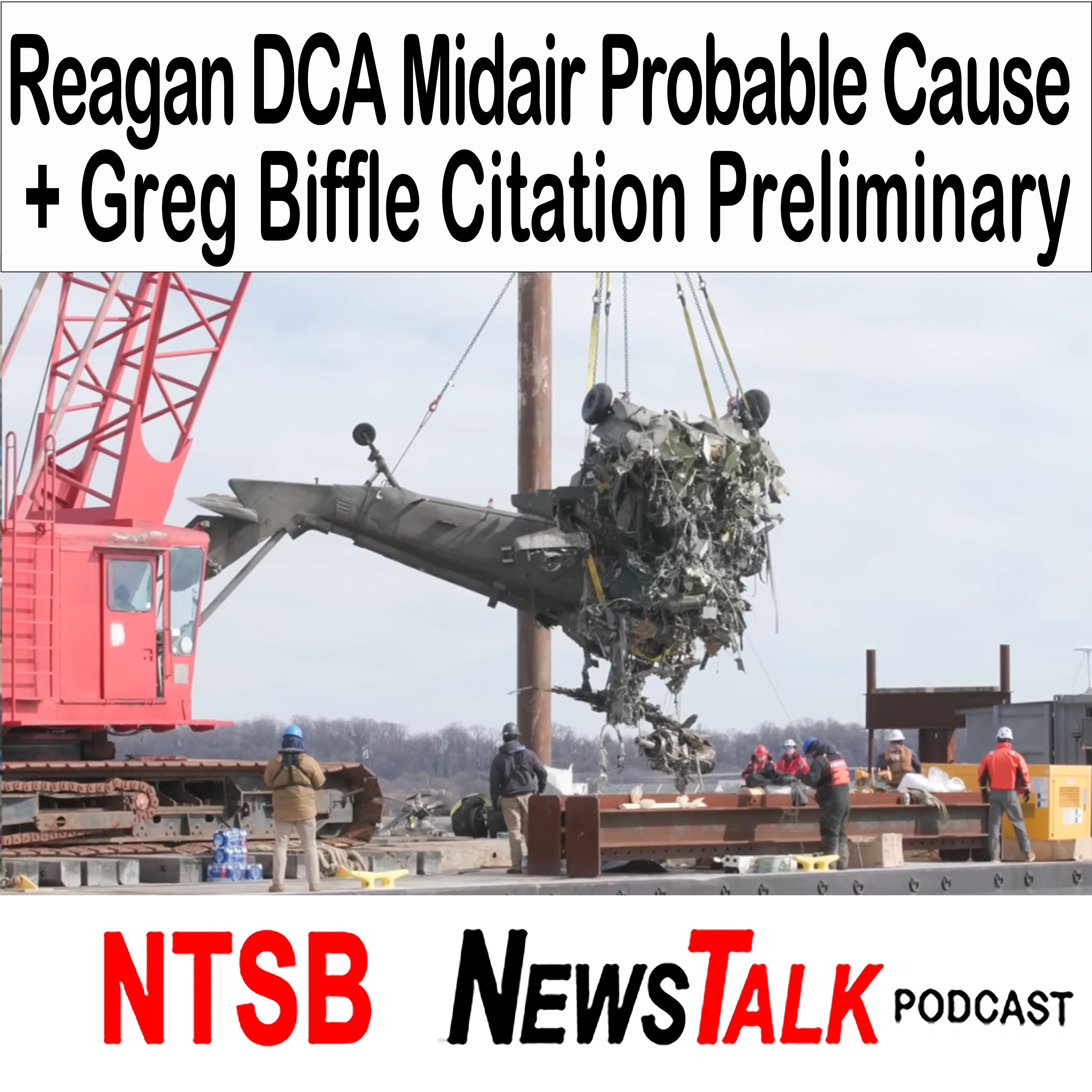 Reagan National (DCA) Midair Collision Probable Cause + Greg Biffle Citation 550 Preliminary Report 10.02.2026 53minMax talks with co-host Rob Mark about two headline-making NTSB threads: the DCA midair collision and the preliminary report on the Greg Biffle crash. First, they react to the NTSB’s day-long public hearing on the DCA midair and the board’s newly adopted probable-cause statement—an unusually long, multi-factor finding that points toward fixes in airspace design, controller procedures, ADS-B policy, and military aviation governance.Then they pivot to the Cessna Citation 550 accident involving NASCAR driver Greg Biffle (N257BW) near Statesville, North Carolina. The preliminary report raises hard questions about cockpit workload and decision-making: instrument anomalies, an apparent electrical/power issue, and a “second in command required” limitation that wasn’t satisfied by the right-seat occupant.The episode also rounds up several other investigations: a Cirrus SR20 CAPS deployment in England where the parachute lines may have separated after snagging power lines, a Cirrus SR22 engine-failure diversion in South Carolina, an IFR Bonanza crash in rain near Sabine, Texas, a Mexican Navy King Air 350i accident near Galveston, and final reports covering a training stall/spin in Georgia and a Musketeer engine failure after an undetected oil-system leak. If you care about real-world lessons—and what the NTSB is signaling for the next wave of safety changes—hit play and share it with another pilot.SupportSupport the work that Rob and Max do creating the NTSB News Talk podcast by making a monthly donation via Patreon.
 -
 Bangor Maine Challenger 650 Jet Crash (N10KJ): Icing, Deicing & NTSB Investigation 26.01.2026 39minMax Trescott and Rob Mark talk about the Bangor, Maine Bombardier Challenger 650 crash (N10KJ)—a major breaking story—and what the earliest discussion points usually look like before investigators have hard answers. They outline why takeoff accidents in winter conditions immediately raise questions about contamination, deicing decisions, holdover time, and whether ice or snow could have been present at the start of the takeoff roll.Then the episode shifts to set of other NTSB cases with sharply different aircraft and missions—but familiar human factors. These include the American Aviation AA-1A (N9439L) near Alamogordo, NM, Cirrus SR20 (N814) in Watertown, WI, Beech C23 (N76SB) in Virginia, Mooney M20C (N1204X) in Texas, Cessna 206 (N460DC) in California, Piper PA-30 Twin Comanche (N8693Y) in Illinois, and a Beechcraft 95 Travel Air (N369BB) training flight in Alabama. Across them: unstable approaches, late go-arounds, loss of control close to the ground, and pilots pushing past safe margins.
 -
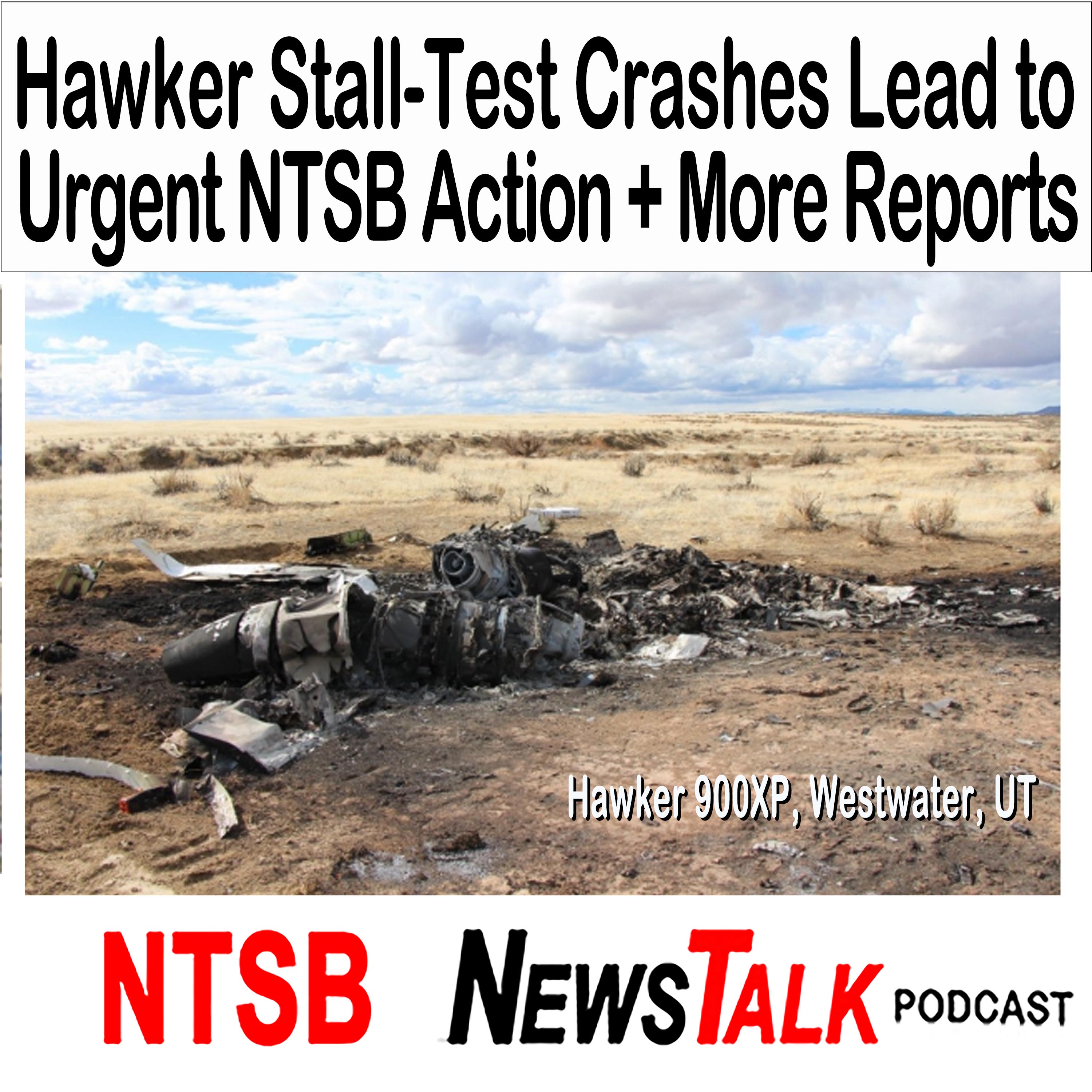 Hawker Stall-Test Crashes: Urgent NTSB Action + NOTAM Slackline Tragedy 12.01.2026 52minMax Trescott and Rob Mark connect a string of very different accidents with one shared theme: safety margin usually disappears one “reasonable” choice at a time—until the airplane (or the environment) collects the debt.They open with a major development: the NTSB’s urgent recommendation to Textron after two fatal post-maintenance stall test flights in Hawker business jets. Max and Rob explain why stall testing in swept-wing jets can be uniquely unforgiving, and why “unacceptable stall characteristics” should make every pilot sit up straight. The takeaway: if a flight requires test-pilot skills, then “maintenance requires it” doesn’t make it safe—it demands the right training, the right crew, and the right conditions.Max then shares NTSB news: a public board meeting on Tuesday, January 27, 2026 at 9:00 a.m. ET to determine probable cause for the January 29, 2025 midair collision over the Potomac River near Reagan National (PSA CRJ700 and an Army UH-60L Black Hawk). Max and Rob will be watching closely and will share clips in a future episode.From there they break down recent accidents and reports, including: the Dassault Falcon 50, 9H-DFS, crash near Haymana, Turkey; an MD530F helicopter, N3502P, near Superior, Arizona where a slackline/highline may have been a factor; a TBM 700, N700PT, near Monroe, Wisconsin involving an approach continued below minimums; the Hawker 900XP, N900VA, fatal post-maintenance stall test crash; a Cessna P210, N1400, fuel exhaustion accident in San Diego in IMC with low recent flying; and a Bonanza G36, N360FV, near Tracy, California that illustrates the engine-emergency dilemma: choose the ugly, certain option—or gamble for the “better” airport you might not reach.
 -
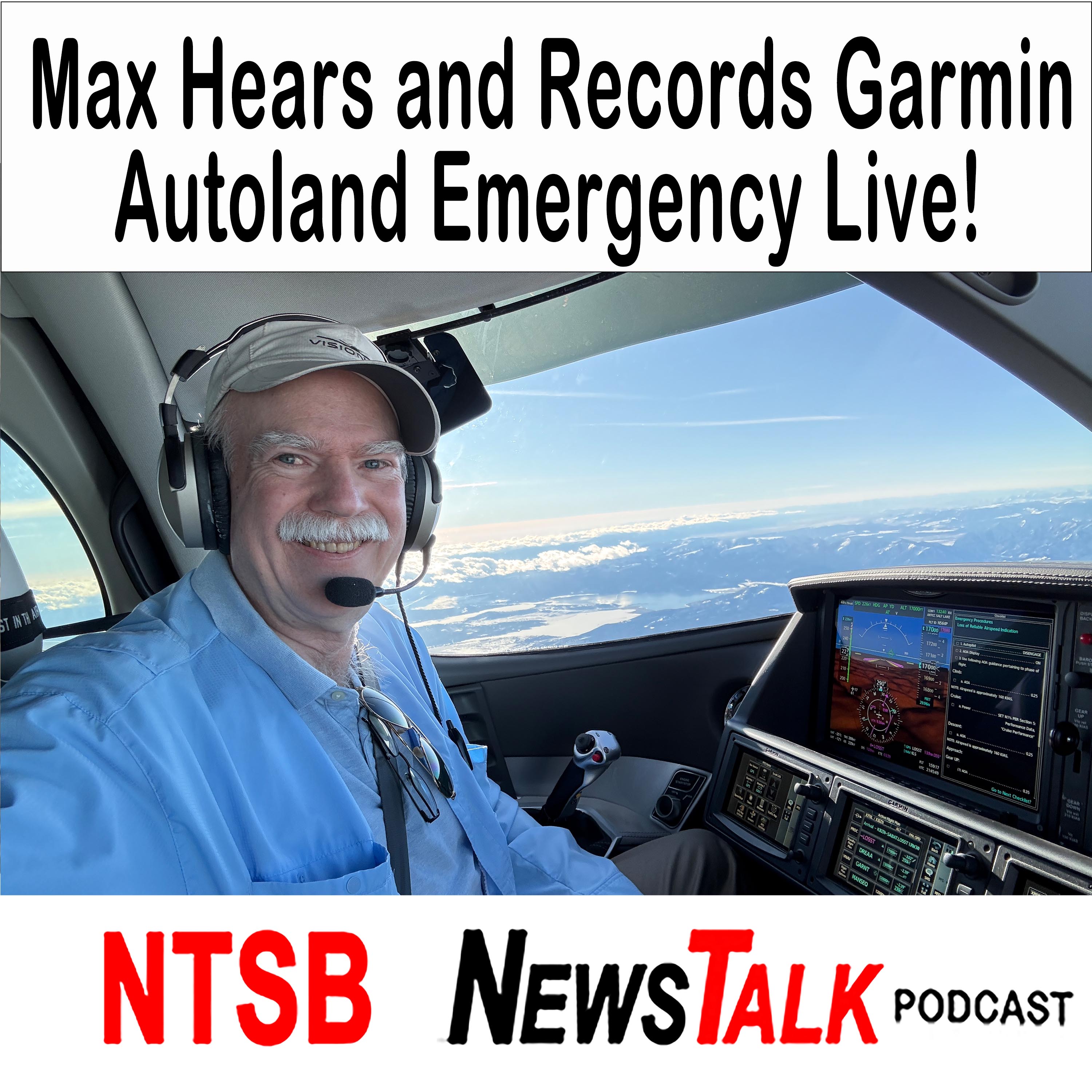 Garmin Autoland Emergency Landing: First King Air Save (Max Heard It Live) 26.12.2025 44minEpisode 20 of NTSB News Talk opens with an aviation milestone: the first confirmed in-service, real-world use of Garmin’s Autoland. A King Air B200, tail number N479BR, squawked 7700 and ultimately landed itself at Rocky Mountain Metropolitan Airport (KBJC) in Broomfield, Colorado on Saturday, December 20, 2025. Garmin later confirmed the activation, and ATC audio captured the synthetic callouts declaring “pilot incapacitation” and the system’s intention to land. Max adds the kind of detail that makes this story feel real: he was flying in Colorado that day, monitoring Guard, and heard the automated messages as they occurred. He also heard a voice transmit on Guard mentioning a depressurization and describing difficulty changing frequencies—consistent with the way Autoland takes control of communications once activated. In their discussion, the flight track shows the airplane climbing out of Aspen into the low-20s, then descending, leveling, and later maneuvering near the destination before landing—exactly the kind of structured “get down, get safe, get on the ground” profile Autoland is designed to execute. Aviation outlets reported the emergency was tied to a pressurization issue and the engagement of emergency descent logic. Aviation International News+1After a quick note that Episode 19 was cited in a New York Post story by Emily Crane, the episode pivots into four NTSB reports that all share one theme: the accidents are “simple” only if you ignore the physics.First is N850JH, a fatal TBM 850 crash near Ludington, Michigan. The NTSB concluded the pilot departed after pulling the airplane from an unheated hangar during active snowfall and taxiing out with visible snow contamination on the wings and horizontal stabilizer. Deice boots don’t solve that on the ground; contamination kills performance margins by reducing lift and increasing drag right when the airplane is most vulnerable—after rotation. The report narrative (and local coverage quoting it) describes a normal-looking departure that quickly turned into a wing drop, stall, and impact. Next is N7756N, a Cherokee accident at Frazier Lake Airport in Hollister, California (Sept. 10, 2025)—no injuries, but packed with lessons. The pilot came in high and fast, tried to salvage it with a slip, floated significantly, then initiated a late go-around. During the go-around attempt, the wheels touched down about two-thirds down the grass runway; with 40° flaps still selected, the airplane became airborne again, but the pilot saw about 45 knots and a mostly-on stall warning and then pulled power to idle to “abort” the go-around, leading to a hard landing, bounce, and impact with a dirt mound. The report also highlights a major contributing setup: landing runway 05 with wind 250 at 11—i.e., meaningful tailwind. Third is a fatal VFR-into-IMC CFIT involving N320P, a Lancair 320 near Manitowoc, Wisconsin. The flight track suggests an attempted approach, then a diversion, but conditions were night IMC with a 400-foot ceiling. The airplane remained on a VFR code (1200) with no recorded ATC contact, and investigators concluded the pilot flew in IMC without an IFR clearance and executed an unapproved instrument approach into trees and terrain. Then comes the gut punch: this wasn’t a low-time private pilot. Max and Rob note the pilot was a 57-year-old airline ATP/CFI with tens of thousands of hours. The point is brutal and useful: experience doesn’t rescue you from bad process and bad decisions.Finally, they cover a Pearland, Texas runway collision involving N127SL, a Cessna 182T and N5450L, a Grumman AA-5 after the AA-5 suffered a total electrical failure. The AA-5 pilot said the airplane had been “jumpstarted,” then lost comms and couldn’t extend flaps, followed the 182 to the runway, and rolled into it after it exited—without increasing spacing or going around. Max and Rob use this to teach a genuinely under-taught concept: alternators often need battery field current to self-excite, so a “dead battery + jumpstart” can still leave you with no charging system after takeoff. The NTSB final report for this event is explicit about the electrical failure and the pilot’s poor judgment that it required an expedited landing.
Panašios tinklalaidės


Populiari šalyje
Ši tinklalaidė taip pat patenka į šių šalių tinklalaidžių topus.
