
Monetary Matters with Jack Farley
Jack Farley
0
Jack Farley interviews top financial minds about macroeconomics, markets, and monetary policy. Follow Jack on Twitter @JackFarley96.
Epizodai
-
 Energy Shock and Rate Hikes Could Cause a 2022 Style Bear Market | Eric Wallerstein | Clocktower Group 23.09.2026 53minEric Wallerstein, Chief Macro Strategist at Clocktower Group, joins OPM to discuss why he sees substantial risk that the Fed is making a policy mistake by hiking into a supply shock that could cause a 2022 style bear market. He also explores the global coordination of rate hikes and why he believes the participation of lower growth economies like Canada indicate that this is a reaction to higher energy prices and not a substantially higher global neutral rate. Try model portfolios available on Plutus and get a 45-day fee waiver when you signup with code OPM45: https://runplutus.com/mm-opm/login Follow Eric on X: https://x.com/ericwallerstein Follow Max on X: https://x.com/maxwiethe Follow Other People’s Money on: Apple Podcast https://bit.ly/4e7QJ1M Spotify https://bit.ly/3Yhaazi YouTube https://bit.ly/3C63VXR X https://x.com/opmpod JFMW Partners LLC (“Promoter”) is providing this endorsement of, and information related to, the advisory services offered by Namsoft Advisors LLC ("Namsoft"). Promoter is not a current client or investor in any Namsoft advisory account or private fund. Promoter receives cash compensation from Namsoft in the form of a flat referral fee of $750 for each client that engages Namsoft as a result of Promoter's promotional activities. Because Promoter is compensated for this endorsement, a material conflict of interest exists, as Promoter has a financial incentive to promote Namsoft's services to you. This endorsement is delivered as part of a podcast or other audio program produced by Promoter and does not constitute investment advice or a recommendation that any particular advisory arrangement is suitable for you. Timestamps: 00:00 Intro 00:56 Fed Hike and Higher for Longer 02:30 Oil Driving Global Yields 05:58 Canada and Global Neutral Rate 07:14 Energy Crisis and Degrowth Risks 08:44 Politicized Fed and Credibility 11:50 Neutral Rate and AI CapEx Boom 14:47 Inflation Outlook and Policy Mistakes 17:20 Plutus Sponsor Break 18:46 Key Data to Watch: Bank Lending 20:07 Doves vs Hawks and Fiscal Drag 23:30 2022 Style Bear Market Setup 25:56 What Could Invalidate the Thesis? 26:41 BOJ Hike and Yen Intervention 31:20 Korea Silicon Boom 35:43 Europe Under Pressure 39:25 Middle East Outlook 43:06 Midterm Issues: AI vs. Gas Prices 48:34 China Oil Strategy 52:10 Big Calls Wrap
 -
 Outlook on 5 Key Commodities: Metals Bull Market is Just Getting Started (Gold, Copper, & Uranium) | Jérémie Boyer | Aurelion 20.09.2026 1val 12minTry model portfolios available on Plutus and get a 45-day fee waiver when you signup with code OPM45: https://runplutus.com/mm-opm/login Jérémie Boyer, co-founder of Aurelion Research, joins OPM to give his outlook for 5 key commodities. He explains why after avoiding earlier downside volatility in gold he just got the buy signal he’s been waiting for, and why the longer-term AI driven bull thesis on copper is very real and happening now. He also gives his outlook for uranium, fertilizer, and oil and discusses how he and his partner turn commodity views into a portfolio of equities that is up over 100% since inception a little over 1-year ago. Aurelion Research: https://aurelionresearch.com/ Follow Aurelion Research on X: https://x.com/AurelionRsch Follow Max on X: https://x.com/maxwiethe Follow Other People’s Money on: Apple Podcast https://bit.ly/4e7QJ1M Spotify https://bit.ly/3Yhaazi YouTube https://bit.ly/3C63VXR X https://x.com/opmpod JFMW Partners LLC (“Promoter”) is providing this endorsement of, and information related to, the advisory services offered by Namsoft Advisors LLC ("Namsoft"). Promoter is not a current client or investor in any Namsoft advisory account or private fund. Promoter receives cash compensation from Namsoft in the form of a flat referral fee of $750 for each client that engages Namsoft as a result of Promoter's promotional activities. Because Promoter is compensated for this endorsement, a material conflict of interest exists, as Promoter has a financial incentive to promote Namsoft's services to you. This endorsement is delivered as part of a podcast or other audio program produced by Promoter and does not constitute investment advice or a recommendation that any particular advisory arrangement is suitable for you. Timestamps: 00:00 Intro 02:16 Why Gold Could Hit 5K 05:45 Geopolitics Over Rates 09:24 Portfolio Positioning 12:28 Managing Miner Cycles 16:26 Plutus 18:26 Bearish Oil & Fertilizer 20:28 Oil Thesis & China Inventories 33:23 Royalties as Exposure 36:07 Valuing Royalty Companies 42:48 Why Uranium Now 46:10 Uranium Contracts & Supply 51:10 Energy Security and Nuclear Buildout 54:31 Copper Bull Case in AI Era 01:00:05 Picking Copper Stocks 01:06:43 Five Commodities Recap 01:11:26 Closing and Where to Follow
 -
 Why The 30-Year Treasury Lost Its Biggest Buyers | David Busch on Why High Yields Are Attractive Right Now 19.09.2026 1val 7minJack Farley is joined by David Busch, Chief Investment Officer of Trajan Wealth, to discuss rising U.S. Treasury yields, persistent inflation, and the Federal Reserve's monetary policy trajectory. Busch breaks down the structural drivers behind elevated bond yields, including $40 trillion in national debt, geopolitical energy shocks, and massive corporate debt issuance for AI infrastructure. He explains how higher interest rates and Treasury Secretary Scott Bessent’s bond buyback program impact market liquidity and equity valuations. Moving to equities, Busch argues that software stocks like Intuit are heavily oversold regarding perceived AI disruption risks. He highlights the real bottleneck of the AI boom, pointing to critical supply needs in energy, rare earth minerals, and nuclear power. Busch also warns investors about hidden credit and liquidity dangers within private credit markets. Finally, he lays out why 3-to-5-year U.S. Treasuries still serve as an essential portfolio ballast in high-yield regimes. Jack Farley on X https://x.com/JackFarley96 About David Busch https://trajanwealth.com/leadership/ Follow Monetary Matters on: Apple Podcasts https://rb.gy/s5qfyh Spotify https://rb.gy/x56dx5 YouTube https://rb.gy/dpwxez
 -
 Hawks Take Flight | Joseph Wang on Fed’s Hawkish Hike and Warsh’s Gameplan 16.09.2026 1val 3minThis Monetary Matters episode is brought to you by Fiscal.ai. Get 15% off any paid tier at: https://fiscal.ai/mm/ Former Fed trader Joseph Wang joins Jack Farley live to break down Chair Kevin Warsh's third meeting — and his first rate hike, framed as "removing a dose of accommodation" against a Middle East oil-shock backdrop. Joseph explains why he called the hawkish move well ahead of the consensus, reading the Jackson Hole signals on financial conditions and the new emphasis on the "speed" of returning to target. The conversation digs into the hawkish dot plot and higher-for-longer path, what a supply-shock reaction function means for the long bond and 30-year TIPS, mortgage rates above 7%, and the plumbing beneath it all — repo, SOFR, the basis trade, and Treasury buybacks. In the second half, Max Wiethe joins to make the case for refiners as the trade of the year, walking through crack spreads, Marathon and Valero, Chinese crude flows, and diesel and fertilizer dynamics. They close on long-bond convexity versus the rate sensitivity of the AI and neocloud buildout, and why Max thinks estimates for names like Lam Research are far too low. A wide-ranging live reaction spanning the Fed's hardest decision in years and the market's response. Recorded September 16, 2026. Follow Joseph Wang on X https://x.com/josephwang Follow Max Wiethe on X https://x.com/maxwiethe Jack Farley on X https://x.com/JackFarley96 Follow Monetary Matters on: Apple Podcasts https://rb.gy/s5qfyh Spotify https://rb.gy/x56dx5 YouTube https://rb.gy/dpwxez
 -
 Hunting for Value in Mining Stocks Amid Soaring Metals Prices | Freddy Brick | Muddy Waters Capital 13.09.2026 1valPrecious metal and base metal prices have soared as have many mining stocks, but despite this, Freddy Brick, partner at Muddy Waters Capital says that the industry feels closer to left for dead than euphoric. He explains why that setup and the consistency of the mispricing in the sector brought them to launch a fund with the help of mining expert Darren McLean allowing them to take concentrated investments in the assets they think the market is overlooking while running lower net exposure. He also discusses how they think about hedging in the sector, why they take a bottom-up approach to portfolio construction, and how they approach short and long activism in the sector. Follow Muddy Waters on X: https://x.com/muddywatersre Follow Max on X: https://x.com/maxwiethe Follow Other People’s Money on: Apple Podcast https://bit.ly/4e7QJ1M Spotify https://bit.ly/3Yhaazi YouTube https://bit.ly/3C63VXR X https://x.com/opmpod Timestamps: 00:00 Intro 01:28 Approach to Portfolio Construction 07:56 Fraud Report Origin 09:35 Block Models Explained 15:27 Why Juniors Are Distressed 21:19 Finding Mispriced Projects 25:12 Venture Like Investing 28:25 Promoters and Capital Raising 33:43 Sentiment and Cycles 38:28 M&A Wave Ahead 43:27 Trading Vol and Hedging 46:57 Long Activism Approach 50:23 Scaling the Strategy 55:10 When Alpha Shows Up
 -
 Why Farmland With Centuries of Water Is the Ultimate Scarce Asset | John Farris of LandFund Partners on Super El Niño, Food Security, and the Sources of Alpha in Farmland 11.09.2026 1val 13minLearn more about LandFund Partners: https://landfundpartners.com/invest#get-started Jack Farley speaks with John Farris, founder & CEO of LandFund Partners and former World Bank agricultural economist, about the tightening global food equation — and where the return actually comes from in farmland. The setup: if the world stopped growing crops tomorrow, John says there are roughly 70 days of food in reserve, down from 110 a decade ago. Two billion more people, more protein per capita, less arable land, and productivity gains that have flattened out. Into that comes a Super El Niño that John's heat maps suggest will hit Brazil, Argentina, and India — the last of which depends on the monsoon to grow the world's most-consumed calorie: rice. Commodity futures prices have risen significantly this year. That's the backdrop. The investment argument rests on three things.The first is a value that sits on no balance sheet. Across most of the eastern US there are no formal water rights, so LandFund carries its water at zero. In the Colorado River states, where those rights did develop, they've compunded at roughly 11% a year over the past thirty-five years, outpacing the S&P 500 over that time period.John argues the same legal framework is coming to the Mid-South within ten years, pushed by the hyperscalers already knocking on his door for water offsets — and that when it arrives, a line item currently marked at nothing gets marked at something. The second leg is convergence. When LandFund started in 2013, Midwest row crop farmland traded roughly 140% above comparable Mid-South ground; today the gap is 80–100%. John's argument is that the gap should be zero, and that it inverts: land with 300 years of water, 93% irrigation, and the ability to rotate between ten and twenty crops is worth more than land that is high-quality soil but weather-dependent — not less. Iowa bets on rain. He doesn't have to. The third is operational. LandFund required regenerative practices in its lease agreements since 2021, and John walks through the J-curve economics: $50–100 an acre and a couple of lean years up front, then lower fertilizer use, fewer passes across the field, less irrigation, and net income he estimates runs 30–40% higher than it otherwise would — which flows straight into rents, which flow into rents. Also covered: the "dirty secret" of powering data centers using 100x the water they consume, riparian rights and what happens when states start metering overuse, what the One Big Beautiful Bill did to price floors through 2032, solar developers paying 3x farmland value for ground with transmission lines, and why US row crop farmland has been negatively correlated to both stocks and bonds. Disclaimer: This episode is a fireside chat sponsored by LandFund Partners. Any data, statistics, or information discussed is for informational purposes only. This is not an offer to sell securities. Past performance is not a guarantee of future results. About LandFund Partners: https://www.landfundpartners.com/#home LandFund's piece on water rights: https://www.forbes.com/councils/forbesfinancecouncil/2026/06/23/water-rights-the-invisible-asset-farmland-investors-are-beginning-to-price-in/ John Farris on LinkedIn https://www.linkedin.com/in/jofarris/ Jack Farley on X https://x.com/JackFarley96 Follow Monetary Matters on: Apple Podcasts https://rb.gy/s5qfyh Spotify https://rb.gy/x56dx5 YouTube https://rb.gy/dpwxez Timestamps 0:00 Intro on John Farris and LandFund Partners 4:22 70 Days of Food Reserves? 7:45 Super El Niño Risk in 2026 8:31 Iowa vs. the Mississippi Alluvial Aquifer 13:49 Beating NCREIF and the S&P 500: The Playbook 14:55 Water Reserves in Mississippi Alluvial Aquifer Are Immense 20:51 "300 Years of Water at Current Draw Rates" 26:28 Improving the Land and Regenerative farming 32:40 Farm Subsidies and the One Big Beautiful Bill 38:07 Crop rotation: cotton, corn, rice, soybeans 42:53 Is rice the trade right now? 46:39 Soybeans, fertilizer, and China buying again 48:38 Rice at all-time highs 50:11 Optionality beyond farming: Solar, Transmission Lines, Minerals 55:27 Data Centers? 56:09 What's next for LandFund 1:00:37 Why Farmland Has Had Negative Correlation With Risk Assets 1:04:35 Super El Niño: What to Expect 1:06:51 Feeding ten billion people 1:07:40 The 20-year outlook for all Four Crops
 -
 What Actually Happens When a Life Insurer Fails (It's Worse Than a Bank) | Pranjal Drall and Andrew Granato on How Private Equity Turned Life Insurance Into a Taxpayer Backstop 06.09.2026 1val 17minAndrew Granato, Assistant Professor of Law at the University of Texas at Austin, and Pranjal Drall, JD/PhD candidate at Yale, join Jack Farley to discuss their paper "Private Credit, State Backstop: How Private Equity Socializes Risk Through Insurers." Private equity ownership of life insurers has grown from roughly $23 billion in 2009 to about $700 billion by 2024, and Granato and Drall argue this has created a system that socializes losses even more sharply than federal deposit insurance does for banks. They walk through how state guarantee funds work: when a life insurer fails, its surviving rivals are assessed based on premium volume rather than risk, and in 44 states those assessments are recouped through tax credits, meaning taxpayers ultimately foot the bill without any vote ever taking place. The conversation covers how PE-linked insurers reallocate balance sheets into opaque private credit and affiliated loans, arbitrage ratings through firms like Egan-Jones and undisclosed private letter ratings, and use Bermuda "shadow reinsurance" to escape disclosure and capital requirements, with leverage reportedly running as high as 30-to-1 or 50-to-1. Jack and the guests also examine emerging run risk from funding agreement-backed notes (FABNs) and policy surrenders, using the Executive Life collapse as a historical precedent. The episode closes with the recent Guggenheim/Delaware Life/Clear Spring scandal, in which Mark Walter's insurers understated affiliated assets (including a loan to LeBron James) at 3% when the true figure was closer to 42%, prompting the sale of the Lakers to raise liquidity. Granato and Drall propose reforms including taxing opacity, banning private letter ratings, pre-funding guarantee funds on a risk-weighted basis, and making insurance holding companies partially liable for guarantee fund assessments. Recorded August 28, 2026. Paper by Pranjal Drall and Andrew Granato, “Private Credit's State Backstop: How Private Equity Socializes Risk Through Insurers”: https://papers.ssrn.com/sol3/papers.cfm?abstract_id=7152239 Follow Andrew Granato on X https://x.com/agranato42?lang=en Follow Pranjal Drall on X https://x.com/PranjalDrall Jack Farley on X https://x.com/JackFarley96 Follow Monetary Matters on: Apple Podcasts https://rb.gy/s5qfyh Spotify https://rb.gy/x56dx5 YouTube https://rb.gy/dpwxez
 -
 “I’m Insanely Bullish on Bonds” | Jared Dillian on Copper, Bonds, Semis, and The Awesome Portfolio 03.09.2026 32minJared Dillian, author of The Daily Dirtmap and the new book “The Awesome Portfolio”, returns to argue that the bond bear market is a sentiment story that has gone too far. Jared calls the market's obsession with deficits and inflation a "mind virus," notes that the $2 trillion deficit is only 6% of GDP versus 12% in 2010, and points out that everyone measures bond supply while nobody measures demand. He has moved a large share of his own money into long bonds as a three-to-five-year hold, calling 5.2–5.3% on 30s and 4.7% on 10s an incredible deal, especially with payrolls deteriorating, JOLTS and PMIs rolling over, and the market still pricing meaningful odds of a hike. On equities, Dillian walked the top 50 S&P charts and sees semis, healthcare, and financials topping — the broker-dealers look worst — while Intel and Oracle look like they're bottoming. He and Jack debate whether the semiconductor washout is over, disagree on where the leverage actually sits (Jack cites Vanda data showing retail positioning in semis near two-year lows), and Dillian warns that the Situational Awareness blowup was the Bear Stearns of this cycle, not the Lehman. He explains why he thinks AI is a bubble for a reason specific to this cycle: it's the first time in his career he's seen tech financed with debt rather than equity, at 6% coupons, for assets that go obsolete in three years. He also lays out his cautiously bullish gold view, why copper is his least favorite metal, why private credit still hasn't found a bottom, and the case for The Awesome Portfolio — equal weights in stocks, bonds, gold, cash, and real estate, which gives up one to two points of annual return but halves volatility and has never drawn down more than 12%. Recorded September 1, 2026. Jared’s new book, “The Awesome Portfolio”: https://lnk.to/theawesomeportfolio Jared Dillian on X https://x.com/dailydirtnap Jack Farley on X https://x.com/JackFarley96 Follow Monetary Matters on: Apple Podcasts https://rb.gy/s5qfyh Spotify https://rb.gy/x56dx5 YouTube https://rb.gy/dpwxez
 -
 The Certainty Premium: What’s Driving the Tech Sector Divergence? | Jeff Keller 31.08.2026 1val 1minMax Wiethe sits down with Capelight Partners founder Jeff Keller to dissect the massive Q3 technology sector divergence and the rapidly shifting landscape of AI investments. Keller breaks down why the market is rewarding near-term certainty in the tech sector and why he doesn’t like the "blow-off top" comparison between AI and the ARK implosion of 2021. He also gives his outlook for usage-based software vs. application software and explains the east coast vs west coast divide in assessing hyperscaler capex. Follow Jeff Keller on X: https://x.com/jeffkeller1 Follow Max on X: https://x.com/maxwiethe Follow Other People’s Money on: Apple Podcast https://bit.ly/4e7QJ1M Spotify https://bit.ly/3Yhaazi YouTube https://bit.ly/3C63VXR X https://x.com/opmpod Timestamps: 00:00 Intro 01:13 Tech Sector Divergence 05:23 Cyber Infra Valuation Risks 08:09 Why Themes Beat Stock Picking 12:01 Valuation and Forecast Limits 17:35 Retail Crowding Warning 20:15 2021Parallels 23:33 Rising Rates and Funding the AI Buildout 27:28 Mag Seven Return Profile Shift 29:43 CapEx is Existential 35:17 Meta Breakdown 39:38 Investor Positioning Themes 41:34 Long Biased Long Short 43:55 What Would Break AI? 46:26 AI Echo Chamber Risk 49:06 Factor Awareness Extremes 51:55 Deleveraging July Playbook 56:58 Year End Watchlist 58:58 Anthropic IPO and SpaceX Effect 01:01:06 Conclusion
 -
 The Commodity Bull Market Is Broadening | Jim Wiederhold on Copper, Grains, and Bloomberg Commodity Index 26.08.2026 56minSponsor: Teucrium Corn Fund (NYSE Arca: CORN): https://teucrium.com/corn Jim Wiederhold, Commodity Indices Product Manager at Bloomberg, joins Monetary Matters for a deep dive into what's really driving this commodities cycle. We start with the AI buildout and why it's quietly becoming one of the biggest demand stories in copper and silver, not just semiconductors. From there, Jim breaks down why central banks keep adding to record gold reserves, and makes the case for why silver could still have room to run. On energy, we get into how much sanctioned oil is still finding its way to market, why refined products have outperformed crude itself, and whether $200 oil is really back on the table. Jim also lays out the case for commodities as a genuine diversifier against stocks and bonds, pointing to how the asset class held up when equities didn't. We close on the "everything rally" — why nearly every corner of the commodity complex is moving at once — and a few overlooked names, from agriculture to industrial metals, that could be next. It's a wide-ranging conversation for anyone trying to understand where commodities go from here. Recorded August 17, 2026. Pieces discussed: “Midyear commodity review 2026, Bloomberg Professional Services”: https://www.bloomberg.com/professional/insights/markets/midyear-commodity-review-2026-2/ Teucrium on X https://x.com/TeucriumETFs Jim Wiederhold on LinkedIn https://www.linkedin.com/in/jim-wiederhold-11901816/ Jack Farley on X https://x.com/JackFarley96 Follow Monetary Matters on: Apple Podcasts https://rb.gy/s5qfyh Spotify https://rb.gy/x56dx5 YouTube https://rb.gy/dpwxez
 -
 Time to Reduce Equity Risk: Why Underappreciated Macro Risks Could Derail the Bull Market | Warren Pies 26.08.2026 1val 3minLearn More About Unlimited HFGM Global Macro ETF $HFGM: https://unlimitedetfs.com/globalmacro In this episode of "Other People's Money," host Max Wiethe welcomes back Warren Pies, co-founder of 3Fourteen Research, to unpack why macro risks are suddenly taking control of the stock market. Pies explains his tactical decision to downgrade stocks and commodities to neutral, shifting capital into cash as the market enters a historically weak seasonal window between August 15th and October 15th. The conversation dives deep into the Federal Reserve's true reaction function, the mispriced odds of a September rate hike, and the hidden political pressures driving the committee's choices. Furthermore, they discuss the critical data behind the AI build-out, including H200 GPU availability and the potential impact of major lab IPOs like Anthropic on the broader software sector. Save $500/year on Caliban AI from 3Fourteen Research: https://www.3fourteenresearch.com/monetary-matters Follow Warren Pies on X: https://x.com/WarrenPies Follow Max on X: https://x.com/maxwiethe Follow Other People’s Money on: Apple Podcast https://bit.ly/4e7QJ1M Spotify https://bit.ly/3Yhaazi YouTube https://bit.ly/3C63VXR X https://x.com/opmpod Timestamps: 00:00 Intro 01:21 Why Macro Takes Over 03:19 Earnings Season Structure 05:43 Upcoming Macro Catalysts 08:24 Fed Hike Odds Mispriced 10:37 Political Pressure on Fed 15:29 Sponsor Break HFGM 17:45 Coin Flip Meeting Dynamics 19:42 Rates Curve and Term Premium 24:54 How to Position in September 26:53 Tech Breadth and AI Cracks 30:17 Lab ARR Reality Check 34:40 Tech Leadership Needed 38:17 Data Center ROI Debate 40:36 Election and Policy Risk 43:44 AI Issuance Scapegoats 47:35 Energy as Diversifier 51:48 Anthropic IPO Impact 55:01 Software Versus Semis 58:28 Pair Trades and Correlations 01:01:19 Fade Macro Risk Playbook 01:02:55 Conclusion
 -
 Is Private Equity Broken? Why the Buyside’s Problems Are Making 2026 “The Year of the Banker” | High Yield Harry 24.08.2026 57minIn this episode of Other People's Money, host Max Wiethe sits down with High Yield Harry to examine the major trends in Wall Street compensation and careers, and why 2026 may be the year of the investment banker. Harry shares data from Buy Side Hub to detail buy-side compensation trends, career mobility bottlenecks, and why private equity professionals are resorting to non-recourse loans while waiting on delayed exits. The conversation breaks down the real threat of AI automation on financial modeling and grunt work, emphasizing why finance professionals must develop real-economy operating skills to survive. They also address the surge in private credit redemptions, retail investor panic, and whether buying small businesses is replacing the traditional mega-fund career path. Check out Buyside Hub: https://www.buysidehub.com Follow High Yield Harry on X: https://x.com/HighyieldHarry Follow Max on X: https://x.com/maxwiethe Follow Other People’s Money on: Apple Podcast https://bit.ly/4e7QJ1M Spotify https://bit.ly/3Yhaazi YouTube https://bit.ly/3C63VXR X https://x.com/opmpod Timestamps: 00:00 Intro 00:45 Year of the Banker 03:38 Private Credit Redemptions 07:04 Retail Flows and Gating 10:18 Comp Trends and Hiring 13:17 Career Pyramid Reality 15:13 AI Reshapes Analyst Work 17:16 Big Firms vs Small Shops 20:27 Operators and Real Economy 23:56 Agents and Human Edge 26:39 Who Gets Displaced? 31:46 Rates and Longer Holds 37:42 Software Credit Time Bomb 41:16 Choosing Your Career Track 47:22 Top Jobs and Trading 51:56 Closing Takeaways 54:03 Banking Cycles and Layoffs 57:03 Conclusion
 -
 Why Bessent Blinked | Luke Gromen on Doubling of Treasury Buyback Plan to Tame Long-End Yields 20.08.2026 1val 28minSponsor: Teucrium Corn Fund (NYSE Arca: CORN): https://teucrium.com/corn Luke Gromen — founder of Forest for the Trees (FFTT) Research — returns to Monetary Matters the same week Treasury Secretary Scott Bessent doubled the size of Treasury buybacks, and Luke argues it's the first real admission that the U.S. has what his firm calls an "emerging market hard currency debt spiral problem." The math that doesn't work: Luke breaks down why entitlements, interest, and veterans benefits now total 105% of federal receipts — and why that obligation is "hard currency" the government can't inflate away, growing 7.5% a year against receipts growing only 4%. The gold revaluation scenario: Step by step, Luke lays out how the Treasury could legally revalue U.S. gold reserves from $42/oz to $20,000/oz under existing Federal Reserve accounting rules, mechanically depositing roughly $5 trillion into the TGA — and stages it as the FDR "fireside chat" he'd give the country to explain it. Grading his own Iran war calls: Luke reviews the predictions he made when the U.S. attacked Iran — three out of four hit (the Treasury market breaking before Iran's economy did, Hormuz staying closed longer than expected) — and owns the one he got wrong: a Chinese oil-demand collapse that never came. Bessent's yen intervention and the $13-14 trillion carry trade: Luke explains the "stylized Instagram" front-run story behind Bessent's yen intervention, and why the offshore dollar carry trade — $65 trillion gross, $22 trillion net in foreign-owned dollar assets — is the real constraint on U.S. policy. Why gold, not bonds: Luke makes the case that TLT is down 90-95% against gold since 2014 with "another 90-95% to go," and that the S&P 500 is already down 30-50% against gold since 2022 and 2000 respectively. Hamiltonian economics and the AI CapEx bubble: From Bessent to Jamieson Greer to JD Vance, Luke argues the administration is quietly building tariff policy around 19th-century "neutral reserve asset" economics — while comparing today's AI buildout to the canal, railroad, and telecom bubbles that all preceded it. Private credit's Treasury problem: Luke connects insurance companies stuffed with illiquid private credit (instead of long-duration Treasuries) to UAE liquidity stress and the Hormuz shutdown, and explains why that's quietly removing a natural buyer from the bond market. Teucrium on X https://x.com/TeucriumETFs Luke Gromen on X https://x.com/LukeGromen Jack Farley on X https://x.com/JackFarley96 Follow Monetary Matters on: Apple Podcasts https://rb.gy/s5qfyh Spotify https://rb.gy/x56dx5 YouTube https://rb.gy/dpwxez
 -
 Ex-Goya COO on the $1.4 Trillion Family Business Opportunity in Three Consumer Sectors | Andy Unanue 18.08.2026 1val 1minAndy Unanue, Founder and Managing Partner of AUA Private Equity Partners and former COO of Goya Foods breaks down the trillion-dollar opportunity in US food, beverage, and pet wellness family businesses. Andy shares how his experience in a family-run business shaped his firm's strategy of partnering with lower-middle-market, family-run companies across those sectors and explains how AUA unlocks 15% to 30% operational efficiencies. The discussion dives into major consumer trends, including the humanization of pets, the rise of ethnic food markets, and the impact of GLP-1 drugs on snacking habits. Finally, Andy offers actionable advice on navigating generational wealth transfers, building positive workplace cultures, and transitioning family enterprises for long-term success. Learn more about AUA Private Equity Partners: https://auaequity.com Follow Max on X: https://x.com/maxwiethe Follow Other People’s Money on: Apple Podcast https://bit.ly/4e7QJ1M Spotify https://bit.ly/3Yhaazi YouTube https://bit.ly/3C63VXR X https://x.com/opmpod Timestamps: 00:00 Intro 00:51 Goya Roots to PE 02:48 Market Size Focus 04:21 Operational Playbook 07:26 Exit Paths for Families 09:34 PE Exits and Buyers 13:18 Leaving Upside for the Next Buyer 16:17 Macro Trends Tailwinds 21:22 Beverage Bets and Risk 28:29 Authenticity Wins Consumers 31:41 Marketing and Internet Shift 36:10 Deal Sourcing and Moats 39:08 Co-Manufacturing Advantage 41:14 Regional Brands and Add Ons 44:56 Manufacturing Renaissance 53:34 Wealth Transfer and Family Offices 58:58 AUA Future and Wrap Up
 -
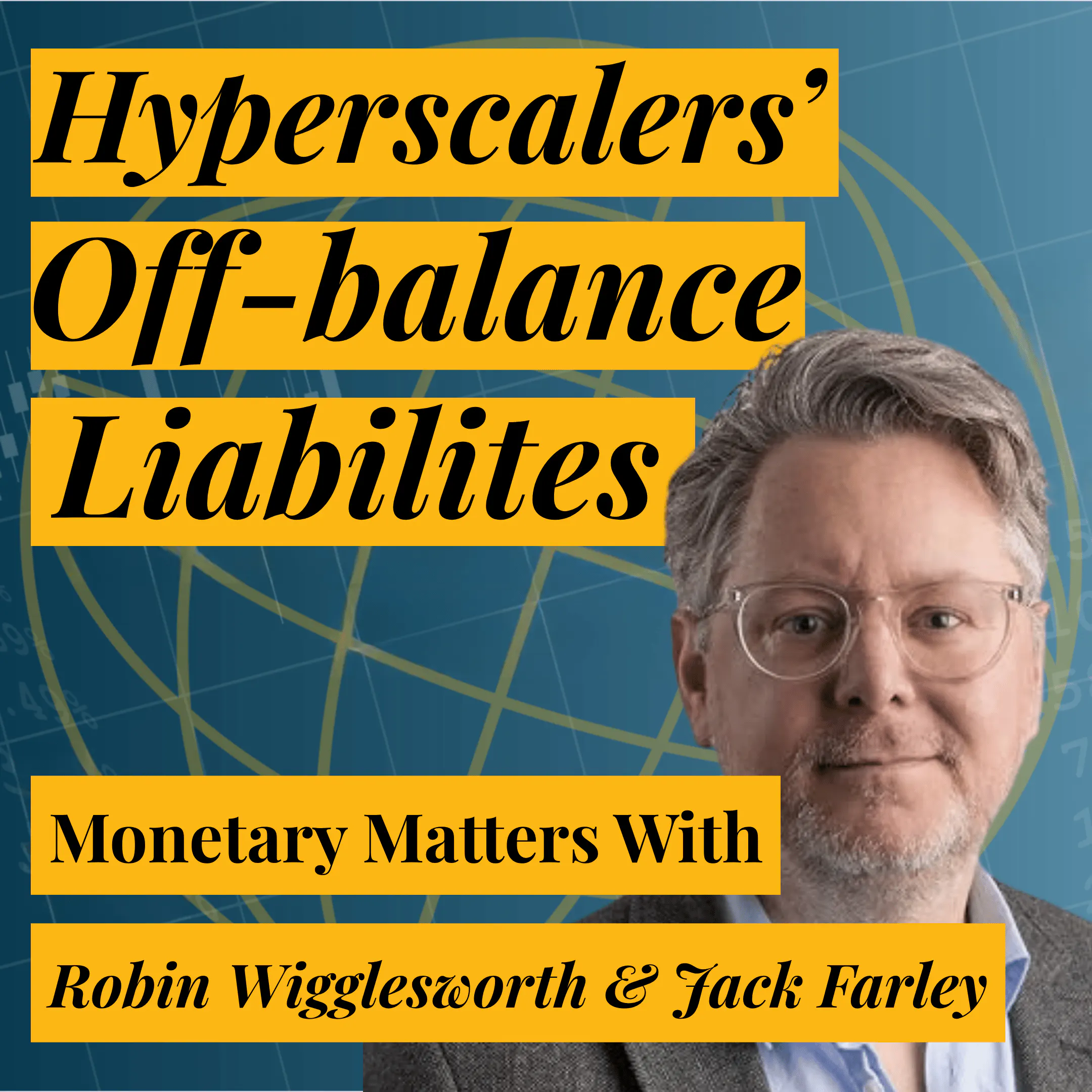 Robin Wigglesworth on Hyperscalers' 1.5 Trillion of Off-Balance Sheet Liabilities, Private Credit, and His Book "A Fabulous Debt" 16.08.2026 1val 5minRobin Wigglesworth — editor of FT Alphaville and author of A Fabulous Debt: The Epic Story of How Bonds Built the Modern World — joins Jack Farley to unpack the hidden debt fueling the AI buildout. Wigglesworth reveals that off-balance-sheet leverage from hyperscalers like Meta, Google, and Microsoft jumped from roughly $1 trillion to $1.5 trillion in a single quarter, hidden in lease structures and purchase commitments that never show up as debt — including Google's own $800 billion in disclosed obligations. He argues the NVIDIA-Blackstone-KKR financing wave marks a shift from an equity-driven boom to a debt cycle, a distinction that makes today's AI buildout riskier than the dot-com bust ever was. The conversation moves from private credit's "spray and pray" lending problem to nine centuries of financial history — the Erie Canal boom, the 1873 railway mania, and the 19th-century fraudster who invented an entire country to sell government bonds. They close on whether credit rating agencies can survive the AI era, and why "the language of credit" may outlast every model built to replace it. It's a conversation about debt, leverage, and the patterns that connect 19th-century railroads to trillion-dollar data centers. Recorded August 13, 2026. “A Fabulous Debt: The Epic Story of How Bonds Built The Modern World”:https://www.penguinrandomhouse.com/books/750210/a-fabulous-debt-by-robin-wigglesworth/ “A Fabulous Debt” on Amazon: https://www.amazon.com/dp/0593719182?lv=shuf&channelId=500&plpRedirect=mhFallback Robin Wigglesworth on X https://x.com/RobinWigg Jack Farley on X https://x.com/JackFarley96 Follow Monetary Matters on: Apple Podcasts https://rb.gy/s5qfyh Spotify https://rb.gy/x56dx5 YouTube https://rb.gy/dpwxez
 -
 Milton Berg: I Have Evidence Market Has Likely Bottomed | Why Milton’s Long Semis, Korea, Nasdaq, and More (With Caveats), and Why He Thinks Gold has made a Multi-year Top 12.08.2026 1val 23minMilton Berg, one of Wall Street's legendary market technicians, returns to Monetary Matters to explain why he believes the recent crash across the S&P 500, Nasdaq 100, KOSPI, and semiconductor stocks has already bottomed — and why he's still positioned long despite major caveats. The positive divergence call: Milton breaks down why the S&P 500's July 29th low held above its June 9th low even as the Nasdaq 100 and Philadelphia Semiconductor Index (SOX) made new lows — a classic technical signal he says points to higher prices ahead. The 1987 crash comparison: Using historical crash-low data, Milton shows how markets rarely V-bottom and go straight up — and lays out why the current setup looks more like 1987 (a retest of the lows) than the COVID V-shaped recovery. The "exhaustive gap" warning: Despite his bullish lean, Milton flags a specific gap pattern in the Nasdaq 100 and KOSPI that has historically signaled short-term tops — and explains what would need to happen for it to resolve bullishly instead. Inside his trading model: Milton walks through his systematic buy-signal model, including a real trade history that turned $10,000 into over $1.15 billion, and unpacks how his signals performed (and failed) around 2008 and other historic drawdowns. His current portfolio positioning: Milton details his exact allocations — long the KOSPI/EWY, Russell 2000, S&P Midcaps, Nasdaq 100, SOXX, and S&P 500 — and explains why he flipped from short to long on July 29th and 30th. Gold, silver, and bond yields: Beyond equities, Milton shares his latest technical read on precious metals and where he sees long-term bond yields heading. Why retail investor behavior matters right now: Milton highlights a retail selling data point — the highest since 2022 — and explains why heavy retail capitulation is historically a bullish signal for stocks. Follow Milton Berg on X https://x.com/BergMilton Follow Milton Berg Edge on X https://x.com/MiltonBergEdgeMilton Berg Edge website https://miltonbergedge.com/ Milton Berg Advisors website https://miltonberg.com/ Jack Farley on X https://x.com/JackFarley96 Follow Monetary Matters on: Apple Podcasts https://rb.gy/s5qfyh Spotify https://rb.gy/x56dx5 YouTube https://rb.gy/dpwxez Disclaimers Milton Berg Edge is a newsletter (“Newsletter”) owned and published by Milton Berg Advisors, LLC (MBA), doing business as “Milton Berg Edge” (“MB Edge,” “firm,” “we,” “our,” and “us”). Milton Berg Advisors, LLC is registered as an investment advisor in the States of Florida and New York. Registration as an investment advisor does not imply any level of skill or training. No portion of the material may be distributed or reproduced without express written permission by Milton Berg Advisors, LLC. (MBA). MBA believes the information and data contained in its materials are reliable but provides them “as is” and without guarantees. MILTON BERG ADVISORS, LLC, DISCLAIMS ALL WARRANTIES, EXPRESS AND IMPLIED, including warranties of merchantability, suitability or fitness for a particular purpose or use. MBA and its agents shall not be liable for any loss resulting from reliance on the contents. MBA does not warrant or make any representations concerning the accuracy, likely results, or reliability of the use of the materials presented herein or on its website. The material reflects opinions as of the date of each, and they will not necessarily be updated as views or information change. All opinions are subject to change without notice, and you should always obtain current information and perform due diligence before trading. MBA may over time modify its approach to evaluating investment opportunities. The Newsletter is a subscription based publication that contains (i) our general commentary and opinion on broad-based market trends and other factors affecting the domestic investment markets in the United States; (ii) answers and reactions to subscriber submitted questions and comments; and (iii) the actual trading activity and net performance of our proprietary investment model (as traded within an account that is actively managed by the firm) and the backtested, hypothetical performance of the model (the “Model”). The contents of the Newsletter and our website (“Website,” and collectively with the Newsletter, the “Content”) are for informational and educational purposes only. No portion of the Content should be construed as investment advice or recommendations tailored to the financial circumstances, investment needs, objectives, and/or limitations of any particular subscriber. Investing in securities involves the risk of loss. Past performance is not indicative of future results. The materials are not designed to meet the particular investment needs of any investor. The materials do not address the suitability of any particular investment for any particular investor and are not intended to be the primary basis for investment decisions. Investors should seek professional advice before making investment decisions. The statements in videos or documents shared through the materials presented shall not be considered as an objective or independent explanation of the matters. Please see our full disclaimers at https://www.miltonbergedge.com/disclaimers/
 -
 Misunderstood Stocks in Data Center Power, Cybersecurity, and Payments | Dean & Deiya Pernas 07.08.2026 1val 11minMonetary Matters listeners can get 20% off subscriptions for one year here (billed quarterly): https://pernasresearch.com/register/monetary-matters/?coupon=monetarymatters In this episode of Monetary Matters, Jack Farley sits down with Deiya and Dean Pernas of Pernas Research to discuss their contrarian investment strategies and overarching market themes. The brothers delve into the massive energy demands of AI data centers, highlighting "bring your own power" solutions and infrastructure needs over traditional semiconductor plays. Additionally, Deiya explores the evolving landscape of cybersecurity and software in the age of AI, noting that while AI threatens some legacy software moats, it creates immense opportunities for exposure management platforms like Tenable and specialized marketplaces like Upwork. The conversation also unpacks the payments sector, specifically emphasizing the robust growth of cross-border money movement through fintechs like Wise and Remitly as they actively disrupt traditional correspondent banking. Throughout the interview, the Pernas brothers emphasize the importance of independent, buy-side research and the value of finding high-conviction, small-to-mid-cap stocks that the broader market may have mispriced. Recorded July 28, 2026. Follow Pernas Research on X https://x.com/pernasresearch Jack Farley on X https://x.com/JackFarley96 Follow Monetary Matters on: Apple Podcasts https://rb.gy/s5qfyh Spotify https://rb.gy/x56dx5 YouTube https://rb.gy/dpwxez
 -
 Victor Haghani on Death of Random Walk, and Passive, Buybacks, and LTCM 04.08.2026 1val 31minVictor Haghani — founder of Elm Wealth, co-author of “The Missing Billionaires” and former founding partner of Long-Term Capital Management — joins Monetary Matters to explain why the stock market doesn't follow a random walk. Drawing on his new paper "Who Killed the Random Walk?", Victor lays out a model where value investors, static asset allocators, and "extrapolators" interact to produce the excess volatility, momentum, and boom-bust cycles that classical finance theory can't explain. Jack and Victor debate whether passive investing is really to blame for market distortions, why stock buybacks are propping up the entire market, and why Elm Wealth's own models say US equities should only return about 6% a year despite blistering AI-driven earnings growth. Victor also breaks down the strange truth that "return chasing" and momentum investing sound identical but perform in opposite ways — and reveals how Elm actually allocates client capital across US and international stocks today. Recorded before Leopold Aschenbrenner's Situational Awareness hedge fund imploded on a leveraged AI trade, Victor's answer about what really went wrong at LTCM in 1998 turned out to be eerily well-timed. Recorded July 21, 2026. Victor Haghani (Elm Wealth) on X https://x.com/ElmWealth Jack Farley on X https://x.com/JackFarley96 “The Missing Billionaires: A Guide to Better Financial Decisions”: https://www.amazon.com/dp/1119747910?lv=shuf&channelId=500&plpRedirect=mhFallback Follow Monetary Matters on: Apple Podcasts https://rb.gy/s5qfyh Spotify https://rb.gy/x56dx5 YouTube https://rb.gy/dpwxez
 -
 Why Macro is “Pretty Risk-On” for Equities | Tian Yang of Variant Perception 02.08.2026 1val 5minIn this episode, host Jack sits down with Tian Yang, co-founder and head of research at Variant Perception, to analyze the current macroeconomic landscape and equity market outlook. Tian shares why macro indicators point to a broadly supportive "risk-on" environment over the next three to six months despite recent pullbacks in semiconductor and tech stocks. He discusses the exhaustion of the agentic AI rally, explaining how capital is actively rotating into value laggards such as energy, financials, and healthcare. Tian also breaks down their Log Periodic Power Law (LPPL) framework, a tactical model designed to detect market bubbles and exhaustion signals to help time entries and exits. Beyond equities, the discussion covers broader macro dynamics, including central bank policy expectations, geopolitical supply-side shocks, and regional preferences for Latin America over markets in Europe and India. Finally, Tian details the systematic strategy behind their VPX ETF, which dynamically combines capital cycle, quality, and crowding models to capture upside relative to the S&P 500. They also talk about oil, gold, and IPO window in U.S. Variant Perception on X https://x.com/VrntPerception Jack Farley on X https://x.com/JackFarley96 Follow Monetary Matters on: Apple Podcasts https://rb.gy/s5qfyh Spotify https://rb.gy/x56dx5 YouTube https://rb.gy/dpwxez
 -
 Mum’s The Word: Kathryn Rooney Vera on Fed’s Second Meeting under Kevin Warsh, Plus Earnings Breakdown (Live Replay) 29.07.2026 1val 3minIn this episode, Jack sits down with Kathryn Rooney Vera, Chief Market Strategist at StoneX Group, to unpack the Federal Reserve's decision to hold interest rates and Chair Warsh's transition toward a quieter, laissez-faire communication style. Kathryn shares her macroeconomic outlook, forecasting that we may still see rate hikes post-election unless widespread AI adoption delivers a significant productivity boost to offset inflation. Later in the show, Jack is joined by Max Wiethe for a live, unfiltered reaction to the latest mega-cap tech earnings from Microsoft and Meta. They analyze Microsoft's massive revenue and 43% Azure cloud growth, weighing these strong figures against the company's aggressive $41 billion in quarterly capital expenditures. Jack then bluntly breaks down Meta's quarterly results, labeling it a "disaster" due to a 55% surge in costs, an 8% drop in operating income, and unexpectedly weak forward guidance. Finally, the duo wraps up with a look at the semiconductor space, assessing how these fluctuating AI investments are directly impacting chip and equipment stocks like Arm Holdings and Lam Research. Kathryn Rooney Vera on X https://x.com/KRooneyVera Kathryn Rooney Vera on LinkedIn https://www.linkedin.com/in/kathrynrooneyvera/ Jack Farley on X https://x.com/JackFarley96 Max Wiethe on X https://x.com/maxwiethe Other People’s Money on X https://x.com/OPMpod Follow Monetary Matters on: Apple Podcasts https://rb.gy/s5qfyh Spotify https://rb.gy/x56dx5 YouTube https://rb.gy/dpwxez
Panašios tinklalaidės


Populiari šalyje
Ši tinklalaidė taip pat patenka į šių šalių tinklalaidžių topus.


