
Numbers Game
Politics UK
0
Politics UK's Numbers Game analyses opinion polls and election models to explain what they mean for British politics. Hosted by Henry Snowdon and Miles Bennington, it breaks down polling trends and forecasts. The show helps listeners understand the numbers behind UK political debate.
Epizodai
-
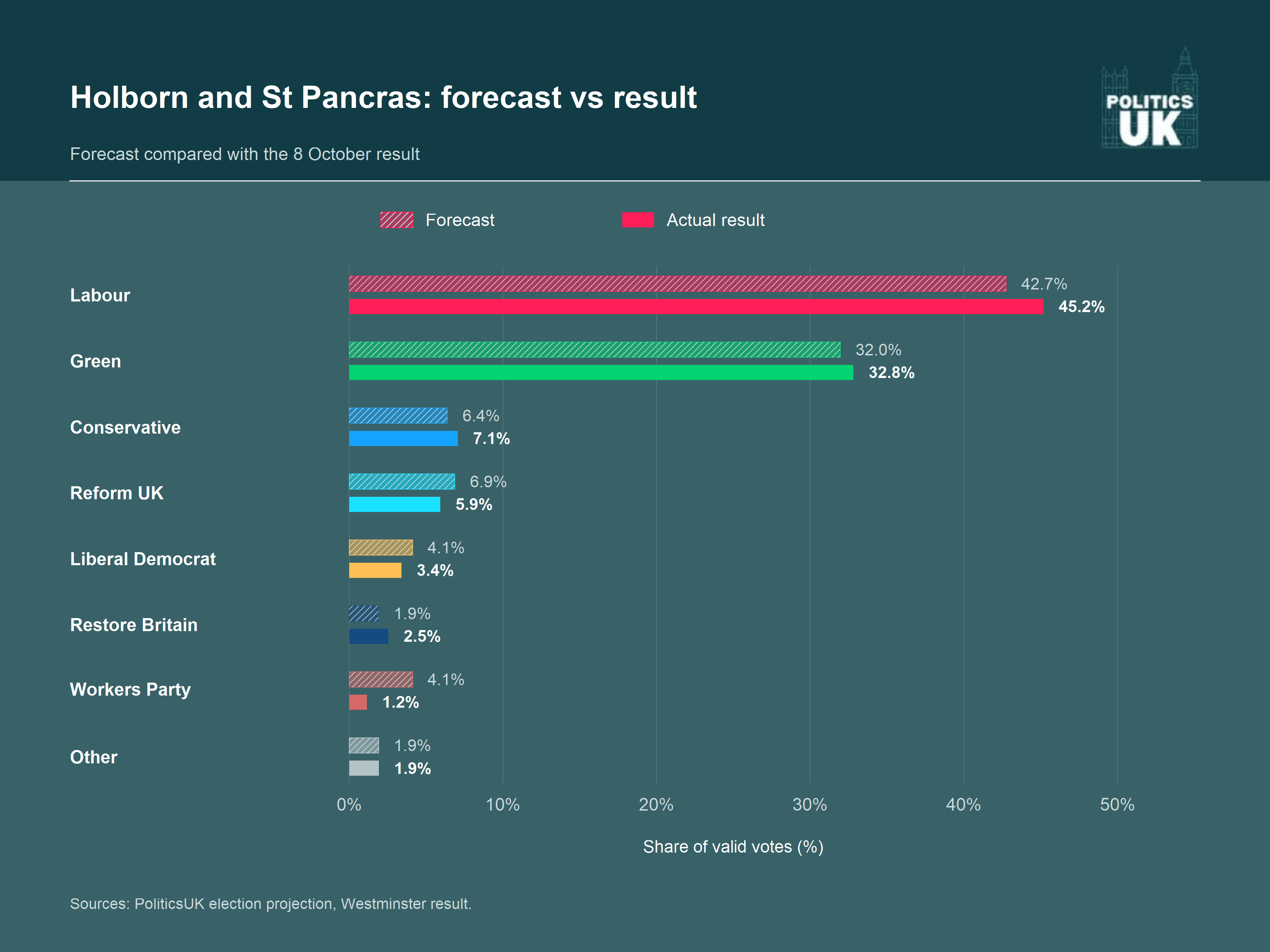 Holborn and St Pancras Reaction 10.10.2026 6minWelcome back to the Numbers Game. I wanted to give a brief update on last night’s election and what it could mean nationally.First, I want to celebrate our projection for doing so well. All party vote shares were within one point, except for Labour, which overperformed by 2.4 points, and Mr Galloway’s Workers Party, which underperformed by 3.0.With my pat on the back out of the way, I want to explore a few questions that this result raises.What do these results mean nationally?First, an important caveat. It would be incorrect to assume that these results directly translate nationally. This was a by-election, with plenty of local effects at play. Tactical voting, the Green Party leader standing, low turnout, and the particularities of the Borough of Camden. An election in Camden doesn’t necessarily tell us much about how voters in Durham North will be voting. Thus, the following projection should still be taken with a grain of salt.But with that said, if we roughly extrapolate this result nationally, under those assumptions, my model would return:* Labour: 288 MPs on roughly 28.7% of the vote.* Reform UK: 132 MPs on 23%.* Conservatives: 114 MPs on 20.9%.* Liberal Democrats: 35 MPs on 9.4%, although that should be taken with an even bigger grain of salt because their support is so dependent on tactical voting and local strength.* Greens: 3 seats on 9.2%.* Restore: 1 seat on 3.9%.* SNP: 46 seats on 2.9%.As this was an election between Labour and the Greens, I have two main takeaways, one pertaining to each party.Labour: A majority within reach?For one, Labour is quite clearly the most popular party in the country, and they would win the most seats if there were an election today. While a majority for them remains unlikely, it is not impossible, and they are very much within range of winning one.It seems quite likely that they’ve recovered a lot of the progressive side of their 2024 coalition. At least for now, they are the dominant party of the left, and they will continue to be seen as the dominant party on the left, which, in an era of increased tactical voting, is nearly as important as actually being the dominant party.I know that Andy Burnham has denied that he will call an early election, but considering how incumbent leaders and parties do once they actually have to make decisions, and the effects of those decisions are felt, it seems very possible to me that views on an early election within Number 10 may be more malleable than they let on.The Greens: A disappointing result?In contrast, the Greens have slid considerably from where they were at their peak in April.Many have asked me, “Henry, do you think it was a mistake for Polanski to run in this election? It seemed so obvious that he was going to lose.”While, in retrospect, I think we can say it was a mistake, at the time I think it was a reasonable decision for the leader of the party to make. The national polling situation was more favourable for the Greens in early September, and the local elections showed that this seat could be incredibly close, with Labour winning by only 3 points. Add in the seat’s very young demographic, all the resources of the party, and the notoriety and local base of support of its leader, and it was completely plausible that he could win.That’s why I think this is actually quite a poor result for the Greens. I don’t think they would have expected to lose by a margin of more than twelve points when this election was announced.The Greens’ turnout problemBut beyond the vote share, the biggest indictment of the Greens is the turnout here: only 38.6%.That’s around average for by-elections in the previous parliament, and compared to by-elections in this parliament, it’s quite low. In fact, it was lower than Gorton and Denton’s 47.5%, Runcorn and Helsby’s 46.2%, and even Clacton’s 44.0%, where the other major parliamentary parties chose not to stand.Beyond just by-elections, turnout yesterday was broadly comparable with turnout in the wards covering this seat at the May local elections.Historically, you would expect a high-profile candidate, especially the leader of a parliamentary party, to bring a higher turnout. The fact that turnout here was only 38.6%, which, by the way, is around the same as the turnout in the May local elections in this constituency, is deeply worrying for the Greens.It means that either the Greens weren’t able to excite their base enough to come out and vote in a competitive by-election where their leader was standing, which would be bad not only for the party but would also raise substantial questions about the position of its leader.Or, potentially even worse, they did effectively turn out their voters but still lost by a big margin, despite relatively low turnout overall.We can’t tell which explanation is right from the turnout figure alone. But taken together, a lot of the numbers under the hood show this to be a really poor result for the Greens, and I think it’s reasonable for people in that party to start having tough conversations. This is a public episode. If you would like to discuss this with other subscribers or get access to bonus episodes, visit politicsuk.substack.com
 -
 Holborn and St Pancras: Final Thoughts 08.10.2026 46minWelcome to the first episode of Numbers Game, the new Politics UK podcast where we explore the polls, predictions and electoral models to see what they mean for British politics.Join Politics UK editor Miles Bennington and election modelling expert Henry Snowdon as they unpack the latest polling data and ask what it means for the parties in this new multi-party environment. With Andy Burnham enjoying a polling bounce, Nigel Farage’s Reform UK losing ground and the Conservatives fighting for their political future, Britain’s electoral landscape is rapidly shifting. In this episode, we discuss:* The Burnham bounce: How much has Labour recovered, and can Andy Burnham rebuild its electoral coalition?* Reform’s retreat: Where is Nigel Farage losing support, and will Reform’s voters actually turn out on polling day?* The Conservative dilemma: Could Reform permanently displace the Tories as Britain’s principal party of the right?* Holborn and St Pancras: Our prediction for the by-election in Keir Starmer’s former constituency, and whether Green leader Zack Polanski has overplayed his hand.* The tactical voting revolution: Why Labour, the Conservatives and even Reform could benefit from unexpected voting alliances.* The Liberal Democrat challenge: Can Ed Davey’s party defend its 72 seats as anti-Conservative tactical voting fades?* Our latest election model: What the Politics UK projections reveal, and how we’re developing the model to make better predictions.From George Galloway’s by-election record to the possibility of the Conservatives becoming the Liberal Democrats of the right, we explore the numbers, challenge the assumptions and examine what could happen next. This is a public episode. If you would like to discuss this with other subscribers or get access to bonus episodes, visit politicsuk.substack.com
Panašios tinklalaidės


Populiari šalyje
Ši tinklalaidė taip pat patenka į šių šalių tinklalaidžių topus.
