
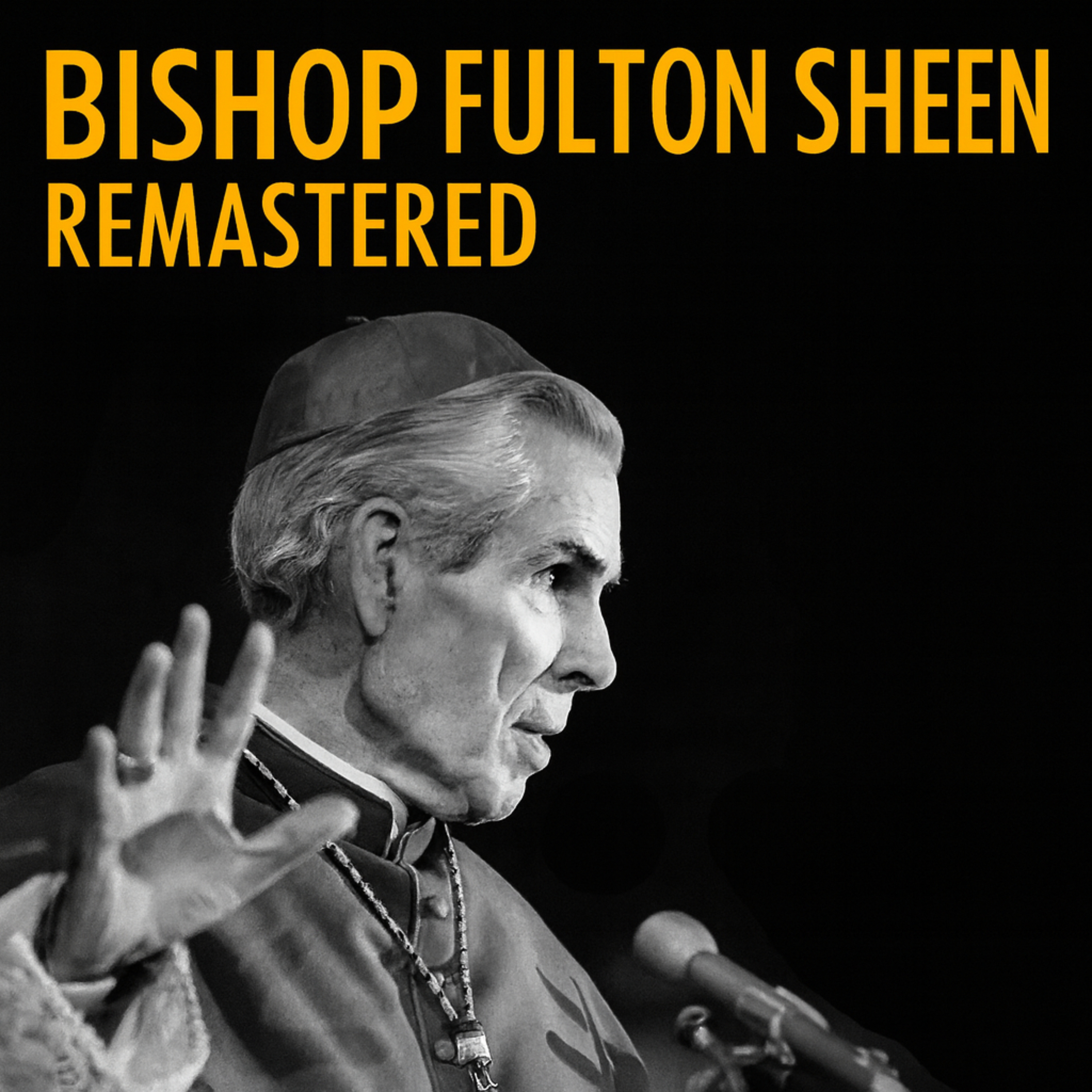
Bishop Fulton Sheen Remastered
Bishop Fulton J. Sheen Audio Team
0
The "Bishop Fulton Sheen Remastered" series features a selection of sermons and speeches, dating from 1940 to 1974, which have been enhanced through AI and modern audio restoration techniques. This approach improves the quality and clarity of the original recordings, making Bishop Fulton Sheen's messages more accessible to today's listeners.
Epizodes
-
 The Meaning of the Cross and the Resurrection 17.05.2026 38minWhy does the cross stand as the most absurd yet central symbol of the Christian faith? Archbishop Fulton Sheen explores the profound paradox of the crucifixion, where the vertical bar of life is violently contradicted by the horizontal bar of death. He argues that the cross becomes the ultimate symbol of the incomprehensible, a place of execution that paradoxically serves as the foundation for a new humanity. By examining the historical and spiritual significance of the place of the skull, Sheen invites listeners to consider how the new Adam brings forth a new creation through the very instrument of his suffering.Sheen masterfully connects the Old Testament imagery of the bronze serpent to the reality of the crucifixion. Just as the Israelites were healed by looking upon the serpent of brass, so too are those who look upon the crucified Christ healed from the poison of sin. He emphasizes that Christ took on the appearance of sin without bearing the stain of it, allowing him to become the ultimate remedy for the human condition. The episode also delves into the varied human responses to the cross, categorizing them into apathy, antipathy, and sympathy--much like the reactions of the soldiers, the thieves, and the faithful followers at Calvary.This reflection remains deeply relevant today as it challenges the modern tendency to seek a Christianity without the cross. Sheen reminds us that the resurrection is not merely a historical event but a reality that requires our active participation and complete surrender to God's will. By confronting the reality of our own crosses, we are called to move beyond a superficial faith and into a deeper, transformative relationship with the risen Lord. Listeners are encouraged to embrace the redemptive power of suffering and to find hope in the promise that all who look to the cross will be healed.
 -
The Continuing Passion of Christ 16.05.2026 36minIs the suffering of Christ an event confined to the past, or does it possess a reality that extends into our present lives? Archbishop Fulton Sheen explores the profound mystery of the continuing passion of Christ, arguing that the redemptive work of the cross is not a closed chapter of history. Instead, he posits that the sufferings of all people--whether physical, mental, or spiritual--are inextricably linked to the cross, as Christ continues to live and suffer within his mystical body, the Church.Sheen illustrates this deep theological truth through poignant anecdotes, including the story of Richard Wurmbrand, a Lutheran pastor who endured horrific torture for his faith. Sheen recounts how Wurmbrand, while in the depths of his suffering, found solace in the realization that his pain was a participation in the passion of Christ. The Archbishop emphasizes that Christ's words on the cross, "It is finished," did not signify the end of his redemptive suffering, but rather the completion of his personal earthly mission. He explains that the "full tale of Christ's afflictions" is still being written through the lives of the faithful, asserting that Christ is "still on the cross until the end of the world."This episode is essential listening for anyone grappling with the reality of personal or collective suffering. Sheen provides a transformative perspective, inviting listeners to move beyond viewing their pain as merely senseless or isolating. By reframing our trials as a way to "graft prayer" and unite ourselves with the passion of Christ, he offers a powerful message of hope and purpose. This reflection is a compelling reminder that our own crosses are not obstacles to grace, but the very means by which we participate in the salvation of the world.
-
The Seven Last Words: The Cross as Autobiography 13.05.2026 1h 11minIn this profound meditation on the Passion, Archbishop Fulton J. Sheen explores the mystery of the Cross not merely as an historical event, but as the ultimate autobiography of God. He challenges listeners to consider the Cross as the intersection of divine justice and infinite mercy, examining the specific individuals who surrounded our Lord in His final hours. By analyzing the reactions of the thief, the soldiers, and the bystanders, Sheen invites us to see our own spiritual state reflected in their responses to the suffering Savior.Sheen masterfully dissects the motivations of those present at Calvary, contrasting the apathy of the crowd with the profound conversion of the repentant thief. He emphasizes that the Cross is not a tragedy to be mourned but a victory to be embraced, serving as the bridge between human sin and divine redemption. Through vivid storytelling and sharp theological insight, he illustrates how the Cross strips away the illusions of the world, forcing a confrontation with the reality of sin and the necessity of sacrifice. He reminds us that the Cross is not just a sign of what happened to Christ, but a sign of what must happen to us if we are to follow Him.This reflection remains deeply relevant for contemporary audiences who often seek a faith stripped of sacrifice or a Christianity without the Cross. Sheen's timeless wisdom cuts through modern distractions, urging us to recognize that our own lives are meant to be lived in the shadow of Calvary. By inviting listeners to stand at the foot of the Cross, he provides a path toward true repentance and a deeper, more courageous commitment to the Gospel in an increasingly secularized world.
-
The Scars of the Lamb 12.05.2026 21minIn this profound meditation, Archbishop Fulton Sheen explores the mystery of the Lamb of God and the significance of His wounds. He traces the theme of sacrifice from the beginning of creation, noting that Christ is pictured as already slain from the foundations of the world. Sheen asks a haunting question that echoes through history: "Where is the Lamb?" This inquiry, first voiced by Isaac on his way to Mount Moriah, becomes a bridge across the centuries, connecting the ancient sacrifices of Israel to the ultimate, perfect sacrifice of Calvary.Sheen recounts the dramatic moment when the risen Lord appears to the disciples, showing them the wounds in His hands and feet. He vividly illustrates the permanence of these scars, suggesting that even in His glorified state, Christ chooses to bear the marks of His passion. He explains that these scars are not merely historical relics but are the very means by which we recognize our Savior. Sheen challenges his listeners to consider the state of their own souls, asking whether they, too, bear the marks of service, sacrifice, and love for God. He reflects on the nature of a heart "scarred in love," emphasizing that these wounds are the true evidence of a life lived for the sake of others.This episode is essential listening for anyone seeking to deepen their understanding of Christ’s redemptive work. Sheen’s ability to weave together Old Testament typology with the reality of the Resurrection provides a fresh perspective on the meaning of suffering. By focusing on the scars of the Lamb, he invites the faithful to find meaning in their own trials and to offer them to God as a sacrifice of love. It is a powerful reminder that our wounds, when united with Christ’s, are transformed into a source of grace and a testament to the enduring power of the cross.
-
The Finished Work of Redemption 11.05.2026 13minIs our work for God ever truly finished, or is there a dimension of human suffering that remains to be offered? In this profound reflection on the sixth word from the Cross, Archbishop Fulton J. Sheen explores the mystery of why so much of our work remains undone. He contrasts the finished, perfect sacrifice of Christ with the ongoing, unfinished lives of the faithful, posing the challenging question of why the enemy constantly tempts us to come down from our own crosses when the path of salvation demands we remain upon them.Sheen illustrates this through the poignant image of the scarlet cord lowered for Rahab, a symbol of the blood of Christ that secures salvation for all who look upon it with faith. He connects this to the bronze serpent in the desert, explaining that just as the Israelites were healed by looking upon the serpent, we are healed by looking upon the Crucified One, who appeared as a sinner though He was sinless. He shares deeply personal stories, including his own experience of receiving blood donations during heart surgery, to demonstrate that we are called to be conduits of grace, filling up in our own flesh the sufferings that are wanting to the passion of Christ for the sake of His body, the Church.This episode is essential listening for anyone seeking to understand the redemptive value of their own daily struggles and hardships. Sheen reframes the concept of reparation, not as an abstract theological term, but as a living, sacrificial participation in Christ’s work. By inviting listeners to embrace their own crosses rather than seeking to escape them, he offers a powerful, counter-cultural vision of what it means to live a life united to the Savior. It is a stirring call to complete the work of salvation in our own lives, finding joy even amidst the thorns, because every sin is a Calvary and every soul a Rood.
-
I Thirst: The Divine Longing 10.05.2026 17minArchbishop Fulton J. Sheen explores the profound spiritual depth behind Christ's fifth word from the cross, "I thirst." He distinguishes between the physical reality of the crucifixion and the deeper spiritual meaning, where this cry represents a divine yearning for the souls of humanity. Sheen argues that this thirst is not merely a request for comfort but a profound expression of God's desire for our love and our return to Him. By examining the context of the crucifixion and the nature of human desire, Sheen invites listeners to consider the true source of satisfaction for the human heart.Throughout the reflection, Sheen uses vivid illustrations to contrast the fleeting, unsatisfying nature of worldly pursuits with the eternal fulfillment found in God. He touches upon the modern idols of pleasure, power, and wealth—which he personifies as the gods Bacchus, Venus, and Mammon—explaining how they offer only temporary relief and ultimately leave the soul parched. He notes that the tragedy of life is not what we suffer, but what we miss when we seek satisfaction in these false gods. The cry "I thirst" serves as a universal symbol for the human condition, pointing toward an infinite longing that only the Creator can satisfy.This episode remains essential listening for those struggling with the emptiness of modern materialism and the search for purpose. Sheen’s timeless wisdom challenges listeners to move beyond superficial desires and embrace a deeper spiritual life. By understanding that our thirst is a reflection of God's own thirst for us, listeners are encouraged to turn their hearts toward Him, finding in that relationship the only true and lasting peace. It is a powerful reminder that the ultimate remedy for our deepest needs is found in the love of Christ, who endured everything to draw us back to Himself.
-
Why Did the Heavenly Father Abandon His Son? 09.05.2026 15minArchbishop Fulton J. Sheen explores the profound mystery behind the fourth word of Christ from the Cross: "My God, my God, why hast thou forsaken me?" He addresses the unsettling question of how the Heavenly Father could seemingly abandon His own Son, who had identified Himself with sinners. Sheen frames this abandonment not as a rejection, but as a deliberate act of divine justice and love, where the Father sees the Son as one with the transgressors to bring about the work of redemption.Sheen uses the poignant illustration of a father taking his young son to a dentist. As the dentist inflicts pain upon the child to treat an infected tooth, the father does not intervene to stop the procedure, because he knows the suffering is necessary to reveal and relieve the toxic condition. Similarly, Sheen argues, the Heavenly Father allowed the Son to suffer for humanity, taking on the pains and pangs of all forms of atheism and sin. He also categorizes atheists into three types—the "gastric atheist" living for carnal pleasures, the "heart atheist" who does not wish for a God, and the "antichrist" who harbors active hatred—and reveals how Christ in His agony atoned for each one.This episode remains essential for modern listeners because it challenges us to understand suffering not as a sign of God's absence, but as a necessary component of our reconciliation with Him. Sheen reminds us that just as a fish is made to be in water, humans are meant to be with God; when we are separated from Him, we are like that fish out of water, gasping for life. This reflection invites us to turn back to the Father, no matter how far we have wandered, and to find hope in the truth that even in our darkest moments of feeling forsaken, God's grace is present to draw us home.
-
The Feminine in Religion: Our Lady at the Cross 08.05.2026 12minWhy does the Lord, who is the author of all things, seem to ignore the feminine in religious life? Archbishop Fulton Sheen explores this provocative question, contrasting the way modern society approaches the feminine with the profound, essential role of the Blessed Mother. He challenges the listener to consider if our own spiritual houses—our churches and our hearts—have become barren by neglecting the maternal influence that brings comfort, tenderness, and a necessary balance to the harshness of the world. Sheen posits that by ignoring the feminine, we risk losing the very vessel through which the Incarnation took place.Sheen masterfully illustrates this through the scene at the Cross, where Jesus entrusts his mother to the disciple John. He emphasizes that this was not merely a sentimental gesture, but a transformative moment where Mary becomes the mother of all believers. Sheen notes, "By and virtue of the pangs of childbirth, she became the mother of us all." He highlights that Mary is not only a refuge for sinners, having known the ultimate loss of her Divine Son, but also a model of the "ideal feminine" that is currently missing from our civilization. He argues that this ideal is not about utility or power, but about a beauty that inspires nobility and a quiet, sacrificial strength that men, in their pursuit of power and logic, desperately need.Today, this message is more vital than ever as the culture struggles to define true femininity and the complementary roles of the sexes. Sheen’s reflection serves as a call to restore the feminine in our spiritual lives, urging us to turn to the Blessed Mother not just as a figure of devotion, but as a teacher of prayer. By inviting Mary into our lives, we learn to approach the Divine with the trust of a child, finding in her a perfect guide to the heart of her Son. This episode is an essential listen for anyone seeking to deepen their understanding of grace and the maternal heart of the Church.
-
The Meaning of Pain in the Shadow of the Cross 07.05.2026 15minHow are we to overcome the reality of suffering that plagues human existence? Archbishop Fulton J. Sheen approaches the mystery of pain not as a mere biological or psychological hurdle, but as a spiritual enigma that is inextricably linked to the Passion of Christ. By examining the scene of the crucifixion, Sheen invites the listener to understand that all the pains and trials of life pass through the hands of God before they ever reach us. He challenges the listener to see that suffering is not a random occurrence, but a potential means of participating in the work of redemption, provided we unite our own crosses with the one carried by our Lord.Sheen vividly illustrates this through the account of the two thieves crucified alongside Christ. He notes that while one thief remained unrepentant, the other recognized the innocence of the Savior, asking to be remembered when He entered His kingdom. This thief, who had mocked Christ moments earlier, received the promise of paradise. Sheen uses this to explain that the cross is the ultimate symbol of the intersection between the vertical bar of divine life and the horizontal bar of human death. He emphasizes that the one who is truly wise is the one who understands that pain, when offered to God, becomes a vehicle for grace and a path to eternal life, rather than a cause for despair.This episode remains profoundly relevant for a world that often seeks to eliminate suffering at any cost. Sheen’s reflection is a call to change our perspective, shifting from a desire to escape pain to a desire to use it as a means of atonement and love. By focusing on the example of the Good Thief, listeners are encouraged to embrace their own crosses with faith, knowing that their suffering is seen and known by the Father. It is a powerful reminder that our pain, no matter how intense, can be transformed into a sacrifice of love that draws us closer to the heart of God.
-
Am I Sick or a Sinner? 06.05.2026 22minArchbishop Fulton J. Sheen challenges the modern tendency to pathologize moral failings, asking the piercing question: are we truly sick, or are we merely sinners? He contrasts the contemporary impulse to seek psychological or medical explanations for our behavior with the traditional understanding of the human soul. By exploring how secular society redefines guilt as a mental health crisis, Sheen invites listeners to move beyond self-justification and confront the reality of sin in the light of the Cross.Sheen illustrates this shift with a poignant anecdote about a boy who attempts a mock confession as a dare, only to find himself unable to complete the sentence, "You died for me, but I don't give a..." before being overcome by the weight of the reality he is mocking. He connects this to the broader theme of the Crucifixion, emphasizing that Christ’s suffering was not merely a tragic event but a deliberate act of atonement. He reminds us that the shedding of blood is the only path to the remission of sin, asserting that "without the shedding of blood, there is no remission of sin."This episode is essential for anyone struggling to navigate the tension between modern therapeutic culture and the timeless call to repentance. Sheen’s insights provide a necessary corrective to our era’s discomfort with moral accountability, offering a path to true freedom through the Sacrament of Reconciliation. By stripping away our excuses and leading us to the foot of the Cross, he helps us recognize that our deepest need is not for a diagnosis, but for the mercy of God. His words serve as a powerful reminder that our lives are a narrative of grace, and that the only way to be set free is to acknowledge our sins and accept the forgiveness won for us by Christ.
-
The Death March to Jerusalem: The Betrayal of Judas 05.05.2026 28minWhat does it mean to be a follower of Christ in a world that demands a price for faith? In this profound reflection, Archbishop Fulton J. Sheen explores the spiritual significance of the journey to Jerusalem, framing it not as a passive walk, but as a deliberate, redemptive march toward the Cross. He challenges the listener to consider the nature of commitment, contrasting those who seek security in their faith with those who are willing to embrace the radical, often costly, call of the Gospel. The central question remains: are we following for the sake of the Kingdom, or are we merely seeking a temporary comfort that will ultimately lead us astray?Sheen masterfully juxtaposes the figures of Mary Magdalene and Judas Iscariot to illustrate two distinct responses to the love of God. Mary Magdalene, in an act of extravagant devotion, breaks her precious vessel of perfume at the feet of the Lord, offering everything she has without reserve. In contrast, Judas, consumed by cynicism and a desire for worldly influence, views this act as a waste, his heart already hardening under the weight of his own calculated betrayals. Sheen poignantly observes, 'You can sell the Lord, but you can never buy Him.' This tension culminates in the chilling realization that Judas’s betrayal was not merely an act of greed, but a fundamental misunderstanding of the value of the Divine, trading the infinite for a finite, worldly gain.This episode serves as a piercing examination of the modern conscience, urging us to strip away the distractions of status and material security that often mask our true allegiance. By analyzing the motives of those who walked near the Lord, Sheen invites us to honestly assess our own spiritual state. It is a necessary call to move beyond a transactional relationship with God, encouraging a total surrender that mirrors the beauty of Magdalene’s sacrifice. For anyone seeking to deepen their understanding of sacrifice and the true cost of discipleship, this reflection provides a timeless, sobering, and ultimately transformative guide.
-
Christ Before the Courts: The Trial of the King 04.05.2026 13minWhat happens when the truth of God encounters the pride of human authority? In this reflection on the Passion, Archbishop Fulton Sheen explores the trial of Christ as a collision between the divine and the secular. He examines the three worldly perspectives that condemned our Lord: a corrupt religion, a pragmatic political machine, and the moral blindness of a society obsessed with power. Sheen posits that these forces were not merely historical actors but represent the eternal opposition that truth faces in every age, as those who hold power often fear the light that exposes their own spiritual emptiness.Sheen vividly depicts the scene as Christ stands before the courts of Caiaphas, Pilate, and Herod, each representing a different failure of the human spirit. He highlights the irony of the proceedings, noting that the judges were the ones truly on trial. When Caiaphas demands to know if Jesus is the Son of God, and our Lord responds with the divine "I Am," the courtroom is transformed from a place of judgment into a place of revelation. Sheen masterfully describes how the cross becomes the only fitting punishment for a world that cannot tolerate a truth that demands total surrender, showing how the "sign of contradiction" is the inevitable fate of the sinless in a fallen world.This episode remains profoundly relevant as we navigate our own modern courts of public opinion, where truth is often sacrificed on the altar of political convenience or social pressure. Sheen challenges the listener to consider whether we, like the judges of old, seek to use our own authority to silence the voice of God when it convicts our conscience. His analysis of the trial is a powerful reminder that while the world may condemn the innocent, the ultimate verdict rests with the one who is the Truth itself. It is a stirring call to stand with Christ, even when the world demands we choose the path of least resistance.
-
The Betrayal and the Agony: A Meditation on the Eucharist 03.05.2026 17minWhat is the true meaning behind the institution of the Eucharist, and how does the betrayal of Judas illuminate the depth of Christ's sacrifice? Archbishop Sheen invites us to step into the Upper Room and the Garden of Gethsemane, exploring the profound intimacy of the Last Supper and the subsequent agony in the garden. He argues that the Eucharist is not merely a memorial, but a real, sacrificial act where Christ offers His body and blood for the redemption of the world, a mystery that requires the spirit to fully grasp.Sheen provides a poignant analysis of the final moments before the Passion, focusing on the specific interactions between Christ and His disciples. He highlights the irony that the only recorded time the Lord sang was on the night He went out to His death. He examines the psychological and spiritual weight of the betrayal, noting that when Christ gave Judas the bread, it was an act of profound, sacrificial love. Sheen vividly describes Christ as the Sin-Bearer, carrying the weight of all human history—from Cain to the present moment—as the blood began to pour from His body onto the olive roots, forming the first red rosary of redemption.This episode is essential listening for those seeking to deepen their understanding of the connection between the Eucharist and the Passion. Sheen’s ability to bridge the historical narrative with the personal, spiritual reality of the listener makes this a powerful meditation. By reflecting on the betrayal, the agony, and the ultimate surrender of the Lord's will to the Father, listeners are challenged to consider their own response to Christ’s sacrifice and the call to carry their own crosses in union with Him.
-
The Meaning of Suffering and Redemption 02.05.2026 1h 7minWhy does suffering exist, and what is its redemptive purpose in the life of a Christian? In this profound reflection on the Passion, Archbishop Fulton Sheen explores the mystery of pain, not as a meaningless absurdity, but as a path to holiness. He challenges the listener to move beyond the modern tendency to view all discomfort as something to be immediately medicated away, inviting us instead to see our own crosses in the light of the Cross of Christ. By examining the physical and spiritual agony of the Savior, Sheen reveals how suffering, when united with the divine will, becomes the very instrument of our transformation and salvation.Sheen masterfully weaves together theology and human experience, drawing on striking imagery such as the "crown of thorns" and the "wounds of Christ" to illustrate the reality of the price paid for our sins. He poses the haunting question: "Are you sick, or are you a sinner?" This distinction cuts to the heart of the human condition, forcing a confrontation with the reality of moral evil. He recounts the story of the "good thief" and the "bad thief" to demonstrate that the Cross is the ultimate dividing line of history, where every soul must choose its eternal destiny. Through his vivid narration, he reminds us that even when we feel abandoned, like the Psalmist, we are held within the compassionate gaze of a God who knows what it means to be human.This message remains urgently relevant in an era that seeks to avoid all forms of sacrifice and denies the reality of sin. Sheen provides a necessary antidote to contemporary despair by grounding our struggles in the hope of the Resurrection. Listening to this reflection offers a deeply moving opportunity to enter into the spirit of Holy Week, inviting the faithful to look at their own burdens with new eyes. By walking with Sheen through the stations of the Cross, one discovers that the path to true liberation is found not in the rejection of suffering, but in the courageous embrace of it, following the One who first walked that way for us.
-
The Last March to Jerusalem 02.05.2026 59minIn this profound meditation, Archbishop Fulton J. Sheen explores the spiritual significance of Christ's final journey to Jerusalem, framing it not as a passive submission to fate, but as a deliberate, divine mission. Sheen challenges the listener to see beyond the historical events of the Passion, emphasizing that our Lord was never a victim of circumstance, but the sovereign Master who willingly chose the path of the Cross. This reflection asks us to consider the nature of redemption and the necessity of the shedding of blood for the forgiveness of sins, grounding the intellectual and moral struggles of humanity in the ultimate reality of Christ's sacrifice.Sheen masterfully illustrates this theological truth through vivid, often startling, historical and literary comparisons. He reflects on the irony of Herod the Great's attempt to slaughter the infants of Bethlehem to preserve his earthly power, contrasting it with the true King of the Universe who entered the world to offer Himself. One of the most striking moments is Sheen's analysis of the Last Supper, where he describes the Lord's deliberate actions as the institution of the Eucharist, and his poignant retelling of the woman who anointed him with precious perfume--an act of radical love that Sheen juxtaposes with the cold betrayal of Judas. He reminds us that "the price of everything" is known to the cynic, but the value of nothing is understood until it is given away in love.This episode remains essential listening for the modern soul, as it cuts through the noise of secular distractions and political anxieties. Sheen's voice serves as a bridge to a deeper understanding of the Christian life, where the apparent "waste" of love, sacrifice, and devotion is revealed to be the highest form of spiritual wisdom. By contemplating the Last Supper and the path to Calvary through Sheen's lens, listeners are invited to move beyond a superficial faith and embrace the challenging, transformative reality of the Cross in their own lives.
-
The King Who Rides on a Donkey 02.05.2026 28minWhy does the King of Kings enter his holy city riding on a humble, unused beast rather than a warhorse? Archbishop Fulton J. Sheen explores the profound mystery of Christ's entry into Jerusalem, challenging our worldly expectations of power and triumph. He reflects on the irony of a crowd that welcomes the Messiah with palm branches and shouts of "Hosanna," only to misunderstand his mission entirely. By examining the historical context and the spiritual significance of this moment, Sheen leads us to consider how we, too, often seek a king who serves our own agendas rather than the Savior who calls us to sacrifice.Sheen paints a vivid picture of the scene, reflecting on the "queer sight" of the Lord entering on an infamous little beast, a stark contrast to the conquerors of history. He draws from the prophecy of Zechariah, reminding us that the King of Israel comes to us in humility. He also delves into the desecration of the Temple, where the marketplace had replaced prayer. With characteristic depth, he recounts the Lord's righteous indignation as he drives out those who had made his Father's house a den of thieves, setting the stage for the solemnity of the coming week. He poignantly captures the Lord's heartbreak over Jerusalem, weeping over a city that failed to recognize the time of its visitation.This episode serves as a powerful meditation for the start of Holy Week, inviting listeners to move beyond the superficial celebrations of Palm Sunday. Sheen ads insights into the nature of true kingship and the cost of faithfulness remain as relevant today as they were decades ago. As we journey through the events leading to the Cross, this reflection encourages us to examine our own hearts: are we truly prepared to welcome the King on his terms, or are we clinging to our own versions of what a savior should be? It is an essential listen for anyone seeking to deepen their understanding of the Passion and the transformative power of Christ's love.
-
Beyond Charisma: Spiritual Transformation by the Holy Spirit 26.03.2026 28minIn this profound theological reflection, Bishop Fulton Sheen explores the nature and role of the Holy Spirit, beginning with the observation that the Church's history often swings between neglecting and overemphasizing sacred truths. He suggests that a past neglect of the Holy Spirit has led to a modern overemphasis, necessitating a return to a balanced, scriptural understanding. Theologically, Sheen explains that the Holy Spirit is the personification of love between God the Father and the Son. Just as Christ came to reveal the Father, the Holy Spirit’s mission is to reveal Christ to humanity. This divine Spirit was intimately imparted when Christ breathed upon His apostles and later poured out upon the broader Church at Pentecost, establishing a living, foundational connection between humanity and the divine.Moving to a psychological perspective, Bishop Sheen argues that the Holy Spirit serves as a vital unifying force for the human person. Without this spiritual grounding, individuals are left internally disjointed and fragmented—a state perfectly captured by the Apostle Paul’s lament in Romans 7 about doing the evil one hates rather than the good one desires. To illustrate how love brings order to this internal chaos, Sheen shares a classic, humorous anecdote about an unkempt, undisciplined boy who suddenly cleans up his appearance and habits simply because he has met a girl named Susie. In this same way, Sheen explains, the Holy Spirit introduces a powerful "love principle" into human life, bringing harmony, purpose, and discipline to our otherwise divided minds, wills, and bodies.Finally, Sheen addresses the moral implications of the Holy Spirit, emphasizing that true spiritual transformation is rooted in self-sacrificing love rather than flashy, charismatic displays. He points out that while people may boast of speaking in tongues, preaching, or healing, these are merely secondary gifts given for the benefit of the Church and do not inherently make a person holy. Echoing Paul’s first letter to the Corinthians, Sheen notes that without patient, kind, and selfless love, all other spiritual gifts are as meaningless as a clanging cymbal. He concludes with a cautionary reminder, drawing from the Letter to the Hebrews, urging the faithful to carefully discern true spiritual fruit from mere emotional or psychological enthusiasm, asserting that genuine holiness is always marked by a deep, enduring love.
-
The Meaning of Love, The Meaning of Christmas (1955) 19.12.2025 22minContext & BackgroundTitle: The Meaning of Love, The Meaning of ChristmasWhy: A special Christmas telecast designed to counter the modern notion that man can perfect himself solely through psychology or self-discipline.Date: December 1955Location: The Adelphi Theatre in New York City, NYOccasion: Episode of the Life Is Worth Living Television SeriesSummaryBishop Sheen opens this telecast by contrasting the two fundamental philosophies of life: the ancient and modern attempt by man to reach perfection through his own efforts versus the Christian reality of God coming down to man. He argues that systems relying on self-discipline or mere psychology fail because humanity cannot "lift itself by its own bootstraps." Sheen diagnoses the human condition as one containing an internal "beast" that cannot be tamed from within; just as chemicals cannot become plants unless the plant comes down to absorb them, man cannot ascend to the divine unless the Divine first descends to him.This analogy sets the stage for the true definition of Christmas: the Incarnation as a necessary rescue operation rather than a mere historical event. Sheen explains that for any lower order of creation to rise, the higher order must humble itself and lift the lower up—a law of nature that finds its ultimate expression in Bethlehem. He concludes that Christ’s birth was not intended to make humans "nice people," but to transform them into "new men" and children of God. The talk ends with the comforting reminder that because Christ was born among beasts in a manger, He is unafraid to be born within the "beast" of the imperfect human soul.
-
Christmas Address 1944: How You Got That Way 18.12.2025 13minContext & BackgroundTitle: Christmas Address 1944: How You Got That WayWhy: To explain the spiritual origins of human brokenness and offer hope to a war-weary nation by framing the Incarnation as a divine rescue mission.Date: December 1944Location: NBC Radio Studios in New York City, NYOccasion: A national radio broadcast delivered on Christmas Eve during World War II.SummarySpeaking to an anxious America during the height of World War II, Bishop Sheen tackles the fundamental mystery of why humanity is prone to conflict and error. He argues that modern man has misunderstood the nature of freedom, treating it as a license to ignore the "manufacturer's instructions" of the human soul. Using the analogy of a car owner trying to run an engine on perfume rather than gasoline, Sheen explains that the chaos of the world stems from the original disorder within the human heart—a rejection of God's design that has left humanity functioning below its true potential, capable of greatness but inclined toward destruction.Sheen counters this grim diagnosis with the radical hope of Christmas, describing Bethlehem not merely as a manger, but as "God's beachhead" in enemy territory. He connects the suffering of families with soldiers overseas to the sacrifice of the Heavenly Father, calling the Star of Bethlehem God's own "service flag." The address concludes with a call to internal transformation; Sheen insists that peace cannot be found in the cessation of external battles alone, but only by allowing Christ to be formed within the soul, restoring the original masterpiece of human nature one person at a time.
-
From Holiness to Worldliness: Diagnosing the Post-Vatican II Confusion 17.12.2025 31minContext & BackgroundDate: Likely September 1974Location: Loyola Retreat House in Faulkner, Maryland (USA)Occasion: A retreat preached to diocesan priests of the Archdiocese of WashingtonWhy: Given during the chaotic decade following Vatican II, this talk was part of a series titled "Renewal and Reconciliation" aimed at steadying the Church and addressing the identity crisis facing the priesthood. SummaryBishop Sheen diagnoses a crisis in the modern Church where the prevailing attitude has shifted from "I am holier than thou" to "I am worldlier than thou," caused by a fatal misunderstanding of the biblical concept of "the world." He argues that in trying to embrace the world as God's creation, the Church accidentally embraced the "spirit of the world"—organization without God—which led to a polarization between those who wanted only rigid stability (the rock) and those who wanted only constant change (the river). This confusion created a generation of "neurotics" who replaced deep prayer with endless discussion, using theological debate as a convenient escape from making difficult moral decisions, much like the Samaritan woman at the well. The most tragic consequence of this shift, Sheen asserts, is that Jesus became an "outer truth" to be analyzed rather than an "inner truth" to be loved, leading to a sterile faith where crucifixes were discarded to avoid alienating modern society. He observes that while the institutional Church ignored the person of Jesus in favor of sociology, the counter-culture was desperately seeking Him, proving that abstract virtues are useless without a personal Savior. Sheen concludes that we often prefer a "plastic Christ" that we can control because a living God is terrifying and demands real transformation, ending the speech with the ultimatum that his retreat is for those who love Christ, and for anyone else, "the retreat is over."
Līdzīgi podkasti


Populārs valstī
Šis podkasts parādās arī šo valstu podkastu topos.


