
Real Gaijin — Japan’s Business, Culture & Life Podcast: A podcast about Japan’s economy, work culture, foreign residen
Mark Kennedy — Real Gaijin / Japan Business & Culture Commentary
0
A podcast that explains Japan’s business, culture, economy, and foreign-resident experience through real stories and in-depth conversations. Hosted by Mark Kennedy, it explores Japan’s economy, work culture, entrepreneurship, immigration, tourism, and the lived experience of foreign residents. The show covers regional revitalization, demographic change, and policy shifts, with deep dives into Kyushu, Fukuoka, Tokyo, and other regions.
Epizodes
-
 🍻 Cheers to Everyone Who Joined the Second “Beers with Real Gaijin” -- Let’s Talk Japan (S-01, E-02) 28.09.2026 1h 5min🍻 Thank you to everyone who joined the second “Beers with Real Gaijin” live stream on Sunday evening! Like last month, what started as an experiment—an informal conversation without an agenda about recent Real Gaijin articles, Japan-related news, and whatever else was on your mind—turned into the kind of lively exchange I had hoped for.Key TakeawaysWhile we enjoyed a wide-ranging discussion that included a review of several recently published Real Gaijin articles, the five main points to take away were probably the following (see below for links to related articles):* Japan’s foreign-resident population is growing larger, becoming more diverse, and growing in economic importance: Japan’s foreign population has grown to roughly 4.2 million, with the largest groups coming from China, Vietnam, South Korea, and the Philippines. Meanwhile, newer communities, such as those from Sri Lanka, are becoming increasingly visible. At the same time, foreign workers are moving beyond the traditional image of temporary, low-wage labor into higher-skilled, better-paid, and longer-term roles.* Doing business in Japan still depends heavily on relationships, localization, and patience: The discussion of LinkedIn, Eight, and Tomomi Iwasaki’s experience highlights a persistent difference between Japan and Western markets: Cold outreach is relatively ineffective, while personal introductions and established relationships carry considerable weight. Foreign companies also need to temper their expectations of immediate results and be prepared to localize their products and approach.* Japan’s economic recovery remains uneven despite stronger wage growth: Large Japanese companies are delivering wage increases that have finally begun to exceed inflation, producing modest real-wage gains. However, these benefits are not evenly distributed across the economy, which helps explain why households remain cautious and why consumer spending has not accelerated correspondingly.* Japan’s demographic challenge begins well before childbirth—with marriage, relationships, and a shrinking pool of young adults: Falling marriage rates are particularly important in Japan because births are still largely associated with marriage. Combined with the already small population of young children, this suggests that Japan’s demographic contraction is becoming structurally embedded and cannot be addressed solely through policies aimed at supporting parents after children are born.* Japan’s aging population is redefining what “retirement” looks like: The rapid growth of older workers taking seasonal resort baito (part-time work) illustrates both opportunity and economic necessity. Seniors can earn income while traveling and gaining new experiences, and employers can hire experienced, flexible workers. However, this phenomenon also exposes a deeper problem: many Japanese people may need to continue working well into their traditional retirement years because their pensions and savings are insufficient for a potentially decades-long retirement.Q & AQ1: Do the Japanese have a purity law for beer?A1: Japan does not have a German-style beer “purity law,” but its Liquor Tax Act strictly defines what can be legally labeled as “beer.” Beer must contain at least 50% malt by weight (not including hops or water), but, unlike the traditional German Reinheitsgebot, Japan allows ingredients such as rice, corn, starch, sugars, fruit, and certain spices and herbs. In 2018, the rules were significantly liberalized, lowering the malt threshold and allowing more flavoring ingredients. This gave craft brewers greater flexibility. Beverages that do not meet these requirements are generally classified as happōshu (発泡酒), or another category, rather than as beer.🍺 I’m already looking forward to the next “Beers with Real Gaijin“ in October—our own little “October Fest!” The invitation will be sent out soon…🎉 P.S. I look forward to meeting you in person at the upcoming “Japan Substackers IRL Meetup in Tokyo” on November 5, 2026, if you’re able to make it.Related articles#BeersWithRealGaijin #リアル外人と飲む #ResidentForeigners #RealGaijin #リアル外人If you found this post valuable, please click the ❤️ button and restack it. Restacking helps more than you’d think! Thanks!Thanks for reading Real Gaijin! This post is public so feel free to share it.Please note that you can subscribe to Real Gaijin for free. If you are so inclined, you can also purchase an annual subscription for a relatively small fee.However, I understand that even the lowest level of annual subscription allowed by Substack may seem too high for many. If you just want to buy a coffee for Real Gaijin (or maybe a green tea), you can also make a small donation here:https://buymeacoffee.com/realgaijinAll levels of support - including just liking a particular article and/or leaving a comment - are very welcome. Thanks again for reading.While Real Gaijin lives in Substack, you can also find Real Gaijin on a few other platforms (listed in alphabetical order).https://www.instagram.com/real_gaijin_on_substack/https://www.threads.net/@real_gaijin_on_substackhttps://www.tiktok.com/@real.gaijinhttps://x.com/Real_Gaijin_https://www.youtube.com/@RealGaijinhttps://www.linkedin.com/in/mark-wilt-kennedy/ Get full access to Real Gaijin at realgaijin.substack.com/subscribe
 -
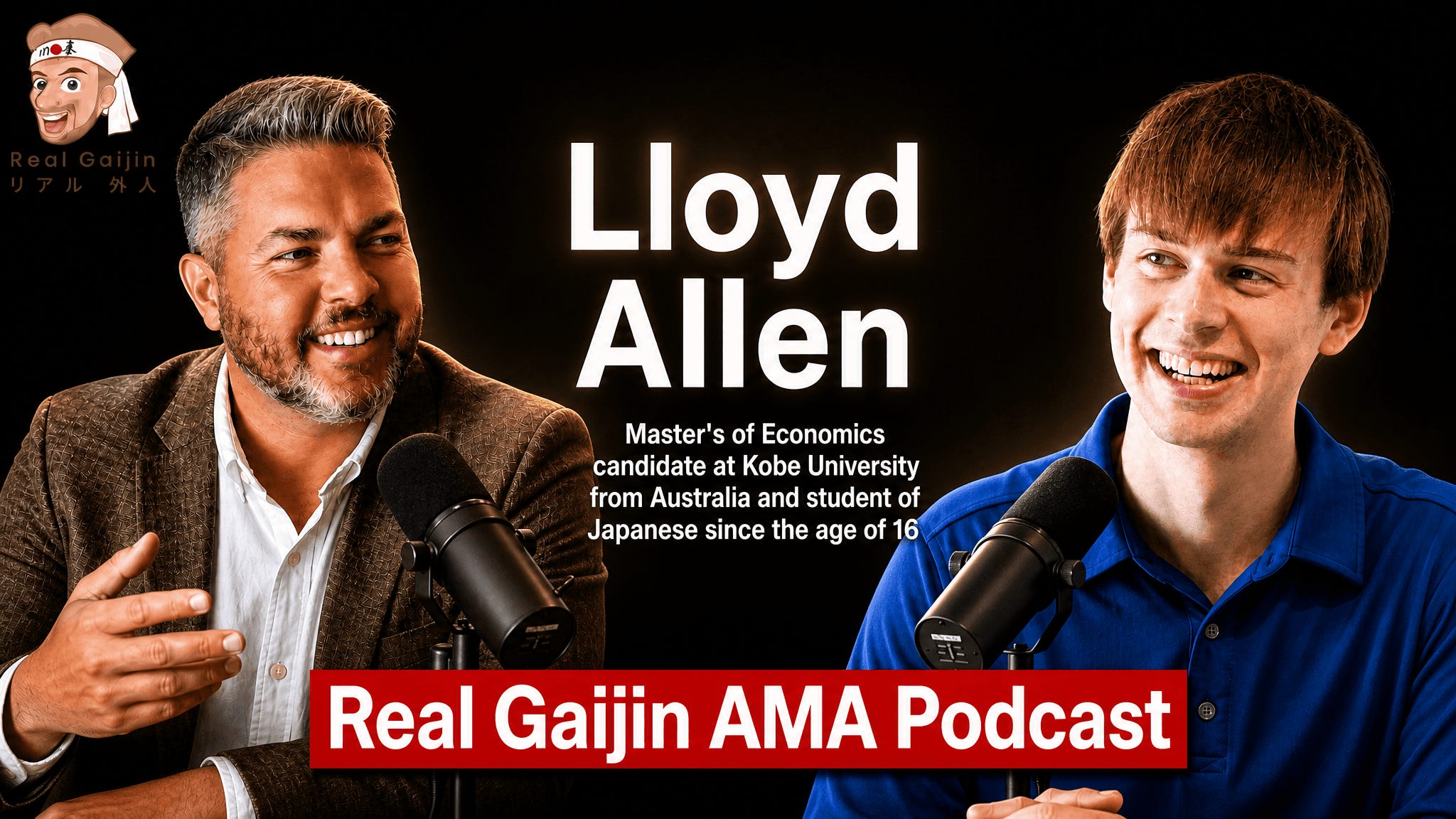 ▶︎ AMA Podcast (S-02, E-26) with Lloyd Allen, Master's of Economics candidate at Kobe University from Australia and student of Japanese since the age of 16 26.09.2026 1h 4minSo, what does it actually take to become proficient in Japanese—not just conversationally competent, but proficient enough to study economics at a Japanese university, conduct academic research, explore the history of kanji, and consider taking the Kanji Kentei (日本漢字能力検定) Level 1 exam?Real Gaijin recently interviewed the perfect guest—particularly for the Gen Z audience. He is destined to have an important career connecting Japan with the rest of the world.Who is he?Lloyd Allen been studying Japanese since his teenage years, and his experience provides a valuable perspective on the ongoing debate about shortcuts, apps, immersion techniques, and “fluency.”Lloyd first came to Japan as a 16-year-old high school exchange student and has been moving between Australia and Japan ever since. He studied economics and Japanese as an undergraduate and spent time at Aoyama Gakuin University and Kobe University. He is now back at Kobe University as a full-time master’s student in economics. Japanese has been a constant thread throughout his journey. Today, Lloyd’s interest extends well beyond communicating. He writes about the Japanese language, society, and history on Substack and has delved into subjects such as the historical evolution of kanji readings. He is preparing to take the Kanji Kentei Level 2 exam, with the Level 1 exam potentially on the horizon.Check out “Roido Does Japan” on Substack:On the agendaThe intention of this conversation was to move beyond typical advice about learning Japanese. We discussed Lloyd’s learning approach, effective versus ineffective methods, the differences between formal study and immersion, and how living in Japan improved his Japanese.We also explored the role of “easy Japanese” (やさしい日本語)—what it is, who it’s intended for, and how it fits into communication and language learning.Then, we took a deep dive into kanji: why Lloyd finds them fascinating, how he studies them, what the Kanji Kentei demands, and whether pursuing extremely advanced literacy has practical value.Finally, we considered the bigger question: What does serious Japanese proficiency allow you to understand about Japan that remains largely inaccessible in English?Key takeaways* Make Japanese part of your life, not just a subject you study: Lloyd’s central advice is immersion. Find something about Japan or the Japanese language that you genuinely enjoy. Then, incorporate as much Japanese into your everyday life as possible: books, news, YouTube, podcasts, television, friendships, and classes, if available. His own progression accelerated when Japanese stopped feeling like “study” and became the language through which he did things he already wanted to do.* Combine immersion with systematic repetition: Exposure alone is not enough. Lloyd maintains a vocabulary deck of roughly 15,000 flashcards and uses spaced repetition (SRS) to reinforce words before they disappear from memory. His approach is twofold: first, encounter vocabulary naturally through reading and listening; then, deliberately reinforce it through flashcards. Neither approach works nearly as well by itself.* Tests are milestones, not the definition of proficiency: The Japanese Language Proficiency Test (JLPT・日本語能力試験) provides useful structure, motivation, and credentials, but Lloyd stresses its limitations—most notably, it does not test speaking or writing. Passing N1 does not mean that someone has “finished” learning Japanese. Learners who want to advance further face challenges such as the Kanji Kentei (日本漢字能力検定), which opens an entirely different level of mastery involving readings, writing, synonyms, antonyms, four-character compounds, and thousands of kanji.* At advanced levels, progress inevitably slows, so consistency matters more than dramatic gains: Beginners can see rapid improvement because almost everything they learn is new. Advanced learners encounter diminishing returns and periods when progress feels almost invisible. Lloyd’s useful rule is that “one is greater than zero”: reading one page, learning one word, or doing a small amount of Japanese is infinitely more productive than doing nothing. The objective is to maintain exposure rather than waiting for the motivation to undertake a major study session.* The real payoff from learning Japanese is access to people, relationships, and experiences that would otherwise be unavailable: Lloyd ultimately describes language as a tool rather than an academic achievement. When motivation wanes, he reconnects with the conversations and friendships that would not exist without Japanese. Greater proficiency progressively “unlocks” people, ideas, culture, history, and experiences that remain partly inaccessible through English alone. For Lloyd, this provides a more enduring reason to continue studying Japanese than passing another exam.TimelineSubstack does not yet have the functionality to allow you to use a link to jump to a specific section like YouTube’s “chapters.” Please refer to the times listed below to navigate through our hour-long conversation. Thank you for your understanding.Links* Substack:* LinkedIn: https://www.linkedin.com/in/lloyd-d-allen/* Kobe University Interdisciplinary Master Program (KIMAP): https://www.group.kobe-u.ac.jp/kimap/* AJATT | All Japanese All The Time: https://alljapanesealltheti.me/blog/index.html* Spaced Repetition System: https://www.bcu.ac.uk/exams-and-revision/best-ways-to-revise/spaced-repetition* Japanese.io (more about Spaced Repetition, etc.): https://www.japanese.io/* INPEX Scholarship Foundation Scholar: https://www.studyinjapan.go.jp/en/search-for-scholarships/detail.php?lang=en&mid=5-00034519* The New Colombo Plan (NCP) Scholarship Program: https://www.dfat.gov.au/people-to-people/new-colombo-plan/new-colombo-plan-scholarship-program* Background about the Kanji Kentei Exam (日本漢字能力検定):* Advice from Uskov Evgeny, a Russian native speaker who was able to pass the Kanji Kentei level 1: https://roshiajin.jp/* Nihongo Kentei (日本語検定): https://www.nihongokentei.jp/#LloydAllen #JapaneseLanguage #LanguageLearning #RealGaijin #リアル外人ICYMIPlease check this out! If you’ll be in Tokyo on Thursday evening, November 5, join Tim, Mark, and a small group of Japan-based Substack writers and readers for a meetup. Get your tickets before they sell out!If you found this post valuable, please click the ❤️ button and restack it. Restacking helps more than you’d think! Thanks!Thanks for reading Real Gaijin! This post is public so feel free to share it.Please note that you can subscribe to Real Gaijin for free. If you are so inclined, you can also purchase an annual subscription for a relatively small fee.However, I understand that even the lowest level of annual subscription allowed by Substack may seem too high for many. If you just want to buy a coffee for Real Gaijin (or maybe a green tea), you can also make a small donation here:https://buymeacoffee.com/realgaijinAll levels of support - including just liking a particular article and/or leaving a comment - are very welcome. Thanks again for reading.While Real Gaijin lives in Substack, you can also find Real Gaijin on a few other platforms (listed in alphabetical order).https://www.instagram.com/real_gaijin_on_substack/https://www.threads.net/@real_gaijin_on_substackhttps://www.tiktok.com/@real.gaijinhttps://x.com/Real_Gaijin_https://www.youtube.com/@RealGaijinhttps://www.linkedin.com/in/mark-wilt-kennedy/ Get full access to Real Gaijin at realgaijin.substack.com/subscribe
 -
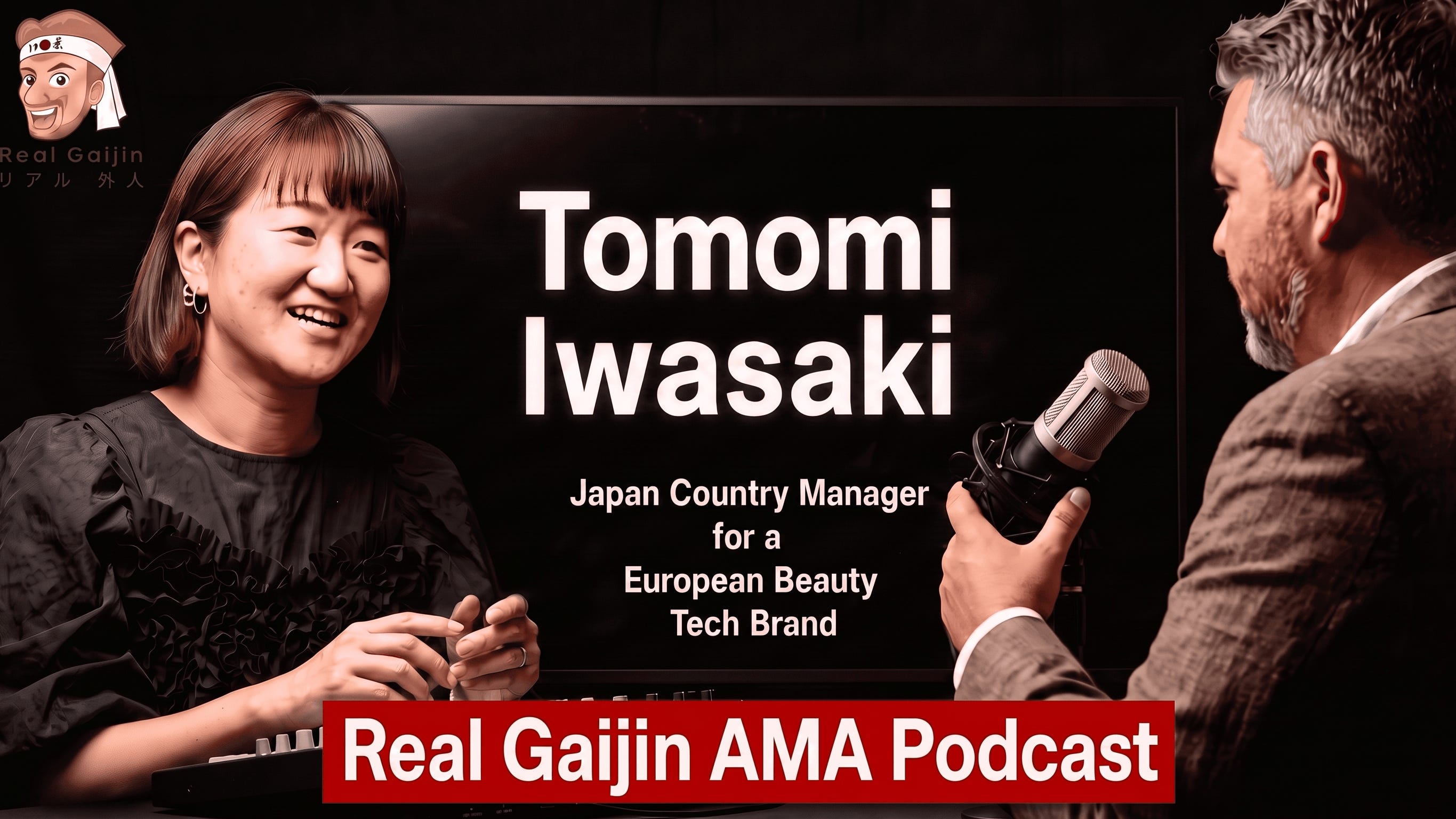 ▶︎ AMA Podcast (S-02, E-25) with Tomomi Iwasaki, Japan country manager for a European beauty tech brand 16.09.2026 1h 2minWhat does it take to build a foreign brand in Japan and serve as the liaison between global headquarters and the realities of the Japanese market?Real Gaijin typically showcases foreigners living and working in Japan, as well as individuals working closely with Japan from outside the country. Occasionally, however, we introduce Japanese nationals with an international background who have a proven track record of helping non-Japanese people interested in Japan.Today’s guest, Tomomi Iwasaki (岩崎ともみ), is just such a person. Plus, she brings a wealth of knowledge about building a foreign brand in Japan and being the hashi-watashi (橋渡し・bridge connector) between cultures.Who is she?Tomomi is a Japan-based business leader who has nearly two decades of experience in B2B sales, e-commerce, consumer products, retail, marketing, and country management.She offers a unique perspective on doing business in Japan. Tomomi started her career in B2B technology sales, collaborating with Japanese corporate clients on significant technology projects. She then transitioned to e-commerce consulting, advising hundreds of Japanese online merchants on sales and promotional strategies.Tomomi then made the move to the brand side, where she managed sales, marketing, e-commerce, and retail operations for an international consumer brand in Japan. She has also been responsible for digital marketing, logistics, customer support, membership programs, technology, and offline retail channels.As a senior country manager today, Tomomi operates at the intersection of global strategy and local execution. She serves as a bridge between an international headquarters and the realities of the Japanese market.Tomomi graduated from Waseda University’s School of International Liberal Studies and also studied at the University of Calgary in Canada. She is fluent in both Japanese and English.Her diverse professional experience in the Japanese market provides Tomomi with a valuable perspective: she has sold to Japanese corporations, advised Japanese e-commerce merchants, sold directly to Japanese consumers, and managed an international business in Japan.Tomomi generously shares her knowledge on the Japan Behind the Scenes Substack. Written in English, it is filled with practical tips on how to live and work effectively in Japan, from articles such as “The Secret Rules of Japanese Business Golf” to “Why LinkedIn Doesn’t Work in Japan.”On the agendaWe had an ambitious agenda, but the intention was to take full advantage of the opportunity to learn from Tomomi’s firsthand experience. We discussed practical ways for foreign companies to enter the Japanese market, ranging from selling on Amazon and Rakuten to establishing an omni-channel presence and navigating the risk-averse nature of the Japanese retail sector. Tomomi also explained why personal connections often matter more than cold outreach and how Japanese consumers differ in their expectations. She described what it is really like to serve as the local country manager, bridging the gap between a foreign headquarters and Japanese customers, retailers, distributors, and business culture.Key takeaways* Japan rewards patience, relationships, and a long-term approach: Tomomi’s overarching message is that foreign companies should not expect immediate results from the Japanese market. New retail channels often start with small orders and gradually expand as the product gains popularity and attracts the attention of other retailers. Once relationships are established, however, Tomomi describes Japan as capable of producing unusually steady business. Partners are invested in long-term relationships, and strong word-of-mouth helps successful companies grow.* Relationships matter more than cold outreach: One of the biggest challenges for outsiders is that the Western strategy of connecting with strangers on LinkedIn, for example, and reaching out to them directly does not translate well to Japan. Tomomi stresses the importance of networking and personal introductions, arguing that connections are fundamental to finding employees, distributors, customers, and other business partners. For an entrepreneur starting with no Japanese network, she recommends working inside a Japanese company to understand the culture and begin building relationships.* Localization goes far beyond translation: Tomomi divides localization into two layers. The first layer is technical and includes regulatory requirements, translation, barcodes, and other necessities of selling in Japan. The second, more difficult layer is cultural. It involves determining how the product should be positioned and explained to Japanese consumers while complying with global brand policies. As a country manager, she spends a lot of time negotiating between what the global headquarters wants and what she believes will work locally. This includes seemingly small decisions, such as product colors and positioning toward Japan’s male beauty market.* In Japan, physical retail matters, even when almost all sales are online: Tomomi’s current business generates roughly 99% of its sales online. Yet, she considers a retail presence to be strategically important because Japanese consumers value physical touchpoints, and retailers can lend credibility to unfamiliar brands. Retailers typically minimize their risk by starting with small orders and expanding only after products demonstrate demand. Physical stores therefore serve as places to build trust, learn directly from customers, gain visibility, and potentially generate wider exposure, not simply as sales channels.* Don’t try to understand Japan entirely from your desk: Tomomi repeatedly emphasizes the importance of direct, local learning. When she needed to understand an unfamiliar market, she hired an experienced professional for just two hours and “asked everything”—advice that she still follows because important information often cannot be found online. Likewise, working on the floor at Japanese retailers provides her with insights into customers that e-commerce analytics cannot offer. Her practical advice for newcomers is to first understand the structure of the market—who the customers, distributors, partners, and gatekeepers are—before trying to sell to it.TimelineSubstack does not yet have the functionality to allow you to use a link to jump to a specific section like YouTube’s “chapters.” Please refer to the times listed below to navigate through our hour-long conversation. Thank you for your understanding.Links* Japan Behind the Scenes Substack:* LinkedIn: https://www.linkedin.com/in/tomomi-iwasaki-519922160/* Eight (business card exchange application): https://8card.net/en/* Note (essentially, the Japanese version of Substack): https://note.com/* YouTrust: https://youtrust.jp/lpTechnical issueTomomi’s connection was fine, but for some reason, perhaps due to inclement weather, my video connection was compromised. The audio came through clearly. Sorry for this technical issue.#TomomiIwasaki #JapanBehindTheScenes #WorkingInJapan #RealGaijin #リアル外人ICYMIPlease check this out! If you’ll be in Tokyo on Thursday evening, November 5, join Tim, Mark, and a small group of Japan-based Substack writers and readers for a meetup. Get your tickets before they sell out!If you found this post valuable, please click the ❤️ button and restack it. Restacking helps more than you’d think! Thanks!Thanks for reading Real Gaijin! This post is public so feel free to share it.Please note that you can subscribe to Real Gaijin for free. If you are so inclined, you can also purchase an annual subscription for a relatively small fee.However, I understand that even the lowest level of annual subscription allowed by Substack may seem too high for many. If you just want to buy a coffee for Real Gaijin (or maybe a green tea), you can also make a small donation here:https://buymeacoffee.com/realgaijinAll levels of support - including just liking a particular article and/or leaving a comment - are very welcome. Thanks again for reading.While Real Gaijin lives in Substack, you can also find Real Gaijin on a few other platforms (listed in alphabetical order).https://www.instagram.com/real_gaijin_on_substack/https://www.threads.net/@real_gaijin_on_substackhttps://www.tiktok.com/@real.gaijinhttps://x.com/Real_Gaijin_https://www.youtube.com/@RealGaijinhttps://www.linkedin.com/in/mark-wilt-kennedy/ Get full access to Real Gaijin at realgaijin.substack.com/subscribe
 -
 ▶︎ AMA Podcast (S-02, E-24) with Tim Romero, a Tokyo-based innovator, author, entrepreneur, and host of the Disrupting Japan podcast 04.09.2026 1h 3minWhat happens when you come to Japan hoping to become a rock star, but end up becoming one of the most recognizable voices in Tokyo’s startup community?That’s the unlikely story of Tim Romero, who is, by the way, still very much of a “rock star” (intentional use of quotation marks).Who is he?Tim arrived in Japan in the late 1980s after being signed by a Japanese record company. His music career didn’t work out, but Japan did. Since then, he has founded and sold companies, invested in startups, worked inside major Japanese corporations, and become a leading chronicler of Japan’s entrepreneurial ecosystem.Tim is a Tokyo-based entrepreneur, investor, mentor, and the founder and host of Disrupting Japan, which explores Japan’s startup and innovation ecosystem.🎂 In fact, this week marks the 12th anniversary of the show, making it the longest-running podcast in English from Japan. Congratulations, Tim! Real Gaijin can learn a lot from him.Tim’s career includes founding and selling Vanguard, bringing Engine Yard to Japan, working on innovation at TEPCO, where he helped to establish their first corporate venture capital fund (CVC), leading Google for Startups Japan, and joining JERA Ventures as a partner.This gives Tim a unique perspective. He has watched Tokyo’s startup scene evolve from the dot-com era to the current government-backed initiative to establish Japan as a global startup hub.On the agendaDuring our wide-ranging discussion, we covered the following topics:* Tim’s unconventional journey to Japan and the successes and failures that shaped his entrepreneurial career;* Tim’s advice for aspiring founders;* Tokyo’s startup ecosystem; and* Tim’s prognosis about where he thinks Japan’s startup ecosystem is headed.Key takeaways* Japan’s startup ecosystem has matured significantly: Japan is now a much better place to start a business than it was when Tim entered the ecosystem in the late 1990s. Venture capital is more plentiful, and M&A and IPO exits are more viable. Perhaps most importantly, large Japanese corporations now actively seek relationships with startups. The old model, in which entrepreneurs trying to work with major corporations were pushed through layers of subcontractors, has largely given way to dedicated startup, innovation, and corporate venture capital (CVC) teams.* Foreign founders should understand Japan before trying to disrupt it: Tim strongly cautions foreigners against moving to Japan with an idea and immediately launching a company. The critical ingredient is proximity to—and understanding of—the customer. He recommends working inside a Japanese startup first to learn the market, build relationships, and identify the relatively small but consequential differences between Japan and other markets. Only then should they launch when a genuine opportunity emerges. Foreign founders must also demonstrate their ability to sell and operate in Japan. Having a capable Japanese co-founder can help solve this execution problem.* Japan’s next startup opportunity may come from commercializing its world-class science: Tim identifies physical AI, particularly the convergence of robotics and artificial intelligence, along with biotech and materials science, as especially promising areas. More consequentially, he expects significant innovation to emerge from Japanese universities over the next five to ten years. Japan has long had world-class academic research, but it has struggled to commercialize it. A shift toward pairing researchers with professional managers and venture investors could finally unlock the intellectual property that has historically remained within universities instead of becoming scalable companies.* Founders must protect their product—and their company—from powerful corporate partners: Working with Japan’s major corporations creates opportunities, but it also poses a significant risk: allowing one customer or investor to dictate the startup’s direction. Tim particularly warns against endless customer-specific customization because every special feature creates a permanent maintenance burden and can eventually cause founders to lose control of their product. His practical rule is revealing: If several customers request the same feature, pay attention. If one customer wants something inconsistent with the product vision, founders should be prepared to stand their ground.* Japan does not lack capable entrepreneurs; it lacks Silicon Valley’s sense of urgency: Tim rejects the stereotype that Japanese founders are less entrepreneurial or risk-tolerant than their Silicon Valley counterparts. He describes their knowledge, capabilities, and tolerance for risk as “world-class.” The biggest remaining difference is speed. In San Francisco, a good idea may trigger action that afternoon. In Tokyo, the same idea may produce a meeting the following week. Japan does not necessarily need Silicon Valley’s hype and exaggerated claims. However, Tim believes that adopting more of its “let’s get it done now” mentality could strengthen the ecosystem.* Japan’s tighter Business Manager visa rules may cause unintended economic damage: Tim argues that the tougher requirements for foreign entrepreneurs should not be interpreted as a message that Japan no longer wants foreign founders. Rather, he describes the policy environment as fragmented, with different ministries and agencies pursuing separate objectives without effective coordination. The result can be rules that appear rational in isolation but contradictory when combined. In the case of the Business Manager visa, this can mean excluding capable would-be entrepreneurs who cannot meet the higher capital threshold, even though they could build viable businesses and contribute to Japan’s economy.TimelineSubstack does not yet have the functionality to allow you to use a link to jump to a specific section like YouTube’s “chapters.” Please refer to the times listed below to navigate through our hour-long conversation. Thank you for your understanding.Links* Substack: * Website: https://www.disruptingjapan.com/* LinkedIn (Tim): https://www.linkedin.com/in/timromero/* LinkedIn (Disrupting Japan podcast): https://www.linkedin.com/company/disrupting-japan-podcast/* Shizen Capital (Matt Romaine and Mark Bivens, who were cited by Tim at around the 53-minute mark): https://shizen.vc/#/#TimRomero #DisruptingJapan #StartUp #RealGaijin #リアル外人ICYMIPlease check this out! If you’ll be in Tokyo on Thursday evening, November 5, join Tim, Mark, and a small group of Japan-based Substack writers and readers for a meetup. Get your tickets before they sell out!If you found this post valuable, please click the ❤️ button and restack it. Restacking helps more than you’d think! Thanks!Thanks for reading Real Gaijin! This post is public so feel free to share it.Please note that you can subscribe to Real Gaijin for free. If you are so inclined, you can also purchase an annual subscription for a relatively small fee.However, I understand that even the lowest level of annual subscription allowed by Substack may seem too high for many. If you just want to buy a coffee for Real Gaijin (or maybe a green tea), you can also make a small donation here:https://buymeacoffee.com/realgaijinAll levels of support - including just liking a particular article and/or leaving a comment - are very welcome. Thanks again for reading.While Real Gaijin lives in Substack, you can also find Real Gaijin on a few other platforms (listed in alphabetical order).https://www.instagram.com/real_gaijin_on_substack/https://www.threads.net/@real_gaijin_on_substackhttps://www.tiktok.com/@real.gaijinhttps://x.com/Real_Gaijin_https://www.youtube.com/@RealGaijinhttps://www.linkedin.com/in/mark-wilt-kennedy/ Get full access to Real Gaijin at realgaijin.substack.com/subscribe
 -
 🍻 Cheers to Everyone Who Joined the First-Ever “Beers with Real Gaijin”-- Let’s Talk Japan (S-01, E-01) 31.08.2026 1h 2min🍻 Thank you to everyone who joined the first-ever “Beers with Real Gaijin” live stream on Sunday evening! What started as an experiment—an informal conversation without an agenda about recent Real Gaijin articles, Japan-related news, and whatever else was on your mind—turned into the kind of lively exchange I had hoped for.Key TakeawaysWhile we enjoyed a wide-ranging discussion that included a review of several recently published Real Gaijin articles, the three main points to take away were probably the following:* Japan’s demographic crisis is no longer an abstract future problem; it is beginning to reshape the country now: The discussion repeatedly returns to the extraordinary contraction of Japan’s younger population and the implications of a shrinking domestic workforce. At the same time, the foreign-resident population is expected to comprise a substantially larger share of the country. The central point is that demographic change will affect virtually everything, including employment, regional economies, social services, immigration policy, and the everyday lives of Japanese nationals and foreign residents alike. Review this recent post for more background:* Japan’s labor shortage is forcing policymakers to make increasingly difficult trade-offs: Raising wages is necessary, but imposing a uniform national minimum wage could hurt rural small-to-medium-enterprises (SMEs) that are already struggling to find workers. The discussion instead argues for greater regional differentiation based on local wages and employers’ ability to pay. Meanwhile, the loosening of overtime guidelines illustrates the other side of the same problem. When Japan cannot find enough workers, existing employees may be asked to work more, increasing the risk of exploitation. This makes it particularly important for foreign workers to understand their employment rights and company work rules. Review these recent posts for more background.* Political and technological change may be coming from outside Japan’s traditional establishment: Team Mirai emerges as an example of a younger, more technocratic approach to Japanese politics. They advocate ideas such as electoral reform, AI-enabled “digital democracy,” and a more pragmatic approach to fiscal policy. While these proposals may have little immediate impact on foreign residents who cannot vote nationally, they are important indicators of whether Japan’s political system can modernize sufficiently to confront demographic decline, labor shortages, fiscal pressures, and other structural problems that affect everyone living in the country. Review this recent post for more background:🍺 I’m already looking forward to the next “Beers with Real Gaijin” in September! The invitation will be sent out soon…🎉 P.S. I look forward to meeting you in person at the upcoming “Japan Substackers IRL Meetup in Tokyo” on November 5, 2026, if you’re able to make it. For more information about this event, check out this post:#BeersWithRealGaijin #リアル外人と飲む #ResidentForeigners #RealGaijin #リアル外人If you found this post valuable, please click the ❤️ button and restack it. Restacking helps more than you’d think! Thanks!Thanks for reading Real Gaijin! This post is public so feel free to share it.Please note that you can subscribe to Real Gaijin for free. If you are so inclined, you can also purchase an annual subscription for a relatively small fee.However, I understand that even the lowest level of annual subscription allowed by Substack may seem too high for many. If you just want to buy a coffee for Real Gaijin (or maybe a green tea), you can also make a small donation here:https://buymeacoffee.com/realgaijinAll levels of support - including just liking a particular article and/or leaving a comment - are very welcome. Thanks again for reading.While Real Gaijin lives in Substack, you can also find Real Gaijin on a few other platforms (listed in alphabetical order).https://www.instagram.com/real_gaijin_on_substack/https://www.threads.net/@real_gaijin_on_substackhttps://www.tiktok.com/@real.gaijinhttps://x.com/Real_Gaijin_https://www.youtube.com/@RealGaijinhttps://www.linkedin.com/in/mark-wilt-kennedy/ Get full access to Real Gaijin at realgaijin.substack.com/subscribe
 -
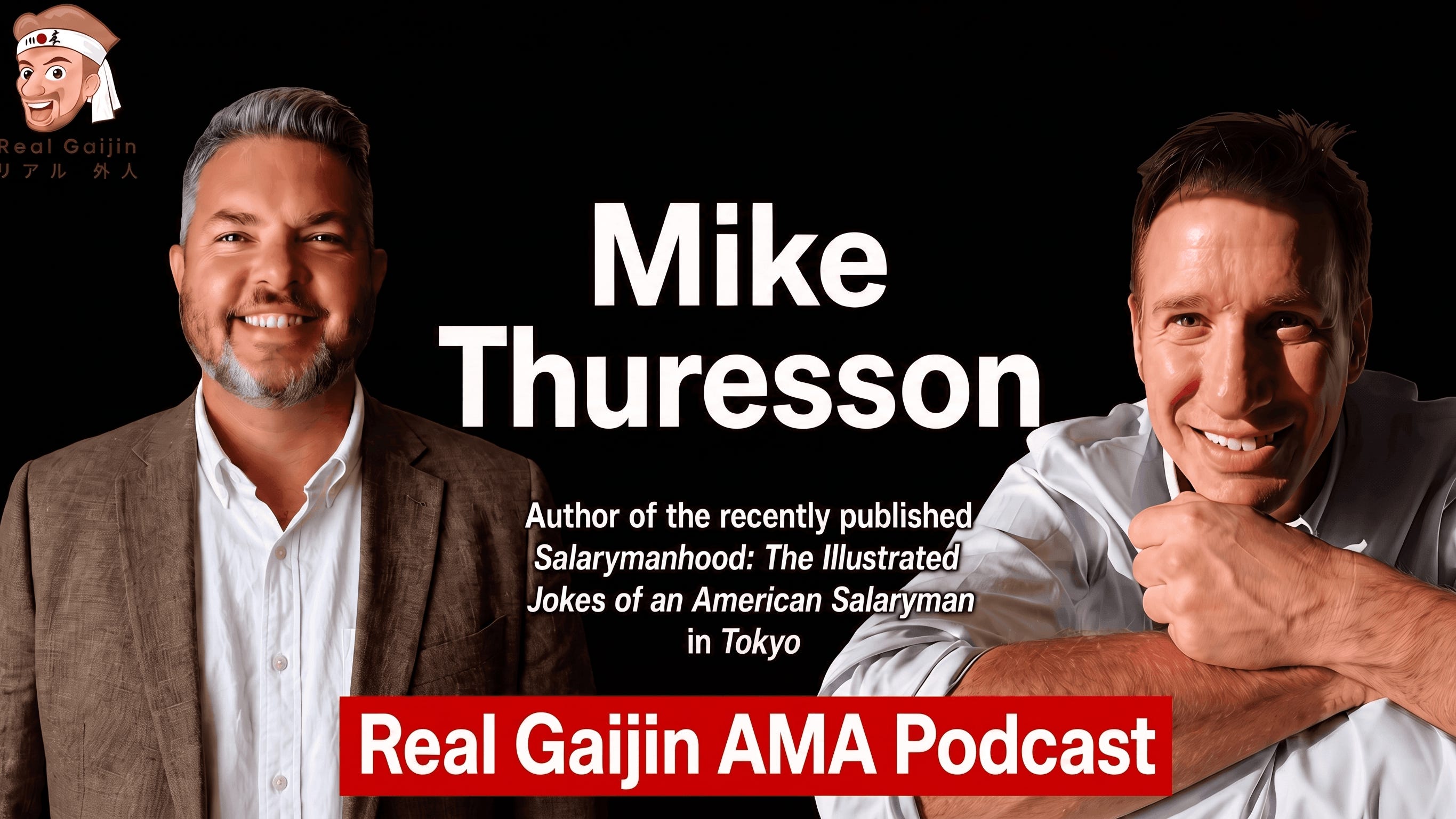 ▶︎ AMA Podcast (S-02, E-23) with Michael (“Mike”) Thuresson, author of the recently published Salarymanhood: The Illustrated Jokes of an American Salaryman in Tokyo 19.08.2026 54minIf you have ever had the opportunity to live and work in Japan, Salarymanhood: The Illustrated Jokes of an American Salaryman in Tokyo will resonate with you. From office customs like VPs falling asleep during discussions they started to everyday life like accidentally buying funeral flowers on Valentine’s Day and dodging road-raged moms on e-bikes, it will all feel familiar.Building upon his past success with the Salaryman series, this week’s guest on the Real Gaijin AMA podcast, Michael (“Mike”) Thuresson, collaborated with Japanese manga artist Kazuhiro Yoshida (吉田一裕) who also goes by the pen name Kotobuki Maeno (前野コトブキ) to create illustrations from his sketches. Japanese stand-up comedian Meshida, famous for the WTF Japan!? The Japan Show, translated Mike’s stories into Japanese. The project evolved into an experiment in cross-cultural collaboration on multiple levels.The book is written in English senryū (川柳), a traditional Japanese form of short poetry consisting of just three lines and 17 syllables. It uses the same basic syllabic—or, more precisely, moraic—pattern as haiku (俳句): 5-7-5. While haiku poetry tends to reference nature, the seasons, and fleeting observations, senryū poetry focus on human nature, everyday life, social behavior, irony, and humor. Senryū poems often make wry observations about people’s habits or contradictions, making them the perfect genre for poking fun at Japan’s salaryman life.Who is he?Before moving to Tokyo and becoming a salaryman in 2008, Mike was a businessman in Los Angeles. His first book, The Salaryman: An American Dude Becomes a Tokyo White-Collar Warrior, A Memoir, was published in 2019 and called “thoroughly entertaining” by The Japan Times. His new book, Salarymanhood: The Illustrated Jokes of an American Salaryman in Tokyo, offers a distinctly Western perspective on Japan’s centuries-old senryū tradition, transforming the rituals, frustrations, and absurdities of Japanese working life into comic verse.On the agendaIn addition to covering Mike’s initial path to Japan, we discussed the following as part of a rolling conversation:* The inspiration behind his books;* The ins and outs of self-publishing in Japan, from writing and illustration to production, distribution, and marketing; and* What’s next for the Salaryman universe, including new books, collaborations, and Mike’s plans for the future of the series.Key takeaways* An accidental journey into Japan became an 18-Year salaryman story: Mike did not arrive in Japan with a lifelong ambition to immerse himself in Japanese culture. It was a friendship with a Japanese college rugby teammate that led to his first visit around 2000, followed by work as a journalist and a business English teacher. After returning to the U.S., he moved back to Japan in 2008 and entered the traditional corporate world, going directly from the casual culture of a Los Angeles software startup to an old-line Japanese manufacturer, where he was the only foreigner in the office. This culture shock ultimately provided the material for his first book, The Salaryman: An American Dude Becomes a Tokyo White-Collar Warrior: A Memoir.* “Salarymanhood” finds humor in the culture gap rather than mocking Japan: The central idea behind Mike’s new book, Salarymanhood: The Illustrated Jokes of an American Salaryman in Tokyo, is that everyday Japanese corporate life can look radically different depending on your cultural perspective. His humor is deliberately self-deprecating rather than an attack on Japanese culture; the comedy stems from the often “unsolvable” gap between how a foreign employee interprets a situation and how Japanese colleagues interpret it. For example, he believed a customer meeting had been a disaster because a Japanese executive fell asleep. However, his colleagues told him that this indicated the customer was comfortable. This example perfectly encapsulates the premise.* Japanese senryū poetry provides the perfect vehicle for salaryman humor: Salarymanhood: The Illustrated Jokes of an American Salaryman in Tokyo grew out of Mike’s fascination with senryū, the traditional three-line poetic form that has long been used in Japan to capture the frustrations and absurdities of everyday life. Inspired by the long-running, annual Salaryman Senryū competition sponsored by the Dai-ichi Life Insurance firm in particular, Mike adapted the concept from a foreign salaryman’s perspective. The new book contains 50 bilingual jokes, each accompanied by manga artwork. This effectively combines a deeply Japanese form of expression with a Western perspective on Japanese working life.* Self-publishing has made professional book publishing accessible, but the author becomes the publisher: Drawing on his experience as an author and a former product manager for Amazon Kindle Direct Publishing, Mike maintains that writers can now perform most of the functions of a traditional publishing house themselves. Freelance marketplaces provide editing, cover design, interior design, and other specialized services. Print-on-demand eliminates the need to finance and warehouse inventory. The trade-off is that the independent author must assemble the production team and, most importantly, market and sell the finished book. By the way, it can be easier said than done to manage all the resources needed to turn your idea into a professional-looking book. Fortunately, Mike runs a side business that can manage the process for you. Visit his Memoir & Life Story Services website for more information.* AI can assist the creative process without replacing the creator: Mike draws a sharp distinction between using AI to create writing and using it as a production tool. He says he did not use AI to write Salarymanhood: The Illustrated Jokes of an American Salaryman in Tokyo, describing the actual writing as “sacred,” but he did use AI extensively to solve difficult design and layout problems for a highly visual, bilingual book. Otherwise, this work might have required an expensive professional designer. His approach offers a broader model for independent creators: preserve human authorship while using AI to reduce the cost and complexity of production, workflow, and other noneditorial tasks.TimelineSubstack does not yet have the functionality to allow you to use a link to jump to a specific section like YouTube’s “chapters.” Please refer to the times listed below to navigate through our hour-long conversation. Thank you for your understanding.Links* Personal Website (includes links to his books): https://www.michaelthuresson.com/* LinkedIn: https://www.linkedin.com/in/michael-thuresson-a39735/ Not our first rodeoMike and I, both sons of Chicago, have collaborated in the past. Back when he was still using his pen name, Michael Howard, I had the pleasure of reviewing his first book, The Salaryman: An American Dude Becomes a Tokyo White-Collar Warrior: A Memoir. The book is still very much relevant.From the archives…https://japaninsider.com/american-dude-becomes-salaryman/#MichaelThuresson #Salarymanhood #JapanBusiness #RealGaijin #リアル外人If you enjoyed this, click the ❤️ button and restack.Thanks for reading Real Gaijin! This post is public so feel free to share it.Please note that you can subscribe to Real Gaijin for free. If you are so inclined, you can also purchase an annual subscription for a relatively small fee.However, I understand that even the lowest level of annual subscription allowed by Substack may seem too high for many. If you just want to buy a coffee for Real Gaijin (or maybe a green tea), you can also make a small donation here:https://buymeacoffee.com/realgaijinAll levels of support - including just liking a particular article and/or leaving a comment - are very welcome. Thanks again for reading.While Real Gaijin lives in Substack, you can also find Real Gaijin on a few other platforms (listed in alphabetical order).https://www.instagram.com/real_gaijin_on_substack/https://www.threads.net/@real_gaijin_on_substackhttps://www.tiktok.com/@real.gaijinhttps://x.com/Real_Gaijin_https://www.youtube.com/@RealGaijinhttps://www.linkedin.com/in/mark-wilt-kennedy/ Get full access to Real Gaijin at realgaijin.substack.com/subscribe
 -
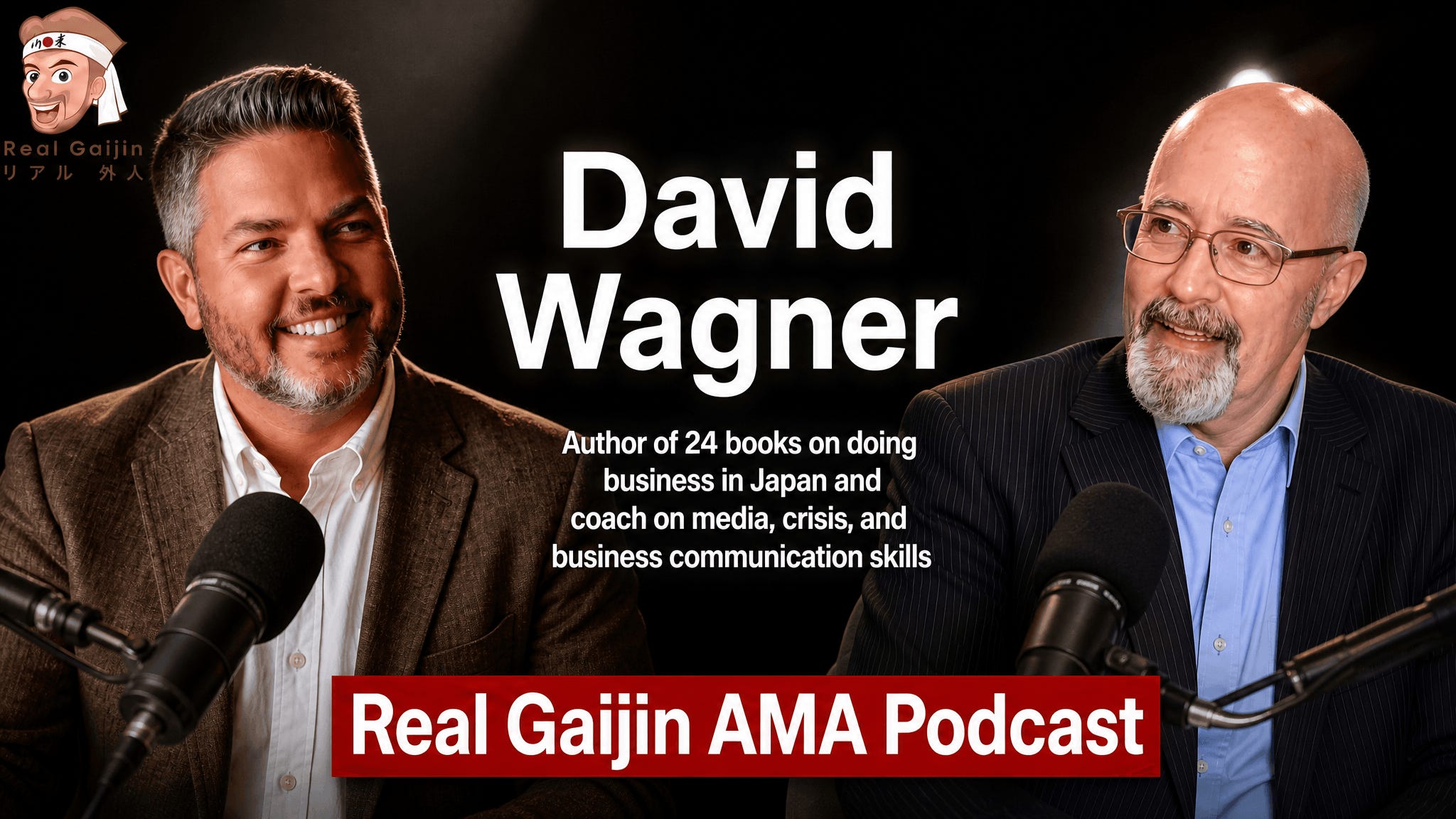 ▶︎ AMA Podcast (S-02, E-22) with David Wagner, author of 24 books on doing business in Japan and coach to more than 30,000 leaders on media, crisis, and business communications skills 14.08.2026 1hHave you ever wondered what it takes to command a room full of top-tier CEOs, advise government officials, and navigate Japan’s media landscape? Today, Real Gaijin was thrilled to welcome David Wagner, a veteran communications expert, media coach, and author who is a well-established fixture in Japan’s international business community. David has trained over 30,000 leaders, written multiple books on business communication, and hosted national television programs. He offers a masterclass in navigating, decoding, and succeeding at the highest levels of media communication.Who is he?Recognized as one of Asia’s premier authorities on media, crisis, and business communications, during his 30+ year career, David has coached over 30,000 trainees, including CEOs, presidents, ambassadors, and government officials, across the Asia-Pacific, Middle East, and North America.David has conducted over 4,000 workshops for over 550 global organizations, including Goldman Sachs, Oracle, Johnson & Johnson, Singapore Airlines, and Walmart. He has also lectured on business communications at institutions including Tokyo’s Waseda University.He is a former reporter for The Denver Post and a columnist for the Mainichi Daily News and The Daily Yomiuri. David was also the creator and host of two nationally televised three-month series on NHK focusing on international business skills. He is also the author of numerous books on Japan regarding business communications and cultural navigation, including Forever Foreign.On the agendaIn addition to covering David’s initial path to Japan, we discussed the following as part of a rolling conversation:* The “Gaijin” Evolution: How foreign leadership and corporate integration in Japan have shifted over three decades.* Managing the Media & Crisis PR: Mastering Japanese media dynamics, executive presence, and high-stakes public messaging.* Cross-Cultural Communication: Bridging behavioral gaps to lead teams and persuade effectively in Japanese corporate environments.* Insights from the Top: Key lessons from coaching 30,000+ executives and interviewing successful foreign business leaders.Key takeaways* Cross-cultural success requires “style shifting” in both directions: David’s concept of “style shifting” applies to Japanese professionals working overseas and non-Japanese people working in Japan. Japanese mmanagers operating internationally may need to become more direct and explicit, as well as more individually oriented. Meanwhile, foreigners in Japan may need to adjust in the opposite direction, learning to work with indirect communication, hierarchy, consensus-building, silence, and other Japanese cultural norms. The point is not to abandon your personality or decide that one culture is “right.” Rather, it is to understand the environment well enough to modify your communication style deliberately so that you can operate effectively within it.* Respecting Japanese norms sometimes means knowing which battles not to fight: David illustrates this with a painful episode from his early career at Fuji Xerox. When company president Yotaro Kobayashi (小林陽太郎), a well-known business mogul, visited his department, the Japanese employees were invited to hear him speak. However, the foreign employees, who were hired to teach cross-cultural communication, were excluded. Furious, a young David wrote directly to the president’s office. The resulting investigation, he says, was a “witch hunt.” He was ostracized and ultimately felt compelled to resign. Decades later, David says he would handle the situation differently. Instead of trying to change the company, he would recognize that the environment was not right for him and leave. This experience taught him that succeeding in Japan requires understanding its cultural and organizational norms, as well as recognizing when confrontation is unlikely to produce the desired change.* In Japan, knowing what happens before the meeting can be more important than the meeting itself: David highlights nemawashi (根回し), or building consensus before a formal meeting, as a particularly important feature of Japanese business culture. This contrasts sharply with cultures in which participants expect debate and decision-making to occur during the meeting itself. He also mentions hierarchy, indirect communication, silence, and nonverbal cues as elements that foreigners must learn to interpret rather than simply applying their home country’s business norms.* Effective media communication is about controlling the message, not saying more: David’s decades of media and crisis training have led him to a deceptively simple principle: executives generally talk too much. Effective communicators identify a few key messages, repeat them consistently, and avoid allowing an interview or press conference to derail them. Delivery matters too—pace, body language, visual presentation, and cultural appropriateness can determine whether the intended message actually reaches its audience.* In a crisis, speed, honesty, and transparency matter more than ritualized contrition: David is skeptical of what he calls the “empty bow”—the highly visible corporate apology that appears disconnected from genuine accountability. He argues that Japan’s consensus-driven decision-making process can become a liability during a crisis because organizations may take too long to formulate a response. Crisis management requires taking control quickly, communicating transparently, and acknowledging mistakes instead of allowing internal deliberation to create a communications vacuum.TimelineSubstack does not yet have the functionality to allow you to use a link to jump to a specific section like YouTube’s “chapters.” Please refer to the times listed below to navigate through our hour-long conversation. Thank you for your understanding.Links* Personal Website (includes a list of his books): https://www.smashwords.com/profile/view/davidwagner* LinkedIn: https://www.linkedin.com/in/david-wagner-a9900317/* Information about Igor Prusa, author of Scandal in Japan: Transgression, Performance and Ritual#DavidWagner #BusinessCommunicationsJapan #CrossCulturalCommunication #RealGaijin #リアル外人If you enjoyed this, click the ❤️ button and restack.Thanks for reading Real Gaijin! This post is public so feel free to share it.Please note that you can subscribe to Real Gaijin for free. If you are so inclined, you can also purchase an annual subscription for a relatively small fee.However, I understand that even the lowest level of annual subscription allowed by Substack may seem too high for many. If you just want to buy a coffee for Real Gaijin (or maybe a green tea), you can also make a small donation here:https://buymeacoffee.com/realgaijinAll levels of support - including just liking a particular article and/or leaving a comment - are very welcome. Thanks again for reading.While Real Gaijin lives in Substack, you can also find Real Gaijin on a few other platforms (listed in alphabetical order).https://www.instagram.com/real_gaijin_on_substack/https://www.threads.net/@real_gaijin_on_substackhttps://www.tiktok.com/@real.gaijinhttps://x.com/Real_Gaijin_https://www.youtube.com/@RealGaijinhttps://www.linkedin.com/in/mark-wilt-kennedy/ Get full access to Real Gaijin at realgaijin.substack.com/subscribe
 -
 ▶︎ AMA Podcast (S-02, E-21) with Arie Meir, PhD, x-Google product leader and computer scientist on leaving the corporate world and career reinvention 08.08.2026 1hWhat happens when someone leaves a successful career at one of the world’s most acclaimed tech companies to trade a major, global city for a quieter life in the countryside, leveraging their experience to develop the next stage of their career? In an era of aging populations, labor shortages, and rural decline reshaping Japan, these personal choices provide a unique perspective on some of the most pressing issues of our time. Today, the Real Gaijin AMA podcast welcomes the perfect guest to discuss reinventing your life across careers, communities, and countries.Who is he?Meet Arie Meir, a computer scientist and a UC Berkeley-trained biophysicist with a Ph.D. He is one of the few AI leaders whose career spans both Silicon Valley and the healthcare industry. Prior to spending over a decade developing AI products at Google, Arie held engineering leadership positions at GE Healthcare, where he worked on advanced medical technologies, and at Qualcomm, where he developed large-scale software platforms.Currently, Arie advises healthcare organizations, startups, and executive teams on integrating artificial intelligence into clinical and business operations—all from a new base in the mountains to the north of Tokyo.On the agendaIn addition to covering Arie’s initial path to Japan (which is quite a story on its own), we discussed his bold decision to leave the corporate world and the “mothership” of Google, deciding to relocate from central Tokyo to the Japanese countryside, and the ins and outs of navigating between multiple cultures and countries.Key takeaways* Treat major life changes as experiments, not leaps of faith: Arie’s philosophy is to test before committing. Before leaving Google, he took mini-sabbaticals to see if greater independence would make him happier and more productive. Arie applied essentially the same method to leaving Tokyo: rent a house, experience ordinary life, talk with locals, document what works and what doesn’t (+ search for hidden patterns with AI tools), and only then make a larger commitment. His broader lesson is that seemingly radical change can be approached systematically by turning uncertainty into a series of manageable experiments.* Leaving a successful career means giving up an identity, not just a paycheck: After 11 years at Google, Arie discovered that leaving the “mothership” entailed a profound psychological transition. Being a “Googler” had become part of his identity, social network, and sense of belonging. This led to the unsettling question:“If I’m not a Googler, who am I now?”Arie’s experience suggests that anyone contemplating a major career transition should prepare not only for the financial consequences but also for the loss of structure, status, community, and professional identity that may accompany it.* Technology matters when it solves a real human or business problem: Although Arie describes himself as an “AI nerd” (notice his shirt), his career philosophy is problem-first rather than technology-first. His early experience at GE Healthcare showed him that engineering and software could directly improve people’s lives. This eventually led him to Google Cloud Healthcare, where he became the first product manager on the healthcare team. Today, Arie’s consulting work focuses on translating business problems into appropriate technological solutions rather than adopting AI simply because it is fashionable.* Japan’s demographic problems create an important laboratory for technology: Arie finds the intersection of healthcare, AI, and Japan particularly compelling. An aging population, a declining birthrate, and a shortage of healthcare providers increase the need for technological solutions. Meanwhile, aspects of Japanese society may make certain technologies easier to deploy. His example of robotic servers (as in replacements for human waiters and waitresses) in “family restaurants” in Japan illustrates a larger point: demographic necessity combined with social acceptance could make Japan an important proving ground for automation and other technologies designed to compensate for labor shortages.* Rural Japan can offer an alternative to big-city life, but integration matters: Arie’s move away from Tokyo was not simply a search for cheaper housing or prettier scenery. He emphasizes that rural communities can differ dramatically even at the neighborhood (shūraku・集落) level and that newcomers need to integrate rather than merely relocate. His preference for Nasushiobara, one of the summer retreats of the Japanese Imperial Family, emerged through repeated visits and experimentation rather than a checklist alone—an instructive example of how remote work can expand lifestyle choices while still requiring careful attention to family needs, infrastructure, community, and everyday quality of life.TimelineSubstack does not yet have the functionality to allow you to use a link to jump to a specific section like YouTube’s “chapters.” Please refer to the times listed below to navigate through our hour-long conversation. Thank you for your understanding.Links* Personal Website: https://ariemeir.com/* LinkedIn: https://www.linkedin.com/in/ariemeir/#ArieMeir #CareerReinvention #キャリアの再構築 #RealGaijin #リアル外人If you enjoyed this, click the ❤️ button and restack.Thanks for reading Real Gaijin! This post is public so feel free to share it.Please note that you can subscribe to Real Gaijin for free. If you are so inclined, you can also purchase an annual subscription for a relatively small fee.However, I understand that even the lowest level of annual subscription allowed by Substack may seem too high for many. If you just want to buy a coffee for Real Gaijin (or maybe a green tea), you can also make a small donation here:https://buymeacoffee.com/realgaijinAll levels of support - including just liking a particular article and/or leaving a comment - are very welcome. Thanks again for reading.While Real Gaijin lives in Substack, you can also find Real Gaijin on a few other platforms (listed in alphabetical order).https://www.instagram.com/real_gaijin_on_substack/https://www.threads.net/@real_gaijin_on_substackhttps://www.tiktok.com/@real.gaijinhttps://x.com/Real_Gaijin_https://www.youtube.com/@RealGaijinhttps://www.linkedin.com/in/mark-wilt-kennedy/ Get full access to Real Gaijin at realgaijin.substack.com/subscribe
 -
 ▶︎ AMA Podcast (S-02, E-20) with Terrie Lloyd, Founder, CEO at Akiya 2.0 Inc, J@pan Inc Holdings KK, MetroWorks KK, Japan Travel KK, and Toursoft Pte Ltd 29.07.2026 1h 3minHave you ever wondered what it takes to build, scale, and successfully exit multiple businesses in one of the world’s most unique and tightly knit corporate landscapes? In this special interactive episode, Real Gaijin was joined by a legend of the Tokyo startup scene to discuss strategy, cultural adaptation, and the realities of doing business in Japan.Who is he?Terrie Lloyd is a powerhouse serial entrepreneur and dual national of Australia and New Zealand. A fixture of the Japanese business ecosystem, he has lived and worked in the country for over four decades. Terrie arrived in Japan on a working holiday visa in March 1983 at the age of 24—without a university degree. He started his first translation and computer-related venture out of an apartment and evolved into a self-made success. Throughout his remarkable career, Terrie has founded or co-founded 18 companies spanning technology, publishing, recruitment, IT services, and inbound tourism. These include pioneering ventures such as Japan’s first mid-career online job site, Daijob.com, and the crowdsourced travel network Japan Travel KK. He also manages Akiya 2.0 Inc, J@pan Inc Holdings KK, MetroWorks KK, and Toursoft Pte Ltd. Widely known for his successful corporate exits (he boasts eight major earn-outs for investors) and his long-running, insightful business newsletter, Terrie’s Take, Terrie is the ultimate authority on navigating Japanese bureaucracy, securing local funding, and turning a foreign perspective into a distinct business advantage.On the agendaIn addition to discussing how Terrie first ended up in Japan on a working holiday, we talked about entrepreneurship, business strategy, and his life in Japan over the last 44 years. We explored Terrie’s accidental beginnings in Japan, his early ventures in technology and importing, and his significant business exits. Terry also shared practical insights on generating and testing business ideas through iterative feedback, executing successful company exits by managing buyer greed and fear, building a targeted professional network as an expert, and his recent ventures into inbound tourism and traditional Japanese housing renovation (Akiya 2.0).Key takeaways* Leverage Your Unique Background as a Foreign Entrepreneur: Foreign entrepreneurs should use their differences to their advantage rather than trying to compete on the same terms as locals.“The foreign face opens the doors, and the Japanese face keeps the doors open.” - Time-tested adage about doing business in JapanBeing a foreigner in Japan can open initial doors and unlock unique opportunities, such as access to distinct ideas, networks, or technologies before others do. This allows founders to embrace their individuality and take calculated risks instead of blending into a crowded market.* Focus on Creating Real Social Change Over Money: The most successful and fulfilling businesses often stem from driving meaningful social change rather than just chasing profit. Terrie’s best companies addressed significant societal needs, such as pioneering mid-career job switching with Daijob or focusing on inbound tourism and traditional housing. This proves that building a business around solving real problems naturally attracts customers and creates lasting value.* Test and Refine Ideas Through Iterative Feedback: Raw business ideas should be rigorously shaped by talking directly to knowledgeable industry peers rather than relying solely on personal intuition. By pitching concepts via presentations and actively seeking critical feedback from sector experts, entrepreneurs can modify their approach after each conversation and fine-tune their offering to be ready for the market.* Understand the Core Dynamics of Exiting a Business: A successful company exit depends on building genuine value for a buyer and managing greed and fear carefully. Founders must understand what a strategic buyer truly wants, whether it’s forward-booked revenue, customer demographics, or skilled employees, while alleviating due diligence concerns. They must also ensure the business is fully mature and profitable before selling.* Cultivate a Targeted Community as an Expert: Building a strong professional network relies on establishing recognized expertise within a specific niche rather than chasing mass appeal. Rather than trying to target thousands of casual readers, newcomers should position themselves as authorities on a specialized topic. This will help them secure a dedicated group of hundreds of people who genuinely care about the subject. In doing so, they will build a far more powerful community.TimelineSubstack does not yet have the functionality to allow you to use a link to jump to a specific section like YouTube’s “chapters.” Please refer to the times listed below to navigate through our hour-long conversation. Thank you for your understanding.Links* Personal Website: https://www.terrielloyd.com/* LinkedIn: https://www.linkedin.com/in/terrielloyd/* Current Companies* Akiya 2.0 Inc: www.akiya2.com* J@pan Inc Holdings KK: www.japaninc.com* MetroWorks KK: www.metroworks.co.jp* Japan Travel KK: www.japantravel.com* Toursoft Pte Ltd: www.toursoft.systems* Volunteer Activity* EO Tokyo Metropolitan (EOTM): https://www.eotokyometropolitan.org/* Singapore Chamber of Commerce in Japan: https://www.singchamjapan.org/* Tokyo Chapter of The IndUS Entrepreneurs (TiE): https://japan.tie.org/#TerrieLloyd #StartupsJapan #Entrepreneurship #RealGaijin #リアル外人If you enjoyed this, click the ❤️ button and restack.Thanks for reading Real Gaijin! This post is public so feel free to share it.Please note that you can subscribe to Real Gaijin for free. If you are so inclined, you can also purchase an annual subscription for a relatively small fee.However, I understand that even the lowest level of annual subscription allowed by Substack may seem too high for many. If you just want to buy a coffee for Real Gaijin (or maybe a green tea), you can also make a small donation here:https://buymeacoffee.com/realgaijinAll levels of support - including just liking a particular article and/or leaving a comment - are very welcome. Thanks again for reading.While Real Gaijin lives in Substack, you can also find Real Gaijin on a few other platforms (listed in alphabetical order).https://www.instagram.com/real_gaijin_on_substack/https://www.threads.net/@real_gaijin_on_substackhttps://www.tiktok.com/@real.gaijinhttps://x.com/Real_Gaijin_https://www.youtube.com/@RealGaijinhttps://www.linkedin.com/in/mark-wilt-kennedy/ Get full access to Real Gaijin at realgaijin.substack.com/subscribe
 -
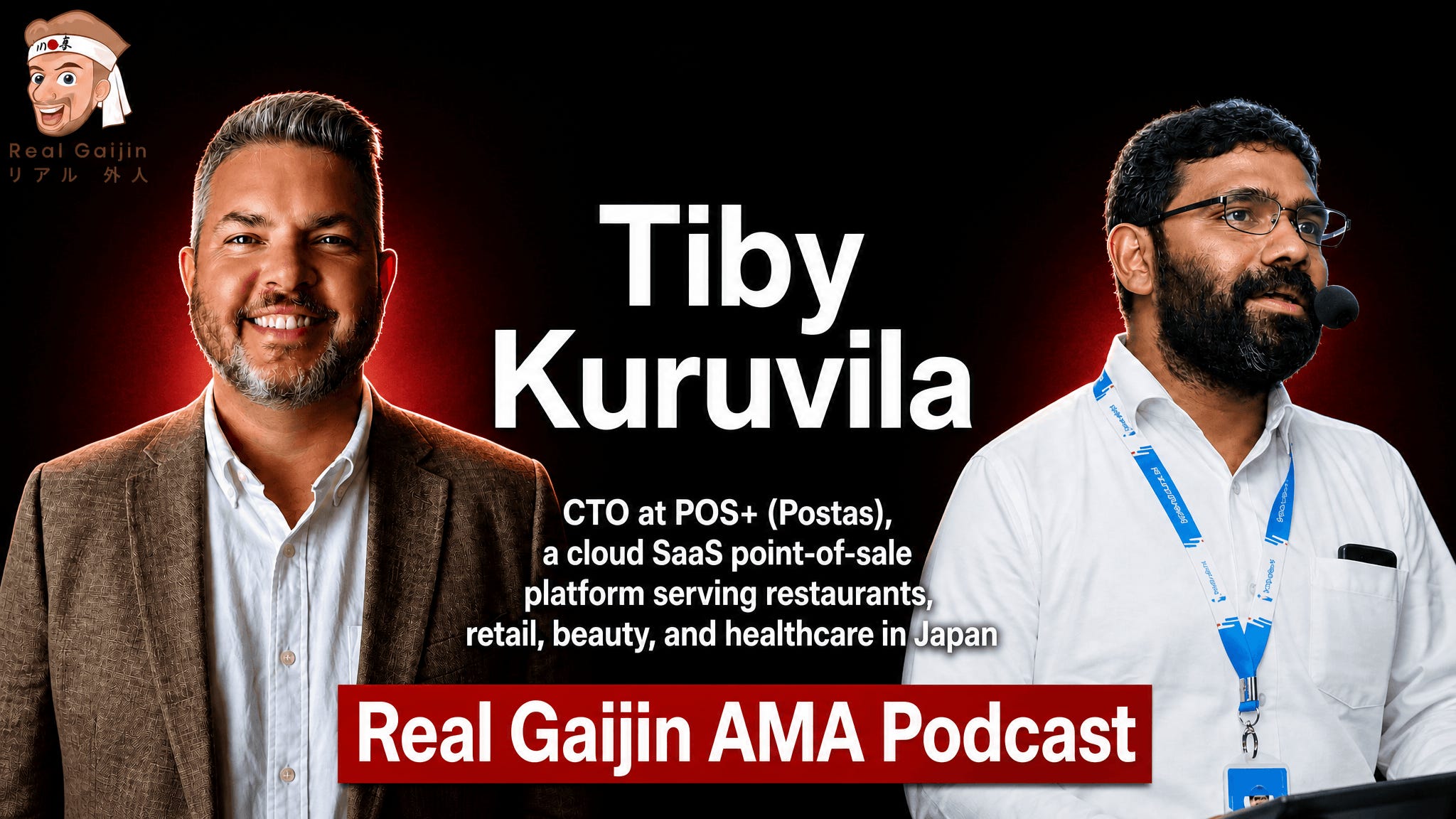 ▶︎ AMA Podcast (S-02, E-19) with Tiby Kuruvila, technologist/entrepreneur and CTO of POS+ (Postas) 24.07.2026 53minThe digital transformation of small and medium-sized enterprises (SMEs) is critical to Japan’s ability to reshape its economy. However, a key question is whether Japanese SMEs are ready.As labor shortages intensify and artificial intelligence transitions from hype to practical implementation, how are companies modernizing the systems that power everyday commerce? To help answer these questions, we’re joined by a resident expert.Who is he?Real Gaijin was joined by Tiby Kuruvila, the Chief Technology Officer of POS+ (Postas). POS+ is one of Japan’s leading cloud-based point-of-sale platforms, serving the restaurant, retail, beauty, and healthcare sectors. With more than 25 years of experience in enterprise software, AI, cloud architecture, and entrepreneurship in Japan and India, Tiby has started companies, mentored startups, and helped thousands of businesses embrace digital transformation.On the agendaWe discussed AI adoption, Japan’s unique technology landscape, and how to build successful products and teams across two distinct business cultures.Key TakeawaysToday’s discussion flew by. It is difficult to select only a few key takeaways, but these were mine:* AI is transforming point-of-sale systems from mere record keepers into intelligent business advisors: Traditional point-of-sale (POS) systems tell owners what happened yesterday. The next generation will predict what will likely happen tomorrow. Instead of merely tracking sales, AI-powered systems will forecast demand, optimize staffing, recommend inventory purchases, identify profitable customer behavior, and communicate recommendations in natural language. The long-term vision is for the POS system to become the “secondary brain” — and eventually the operating system — for an entire business, rather than merely processing transactions.* Japan’s greatest obstacle to digital transformation is not technology—it is trust: Throughout the interview, Tiby emphasizes that Japanese businesses rarely adopt new technology solely because it offers a better return on investment. Instead, adoption depends on building long-term trust. Sales cycles may last a year or more, but once a relationship is established, customers often remain loyal for many years. For foreign technology companies entering Japan, demonstrating reliability, cultural understanding, and long-term commitment is often more important than showcasing technical superiority.* Labor shortages are making digital transformation a business necessity rather than a luxury: Japan’s aging population and shrinking workforce are forcing businesses, particularly restaurants and SMEs, to automate routine operations. Technologies such as QR code ordering, AI-assisted forecasting, CRM systems, and workflow automation allow companies to serve more customers with fewer employees while improving customer service. Many technologies evolve from being “nice to have” to becoming essential when labor shortages threaten business survival.* The future belongs to organizations that combine human judgment with AI execution: Rather than replacing people outright, AI will perform more repetitive, administrative, and analytical tasks, allowing humans to focus on strategy, creativity, and decision-making. Tiby argues that developers, managers, and business leaders will spend less time producing work themselves and more time designing systems, defining objectives, and directing AI agents. This shift enables dramatically smaller teams to accomplish work that previously required many more employees.* Success in Japan requires localization, patience, and solving uniquely Japanese problems: Tiby advises entrepreneurs that simply translating an overseas product into Japanese is not enough. They must design products specifically for the Japanese market, address challenges such as an aging society and labor shortages, build local relationships, respect Japanese business processes, and maintain exceptional customer support. Those willing to invest the necessary time to earn trust are rewarded with exceptionally loyal customers and long-lasting relationships.TimelineSubstack does not yet have the functionality to allow you to use a link to jump to a specific section like YouTube’s “chapters.” Please refer to the times listed below to navigate through our hour-long conversation. Thank you for your understanding.Links* POS+: https://www.postas.co.jp/* LinkedIn: https://www.linkedin.com/in/tibyk/#JapanBusiness #DigitalTransformation #EnterpriseAI #RealGaijin #リアル外人If you enjoyed this, click the ❤️ button and restack.Thanks for reading Real Gaijin! This post is public so feel free to share it.Please note that you can subscribe to Real Gaijin for free. If you are so inclined, you can also purchase an annual subscription for a relatively small fee.However, I understand that even the lowest level of annual subscription allowed by Substack may seem too high for many. If you just want to buy a coffee for Real Gaijin (or maybe a green tea), you can also make a small donation here:https://buymeacoffee.com/realgaijinAll levels of support - including just liking a particular article and/or leaving a comment - are very welcome. Thanks again for reading.While Real Gaijin lives in Substack, you can also find Real Gaijin on a few other platforms (listed in alphabetical order).https://www.instagram.com/real_gaijin_on_substack/https://www.threads.net/@real_gaijin_on_substackhttps://www.tiktok.com/@real.gaijinhttps://x.com/Real_Gaijin_https://www.youtube.com/@RealGaijinhttps://www.linkedin.com/in/mark-wilt-kennedy/ Get full access to Real Gaijin at realgaijin.substack.com/subscribe
 -
 ▶︎ AMA Podcast (S-02, E-18) with Simon Partner, Professor of History, Duke University 11.07.2026 1h 8minForeigners have been visiting and trading with Japan for centuries, but from the 1630s the Tokugawa shogunate imposed strict limits on foreign contact. For more than two centuries, European trade was largely confined to the Dutch trading post on Dejima in Nagasaki, while Chinese merchants and a handful of other neighboring states maintained tightly regulated relations.Following the arrival of U.S. Commodore Matthew Perry’s “Black Ships” (Kurofune, 黒船) in 1853 and the treaties that followed, Japan reopened its ports beginning in 1859. As the country entered the turbulent 1860s, Yokohama rapidly emerged as the primary gateway for trade and interaction with the West, becoming the focal point of Japan’s transformation into a modern nation.Today, Real Gaijin sat down with Simon Partner, a professor of history at Duke University, to discuss life in 1860s Yokohama. As a new treaty port, Japan’s encounter with the outside world became part of daily life there. Drawing on The Merchant’s Tale, Professor Partner introduced us to the lives of visiting foreigners and some of the Japanese people who encountered them for the first time. Professor Partner has written extensively about one particular farmer-turned-merchant named Shinohara Chūemon, who arrived in Yokohama in 1859. Over the next fourteen years, Shinohara witnessed extraordinary upheaval, including foreign trade, gunboat diplomacy, civil war, the collapse of the Tokugawa order, and the birth of Meiji Japan. Through Chūemon’s eyes, we explored high politics, global markets, and the lived realities of food, clothing, medicine, hygiene, opportunity, anxiety, and cultural exchange for Japanese people and foreigners in one of the most consequential cities in modern Japan.More about Professor PartnerSimon Partner is professor of history, with particularly deep knowledge in the fields of Asian Studies and East Asian History, at Duke University.Besides The Merchant’s Tale, Professor Partner is the author of several books including Assembled in Japan: Electrical Goods and the Making of the Japanese Consumer (1999); Toshié: A Story of Village Life in Twentieth-Century Japan (2004); The Mayor of Aihara: A Japanese Villager and His Community, 1865–1925 (2009); and most recently Koume’s World (2023), which was the winner of the 2026 Modern Japan History Association Book Prize.On the agendaWe discussed Professor Partner’s personal connection to Japan — which includes a 40+ year marriage partner whom he originally met in Alabama (of all places) — before exploring the following:* Why Yokohama mattered: How a small fishing village became Japan’s gateway to the West and the epicenter of the country’s modernization.* Everyday life in a changing city: What life was like for both Japanese residents and foreign visitors, from commerce and housing to food, clothing, medicine, and hygiene.* Shinohara Chūemon’s story: How one farmer-turned-merchant witnessed foreign trade, political upheaval, and the transition from Tokugawa to Meiji Japan.* Lessons for today: What Yokohama’s first wave of globalization can teach us about cross-cultural exchange, immigration, and international business in the 21st century.Key TakeawaysToday’s discussion flew by. We covered a variety of subjects and took questions from active participants who used the chat functionality (many thanks). It is difficult to select only three key takeaways, but these were mine:* Yokohama’s opening transformed Japan before the Meiji Restoration: The conversation emphasizes that Japan’s economic and social transformation did not begin with the Meiji government alone. Rather, the opening of Yokohama in 1859 unleashed an unprecedented wave of largely unrestricted international trade, which rapidly reshaped markets, created new industries, accelerated inflation, and produced winners and losers across Japanese society. Professor Partner argues that this period of commercial disruption laid much of the foundation for Japan’s later modernization. This challenges the conventional narrative that places the Meiji Restoration at the center of the country’s transformation.* Ordinary people provide the most revealing perspective on history: Rather than focusing exclusively on political leaders or famous historical figures, Professor Partner explains that his research examines how major historical events were experienced by everyday people. Through the story of farmer-turned-merchant Shinohara Chūemon, we learn how individuals navigated uncertainty, embraced entrepreneurial risk, adapted to global economic forces, and experienced spectacular success and devastating failure. This micro-historical approach illustrates that history is best understood through the experiences of those affected by large-scale political and economic change.* Japan’s early globalization was deeply connected to world events: The interview highlights how local merchants in developing 1860s Yokohama were influenced by events occurring thousands of kilometers (miles) away. For example, the American Civil War unexpectedly created a lucrative export boom for Japanese cotton. Later, the Franco-Prussian War contributed to the collapse of European silk demand, ruining highly leveraged traders such as Shinohara Chūemon. These examples demonstrate that, by the 1860s, Japan was tightly integrated into the global economy, where international conflicts and market disruptions could dramatically alter the fortunes of businesses and communities.TimelineSubstack does not yet have the functionality to allow you to use a link to jump to a specific section like YouTube’s “chapters.” Please refer to the times listed below to navigate through our hour-long conversation. Thank you for your understanding.Links* Professor Partner’s new Substack (open to collaborating with guest historians): * Duke University: https://scholars.duke.edu/person/spartner* Book cited during podcast -- The Merchant’s Tale: https://cup.columbia.edu/book/the-merchants-tale/9780231182928/* Most recent book – Koume’s World: https://cup.columbia.edu/book/koumes-world/9780231211857/* Colleague’s book about the international tea trade during the 19th century - Green Tea with Milk and Sugar: When Japan Filled America’s Tea Cups by Robert Hellyer: https://www.amazon.co.jp/-/en/Green-Milk-Sugar-Filled-America/dp/0231199104#SimonPartner #DukeUniversity #JapanHistory #Yokohama #MeijiRestoration #TokugawaJapan #JapaneseHistory #ModernJapan #EastAsianHistory #CommodorePerry #BlackShips #CulturalExchange #サイモンパートナー #デューク大学 #横浜 #明治維新 #幕末 #日本史 #開国 #黒船 #徳川幕府 #外国人 #日米交流 #横浜開港 #RealGaijin #リアル外人If you enjoyed this, click the ❤️ button and restack.Thanks for reading Real Gaijin! This post is public so feel free to share it.Please note that you can subscribe to Real Gaijin for free. If you are so inclined, you can also purchase an annual subscription for a relatively small fee.However, I understand that even the lowest level of annual subscription allowed by Substack may seem too high for many. If you just want to buy a coffee for Real Gaijin (or maybe a green tea), you can also make a small donation here:https://buymeacoffee.com/realgaijinAll levels of support - including just liking a particular article and/or leaving a comment - are very welcome. Thanks again for reading.While Real Gaijin lives in Substack, you can also find Real Gaijin on a few other platforms (listed in alphabetical order).https://www.instagram.com/real_gaijin_on_substack/https://www.threads.net/@real_gaijin_on_substackhttps://www.tiktok.com/@real.gaijinhttps://x.com/Real_Gaijin_https://www.youtube.com/@RealGaijinhttps://www.linkedin.com/in/mark-wilt-kennedy/ Get full access to Real Gaijin at realgaijin.substack.com/subscribe
 -
 ▶︎ AMA Podcast (S-02, E-17) with Carlos Lastres, Tokyo-Based Apple Design Awards-Winning Designer and Engineer 02.07.2026 51minWe are often told that the path to success in Japan is straightforward: study hard, join a company, work long hours, and repeat. This system is built on precision and discipline, but it often comes at a heartbreaking cost: the fading of our creative spark. Our guest today spent years observing this struggle and realized that creativity isn’t a divine gift reserved for artists. Rather, it’s a survival skill we’ve forgotten.Today on the Real Gaijin AMA podcast, we introduce a guest who refuses to color within the lines. He is a man who transformed his own grief and isolation into a blueprint for innovation. He proves that even a “gaijin“ with tattoos can thrive by putting broken pieces back together in unexpected ways.Who is he?Carlos Lastres is not your typical designer. A senior product designer, software engineer, and MBA holder, he operates at the volatile, lucrative intersection of aesthetics, code, and business strategy. A winner of the Apple Design Award for Inclusivity (2025, Speechify), Carlos has built digital experiences that have reached millions across SaaS, Web3, and health tech.His journey is one of profound transformation. Growing up in Costa Rica, he was pushed toward “safe” paths. However, life took a turn when he lost his mother to cancer in his early 20s. This tragedy shocked Carlos to his core and forced him to ask hard questions about legacy and purpose. This quest led him to China and eventually to Japan, where he became a three-time TEDx speaker, a polyglot, and a vocal proponent of fostering creativity in the workplace. Carlos doesn’t just design products; he solves problems by blending his unique cultural perspective with his passion for business-driven, user-centric design.On the agendaWe cut through the jargon to explore what it means to be creative in a rigid world.* The “Gaijin“ Edge: How Carlos’ background as an outsider in Japan and China became his greatest asset for innovation.* Creativity as a Survival Skill: Tactical steps to retrain the brain, break out of professional labels, and move beyond the “logical vs. creative” binary;* Designing for Revenue: Why the best design isn’t just about beauty—it’s about data-informed decisions that move the needle.* The AI Era: How tools are changing the landscape for product designers, and why the human “taste” factor remains irreplaceable.* Lessons from the Journey: Insights from winning an Apple Design Award.Key Takeaways* Embrace cultural differences as a catalyst for professional growth: Carlos describes his journey through Latin America, Silicon Valley, China, and Japan as a master class in professional development. He learned to balance the innate creativity of his roots with the essential “speed-to-market” mindset practiced in China and the meticulous, quality-driven documentation standards found in Japan. Ultimately, he used this blend to develop award-winning software.* View “gaijin” (foreigner) status as a strategic superpower: Rather than letting his status as a foreigner in Japan be a barrier, Carlos uses it to challenge rigid corporate norms. Acting as a contrast to the traditional Japanese “salaryman” archetype provides his colleagues with a different perspective and helps them feel more comfortable taking calculated risks and thinking creatively within a structure that often discourages standing out.* Understand that true “balance” is a myth: Carlos asserts that achieving a perfect work-life balance is not the goal for high-performing professionals. He advises prioritizing based on a project’s specific needs, whether that means moving at lightning speed to capture market share or slowing down to ensure absolute quality and compliance when working with government entities.* Leverage AI as a partner, not a replacement: Addressing the fear that AI will replace developers, Carlos argues that people using AI will replace those who do not. He emphasizes that the future of software interaction is natural language and has found that using tools like ChatGPT helps him become a better, more precise thinker by forcing him to refine his ability to describe complex ideas clearly.* Invest in yourself to remain relevant in an evolving landscape: Carlos emphasizes that, regardless of tools or technological shifts, the most critical investment is in oneself. He maintains confidence in his ability to stay ahead of the curve by “learning how to learn” and continuously adding new skills, whether through certifications, personal projects, or exploring fields outside of software development. Carlos notes that he currently feels three times faster and more productive than before the widespread adoption of AI.TimelineSubstack does not yet have the functionality to allow you to use a link to jump to a specific section like YouTube’s “chapters.” Please refer to the times listed below to navigate through our hour-long conversation. Thank you for your understanding.Links* Website: https://www.lastrescarlos.com/* LinkedIn: https://www.linkedin.com/in/carloslastres/* Speechify — Text to speech. Voice typing. Fast answers: https://speechify.com/* Glimpse – AI vision for your Ray-Bans: https://glimpseai.jp/* YouTube TEDx Talk:#CarlosLastres #ProductDesign #Innovation #Creativity #JapanTech #UXDesign #CareerAdvice #TechLeadership #DesignThinking #カルロスラストレス #プロダクトデザイン #イノベーション #クリエイティビティ #日本企業 #キャリア #デザイン思考 #テック #エンジニア #RealGaijin #リアル外人Please note that you can subscribe to Real Gaijin for free. If you are so inclined, you can also purchase an annual subscription for a relatively small fee.However, I understand that even the lowest level of annual subscription allowed by Substack may seem too high for many. If you just want to buy a coffee for Real Gaijin (or maybe a green tea), you can also make a small donation here:https://buymeacoffee.com/realgaijinAll levels of support - including just liking a particular article and/or leaving a comment - are very welcome. Thanks again for reading.While Real Gaijin lives in Substack, you can also find Real Gaijin on a few other platforms (listed in alphabetical order).https://www.instagram.com/real_gaijin_on_substack/https://www.threads.net/@real_gaijin_on_substackhttps://www.tiktok.com/@real.gaijinhttps://x.com/Real_Gaijin_https://www.youtube.com/@RealGaijinhttps://www.linkedin.com/in/mark-wilt-kennedy/ Get full access to Real Gaijin at realgaijin.substack.com/subscribe
 -
 ▶︎ AMA Podcast (S-02, E-16) with Kevin Dias, Founder of Ambiki and The Problem-First Method 05.06.2026 54minImagine if pediatric therapists could spend less time on paperwork and more time helping children communicate, move, and thrive. Innovative software platforms are transforming how clinics operate across the healthcare industry, and pediatric therapy is no exception. In this episode, we explored how technology, artificial intelligence, and thoughtful software design are helping speech-language pathologists, occupational therapists, and physical therapists reduce administrative burdens, improve patient care, and establish more sustainable practices.This episode of Real Gaijin’s Ask Me Anything (AMA) podcast series featured an expert in this emerging field, Japan-based Kevin Dias, Founder of Ambiki and The Problem-First Method.Who is he?Kevin Dias is the founder of Ambiki, a healthcare technology company that develops electronic medical record (EMR) and practice management software for pediatric speech, occupational, and physical therapy clinics. Originally from the United States, Kevin has lived in Japan since 2008. His career has taken him from investment banking and English teaching to translation technology and healthcare software. Prior to launching Ambiki, Kevin served as the CTO of Sidekick Therapy Partners. There, he helped develop a custom practice management platform that supported the company’s rapid growth from roughly 70 to over 180 clinicians in just three years.In 2026, Kevin published The Problem-First Method, a book that challenges organizations to focus on solving real problems instead of creating solutions in search of a problem.He currently lives in Oyama, Japan, with his wife and three sons.On the agendaIn this conversation, Kevin shared his journey from the United States to Japan and his unconventional career path from English teaching and technology to healthcare software. We discussed the challenges pediatric speech-language pathology (SLP), occupational therapy (OT), and physical therapy (PT) practices face, such as clinician burnout, staffing shortages, and the administrative burden that often prevents therapists from providing patient care. Kevin explained why existing electronic medical record (EMR) systems often fail to meet the needs of pediatric providers, how Ambiki was designed to address these shortcomings, and how AI can help clinicians without replacing them. We also discussed the lasting impact of teletherapy, lessons learned from scaling a healthcare technology company, the principles behind his book The Problem-First Method, and his vision for the pediatric therapy clinic of the future.Key takeaways* Increasing your “Luck Surface Area”: Kevin emphasized the importance of proactively learning new skills and taking risks to create more opportunities. He describes this process as increasing one’s “luck surface area.” He demonstrated this concept by teaching himself programming and attempting to solve operational problems during his time as an English teacher. This willingness to go beyond his initial job duties eventually facilitated his successful pivot into the tech industry.* Leveraging remote work structures: Running a U.S.-based company from a rural area in Japan required Kevin to master asynchronous communication and strategic time management. He is successfully balancing his professional responsibilities with his life abroad by waking up early to overlap with U.S. business hours for meetings and dedicating his remaining time to deep, focused work.* The “Problem-First Method”: At the core of his business, Ambiki, is the “Problem First Method,” a philosophy that focuses on deeply understanding the specific pain points of a niche customer base. After identifying that speech-language pathologists were underserved by existing software, Kevin built a tailored operating system that addressed their complex administrative and clinical workflows rather than attempting to provide a generalized product.* The value of local community: Reflecting upon his experience living in Japan, Kevin highlighted how deep integration into a local Japanese neighborhood can provide a vital, supportive safety net. After a frightening health incident involving his middle son, his rural neighbors’ immediate, caring response transformed his perspective on local communal obligations. Being an active, contributing member of the community is a significant and rewarding part of living in Japan, he says.TimelineSubstack does not yet have the functionality to allow you to use a link to jump to a specific section like YouTube’s “chapters.” Please refer to the times listed below to navigate through our hour-long conversation. Thank you for your understanding.Links* Substack: https://substack.com/@kevindias2* LinkedIn: https://www.linkedin.com/in/kevin-dias-ambiki/* Ambiki Website: https://ambiki.com/* The Problem-First Method Book Website / Bookstore: https://problem-first-method.com/#TheProblemFirstMethod #FounderStory #ExpatEntrepreneur #LifeInJapan #HealthcareTech #FromTeachingToTech #KevinDias #Ambiki #AIinHealthcare #PediatricTherapy #SpeechTherapy #OccupationalTherapy #PhysicalTherapy #DigitalHealth #創業ストーリー #外国人起業家 #ヘルスケアテック #教育からテックへ #ケビンディーアス #医療分野におけるAI #小児療法 #言語療法 #作業療法 #理学療法 #デジタルヘルス #RealGaijin #リアル外人Please note that you can subscribe to Real Gaijin for free. If you are so inclined, you can also purchase an annual subscription for a relatively small fee.However, I understand that even the lowest level of annual subscription allowed by Substack may seem too high for many. If you just want to buy a coffee for Real Gaijin (or maybe a green tea), you can also make a small donation here:https://buymeacoffee.com/realgaijinAll levels of support - including just liking a particular article and/or leaving a comment - are very welcome. Thanks again for reading.While Real Gaijin lives in Substack, you can also find Real Gaijin on a few other platforms (listed in alphabetical order).https://www.instagram.com/real_gaijin_on_substack/https://www.threads.net/@real_gaijin_on_substackhttps://www.tiktok.com/@real.gaijinhttps://x.com/Real_Gaijin_https://www.youtube.com/@RealGaijinhttps://www.linkedin.com/in/mark-wilt-kennedy/ Get full access to Real Gaijin at realgaijin.substack.com/subscribe
 -
 ▶︎ AMA Podcast (S-02, E-15) with Dominic Carter, CEO, The Carter Group and co-founder of Living Best 30.05.2026 1h 3minJapan is experiencing one of the most significant demographic shifts in modern history, including a shrinking population, rapid aging, labor shortages, depopulation of rural areas, and increasing strain on healthcare and social infrastructure. However, this seemingly dire situation is not all doom and gloom. For entrepreneurs, investors, and care providers willing to look beyond the headlines, these challenges are creating new markets.This episode of the Real Gaijin’s Ask Me Anything (AMA) series features an expert in this emerging field, Dominic Carter, CEO, The Carter Group.Who is he?Dominic was born and raised in Australia. He studied marketing and Japanese at the University of New South Wales. Dominic began his career at Millward Brown, a branding, media, and communications consultancy, before relocating to Japan at age 24 to establish and lead the company’s local office.A serial entrepreneur with over 25 years of experience building and leading businesses in Japan, Dominic has cultivated strong relationships with clients and partners in various sectors, including market research, market entry, executive search, ad tech, video gaming, and VR. He specializes in prescient marketing analysis and strategy attuned to Japanese culture and the nuances of the Japanese buyer. He is now the CEO of The Carter Group. Through its network of affiliated firms and investments, The Carter Group supports the success of global companies in Japan.In 2022, Dominic co-founded Living Best, a pioneering age-tech platform that identifies high-potential longevity and age-tech concepts from North America and beyond. The platform connects these concepts with commercial opportunities and capital in Japan. His work bridges technology and philosophy, drawing on Japanese concepts such as ikigai (living with purpose・生きがい) and pin pin korori (living well and dying quickly・ピンピンコロリ) to guide innovations that enhance quality of life as we age.Dominic has delivered keynotes at major global forums, including the AGE-WELL Conference in Canada and the Centre on Aging and Health’s Distinguished Lecture at the University of Regina. He regularly contributes to the broader business community through guest lectures and consultative roles, offering his insights on market entry, entrepreneurship, and consumer and societal megatrends in Japan.On the agendaWe explored the opportunities created by Japan’s demographic trends in sectors such as aging technology, health technology, elder care innovation, robotics, automation, preventive healthcare, wealth management, and AI-driven productivity solutions. Dominic explained that we should view Japan not as a case study in decline, but rather as one of the world’s most important real-time laboratories for aging societies and the businesses built to serve them.Key Takeaways* Japan’s aging population is more of a predictable business opportunity than a crisis. Japan’s demographic challenges have been apparent for decades and are often exaggerated as an impending catastrophe. Although caring for the current elderly population is resource-intensive, Japan has largely managed the transition successfully. A bigger challenge lies ahead: the large group of people currently in their 50s will eventually require support from a much smaller younger generation. This will create strong demand for technologies and services that help people maintain their independence for longer periods of time.* Age-tech encompasses far more than nursing homes and caregiving robots. Dominic defines it as any product or service that helps people compensate for, prevent, or manage the effects of aging beginning as early as age 50. This spectrum ranges from wellness and preventive technologies, such as fitness tracking, gait analysis, brain training, and personalized health monitoring, to care-focused solutions, including fall detection systems, mobility aids, exoskeletons, and caregiving robots. This broad definition expands the total addressable market far beyond traditional elder care.* The biggest commercial winners will solve problems without creating more work. Many promising technologies fail because they disrupt existing workflows or create additional burdens for caregivers and care facilities. Solutions that operate quietly in the background, reduce costs, lower hospital readmission rates, improve safety, or seamlessly integrate into daily routines are far more likely to be adopted than technologies that require extensive retraining or behavioral changes.* Personalized wellness may become one of the most important age-tech sectors. Although robotics and autonomous transportation currently attract the most attention, Dominic believes that the larger, long-term opportunity may be in personalized health optimization. Advances in diagnostics, biomarkers, AI-driven health monitoring, individualized treatments, and preventive interventions could help people extend their healthy life span, delaying or even avoiding the need for formal care. Japan, a country where people already embrace regular health screenings, may prove to be a particularly fertile market for such solutions.* The future belongs to proactive individuals who take responsibility for their own aging journey. Personal responsibility was a recurring theme throughout the discussion. Dominic emphasized that many people in their 50s and 60s recognize that they cannot rely on the family-based support systems enjoyed by previous generations. Those who actively plan ahead, embrace technology, maintain digital literacy, monitor their health, and experiment with new solutions will likely be better positioned to remain independent and enjoy a higher quality of life as they age.TimelineSubstack does not yet have the functionality to allow you to use a link to jump to a specific section like YouTube’s “chapters.” Please refer to the times listed below to navigate through our hour-long conversation. Thank you for your understanding.Links* Substack: https://substack.com/@dominiccarter* LinkedIn: https://www.linkedin.com/in/dominiccarterjapan/* The Carter Group Website: https://the-carter-group.com/en/* Living Best Website: https://living-best.tech/* The World’s Real-time Laboratory for Age-Tech White Paper: https://living-best.tech/age-tech-white-paper/#DominicCarter #TheCarterGroup #LivingBest #AgingSociety #Demographics #AgeTech #HealthTech #Longevity #SilverEconomy #JapanBusiness #JapanEconomy #HealthcareInnovation #ElderCare #DigitalHealth #MedTech #ドミニクカーター #カーターグループ #リビングベスト #ヘルステック #長寿 #シルバーエコノミー #ヘルスケアイノベーション #高齢者ケア #デジタルヘルス #メドテック #長寿経済 #RealGaijin #リアル外人Please note that you can subscribe to Real Gaijin for free. If you are so inclined, you can also purchase an annual subscription for a relatively small fee.However, I understand that even the lowest level of annual subscription allowed by Substack may seem too high for many. If you just want to buy a coffee for Real Gaijin (or maybe a green tea), you can also make a small donation here:https://buymeacoffee.com/realgaijinAll levels of support - including just liking a particular article and/or leaving a comment - are very welcome. Thanks again for reading.While Real Gaijin lives in Substack, you can also find Real Gaijin on a few other platforms (listed in alphabetical order).https://www.instagram.com/real_gaijin_on_substack/https://www.threads.net/@real_gaijin_on_substackhttps://www.tiktok.com/@real.gaijinhttps://x.com/Real_Gaijin_https://www.youtube.com/@RealGaijinhttps://www.linkedin.com/in/mark-wilt-kennedy/ Get full access to Real Gaijin at realgaijin.substack.com/subscribe
 -
 ▶︎ AMA Podcast (S-02, E-14) with Daichi Kunii, CEO of ReDelta 24.05.2026 1hCurrently, there are hundreds of thousands of SMEs in Japan with no designated successor. Despite having solid financials and a long list of satisfied customers, many of these firms are at risk of ceasing operations because there is nobody to take over once the current owner retires, becomes incapacitated, or passes away. Thus, there are ample opportunities to acquire such firms or take an equity stake in them. But how do you uncover such opportunities, determine the seller’s motivation, assess business performance, and navigate Japan’s cultural and legal landscapes to close a deal?This episode of Real Gaijin’s Ask Me Anything (AMA) series features a Japanese individual with an extensive background working with foreigners.Who is he?Daichi Kunii (國井大地) was born and raised in Japan and is now the CEO of ReDelta, a Tokyo-based boutique M&A advisory firm. Previously, Daichi worked at Deloitte Touche Tohmatsu, where he gained extensive experience in cross-border M&A and developed deep expertise in global financial practices and complex transaction structures. In 2019, he founded ReDelta, an enterprise dedicated to connecting Japanese SMEs with their counterparts in the ASEAN region.On the agendaWe covered the following topics and also took several questions:* What kind of opportunities are available (industries, scope, geography, etc.)?* What is the process for assessing a potential seller and approaching them with an offer?* What kinds of deal structures are possible and common (e.g., full- or partial-equity acquisition, seller rollover, support for the post-merger integration transition/hand-off, advisory contract)?* What are past success cases?* What are the pitfalls regarding the potential clash of business cultures and expectations on both sides?Key Takeaways* Japan’s SME market, driven by succession, is dominated by privately held small businesses that are often underappreciated. These businesses are in sectors such as food and beverage (F&B including small-scale restaurants and pubs, which are called izakaya in Japanese), small-scale manufacturing, and hospitality, especially traditional inn (ryokan) and hot spring (onsen) properties. Many manufacturing firms facing succession issues generate less than US $7 million in annual revenue and have only 10–12 employees. Meanwhile, ryokan deals may involve approximately $2 million in annual revenue and profit margins below 10–15%. The “Japan M&A Finder” database from ReDelta includes hundreds of current opportunities that are much smaller in scale (can check 3 opportunities/month for free or pay US $150/month for unlimited access). Valuations commonly use EBITDA multiples of 3x–6x, and deals often close within three to four months because the financial structures are relatively simple. With prices like these, it should be possible to recoup the initial investment within three to four years. An important nuance is that many buildings, machinery, and facilities were fully depreciated decades ago and may have a balance sheet value of only 1 yen, even though they are still operationally valuable. Daichi also noted that, while distressed sellers may occasionally accept discounted offers, foreign buyers should generally avoid “lowball” tactics. Offers materially below 90% of the asking price can damage trust and reduce the likelihood of a successful transaction. Additionally, ReDelta usually charges fees equivalent to 3% of the valuation or $7,000, whichever is greater. Separate fees for post-acquisition consultation are charged monthly and vary depending on the size of the business.* Trust and employee continuity often outweigh price in Japanese succession deals. Daichi emphasized that sellers care deeply about their employees’ and the local community’s future after retirement. Foreign buyers who demonstrate respect for staff, long-term commitment, and genuine appreciation for the business culture are far more likely to succeed. In many cases, buyers must formally commit to maintaining associate employment for two to three years post-acquisition. Sellers are often reassured when buyers present the acquisition as a means of preserving the company, protecting jobs, and continuing the founder’s legacy rather than as a hostile takeover.* Two distinct categories of foreign buyers are emerging in Japan’s succession-driven M&A market. According to Daichi, many Singapore-based buyers act primarily as financial investors, focusing on acquiring businesses with significant assets, such as ryokans and hotels, for their land and real estate value. In contrast, many North American and European buyers are “hands-on” operators seeking a lifestyle change, retirement opportunity, or long-term relocation to rural Japan. These buyers often become personally involved in managing the business after the acquisition and are motivated as much by lifestyle and community integration as by financial returns. While many transactions are completed in cash, financing is also possible through Japanese regional banks, megabanks, or lenders in the buyer’s home country, particularly in Singapore.* Buying an existing Japanese business is often faster and less risky than starting one from scratch, especially for foreigners. Daichi argued that acquisitions allow buyers to “buy time” by inheriting existing employees, customer relationships, operating licenses, distribution channels, and stable revenue streams. This is particularly valuable for foreigners who are unfamiliar with Japanese business culture or lack local networks. Rather than spending years building trust and infrastructure, buyers can immediately step into an operating business and gradually modernize it.* The biggest risks are often cultural and operational, not financial. Daichi noted that many small Japanese firms have relatively simple accounting structures, meaning legal compliance, labor practices, permits, and cultural integration matter more than sophisticated financial engineering. Foreign buyers may face resistance in rural areas where employees and communities are unfamiliar with foreign ownership. Establishing credibility, clearly communicating intentions, and respecting local culture are essential for long-term success. The “storytelling” around why the buyer wants the business can materially affect employee morale and seller confidence.* Preparation and seriousness strongly influence whether Japanese sellers agree to a deal. Daichi stressed that first impressions are critical. Those who thoroughly research the company, understand the founder’s background, ask informed questions, and show genuine respect tend to gain seller confidence quickly. Conversely, buyers who appear opportunistic or poorly prepared often fail, even if they become more serious later on. In Japan’s SME succession market, personal credibility and relationship-building are central to successful M&A execution.TimelineSubstack does not yet have the functionality to allow you to use a link to jump to a specific section like YouTube’s “chapters.” Please refer to the times listed below to navigate through our hour-long conversation. Thank you for your understanding.Key contacts (and resources)* ReDelta Website: https://redelta.co.jp/en* Japan M & A Finder: https://app.redelta-ma.com/en* LinkedIn: https://www.linkedin.com/in/daichi-kunii/* Substack: Japan Bridge Insights#DaichiKunii #ReDelta #JapanSMEs #JapaneseBusiness #MandA #JapanBusiness #CrossBorderMAndA #JapanInvesting #SMEAcquisition #BusinessAcquisition #Entrepreneurship #JapanOpportunity #AcquireInJapan #SuccessionPlanning #PrivateEquity #ASEANBusiness #ForeignEntrepreneurs #JapanEconomy #DealMaking #國井大地 #株式会社リデルタ #リデルタ #日本企業 #中小企業 #事業承継 #後継者不足 #クロスボーダーMandA #企業買収 #日本投資 #中小企業MandA #事業買収 #起業家 #日本経済 #日本ビジネス #事業承継問題 #プライベートエクイティ #ASEANビジネス #外国人起業家 #日本で起業 #企業再生 #ディールメイキング #地方創生 #RealGaijin #リアル外人Please note that you can subscribe to Real Gaijin for free. If you are so inclined, you can also purchase an annual subscription for a relatively small fee.However, I understand that even the lowest level of annual subscription allowed by Substack may seem too high for many. If you just want to buy a coffee for Real Gaijin (or maybe a green tea), you can also make a small donation here:https://buymeacoffee.com/realgaijinAll levels of support - including just liking a particular article and/or leaving a comment - are very welcome. Thanks again for reading.While Real Gaijin lives in Substack, you can also find Real Gaijin on a few other platforms (listed in alphabetical order).https://www.instagram.com/real_gaijin_on_substack/https://www.threads.net/@real_gaijin_on_substackhttps://www.tiktok.com/@real.gaijinhttps://x.com/Real_Gaijin_https://www.youtube.com/@RealGaijinhttps://www.linkedin.com/in/mark-wilt-kennedy/ Get full access to Real Gaijin at realgaijin.substack.com/subscribe
 -
 AMA Podcast (S-02, E-13, Session 3 of 3・The Fall) with Steven Gan, the founder of Japan's first debt collection agency run by a foreigner 08.05.2026 1h 55minForeign businesspeople often push the boundaries of conventional business practices in Japan. They have the vision, technical expertise, and drive necessary to think outside the box and achieve their goals. Japan, a conformist and chronically conservative society, often needs this kind of disruptive leader. Periods of foreign influence help propel Japanese society forward.Today’s guest has a lot in common with Carlos Ghosn, the former head of Nissan. Both are foreign businesspeople who gained prominence as outsiders in Japan’s challenging business environment, only to face serious legal consequences. However, their responses to these consequences differ significantly. Our guest admitted his wrongdoing, submitted to the Japanese legal process, and served his prison sentence despite his strong conviction that he had done nothing wrong. In fact, he had sought legal advice prior to launching his business to support his position. In contrast, Ghosn denied the charges and fled the country to avoid prosecution. These cases highlight the broader narrative that, while they both reflect the risks faced by outsiders navigating Japan’s institutional and cultural boundaries, especially in legal “gray areas,” they also illustrate different approaches to accountability, justice, and personal responsibility.Real Gaijin is privileged to introduce exceptional foreigners who, in one way or another, have made Japan their home or are closely involved with the country. Each story offers insights into how to best interact with the Japanese, and today’s guest is no exception.Who is he?Meet Steven (”Steve”) Gan, an American business professional, author, and credit risk expert. He founded the first debt collection agency run by a foreigner during Japan’s turbulent post-bubble era and has spent decades living and working in Japan. Steve chronicled this experience in his 2016 memoir, Making It & Breaking It in Japan: My True Story of Songs, Sins, and Solitary. The book became an Amazon bestseller in the Foreign Cultures category and is valued by educators and executives seeking a cross-cultural understanding of Japan’s business environment and legal systems.After returning to his hometown of Chicago, Steve founded Stellar Risk Management Services, Inc. in the U.S. His work emphasizes intercultural management and financial ethics, bridging U.S.–Japan business practices.Three stories in oneAs it is simply not possible to do justice to Steve’s long tenure in Japan in a single hour-long podcast, we have split this true story into three pre-recorded sections.* Initial experience in Japan and working for a traditional Japanese company* Starting the country’s first debt collection agency run by a foreigner, which achieved extraordinary success* Colliding with the harsh justice system and eventually facing legal consequences that led to his imprisonment in TokyoEpisode 3 of 3: “I fought the law, and the law won”We discussed how Steve’s business ran afoul of the authorities, leading to his imprisonment. Steve explained how he navigated this crisis both in and out of court appearances and being locked up in the Tokyo Detention Center in a country with a 99% conviction rate, thanks mainly to the tremendous support of his immediate family, business colleagues, and loyal customers.Key take-aways* In Japan, disruption often triggers institutional resistance rather than market competition: Steve’s business succeeded by introducing an aggressive, outcome-based debt collection model that filled a clear market gap. However, success itself became the liability. As the firm grew from a niche operation into a thriving, national business, it began to threaten established professional monopolies, especially those in the legal sector. Rather than competing based on service quality or pricing, the “Committee that Guards Against Illegal Activities Performed by Non-Attorneys” (now “Committee on Regulation of Non-Lawyer Activities”・非弁護士取締委員会) of the Tokyo Bar Association leveraged a regulatory interpretation of Article 72 of the Attorney’s Law to challenge the legitimacy of the entire model. This illustrates a structural dynamic in Japan: innovation that encroaches on protected domains often invites administrative or legal suppression rather than open competition. * Legal ambiguity can persist until it is forcefully resolved, and the process can outweigh the substance: Despite multiple legal opinions supporting Steve’s business model, as well as the active use of his service by law firms, some of Japan’s “mega-banks,” and government entities, the company operated in a “gray zone” that remained vulnerable. The subsequent investigation revealed a system heavily oriented toward procedural outcomes, particularly obtaining a signed confession, rather than adjudicating underlying legality. The inability to have legal counsel present during questioning, pressure to sign statements, and high conviction rate all point to a system driven by process where compliance matters as much as legal merit.It is important to note that back in 2004, Japan still lacked a formal plea-bargaining system. This reflected a criminal justice framework that relied more heavily on prosecutorial discretion, confessions, and negotiated remorse than on American-style legal dealmaking. This changed in 2018 when Japan introduced a limited form of plea-bargaining known as the “cooperative agreement system.” However, Japan’s system remains far narrower in scope than the American version: it is primarily designed for white-collar and organized crime investigations and focuses on suspects providing evidence against other individuals or organizations rather than simply pleading guilty to their own crimes in exchange for reduced punishment.Ultimately, Steve’s refusal to concede guilt prolonged the process, exposing how legal ambiguity is often resolved through pressure rather than clarity. * Foreign-led innovation in Japan carries asymmetric risk, especially when it scales up: Steve explicitly frames his experience as a cautionary tale: Being a foreign disruptor amplifies visibility and vulnerability. Early-stage novelty may be tolerated—or even celebrated—but once the model gains traction and begins to reshape an industry, the level of scrutiny intensifies. Media exposure, such as book publication and an NHK documentary, accelerated growth and backlash, effectively forcing regulators to act. The comparison to other high-profile foreign executives underscores a broader pattern: Outsiders can catalyze change in Japan, but they lack institutional protections and informal networks that buffer domestic actors. Therefore, scaling innovation is not just a business challenge, but also a political and cultural one. Link to Session 1 of 3Link to Session 2 of 3Silver liningDespite experiencing such a tumultuous journey, which included the meteoric growth of a startup only to be dealt a proverbial “Go to Jail. Go directly to Jail. Do not pass Go. Do not collect $200” card from the Japanese equivalent of the game of Monopoly, there is a silver lining. Steve still loves Japan and was able to “rise from the ashes like a phoenix.” After returning to the United States in 2005, he founded Stellar Risk Management Services in Illinois. Today, the company advises Fortune 500 clients on credit, collections, and financial risk strategies. The company specializes in helping firms expand safely while minimizing exposure to bad debt.Today, Steve publishes a monthly newsletter written in Japanese called The Stellar Journal, which is distributed to roughly 14,000 readers.TimelineSubstack does not yet have the functionality to allow you to use a link to jump to a specific section like YouTube’s “chapters.” Please refer to the times listed below to navigate through our hour-long conversation. Thank you for your understanding.Books (by Steve)* 青い目の債権取り立て屋・奮闘記 (“Chronicle of the Struggles of a Blue-Eyed Debt Collector”): Published in Japanese.* Making It & Breaking It in Japan: My True Story of Songs, Sins, and Solitary: Published in English.Key contactsWebsite: https://www.stellarrisk.com/Newsletter: https://www.stellarrisk.com/blogLinkedIn: https://www.linkedin.com/in/stgan/IAESTE Internship: https://iaeste.org/internshipsJapan America Society of Chicago: https://jaschicago.org/Thunderbird School of Global Management: https://thunderbird.asu.edu/#JapanBusiness #ForeignEntrepreneurs #StevenGan #CrossCulturalBusiness #JapanLegalSystem #BusinessEthics #CarlosGhosn #DebtCollection #TokyoBarAssociation #TokyoDetentionCenter #ExpatLifeJapan #日本ビジネス)#外国人起業家 #スティーブンギャン #異文化ビジネス #司法制度 #ビジネス倫理 #カルロスゴーン #東京弁護士会 #債権回収 #米国公認会計士 #外資系企業 #アドバンスアンドアソシエイツ株式会社 #延滞売掛金の回収 #与信管理相談士 #キャッシュフロー問題 #日本での外国人生活 #東京拘置所 #RealGaijin #リアル外人Please note that you can subscribe to Real Gaijin for free. If you are so inclined, you can also purchase an annual subscription for a relatively small fee.However, I understand that even the lowest level of annual subscription allowed by Substack may seem too high for many. If you just want to buy a coffee for Real Gaijin (or maybe a green tea), you can also make a small donation here:https://buymeacoffee.com/realgaijinAll levels of support - including just liking a particular article and/or leaving a comment - are very welcome. Thanks again for reading.While Real Gaijin lives in Substack, you can also find Real Gaijin on a few other platforms (listed in alphabetical order).https://www.instagram.com/real_gaijin_on_substack/https://www.threads.net/@real_gaijin_on_substackhttps://www.tiktok.com/@real.gaijinhttps://x.com/Real_Gaijin_https://www.youtube.com/@RealGaijinhttps://www.linkedin.com/in/mark-wilt-kennedy/ Get full access to Real Gaijin at realgaijin.substack.com/subscribe
 -
 AMA Podcast (S-02, E-12, Session 2 of 3・The Rise) with Steven Gan, the founder of Japan's first debt collection agency run by a foreigner 08.05.2026 1h 7minForeign businesspeople often push the boundaries of conventional business practices in Japan. They have the vision, technical expertise, and drive necessary to think outside the box and achieve their goals. Japan, a conformist and chronically conservative society, often needs this kind of disruptive leader. Periods of foreign influence help propel Japanese society forward.However, such innovations can sometimes cause such a stir that those in power become determined to quash gaiatsu (外圧), or external influence, that threatens the status quo.Today’s guest has a lot in common with Carlos Ghosn, the former head of Nissan. Both are foreign businesspeople who gained prominence as outsiders in Japan’s challenging business environment, only to face serious legal consequences. However, their responses to these consequences differ significantly. Our guest admitted his wrongdoing, submitted to the Japanese legal process, and served his prison sentence despite his strong conviction that he had done nothing wrong. In fact, he had sought legal advice prior to launching his business to support his position. In contrast, Ghosn denied the charges and fled the country to avoid prosecution. These cases highlight the broader narrative that, while they both reflect the risks faced by outsiders navigating Japan’s institutional and cultural boundaries, especially in legal “gray areas,” they also illustrate different approaches to accountability, justice, and personal responsibility.Real Gaijin is privileged to introduce exceptional foreigners who, in one way or another, have made Japan their home or are closely involved with the country. Each story offers insights into how to best interact with the Japanese, and today’s guest is no exception.Who is he?Meet Steven (”Steve”) Gan, an American business professional, author, and credit risk expert. He founded the first debt collection agency run by a foreigner during Japan’s turbulent post-bubble era and has spent decades living and working in Japan. Steve chronicled this experience in his 2016 memoir, Making It & Breaking It in Japan: My True Story of Songs, Sins, and Solitary. The book became an Amazon bestseller in the Foreign Cultures category and is valued by educators and executives seeking a cross-cultural understanding of Japan’s business environment and legal systems.After returning to his hometown of Chicago, Steve founded Stellar Risk Management Services, Inc. in the U.S. His work emphasizes intercultural management and financial ethics, bridging U.S.–Japan business practices.Three stories in oneAs it is simply not possible to do justice to Steve’s long tenure in Japan in a single hour-long podcast, we have split this true story into three pre-recorded sections.* Initial experience in Japan and working for a traditional Japanese company* Starting the country’s first debt collection agency run by a foreigner, which achieved extraordinary success* Colliding with the harsh justice system and eventually facing legal consequences that led to his imprisonment in TokyoEpisode 2 of 3: Start-up Success in TokyoWe discussed how Steve founded and successfully developed the first debt collection agency run by a foreigner in Japan in 1992. He introduced international credit risk practices to a tightly regulated market. Through publications, seminars, and television appearances, Steve became a prominent advocate for professional credit management and corporate accountability. His firm served hundreds of clients, promoting transparency and modern business standards in Japanese finance.Key take-aways* In Japan, relationship-first networking can be a primary engine of business creation: Steve deliberately used informal settings, especially izakayas (Japanese pubs) and karaoke, as a structured strategy to build trust, exchange business cards, and generate leads. These relationships later translated directly into clients, partnerships, and market insight. This demonstrates that social integration is often a prerequisite to gaining a foothold in the market.* Successful market entry often depends on identifying structural inefficiencies and navigating legal constraints creatively: Steve identified a clear gap: small-to-mid-sized debt collection was underserved due to stigma (association with the Yakuza or Japanese mafia) and misaligned incentives for law firms. By leveraging a legal workaround (partnership structures) and targeting neglected claims, he created a viable niche. The broader takeaway is that opportunities in Japan often exist in regulatory gray zones or culturally avoided sectors.* Reframing a stigmatized industry through ethics and value creation can enable growth: Rather than using coercion, Steve’s firm adopted a “soft collection” model, prioritizing dialogue, repayment plans, and employment support for debtors. This differentiated the company from the Yakuza and traditional collectors, reshaping its public image and enabling media exposure, institutional trust, and large enterprise clients. In effect, ethical repositioning became a competitive advantage.Spoiler alertSteve’s account of his first encounter with a skip tracing service (as advertised), which later turned out to be a local enforcer of the Japanese mafia, or Yakuza, will undoubtedly grab your attention. Skip to around 32:38.Link to Session 1 of 3Link to Session 3 of 3Silver liningDespite experiencing such a tumultuous journey, which included the meteoric growth of a startup only to be dealt a proverbial “Go to Jail. Go directly to Jail. Do not pass Go. Do not collect $200” card from the Japanese equivalent of the game of Monopoly, there is a silver lining. Steve still loves Japan and was able to “rise from the ashes like a phoenix.” After returning to the United States in 2005, he founded Stellar Risk Management Services in Illinois. Today, the company advises Fortune 500 clients on credit, collections, and financial risk strategies. The company specializes in helping firms expand safely while minimizing exposure to bad debt.Today, Steve publishes a monthly newsletter written in Japanese called The Stellar Journal, which is distributed to roughly 14,000 readers.TimelineSubstack does not yet have the functionality to allow you to use a link to jump to a specific section like YouTube’s “chapters.” Please refer to the times listed below to navigate through our hour-long conversation. Thank you for your understanding.Books (by Steve)* 青い目の債権取り立て屋・奮闘記 (“Chronicle of the Struggles of a Blue-Eyed Debt Collector”): Published in Japanese.* Making It & Breaking It in Japan: My True Story of Songs, Sins, and Solitary: Published in English.Key contactsWebsite: https://www.stellarrisk.com/Newsletter: https://www.stellarrisk.com/blogLinkedIn: https://www.linkedin.com/in/stgan/IAESTE Internship: https://iaeste.org/internshipsJapan America Society of Chicago: https://jaschicago.org/Thunderbird School of Global Management: https://thunderbird.asu.edu/#JapanBusiness #ForeignEntrepreneurs #StevenGan #CrossCulturalBusiness #JapanLegalSystem #BusinessEthics #CarlosGhosn #DebtCollection #TokyoBarAssociation #TokyoDetentionCenter #ExpatLifeJapan #日本ビジネス)#外国人起業家 #スティーブンギャン #異文化ビジネス #司法制度 #ビジネス倫理 #カルロスゴーン #東京弁護士会 #債権回収 #米国公認会計士 #外資系企業 #アドバンスアンドアソシエイツ株式会社 #延滞売掛金の回収 #与信管理相談士 #キャッシュフロー問題 #日本での外国人生活 #東京拘置所 #RealGaijin #リアル外人Please note that you can subscribe to Real Gaijin for free. If you are so inclined, you can also purchase an annual subscription for a relatively small fee.However, I understand that even the lowest level of annual subscription allowed by Substack may seem too high for many. If you just want to buy a coffee for Real Gaijin (or maybe a green tea), you can also make a small donation here:https://buymeacoffee.com/realgaijinAll levels of support - including just liking a particular article and/or leaving a comment - are very welcome. Thanks again for reading.While Real Gaijin lives in Substack, you can also find Real Gaijin on a few other platforms (listed in alphabetical order).https://www.instagram.com/real_gaijin_on_substack/https://www.threads.net/@real_gaijin_on_substackhttps://www.tiktok.com/@real.gaijinhttps://x.com/Real_Gaijin_https://www.youtube.com/@RealGaijinhttps://www.linkedin.com/in/mark-wilt-kennedy/ Get full access to Real Gaijin at realgaijin.substack.com/subscribe
 -
 AMA Podcast (S-02, E-11, Session 1 of 3・The Beginning) with Steven Gan, the founder of Japan's first debt collection agency run by a foreigner 08.05.2026 1h 4minForeign businesspeople often push the boundaries of conventional business practices in Japan. They have the vision, technical expertise, and drive necessary to think outside the box and achieve their goals. Japan, a conformist and chronically conservative society, often needs this kind of disruptive leader. Periods of foreign influence help propel Japanese society forward.However, such innovations can sometimes cause such a stir that those in power become determined to quash gaiatsu (外圧), or external influence, that threatens the status quo.Today’s guest has a lot in common with Carlos Ghosn, the former head of Nissan. Both are foreign businesspeople who gained prominence as outsiders in Japan’s challenging business environment, only to face serious legal consequences. However, their responses to these consequences differ significantly. Our guest admitted his wrongdoing, submitted to the Japanese legal process, and served his prison sentence despite his strong conviction that he had done nothing wrong. In fact, he had sought legal advice prior to launching his business to support his position. In contrast, Ghosn denied the charges and fled the country to avoid prosecution. These cases highlight the broader narrative that, while they both reflect the risks faced by outsiders navigating Japan’s institutional and cultural boundaries, especially in legal “gray areas,” they also illustrate different approaches to accountability, justice, and personal responsibility.Real Gaijin is privileged to introduce exceptional foreigners who, in one way or another, have made Japan their home or are closely involved with the country. Each story offers insights into how to best interact with the Japanese, and today’s guest is no exception.Who is he?Meet Steven (”Steve”) Gan, an American business professional, author, and credit risk expert. He founded the first debt collection agency run by a foreigner during Japan’s turbulent post-bubble era and has spent decades living and working in Japan. Steve chronicled this experience in his 2016 memoir, Making It & Breaking It in Japan: My True Story of Songs, Sins, and Solitary. The book became an Amazon bestseller in the Foreign Cultures category and is valued by educators and executives seeking a cross-cultural understanding of Japan’s business environment and legal systems.After returning to his hometown of Chicago, Steve founded Stellar Risk Management Services, Inc. in the U.S. His work emphasizes intercultural management and financial ethics, bridging U.S.–Japan business practices.Three stories in oneAs it is simply not possible to do justice to Steve’s long tenure in Japan in a single hour-long podcast, we have split this true story into three pre-recorded sections.* Initial experience in Japan and working for a traditional Japanese company* Starting the country’s first debt collection agency run by a foreigner, which achieved extraordinary success* Colliding with the harsh justice system and eventually facing legal consequences that led to his imprisonment in TokyoEpisode 1 of 3: Early DaysWe discussed Steve’s first experience of Japan during the Bubble Era. We heard how he survived and thrived as a newly qualified engineer from abroad in the completely unfamiliar environment of a traditional Japanese company in the early 1980s. Steve then recounted how he returned home to Chicago to earn an accounting degree and join the family business. Eager to return to Japan, years later Steve found a way to go back to Tokyo and take up a position at Nippon Motorola. This time, however, he was treated differently and had to forge new friendships using an unconventional approach.Key take-aways* Success in Japan is determined by adaptability, not just enthusiasm: Steve’s first internship was successful because he followed critical behavioral heuristics: patience, humility, and a willingness to “go with the flow.” In contrast, his later return was initially unsuccessful because he overcorrected—his excessive enthusiasm and assertiveness disrupted group harmony. The core lesson is that cultural calibration matters more than effort or intent.* Making an effort to learn the language is a high-leverage signal that unlocks social and professional access: Even minimal Japanese proficiency (e.g., greetings, phone handling, and basic interactions) significantly improved Steve’s ability to integrate into Japanese society, while his peers who avoided learning the language struggled. Beyond the mechanics of communication, speaking the language signaled respect and lowered barriers, accelerating the formation of trust both inside the company and in broader social settings.* Informal networks, such as izakaya (Japanese pub) and karaoke culture, are critical to relationship-building and business outcomes: Formal workplace channels failed to provide feedback or integration, but informal environments enabled authentic connection. Through repeated, low-pressure social participation, especially karaoke, Steve built relationships, gained acceptance, and generated business opportunities. This suggests that relational capital in Japan is often built outside of formal structures.Link to Session 2 of 3Link to Session 3 of 3Silver liningDespite experiencing such a tumultuous journey, which included the meteoric growth of a startup only to be dealt a proverbial “Go to Jail. Go directly to Jail. Do not pass Go. Do not collect $200” card from the Japanese equivalent of the game of Monopoly, there is a silver lining. Steve still loves Japan and was able to “rise from the ashes like a phoenix.” After returning to the United States in 2005, he founded Stellar Risk Management Services in Illinois. Today, the company advises Fortune 500 clients on credit, collections, and financial risk strategies. The company specializes in helping firms expand safely while minimizing exposure to bad debt.Today, Steve publishes a monthly newsletter written in Japanese called The Stellar Journal, which is distributed to roughly 14,000 readers.TimelineSubstack does not yet have the functionality to allow you to use a link to jump to a specific section like YouTube’s “chapters.” Please refer to the times listed below to navigate through our hour-long conversation. Thank you for your understanding.Books (by Steve)* 青い目の債権取り立て屋・奮闘記 (“Chronicle of the Struggles of a Blue-Eyed Debt Collector”): Published in Japanese.* Making It & Breaking It in Japan: My True Story of Songs, Sins, and Solitary: Published in English.Key contactsWebsite: https://www.stellarrisk.com/Newsletter: https://www.stellarrisk.com/blogLinkedIn: https://www.linkedin.com/in/stgan/IAESTE Internship: https://iaeste.org/internshipsJapan America Society of Chicago: https://jaschicago.org/Thunderbird School of Global Management: https://thunderbird.asu.edu/#JapanBusiness #ForeignEntrepreneurs #StevenGan #CrossCulturalBusiness #JapanLegalSystem #BusinessEthics #CarlosGhosn #DebtCollection #TokyoBarAssociation #TokyoDetentionCenter #ExpatLifeJapan #日本ビジネス)#外国人起業家 #スティーブンギャン #異文化ビジネス #司法制度 #ビジネス倫理 #カルロスゴーン #東京弁護士会 #債権回収 #米国公認会計士 #外資系企業 #アドバンスアンドアソシエイツ株式会社 #延滞売掛金の回収 #与信管理相談士 #キャッシュフロー問題 #日本での外国人生活 #東京拘置所 #RealGaijin #リアル外人Please note that you can subscribe to Real Gaijin for free. If you are so inclined, you can also purchase an annual subscription for a relatively small fee.However, I understand that even the lowest level of annual subscription allowed by Substack may seem too high for many. If you just want to buy a coffee for Real Gaijin (or maybe a green tea), you can also make a small donation here:https://buymeacoffee.com/realgaijinAll levels of support - including just liking a particular article and/or leaving a comment - are very welcome. Thanks again for reading.While Real Gaijin lives in Substack, you can also find Real Gaijin on a few other platforms (listed in alphabetical order).https://www.instagram.com/real_gaijin_on_substack/https://www.threads.net/@real_gaijin_on_substackhttps://www.tiktok.com/@real.gaijinhttps://x.com/Real_Gaijin_https://www.youtube.com/@RealGaijinhttps://www.linkedin.com/in/mark-wilt-kennedy/ Get full access to Real Gaijin at realgaijin.substack.com/subscribe
 -
 ▶︎ AMA Podcast (S-02, E-10) with Andrew Neuman, a Japan-Based Professional and Adoptive Parent 12.04.2026 1h 13minJapan records relatively few adoptions each year. The majority are adult adoptions tied to family succession, not placements of unrelated children. True child adoptions, especially of children from the welfare system, remain limited. Against this backdrop, foreign adoptive parents are a small but notable edge case, navigating a system that is both structurally restrictive and culturally cautious.Today, Real Gaijin was privileged to speak with a longtime Japan resident originally from California who made the momentous decision to adopt a Japanese child and raise them in a bicultural setting.Who is he?Andrew Neuman, a Japan-based professional and adoptive parent, has firsthand experience navigating the country’s complex and often opaque adoption system. His experience gives him a rare, practitioner-level perspective on the structural, legal, and cultural dynamics that shape adoption in Japan, from the constraints of the special adoption framework, which is called Tokubetsu Yoshiengumi (特別養子縁組) in Japanese, to the practical realities of raising a child across cultural and linguistic boundaries. His story provides insight into the discrepancy between policy design and lived experience, as well as the broader question of how family formation is evolving in a rapidly aging society.On the agendaWe heard about Andrew’s family’s experiences in the context of how Japan’s adoption process operates. We examined instances where the system breaks down in practice, the reasons behind the persistent gap between the number of children in need of “forever homes” and the limited number of successful adoptions, and the ways in which institutional incentives influence these outcomes.Key Takeaways* Japan’s adoption system is significantly underutilized. This leaves a stark gap between the number of children in need of “forever homes” and the number of children who are actually adopted. Though approximately 42,000 children cannot live with their biological parents, most of whom remain in institutional settings, only 300 to 500 adoptions occur annually. This means that only a tiny fraction of eligible children transition into permanent family environments each year. This underscores a structural imbalance driven by legal constraints, cultural preferences for bloodline continuity, and limited adoption throughput.* The adoption process, particularly for foreign applicants, is highly constrained, hierarchical, and psychologically demanding. Prospective parents must navigate strict prioritization rules that place non-Japanese couples, especially those living abroad, at the lowest tier. They must also endure long periods of uncertainty with no guaranteed outcome. The process requires candid self-assessment about what challenges prospective parents can handle. It is less about choosing a child and more about proving suitability within a rigid system. At the same time, a practical takeaway from the discussion is the importance of seeking guidance from adoptive parents who have already gone through the process. Their firsthand experience can help set expectations, reduce uncertainty, and provide critical emotional and procedural support.* Go deeper: Restrictions on the age of adoptive parents, especially the mother, are a standard but variably enforced feature of adoption policy across countries. These restrictions reflect concerns about long-term caregiving capacity and generational fit. In Japan, although there is no uniform legal cutoff, adoption agencies and courts impose strict de facto limits. They typically favor adoptive mothers in their 20s and early 40s for infant adoptions. Flexibility increases for older children, though matching odds are sharply reduced beyond the mid-40s. By contrast, the United States has no formal age caps, relying instead on a holistic “fitness” standard. However, agencies often impose soft ceilings tied to the parent’s ability to raise a child to adulthood. Other countries take a more rules-based approach. South Korea enforces explicit upper age limits; China uses tiered systems that restrict older parents to harder-to-place children; and India applies combined parental age thresholds that vary by the child’s age. Two consistent patterns emerge across all systems: age constraints are stricter for infant adoption and relax for older children, and maternal age is often treated as the primary gating factor, whether formally codified or informally applied.* Becoming an adoptive parent of a Japanese child—especially as a non-Japanese national—requires a structured, multi-stage process with limited flexibility. Applicants must first engage an accredited agency (often in their home country), complete extensive documentation and screening over several months, and then have their case reviewed by a Japanese intermediary, such as International Social Services Japan. Approval is followed by a potentially multi-year waiting period for a match. After that, the process shifts to Japan and includes travel, legal custody procedures, and a mandatory 6 ~ 18 month “period of nurturing.” During this period, prospective parents must reside temporarily in Japan to establish and demonstrate a stable parent-child relationship before finalization. Importantly, applicants cannot “hedge” across multiple countries or agencies. They must commit to a single pathway, which increases the risk and time commitment of the process.TimelineSubstack does not yet have the functionality to allow you to use a link to jump to a specific section like YouTube’s “chapters.” Please refer to the times listed below to navigate through our hour-long conversation. Thank you for your understanding.Key contacts (and resources)* LinkedIn: https://www.linkedin.com/in/aneuman/* International Social Service Japan (page for “Prospective Adoptive Parents”): https://www.issj.org/adoption-web-en/paps/* The Nippon Foundation (Happy Yurikago Project): https://en.nippon-foundation.or.jp/what/projects/youth/happy_yurikago* U.S. Embassy & Consulates in Japan (Adoption): https://jp.usembassy.gov/services/adoption/* Japan Children Support Association: https://npojcsa.com/en/index.html* Children and Families Agency (Global Site): https://www.cfa.go.jp/en* Adopt International: https://www.adoptinter.org/* Short Documentary “Japan’s Throwaway Children | 101 East |日本の捨て児”* Discussion of “What it’s like to adopt a child in Japan” with Andrew#AndrewNeuman #Adoption #ChildWelfare #Parenting #Bicultural #ExpatLife #SocialPolicy #Demographics #SpecialAdoptionFramework #アンドリューニューマン #ニューマンアンドリュー #養子縁組 #児童福祉 #子育て #バイカルチャー #海外生活 #社会政策 #人口動態 #特別養子縁組 #RealGaijin #リアル外人Please note that you can subscribe to Real Gaijin for free. If you are so inclined, you can also purchase an annual subscription for a relatively small fee.However, I understand that even the lowest level of annual subscription allowed by Substack may seem too high for many. If you just want to buy a coffee for Real Gaijin (or maybe a green tea), you can also make a small donation here:https://buymeacoffee.com/realgaijinAll levels of support - including just liking a particular article and/or leaving a comment - are very welcome. Thanks again for reading.While Real Gaijin lives in Substack, you can also find Real Gaijin on a few other platforms (listed in alphabetical order).https://www.instagram.com/real_gaijin_on_substack/https://www.threads.net/@real_gaijin_on_substackhttps://www.tiktok.com/@real.gaijinhttps://x.com/Real_Gaijin_https://www.youtube.com/@RealGaijinhttps://www.linkedin.com/in/mark-wilt-kennedy/ Get full access to Real Gaijin at realgaijin.substack.com/subscribe
 -
 ▶︎ AMA Podcast (S-02, E-09) with Derek Cirillo and Nick McLoota, the Co-founders of Yuki Homes 29.03.2026 1h 4minJapan has consistently ranked high on the bucket lists of foreign visitors in recent years. While Japan is a wonderful place to visit year-round, it boasts some of the best snowboarding and skiing in the world, making it a must-visit destination for winter sports enthusiasts.Almost all snowboarders and skiers have heard of the world-famous Niseko ski resort, but there is a lot more to Japan’s skiing scene. Today, Real Gaijin introduces a pair of Americans who know Japan’s backcountry well.Meet Derek Cirillo and Nick McLoota, the co-founders of Yuki Homes.These young entrepreneurs fell in love with JAPOW and some of the best snowboarding and skiing resorts in Hokkaido. Together with a third partner, they decided to invest in their own property in Otaru to use as a home base for long visits (40 or 50 days at a time, for example). When they are not in town, they rent out the property on Airbnb, Rakuten Travel, and other online travel agencies (OTAs).After learning how many other foreigners had similar dreams and having a Reddit post about their own experience go viral, Derek and Nick decided to start their own real-estate consulting agency. Their agency connects overseas skiers and investors with Japanese real-estate brokers and other support services, such as local property managers, remodeling construction contractors, and tax accountants. Now, Yuki Homes helps foreign clients take advantage of Japan’s growing stock of affordable homes near some of the world’s best snowboarding and skiing destinations.Yuki Homes is now a full-service provider and expanding across JapanYou might recall that we first met the team at Yuki Homes last summer, well before the snow had fallen in Hokkaido this winter. ICYMI, see here:That didn’t stop the pair, though, from expanding their network across Japan (when they weren’t surfing in Miyazaki). Yuki Homes now has many more satisfied clients, and their Instagram following has ballooned. They now have a full team handling property tours, renovations and short-term rental management throughout Japan for buyers from the US, UK, Australia and Canada — with a special focus on Otaru, Asahikawa, and Miyoko. Despite the fact that most of their clients do not have long-term visas or local bank accounts, business is booming. Yuki Homes currently has seven remodeling projects underway, for example.Key takeaways (from our conversation on 29 MAR 2026)* From Snowboard Trip to Scalable Real Estate Venture: The business model behind Yuki Homes was born from a clear arbitrage opportunity: inexpensive rural Japanese properties, particularly those near ski resorts, combined with strong international demand for seasonal stays. After all, Japan currently offers the only affordable world-class ski locations. Derek and Nick found that comparable ski homes in North America were too expensive, but Japan offered similar or better snow conditions at a much lower price. They didn’t just decide to purchase property themselves; they also developed a process to help others do the same. Thus, Derek and Nick turned their personal experience into a brokerage-plus-advisory service that guides foreign buyers through the process of acquiring, renovating, and monetizing property. * Operational Complexity—and Resulting Value—of Local Execution: The business is not just about sourcing properties. It depends heavily on a distributed network of local experts across Japan. This includes licensed real-estate agents who handle legal compliance, local contractors who manage renovations, property checkers, and even neighbors to mitigate friction. The founders split responsibilities, with one handling front-end acquisition and client advisory and the other handling post-purchase execution and income optimization. This hybrid model—part concierge and part project manager—is essential in a market where language barriers, regulatory nuances, and local trust networks are decisive factors.* Handling Japan’s Regulatory Complexity on Your Behalf: Regulatory structure—particularly Japan’s minpaku (short-term rental) versus ryokan (hotel) licensing regime—fundamentally shapes investment outcomes. Minpaku properties face strict limitations, often capped at 180 rental days or further restricted locally, while hotel licenses allow for full-year operation, though they require higher compliance costs, such as fire safety measures, inspections, and proximity requirements for emergency contacts. Yuki Homes actively steers clients toward hotel-compliant properties to ensure long-term viability, especially amid tightening enforcement driven by concerns about overtourism. In effect, regulatory arbitrage, not just property price, is central to the investment thesis. TimelineSubstack does not yet have the functionality to allow you to use a link to jump to a specific section like YouTube’s “chapters.” Please refer to the times listed below to navigate through our hour-long conversation. Thank you for your understanding.Key contacts* Yuki Homes’ Instagram (Just DM them via IG for the fastest response): https://www.instagram.com/yukihomesjapan/* Yuki Homes’ Website: https://www.yukihomes.com/* Yuki Homes’ Substack (check out “The Bento Box” released every Friday for a showcase of a few select properties):* NipponHomes Dot Com (Zillow-like Tool): https://www.nipponhomes.com/* Kiroro Snow World: https://www.kiroro.co.jp/* PowderHounds: https://www.powderhounds.com/#JapanRealEstate #SkiProperty #Japow #Hokkaido #JapanRealEstate #Akiya #SkiJapan #ExpatLife #JapanInvesting #スキーリゾート #ジャパウ #北海道 #不動産投資 #空き家 #スキー日本 #YukiHomes #RealGaijin #リアル外人Please note that you can subscribe to Real Gaijin for free. If you are so inclined, you can also purchase an annual subscription for a relatively small fee.However, I understand that even the lowest level of annual subscription allowed by Substack may seem too high for many. If you just want to buy a coffee for Real Gaijin (or maybe a green tea), you can also make a small donation here:https://buymeacoffee.com/realgaijinAll levels of support - including just liking a particular article and/or leaving a comment - are very welcome. Thanks again for reading.While Real Gaijin lives in Substack, you can also find Real Gaijin on a few other platforms (listed in alphabetical order).https://www.instagram.com/real_gaijin_on_substack/https://www.threads.net/@real_gaijin_on_substackhttps://www.tiktok.com/@real.gaijinhttps://x.com/Real_Gaijin_https://www.youtube.com/@RealGaijinhttps://www.linkedin.com/in/mark-wilt-kennedy/ Get full access to Real Gaijin at realgaijin.substack.com/subscribe
Līdzīgi podkasti


Populārs valstī
Šis podkasts parādās arī šo valstu podkastu topos.

