
Isaac Newton
Podra Network
0
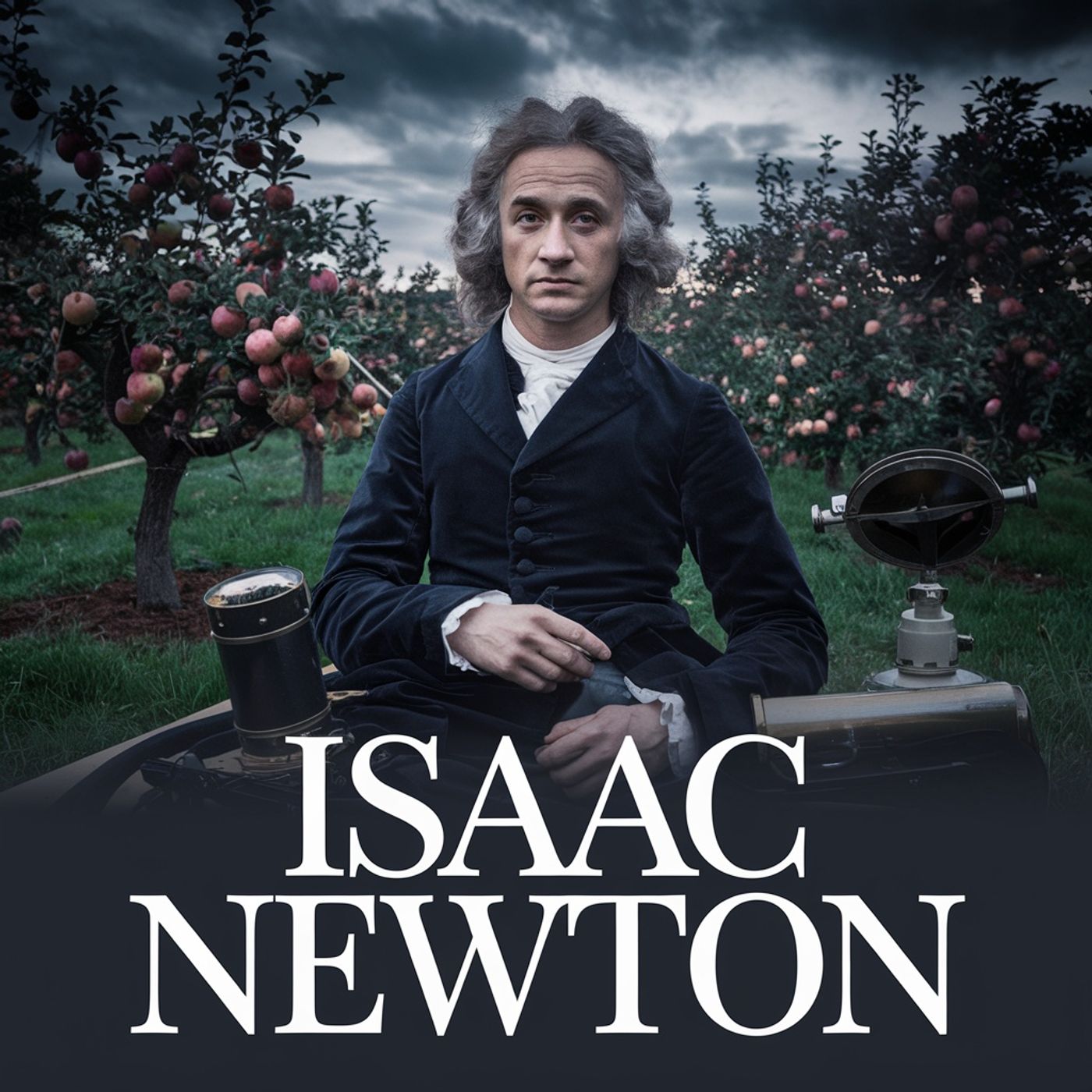
The apple and the universe — the life and revolutionary science of Isaac Newton.
Epizodes
-
 Legacy of a Legend: How Newton's Work Continues to Shape Our World 02.07.2026 5minExplore how Sir Isaac Newton's groundbreaking scientific discoveries from the 17th century continue to influence our modern world. Dr Sarah Quinn examines Newton's three laws of motion and their applications in everything from automotive safety systems to space exploration missions. Discover how calculus, co-developed by Newton, powers today's technology including GPS systems, smartphone accelerometers, and computer algorithms. Learn about Newton's universal law of gravitation and its crucial role in satellite operations, interplanetary travel, and astronomical research. The episode reveals Newton's impact on engineering, from skyscraper construction to bridge design, and explores how his scientific methodology established standards still used in research today. Uncover surprising connections between Newton's work and modern innovations like computer graphics, video game physics engines, and financial modeling systems. From the Large Hadron Collider to everyday mechanical devices, Newton's mathematical principles remain fundamental to human technological progress. This comprehensive exploration demonstrates why Isaac Newton's intellectual legacy continues to shape scientific advancement, space missions, and technological innovation three centuries after his death, cementing his position as history's most influential scientist whose work transcends time.
 -
The Royal Society Years: Politics, Power, and Scientific Revolution 25.06.2026 6minExplore Isaac Newton's transformative years with the Royal Society of London, where scientific revolution met institutional politics. This episode examines Newton's complex relationship with Europe's premier scientific institution, from his controversial early papers on optics and heated exchanges with Robert Hooke, to his unprecedented 24-year presidency that reshaped British science. Discover how Newton leveraged institutional power during the famous Leibniz calculus controversy, and learn about Edmond Halley's crucial role in publishing the Principia Mathematica when the Society faced financial crisis. We delve into the political dimensions of 17th-century natural philosophy, examining how Newton's leadership established precedents for peer review, experimental standards, and scientific authority that influence modern institutions today. This fascinating period reveals how the scientific revolution wasn't just about new discoveries, but about creating entirely new forms of knowledge validation and dissemination. Perfect for history enthusiasts, science students, and anyone interested in understanding how scientific institutions gained their authority and influence in shaping our modern understanding of the natural world through rigorous empirical methodology.
-
Standing on the Shoulders of Giants: Newton's Debt to Earlier Scientists 18.06.2026 5minIn this fascinating episode of Isaac Newton, Dr Sarah Quinn explores the brilliant minds who paved the way for Newton's groundbreaking discoveries. We examine Newton's famous quote about 'standing on the shoulders of giants' and identify exactly who those intellectual giants were. From Johannes Kepler's revolutionary laws of planetary motion to Galileo's foundational work on gravity and motion, we trace the scientific lineage that made Newton's achievements possible. The episode highlights René Descartes' mechanical philosophy, Pierre de Fermat's mathematical innovations, and the crucial heliocentric model of Nicolaus Copernicus. We also explore contributions from ancient philosophers like Democritus and Islamic Golden Age scholars such as Ibn al-Haytham (Alhazen), whose work on the scientific method and optics proved essential. This episode reveals how scientific progress builds collaboratively across generations, with each breakthrough enabling the next. Perfect for science enthusiasts, history buffs, and anyone interested in understanding how knowledge accumulates over time. Dr Quinn demonstrates that Newton's genius lay not only in his discoveries but in his generous acknowledgment of intellectual debts to predecessors. Discover the interconnected story of scientific advancement and learn how today's greatest achievements rest firmly on foundations built by yesterday's pioneers in this compelling exploration of scientific heritage.
-
The Hermit of Cambridge: Understanding Newton's Reclusive and Obsessive Nature 11.06.2026 5minExplore the fascinating psychology behind Isaac Newton's groundbreaking discoveries in this deep dive into his reclusive and obsessive personality. Dr Sarah Quinn examines how Newton's hermit-like existence at Cambridge University both enabled and complicated his scientific work. From his eighteen months of isolation during the plague years that produced calculus and gravitational theory, to his bitter feuds with contemporaries like Leibniz and Hooke, we uncover how Newton's intense focus and sensitivity to criticism shaped both his methods and his legacy. The episode reveals Newton's forgotten meals, all-night alchemical experiments, and decades-long biblical chronology studies, painting a portrait of a mind that operated at extraordinary intensity. Discover how Newton's fear of criticism nearly prevented the publication of the Principia, and why his friend Edmund Halley had to personally fund its printing. We explore the connection between Newton's solitary nature and his revolutionary insights, examining whether his social isolation was a necessary condition for his scientific breakthroughs. This episode offers fresh perspective on how personality traits often viewed as problematic can be integral to genius, and how the hermit of Cambridge transformed our understanding of the universe through sheer obsessive dedication.
-
Enemies and Rivalries: The Dark Side of Newton's Scientific Relationships 04.06.2026 5minExplore the darker side of Isaac Newton's personality in this revealing episode about his bitter scientific rivalries and personal feuds. Dr Sarah Quinn examines Newton's most infamous conflicts, including his decades-long battle with Leibniz over the invention of calculus, his vindictive relationship with Robert Hooke over optics and gravity, and his harsh treatment of Astronomer Royal John Flamsteed. Discover how Newton's childhood trauma may have shaped his combative nature, his role as Master of the Royal Mint in pursuing counterfeiters, and the lasting impact these personal conflicts had on scientific progress. Learn about the psychological factors that drove history's greatest scientist to engage in intellectual warfare, often at great personal and professional cost. This episode reveals how Newton's genius was inseparably linked to his capacity for holding grudges, seeking revenge, and destroying his enemies' reputations. Perfect for listeners interested in the human side of scientific discovery, the history of mathematics and physics, and the complex personalities behind groundbreaking achievements. Understanding Newton's rivalries provides crucial context for appreciating both his monumental contributions to science and the very human flaws that motivated his relentless pursuit of knowledge and recognition.
-
The Mint Master: Newton's Surprising Second Career Fighting Counterfeiters 28.05.2026 4minDiscover Isaac Newton's lesser-known but fascinating second career as Master of the Royal Mint. In this episode, Dr Sarah Quinn explores how the legendary physicist became England's most effective counterfeiter hunter, transforming from theoretical scientist to practical crime fighter. Learn about Newton's role in the Great Recoinage of the 1690s, his detective work in London's underworld, and his legendary pursuit of the notorious counterfeiter William Chaloner. We examine how Newton applied his scientific methodology to financial crime investigation, introducing revolutionary anti-counterfeiting measures and forensic techniques. The episode reveals how Newton's background in alchemy and metallurgy proved invaluable in identifying sophisticated fakes, and how his administrative skills transformed the efficiency of the Royal Mint. Discover the surprising ways Newton's work at the Mint influenced monetary policy for generations and provided him with the financial security to continue his scientific research. This compelling story demonstrates how Newton's analytical genius extended far beyond physics and mathematics, showing his remarkable ability to apply scientific thinking to solve practical, real-world challenges in 17th-century England.
-
Beyond the Telescope: Newton's Secret Obsessions with Alchemy and Theology 21.05.2026 4minDiscover the hidden side of Sir Isaac Newton in this fascinating exploration of his secret passions for alchemy and theology. While Newton is celebrated for his groundbreaking work in physics and mathematics, he actually spent more time studying chemical transformations and biblical prophecy than developing scientific theories. Dr Sarah Quinn reveals how Newton's alchemical experiments in his Cambridge rooms led him to seek divine forces animating matter, while his extensive theological studies resulted in controversial anti-Trinitarian beliefs and predictions about the world's end in 2060. Learn why Newton kept these pursuits secret, how they actually informed his scientific work, and why his heirs tried to suppress these manuscripts after his death. This episode examines the interconnected worldview of a complex genius who saw alchemy, theology, and physics as complementary paths to understanding God's creation. Featuring insights into Newton's coded writings, his rejection of the Trinity doctrine, and how economist John Maynard Keynes later called him 'the last of the magicians.' Perfect for history enthusiasts, science lovers, and anyone curious about the hidden depths of one of history's greatest minds.
-
The Principia: How One Book Changed Science Forever 14.05.2026 6minExplore the revolutionary impact of Isaac Newton's Principia Mathematica, published in 1687, and discover how this single book transformed science forever. Dr. Sarah Quinn examines the three laws of motion, universal gravitation, and the mathematical framework that unified terrestrial and celestial mechanics for the first time in history. Learn about the book's immediate impact on contemporaries like Edmund Halley, the Continental European reception, and how Newton's mathematical approach became the foundation of modern physics. This episode covers the scientific methodology that dominated physics for over 200 years until Einstein's theories, the unification of previously separate domains of knowledge, and why the Principia remains relevant to physics education today. Discover the story behind the publication, the mathematical rigor that set new scientific standards, and how Newton's famous phrase 'I do not feign hypotheses' reflected his revolutionary approach to natural philosophy. Perfect for science enthusiasts, students, and anyone interested in the history of scientific thought and the Scientific Revolution's lasting impact on human understanding of the universe.
-
Seeing the Light: Newton's Groundbreaking Work in Optics and Color Theory 07.05.2026 5minExplore Isaac Newton's revolutionary discoveries in optics and color theory in this fascinating episode of the Isaac Newton podcast. Dr Sarah Quinn examines how young Newton's experiments with prisms during the 1660s plague years completely overturned centuries of accepted wisdom about light and color. Learn about Newton's famous 'crucial experiment' that proved white light contains all colors of the spectrum, his invention of the reflecting telescope that solved chromatic aberration problems, and his observations of interference patterns now known as Newton's rings. This episode reveals how Newton's methodical experimental approach challenged the Aristotelian view that white light was pure, instead demonstrating it was a complex mixture of all colors. Discover how his work with dispersion explained natural phenomena like rainbows and laid groundwork for modern understanding of light's wave-particle duality. From his tiny six-inch reflecting telescope that revolutionized astronomy to color theory insights that influenced artists, Newton's optical discoveries continue impacting technology today. Perfect for science enthusiasts, history buffs, and anyone curious about foundational discoveries in physics and astronomy that shaped our modern understanding of light, color, and the scientific method itself.
-
The Calculus Wars: Newton vs Leibniz and the Battle for Mathematical Glory 30.04.2026 5minExplore one of history's most explosive scientific controversies in this gripping episode about the calculus wars between Isaac Newton and Gottfried Wilhelm Leibniz. Dr Sarah Quinn examines how two mathematical geniuses independently developed calculus in the 17th century, sparking a bitter priority dispute that divided the scientific community for decades. Learn about Newton's secret development of fluxions in the 1660s, Leibniz's groundbreaking 1684 publication, and the political machinations of the Royal Society's biased investigation. This episode reveals how national pride, academic politics, and personal ego transformed a mathematical breakthrough into an international scandal. Discover why Leibniz's superior notation system ultimately prevailed, how British mathematics suffered from stubborn loyalty to Newton, and what modern historians believe really happened. The calculus wars demonstrate that even the purest scientific discoveries can't escape human nature's messier impulses. Perfect for mathematics enthusiasts, history buffs, and anyone interested in the human drama behind scientific progress. Keywords: Isaac Newton, Gottfried Leibniz, calculus, mathematical history, scientific controversy, Royal Society, 17th century mathematics, priority disputes, mathematical notation, scientific revolution.
-
Laws in Motion: How Newton Redefined Our Understanding of Movement 23.04.2026 4minIn this episode of Isaac Newton, Dr Sarah Quinn explores how Sir Isaac Newton's three laws of motion revolutionized our understanding of movement and force. Discover how Newton's Principia Mathematica, published in 1687, challenged two millennia of Aristotelian physics and introduced the groundbreaking concepts of inertia, force relationships, and action-reaction principles. Learn about Newton's law of universal gravitation and how it unified terrestrial and celestial mechanics, explaining everything from falling apples to planetary orbits using the same mathematical principles. We examine the historical context of Newton's work, its departure from earlier philosophical approaches to natural phenomena, and its lasting impact on modern science and engineering. The episode covers Newton's first law of inertia, the mathematical elegance of F=ma, and the famous principle that every action has an equal and opposite reaction. Explore how these seemingly simple laws laid the foundation for classical mechanics and influenced scientific thinking for centuries, while also discussing their relationship to modern physics concepts like relativity and quantum mechanics. Perfect for science enthusiasts, students, and anyone curious about the fundamental principles that govern motion in our universe.
-
When the Apple Falls: The Revolutionary Discovery of Universal Gravitation 16.04.2026 5minExplore the true story behind Isaac Newton's most famous discovery in this episode of the Isaac Newton podcast. Dr Sarah Quinn examines how a simple falling apple led to one of the most revolutionary insights in scientific history – the law of universal gravitation. Discover how Newton's observation in 1665 during the Great Plague transformed our understanding of the cosmos by revealing that the same force governing falling objects on Earth also controls planetary motion. Learn about the mathematical breakthroughs Newton needed to prove his theory, including the development of calculus and the inverse square law. This episode separates fact from fiction in the apple story while exploring how Newton's principle of universal gravitation unified terrestrial and celestial mechanics, forever changing how humans understand their place in the universe. From explaining ocean tides to guiding space missions, discover how this 17th-century insight continues to shape modern science and technology. Perfect for science enthusiasts, students, and anyone curious about how simple observations can lead to profound discoveries about the nature of reality itself.
-
The Reluctant Genius: Newton's Early Years and the Making of a Mind 12.04.2026 5minExplore the formative years of Isaac Newton in this compelling episode examining how a premature baby from rural Lincolnshire became history's greatest scientific genius. Dr Sarah Quinn delves into Newton's traumatic early childhood, including his father's death before his birth and abandonment by his mother at age three when she remarried. Discover how these difficult circumstances shaped Newton's solitary personality and obsessive work habits that would later fuel his revolutionary discoveries. Learn about Newton's unremarkable early education, his near-derailment as a failed farmer, and his humble beginnings at Cambridge University as a working student. The episode traces Newton's intellectual awakening through his exposure to modern natural philosophy and culminates with the Great Plague of 1665, which sent him home to Woolsthorpe for his miraculous year of discovery. During this period of isolation, the young Newton laid the foundations for calculus, optics, and his theory of universal gravitation. This episode reveals how personal trauma, intellectual curiosity, and historical circumstance combined to create one of history's most brilliant scientific minds. Perfect for listeners interested in scientific biography, the history of science, and the psychological factors that contribute to genius-level achievement.
Līdzīgi podkasti


Populārs valstī
Šis podkasts parādās arī šo valstu podkastu topos.
