
Chesterton Radio
Chesterton Radio
0
Chesterton Radio is a daily podcast that blends original fiction, Father Brown mysteries, classic radio drama, and thoughtful conversations, all inspired by G. K. Chesterton and C. S. Lewis. The show also includes literary deep dives, daily Morning Prayer, and reflections on Christian storytelling. Broadcasting from Atchison, Kansas, it aims to offer a quiet refuge from modern noise and to rediscover the moral imagination. Listeners are invited to slow down and enjoy timeless stories that illuminate truth, goodness, and beauty.
Epizodes
-
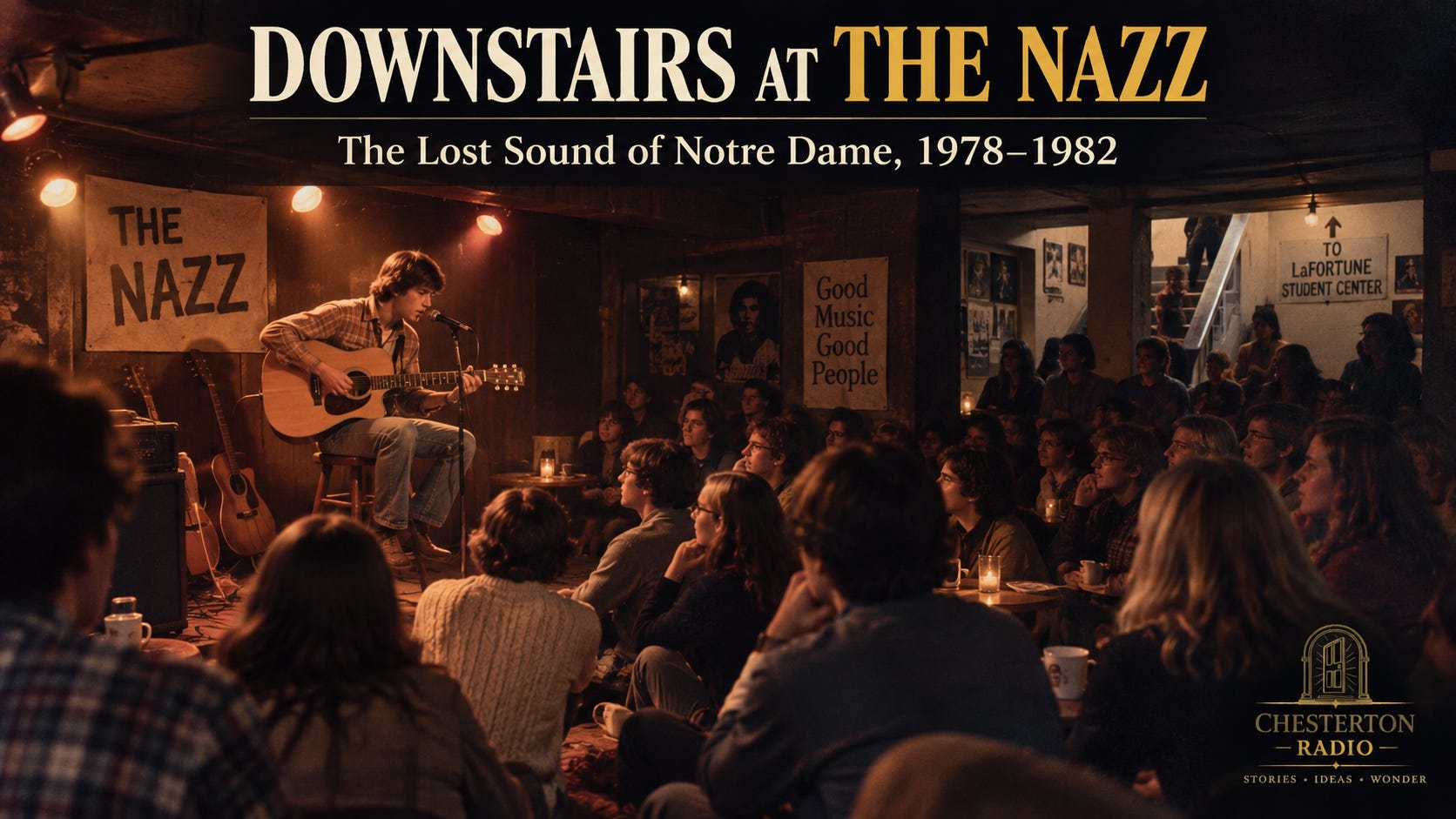 Downstairs at The Nazz 20.09.2026 40minIn the basement of Notre Dame’s LaFortune Student Center was a little room called The Nazz.On weekend nights, students crowded in to hear other students play jazz, folk, soft rock and the songs of the era. There were open stages, packed performances, Christmas shows and musicians like Rich Prezioso and Rick Walters—some of whom would also find their way onto WSND-FM.For one Notre Dame student, The Nazz was where he first remembers hearing “Amie” and “Desperado,” played not from a record, but by another student with a guitar.Drawing on contemporary issues of The Observer and Scholastic—and memories from someone who was there—this Chesterton Radio Deep Dive returns to a nearly forgotten corner of Notre Dame life and the music that once drifted up from the basement of LaFortune.THE NAZZ — NOTRE DAMEDeep Dive Source LinksNotre Dame Scholastic — “Jazzing Up the Nazz” (December 9, 1977)https://archives.nd.edu/Scholastic/VOL_0119/VOL_0119_ISSUE_0006.pdfThe Observer — The Nazz: “We’re Back!” / Rich Prezioso and other performers (September 6, 1979)https://archives.nd.edu/observer/v14/1979-09-06_v14_008.pdfThe Observer — The Nazz schedules performers; Rick Walters and Rich Prezioso (February 8, 1980)https://archives.nd.edu/Observer/1980-02-08_v14_081.pdfThe Observer — “Rick Walters Plays Acoustic on Nightflight” / WSND-FM (May 1, 1980)https://archives.nd.edu/observer/v14/1980-05-01_v14_131.pdfThe Observer — The Nazz feature: music, Open Stage, Rich Prezioso, Rick Walters (September 11, 1980)https://archives.nd.edu/observer/1980-09-11_v15_015.pdfThe Observer — Rich Prezioso & Kevin Quigley / Country Rock Jam preview (October 31, 1980)https://archives.nd.edu/observer/1980-10-31_v15_047.pdfThe Observer — Country Rock Jam review / Prezioso & Quigley / Pure Prairie League connection (November 13, 1980)https://www.archives.nd.edu/Observer/v15/1980-11-13_v15_056.pdfThe Observer — Christmas Nazz (December 4, 1981)https://archives.nd.edu/observer/v16/1981-12-04_v16_069.pdfThe Observer — Campus performers who regularly played The Nazz (February 3, 1982)https://archives.nd.edu/observer/v16/1982-02-03_v16_088.pdfNotre Dame Performing Arts — History and legacy of The Nazzhttps://performingarts.nd.edu/news-announcements/todd-rundgrens-influence-at-notre-dame-dates-back-to-the-nazz/Notre Dame Observer Digital Archivehttps://archives.nd.edu/Observer/Observer.htmNotre Dame Scholastic Digital Archivehttps://archives.nd.edu/scholastic/Scholastic.html Get full access to CHESTERTON RADIO at www.chestertonradio.com/subscribe
 -
 WHEN MUSICAL WORLDS COLLIDE 19.09.2026 47minSometime around 1981, a record arrived at WSND-FM at Notre Dame that made everyone in the room laugh.John Denver and Plácido Domingo.On paper, it seemed absurd: the gentle folk-pop singer from Colorado paired with one of the world’s great operatic tenors. Then someone put on “Perhaps Love.”And something unexpected happened.It worked.In this Chesterton Radio Deep Dive, we explore the strange and wonderful moments when musicians stepped across boundaries that audiences, radio stations and record companies had carefully drawn around them.Frank Sinatra welcomes Elvis Presley home from the Army—and they exchange songs. Johnny Cash opens his television stage to artists from Louis Armstrong to Joni Mitchell and Bob Dylan. Tom Jones meets Janis Joplin and discovers that beneath their wildly different images they speak much the same language.Bing Crosby meets David Bowie for a Christmas duet nobody could have predicted. Linda Ronstadt leaves contemporary pop behind to make records with Frank Sinatra’s legendary arranger Nelson Riddle. Freddie Mercury finds an unlikely musical partner in operatic soprano Montserrat Caballé.Then Luciano Pavarotti opens the doors even wider, standing onstage with everyone from Meat Loaf and James Brown to Lou Reed and Bono.Run-DMC and Aerosmith discover that rock and hip-hop can occupy the same record. Robert Plant and Alison Krauss find a musical world that belongs completely to neither of them. And decades after rock supposedly replaced Sinatra, metal guitarist Mark Tremonti puts down his guitar and steps in front of musicians from Sinatra’s world to sing the Great American Songbook.Some of these collaborations began as publicity stunts. Others were acts of admiration. A few changed careers—and some helped erase musical boundaries that once seemed permanent.But together they suggest something wonderfully simple:Sometimes the song is bigger than the category.From a record that made a college radio station laugh to collaborations that changed popular music, this is the story of what happens when musical worlds collide. Get full access to CHESTERTON RADIO at www.chestertonradio.com/subscribe
 -
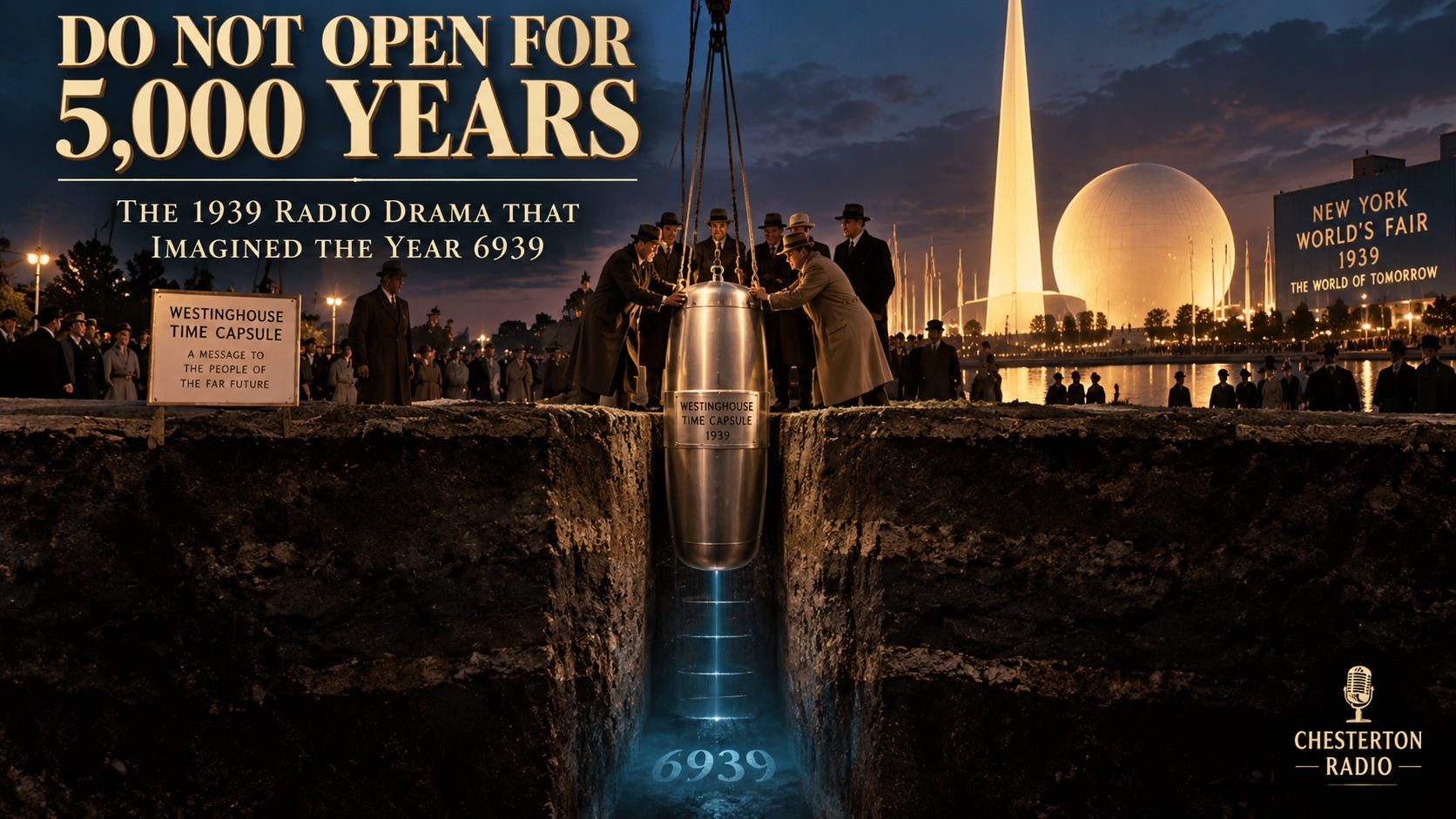 Do Not Open for 5,000 Years 19.09.2026 40minIn 1939, as the New York World’s Fair promised a dazzling “World of Tomorrow,” Americans buried a time capsule intended to remain sealed for 5,000 years.At nearly the same moment, Columbia Workshop asked an even stranger question: What would happen if we could look 5,000 years into humanity’s past—and 5,000 years into its future?In this Chesterton Radio Deep Dive, we rediscover William N. Robson’s remarkable 1939 radio drama Do Not Open for 5,000 Years and explore the real Westinghouse Time Capsule that helped inspire an era fascinated by the distant future.This Deep Dive includes Spoilers. We invite you to listen to the original program below then return for our in depth discussion. It is a journey through experimental radio, science fiction, the 1939 World’s Fair, and one enormous question:What will the people of the year 6939 think of us? Get full access to CHESTERTON RADIO at www.chestertonradio.com/subscribe
 -
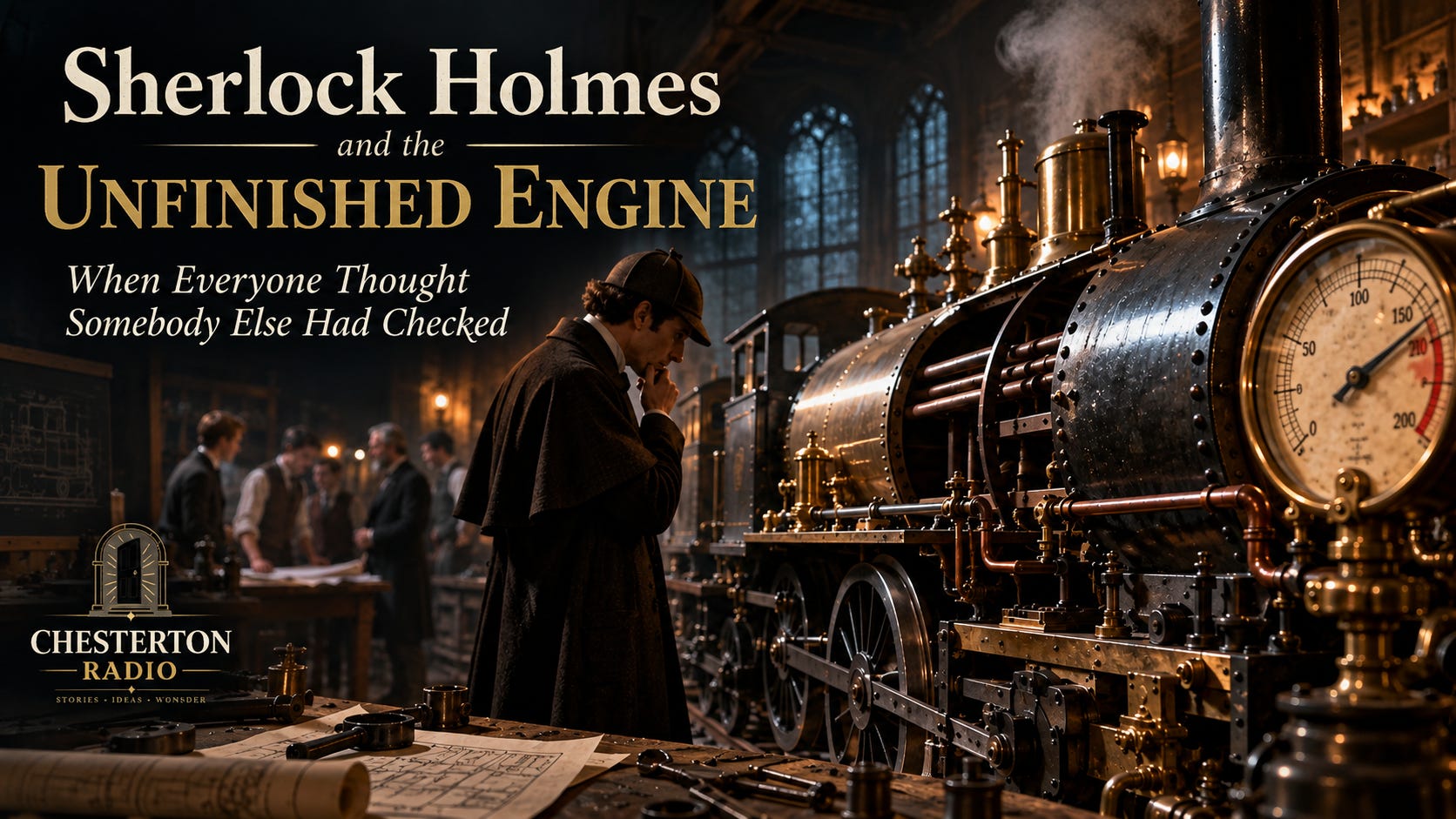 Sherlock Holmes and the Unfinished Engine 18.09.2026 57minA steam locomotive is being built. Someone appears determined to sabotage it. But Sherlock Holmes begins to suspect the opposite: what if the saboteur is actually trying to prevent a disaster?In this Chesterton Radio deep dive, Adrian and Clara Markham explore The Adventure of the Unfinished Engine and the surprisingly modern questions beneath the mystery: engineering responsibility, boiler safety, professional ethics, and the danger of trusting an authority nobody has actually verified.From the hard lessons that created modern boiler codes to the organizational failures examined after Challenger, the story turns on one very Holmesian question:How do you know?Because sometimes the most dangerous words aren’t “Nobody checked.”They’re “I thought somebody else did.” Get full access to CHESTERTON RADIO at www.chestertonradio.com/subscribe
 -
 Can a Machine Make Something Beautiful? 17.09.2026 45minCan artificial intelligence make something beautiful—or can it only imitate beauty?Catholic songwriter Justin West writes the words, then uses AI to create music and images that have reached millions. His argument raises a provocative question: What if AI isn’t replacing an artist? What if the alternative is that the song, painting, or story would never have existed at all?In this episode of The Common Room, we explore AI and creativity through Peter’s Barque, C.S. Lewis, St. John Paul II, Catholic teaching on artificial intelligence—and Chesterton Radio’s own experiment with AI-assisted storytelling.A traditional radio drama once required writers, actors, directors, engineers, musicians, artists, and a studio. Today, one person with new tools can attempt to create an entire repertory company.Something has clearly been gained.But has something human been lost?And if a song or story moves you before you know how it was made, does discovering that AI helped create it make it any less beautiful?Perhaps the most important question isn’t simply “Was this made by AI?”It may be:“Where is the human being in this?” Get full access to CHESTERTON RADIO at www.chestertonradio.com/subscribe
 -
 THE OTHER SOMERSET MAUGHAM 17.09.2026 39minToday we remember W. Somerset Maugham for Of Human Bondage, The Razor’s Edge and The Painted Veil. But there was another Somerset Maugham—one of the most successful playwrights of his generation, a writer who once had four plays running simultaneously in London’s West End.In this Chesterton Radio Deep Dive, we rediscover Maugham through the medium that may suit him better than almost any other: radio.From The Circle, The Tenth Man and The Sacred Flame to The Letter, The Narrow Corner, Our Betters and Home and Beauty, Maugham created worlds in which conversation is action. Behind the polished manners and drawing-room wit are marriages in trouble, concealed desires, money, ambition, hypocrisy, murder, sacrifice—and secrets waiting for someone to say the wrong thing.We also explore the remarkable radio afterlife of Maugham through BBC Saturday Night Theatre, Lux Radio Theatre, Ford Theatre and Screen Guild Theater, with performers including Bette Davis, Ronald Colman, Ida Lupino, Ray Milland, Vincent Price, Herbert Marshall, Lucille Ball, Bob Hope and Frank Sinatra.And one question runs through it all:Why does Somerset Maugham sound so extraordinarily good on radio?Perhaps the answer is simple.Take away the scenery. Put two people in a room. Give them a secret.And turn on the microphone.Somerset Maugham takes care of the rest.A Chesterton Radio Deep DiveExplore the complete collection of Maugham radio dramas accompanying this episode at Chesterton Radio. Get full access to CHESTERTON RADIO at www.chestertonradio.com/subscribe
 -
 The Stories Hiding Inside Meat Loaf 16.09.2026 32minJim Steinman rarely wrote songs that felt like just songs. Performed with the enormous voice and theatrical presence of Meat Loaf, they became little worlds of their own—filled with motorcycles and highways, bedrooms and photographs, desperate promises, lost youth, memory, love, escape and death.And they often leave you with the feeling that there is more story than the song has time to tell.Recently, Chesterton Radio tried an experiment: What happens if we follow those stories beyond the songs?“Objects in the Rear View Mirror May Appear Closer Than They Are” became two entirely different works of fiction. “Two Out of Three Ain’t Bad” became a story about the painful distance between loving someone and being able to love them in the way they need. And “Bat Out of Hell” took an unexpected turn into the moral and mysterious world of Father Brown.In this Common Room Deep Dive, Adrian and Clara explore those experiments—and the remarkable storytelling underneath the Meat Loaf/Jim Steinman collaboration. Why do Steinman’s songs so readily suggest characters, places and stories beyond the lyrics? Why do roads, memory, lost youth, regret, homecoming, death and second chances keep appearing?And then we turn the experiment around. Instead of asking what happens when Steinman becomes literature, we ask what happens when Shakespeare becomes a gothic rock opera.Perhaps the greatest songs don’t tell us the whole story.Perhaps they give us a road, a photograph, a motorcycle, someone leaving, someone waiting—and just enough darkness beyond the final note for us to wonder what happens next.Meatloaf Steinman Objects in the rearview mirrorMeatloaf Steinman Bat out of HellMeatloaf Steinman Two out of ThreeNanci Griffith - Gulf Coast Highway Get full access to CHESTERTON RADIO at www.chestertonradio.com/subscribe
 -
 ONE RING TO RULE THEM ALL 15.09.2026 41minBefore anyone knew what the Shire, Gandalf, Gollum, or Mordor were supposed to look like, listeners had to imagine them.In 1955, barely a year after The Fellowship of the Ring appeared, the BBC attempted the first radio dramatization of Tolkien’s epic—with Tolkien himself listening, corresponding with the producer, and offering his opinions. Today, that historic production is almost entirely lost.But Middle-earth returned to the airwaves.From the wonderfully atmospheric 1968 BBC Hobbit, through the American Mind’s Eye production, to the magnificent 1981 BBC Lord of the Rings starring Ian Holm, Michael Hordern, and Bill Nighy, radio created Middle-earth using nothing more than words, voices, music, sound—and imagination.Join us for a journey through the forgotten history of Tolkien on radio, including rare broadcasts, lost recordings, remarkable casting, and links to productions you can still hear today.Perhaps Middle-earth never needed to be seen.Perhaps it only needed to be heard.Listen to Middle-earth on RadioThe Lost 1955–56 BBC Lord of the Rings — The first-ever LOTR dramatization; the recordings are lost, but the scripts and Tolkien’s annotations survive.Oxford University — The 1955–56 BBC Lord of the Rings1968 BBC The Hobbit — The wonderful eight-part BBC radio dramatization.Listen — The Hobbit, Part One1979 Mind’s Eye The Lord of the Rings — The American full-cast adaptation later heard on public radio.Listen — Mind’s Eye Lord of the Rings1981 BBC Radio 4 The Lord of the Rings — The celebrated production starring Ian Holm, Michael Hordern and Bill Nighy.Listen — BBC Lord of the RingsExplore the larger history of Tolkien on radio — including the obscure broadcasts and adaptations we mention in the program.The Tale of Ears — Tolkien and the BBCKeep Chesterton Radio on the AirChesterton Radio is listener-supported. If you enjoy programs like this—original Deep Dives, new audio dramas, mysteries, classic radio, Morning Prayer, and the stories we keep discovering—please consider supporting our work.Your support helps us create new programs, maintain the station, and keep the door open.Support Chesterton Radio:Buy Me a CoffeePatreonSubstackThe Open Door — Live 24/7And the radio is always on.The Open Door streams Chesterton Radio 24 hours a day: classic radio, original programs, mysteries, stories, faith, literature, and whatever happens to come through the door next.Put it on while you’re working, driving, reading—or simply wondering what’s playing.Listen Live to The Open DoorGood stories. Good conversation. A little mystery. And the radio is always on. Get full access to CHESTERTON RADIO at www.chestertonradio.com/subscribe
 -
 Nevil Shute: The Engineer Who Became a Storyteller 13.09.2026 52minBefore Nevil Shute became one of the twentieth century’s most popular novelists, Nevil Shute Norway was an aeronautical engineer—helping build the great R100 airship, working in Britain’s emerging aircraft industry, and eventually helping found an aircraft company of his own.And once you know that, his stories begin to look different.In this Chesterton Radio Deep Dive, we explore the extraordinary life behind the novels and radio plays: the engineer who wrote about pilots, mechanics, craftsmen and ordinary people suddenly confronted with extraordinary circumstances.This Deep Dive includes spoilers. Before listening we invite you to explore the original plays below - then return for our in-depth discussions. From Landfall and Pied Piper to No Highway, A Town Like Alice, Requiem for a Wren, Trustee from the Toolroom and the haunting On the Beach, Shute returned again and again to questions of competence, duty, technology, bureaucracy, courage and personal responsibility.Why did his stories translate so beautifully to radio?What happens when an engineer knows something is wrong—but nobody wants to listen?And what do we owe one another when the machinery, the institutions, or even civilization itself begins to fail?Meet Nevil Shute—the engineer behind the storyteller.🎧 Part of the Chesterton Radio Deep Dive series.ChestertonRadio.comGood stories. Good conversation. A little mystery. And the radio is always on.This Nevil Shute Play Collection includes: The Pied Piper - Margaret O’ Brien - Frank Morgan - Nevil Shute - Lux Radio Theater - The hope of the world of tomorrow rests with the children of today... In June 1940, Howard goes to France, near the border with Switzerland, to sulk after his offer to serve in the Second World War is turned down by every government department in London because he is too old. Round the Bend - A 1951 novel by Nevil Shute. It tells the story of Constantine “Connie” Shaklin, an aircraft engineer who founds a new religion transcending existing religions based on the merit of good work. It deals with racism, including the White Australia policy, and also with the importance of private enterprise. It was one of the first novels Shute wrote after emigrating from Britain to Australia in 1950.Beyond the Black Stump - A novel by British author Nevil Shute. It was first published in the UK by William Heinemann Ltd in 1956. The story concerns a young American geologist, Stanton Laird, working in the Australian outback in the field of oil exploration. Although he is in a very remote location - beyond the black stump - in a region called “the Lunatic” in Western Australia, he is part of a crew that has a well-appointed mobile facility.Trustee From the Toolroom - A novel written by Nevil Shute. Shute died in January 1960; Trustee was published posthumously later that year.Landfall - Nevil Shute Norway was an English novelist and aeronautical engineer who spent his later years in Australia. He used his full name in his engineering career and Nevil Shute as his pen name to protect his engineering career from inferences by his employers (Vickers) or fellow engineers that he was not a serious person or from potential negative publicity in connection with his novels, which included On the Beach and A Town Like Alice.Requiem for a Wren - First published in 1955 by William Heinemann Ltd. It was published in the United States under the title The Breaking WaveNo Highway in the Sky - Jimmy Stewart - Marlene Dietrich - Lux Radio TheaterDennis Scott, new chief of metallurgy at the Royal Aircraft Establishment at Farnborough, is introduced to Theodore Honey, an eccentric American scientist who is testing his theory that the new Rutland Reindeer aircraft is susceptible to structural failure of the tailplane. Get full access to CHESTERTON RADIO at www.chestertonradio.com/subscribe
 -
 Football on the Radio 12.09.2026 36minThere is something about football that belongs on the radio.The murmur of the crowd. The marching band somewhere beyond the microphone. The quarterback under center. And the announcer trying, with nothing but words, to put an entire football field inside the listener’s imagination.In this Chesterton Radio deep dive, we return to a collection of listener-favorite football radio shows and use them as a doorway into the remarkable relationship between American football and radio.From Friday nights under the lights to Saturday afternoons on college campuses and Sunday professional football, we explore the rituals that made the game part of the American autumn—and the broadcasters who learned to make listeners see a game they could only hear.We’ll also visit the extraordinary story of Notre Dame football on radio, when a university in Indiana discovered that the airwaves could turn a local stadium into a national gathering place.But the old radio stories remind us that football has never been only about touchdowns and final scores. It is also about coaches and players, fathers and sons, loyalty and disappointment, hometowns, second chances, growing up—and coming home.Because sometimes the best seat in the stadium isn’t a seat at all.It’s a radio.Chesterton Radio — Where the great stories are always playing.Listen, explore, and support Chesterton Radio at ChestertonRadio.com.Bill Stern’s Sports Newsreel - Harry JamesFlash Benny Football CoachKnute Rockne All American - Ronald Reagan - Pat O’Brien - Lux TheaterGreat Gildersleeve - Thanksgiving Football GameJack Tries to buy USC Football TicketsT-Formation - Bob Hope - Family TheaterThe Football Player and the Syndicate - Night Beat - Frank LovejoyThe Big Football Game - Great GildersleeveThe Rose Bowl Game - Jack Benny ShowIt Isn’t Cricket - Bob Hope - Family TheaterPatriotism and Sport - G.K. ChestertonThey Knew Knute Rockne - Biography in Sound Get full access to CHESTERTON RADIO at www.chestertonradio.com/subscribe
 -
 Pygmalion: The Play That Became My Fair Lady 11.09.2026 45minGeorge Bernard Shaw thought he knew exactly what Pygmalion was about.His audiences had other ideas.What begins as an outrageous experiment—can Professor Henry Higgins transform a Cockney flower girl into a lady simply by changing the way she speaks?—becomes something much larger: a brilliant argument about class, language, identity, education, independence, and the strange relationship between a creator and his creation.In this Chesterton Radio deep dive, we meet the remarkable and argumentative George Bernard Shaw, trace Pygmalion back to the ancient myth that gave the play its name, and explore what really happens to Eliza Doolittle when Higgins teaches her to speak like a duchess.Then the story takes another turn.We follow Pygmalion through its celebrated 1938 film adaptation and into Lerner and Loewe’s My Fair Lady—one of the most beloved musicals ever written.But something changed along the way.Shaw resisted the idea that Higgins and Eliza belonged together. Audiences kept seeing a romance. My Fair Lady embraced an emotional relationship that Shaw spent years trying to push away.So did the musical betray Shaw’s Pygmalion?Or did Lerner and Loewe discover something in Eliza and Higgins that even their creator couldn’t entirely control?It leads to a wonderfully appropriate question for a story called Pygmalion:Who owns a great story—the author who creates it, the artists who reinterpret it, or the audience that falls in love with it?And perhaps the greatest irony is that Shaw wrote a story about a creator losing control of his creation.Then Pygmalion escaped from him too.Support the Little StationChesterton Radio is listener-supported. If conversations like this help you rediscover great plays, books, films, music, and ideas worth remembering, please consider becoming a paid subscriber or supporting the Little Station.Your support helps us preserve great stories, create original programs, produce Deep Dives like this one, and keep the Open Door broadcasting.Enter the Chesterton Radio World:📖 Read, Listen & Subscribe📻 Listen Live — 24/7https://live.chestertonradio.com🌎 Chesterton Radio📺 YouTubehttps://www.youtube.com/@chestertonradio☕ Support Chesterton Radiohttps://shop.chestertonradio.comChesterton Radio — Stories • Ideas • WonderThe door is open. Stay awhile. Get full access to CHESTERTON RADIO at www.chestertonradio.com/subscribe
 -
 Two Voices on the Same Road 11.09.2026 33minSome musical partnerships seem planned. Others feel as though two long roads simply happened to meet.In this edition of Nocturne Nightflight, we travel into Mark Knopfler and Emmylou Harris’s remarkable Real Live Roadrunning—a performance built not on spectacle, but on restraint, trust and two unmistakable voices finding room for one another.Their roads to this stage could hardly have been richer: Dire Straits and Knopfler’s quiet mastery of the guitar; Gram Parsons, Boulder to Birmingham, and Emmylou Harris’s extraordinary journey through American music. By 2006, both had reached a point where they had very little left to prove—and perhaps that is precisely why the music feels so natural.Along the way, we linger with Romeo and Juliet, Boulder to Birmingham, Speedway at Nazareth, If This Is Goodbye and the beautiful closing reassurance of Why Worry. These become more than songs. They become reflections on roads taken and not taken, people lost, love remembered, growing older, and the consolation of having someone beside you for part of the journey.This isn’t a track-by-track review. It’s a late-night journey through a concert—and through the strange way certain music seems to mean more to us with every passing year.Turn down the lights. The road is still ahead. This is Nocturne Nightflight. Get full access to CHESTERTON RADIO at www.chestertonradio.com/subscribe
 -
 Doctor Who Beyond the TARDIS: The Radio Plays of Doctor Who’s Writers 10.09.2026 31minWhat happens when you take Doctor Who, turn off the picture, remove the sets and special effects—and leave the storytelling?Something remarkable happens. The universe gets bigger.In this edition of The Saturday Night Theatre Companion, we explore the fascinating world where classic Doctor Who and BBC radio drama meet.This Saturday Night Theatre Companion episode includes Spoilers. We invite you to listen to the plays below and then join us for our in-depth discussions. Eric Saward, Victor Pemberton, Brian Hayles and others moved through a remarkable BBC creative world in which writers, actors and ideas crossed freely between radio and television. We hear echoes of the TARDIS in their radio plays—and discover how radio could do things even Doctor Who couldn’t.We look at Victor Pemberton’s The Slide and its extraordinary connection to Fury from the Deep, Eric Saward’s journey from BBC radio drama to the Doctor Who script editor’s chair, and the actors and writers whose careers connected these two great traditions of British imaginative storytelling.Because on radio there is no expensive alien planet.There isn’t even a quarry pretending to be an alien planet.There is only a voice, a sound effect, a moment of silence—and your imagination.That may be the greatest special effect of all.🎙️ The Saturday Night Theatre CompanionStories behind the stories, from Chesterton Radio.Support Chesterton RadioChesterton Radio is an independent project devoted to keeping great stories, classic radio drama, original productions, thoughtful conversation and the life of the imagination alive.If you enjoy what we’re building, please consider becoming a paid subscriber or supporting Chesterton Radio. Every subscription and contribution helps us create more original stories, Companion programs, deep dives and new productions—and helps keep the Open Door open.The Chesterton Radio WorldListen Live — The Open Door, 24/7Live.ChestertonRadio.comChesterton Radio on SubstackChesterton RadioDoctor Who CollectionExplore the Doctor Who playlistSupport Chesterton RadioBecome a paid subscriber here on Substack, and help us continue opening the door to Stories • Ideas • Wonder.https://youtube.com/live/CySb4QkSo-U Get full access to CHESTERTON RADIO at www.chestertonradio.com/subscribe
 -
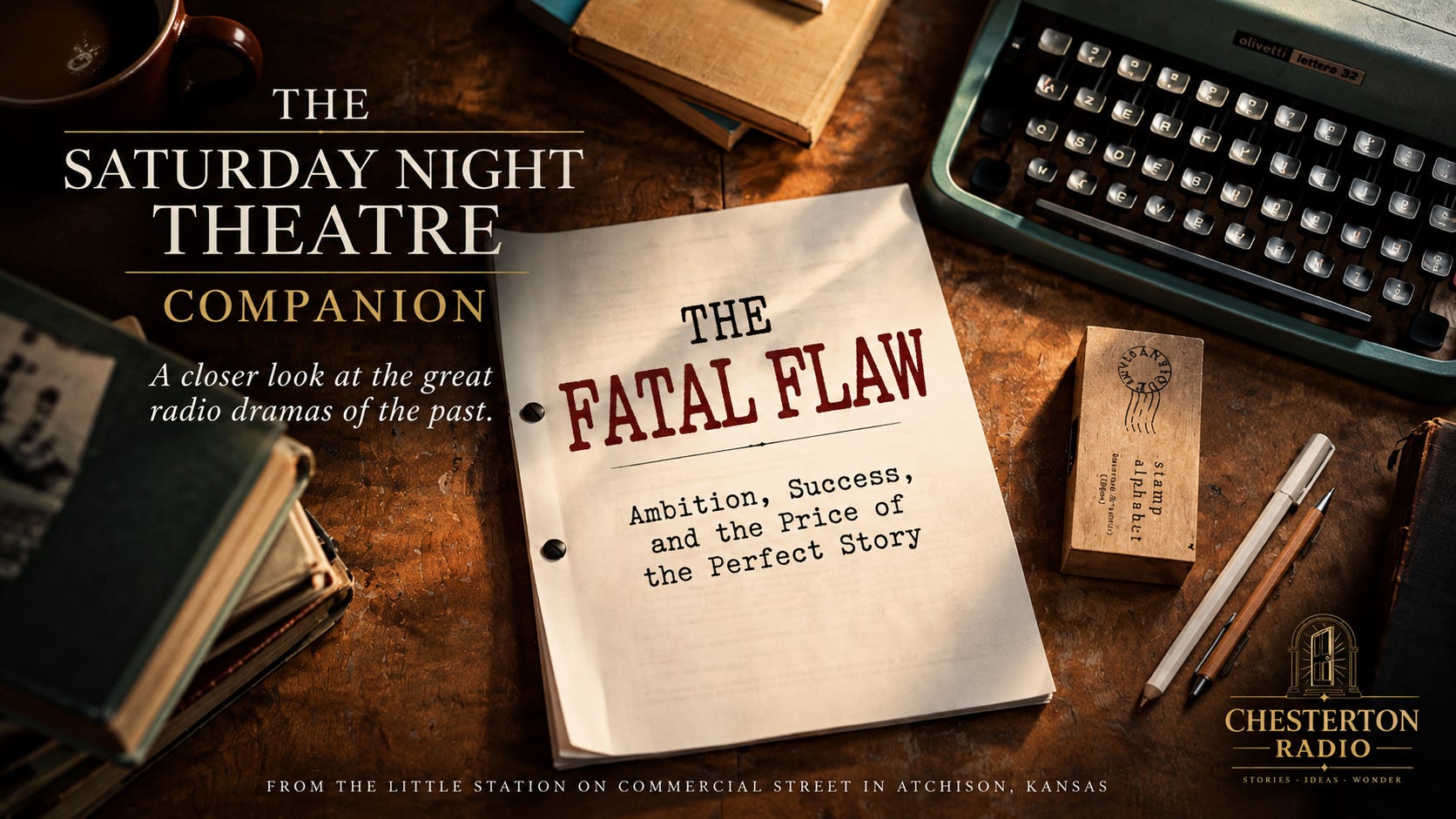 The Fatal Flaw | The Saturday Night Theatre Companion 10.09.2026 36minWhat would you sacrifice to write the book everyone wants to read?In this edition of The Saturday Night Theatre Companion, we return to the BBC’s 1982 radio drama The Fatal Flaw, written by Chris Allen and starring Martyn Read as Matthew Bradford—a writer confronted by the seductive promise of literary success.This Deep Dive includes Spoilers. We invite you to listen to the original play below first then return for our in-depth discussion. We explore the play’s world of writers and publishing, its performances and radio craftsmanship, and the larger questions lurking beneath the story: What happens when ambition overtakes integrity? Can success become its own kind of failure? And where, exactly, does the fatal flaw lie?We’ll begin spoiler-free before moving deeper into the drama and its conclusion—and consider why this largely forgotten radio play remains worth hearing more than forty years later.The Saturday Night Theatre Companion is a Chesterton Radio Original, revisiting the great radio dramas of the past—not simply to remember them, but to discover what they still have to say.From the little station on Commercial Street in Atchison, Kansas. Get full access to CHESTERTON RADIO at www.chestertonradio.com/subscribe
 -
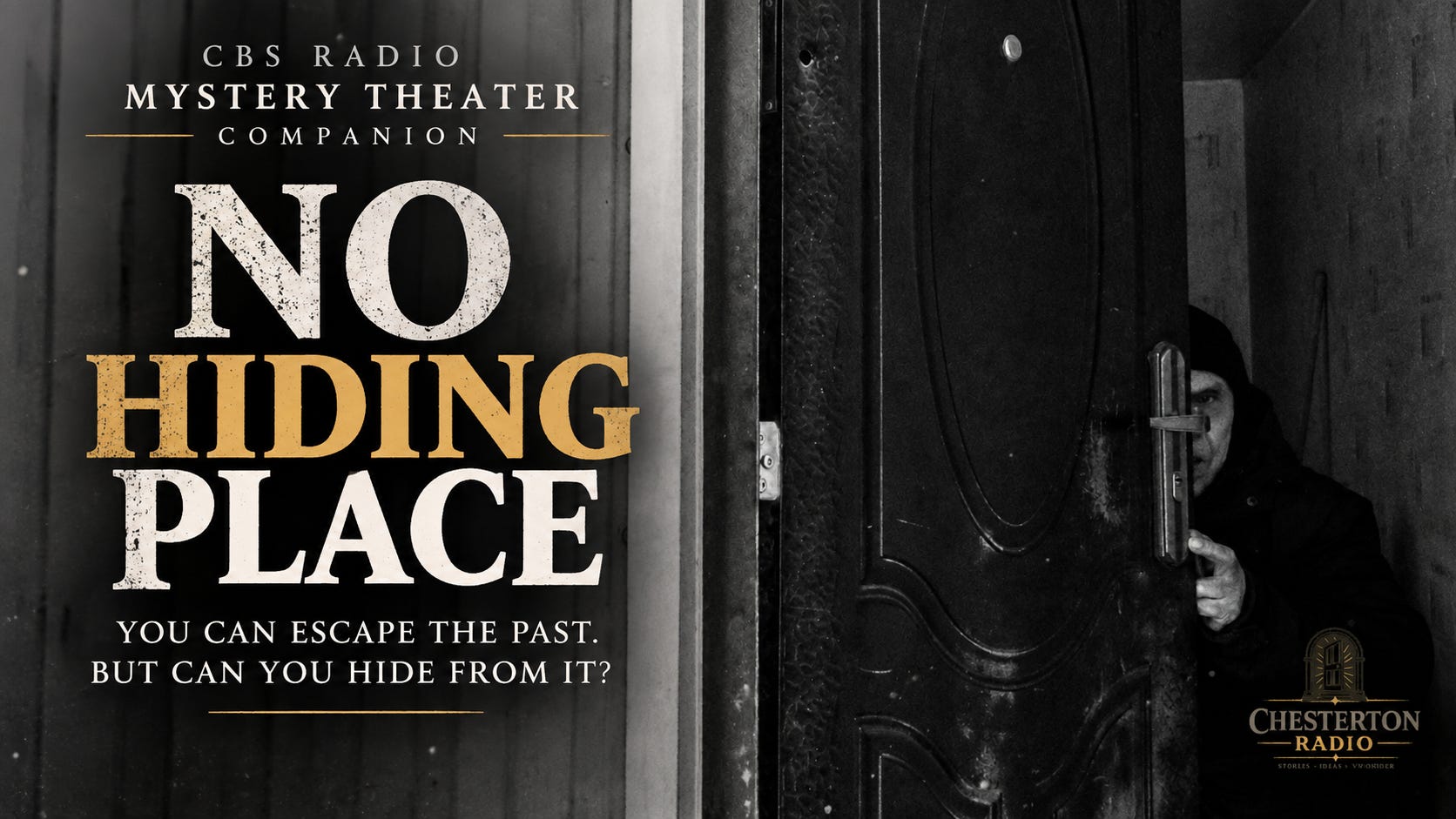 No Hiding Place | You Can Escape the Past. But Can You Hide from It? 10.09.2026 31minWhat happens when the life you’ve built depends upon a past that must never be discovered?On January 10, 1974, CBS Radio Mystery Theater opened the creaking door for only the fifth time with “No Hiding Place,” a tense psychological drama about a man confronted by a secret he believed he had left behind.In this edition of The CBS Radio Mystery Theater Companion, we go beyond the plot to explore the questions underneath it: the difference between legal guilt and moral guilt, reputation and character, justice and revenge—and the terrible things fear can persuade an otherwise decent person to do.We also listen closely to the performances, the remarkable craft of radio drama, and the work of Himan Brown and E. G. Marshall as CBS Radio Mystery Theater was still finding its voice during its very first week on the air.And finally, we return to the title itself.No Hiding Place.Because perhaps the most dangerous secret isn’t the one we’re hiding from other people.It’s the one we’re hiding from ourselves.The CBS Radio Mystery Theater Companion — from the little station on Commercial Street in Atchison, Kansas. Chesterton Radio. Get full access to CHESTERTON RADIO at www.chestertonradio.com/subscribe
 -
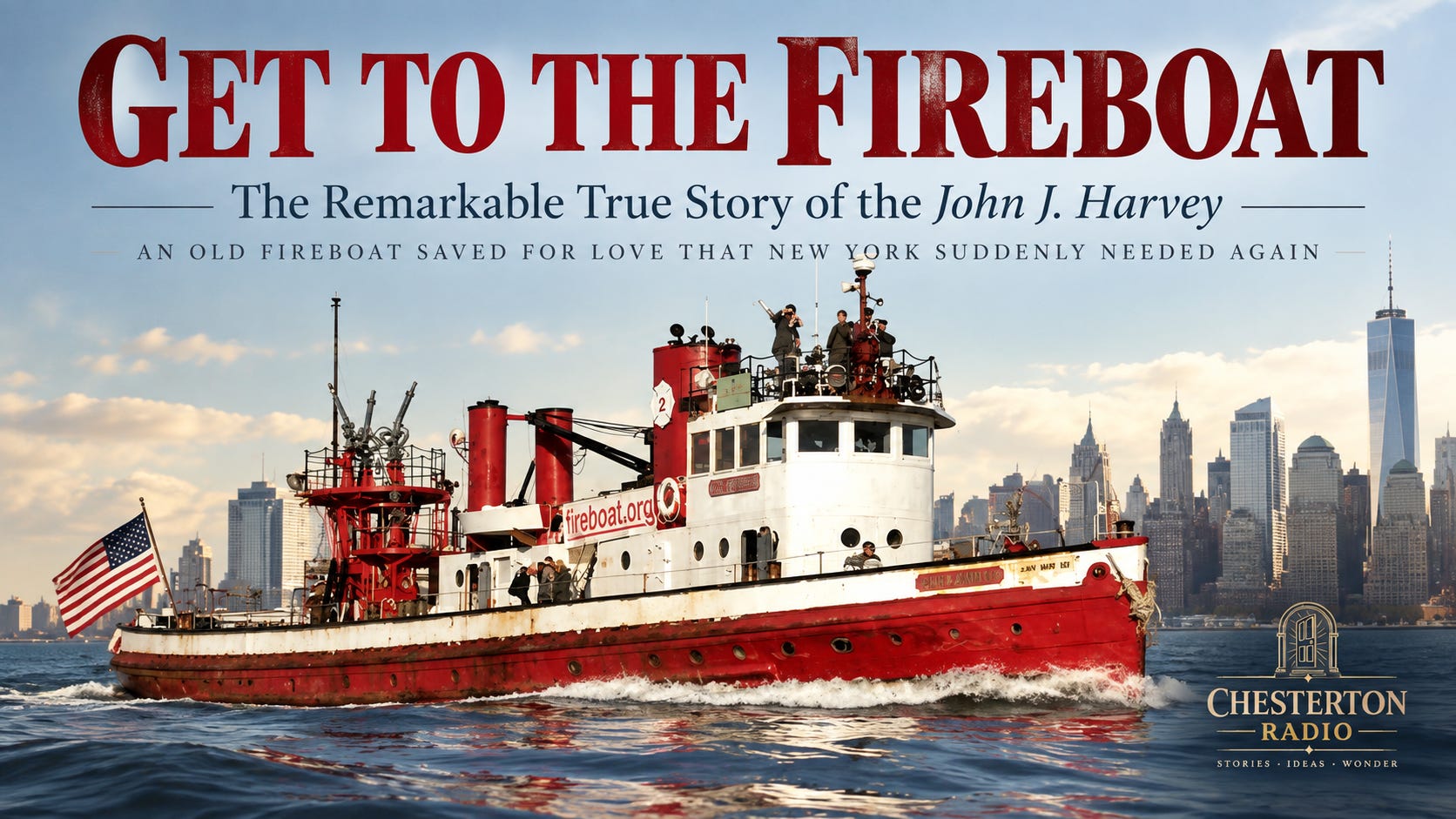 Get to the Fireboat 09.09.2026 30minIn 1999, a wonderfully unlikely group of New Yorkers did something that made very little practical sense.They bought an old fireboat.The John J. Harvey had served New York Harbor for more than six decades. Retired from the FDNY and facing the scrapyard, she seemed to belong to another age. But a diverse group of people couldn’t bear to see her disappear. They pooled their resources, bought the boat, and began bringing her back to life.Not because New York needed another fireboat.They simply thought she was worth saving.Two years later, on the morning of September 11, 2001, those people were scattered around New York as news of the attacks began to spread.And their thoughts turned to the same place:Get to the fireboat.Soon the nearly 70-year-old John J. Harvey was heading down the Hudson toward Lower Manhattan. Before the day was over, a vessel once considered obsolete would again be doing the work she had been built to do.In this Chesterton Radio Deep Dive, we explore the extraordinary true story behind Maira Kalman’s acclaimed children’s book Fireboat: The Heroic Adventures of the John J. Harvey — from the great age of New York fireboats to the Harvey’s retirement, unlikely rescue, and remarkable return to service on September 11.But this is also a story about a larger question:Why do we save old things?Old boats. Old buildings. Old machines. Old books. Old recordings. Old stories.Sometimes we preserve them not because we know we’ll need them, but simply because something tells us they are worth keeping.And every once in a while, history proves us right.From the Little Station on Commercial Street in Atchison, Kansas, this is Chesterton Radio.Support Chesterton RadioIf stories like this are worth preserving, then so is a place where they can still be told. Chesterton Radio is listener-supported, helping us create original stories, thoughtful deep dives, classic radio companions, Daybreak, and the Little Station on Commercial Street. If this program meant something to you, please consider becoming a paid subscriber or making a contribution. Your support helps us keep old stories alive—and create new ones worth keeping.FIREBOAT: The Heroic Adventures of the John J. Harvey Get full access to CHESTERTON RADIO at www.chestertonradio.com/subscribe
 -
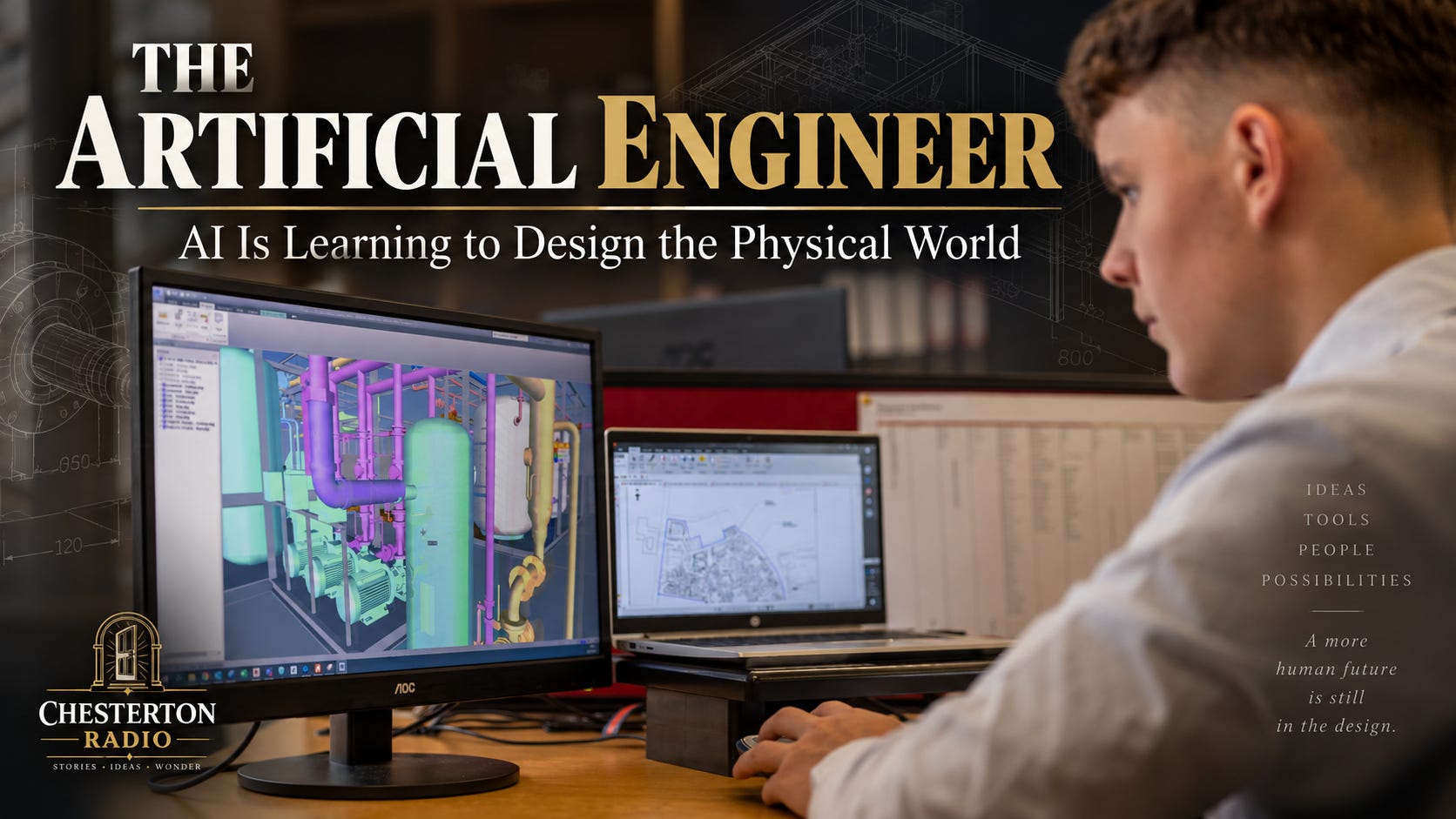 The Artificial Engineer 08.09.2026 28minAI learned to write. Then it learned to code. Now it is beginning to design.For an experienced mechanical engineer, that raises a much more practical question: Can AI multiply the value of decades of engineering experience?In this episode of The Common Room, we examine the cutting edge of AI-assisted mechanical CAD and machine design in 2026—from the perspective of a veteran automation engineer who has spent four decades designing real machines and is now working as an independent consultant.We look at Onshape and its remarkable new AI/MCP connection to parametric CAD; SOLIDWORKS and 3DEXPERIENCE; Autodesk Inventor; PTC Creo; and Siemens NX and Solid Edge. We also look beyond the familiar CAD companies to China’s emerging AI-CAD efforts and Japan’s CADDi, where AI is being applied to the accumulated knowledge surrounding manufacturing and design.Then we go further.Jeff Bezos-backed Prometheus is pursuing the idea of an “artificial general engineer” for the physical world. Meanwhile, local AI tools such as LM Studio and Ollama raise another possibility: a private engineering workstation where confidential designs, calculations, standards, component information and decades of accumulated engineering knowledge could work together with AI.Consider a typical automation project. An engineer must turn requirements into cycle-time calculations, machine architecture, mechanisms, conveyors, actuators, frames, guarding, CAD models, cost estimates and eventually a customer proposal.A senior machine designer may already know what should be built.The bottleneck is often turning that knowledge into all the engineering work required to build it.What happens when AI begins helping with that translation?Could one experienced independent engineer eventually produce the conceptual output that once required a small engineering team?And if AI can increasingly draw, calculate, configure, simulate and document the machine, does forty years of engineering experience become less valuable—or more valuable than ever?The Artificial Engineer is a practical, skeptical look at where mechanical CAD and engineering AI stand today—and where they may be taking the engineering profession next.The Common Room is a Chesterton Radio original from the little station on Commercial Street in Atchison, Kansas.If you value independent programs like this, please consider supporting Chesterton Radio with a paid subscription. Get full access to CHESTERTON RADIO at www.chestertonradio.com/subscribe
 -
 The Mystery Theater Companion #3: “The Bullet” 08.09.2026 32minTwo old Army buddies meet again after nine years. There is only one problem: one of them is dead.Tonight, on The Mystery Theater Companion, we return to the opening week of CBS Radio Mystery Theater for Episode #3, “The Bullet,” originally broadcast January 8, 1974.Written by Sam Dann and produced and directed by Himan Brown, “The Bullet” turns a reunion between wartime friends into a haunting story of memory, guilt, loyalty, and the unfinished business the dead sometimes leave behind.We’ll explore the performances, atmosphere, sound, pacing, and storytelling techniques that make the drama work so effectively in the imagination. We’ll also consider what this third broadcast tells us about the identity CBS Radio Mystery Theater was already beginning to establish in its very first week on the air.The first portion of our conversation is spoiler-free. We’ll give you a clear warning before discussing the story’s major revelations and ending.The Mystery Theater Companion is a nightly journey through CBS Radio Mystery Theater, beginning with Episode #1 and continuing through the series in broadcast order—one story, one night, one conversation at a time.Best experienced after listening to the original drama.From Chesterton Radio — the little station on Commercial Street in Atchison, Kansas.If you enjoy these programs, please consider supporting Chesterton Radio. Your support helps us keep the station streaming, preserve classic radio, and create new programs like The Mystery Theater Companion.And you can listen anytime to Chesterton Radio Live — The Open Door, our 24-hour stream of classic radio, drama, conversation, and more. Get full access to CHESTERTON RADIO at www.chestertonradio.com/subscribe
 -
 Les Misérables: When the Music Comes Home 08.09.2026 49minWe’ve heard this before.Near the end of Les Misérables, Javert confronts an act of mercy that shatters everything he believes about justice—and suddenly the music takes us somewhere strangely familiar.That musical echo is no accident.In this follow-up to “Les Misérables: From Orson Welles to Broadway,” we listen more closely to Claude-Michel Schönberg’s remarkable score: the recurring melodies that connect Valjean and Javert, the different forms of love expressed by Fantine, Éponine, Marius and Cosette, the extraordinary convergence of One Day More, and the music that returns as Valjean’s journey reaches its end.At the center are two men confronted by mercy. One allows it to make him a new man. The other discovers that his entire understanding of the world cannot contain it.Why does Les Misérables remain so powerful when millions of us already know how the story ends?Perhaps because the melodies return for the same reason we return to the story.The questions return.Justice and mercy. Guilt and redemption. Sacrifice and suffering. Hope and love.The barricades belong to another century.The questions do not.A Chesterton Radio Original.Spoiler warning: This program discusses major events throughout Les Misérables, including its ending.Support independent radio: If you enjoy thoughtful programs like this, consider becoming a paid subscriber and helping Chesterton Radio continue creating original programming. Get full access to CHESTERTON RADIO at www.chestertonradio.com/subscribe
 -
 Who’s on First? — The Joke America Never Stopped Telling 08.09.2026 49minA confusing office meeting ended with an unexpected question: “You’ve never seen Who’s on First?”When a new student worker from Eastern Europe didn’t recognize the reference, everyone stopped to introduce him to Abbott and Costello’s legendary routine. It was a small moment—but it raised a wonderful question: How did a vaudeville comedy bit become so deeply embedded in American culture that its title still describes what happens when people simply cannot understand one another?In this Chesterton Radio Deep Dive, we go back to Abbott and Costello’s vaudeville roots, the early radio performances, the famous Naughty Nineties version, and the routine’s place in baseball and American comedy history. Along the way, we look at the remarkable machinery of the joke itself—Who, What, I Don’t Know, Why, Because, Today, Tomorrow and Naturally—and why Bud Abbott may deserve far more credit than he usually gets for making the whole thing work.Most of all, we ask why Who’s on First? still works nearly ninety years later—and what happens when someone hears it for the very first time.Because sometimes the best way to discover an American classic is to sit through a really confusing meeting.Listen to the original routine!Stories. Ideas. Wonder. — Chesterton Radio Get full access to CHESTERTON RADIO at www.chestertonradio.com/subscribe
Līdzīgi podkasti


Populārs valstī
Šis podkasts parādās arī šo valstu podkastu topos.
