
Deutsch Podcast 101 FM – Langsam hören, besser sprechen
Deutsch Podcast 101 FM
0
Deutsch Podcast 101 FM ist ein Hörpodcast für Deutschlernende auf dem Niveau A2 bis B1. In jeder Folge werden Alltagsthemen langsam und deutlich besprochen, damit die Hörerinnen und Hörer gut folgen können. Neben klarer Aussprache und nützlichen Sätzen geht es um typische Situationen aus dem Leben in Deutschland. Der Podcast hilft beim Sprechen, Verstehen und Reagieren und soll mehr Selbstvertrauen im Umgang mit der deutschen Sprache geben.
Epizodes
-
 750€ für eine Wohnung? Lies diese Wörter nicht falsch! | Deutsch A2–B1 #118 15.09.2026 12min🏠 €750 for an Apartment? Kaltmiete or Warmmiete? | German Podcast A2–B1Looking for an apartment in Germany can be confusing—especially when you see words such as Kaltmiete, Warmmiete, Nebenkosten, Einbauküche or Zwei-Zimmer-Wohnung for the first time.In this episode of Deutsch Podcast 101 FM, Emil and Sophia examine a realistic apartment listing. Sophia believes she has found a two-room apartment for only €750—but has she understood the price and number of rooms correctly?You will learn how to:• understand German apartment listings• distinguish between Kaltmiete and Warmmiete• calculate the approximate monthly rent• understand how rooms are counted in Germany• ask what is included in the apartment• compare two different listings• contact a landlord politely• request an apartment viewing💶 Understanding the rent:die Kaltmiete — basic rent without additional service chargesdie Nebenkosten — additional building and utility-related chargesdie Warmmiete — Kaltmiete plus the listed NebenkostenExample:750 € Kaltmiete + 180 € Nebenkosten = 930 € WarmmieteHowever, electricity, internet and some other costs may still have to be paid separately. Always ask exactly what is included.„Wie hoch ist die Warmmiete?“How much is the total warm rent?„Was ist in den Nebenkosten enthalten?“What is included in the additional charges?„Sind Strom und Internet in der Warmmiete enthalten?“Are electricity and internet included in the warm rent?🚪 Understanding the apartment:die Zwei-Zimmer-Wohnung — a two-room apartmentIn Germany, the living room normally counts as a room. A two-room apartment usually means one living room and one bedroom—not two bedrooms.die Wohnfläche — living spaceder Quadratmeter — square metredie Einbauküche — fitted kitchenmöbliert — furnishedunmöbliert — unfurnishedab sofort — available immediatelyfrei ab … — available from …zentral gelegen — centrally locateddie Besichtigung — apartment viewing🗣️ Useful questions:„Wie viele Schlafzimmer hat die Wohnung?“How many bedrooms does the apartment have?„Gehört die Einbauküche zur Wohnung?“Is the fitted kitchen included with the apartment?„Welche Küchengeräte gehören dazu?“Which kitchen appliances are included?„Bleiben die Möbel in der Wohnung?“Will the furniture remain in the apartment?„Ab wann ist die Wohnung frei?“From when is the apartment available?„Wie weit ist die Wohnung vom Stadtzentrum entfernt?“How far is the apartment from the city centre?✉️ Message to a landlord:„Guten Tag, ich interessiere mich für Ihre Wohnung. Ist die Wohnung noch verfügbar? Wann wäre eine Besichtigung möglich? Viele Grüße, [Name]“Hello, I am interested in your apartment. Is it still available? When would a viewing be possible? Kind regards, [name]⚠️ Important reminder:Never look only at the largest price in the listing. Check the complete monthly cost, location, number of rooms, availability, kitchen and furniture. If an offer seems unusually cheap, ask questions and view the apartment before sending money.🎯 Useful sentence for comparing apartments:„Ich würde Wohnung B nehmen, weil sie zentral liegt und einen Balkon hat.“I would choose apartment B because it is centrally located and has a balcony.Which is more important to you: lower rent, a central location, more space or a fitted kitchen?🎧 Learn German naturally. Understand everyday life in Germany. Speak with more confidence.
 -
Du wartest auf den richtigen Moment – und verlierst Zeit | Deutsch Podcast A2–B1 #117 12.09.2026 12min⏳ Stop Waiting – Your Life Is Happening Now | German Podcast A2–B1Do you often say, “I’ll do it later”?Later, when you have more time. Later, when you have more money. Later, when your German is better or your life is less stressful.But what if the perfect moment never comes?In this reflective episode of Deutsch Podcast 101 FM, Emil and Sophia talk about postponed dreams, difficult decisions and the power of taking one small step today.While listening to slow and natural German, you will learn how to:• talk about plans, possibilities and decisions• say that you want to try something new• describe what gives or takes away your energy• stop waiting for the perfect moment• use practical German sentences in real conversations⭐ Three important ideas from this episode:There is not only one correct path in life.You do not have to change everything—start with a small test.Do not wait for a new life to enjoy meaningful moments.🗣️ Useful German sentences:„Worauf habe ich eigentlich gewartet?“What was I actually waiting for?„Es gibt nicht nur einen richtigen Weg.“There is not only one right path.„Vielleicht gibt es mehrere gute Möglichkeiten.“Perhaps there are several good possibilities.„Welche Zukunft macht mich neugierig?“Which future makes me curious?„Ich möchte das einfach mal ausprobieren.“I would simply like to give it a try.„Ich probiere es erst einmal aus.“I’ll try it first and see how it goes.„Ich muss heute noch nicht alles entscheiden.“I do not have to decide everything today.„Das tut mir gut.“That is good for me. / That makes me feel better.„Ich will mir dafür Zeit nehmen.“I want to make time for it.„Was hat mir heute Energie gegeben?“What gave me energy today?„Was hat mir Energie genommen?“What took away my energy today?„Ich kann gestern nicht ändern.“I cannot change yesterday.„Aber ich kann heute etwas Kleines tun.“But I can do something small today.„Ein kleiner Schritt ist kein kleines Leben.“A small step does not mean a small life.⭐ The courage sentence:„Ich fange klein an.“I’m starting small.📚 Important vocabulary:auf etwas warten — to wait for somethingetwas aufschieben — to postpone somethingetwas ausprobieren — to try somethingdie Möglichkeit — possibilitydie Entscheidung — decisionder richtige Weg — the right pathneugierig — curiousder Schnupperkurs — introductory trial classsich Zeit nehmen — to make timeanfangen — to begindie Erfahrung — experiencedie Ausrüstung — equipment💡 Useful grammar patterns:„Ich warte auf den richtigen Moment.“I’m waiting for the right moment.„Ich nehme mir Zeit für meine Freunde.“I make time for my friends.„Ich probiere einen neuen Kurs aus.“I try a new course.🎯 Think of one thing you always postpone. Do not complete the whole goal today—just take the first real step. Send a message, find an appointment, book a trial class or spend ten minutes trying something new.Your life does not begin later. It is already happening now.🎧 Learn German naturally. Understand meaningful conversations. Speak with more confidence.
-
15 Sätze, die Deutsche ständig sagen – aber niemand erklärt Deutsch A2–B1 #116 11.09.2026 12min🗣️ 15 Everyday German Phrases Native Speakers Use All the Time | A2–B1Do you understand the individual German words—but still wonder what the complete sentence really means?Native speakers often use short expressions such as „Mal sehen“, „Kommt drauf an“ or „Mach dir keinen Kopf“. These phrases sound simple, but their real meaning depends on the situation.In this episode of Deutsch Podcast 101 FM, Emil and Sophia explain 15 common German phrases for small talk, reactions, plans, appointments, requests and difficult moments.You will learn:• what each phrase really means• when and with whom you can use it• which expressions are informal• how shortened spoken German differs from textbook German• how to react more naturally in everyday conversations💬 Small talk:„Wie läuft’s bei dir?“How are things going for you?„Was gibt’s Neues?“What’s new?„Und sonst so?“What else is new? / Anything else?You can keep the conversation going with:„Ganz gut. Bei der Arbeit ist gerade viel los. Und bei dir?“Pretty good. Things are busy at work at the moment. How about you?😮 Natural reactions:„Echt jetzt?“Really? / Seriously?„Ach so!“Oh, I see!„Das gibt’s doch nicht!“No way! / I can’t believe it!A friendly example:„Ach so, jetzt verstehe ich.“Oh, I see. Now I understand.📅 Plans and appointments:„Kommt drauf an.“It depends.The complete form is:„Es kommt darauf an.“It depends.„Mal sehen.“We’ll see.⚠️ Important: “Mal sehen” is not a definite yes. It means the person has not decided yet.If you need a clear answer, ask:„Kannst du mir bitte bis morgen Bescheid geben?“Could you please let me know by tomorrow?„Das passt für mich.“That works for me.„Bin gleich da!“I’ll be there soon!The complete form is:„Ich bin gleich da.“I’ll be there soon.If you need more time, be more specific:„Ich bin in ungefähr zwanzig Minuten da.“I’ll be there in approximately twenty minutes.🤝 Help, tasks and difficult moments:„Kannst du mir kurz helfen?“Can you help me for a moment?A more formal version is:„Könnten Sie mir bitte kurz helfen?“Could you please help me for a moment?„Das kriege ich hin.“I can manage that. / I can do it.A more neutral version is:„Das bekomme ich hin.“I can manage that.„Kein Problem, mach ich.“No problem, I’ll do it.„Mach dir keinen Kopf.“Don’t worry about it.This is an informal phrase used with friends, family and friendly colleagues.„So war das nicht gemeint.“That’s not what I meant.You can then explain your real intention:„Nein, so war das nicht gemeint. Ich wollte nur sagen, dass …“No, that’s not what I meant. I only wanted to say that …⭐ Most important lesson:Short German sentences can have meanings that are not immediately obvious. You do not need to understand everything perfectly—you learn these small differences through real conversations.🎯 Choose three phrases, repeat them aloud and use at least one of them in a real conversation this week.🎧 Learn German naturally. Understand native speakers. Speak with more confidence.
-
Alle in Deutschland sagen diese 15 Wörter — weißt du, was sie bedeuten? | Deutsch A2-B1 #115 10.09.2026 20min15 Essential German Words for Life in Germany | German Podcast A2–B1Have you recently moved to Germany—or do official letters from German authorities still feel confusing?Words such as Anmeldung, Rundfunkbeitrag, Nebenkostenabrechnung and Widerspruch are rarely taught in ordinary German courses, but you will see them everywhere in everyday life.In this episode of Deutsch Podcast 101 FM, Emil and Sophia explain 15 essential words connected to registration, housing, insurance, appointments, taxes and official documents.For every word, you will hear:• a simple explanation• clear pronunciation• a real everyday situation• a practical tip• a short example dialogue📚 The 15 essential German words:die Anmeldung — address registrationder Rundfunkbeitrag — household broadcasting contributiondie Kaution — rental depositdie Bescheinigung — official certificate or confirmationder Termin — appointmentdie Sozialversicherungsnummer — social insurance numberdie Krankenversicherung — health insurancedie Nebenkostenabrechnung — annual utility and service-charge statementdas Kindergeld — child benefitder Widerspruch — formal objection or appealdas Pfand — refundable deposit on bottles and cansdie Steuererklärung — tax returndie Ummeldung — address registration after movingdie Abmeldung — official deregistrationder Sperrmüll — bulky waste🗣️ Useful German sentences:„Guten Morgen. Ich möchte mich anmelden. Ich bin neu hier.“Good morning. I would like to register my address. I am new here.„Welche Unterlagen brauche ich für die Anmeldung?“Which documents do I need for the registration?„Ich möchte gerne einen Termin vereinbaren.“I would like to make an appointment.„Wann passt es Ihnen?“When would be convenient for you?„Können Sie mir bitte eine Bescheinigung geben?“Could you please give me an official confirmation?„Wie hoch ist die Kaution?“How much is the rental deposit?„Wann bekomme ich die Kaution zurück?“When will I get the deposit back?„Ich habe die Nebenkostenabrechnung nicht verstanden.“I did not understand the utility and service-charge statement.„Können Sie mir das bitte erklären?“Could you please explain that to me?„Hier ist meine Versicherungskarte.“Here is my health-insurance card.„Hiermit lege ich Widerspruch gegen Ihren Bescheid vom [Datum] ein.“I hereby submit an objection to your official decision dated [date].„Ich bin umgezogen und möchte mich ummelden.“I have moved and would like to register my new address.„Wo kann ich Sperrmüll anmelden?“Where can I arrange a bulky-waste collection?⭐ Useful word family:Anmeldung — registering when you arriveUmmeldung — updating your registration after movingAbmeldung — deregistering when you leave🎯 Choose three words from this episode and use them this week. Make an appointment, ask for a certificate, read an official letter or practise one of the example sentences aloud.Please remember that procedures, deadlines, fees and eligibility can vary depending on your city and personal situation. Always check the relevant official authority for current information.🎧 Learn German naturally. Understand everyday life in Germany. Speak with more confidence.
-
Wohnungsbesichtigung : Diese Fragen musst du kennen | A2–B1 #119 09.09.2026 13min🔑 Apartment Viewing in Germany: Questions You Need to Know | German Podcast A2–B1Are you going to a Wohnungsbesichtigung in Germany?You may understand the apartment listing—but what should you say when you meet the landlord? Which costs should you ask about? And what can you say if the landlord speaks too quickly?In this episode of Deutsch Podcast 101 FM, Emil and Sophia prepare for a real apartment viewing. You will learn simple, polite questions that help you understand the apartment and show genuine interest.You will learn how to:• introduce yourself when you arrive• ask what is included in the rent• ask about electricity and heating costs• check whether the fitted kitchen remains• mention moisture or other problems• ask someone to speak more slowly• ask about pets and parking• show that you are interested• ask what happens after the viewing👋 When you arrive:„Guten Tag. Ich habe um achtzehn Uhr einen Besichtigungstermin.“Good afternoon. I have a viewing appointment at 6 p.m.„Vielen Dank, dass ich die Wohnung besichtigen darf.“Thank you for allowing me to view the apartment.„Darf ich mich kurz umsehen?“May I have a quick look around?💶 Questions about rent and additional costs:„Wie hoch ist die Warmmiete?“How much is the total warm rent?„Was ist in den Nebenkosten enthalten?“What is included in the additional charges?„Sind die Heizkosten in der Warmmiete enthalten?“Are the heating costs included in the warm rent?„Muss ich Strom extra bezahlen?“Do I have to pay for electricity separately?„Gibt es noch weitere monatliche Kosten?“Are there any other monthly costs?🍳 Questions about the kitchen and furniture:„Bleibt die Einbauküche in der Wohnung?“Does the fitted kitchen remain in the apartment?„Welche Geräte gehören zur Küche?“Which appliances are included with the kitchen?„Muss ich für die Küche eine Ablöse bezahlen?“Do I have to pay a takeover fee for the kitchen?„Bleiben die Möbel in der Wohnung?“Will the furniture remain in the apartment?🔍 Questions about the condition of the apartment:„Gibt es hier ein Problem mit Feuchtigkeit?“Is there a problem with dampness here?„Gab es in der Wohnung schon einmal Schimmel?“Has there ever been mould in the apartment?„Funktionieren die Heizung und die Fenster einwandfrei?“Do the heating system and windows work properly?🐕 Other practical questions:„Sind Haustiere erlaubt?“Are pets allowed?„Gibt es einen Stellplatz oder eine Garage?“Is there a parking space or garage?„Ist der Stellplatz im Preis enthalten?“Is the parking space included in the price?„Ab wann kann ich einziehen?“From when can I move in?👂 If you do not understand something:„Könnten Sie das bitte noch einmal sagen?“Could you please say that again?„Könnten Sie bitte etwas langsamer sprechen?“Could you please speak a little more slowly?„Was bedeutet das genau?“What exactly does that mean?⭐ Showing your interest:„Die Wohnung gefällt mir sehr gut.“I like the apartment very much.„Ich interessiere mich sehr für die Wohnung.“I am very interested in the apartment.„Welche Unterlagen benötigen Sie von mir?“Which documents do you need from me?„Wie geht es jetzt weiter?“What happens next?„Wann kann ich mit einer Rückmeldung rechnen?“When can I expect a response?📚 Important vocabulary:die Wohnungsbesichtigung — apartment viewingder Besichtigungstermin — viewing appointmentdie Nebenkosten — additional chargesdie Heizkosten — heating costsder Strom — electricitydie Einbauküche — fitted kitchendie Ablöse — payment for taking over itemsdie Feuchtigkeit — dampness / moistureder Schimmel — mouldder Stellplatz — parking spacedie Haustiere — petsdie Unterlagen — documentseinziehen — to move indie Rückmeldung — response / feedback💡 You do not need complicated German at an apartment viewing. A few simple and clear questions can help you understand what is included and avoid unpleasant surprises.
-
Krank in Deutschland – aber du kannst es nicht erklären? #144 08.09.2026 10minWhat should you say when you need to see a doctor in Germany but do not have an appointment?For many German learners, visiting a doctor is stressful. You may know the necessary words—but when you enter the doctor’s office, you suddenly forget everything.In this episode of Deutsch Podcast 101 FM, Emil and Sophia teach you simple, practical German sentences that you can use at a doctor’s office in Germany.You will learn how to:• ask to see a doctor without an appointment• explain your symptoms clearly• say where and how much something hurts• talk about your health insurance• ask the doctor to repeat or explain something• understand natural spoken German⭐ The first important sentence:„Guten Morgen, ich habe keinen Termin, aber ich würde gerne einen Arzt sprechen.“Good morning. I don’t have an appointment, but I would like to speak to a doctor.„Ich habe seit gestern Schmerzen. Ist es möglich, heute noch einen Arzt zu sehen?“I have been in pain since yesterday. Is it possible to see a doctor today?🗣️ Explaining your symptoms:„Ich habe Bauchschmerzen.“I have stomach pain.„Ich habe Kopfschmerzen.“I have a headache.„Ich habe Rückenschmerzen.“I have back pain.„Ich fühle mich nicht gut.“I don’t feel well.„Ich habe die Schmerzen seit drei Tagen.“I have had the pain for three days.„Es tut hier oben weh.“It hurts up here.„Es tut links / rechts weh.“It hurts on the left / right side.„Die Schmerzen sind nicht sehr stark, aber konstant.“The pain is not very strong, but it is constant.„Manchmal sind die Schmerzen sehr stark.“Sometimes the pain is very strong.💬 If you do not understand something:„Können Sie das bitte wiederholen?“Could you please repeat that?„Können Sie das bitte langsamer sagen?“Could you please say that more slowly?„Können Sie das bitte aufschreiben?“Could you please write that down?„Ich habe das nicht ganz verstanden. Was bedeutet das?“I didn’t fully understand that. What does it mean?„Was soll ich jetzt machen?“What should I do now?„Wie sagt man das auf Deutsch?“How do you say that in German?🏥 Insurance and referral:„Ich habe keine Überweisung.“I don’t have a referral.„Ich bin Kassenpatient.“I have public health insurance.„Ich bin Privatpatient.“I have private health insurance.📝 Important vocabulary:der Arzt / die Ärztin — doctorder Termin — appointmentdie Praxis — doctor’s officedie Schmerzen — painder Bauch — stomach / bellyder Kopf — headder Rücken — backdie Überweisung — referralder Kassenpatient — public-insurance patientwiederholen — to repeataufschreiben — to write downverstehen — to understand⭐ The courage sentence for this episode:„Ich muss nicht perfekt sein. Ich muss nur anfangen.“I don’t have to be perfect. I just have to start.🎯 Write down the first sentence, read it aloud, and repeat it three times. One prepared sentence can make your next visit to the doctor much easier.🎧 Learn German naturally. Understand everyday conversations. Speak with more confidence.
-
Meine Morgenroutine | A2-B1 | Deutsch Podcast #113 07.09.2026 14minHave you ever been asked „Wie war dein Morgen?“—“How was your morning?”—and answered with only „Gut“?You probably did many things: you got up, brushed your teeth, made coffee, got dressed, prepared your child for daycare, or travelled to work. But how can you describe all of this naturally in German?In this episode of Deutsch Podcast 101 FM, Emil and Sophia help you talk about your morning routine using simple, practical German sentences.You will learn how to:• describe your morning in the correct order• use common morning-routine verbs• talk about the time naturally• describe how you feel in the morning• answer everyday questions from colleagues and friends📚 Useful words for showing order:zuerst — firstdann — thendanach — after thatam Ende — finally / at the end🗣️ Example morning routine:„Zuerst stehe ich auf.“First, I get up.„Dann gehe ich ins Bad.“Then I go to the bathroom.„Danach mache ich mir Kaffee.“After that, I make myself some coffee.„Am Ende gehe ich aus dem Haus.“Finally, I leave the house.⭐ Useful German sentences from this episode:„Meistens stehe ich gegen sieben Uhr auf.“I usually get up at around seven o’clock.„Danach putze ich mir die Zähne.“After that, I brush my teeth.„Ich ziehe mich an.“I get dressed.„Um acht Uhr gehe ich los.“I leave at eight o’clock.„Ich fahre mit der Bahn zur Arbeit.“I travel to work by train.„Ich brauche morgens erst mal zehn Minuten Ruhe.“I need ten minutes of quiet first thing in the morning.„Ich bin morgens noch ein bisschen müde.“I’m still a little tired in the morning.„Ich hatte wenig Zeit, aber ich habe es geschafft.“I didn’t have much time, but I managed it.„Ich komme langsam in den Tag.“I’m slowly getting into the day.👨👩👧 Useful sentences for parents:„Ich mache mein Kind für die Kita fertig.“I get my child ready for daycare.„Ich bringe mein Kind in die Kita.“I take my child to daycare.⭐ The most important sentence:„Mein Morgen war etwas stressig, aber jetzt bin ich da.“My morning was a little stressful, but now I’m here.This sentence is simple, honest, and perfect for conversations with colleagues.📝 Important vocabulary:der Wecker — alarm clockaufstehen — to get upsich waschen — to wash oneselfsich anziehen — to get dressedfrühstücken — to have breakfastlosgehen — to leave / set offruhig — calmstressig — stressfulmüde — tiredgegen sieben — around seven o’clock🎯 Your practice task:Say three sentences about your morning:What time do you get up?What do you do next?Was your morning calm or stressful?🎧 Learn German naturally. Understand everyday conversations. Speak with more confidence.
-
🎙️ I Stayed Silent – Say the First Sentence | German Podcast B1-B2 #112 06.09.2026 14minHave you ever known what you wanted to say in German—but stayed silent because you were afraid of making a mistake?In this episode of Deutsch Podcast 101 FM, Emil and Sophia talk about speaking anxiety, leaving your comfort zone, and why one simple sentence can change everything.You will hear the story of Mia, who understands German well but rarely speaks at work. When a colleague suddenly asks for her opinion, she has to decide: stay silent again—or finally say the first sentence?This episode will help you:• understand natural, slow German• speak even when you feel nervous• stop waiting for “perfect” German• take small steps outside your comfort zone• learn useful phrases for work and everyday life📚 Useful German sentences from this episode:„Ich möchte etwas Neues ausprobieren – auch wenn es sich komisch anfühlt.“I want to try something new—even if it feels strange.„Ich fange klein an. Nur ein kleiner Schritt heute.“I’m starting small. Just one small step today.„Ich habe ein bisschen Angst – aber ich mache es trotzdem.“I’m a little afraid—but I’m doing it anyway.„Ich probiere das einfach mal aus.“I’ll just give it a try.In natural spoken German, you will often hear:„Ich probier das einfach mal.“I’ll just give it a try.„Das ist neu für mich – aber ich lerne gerade.“This is new to me—but I’m still learning.„Können Sie mir kurz helfen? Ich bin noch nicht so sicher.“Could you help me for a moment? I’m not very confident yet.„Ich mache vielleicht Fehler – aber ich versuche es.“I may make mistakes—but I’m trying.⭐ The most important sentence:„Du musst nicht bereit sein, um anzufangen. Du wirst bereit, indem du anfängst.“You don’t have to be ready before you start. You become ready by starting.📝 Important vocabulary:schweigen — to remain silentder Mut — couragedie Angst — feardie Komfortzone — comfort zoneetwas ausprobieren — to try somethingetwas aufschieben — to postpone somethingsich anmelden — to register or sign uptrotzdem — nevertheless / anywayder erste Schritt — the first step🎯 After listening, choose one small step: say „Guten Morgen“, ask one question in German, or send a short German message.What is one thing you would like to try? Say your first sentence today.🎧 Learn German naturally. Understand real conversations. Speak with more confidence.
-
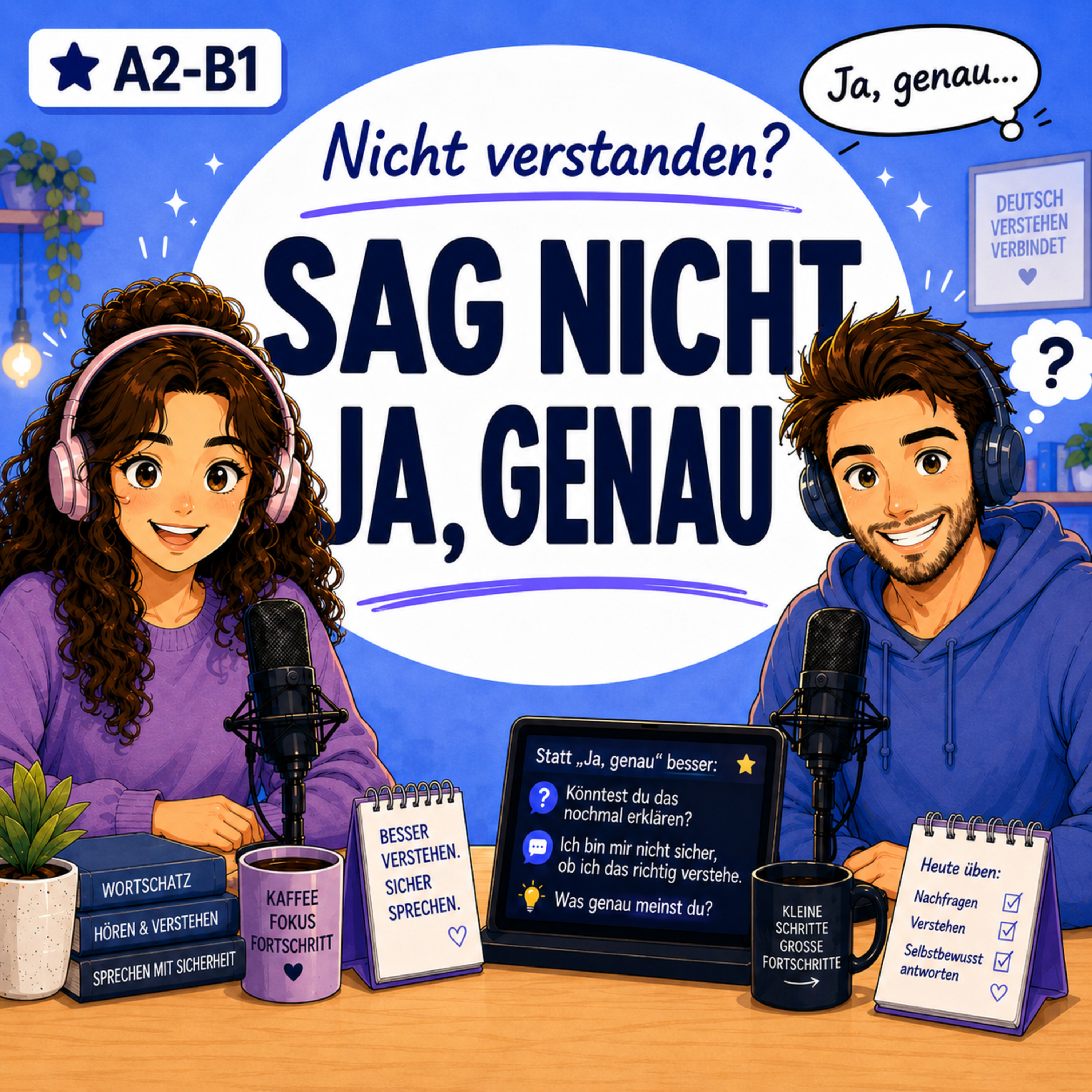 Nicht verstanden? Sag nicht einfach „Ja, genau“ | Deutsch Podcast 101FM | #111 01.06.2026 10minIn dieser Folge sprechen Emil und Sophia über den Gedanken: „Mein Deutsch ist nicht gut genug.“ Warum kommt dieser Gedanke besonders in stressigen Situationen – beim Arzt, am Telefon, bei der Arbeit oder beim Nachbarn? Und warum bedeutet ein Fehler nicht, dass dein Deutsch schlecht ist?Du lernst einfache und stärkende Sätze wie: „Ich spreche nicht perfekt, aber ich spreche“, „Könnten Sie das bitte langsamer wiederholen?“, „Ich verstehe das Wort nicht ganz“ und „Ich bin gerade etwas nervös, aber ich versuche es.“ Diese Folge hilft dir, deinen inneren Kritiker leiser zu machen und mutiger Deutsch zu sprechen.Perfekt für A2–B1 Deutschlernende: langsam gesprochen, klar erklärt und mit echten Alltagssituationen.
 -
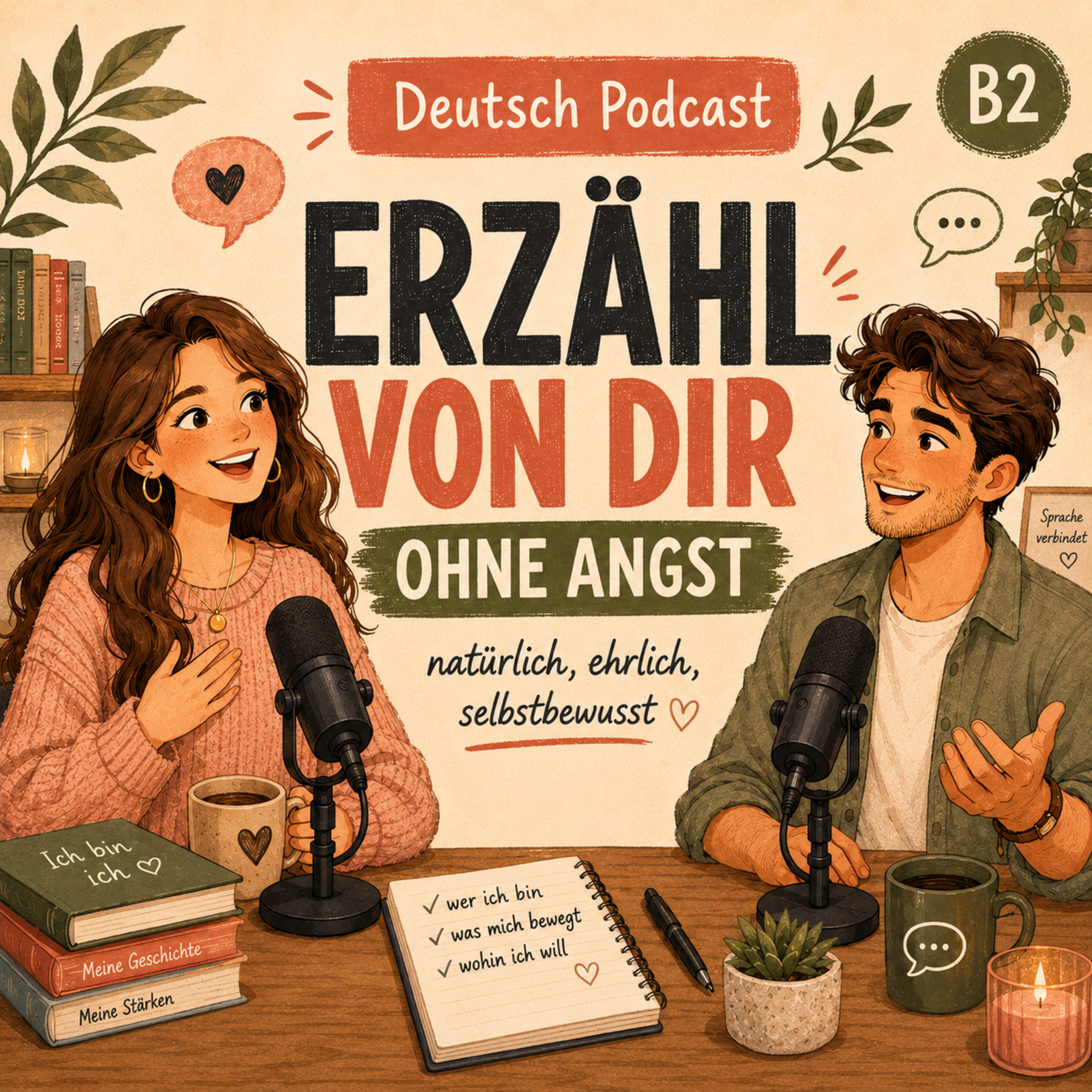 So sprichst du über dich auf Deutsch | Deutsch Podcast B2 | #110 31.05.2026 15minIn dieser Folge sprechen Emil und Sophia darüber, wie du auf Deutsch über dich selbst sprechen kannst – im Deutschkurs, bei der Arbeit, mit neuen Leuten oder in echten Alltagssituationen. Was sagt man, wenn jemand fragt: „Erzähl mal etwas über dich“ und der Kopf plötzlich leer ist?Du lernst einfache und natürliche Sätze wie: „Ich komme ursprünglich aus…“, „Mittlerweile lebe ich in Deutschland“, „Ich bin am Anfang etwas zurückhaltend“ und „Ich suche gerade das richtige Wort“. Diese Folge hilft dir, dich freundlicher, ruhiger und selbstbewusster auf Deutsch vorzustellen.Perfekt für A2–B1 Deutschlernende: langsam gesprochen, klar erklärt und mit echten Beispielen aus dem Alltag.
 -
 Keine Lust? Fang trotzdem an | Deutsch Podcast A2-B1 | #109 30.05.2026 13minIn dieser Folge sprechen Emil und Sophia über Zeit, Schuldgefühle und den inneren Schweinehund beim Deutschlernen. Was passiert, wenn du eigentlich Deutsch lernen willst, aber plötzlich zwei Stunden am Handy bist? Und wie kannst du wieder anfangen, ohne dich selbst fertigzumachen?Du lernst einfache und motivierende Sätze wie: „Ich bin nicht faul“, „Ich fange jetzt klein an“, „Ich brauche eine kurze Pause, dann mache ich weiter“ und „Heute war nicht perfekt, aber ich mache weiter“. Diese Folge hilft dir, mit kleinen Schritten wieder ins Deutschlernen zu kommen.Perfekt für A2–B1 Deutschlernende: langsam gesprochen, klar erklärt und mit echten Alltagssituationen.
 -
 Sag es richtig: DU oder SIE | Deutsch Podcast A2-B1 | Höflich sprechen | #108 29.05.2026 12minIn dieser Folge sprechen Emil und Sophia über eine der größten Fallen im Deutschen: Soll man „du“ oder „Sie“ sagen? Viele Deutschlernende haben Angst, im Gespräch unhöflich zu wirken – beim Nachbarn, im Büro, im Fitnessstudio oder mit fremden Personen.Du lernst einfache und nützliche Sätze wie: „Darf ich du sagen?“, „Sollen wir uns duzen?“, „Entschuldigung, soll ich Sie duzen oder siezen?“ und „Ich bin mir nicht sicher, was hier höflicher ist.“ Diese Folge hilft dir, höflicher und sicherer auf Deutsch zu sprechen.Perfekt für A2–B1 Deutschlernende: langsam gesprochen, klar erklärt und mit echten Alltagssituationen aus Deutschland.
 -
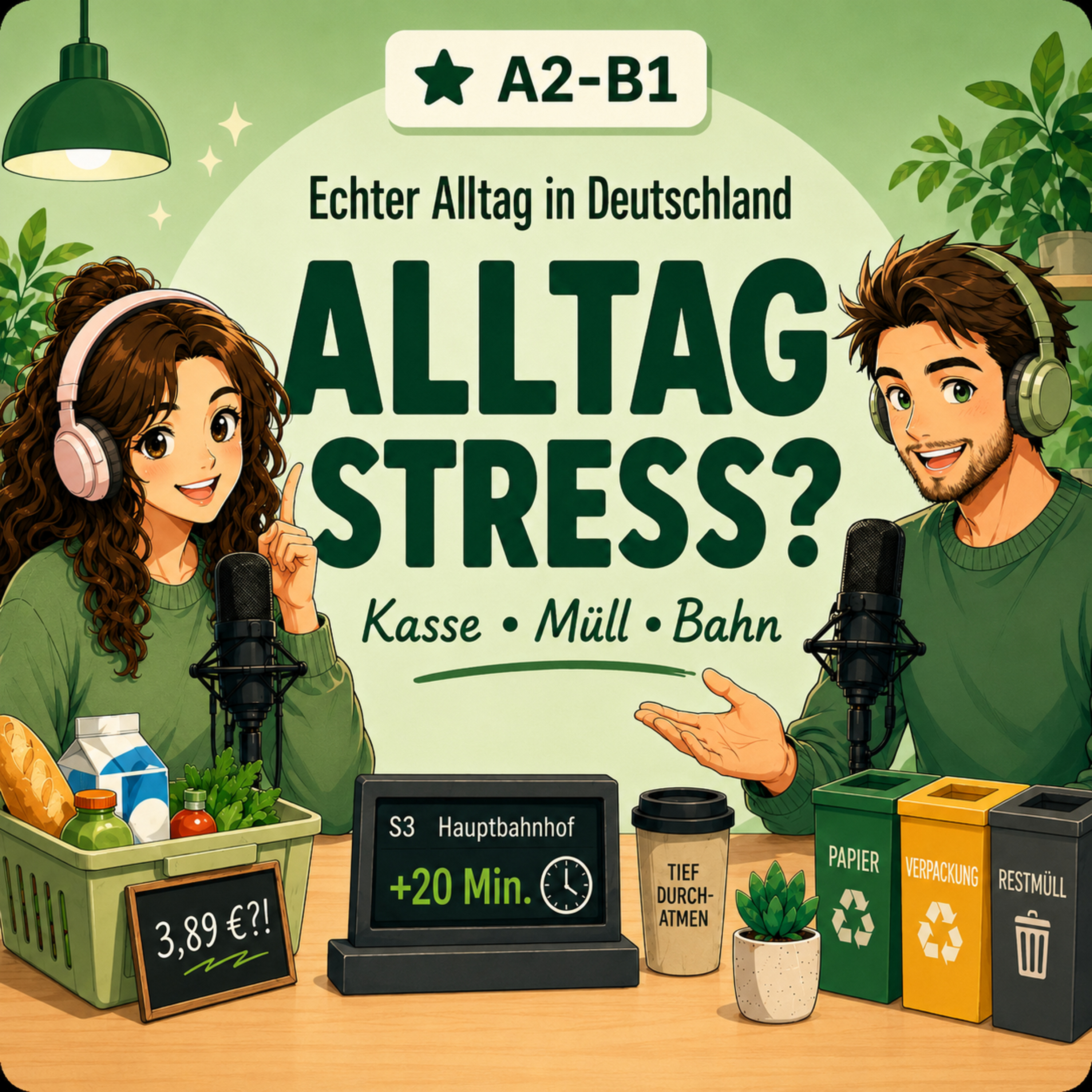 Echter Alltag in Deutschland | Deutsch Podcast A2-B1 für Anfänger | #107 28.05.2026 13minIn dieser Folge sprechen Emil und Sophia über den echten Alltag in Deutschland – nicht wie im Lehrbuch, sondern so, wie er wirklich ist: schnelle Supermarktkassen, Pfandautomaten, Bargeld, Mülltrennung, Sonntage, Arzttermine, Stoßlüften und Deutsche Bahn.Du lernst einfache und nützliche Sätze wie: „Könnten Sie das bitte etwas langsamer machen?“, „In welche Tonne kommt das?“ und „Ich habe keinen Termin, aber ich habe Schmerzen.“ Diese Folge hilft dir, typische Alltagssituationen in Deutschland besser zu verstehen und ruhiger zu reagieren.Perfekt für A2–B1 Deutschlernende: langsam gesprochen, klar erklärt und mit echten Geschichten aus Deutschland.
 -
 Deutsch-Burnout? So lernst du ohne Stress | A2-B1 Podcast | #106 27.05.2026 12minIn dieser Folge sprechen Emil und Sophia über Deutsch-Burnout: diesen Moment, wenn dein Kopf voll ist, du müde vom Lernen bist und sogar einfache Wörter plötzlich verschwinden. Warum passiert das besonders auf A2–B1 Niveau? Und was kannst du tun, wenn dein Deutsch-Akku leer ist?Du lernst einfache und ehrliche Sätze wie: „Mein Kopf ist gerade voll“, „Ich verstehe mehr, als ich sprechen kann“ und „Ich lerne langsam, aber ich lerne“. Diese Folge hilft dir, mit Sprachmüdigkeit, Perfektionismus und kleinen Fehlern im Alltag entspannter umzugehen.Perfekt für A2–B1 Deutschlernende: langsam gesprochen, klar erklärt und mit echten Alltagssituationen aus Deutschland.
 -
 Angst vorm Telefonieren auf Deutsch? 😳 | Deutsch Podcast A2-B1 | #105 26.05.2026 14minIn dieser Folge sprechen Emil und Sophia über Telefon-Angst auf Deutsch. Warum wird der Kopf plötzlich leer, wenn man beim Arzt, bei der Krankenkasse, beim Bürgeramt oder beim Vermieter anrufen muss? Und warum ist Telefonieren auf Deutsch oft schwieriger als ein normales Gespräch?Du lernst einfache und nützliche Sätze wie: „Ich rufe an wegen eines Termins“, „Bitte sprechen Sie etwas langsamer, ich lerne noch Deutsch“ und „Können Sie mir das bitte zur Bestätigung kurz per E-Mail schreiben?“ Diese Folge hilft dir, ruhiger zu telefonieren, Schlüsselwörter zu nutzen und weniger Angst vor Fehlern zu haben.Perfekt für A2–B1 Deutschlernende: langsam gesprochen, klar erklärt und mit echten Alltagssituationen aus Deutschland.
 -
 Deutsche sprechen zu schnell? | Deutsch verstehen im Alltag 25.05.2026 15minIn dieser Folge sprechen Emil und Sophia darüber, warum Deutsche im Alltag oft so schnell klingen – beim Paketboten, beim Bäcker, im Supermarkt oder am Telefon. Was passiert, wenn dein Kopf plötzlich leer ist und du nur einzelne Wörter wie „Paket“, „Nachbar“ oder „Karte“ verstehst?Du lernst einfache und nützliche Sätze wie: „Entschuldigung, können Sie das bitte langsamer sagen?“, „Ich habe den letzten Teil nicht verstanden“ und „Meinen Sie, ich soll hier unterschreiben?“ Diese Folge hilft dir, ruhiger zu bleiben, Schlüsselwörter zu erkennen und echte Alltagssituationen besser zu verstehen.Perfekt für A2–B1 Deutschlernende: langsam gesprochen, klar erklärt und mit echten Situationen aus Deutschland.
 -
 Du bist nicht allein | Deutsch lernen in Deutschland 24.05.2026 16minIn dieser Folge sprechen Emil und Sophia darüber, wie es sich anfühlt, in Deutschland allein zu sein – auch wenn viele Menschen um einen herum sind. Warum ist es manchmal so schwer, auf Deutsch kleine Gespräche zu beginnen? Und warum kann sogar ein Fehler eine kleine Brücke zu anderen Menschen sein?Du lernst einfache und nützliche Sätze wie: „Ich lerne noch Deutsch“, „Können Sie bitte langsamer sprechen?“ und „Ich sage es einfach kurz“. Diese Folge hilft dir, kleine Kontakte im Alltag zu machen und dich beim Deutschsprechen weniger allein zu fühlen.Perfekt für A2–B1 Deutschlernende: langsam gesprochen, klar erklärt und mit echten Alltagssituationen aus Deutschland.
 -
 Ich schaffe das! | Positiv Deutsch lernen mit Podcast 23.05.2026 14minIn dieser Folge sprechen Emil und Sophia über einen schlechten Tag, Stress beim Deutschlernen und einen kleinen Fehler im Café. Was passiert, wenn man eine einfache Frage nicht versteht und plötzlich an sich selbst zweifelt?Du lernst positive und nützliche Sätze wie: „Ich schaffe das“, „Ich lerne noch“, „Schritt für Schritt“ und „Das war nur ein Fehler“. Diese Folge hilft dir, nach Fehlern weiterzumachen und freundlicher mit dir selbst zu sprechen.Perfekt für A2–B1 Deutschlernende: langsam gesprochen, klar erklärt und mit echten Alltagssituationen aus Deutschland.
 -
 Peinlich im Zug in Deutschland | Einfach Deutsch lernen mit Podcast 22.05.2026 8minEin peinlicher Moment im Zug, ein Klingelton im Ruhebereich und eine falsche Antwort aus Panik. In dieser Folge lernst du einfache deutsche Sätze für unangenehme Alltagssituationen in Deutschland. Langsam gesprochen für A2–B1 Deutschlernende.
Līdzīgi podkasti


Populārs valstī
Šis podkasts parādās arī šo valstu podkastu topos.
