
Yudame Research
Yudame Research
0
Deep-dive research podcast exploring topics in health, education, technology, and decision-making. Each episode synthesizes academic and industry research into actionable insights.
Епизоди
-
 Who Runs the Project Now? 08.07.2026 22минAn AI trained on 750,000 construction projects found $30 million in hidden risk that seasoned human planners missed entirely — but a landmark MIT meta-analysis shows adding a human to that same AI's decision-making can actually make outcomes worse, not better. This episode unpacks the uncomfortable science of who should really run the project: the machine, the manager, or some carefully governed mix of both. Read the full report: https://yudame.ai/podcast/yudame-research/who-runs-the-project-now/#report
 -
 The Dieter Rams of Software: Who Shapes the Apps We Use Every Day 15.06.2026 19минSoftware has no Dieter Rams — and understanding why reveals the hidden architecture shaping every app you touch. This episode traces how design authority in software moved from individual geniuses to portable vocabularies, corporate design systems, and now government regulation, with a stunning case study: Linear reached a $1.25 billion valuation on just $35,000 in paid marketing by encoding opinionated design principles into defaults. Read the full report: https://yudame.ai/podcast/yudame-research/the-dieter-rams-of-software-who-shapes-the-apps-we/#report
 -
 Back and Knee Longevity for the Athletic Man at 40 11.06.2026 51минThe 3,400-newton "safe limit" stamped on heavy lifting was designed for warehouse workers — not the 40-year-old man who's been deadlifting for fifteen years — and understanding why changes everything about how you train, recover, and stay injury-free for decades. This episode maps the exact biology of why your tendons and discs behave differently at 40, why rep 12 is statistically more dangerous than your heaviest single, and which free, evidence-backed tools actually move the needle on longevity. Read the full report: https://yudame.ai/podcast/yudame-research/a4c2c9a72a2b/#report
 -
 Synthetic Fabrics and Your Body: Polyester, Hormones, and Microplastics 02.06.2026 1ч 8минYour polyester clothing contains a heavy metal catalyst called antimony trioxide baked permanently into the fiber — and a 2021 study confirmed it migrates into your sweat even after repeated washing. This episode cuts through the viral hormone panic and the industry reassurance to map exactly what the evidence does and doesn't say about the chemicals in your clothes, your sheets, and your kids' pajamas. Read the full report: https://yudame.ai/podcast/yudame-research/synthetic-fabrics-and-your-body-polyester-hormones/#report
 -
 AI Tools for Content Marketing: A Practical Guide for Founders 20.05.2026 22минMost founders using AI for content are unknowingly trading their most valuable asset — technical credibility — for generic, algorithm-penalized posts that audiences can detect as AI-written within two sentences. This episode breaks down the verified data on AI content's trust erosion, reveals the four-tool stack the creator community has converged on, and delivers a concrete five-hour weekly workflow that scales your output without hollowing out the human voice that makes technical founders worth following. Read the full report: https://yudame.ai/podcast/yudame-research/ai-tools-content-marketing-founders/#report
 -
 Kindergarten, from First Principles: Frameworks & Environment 06.02.2026The final episode examines what research actually reveals about Montessori, Reggio Emilia, Waldorf, and other educational frameworks—from the Perry Preschool's $12:1 return on investment to the shocking finding that only 5% of "Montessori" schools meet rigorous standards. Explores environmental design research showing classroom layout explains 16% of learning variation, why 90 toys is worse than 4, and how implementation fidelity matters more than philosophical labels. Full research report: https://research.yuda.me/podcast/episodes/kindergarten-first-principles/ep6-frameworks-environment/report.md Read the full report: https://yudame.ai/podcast/yudame-research/ep6-frameworks-environment/#report
 -
 Kindergarten, from First Principles: Sustaining Excellence 06.02.2026The intimacy paradox of early childhood education: while close relationships create developmental magic for children, they threaten the sustainability of those providing it. Research reveals 45-72% burnout rates across settings, with professional isolation emerging as the dominant risk in intensive care. Evidence shows the first three years as the critical vulnerability window, with compensation as the strongest retention predictor—yet organizational climate and collegial support remain the most potent modifiable factors. This episode examines the ratio threshold effect (7.5:1), the homeschooling paradox (flexibility protects, rigidity depletes), and why Communities of Practice function as the "silver bullet" for isolated practitioners. Full research report: https://research.yuda.me/podcast/episodes/kindergarten-first-principles/ep5-sustaining-excellence/report.md Read the full report: https://yudame.ai/podcast/yudame-research/ep5-sustaining-excellence/#report
 -
 Kindergarten, from First Principles: The Social Laboratory 06.02.2026The kindergarten classroom is a social laboratory where children develop competencies through peer interaction that adults cannot replicate. This episode explores the unique value of symmetrical peer relationships, why conflict is developmental fuel when properly scaffolded, and the evidence-based design principles for optimal social-emotional learning environments. We examine effect sizes from major meta-analyses (d = 0.35-0.69), the ratio question (why 7.5:1 matters), the SEL paradox (large effects vs. fade-out concerns), and how individual differences (temperament, ADHD, autism, attachment) require differentiated support. Full research report: https://research.yuda.me/podcast/episodes/kindergarten-first-principles/ep4-social-laboratory/report.md Read the full report: https://yudame.ai/podcast/yudame-research/ep4-social-laboratory/#report
 -
 Kindergarten, from First Principles: Sleep, Memory & Scheduling 06.02.2026Missing a single nap causes irreversible memory loss in habitual nappers—overnight sleep cannot compensate. Rebecca Spencer's landmark research reveals why the hippocampal "desk" fills up faster in young children, requiring strategic timing of declarative content before naps and procedural skills after. Sleep deprivation symptoms mimic ADHD, making sleep quality the primary upstream intervention for classroom behavior and retention. Full research report: https://research.yuda.me/podcast/episodes/kindergarten-first-principles/ep3-sleep-memory-scheduling/report.md Read the full report: https://yudame.ai/podcast/yudame-research/ep3-sleep-memory-scheduling/#report
 -
 Kindergarten, from First Principles: Play & Pedagogy 06.02.2026The neuroscience of play is remarkably strong—precise mechanisms show how play shapes brain architecture through BDNF upregulation and synaptic pruning. Yet behavioral evidence reveals modest effect sizes (g ≈ 0.3-0.4) and limited transfer across domains. This episode examines the paradox: strong neurobiological foundations meet surprisingly modest measurable gains. We explore guided play as the optimal approach (outperforming both free play and direct instruction), the deprivation-enrichment asymmetry, the minimum effective dose (35+ minutes), and why at-risk children benefit most. The evidence favors "equifinality"—play as one of multiple valid developmental routes—challenging claims that play is uniquely necessary. Full research report: https://research.yuda.me/podcast/episodes/kindergarten-first-principles/ep2-play-pedagogy/report.md Read the full report: https://yudame.ai/podcast/yudame-research/ep2-play-pedagogy/#report
 -
 Kindergarten, from First Principles: The Developmental Imperative 06.02.2026What developmental science identifies as the highest-leverage variables for children ages 4-6. Reveals the shocking Duncan study finding that early math skills—not social-emotional competence—are the strongest predictor of later academic success, examines how executive function acts as a cognitive amplifier across 25 lifespan outcomes, and exposes the implementation paradox where Tools of the Mind produced effect sizes ranging from 0.0 to 0.8 based purely on teacher fidelity. Full research report: https://research.yuda.me/podcast/episodes/kindergarten-first-principles/ep1-developmental-imperative/report.md Read the full report: https://yudame.ai/podcast/yudame-research/ep1-developmental-imperative/#report
 -
 Cardiovascular Health: Lifestyle & Beyond 02.01.2026Finnish men who sauna 4-7 times weekly have 63% lower sudden cardiac death risk—numbers rivaling aggressive pharmaceutical intervention. Meanwhile, social isolation increases cardiovascular mortality by 61% in men, making loneliness as dangerous as smoking. This final episode in our cardiovascular series examines the "second tier" factors beyond diet, exercise, and sleep: heat therapy, social connection, breathing protocols, purpose, nature exposure, and the controversial cold exposure. Using the KIHD cohort (2,315 men, 20+ year follow-up) and Holt-Lunstad meta-analysis (308,849 people), we separate Tier A evidence (hard cardiovascular outcomes) from Tier C hype (cold exposure's dramatic claims vs. weak evidence). The bottom line: slow breathing at 5-6 breaths/minute reduces blood pressure by 7 mmHg for free, while retirement transitions represent acute cardiovascular risk windows requiring proactive social planning. Full research report: https://research.yuda.me/podcast/episodes/cardiovascular-health/ep6-lifestyle-beyond/report.md Read the full report: https://yudame.ai/podcast/yudame-research/ep6-lifestyle-beyond/#report
 -
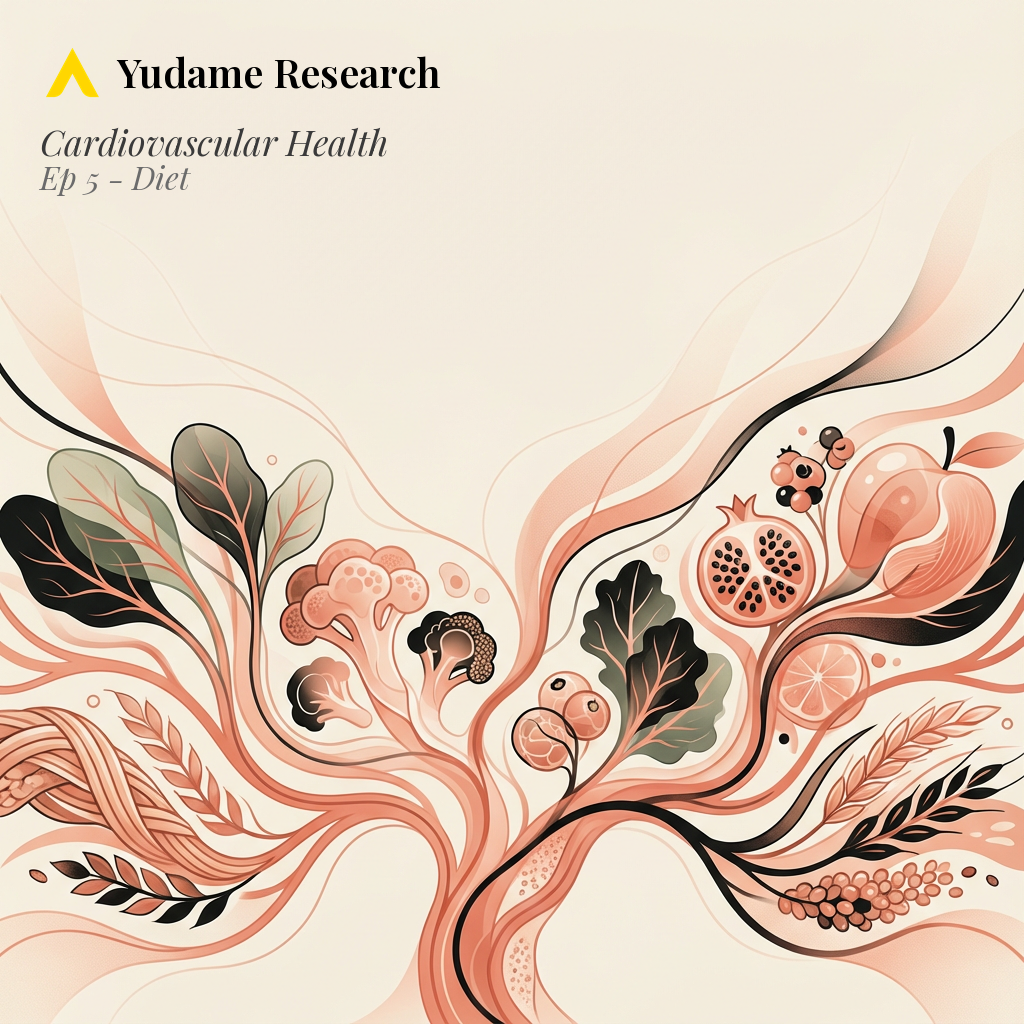 Cardiovascular Health: Diet 02.01.2026When Italian researchers examined arterial plaques from 257 patients in early 2024, they found microplastics embedded in diseased tissue—patients with detectable plastics experienced cardiovascular events at 4.5x the rate of those without. Yet the FDA maintains current evidence doesn't demonstrate risk. Welcome to modern nutritional science, where emerging threats sit alongside decades-old debates. The PURE study (135,000 participants) found higher saturated fat linked to lower mortality, while Cochrane RCTs show reducing it prevents heart attacks by 21%. The reconciliation: replacement nutrients determine everything. Swap saturated fat for refined carbs and benefits vanish; replace with polyunsaturated fats and cardiovascular events drop 17-30%. Ultra-processed foods increase CVD risk independent of their nutrient content—the Hall RCT showed 500 extra calories/day consumed simply because food was ultra-processed. Added sugar shows exponential dose-response with mortality (NNT to harm: 22 at high intake). Mediterranean and plant-based patterns have the strongest trial evidence. Full research report: https://research.yuda.me/podcast/episodes/cardiovascular-health/ep5-diet/report.md Read the full report: https://yudame.ai/podcast/yudame-research/ep5-diet/#report
 -
 Cardiovascular Health: Supplementation 02.01.2026Evidence-based guide to cardiovascular supplements and medications for 40-year-old men, covering what works, what fails spectacularly, and optimal dosing protocols. Learn why high-dose omega-3 reduces heart attacks by 25% but increases atrial fibrillation risk by 50%, how CoQ10 cut heart failure mortality by 49% in the Q-SYMBIO trial, and why vitamin D and niacin failed despite decades of hype. Full research report: https://research.yuda.me/podcast/episodes/cardiovascular-health/ep4-supplementation/report.md Read the full report: https://yudame.ai/podcast/yudame-research/ep4-supplementation/#report
 -
 Cardiovascular Health: Heart Rate Variability 02.01.2026Heart rate variability (HRV) has moved from clinical labs to consumer wearables, offering a powerful window into autonomic nervous system function, stress resilience, and training readiness. This episode synthesizes meta-analyses and systematic reviews to provide an evidence-based playbook for the active 40-year-old man: which metrics actually matter (RMSSD vs SDNN), how to measure reliably with validated devices, when a 15% drop signals overtraining, and which interventions show the largest effect sizes for improving cardiovascular health. Full research report: https://research.yuda.me/podcast/episodes/cardiovascular-health/ep3-hrv/report.md Read the full report: https://yudame.ai/podcast/yudame-research/ep3-hrv/#report
 -
 Cardiovascular Health: VO2 Max 02.01.2026Episode 2 in the Cardiovascular Health series. Deep dive into evidence-based strategies to maximize VO2 max—the strongest predictor of longevity—through polarized training (80% easy, 20% brutally hard), optimal interval protocols, performance nutrition, and strategic supplementation. Full research report: https://research.yuda.me/podcast/episodes/cardiovascular-health/ep2-vo2-max/report.md Read the full report: https://yudame.ai/podcast/yudame-research/ep2-vo2-max/#report
 -
 Cardiovascular Health: Lifestyle 02.01.2026Finnish men who sauna 4-7 times weekly have 63% lower sudden cardiac death risk—numbers rivaling aggressive pharmaceutical intervention. Meanwhile, social isolation increases cardiovascular mortality by 61% in men, making loneliness as dangerous as smoking. This final episode in our cardiovascular series examines the "second tier" factors beyond diet, exercise, and sleep: heat therapy, social connection, breathing protocols, purpose, nature exposure, and the controversial cold exposure. Using the KIHD cohort (2,315 men, 20+ year follow-up) and Holt-Lunstad meta-analysis (308,849 people), we separate Tier A evidence (hard cardiovascular outcomes) from Tier C hype (cold exposure's dramatic claims vs. weak evidence). The bottom line: slow breathing at 5-6 breaths/minute reduces blood pressure by 7 mmHg for free, while retirement transitions represent acute cardiovascular risk windows requiring proactive social planning. Full research report: https://research.yuda.me/podcast/episodes/cardiovascular-health/ep6-lifestyle-beyond/report.md Read the full report: https://yudame.ai/podcast/yudame-research/ep1-lifestyle/#report
 -
 Building a Micro School: The Soft Skills Curriculum 28.01.2026Children who received social-emotional learning (SEL) at age 7 were 23% more likely to complete high school and 26% more likely to attend university—not from higher test scores, but from better self-regulation and reduced impulsivity. This episode explores how micro schools can deliberately develop the "soft skills" that form the operating system for all academic learning. We examine meta-analyses spanning 575,000+ students showing SEL programs produce 0.23 standard deviation gains, why teacher-delivered programs outperform specialists by 3x, the evidence for explicit instruction plus integration, and practical protocols for morning meetings, calm-down corners, and mixed-age SEL delivery. Read the full research report at https://research.yuda.me/podcast/episodes/building-a-micro-school/ep5-soft-skills-curriculum/report.md Key Sources: • Durlak et al. (2011) - Meta-analysis of 213 school-based SEL programs (270,034 students): https://casel.org/wp-content/uploads/2016/08/PDF-3-Durlak-Weissberg-Dymnicki-Taylor-Schellinger-2011.pdf • Cipriano et al. (2023) - Updated meta-analysis of 424 programs (575,361 students) • Taylor et al. (2017) - 15-year longitudinal follow-up study showing 23-26% better life outcomes • CASEL Framework - Five core competencies for social-emotional learning: https://casel.org/fundamentals-of-sel/ • Prenda & Acton Academy - Micro school implementation case studies Read the full report: https://yudame.ai/podcast/yudame-research/ep5-soft-skills-curriculum/#report
 -
 Building a Micro School: Technology as Infrastructure 27.01.2026A 2025 meta-analysis of 10,116 children found excessive screen time associated with poorer development (OR 1.24). Yet one month of coding produced Cohen's d of 1.62 for executive function—equivalent to seven months of standard activities. The paradox isn't an error. It's the point. The question isn't whether screens are good or bad, but when, how, and for whom specific technologies produce specific outcomes under specific conditions. Read the full research report at https://research.yuda.me/podcast/episodes/building-a-micro-school/ep4-technology-infrastructure/report.md Key Sources: • 2025 Meta-Analysis - Screen Time Effects: OR 1.24 for social-emotional issues across 10,116 children • Arfé et al. 2019 Coding RCT: d=1.62 for executive function in one month (76 first graders) • Cambridge 2026 Longitudinal Study: Screen time before age 2 altered brain development, neutralized by parent-child reading • DOJ WCAG Rule (April 2024): Compliance deadlines April 2026/2027 for accessibility standards • GPT-Researcher Industry Analysis: ChromeOS 60.1% K-12 market share, 10-year update policy Read the full report: https://yudame.ai/podcast/yudame-research/ep4-technology-infrastructure/#report
 -
 Building a Micro School: The Self-Direction Transition 06.01.2026Meta-analyses show mastery learning produces effect sizes of d=0.94 at elementary level, scaffolding yields g=0.46, and cross-age tutoring benefits both tutors (g=0.39) and tutees (g=0.33). Yet when RAND Corporation evaluated microschools in November 2025, they found "negligible impacts" on academic growth and could identify less than 0.1% of U.S. microschools for rigorous study. The components work. The implementations often don't. This episode examines the specific challenge of ages 6-9—the transition years when children move from guided play to genuine self-direction. We explore why this age range presents unique opportunities and pitfalls, what research shows about scaffolding independence, and how successful microschools operationalize abstract principles into concrete daily routines. Read the full research report at https://research.yuda.me/podcast/episodes/building-a-micro-school/ep3-self-direction-transition/report.md Key Sources: • RAND Corporation (2025) - Microschool Evaluation: https://www.rand.org/pubs/research_reports/RRA4414-1.html • Veenman (1995) - Mixed-Age Meta-Analysis: https://journals.sagepub.com/doi/abs/10.3102/00346543065004319 • Randolph et al. (2023) - Montessori Campbell Review: https://pmc.ncbi.nlm.nih.gov/articles/PMC10406168/ • Belland et al. (2017) - Scaffolding Meta-Analysis: https://journals.sagepub.com/doi/10.3102/0034654316670999 • Martin et al. (2018) - Mrs. Lewis Effect Study: https://pmc.ncbi.nlm.nih.gov/articles/PMC6519686/ Read the full report: https://yudame.ai/podcast/yudame-research/ep3-self-direction-transition/#report
Слични подкасти


Популарен во
Овој подкаст се појавува и на подкаст-листите на овие земји.
