
Sleeping Barber - A Marketing Podcast
Sleeping Barber
0
Ready to rethink business strategy and supercharge your marketing game? Join hosts Marc Binkley and Vassilis Douros as they break down big questions at the crossroads of strategy, marketing effectiveness, and creative impact. From real-world case studies to hot-off-the-press business news, each episode dives deep into how modern companies navigate complexity. Plus, interviews with global thought leaders bring you fresh insights and actionable strategies to drive growth and build unforgettable customer experiences. This is your backstage pass to smarter thinking and better business results.
Епизоди
-
 SBP 241: The PostPod - Lessons from Omar Roubi, The Rise and Fall of a Promise 01.10.2026 20минFresh off the Omar Roubi interview, Marc and Vassilis sit down for the PostPod to work through what stuck.The uncomfortable one: when the business is broken, whose job is it to stop advertising? Target Canada ran full advertising cycles, back to school, holiday, the works, while shelves sat empty and the experience fell apart. So the spend did not just fail to help. It amplified a promise the business could not keep. "Expect more, pay less" landed as "expecting more, paying more."They get into the reflex every marketer knows: use it or lose it, and the maturity it takes to hand budget back and say the problem is upstream. Plus leading versus lagging indicators, why revenue tells you far too late, and how supply chain efficiency and customer sentiment map onto physical and mental availability.They also sit with the thing that keeps pulling them back: it was not one P, it was the clock. A lease deal and government hiring timelines built a manufactured pressure that eroded the quality of every decision after it. Nordstrom entered around the same time with a slower playbook and lasted longer.No clean verdict. A much better set of questions.Enjoy the show!Chapters00:00 Doomed from day one00:38 PostPod: debriefing Target Canada00:52 A case study that keeps giving02:40 Going all in, and Nordstrom's different path04:05 Canada's geography vs three warehouses05:41 Whose job was it to say "stop advertising"?07:49 Use it or lose it: should marketing give budget back?08:14 Shared accountability and deferred blame10:56 Leading vs lagging indicators12:08 The promise to the customer13:49 Mapping mental and physical availability14:13 The price problem: priced premium, wasn't16:08 You can't isolate one P: the clock17:00 Making quality decisions under pressure19:28 Why extremes are the best teachers
 -
 SBP 240: SBP Interview - Target Canada: The Rise and Fall of a Promise, with Omar Roubi 29.09.2026 1ч 3минTarget is a company people love. More than 1,700 stores, a brand with real pull. Then it came to Canada, lost billions, and walked away inside four years.This is a story about Big and Little marketing. Little is the advertising. Big is everything else: product, price, place, and how the whole business organizes around the customer. Roger Martin says a promise has to be memorable, valuable, and deliverable. Advertising makes it memorable. Price and place make it valuable. Product makes it deliverable. In Canada, Target's ads were excellent, and the business broke the promise anyway.CPA Omar Roubi joins Marc and Vassilis to reverse engineer the collapse through the four Ps. Omar teaches this case at the University of Colorado Denver and built a definitive audio case study on it at LumiQ. He also lived it: his wife moved from Texas to help launch the Toronto-area stores.Inside: the Zellers real estate deal that started the countdown, empty shelves sitting above full back rooms, the imperial vs metric mix-up, three distribution centres across a 6,000 km country, and why the famous $5.4B loss is mostly a writedown, not operating losses.A case study in why great marketing can't save a broken business.Our Guest:Omar Roubi - https://www.linkedin.com/in/omar-roubi-cpa-texas/Chapters:00:00 Cold open: one bad decision begets more00:26 Big marketing vs Little marketing02:16 Omar Roubi returns03:14 The personal connection: launching Target in Toronto06:14 "Too big to fail"06:36 The accountant's takeaway09:22 Place: the Zellers real estate deal12:08 Wrong locations, wrong customer18:47 The 12-month countdown clock22:25 Product: empty shelves, full back rooms25:02 Physical availability and the metric mix-up32:46 Price: "expect more, pay less" meets three warehouses41:05 The currency headwind45:07 The $5.4B loss vs the $200M operating loss48:27 Little marketing: is ROI the wrong number?53:01 The apology videos, and brand vs performance57:04 The one number that signals trouble first1:00:07 The human cost: 17,600 peopleReferences:ReferencesCBC News. (2011, January 13). Target buys Zellers leases for $1.8B. https://www.cbc.ca/news/business/target-buys-zellers-leases-for-1-8b-1.981132CBC News. (2012, July 6). Target wins approval to come to Canada. https://www.cbc.ca/news/business/target-wins-approval-to-come-to-canada-1.1160485Castaldo, J. (2016, January 1). The last days of Target. Canadian Business. https://canadianbusiness.com/ideas/the-last-days-of-target-canada/Kumar, N. (2025, September 2). The experience paradox: Why better satisfaction scores don't always mean growth. Kantar. https://www.kantar.com/north-america/inspiration/experience/the-experience-paradoxLinkedIn B2B Institute & WARC. (2024, August 13). Making a promise to the customer: How to give campaigns a competitive edge. https://business.linkedin.com/advertise/resources/b2b-institute/making-a-promise-to-the-business-customerRoubi, O. (Host). (2021, August). The rise and fall of Target Canada [Audio podcast]. LumiQ.Strauss, M. (2013, April 5). Target Canada prices 0.2 per cent higher than Wal-Mart's: Survey. The Globe and Mail.Strauss, M. (2014, September 22). Target Canada winning price battle with Wal-Mart. The Globe and Mail.Target Corporation. (2011, January 13). Target Corporation to acquire interest in Canadian real estate from Zellers Inc., a subsidiary of Hudson's Bay Company, for C$1.825 billion [Press release]. https://corporate.target.com/press/release/2011/01/Target Corporation. (2015a, January 15). Target Corporation announces plans to discontinue Canadian operations [Press release]. https://corporate.target.com/press/release/2015/01/Target Corporation. (2015b, January 15). Form 8-K. U.S. Securities and Exchange Commission. https://www.sec.gov/Archives/edgar/data/0000027419/000002741915000005/Zellers Inc., Hudson's Bay Company, Target Corporation, & Target Canada Co. (2011, September 12). Amended and restated transaction agreement [Exhibit 2(a) to Form 10-Q]. U.S. Securities and Exchange Commission. https://www.sec.gov/Archives/edgar/data/0000027419/000110465911066091/
 -
 SBP 239: The Sharp Cut - Who Killed the Click? 24.09.2026 25минMarketing runs on comfort blankets. The Sharp Cut cuts them up to see what's inside. This week, we did it as a murder mystery.The victim: the click. Once upon a time a click was one honest fact, a machine noting that a file left a building. Over eleven years it got poisoned, dose by dose, until it was taking credit for sales it never caused.The body: in 2012, eBay turned off roughly $51M in paid search across a third of the US, with matched control markets. Scored the way a dashboard scores it, the return was over 4,000%. Scored against the control, the only way that actually answers the question, it was minus 63%. Same company, same spend, same year.Then we line up six suspects, the auction, the platforms, last click attribution, the CFO, the agency, and us, and ask each one the same two questions: did they have a reason, and did they have the access?Marc and V get out of the costume for the part that stings: the doses we added ourselves. The Sport Chek war room. The machine V built to move money faster. The P&G cut everyone quotes that fails our own evidence test. And what happens to the click when the shopper is an AI.We won't hand you a verdict, because we don't fully agree. You're the jury. Enjoy the show!Chapters:00:00 What the Sharp Cut is00:49 A murder mystery: who killed the click?01:30 Meet your six suspects01:45 The body: eBay turns off $51M in paid search03:35 4,000% ROI or minus 63%? Same campaign, two scores03:57 What a click actually was (the first banner, 1994)05:23 The 44% click rate nobody can verify06:25 Cause of death: poisoned over eleven years06:42 Three doses: price, bouncer, then credit08:43 When a measure becomes a target (Goodhart's Law)09:09 Whodunit: motive and opportunity11:21 The evidence: Facebook's own 2016 deck12:45 Out of the costume: the doses we added ourselves15:28 The Sport Chek war room18:16 Building a machine to move money faster19:41 The P&G $200M cut, and why it fails our own test20:49 The alibi that holds: same test, opposite answer21:27 The click's replacement: AI shoppers22:39 The verdict is yours24:06 One warning before you turn anything offSources:Allouah, A., Besbes, O., Figueroa, J. D., Kanoria, Y., & Kumar, A. (2026). What is your AI agent buying? Evaluation, biases, model dependence, and emerging implications of agentic e-commerce. In Proceedings of the ACM Web Conference 2026 (pp. 8697–8700). https://doi.org/10.1145/3774904.3792943Blake, T., Nosko, C., & Tadelis, S. (2015). Consumer heterogeneity and paid search effectiveness: A large-scale field experiment. Econometrica, 83(1), 155–174. https://doi.org/10.3982/ECTA12423Chan, D. X., Yuan, Y., Koehler, J., & Kumar, D. (2011). Incremental clicks: The impact of search advertising. Journal of Advertising Research, 51(4), 643–647. https://doi.org/10.2501/JAR-51-4-643-647Golden, J., & Horton, J. J. (2021). The effects of search advertising on competitors: An experiment before a merger. Management Science, 67(1), 342–362.Gordon, B. R., Zettelmeyer, F., Bhargava, N., & Chapsky, D. (2019). A comparison of approaches to advertising measurement: Evidence from big field experiments at Facebook. Marketing Science, 38(2), 193–225. https://doi.org/10.1287/mksc.2018.1135Lewis, R. A., & Rao, J. M. (2015). The unfavorable economics of measuring the returns to advertising. The Quarterly Journal of Economics, 130(4), 1941–1973. https://doi.org/10.1093/qje/qjv023Lysen, S. (2013). Incremental clicks impact of mobile search advertising. Google. https://research.google/pubs/incremental-clicks-impact-of-mobile-search-advertising/Simonov, A., Nosko, C., & Rao, J. M. (2018). Competition and crowd-out for brand keywords in sponsored search. Marketing Science, 37(2), 200–215. https://doi.org/10.1287/mksc.2017.1065The Procter & Gamble Company. (2017). Additional definitive proxy soliciting materials (DEFA14A). U.S. Securities and Exchange Commission. https://www.sec.gov/Archives/edgar/data/0000080424/000119312517299631/d464866ddefa14a.htmFacebook. (2016). Everything competes with everything [Slide presentation].GoTo.com, Inc. (1999). Form S-1 and Form 10-Q. To be reformatted as SEC legal sources.Nielsen. (2009). NetEffect CPG home scanner panel meta-analysis of 200+ online campaigns. As reported in Facebook (2016).Nielsen. (2015). BrandEffect meta-analysis of 478 online global campaigns, October 2014 to April 2015. As reported in Facebook (2016).
 -
 SBP 238: The Barber's Brief - Playing on rented land, again. 22.09.2026 32минMarc and V are back with the Barber's Brief: the good, the bad, and the overhyped from the last couple of weeks, with data, a few strong opinions, and Great Creative getting the last word.This week:"My CEO doesn't get brand." Nearly half of B2B marketers say they can't get brand budget signed off. But 40% admit brand isn't seen as delivering ROI inside their own company. V's take: that's not an education gap, it's a proof gap. Fix the proof and the understanding follows.Google AI Overviews are eating your website traffic. Studies put the click drop anywhere from 15% to 90%. Marc makes the case that we never owned our search rankings anyway. We've always been playing on rented land, and the landlord just changed.QR codes in ads. Andrew Tindall of System1 says if you're still using them, you're a moron. CTV scan rates have fallen to 0.004%. V argues the QR code isn't the disease, it's the symptom. It is measurement theater and a confession that you don't trust the ad to do its job. Marc pushes back, and it gets good.Nobody owns demand. A sharp post from Mats Georgson: who decides what you sell, to whom, at what price, and where. Rarely marketing. So what should marketing actually own?Plus Ad of the Week: Tubi's funeral spot from "Find Any Feeling For Free," the funniest ad with the weakest branding you'll see all month.Enjoy the show!Chapters00:00 Intro: welcome back to the Barber's Brief01:11 Story 1: "My CEO doesn't get brand"02:07 Education gap or proof gap?04:05 The B2B Institute evidence: brand as the icebreaker05:53 Story 2: Google AI Overviews are eating your traffic07:23 Playing on rented land, again09:34 Own your audience, or just change landlords?12:12 Story 3: QR codes, Andrew Tindall, and measurement theater15:07 Marc's rebuttal: signal vs noise18:01 Last click is dumb, so why do we default to it?20:04 Story 4: Nobody owns demand22:54 You don't own the four Ps, but stay close to them25:08 Ad of the Week: Tubi, "Find Any Feeling For Free"27:06 The gag that outran the brand29:31 Coming up: Who Killed the Click, and Target CanadaLinks:Title: Lack of CEO understanding harming B2B brand building pushLink: https://www.marketingweek.com/brand-spend-b2b-ceo-cfo/Title: Google AI Overviews Are Eating Your Website Traffic. Here’s How To Get That Traffic BackLink: https://www.forbes.com/sites/terdawn-deboe/2026/05/18/google-ai-overviews-are-eating-your-website-traffic-fight-back/Title: Andrew Tindall: If you’re still putting QR codes in your ads, sorry, you’re a moronLink: https://www.thedrum.com/opinion/andrew-tindall-if-you-re-still-putting-qr-codes-in-your-ads-sorry-you-re-a-moronTitle: Nobody in your company owns demand.Link: https://www.linkedin.com/posts/matsgeorgson_nobody-in-your-company-owns-demand-ask-activity-7505219391089983488-BoMM?utm_source=share&utm_medium=member_desktop&rcm=ACoAAASDjbUB2U9VXn6rXo3lEfvMAwrkF_01wlkAd of the WeekTitle: Tubi Fakin' It 30sLink: https://www.youtube.com/watch?v=TGklD2yU-3I&t=30s
 -
 SBP 237: The PostPod - Lessons from Ian Whittaker, Data is not the problem. 17.09.2026 18минFresh off the Ian Whittaker interview, Marc and Vassilis sit down for the PostPod to unpack what actually stuck.The through line: marketing keeps losing the budget argument because it treats finance as an obstacle instead of a customer. Ian's framing reframed it. Follow the incentives. Understand what executives are rewarded and punished for. Reframe budget as risk, not just missed opportunity. And stop leaning on "ROI" as if the word alone wins the room, because it is a ratio you can improve simply by cutting spend.They also get honest about the echo chamber marketers live in, the gap between how advertising works and how people believe it works, and why infinite data and AI still have not cracked proof. Marc brings it down to earth with a personal lesson from running a real P&L.No tidy answers. A much better set of questions.Chapters:00:00 The board is a customer too (cold open)00:41 PostPod: why our heads were spinning02:22 Follow the incentives, the question we never ask finance03:12 Marc runs a P&L now, and cost is a worthy adversary05:07 Marketing's echo chamber problem06:10 Finance is the customer: vocabulary vs grammar07:16 Learn capital allocation, not just the buzzwords09:42 Why leading with ROI can get you cut10:27 How advertising works vs believing how it works11:40 Understand board priorities before you pitch12:53 Infinite data, still can't prove ROI, enter DCF15:05 The bridge and the ravine16:45 Getting marketers closer to the business
 -
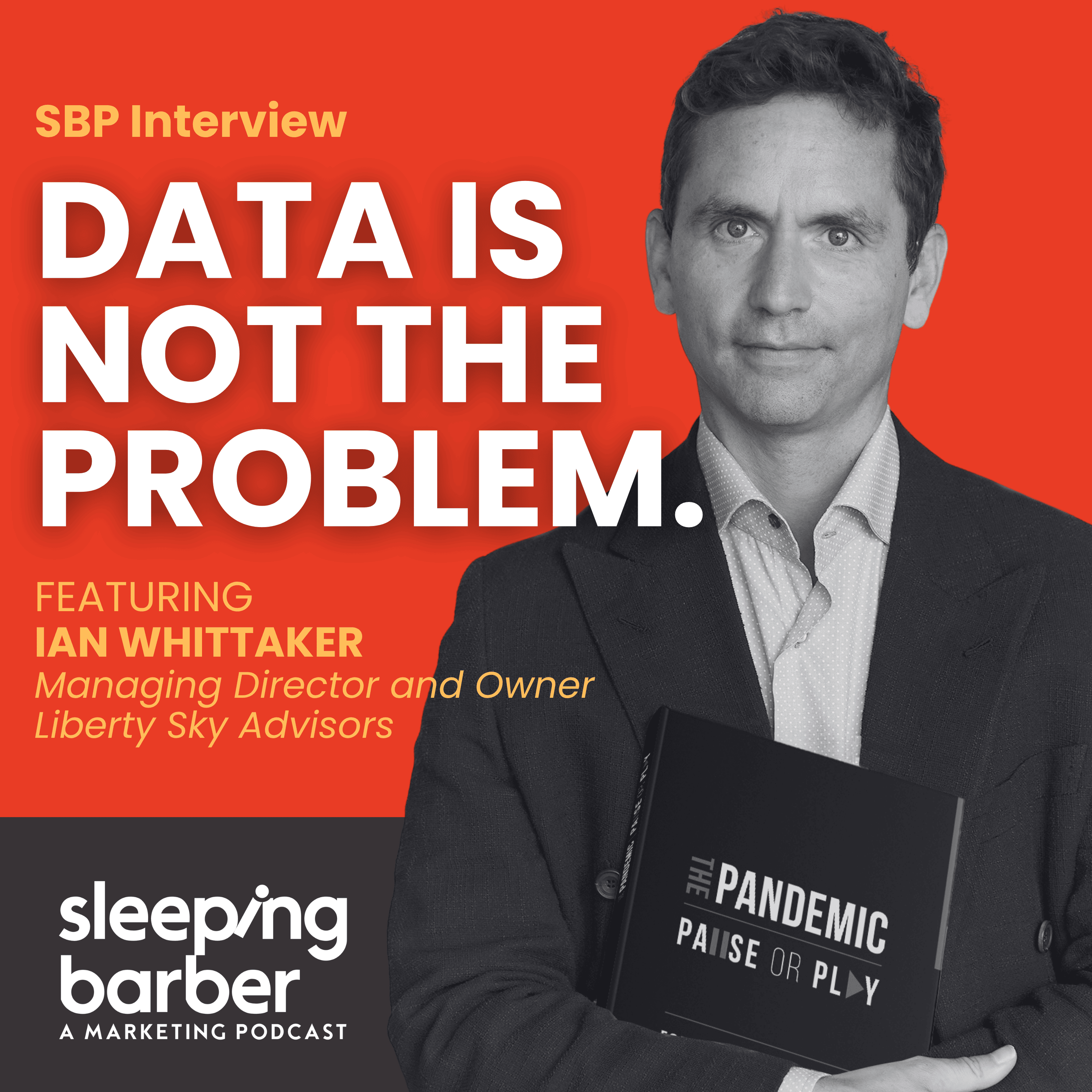 SBP 236: SBP Interview - Data is not the problem. With Ian Whittaker. 15.09.2026 50минMarketers have spent years trying to prove marketing works.Better attribution. Better dashboards. Better measurement. More data.And yet marketing still struggles to defend investment when budgets come under pressure.Maybe proof isn't the real problem.In this episode of the Sleeping Barber Podcast, Marc and V sit down with Ian Whitaker, Founder and Managing Partner of Liberty Sky Advisors and a former equities analyst with more than 20 years covering media, technology and telecommunications.Ian argues that marketers have learned the vocabulary of finance without necessarily learning its grammar. Boards aren't simply deciding whether marketing works. They're deciding where the next dollar of capital should go, what return it could generate, what risk it carries and what risk the business accepts by not investing.That changes the marketing conversation.Ian explains why he thinks marketing should be understood as intangible capex, why brand investment could be separated into maintenance and growth, and why cutting marketing can create risks that aren't visible on the next quarterly earnings report.The conversation also challenges one of marketing's favourite financial metrics: ROI.As Ian points out, ROI can improve simply by reducing the denominator. You can cut marketing investment and increase marketing ROI, even while potentially making the business weaker over time. The metric may tell us something about efficiency without necessarily telling us whether we're maximizing effectiveness or enterprise value.The discussion explores discounted cash flow, pricing power, financial incentives, the accounting treatment of brand investment and why strong brands can paradoxically become victims of their own success.And ultimately, Ian makes a much simpler argument:Data isn't the problem. Data is evidence that supports the business case. It isn't the business case itself.Our Guest:Ian Whittaker: https://www.linkedin.com/in/ianwhittakermedia/Chapters:00:00 Why Marketing Keeps Losing the Budget Argument01:46 Meet Ian Whitaker04:54 Seeing What Others Miss07:16 Why Brand Is an Underappreciated Asset09:42 The Board Is Another Customer11:19 Marketing Knows Finance's Words, Not Its Grammar13:45 Why Marketing Budget Is Really a Risk Conversation18:18 Marketing Is Intangible Capex22:10 Why Accounting Makes Marketing Easy to Cut25:01 Marketing Compounds — It Doesn't Just Add26:46 Why Investors Value Brand but Still Cut Marketing32:16 What's Wrong With Marketing ROI?34:32 A Better Financial Model for Marketing39:58 When Strong Brands Become Victims of Their Own Success42:18 Data Isn't the Problem43:11 Building the Bridge Between Marketing and Finance45:48 Becoming a Better Marketer by Thinking Beyond Marketing46:27 Start With the Business and Work Backwards47:45 Why Brand Investment Is Like Defence Spending48:56 Where to Find Ian
 -
 SBP 235: The Sharp Cut - AI Won't Save You. Leadership Will. 10.09.2026 36минAI Won’t Save You. Leadership Will.Companies have spent the last few years buying AI tools, running pilots and training employees. Yet much of that investment still isn't producing the transformation leaders expected.Maybe the problem isn't the technology.In this Sharp Cut, Marc and V examine why AI transformation is ultimately a leadership and organizational design problem.They unpack research on the divide between AI experimentation and measurable business impact, Roger Martin's idea of the organization as a “decision factory,” and why making individual marketers faster may be solving the wrong problem. The real opportunity may lie in redesigning workflows, decision rights and standards around what AI can now do.They also examine a more uncomfortable question: as AI becomes increasingly capable at professional work, what should humans actually be getting better at?Marc shares the results of an AI marketing workshop where three groups used very different approaches to solve the same brief. All three produced impressive-looking work. The difference wasn't production quality. It was whether the people behind the work could explain and defend the decisions AI had helped them make.Finally, the conversation goes back to 1855 and Daniel McCallum's railroad organization. A new information technology — the telegraph — forced leaders to rethink how their organizations worked. AI may be creating the same challenge today.The tools are increasingly available to everyone.The advantage won't come from simply having them.It will come from how leaders redesign the organization around them.Chapters00:00 AI Won't Save You. Leadership Will.01:14 The AI Transformation We Expected Never Happened02:23 AI Is a Mode-Seeking Machine03:29 When AI Produces the Safe Answer04:21 Why AI Always Says “Good Point”05:25 The 95% AI Failure Problem06:06 What Separates the Successful 5%?07:45 The Organization Is the Constraint08:00 Are We Moving Marketing Dollars Into AI?09:08 The Modern Organization as a Decision Factory10:46 What AI Exposes About Knowledge Workers11:40 Does the Decision Factory Apply to Small Teams?12:36 The Bottleneck Is Between People13:28 The Comfortable Assumption About Human Skills13:50 AI Is Catching Human Experts15:36 What Should Humans Actually Be Doing?16:03 The AI Capability Trap17:04 Is the T-Shaped Marketer Dead?18:24 Why AI Should Attack the Hard Problems19:21 What Happened When Marketers Let AI Lead20:55 Three Teams, One Marketing Brief21:31 Polished Work That Nobody Could Defend22:34 Evidence vs. Familiar Frameworks24:18 Why AI Needs Human Judgment25:17 Marketing's Stack of Bad Assumptions26:35 The Streetlight Effect in Marketing Measurement27:03 Are We Optimizing the 17% We Can See?28:03 “Busy Is the New Stupid”28:56 AI Should Multiply, Not Just Automate30:12 It Ain't What You Do, It's the Way That You Do It31:06 Should Leaders Lead From the Front or Behind?32:12 What an 1855 Railroad Can Teach Us About AI34:23 New Technology Requires New Organizations34:51 What Leaders Should Do Monday Morning36:21 The Difference Between the 95% and the 5%36:34 AI Won't Save You. Leadership Will.
 -
 SBP 234: The Barber's Brief - More Data. More Tech. More Specialists. Better Marketing? 08.09.2026 33минMarketing has more data, technology and specialist expertise than ever.But is all that sophistication actually making marketing better?In this edition of The Barber's Brief, Marc and Vassilis unpack five stories that all raise different versions of that question.First, AI assistants are increasingly embedded in how people discover and evaluate products, yet they still rank near the bottom of trusted sources for shopping recommendations. Marc asks whether AI will eventually become a reliable source of marketing knowledge or simply produce increasingly confident averages of everything we've already said. Then, V looks at PepsiCo's decision to consolidate its global media business with Publicis under a single operating model spanning strategy, planning, activation, data, identity and technology. The bigger question: has fragmentation itself become one of marketing's biggest effectiveness problems? Marc follows with the $700 billion MarTech delusion. One former privacy executive pulled her own data-broker profile and discovered she belonged to 500 segments, simultaneously classified as male and female, low income and high income. Research discussed in the episode suggests purchased targeting data can sometimes perform little better than chance, while contextual targeting may outperform it at lower cost. Then comes something refreshingly simple.The UPS Store has introduced its first brand character, Blu, designed to help expand the brand's mental associations beyond shipping into printing, shredding, mailboxes and other small-business services. V argues the opportunity isn't simply creating entertaining advertising; it's building a distinctive memory structure that can work across multiple buying situations. Finally, Marc's Ad of the Week goes to Canva's Wild Design: handcrafted stop-motion advertising in an era where almost anyone can generate something instantly with AI. The campaign combines showmanship with salesmanship while continuing to invest in a recurring character as a potential distinctive asset. More technology doesn't automatically mean better marketing.Sometimes the advantage may come from making the whole system work together — and remembering the fundamentals underneath it.Chapters:00:00 Welcome to the Barber's Brief01:58 Why Shoppers Use AI But Don't Trust It03:01 Who Do Consumers Trust for Recommendations?04:13 The AI Credibility Gap05:09 When Low-Evidence Categories Reward the First Answer06:23 Does AI Know Marketing Effectiveness?08:18 Is AI Learning From Its Own Slop?09:01 PepsiCo's Massive Global Media Shift10:29 The Problem With Marketing Specialization12:24 Is Fragmentation Hurting Marketing Effectiveness?15:15 The $700 Billion MarTech Delusion16:02 When Audience Data Is Completely Wrong17:30 Does Targeting Actually Work?18:42 Did MarTech Solve the Wrong Problem?19:15 What Should CMOs Do With Their MarTech Stack?21:31 The UPS Store Introduces Its First Brand Character23:25 Blu as a Distinctive Brand Asset24:21 Why Brand Characters Need Consistency25:41 Are Brand Characters Really Making a Comeback?27:20 Marc's Marketing Effectiveness Haiku28:05 Ad of the Week: Canva's Wild Design29:05 Showmanship Meets Salesmanship30:22 Building Distinctive Assets Over Time31:51 Why Canva Chose Craft in the Age of AI34:18 What's Coming Next35:38 Stay SharpEpisode Links:Shoppers ask AI for help but don't trust its adviceLink: https://www.emarketer.com/content/shoppers-ask-ai-help-don-t-trust-its-advicePepsiCo hands global media to Publicis amid transformation at CPG giantLink: https://www.marketingdive.com/news/pepsico-hands-global-media-to-publicis-amid-transformation-at-cpg-giant/829556/The $700bn DelusionLink: https://www.mi-3.com.au/26-06-2024/data-delusion-does-using-data-target-specific-audiences-advertising-actually-makeThe UPS Store enlists first brand character to support franchiseesLink: https://www.marketingdive.com/news/the-ups-store-enlists-first-brand-character-to-support-franchisees/829215/Ad of the week - Canva - Wild Design Link: https://www.adsoftheworld.com/campaigns/wild-design-f89d06d3-3b9d-4cd0-95de-189714c47446
 -
 SBP 233: The PostPod - Lessons From Fiona Stevenson. Why Innovation Fails. 03.09.2026 21минEveryone wants innovation. But what exactly are we asking for?In this Post-Pod, Marc and Vassilis unpack their conversation with Fiona Stevenson, co-author of Built for Breakthrough, and start with one of the simplest problems: organizations frequently use the word “innovation” without agreeing on what it actually means.Breakthrough? Disruption? A game changer? Incremental growth? A new tactic?That distinction matters because, as Fiona argued, an idea doesn't become innovation until it is implemented and creates value.From there, the conversation turns to the organizational conditions that innovation requires. Marc and V discuss why teams rush to solutions before properly understanding the problem, why genuine innovation creates fear, and how the pursuit of certainty can push organizations toward safer incremental improvements.They also revisit Fiona's Six I's framework:Identify → Insights → Inspiration → Ideation → Iteration → ImplementationRather than treating those stages as a checklist, Vassilis argues they should be viewed as multipliers. Skip one and you risk weakening the entire system.The conversation closes with two bigger questions.First, if innovation requires focused thinking, why do we expect it to happen between back-to-back meetings?And second, if AI is giving us unprecedented productivity gains, will we use that extra capacity to explore new possibilities — or simply fill it with more of the same work?A Post-Pod about innovation, uncertainty, AI, marketing and why being busy isn't the same thing as building the future.Chapters00:00 Welcome to the Post-Pod00:21 Why “Innovation” Means Different Things to Everyone01:43 What Kind of Innovation Are We Actually Asking For?02:24 Defining Innovation Before Starting the Work02:53 An Idea Isn't Innovation Until It Creates Value04:04 Are We Solving Before Understanding the Problem?04:47 The Optimization Trap06:42 Why Fear Kills Innovation08:39 Why Incremental Innovation Feels Safer10:04 Fear Creates Overanalysis10:21 “How Might We?” vs. “We Should”11:10 Fiona's Six I's of Innovation11:40 Innovation as a Multiplicative System12:53 Is Intuition the Seventh I?13:20 How Marketing and Innovation Overlap14:28 Should Marketing Be an Innovation Function?17:39 Innovation Doesn't Happen Between Meetings18:32 Are We Using AI for Efficiency or Growth?19:48 Why AI Should Create Possibility20:08 AI Increases the Need for Discernment20:55 Final Thoughts
 -
 SBP 232: SBP Interview - Why Innovation Fails Before the Idea Ever Gets a Chance. With Fiona Stevenson. 01.09.2026 55минWhy do organizations say innovation is mission-critical, then create conditions that make innovation almost impossible?Fiona Stevenson has spent her career on both sides of that problem.After 12 years at Procter & Gamble, she co-founded The Idea Suite, an innovation consultancy that has worked across hundreds of innovation projects. She is also the co-author of Built for Breakthrough: Why Innovation Fails and How Smart Leaders Get It Right.In this conversation, Fiona joins Marc and Vassilis to unpack why innovation usually fails long before the idea itself is tested.They explore the famous Febreze story and why understanding the actual consumer problem changed the brand’s trajectory, before getting into the organizational conditions required for innovation to survive.Fiona explains why big innovation ambitions often collide with tiny budgets, part-time teams and unrealistic timelines; why past data can become dangerous when designing for the future; and why innovators need to build evidence instead of waiting for certainty.The conversation also covers Fiona’s six-stage innovation framework:Identify → Insights → Inspiration → Ideation → Iteration → ImplementationAnd perhaps a seventh: Intuition.Plus:Why “we should…” is not an ideaWhy “How might we?” is such a powerful innovation questionHow AI is dramatically lowering the cost of prototypingWhy AI should be an input, not the final outputHow implementation destroys good ideas through “death by a thousand cuts”Why innovation needs dedicated time, not calendar scrapsHow to create an innovation charterWhy the best first step is simply defining the problem properlyIf your organization wants innovation but struggles to actually get ideas into market, this episode is for you.Enjoy the show!Chapters:00:00 Why Innovation Dies Before the Whiteboard01:36 Meet Fiona Stevenson02:16 From P&G to Innovation Consulting04:07 Moving From Client Side to Consulting05:41 The Febreze Innovation Story09:09 Why Consumer Understanding Comes First10:59 What Is Innovation, Really?13:02 The Uber Opportunity Fiona Turned Down14:24 Different Types of Innovation16:23 Big Innovation Ambitions vs. Organizational Reality17:44 Why Stakeholder Alignment Matters20:16 The Innovation Charter21:24 Fear and the Unknown22:00 Why Past Data Can Mislead Innovation23:48 Why Great Marketers Can Struggle With Innovation25:29 Getting Innovation Out the Door27:24 The Future Has No Data28:04 Challenging Assumptions With First Principles30:00 AI as a Tool for Building Evidence32:00 AI, Prototyping and Creative Potential32:51 AI Should Be an Input, Not the Output34:15 “We Should” Is Not an Idea36:03 Why “How Might We?” Changes the Conversation37:39 Fiona’s Six I’s of Innovation39:09 Insights, Inspiration & Ideation40:28 Why Iteration Matters41:53 Implementation and Death by a Thousand Cuts42:18 Protecting the Idea’s DNA42:45 Is Intuition the Seventh I?45:05 Why Skipping Steps Kills Innovation47:06 The Most Undervalued Stage48:49 How Innovation Survives Budget Pressure50:17 Why Innovation Can’t Be a Side Job51:39 What to Do Monday Morning53:48 Why Innovation Needs Champions54:26 It’s Never Too Late to Redefine the Problem55:41 Built for Breakthrough Resources56:11 Where to Find FionaLink to the book:Built for Breakthrough - https://www.builtforbreakthrough.com/
 -
 SBP 231: The Sharp Cut - Marketing has more data than ever. So why does nobody believe it? 27.08.2026 36минMarketing has never been more measurable. It may also have never been more short-term.If measurement was supposed to solve marketing's credibility problem, why hasn't five years of better data increased CEO confidence in marketing?In this Sharp Cut, Marc and Vassilis unpack what happens when the things marketing can observe quietly become the things organizations value.They trace the progression from visibility → accountability → optimization → observability, and ask whether attribution windows, platform dashboards and ROI have inadvertently trained marketers to optimize for short-term outcomes.Using research from Boathouse, the Norwegian marketing industry and others, they explore why the same data can produce radically different conclusions depending on how it is framed.They also tackle a harder question: who is responsible?Is finance forcing marketing to think short-term? Or have marketers quietly accepted the measurement windows handed to them by platforms and brought those definitions of effectiveness into the boardroom?The answer turns measurement into something much bigger: a leadership decision.Because the moment you choose the window, you decide what value counts — and what value doesn't.Chapters:00:00 Marketing Has Never Been More Measurable00:50 More Measurement, Same Confidence02:14 Marketing Won the Seat but Lost the Argument03:49 How Measurement Became Optimization05:13 When What We Can Observe Becomes What Counts05:30 The Fishing Net Problem06:47 Where Leadership Enters the Measurement Debate08:38 Are Marketers Responsible?09:12 When Marketing Takes Credit for the Weather11:16 The 35 Forces That Affect ROI12:09 The Halo Effect13:30 Same Data, Two Completely Different Answers15:45 The Retail Number That Changes the Story16:26 Why Every Channel Wants More Budget17:57 Measuring Podcast Advertising With the Wrong Net20:07 The Problem With the 95:5 Rule21:46 Why ROI Can Mislead24:06 How Cutting Spend Can Improve ROI25:20 What Does “Return” Actually Mean?27:03 When Long-Term Evidence Loses to the Quarter28:23 Can Marketing Choose a Different Window?31:29 Measurement Becomes a Leadership Problem32:42 You Can Predict the Answer by Looking at the Net34:07 Five Questions to Ask Before Measuring35:00 What Marketing Can Learn From Finance35:35 The Measurement Problem Is a Leadership Problem35:59 What Comes Next: Discounted Cash FlowEpisode Sources:Boathouse, Fifth Annual CEO Study on Marketing and the CMO, 150 US CEOs, fielded January 2026. Coverage via Marketing Dive, SmartBrief, CommPRO.Gartner, May 2024, CMO survey on internal skepticism of marketing value.Calgary Marketing Association and Stone-Olafson, 2024 ROI report, Alberta marketers, n=124.Kapero, ANFO and the Norwegian Media Businesses’ Association, The Commercial Power of Brands in the Digital World, 13 Norwegian companies, 2024 data.Podscribe, Conversion Rate by Podcast Player, more than 50 direct response brands, 30 daywindow.Quatical, The 35 Factors That Affect Marketing ROI.Rosenzweig, P. (2007). The Halo Effect. Free Press.Eddington, A. S. (1939). The Philosophy of Physical Science. Cambridge University Press. The ichthyologist parable, told in summary. No direct quotation used.
 -
 SBP 230: The Barber's Brief - Are We Measuring Marketing Value — or Just What’s Easy to Measure? 25.08.2026 37минAre marketers getting better at measuring activity while getting worse at understanding value?In this edition of The Barber’s Brief, Vassilis and Marc unpack four marketing debates that caught their attention.First, the agency industry's truth-in-pricing problem: agencies teach clients to build premium brands while continuing to sell their own expertise through hours and headcount. As AI changes how quickly work gets done, what should clients actually be paying agencies for?Then, a provocative challenge to Byron Sharp and the Ehrenberg-Bass school of thought: if mental and physical availability are table stakes, what actually allows a brand to break away from the competition and win?The conversation then turns to attribution vs. incrementality, and why creators, affiliates and reviews can appear to generate revenue without necessarily creating incremental demand.Finally, we explore pricing power and the idea that the biggest danger isn't failing to become a premium brand. It's losing the ability to set your own price.And for Ad of the Week, Spotify shows how data, culture and great outdoor creative can create personalization at scale without needing to personalize advertising to individuals.In this episode:Why agency pricing may be fundamentally brokenWhat AI means for the billable-hour modelMental and physical availability vs. competitive strategyRoger Martin's “Where to Play / How to Win”Attribution vs. incrementalityThe changing role of creator and review contentWhy pricing power is really permissionSpotify's hyperlocal OOH campaignWhy creative can be the targeting mechanismChapters:00:00 Welcome to the Barber’s Brief01:23 The Marketing Industry’s Truth-in-Pricing Problem03:36 What Should Clients Actually Pay Agencies For?06:54 Why the Agency Model Is So Difficult to Change09:14 Will AI Actually Reduce Agency Costs?11:04 The Mental & Physical Availability Trap14:52 What Actually Helps a Brand Win?16:06 Breaking Out When Every Competitor Plays the Same Game18:58 Attribution vs. Incrementality in Creator Marketing21:18 How Creator Content Changes Value Over Time22:49 Do We Have Too Much Attribution Data?24:23 Pricing Power: Permission, Not Intent28:20 Have Discounts Trained Consumers to Wait?31:28 Ad of the Week: Spotify’s Hyperlocal Playlists33:56 Why Spotify Gets Personalization Right35:41 What’s Coming Next37:12 Stay SharpLinks:The marketing industry's truth-in-pricing problem (and why adland is to blame) Link: https://www.mediaweek.com.au/marketing-industry-truth-in-pricing-problemOff Kilter 232: The Availability Trap.Link: https://offkilter.substack.com/p/off-kilter-232-the-availability-trapHow to measure the true value of creators and review contentLink: https://searchengineland.com/value-creators-review-content-485028Pricing PowerLink: https://www.linkedin.com/posts/mary-kyriakidi-4a5a4a57_when-i-talk-about-pricing-power-the-question-share-7496127277890568192-nzTS/Ad of the Week - SpotifySpotify turns playlist names into hyper-local punchlinesLink: https://www.thedrum.com/news/ad-of-the-day-spotify-turns-playlist-names-into-hyper-local-punchlines
 -
 SBP 229: The PostPod - Lessons from Pats McDonald. AI Won't Decide the Future of Marketing. We Will. 20.08.2026 26минAI is going to take our jobs. AI will commoditize creativity. AI will make strategy worse.But AI isn't making those decisions. We are.In this PostPod, Marc and V reflect on their conversation with Pats McDonald, Chief Strategy Officer at dentsu, and explore one of the most important ideas emerging from the AI conversation: human agency still matters.They discuss why AI may eliminate barriers without eliminating expertise, how LLMs naturally pull marketers toward the average, the danger of settling for “strategy-ish,” and why faster answers don't necessarily produce better thinking.The conversation also explores what AI means for specialists and generalists, how marketing organizations may need to evolve, and why companies may eventually need to onboard their AI systems with the same strategic frameworks, principles and ways of working they use to onboard their people.Because the biggest question may no longer be what AI can do.It's what we're going to choose to let it do.Chapters: 00:00 Stop Blaming AI00:46 Reflecting on Pats McDonald02:02 AI, Jobs and Human Agency03:00 AI Is Removing Barriers to Entry05:13 Why Expertise Still Matters06:36 Design for Difference, Not Sameness09:27 The Danger of “Strategy-ish”11:24 When AI Becomes “Good Enough”13:53 Do We Still Need Specialists?14:58 The Marketer of the Future16:16 Why AI Still Needs Human Expertise17:07 Turning Ideas Into Reality Faster20:16 Human Agency Still Matters20:27 AI and Strategic Drift21:30 Keeping AI Inside the Strategic Framework24:00 Should Companies Onboard Their AI?26:29 Final Thoughts
 -
 SBP 228: Interview - AI Won't Decide the Future of Marketing. We Will. With Pats McDonald. 18.08.2026 28минWhat if the biggest mistake we're making with AI is the way we talk about it?Pats McDonald, Chief Strategy Officer at Dentsu Creative, joins the Sleeping Barber Podcast to challenge one of the dominant narratives surrounding artificial intelligence: that AI itself is determining what comes next.Her argument is simple: AI doesn't make these choices. People do.We explore what that means for marketers, strategists and leaders as AI becomes embedded in everyday marketing practice.Pats explains why AI's greatest opportunity isn't simply doing more with less, but enabling ideas that previously weren't possible. We discuss the danger of “strategy-ish”—plausible, polished strategic thinking that never gets somewhere genuinely distinctive—and why strategists should use AI to identify category conventions so they can deliberately break away from them.We also tackle one of the biggest organizational questions surrounding AI: if technology increasingly performs the work traditionally given to junior marketers, how do we develop the next generation of senior talent?Plus:Why strategists need to understand both consumers and algorithmsWhy curiosity may become more valuable than having all the answersHow AI can expose category clichés and strategic blind spotsWhy data hygiene and fact-checking become even more importantHow AI could become institutional memory for brandsWhy marketers should design for difference rather than scale samenessWhat responsible AI leadership actually looks likeUltimately, Pats leaves us with a powerful distinction:Stop saying “AI will.” Start asking what people, enabled by AI, will choose to do.Chapters:00:00 - Introduction01:03 - Stop Saying “AI Will”02:58 - How AI Is Changing Strategy05:40 - Doing What Wasn't Possible Before06:50 - What Happens to Junior Talent?08:35 - Specialists vs. Generalists11:35 - Curiosity as a Strategic Skill13:45 - Can AI Accelerate Curiosity?15:10 - Why Leaders Must Keep Learning16:50 - The Danger of “Strategy-ish”18:10 - Designing for Difference, Not Sameness19:45 - AI, Bias and Strategic Blind Spots21:05 - Why AI Still Needs Fact-Checkers22:45 - Can AI Prevent Strategic Drift?24:15 - AI as Institutional Brand Memory25:55 - Great Examples of AI in Creativity27:35 - AI Becomes Part of the Creative Toolkit28:50 - Human Agency and the Future of AI30:05 - Stop Saying “AI Will”
 -
 SBP 227: The Sharp Cut - Brand Does Not Belong to Marketing 13.08.2026 1ч 7минAsk ten marketers to define brand and you get ten answers. Ask them who owns it and you get one: marketing. Marc and V think that second answer is the problem.In this reboot of episode 4, they work through three questions with no guest and no script. What is brand? Marty Neumeier calls it the gut feeling people have about you. Roger Martin calls it generating confidence. Both descriptions point at things the promotion team does not control.Who owns it? V argues brand needs its own team, possibly reporting to the CEO, because the frontline, the packaging, the product roadmap and the customer service queue all write the brand whether marketing likes it or not. Marc pushes back on where the line sits, and lands on why an ad only ever amplifies the truth.Why is any of it useful? This is where it gets uncomfortable. NPS goes up when you lose customers. Last click hands the credit to the channel that was standing closest to the till. Share of search actually predicts something. And the retention economics everyone repeats turns out to be a thought experiment nobody checked.Recorded in 2021. Republished because the org chart problem has not moved.
 -
 SBP 226: The Barber's Brief - The AI Efficiency Trap: When Doing More With Less Backfires 11.08.2026 29минWhat happens when AI makes marketing more efficient, but every dollar saved gets taken out of the marketing budget?Welcome back to the Barber’s Brief, where we unpack the marketing stories, ideas and creative work that caught our attention.This week, we start with what might be one of the unintended consequences of the AI revolution: the efficiency spiral. As marketers use AI to accomplish more with less, are they inadvertently proving that their organizations need less marketing investment?We also explore why marketing may have the "loneliest seat at the table," despite having one of the broadest views of the business, and why marketers need to reconnect what they do to financial outcomes if they want greater influence inside organizations.Then we turn to Google. A German court ruling could fundamentally change the relationship between platforms, publishers and AI-generated answers by treating Google's AI Overviews as Google's own content. If an answer belongs to Google, does the responsibility for that answer belong to Google too?Finally, Marc's Ad of the Week takes us back to Cannes with Columbia Sportswear's Expedition Impossible, a brilliantly committed challenge to flat-earthers that demonstrates why great creative showmanship is about much more than spectacle.In this episode:The AI efficiency spiralWhy AI should be treated as a growth tool, not simply a cost-saving toolMarketing's "panoramic view" of the businessWhy marketing needs to get beyond communicationsConnecting marketing activity to financial outcomesGoogle's emerging responsibility for AI-generated answersThe changing economics of AI searchColumbia Sportswear's Expedition ImpossibleWhy showmanship makes great advertising memorableChapters:00:00 Welcome to the Barber's Brief00:34 The AI Efficiency Spiral01:01 How CMOs Are Funding AI02:15 Why Smaller Companies May Be Winning With AI03:22 AI as a Growth Tool, Not a Cost-Cutting Tool05:49 Marketing Has the Loneliest Seat at the Table06:12 Marketing's Panoramic View of the Business08:43 Does the Rest of the Business See Marketing Differently?10:42 Why Marketing Feels Unpredictable12:31 Should Everything Marketing Does Link to Financial Outcomes?13:39 Marketing's Retreat Into Communications15:16 Getting Marketing Back Into the Business16:36 Google's AI Search Liability Problem18:45 When Google Becomes the Answer, Who Is Responsible?20:18 How AI Overviews Are Changing Search Behaviour23:18 Ad of the Week: Columbia's Expedition Impossible24:02 Challenging Flat-Earthers to Find the Edge of the Earth25:35 Why Columbia's Commitment Made the Idea Work27:11 Showing a Different Side of Columbia28:08 Why Showmanship Makes Advertising Great28:57 Closing Thoughts
 -
 SBP 225: The PostPod - Lessons from Traci Alfford. Good Work Is a Habit Not a Score 06.08.2026 26минWhat actually makes marketing effective?It's tempting to point to great creative.Or strong media.Or impressive results.But after our conversation with Effie Worldwide CEO Traci Alford, we realized effectiveness is something much bigger.In this Post-Pod we unpack the four-part system behind effective marketing and discuss why leadership, culture and organizational alignment often matter more than any individual campaign.Topics include:Why effectiveness is a system—not a scorecardObjectives, insight, creativity and learningWhy marketers struggle to define the real problemBravery versus riskThe importance of common language across the C-suiteWhy incentives may be working against effective marketingWe also introduce another edition of our Quick Fire round, highlighting the biggest ideas from the episode.Chapters:00:00 - Welcome to the Post-Pod00:40 - First Impressions of Traci Alford01:20 - Effectiveness Is a System03:10 - Are We Solving the Right Problem?05:15 - Great Systems Need Great Teams07:30 - Stakeholder Management & Common Language10:40 - Do Incentives Work Against Marketing?14:45 - Future Demand & Long-Term Thinking17:40 - Bravery vs Risk21:50 - Global Insights vs Statements of Fact24:05 - ⚡ Quick Fire24:20 - Best Quote24:40 - Biggest Insight25:10 - Most Practical Takeaway25:40 - Biggest Challenge for Marketers25:50 - Debate Question26:05 - Closing Thoughts
 -
 SBP 224: Interview - Good Work is a Habit, Not a Score. With Traci Alford 04.08.2026 38минMost companies treat effectiveness like a scoreboard. Traci Alford, Global CEO of Effies Worldwide, sees the entries from 130 countries, and she says that is exactly where it goes wrong.Measuring the crop does not grow it.In this conversation recorded in Cannes, Traci lays out the 4 things behind every winning case:understand the business problemfind a real insight rather than a statement of factexecute the creative brilliantly, andmeasure what happened so you can learn from it.Plenty of companies are strong at 1 or 2. Almost nobody is strong at all 4, and fewer still can tell the story that ties them together.Traci also draws a line most of the industry blurs. Brave is not the same as risky. Risk means you have not thought about your headwinds. Brave means you made a calculated choice and you can defend it in the room. And her data says you cannot do it halfway. Stick to your knitting and execute well, or take the real swing. Hovering in the middle is where work dies.Marc and V push on the parts that hurt. Why the short term always wins the budget fight. Why agency relationships go sour when a campaign is the only unit of measurement. Why marketing jargon loses the room. And where technology spend quietly eats the money that could have gone into media.Traci keeps coming back to the same place. This is a people business, and the habit has to live at the executive table, not just in the marketing team.Timestamps00:00 Cold open and welcome02:37 The 4 pillars behind every winning case05:39 Brave is not the same as risky09:18 Why this is a people business13:24 The short term trap and shared accountability18:28 Talking to the C-suite without the jargon24:07 Insight is the one most people fail29:34 Risk retreat, tech debt, and opportunity cost36:16 What to take home from CannesShow Notes LinksEffie Worldwide: https://effie.org/Tubi "Rabbit Holes" Super Bowl spot https://www.youtube.com/watch?v=mROTZBUM1YkPrevious SBP episode with Karen Pearce, RethinkEhrenberg-Bass Institute 95:5 rule https://marketingscience.info/news-and-insights/the-955-rule-is-the-new-6040-rule
 -
 SBP 223: The Sharp Cut - Brand Awareness Is The Wrong Metric 30.07.2026 21минBrand awareness is one of the most reported metrics in marketing.It's in almost every board deck.Almost every brand tracker.Almost every agency review.But what if it's measuring the wrong thing?In this Sharp Cut, Marc and V explore why mental availability matters more than awareness, why Category Entry Points (CEPs) outperform personas as a planning framework, and why marketers should stop asking "Who is our customer?" and start asking "What buying situations do we need to own?"Topics include:Mental availability vs brand awarenessWhy awareness often fails to predict growthThe power of Category Entry PointsCreative as a targeting systemWhy Meta is moving away from hyper-targetingThe measurement framework marketers should actually useIf you've ever presented a rising awareness score alongside a flat business result, this episode is for you.Chapters:00:00 - Welcome to Sharp Cuts00:35 - Why Brand Awareness Is Misleading02:00 - Mental Availability vs Awareness03:45 - What Should We Measure Instead?05:15 - Category Entry Points Explained07:10 - The Seven Whys Framework08:00 - Why CEPs Changed the Conversation09:00 - Creative Becomes the Targeting Tool11:00 - Why Meta Is Broadening Audiences12:30 - Two Performance Marketers Confess15:30 - Where CEPs Go Wrong16:30 - The Three Cs of Prioritization17:30 - Distinctive Assets & Memory18:30 - Bailey's Case Study19:00 - Stop Measuring Brand Love20:30 - The New Measurement Framework21:30 - Final Takeaways
 -
 SBP 222: SBP Interview - Feels vs. Deals: The Real Battle for Q4. With Andrew Tindall and Vanessa Chin. 28.07.2026 1ч 3минWhat actually mattered at Cannes?More importantly...What should marketers do differently because of it?In this special collaboration between The Sleeping Barber, That's What I Call Marketing, and System1, we unpack the biggest lessons from Cannes Lions and turn them into practical advice for the second half of the year.Topics include:Mark Ritson & Byron Sharp's rare appearance togetherWhy creativity still beats optimizationAI's real role in advertisingThe rise of creatorsWhy memory—not impressions—is becoming the metric that mattersWhy audio may be marketing's biggest opportunityThe Q4 creative playbookIf you're planning campaigns for the second half of the year, this conversation is your roadmap.Chapters:00:00 - Welcome & Why This Conversation Matters01:20 - What Really Happened Between Byron Sharp & Mark Ritson05:35 - Where They Still Disagree06:15 - Why Consistency Is Marketing's Biggest Weakness09:20 - What Marketers Often Misunderstand11:45 - AI After Cannes: Hype vs Reality17:15 - Are We Already Bored of AI?18:35 - Brand Characters, Consistency & Memory23:40 - Why Audio Could Be Marketing's Next Big Opportunity31:30 - Why Radio Still Works37:20 - Creators: What Most Brands Get Wrong43:30 - Memory Is Becoming Marketing's Most Important Metric51:50 - The Q4 Playbook54:00 - Feels vs Deals59:00 - Why Great Christmas Ads Return Every Year1:00:30 - Final Advice for Marketers
Слични подкасти


Популарен во
Овој подкаст се појавува и на подкаст-листите на овие земји.


