
Citrus Research International (CRI) Podcast
Citrus Research International
0
The Citrus Research International (CRI) Podcast delivers practical, research-based insights for the Southern African citrus industry. It features experts and industry professionals discussing topics across the value chain, including production, pest and disease management, postharvest handling, and market access. The podcast translates technical knowledge into clear, actionable guidance to support growers, packhouses, exporters, and stakeholders in making informed, sustainable decisions.
Епизоди
-
 Why Pallet Design Matters in Citrus Exports – John Jones, Janno Smit & Jaco Loubser [2026, June] 16.07.2026 31минIn this CRI Podcast episode, we bring together threeperspectives from across the citrus value chain to discuss one of the most overlooked components of successful citrus exports: the pallet.Joining the discussion are John Jones, CRI PackagingSpecialist; Janno Smit, Managing Director of Morreto Trade (Pty) Ltd.; and Jaco Loubser, Technical Manager at Everseason, who explore how pallet quality, design and standardisation influence fruit protection, cooling efficiency and export performance.Although pallets are often viewed simply as a transport platform, they play a critical role in protecting fruit throughout a supply chain that may span several months and multiple handling points before reaching overseas markets. Poor pallet design or inconsistent quality can have a significant effect on usability and safety as well as fruit quality.The discussion explores:· why not all pallets are suitable for citrusexports · the relationship between pallet design,ventilation and cooling performance · how pallet construction influences loadstability during transport · the industry's move towards stronger and moreconsistent pallet standards · new pallet designs aimed at improving containerutilisation while maintaining fruit quality· future innovations in pallet design andalternative materials A recurring theme throughout the discussion is that every component of the packaging system works together. Even the best cartons and fruit cannot perform optimally if the pallet underneath them is not designed for the demands of international citrus logistics.The episode also highlights the value of collaboration between researchers, pallet manufacturers, exporters and packhouses to continuously improve packaging systems that protect fruit quality while remaining commercially practical.The key takeaway is simple: better pallets don't simply movefruit - they help protect quality, reduce risk and strengthen the reputation of South African citrus in global markets.This podcast was recorded in June 2026.About the CRI PodcastThe CRI Podcast features interviews with leading researchers and extension experts from Citrus Research International, highlighting the science and field innovation that keep southern Africa’s citrus industry competitive and sustainable.
 -
 IPM in Citrus: Reducing Costs and Improving Sustainability – Sean Moore [2026, June] 26.06.2026 19минIn this CRI Podcast episode, we speak with Dr Sean Moore, Research Manager at Citrus Research International, about one of the most ambitious Integrated Pest Management (IPM) initiatives undertaken by CRI in recent years.Despite decades of IPM research and grower engagement, adoption across the citrus industry has remained slower than expected. In response, CRI has launched a three-year IPM Transformation Project aimed at demonstrating the practical implementation of IPM under commercial farming conditions.The discussion explores why the transition away from conventional spray programmes can be challenging, particularly in an industry facing increasing regulatory pressure, rising production costs and evolving market requirements. Sean explains how growers exporting to Europe will face growing restrictions on crop protection products in the near future, making the adoption of more sustainable pest management approaches increasingly important.The episode also provides feedback on research comparing IPM-focused growers with conventional production systems. Early findings suggest that growers successfully implementing IPM are achieving export pack-out percentages comparable to industry averages while using significantly fewer conventional crop protection interventions.The conversation further covers:• CRI's three-year IPM Transformation Project• biological control and conservation of beneficial insects• reducing dependence on conventional pesticide programmes• orchard management practices that support IPM success• the economic and sustainability benefits of IPM adoption• the role of growers, CRI researchers and the agricultural crop protection industry in the transition processA key message throughout the discussion is that IPM is not a single product or intervention. It is a management system that requires monitoring, data collection, planning and a gradual transition toward more biologically managed orchards.The ultimate goal is to provide growers with practical, field-tested examples of how IPM can be successfully implemented while maintaining profitability.This podcast was recorded in June 2026.About the CRI PodcastThe CRI Podcast features interviews with leading researchers and extension experts from Citrus Research International, highlighting the science and field innovation that keep southern Africa’s citrus industry competitive and sustainable.
 -
 Managing Alternaria in Citrus: New Tools for Smarter Disease Control – Prof Jacquie van der Waals [2026, May.] 02.06.2026 14минIn this CRI Podcast episode, we speak with Prof Jacquie vander Waals, Researcher and Programme Coordinator: Preharvest Diseases, about ongoing CRI research aimed at improving the management of Alternaria Brown Spot(ABS) in citrus. ABS is one of the most economically important diseasesaffecting susceptible citrus cultivars. Severe infections can lead to extensive fruit blemishes, fruit drop, reduced packouts and, in some cases, fruit that cannot be exported. The discussion focuses on two major areas of current CRIresearch. The first is the development of improved screening methods for cultivar resistance. CRI is working on reliable inoculation methods and genetic marker identification to help breeders and industry stakeholders determine susceptibility much earlier in the cultivar development process. The long-term goal is to avoid situations where orchards are planted commercially, only for growers to discover years later that a cultivar is highly susceptible to ABS. The second focus area is the use of infection risk models toimprove fungicide timing and disease management decisions. Jacquie explains how the CRI ABS model uses environmental conditions to predict likely infection periods, helping growers spray more strategically and potentially reduce unnecessary fungicide applications. A key theme throughout the discussion is that disease management should be proactive rather than reactive. By the time symptoms are visible, infection has already occurred, making preventative management and accurate risk prediction essential.The episode also highlights how digital decision-support tools can help growers improve spray timing, reduce input costs and make more informed disease management decisions under challenging environmental conditions.This podcast was recorded in May 2026.For viewers wanting additional background on ABS management and disease risk in citrus, CRI also recommends watching the previous CRI Podcast discussion with Prof Jacquie van der Waals on this topic: https://youtu.be/Kt5P1gV6Kzc About the CRI PodcastThe CRI Podcast features interviews with expert researchers and area extension managers from Citrus Research International, highlighting the science and field innovation that keep Southern Africa’s citrus industry competitive and sustainable.
 -
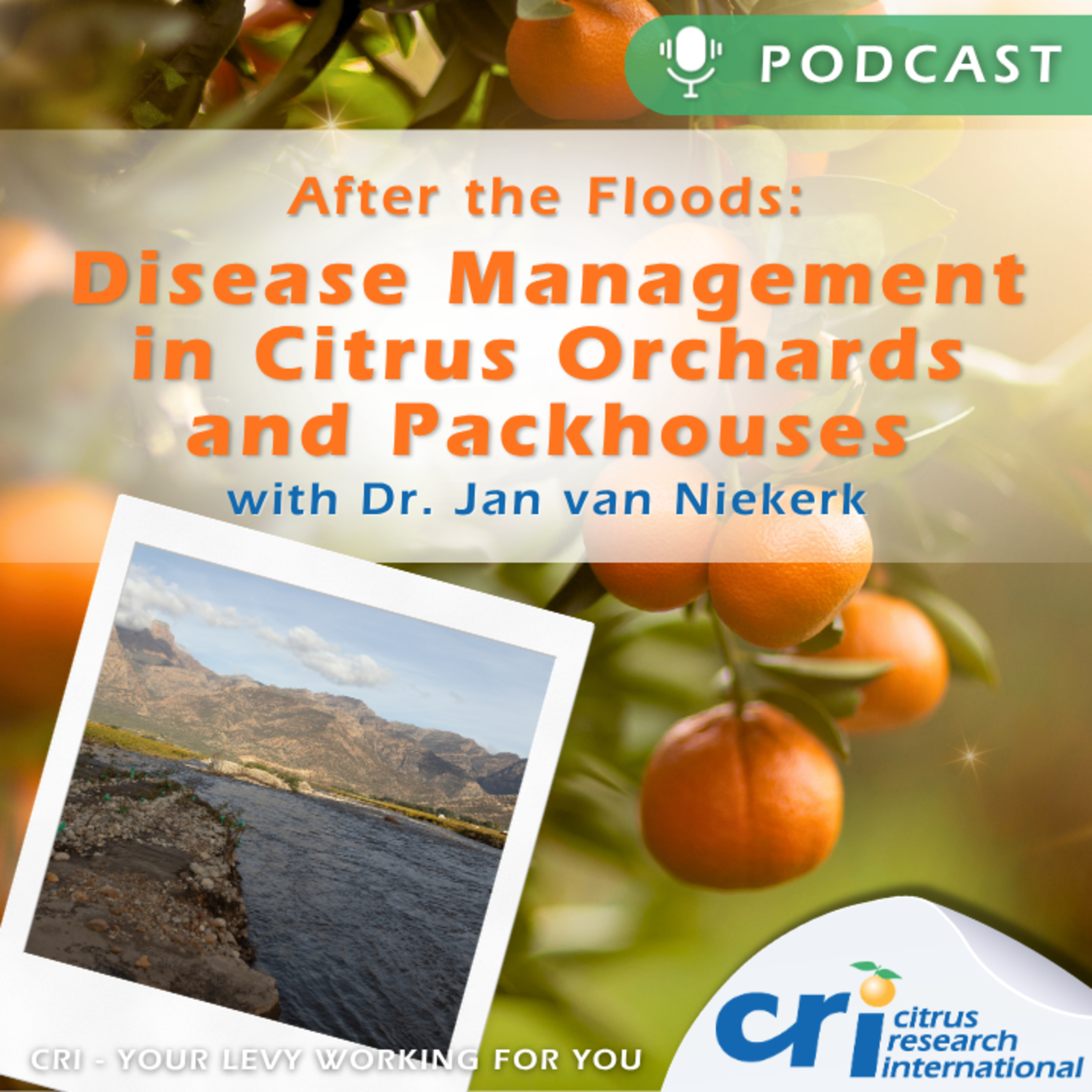 After the Floods: Disease Management in Citrus Orchards and Packhouses – Jan van Niekerk [2026, May.] 28.05.2026 22минIn this CRI Podcast episode, we speak with Dr. Jan vanNiekerk, CRI Soilborne Disease Researcher and Portfolio Manager for Disease Management Research, about the disease challenges citrus growers and packhousesface following severe flooding and prolonged wet conditions. The discussion focuses on how saturated soils and waterlogged orchards create ideal conditions for Phytophthora root rot, one of the most serious soilborne disease threats in citrus production. Jan explains how flooding removes oxygen from the soil, causing root stress and root death, which in turn creates favourable conditions for disease development. Flooding also increases the risk of fruit decay, especially Phytophthora brown rot andsour rot, which can have serious implications for fruit intended for export.The episode also explores the practical management decisions growers need to make after flooding events, including: · improving orchard drainage and removing standing water · strict orchard sanitation through removal of rotten fruit from trees and orchard floors · careful handling of sensitive fruit from flooded and waterlogged orchards· more frequent changing of sanitiser and fungicide baths in the pack house · understanding the role and risks of phosphonate applications · managing the increased risk of Phytophthora brown rot, sour rot and postharvest decay on flood-affected fruit A key theme throughout the discussion is that fruit from stressed trees require more careful handling than under normal conditions. Even small handling injuries can increase the risk of postharvest disease development later in the supply chain. This is especially important where fruit mayalready have been exposed to floodwater, mud or high disease pressure before reaching the pack house. The conversation also highlights the importance of patienceafter flooding events. Entering saturated orchards too early can cause additional damage, while long-term root disease management strategies remain critical well beyond the initial flooding period. The key takeaway for growers and packhouses is clear: flooddamage is not only a short-term event - it creates long term risks of Phytophthora root rot development, as well as increased risk of fruit decay such as Phytophthora brown rot and sour rot, which must be carefully considered before fruit is packed and exported.This podcast was recorded in May 2026. CRI Members should also read Cutting Edge No. 440 for moreinformation. About the CRI PodcastThe CRI Podcast features interviews with expert researchersand area extension managers from Citrus Research International, highlighting the science and field innovation that keep Southern Africa’s citrus industry competitive and sustainable.
 -
 Citrus Packaging Systems: How Small Decisions Impact Big Outcomes – John Jones [2026, Feb.] 20.05.2026 19минIn this CRI Podcast episode, we speak with John Jones, CRIPackaging Specialist, about the critical role packaging plays in protecting citrus fruit quality throughout the supply chain.While often viewed as a cost component, packaging is afundamental part of the system that ensures fruit arrives in the market in optimal condition. John explains how packaging should be approached holistically - from cartons and strapping to pallet design - as each component contributes to the overall performance of the load.A key focus in the discussion is the importance of palletquality. Variability in pallet design, materials and manufacturing standards can introduce significant risk, particularly when pallets are not fit for purpose or are selected based purely on cost. These risks may only becomevisible once fruit is already in transit or has reached export markets, where the financial consequences can be substantial.John highlights that packaging should not be seen as asecondary consideration, but as a risk management tool. Compromising on quality may offer short-term savings, but increases the likelihood of damage, inefficiencies and loss further down the value chain.The key takeaway for growers and packhouses is clear:packaging is the foundation of the load - and small decisions at this level can have major consequences for fruit quality, market access and returns. This podcast was recorded in February 2026. About the CRI PodcastThe CRI Podcast features interviews with leading researchers and extension experts from Citrus Research International, highlighting the science and field innovation that keep Southern Africa’s citrus industry competitive and sustainable.
 -
 Optimising the Citrus Cold Chain – Dr. Tarl Berry [2026, Feb.] 22.04.2026 27минIn this CRI Podcast episode, we speak with Dr. Tarl Berry, CRIProgramme Coordinator: Cold Chain Research, about the critical role the cold chain plays in protecting citrus fruit quality from packhouse to market.South Africa exports citrus over long distances, oftenrequiring extended shipping periods under strict temperature protocols. This makes the cold chain one of the most important - and complex - components of the value chain. Tarl explains how citrus differs from other fruit types, and why managing chilling injury, airflow and temperature exposure is a unique challenge with limited global research to guide decision-making.The discussion highlights how small deviations in cold roomhandling can significantly increase the risk of chilling injury later in the supply chain. Research shows that factors such as cooling rate, airflow distribution, humidity and handling practices in cold storage all influence fruit susceptibility - often with effects only visible weeks later in the market.Tarl also shares practical insights into improving airflowin containers, including the development of simple, cost-effective floor cover designs that help create more uniform temperature distribution. The role of packaging, pallet design and ventilation alignment is also discussed as part of a broader systems approach to cold chain optimisation.A key takeaway is that cold chain performance is notcontrolled by a single point in the system. It requires alignment between growers, packhouses, cold stores and logistics providers, with improved communication and transparency becoming increasingly important. This episode provides practical, research-driven insightinto how the citrus industry can reduce risk, improve consistency and protect fruit quality across the full export chain. This podcast was recorded in February 2026.About the CRI PodcastThe CRI Podcast features interviews with leading researchers and extension experts from Citrus Research International, highlighting the science and field innovation that keep Southern Africa’s citrus industry competitive and sustainable.
 -
 Economic Considerations for 2026 and Beyond - Hannes Bester & Steve Turner [2026, Feb.] 15.04.2026 34минIn this CRI Podcast episode, Hannes Bester, CRI NationalExtension Manager, and Steve Turner, Technical Manager at Core Fruit, unpack the economic realities shaping the citrus industry as it moves toward 2026 and beyond.The discussion focuses on the increasing cost pressuresfaced by growers, including input costs, logistics, labour, and compliance requirements, and how these factors are tightening margins across the value chain. The speakers also explore how global market dynamics, exchange rates,and shifting export conditions are influencing profitability and long-term sustainability.A key theme is the importance of strategic decision-making.Growers are encouraged to critically evaluate orchard performance, input efficiency, and return on investment, while also considering future planting decisions in a more constrained economic environment. The conversation highlights the need for disciplined cost management, data-driven planning, and a clear understanding of market requirements.This episode provides practical insight into how growers, packhouses, and industry stakeholders can position themselves to remain competitive in a changing economic landscape.About the CRI PodcastThe CRI Podcast features interviews with leading researchers and extension experts from Citrus Research International, highlighting the science and field innovation that keep Southern Africa’s citrus industry competitive and sustainable.
 -
 Postharvest Management: Decisions That Drive Returns - Dr. Arno Erasmus 23.02.2026 30минIn this episode of the Citrus Research International (CRI) Podcast, we speak with Dr Arno Erasmus, former CRI researcher and now Postharvest Plant Pathologist at Wonderful Citrus in the United States.Arno shares his journey from applied research in South Africa to working inside one of the world’s most highly integrated citrus businesses, where every technical decision must make economic sense. He explains how postharvest practices, sanitation, grading accuracy and line performance are evaluated through the lens of return to the grower, and why even small inefficiencies carry a measurable cost.The conversation explores how electronic grading, consistent specifications, and data-driven scorecards can improve utilisation without compromising quality. Arno also discusses how technology is used not to replace people, but to remove emotion, improve accountability, and support better decision-making across operations, maintenance, treatments and management teams.A central theme is that postharvest success is not only about chemistry or equipment, but about people, consistency and culture. By measuring what matters, understanding fruit behaviour, and aligning technical actions with business outcomes, packhouses can improve efficiency while protecting fruit value.For South African growers and packers, this episode offers practical insight into how postharvest systems can be optimised to reduce waste, improve consistency and ultimately strengthen returns throughout the value chain.About the CRI PodcastThe CRI Podcast features interviews with leading researchers and extension experts from Citrus Research International, highlighting the science and field innovation that keep Southern Africa’s citrus industry competitive and sustainable.
 -
Citrus Rootstocks Explained: Disease Tolerance, Tree Health & Yield - Dr. Kim Bowman 26.01.2026 28минIn this episode of the Citrus Research International (CRI) Podcast, we speak with Dr Kim Bowman, research geneticist at the US Department of Agriculture – Agricultural Research Service (USDA-ARS) in Fort Pierce, Florida, and one of the world’s leading citrus rootstock breeders.Dr Bowman shares insights from more than 30 years of citrus rootstock development, including the release of 16 USDA rootstocks, one of which, US-942, has become the most widely planted rootstock in Florida. He explains why rootstocks play a foundational role in citrus production, influencing tree vigour, anchorage, nutrient uptake, disease tolerance and ultimately fruit yield and quality.The conversation focuses strongly on Huanglongbing (HLB) and how Florida’s experience with the disease reshaped global thinking around rootstocks. Dr Bowman explains how certain rootstocks show improved tolerance by limiting bacterial multiplication in the root system, while also emphasising that tolerance is not immunity. Rootstocks, he notes, are one part of a broader system aimed at sustaining fruit production under disease pressure.He also unpacks how rootstocks are bred and evaluated, why they cannot simply be “discovered” like scion mutations, and how long-term field performance is essential before release. Additional discussion covers tolerance to phytophthora, nematodes, soil constraints, anchorage under extreme weather, and the role rootstocks may play in future production systems such as protected structures.For South African growers, the key takeaway is clear: rootstocks are not interchangeable. They are strategic production decisions that shape orchard performance for decades and become even more critical as disease, climate and soil challenges intensify.About the CRI PodcastThe CRI Podcast features interviews with leading researchers and extension experts from Citrus Research International, highlighting the science and field innovation that keep Southern Africa’s citrus industry competitive and sustainable.
-
Getting Irrigation Right: Basics for Better Orchard Performance – Coenraad Fraenkel & Jaco Lindeque 12.01.2026 22минIn this Citrus Research International (CRI) Podcast,Coenraad Fraenkel, Area Extension Manager for the Western and Northern Cape, and Jaco Lindeque, Production Manager at Groep 91, discuss one of the most influential – and most often underrated – crop manipulation tools influencing citrusperformance: irrigation.Coenraad explains how incorrect irrigation remains a leadingcause of poor orchard performance across South Africa. Through CRI’s national irrigation courses and field diagnostics, the team repeatedly found that manytree health problems traced back to over-irrigation, poor system maintenance, and a lack of soil observations.Jaco shares the practical journey of transforming irrigationmanagement at farm level using simple tools, consistent planning, and disciplined auditing. By adopting basic practices like regular soil augering, checking root depth and health, verifying system pressure, and using probes toaudit rather than replace decision-making, his team achieved measurable improvements in yield, water use efficiency and production consistency - even in difficult, high-clay soils.Both guests emphasise the same message:Irrigation success comes from getting the basics right, not only relying on technology .Have a plan. Execute it consistently. Audit it honestly. Repeat it. This episode is essential for any grower wanting to improvefruit quality, reduce wasted inputs, and strengthen long-term orchard performance.About the CRI PodcastThe CRI Podcast features interviews with leading researchers and extensionexperts from Citrus Research International, highlighting the science and fieldinnovation that keep southern Africa’s citrus industry competitive andsustainable.
-
Citrus Profitability: The Economics Citrus Growers Must Understand – Dr. Kandas Cloete 10.12.2025 35минIn this Citrus Research International (CRI) Podcast, wespeak with Dr Kandas Cloete, Senior Analyst at BFAP and specialist in farmprofitability and agricultural policy for high-value export crops.Kandas explains the core drivers of economic sustainabilityin citrus farming, showing that profitability depends far more on cartons per hectare, fruit size, market returns, and farm gate value than simply on cost-cutting. Drawing on BFAP’s work with citrus producers, she highlights how counts, pack-outs, logistics costs, distance to port, and market choice allshape the price a grower ultimately receives.She unpacks the relationship between fruit size and profit,explaining why smaller fruit not only earns less per carton, but also increasespicking and packing costs throughout the chain. She discusses how market preferences vary (EU, UK, Russia, US), and why understanding which fruit fits which market is essential for maximising returns.Kandas also discusses financial risk, debt pressure, farmperformance variation, and why growers need accurate information flowing between farm, packhouse and exporter. Her message is clear:To be profitable, growers must maximise the number of exportable cartons at theright counts, and make informed decisions based on reliable economic data.About the CRI PodcastThe CRI Podcast features interviews with leading researchers and extension experts from Citrus Research International, highlighting the science and field innovation that keep Southern Africa’s citrus industry competitive and sustainable.
-
Alternaria: Disease Risks, Cultivar Susceptibility & Management - Prof Jacquie van der Waals 03.12.2025 17минIn this episode of the Citrus Research International (CRI)Podcast, Prof Jacquie van der Waals, Programme Coordinator for Preharvest Diseases, explains the epidemiology and management of Alternaria Brown Spot and Core Rot - two important diseases increasingly affecting soft citrus.Jacquie discusses how Alternaria infections begin early inthe season, often during first flush and flowering, and how warm, humid conditions drive both disease development and severity. She highlights the role of canopy management, airflow and light penetration in reducing favourableinfection conditions, and explains why preventative fungicide applications must be carefully timed and managed to avoid resistance.She also addresses cultivar susceptibility and shares howCRI is developing rapid bioassays to screen new cultivars before commercial release. Her core message is the importance of early observation and regular “footprints in the orchard,” supported by accurate diagnosis and close communication with CRI extension staff.About the CRI PodcastThe CRI Podcast features interviews with leading researchers and extension experts from Citrus Research International, highlighting the science and field innovation that keep Southern Africa’s citrus industry competitive and sustainable.
-
Biosecurity: Protecting South Africa’s Citrus Future - Dr. Paul Fourie 20.11.2025 28минIn this episode of the Citrus Research International Podcast, we talk to Dr. Paul Fourie, Manager of Biosecurity and the Citrus Improvement Scheme (CIS) at CRI.Paul explains how South Africa’s world-class citrus industry depends on one critical safeguard - certified, disease-free propagation material. From the Citrus Foundation Block in the Eastern Cape, every legal citrus tree in South Africa starts clean.He warns that illegal plant imports and backyard grafting are among the biggest biosecurity risks, capable of introducing devastating diseases like Huanglongbing (HLB), also known as citrus greening, which has destroyed citrus industries abroad.Paul shares how CRI and the CGA are working with neighbouring countries to strengthen regional surveillance and early detection systems, and why public awareness is now key: every gardener, grower, and traveller has a role in keeping our citrus safe.About the CRI PodcastThe CRI Podcast features interviews with leading researchers and extension experts from Citrus Research International, highlighting the science and field innovation that keep Southern Africa’s citrus industry competitive and sustainable.Connect with us:Website: https://www.citrusres.com/
-
Integrated Pest Management (IPM): Rethinking Citrus Pest Control - Andre Combrink 13.11.2025 46минIn this episode of the Citrus Research International Podcast, André Combrink, Area Extension Manager for the Eastern Cape, shares practical insights into Integrated Pest Management (IPM) and how growers can reduce chemical reliance through smarter cultural practices.Drawing on decades of experience—from his years at SRCC to his current role at CRI—André explains how pruning, spray machine calibration, orchard sanitation, and ant control all contribute to cleaner fruit and a healthier orchard ecosystem.He discusses the importance of monitoring data, avoiding unnecessary sprays, and preserving natural predators and parasitoids that form the backbone of sustainable pest control. His message is clear: long-term citrus success depends on working with nature, not against it.About the CRI PodcastThe CRI Podcast features interviews with leading researchers and extension experts from Citrus Research International, highlighting the science and field innovation that keep Southern Africa’s citrus industry competitive and sustainable.
-
Marketing Global Citrus Exports : Insights from Etienne Rabe 17.10.2024 21минWe are excited to share key insights from our recent conversation with Etienne Rabe, who discussed the future of citrus farming. With decades of experience across South Africa, California, and Mexico, Etienne highlighted how South African citrus growers are at the forefront of the global market.
-
Effective Strategies for Managing Fruit Fly Threats 09.10.2024 33минWe are excited to share insights from our recent podcast with Dr. Aruna Manrakhan, Research Entomologist at Citrus Research International (CRI). Fruit flies pose significant threats to our citrus industry, but effective management practices can help mitigate these risks. Listen to this new podcast in our library.
-
Introduction to IPM by Dr Sean Moore 23.07.2024 29мин"Integrated Pest Management (IPM) is a sustainable approach that combines biological, cultural, and chemical tools to manage pests effectively. Learn more from our podcast with Dr Sean Moore. #CitrusResearch #IPM"
Слични подкасти


Популарен во
Овој подкаст се појавува и на подкаст-листите на овие земји.
