
EY Sustainability Matters
EY
0
EY Sustainability Matters is a podcast that explores sustainability as a business issue. It provides insights into key business risks and opportunities through an environmental, social, governance, and sustainability lens. The series discusses how companies can address sustainability challenges and integrate them into their strategies. It offers perspectives from EY professionals and industry experts.
Епизоди
-
 Beyond the buzz of Climate Weeks 15.09.2026 29минIn this episode of Sustainability Matters podcast, host Alexis Gazzo brings together Global EY leaders Ruth Guevara and Bruno Sarda to explore whether the global climate conversation is genuinely moving from ambition to action. Recorded ahead of Climate Week NYC 2026, the discussion tackles how extreme weather events — from record heat waves to devastating wildfires — are shifting physical climate risk from a future scientific model to an immediate operational reality for global businesses. The panel addresses the challenge of navigating a fragmented geopolitical landscape as companies prepare for COP31. The guests also examine the evolving reporting landscape, discussing whether frameworks such as the ISSB are creating real business value or simply making organizations busier.
 -
 Why short-term growth mindset can put business at risk 02.09.2026 46минIn this episode of the Sustainability Matters podcast, host Nadia Woodhouse from the EY New Economy Unit explores the notion of the extractivist economy. As companies work to meet sustainability goals, a critical question emerges: is our focus on short-term extraction quietly undermining long-term resilience? Nadia is joined by economist and writer Professor Tim Jackson and Kiara Konti, Climate Change and Sustainability Services Leader for Ernst & Young (Hellas) Certified Auditors Accountants SA (EY Greece). Together, they reveal how overusing natural resources and ignoring systemic degradation may directly threaten global supply chains and day-to-day business stability. The conversation confronts major structural challenges — from prioritizing short-term investor returns and overlooking unpriced environmental costs, to an over-reliance on the current metrics of economic growth. Tim and Kiara explain why simply "doing less harm" through superficial sustainability isn't enough, warning that ignoring core dependencies on nature creates severe systemic risks. However, they also highlight practical solutions for businesses, such as rethinking value chains around circular models, net-positive impacts and choosing "care over growth," to safeguard both society and long-term business viability. Read more about the EY New Economy Unit and their research here.
 -
 How sport can become a catalyst for business sustainability 11.08.2026 22минIn this episode of Sustainability Matters podcast, host Colin Tetreault, Managing Director, Climate Change and Sustainability Services, Ernst & Young LLP, explores the shifting environmental landscape of the sports industry. As North America enters an unprecedented era of mega events, a critical question emerges: Is the massive environmental footprint of sports a standard business liability, or can it become a powerful driver for operational resilience? Colin is joined by Heather Watkins, co-founder of Bold Reuse, to break down the operational realities of tackling single-use waste at scale. The conversation confronts major logistical and economic challenges, mapping out the impact of rising supply-chain costs for single-use products and upcoming Extended Producer Responsibility (EPR) legislation in the US. The episode offers an inspiring look at how sports venues act as a "cultural beacon" for innovation. Heather explains how implementing reusable packaging systems not only cuts costs but also drives local jobs, community engagement and new corporate sponsorship revenue.
 -
 How sustainability reporting can drive financial performance 15.07.2026 24минIn this episode of Sustainability Matters podcast, host Christian Orth explores how Siemens is using sustainability reporting as a powerful management tool to help steer business performance. As new regulatory frameworks such as CSRD (Corporate Sustainability Reporting Directive) roll out, he explores whether ESG disclosure is simply an administrative burden or a tool to drive real value. Christian is joined by Thomas Knobloch from Siemens AG and Caroline Pfaff, Partner at EY Germany to break down the practical reality of ESG reporting. Together, they look at the challenge of complex global data, tracking how organizations can move past chasing "perfect" real-time metrics and instead prioritize immediate progress over perfection. They discuss the real-world operational challenges, how Siemens successfully built a 360-degree target framework directly into its board-level decisions and how focusing on material KPIs, like carbon intensity and product carbon footprints, can simultaneously mitigate long-term risk while unlocking competitive advantages. Through it all, Thomas and Caroline highlight that building a strong company culture is what can drive true organizational transformation as well as the opportunities to unlock real business value. @2026 Ernst & Young LLP
 -
 AI for climate: risk or solution? 24.06.2026 14минIn this episode of Sustainability Matters, host David Rae, EY Global Lead for Sustainability Technology and Innovation, explores the impact of AI on climate change. As AI companies build massive data centers worldwide, a critical question emerges: Will the skyrocketing resource footprint of AI push global grids past their limits, or will AI become a vital tool to help accelerate the energy transition? David is joined by James Grabert from the UNFCCC (United Nations Framework Convention on Climate Change) and Michael Lepech from Stanford University to break down the duality of this digital megatrend. Together, they look at the physical reality behind "the cloud," tracking how AI is driving a massive surge in electricity demand while also leaving an extensive water footprint through data center cooling and the lifecycle of chip manufacturing. However, they also identify areas of opportunity. The episode offers a hopeful look at "decision intelligence." The guests explain how AI is already delivering measurable climate benefits — from transforming early warning weather models in the Global South to balancing power grids and optimizing renewable energy.
 -
 Why healthy rivers are critical to businesses and the economy 26.04.2026 33минIn this episode of the EY Sustainability Matters podcast, Bruno Sarda hosts a discussion with Mark Greatrex, President of Cox Communications, and Tom Kiernan, CEO of American Rivers, about the pivotal role of water in supporting communities and businesses. The guests emphasize that, amid increasing challenges such as nature loss, pollution, drought, flooding and climate extremes, safeguarding rivers is now more critical than ever for commercial interests and economic health. The dialogue explores how organizations can deepen their understanding of their reliance on healthy river systems, advance solutions through collaborative efforts, and promote water-positive and nature-positive practices. Additionally, the speakers underscore the importance of strategic partnerships in achieving watershed-scale outcomes. Effective collaboration between businesses and nonprofit organizations facilitates data sharing, strategic alignment, and the development of practical projects that provide multifaceted benefits to communities, industry and ecosystems. Both guests highlight the value of establishing relationships prior to crises, ensuring that trust and momentum are established when challenges inevitably arise.
 -
 Can AI save nature, or will it cause more harm? 17.03.2026 16минIn this episode of EY Sustainability Matters, David Rae, EY Global Lead for Technology, AI and Innovation at EY Climate Change and Sustainability Services, explores the complex intersection of artificial intelligence (AI) and nature. The host poses the question: Can technology solve the nature loss crisis, or will its resource-heavy footprint only accelerate the problem? Hear industry voices and activists debate whether AI is a necessary tool for nature's survival and offer holistic views on the risks and opportunities ahead, drawing on a hypothetical debate from The EY AI x Sustainability Exchange: from big questions to real solutions, where activists were asked to take opposing sides of the argument. Gilad Goren of the Nature Tech Collective argues that reversing nature loss is impossible without AI, which is essential for de-risking private sector investment and closing the nature finance gap. We also hear how companies, such as SAP, IBM, Treefera and others, are leveraging real-time data to track deforestation and optimize crop yields in hard-to-abate sectors. Conversely, activists Livia Pagoto and Fred Werner highlight the "shadow effect" — the skyrocketing energy and water demands of massive data centers. The conversation also explores ethical governance, questioning whether potentially biased algorithms can ever replicate human care required to protect the environment. AI is already accelerating nature protection, from monitoring deforestation and biodiversity to improving climate risk assessment, supply‑chain transparency and renewable energy optimization. However, AI's rapid growth is resource‑intensive, driving significant increases in energy and water use, and raising concerns about scalability, equity and environmental impact. Progress requires collective action, combining human wisdom, inclusive governance, Indigenous knowledge and responsible innovation, to ensure that AI strengthens — rather than replaces — our relationship with nature. @2026 Ernst & Young LLP
 -
 How collaboration can open new opportunities to reduce emissions 19.02.2026 30минIn this episode of the Sustainability Matters podcast, hosts Bruno Sarda and Anne Munaretto interview Ravi Annapragada, Director of Sustainability and Energy Strategy at Carrier, a global supplier of heating, ventilation, and air conditioning (HVAC) products. Together they discuss 'Joining forces for a sustainable future', a collaboration between Carrier customers, suppliers, and internal teams that aims to accelerate decarbonization and drive meaningful sustainability progress. The initiative, engaging 10 major customers across various sectors at different stages of their sustainability journey, highlights the benefits of moving away from isolated efforts toward partnership and co-creation. The discussion describes the HVAC giant's path to setting ambitious science-based targets, recognizing that most emissions stem from product use and realizing that addressing these challenges requires collaboration rather than a solely transactional relationship. The guests also emphasize the importance of internal alignment, especially with sales teams, and demonstrate that sustainability and business growth can be mutually reinforcing.
 -
 2026: from climate pledges to measurable results 15.01.2026 34минIn this episode of the EY Sustainability Matters podcast, hosts Elanne Almeida, EY LATAM Industrials and Energy Lead for Climate Change and Sustainability Services (CCaSS), and Matthew Handford, EY CCaSS Lead for Financial Services in the Americas, unpack the pivotal outcomes of COP30 and what they mean for the year ahead. This episode moves beyond the conference itself to focus on how its decisions are shaping business and policy strategies for 2026. Listeners will hear insights from global leaders and industry professionals on the shift from climate pledges to implementation, the rise of accountability frameworks, and the growing role of collaboration between the private and public sectors. Discover how new transparency requirements, ambitious national climate plans (NDCs) and innovative collaborations are setting the stage for measurable progress in sustainability — and why 2026 is poised to be a defining year for climate action worldwide.
 -
 What working in sustainability looks like in today's global market 27.11.2025 38минIn this episode of the EY Sustainability Matters podcast, listeners will explore what it means to work in sustainability by hearing from three unique perspectives: Janine Osborne, CEO of Sustainable Seas Trust and marine conservation advocate; Alice Ashpitel, Sustainability Lead at Mercedes AMG Petronas Formula 1 Team; and Benjamin Okpara, Senior Consultant in EY Climate Change and Sustainability Services. Together, they reveal how sustainability for them is more than a job - it's a mission that spans advocacy, business innovation and advisory work. Listeners will hear how Janine drives systemic change across Africa's blue economy, how Alice embeds sustainability in the fast-paced world of Formula 1 and how Ben helps organizations navigate complex environmental challenges. The episode delves into the realities of the field: balancing ambition with practical constraints, the importance of collaboration, and the personal motivations and experiences that keep these leaders moving forward. 0:00 - Exploring Diverse Roles in the Sustainability Ecosystem 2:12 - Alice Ashpitel on Driving Sustainability in Formula 1 13:41 - Janine Osborne on Marine Conservation and Advocacy 26:00 - Benjamin Okpara on Consulting for Sustainable Business Practices 37:03 - Connecting Advocacy, Practice, and Advisory for Impact @2025 Ernst & Young LLP
 -
 Why businesses are leaning in at Climate Week NYC 2025 03.11.2025 16минWhat happens when over a thousand climate-focused events converge in one city? At Climate Week NYC 2025, the private sector showed up in force, bringing bold ideas, collaborative energy and a clear shift from strategy to delivery. In this episode of EY Sustainability Matters, host Matthew Bell shares insights from leaders across various industries-utilities, consumer goods, technology and agriculture-as well as NGOs interviewed on the sidelines of EY-hosted events. Hear how artificial intelligence (AI) is transforming sustainability efforts, enabling smarter and faster decisions in the race against time. Discover why nature is no longer just an ethical concern but a material business priority. Learn how cross-sector partnerships are unlocking regenerative practices and reshaping supply chains. From boardroom strategies to landscape-level collaboration, this episode captures the pulse of NY Climate Week and the momentum building toward the upcoming COP30 in Brazil. Collaboration and cross-sector partnerships can unlock scalable climate and nature solutions, especially in agriculture and energy. Nature is now strategic, and businesses are integrating nature into core operations for resilience and profitability. From predictive analytics to emissions reduction, AI is accelerating sustainability with speed and precision. @2025 Ernst & Young LLP
 -
 How to overcome fear in financing climate innovation 29.09.2025 35минThis episode of the EY Sustainability Matters podcast is a rare opportunity to hear from two global thought leaders who have shaped sustainability strategies at the highest levels of business and international development, about the need for a move toward a regenerative economy, and the challenges and opportunities that will present. Nadia Woodhouse from the EY New Economy Unit (NEU) welcomes two distinguished thinkers: Sir Noel Quinn, former Chief Executive of HSBC, and Usha Rao-Monari, former Under-Secretary General of the United Nations Development Programme and member of the EY New Economy Unit Advisory Council. Both guests bring a wealth of experience from the worlds of global finance, development and industry, and currently serve as independent directors on the board of Fortescue, a global metal mining company at the forefront of commercial decarbonization. The conversation dives deep into the challenges and opportunities of building a regenerative economy. Noel shares insights from his tenure at HSBC, emphasizing the importance of economic case-making, transparency in target setting and overcoming organizational fear in driving change. Usha expands the discussion to the global scale, highlighting the push for better data, risk mitigation, and collaboration between public and private sectors — especially in emerging markets. Together, they explore the roles of policy, finance and innovation in accelerating the transition to a sustainable future, offering practical insights for leaders navigating the complexities of climate action and systemic transformation. Read more about the EY New Economy Unit here.
 -
 How national climate plans can reshape global investments 28.08.2025 25минHost Matt Bell explores the pivotal role of Nationally Determined Contributions (NDCs) in shaping climate policy and investment strategies. He interviews four experts to get their insights. Joanna MacGregor, a senior advisor at the UN Climate Change (UNFCCC), explains how NDCs have evolved into comprehensive national climate plans that can drive economic growth and resilience. Antonina Scheer, Policy Fellow at the London School of Economics and Research Project Manager at the Transition Pathway Initiative Centre, discusses the challenges of financing climate action in emerging markets and introduces a tool that helps assess the credibility and ambition of NDCs. Pablo Carvajal, Director in the Climate Change and Sustainability Services team at EY UKI, shares insights from his work with governments and banks, highlighting the disconnect between policy targets and business implementation. Claudia Gollmeier, Managing Director at Colchester Global Investors, emphasizes the importance of investors considering NDCs and the rise of innovative financial instruments like sustainability-linked bonds. Together, the guests underscore the urgency of making NDCs investable and inclusive, involving businesses and investors in their design and execution. Despite delays in countries submitting their NDC plans, they remain optimistic about the potential of NDCs to unlock financial flows and accelerate the global transition to a low-carbon economy. NDCs are evolving into powerful economic tools that can drive growth, resilience and clean energy transitions. Businesses and investors play a crucial role in implementing NDCs, even though governments set the targets. Transparent information and innovative financial products are helping bridge the gap between climate ambition and investable action. @2025 Ernst & Young LLP
 -
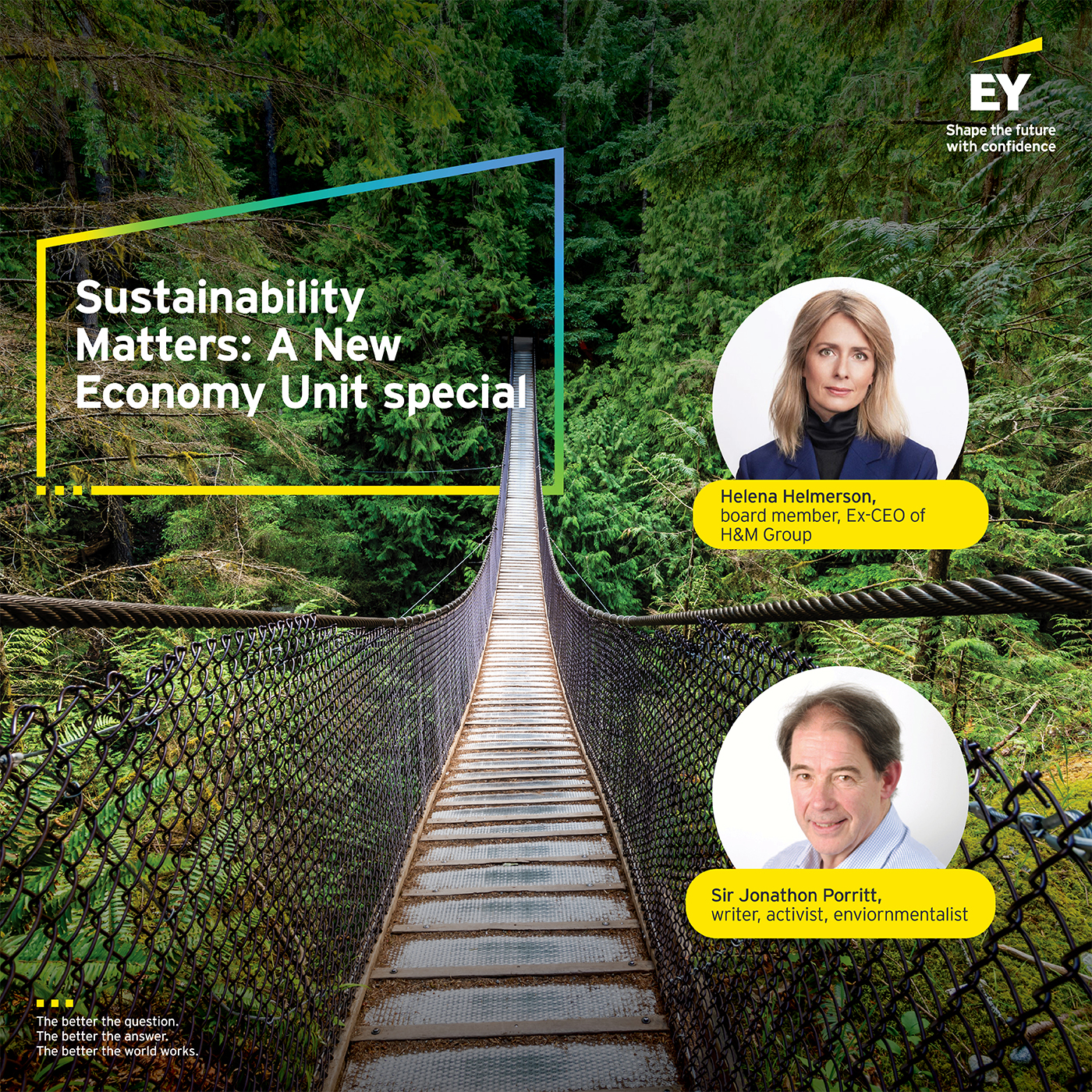 How and why should CEOs put sustainability at the core of business 30.06.2025 40минThis special episode of the EY Sustainability Matters podcast is introduced by Nadia Woodhouse from the EY New Economy Unit (NEU), which focuses on the long-term, systemic shifts toward a new, regenerative economy. Nadia presents a thought-provoking dialogue with two influential leaders in sustainability: Helena Helmersson, former CEO of the fashion giant H&M Group, and Jonathon Porritt, a writer, environmentalist, advocate for sustainable development and a member of the advisory council for the NEU. The discussion centers around the pressing need for businesses to adopt regenerative practices in the face of escalating sustainability challenges and the crucial role of CEOs in driving that change. The conversation delves into critical themes, such as the tension between profitability and sustainability, the importance of structural changes within large organizations, and the importance of forming deep, cross-industry coalitions. Both guests emphasize the need for greater inclusion of sustainability professionals in decision-making roles, the need for appropriate regulation, and urge CEOs to view sustainability not just as a responsibility, but as a core business imperative that drives innovation and competitiveness. Read more about the EY New Economy Unit here. CEOs' commitment to sustainability can drive significant organizational change and inspire collective action at all levels of the business. Immediate and decisive actions are essential for companies to transition toward sustainable practices and mitigate the drastic impacts of climate change. Companies should align their economic objectives with sustainability commitments to foster innovation and resilience in an increasingly resource-constrained world. © 2025 Ernst & Young LLP
 -
 How companies can address human rights risks in global supply chains 28.05.2025 29минDespite the popular belief that slavery is a thing of the past, it is estimated that slavery affects around 50 million people globally. Human exploitation for labour and other forms of modern slavery are embedded within the supply chains of many of the products and services that we choose to consume regularly, whether we are buying clothes, electronics, or even a bar of chocolate. This is becoming an increasing concern for business as well. Mounting pressure from both legislative bodies that introduce new regulations and a new generation of consumers, who seem to be willing to pay more for sustainable products, signals a need for a change. In this episode of the EY Sustainability Matters podcast, host Bruno Sarda explores this topic further with Tom Veit, CEO of Asahi Global Procurement – a large Japanese consumer goods company, and Kate Skattang, Director in the Climate Change and Sustainability Services practice at EY Australia (Ernst & Young Services Pty Limited). The guests discuss the challenges posed by the issue of forced labor across global supply chains and the recent legislative changes that compel organizations to scrutinize their procurement. Tom and Kate share industry insights about how EY worked with Asahi Global to create their own human rights due diligence framework, emphasizing the importance of a top-down approach as well as putting people first across all areas of business processes. Protecting human rights is a fundamental responsibility for companies, as forced labor impacts tens of millions of people globally. Leadership commitment is essential for prioritizing human rights and implementing effective due diligence frameworks within organizations. Recent laws, such as modern slavery regulations in the UK and Australia, or Corporate Sustainability Due Diligence Directive (CSDDD), are driving companies to assess and proactively disclose human rights risks in their supply chains. © 2025 Ernst & Young LLP
 -
 How businesses can drive sustainability in a volatile political landscape 28.04.2025 26минIn this episode of the EY Sustainability Matters podcast hosted by Bruno Sarda, the discussion centers around the vital collaboration between the public and private sectors in advancing sustainability efforts. Bruno welcomes Ruth Ahchow, EY Global Government and Public Sector Leader for Climate Change and Sustainability Services, who elaborates on the importance of public-private partnerships (PPPs) as key mechanisms for sustainable development, showcasing successful examples from around the world, including the Asia-Pacific region. Bruno and Ruth discuss how recent political shifts in regions, such as the US and Europe, influence sustainability initiatives. Ruth also provides actionable insights, urging governments to actively participate in sustainable procurement and create stable policies that encourage green investments, while companies are encouraged to integrate long-term sustainability into their core strategies. 01:48 - Evolution of sustainability in the public sector through Ruth's career 05:50 - Understanding PPPs 08:06 - Examples of successful PPPs around the world and in the Asia-Pacific 16:16 - The impact of political shifts on sustainability 19:41 - Role of sustainability reporting standards 25:34 - Actionable insights for business and governments © 2025 Ernst & Young LLP
 -
 How music artists and labels can innovate for a better planet 28.03.2025 26минIn this episode of the EY Sustainability Matters podcast, host Bruno Sarda and guests dive into the intersection of sustainability and the music industry. Discussing the topic with Bruno are: Joel Makower, Chairman and Cofounder of the Trellis Group (formerly GreenBiz) and the Strategy Director & Industry Council Chair of the Music Sustainability Alliance, and Olga LaBelle, Vice President and Head of Environmental, Social and Governance (ESG) at Warner Music Group. The speakers discuss the current state of sustainability in the music industry, innovative collaborations for environmental benefit, and how artists, labels, concert venues and fans can contribute to a more sustainable industry. © 2025 Ernst & Young LLP
 -
 Why integrating sustainability is everybody's business 10.02.2025 38минThe relationship between business and sustainability is evolving. As awareness of its importance – and value – grows, so does the recognition that responsibility for addressing the subject is not confined to specific sustainability roles. Indeed, growing opinion is that every job within an organization can and should be considered a sustainability job. In this episode, EY Americas Climate Change and Sustainability Services Leader Bruno Sarda sits down with Pia Heidenmark Cook, a former Chief Sustainability Officer at IKEA and now senior board member, speaker and sustainability advisor, and Lisen Wiren, Programme Manager at IKEA Social Entrepreneurship, to discuss the very idea that every professional within any business can make an impact. Pia and Lisen have just published a book "Embedding Sustainability - How to Drive Organizational Transformation," based on decades of their experience. Listen to this insightful conversation where two seasoned sustainability professionals talk about the importance of threading sustainability into the basis of every organization, as well as on how typically small corporate sustainability departments can make a big difference. © 2025 Ernst & Young LLP
 -
 How to transform your business on a journey to a new economy 12.12.2024 28минWith the world in the midst of a global polycrisis, the New Economy Unit (NEU) — a global research group at the EY organization — was established to look at the key economic forces at play and the leading business practices needed to create a sustainable future. Host Bruno Sarda discusses the NEU and a bigger idea of regenerative business transformation it represents with Matt Bell, EY Global Leader, Climate Change and Sustainability Services, and Anastasia Roussou, EY Head of New Economy Research Unit, in London. Moreover, the discussion covers the work the NEU does with the activist and academic community, some of whom sit on the NEU advisory board. It also highlights the importance of taking a long-term view while not neglecting short-term objectives, and teases what the NEU will be exploring next. Please, read the full report "A new economy - Exploring the root causes of the polycrisis and the principles to unlock a sustainable future" on ey.com, or contact the New Economy Unit at [email protected]. Key takeaways include: The New Economy Unit help enables practitioners to think about the long-term future and what they need to radically change. The report aims to bring everyone on the same page and mainstream the concepts that will likely aid the transition to long-term sustainability. © 2024 Ernst & Young LLP
 -
 COP29: what's at the top of the world's sustainability agenda 30.10.2024 25минIn this episode, Bruno Sarda, host of the EY Sustainability Matters podcast, meets with prior guests to talk about the significant developments in sustainability over the past year, ahead of the upcoming UN Climate Change Conference or COP29 in Baku, Azerbaijan, later this November. Amy Brachio, EY Global Vice Chair for Sustainability, and Matt Bell, EY Global Leader for Climate Change and Sustainability Services, share their experiences from the 2024 New York Climate Week . They discuss the transition from addressing environmental issues in siloes to a comprehensive view that acknowledges the interdependence of various sustainability factors that must be addressed together. The speakers share their expectations for the upcoming COP29, underscoring emerging trends, such as the increased emphasis on finance and carbon markets to support the transition. In the final part of the episode, Amy and Matt express optimism about the future, talking about the businesses' desire for innovation, investment in new technologies and a collective willingness to undertake systemic change. © 2024 Ernst & Young LLP
Слични подкасти


Популарен во
Овој подкаст се појавува и на подкаст-листите на овие земји.
