
New Books in Sound Studies
New Books Network
0
This podcast is a channel on the New Books Network, an academic audio library dedicated to public education. In each episode, scholars discuss their recently published research with another expert in their field. The channel focuses on sound studies, covering topics related to sound, music, listening, and acoustic culture. It also directs listeners to the network's extensive catalog of over 150 channels and 28,000 episodes, along with its newsletter and social media.
Епизоди
-
 Musical Pripetshik: Lyrics and Melodies of Traditional Yiddish Folksongs 25.08.2026 59минMost of the Yiddish songs we know today were created in the first half of the 20th century and distributed through commercial channels such as sheet music, concerts, radio broadcasts, records and CDs, theater stages, and more recently through songbooks produced in educational settings around the world. Our discussion focuses on lesser-known songs – Eastern Yiddish musical folklore, which emerged over a period of approximately four hundred years preceding the formation of the “popular” repertoire. Although we lack transcriptions of melodies or lyrics from before the end of the 19th century, a comparative study of documentation collected from then until the middle of the 20th century reveals that older layers of this musical-poetic creativity had been preserved over long periods of time. I refer to this older repertoire as the "musical pripetshik." Similar to the traditional combined home-heat-generating cooking oven known as the pripetshik, this old song repertoire was an integral part of Jewish culture, evolving in meaning and function over time. While for many, the image of the pripetshik corresponds to the nostalgic song by Mark Varshavski of 1901, this lecture will explore the earlier history of this and other poetic and musical images to offer an appreciation of their significance. This lecture originally took place on July 23, 2024. Support our show by becoming a premium member! https://newbooksnetwork.supportingcast.fm/sound-studies
 -
Mhoze Chikowero, "The Military Entertainment Complex: Chimurenga Afrosonic Making of Zimbabwe" (MIT Press, 2026) 24.08.2026 1ч 5минThe Military Entertainment Complex: Chimurenga Afrosonic Making of Zimbabwe (MIT Press, 2026) by Dr. Mhoze Chikowero is the story of the making of post-independence Zimbabwe from the sounds and songs born of the country’s armed liberation wars, waged against British Rhodesian white settler rule since the 1890s.The war from 1896 through the twentieth century to resist the initial colonization, as well as the one waged to reclaim land from the colonial farmers in the 2000s, is known as Chimurenga, and the music it produced is thus called Chimurenga music. The sounds and music were Afrosonic—that is, deeply grounded in the ideology of the 1960s–70s war, spawning the cultural liberation of a people whose self-expression the colonial system had criminalized and oppressed for close to a century.The living labs of the liberation war, Chimurenga, powered not just military but also cultural rearmament, thereby producing cultural blueprints for a confident, regenerative public consciousness and expressiveness as independence. The open-access title captures the sounds of self-liberation, framing a state of militant audibility in public cultural expressiveness, public policy propagation, and contestation. It invites readers to imagine, see, hear, and feel self-liberation war redeployed as popular entertainment in the service of state making. This interview was conducted by Dr. Miranda Melcher whose book focuses on post-conflict military integration, understanding treaty negotiation and implementation in civil war contexts, with qualitative analysis of the Angolan and Mozambican civil wars. You can find Miranda’s interviews on New Books with Miranda Melcher, wherever you get your podcasts. Support our show by becoming a premium member! https://newbooksnetwork.supportingcast.fm/sound-studies
-
Michelle Bigenho and Henry Stobart, "Heritage Fever: Law and Cultural Politics in a Decolonizing State" (Oxford UP, 2025) 26.07.2026 56минThe early twenty-first century ushered in a period of change in Bolivia. The country welcomed its first Indigenous president, a new constitution, and a profusion of laws that recognized individual music and dance expressions as intangible cultural heritage. Using cultural heritage lawmaking as a window through which to view the de-centered workings of the Indigenous-focused Plurinational Bolivian State, Heritage Fever: Law and Cultural Politics in a Decolonizing State (Oxford University Press, 2025) by Dr. Michelle Bigenho and Dr. Henry Stobart unpacks the myriad motivations for heritage making in this this politically transformative moment. Heritage Fever reorients UNESCO-driven heritage debates towards a different set of questions—a pivot the authors call “heritage otherwise.” These inquiries focus on how citizens use law to frame expressive culture and engage their new state. Through grounded case studies, Bigenho and Stobart reveal how competing claims over cultural expressions stimulate aficionado research and produce an abundance of cultural activities. Managing these productive conflicts often involves strategic uses of scale within the country's new political autonomies, even as old-style nationalisms lurk beneath a plurinational sheen. One case study highlights imagined Indigenous autonomy as bolstered by decolonizing historiography that predates the Plurinational State by several decades. Privileging the stories told by those who championed or who were bureaucratically involved in the respective heritage-making campaigns, Heritage Fever's research draws from the authors' combined fieldwork in Bolivia over the last 30 years, recent multi-sited fieldwork conducted as a team, and ethnographic interviews conducted with Bolivians involved in heritage-making projects. Contributing to legal anthropology, critical heritage studies, ethnomusicology, and anthropology of the state, Heritage Fever looks beyond intellectual property frames, opens new perspectives on archival thinking, reflects on decolonizing practices in expertise and knowledge production, and uncovers the agency of mid-level citizens in a decolonizing state. This interview was conducted by Dr. Miranda Melcher whose book focuses on post-conflict military integration, understanding treaty negotiation and implementation in civil war contexts, with qualitative analysis of the Angolan and Mozambican civil wars. You can find Miranda’s interviews on New Books with Miranda Melcher, wherever you get your podcasts. Support our show by becoming a premium member! https://newbooksnetwork.supportingcast.fm/sound-studies
-
Stacey Copeland, "Lavender Sounds: From Lesbian Radio to Queer Feminist Soundwork" (U Michigan Press, 2026) 17.07.2026 48минStacey Copeland, Assistant Professor of Cultural Heritage and Identity at the Centre for Media and Journalism Studies at the University of Groningen, joins Jana Byars to talk about Lavender Sounds: From Lesbian Radio to Queer Feminist Soundwork (University of Michigan Press, 2026) delves into lesbian radio history and its evolution into queer feminist podcasting today, exploring the politics, aesthetics, and cultural activism embedded in queer feminist soundwork. Through deeply personal and archival explorations, Stacey Copeland traces the emergence of queer feminist soundwork—a unique blend of community-led storytelling, political resistance, and creative expression rooted in feminist and LGBTQ+ activism. At the heart of the book lies a powerful idea: sound is not just heard but felt, connecting generations through shared voices and struggles. In conversation with award-winning and cutting-edge queer and feminist podcast producers from across Canada and the U.S., Lavender Sounds invites us to turn a feminist embodied ear to the past to uncover the ways gender, race, and sexual orientations are embedded in our everyday media listening practices. From pioneering Canadian radio shows like Vancouver's The Lesbian Show and Montreal's Dykes on Mykes to today's queer chumcasts and audio documentary, Lavender Sounds is a journey through auditory landscapes where joy, protest, intimacy, and identity intersect. This book opens a vibrant conversation about how radio and podcasting are vital tools for marginalized communities to connect, create, and claim space in the media world. Support our show by becoming a premium member! https://newbooksnetwork.supportingcast.fm/sound-studies
-
Carola E. Lorea, "Communities of Sound: Religion, Displacement, and Caste in the Bay of Bengal" (Wesleyan UP, 2026) 25.06.2026 33минCommunities of Sound: Religion, Displacement, and Caste in the Bay of Bengal (Wesleyan University Press, 2026) brings together insights from religion, anthropology, sound, and migration studies to explore the sonic traces of untouchability and forced migration across the Bay of Bengal. Based on an immersive, multi-sited ethnography with Matua devotees—a low-caste, Bengali-speaking Dalit religious community fragmented by Partition, war, and postcolonial displacement—the book explores how sound sustains identity across fractured geographies. Using richly detailed descriptions, the book follows traveling archives of song, story, and ritual performance through West Bengal, Bangladesh, and the Andaman Islands. These sonic practices—congregational singing, drumming, and itinerant storytelling—forge belonging beyond nation-states, connecting the Matua's fifty million members across borders and seas. In a world dominated by visual culture, Communities of Sound centers listening as a mode of knowledge and care, revealing how sound shapes our sense of self and cosmos. More than scriptures or doctrine, it is sound—entangled with authority and power—that binds this transregional Dalit movement and animates its collective action. The book is generously illustrated and references an online companion with video and audio examples. Author bio: Carola E. Lorea is Professor of Social and Cultural Anthropology University of Tübingen, at the University of Tübingen, Germany, where she leads the ERC-funded project MANTRAMS: Mantras in Religion, Media, and Society in Global Southern Asia. She is the author of Folklore, Religion and the Songs of a Bengali Madman (2016), and editor with Rosalind Hackett of Religious Sounds Beyond the Global North: Senses, Media and Power (2024). Support our show by becoming a premium member! https://newbooksnetwork.supportingcast.fm/sound-studies
-
Shikha Jhingan, "The Female Playback in Bombay Cinema: Voice, Body, Technology" (Wayne State UP, 2025) 09.06.2026 43минHow the sound of the female playback voice impacts Bollywood's cultural, musical, and cinematic environment. Drawing on sound studies and performance theory, scholar Shikha Jhingan explores the discursive nature of the female playback voice in Bombay film songs in The Female Playback in Bombay Cinema: Voice, Body, Technology (Wayne State UP, 2025). Mapping the production, circulation, and reception of the voices of singing stars—notably Lata Mangeshkar and Asha Bhosle—Jhingan situates the singing voice as a cinematic object with limitless possibilities of distribution and dispersal. She employs the perspectives of a diverse range of listeners across a vast media landscape to illustrate how the affective charge of the female playback voice, combined with developments in audio technology, has led to a gradual expansion of opportunities for women in film, popular music, and media and audio production. With nuanced exploration of the way the human voice becomes intertwined with devices such as the microphone, radio, cassettes, and digital technologies, Jhingan argues for the sonic excess of the female voice beyond the narrative and visual. The Female Playback in Bombay Cinema is an authoritative addition to the field of sound studies with implications for gender studies, performance studies, and cinema studies. Support our show by becoming a premium member! https://newbooksnetwork.supportingcast.fm/sound-studies
-
Ginger Dellenbaugh, "Maria Callas's Lyric and Coloratura Arias" (Bloomsbury, 2021) 06.06.2026 56минMore than 40 years after her death, the legend of Maria Callas, "La Divina Assoluta," remains unsurpassed. Much has been written about her sensational opera career and fraught private life, from her definitive mastery of iconic opera roles to her love affairs and tantrums. The prototype for the 20th century celebrity diva, Callas emblematizes the cliche of tormented talent - genius in the ring with catastrophe. Her extraordinary voice, in particular, has become an object of cult-like adoration and cultural significance almost with a life of its own: as fetish object, as sophisticated sonic signifier, and most recently, as the lifeblood for a Callas hologram. Such adoration is not without consequences. When Callas is transformed into a vessel for such transcendent magic, it overshadows what is perhaps her most superhuman ability - the masterful technique she deployed to shape and craft her astounding instrument. Singing bodies are working bodies, enacting an intimate and complex form of artistic labor and cultural signification. Using one of Callas's first recital recordings from 1954, Maria Callas's Lyric and Coloratura Arias (Bloomsbury, 2021) envisions each aria as a lens to examine various aspects of vocalization and cultural reception of the feminized voice in both classical and pop culture, from Homer's Sirens to Star Trek. With references to works by Marina Abramovic, Charles Baudelaire, Michel Chion, Wayne Koestenbaum, Greil Marcus, and Farah Jasmine Griffin, as well as films by Pier Paolo Pasolini, Jonathan Demme, and Rainer Werner Fassbinder, each chapter explores phenomena unique to the singing voice, including the operatic screaming point, the politics of listening, and the singing simulacrum. Ginger Dellenbaugh is a musician and historian who has written and lectured on music and politics, vernacular notation systems, and the cultural history of the voice. A trained opera singer, she performed for over a decade in Europe and the United States. Ginger is currently a lecturer at The New School in New York, USA and completing a PhD in musicology at Yale University, USA. She lives in New York City and Vienna, Austria. Ginger Dellenbaugh’s website. Bradley Morgan is a media arts professional in Chicago and author of U2's The Joshua Tree: Planting Roots in Mythic America (Backbeat Books, 2021), Frank Zappa's America (LSU Press, 2025), and U2: Until the End of the World (Gemini Books, 2025). He manages partnerships on behalf of CHIRP Radio 107.1 FM and is the director of its music film festival. Bradley on Facebook and Bluesky. Support our show by becoming a premium member! https://newbooksnetwork.supportingcast.fm/sound-studies
-
Ralph Jones, "Microphone" (Bloomsbury, 2026) 05.06.2026 50минSince its invention more than 150 years ago, the microphone transformed the world in an instant. Yet its evolution and integration into our daily lives has been comparatively gradual – so gradual, crucially, that it is easy to forget just how much we take it for granted. As explored in Microphone (Bloomsbury, 2026) by Ralph Jones, every phone has a microphone. Every laptop has a microphone. We are surrounded by microphones. The microphone wields enormous power. But when we're 'on mic' we aren't just powerful, we're vulnerable. Microphones can destroy careers as quickly as make them. The microphone is inextricable from our need to be heard. This book takes a curious, always humorous look at this object as a metaphor for power and how the fulfillment of our desire to be heard has created a multi-headed beast we are still learning how to tame. This interview was conducted by Dr. Miranda Melcher whose book focuses on post-conflict military integration, understanding treaty negotiation and implementation in civil war contexts, with qualitative analysis of the Angolan and Mozambican civil wars. You can find Miranda’s interviews on New Books with Miranda Melcher, wherever you get your podcasts. Support our show by becoming a premium member! https://newbooksnetwork.supportingcast.fm/sound-studies
-
Petal Kimberly Samuel, "The Quiet Zone: Caribbean Expressive Cultures and the Feminist Aesthetics of Disturbance" (Rutgers UP, 2026) 26.05.2026 1ч 15минA serene beach. The classroom of an elite private school. The still nights in an upscale residential neighborhood. An acclaimed poet with a quiet, dignified mode of address. The sonic etiquette and experience of quiet is integral to each of these scenes. The Quiet Zone: Caribbean Expressive Cultures and the Feminist Aesthetics of Disturbance (Rutgers UP, 2026) examines what the emergence of quiet as an elite aesthetic, privilege, and entitlement means for minoritized people who are often narrated as loud, disruptive, and disturbing, sonically, visually, and otherwise. Taking the Caribbean and its diasporas as its key sites of study, the book explores what we can learn from efforts to transform the region into the quintessential site of quiet leisure, in part, through the enactment of regimes of sonic discipline and surveillance directed against its majority Black population. Analyzing the work of Afro-Caribbean artists that catalog and critique sonic surveillance, the book questions the ways that quiet gets produced both as a regulatory ideal of racial, gender, sexual, national, and civilizational belonging and as a universal object of desire. Support our show by becoming a premium member! https://newbooksnetwork.supportingcast.fm/sound-studies
-
The YIVO Sound Archive at 40: A Celebration 11.05.2026 1ч 3минThe YIVO Sound Archive houses over 20,000 recordings (including 78, 45, and 33rpm discs, open-reel and cassette tapes, piano rolls, and compact discs and other digital formats) as well as various artifacts related to sound recordings. It is is one of the most extensive and frequently consulted Jewish music collections in the world, embracing Yiddish and Hebrew folk, pop and theater music, Holocaust songs, liturgical, choral and instrumental compositions and, of course, klezmer music, as well as spoken word, oral histories, interviews, and radio programs. In addition to serving researchers, the Sound Archive maintains a special link to the Yiddish cultural world, and has close relationships with many musicians who utilize its resources in creating their art. It serves anyone seeking to include Yiddish music in their life or work, including teachers, journalists, camp counselors, and radio producers, among others. Join us for a fascinating insider discussion of the history of the YIVO Sound Archive, important areas of its collections, projects it has facilitated, and other stories of the past 40 years. Moderated by Hankus Netsky, this event will, for the very first time, bring together the founder of YIVO's Sound Archive, Henry Sapoznik, current YIVO Sound Archivists Lorin Sklamberg and Eléonore Biezunski, and former YIVO Sound Archivist Jenny Romaine. Learn more about the YIVO Sound Archive: https://www.yivo.org/Sound This panel discussion originally took place on September 13, 2022. Support our show by becoming a premium member! https://newbooksnetwork.supportingcast.fm/sound-studies
-
Mariam Goshadze, "The Noise Silence Makes: Secularity and Ghana's Drum Wars" (Duke UP, 2025) 10.05.2026 1ч 1минIn The Noise Silence Makes: Secularity and Ghana's Drum Wars (Duke UP, 2025) Mariam Goshadze traces the history of noise regulation in Accra, Ghana, showing how the 1990s and 2000s conflicts between the Ga people and Pentecostal/Charismatic churches during the annual city-wide ban on drumming illuminates the inner workings of Ghanaian secularity and the importance of "traditional religions" to African urbanity. Goshadze shows how the drumming ban represents a reversal of the top-down model of noise regulation and illuminates the reality of Ghanaian secularity, in which the state unofficially collaborates with indigenous religious authorities to control sound. In so doing, Goshadze counters the tendency to push African “traditional religions” to the margins. The author, Mariam Goshadze, is an Assistant Professor in the Study of Religion at Leipzig University. The host, Elisa Prosperetti, is an Assistant Professor of African and global history at NIE/NTU in Singapore. Support our show by becoming a premium member! https://newbooksnetwork.supportingcast.fm/sound-studies
-
The World According to Sound: Chris Hoff and Sam Harnett on Audio Art, Wonder, and Humanistic Reasoning 04.05.2026 1ч 12минPeoples & Things host, Lee Vinsel, and special guest host, Melanie Kiechle (Associate Professor of History, Virginia Tech), chat with radio producers Chris Hoff and and Sam Harnett about their sound production project, The World According to Sound. Hoff and Harnett came to Virginia Tech to put on their octophonic sound show, Ways of Knowing. We recorded this special livestream edition of Peoples & Things in Virginia Tech's Athenaeum, and the conversation includes thoughts and questions from a live audience that gathered there. Support our show by becoming a premium member! https://newbooksnetwork.supportingcast.fm/sound-studies
-
Deirdre Loughridge & Thomas Patteson, "The Museum of Imaginary Musical Instruments" (Reaktion, 2026) 30.04.2026 47минThe Museum of Imaginary Musical Instruments (Reaktion, 2026) by Dr. Deirdre Loughridge & Dr. Thomas Patteson is a guided tour through centuries of instruments that never existed. From ancient myths to futuristic media, these imagined devices appear in literature, theory, video games and art, at times echoing real instruments, other times pushing far beyond the bounds of technology. This book presents a wide-ranging collection of such creations, showing how they reflect changing ideas about sound, invention and the limits of the possible. At once a cultural history and a study of creative thought, it uncovers unexpected links between music, design and the human urge to make meaning through sound. These are not just fictional artefacts – they are windows into what music might mean, even when it cannot be played. This interview was conducted by Dr. Miranda Melcher whose book focuses on post-conflict military integration, understanding treaty negotiation and implementation in civil war contexts, with qualitative analysis of the Angolan and Mozambican civil wars. You can find Miranda’s interviews on New Books with Miranda Melcher, wherever you get your podcasts. Support our show by becoming a premium member! https://newbooksnetwork.supportingcast.fm/sound-studies
-
Philip Abbott, "Sounds for a New World: The Christianizing Soundscapes of Late Antiquity" (Oxford UP, 2026) 29.04.2026 28минIn the Greco-Roman world, gods were known to tame soundscapes, or acoustic landscapes. Zeus, Apollo, Orpheus, and other Classical deities demonstrated their power by bringing order to chaotic sound worlds, replacing cacophony with harmony. In late antiquity, Christians took up this archetype and applied it to Jesus. For many early Christians, the advent of Christ resembled the modern phenomenon of a musical key change, but on a grand scale: Jesus initiated a recalibration of the cosmic soundscape, ushering in a new world. However, according to many Christians in late antiquity, this universal key change was not yet complete. Late ancient Christians believed that they could participate in the ongoing sonic work of Christ by Christianizing the acoustic landscapes of the world.In Sounds for a New World: The Christianizing Soundscapes of Late Antiquity (Oxford UP, 2026), Dr. Philip Abbott explores how late ancient Christians envisioned themselves as participants in the worldwide retuning effort, harmonizing the Classical world to the new Christian reality. Rejecting the sounds of traditional Greco-Roman and Persian cultures, Christians advocated a variety of sonic practices to realize their grand retuning endeavor, including shouting, singing, silent meditation, chanting, and even belching. From the Latin West to the Syriac East, late ancient Christians formed a polyphonous chorus of diverse voices all joining in the great harmonizing work of Jesus as they Christianized the soundscapes of the world.For years, scholars have noted the monumental changes that took place in early Christianity during the so-called Constantinian Revolution. But Dr. Abbott turns our attention to an unexplored aspect of this transitional moment, arguing that it was not simply a political or religious revolution - it was a revolution of the senses. Central to this sensorial transformation was sound. As Christianity gained imperial power in the fourth century, Christians began the process of re-tuning the world for Christ. This interview was conducted by Dr. Miranda Melcher whose book focuses on post-conflict military integration, understanding treaty negotiation and implementation in civil war contexts, with qualitative analysis of the Angolan and Mozambican civil wars. You can find Miranda’s interviews on New Books with Miranda Melcher, wherever you get your podcasts. Support our show by becoming a premium member! https://newbooksnetwork.supportingcast.fm/sound-studies
-
Christina Schwenkel, "Sonic Socialism: Crisis and Care in Pandemic Hanoi" (U California Press, 2025) 31.03.2026 1ч 8минIn an era dominated by visual information, what can the sounds of a pandemic reveal about crisis and care? How might attuning to sonic atmospheres uncover new dimensions to states of emergency and their implications for collective life? In Sonic Socialism: Crisis and Care in Pandemic Hanoi (U California Press, 2025), Christina Schwenkel examines the use of sound in COVID-19 response efforts in urban Vietnam. Based on “soundwork” conducted in Hanoi in 2020 during the pandemic’s first year, she shows how acoustic technologies played a pivotal yet overlooked role in state efforts to achieve record-low infection rates worldwide. Across lived experiences of quarantine, lockdown, and spatial distancing, Schwenkel explores sound-based interventions to curb virus transmission, and the public’s response to these auditory measures. From instant messaging alerts to public health videos and neighborhood loudspeakers, sonic governance sought to transform urban sounds and listening practices to mobilize action, drawing people into networks of care and control. As anthropology stands at a crossroads, Sonic Socialism makes the compelling case for the value of sensory autoethnography in reimagining a more careful and caring ethnographic practice in a post-pandemic world. Christina Schwenkel is Professor of Anthropology and Southeast Asian Studies at the University of California, Riverside. She currently serves on the Editorial Committee of University of California Press and is Vice Chair of the AAS Publications Editorial Board. Her research examines the material legacies of infrastructural warfare in urban Vietnam and the Cold War circulations of people, objects, design technologies, and architectural practices among socialist-allied countries in its wake. She is the author of The American War in Contemporary Vietnam: Transnational Remembrance and Representation (Indiana UP, 2009) and the award-winning Building Socialism: The Afterlife of East German Architecture in Urban Vietnam (Duke UP, 2020), which together explore the material practices through which people remember and rebuild in the aftermath of empire. Her most recent book, a sensory autoethnography entitled Sonic Socialism: Crisis and Care in Pandemic Hanoi (UC Press, 2025), extends her work on urban disaster and decay to encompass media infrastructures and the anthropology of sound. Sonic Socialism is available in open-access format via Luminos. She can be reached via her personal website: https://christinaschwenkel.com. Camellia (Linh) Pham is a PhD student in Comparative Literature at Harvard University. Her research focuses on modern Vietnamese literature, socialist realism, and literary translation across French, Vietnamese, Chinese, and English. She can be reached at [email protected]. Support our show by becoming a premium member! https://newbooksnetwork.supportingcast.fm/sound-studies
-
P. Thirumal and K. A. Nuaiman eds., "Inhabiting Technologies/Modernities: Media and Cultural Practices in South Asia" (Orient BlackSwan, 2025) 17.03.2026 1ч 18минStudies of forms of media have focused on either political or cultural histories of media. Political histories study media growth and literacy, and the emergence of liberal democratic institutions in Western and postcolonial societies. Cultural histories study the multiple origins of media technologies, seek lost or marginalised cultural objects, and examine how artefacts are connected to earlier modes of production and consumption. What is lost in both is the idea that media and technologies have an independent existence, with their own lives, histories, and afterlives. Inhabiting Technologies/Modernities: Media and Cultural Practices in South Asia (Orient BlackSwan, 2025) fills this gap, showing how media and technologies create the human condition even as they are created by it. The authors highlight this through everyday artefacts like the book, newspaper, radio, photograph, film, television and activism on digital media. P. Thirumal is Professor of Communication Studies at the Department of Communication, University of Hyderabad, Sarojini Naidu School of Arts and Communication, University of Hyderabad. Carmel Christy K. J. is an Assistant Teaching Professor in the Department of Women’s and Gender Studies at Syracuse University and is affiliated with the South Asian Studies program. Support our show by becoming a premium member! https://newbooksnetwork.supportingcast.fm/sound-studies
-
Podcast Intellectuals Panel #3 with Joy Connolly, Barry Lam, and Aurora Hutchinson 14.03.2026 41минThis is a special edition of the New York Institute for the Humanities’ Vault podcast. On October 10, 2025, NYU’s Journalism Institute hosted a day-long conference titled Podcast Intellectuals: Producing Original Scholarship with Audio. Over the course of three panels, scholars, podcasters, and journalists discuss how academics might employ the techniques of narrative audio as part of their research. In this third, and final, panel, Robert Boynton moderates a conversation which asks, “Can podcasts save the university?” In it, Joy Connolly, Barry Lam, and Dr. Aurora Hutchinson discuss what role podcasts might play in the university’s system of hiring, promotion and tenure. Robert S. Boynton is the director of the Literary Reportage program, and associate director of NYU’s Arthur L. Carter Journalism Institute. He is author of The Invitation Only Zone: The True Story of North Korea’ s Abduction Project, and The New New Journalism. Joy Connolly is president of the American Council of Learned Societies and a scholar of ancient Roman political thought and literature. At ACLS, she has led initiatives such as Doctoral Futures to broaden the scope and reach of humanistic inquiry. She is the author of The State of Speech and The Life of Roman Republicanism, and is completing a new book called All the World’ s Pasts. Professor Barry Lam earned a Ph.D. in Philosophy from Princeton, taught at Vassar, and recently moved to UC Riverside. He is the host and executive producer of Hi-Phi Nation, a story-driven podcast about philosophy, at Slate magazine. He is also an Associate Director of the Marc Sanders Foundation, which promotes excellence in philosophy and public philosophy. Dr Lauren Arora Hutchinson, previously a BBC journalist, is an award-winning audio storyteller, an academic, and the inaugural director of the Dracopoulos-Bloomberg iDeas Lab, a studio and incubator for world class stories at the intersection of science, ethics, medicine and public health, at the Johns Hopkins Berman Institute of Bioethics. Lauren’s immersive audio work has premiered at IDFA and the Venice Film Festival. She has a PhD in History of Science with a focus on Oral History, and was a Wellcome Trust Imperial Media Fellow. She is the host of the signal award winning podcast playing god? Support our show by becoming a premium member! https://newbooksnetwork.supportingcast.fm/sound-studies
-
Podcast Intellectuals Panel #2 with Ellen Horne, Chenjerai Kumanyika, Barry Lam, and Julia Barton 13.03.2026 47минThis is a special edition of the New York Institute for the Humanities’ Vault podcast. On October 10, 2025, NYU’s Journalism Institute hosted a day-long conference titled Podcast Intellectuals: Producing Original Scholarship with Audio. Over the course of three panels, scholars, podcasters, and journalists discuss how academics might employ the techniques of narrative audio as part of their research. In this second panel of the day, Ellen Horne moderates a conversation with Chenjerai Kumanyika, Barry Lam, and Julia Barton, three veterans who have made a specialty of working on creative, idea-informed series. Professor Ellen Horne directs the Podcasting and Audio Reportage concentration at NYU’s Arthur L. Carter Journalism Institute. She was the executive producer and editor of Admissible: Shreds of Evidence, and was host, reporter, and producer for Luminary’s Lies We Tell. Horne was the executive producer of WNYC’s Radiolab, where she won George Foster Peabody Awards, Third Coast Awards, and the Kavli Science Journalism Award. Her new documentary, Age of Audio, tells the story of the podcast from birth to boom to today. NYU Professor Chenjerai Kumanyika specializes in using narrative non-fiction audio journalism to critique the ideology of American historical myths about issues such as race, the Civil War, and policing. His podcast Empire City was chosen by the New York Times as one of the best podcasts of 2024. He was the co-creator, co-executive producer and co-host of Uncivil, a podcast on the Civil War, and he is the collaborator for Scene on Radio’s Season 2 “Seeing White,” and Season 4 on the history of American democracy. Professor Barry Lam earned a Ph.D. in Philosophy from Princeton, taught at Vassar, and recently moved to UC Riverside. He is the host and executive producer of Hi-Phi Nation, a story-driven podcast about philosophy, at Slate magazine. He is also an Associate Director of the Marc Sanders Foundation, which promotes excellence in philosophy and public philosophy. Julia Barton is an award-winning podcast, audiobook, and radio editor. She was the executive editor of Pushkin Industries, where she helped develop Revisionist History and Against the Rules. She’s the editor of Malcolm Gladwell’s audiobook The Bomber Mafia, Michael Specter’s Fauci, and Michael Lewis’s unabridged Liar’s Poker and companion podcast. Her 2019 series, Spacebridge, was called “dazzling” by The New Yorker. She is the author of the audio history newsletter, Continuous Wave. Support our show by becoming a premium member! https://newbooksnetwork.supportingcast.fm/sound-studies
-
Podcast Intellectuals Podcast Panel #1 with Benjamen Walker and Fanny Gribenski 12.03.2026 50минThis is a special edition of the New York Institute for the Humanities’ Vault podcast. On October 10, 2025, NYU’s Journalism Institute hosted a day-long conference titled Podcast Intellectuals: Producing Original Scholarship with Audio. Over the course of three panels, scholars, podcasters, and journalists discuss how academics might employ the techniques of narrative audio as part of their research. In the first panel, podcaster Benjamen Walker discusses his work with NYU media studies professor Mara Mills as they produce Tuning Time, a podcast about the politics of time stretching technology. Professor Mills is an interdisciplinary scholar in the fields of disability studies, Science and Technology Studies, and sound studies. She teaches in the Department of Media, Culture, and Communication and is Director of the NYU Center for Disability Studies. Her work on “disability and media” spans disability arts and technoscience, with a focus on the history, politics, and cultures of electronics and digital media. Benjamen Walker is a radio writer and producer. He is one of the co-founders of the podcast network Radiotopia from PRX, and for a decade hosted and produced his award winning program Benjamen Walker’s Theory of Everything. The first panel concluded with a presentation by NYU musicologist Fanny Gribenski in which she discusses her current project, The Elephant in the Piano: Music, Ecology, Empire. The book, and podcast, is an investigation of the 19th century piano through a material history of its primary components: ivory, wood, felt, and metal. Professor Gribenski is a historical musicologist who specializes in the history of musical and sonic practices. Her first book, L'Église comme lieu de concert. Pratiques musicales et usages de l'espace (Paris, 1830–1905) analyzes the role of music in the production of sacred spaces. Tuning the World: The Rise of 440 Hertz in Music, Science, and Politics, 1859-1955 (University of Chicago, 2023) traces the rocky path towards international pitch standardization. Support our show by becoming a premium member! https://newbooksnetwork.supportingcast.fm/sound-studies
-
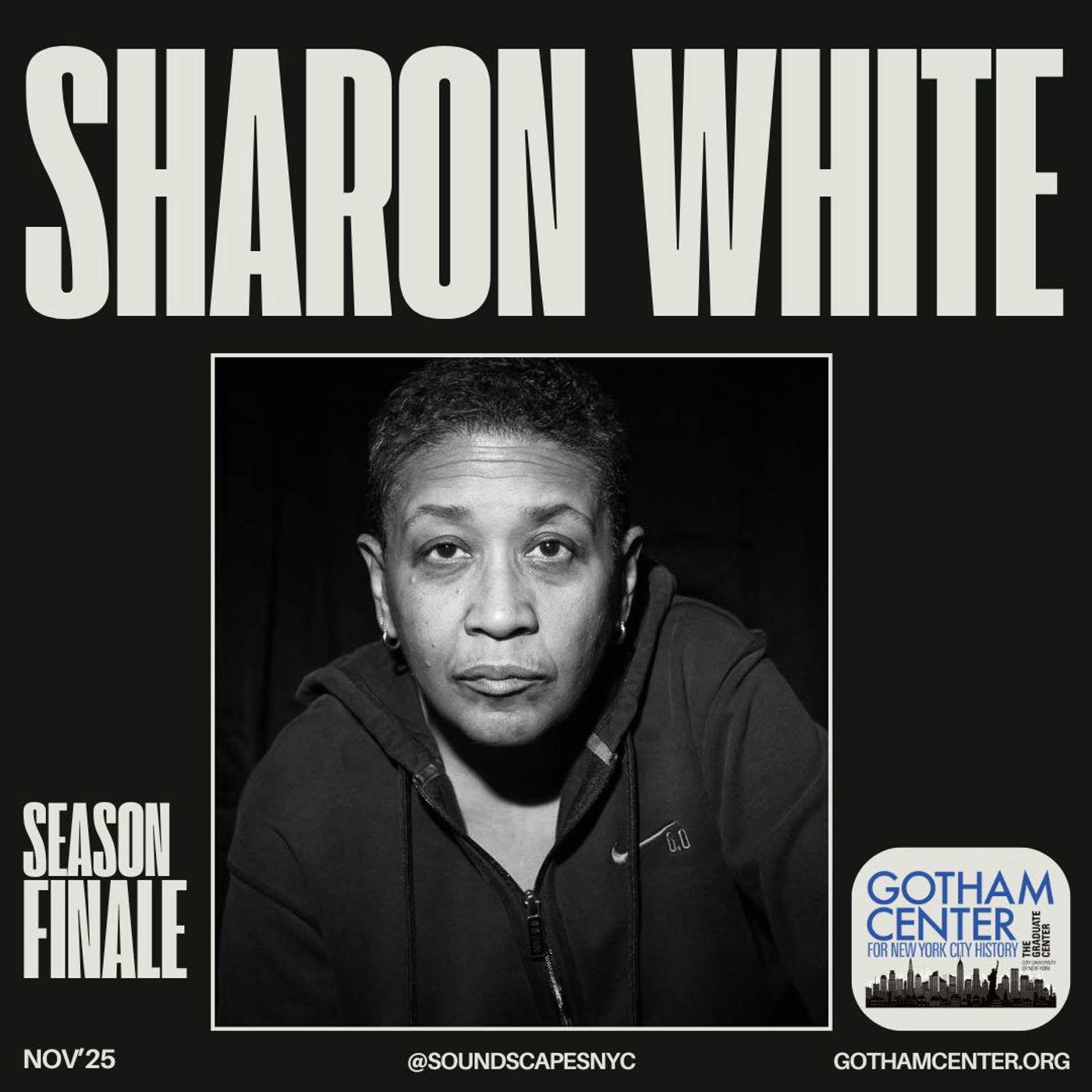 S2. E10. Sharon White Rewires Disco 25.11.2025 1ч 6минAt the center of 1970s New York's most iconic clubs—from the celebrity-studded Studio 54 to the premiere lesbian discotheque Sahara—stood a queer Black woman on the turntables: Sharon White. With a sound she describes as "edgy, deep, aggressive, tech, synthy, percussive and lush," White became the first woman resident DJ at the Saint and the only woman to ever play Paradise Garage, breaking barriers in spaces where women were told they didn't belong. Her five-decade career didn't just challenge disco's male-dominated DJ culture; it redefined it, paving the way for future generations of women behind the decks. In this season finale, we explore how one visionary artist carved out space in disco's inner sanctum and what her trailblazing journey reveals about women—especially queer Black women—who shaped the sound and culture of an era from behind the booth. In the Season 2 Finale, hosts Ryan Purcell and Kristie Soares talk with legendary DJ Sharon White. Born in West Babylon, New York, White studied music at the New York School of Music before becoming a radio disc jockey. In 1975, she transitioned to club DJing, finding near-instant success at legendary venues including Studio 54, the Saint, Paradise Garage, Sahara, Limelight, and the Warehouse. She has been credited by several other women DJs, including Lizzz Krizer and Wendy Hunt, for helping them break onto the scene. White is still DJing today, and you can find her mixes on SoundCloud and Mixcloud. Support our show by becoming a premium member! https://newbooksnetwork.supportingcast.fm/sound-studies


