
Decode Econ
Abdullah Al Bahrani
0
Decode Econ breaks down how the economy affects everyday life, from coffee prices to policy decisions. Hosted by Dr. Abdullah Al Bahrani, an economist and educator, the show makes economics personal and practical. Each episode explores trends behind headlines such as inflation, jobs, technology, and policy. Through stories, data, and conversations with experts and community leaders, listeners stay informed.
Епизоди
-
 Development Economics: Micro vs Macro 14.09.2026 45минDevelopment economics explained simply: what's the difference between the macro and micro sides of the field?Development economics sounds like a topic for "somewhere else." It's not.In my latest Decode Econ conversation, I sat down with two economists who study the same big question — how economies, and the people inside them, actually develop — from completely different altitudes. Dr. Amrita Dhar tracks capital flows into emerging markets and, closer to home, how U.S. states split the bill for K-12 schools. Dr. Shreyasee Das studies what happens inside a household in rural India after the lights come on.That second one stopped me. Shreyasee's research on rural electrification found that as women gained more independence, information, and control over their own lives, fertility often dropped — but in some households, so did stability and safety. Progress doesn't move in a straight line. Sometimes it just moves the friction somewhere else.We also got into something I think about a lot: development economics isn't just a lens for poor countries. Flint's water crisis, schools without air conditioning, sewage problems in the rural South — the same forces we study abroad are sitting here in our own zip codes.And we closed on something I want to actually do something about, not just talk about: why the researchers doing this work — especially women — aren't the ones you see on podcasts and panels. That's turning into a real project between the three of us now.Resources Amrita’s Resources1. Poor Economics by Abhijeet Banerjee and Esther Duflo https://amzn.to/4cIhgFd 2. Analytical Development Economics - Kaushik Basu https://amzn.to/4cBAQTG Shreyasee1. Amartya Sen's Capability Approach Amartya Sen's Capability Approach https://amzn.to/4gXNf5C 2. Amartya Sen's Tanner Lecture #1: Equality of What https://tannerlectures.org/lectures/equality-of-what/ 3. Amartya Sen's Tanner Lecture #2: Standard of Livinghttps://tannerlectures.org/lectures/the-standard-of-living/ 4. Women's Role in Economic Development by Ester Boserup https://amzn.to/4AbIJsZ
 -
AI in the Classroom: One Professor's Radical Teaching Experiment 07.09.2026 43минNo homework. No midterms. No final exam. In this episode of Decode Econ, I sit down with Dr. Shishir Shakya, an economist at Appalachian State University, who redesigned his entire econometrics and statistics courses around one question: what happens if we stop preparing students for the job market of 2022 and start preparing them for 2028?We get into:Why he cut his curriculum down to the "absolute theoretical minimum" — and how that made his students learn fasterHis AI-based oral exam system that catches understanding gaps multiple-choice tests missThe uncomfortable question I pushed him on: if students can't use AI, why can professors?Why he thinks every student — marketing, supply chain, or otherwise — needs to start thinking like an engineerWhat "flourishing" means in an AI economy, and why creative destruction isn't just a threatIf you're an educator, a student, or just trying to figure out what skills actually matter in an AI-driven labor market, this conversation will change how you think about learning itself.Connect with Dr. Shishir Shakya: https://www.linkedin.com/in/shishir-shakya/ Subscribe to Decode Econ for weekly breakdowns of the economy and your place in it.00:49 – Intro: How AI is disrupting education02:17 – No homework, no midterms, no finals — what replaced them11:22 – The moment AI broke his old teaching model16:05 – Inside his AI-powered oral exam system24:33 – "If students can't use AI, why can professors?"39:06 – Preparing students for the job market of 2028
-
The Economics of Entrepreneurship 30.08.2026 50минStartups just had a record funding quarter — $285 billion in Q1 2026. Here's what the headline doesn't tell you: 43% of that went to one company's raise, and the rest of the money is piling into AI. So if you're a student founder building anything else, what does "record year" actually mean for you?I sat down with Dr. Jeni Al Bahrani, who teaches entrepreneurship at Miami University's Farmer School of Business, and Sarah Bosse, a senior who went from a student in Dr. A's class to her TA to her mentee. We get into why entrepreneurs can't outsource economics to their accountant, the pricing mistake Sarah watched half her classmates make as a TA, why rising interest rates change what investors are willing to fund, and why TAM/SAM/SOM is really a demand-estimation problem dressed up as a pitch-deck slide. We also get into why I've stopped calling them "soft skills" — they're durable skills, and they're the actual product of a good entrepreneurship classroom.Timestamps:0:00 – Why should entrepreneurs learn economics at all?10:00 – The pricing mistake that burns first-time founders17:00 – Interest rates, the $285B funding headline, and what it means if you're not building AI33:00 – TAM/SAM/SOM: the market-sizing mistake that isn't really about math44:00 – Why "soft skills" is the wrong word, and what workforce-ready actually meansIf this episode connects to something you're building — or teaching — leave a comment and tell me what's landing.
-
Bond Market Warning Signs Explained By Miami Professor Ej Ume 24.08.2026 40минThe bond market has been sending us warning signs. I sat down with Monetary Economist EJ Ume from Miami University’s Farmer School of Business to explain what is happening and what it means to you. If you don’t already do so, make sure to connect with EJ on LinkedIn. We would love to hear your thoughts on this conversation. Here is what we discussedEJ walks through three forces pushing long-term yields higherEJ's research and how monetary policy is a "blunt instrument" that hits different people differentlyStablecoins and what you need to know about themCareer and teaching: EJ's path from Wall Street into academiaPapers ReferencedUme, E. (2025). Racial Disparities and Monetary Policy: Evidence from Augmented Taylor Rules. Economic Letters, 257, 112692. https://doi.org/10.1016/j.econlet.2025.112692 Ume, E., & Williams, M.J. (2018). The Differential Impact of Monetary Policy on Blacks and Whites since the Great Recession. Journal of Economics, Race, and Policy, pp 1-13.Burgess, O. & Ume, E. “Stablecoin Flows and Money Market Conditions.” Under review
-
You can't cut taxes and raise spending forever— Brandon Sheridan and Abdullah Al Bahrani 16.08.2026 47минIs the economy stalled, or are we about to hit a wall? Dr. Abdullah Al-Bahrani and Elon University's Dr. Brandon Sheridan break down a week of noisy data — and land on the one number nobody's talking about: you can't cut taxes and raise spending forever. Something gives.In this episode:01:12 — Why Brandon calls the economy "moving sideways," and what 1.5% GDP growth is hiding02:04 — Consumers continue to spend06:29 — The jobs report: Is -23K real, or just noisy data?09:40 — Labor force participation is a concern 19:53 — Inflation's hidden secret31:10 — "You can't reduce revenue and increase spending simultaneously when you're already in debt." Brandon's warning on where this endsFollow Decode Econ for updates on the economy and what it means to you.
-
Should the Fed provide forward guidance? 09.08.2026 27минIn this conversation, Jack Marx and Dr. Al Bahrani discuss the Federal Reserve and the recent changes being proposed by Fed Chair Kevin Warsh. Jack and Dr. A have different views on what the correct approach is for the Fed. The discussion centers around the frequency of FOMC meetings and the importance of forward guidance. Check out the YouTube conversation or find us on the podcast platform of your choice. I
-
ClaudeFishing- Will this be the death of the newsletter? 03.08.2026 6минLast week, Substack released a new feature to detect AI-written text. They partnered with Pangram to let readers scan a post and see how much of it is AI-generated. I both love and hate this update, and I want to share my views with you.As I read it, they’re attempting to solve for two problems: the rise of AI slop, and reader trust. Both are real concerns. However, there is a big difference between AI slop and AI-enhanced posts, and Substack AI score does not make a distinction between those two.With that said, Substack is upfront that Pangram isn’t perfect, just that “independent research suggests it detects AI-generated text with a high degree of accuracy.” Fine.But they also admit the actual limitation:“Pangram can only detect whether AI was used to make the text, not whether great human care went into creating it, nor whether AI tools were used as a source.”Anyone who’s spent time in higher education already knows this. Detection tools flag patterns, not quality, and not authorship in any meaningful sense. Moreover, there are good and bad uses of AI, and that nuance is lost in the Substack AI score. The problem I have with this is that the score measures how much AI touched the writing and editing, not how much AI shaped the thinking, whether it was used for research, or whether a human sat with the final draft and meant every word. The Substack measure doesn’t capture when AI is used for the followingIdeationResearch and sourcesImages and visualsIt strictly captures the use of AI in text. Read more at DecodeEcon.com about what the research says will happen.
-
Learning Economics at a Startup 26.07.2026 34минDecode Econ is a startup. Our goal is to help you see the economy clearly — and your place in it. It is a media firm with a mission to improve economic understanding. It is fun building it and seeing its impact, but the biggest joy is in working with the team that makes this work possible. I love working with young professionals and current students. They bring energy and creativity, and in return I mentor them on public engagement and translating research into impact. It is a win-win situation. This week, we sat down with Frannie and Claire to talk about experiential learning through on-the-job work at Decode Econ.They talked about how working at Decode Econ has taught them so much about economics and business, but also about teamwork, creativity, and understanding your audience. Most importantly, they discussed how they grew their adaptability muscle.The classroom only gets you halfway.Claire told me she joined Decode Econ because of my macro class. She learned to love the content, but she appreciated my class more for the energy I brought to a silent classroom on day one, which made her feel comfortable speaking up.Frannie said something similar about her marketing classes: the value wasn’t the frameworks, it was “being able to be applicable and actually figure it out for myself” before getting thrown into a real job.This tells me that the actual value of what we do is to help our students transfer knowledge and skills into action.Confidence isn’t taught. It’s built in reps.Claire shares with us that her turning point in college was showing up to observe the Haile research lab, staying silent for a while, then finally speaking up. Each exposure helped her open up new doors to new opportunities. Opportunity rewards students who are already in the room.My favorite moment: Frannie was on campus for an unrelated meeting when Dr. Raska (Chair of Marketing, Sports Business, and Construction Management) passed by and, on a whim, invited her, on the spot, to tour a market research firm partnering with our college. There was no calendar invite and no time for her to prepare. She said yes anyway. Being present helped her open a new door and expand her network. Adaptability is the actual labor market skill, and startups teach it for free.Both students described Decode Econ’s early days as constant pivoting. The daily changes in direction that, at first, felt like personal failure. Frannie said she used to wonder, “Did I do something wrong?” every time we changed course. It wasn’t her. It was a small team figuring out its audience in real time, which is exactly what most of their future employers will also be doing.This is the argument I’d make directly to other business and econ educators: if you want to teach adaptability, you cannot lecture it into existence. You have to put students inside genuine ambiguity — a live project, a startup, a research team— and let them feel the discomfort of the pivot. That discomfort is the curriculum; do not shy away from it.Pick the manager and team over the salaryThat was a big takeaway from this conversation.If you are interested in supporting the students or have projects you want to work on together, please reach out. Students are funded through consulting projects, public speaking engagement, sponsorship, and gifts.Timestamps00:00 — Economic literacy has to meet Gen Z where they already are02:18 — Frannie’s background: marketing coursework meets real-world application07:05 — Claire’s origin story: how one macro class built her classroom confidence09:31 — Building confidence through low-stakes reps at the research lab14:17 — Purpose and impact: why Gen Z engagement is the point, not a side effect19:09 — FOMO as a signal of investment21:25 — Career advice: pick the manager and team over the salary23:54 — Naming and working through perfectionism and imposter syndrome31:05 — What community inside a startup actually provides
-
Dr. Jose Saavedra on the Importance of Trust in Influencer Marketing 20.07.2026 41минToday’s episode is a special one. It’s a cross-collaboration with Beyond the Degree, the podcast from Haile Graduate Programs — so if you like hearing how executives and researchers actually make decisions, that show belongs in your feed too.My guest is Dr. Jose Saavedra Torres, my next-door neighbor at Haile College of Business and one of my closest collaborators on campus. Jose studies why we trust the people who sell to us online, and every time you buy something because someone on your phone told you to, you’re making an economic decision without realizing it. That’s what we unpacked on the show.Here’s the distinction Jose kept coming back to, and it’s the one most people get wrong. Credibility is about knowledge — can I trust this person’s expertise? Authenticity is about honesty — is this person being true to their own values?Those two things sound similar. They’re not. Marketers have been optimizing for credibility for years. Jose’s research says authenticity is the bigger lever.The reason authenticity moves people is something called a parasocial relationship — a one-sided bond where you feel like you know someone who has no idea you exist. Jose put it well: Cristiano Ronaldo has 900 million followers who feel like his buddies. He doesn’t know a single one of them.This changes the actual mechanics of a purchase. Normally you search, compare, then decide. When an influencer you trust recommends something, you skip straight to the decision — your brain already did the research for you, because it thinks that person is your friend. I’ve done this myself. I’ve bought books off a single video, no research, because I trusted the person recommending it. Sometimes it’s great. Sometimes it’s a total miss for my taste. That’s the trade-off of buying on trust instead of evidence.Jose’s advice for anyone building an audience, or any brand hiring one: authenticity lives or dies on consistency. Pick almost any big influencer — Mr. Beast is his go-to example. If Mr. Beast showed up tomorrow promoting anti-aging skincare, you’d feel the mismatch immediately. There’s no story connecting who he is to what he’s selling, and that gap is exactly what triggers skepticism.This isn’t just a hunch Jose has from watching his daughters trust an influencer he was skeptical of — though that’s literally how the research started. It’s now a peer-reviewed finding. Jose and his co-authors surveyed 504 consumers and found that influencer authenticity significantly predicts both brand engagement and parasocial relationships, and that the fit between an influencer and the product they’re pushing measurably strengthens that effect.Banerjee, N., Rawal, M., Saavedra Torres, J. L., & Bagherzadeh, R. (2025). Beyond the Facade: Exploring the Authenticity of Social Media Influencers and Its Influence on Consumer Brand Engagement and Advocacy. Journal of Promotion Management. https://doi.org/10.1080/10496491.2025.2571948I think we’ve been asking the wrong question about influencer marketing. Everyone wants to know if an influencer is credible. The better question is whether they’re authentic — because credibility gets you a sale, authenticity gets you a customer for life. Brands chasing follower counts are optimizing for reach. Jose’s research says the money is in fit and honesty, not fame.Credibility vs. authenticity: credibility is expertise, authenticity is honesty — they’re not the same thing, and authenticity is the stronger driver of trust.Parasocial relationships change the decision process: consumers skip the research phase entirely when they trust the person recommending the product.Consistency protects authenticity: the moment an influencer’s endorsement doesn’t match who they are, skepticism kicks in.The data backs it up: read the full study — Beyond the Facade: Exploring the Authenticity of Social Media Influencers, Journal of Promotion Management (2025).
-
 Why Saving Money in Your 20s Might Be a Mistake 29.06.2026 37минHere's what the data doesn't say: saving for retirement at 22 has an opportunity cost. Every $7,500 someone parks in a Roth IRA is $7,500 that isn't going toward tuition, a certification, or the thing that increases their income over the next twenty years. I've watched students skip a semester of school to save money. That is not what I would call financial literacy. We have pushed this generation to be savers at the expense of income potential. After 2008, we spent fifteen years telling people that the average American doesn't understand personal finance. We weren't wrong. But the lesson that we taught didn’t focus on understanding your options; it was to save every dollar, distrust Social Security, and never touch a Roth IRA. Gen Z is doing just that."Gen Z isn't saving optimally for the future. They're responding to fears that they won't have one."We also discussed Oman’s budget and strategy, and Alan Greenspan’s legacy. We ended the podcast with an audience question. Thank you for sharing those. If you have more, leave them in the comments. Subscribe to www.DecodeEcon.com• 00:00 — Is Gen Z saving too much, too early? The opportunity cost nobody talks about • 11:41 — The Roth IRA deep dive: tax advantages, income limits, and why personal finance is personal • 13:30 — The Oman case study: logistics diversification, Dutch disease, and the easy dollar problem • 23:35 — Alan Greenspan: moral hazard, irrational exuberance, and the AI parallel • 32:30 — Audience question
 -
The Economics of FIFA 21.06.2026 22минWednesday's digest flagged the Levi's logo story in two sentences. This week's episode is the full decode — and it's worth watching, not just reading about.Quick recap of where we left it: FIFA strips every sponsor logo off a host stadium, no exceptions. Levi's got blacked out like everyone else — except their silhouette happened to read like a comic-book bat symbol, someone turned it into a joke online, and Levi's leaned all the way in. Profile picture, and Reels. The post blew up. Their stock hit a two-year high the day after.What Wednesday's digest didn't have room for: why this actually worked, economically. On the episode, Claire — who runs our Instagram — walks through the marketing mechanics in real time, and I get into why this is brand differentiation doing exactly what it's supposed to do. The value was never in how much logo space Levi's bought. It was in how distinct the moment felt next to every other forgettable sponsor placement. That's what lets a brand extract producer surplus — pull more value out of the market — without spending another marketing dollar to do it. Jack puts it best on the episode: stop measuring ad spend, start measuring ad outcomes.We also discussed Levi's actual stock price the day after the post went viral, on camera — and the real story behind that number is messier than "marketing stunt moved the stock." That part doesn't read well in a newsletter recap. You kind of have to watch us work through it.Then we move from the World Cup to the World Cup's other economics story this week (hydration breaks are not about hydration), and close out with our take on Kevin Warsh's first Fed press conference.00:30 – Welcome Back to Decode Econ (Claire's 2nd Episode)02:54 – How Levi's Turned a Logo Ban Into a Viral Moment05:20 – Did It Actually Move Levi's Stock?07:40 – FIFA's Hydration Breaks: Player Safety or Ad Revenue?10:05 – For-Profit vs. Nonprofit: Why FIFA Still Maximizes Profit12:27 – Is the World Cup Becoming Four Quarters?14:50 – Kevin Warsh's First Fed Press Conference17:06 – Should the Fed Say Less? Prediction Markets & Transparency19:25 – Claire on Learning Economics Before Forming Opinions21:51 – Claire Summer & Team Reflections22:25 – Takeaways: Be Like FIFA
-
We Recorded This One In Person — And Brought Someone New to the Table 14.06.2026 25минThis week’s episode looked different. For the first time, Jack and I sat down at a table together instead of across the internet, and we brought a second student voice into the discussion.Meet ClaireClaire Maddox is a first-year student; she starts her second year in August at the Haile College of Business, and she's my research assistant on a project we’re running this summer on housing affordability policy. This was her first episode, and the in-person setup was actually her idea. We weren’t sure if it would work. We think it did — but we want to hear from you. Tell us in the comments if you want more episodes like this one.And do us a favor: this was Claire’s first time on the mic. Drop her a comment and welcome her to the show. First episodes are nerve-wracking — a little encouragement goes a long way.Leave a commentThe jobs report looked fine on the surface: 170,000 jobs added, unemployment holding at 4.3%. But almost half of those jobs came from hospitality and leisure, and there’s a real chance a lot of that hiring is World Cup-driven and temporary. The number that actually worries me is long-term unemployment: over 2 million people have now been out of work for 26+ weeks. That’s not a “create more jobs” problem anymore — that’s a skills-depreciation problem, and it calls for a completely different policy response.Then we layered in this week’s inflation data. CPI came in at 4.3%, PPI was close to 6.8%, and 80% of that increase was due to energy prices. Real wages went negative. So if your grocery and gas bills feel like they’re outrunning your paycheck, you’re not imagining it, the math backs you up. And here’s the complication for the Fed: the market expects them to raise rates to fight inflation, but this isn’t a demand problem. Raising rates won’t touch energy and supply costs. It’ll just slow things down without solving the actual issue.We also got into the economics of the World Cup (hosting it is probably a wash — or a loss — once you account for crowding-out effects), and a conversation about picking a major that I think is one of the more useful things we’ve said on this show: it’s not about whether your degree has “ROI.” It’s about whether you understand the risk profile of the path you’re choosing and budgeting accordingly.Timestamps0:40 – Welcome back + introducing Claire’s first episode1:34 – Does hosting the World Cup actually pay off?6:27 – The jobs report: 170K looks fine, until you look at long-term unemployment11:48 – Real wages went negative — what that means for your wallet12:34 – Claire’s take: how this economy hits students at the pump and the grocery store13:08 – Rethinking the “is college worth it” question22:22 – Retirement, the FIRE movement, and why doing nothing is harder than it soundsOne More ThingNext week the Fed meets for the first time under Kevin Warsh. We’ll be watching that press conference closely — see you then.Thanks for sharing this post with your community. Informed consumers and employees improve market outcomes for all.
-
Is a Recession Coming? Savings Rates, Childcare Costs, and the Cracking Consumer 07.06.2026 25минThe savings rate just hit 2.6%. Disposable income dropped for the second straight month. And somewhere under all the tariff headlines, a quiet shift in American family life is telling us something the Wall Street Journal got almost entirely wrong.This week, Dr. A and Jack work through three data points that don't look related on the surface — falling savings, rising childcare costs, and fathers quietly cutting their work hours — and show why they're actually the same story. The consumer is still spending, but they're running out of room to do it. When they stop, that's the beginning of something.Plus: Dr. A's take on higher education's real problem. It's not AI. It's that faculty stopped explaining what they actually do.01:00 — The personal savings rate: what it is, why it matters right now, and why Abdullah has been watching it03:30 — Credit card debt, delinquency rates, and how much longer the consumer can hold this up08:47 — The Wall Street Journal's childcare piece — and why Abdullah thinks they gave men too much credit11:00 — The real driver: childcare costs are reshaping labor force participation, not culture18:15 — Stock market reality check: what's holding the positive numbers up, and why Abdullah is personally preparing for Q3/Q4 weakness24:00 — What students should do differently right now (and why office hours are underrated). Want to receive our commentary via email? Subscribe at www.DecodeEcon.com
-
The Economy is Messy- With Dr. Cecilia Cuellar 31.05.2026 40минThe Economy Is Messy. That’s the Point.Consumer sentiment just hit its lowest level since the 1950s — yet Americans are still spending. Inflation is picking up, and your grocery bill is getting out of hand. Economists even have a name for what’s happening: doom spending — spending freely because the future feels too uncertain to save for.This week on The Weekly Rap, Dr. A and Jack sit down with Dr. Cecilia Cuellar, research analyst at the Hibbs Institute at UT Tyler, to decode the gap between what the data says and what people actually feel.Three things worth your time:Why uncertainty hasn’t changed — but the weight we give it hasWhat doom spending reveals about how people really process economic fearThe BRIC method: a karate-trained economist’s framework for navigating high-stakes uncertainty
-
When Trust Breaks, People Stop Investing and Start Betting 24.05.2026 26минNobody Trusts the Numbers. (The Economy Is Fine. For Some People.)73% of Americans say they're financially stable. That number is up 10 points from 2013. So why does nearly everyone say the economy isn't working for them?Dr. A and Jack break down the K-shaped economy, congressional stock trading, prediction market addiction, and why trust — not data — is the real economic crisis right now.In this episode:00:00 — Welcome & intro 02:12 — The K-shaped economy: why the average hides the real story 06:50 — Economics has become the third rail — after religion and politics 09:15 — Congress is working less. Is that actually the problem? 12:04 — Gen Z, voting, and institutional trust 15:47 — Congressional stock trading: the incentive structure is broken 19:46 — Prediction markets are the new cigarette ads 22:40 — Capitalism runs on trust and hope — what happens when both erode 25:44 — Where to find us this weekLinks & resources mentioned:→ Washington Post: prediction market ads appear every 4 minutes during sports broadcasts → Senate committee meets this week to examine prediction market oversight → OGE financial disclosures: 3,700+ stock transactions tied to Trump portfolio in Q1 2026Subscribe to the Decode Econ newsletter: Every Monday, Wednesday, and Friday — economics decoded without jargon, hype, or partisan framing. 🔗 www.DecodeEcon.com Follow Dr. A: Instagram: @econwithdra Follow Decode Econ: Instagram: @decodeecon YouTube: Decode EconDecode Econ helps people understand what economics and data actually mean in the real world. Led by economist and educator Dr. Abdullah Al-Bahrani, the show translates data, policy, and research into clear, responsible analysis — without jargon, hype, or partisan framing.
-
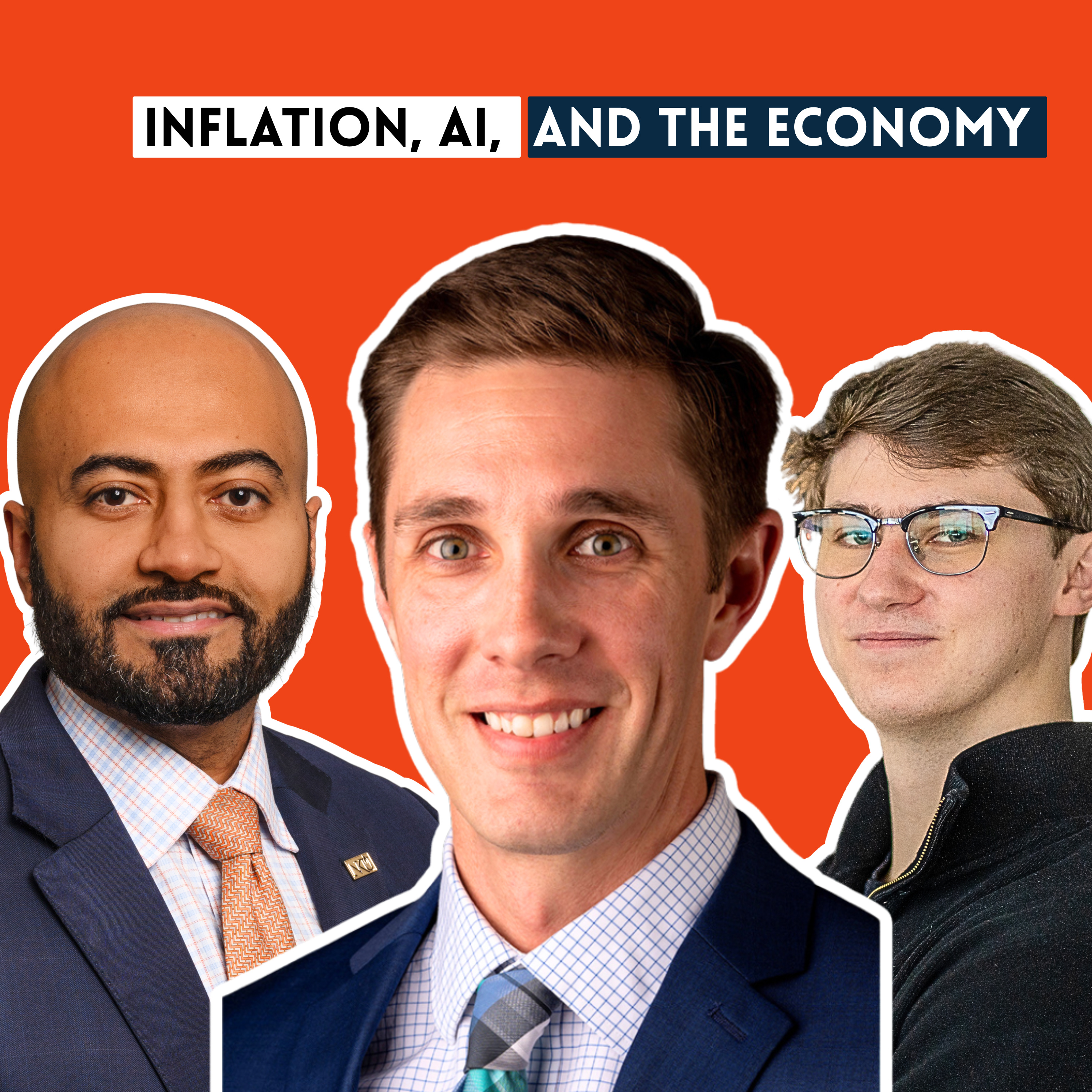 The Price Spiral Isn’t Over. It’s Just Getting Started. 16.05.2026 30минLast Wednesday, we reported that the CPI came in at 3.8%. The next day, the BLS reported the PPI, the prices producers pay, hit 6%.What does that mean? The PPI leads CPI. What businesses absorb today, consumers are likely to pay tomorrow. If producers are paying more, they will eventually pass that on to consumers. That means consumers should brace themselves for even higher prices in the near future. We are likely to see CPI increase even faster than it has been. Here’s what Brandon said on the podcast this week that stayed with me: this isn’t something that happened to us. Tariffs are a policy choice. The Iran conflict accelerated it, but the stair-step rise in prices was already underway before that. And because prices move up like a rocket and come down like a feather, sticky on the way down due to long-term contracts, renegotiation cycles, and producer margins, expecting a fast reversal is wishful thinking.The labor market is holding, but it’s not dynamic. Brandon noted that with reduced immigration, the economy simply needs fewer new jobs to maintain stability, which makes 115,000 monthly additions look better than they probably are. And less immigration over time means fewer entrepreneurs, less innovation, and more anemic growth further down the road. The GDP math is not flattering.What does this mean for your wallet right now? Brandon’s personal story said it better than any chart could: airfare that was $300 rose to $1,200 after the news of Iran broke. He took a connecting flight instead of a direct flight. Gas is running 50–60% higher than it was two months ago, which changes the calculus for which jobs are worth commuting to, how hard people push back on return-to-office mandates, and which big purchases get delayed.It is easy to focus on the data point and forget the human-centered story behind the data. One more thing from this episode worth knowing about:Brandon is a founding member of EENE — the Economic Education Network for Experiments (eene.org). It’s a research collaboration of 200+ economics instructors across institutions — public, private, HBCUs, R1s — running synchronized classroom experiments to actually answer what works in economics education. Most education research is too small to generalize. EENE is trying to fix that with scale and rigor. They have papers under review and their third annual conference coming up after CTREE in Las Vegas this summer. If you teach economics or know someone who does, this is worth knowing about.The full conversation — inflation, AI in education, what Microsoft and OpenAI executives actually want from new graduates — is in this week’s episode of The Weekly Rap.Thank you for sharing this post with your community. Informed consumers and employees improve market outcomes for all.We would love to hear from you. What resonated with you from this episode?
 -
 The Jobs Report Nobody Celebrated 10.05.2026 25мин115,000 jobs. Unemployment unchanged. And almost nobody feels good about it.The April jobs report came in more than double what economists expected — and the labor market still feels fragile to most people. That gap isn't a vibe problem. It's a data problem.In this episode, Dr. Abdullah Al-Bahrani and Jack Marx break down what the headline number misses: a 445,000-person spike in part-time workers who wanted full-time jobs, 348,000 federal workers gone since October, and a warehousing sector that had a good month but is still 105,000 jobs below its 2025 peak.They also get into GameStop's bid to buy eBay — and what Ryan Cohen's CNBC appearance reveals about how markets actually process information. Plus: why Decode Econ is changing its format this summer, and what that means for you.📩 Get the full written analysis — free — every Monday, and Wednesday at Decode Econ: www.DecodeEcon.com Paid subscribers get Friday's deep dive: What you should know about economics.Timestamps 00:00 — The jobs number everyone saw 04:20 — What the headline misses: part-time, federal, warehousing 11:45 — Why the vibes and the data keep diverging 18:30 — GameStop bids for eBay. Ryan Cohen biffs the CNBC interview. 25:10 — Why we're changing the format Decode Econ translates economic data into clear, responsible analysis — without jargon, hype, or partisan framing.#economics #jobsreport #labormarket #decodecon #theweeklyrap
 -
Is the U.S. Economy Built on an AI Bubble? Debt Hits 100% GDP & Fed Pressure Explained 02.05.2026 22минSubscribe to www.DecodeEcon.comIs the U.S. economy actually strong—or just riding an AI bubble?In this episode, Dr. Abdullah Al Bahrani and Jack Marx break down GDP growth, rising U.S. debt (now at 100% of GDP), Federal Reserve pressure, and whether AI investment is artificially propping up the economy.We also discuss inflation, wages, oil prices, and what history (like Japan’s zero interest rate policy) tells us about what could happen next.🔍 What You’ll Learn* Why GDP growth is being driven by AI investment* The risks behind a 100% debt-to-GDP ratio* How Federal Reserve independence impacts markets* Whether the AI boom is sustainable* What rising oil prices mean for inflation* Lessons from Japan’s economic policies* The mindset students need to succeed today⏱️ Timestamps00:00 – U.S. debt hits 100% of GDP 00:41 – GDP growth breakdown (2%)01:20 – AI driving the economy?02:12 – Strong economy despite global turmoil03:23 – Why this feels unsustainable04:10 – The AI bubble explained05:18 – Will AI companies actually profit?06:00 – Jerome Powell & the Fed08:23 – Japan’s zero interest rate warning09:42 – Gas prices & geopolitics11:16 – Debt crisis risks12:29 – Can we fix government spending?15:19 – The “Last Lecture” mindset19:01 – Life advice: curiosity & resilience22:27 – Final thoughts
-
The Hidden Reason Young People Can't Get Ahead 27.04.2026 22минIn this episode of Decode Econ Podcast, Dr. Abdullah Al Bahrani and Jonathan Marx break down why starting your career feels harder than ever—and why it’s not just in your head.Subscribe nowFrom real conversations at Eggs & Issues to insights from the Notes app, this discussion connects what students are experiencing with what’s actually happening in the economy.We also have some important questions for you. Make sure to watch and tell us what you think. We cover:Why “entry-level” now means experience requiredHow rising expectations are reshaping the job marketWhat income inequality (yes, the Gini coefficient) has to do with your careerInsights inspired by Kyla Scanlon and Gary HooverWhat students and graduates can actually do to adaptWhat is the American Dream, and how is it changing?If you’re a student, recent graduate, or just trying to understand today’s economy, this conversation is for you.You’re not falling behind—the system is changing.00:00 Intro02:00 The Notes App & Thinking Process05:30 Are Entry-Level Jobs Disappearing?10:00 Eggs & Issues: What Leaders Are Saying14:30 Inequality & the Gini Coefficient18:00 The Broken First Rung22:00 What Students Should Do NextShareNKY Chamber of Commerce events - Next Eggs ‘N Issues event Scott Galloway on Gini Coefficient.NBER Paper INCOME AND WEALTH INEQUALITY IN THE UNITED STATES:AN UPDATE INCLUDING THE 2022 WAVEBE NKY Report on Productivity. Leadership program at Haile Graduate Programs. Applications are open for the 2026 cohort. Master of Business Leadership and Innovation.The first rung is broken. My Notes app has 1,461 entries. That’s where I write down ideas, save random images, and drop links to videos I want to return to. It is not organized.Join us this Friday for the Haile Research Lab Senior Sendoff and to welcome next year’s cohort. The big idea: the first rung of the ladder is breaking
-
The Lecture That Made Students Applaud 13.04.2026 23минWhat does a donut have to do with monetary policy—and why did it earn a round of applause? In this week’s Decode Econ Weekly Rap, we unpack what makes a “perfect lecture,” rethink how we teach economics (hint: fewer multiple-choice exams, more real thinking), and break down the surprisingly doable path to saving $2 million starting from your first paycheck. Along the way, we tackle a deeper issue: why comparison—especially in school, careers, and money—is quietly undermining how we measure success. If you’ve ever felt behind, this episode will challenge how you think about progress, purpose, and your own path.Subscribe to Decode Econ on YouTube00:00 – 02:30 | Names, Identity, and Professional SignalsWhy “Jonathan vs. Jack” matters more than it seems—and how naming reflects identity in professional spaces.02:30 – 06:00 | The “Perfect Lecture.”A monetary policy lecture that landed—storytelling, student engagement, and ending with a donut analogy.06:00 – 10:30 | Rethinking Econ EducationMoving away from multiple-choice finals toward research, writing, and economic thinking.10:30 – 14:30 | The $620 QuestionCan students realistically save $2 million? Breaking down the math behind early-career saving.14:30 – 17:00 | Can You Live on $3,600/month?Cost of living, geography, and how Cincinnati compares to major cities.17:00 – 21:00 | Comparison Is the Thief of JoyFrom social media to the classroom—how relative thinking distorts well-being and decision-making.21:00 – 24:00 | Student Pressure and “Figuring It Out.”Why students feel behind—and when the “click” actually happens.24:00 – End | Trusting the ProcessGrowth, mentorship, and why your path doesn’t need to look like anyone else’s.
Слични подкасти


Популарен во
Овој подкаст се појавува и на подкаст-листите на овие земји.
