
The Journal of Space Commerce Podcast
Ex Terra Media, LLC
0
This podcast focuses on issues related to the commercial space industry, and the impacts for people on Earth. It is produced by Ex Terra Media, LLC and covers topics such as space commerce, policy, and technology. The podcast aims to inform listeners about the growing space economy and its relevance to everyday life.
Episod
-
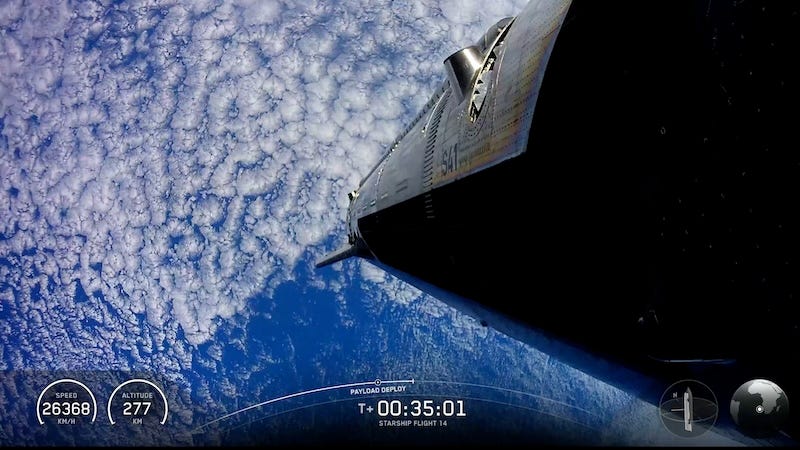 Starship achieves orbit, and an Update on Starliner 04.10.2026 16minA SpaceX Starship reached orbit on Test Flight 14, marking a significant milestone towards NASAs goal of building an ongoing human presence on the moon.Starship lifted off as its launch window opened at 7:48 am local time at Starbase Texas. The super heavy booster performed mostly nominally, though one of the 33 Raptor engines did shut down prematurely. Still, the mission continued with a clean stage separation and booster return to Earth, splashing down in the Gulf of America about 8 minutes after launch. The booster simulated the manuver that will be needed for a capture back at Starbase, but it did not attempt that land recovery on this mission.There were more tense moments when one of the two Raptor Vac engines on Ship failed during the initial ascent. But the SpaceX team determined that since the sea level engines were all that were needed for orbital insertion and de-orbit burn, the mission could continue. Through the Starlink relay, SpaceX was able to provide spectacular images of Earth and the spacecraft in orbit while a batch of 28 operational Starlink V3 satellites were deployed.Ship did not complete the planned six orbits of the Earth. The de-orbit burn was initiated after just one full orbit, with splashdown occurring in the northern Pacific Ocean. The mission was cut short after mission controllers determined that all objectives had been accomplished and they had collected all pertinent data.With this orbital milestone achieved, SpaceX and NASA can start looking ahead to testing the in-orbit docking and refueling capability that will be necessary for the return to the lunar surface. Executive Order 14369 signed by President Trump last December directed NASA to land humans back on the Moon by 2028, with a permanent human presence established by 2030.-0- NASA and Boeing held a news conference Monday to provide an update on the Starliner program.Boeing was awarded a commercial crew contract to provide transportation to and from the International Space Station in 2014. Three test flights were completed, one manned, that took Butch Wilmore and Suni Williams to the ISS ... but ongoing issues with multiple systems forced NASA to bring the Starliner spacecraft back to Earth without its crew. Wilmore and Williams spend nearly nine months aboard the station, and eventually returned to Earth aboard a SpaceX Crew Dragon capsule.In June, the NASA Office of Inspector General issued a report that said Starliner would be at least a decade behind schedule. In the meantime, the agency has shifted several crew rotation flights over to SpaceX, which is currently the sole U.S. provider of transportation services to the station.During the news conference, NASA Administrator Jared Issacman said Starliner is still critical for assuring reliable continued access to ISS.“So given our extensive history with Starliner and the taxpayer investment already made, we believe it represents the fastest path to preserving reliable crewed access to low Earth orbit. But from the beginning, commercial crew was built around competition, and NASA continues to see real value in having two crew transportation providers,” Issacman said. “Our forecasted demand is approximately 1 crewed mission to low Earth orbit every six months, and competition can help drive down costs, strengthen resilience, and support the broader commercial ecosystem.”Isaacman noted SpaceX plans to retire Falcon 9 and Dragon as it transitions to Starship, which reached orbit the same day as the briefing. He said NASA wants a second ride.John Mulholland, Boeing’s Starliner Program Manager, said the uncrewed flight is on track for the December–January timeframe, lined up with the station’s schedule.“NASA and Boeing, as I mentioned, are confident in the Starliner for the uncrewed mission. The safety findings from CFT have been addressed. We’ve worked corrective action plans for the eight Starliner 1 PIT recommendations, and out of the 21 CFT in-flight anomalies, 19 are closed,” Mulholland said. “The remaining actions are expected to close in October. Some of the mitigations require in-flight demonstration, which we’ll achieve during Starliner 1.”But NASA Astronaut Woody Hoburg, who has been named as the crewed Starliner mission commander, was blunt about the bigger problem NASA’s investigation found.“So what keeps me up at night? It’s not the hardware, it’s the underlying pattern. The PIT, the program investigation team, they zoomed out and looked at root causes, so the organizational causes, and they identified 3. And I want to highlight one of those today,” Hoburg said. “It was inadequate systems engineering and integration, creating gaps in hardware qualification. In the case of the helium leaks and the crew module RCS failures, the unqualified environment was actually on the ground, not in space. And we now know that the hardware damage occurred before liftoff.”Isaacman said that NASA would like nothing more than to see additional crewed and cargo transportation providers, a thriving commercial LEO destination, and a robust overall orbital economy. That would lead one to believe that the planned retirement of Crew Dragon could open the door for other companies to develop human-rated spacecraft. -0-The National Oceanic and Atmospheric Administration has awarded Spire Global a $33.2 million task order for commercial satellite weather data.Spire, based in Virginia, will deliver radio occultation data from Dec. 1, 2026, to Dec. 1, 2028. Radio occultation uses global navigation satellite system signals to measure the atmosphere. Spire says its near-real-time data gives vertical profiles of pressure, humidity and temperature around the globe.The order includes what the company calls Temporal Resolution Enhancements. Spire says they provide a broader range of time sampling.The data will feed NOAA’s operational forecast models and support weather forecasting, space weather work and research with partner agencies and universities, according to the company.The order also carries unfunded surge options. Spire says if NOAA exercises all of them, the order could be worth about $66 million over two years. NOAA’s award notice confirms the options but doesn’t put a dollar value on them.The award falls under NOAA’s Space-Based Environmental Monitoring contract, a multiple-award indefinite delivery, indefinite quantity vehicle. Spire says it has a five-year base period and a five-year option. It sits under NOAA’s ProTech 2-point-0 program, which has a shared $8 billion ceiling.The new order follows a $3.7 million NOAA contract for the same type of data. That one runs from Sept. 18 through Dec. 1, the day the new order begins.Spire says it was also selected under the same contract to provide reflectometry, hyperspectral microwave sounding and thermospheric neutral density data. The company says it’s eligible for future task orders in those categories over the five-year contract period.The FCC voted Wednesday to open more than 1,000 megahertz of spectrum to satellite broadband in the 12-point-7 and 42 gigahertz bands. The order is a binding rule, and it’s the latest step in the commission’s spectrum abundance proceeding. Chairman Brendan Carr has said the goal is to keep competitive, high-speed internet from next-generation satellites flowing to consumers.The commission also asked for more. A further notice attached to the order seeks comment on another 1,450 megahertz in the Ku- and Ka-bands, plus 138-point-25 gigahertz in the D-band. Those numbers are proposals, not final allocations.A second further notice adds bands to what the FCC calls its “Weird Space Stuff” docket. The commission opened that proceeding in March. It covers spectrum for missions that don’t provide connectivity to the public: in-orbit servicing, refueling, in-space manufacturing and operations around the moon. Those missions fall outside the FCC’s traditional service categories.“This clarification means that our nation’s innovators can continue to build without the unpredictable specter of activist lawsuits or last-minute surprises,” Carr said. “In the end, by eliminating uncertainty and delays, providers can accelerate the deployment of network solutions, allowing consumers to enjoy improved service sooner.”For broadband operators and their terminal and ground-segment suppliers, the order sets the bands they can build around. For servicing, manufacturing and lunar companies, the further notice is where they put their spectrum needs on the record.-0-European Space Agency member states have endorsed a framework that sets three priorities for Europe’s human and robotic exploration programs. They adopted the document, titled “A Call to Boost European Space Exploration,” at the International Space Summit in Paris.The first priority is securing Europe’s access to and presence in low Earth orbit after the International Space Station era. The second is strengthening Europe’s presence on and around the moon, through international cooperation and what the agency calls targeted autonomy. The third is using low Earth orbit and the moon as stepping stones toward Mars.The framework is political guidance, not a program commitment. The agency’s release doesn’t list costs, budgets or schedules for any program.Director General Josef Aschbacher called the summit an important step toward a common European vision for exploration. He said Europe has set a course toward more autonomy in low Earth orbit, a stronger lunar role and a more competitive European space sector, while staying a reliable international partner.The document describes space as a strategic domain for science, economic growth, technology leadership and international influence. It calls for sustained political commitment and coordinated investment.For European station developers, lunar suppliers and their U.S. partners, the dollar figures come next. ESA is preparing options to turn the framework into concrete programs. Ministers will take them up at an Intermediate Ministerial Meeting in Rome on Dec. 15.-0-The International Space Station National Laboratory is expanding its Orbital Edge Accelerator to eight startups this year, up from six, with $500,000 to $750,000 in available investment per company.The ISS National Lab announced the changes Sept. 22. The program is in its second year. Last year, each startup was eligible for up to $500,000. The Center for the Advancement of Science in Space manages the lab.Six investment partners get credit for the increase: Cook Inlet Region Inc., Context Ventures, Draper Associates, Draper University, E2MC and Stellar Ventures. An ISS National Labs news release didn’t lay out how the money will be split or whether every startup gets the same amount. It also doesn’t name the eight companies.Boeing is the presenting sponsor. One cohort member will win Boeing’s Technology in Space Prize, $100,000 in non-dilutive funding paid for by Boeing and the center.Three flight sponsors, Exotrail, Loft Orbital and Rogue Space Systems, have committed to free or discounted flight opportunities. The release doesn’t describe the terms or name recipients. Each startup can also get up to $200,000 in cloud credits over two years through Google for Startups Cloud.Sven Eenmaa, the ISS National Lab’s chief economist, said the program is built to turn promising space startup ideas into commercial businesses, drawing on private capital and the station’s assets.The eight startups will present their planned spaceflight projects at a Demo Day in San Francisco in December. A date hasn’t been announced.You Might Also LikeOpen-Source AI Model Trained on Decades of Lunar Data Released for Moon ScienceTwo Contractors Selected to Build High-Revisit Satellite FleetWar Department Commits $16 Million To Revive Radiation-Hardened Chip LineIn-Orbit Servicing Firm Signs Contract for Docking Propulsion SystemThe Dual-Identity Problem [Paywall]Theme Stock Music “Interesting Facts” Licensed from Pond 5 This is a public episode. If you'd like to discuss this with other subscribers or get access to bonus episodes, visit www.exterrajsc.com/subscribe
 -
 Ex Terra Extra: NASA, Boeing Provide Starliner Update 29.09.2026 5minNASA still wants a second ride to the International Space Station. The obvious choice is Boeing’s Starliner, on which the taxpayers have already spent a lot of money. But the issues with the spacecraft are well documented.On Monday, shortly after SpaceX’s Starship was reached orbit for the first time, NASA and Boeing officials held a news conference at the Kennedy Space Center to outline where the Starliner program stands, what is being done to correct the issues, and introduce the commander of the next crewed mission. This is a public episode. If you'd like to discuss this with other subscribers or get access to bonus episodes, visit www.exterrajsc.com/subscribe
 -
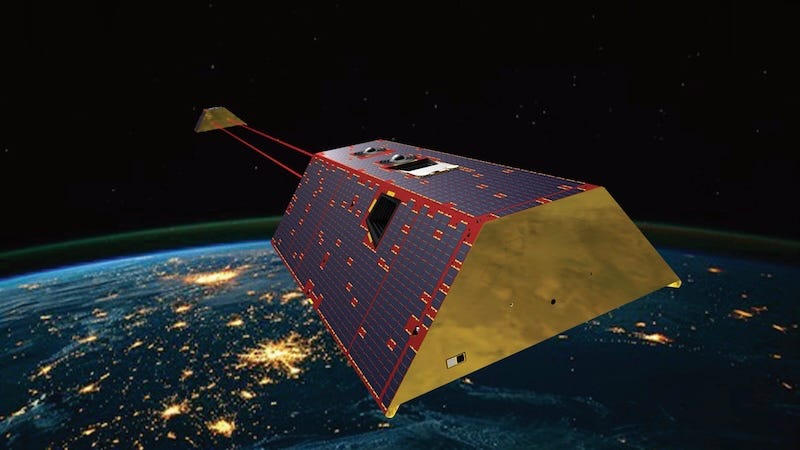 NASAs OIG Audits GRACE-C Mission, and Breaking the Germainium Stranglehold on Solar Cells 27.09.2026 15minA NASA OIG audit released Wednesday found the GRACE-C gravity mission on track to launch within its $658 million baseline. But the project has already used most of its cost reserves.GRACE-C stands for Gravity Recovery and Climate Experiment-Continuity. NASA’s Jet Propulsion Laboratory, or JPL, manages the mission in partnership with the German Aerospace Center, known as DLR. The mission’s twin satellites will track changes in Earth’s gravity field to measure ice sheets, groundwater and sea levels.NASA’s Office of Inspector General found the project had spent 61.2 percent of its project-managed cost reserves as of May. After known risks were covered, only $13.6 million remained unallocated. That’s about 7 percent of remaining development costs, which is below JPL guidelines.In February, a JPL review group estimated the project could need $637.3 million to finish. That’s $9.3 million over its $628 million management agreement. The inspector general said its own calculations closely matched that estimate. In June, the group cut the projected overrun to $300,000. The inspector general said it didn’t independently verify that figure.The report cites two outside cost drivers. The first is overhead. JPL has gone through reorganizations and workforce reductions since 2024, mainly because of funding uncertainty around the Mars Sample Return mission. The resulting rate adjustments added about $4.6 million to GRACE-C’s cost, and the project expects another $13.3 million.The second is currency exposure. JPL’s firm-fixed-price contract with Airbus Defence and Space in Germany for the two satellites is priced at 150.5 million euros, or about $172.5 million. Smaller euro contracts cover laser work from Tesat-Spacecom in Germany and accelerometers from ONERA in France. NASA budgeted for an exchange rate of up to $1.10 per euro. The rate reached $1.14 in July, adding an estimated $8 million. About $60.6 million in contract payments are still due in euros.The project has kept all 163 days of its schedule margin. The inspector general said managers chose to spend reserves to protect that schedule. That includes $35.3 million to keep JPL’s share of the laser ranging interferometer on track. Two DLR-supplied subsystems are each running about four weeks late.NASA agreed with the first of the inspector general’s two recommendations, which calls for routine review of the project’s risk posture. It partially agreed with the second, which covers how requirements in partner agreements are written. That work has a target completion date of Jan. 29, 2027.Launch aboard a SpaceX Falcon 9 from Vandenberg Space Force Base in California is planned before July 2029.-0-Exolaunch has signed a contract with SpaceX to serve as payload integrator for a Starfall mission. The mission is targeted to launch on a Starship rocket in 2029.Starfall is a SpaceX spacecraft built for microgravity research, in-space manufacturing and return to Earth. Exolaunch already integrates and deploys satellites on SpaceX rideshare launches. This contract moves the company into a different line of business: helping customers fly experiments in orbit and bring them home.Exolaunch says it’ll offer the service to biotechnology and pharmaceutical companies, materials developers, government agencies and research institutions. Expected payloads include life-science experiments, advanced materials research, in-space manufacturing and technology demonstrations.While that all sounds good, no financial terms were disclosed, and no paying customers or specific payloads have been named. The 2029 date is a target, more than three years out.The contract also comes while Exolaunch is the subject of a pending acquisition by EQT Private Equity.The Starfall deal follows two other recently announced Exolaunch missions, Exo-1 and Exo-2. Both are set to fly on SpaceX Falcon 9 missions.It’s worth noting that the deal places an established rideshare integrator between SpaceX and the microgravity research market. That’s the same role Exolaunch already plays for satellite operators.Exolaunch says it’s now engaging customers and strategic partners for the 2029 mission.-0-The Air Force Research Laboratory has agreed to transfer decades-old rocket propulsion hardware and engineering data to Blue Origin.The deal is a Cooperative Research and Development Agreement, or CRADA. It was announced through AFRL’s Rocket and Space Propulsion Division at Edwards Air Force Base in California, and it expands an existing partnership between the lab and the company.The agreement covers hardware and engineering records from two AFRL programs. One is the Hydrocarbon Boost program. The other is the Integrated Powerhead Demonstrator. Those programs pioneered oxygen-rich and full-flow staged combustion technology decades ago.Blue Origin says it’ll study the hardware and data to inform its own commercial engine development. A senior Blue Origin engines executive said the material will help ground the company’s engineering models in government research.The data transfer is separate from an existing arrangement to test Blue Origin’s BE-7 lunar lander engine at Edwards Air Force Base. The BE-7 is a dual-expander cycle engine. Blue Origin says it delivers high efficiency and deep throttling, which suits it for carrying large payloads to the Moon.The head of AFRL’s propulsion division said the transfer is meant to keep the value of past government science and technology investments working for national capability.Rocket Lab has started producing a spacecraft solar cell that doesn’t use germanium, a critical mineral that’s been under supply and cost pressure across the space industry.The product is called Inverted Metamorphic Apex, or IMM Apex. It’s the newest version of a solar cell line Rocket Lab has built for more than a decade. An earlier version powered NASA’s Ingenuity helicopter on Mars.Here’s why it matters for the supply chain. Rocket Lab says conventional multi-junction space solar cells have been built on germanium substrates for about 30 years. The company says that dependency leaves manufacturers exposed to shortages and price swings in the critical minerals market.Rocket Lab says IMM Apex reaches 31.5 percent conversion efficiency at beginning of life. It also weighs 40 percent less than earlier versions, which gives it a higher power-to-weight ratio.The company says the new cell is a mechanical and electrical replacement for existing germanium-based cells. That means satellite builders wouldn’t need to redesign their systems to switch.On capacity, Rocket Lab says changes to its manufacturing process and targeted capital investment now let it produce cells in volumes above 100 kilowatts. The product pairs a germanium-free design with a drop-in fit, which gives spacecraft builders a potential alternative to a single-mineral dependency.IMM Apex is available now. Rocket Lab says it plans more updates to the technology to support future missions.-0-Impulse Space has raised another $308 million, extending its Series D round to a combined $808 million.The Redondo Beach, California, company builds spacecraft that move satellites and other payloads between orbits after launch. The extension builds on a $500 million Series D that closed in June.Existing investors took part, including 137 Ventures, BANNER VC, DFJ Growth, Linse Capital, Lux Capital and Valor Equity Partners.Impulse didn’t disclose an updated valuation. It also didn’t say how the new money will be split among hiring, manufacturing and other costs, beyond supporting product development and team growth. The company’s president said Impulse has more than doubled its headcount over the past year.The raise follows two government contract actions this year. The U.S. Space Force’s Space Systems Command selected Impulse’s Helios spacecraft for the National Security Space Launch Phase 3 Lane 1 program. Impulse says that makes it the first upper-stage developer awarded a prime position in the program.Space Systems Command’s Space Safari Office also awarded Impulse a $28 million contract extension. It supports the VICTUS SALO 2 and VICTUS SALO 3 missions and builds on the company’s existing Mira awards.Impulse’s lineup includes the Mira maneuvering spacecraft, the Helios kick stage and the Caravan rideshare program. It also recently introduced Electra, an electric propulsion system.Impulse says it’s hiring engineers and operators to build, test and fly its spacecraft.-0-Planet has opened a satellite factory in Berlin, and production of its Pelican Earth-imaging satellites is set to start this fall.The plant is run by Planet Labs GmbH, the German unit of San Francisco-based Planet Labs. Germany’s federal minister for economic affairs and energy, Katherina Reiche, attended the opening. She framed the facility around European security and access to independent satellite intelligence.Planet says the site finished handover and cleanroom fit-out less than a year after the project was announced. It’s designed to eventually build as many as 60 satellites a year.Production hasn’t started yet. Pelican satellites are in the 300-kilogram class, about 660 pounds, and are designed to capture imagery at about 30-centimeter resolution. The company is targeting its first completed Berlin satellite before year’s end, and plans to add 70 employees to its Berlin staff of nearly 150.The company pointed to two recent contracts as evidence of how quickly it can deliver. One German-funded agreement delivered dedicated satellite capacity within two months of signing. A multi-year deal with the Swedish Armed Forces, signed in January, put Sweden’s first dedicated satellite in orbit within four months.The Berlin plant adds in-region production capacity for Earth observation satellites. The first Berlin-built Pelicans are scheduled to launch on an Isar Aerospace Spectrum rocket in early 2027. Planet says it would be the first time a German-built satellite flies on a German-built rocket. Worth a Second Look* NASA Targets 2028 Launch for Gamma-Ray Burst Satellite* Space Intelligence Firm Opens European Subsidiary, Signs Two Agreements With Defense Firms* Statement of Work Finalized for Nova Scotia Rocket Complex* Fueling Hardware Installed on ESA’s Newest Rocket Demonstrator* BlackSky’s Fifth Gen-3 Satellite Sends Imagery Hours After Launch, Company SaysTheme Stock Music “Interesting Facts” Licensed from Pond 5 This is a public episode. If you'd like to discuss this with other subscribers or get access to bonus episodes, visit www.exterrajsc.com/subscribe
 -
 A New U.K. Space Strategy, and a Billion Dollar Raise for Stoke Space 13.09.2026 12minThe British government has unveiled a new national space strategy. It consolidates $10.6 billion in defense, security and industrial growth spending through 2030, and that’s the first time all of that spending has been folded into a single framework.The plan, which replaces the UKs 2021 space strategy, comes from the Department for Business, Innovation, Science and Trade. The new document names four priority areas: satellite communications, in-orbit servicing and manufacturing, space domain awareness, and assured access to space.Connectivity programs get the largest share of the money, at $3.8 billion. That includes the Connectivity in Low Earth Orbit initiative and the SKYNET defense communications system. Space control and intelligence, surveillance and reconnaissance capability gets $1.19 billion.Smaller allocations round out the plan. The European Space Agency’s Vigil mission gets $202 million; in-orbit servicing and manufacturing technology gets $54 million; and the SaxaVord Spaceport in Shetland gets $41 million.The government also announced regulatory changes, including a variable liability limits system for orbital operators. Operators running some in-orbit servicing and lunar missions before 2030 will get a liability waiver.The trade groups UK space and the Space Academic Network welcomed the strategy. But both said they’re still waiting on implementation details that haven’t been published yet. The government puts the UK’s current space sector value at $25.2 billion. It says that supports more than 55,000 jobs.-0-The Pentagon’s Defense Innovation Unit has awarded a new contract to satellite communications company ALL.SPACE. The goal is to scale up production of U.S. satellite hardware.The deal falls under DIU’s Adaptive Space Manufacturing and Integration at Scale ... or “10ⁿ” project. That project was created to fix bottlenecks in the space supply chain. The old supply chain was built for low-volume, custom components with long lead times. That model is straining under rising demand from bigger constellations and more launch capacity.Under the agreement, ALL.SPACE will apply its Hydra multi-orbit communications terminal. The company will serve as what it calls a “Disruptive Innovator” on the project. It plans to use rapid integration and automated testing to speed up production.The stated goal is ambitious. DIU wants the Department of War to reach hundreds of production units a month, and thousands per year. But those are targets, and not confirmed output.ALL.SPACE Chief Operating Officer Rod McCurdy said the award reflects a broader shift. He said defense capabilities are increasingly being fielded through commercial technology, not traditional acquisition timelines.The company says it will now move through a design-build-test-and-validate cycle, a process meant to raise the manufacturing readiness level of the Hydra hardware.-0-Stoke Space Technologies has closed the first part of a $1 billion funding round. That brings the company’s total capital raised to $2.3 billion. And it hasn’t even flown its first orbital rocket yet.Point72 Ventures and Spark Capital co-led the round. Stoke is developing the Nova family of reusable launch vehicles. The first one, Nova Pathfinder, is targeted to debut in early 2027. It will fly with seven of the company’s Zenith engines.A larger vehicle called Nova Block 2 is also in development. It’s designed to carry 15 metric tons to low Earth orbit. Its first flight is targeted for 2029.Stoke CEO Andy Lapsa said full reusability is the only way to reach the industry’s cost floor at scale. Investors Chris Morales of Point72 and Clay Fisher of Spark both pointed to that reusability strategy as the reason behind their firms’ investment.The new funding will also expand infrastructure. Stoke’s test site in Moses Lake, Washington, is growing from 75 acres to 550 acres. The company is also building a new payload processing facility and offshore recovery platform at Cape Canaveral Space Force Station in Florida.Stoke says it’s planning multiple Pathfinder missions in 2027 and 2028. Development on Nova Block 2 continues in parallel.Astral Materials has booked up to 100 flights aboard Dawn Aerospace’s Aurora spaceplane. The flights will happen over the next two years with a goal of testing hardware for microgravity manufacturing.The campaign starts at the Infinity One Oklahoma Spaceport. Astral is a materials company based in Mountain View, California. It plans to use Aurora’s roughly four-hour turnaround to repeatedly test furnace hardware. That hardware is designed to grow semiconductor crystals in microgravity.Here’s why that matters. Reduced convection and sedimentation in microgravity can produce crystals with fewer defects. Those crystals could be used in photonics, quantum computing and high-power electronics.Aurora reaches speeds up to Mach 3.7. It flies to altitudes of 62 miles. Each flight produces up to 127 seconds of microgravity, according to Dawn Aerospace. The company says a single vehicle can support up to 100 flights a year.Dawn Aerospace CEO Stefan Powell and Astral CEO Jessica Frick both framed the deal the same way. They say it lets engineers iterate on manufacturing hardware faster than ever before. Astral Chief Technology Officer Jiya Janowitz said the company can test, recover and adjust hardware within the same day.The announcement didn’t specify contract value or a full spaceport timeline beyond the initial Oklahoma campaign.-0-A privately built rocket has delivered satellites to orbit from continental Europe for the first time. And it happened on only the vehicle’s second test flight.Isar Aerospace’s two-stage Spectrum rocket lifted off from the company’s launch complex at Andøya (AHN-doh-ya) Space in Norway. The “Onward and Upward” mission deployed payloads chosen through the Microlauncher Competition, a program run by the German Space Agency at DLR, and funded through the European Space Agency’s Boost! initiative. Isar says it’s still confirming the satellites’ status with customers.The flight hit its major milestones. Spectrum passed through maximum dynamic pressure, or “MaxQ” and completed main engine cutoff and stage separation. It crossed the Kármán line and reached orbital velocity, then the spacecraft separated successfully after a circularization burn.Isar Aerospace CEO Daniel Metzler said launch capacity remains the biggest bottleneck for the global space industry. He said the company’s next focus is scaling up production.Isar says Spectrum vehicles three through seven are already in production. It’s building a second launch complex in Nova Scotia, Canada. And it’s finishing a production facility near Munich, designed to eventually build up to 40 vehicles a year. Spectrum is rated to carry up to 2,200 pounds to low Earth orbit.-0-Isar Aerospace has a new customer lined up for its Spectrum rocket. Astroscale Japan has signed on to launch its ADRAS-J2 debris removal spacecraft aboard the vehicle. The mission is targeted for a 2027-to-2028 liftoff from Andøya.The mission is part of JAXA’s Commercial Removal of Debris Demonstration project. ADRAS-J2 is designed to approach and capture a non-cooperative rocket upper stage. That target is roughly 36 feet long, 13 feet in diameter, and weighs about 6,600 pounds. It was never built to be grabbed by anything. This is the second launch agreement between Isar Aerospace and the Astroscale group. The first was for the ELSA-M In-Orbit Demonstration mission with Astroscale UK. That deal was signed in March of this year.Isar Chief Commercial Officer Stella Guillen (GEE-len) said the mission’s precision and timing requirements fit Spectrum’s design. Astroscale founder and CEO Nobu Okada said ADRAS-J2 aims to remove the first piece of legacy space debris that’s been in orbit for decades. That debris was never designed for removal.Worth a Second Look* Europe Signs Contract to Build Its First Lunar Rover* Earth Observation, Verification Firms Partner On Nature-Based Project Monitoring* Nonprofit Sets 2029 Target To Launch First Interstellar Spacecraft* HyImpulse Secures $58 Million To Push Toward First Orbital Launch* A United States Space Academy [Paywall]Stock Theme Music “Interesting Facts” Licensed from Pond 5 This is a public episode. If you'd like to discuss this with other subscribers or get access to bonus episodes, visit www.exterrajsc.com/subscribe
 -
 Planning for Microgravity Experiments, and a Cargo Hangar in Space 23.08.2026 12minEight early-stage companies have been selected for the second year of a national accelerator program that pairs access to the International Space Station with private investment capital.The International Space Station National Laboratory named the group as the 2026 cohort of its Orbital Edge Accelerator. The Center for the Advancement of Science in Space, or CASIS, runs the program under agreement with NASA. Selected companies will receive $500,000 to $750,000 in private capital along with access to low Earth orbit for research and development.The cohort splits into two tracks. The Sentinel Track includes four companies working on dual-use space technologies: Aspect Aerospace, Mithril Space, Polaris Semiconductor and Vaxon Space. The Disrupt Track includes four companies focused on in-space manufacturing and space biology: Astrileux, Aura Life Science, Micro-gRx and Tensr.Investment partners backing this year’s cohort include Cook Inlet Region, E2MC, Stellar Ventures, Context Ventures, Draper Associates and Draper University. The companies are also eligible for a Boeing-funded prize offering up to $100,000 in non-dilutive funding.CASIS Chief Executive Officer Ray Lugo says startups that have completed spaceflight projects through the ISS National Lab have raised nearly $3 billion in venture capital and non-NASA grant funding since the program began.The eight companies will travel to events in Anchorage, Houston, Washington and Boston before a Demo Day in San Francisco in December, where each will present its planned spaceflight project.-0-A venture capital firm has taken an undisclosed stake in Starlab Space, a company developing one of the commercial space station concepts competing to succeed the International Space Station.Starlab Space and Global Venture Management announced the investment Wednesday. Neither company disclosed the size of the stake, the form the investment took or what percentage of the venture Global Venture Management now holds.Starlab is a joint venture led by Voyager Technologies. Airbus, Mitsubishi Corp., MDA Space, Palantir Technologies and Space Applications Services round out the venture, with Hilton, Journey, Northrop Grumman and Ohio State University listed as strategic partners. Global Venture Management, based in San Juan, Puerto Rico, describes itself as a venture capital and private equity firm that gives accredited investors access to pre-IPO companies.Voyager President Matt Kuta says the country needs a continuous human presence in low Earth orbit once the space station retires, and calls Starlab the program built to meet that need.Wednesday’s announcement follows a similar strategic investment Starlab disclosed in May from 1789 Capital.-0-NASA has selected Gravitics for a six-month study of a hangar system designed to return cargo from low Earth orbit on a more regular schedule.The Seattle-based orbital infrastructure company will use the Small Business Innovation Research Phase I award to evaluate the Multiple-Downmass Hangar, a platform designed to hold several return vehicles at once so customers don’t have to wait on a dedicated flight. NASA announced its 2026 SBIR Phase I selections Aug. 6. The agency did not specify a dollar figure for the award, and the deal is subject to contract negotiation through NASA’s Shared Services Center.Gravitics Chief Executive Officer Colin Doughan says the company remains focused on cargo logistics for low Earth orbit, and calls the return capability a natural extension of its existing cargo-delivery work.Material return has been a persistent constraint for companies conducting research or manufacturing on orbit. Gravitics is currently executing a STRATFI contract with the U.S. Space Force and says it’s developing its first commercial cargo-delivery partnerships to low Earth orbit destinations.The next step is contract negotiation between Gravitics and NASA’s Shared Services Center.An artificial intelligence system detected and canceled satellite signal interference up to 10 times more effectively than conventional methods in early testing, according to results announced by Gilat Satellite Networks.Gilat, based in Petach Tikva, Israel, says the patent-pending system runs AI-based signal processing on standard edge neural processing hardware. Gilat tested the system against interference and jamming patterns that were neither fixed nor predictable — the kind of signal that’s harder for older mitigation tools to track.The results are preliminary and come from Gilat’s own testing rather than an independent evaluation. The company says the target signal showed only negligible quality loss after the interference was canceled, but the system still needs to be demonstrated on dedicated AI accelerator hardware before it could be built into operational satellite terminals.Gilat Chief Research and Development Officer Aharon Mullokandov says the technology opens opportunities in an environment where spectrum has become a critical resource for both defense and commercial users.Gilat plans to move the system onto dedicated AI accelerator hardware next, a step the company says would allow a lower-power version suitable for terminals already fielded in commercial and defense satellite networks. The company gave no timetable for reaching commercial terminals.-0-The global market for GPS tracking devices is projected to grow from an estimated $4.58 billion this year to $15.3 billion by 2035, according to a new report from Market Research Future, a New York-based market research firm.The report projects a compound annual growth rate of 12.8% over the decade, driven by two forces: expanding fleet telematics mandates across North America, Europe and Asia-Pacific, and the growth of last-mile logistics tied to e-commerce fulfillment. Global logistics spending is expected to exceed $2.1 trillion annually by 2030, the report states, adding pressure on fleet operators to adopt connected tracking systems.On the hardware side, the report points to multi-constellation satellite receivers — combining the U.S. GPS system with Russia’s GLONASS, Europe’s Galileo and China’s BeiDou constellations — as a factor pushing sub-meter positioning accuracy in both urban and rural settings.Regionally, North America holds about 36% of the global market, the report states, followed by Europe at about 28%. Asia-Pacific is forecast to be the fastest-growing major region, while the Middle East and Africa is projected to post the highest regional growth rate, at about 9.1% annually through 2035.-0-The Defense Innovation Unit and the Space Development Agency have awarded Firefly Aerospace a contract for a preliminary design review of a spacecraft mission to deorbit satellites nearing the end of their working life.The mission would use Firefly’s Elytra spacecraft. Completing the design review doesn’t guarantee Firefly the full mission; the Cedar Park, Texas-based company says it will be eligible to compete for the next phase, covering launch and spacecraft operations, only after the review wraps up.Firefly Chief Executive Officer Jason Kim says the design aligns with a White House order to prioritize orbital debris mitigation, and describes the system as capable of deorbiting satellites of different sizes and configurations.Under the mission design, Elytra would launch into low Earth orbit, maneuver to the target satellite, carry out rendezvous and proximity operations, survey the object, then perform the deorbit service. Firefly says the system is designed to work in low, medium and geostationary Earth orbit.The award is separate from an existing Defense Innovation Unit contract under which Firefly is building an Elytra spacecraft for a space domain awareness mission, targeted no earlier than 2027; the company says the core flight structures for that vehicle are complete and it has entered integration and testing.Firefly has not disclosed the value of the design review contract.You Might have Missed:Startup Taps Satellite Maker for First Air-Breathing Propulsion FlightSolar Array Design Clears Key Technical Review for Undisclosed Defense Satellite ProgramSatellite-Servicing Spacecraft Completes Second Life-Extension MissionBipartisan Bill Seeks to Expand Space Force Wargaming and TrainingSatellite Launch Advances Globalstar Network ReplenishmentStock Theme Music Provided by Pond 5 This is a public episode. If you'd like to discuss this with other subscribers or get access to bonus episodes, visit www.exterrajsc.com/subscribe
 -
 A Leadership Change at the Top of the FCC’s Space Bureau. And Repurposing Gateway Hardware for the Lunar Surface 16.08.2026 11minFederal Communications Commission Chair Brendan Carr says Space Bureau Chief Jay Schwarz will leave his post later this month, with Deputy Bureau Chief Jennifer Gilsenan taking over as acting chief during the transition.Schwarz led the bureau, which handles licensing and policy for satellite and space-based communications, through a period of expanded processing targets and a rewrite of the agency’s space rules. On July 22, the commission voted to adopt a Report and Order replacing the decades-old Part 25 licensing framework with a new Part 100. Carr credited Schwarz and Space Bureau staff with cutting the agency’s licensing backlog by 43% in Schwarz’s first year and by another 15% so far this year.The commission’s announcement did not specify Schwarz’s exact departure date or his next role. Gilsenan will lead the bureau on an acting basis until a permanent successor is named.-0-A new market forecast projects satellites that refuel, repair or extend the working life of other spacecraft will generate roughly $3 billion in cumulative revenue over the next 10 years.The forecast comes from Novaspace, a Paris-based space industry research and consulting firm, in a report titled “In-Orbit Services Markets.” The firm says early demand is coming largely from government and defense agencies working to make satellite refueling a standing military capability.Satellite refueling is expected to be the largest segment of that market, representing a projected $1.2 billion opportunity over the decade. Life-extension services delivered through docking hardware attached to a client satellite — a method the report calls “backpacking” — are projected to generate an estimated $860 million over the same period.Novaspace says the sector remains at varying levels of maturity, ranging from early concepts to limited commercial operations, and that the model is based on more than 10 years of projected mission activity and dollar value.-0-Redwire subsidiary Space Microgravity Development has signed a contract to fly up to 32 pharmaceutical research payloads aboard SpaceX’s new Starfall spacecraft in 2028.The company, known as SpaceMD, says the mission would be the largest dedicated commercial microgravity research flight ever conducted. Under the agreement, SpaceMD’s payloads would fly a next-generation version of its Pharmaceutical In-Space Laboratory, or PIL-BOX, sized to fill the entire Starfall vehicle. The announcement did not disclose the contract’s value or which drug candidates would fly.SpaceMD has flown 54 PIL-BOX units to the International Space Station since November 2023, with 12 more scheduled to launch between September and December of this year. The company says it has crystallized 45 unique compounds through that program, including insulin and molecules targeting cancer, cardiovascular disease, obesity and diabetes.The announcement comes as the federal government’s mission-authorization framework for novel commercial space activities remains under development. Officials from the Commerce Department’s Office of Space Commerce addressed the deal in a recent panel discussion, saying that framework is advancing with input from industry and other federal agencies.Taylor Jordan, Director of the Office of Space Commerce, said that commercial space activities will soon be moving beyond Earth observation and communications.“Soon you will see on the Federal Register a call for applications to begin the process of authorizing all these new novel technologies,” Jordan said.Gabriel Swiney, acting deputy director of the Office of Space Commerce, tied the announcement to a broader administration goal of drawing $50 billion in additional investment into the commercial space sector, calling the deal significant beyond the two companies involved.“Obviously this is an enormous deal, not just for Redwire and for SpaceX and all involved, but for the entire space community because what it takes is to prove that this is possible,” Swiney said. “Prove that it is possible to use space and the capabilities that space can bring to do things that we’ve never done before in space. That’s what will unlock the rest of space for all the other companies and ultimately those American people and the benefits.That’s what will unlock the rest of space for all the other companies and ultimately those American people and the benefits.”A new set of atmospheric-sensing satellites from PlanetiQ has finished manufacturing and testing, clearing a milestone toward a launch planned later this year.The Golden, Colorado-based company builds and operates a commercial satellite constellation using GNSS radio occultation (Ah-cull-TAY-shen) , or GNSS-RO, technology to measure atmospheric conditions for weather forecasting and space weather monitoring. The new spacecraft are the next generation of PlanetiQ’s GNOMES satellites and carry the company’s Pyxis sensors, which PlanetiQ says can track signals from all four major GNSS constellations — GPS, BeiDou (bay-DOUGH), GLONASS and Galileo — using a 75-degree limb-sounding field of view.PlanetiQ says its data is used by the National Oceanic and Atmospheric Administration, the European Centre for Medium-Range Weather Forecasts and the UK Met Office, along with the U.S. Air Force, Space Force and Navy.The satellites are expected to ship for launch integration in the coming weeks. PlanetiQ did not specify a launch date, vehicle or site.-0-The Canadian Space Agency intends to redirect existing Canadarm3 investment to support the next phase of lunar exploration under NASA’s Artemis program.Canadarm3, developed under contract with MDA Space, was originally conceived as Canada’s robotic contribution to Gateway, the lunar-orbiting station NASA announced in March it would pause in its current form as the agency shifts its Artemis architecture toward a surface-based moon base. Still, the underlying Canadarm3 technology will be kept in place, focusing the agency’s work with MDA toward lunar surface operations, including cargo transport, infrastructure deployment, scientific exploration, site inspection and astronaut assistance.Canada’s minister of industry, Mélanie Joly, tied the move to broader economic goals, framing the investment as a way to build domestic companies, talent and capabilities. MDA Space CEO Mike Greenley welcomed the shift, citing the company’s four-decade history in space robotics following the Artemis II mission around the moon.The agency’s release did not specify new funding, a signed contract amendment or a timeline for lunar deployment, describing the change only as an intention to adapt work already underway. Continued access to low Earth orbit, the agency said, remains part of Canada’s broader industrial base strategy.-0-Northrop Grumman is developing three demonstration missions designed to test whether spacecraft systems can survive the two-week lunar night and support a sustained human outpost near the moon’s South Pole.The missions, designated LID-1, LID-2 and LID-3, are intended to help NASA mature the power and data systems needed for a future Moon Base under the Artemis program. According to the company, the missions will repurpose hardware and technologies developed for the Habitation and Logistics Outpost, or HALO, a module Northrop Grumman built for Gateway. The company said HALO’s existing power, data and mechanical systems can now be applied to the new surface-focused demonstrations.The demonstrations are designed to show that surface hardware can stay powered, protected and connected through the lunar night and periods of shadow — data NASA would use to plan future Artemis surface campaigns.Northrop Grumman’s announcement did not include launch dates, mission costs, or the contract or funding vehicle under which the work is being performed.-0-You might also like:European Commission, Satellite Operators Finalize Deal to Expand IRIS² NetworkUK’s Copernicus Return Still Trails Program’s Annual Cost, Report FindsTelesat Adds 69 Satellites to Broadband Network in Contract ExpansionKepler Books Dedicated Neutron Launch For 2028 Satellite ExpansionThe Regulatory Credibility Moat (Paywall) This is a public episode. If you'd like to discuss this with other subscribers or get access to bonus episodes, visit www.exterrajsc.com/subscribe
 -
 Space Foundation's Latest Global Space Economy Report, and a Familiar Name in Rocket Engines Is Back 09.08.2026 19minThe global space economy grew 12% last year, reaching $686 billion, according to a new report from Space Foundation.That’s the second double-digit gain of the decade, though it trails 2021’s 15.5% post-pandemic surge. It’s the fourth-highest growth rate Space Foundation has recorded since it began tracking the industry in 2006. The five-year compound annual growth rate now stands at 9.8%, up more than two percentage points from the prior five-year stretch.Commercial activity drove most of the increase, accounting for $544.3 billion — 79% of the total — up from $481.5 billion in 2024. U.S. government spending came in at $78.3 billion, or 57% of all government space spending worldwide, though that increase was among the smallest of any leading spacefaring nation.Two sectors led commercial revenue: positioning, navigation and timing, and ground stations and equipment, combining for $419.8 billion. Newer categories grew faster in percentage terms — in-space servicing, assembly and manufacturing rose 23%, while lunar activity, tracked for the first time this year, jumped 43%.Space Foundation board members Kevin O’Connell of Space Economy Rising and Carissa Christensen of BryceTech both pointed to the same trend in their comments: government funding and private capital are increasingly moving together, and that combination, they said, is reshaping how the industry thinks about activity beyond low Earth orbit — particularly around the moon.Government space spending rose 7.4% worldwide, to nearly $141 billion, as 53 national space budgets added nearly $10 billion in 2025, with defense budgets accounting for a growing share of that total.-0-A space propulsion, power and electronics business once part of L3Harris Technologies has spun off into its own company. The $845 million deal closed Monday, seven months after it was first announced, with AE Industrial Partners taking majority ownership and L3Harris retaining roughly a 40% stake as what the companies call a strategic partner. The new company revives a familiar name in the industry: Rocketdyne.AE Industrial Partners, a Boca Raton, Florida-based private investment firm, completed its purchase of a majority stake in the units from L3Harris. The RS-25 rocket engine program was excluded from the sale, and remains under L3Harris.Kristin Houston, who previously led L3Harris’ Space Propulsion and Power Systems sector and spent 16 years at Boeing before that, becomes Rocketdyne’s chief executive. In comments accompanying the announcement, she said the standalone structure gives the company more room to invest in its people and pursue new work in a fast-growing industry.AE Industrial’s Jon Lusczakoski (luss-a-KOW-ski) and Kirk Konert both framed the deal as a chance to scale Rocketdyne’s core business lines. Lusczakoski, who was the lead partner on the transaction, told Ex Terra media that the deal was fairly straightforward.“Given the structure of the deal and it being a carve-out, this is really typical for a transaction like this. We had some standard government approvals and customer approvals that we had to walk through, but we hit our original timeline that we communicated to the market, you know, back in the beginning of this year when we announced the deal,” he said. “You know, we said it would be second half and ended up closing the deal right in Q3. So from us, it was a great success.”Even with L3Harris staying on as what the companies call a strategic partner, Lusczakoski said that Rocketdyne will be a fully independent company.“We do have a transition service agreement and a lot of carve-out work that the company will have to get done, you know, over the coming months. But from an operational perspective, governance perspective, they’re now fully independent, which is fantastic. L3 will have some board representation that comes along with their, you know, minority ownership,” Lusczakoski said. “And with that representation on the board, you know, we think they’ll be able to help us on the board and help the company, you know, with insights from their previous ownership of owning Rocketdyne, as well as, you know, insights that they gained from the market with all the exposure and the experience that they have in space and other markets that are relevant here.”AE Industrial Partners has laid out plans to continue with the RL10 engine, expand thruster production, and push into nuclear power for space applications, and Lusczakoski said all of those will be priorities for the company.“As we plan to increase investment in higher, you know, exceptional talent across all of our different sites around the country. You know, difficult to put a dollar on it or a head count on it, but definitely plan to be making investments where needed and doing what’s required to, you know, help the customer. For the RL10, you know, we won’t be upgrading the engine. The plan is to, you know, continue to modernize the manufacturing process and increase production of the engine,” he said. “For in-space thruster production, you know, we’re seeing a significant demand from our customer. So it’s really investing into the production line supply chain to really be able to answer that demand. And for nuclear, you know, NASA, the Pentagon Department of Energy established a new initiative back in April to fast track space fission reactors for lunar surface power and nuclear electric propulsion. You know, today Rocketdyne is a leader in both those areas. So we plan to invest further into those to really help support that initiative with those entities.AE Industrial’s other space holdings include Firefly Aerospace, Redwire Space and York Space Systems.-0-The FAA proposed a rule late last month that would let the agency waive parts of 13 federal laws — including environmental and historic preservation statutes — when reviewing certain commercial space launch and reentry license applications.The proposal comes from the U.S. Department of Transportation, which oversees the FAA, and was announced by Transportation Secretary Sean Duffy. It builds on President Trump’s August 2025 executive order on commercial space competition, along with an existing congressional mandate directing regulators to speed up launch licensing.This is a proposal, not a final rule. The FAA has opened a 30-day public comment period and says it will review that input before deciding on a final version. Requirements tied to public health and safety, property, national security or foreign policy would not be affected.The laws in question include the National Environmental Policy Act, the Endangered Species Act, portions of the Clean Water Act and Clean Air Act, and the National Historic Preservation Act, among others.FAA Administrator Bryan Bedford said the pace of commercial launch activity is outrunning the agency’s current review process and that the FAA needs to streamline and modernize its approach to keep up.The agency authorized a record 204 commercial space operations in fiscal year 2025, and says it has cleared more launches in the past five years than in the previous three decades combined. The rule cites a unanimous 2025 U.S. Supreme Court ruling that found the National Environmental Policy Act had turned into what the court called a blunt tool used by project opponents. The FAA did not cite specifi c past licensing cases.The next step is the close of the comment period, after which the FAA will decide whether to move to a final rule.Companion bills in the House and Senate would authorize NASA to accept voluntary private contributions to modernize shared infrastructure at its centers, including Kennedy Space Center.Florida Republican representative Mike Haridopolos introduced H.R. 9651 on July 13; it’s now with the House Science, Space and Technology Committee. Florida Republican Senator Ashley Moody introduced the companion measure, S. 4905, on June 24; it’s in the Senate Commerce Committee. Both carry the same name, the Space Ready 2.0 Act, and neither has so far picked up a cosponsor.The bills aren’t identical. Both would create a pilot program letting public and private investment go toward “common use infrastructure” — projects like roadways and pipelines that benefit NASA and outside users jointly, not infrastructure that benefits NASA alone. Where they diverge is on collection: the House version blocks NASA from collecting or accepting contributions, or executing an agreement to do so, unless an appropriations act allows it in advance. The Senate version doesn’t include that restriction; it applies a more standard appropriations condition only to a related repair account.Senator Moody said that it was also important to point out what the legislation does NOT do.“In no way does this bill mean that there is new spending programs or a new treasury fund or it doesn’t authorize new federal spending,” Moody said. “This is a legal mechanism to facilitate voluntary contributions into our aging infrastructure. It is important to me, as someone that takes very seriously our use of taxpayer dollars, that we are thinking outside the box and making sure we are using innovative programs to fund some of this demand.Haridopolos and Moody both framed the bills as necessary to keep pace with growth on Florida’s Space Coast. Space Florida president and CEO Rob Long echoed that message, calling the legislation a step toward modernizing Cape Canaveral.The bills follow a June NASA Inspector General report finding that Kennedy Space Center still relies on launch-support infrastructure — roads, power systems, pipelines — dating to the Apollo program. The report put the needed upgrade cost at approximately $1 billion to keep pace with Artemis. Moody’s office says Space Coast launch activity has climbed more than 500% since 2016.Participation is voluntary, unspent funds would be refunded or redirected after 90 days, and completed improvements would generally become U.S. government property. The authority to collect contributions would expire Dec. 31, 2031.Both bills remain in committee, and no hearing dates have been set.-0-The U.S. Patent and Trademark Office has issued a patent covering the design of computer data centers built to run in Earth orbit, jointly owned by Sophia Space and the California Institute of Technology.Patent number 12,679,564, titled “Space-Based Data Centers,” was filed in October 2024 and issued July 14. Sophia Space, based in Pasadena, California, and backed by Mandala Space Ventures, traces the invention to research inside NASA’s Jet Propulsion Laboratory, which Caltech manages. Seven inventors are named on the patent, drawn from JPL, Caltech and Sophia Space.The design draws power from sunlight to run onboard computing and storage, then sheds heat by radiating it directly into space rather than relying on a mechanical cooling system. Sophia Space founder Dr. Leon Alkalai (al-kah-lie), a former JPL fellow, said cooling in orbit required an entirely different approach than cooling on the ground, since radiating heat into space is the only option available. He calls the resulting modular unit TILE — Thermal Integrated LEO Edge — designed to be assembled into a larger, continuously powered orbital data center.The work builds on Caltech’s Space Solar Power Project, funded by the Donald and Brigitte Bren Foundation since 2013, which demonstrated wireless power transmission from space to Earth for the first time in 2023. JPL researcher Dr. John Brophy, one of the named inventors, described the patent as an example of moving federally funded research into commercial use.Alongside the patent, Sophia Space signed a new sponsored research agreement with Caltech under which Professor Sergio Pellegrino’s team will develop lightweight deployable structures and thermal management techniques for future orbital data centers.Sophia Space has raised $22 million to date and is targeting a 2027 in-space demonstration of the TILE technology aboard an Apex Nova satellite bus.-0-The Federal Communications Commission voted unanimously Thursday to adopt a Notice of Proposed Rulemaking (NPRM) that would let satellites communicate directly with smartphones, laptops and other consumer devices using spectrum currently reserved for unlicensed uses such as Wi-Fi and Bluetooth.The notice, adopted at the Commission’s August open meeting, targets three frequency bands governed by the agency’s Part 15 unlicensed-device rules. Certified devices could transmit to FCC-authorized satellites at up to four watts equivalent isotropically radiated power — the same limit that applies to their terrestrial use today.The measure responds to more than $40 billion that has moved through the direct-to-device satellite sector over 18 months, including SpaceX’s $19.6 billion spectrum acquisition from EchoStar and separate deals involving AST SpaceMobile, Amazon and Rocket Lab.Most of the notice raises questions rather than settling rules. FCC Chairman Brendan Carr said that the NPRM is moving spectrum allocation into “uncharted frontiers.”“For the first time, we are exploring whether D2D services are technically possible in more than 200 megahertz of unlicensed spectrum bands,” Carr said. “These frequencies could yield more capacity to complement D2D services and encourage experimentation. Unlicensed spectrum already powers a range of household devices and important innovations and our inquiry today asks a lot of questions that are designed to ensure that these bands remain an American success story for existing and future services of all types. We are excited to see where the answers to this inquiry lead us.”The Commission has proposed allowing device-to-satellite transmission in all three bands, but has not yet proposed a matching path for satellites to transmit back down to devices, and it’s asking for public input on interference protections, device authorization, and potential impacts on radio astronomy.The vote starts the rulemaking process rather than ending it. The public will have 30 days to comment once the notice is published in the Federal Register, and 60 days to file replies.You Might Also LikeFCC Clears Full Deployment of Private Navigation Satellite NetworkLong-Missing Transmitter Found, Freeing Up NOAA Weather Satellite Uplink SlotWind Tunnel Tests Wrap For Redesigned Moon Rocket BoosterEarth-Observation Satellite Reaches Orbit, Completing Constellation’s Commercial ThresholdEighteen Missile-Tracking Satellites To Carry Flight-Proven Infrared SensorsTheme Stock Music “Interesting Facts” Provided by Pond 5 This is a public episode. If you'd like to discuss this with other subscribers or get access to bonus episodes, visit www.exterrajsc.com/subscribe
 -
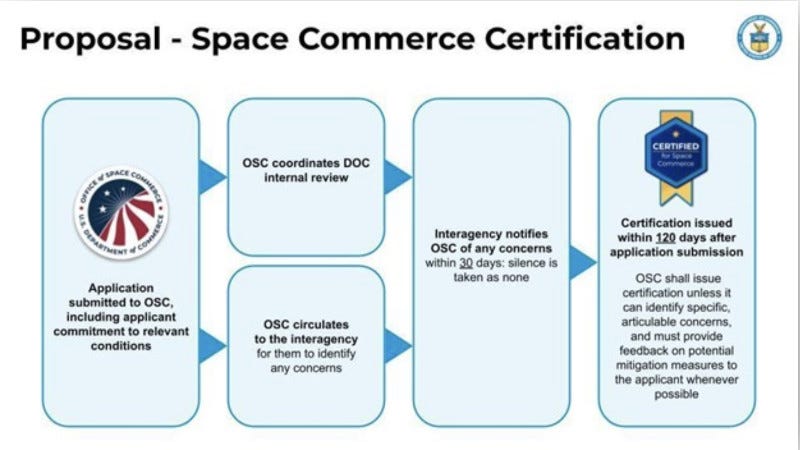 Novel Mission Licensing Rules, and a Spectrum Auction That Will Benefit Satellite Companies 02.08.2026 14minThe Office of Space Commerce says it will publish a Federal Register notice within weeks seeking the first applications for its proposed space licensing certification.The notice would invite companies to apply under the “Space Commerce Certification,” a voluntary process OSC proposed in March to consolidate licensing for commercial space activities not clearly covered under existing FAA, FCC or OSC remote-sensing rules. The office says it plans to begin certifying missions within months of the notice’s publication.OSC posted a video with the announcement. Commerce Secretary Howard Lutnick framed the certification as central to the department’s ambitions in space.“It’s going to be a multi-trillion dollar industry, and the Department of Commerce is going to lead the way.” he said, adding that the certification carries what he called a presumption of approval. “Which means we’re looking to help you get in business, to get in space, to launch your satellites, and to create the amazing opportunity that’s going to be space.”The announcement comes eight days after OSC Director Taylor Jordan testified before the House Science, Space, and Technology Committee’s Space and Aeronautics Subcommittee. Lawmakers there questioned whether the office has the money to run the process it’s now moving to launch. The Trump administration’s fiscal 2027 budget request seeks $11 million for OSC, down from an enacted 52-and-a-half million this year. Jordan told the subcommittee the office hasn’t built additional staffing into its budget for the certification work.The FAA, FCC, and OSC’s own remote sensing division have not said whether they’ll accept the certification in place of their existing requirements. That means companies who apply before that question is settled may not know yet how much regulatory relief the certification will actually deliver.OSC has not said which category of activity — satellite servicing, in-space manufacturing, or lunar operations — will be first in line once the Federal Register notice publishes.-0-The FCC has approved a framework to free up 160 megahertz of Upper C-band spectrum for wireless use across the country.The Commission adopted the order Wednesday under two dockets, combining freshly cleared spectrum between 3.98 and 4.14 gigahertz — plus a 20 megahertz guard band — with previously auctioned Lower C-band frequencies. Together, that creates a contiguous 440 megahertz band for next-generation wireless service. The move satisfies a requirement in the One Big Beautiful Bill Act that the commission auction at least 100 megahertz of the band by July 4, 2027.Three satellite operators will split $6.3 billion in incentive payments for clearing the spectrum: SES gets a touch over $5.6 billion, Eutelsat gets $504 million, and Telesat gets $189 million. The payments come in two installments — $4.914 billion tied to a primary deadline, followed by $1.386 billion before a second deadline. Operators who fall more than 180 days behind schedule forfeit the payment entirely.New Upper C-band license holders will also have to reimburse the operators’ transition costs, which the commission estimates at $4 to $5 billion.Commissioner Anna Gomez approved the order in part but dissented on one point — she wanted a Tribal Licensing Window added for the Navajo Nation, the Shoshone-Bannock Tribes and other tribal governments. “As part of the federal government, the FCC has a trust responsibility to tribal nations. The United States trust responsibility to tribes is a legal obligation established by the Constitution, treaties, and over a hundred years of Supreme Court precedent. Under this obligation, we engage with tribal nations on a government to government basis and are charged with carrying out the law in a manner that supports their sovereignty,” Gomez said.“The unique legal framework and relationship between the federal government and tribal nations requires us to ensure that they have a fair and meaningful opportunity to secure spectrum that is essential to their economic development, public safety, and cultural preservation.”Chairman Brendan Carr agreed to take further comment on that idea, but it’s not in this order.Executives at SES and Eutelsat both welcomed the payments, calling them recognition of the role their companies will play in the transition.Eligible operators have to file transition plans with the FCC by Nov. 5. A clearinghouse selection committee has 60 days from the order’s publication to convene and name a candidate by Dec. 15.-0-A Budapest-based rover developer and a Miami-based space-data company are exploring a joint mission to put environmental sensors on the lunar surface.Puli Space Technologies and Mission Space have signed a memorandum of understanding to evaluate pairing Puli’s rover platform with Mission Space instruments that measure radiation, charged particles, dust behavior and surface charging on the moon. The agreement is nonbinding — it commits the companies only to studying the concept, with no disclosed timeline, funding source or target launch date.The deal follows Mission Space’s selection by NASA to develop a lunar dust and surface-charging instrument with the agency’s Goddard Space Flight Center. NASA is separately funding a similar effort of its own: DUSTER, a University of Colorado/Boulder-led instrument suite being developed under a $24.8 million contract for the Artemis IV mission.Both efforts fall under NASA’s broader “Ignition” initiative that includes a Moon Base program aimed at a permanent lunar outpost by 2030.Under the concept, Puli’s rover would handle mobility and terrain access while Mission Space instruments collect measurements along the way. Executives from both companies say the collaboration builds on Puli’s Water Snooper instrument, which already returned data from the lunar south pole under a European Space Agency contract.The companies are also looking at a joint commercial data product, combining the rover’s positioning data with Mission Space’s environmental readings.The Office of Space Commerce and the Aerospace Industries Association will host a forum on the commercial space supply chain Aug. 18 in Arlington, Virginia.The Commercial Space Supply Chain Forum runs from 8 a.m. to 5 p.m. at AIA headquarters — the second event in OSC’s forum series on Commercial Space Competitiveness, which connects industry with federal agencies.Organizers say growth in the commercial space industry is straining the industrial base that supports it, pointing to challenges around demand visibility, manufacturing capacity, component availability, testing and qualification, capital access and regulatory compliance.Sessions will cover eight topics, including domestic manufacturing capacity, constraints among tier 2 and tier 3 suppliers, supply chain dependencies, capital access, testing capacity, regulatory pressures, export considerations and barriers to adopting emerging technology. The forum will mix panel discussions with what organizers call hands-on working sessions.The goal, according to the announcement, is to identify policy priorities that could strengthen the resilience of the U.S. commercial space industrial base.Space is limited, and no agenda, panelist list or registration deadline has been published yet. Those interested can reach the Office of Space Commerce at [email protected] has picked SES Space & Defense to handle continuous satellite relay communications for its commercial space station.The companies announced the arrangement Monday. Starlab is under development through NASA’s Commercial Low Earth Orbit Development program, meant to succeed the International Space Station. SES Space & Defense, a subsidiary of SES S.A., has provided communications to the U.S. government and allied defense agencies for nearly six decades.Neither company said whether the arrangement is a signed contract, a memorandum of understanding or a letter of intent. Contract terms and a target launch date for the station weren’t disclosed.Under the deal, SES Space & Defense will route Starlab’s data through its O3b mPOWER satellite network in medium Earth orbit, relaying information to ground networks with minimal delay instead of relying on direct contact windows.Executives at both companies described the setup as central to keeping the station connected around the clock, with SES Space & Defense saying the service will expand as Starlab’s operations grow.-0-NASA has ordered a second CAPSTONE mission that will send two small spacecraft into lunar orbit to practice rendezvous and docking ahead of future crewed Moon landings.The agency awarded the contract to Advanced Space. CAPSTONE 02 is targeted for launch in 2027, building on the original CAPSTONE mission, which NASA calls the first U.S. commercial mission to the moon and the first spacecraft to fly in a near rectilinear halo orbit.Where the first mission tested navigation and communications, CAPSTONE 02 moves into active demonstrations. The two spacecraft, each about 882 pounds, or 400 kilograms, and built by Terran Orbital Systems, will practice rendezvous, proximity operations and formation flying to study how trajectories behave under the combined gravitational pull of Earth and the moon.Each spacecraft can switch between chaser and target roles, testing scenarios NASA says can’t be fully replicated on Earth. The techniques mirror the navigation approach planned for Orion’s rendezvous with a lunar lander.The mission will also test three NASA-developed navigation software suites and carry an optical imaging payload from Lawrence Livermore National Laboratory. NASA officials say the work builds toward the lasting capabilities needed for a permanent presence at the moon, supporting Artemis, Moon Base and future deep-space missions.The mission is funded by NASA’s Human Spaceflight Mission Directorate and managed by the Small Spacecraft & Distributed Systems office at NASA’s Ames Research Center in California.Worth a Second LookFlorida, South Australia Agency Sign Deal to Link Spaceport DevelopmentSpace Development Agency Commits $1.75 Billion to Golden Dome Tracking SatellitesSpace Force Awards $69.2 Million Contract for AI-Powered Mission TrainingRovers Bound for the Moon Will Get NVIDIA-Powered Onboard ComputingThe True Competitive Frontier [Paywall] This is a public episode. If you'd like to discuss this with other subscribers or get access to bonus episodes, visit www.exterrajsc.com/subscribe
 -
 America’s Launch Capacity Crisis: Is the U.S. Running Out of Room to Launch? 26.06.2026 40minThe United States is launching more rockets than ever before — but is it enough? With U.S. orbital launch demand already surpassing 180 launches per year and a pipeline of satellite constellations, government missions, and proposed space-based data centers that could push that number into the thousands, America’s launch infrastructure is facing a stress test it was never designed to handle. In this episode, Tom Patton talks with Dr. Tom Colvin, Managing Partner and Chief Technologist at Rational Futures, to unpack the findings of the firm’s May 2026 report “SCRUBBED: America’s Launch Capacity Challenge”, which was commissioned by the Commercial Space Federation.Dr. Colvin brings rare cross-domain credibility to this conversation — a Ph.D. in Aeronautics and Astronautics from Stanford, years as a Senior Policy Advisor at NASA, and deep roots in the space sustainability and commercialization policy world. At Rational Futures, he and co-founder Dr. Akhil Rao have built a firm focused on exactly the kind of rigorous, independent analysis that government agencies and commercial operators need but rarely get: quantitative, mission-specific, and free from institutional bias. The report they’ve produced doesn’t predict the future — it maps the conditions under which a serious launch capacity crisis becomes unavoidable.What emerges from the data is both clarifying and alarming. Traditional launch sites like Cape Canaveral and Vandenberg are already straining under congestion, infrastructure coordination failures, and regulatory friction. “Right now, operators are experiencing friction at the current launch cadence. The predictions for future launches are kind of off the charts, and nobody knows really what the capacity of even our existing infrastructure is, or when we’ll hit that capacity limit, what’s the biggest bang for the buck to fix it,” Colvin said. “And so we were taking a first sort of stab at making a much more rigorous, physically grounded and traceable analysis that people who are trying to plan for future infrastructure can use. Because if you’re going to build new infrastructure, you want it to be right-sized to the amount of demand or services that you’re going to have to provide. So that was effectively what we were doing — we pitched that we can also bring in certain technical constraints that we haven’t seen other people address.”Non-traditional sites — inland and sea-based spaceports — hold theoretical promise but face massive capital requirements and a chicken-and-egg demand problem that market forces alone are unlikely to solve. Meanwhile, proposals for orbital data center constellations totaling over one million satellites represent a demand scenario so large it would require an entirely different conception of what American launch infrastructure looks like. This is a public episode. If you'd like to discuss this with other subscribers or get access to bonus episodes, visit www.exterrajsc.com/subscribe
 -
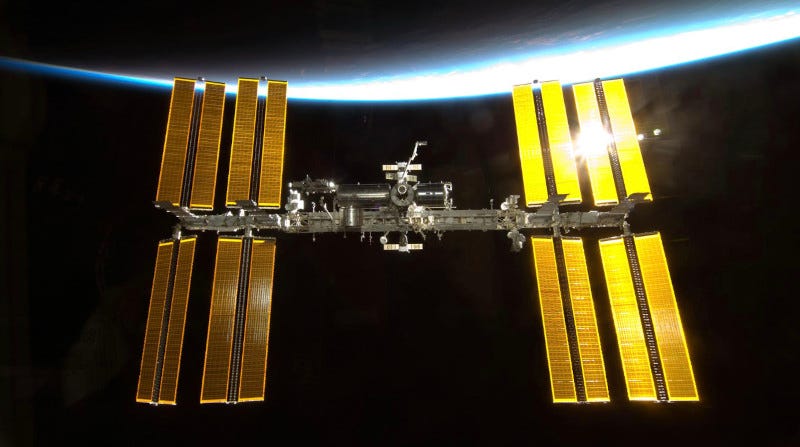 NASA’s Pivot on the CLD Program Pivot 08.06.2026 6minIn the span of roughly twelve months, NASA’s Commercial LEO Destinations program — CLD — has been restructured, redirected, walked back, and redirected again. That’s not normal. It’s worth talking about why.The CLD program was created in March 2021 under the Biden administration. The idea was straightforward: NASA would invest in privately built space stations, then become one of several paying customers — not the owner, not the operator. The agency would buy a seat at the table, not build the table.That model held for four years.Then, in July 2025, President Trump named Transportation Secretary Sean Duffy as acting NASA Administrator. Within three weeks, Duffy signed a new directive reshaping Phase 2 of the CLD program — shifting from firm fixed-price contracts to funded Space Act Agreements. The companies already under contract had not asked for that change. In March 2026, confirmed Administrator Jared Isaacman unveiled a strategy called Ignition. Under that plan, NASA would purchase a government-owned core module, attach it to the International Space Station, and invite commercial partners to bolt their modules onto it. The free-flying commercial station concept — the original CLD premise — was effectively shelved. Industry pushed back. Hard.By the end of May 2026, NASA reversed course. Senior Advisor and Press Secretary Bethany Stevens posted on X that, quote, “The industry position will now shape the path forward as NASA proceeds with the original commercial strategy.” A draft RFP was expected to follow within weeks. Here’s the thing about that sequence of events. It’s fast. By NASA standards, it is remarkably fast.For comparison: NASA’s Constellation program — the post-Shuttle architecture intended to return Americans to the Moon — was authorized in 2005, funded for five years, and then cancelled in 2010 under the Obama administration. That cancellation triggered two years of congressional hearings, a legislative rescue of parts of the program, and the eventual creation of the Space Launch System. The cycle from policy to reversal took nearly a decade.The CLD reversal, from Ignition to walking it back, took approximately ten weeks. Jared Isaacman was confirmed as NASA’s 15th administrator on December 18, 2025, by a vote of 67 to 30. He is 42. He built an e-commerce payments company, flew two private orbital missions through SpaceX, and conducted the first spacewalk by a non-professional astronaut in 2024. He is, in the clearest sense, not a career government official. That is not a criticism. It is a distinction.The administrators who ran NASA through its middle decades — men like Daniel Goldin, who served under three presidents; Sean O’Keefe, a former Navy secretary and OMB director; Charles Bolden, a former astronaut and Marine general — all came from within established institutional frameworks. They understood budget cycles, Congressional authorization, and the pace at which a federal agency is designed to move.Jim Bridenstine, confirmed in 2018 after a 50-to-49 Senate vote, was a congressman. He pushed commercial partnerships aggressively and was often at odds with the agency’s institutional culture. Isaacman’s Project Athena agenda calls for reducing bureaucratic layers, increasing mission cadence, and extracting commercial value from space-based research. The language is the language of a company operating plan, not a federal agency’s strategic review. That framing produces a different kind of decision-making. When industry told NASA the Ignition LEO plan didn’t work commercially, Isaacman’s team moved in weeks. Not quarters. Not fiscal years. Weeks. The question the CLD reversal does not answer is whether speed alone is sufficient. The original CLD contractors invested years and engineering resources under one set of rules. Those rules changed twice in ten months. A draft RFP for the next phase is now expected mid-to-late summer 2026. The ISS is still scheduled for deorbit in 2030. That date has not moved.NASA’s FY2026 budget — the largest in nearly three decades after Congress rejected proposed OMB cuts — includes $272 million for the CLD program for the year, with $2.1 billion projected across the plan. That money exists. The acquisition path for spending it has changed three times. What we’re watching with the CLD program is not simply a policy debate about space station architecture. It is a real-time test of whether an entrepreneurial operating tempo can function inside a federal procurement structure built for a very different pace.And the outcome matters — for the companies that have been building toward this program, for the supply chains behind them, and for whether the United States maintains a human presence in low Earth orbit after 2030.The draft RFP is expected this summer. We’ll be watching. This is a public episode. If you'd like to discuss this with other subscribers or get access to bonus episodes, visit www.exterrajsc.com/subscribe
 -
 Congress Sets its Sights on the NASA Budget 08.05.2026 6minNASA Administrator Jared Isaacman faced tough questions from both chambers of Congress last week over the Trump administration’s proposed twenty-three percent cut to the agency’s budget. But behind the bottom-line numbers lies a more specific debate — one with real stakes for the commercial space industry and the supply chains that keep American rockets flying. The Artemis II mission may have captured the world’s attention last month — sending four astronauts farther from Earth than any humans in history. But on Capitol Hill, the glow didn’t last long. Lawmakers on both sides of the aisle arrived at the same question: can NASA stay ahead of China while cutting nearly six billion dollars from its own budget? This is a public episode. If you'd like to discuss this with other subscribers or get access to bonus episodes, visit www.exterrajsc.com/subscribe
 -
 Space Foundation: Convening the Industry for More Than 40 Years 07.05.2026 39minOne of the long-standing advocacy groups for space is Space Foundation, which was established in 1983 with a mission to advance the global space community through education, collaboration, and information.“We know that there are going to be some obstacles, but we know together we can get there. Artemis II proved that when you have all of the various pieces that came together and it all worked perfectly.”Rich Cooper, Space FoundationSpace Foundation is perhaps best known for its Research & Analysis, Space Certification program, the Space Technology Hall of Fame, and its signature annual event: Space Symposium, which has been around for more than 40 years.Space Foundation operates across nearly every segment as a neutral convener. It doesn’t build rockets, it builds the ecosystem around those who do.On this edition of The Journal of Space Commerce podcast is Rich Cooper, vice president of Strategic Communications & Outreach at Space Foundation, talks with Tom Patton about the hot topics on everyone’s mind during the recent Space Symposium in Colorado Springs.Cooper said that while Artemis and Golden Dome got a lot of the attention in the keynote speeches and breakout sessions, in the corridors people were talking about something else.“I will say the state of relationships between international partners, who can do what, who is prepared to do what. Obviously, there’s a lot of challenge that’s going on in the world and lots of debate and discussion about what those alliances are and what they may look like in the future,” Cooper said. “But what you also, I would say, saw is relationships that have been built over decades. literally decades of collaboration and cooperation on countless numbers of missions. Those relationships remain as strong today as they were before. And that’s what gives, I would say, a great deal of energy to this community that we know we can do hard things. We know it’s going to take some challenge. We know that there are going to be some obstacles, but we know together we can get there. Artemis II proved that when you have all of the various pieces that came together and it all worked perfectly.”Space Foundation is a nonprofit organization founded as a gateway to advance the global space community. As a charitable organization, Space Foundation raises support from corporate members, sponsors, individuals, and grants to offer a comprehensive portfolio of programs and activities that extend our worldwide mission. This is a public episode. If you'd like to discuss this with other subscribers or get access to bonus episodes, visit www.exterrajsc.com/subscribe
 -
 Ex Terra Extra: Space Symposium 01.05.2026 5minInterested in what happened at Space Symposium? Here’s a quick recap of some of the main topics at the show in Colorado Springs from Rich Cooper, VP of Strategic Communicaitons and Outreach at Space Foundation. This is a public episode. If you'd like to discuss this with other subscribers or get access to bonus episodes, visit www.exterrajsc.com/subscribe
 -
 Unpacking the Space Supply Chain 23.04.2026 37minThe Aerospace Industries Association (AIA) and PricewaterhouseCoopers (PwC) released a white paper last month focused on the supply chain for the commercial space industry, and the findings may have been something of a wake-up call for the industry. According to the report, “Strengthening America’s Space Supply Chain: Built for yesterday, igniting momentum for tomorrow”, the U.S. space industrial base has not kept pace with industry growth, and that poses risks to national security, as well as civil, and commercial space programs.On this edition of The Journal of Space Commerce Podcast, Tom Patton talks with Steve Jordan Tomaszewski, VP of Space Systems at AIA, and Doug Anderson, a Consulting Solutions Partner at PwC’s Operations and Supply Chain Services practice and co-author of the report.Steve Jordan Tomaszewski said that the pressure is coming largely from the increasing demand for spacecraft and components for a variety of missions.“Overall, that is a good problem to have. It means that space is being more and more useful in our everyday lives all around the world. And especially if we look for applications like using satellites for national security purposes,” he said. “If we’re looking at using satellites for exploration, for communications and more of commercial applications, there is just more and more demand happening today. However, we don’t see capacity and the manufacturing base able to keep up with that demand.”The fix, according to the report, requires action on multiple fronts — better coordination between government and industry on long-term planning, easing outdated qualification requirements, expanding shared testing infrastructure, and creating financial incentives to bring more suppliers online. Jordan Tomaszewski said that 2026 will be the ‘year of the supply chain’. This is a public episode. If you'd like to discuss this with other subscribers or get access to bonus episodes, visit www.exterrajsc.com/subscribe
 -
 Weird Space Stuff: Jay Schwarz on the Journal of Space Commerce Podcast 09.04.2026 37minAt its March meeting, the FCC unanimously approved a Notice of Proposed Rulemaking (NPRM) seeking comments on a proposal to make additional spectrum available for command and control of spacecraft supporting emergent space operations, but which do not use spectrum as part of any radiocommunications services provided to the public. The NPRM was dubbed “Weird Space Stuff” by the commission.On this edition of The Journal of Space Commerce podcast, Tom Patton talks with FCC Space Bureau Chief Jay Schwarz about the proposal, as well as some of the history and the broader range of functions carried out by the Space Bureau. Schwarz said that the number of applications that have been submitted to the FCC for spectrum authorization has increased by more than 200 percent over the past decade, and that is just a part of the story.“There’s also been a significant change in the types of applications in terms of the complexity that we’ve gotten. So a decade ago, about 80% of the applications were geostationary applications, relatively straightforward to license. And typically you’re dealing with just one satellite, right? What we’re seeing today is we’re seeing that flipped and something on the order of about 80% are your NGSO or your LEO constellations,” Schwartz said. “So more complex, larger, obviously, in terms of the number of satellites, more complex interference environments. And then actually, we’re also getting a number of things, we might touch on this a little bit later, that don’t even fall into that traditional NGSO or GSO category. So we’ve licensed a few commercial lunar missions, for instance, and I think we’ll continue to see more and more of those type of emerging space activities.”The “Weird Space Stuff” NPRM will be open for comments after it is published in the Federal Register. The Journal of Space Commerce podcast is available on Spotify, Apple Podcasts, and many other popular podcasting platforms as well as here on Substack. This is a public episode. If you'd like to discuss this with other subscribers or get access to bonus episodes, visit www.exterrajsc.com/subscribe
 -
 Using AI to Train Space Warfighters 27.02.2026 32minSpace has become a critical warfighting domain, requiring an approach to training that prepares warfighters to use new technology. AI is redefining space warfare training, and is becoming vital for deterrence and national security.Slingshot Aerospace is a U.S.-based space data and analytics company focused on making space operations more safe, sustainable, and secure through satellite tracking, space traffic coordination, and high‑fidelity modeling and simulation tools.What does this signal for the future of AI-enabled military training? On this edition of The Journal of Space Commerce, Tom Patton talks with Dr. Belinda Marchand, Chief Scientist at Slingshot Aerospace, leading astrodynamics and data science teams that build foundational capabilities for its products.She says that while the system was developed for defense use, the simulations are adaptable to other scenarios.“I think the defense use case was a very valuable and timely example of a way to demonstrate the capabilities of the technology. But the technology itself that powers things like Talos, or even that powers our anomaly detection software like Agatha or anomalous actor detection, all those technologies can be used for other purposes as well, right? You can use them to... fly your fleet to control your fleet, to achieve your on-orbit servicing objectives, anything that involves rendezvous proximity operations. You could adapt” Marchand said. “If you’re doing RPOs for intercepting something, that’s not that dissimilar from the type of activity you would do to go service something or refuel something, right? Or to do in-orbit manufacturing and things like that. So the actions have elements in common and the framework itself is agnostic to those actions.”Slingshot recently achieved Cybersecurity Maturity Model Certification (CMMC) Level 2, validating its ability to protect Controlled Unclassified Information (CUI) in support of Department of Defense (DoD) missions. This is a public episode. If you'd like to discuss this with other subscribers or get access to bonus episodes, visit www.exterrajsc.com/subscribe
 -
 Inside AE Industrial Partners 09.01.2026 33minAE Industrial Partners is a private investment firm focused on technologies and services considered critical to aerospace and national and economic security. Founded in 1998 by father-son team Brian and David Rowe, AEI manages $7.2 billion in assets from their headquarters in Boca Raton, FL.“(W)ithout space as a backbone of that infrastructure our modern day economy sort of collapses at this point.” Kirk Konert, AE Industrial PartnersOn this edition of The Journal of Space Commerce podcast, Tom Patton talks with Kirk Konert, A Managing Partner with the firm.AE Industrial Partners supports multiple verticals in the commercial space sector, with several companies involved in the space supply chain. Company co-founder Brian Rowe came from GE Aviation, and the company still is interested in things that fly, and things that make things fly.The company has also invested in such firms as Firefly Aerospace, York Space Systems, Redwire and others. In fact, Konert said that AEI has been the most active private investment firm in space over the past several years. “We believe space has been at an inflection point in industrialization, where it’s become a key part of our economy and infrastructure for driving our economy globally,” Konert said. “And without space as a backbone of that infrastructure our modern day economy sort of collapses at this point.”The company this week announced that it has signed a definitive agreement to acquire a controlling interest in the Space Propulsion and Power Systems business of L3Harris Technologies. The transaction encompasses business units across five locations in the U.S., which have developed the upper-stage rocket engines used in national security, civil and commercial missions for more than 60 years, as well as in-space propulsion, nuclear power and avionics assets.L3Harris will retain a minority investment interest and continue to act as a strategic partner to the business. AE Industrial plans to restore and use the “Rocketdyne” name for the acquired business in recognition of its heritage and longstanding innovation within space propulsion technology. This is a public episode. If you'd like to discuss this with other subscribers or get access to bonus episodes, visit www.exterrajsc.com/subscribe
 -
 Extending the Range and Life of Satellites 13.11.2025 30minSpace Ocean Corp is an emerging pre-revenue space logistics startup headquartered in Brownsville, Texas. Founded in 2021, the company is developing what amounts to the “gas station in space” infrastructure—providing critical on-orbit refueling and resource transfer services that enable satellites to operate longer, travel farther, and reduce launch costs.“And if you could get refueled out there in those far away locations, which are several years away, or maybe in the future, only several months away, well, that’ll extend that billion dollar satellite and enable more capability.” Paul Mamakos, Space OceanThe company has engineered the ALV-N (Autonomous Logistics Vehicle - Next generation) as a multipurpose orbital platform capable of servicing customer satellites through proximity operations and resource delivery. The ALV-N serves as both a technology demonstrator and a planned commercial service platform.On this edition of The Journal of Space Commerce Podcast, Tom Patton talks with Paul Mamakos, CEO of Space Ocean. He said refueling spacecraft is essential, particularly for deep space missions.“If somebody sends a billion dollar satellite out toward the deeper space, deeper solar system, Mars, Saturn, Pluto, Jupiter, it’s going to take a while to get there. And they usually expend a large amount of their fuel just to get out there, maybe 80 to 90% of their mass, spacecraft mass, just in fuel to get out there. So when they get out there, they’ve run out of most of their capability for maneuvering. So not only maneuvering in low Earth orbit or the GEO area or the MEO cislunar area, but also in the deeper solar system,” Mamakos said. “And if you could get refueled out there in those far away locations, which are several years away, or maybe in the future, only several months away, well, that’ll extend that billion dollar satellite and enable more capability. So we’re looking to source fluid from off Earth. Initially, we’ll get our fluid or water from Earth. You know, it could be other things like liquid nitrogen or oxygen. And then also we could source it from off-Earth and deliver off-Earth.”Along with in-space refueling, the Space Ocean business model includes Infrastructure as a Service (IaaS), Data as a Service (DaaS), and resources for space laboratories and pharmaceutical R&D. This is a public episode. If you'd like to discuss this with other subscribers or get access to bonus episodes, visit www.exterrajsc.com/subscribe
 -
 Tracking Space Objects for Fun and Profit 16.10.2025 34minNo one knows precisely how many objects there are in Earth orbit. Estimates range from NASA’s 31,000 to just over 40,000, according to ESA. But at some point, it just becomes a large number. The bottom line is there are a lot of satellites, defunct spacecraft, parts of spacecraft and outright junk orbiting the Earth, and any one of them could cause a catastrophe.One company that is working to catalog and track both functioning satellites and orbital debris is Kayhan Space. Their SatCat program allows both governments, businesses and the general public to see and follow what is out beyond the atmosphere. SatCat is a follow-on product to Pathfinder, their cloud-based collision avoidance service that automates conjunction assessment and maneuver planning.“SatCat is kind of a data aggregation platform and automation platform. We ingest data from various data sources, from (the) US Space Force’s catalog to almost close to 10,000 ephemerides from satellites that have GPS on board, to commercial data that we procure and purchase from commercial data providers,” said Araz Feyzi, company co-founder and Chief Technical Officer. “And all of that gets combined together and kind of creates this most comprehensive space object catalog. Why I say most comprehensive is because when you have maneuver plans and very precise trajectories from almost 10,000 satellites on a platform, you don’t get that kind of up-to-date and live data from space objects ever.” SatCat is open for use by the general public, with advanced features available to paid subscribers. The company was recently selected for the Office of Space Commerce’s TraCSS data quality monitoring service, and recently launched a GPU-accelerated SGP4 propagator purpose-built for large-scale satellite modeling. sgp4.gl is freely available for anyone to use, and it demonstrates how higher performance can transform the user experience. To ensure broad accessibility, Kayhan has also released a complete open-source demo that integrates sgp4.gl with Next.js and CesiumJS, deployable in minutes on Vercel. This is a public episode. If you'd like to discuss this with other subscribers or get access to bonus episodes, visit www.exterrajsc.com/subscribe
 -
 LUMA: A Digital Museum on the Moon 21.08.2025 35minLUMA … The Lunar Museum of Art … is a digital museum and archival initiative focused on the intersection of art, space, and technology. It presents curated exhibitions, immersive galleries, and projects that explore humanity’s cultural expansion beyond Earth. LUMA is also a leader in integrating NFTs and digital storytelling into space-themed experiences."From a practical point of view, we're the first museum on the moon.”Michael Potter, LUMAThe museum offers virtual exhibitions centered on space history, human imagination, and frontier themes, including art sent to the moon and space and digital and physical artworks launched into orbit and beyond.On this edition of The Journal of Space Commerce podcast, Tom Patton talks with Michael Potter, one of the founding trustees of the Lunar Museum of Art. Potter explained that LUMA is a digital layer on top of the Lonestar Data Holdings data center, which was carried to the moon aboard the Intuitive Machines lunar lander."From a practical point of view, we're the first museum on the moon, we're the first non-profit museum on the moon (and) the first art museum on the moon," Potter said. "But to get a start, we had to do it in a digital context because that was all that was available to us at that moment. But the idea is that this is really a hybrid museum."Potter hopes that LUMA will eventually become part of an envisioned network called "The Museums of the Next Frontiers" with other art museums.LUMA currently has four galleries: * The Best of NASA* Space for Art: Healing Through Creativity* Cinema* Next FrontiersThe museum says on its website that it presents an innovative new model for global museums, creating a bridge between digital and physical collections and providing traditional museums with extended exhibition, scientific, digital and educational solutions. This is a public episode. If you'd like to discuss this with other subscribers or get access to bonus episodes, visit www.exterrajsc.com/subscribe
Podcast serupa


Popular di
Podcast ini turut muncul dalam senarai podcast negara-negara ini.
