
F them fish! AuDHD for grownups
F them fish
0
AuDHD for grownups: honest, funny conversations about work, relationships, sensory overload, identity, and the stuff nobody explains after diagnosis. The podcast raises awareness for neurodivergent individuals and their allies, aiming to push off stigma and reinvent the discussion. The hosts are not mental health professionals, and neurodivergence is treated as a social identity. Listeners are invited to join the community on Instagram, LinkedIn, TikTok, and Facebook.
Episod
-
 AuDHD Burnout or Simple Tiredness: Are You Running on Empty? 29.09.2026 33minDo you feel like you’re constantly low on spoons? Are even the things you want to do feeling like effort? Does working out what might help sound like another job you don’t have the energy for? You’re not alone. Hit play to sit with two friends who get it.This week, Callie and Jayne talk about waking up with nothing in the tank, switching between professional and social roles, and making space for recovery when you still don’t feel recovered. From the background radiation of world events to financial stress and information overload, we explore the modern pressures that can leave neurodivergent brains entirely fried.In this episode, you’ll find:We share things we personally find helpful, including noticing what we want less of, and choosing one manageable next stepLow demand comforts, including rediscovering favourite musicBasket date night… Dopamining - salt and vinegar Cheezels, house-system wins, and a particularly inappropriate suggestion for finding lost belongingsAsking for professional and personal support when exhaustion persists.We might get better. But today, we’re starting small.Interested in having Jayne as your wedding celebrant? Email [email protected], and we’ll connect you.Timestamps00:00 – Theme tune and welcome 02:50 – Do you feel constantly low on energy? 03:35 – Snack fixations and dopamining 05:39 – Can a timer keep us on track? 08:01 – Jayne’s new job, weddings, and the cost of switching roles 11:26 – Making time for recovery but still feeling depleted 13:36 – House systems that work for who you are - we might get better 16:54 – Basket date night: Unf*cking the household clutter together 18:05 – A very inappropriate lost-items strategy from Tom Cardy 19:44 – Feeling underwater and blurred vision 20:49 – When working out what you need feels like another job 22:56 – AuDHD Burnout and invisible effort 24:25 – World events, feeling unsafe, and the cost of living crisis 26:14 – Starting with what you don’t want 28:08 – Sleep, familiar music, and small comforts 29:39 – Finding just one manageable next step 31:16 – Time’s up: staying connected 32:37 – Producer’s note: seeking help and sharing the recovery loadMentioned in this episodeTom Cardy — H.Y.C.Y.BH?: the lost-items song from our side quest. Explicit language.Find our earlier house-systems episode: in your podcast feed.Healthdirect: Fatigue: further information about persistent tiredness and seeking support.Connect with usWe are a 100% independent podcast with no corporate backing or production company. If this episode felt like a warm hug, please follow, rate, or share it with another neurodivergent adult who needs to hear itEmail Us: Send your questions, stories, feedback, and small wins to [email protected]: Search AuDHD for Grownups: F Them Fish on TikTok, Instagram, or YouTubeCallie’s Info: Explore executive functioning coaching, keynotes, and workshops at Executive Functioning Leadership Callie on LinkedInJayne on LinkedInAcknowledgement of CountryThis podcast was created on the lands of the Ngunnawal, Wadawurrung, and Dja Dja Wurrung Peoples. We pay our respects to Elders past and present, and recognise their continuing connections to Country, culture, and community.Lived-experience noteWe share personal experiences and general discussion, not medical or psychological advice. ‘Low spoons’ describes limited energy or capacity, it is not a diagnosis. Persistent exhaustion, difficulty recovering, or changes in vision deserve professional assessment rather than assumptions about their cause. As Callie’s closing note reminds us, you don’t have to manage recovery alone.Contains occasional explicit language and adult humour.Email: [email protected] and Instagram at AuDHD for Grownups: F Them FishCallie's Website: https://executivefunctioning.com.au/LinkedIn: Callie: www.linkedin.com/in/callie-elward-barrett-263068142 Hosted on Acast. See acast.com/privacy for more information.
 -
 Autistic, Queer, and Doing Life My Way. With Yenn Purkis 22.09.2026 55minAutism, queer identity, ambition, and building a life on your own terms. Author and advocate Yenn Purkis joins us for an honest conversation about their experiences and the expectations they’ve refused to live by.Welcome to AuDHD for Grownups: F Them Fish, with Callie Elward-Barrett and Jayne Gurton, your neurodivergent besties talking adult ADHD, autism, and the stuff nobody explains about grown-up life.This week, Yenn Purkis joins us in the Nook, bringing spectacular rainbow hair, a love of cats, and a remarkable willingness to share the difficult parts of their story alongside the joy.Yenn talks about receiving an autism diagnosis in prison, being misunderstood within mental health services, and finding support that helped them imagine a different future. They describe the steps towards university, a 17-year public service career, writing books, and a home they love, alongside the continuing reality of living with schizophrenia.We get into ambition, the limits other people place on us, and why asking for help can be complicated when independence matters deeply. We also compare our responses to motivational advice and question where protection, challenge, and resilience meet.Then we explore the joy of recognising your identity. Yenn shares their experience of coming out as non-binary and asexual, choosing their name, and finding people who understood. Expect swearing, side quests, and a Podcat determined to join the conversation.Content noteStrong language and discussion of incarceration, bullying, trauma, drug use, psychiatric hospitalisation, schizophrenia, suicide risk, and discrimination.In this episodeAutism diagnosis, misdiagnosis, and Yenn’s experiences of prison and mental health services.Finding hope, accepting support, and taking the next step towards change.Ambition and questioning other people’s assumptions about your capabilities.Support that respects boundaries and autonomy.Our different experiences of motivation, resilience, and discomfort.Non-binary and asexual identity, coming out, and becoming Yenn.Writing for autistic children and discovering how much those books mean to readers.Yenn’s books and websiteYenn Purkis’s biography and websiteYenn’s books at Woodslane HealthYenn also mentions their books with Lived Places Publishing. Contact Yenn through their website or social media to enquire about their newsletter or signed copies.A note from usWe share lived experience, professional perspectives, and personal reflections. This conversation is not individual medical, psychological, or workplace advice. Our ideas about autism, motivation, and resilience are exploratory, not established explanations of how everyone’s brain works. People’s circumstances, barriers, and support needs differ. Expect swearing, disagreement, and ongoing learning.Join the conversationSend your stories, questions, ADHD taxes, guest ideas, and feedback to [email protected] us on YouTube and Instagram at AuDHD for Grownups: F Them FishCallie's Website: https://executivefunctioning.com.au/LinkedIn: Callie: www.linkedin.com/in/callie-elward-barrett-263068142 Jayne: https://www.linkedin.com/in/jayne-gurton-Follow or subscribe so you don’t miss an episode, and leave us a five-star review if the pod makes you feel understood, entertained, or slightly less alone.This podcast was created on the lands of the Ngunnawal, Wadawurrung and Dja Dja Wurrung Peoples. We pay our respects to Elders past and present, and extend that respect to Aboriginal and Torres Strait Islander listeners.Email: [email protected] and Instagram at AuDHD for Grownups: F Them FishCallie's Website: https://executivefunctioning.com.au/LinkedIn: Callie: www.linkedin.com/in/callie-elward-barrett-263068142 Hosted on Acast. See acast.com/privacy for more information.
 -
 ADHD and the Social Media Neuroscience Trap 15.09.2026 1j 9minIs internet pop-science lying to you? In this episode of AuDHD for Grownups: F Them Fish, Callie and Jayne dismantle ADHD and the social media neuroscience trap to find out what the research actually says. Does visual clutter actually break the ADHD brain, or is social media overhyping the science? Real scientific studies get twisted into confident, viral social media claims about ADHD, clutter, stress, and working memory. We break down what the research actually measured, where the online interpretations stretch the truth, and how to balance competing sensory needs in shared spaces, because Callie needs a minimalist, clear space to think, while Jayne thrives in a cozy, dopamine-filled environment.Hit follow to join two AuDHD grownups as they debunk pop-neuroscience and figure out whose neurodivergent home wins. In This Episode:Why feeling validated makes us less likely to question internet claims.What visual-processing studies actually tell us about clutter.The real link between uncompleted tasks, stress, and laundry piles.Why useful brain metaphors aren’t empirical proof.How to negotiate shared spaces.Unmasking, mutual consideration, and whose accommodations get prioritised.Timestamps:00:00 Welcome back, Jayne04:38 Your house hacks and the big-light dispute06:04 When a neuroscience post feels almost too validating07:29 Jury duty12:48 British passport rant19:44 The post that started it all23:05 How do we know which neurodivergence content to trust?28:36 Overstating the evidence30:13 Research timelines36:51 Taking laboratory findings into everyday life38:14 Can your brain ignore clutter?40:10 The Yale study42:29 Unfinished tasks and open-tabs analogy44:58 Clutter & cortisol, the 2010 study46:56 The 501-person study48:56 Does visual clutter make working memory shrink?52:18 Validation or pressure54:13 Competing sensory needs and shared spaces58:20 Who gets overlooked in Autism1:02:21 Checking citations1:06:02 Your house hacks Research:These sources give context for our discussion on scientific interpretation and are not interchangeable evidence about ADHD or autistic people.Visual Clutter Study (Yale, 2024): Yale Research Link (Neural activity in macaques, not humans in messy homes).Clutter & Cortisol Study (Saxbe & Repetti, 2010): No Place Like Home Study (Correlated home descriptions with mood, did not establish causation).Home Clutter & Wellbeing (Quinn, 2025): ScienceDirect Link (Survey of 501 adults on perceived clutter and home beauty).Visual Attention Cortex (McMains & Kastner, 2011): JNeurosci Link (Research on visual competition, not working-memory).Unfinished Work Meta-Analysis (Wendsche et al., 2026): PubMed Link (Thoughts about work outside of working hours).Zeigarnik Effect Review (Ghibellini & Meier, 2025): Nature Link (Questions whether unfinished tasks enjoy a memory advantage).Original Instagram CarouselGhibellini and Meier’s 2025 review of the Zeigarnik and Ovsiankina effects adds context to the open-tabs discussion. Join the Conversation:Send us your house hacks, your big-light stance, or a claim you’d like us to investigate!Email: [email protected]: Find us on YouTube and Instagram at AuDHD for Grownups: F Them FishCallie’s Website: https://executivefunctioning.com.au/LinkedIn: Callie: www.linkedin.com/in/callie-elward-barrett-263068142Jayne: https://www.linkedin.com/in/jayne-gurton- If you enjoyed this episode, please follow the show and leave a rating or review to help other neurodivergent grownups find us!Disclaimer & Acknowledgements:We share lived experience, professional perspectives, and our own interpretations of research. This conversation is not medical advice. Expect mild swearing and ongoing learning.We acknowledge the Traditional Custodians of the lands from which we record: the Ngunnawal, Wadawurrung, and Dja Dja Wurrung peoples. We pay our respects to Elders past and present, and extend that respect to all Aboriginal and Torres Strait Islander listeners.Email: [email protected] and Instagram at AuDHD for Grownups: F Them FishCallie's Website: https://executivefunctioning.com.au/LinkedIn: Callie: www.linkedin.com/in/callie-elward-barrett-263068142 Hosted on Acast. See acast.com/privacy for more information.
 -
 House Hacks: ADHD Organisation & Reducing Cognitive Load 08.09.2026 44minThe answer to forgetting, losing things, laundry chaos, and food going mouldy in the fridge isn't to simply try harderIn this solo episode, Callie (a neuroinclusion specialist and coach) takes you inside the practical neurodivergent home systems her family uses to reduce cognitive load, support executive dysfunction, and make a multi-brained household easier to live in. You don’t need a perfectly organised, picture-perfect home, it’s about systemic changes in your environment so your brain doesn't have to work so hard.Drawing on her background in systems thinking, behavioural insights, and neurodivergence, Callie explains how small environmental tweaks can reduce your reliance on working memory, help with task initiation, and smooth out daily transitions.Enjoying the show? Please hit follow/subscribe and leave a review to help other AuDHD grownups find us! In This Episode:The Neurodivergent Fridge: Why fresh food is banned from the bottom drawersLaundry Hacks: And the ongoing mystery of SOCKMAGEDDONVisual Cues & Labels: Making the physical environment do the remembering for youThe Nike Rule: Managing clutter and visual load without getting overwhelmedSensory-Friendly Lighting: Designing spaces around activities and different sensory preferencesHousehold Infrastructure: Turning charging cables into permanent fixtures and creating functional transition and landing zonesThe Octo-pissoff-opus: An orange octopus with a very important jobExternalising Time: Strategies to combat time blindnessTakeaway: When a routine repeatedly fails, start asking whether the environment or system can be redesigned to better support the humans using it.Timestamps00:00 - Episode introduction: Callie flying solo00:40 - Inside a neurodivergent household07:00 - Identifying friction points and designing new systems10:02 - Making your environment do the remembering10:38 - Labels, storage, and giving items a home14:06 - Managing clutter, visual load, and disappearing Post-it notes18:03 - The three-minute Nike rule19:48 - Putting the solution exactly where the task happens20:03 - Laundry baskets, SOCKMAGEDDON, and natural consequences23:00 - The coat hanger hack for clothing management25:27 - The receipt drawer: Delaying decisions until they matter26:45 - Transition spots and attaching tasks to existing journeys27:52 - Out of sight, out of mind: The fridge drawer problem29:19 - Garage zones, storage categories, and dancing skeletons30:06 - Designing rooms around activities31:34 - Sensory lighting and Callie's controversial love of the big light33:12 - Meet the Octo-pissoff-opus34:20 - Charging cables as household infrastructure36:33 - Landing zones and handling systems that only partly work38:04 - Externalising time to manage executive dysfunction38:36 - Weekly planners, meal planning, and shared shopping lists40:54 - Annual planning and the bigger picture41:51 - Should Callie come back for Part 2?Share Your Systems With Us!Do you have a home system that genuinely changed your life, or a friction point you just can't seem to figure out? We want to hear about it!Email us: [email protected], TikTok, & YouTube: @AuDHDforGrownups_FThemFishCallie’s Website: https://executivefunctioning.com.au/Connect on LinkedIn: Callie Elward-Barrett: www.linkedin.com/in/callie-elward-barrett-263068142 Jayne Gurton: https://www.linkedin.com/in/jayne-gurton- We talk about neurodivergence from our own lived and professional experiences. Neurodivergent people are not a monolith, a system that works brilliantly for one person might be useless for another. Use what helps, ignore what doesn't, and change the system when it stops serving you. We acknowledge the Traditional Custodians of the lands on which we live, work, and record, including the Ngunnawal, Wadawurrung, and Dja Dja Wurrung peoples. We pay our respects to Elders past and present and recognise that sovereignty was never ceded.Email: [email protected] and Instagram at AuDHD for Grownups: F Them FishCallie's Website: https://executivefunctioning.com.au/LinkedIn: Callie: www.linkedin.com/in/callie-elward-barrett-263068142 Hosted on Acast. See acast.com/privacy for more information.
 -
 What is AuDHD Rage Exactly? Big Feelings, Sensory Overload, and Joy 01.09.2026 59minWhat does AuDHD rage actually feel like? And is anger even the right word for it?In this episode of AuDHD for Grownups: F Them Fish, Callie and Jayne dive into the reality of emotional intensity in adult ADHD, autism, and AuDHD. If your neurodivergent nervous system goes from completely fine to ABSOLUTELY NOT due to sensory overwhelm, a meltdown, or sudden anger, you’re not alone.This isn’t an episode about neurodivergent people being angry, because if the difficult emotions hit hard, neurodivergent joy is just as loud.We explore why conversations about adult neurodivergence and emotional regulation focus so heavily on rejection sensitivity, frustration, and dysregulation while overlooking enthusiasm, awe, excitement, love and the glorious kind of joy that makes you want to kick your feet because there are king parrots in the garden.We also tackle a tough question: when does validating an emotion help us move through it, and when does validation accidentally trap us in rumination?In this episode:The myth of ADHD rage vs. what the research supportsEmotional reactivity and rapid mood shifts in adult ADHDSensory overload, panic, and the fight/flight responseWhy anger can feel saferAutistic communication, flat affect, and being mistaken for angryVenting, passionate speech, and how it impacts people around usExploring the neurodivergent window of toleranceRumination vs. validation: finding your logical brain againThe joyful side of neurodivergent emotional intensityFinding your tiny, ridiculous, wonderful sources of joyMetacognition, anxiety, and learning to trust your intuitionPattern recognition, dating choices, and ‘Deb’Timestamps:00:11 Welcome, chest pops, and absolutely no normal02:34 Today’s topic10:28 What we mean by neurodivergent rage12:12 Why does research focus heavily on negative emotions?15:42 Late diagnosis, and finding the joy again18:06 Suggestibility, self-talk, and changing your story20:41 Validation versus rumination: moving through it25:39 Is ADHD rage a real thing?27:03 Autistic flat affect, passionate speech, and being misunderstood29:02 When one person recovers quickly and the other doesn’t31:01 Sensory overwhelm, panic, meltdowns, and rage36:35 Nervous-system reactivity and emotional intensity38:14 The neurodivergent window of tolerance40:42 When your joy is too much42:18 Rage, frustration, passion, and the full emotional range45:29 Squishmallows, parrots, and finding joy47:31 Listener question: intuition, anxiety, and Deb51:28 Confirmation bias in dating patterns55:40 Are we sometimes too busy being nice to help each other grow?59:04 See you next week, Besties!A quick note:ADHD rage is not a clinical diagnosis. This conversation combines research-informed discussion with our own lived experience of ADHD, autism, and AuDHD. It isn’t medical or mental health advice, and neurodivergent people are every bit as varied as everyone else.Acknowledgment:We acknowledge the Ngunnawal, Wadawurrung, and Dja Dja Wurrung peoples, the Traditional Custodians of the lands from which we record and pay our respects to Elders past and present.Connect with us:Email: [email protected]: Find us on YouTube and Instagram at AuDHD for Grownups: F Them FishCallie's Website: executivefunctioning.com.auLinkedIn: Callie: www.linkedin.com/in/callie-elward-barrett-263068142Jayne: https://www.linkedin.com/in/jayne-gurton-About the Show:AuDHD for Grownups: F Them Fish is all about real conversations for late-diagnosed adults navigation adult ADHD, autism, AuDHD, neurodivergent relationships, work, emotional regulation, sensory overwhelm, and figuring out your brain as a grown-up. Email: [email protected] and Instagram at AuDHD for Grownups: F Them FishCallie's Website: https://executivefunctioning.com.au/LinkedIn: Callie: www.linkedin.com/in/callie-elward-barrett-263068142 Hosted on Acast. See acast.com/privacy for more information.
 -
 Are Neurodivergent People More Intuitive? 25.08.2026 1j 5minAre Neurodivergent People More Intuitive?Why do so many autistic, ADHD, and AuDHD people describe simply knowing something before they can explain why?In this episode of AuDHD for Grownups: F Them Fish, Callie and Jayne dive deep into the neuroscience and lived experience behind neurodivergent intuition. We unpack the thin line between a true gut feeling and trauma-informed hypervigilance, exploring how our brains process the world around us.In This Episode:The Neuroscience of Intuition: How rapid processing and predictive processing create unconscious knowing.Pattern Recognition vs. Hypervigilance: Distinguishing genuine intuition from anxiety, trauma responses, and rejection sensitivity.The Body Connection: The vital role of interoception and what a literal gut feeling means for an AuDHD brain.Masking & Self-Trust: How years of social monitoring and masking cause us to override our own internal signals.Are We Psychic?: A lighthearted look at why neurodivergent people frequently joke about having a sixth sense.Timestamps00:00 – Welcome04:03 – Big changes for Jayne07:35 – Callie's Melbourne adventures and Dame Jacinda14:54 – What do we mean by intuition?20:11 – Is there neuroscience behind intuition?22:10 – Jayne's journey back into her body and trusting herself25:45 – Spirituality, skepticism, and understanding intuition28:31 – ADHD, hypervigilance, and taking in ALL the information34:13 – Autism and enhanced pattern recognition39:36 – Predictive processing: Is the brain predicting what comes next?42:10 – Interoception and the literal gut feeling48:37 – Hypervigilance, trauma, intuition, or anxiety?50:35 – Masking and learning not to trust yourself55:32 – Are neurodivergent people psychic?1:00:30 – A practical way to investigate your intuition1:02:34 – Listener questions & Callie’s shameful unreleased episode vault Hello, hello, and welcome!We are your neurodivergent besties, Callie Elward-Barrett and Jayne Gurton. We talk about neurodivergence in real adult life: work, relationships, burnout, identity, and all the things we wish someone had explained earlier.This podcast was created on the lands of the Ngunnawal, Wadawurrung, and Dja Dja Wurrung Peoples.Disclaimer: This episode shares lived experience and general discussion of research, neurodivergence, trauma, fibromyalgia, somatic practices, and wellbeing. It is not medical or psychological advice. Connect With UsEmail: [email protected]: Find us on YouTube and Instagram at AuDHD for Grownups: F Them FishCallie’s Website: https://executivefunctioning.com.au/Callie on LinkedIn: Connect with CallieJayne on LinkedIn: Connect with JayneAuDHD for Grownups: F Them Fish is a podcast about adult ADHD, autism, AuDHD, neurodivergence, executive functioning, masking, burnout, relationships, work, identity, and figuring out grown-up life with a differently wired brain. Email: [email protected] and Instagram at AuDHD for Grownups: F Them FishCallie's Website: https://executivefunctioning.com.au/LinkedIn: Callie: www.linkedin.com/in/callie-elward-barrett-263068142 Hosted on Acast. See acast.com/privacy for more information.
 -
 AuDHD Digital Overwhelm: Tech Traps Designed to Manipulate Your Neurodivergent Brain 19.08.2026 1j 12minWhy can you spend hours doomscrolling, but still feel completely unable to reply to a text or pay a bill?In Episode 62 of AuDHD for Grownups: F Them Fish, hosts Callie Elward-Barrett and Jayne Gurton unpack digital overwhelm through an adult ADHD and autism lens. They dive deep into the swing between compulsive tech use and total tech avoidance, the crushing shame of ghosting people you love, dopamine traps, sensory regulation, and why willpower is a terrible strategy for neurodivergent digital wellbeing.The Quick Takeaway: Your inability to manage your phone isn't a moral failure or a lack of discipline. It is a capacity, sensory, and executive functioning bottleneck.Overwhelmed by adulting? Get practical tools and executive functioning support at Callie’s website: executivefunctioning.com.au. Timestamps00:35 Welcome to F Them Fish and navigating a neurodivergent adult world03:05 90s parenting style, random physical injuries, and yoga attempts09:49 Women Unlimited, public speaking jitters, and a classic AuDHD cheese side quest17:17 Jayne’s Confession: The shame when digital burnout turns into missed texts, bills, and birthdays21:00 Why you aren't actually failing at tech, you’re just measuring by neurotypical metrics25:30 Debunking the Goldfish: Why the viral 8-second attention span claim is total fiction (and how attention actually works)30:50 All-or-Nothing Doomscrolling: Is your phone use an addiction, or are you desperately seeking dopamine and sensory regulation?36:28 Why neurodivergent brains and young people are uniquely vulnerable to social media traps41:46 Neurodivergent Kids & Screen Time: Balancing parental anxiety with active sensory regulation needs43:13 A breakdown of the American Academy of Pediatrics framework for managing screens51:01 How repeated exposure to algorithm feeds silently shapes your mood and beliefs56:46 A raw look at parenting, social media, and Australia’s under-16 platform restrictions1:01:00 How gaming loops exploit executive dysfunction1:03:02 How Callie uses AppBlock and tactical boundaries to trick her brain out of tech loops1:08:25 Practical strategies and mapping what you actually want from tech1:09:48 How to rebuild your relationship with tech safely after autism/ADHD burnout1:11:52 Outro & Epilogue: An unfortunate linguistic discovery Resources Tech Boundary: AppBlock App (Callie’s tool recommendation - completely unsponsored)Screen Framework: AAP’s 5 Cs of Media Use GuideGlobal Tech Report: WHO Report: Teens, Screens and Mental HealthPolicy Context: eSafety Commissioner: Australia’s Social Media Age RestrictionsSupport & ConnectIf you love our messy, honest conversations about adult neurodivergence, please take 5 seconds to Follow or Subscribe on this app and leave us a 5-star review! It directly helps other AuDHD adults find our community.Find us on YouTube and Instagram at AuDHD for Grownups: F Them FishCallie's Website: https://executivefunctioning.com.au/LinkedIn: Callie: www.linkedin.com/in/callie-elward-barrett-263068142 Jayne: https://www.linkedin.com/in/jayne-gurton-Disclaimer: This is a lived-experience conversation, not medical, psychological, psychiatric, or professional parenting advice.Acknowledgment: This podcast was created on the lands of the Ngunnawal, Wadawurrung, and Dja Dja Wurrung Peoples.Email: [email protected] and Instagram at AuDHD for Grownups: F Them FishCallie's Website: https://executivefunctioning.com.au/LinkedIn: Callie: www.linkedin.com/in/callie-elward-barrett-263068142 Hosted on Acast. See acast.com/privacy for more information.
 -
 AuDHD and Perimenopause - What The Hell is Happening? 11.08.2026 1j 5minEver feel like your executive function completely packed its bags and left? If you are an AUDHD adult riding the hormonal rollercoaster, you are not losing your mind. Your hormones are just messing with your brain chemistry.This week, we are diving into the chaotic intersection of ADHD, AuDHD, and perimenopause. Spoiler alert: this is not a dry medical lecture. We are talking real, lived-experience chatter about what actually happens when estrogen drops and ADHD traits dial up to eleven. From sensory overloads and catastrophic brain fog, to why your usual coping strategies suddenly stop working, we are breaking down the unfiltered reality of mid-life hormonal shifts. We also look at how this impacts the parenting journey, why women are fighting for testosterone access, the reality of manopause, the hidden pink tax on female hormones, the anxiety ADHD autism pipeline, why perimenopause absolutely counts as an acquired form of neurodivergence, and why you do not need an official diagnosis to start advocating for your health.We can guarantee you’ve never heard ANYONE talking about estrogen and dopamine like this! What did she say?? Dopamine does what??Whether you are officially diagnosed, self-identified, or just trying to figure out why everything feels ten times harder lately, pull up a chair. Let's figure out what the hell is happening together.Timestamps00:00 Catch ups, spring cleaning, and life updates03:00 Late diagnosed neurodivergence and the hormonal storm04:24 Keeping it real: Our official non-medical disclaimer05:44 Overwhelm, frantic schedules, and a car crash update13:37 Pushing through severe vertigo, double vision, and the 2011 Brixton riots18:50 The core science: Estrogen, dopamine, and diagnosis peak at age thirty-seven22:50 The layperson guide to brain chemistry: Dopaminergic neurons, inhibitors, and estrogen lube28:40 Survival strategies, the DSM-5, and adult diagnosis history33:04 Testosterone and the pink tax36:15 The big debate: Is perimenopause a temporary or acquired form of neurodivergence?40:06 Hormone testing, MHT, and clinical myths47:13 Pregnancy and the anxiety, ADHD, autism connection49:42 How to talk to your doctor and medical gaslighting59:30 Final side quest: MySpace, old emo pages1:05:55 See you next time!Connect With UsEmail: [email protected] us an email to get your copy of Callie’s dandelion neurodivergence graphic!Got a perimenopause, ADHD, AuDHD, hormone, or is this just me? question? Send it to Jayne (with a Y) there are no dumb questions.Find us on YouTube and Instagram at AuDHD for Grownups: F Them FishCallie's Website: https://executivefunctioning.com.au/ LinkedIn: Callie: www.linkedin.com/in/callie-elward-barrett-263068142 Jayne: https://www.linkedin.com/in/jayne-gurton-/References European Psychiatry Journal study on the intersection of estrogen, dopamine, and late-stage neurodivergence: https://www.cambridge.org/core/journals/european-psychiatry/article/perimenopausal-symptoms-in-women-with-and-without-adhd-a-populationbased-cohort-study/7C584E5C4363EBCADFC485D3F0892A62 Follow Dr Mary Haver on Instagram and TikTok for accessible women's health updates.Crappy to Happy podcast hosted by Cass Dunn, featuring insights on estrogen and cognitive health.Medical DisclaimerWe are not doctors, medical professionals, or scientists. We are just two AuDHD grown-ups sharing our experiences, research, and frustrations. Menopausal Hormone Therapy (MHT) updates shared here are purely for conversational purposes. Always consult a healthcare professional for medical advice. Email: [email protected] and Instagram at AuDHD for Grownups: F Them FishCallie's Website: https://executivefunctioning.com.au/LinkedIn: Callie: www.linkedin.com/in/callie-elward-barrett-263068142 Hosted on Acast. See acast.com/privacy for more information.
 -
 AuDHD: Perfectly Imperfect, Getting through Grief - Kintsugi with Sarah Rosse 04.08.2026 50minIn this special in-person episode recorded in Melbourne’s CBD, Jayne sits down with author Sarah Rosse to discuss her debut memoir, So, Who Are You Anyway?Sarah shares the raw, keep getting up reality of supporting her son through a mental health crisis and suicide attempt at age 16. This is a conversation about the surreal days that follow a crisis, the family members often forgotten in the chaos, and finding gold in the cracks of our lives.Content Warning: This episode includes discussion of suicide and a suicide attempt. It also includes a brief mention of the loss of a baby. Please take care while listening and skip this one if these topics aren't right for you today. This podcast is for entertainment and community purposes only. We are not a medical or therapy podcast - please don't take anything said here as medical or therapeutic advice.Correction: During the conversation, Sarah refers to the loss of her baby as happening in 2021. This was a verbal slip - the loss actually occurred in 2012.In this episode, we cover:The Aftermath: The out-of-body feeling of the days following a crisis and the pressure to show life goes on.Kintsugi Healing: How the Japanese art of repairing broken pottery with gold became a metaphor for Sarah’s life and her work with Kintsugi Heroes.The Forgotten Siblings: Practical ways to support brothers and sisters who are often overlooked during a mental health emergency.Writing as Medicine: Using journaling to stop the blur and process grief, shame, and disbelief.Living Grief: Understanding the loss of a baby in-utero and how we carry different types of grief.Exclusive Scoop: Sarah reveals details about her second book and her 100 Conversations project.Timestamps00:00 – Intro01:24 – Sarah’s story 02:30 – Navigating a child’s mental health crisis as a parent05:26 – Kintsugi and embracing the perfectly imperfect08:54 – Reframing shame and sharing stories 10:37 – The forgotten family members in a mental health crisis17:46 – Navigating the mental health system20:00 – The advocacy gap for neurokin22:10 – The impact of neurodiversity in a mental health journey 27:31 – The role of schools32:38 – Dismantling traditional thinking36:21 – Grief and its complexities 41:43 – Answering the question, So, who are you anyway?42:39 – Advice for parents facing their child’s mental health crisis 44:11 – Journalling for neurodivergent brains45:48 – An exclusive scoop just for our besties… 47:28 – Getting in touch If you or someone you know is navigating similar challenges, remember that you are not alone. If this episode has brought up anything for you, please reach out to any of the resources below. Emergency & Immediate Crisis SupportEmergency Services: Call 000 if life or safety is at riskSuicideLine Victoria: Call 1300 651 251 (24/7 free professional phone and online counselling for Victorians)Lifeline: Call 13 11 14 (24/7 national crisis support and suicide prevention).Suicide Call Back Service: Call 1300 659 467 (24/7 free national phone and online counselling) Specialised Support Lines13 YARN: Call 13 92 76 (24/7 national crisis support for Aboriginal and Torres Strait Islander people)Beyond Blue: Call 1300 224 636 (24/7 general mental health and support).QLife / Switchboard Victoria: Call 1800 184 527 (Peer support and referral for LGBTIQA+)Kids Helpline: Call 1800 55 1800 (24/7 support for ages 5 to 25) Bereavement and Postvention SupportSupport After Suicide: Visit Support After Suicide or call 1800 943 415 for grief support and specialised resourcesStandBy Support After Suicide: Visit StandBy Support After Suicide for local community postvention assistance Kintsugi Heroes: https://www.kintsugiheroes.com.au/ Sarah’s Website: https://www.intentionalwritingforwellness.com/ Sarah’s Insta: https://www.instagram.com/sarah_rosse_author/ Sarah’s Book: https://books.google.com.au/books/about/So_Who_Are_You_Anyway.html?id=4iAN0gEACAAJ&redir_esc=y Get in touch: [email protected] or find us on socials. Email: [email protected] and Instagram at AuDHD for Grownups: F Them FishCallie's Website: https://executivefunctioning.com.au/LinkedIn: Callie: www.linkedin.com/in/callie-elward-barrett-263068142 Hosted on Acast. See acast.com/privacy for more information.
 -
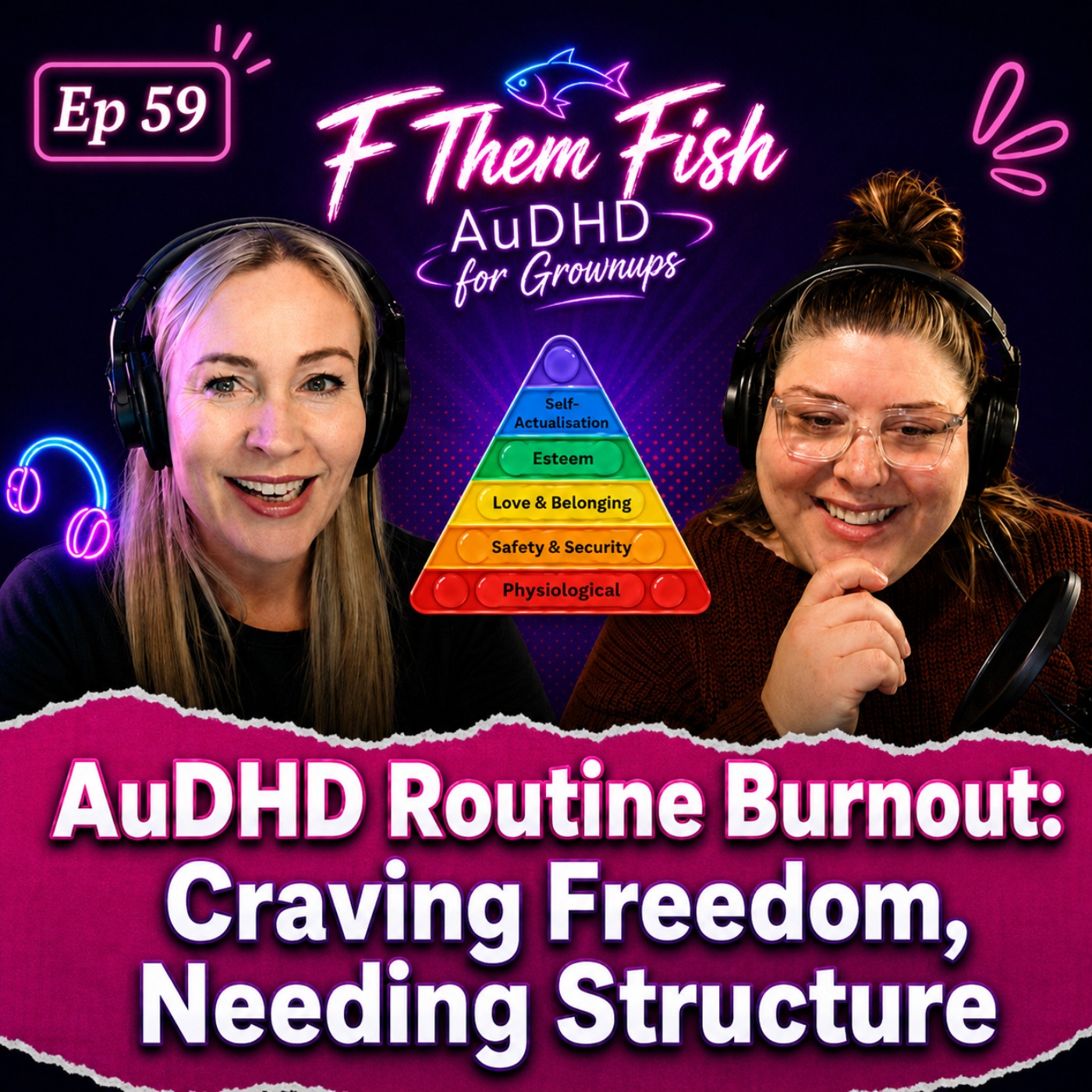 AuDHD Routine Burnout: Craving Freedom, Needing Structure 28.07.2026 56minWhy can a positive change you planned and genuinely wanted leave you dysregulated, exhausted, and desperate to get back to normal?In this episode of AuDHD for Grownups: F Them Fish, your neurodivergent besties Callie Elward-Barrett and Jayne Gurton unpack why late-diagnosed adults crave novelty and freedom but desperately rely on structure, systems, and predictable anchor points to prevent neurodivergent burnout.After a side quest involving a kangaroo collision, a battered Mazda, and a fancy stay at the Sofitel Melbourne, Callie and Jayne respond to a listener question from an AuDHDer whose daily structure was disrupted by several weeks of house guests.They explore why being highly organised is less about productivity and more about protecting nervous-system capacity, memory, energy, and sensory regulation. Hear how to navigate ADHD and autism routine disruption, set clear boundaries, and create low-effort anchor points without trying to rebuild everything while you are already overwhelmed.This podcast was created on the traditional lands of the Ngunnawal, Wadawurrung, and Dja Dja Wurrung Peoples. We pay our respects to Elders past, present, and emerging. In This Episode:Why positive change can still trigger intense autistic and ADHD overwhelmHow routines act as essential scaffolding for memory and sensory regulationWhy capable-looking AuDHD adults may be hanging on by a threadOvercoming the shame of wanting visitors, holidays, or disruptions to endThe physical cost of masking and the need for safe places to resetHow to design flexible, temporary routines around your current energy levelsUsing clear communication and shared plans with family or house guestsLow-effort, stabilizing habits rather than trying to fix everything at onceWhy checking your basic physiological needs (food, water, rest, movement) must come firstAllowing yourself intentional, guilt-free recovery time when normal life finally returns Timestamps 00:00 – Neurodivergent travel stories with an unexpected American sidequest06:17 – Two weeks off routine and the immediate impact of losing daily structure09:52 – The kangaroo collision and arriving at a luxury hotel with half a car23:15 – Listener Q&A: Why do planned, positive changes slowly trigger autistic overwhelm?30:43 – When being highly organized is actually vital nervous-system support34:00 – Late-diagnosed AuDHD masking: Dropping unrealistic, unsustainable standards to prevent burnout36:36 – Brain scaffolding, using routines as systems for memory, energy, and sensory regulation38:37 – How to build temporary, low-demand routines when your capacity drops42:55 – Boundary setting: Protecting your peace and creating shared expectations with house guests45:34 – Micro-anchors - stabilizing, low-effort anchor points to reduce daily overwhelm48:02 – The nervous system pyramid: checking basic physical needs first49:33 – Giving yourself permission to rest when life finally returns to normal51:54 – The ultimate paradox: How AuDHD adults navigate the constant tug-of-war between needing novelty and needing structure Connect With UsWatch & Follow: Find us on YouTube, Instagram, and TikTok at @FThemFishGet In Touch: Send your stories, listener questions, ADHD tax confessions, guest ideas, and feedback to [email protected] for Grownups: F Them Fish is an honest, funny podcast about ADHD, Autism, work, relationships, sensory overload, burnout, identity, late diagnosis, rest, overthinking, and the stuff nobody explains after diagnosis. Follow or subscribe on your favourite player so you never miss an episode, and please leave us a five-star review if the pod makes you feel understood, entertained, or slightly less alone.This episode shares lived experiences and practical ideas for educational and entertainment purposes. It is not medical, clinical, or psychological advice.Email: [email protected] and Instagram at AuDHD for Grownups: F Them FishCallie's Website: https://executivefunctioning.com.au/LinkedIn: Callie: www.linkedin.com/in/callie-elward-barrett-263068142 Hosted on Acast. See acast.com/privacy for more information.
 -
 Neuroinclusive Leadership, an AuDHD Deep Dive 14.07.2026 29minWhat does neuroinclusive leadership actually look like, and can empathy, active listening, adaptability, and emotional intelligence be learned?In this solo deep dive, Jayne translates the findings from her Master of Leadership research into practical, plain-English lessons for leaders, workplaces, and neurodivergent employees.Hello, hello, and welcome to AuDHD for Grownups: F Them Fish with your neurodivergent besties, Callie Elward-Barrett and Jayne Gurton. We talk about neurodivergence in real adult life: work, relationships, burnout, sensory needs, identity, and all the messy bits in between. With Callie taking a well-earned break, Jayne hijacks the pod in full corporate boss-baddie mode to unpack her thesis, Empowering Neuroinclusivity: Exploring the Role of Leadership in Cultivating Neuroinclusive Workplace Culture. She explores why leadership is central, not incidental, to neuroinclusive workplaces, why empathy is a skill, and why inclusion requires much more than a quiet room or a one-off training day. (And yes, she would now like to be addressed as Master Jayne). In this episode, we talk about:The shift from treating neurodivergence as a deficit to recognizing cognitive diversity as an organizational strengthThe learnable skills behind neuroinclusive leadership, including empathy, active listening, emotional intelligence, and adaptabilityWhy intersectionality matters, and why support cannot focus on one part of a person in isolationHow language, communication, and growth mindset shape identity, safety, and belonging at workPhysical, social, and organisational environments, and why accommodations are only one piece of the puzzleMicroaggressions, allyship, accessible recruitment, and the risk of quietly filtering neurodivergent people outWhat is still missing from the research, including a clear leadership framework built around neuroinclusive practiceTimestamps 00:35 - Jayne hijacks the pod03:12 - The thesis and research questions06:35 - From medical deficit to organizational strength10:55 - Intersectionality: it is never just one thing15:19 - Language, identity, and empowerment20:32 - Physical, social, and organizational environments25:34 - What the research still does not tell us30:13 - The big takeaway: neuroinclusive leadership skills can be learned Disclaimer: This episode shares research interpretation and lived experience. It is not medical, therapeutic, or legal advice.Connect with us:Find us on YouTube, Instagram, and TikTok at AuDHD for Grownups: F Them Fish. Send us your questions, workplace stories, examples of leadership that made a real difference, or your latest ADHD taxes!Email us at: mailto:[email protected]:Neuroinclusive leadership | AuDHD at work | neurodiversity in the workplace | ADHD leadership | autistic employees | workplace inclusion | psychological safety | reasonable adjustments | inclusive leadershipEmail: [email protected] and Instagram at AuDHD for Grownups: F Them FishCallie's Website: https://executivefunctioning.com.au/LinkedIn: Callie: www.linkedin.com/in/callie-elward-barrett-263068142 Hosted on Acast. See acast.com/privacy for more information.
 -
 AuDHD & Rest: Giving Permission to Pause and Reset 07.07.2026 5minIn this short podcast update, Callie explains why we are taking a week off, asks for listener feedback, and gives ADHD and AuDHD grownups permission to rest, be present, and do a little bit less.This podcast was created on the lands of the Ngunnawal, Wadawurrung, and Dja Dja Wurrung Peoples.Hello, hello, and welcome to AuDHD for Grownups: F Them Fish with your neurodivergent besties, Callie Elward-Barrett and Jayne Gurton. Where we talk about neurodivergence in real adult life: work, relationships, burnout, overwhelm, identity, and all the weird little things that make you think, ‘surely it’s not just me’. We’re honest, occasionally sweary, and very much not interested in pretending to be polished.This is not quite a full episode, besties. It is a short update from Callie, because we are taking a week off and, in true ADHD fashion, forgot to tell you.It is school holidays in Australia, the house is full of kids, Tech Guy is also taking some time off, and Callie is trying to be properly present with family. Because honestly, what is the point of working for yourself if you never let yourself use that flexibility?This update is also about rest, guilt, and the pressure to keep producing, even when your actual life needs you. Callie gives you official permission to do less, pause without earning it through total burnout, and stop being everything to everyone all the time.We also want your feedback. What do you want more of? What do you like? What is missing? What questions, ADHD tax stories, mortifying moments, overthinking spirals, or guest suggestions do you want to send us?Timestamps00:00 We are taking a week off00:55 School holidays, family time, and being present01:28 We want your feedback02:10 Send us your questions, stories, ADHD tax, and overthinking spirals03:10 Follow, subscribe, and help the algorithm03:49 Permission to do less04:41 You do not have to be everything to everyone05:01 Upcoming guests and what is coming next05:24 See you next week, bestiesThis short update includes Callie’s lived and professional perspective on rest, work, family, and doing less. It is not medical, psychological, or workplace advice.ConnectFind us on YouTube, Instagram, and TikTok at F Them Fish AuDHD for GrownupsSend your stories, questions, ADHD tax, guest ideas, and feedback to mailto:[email protected] for Grownups: F Them Fish is an honest, funny podcast about ADHD, Autism, work, relationships, sensory overload, burnout, identity, late diagnosis, rest, overthinking, and the stuff nobody explains after diagnosis.Follow or subscribe so you do not miss an episode and leave us a five-star review if the pod makes you feel understood, entertained, or slightly less alone.Email: [email protected] and Instagram at AuDHD for Grownups: F Them FishCallie's Website: https://executivefunctioning.com.au/LinkedIn: Callie: www.linkedin.com/in/callie-elward-barrett-263068142 Hosted on Acast. See acast.com/privacy for more information.
 -
 AuDHD Noise Sensitivity and Sensory Overload 30.06.2026 32minWhy can everyday noise feel impossible to ignore when you have AuDHD? In this episode of AuDHD for Grownups, your neurodivergent besties Callie and Jayne talk about noise sensitivity, unexpected change, justice sensitivity, and what happens when something affecting your nervous system sits firmly outside your control.This podcast was created on the lands of the Ngunnawal, Wadawurrung, and Dja Dja Wurrung Peoples.Hello, hello, and welcome to F Them Fish: AuDHD for Grownups with your neurodivergent besties, Callie Elward-Barrett and Jayne Gurton. Where we talk about neurodivergence in real adult life: work, relationships, burnout, overwhelm, identity, and all the weird little things that make you think, ‘surely it’s not just me’. We’re honest, occasionally sweary, and very much not interested in pretending to be polished.Grab a beverage, or body double some life admin with us in your ears, and let’s get started.Jayne has new neighbours. They seem lovely, but they have also brought children, dogs, visitors, music, and considerably more noise into what was previously a very quiet neighbourhood. In this episode, Jayne asks Callie for some coaching advice about what to do when the sound around your home suddenly changes and your nervous system is having very big feelings about it. They talk about AuDHD noise sensitivity, sensory overload, and why home is an important place for recovery and regulation.Callie introduces the circles of control, influence, and concern as a way of thinking through situations that cannot immediately be changed. They discuss whether reframing your thoughts is genuinely helpful, or whether it can feel suspiciously like gaslighting yourself into pretending something is fine.Naturally, the conversation then wanders into fairness, ethical consumer choices, and the personal hills neurodivergent people are prepared to die on. This leads to a few unexpected realisations about justice sensitivity and why some things can feel not just annoying, but fundamentally wrong.In this episode:· AuDHD and noise sensitivity· Why some sounds are so difficult to ignore· Sensory overload at home· Why home is an important neurodivergent safe space· Coping when you cannot remove yourself from the noise· Balancing your sensory needs with other people’s needs· The circles of control, influence, and concern· Reframing negative thoughts without dismissing your feelings· The difference between reframing and toxic positivity· Feeling hyper-aware of your impact on other people· Fairness, reciprocity, and resentment· Neurodivergent justice sensitivity· Ethical consumer choices and the hills we choose to die on· How relationships and familiarity can help build empathyTimestamps00:00 Catching up with our besties01:54 Jayne's new neighbours06:51 Noise, boundaries, and competing needs08:47 Sensory sensitivity and accepting what you cannot change11:40 Circles of control, influence, and concern13:22 Reframing16:42 Fairness, reciprocity, and being hyper-aware21:19 Ethical choices, personal values, and the things that stick24:25 Consumer power and voting with your money25:46 Justice sensitivity and the hills we will die on29:51 Queer Quail, Pride Month, and the NeuroQueer EngineersThis conversation is based on Callie and Jayne’s lived and professional experience with AHD and Autism. It is not medical or psychological advice, and neurodivergent people may experience noise, sensory processing, emotional regulation, and justice sensitivity differently.ConnectFind us on YouTube, Instagram, and TikTokSend your stories and questions to [email protected] for grownups: honest, funny conversations about work, relationships, sensory overload, identity, and the stuff nobody explains after diagnosis.Follow or subscribe so you do not miss an episode, and leave us a five-star review if the pod makes you feel understood, entertained, or slightly less alone.Email: [email protected] and Instagram at AuDHD for Grownups: F Them FishCallie's Website: https://executivefunctioning.com.au/LinkedIn: Callie: www.linkedin.com/in/callie-elward-barrett-263068142 Hosted on Acast. See acast.com/privacy for more information.
 -
 ADHD Kids: What Adults Get Wrong 30.06.2026 41minHello, hello, and welcome to F Them Fish: AuDHD for Grownups with your neurodivergent besties, Callie Elward-Barrett and Jayne Gurton. This is the podcast where we talk about neurodivergence in real adult life: work, relationships, burnout, overwhelm, identity, and all the weird little things that make you think, ‘surely it’s not just me.’ We’re honest, occasionally sweary, and very much not interested in pretending to be polished.Grab a beverage, or body double some life admin with us in your ears and let’s get started!In this episode, Callie sits down with Twice-Exceptional PB - 11 year-old host of the popular podcast: 'PB's Productions, My ADHD Kids Podcast', that she started when she was only 8 years old!. PB has a lot of insights to share about what it really means to be a kid with ADHD. She talks with an incredible poise and emotional intelligence that most adults would be proud of. There are multiple moments that will make you stop and think a little deeper about the young people in your life, whether you're a parent, teacher, or favourite Aunty. The episode keeps coming back to adults assuming they know, not asking what kids need, and mistaking ADHD challenges for intentional misbehaviour. In a world full of adults explaining ADHD kids, this episode lets an ADHD kid explain it herself. Share this episode with the ADHD kids you know and ask them if they agree, or what they might say differently. And more importantly, share it with any adults who need to hear it. "Try, be you, be kind, and bloom like that sunflower. Bloom bright... Just try, believe in yourself, because you are amazing." PBTimestamps00:15 – Meet PB, ADHD kid podcaster02:05 – “I have a more advanced brain” PB introduces herself as a kid with ADHD, big thoughts, humour and a grown-up way of seeing things.02:44 – If your ADHD brain had a theme song08:19 – PB describes her brain in three words and explains what it is like when funny thoughts arrive at exactly the wrong moment.09:54 – Why PB started her own ADHD podcast and why kids need to hear from other kids, not only adults talking about them.13:56 – ADHD explained by an actual ADHD kid.15:11 – What adults get wrong about ADHD kids17:30 – “I don’t believe you” and “you did it on purpose” two things she wishes adults would stop saying to ADHD kids.19:00 – What is actually cool about ADHD21:07 – ADHD brain control panel24:02 – The ultimate ADHD gadget27:18 – Rapid-fire ADHD would-you-rathers28:58 – The question adults should ask more often “What do you need?” and why that matters.31:18 – The question PB is sick of adults asking and what adults might miss when they judge attention from the outside.34:47 – What to say to ADHD kids who feel too much - a beautiful answer about being the perfect amount for yourself and blooming in your own way.36:40 – ADHD is not about trying harder37:38 – Bloom bright like a sunflower.38:02 – Where to find PB’s podcastConnectFind us on YouTube, Instagram and TikTok at F Them Fish: AuDHD for GrownupsSend your stories and questions to [email protected] for grownups: honest, funny conversations about work, relationships, sensory overload, identity, and the stuff nobody explains after diagnosis.This podcast was created on the lands of the Ngunnawal, Ngambri, Wadawurrung and Dja Dja Wurrung Peoples. Always was, always will be Aboriginal Land.Email: [email protected] and Instagram at AuDHD for Grownups: F Them FishCallie's Website: https://executivefunctioning.com.au/LinkedIn: Callie: www.linkedin.com/in/callie-elward-barrett-263068142 Hosted on Acast. See acast.com/privacy for more information.
 -
 PDA Explained: I Want to Do It, So Why Can’t I? 23.06.2026 1j 9minWhat is adult PDA (Pathological Demand Avoidance), and what does neurodivergent demand paralysis feel like from the inside? In this episode of F Them Fish: AuDHD for Grownups, your neurodivergent besties Callie and Jayne dive deep into the PDA cycle, burnout, and why everyday tasks can trigger a nervous system shutdown.This podcast was created on the lands of the Ngunnawal, Wadawurrung, and Dja Dja Wurrung Peoples.Hello, hello, and welcome to F Them Fish: AuDHD for Grownups with your neurodivergent besties, Callie Elward-Barrett and Jayne Gurton. Where we talk about neurodivergence in real adult life: work, relationships, burnout, overwhelm, identity, and all the weird little things that make you think, ‘surely it’s not just me’. We’re honest, occasionally sweary, and very much not interested in pretending to be polished.Grab a beverage, or body double some life admin with us in your ears, and let’s get started.PDA gets discussed constantly online, but it is often reduced to ‘not liking being told what to do’. In this episode, Callie and Jayne dig underneath that explanation. They look at what PDA feels like from the inside and what current research can and cannot tell us.Callie walks through a proposed PDA cycle, from detecting a demand through to the nervous system’s appraisal of effort, uncertainty, safety, sensory discomfort, autonomy, and available capacity. They also discuss why avoidance can provide enough immediate relief to reinforce the pattern, even when it creates more distress later. They explore practical ways to reduce friction, including recognising personal triggers, creating safer sensory conditions, increasing clarity and certainty, protecting capacity, and resisting the idea that every struggle can be fixed by applying more pressure.In this episode:PDA burnout and executive dysfunction in adultsHow to manage PDA paralysisAuDHD (Autism and ADHD) and demand avoidanceDifficult school mornings, parenting guilt, and repairing after things go badlyPDA in everyday lifePathological demand avoidance versus pervasive drive for autonomyWhat science currently knows, and does not know, about PDAWhy PDA is more complicated than anxiety, defiance, or simply disliking demandsHow demands may be assessed for effort, uncertainty, sensory discomfort, safety, and loss of controlThe relationship between stress, executive functioning, and PDA paralysisHow avoidance can reinforce future avoidanceIdentifying triggers and creating more supportive sensory and environmental conditionsSimilarities and differences between PDA and ODDTimestamps00:00 A difficult morning, parenting guilt, and trying to repair10:55 Overwhelm and a real-life PDA segue19:11 PDA explained: pathological demand avoidance and pervasive drive for autonomy25:13 What research can, and cannot, currently tell us about PDA31:06 The PDA cycle: demands, appraisal, stress, and reduced executive access40:30 PDA paralysis, chronic illness, limited capacity, and shame44:49 Why avoidance can temporarily help and reinforce the cycle49:14 What might help: triggers, sensory needs, certainty, and supportive conditions57:07 Why PDA changes with context, safety, capacity, and sensory load01:01:19 PDA versus ODD: similarities, differences, and why neither is a choicePDA remains a developing and contested area. This conversation combines available research discussed during recording with Callie and Jayne’s lived and professional experience. It is not medical advice, and people may understand or describe their experiences differently.ConnectFind us on YouTube, Instagram and TikTok at F Them Fish: AuDHD for GrownupsSend your stories and questions to [email protected] for grownups: honest, funny conversations about work, relationships, sensory overload, identity, and the stuff nobody explains after diagnosis.Follow or subscribe so you do not miss an episode, and leave us a five-star review if the pod makes you feel understood, entertained, or slightly less alone.Email: [email protected] and Instagram at AuDHD for Grownups: F Them FishCallie's Website: https://executivefunctioning.com.au/LinkedIn: Callie: www.linkedin.com/in/callie-elward-barrett-263068142 Hosted on Acast. See acast.com/privacy for more information.
 -
 Men's Mental Health In Crisis: When Men Go Quiet 16.06.2026 59minHello, hello, and welcome to F Them Fish: AuDHD for Grownups with your neurodivergent besties, Callie Elward-Barrett and Jayne Gurton. This is the podcast where we talk about neurodivergence in real adult life: work, relationships, burnout, overwhelm, identity, and all the weird little things that make you think, ‘surely it’s not just me.’ We’re honest, occasionally sweary, and very much not interested in pretending to be polished.Grab a beverage, or body double some life admin with us in your ears and let’s get started!Content note: this episode includes discussion of men’s mental health, suicide, mining culture, isolation, alcohol, and the emotional impact of working away from home. Please take care while listening, and use the support links below if anything in this episode brings things up for you.Callie and Jayne are joined by Rhys Heland, a WA mining professional, Callie’s brother-ish, and guest at Pod HQ in The Nook.What starts with Thirsty Merc, email shame, and Callie’s deeply committed front-row concert behaviour becomes a powerful conversation about men’s mental health, mining culture, FIFO-style isolation, and what can happen when men are expected to just keep going.Rhys shares the story of Dragged to the Mines, a Pilbara project that used drag photography to challenge blokey mining culture and open up conversations about masculinity, mental health and suicide. He talks about life in remote mining environments, long swings, tiny dongas, twelve-hour days, fatigue, isolation, welfare checks, alcohol rules, and the reality of trying to stay connected to family and community while working away.The conversation also explores what withdrawal can look like, why going quiet can be a warning sign, and how the smallest conversations can matter. Sometimes the starting point is not a perfect mental health script. Sometimes it is asking about dinner, family, footy, trivia night, or whether someone has spoken to anyone lately.Callie, Jayne and Rhys also talk about the idea of having a code phrase with your people, like “I need seven seconds,” for those moments when explaining everything feels too hard but being alone with it feels worse.This episode is not medical advice. It is three people having a real conversation about men, mental health, neurodivergence, isolation, work, resilience, and the importance of asking the hard questions gently.Timestamps:00:00 – Intro02:00 – Callie REALLY loves Thirsty Merc10:54 – Dragged to the Mines13:28 – Mining, masculinity and mental health15:43 – Isolation16:18 – Being away from family35:30 – Withdrawal35:55 – How men may show distress36:57 – The power of a simple phrase37:34 – Small talk as big talk38:18 – Creating a code43:06 – Neuroplasticity, resilience and mindset51:51 – Asking hard questions gently52:26 – What you can doSupport:Lifeline Australia 24/7 crisis support and suicide preventionCall: 13 11 14Text: 0477 13 11 14https://www.lifeline.org.au/MensLine Australia 24/7 counselling and support for menCall: 1300 78 99 78https://mensline.org.au/Suicide Call Back Service24/7 phone and online counselling for people affected by suicideCall: 1300 659 467https://www.suicidecallbackservice.org.au/Beyond BlueMental health support and men’s mental health resourcesCall: 1300 22 4636https://www.beyondblue.org.au/mental-health/mens-mental-healthMATES in MiningSuicide prevention and mental health support for the mining industryhttps://mining.mates.org.au/13YARN24/7 crisis support for Aboriginal and Torres Strait Islander peopleCall: 13 92 76https://www.13yarn.org.au/Links Dragged to the MinesSkimpies in WAThirsty MercConnectFind us on YouTube, Instagram and TikTok at F Them Fish: AuDHD for GrownupsSend your stories and questions to [email protected] for grownups: honest, funny conversations about work, relationships, sensory overload, identity, and the stuff nobody explains after diagnosis.This podcast was created on the lands of the Ngunnawal, Wadawurrung and Dja Dja Wurrung PeoplesEmail: [email protected] and Instagram at AuDHD for Grownups: F Them FishCallie's Website: https://executivefunctioning.com.au/LinkedIn: Callie: www.linkedin.com/in/callie-elward-barrett-263068142 Hosted on Acast. See acast.com/privacy for more information.
 -
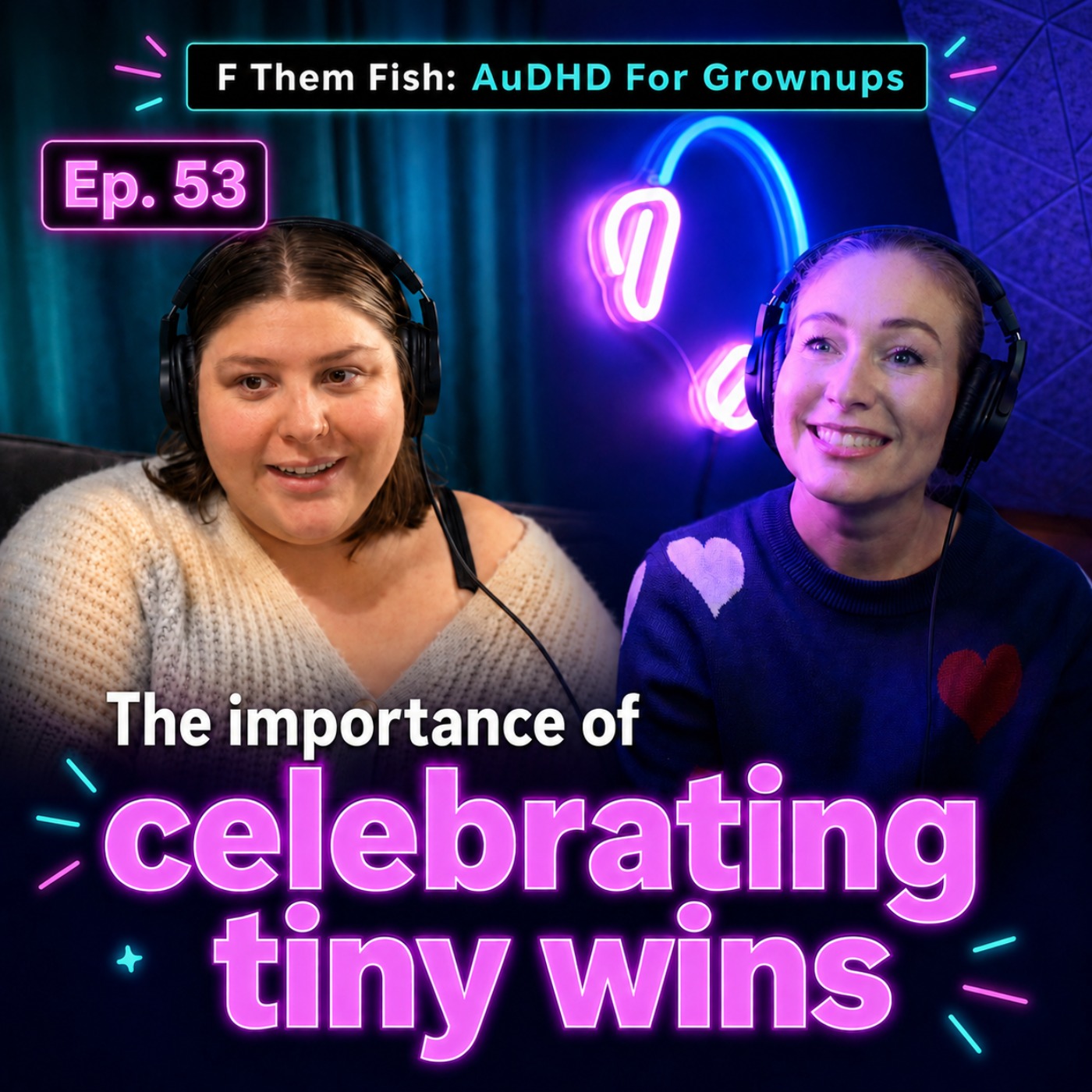 Neurodivergence and The Importance of Celebrating Tiny Wins 02.06.2026 35minHello, hello, and welcome to F Them Fish: AuDHD for Grownups with your neurodivergent besties, Callie Elward-Barrett and Jayne Gurton. This is the podcast where we talk about neurodivergence in real adult life: work, relationships, burnout, overwhelm, identity, and all the weird little things that make you think, ‘surely it’s not just me.’ We’re honest, occasionally sweary, and very much not interested in pretending to be polished.Grab a beverage, or body double some life admin with us in your ears and let’s get started!Our topic for today is all about how celebrating tiny wins can get you further towards your bigger goals. And please! It's important to keep those bigger goals! Not to beat yourself with, or berate yourself for not achieving them immediately, but because without them, life feels so much smaller. Callie is feeling the restriction of having lower expectations and how that feels the opposite of liberating - it feels suffocating. As neurodivergent people, we can smash through the limited expectations others may place upon us and do truly amazing things. We don't HAVE to, we GET to. Underestimate us. We dare you.Timestamps00:07 Intro01:08 Callie's best birthday ever? Maybe?01:54 The 'wants vs needs' family hack because everyone wants something all the time!04:58 Feeling seen rather than perceived09:30 The six-minute birthday dance video14:59 Listeners, we want your input! Should episodes start with a quick topic signpost?15:41 Rubbish fidgets and blue moon rituals17:49 Emotional and sensory hangovers 19:04 Main topic begins: Celebrating tiny wins20:14 What celebrating tiny wins means for neurodivergent people21:42 Everyday wins, momentum and using small successes to get started24:26 Tiny wins, gratitude practice and undoing years of negative feedback27:12 Who decides what counts as a win?28:47 Tiny wins are not small dreams: building toward bigger goals32:20 Fibro, health progress and finding hope in tiny improvements33:53 Homework - watch the Room to Move doco on Netflix and share your tiny wins with us!ConnectFind us on YouTube, Instagram and TikTok at F Them Fish: AuDHD for GrownupsSend your stories and questions to [email protected] for grownups: honest, funny conversations about work, relationships, sensory overload, identity, and the stuff nobody explains after diagnosis.This podcast was created on the lands of the Ngunnawal, Wadawurrung and Dja Dja Wurrung Peoples. Always was, always will be.Email: [email protected] and Instagram at AuDHD for Grownups: F Them FishCallie's Website: https://executivefunctioning.com.au/LinkedIn: Callie: www.linkedin.com/in/callie-elward-barrett-263068142 Hosted on Acast. See acast.com/privacy for more information.
 -
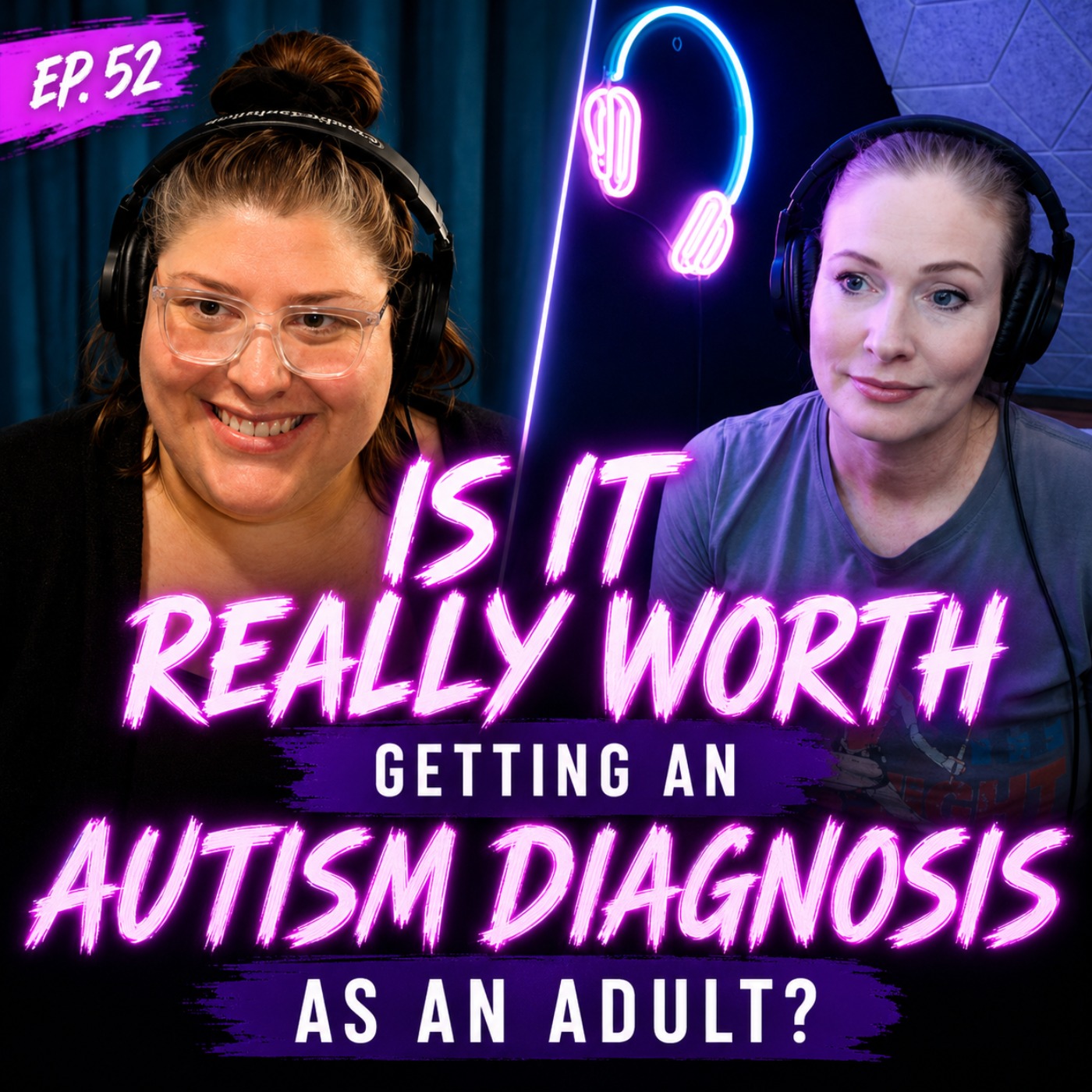 Autism Diagnosis As An Adult: Is It Really Worth It? 26.05.2026 50minHello, hello, and welcome to F Them Fish: AuDHD for Grownups with your neurodivergent besties, Callie Elward-Barrett and Jayne Gurton. This is the podcast where we talk about neurodivergence in real adult life: work, relationships, burnout, overwhelm, identity, and all the weird little things that make you think, ‘surely it’s not just me.’ We’re honest, occasionally sweary, and very much not interested in pretending to be polished.Grab a beverage, or body double some life admin with us in your ears and let’s get started!Callie's brain is unhappy at the fact that she didn't knock off those extra few seconds and make this episode a nice, round 55 minutes! Also... 50 minutes is nowhere near the 30 minutes we keep promising ourselves!In this episode, Callie and Jayne have no technical issues! It's true! That said, Jayne's pod dogs cause a whole other set of issues that lead to Callie singing. Sorry besties, this was a moment we are all going to need to process. We go deep with listener bestie Robbie today, with their question about whether it is really necessary to get an Autism diagnosis as an adult. We're not going to lie, this one feels like a bit of a minefield, but we are committed to having the hard chats and giving you that space you need to talk about these things. Not everyone has a person, or a group of people they can talk with about their neurodivergence or when they feel they are neurodivergent. There are so many reason someone may not have a 'real life' bestie to bounce these things through, so we are honoured when we can be those people for you. We absolutely loved this chat and hopefully, it answers some of your questions about Autism as a grown up.Timestamps00:14 — Welcome, pod dogs, and chaotic bestie energy03:35 — Unexpected moments of connection with strangers can be beautiful05:25 — Teeth brushing and did you know that ADHDers don't form habits?10:15 — Motivation, meds, and mostly practical ADHD systems13:35 — Robbie’s listener email 20:15 — Autism diagnosis and where un/self-diagnosed people fit within the Autism community22:40 — Loneliness29:15 — The weird in-between feeling when you don't have a formal diagnosis31:35 — Imposter feelings and self-doubt34:00 — Is formal diagnosis necessary?39:00 — Practical supports without diagnosis40:55 — When formal diagnosis can matter46:35 — Final thoughts, validation, and listener call-outConnectFind us on YouTube, Instagram and TikTok at F Them Fish: AuDHD for GrownupsSend your stories and questions to [email protected] for grownups: honest, funny conversations about work, relationships, sensory overload, identity, and the stuff nobody explains after diagnosis.This podcast was created on the lands of the Ngunnawal, Wadawurrung and Dja Dja Wurrung PeoplesEmail: [email protected] and Instagram at AuDHD for Grownups: F Them FishCallie's Website: https://executivefunctioning.com.au/LinkedIn: Callie: www.linkedin.com/in/callie-elward-barrett-263068142 Hosted on Acast. See acast.com/privacy for more information.
 -
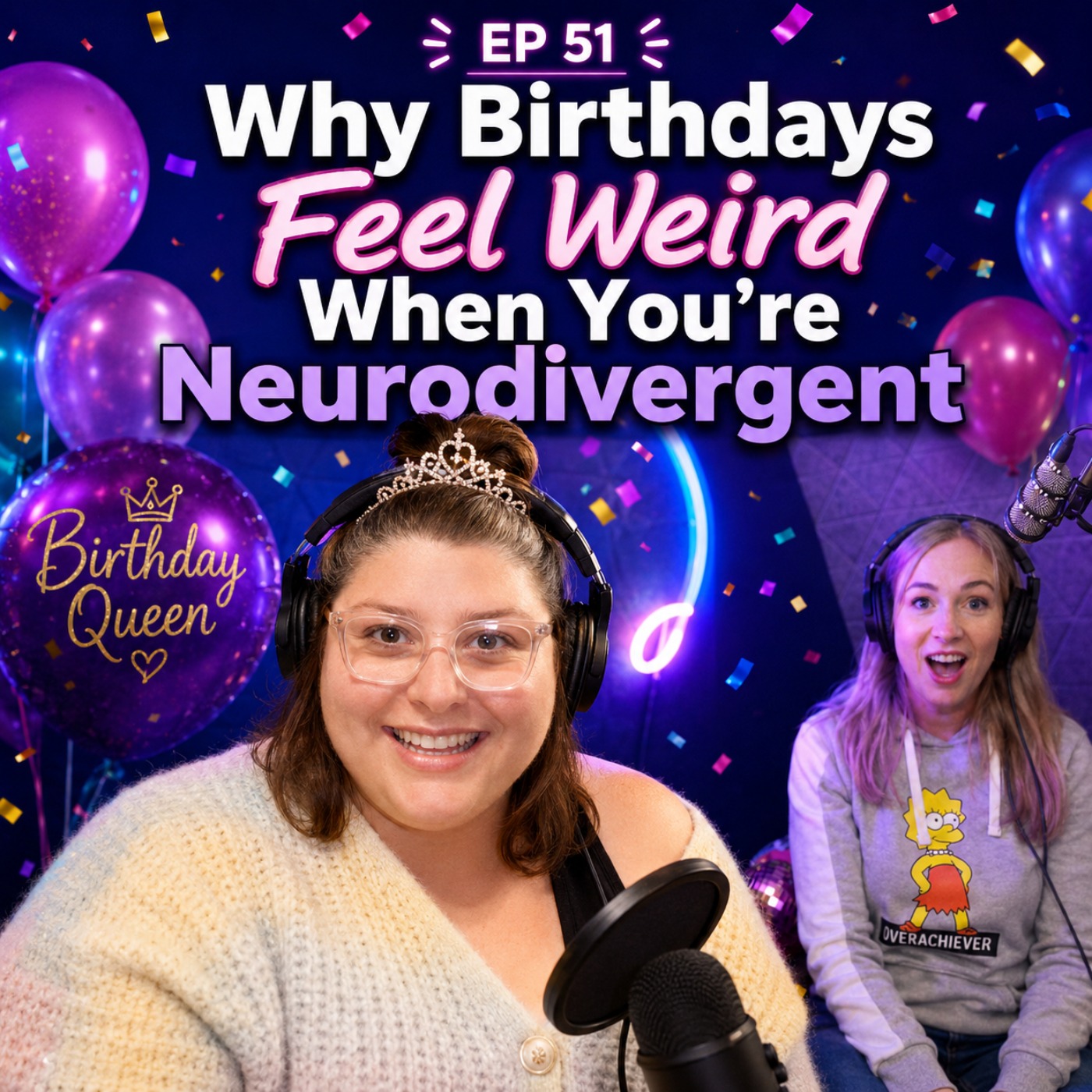 Neurodivergent Birthdays: Why They Feel Weird 19.05.2026 48minHello, hello, and welcome to F Them Fish: AuDHD for Grownups with your neurodivergent besties, Callie Elward-Barrett and Jayne Gurton. This is the podcast where we talk about neurodivergence in real adult life: work, relationships, burnout, overwhelm, identity, and all the weird little things that make you think, ‘surely it’s not just me.’ We’re honest, occasionally sweary, and very much not interested in pretending to be polished.Grab a beverage, or body double some life admin with us in your ears and let’s get started!It’s Jayne’s birthday, which means tiaras, deli-meat picnics, crystals, birthday queen energy… and an honest chat about why birthdays can feel so complicated when you’re neurodivergent.In this episode, Callie and Jayne talk about the weird pressure of being celebrated, the discomfort of being perceived, and the difference between loving other people’s birthdays and wanting to crawl into a hole on your own. They unpack the emotional load of responding 'properly', performing the right level of joy, and feeling exposed.The conversation takes a very F Them Fish sidequest into sleep deprivation, business overload, rage buying, and whether a digital notebook can, in fact, save your life. Spoiler: possibly not, but we remain emotionally attached to the dream. You should definitely send this to whoever makes the Remarkable notepad though because Callie spent way too much money and would love some retrospective sponsorship if you please!Timestamps01:00 — Welcome to Jayne’s birthday episode!04:44 — Being Perceived when you're neurodivergent13:06 — Sleep deprivation, work overload and shame14:41 — Rage buying YOU'RE NOT THE BOSS OF ME!31:12 — Interoception and body signals32:03 — Neurodivergent kids and toilet training - it's hard and there is support33:58 — Sensory regulation, music and respecting other people’s joy36:03 — Late diagnosis - unlearning alll that stuff37:00 — Listener question: office gossip40:00 — Listener question: no-one takes me seriously47:00 — Wrap-up, listener love and birthday dinnerConnectFind us on YouTube, Instagram and TikTok at F Them Fish: AuDHD for GrownupsSend your stories and questions to [email protected] for grownups: honest, funny conversations about work, relationships, sensory overload, identity, and the stuff nobody explains after diagnosis.This podcast was created on the lands of the Ngunnawal, Wadawurrung and Dja Dja Wurrung Peoples.Email: [email protected] and Instagram at AuDHD for Grownups: F Them FishCallie's Website: https://executivefunctioning.com.au/LinkedIn: Callie: www.linkedin.com/in/callie-elward-barrett-263068142 Hosted on Acast. See acast.com/privacy for more information.
 -
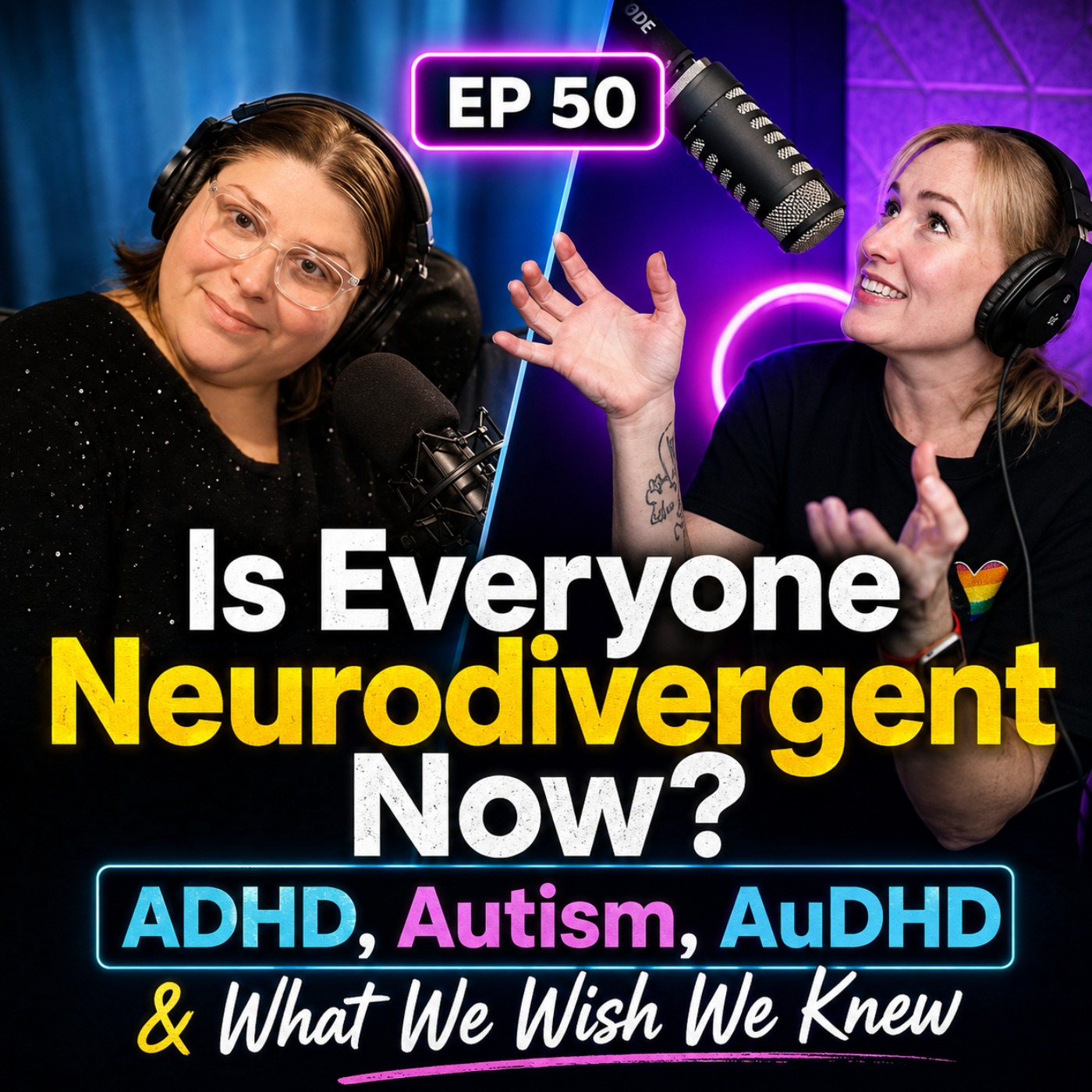 Is Everyone Neurodivergent Now? 12.05.2026 58minAuDHD for grownups: honest, funny, neurodivergent conversations about work, relationships, sensory overload, identity, and the stuff nobody explains after diagnosis.This podcast was created on the lands of the Ngunnawal, Wadawurrung and Dja Dja Wurrung Peoples.Hello, hello, and welcome to F Them Fish: AuDHD for Grownups with your neurodivergent besties, Callie Elward-Barrett and Jayne Gurton. This is the podcast where we talk about neurodivergence in real adult life: work, relationships, burnout, overwhelm, identity, and all the weird little things that make you think, ‘surely it’s not just me.’ We’re honest, occasionally sweary, and very much not interested in pretending to be polished.Grab a beverage, or body double some life admin with us in your ears and let’s get started!It's our 50th Episode! We started with a bit of a rant about Mother's Day, then decided to tackle this pervasive idea that there is an 'overdiagnosis crisis' - spoiler alert, we have opinions!We decided after all of that to run through our '50 Things That...' lists in honour of our milestone. We think you'll find something that not only hits you in the feel bone, validates things you always suspected, and gives you some interesting dinner table chats, but our 50 accommodations list might just change your life. What did we miss? Tell us!ConnectFind us on YouTube, Instagram and TikTok at F Them Fish: AuDHD for GrownupsSend your stories and questions to [email protected] for grownups: honest, funny conversations about work, relationships, sensory overload, identity, and the stuff nobody explains after diagnosis.Timestamps00:00 - Intro and Mother's Day Rant - Cancel it!06:49 - Sidequest: That's not alcohol free!09:14 - Everyone is getting diagnosed nowadays11:58 - Understanding Neurodivergence across Generations14:45 - Generational Neurodivergence in the Workforce17:41 - The Spectrum of Neurodivergence21:02 - 50 signs it was probably AuDHD all along28:45 - Don't iron clothes on your body!30:18 - 50 Things We Wish We'd Known Earlier38:09 - 50 Tiny Accommodations That Changed Our Lives46:31 - Contact us if you want to know more about accommodations47:41 - 'Sorry' is the armour we wear to protect ourselves48:52 - 50 Things We No Longer Apologize For56:17 - Reflecting and outroEmail: [email protected] and Instagram at AuDHD for Grownups: F Them FishCallie's Website: https://executivefunctioning.com.au/LinkedIn: Callie: www.linkedin.com/in/callie-elward-barrett-263068142 Hosted on Acast. See acast.com/privacy for more information.
Podcast serupa


Popular di
Podcast ini turut muncul dalam senarai podcast negara-negara ini.
