
Today's Catholic Mass Readings
USCCB
0
This podcast delivers the daily Catholic Mass readings from the United States Conference of Catholic Bishops (USCCB). It simplifies access by providing only the current day's reading, avoiding the need to scroll through a month of episodes. Each episode includes the full text of the readings and a bonus biography of the Saint of the Day from Catholic News Agency. The feed is designed for convenience and reduced bandwidth use.
Episod
-
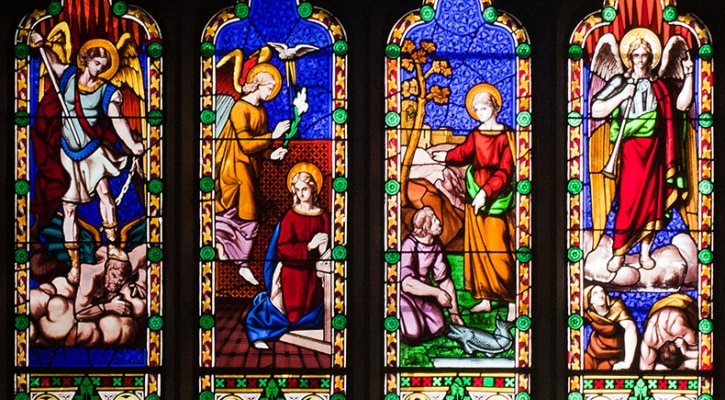 Today's Catholic Mass Readings Tuesday, September 29, 2026 29.09.2026Full Text of Readings Feast of Saints Michael, Gabriel, and Raphael, Archangels Lectionary: 647 The Saint of the day is Saints Michael, Gabriel, and Raphael Saints Michael, Gabriel, and Raphael’s Story Angels—messengers from God—appear frequently in Scripture, but only Michael, Gabriel and Raphael are named. Michael appears in Daniel’s vision as “the great prince” who defends Israel against its enemies; in the Book of Revelation, he leads God’s armies to final victory over the forces of evil. Devotion to Michael is the oldest angelic devotion, rising in the East in the fourth century. The Church in the West began to observe a feast honoring Michael and the angels in the fifth century. Gabriel also makes an appearance in Daniel’s visions, announcing Michael’s role in God’s plan. His best-known appearance is an encounter with a young Jewish girl named Mary, who consents to bear the Messiah. Raphael’s activity is confined to the Old Testament story of Tobit. There he appears to guide Tobit’s son Tobiah through a series of fantastic adventures which lead to a threefold happy ending: Tobiah’s marriage to Sarah, the healing of Tobit’s blindness, and the restoration of the family fortune. The memorials of Gabriel and Raphael were added to the Roman calendar in 1921. The 1970 revision of the calendar joined their individual feasts to Michael’s. Reflection Each of the archangels performs a different mission in Scripture: Michael protects; Gabriel announces; Raphael guides. Earlier belief that inexplicable events were due to the actions of spiritual beings has given way to a scientific world-view and a different sense of cause and effect. Yet believers still experience God’s protection, communication, and guidance in ways which defy description. We cannot dismiss angels too lightly.Saint of the Day, Copyright Franciscan Media
 -
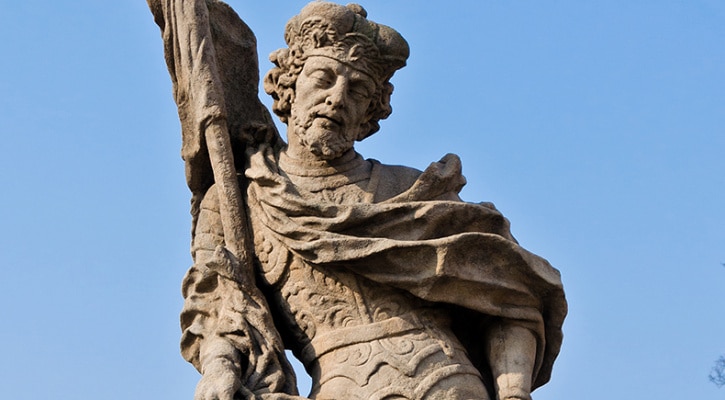 Today's Catholic Mass Readings Monday, September 28, 2026 28.09.2026Full Text of Readings Monday of the Twenty-sixth Week in Ordinary Time Lectionary: 455 The Saint of the day is Saint Wenceslaus Saint Wenceslaus’ Story If saints have been falsely characterized as “other worldly,” the life of Wenceslaus stands as an example to the contrary: He stood for Christian values in the midst of the political intrigues which characterized 10th-century Bohemia. Saint Wenceslaus was born in 907 near Prague, son of the Duke of Bohemia. His saintly grandmother, Ludmilla, raised him and sought to promote him as ruler of Bohemia in place of his mother, who favored the anti-Christian factions. Ludmilla was eventually murdered, but rival Christian forces enabled Wenceslaus to assume leadership of the government. His rule was marked by efforts toward unification within Bohemia, support of the Church, and peace-making negotiations with Germany, a policy which caused him trouble with the anti-Christian opposition. His brother Boleslav joined in the plotting, and in September of 929 invited Wenceslaus to Alt Bunglou for the celebration of the feast of Saints Cosmas and Damian. On the way to Mass, Boleslav attacked his brother, and in the struggle, Wenceslaus was killed by supporters of Boleslav. Although Saint Wenceslaus’ death resulted primarily from political upheaval, Wenceslaus was hailed as a martyr for the faith, and his tomb became a pilgrimage shrine. He is hailed as the patron of the Bohemian people and of the former Czechoslovakia. Reflection “Good King Wenceslaus” was able to incarnate his Christianity in a world filled with political unrest. While we are often victims of violence of a different sort, we can easily identify with his struggle to bring harmony to society. The call to become involved in social change and in political activity is addressed to Christians; the values of the gospel are sorely needed today.Saint of the Day, Copyright Franciscan Media
 -
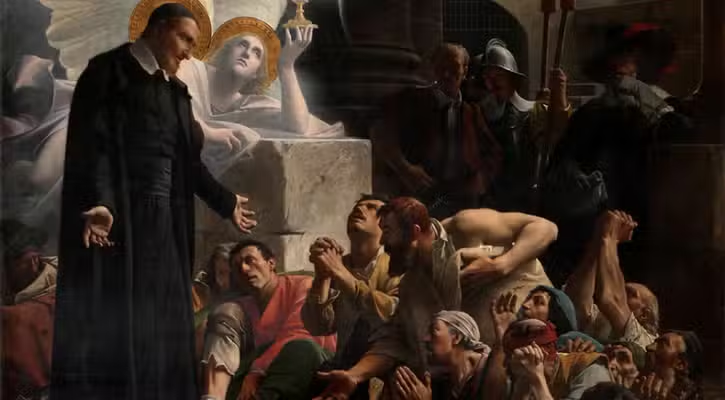 Today's Catholic Mass Readings Sunday, September 27, 2026 27.09.2026Full Text of Readings The Saint of the day is Saint Vincent de Paul Saint Vincent de Paul’s Story The deathbed confession of a dying servant opened Saint Vincent de Paul’s eyes to the crying spiritual needs of the peasantry of France. This seems to have been a crucial moment in the life of the man from a small farm in Gascony, France, who had become a priest with little more ambition than to have a comfortable life. The Countess de Gondi—whose servant he had helped—persuaded her husband to endow and support a group of able and zealous missionaries who would work among poor tenant farmers and country people in general. Vincent was too humble to accept leadership at first, but after working for some time in Paris among imprisoned galley slaves, he returned to be the leader of what is now known as the Congregation of the Mission, or the Vincentians. These priests, with vows of poverty, chastity, obedience, and stability, were to devote themselves entirely to the people in smaller towns and villages. Later, Saint Vincent de Paul established confraternities of charity for the spiritual and physical relief of the poor and sick of each parish. From these, with the help of Saint Louise de Marillac, came the Daughters of Charity, “whose convent is the sickroom, whose chapel is the parish church, whose cloister is the streets of the city.” He organized the rich women of Paris to collect funds for his missionary projects, founded several hospitals, collected relief funds for the victims of war, and ransomed over 1,200 galley slaves from North Africa. He was zealous in conducting retreats for clergy at a time when there was great laxity, abuse, and ignorance among them. He was a pioneer in clerical training and was instrumental in establishing seminaries. Most remarkably, Saint Vincent de Paul was by temperament a very irascible person—even his friends admitted it. He said that except for the grace of God he would have been “hard and repulsive, rough and cross.” But he became a tender and affectionate man, very sensitive to the needs of others. Pope Leo XIII made him the patron of all charitable societies. Outstanding among these, of course, is the Society of St. Vincent de Paul, founded in 1833 by his admirer Blessed Frédéric Ozanam. Reflection The Church is for all God’s children, rich and poor, peasants and scholars, the sophisticated and the simple. But obviously the greatest concern of the Church must be for those who need the most help—those made helpless by sickness, poverty, ignorance, or cruelty. Vincent de Paul is a particularly appropriate patron for all Christians today, when hunger has become starvation, and the high living of the rich stands in more and more glaring contrast to the physical and moral degradation in which many of God’s children are forced to live.Saint of the Day, Copyright Franciscan Media
 -
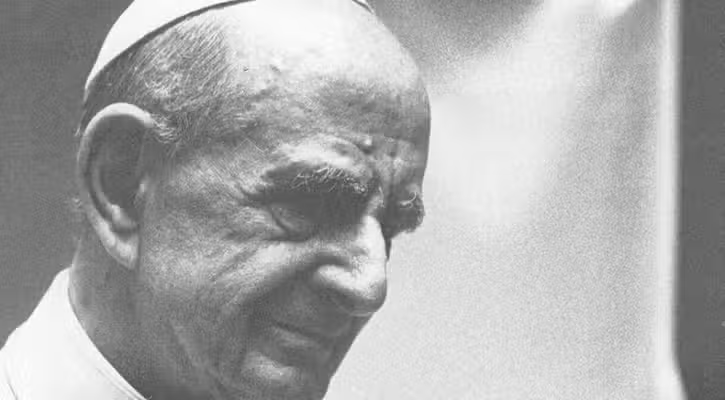 Today's Catholic Mass Readings Saturday, September 26, 2026 26.09.2026Full Text of Readings Saturday of the Twenty-Fifth Week in Ordinary Time Lectionary: 454 The Saint of the day is Saint Paul VI Saint Paul VI’s Story Born near Brescia in northern Italy, Giovanni Battista Montini was the second of three sons. His father, Giorgio, was a lawyer, editor, and eventually a member of the Italian Chamber of Deputies. His mother, Giuditta, was very involved in Catholic Action. After ordination in 1920, Giovanni did graduate studies in literature, philosophy, and canon law in Rome before he joined the Vatican Secretariat of State in 1924, where he worked for 30 years. He was also chaplain to the Federation of Italian Catholic University Students, where he met and became a very good friend of Aldo Moro, who eventually became prime minister. Moro was kidnapped by the Red Brigade in March 1978, and murdered two months later. A devastated Pope Paul VI presided at his funeral. In 1954, Fr. Montini was named archbishop of Milan, where he sought to win disaffected workers back to the Catholic Church. He called himself the “archbishop of the workers” and visited factories regularly while overseeing the rebuilding of a local Church tremendously disrupted by World War II. In 1958, Montini was the first of 23 cardinals named by Pope John XXIII, two months after the latter’s election as pope. Cardinal Montini helped in preparing Vatican II and participated enthusiastically in its first sessions. When he was elected pope in June 1963, he immediately decided to continue that Council, which had another three sessions before its conclusion on December 8, 1965. The day before Vatican II concluded, Paul VI and Patriarch Athenagoras revoked the excommunications that their predecessors had made in 1054. The pope worked very hard to ensure that bishops would approve the Council’s 16 documents by overwhelming majorities. Saint Paul VI had stunned the world by visiting the Holy Land in January 1964, and meeting Athenagoras, the Ecumenical Patriarch of Constantinople in person. The pope made eight more international trips, including one in 1965, to visit New York City and speak on behalf of peace before the United Nations General Assembly. He also visited India (1964), Colombia (1968), Uganda (1969), and seven Asian countries during a 10-day tour in 1970. Also in 1965, he instituted the World Synod of Bishops, and the next year decreed that bishops must offer their resignations on reaching age 75. In 1970, he decided that cardinals over 80 would no longer vote in papal conclaves or head the Holy See’s major offices. He had increased the number of cardinals significantly, giving many countries their first cardinal. Eventually establishing diplomatic relations between the Holy See and 40 countries, he also instituted a permanent observer mission at the United Nations in 1964. Paul VI wrote seven encyclicals; his last one in 1968 on human life—Humanae Vitae—prohibited artificial birth control. Saint Paul VI died at Castel Gandolfo on August 6, 1978, and was buried in St. Peter’s Basilica. He was beatified on October 19, 2014, and canonized on October 14, 2018. Since 2019 his liturgical feast has been celebrated on May 29. Reflection Saint Paul VI’s greatest accomplishment was the completion and implementation of Vatican II. It was a monumental task that he completed with grace and integrity. Its decisions about liturgy were the first ones noticed by most Catholics, but its other documents—especially the ones about ecumenism, interfaith relations, divine revelation, religious liberty, the Church’s self-understanding and the Church’s work with the entire human family—have become the Catholic Church’s road map since 1965.Saint of the Day, Copyright Franciscan Media
 -
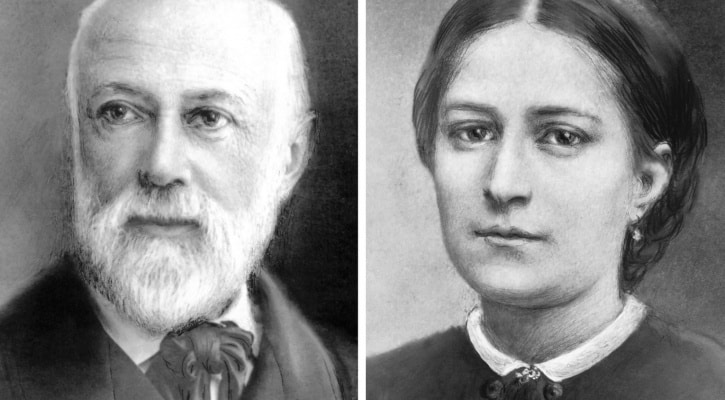 Today's Catholic Mass Readings Friday, September 25, 2026 25.09.2026Full Text of Readings Friday of the Twenty-fifth Week in Ordinary Time Lectionary: 453 The Saint of the day is Saints Louis Martin and Zélie Guérin Saints Louis Martin and Zélie Guérin’s Story Born into a military family in Bordeaux, Louis trained to become a watchmaker. His desire to join a religious community went unfulfilled because he didn’t know Latin. Moving to Normandy, he met the highly-skilled lace maker, Zélie Guérin, who also had been disappointed in her attempts to enter religious life. They married in 1858, and over the years were blessed with nine children, though two sons and two daughters died in infancy. Louis managed the lace-making business that Zélie continued at home while raising their children. She died from breast cancer in 1877. Louis then moved the family to Lisieux to be near his brother and sister-in-law, who helped with the education of his five surviving girls. His health began to fail after his 15-year-old daughter entered the Monastery of Mount Carmel at Lisieux in 1888. Louis died in 1894, a few months after being committed to a sanitarium. The home that Louis and Zélie created nurtured the sanctity of all their children, but especially their youngest, who is known to us as Saint Thérèse of the Child Jesus. Louis and Zélie were beatified in 2008, and canonized by Pope Francis on October 18, 2015. The liturgical feast of Saints Louis Martin and Zélie Guérin is celebrated on July 12. Reflection In life, Louis and Zélie knew great joy and excruciating sorrow. They firmly believed that God was with them throughout every challenge that married life, parenting, and their occupations presented.Saint of the Day, Copyright Franciscan Media
 -
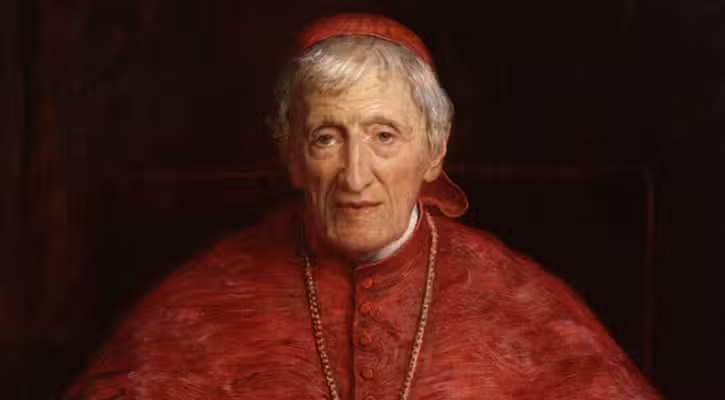 Today's Catholic Mass Readings Thursday, September 24, 2026 24.09.2026Full Text of Readings Thursday of the Twenty-fifth Week in Ordinary Time Lectionary: 452 The Saint of the day is Saint John Henry Newman Saint John Henry Newman’s Story Saint John Henry Newman, the 19th-century’s most important English-speaking Catholic theologian, spent the first half of his life as an Anglican and the second half as a Roman Catholic. He was a priest, popular preacher, writer, and eminent theologian in both churches. Born in London, England, he studied at Oxford’s Trinity College, was a tutor at Oriel College, and for 17 years was vicar of the university church, St. Mary the Virgin. He eventually published eight volumes of Parochial and Plain Sermons as well as two novels. His poem, “Dream of Gerontius,” was set to music by Sir Edward Elgar. After 1833, Newman was a prominent member of the Oxford Movement, which emphasized the Church’s debt to the Church Fathers and challenged any tendency to consider truth as completely subjective. Historical research made Newman suspect that the Roman Catholic Church was in closest continuity with the Church that Jesus established. In 1845, he was received into full communion as a Catholic. Two years later he was ordained a Catholic priest in Rome and joined the Congregation of the Oratory, founded three centuries earlier by Saint Philip Neri. Returning to England, Newman founded Oratory houses in Birmingham and London and for seven years served as rector of the Catholic University of Ireland. Before Saint John Henry Newman’s Story, Catholic theology tended to ignore history, preferring instead to draw deductions from first principles—much as plane geometry does. After Newman, the lived experience of believers was recognized as a key part of theological reflection. Newman eventually wrote 40 books and 21,000 letters that survive. Most famous are his book-length Essay on the Development of Christian Doctrine, On Consulting the Faithful in Matters of Doctrine, Apologia Pro Vita Sua—his spiritual autobiography up to 1864—and Essay on the Grammar of Assent. He accepted Vatican I’s teaching on papal infallibility while noting its limits, which many people who favored that definition were reluctant to do. When Saint John Henry Newman’s Story was named a cardinal in 1879, he took as his motto “Cor ad cor loquitur”—“Heart speaks to heart.” He was buried in Rednal 11 years later. After his grave was exhumed in 2008, a new tomb was prepared at the Oratory church in Birmingham. Three years after Newman died, a Newman Club for Catholic students began at the University of Pennsylvania in Philadelphia. In time, his name was linked to ministry centers at many public and private colleges and universities in the United States. In 2010, Pope Benedict XVI beatified Newman in London. Benedict noted Newman’s emphasis on the vital place of revealed religion in civilized society, but also praised his pastoral zeal for the sick, the poor, the bereaved, and those in prison. Pope Francis canonized Newman in October 2019. Saint John Henry Newman’s liturgical feast is celebrated on October 9. Reflection John Henry Newman has been called the “absent Father of Vatican II” because his writings on conscience, religious liberty, Scripture, the vocation of lay people, the relation of Church and State, and other topics were extremely influential in the shaping of the Council’s documents. Although Newman was not always understood or appreciated, he steadfastly preached the Good News by word and example.Saint of the Day, Copyright Franciscan Media
 -
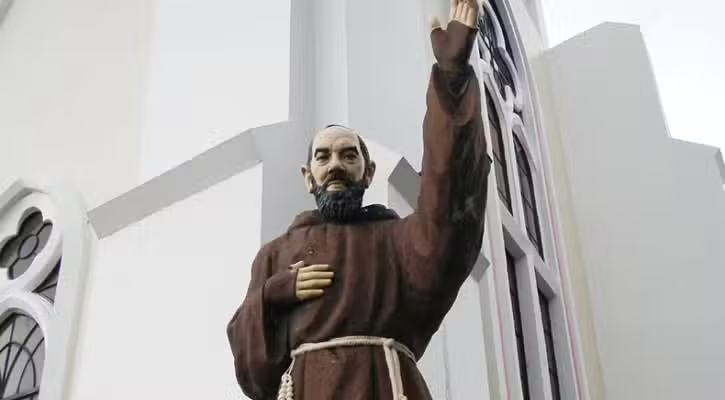 Today's Catholic Mass Readings Wednesday, September 23, 2026 23.09.2026Full Text of Readings The Saint of the day is Saint Pio of Pietrelcina Saint Pio of Pietrelcina’s Story In one of the largest such ceremonies in history, Pope John Paul II canonized Saint Pio of Pietrecina on June 16, 2002. It was the 45th canonization ceremony in Pope John Paul’s pontificate. More than 300,000 people braved blistering heat as they filled St. Peter’s Square and nearby streets. They heard the Holy Father praise the new saint for his prayer and charity. “This is the most concrete synthesis of Padre Pio’s teaching,” said the pope. He also stressed Padre Pio’s witness to the power of suffering. If accepted with love, the Holy Father stressed, such suffering can lead to “a privileged path of sanctity.” Many people have turned to the Italian Capuchin Franciscan to intercede with God on their behalf; among them was the future Pope John Paul II. In 1962, when he was still an archbishop in Poland, he wrote to Padre Pio and asked him to pray for a Polish woman with throat cancer. Within two weeks, she had been cured of her life-threatening disease. Born Francesco Forgione, Saint Pio of Pietrecina grew up in a family of farmers in southern Italy. Twice his father worked in Jamaica, New York, to provide the family income. At the age of 15, Francesco joined the Capuchins and took the name of Pio. He was ordained in 1910 and was drafted during World War I. After he was discovered to have tuberculosis, he was discharged. In 1917, he was assigned to the friary in San Giovanni Rotondo, 75 miles from the city of Bari on the Adriatic. On September 20, 1918, as Saint Pio of Pietrecina was making his thanksgiving after Mass, Padre Pio had a vision of Jesus. When the vision ended, he had the stigmata in his hands, feet, and side. Life became more complicated after that. Medical doctors, Church authorities, and curiosity seekers came to see Padre Pio. In 1924, and again in 1931, the authenticity of the stigmata was questioned; Padre Pio was not permitted to celebrate Mass publicly or to hear confessions. He did not complain of these decisions, which were soon reversed. However, he wrote no letters after 1924. His only other writing, a pamphlet on the agony of Jesus, was done before 1924. Saint Pio of Pietrecina rarely left the friary after he received the stigmata, but busloads of people soon began coming to see him. Each morning after a 5 a.m. Mass in a crowded church, he heard confessions until noon. He took a mid-morning break to bless the sick and all who came to see him. Every afternoon he also heard confessions. In time his confessional ministry would take 10 hours a day; penitents had to take a number so that the situation could be handled. Many of them have said that Padre Pio knew details of their lives that they had never mentioned. Saint Pio of Pietrecina saw Jesus in all the sick and suffering. At his urging, a fine hospital was built on nearby Mount Gargano. The idea arose in 1940; a committee began to collect money. Ground was broken in 1946. Building the hospital was a technical wonder because of the difficulty of getting water there and of hauling up the building supplies. This “House for the Alleviation of Suffering” has 350 beds. A number of people have reported cures they believe were received through the intercession of Padre Pio. Those who assisted at his Masses came away edified; several curiosity seekers were deeply moved. Like Saint Francis, Padre Pio sometimes had his habit torn or cut by souvenir hunters. One of Padre Pio’s sufferings was that unscrupulous people several times circulated prophecies that they claimed originated from him. He never made prophecies about world events and never gave an opinion on matters that he felt belonged to Church authorities to decide. He died on September 23, 1968, and was beatified in 1999. Reflection Referring to that day’s Gospel (Matthew 11:25-30) at Padre Pio’s canonization Mass in 2002, Saint John Paul II said: “The Gospel image of ‘yoke’ evokes the many trials that the humble Capuchin of San Giovanni Rotondo endured. Today we contemplate in him how sweet is the ‘yoke’ of Christ and indeed how light the burdens are whenever someone carries these with faithful love. The life and mission of Padre Pio testify that difficulties and sorrows, if accepted with love, transform themselves into a privileged journey of holiness, which opens the person toward a greater good, known only to the Lord.”Saint of the Day, Copyright Franciscan Media
 -
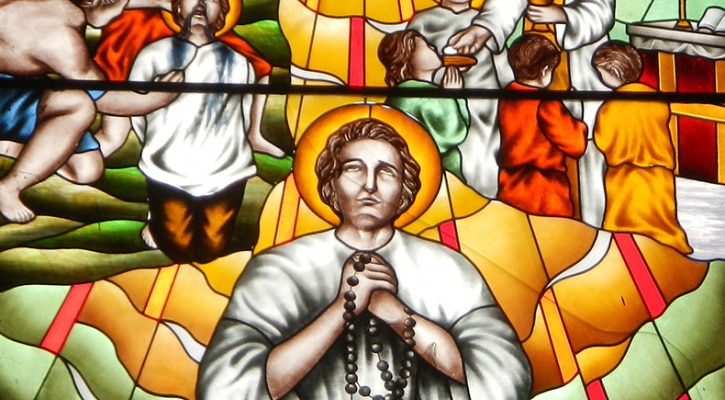 Today's Catholic Mass Readings Tuesday, September 22, 2026 22.09.2026Full Text of Readings Tuesday of the Twenty-fifth Week in Ordinary Time Lectionary: 450 The Saint of the day is Saint Lorenzo Ruiz and Companions Saint Lorenzo Ruiz and Companions’ Story Saint Lorenzo Ruiz was born in Manila of a Chinese father and a Filipino mother, both Christians. Thus he learned Chinese and Tagalog from them, and Spanish from the Dominicans whom he served as altar boy and sacristan. He became a professional calligrapher, transcribing documents in beautiful penmanship. He was a full member of the Confraternity of the Holy Rosary under Dominican auspices. He married and had two sons and a daughter. Lorenzo’s life took an abrupt turn when he was accused of murder. Nothing further is known except the statement of two Dominicans that “he was sought by the authorities on account of a homicide to which he was present or which was attributed to him.” At that time, three Dominican priests, Antonio Gonzalez, Guillermo Courtet, and Miguel de Aozaraza, were about to sail to Japan in spite of a violent persecution there. With them was a Japanese priest, Vicente Shiwozuka de la Cruz, and a layman named Lazaro, a leper. Lorenzo, having taken asylum with them, was allowed to accompany them. But only when they were at sea did he learn that they were going to Japan. They landed at Okinawa. Lorenzo could have gone on to Formosa, but, he reported, “I decided to stay with the Fathers, because the Spaniards would hang me there.” In Japan they were soon found out, arrested, and taken to Nagasaki. The site of wholesale bloodshed when the atomic bomb was dropped had known tragedy before. The 50,000 Catholics who once lived there were dispersed or killed by persecution. They were subjected to an unspeakable kind of torture: After huge quantities of water were forced down their throats, they were made to lie down. Long boards were placed on their stomachs and guards then stepped on the ends of the boards, forcing the water to spurt violently from mouth, nose and ears. The superior, Fr. Gonzalez, died after some days. Both Fr. Shiwozuka and Lazaro broke under torture, which included the insertion of bamboo needles under their fingernails. But both were brought back to courage by their companions. In Saint Lorenzo Ruiz’s moment of crisis, he asked the interpreter, “I would like to know if, by apostatizing, they will spare my life.” The interpreter was noncommittal, but in the ensuing hours Lorenzo felt his faith grow strong. He became bold, even audacious, with his interrogators. The five were put to death by being hanged upside down in pits. Boards fitted with semi-circular holes were fitted around their waists and stones put on top to increase the pressure. They were tightly bound, to slow circulation and prevent a speedy death. They were allowed to hang for three days. By that time Lorenzo and Lazaro were dead. Still alive, the three priests were then beheaded. In 1987, Pope John Paul II canonized these six and 10 others: Asians and Europeans, men and women, who spread the faith in the Philippines, Formosa, and Japan. Lorenzo Ruiz is the first canonized Filipino martyr. The liturgical feast of Saint Lorenzo Ruiz and Companions is celebrated on September 28. Reflection We ordinary Christians of today—how would we stand up in the circumstances these martyrs faced? We sympathize with the two who temporarily denied the faith. We understand Lorenzo’s terrible moment of temptation. But we see also the courage—inexplainable in human terms—which surged from their store of faith. Martyrdom, like ordinary life, is a miracle of grace.Saint of the Day, Copyright Franciscan Media
 -
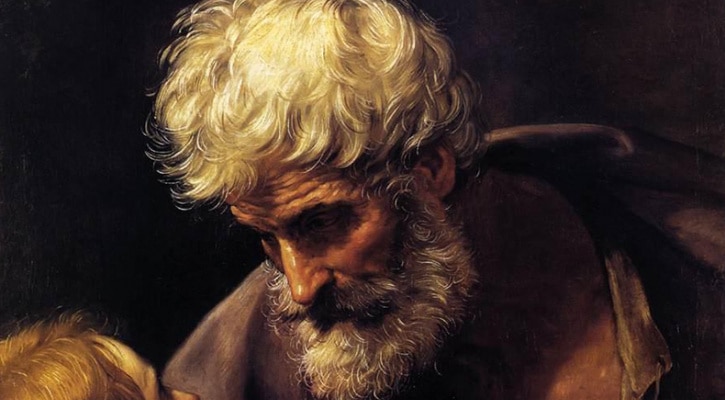 Today's Catholic Mass Readings Monday, September 21, 2026 21.09.2026Full Text of Readings Feast of Saint Matthew, Apostle and evangelist Lectionary: 643 The Saint of the day is Saint Matthew Saint Matthew’s Story Saint Matthew was a Jew who worked for the occupying Roman forces, collecting taxes from other Jews. The Romans were not scrupulous about what the “tax farmers” got for themselves. Hence the latter, known as “publicans,” were generally hated as traitors by their fellow Jews. The Pharisees lumped them with “sinners” (see Matthew 9:11-13). So it was shocking to them to hear Jesus call such a man to be one of his intimate followers. Matthew got Jesus in further trouble by having a sort of going-away party at his house. The Gospel tells us that many tax collectors and “those known as sinners” came to the dinner. The Pharisees were still more badly shocked. What business did the supposedly great teacher have associating with such immoral people? Jesus’ answer was, “Those who are well do not need a physician, but the sick do. Go and learn the meaning of the words, ‘I desire mercy, not sacrifice.’ I did not come to call the righteous but sinners” (Matthew 9:12b-13). Jesus is not setting aside ritual and worship; he is saying that loving others is even more important. No other particular incidents about Saint Matthew are found in the New Testament. Reflection From such an unlikely situation, Jesus chose one of the foundations of the Church, a man others, judging from his job, thought was not holy enough for the position. But Matthew was honest enough to admit that he was one of the sinners Jesus came to call. He was open enough to recognize truth when he saw him. “And he got up and followed him” (Matthew 9:9b).Saint of the Day, Copyright Franciscan Media
 -
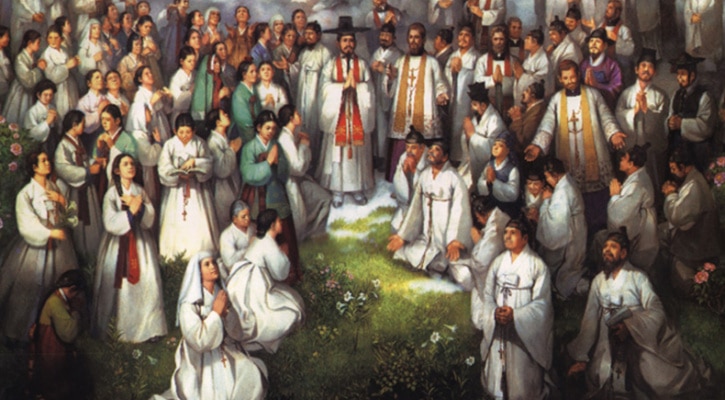 Today's Catholic Mass Readings Sunday, September 20, 2026 20.09.2026Full Text of Readings Twenty-fifth Sunday in Ordinary Time Lectionary: 133 The Saint of the day is Saints Andrew Kim Taegon, Paul Chong Hasang, and Companions Saints Andrew Kim Taegon, Paul Chong Hasang, and Companions’ Stories The first native Korean priest, Andrew Kim Taegon was the son of Christian converts. Following his baptism at the age of 15, Andrew traveled 1,300 miles to the seminary in Macao, China. After six years, he managed to return to his country through Manchuria. That same year he crossed the Yellow Sea to Shanghai and was ordained a priest. Back home again, he was assigned to arrange for more missionaries to enter by a water route that would elude the border patrol. He was arrested, tortured, and finally beheaded at the Han River near Seoul, the capital. Andrew Kim Taegon’s father Ignatius Kim, was martyred during the persecution of 1839, and was beatified in 1925. Paul Chong Hasang, a lay apostle and married man, also died in 1839 at age 45. Among the other martyrs in 1839 was Columba Kim, an unmarried woman of 26. She was put in prison, pierced with hot tools and seared with burning coals. She and her sister Agnes were disrobed and kept for two days in a cell with condemned criminals, but were not molested. After Columba complained about the indignity, no more women were subjected to it. The two were beheaded. Peter Ryou, a boy of 13, had his flesh so badly torn that he could pull off pieces and throw them at the judges. He was killed by strangulation. Protase Chong, a 41-year-old nobleman, apostatized under torture and was freed. Later he came back, confessed his faith and was tortured to death. Christianity came to Korea during the Japanese invasion in 1592 when some Koreans were baptized, probably by Christian Japanese soldiers. Evangelization was difficult because Korea refused all contact with the outside world except for taking taxes to Beijing annually. On one of these occasions, around 1777, Christian literature obtained from Jesuits in China led educated Korean Christians to study. A home Church began. When a Chinese priest managed to enter secretly a dozen years later, he found 4,000 Catholics, none of whom had ever seen a priest. Seven years later there were 10,000 Catholics. Religious freedom came to Korea in 1883. Besides Andrew Kim Taegon and Paul, Pope John Paul II canonized 98 Koreans and three French missionaries who had been martyred between 1839 and 1867, when he visited Korea in 1984. Among them were bishops and priests, but for the most part they were lay persons: 47 women and 45 men. Reflection We marvel at the fact that the Korean Church was strictly a lay Church for a dozen years after its birth. How did the people survive without the Eucharist? It is no belittling of this and other sacraments to realize that there must be a living faith before there can be a truly beneficial celebration of the Eucharist. The sacraments are signs of God’s initiative and response to faith already present. The sacraments increase grace and faith, but only if there is something ready to be increased.Saint of the Day, Copyright Franciscan Media
 -
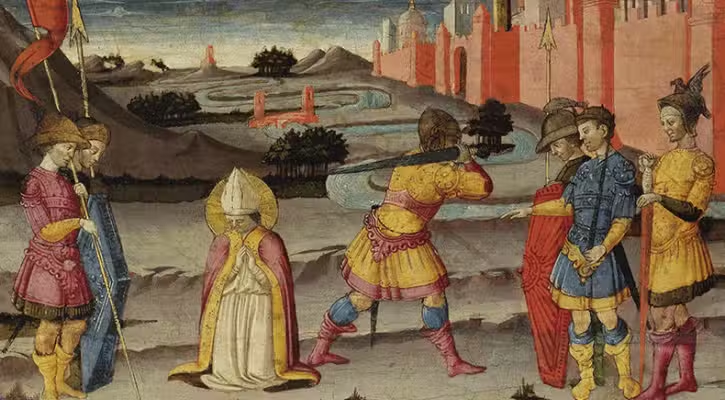 Today's Catholic Mass Readings Saturday, September 19, 2026 19.09.2026Full Text of Readings Saturday of the Twenty-fourth Week in Ordinary Time Lectionary: 448 The Saint of the day is Saint Januarius Saint Januarius’ Story Little is known about the life of Januarius. He is believed to have been martyred in the Emperor Diocletian’s persecution of 305. Legend has it that Januarius and his companions were thrown to the bears in the amphitheater of Pozzuoli, but the animals failed to attack them. They were then beheaded, and Januarius’ blood ultimately brought to Naples. “A dark mass that half fills a hermetically sealed four-inch glass container, and is preserved in a double reliquary in the Naples cathedral as the blood of St. Januarius, liquefies 18 times during the year…Various experiments have been applied, but the phenomenon eludes natural explanation….” [From the Catholic Encyclopedia] Reflection It is defined Catholic doctrine that miracles can happen and are recognizable. Problems arise, however, when we must decide whether an occurrence is unexplainable in natural terms, or merely unexplained. We do well to avoid an excessive credulity but, on the other hand, when even scientists speak about “probabilities” rather than “laws” of nature, it is something less than imaginative for Christians to think that God is too “scientific” to work extraordinary miracles to wake us up to the everyday miracles of sparrows and dandelions, raindrops and snowflakes.Saint of the Day, Copyright Franciscan Media
 -
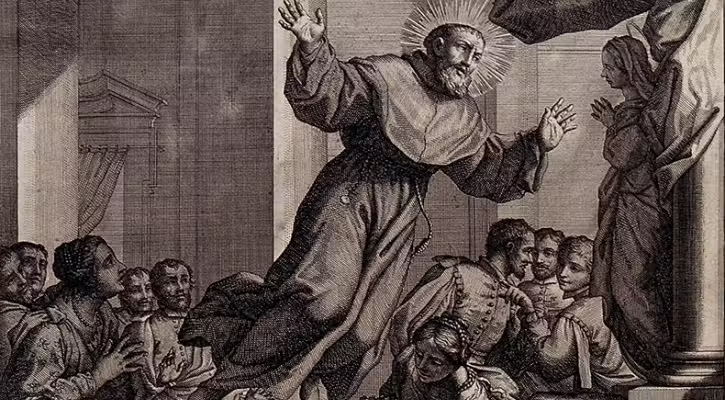 Today's Catholic Mass Readings Friday, September 18, 2026 18.09.2026Full Text of Readings Friday of the Twenty-fourth Week in Ordinary Time Lectionary: 447 The Saint of the day is Saint Joseph of Cupertino Saint Joseph of Cupertino’s Story Saint Joseph of Cupertino is most famous for levitating at prayer. Already as a child, Joseph showed a fondness for prayer. After a short career with the Capuchins, he joined the Conventual Franciscans. Following a brief assignment caring for the friary mule, Joseph began his studies for the priesthood. Though studies were very difficult for him, Joseph gained a great deal of knowledge from prayer. He was ordained in 1628. Saint Joseph of Cupertino’s tendency to levitate during prayer was sometimes a cross; some people came to see this much as they might have gone to a circus sideshow. Joseph’s gift led him to be humble, patient, and obedient, even though at times he was greatly tempted and felt forsaken by God. He fasted and wore iron chains for much of his life. The friars transferred Joseph several times for his own good and for the good of the rest of the community. He was reported to and investigated by the Inquisition; the examiners exonerated him. Saint Joseph of Cupertino was canonized in 1767. In the investigation preceding the canonization, 70 incidents of levitation are recorded. Reflection While levitation is an extraordinary sign of holiness, Saint Joseph of Cupertino is also remembered for the ordinary signs he showed. He prayed even in times of inner darkness, and he lived out the Sermon on the Mount. He used his “unique possession”–his free will–to praise God and to serve God’s creation.Saint of the Day, Copyright Franciscan Media
 -
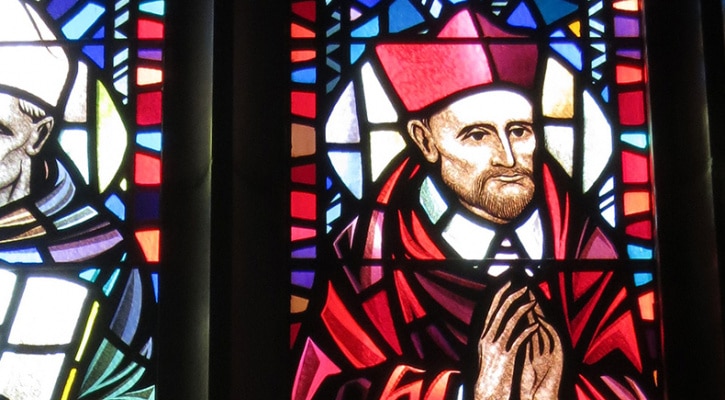 Today's Catholic Mass Readings Thursday, September 17, 2026 17.09.2026Full Text of Readings Thursday of the Twenty-fourth Week in Ordinary Time Lectionary: 446 The Saint of the day is Saint Robert Bellarmine Saint Robert Bellarmine’s Story When Saint Robert Bellarmine was ordained in 1570, the study of Church history and the fathers of the Church was in a sad state of neglect. A promising scholar from his youth in Tuscany, he devoted his energy to these two subjects, as well as to Scripture, in order to systematize Church doctrine against the attacks of the Protestant Reformers. He was the first Jesuit to become a professor at Louvain. His most famous work is his three-volume Disputations on the Controversies of the Christian Faith. Particularly noteworthy are the sections on the temporal power of the pope and the role of the laity. Bellarmine incurred the anger of monarchists in England and France by showing the divine-right-of-kings theory untenable. He developed the theory of the indirect power of the pope in temporal affairs; although he was defending the pope against the Scottish philosopher Barclay, he also incurred the ire of Pope Sixtus V. Bellarmine was made a cardinal by Pope Clement VIII on the grounds that “he had not his equal for learning.” While he occupied apartments in the Vatican, Bellarmine relaxed none of his former austerities. He limited his household expenses to what was barely essential, eating only the food available to the poor. He was known to have ransomed a soldier who had deserted from the army and he used the hangings of his rooms to clothe poor people, remarking, “The walls won’t catch cold.” Among many activities, Bellarmine became theologian to Pope Clement VIII, preparing two catechisms which have had great influence in the Church. The last major controversy of Bellarmine’s life came in 1616 when he had to admonish his friend Galileo, whom he admired. He delivered the admonition on behalf of the Holy Office, which had decided that the heliocentric theory of Copernicus was contrary to Scripture. The admonition amounted to a caution against putting forward—other than as a hypothesis—theories not yet fully proven. This shows that saints are not infallible. Saint Robert Bellarmine died on September 17, 1621. The process for his canonization was begun in 1627, but was delayed until 1930 for political reasons, stemming from his writings. In 1930, Pope Pius XI canonized him, and the next year declared him a doctor of the Church. Reflection The renewal in the Church sought by Vatican II was difficult for many Catholics. In the course of change, many felt a lack of firm guidance from those in authority. They yearned for the stone columns of orthodoxy and an iron command with clearly defined lines of authority. Vatican II assures us in The Church in the Modern World, “There are many realities which do not change and which have their ultimate foundation in Christ, who is the same yesterday and today, yes, and forever” (#10, quoting Hebrews 13:8). Saint Robert Bellarmine devoted his life to the study of Scripture and Catholic doctrine. His writings help us understand that the real source of our faith is not merely a set of doctrines, but rather the person of Jesus still living in the Church today.Saint of the Day, Copyright Franciscan Media
 -
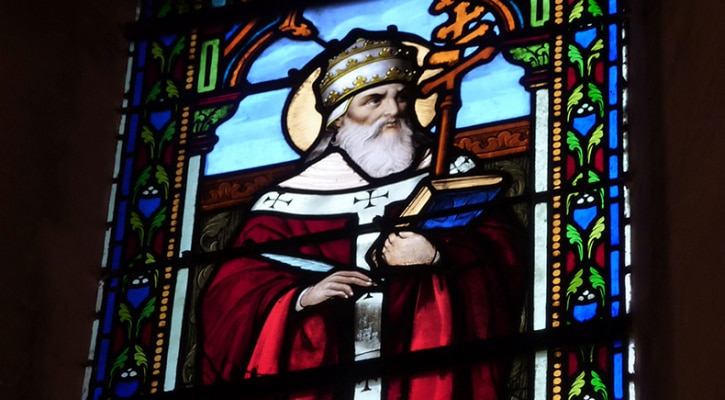 Today's Catholic Mass Readings Wednesday, September 16, 2026 16.09.2026Full Text of Readings Memorial of Saints Cornelius, Pope, and Cyprian, Bishop, Martyrs Lectionary: 445 The Saint of the day is Saint Cornelius Saint Cornelius’ Story There was no pope for 14 months after the martyrdom of Saint Fabian because of the intensity of the persecution of the Church. During the interval, the Church was governed by a college of priests. Saint Cyprian, a friend of Cornelius, writes that Cornelius was elected pope “by the judgment of God and of Christ, by the testimony of most of the clergy, by the vote of the people, with the consent of aged priests and of good men.” The greatest problem of Saint Cornelius’s two-year term as pope had to do with the Sacrament of Penance and centered on the readmission of Christians who had denied their faith during the time of persecution. Two extremes were finally both condemned. Cyprian, primate of North Africa, appealed to the pope to confirm his stand that the relapsed could be reconciled only by the decision of the bishop. In Rome, however, Saint Cornelius met with the opposite view. After his election, a priest named Novatian (one of those who had governed the Church) had himself consecrated a rival bishop of Rome—one of the first antipopes. He denied that the Church had any power to reconcile not only the apostates, but also those guilty of murder, adultery, fornication, or second marriage! Cornelius had the support of most of the Church (especially of Cyprian of Africa) in condemning Novatianism, though the sect persisted for several centuries. Saint Cornelius held a synod at Rome in 251 and ordered the “relapsed” to be restored to the Church with the usual “medicines of repentance.” The friendship of Cornelius and Cyprian was strained for a time when one of Cyprian’s rivals made accusations about him. But the problem was cleared up. A document from Cornelius shows the extent of organization in the Church of Rome in the mid-third century: 46 priests, seven deacons, seven subdeacons. It is estimated that the number of Christians totaled about 50,000. He died as a result of the hardships of his exile in what is now Civitavecchia. Reflection It seems fairly true to say that almost every possible false doctrine has been proposed at some time or other in the history of the Church. The third century saw the resolution of a problem we scarcely consider—the penance to be done before reconciliation with the Church after mortal sin. Men like Cornelius and Cyprian were God’s instruments in helping the Church find a prudent path between extremes of rigorism and laxity. They are part of the Church’s ever-living stream of tradition, ensuring the continuance of what was begun by Christ, and evaluating new experiences through the wisdom and experience of those who have gone before.Saint of the Day, Copyright Franciscan Media
 -
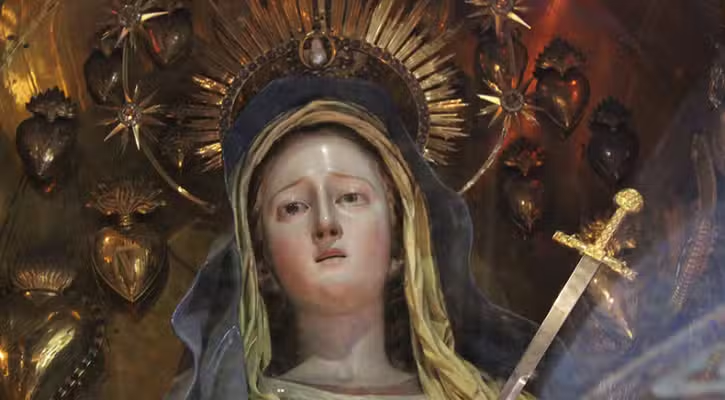 Today's Catholic Mass Readings Tuesday, September 15, 2026 15.09.2026Full Text of Readings Memorial of Our Lady of Sorrows Lectionary: 444/639 The Saint of the day is Our Lady of Sorrows The Story of Our Lady of Sorrows For a while there were two feasts in honor of the Sorrowful Mother: one going back to the 15th century, the other to the 17th century. For a while both were celebrated by the universal Church: one on the Friday before Palm Sunday, the other in September. The principal biblical references to Mary’s sorrows are in Luke 2:35 and John 19:26-27. The Lucan passage is Simeon’s prediction about a sword piercing Mary’s soul; the Johannine passage relates Jesus’ words from the cross to Mary and to the beloved disciple. Many early Church writers interpret the sword as Mary’s sorrows, especially as she saw Jesus die on the cross. Thus, the two passages are brought together as prediction and fulfillment. Saint Ambrose in particular sees Mary as a sorrowful yet powerful figure at the cross. Mary stood fearlessly at the cross while others fled. Mary looked on her Son’s wounds with pity, but saw in them the salvation of the world. As Jesus hung on the cross, Mary did not fear to be killed, but offered herself to her persecutors. Reflection John’s account of Jesus’ death is highly symbolic. When Jesus gives the beloved disciple to Mary, we are invited to appreciate Mary’s role in the Church: She symbolizes the Church; the beloved disciple represents all believers. As Mary mothered Jesus, she is now mother to all his followers. Furthermore, as Jesus died, he handed over his Spirit. Mary and the Spirit cooperate in begetting new children of God—almost an echo of Luke’s account of Jesus’ conception. Christians can trust that they will continue to experience the caring presence of Mary and Jesus’ Spirit throughout their lives and throughout history.Saint of the Day, Copyright Franciscan Media
 -
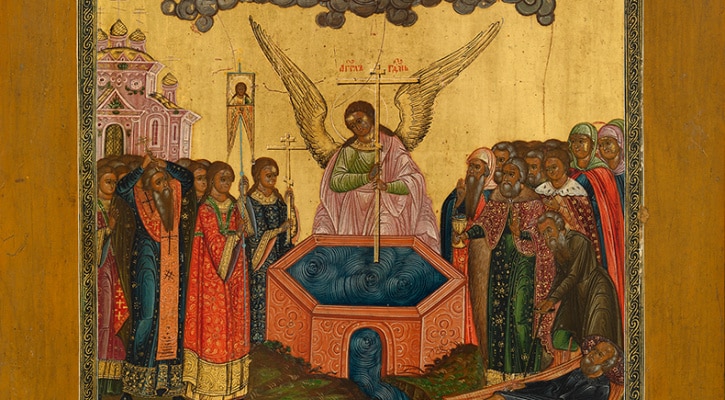 Today's Catholic Mass Readings Monday, September 14, 2026 14.09.2026Full Text of Readings Feast of the Exaltation of the Holy Cross Lectionary: 638 The Saint of the day is Exaltation of the Holy Cross The Story of the Exaltation of the Holy Cross Early in the fourth century, Saint Helena, mother of the Roman Emperor Constantine, went to Jerusalem in search of the holy places of Christ’s life. She razed the second-century Temple of Aphrodite, which tradition held was built over the Savior’s tomb, and her son built the Basilica of the Holy Sepulcher on that spot. During the excavation, workers found three crosses. Legend has it that the one on which Jesus died was identified when its touch healed a dying woman. The cross immediately became an object of veneration. At a Good Friday celebration in Jerusalem toward the end of the fourth century, according to an eyewitness, the wood was taken out of its silver container and placed on a table together with the inscription Pilate ordered placed above Jesus’ head: Then “all the people pass through one by one; all of them bow down, touching the cross and the inscription, first with their foreheads, then with their eyes; and, after kissing the cross, they move on.” To this day, the Eastern Churches, Catholic and Orthodox alike, celebrate the Exaltation of the Holy Cross on the September anniversary of the basilica’s dedication. The feast entered the Western calendar in the seventh century after Emperor Heraclius recovered the cross from the Persians, who had carried it off in 614, 15 years earlier. According to the story, the emperor intended to carry the cross back into Jerusalem himself, but was unable to move forward until he took off his imperial garb and became a barefoot pilgrim. Reflection The cross is today the universal image of Christian belief. Countless generations of artists have turned it into a thing of beauty to be carried in procession or worn as jewelry. To the eyes of the first Christians, it had no beauty. It stood outside too many city walls, decorated only with decaying corpses, as a threat to anyone who defied Rome’s authority—including Christians who refused sacrifice to Roman gods. Although believers spoke of the cross as the instrument of salvation, it seldom appeared in Christian art unless disguised as an anchor or the Chi-Rho until after Constantine’s edict of toleration.Saint of the Day, Copyright Franciscan Media
 -
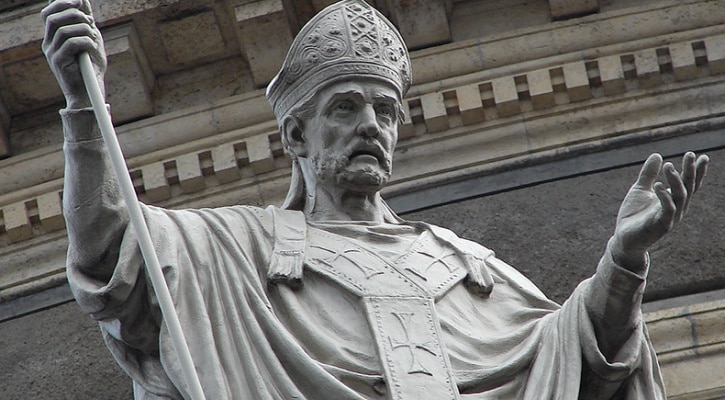 Today's Catholic Mass Readings Sunday, September 13, 2026 13.09.2026Full Text of Readings Twenty-fourth Sunday in Ordinary Time Lectionary: 130 The Saint of the day is Saint John Chrysostom Saint John Chrysostom’s Story The ambiguity and intrigue surrounding John, the great preacher (his name means “golden-mouthed”) from Antioch, are characteristic of the life of any great man in a capital city. Brought to Constantinople after a dozen years of priestly service in Syria, John found himself the reluctant victim of an imperial ruse to make him bishop in the greatest city of the empire. Ascetic, unimposing but dignified, and troubled by stomach ailments from his desert days as a monk, Saint John Chrysostom became a bishop under the cloud of imperial politics. If his body was weak, his tongue was powerful. The content of his sermons, his exegesis of Scripture, were never without a point. Sometimes the point stung the high and mighty. Some sermons lasted up to two hours. His lifestyle at the imperial court was not appreciated by many courtiers. He offered a modest table to episcopal sycophants hanging around for imperial and ecclesiastical favors. John deplored the court protocol that accorded him precedence before the highest state officials. He would not be a kept man. His zeal led him to decisive action. Bishops who bribed their way into office were deposed. Many of his sermons called for concrete steps to share wealth with the poor. The rich did not appreciate hearing from Saint John Chrysostom that private property existed because of Adam’s fall from grace any more than married men liked to hear that they were bound to marital fidelity just as much as their wives were. When it came to justice and charity, John acknowledged no double standards. Aloof, energetic, outspoken, especially when he became excited in the pulpit, Saint John Chrysostom was a sure target for criticism and personal trouble. He was accused of gorging himself secretly on rich wines and fine foods. His faithfulness as spiritual director to the rich widow, Olympia, provoked much gossip attempting to prove him a hypocrite where wealth and chastity were concerned. His actions taken against unworthy bishops in Asia Minor were viewed by other ecclesiastics as a greedy, uncanonical extension of his authority. Theophilus, archbishop of Alexandria, and Empress Eudoxia were determined to discredit John. Theophilus feared the growth in importance of the Bishop of Constantinople and took occasion to charge John with fostering heresy. Theophilus and other angered bishops were supported by Eudoxia. The empress resented his sermons contrasting gospel values with the excesses of imperial court life. Whether intended or not, sermons mentioning the lurid Jezebel and impious Herodias were associated with the empress, who finally did manage to have John exiled. He died in exile in 407. Reflection Saint John Chrysostom’s preaching, by word and example, exemplifies the role of the prophet to comfort the afflicted and to afflict the comfortable. For his honesty and courage, he paid the price of a turbulent ministry as bishop, personal vilification, and exile.Saint of the Day, Copyright Franciscan Media
 -
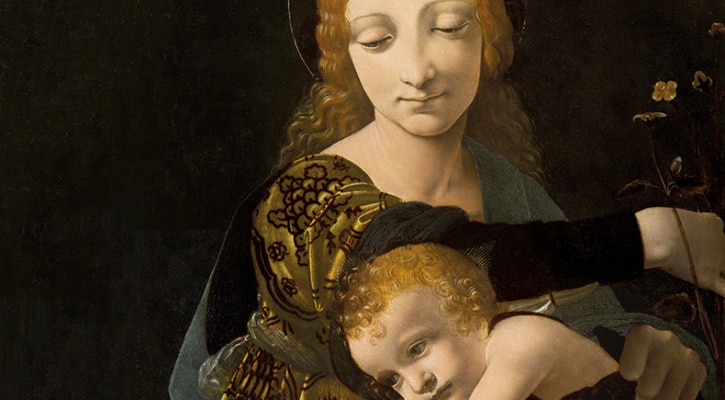 Today's Catholic Mass Readings Saturday, September 12, 2026 12.09.2026Full Text of Readings The Saint of the day is Most Holy Name of the Blessed Virgin Mary The Story of the Most Holy Name of the Blessed Virgin Mary This feast is a counterpart to the Feast of the Holy Name of Jesus; both have the possibility of uniting people easily divided on other matters. The feast of the Most Holy Name of Mary began in Spain in 1513 and in 1671 was extended to all of Spain and the Kingdom of Naples. In 1683, John Sobieski, king of Poland, brought an army to the outskirts of Vienna to stop the advance of Muslim armies loyal to Mohammed IV of Constantinople. After Sobieski entrusted himself to the Blessed Virgin Mary, he and his soldiers thoroughly defeated the Muslims. Pope Innocent XI extended this feast to the entire Church. Reflection Mary always points us to God, reminding us of God’s infinite goodness. She helps us to open our hearts to God’s ways, wherever those may lead us. Honored under the title “Queen of Peace,” Mary encourages us to cooperate with Jesus in building a peace based on justice, a peace that respects the fundamental human rights of all peoples.Saint of the Day, Copyright Franciscan Media
 -
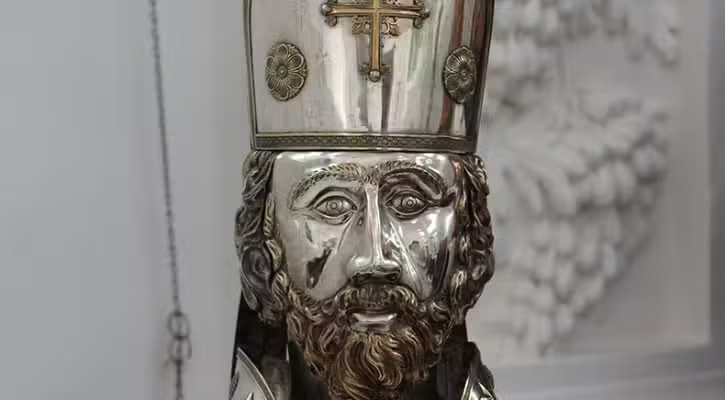 Today's Catholic Mass Readings Friday, September 11, 2026 11.09.2026Full Text of Readings Friday of the Twenty-third Week in Ordinary Time Lectionary: 441 The Saint of the day is Saint Cyprian Saint Cyprian’s Story Saint Cyprian is important in the development of Christian thought and practice in the third century, especially in northern Africa. Highly educated and a famous orator, he became a Christian as an adult. He distributed his goods to the poor, and amazed his fellow citizens by making a vow of chastity before his baptism. Within two years he had been ordained a priest and was chosen, against his will, as Bishop of Carthage. Saint Cyprian complained that the peace the Church had enjoyed had weakened the spirit of many Christians and had opened the door to converts who did not have the true spirit of faith. When the Decian persecution began, many Christians easily abandoned the Church. It was their reinstatement that caused the great controversies of the third century, and helped the Church progress in its understanding of the Sacrament of Penance. Novatus, a priest who had opposed Cyprian’s election, set himself up in Saint Cyprian’s absence (he had fled to a hiding place from which to direct the Church—bringing criticism on himself) and received back all apostates without imposing any canonical penance. Ultimately he was condemned. Cyprian held a middle course, holding that those who had actually sacrificed to idols could receive Communion only at death, whereas those who had only bought certificates saying they had sacrificed could be admitted after a more or less lengthy period of penance. Even this was relaxed during a new persecution. During a plague in Carthage, Cyprian urged Christians to help everyone, including their enemies and persecutors. A friend of Pope Cornelius, Cyprian opposed the following pope, Stephen. He and the other African bishops would not recognize the validity of baptism conferred by heretics and schismatics. This was not the universal view of the Church, but Cyprian was not intimidated even by Stephen’s threat of excommunication. He was exiled by the emperor and then recalled for trial. He refused to leave the city, insisting that his people should have the witness of his martyrdom. Saint Cyprian was a mixture of kindness and courage, vigor and steadiness. He was cheerful and serious, so that people did not know whether to love or respect him more. He waxed warm during the baptismal controversy; his feelings must have concerned him, for it was at this time that he wrote his treatise on patience. Saint Augustine remarks that Cyprian atoned for his anger by his glorious martyrdom. His liturgical feast is celebrated on September 16. Reflection The controversies about Baptism and Penance in the third century remind us that the early Church had no ready-made solutions from the Holy Spirit. The leaders and members of the Church of that day had to move painfully through the best series of judgments they could make in an attempt to follow the entire teaching of Christ and not be diverted by exaggerations to right or left.Saint of the Day, Copyright Franciscan Media
 -
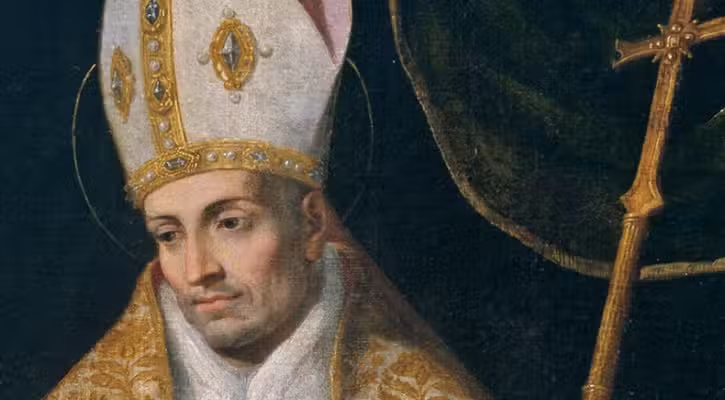 Today's Catholic Mass Readings Thursday, September 10, 2026 10.09.2026Full Text of Readings Thursday of the Twenty-third Week in Ordinary Time Lectionary: 440 The Saint of the day is Saint Thomas of Villanova Saint Thomas of Villanova’s Story Saint Thomas of Villanova was from Castile in Spain and received his surname from the town where he was raised. He received a superior education at the University of Alcala and became a popular professor of philosophy there. After joining the Augustinian friars at Salamanca, Saint Thomas of Villanova was ordained and resumed his teaching–despite a continuing absentmindedness and poor memory. He became prior and then provincial of the friars, sending the first Augustinians to the New World. He was nominated by the emperor to the archbishopric of Granada, but refused. When the see again became vacant he was pressured to accept. The money his cathedral chapter gave him to furnish his house was given to a hospital instead. His explanation to them was that “our Lord will be better served by your money being spent on the poor in the hospital. What does a poor friar like myself want with furniture?” He wore the same habit that he had received in the novitiate, mending it himself. The canons and domestics were ashamed of him, but they could not convince him to change. Several hundred poor came to Thomas’s door each morning and received a meal, wine, and money. When criticized because he was at times being taken advantage of, he replied, “If there are people who refuse to work, that is for the governor and the police to deal with. My duty is to assist and relieve those who come to my door.” He took in orphans and paid his servants for every deserted child they brought to him. He encouraged the wealthy to imitate his example and be richer in mercy and charity than they were in earthly possessions. Criticized because he refused to be harsh or swift in correcting sinners, Saint Thomas of Villanova said, “Let him (the complainer) inquire whether Saint Augustine and Saint John Chrysostom used anathemas and excommunication to stop the drunkenness and blasphemy which were so common among the people under their care.” As he lay dying, Thomas commanded that all the money he possessed be distributed to the poor. His material goods were to be given to the rector of his college. Mass was being celebrated in his presence when after Communion he breathed his last, reciting the words: “Into your hands, O Lord, I commend my spirit.” In his lifetime Saint Thomas of Villanova was already called “the almsgiver” and “the father of the poor.” He was canonized in 1658. Thomas of Villanova’s liturgical feast is celebrated on September 22. Reflection The absent-minded professor is a stock comic figure. Saint Thomas of Villanova earned even more derisive laughs with his determined shabbiness and his willingness to let the poor who flocked to his door take advantage of him. He embarrassed his peers, but Jesus was enormously pleased with him. We are often tempted to tend our image in others’ eyes without paying sufficient attention to how we look to Christ. Thomas still urges us to rethink our priorities.Saint of the Day, Copyright Franciscan Media
Podcast serupa


Popular di
Podcast ini turut muncul dalam senarai podcast negara-negara ini.


