
The Growth Podcast
Aakash Gupta
0
Join 65K+ other listeners in the world's biggest podcast on AI and product management. Host Aakash Gupta brings on the world's leading AI PM experts. The podcast is available at www.news.aakashg.com.
Afleveringen
-
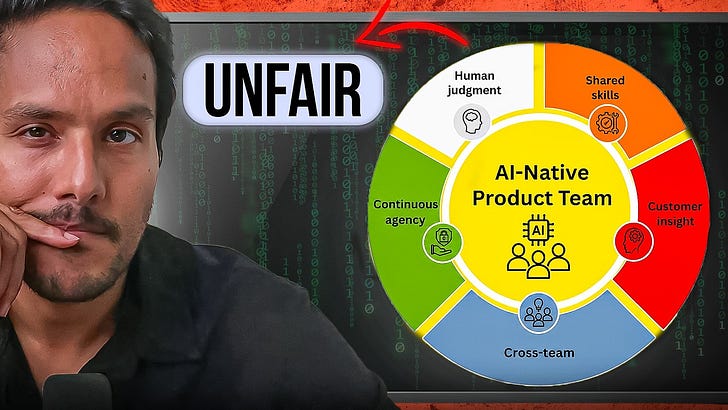 Inside the AI Stack of an $8.3B AI Company’s Product Team | Together AI 14.09.2026 59minToday’s Episode90% of teams have adopted AI, yet 56% of CEOs say they saw no major financial benefit. Both metrics are accurate, and I’m pretty sure you fall somewhere between them.With new AI tools flooding the market every week, it is safe to say that every team has its own AI setup by now. But are any of those setups in sync with each other?I’ve been building this argument in stages. First, Carl Vellotti showed you how to build a personal OS, and Hannah layered it with building a team OS. Jiaona and Mikhail vouch for a full-blown company OS as well.So, today you get a screen share.My guests are the product team at Together AI that raised $800M at an $8.3B valuation and sells inference and fine-tuning to developers. Charles Zedlewski is their CPO who brought Necoline, Pavneet, and Hassan on the call to talk about how to build a shared context repo.Their customers are already agents and their engineers are already agent-first. Their product team had no choice but to catch up.Brought to you byArize - Ship AI agents and features faster with fewer regressions.Get a full year of Arize, Bolt.new, Airtable, Speechify, Descript, Magic Patterns, Linear, Dovetail and Mobbin at bundle.aakashg.com.10 Key takeaways1. Individual productivity can move a company backwards - The team's starting question was not how to make each person faster. It was whether everyone generating unlimited code and content actually added up to progress. Charles called the failure mode flooding your coworkers' context windows, where everyone launches slop at each other.2. The shared repo holds context and skills, not code - Markdown and YAML files covering customer intelligence, sandboxes, and the output of strategy meetings broken down by mission and milestone. Anything tied to a specific codebase stays out of it. The point is that a PM can read another team's context and draft a real proposal before taking up that PM's time.3. Skills live closest to the work they touch - If a skill references code inside one team's repo, it stays colocated there. Everything else goes to a personal or shared repo. Test it on a branch, use it a few times, and only push to main once it proves repeatable. Niche ones never get pushed.4. Shared context is a hierarchy, not a flat pool - The team abandoned the idea that everyone should carry everyone's context. Most people have no motivation to learn the depth of someone else's area. They want the one answer they came for. Some people live at the bottom of the hierarchy, most just traverse the top.5. The PRD stopped being a gate - Historically it was the document everyone aligned on before building started. Together treats it as a trigger for ideation and problem solving instead. One to two pages, defining the customer problem, a few solution options, and a sample user journey. That is enough to argue about whether the thing is worth building.6. A prototype replaces the bulk of the long document - A separate skill takes the one pager and produces a prompt for a design tool, and that visual is where the sharpest feedback shows up, from engineering and marketing alike.7. Discovery collapsed from half a day to five minutes - The research agent pulls from the support platform, the project tracker, and internal docs at once. It surfaced 19 tickets filed in two months, flagged that the feature had been partially built and abandoned, and gave verbatim quotes with sources. The value is not the summary. It is not duplicating work someone already started.8. Automate execution, keep decisions human - Defining the feature, the API surface area, and the abstraction layer stay hands on. Code writing is the part that runs on its own. The PRD skill is explicitly instructed to challenge the PM's assumptions rather than accept them.9. Agents are already the majority user, so validate for them - Agent evals spins up a sandbox, gives an agent a real task against the product, and watches. It caught that agents could not find the fine-tunable models page because it was not linked from the quick start. Dozens of docs fixes came out of this. Charles calls agent success the new bar for UX.10. They refused to oversell the gains - No story points, so no proof, but velocity is up more than 5%. Charles finds 3x claims suspicious, because discovery, debate, and coordination do not get magically better with AI. Costs stayed sane partly through open weight models, partly because optimizing for collective output never produced the runaway token budgets others report.Go DeeperAs promised, I put together this section to help you become the best version in your product management journey. If you’re starting from zero on this, begin with How to build a Team OS in Claude Code with Hannah Stulberg, then scale it up with How to build a Company Operating System with Hermes and OpenClaw. For the skills layer specifically, 3x CPO Oji Udezue on the Essential Claude Skills for PMs is the one to read. And if section 3 sold you on agent evals, go to How to Build Frontier-Lab Quality Evals with Daniel McKinnon. Finally, Pavneet’s take on the one-page PRD lines up almost exactly with what Srini Raghavan showed from Freshworks.You can get my podcasts on Apple, Spotify, and YouTube.If you want to advertise, please email - productgrowthppp[at]gmail[dot]com. This is a public episode. If you'd like to discuss this with other subscribers or get access to bonus episodes, visit www.news.aakashg.com/subscribe
 -
 How to Build Effective Product Loops in Claude Code, with Chief AI and Product Officer at JobNimbus, Tyler Folkman 04.09.2026 1u 8minToday’s episodeMost PMs have automated something with AI by now. A PRD review. A weekly status update. The problem is that every session starts from scratch.Loops are what fix that. A skill that runs the same way forever is just a skill. A skill that takes the log of what happened and rewrites itself is a loop. Everyone keeps saying loops are the new prompts. Almost nobody shows you how to build one.Tyler Folkman is Chief AI Officer and Head of Product at JobNimbus. In this episode he builds a loop live on screen. He runs a preflight check on his own podcast recording, spins up three prototype variants while answering questions, writes a decision skill from scratch, and closes the loop on camera.He also covers the loops every PM should be running, the hooks that stop Claude from doing real damage, and the point where vibe PMing breaks.Brought to you byCustomer.io - Send smarter messages using your product dataAriso - Ship AI agents and features faster with fewer regressionsViktor - AI employee connected to 3k+ tools with every action approved by your teamBolt - Build a complete design system from your codeProduct Faculty - Get $150 off their #1 AI PM Certification with code AAKASH15010 Key takeaways1. A skill becomes a loop when you feed the learning back. A static skill sits there and stays the same forever. The loop closes when you hand the AI the log of the whole session and ask what to improve. Skip that step and you are just running a skill.2. The gate is the most important part of the loop. Fetch inputs, do work, pass a gate, write the artifact. The gate is where you validate the work was correct, and making it deterministic matters more than anything else in the chain.3. Agents make decisions, prompts wait for you. The difference is not the model. An agent gets a task plus a way to verify itself and executes as far as it can alone. Prompting keeps you in the loop, which caps how far you can scale yourself.4. Write the first version of a skill by hand. Human authored skills tend to beat AI authored ones because you know more about what you actually want. Once you are on the AI loop it moves fast enough that injecting your own thinking gets hard, like promising you will still pedal on an ebike.5. In product, the gate is a customer, and that breaks the loop. Code loops run fast because the gate is a test. You cannot lock customers in a room and iterate on them. The workaround is mining the research calls and transcripts you already have to build a cheap first filter.6. Prototypes are free now, so generate variants instead of one answer. The internal standard is at least three variants per idea. One minimal, one full featured, one creative. Then narrow a hundred ideas down to five before anyone talks to a real customer.7. Synthetic customers filter, real customers decide. Customer research transcripts loaded into a warehouse let AI inspect a prototype as your customer. It is not a high bar, but it catches low hanging failures fast, which is the whole point of a gate.8. Write docs for AI, keep human docs to three pages. Part of onboarding is not written for people to read. It is context so the AI can answer questions. Anything a human is expected to read should be one to three pages, visual, and cut down by hand.9. Hooks add determinism that a prompt cannot. Telling Claude never to delete everything or never to share credentials only works if it reads that instruction today. A hook fires on the bash command itself. Session close hooks can also force the improvement step you would otherwise forget.10. Ship AI output you have not thought about and it costs you. Passing unreviewed AI work up the chain just moves the effort to someone busier than you. Answering a question in a meeting with what Claude said is the failure mode. Use AI to push your thinking, not to replace the part where you do it.Related ContentIf you don't know where to start on Claude loops, I got you covered with my ultimate guide on Loops for PMs. And then you can follow it up with The Complete PM Guide to /goal in Claude Code. Tyler mentioned the evolving role of PMs and how it is shifting into a Product Builder role, so you can read all about it in my How to Become a Builder PM deep dive.If you want to advertise, please email productgrowthppp[at]gmail[dot]com. P.S. Please subscribe on YouTube and follow on Apple and Spotify. It helps! This is a public episode. If you'd like to discuss this with other subscribers or get access to bonus episodes, visit www.news.aakashg.com/subscribe
 -
 How to build a Company Operating System with Hermes and OpenClaw 28.08.2026 1u 6minToday’s episodeToday I’m showing you how to build a company operating system, with Mikhail Shcheglov, CPO at OLX Classifieds.After 5 months of continuous building on OpenClaw and Hermes, his entire product team now runs on it.His knowledge graph covers 54% of the company's product, business and customer context. That is a number he tracks as a personal KPI. At that level the agent already makes backlog decisions. Stakeholders pitch feature requests to it before they’re allowed near a PM. It runs his email, his calendar, his recruiting funnel and his design system.He opens his IDE on camera and shows all of it. 2 findings cut against everything you’ve been told. Summarizing your meeting transcripts costs you 20-25% recall, so he stores every single one raw. And letting Hermes write its own skills off repeated tasks produced a 31% accuracy lift in controlled testing.We also get into something heavier than architecture.What happens to PM headcount when one PM covers four domains? And what does a CPO actually screen for now when hiring?Don't miss....Brought to you byBolt.new - Ship AI-powered products 10x fasterProduct Faculty - Get $150 off their #1 AI PM Certification: code AAKASH150Customer.io - Send smarter messages using your product dataLand PM Job - 12-week live course to master the PM job searchViktor - Use $100 in starting credits to get 5x more done with this AI employeeIf you want access to my AI tool stack including Airtable, Speechify, Descript, Magic Patterns, Linear, Dovetail, Arize and Mobbin, that's $27,000 of value for $150, grab https://bundle.aakashg.com/. Key TakeawaysContext coverage is a CPO level KPI - Mikhail tracks what percentage of the company's industry, business model and customer knowledge his agent actually holds. It sits at 54%. That is enough for it to operate like a junior to mid PM and make backlog calls. At 70 to 90% he expects strategy level work.The real problem AI solves is knowledge leakage - A domain expert leaves and takes five years of context with them. Every company has this hole and almost nobody measures it. One store of business, customer, product and technical knowledge closes it, and the better your AI knows that context the more you can hand it.Do not summarize your transcripts - Summarization cost them 20 to 25% recall. You lose the granular detail where the answer usually lives, and you force every conversation into a template it was never shaped like. Store everything raw.Memory needs three layers, not one - A knowledge graph for structure, a vector database for fuzzy retrieval, and raw daily transcripts in MD files. Exact keyword matching fails on most real queries because real questions are ambiguous. The vector layer carries the load.Auto generated skills lifted recall by 31% - Hermes watches what you keep asking for and decides on its own that a skill is worth writing. Tested across five core topics with ten questions each, control group against treatment group. Plus 31% accuracy.Imperatives matter more than prompts - Their rules file runs 700 lines. No fabrications. Think before you act. Facts over guesswork. And a ban on what he calls fake helpful, where the agent can't do the thing so it explains how you could do it yourself.CLAUDE.md stays short, SOUL.md goes long - CLAUDE.md holds under 100 lines and carries the highest priority. SOUL.md runs 800 and sits second. Some of those 800 lines contradict each other and it still produces his most accurate output, because every imperative gets tested against real queries.Make the agent the gatekeeper - Stakeholders are trained to pitch the agent first. It asks clarifying questions, checks the request against priorities already set, declines politely if it doesn't clear the bar, and routes it to the right PM if it does. The org chart is mapped internally so it knows who owns what.Half of PM time is process, not thinking - Weekly reports, stakeholder updates, demos. Delegate that layer and one PM does the work of two, pointed entirely at discovery. He now runs one PM across three or four customer facing domains, and only keeps dedicated owners on monetization and search.Own the agent yourself or lose the advantage - Feedback arrives daily and he pushes changes from his phone straight into the repo. Hand it to an AI ops hire or an engineering team and you keep the tool but lose the speed. Nobody without skin in the game iterates fast enough.Related contentI’ve already created all of the resources Mikhail mentioned in this episode. But I never mapped them all to one place. That changes today in this edition. PFA the map sorted by the parts you want to build.Memory first, I Built You Memory for Claude Code, Hermes and OpenClawOnce you've got a memory layer, put it in version control. GitHub for PMs has the 3-repo setup I use for skills and evalThe Hermes Agent Guide for PMs is a 20-minute setup and a 30-day rollout with persona and skill templates includedFor OpenClaw, start with Mahesh Yadav on becoming a Builder PMFor the org-wide version, watch my episode with Jiaona Zhang, CPO at Laurel, on building a Company OSMy conversation with Hannah Stulberg of DoorDash on building a Team OS is the same thing one floor down, with a free starter kit👨💻 Where to find Mikhail Shcheglov:LinkedIn: https://www.linkedin.com/in/scheglovm1/Substack: https://corpwaters.substack.com/👨💻 Where to find Aakash:Twitter: https://x.com/aakashguptaLinkedIn: https://www.linkedin.com/in/aagupta/Newsletter: https://www.news.aakashg.com/If you want to advertise, email [email protected]. This is a public episode. If you'd like to discuss this with other subscribers or get access to bonus episodes, visit www.news.aakashg.com/subscribe
 -
 How Srini Raghavan helped $3.4B SaaS Giant Freshworks Embrace the AI PDLC 24.08.2026 1u 5minCheck out the conversation on Apple, Spotify and YouTube. Brought to you by* Customer.io - Send smarter messages using your product data* Ariso - The AI operating partner for every manager and team* Product Faculty - Get $150 off their #1 AI Builder Fellowship. Code AAKASH150* Land PM Job - Join me for Cohort 5 starting November 16th* Amplitude - Custom agents that monitor your funnel and file the ticket Today’s EpisodeFreshworks is a $3.4B giant of SaaS. They’ve been around since 2010. They have over 75,000 customers and 4,000 employees. Their 2026 revenue will be $960M.They’re a colossus.When Srini Raghavan joined them as Chief Product Officer, they had a 6 month release process. Under his tenure, they moved to a 2 week release cycle. They embraced a new way of working powered by AI.In today’s episode, he breaks down everything:* The AI PDLC they embraced* The AI Harness they created in Cursor, so it can run on any models* How the PM role shifted to Product BuilderIf you’re a product leader, this is a great example of how to become AI-native. If you’re a PM, it’s a great harness (using Grok models!) to learn from.I hope you enjoy it as much as I did:Apple | Spotify. | YouTubeI’ve written up the key takeaways for newsletter subscribers as well.1. The AI PDLC they EmbracedHow do you go from shipping every 6 months to every 2 weeks? It’s not about becoming AI first! Most teams try that: they open Cursor or Figma Make and start prompting. Srini made the point that it actually all begins with being Data First:When you’re data first, you create the right foundation to actually be AI first. At Freshworks scale, with 300 million end users, you can’t afford a hallucination. For Freshworks, that was three things:* A design system structured so agents can parse it* Coding standards written down explicitly* A single repo as the source of truthThey wrapped that all into a system they call Prism. It’s a knowledge hub that knows the product and its dependencies inside out, plus a context hub that passes feature context between phases, and a central library of what they call AI builder artifacts. These are the skills, rules, commands, and agents that describe how Freshworks specifically builds. The AI PDLC sits atop all of that. And it looks like this:It’s the same lifecycle every SaaS company runs from discovery through release, with two changes. First, there’s a governed AI agent working inside each. Second, there’s an evals phase at the end. And that’s how their release cycle went from 6 months to 2 weeks.But even in the episode, there were some cracks. Figma Make skipped a few design system components. Srini noted that those are the places where humans still have a role. 2. The AI Harness in Cursor they createdI began in engineering. After 14 years of not touching code, now I’m spending a lot of time in Cursor.Srini is now spending lots of time in Cursor, and he showed us. Everything starts with a slash command, /fw-innit. Here’s what that kicks off:The harness asks for the business unit, Epic ID, and feature team. Then it runs 12 phases, all the way from idea brief through to prototyping and QA.Srini did the whole demo on Grok models! He explained:I used to use Claude, but Grok seems to be working really well, and it’s really really fast. Nothing takes more than 10-15 seconds.And indeed, that’s what we found. If you really need speed, consider Grok.He live built a performance dashboard for their new EX Agent Studio. After he described the feature in plain English, the agent came back with questions a good PM would ask:* How deep should the drill down go?* Who is the primary persona?* What does success look like in 6 months?It then wrote its own SQL against Bel, their Databricks data lake with usage from all 75,000 customers. It assembled this into quantitative evidence in the PRD:It looked across all 4,358 active ITSM accounts and showed its work. At the end of the process is a step called CPO check which reviews the draft the way Srini would. His team named it after him. From there, the PRD goes straight into Figma Make. Because of being data-first, they have a design system built into it. And after a few prompts we had a working prototype:That’s the end-to-end process. No Claude Code or Codex. Just Cursor + any model. 3. How the PM role shifted to product builderWhich brings us back to where we started: what roles will execute work like this in the picture? Srini manages 200+ people with titles like PM, UX researcher, and designer. His prediction is:The titles Product Manager, Product Designer, and Engineer will go away in the next 5 years.He didn’t say that to get clicks on Social Media. That’s how he’s running Freshworks. When he joined, Freshworks ran 1 PM and 1 designer for every 10 to 20 engineers. Now, their new workflow is 1 PM to 1 engineer. Some teams have no dedicated designer at all. Here’s why: those titles marked stations on an assembly line. The PM would write the PRD, hand it to design, and design would hand it to engineering. Now, like in section 2, one person can do the whole assembly line. If you want to prepare for this future, I’ve put together the roadmap:Pay close attention to step 8. Since one person can now run this assembly line, that person also owns whether the thing made any money. In the full episode, he also covers how Freshworks’ agent builder works, how CPOs can replicate his playbook more. Check it out: Apple, Spotify., YouTube. Get more of SriniFreshworks is hiring and you can find Srini on LinkedIn. He also generously shared his deck.Since the episode was recorded, Srini actually left Freshworks. With his tenure as CPO at RingCentral, SVP at Five9, and Director at Cisco, I’d expect you see him at another high-powered role soon.Go Deeper* Hear from more CPOs on becoming AI native: Rachel Wolan, Jiaona Zhang* Learn more about becoming a Builder PM: Mahesh Yadav* Explore other Coding Harnesses: Codex, Claude CodePS. Please subscribe on YouTube and follow on Apple & Spotify. It helps! This is a public episode. If you'd like to discuss this with other subscribers or get access to bonus episodes, visit www.news.aakashg.com/subscribe
 -
 3x CPO Oji Udezue on the Essential Claude Skills for PMs 06.08.2026 1u 4minThis is a public episode. If you'd like to discuss this with other subscribers or get access to bonus episodes, visit www.news.aakashg.com/subscribeWhether you’re using a PM OS, or using regular Claude, or using another AI harness (like ChatGPT Work or Codex)…One of the most important parts of any PM’s AI setup is the skills you have.Today’s guest Oji Udezue, CPO at Typeform, Calendly, and Parsable, and he goes into a masterclass of what skills PMs should have, how to build them, and how to use them.Brought to you by:Bolt.new - Ship AI-powered products 10x fasterProduct Faculty - Get $150 off their #1 AI PM Certification: code AAKASH150Customer.io - Send smarter messages using your product dataAriso - Ship AI agents and features faster, with fewer regressionsLand PM Job - 12-week live course to master the PM job searchGet More of OjiLinkedInProductMindThe open-source skills repoShipyardBuilding RocketshipsGo DeeperI’ve done extensive testing on what makes a good skill and how to build a PM OS for paid newsletter subscribers (that go much deeper than this podcast).→ Get the founding plan to get access.I also have several free podcasts on Claude Code that you may find helpful: my 3 part series with Carl Vellotti, PM OS with Dave Killeen, Team OS with Hannah Stullberg, Company OS with Jiaona Zhang, and Claude Code for CPOs.→ To never miss an episode, subscribe on YouTube and follow on Apple & Spotify.Finally, in my live course, I teach you how to do extremely advanced PM automation Claude Code.→ Join us.
 -
 How to Build Frontier-Lab Quality Evals with Daniel McKinnon, ex-PM at Meta, Google 28.07.2026 56minToday’s EpisodeA developer posted this workflow in March, and it is the clearest picture of where PM is heading that I’ve seen all year.Rasty Turek spent the past year building with coding agents, and he mapped how his process changed over that time. He reckons he now spends around 90% of his time on evals. His eval started as QA, and then it became the spec.Great, now everyone agrees evals are important and will become indispensable for PMs going forward. But there is very little on how to write one.That changes today.I’ve now done 6 episodes on evals, and all of them start with an agent that is running and failing. So what do you do on day 0?Daniel McKinnon was a PM on the Llama models at Meta, a boomerang who spent around 7 years there in total. He sat on Facebook’s central AI team for the entirety of its existence. He wrote enterprise evals for Gemini, Llama, and Ray-Ban Meta.His first job at Meta was on the speech recognition team. He had to figure out how to check whether the models were any good. They weren’t called evals back then. But he’s been writing them for his entire career anyway.In this episode you’ll learn:* How to build an eval set from nothing* The floor-and-ceiling method for calibrating* How to score it and make the shipping callCheck it out:Please fill out this short survey on PM salaries.🆓 I’m doing a free webinar Thursday on getting AI PM interviews. Join me:The next cohort of my LandPMJob program starts in August. If you want my 1:1 coaching, sign up.----Check out the conversation on Apple, Spotify, and YouTube.Brought to you by:* SerpApi - Get started with SerpApi using 250 free credits.* Product Faculty - Get $550 off their #1 AI PM Certification with code AAKASH550C7* Ariso - Ship AI agents and features faster, with fewer regressions* Land PM Job - 12-week experience to master getting a PM job* Pendo - The #1 software experience management platform----Key Takeaways:1. An eval is a trivia question for the model - At its core, an eval is a prompt with a correct or plausibly correct answer plus a way to score whether the output is good. It is the clearest way to communicate what your product should do in the AI era.2. Offline evals catch problems before you ship - Test the model offline against a fixed prompt set before pushing to production. If it fails, you change the model, the prompt, or the approach before real users ever see it.3. The best eval sits between too easy and too hard - An eval that scores 100% gives your engineering team nothing to optimize. An eval that scores 0% is equally useless. Aim for a 25% to 50% success rate so there is room to run.4. Old benchmarks are already saturated - MMLU, HellaSwag, ARC and the rest were built for a simpler question-and-answer world. Frontier models now score effectively 100% on them, which is why you have to keep building new evals and throwing away old ones.5. Writing an eval is mechanical once you understand the problem - Come up with roughly 100 prompts that match the real distribution of tasks. The hard part is not the writing. It is deeply understanding the domain first.6. Subject matter expertise drives everything - The cystic fibrosis and congenital heart disease evals worked because Daniel understood the genetics, not because of any template or tool. There is no eval template the way there is a PRD template.7. Modern evals are agentic, not just Q&A - The genetics eval hands the agent a file with billions of variants and asks it to find the cause of a disease. This is a task, not a lookup, and it mirrors how real AI products now work.8. Find the model ceiling on purpose - The easy cystic fibrosis case gets solved by most models. The harder digenic congenital heart disease case exposes where even strong models fail. Knowing the ceiling is the point of the exercise.9. Sample multiple times before you trust a result - Models are non-deterministic. Run the same task several times so you understand the real distribution of outcomes rather than a single lucky or unlucky pass.10. Meta and Google build products very differently - Google is seen as more engineering-led, Meta as more product-led and far more aggressive culturally. Daniel worked on both Gemini and Llama and saw everything from Llama 3 highs to Llama 4 lows.----Where to find Daniel McKinnon* LinkedIn* X* Gamow LabsRelated contentPodcasts:* AI Evals with Hamel Husain and Shreya Shankar* How to Run Evals in Claude Code with Aparna Dhinakaran* Evals are the New PRD with Ankur GoyalNewsletters:* AI Evals for PMs: Everything You Need to Know to Get Started in 2026* AI PM’s Guide to LLM Judges* AI Evals Explained Simply----PS. Please subscribe on YouTube and follow on Apple & Spotify. It helps! This is a public episode. If you'd like to discuss this with other subscribers or get access to bonus episodes, visit www.news.aakashg.com/subscribe
 -
 The PM's Guide to Governance with Eric Ries, author of The Lean Startup 20.07.2026 1u 19minCheck out the conversation on Apple, Spotify, and YouTube.Brought to you by* Land PM Job - 12-week experience to master getting a PM job* Jira Product Discovery - Plan with purpose, ship with confidence* Amplitude - The market-leader in product analytics* Bolt - Ship AI-powered products 10x faster* Product Faculty - Get $550 off their #1 AI PM Certification with code AAKASH550C7----Today’s episodeEvery startup founder picks up Zero to One. Reads the chapter on Delaware C-Corps. Files the paperwork. Moves on.That paperwork will outlast every product decision they ever make.I sat down with Eric Ries, the man who created Build, Measure, Learn. NYT bestselling author of The Lean Startup. Co-founder of Answer.AI with Jeremy Howard. Founder of the Long-Term Stock Exchange. Dario Amodei called him before Anthropic’s seed round.His new book Incorruptible drops May 26. It is the blueprint for building a company that the financial system cannot capture.He also demoed live how he wrote the book using Solve It, the AI platform from Answer.AI. Not prompting. Not generating. Editing the model’s responses directly.If you are building anything you want to outlast the next funding round, this is the one episode to watch.Check out the episode on Apple Podcast and Spotify.If you want access to my AI tool stack, grab Aakash’s bundle.----Key Takeaways:1. Governance has four dimensions - Compliance is table stakes. Purpose, coherence, and integrity are the three most boards ignore. Companies that nail all four outperform the market over decades.2. Financial gravity destroys good companies - The unconscious reflex to comply with the values of those who have more than you. Jim Senegal called it heroin. You compromise once and it gets baked into the forecast.3. Costco's governance fortress is the blueprint - Staggered board terms, poison pills, fiduciary hierarchy. $10K at the Costco IPO is worth $8.7M today versus $151K in the S&P 500.4. Stone does not enforce itself - Johnson & Johnson carved values into limestone. Asbestos ended up in the baby powder. $10B settlement. Structure protects ethos but does not create it.5. Mission lock vehicles create 6x survival - A separate entity holding the for-profit board accountable. Novo Nordisk, IKEA, Patagonia, Hershey, Vanguard all use this structure. 60% survival to year 50 versus 10%.6. Anthropic's LTBT took two years to defend - AI safety experts appoint board seats. The trust gains power as the company hits milestones. Structural protection is why Anthropic can afford to be courageous.7. Public Benefit Corporations write mission into the charter - Legal permission to pursue purpose over shareholder value. Not the B-Corp certification sticker. A legal structure.8. LLMs are conformity machines - They produce the center of the outcome distribution. For competitive advantage you must change how you use AI.9. Solve It enables human-in-the-loop writing - Edit the model's responses directly. 600 test readers, 10K structured comments, Python scripts organizing feedback per chapter.10. Build Measure Learn works at any timescale - Not about absolute speed. Relative velocity versus your industry convention. The AI labs that release more quickly create decisive trust advantages.----Where to find Eric Ries* LinkedIn* Incorruptible* Answer.AI / Solve It* Long-Term Stock Exchange* Lean Startup----Related contentPodcasts:* AI Product Strategy with Aman Khan* The Marty Cagan Episode on Product Management* How to Succeed as a Head of Growth with Dan OlsenNewsletters:* AI product strategy in 2026* How Cursor grows* PLG in 2026----PS. Please subscribe on YouTube and follow on Apple & Spotify. It helps!If you want to advertise, email productgrowthppp at gmail. This is a public episode. If you'd like to discuss this with other subscribers or get access to bonus episodes, visit www.news.aakashg.com/subscribe
 -
 Claude PM Masterclass from Former FAANG AI PM Jyothi Nookula 13.07.2026 1u 33minToday’s episode“This one’s too complex. I’m still stuck on ChatGPT.”I get some version of that DM every week, usually right after I publish something on the PM OS or the Team OS. And every time, I feel it, because those guides do assume you’re already up and running.So I made this episode for the person sending the message. Jyothi Nookula has been an AI PM since before that was a title, through Netflix, Meta, and Amazon, and I asked her to take a PM from zero to eighty on the entire Claude stack in one sitting.She walks through:The five-layer Claude stack, so you finally know which surface and which model to reach for and whenA chief of staff you build in Claude Code that reads your meetings and quietly learns your org, your people, and your politicsThe self-improving agent loop she used to beat 30 engineering teams at an internal hackathon, as a PMEverything she shows is something she runs at work, which is the only reason any of it holds up.Send this to the PM in your life who keeps saying they’re behind. Two hours from now, they won’t be.----Brought to you by:Hyper Agent: Turn your recurring PM work into reusable agents----If you want access to my AI tool stack - Dovetail, Arize, Linear, Descript, Reforge Build, Relay.app, Magic Patterns, Speechify, Bolt.new and Mobbin - become an annual subscriber ($150), and grab Aakash’s bundle.If you want access to my AI PM customizations - PM OS, Job Search OS, and Prompt Library - become a founding subscriber ($250).----Key Takeaways:1. Match the model to the job - Sonnet handles ninety percent of PM work at the best cost. Save Opus for genuinely hard reasoning, and hand fast bulk jobs to Haiku. Defaulting to the smartest model for everything just burns time and money.2. Stop skipping the knowledge layer - Projects, skills, and memory are what make Claude know your actual work instead of guessing from a blank slate. Almost everyone underinvests here, and it is the difference between a chatbot and an assistant that knows you.3. A skill beats a prompt - A skill is a saved playbook Claude picks up on its own when it fits the task. It only loads when needed, so it never clogs the context window. Build one once and stop re-explaining the same task forever.4. Write your skills yourself - Human-written skill files consistently beat AI-written ones. Draft with Claude to move fast, then layer in the domain knowledge only you have. That last step is what makes it actually work.5. Automate your time based work - A morning brief, a standup summary, and an end-of-day wrap can all run on a schedule while you sleep. You walk in already knowing what needs your attention. It clears the busywork that eats your mornings.6. Give your automations guardrails - Cap the length, tell them to stick to facts, and never let them hallucinate. Left unchecked, an AI brief will pad itself and invent things. A few hard rules keep it sharp and trustworthy.7. Build a chief of staff that learns your org - Point Claude at your meeting notes and let it build a picture of your people, your priorities, and your politics over time. Feed it transcripts first, since they carry the richest signal. It compounds into something no generic chatbot can match.8. Keep that knowledge base on your own laptop - Your most personal work data does not belong in someone else's cloud. When you leave a company, it walks out with you. You keep full control of your most sensitive context.9. The PM job is changing fast - The ratio is shifting from one PM per eight engineers toward two PMs per one. Building is becoming part of the role, and the PMs who can ship are pulling ahead.10. Building is easy now, taste is scarce - When anyone can build, the edge moves to knowing what is worth building and what good actually looks like. That judgment is the one skill you cannot download.----Related contentGithub repo: https://github.com/fibbonnaci/ai-builder-skillsPodcasts:How to Become an AI PM - YouTube | Spotify | AppleHow a VP Uses Claude Without Producing Slop - YouTube | Spotify | AppleThis CPO Uses Claude Code to Run His Entire Work - YouTube | Spotify | AppleNewsletters:I Built You Memory for Claude Code, Hermes, and OpenClawI spent 100s of hours building a PM OS for youHow to build a Team OS in Claude Code----Where to find Jyothi Nookula:LinkedIn: https://www.linkedin.com/in/jyothinookula/NextGen Product Manager: https://nextgenproductmanager.com/Where to find Aakash:Twitter/X: https://x.com/aakashguptaLinkedIn: https://www.linkedin.com/in/aagupta/Newsletter: https://www.news.aakashg.com---PS. Please subscribe on YouTube and follow on Apple & Spotify. It helps!If you want to advertise, email productgrowthppp at gmail. This is a public episode. If you'd like to discuss this with other subscribers or get access to bonus episodes, visit www.news.aakashg.com/subscribe
 -
 The PM's Guide to AI Design that isn't Slop 09.07.2026 1u 14minToday’s episodeToday I’m showing you, advanced Codex workflows with Meng To, founder of Design+Code.He told me early on that he’s barely touched Claude. He’s been living inside Codex every day since launch, running a setup most PMs have never seen up close.Plan mode and a fleet of 20 agents running at once while he steps away from his desk entirely. Slides, charts, and full brainstorms generated inside the same chat window, reviewed, regenerated, and shipped, all without writing a line of code.We also get into something heavier than workflows.Why PMs are losing their jobs to layoffs right now? And how to future proof your career?Don’t miss....----Brought to you by:Arize: Trace, evaluate, and fix your AI agents before broken behavior ships to users----If you want access to my AI tool stack - Dovetail, Arize, Linear, Descript, Reforge Build, Relay.app, Magic Patterns, Speechify, Bolt.new and Mobbin - become an annual subscriber ($150), and grab Aakash’s bundle.If you want access to my AI PM customizations - PM OS, Job Search OS, and Prompt Library - become a founding subscriber ($250).----Key Takeaways:1. Codex is a fleet operator - Meng runs 20 agents at once while stepping away from his desk entirely. Each one works on something different, slides, charts, brainstorms, while he does something else completely.2. Plan mode isn't optional - Skipping it means paying twice, once to build the wrong thing, once to undo it. Codex returns a full breakdown, architecture, steps, and open questions, before touching anything.3. A screenshot beats a paragraph every time - It shows the AI what you mean instead of what you think you mean. A simple two-key shortcut drops any window straight into the chat as context.4. The taste skill is the real differentiator - Without it, AI design defaults to generic. With it, the output looks like something a senior designer with years of experience actually made.5. Trust is earned in tiers - Read only first, then supervised access, then full access. Skipping straight to full access before learning where the AI tends to fail is how people get burned.6. HTML beats Figma for speed - Every extra tool is a login, a subscription, and a context switch the AI can't do for you. Keep your blast radius small.7. UGC won because audiences are tired of corporate polish - A synthetic version of you, used honestly, reads as more human than a generic message. Ten old photos is all it takes to build a digital twin.8. Technical PMs aren't surviving layoffs because they write code - Meng hasn't written a single line in six months. They're surviving because they're fluent enough to direct a fleet of agents and catch a wrong output before it ships.9. Meng builds his own tools when nothing off the shelf fits - His own video editor, his own SaaS templates, his own design brainstorming app. The tool built for your exact workflow beats the popular one every time.10. The bar isn't five star anymore - Five star is just the floor everyone clears by default now. The real question is what six, seven, all the way to eleven star looks like, because that ceiling rises exactly as fast as the floor does.----Related contentPodcasts:How to Design with AI - YouTube | Spotify | AppleHow to Use Codex Like an OpenAI PM - YouTube | Spotify | AppleThe Ultimate Guide to ChatGPT Codex - YouTube | Spotify | AppleNewsletters:OpenAI’s Codex is the Best Way to Use ChatGPTI spent 100s of hours building a PM OS for youHow to build product strategy in the age of AI----👨💻 Where to find Meng To:LinkedIn: https://www.linkedin.com/in/mengtoDesign+Code: https://designcode.ioAura: https://aura.build👨💻 Where to find Aakash:Twitter/X: https://x.com/aakashguptaLinkedIn: https://www.linkedin.com/in/aagupta/Newsletter: https://www.news.aakashg.com---PS. Please subscribe on YouTube and follow on Apple & Spotify. It helps!If you want to advertise, email productgrowthppp at gmail. This is a public episode. If you'd like to discuss this with other subscribers or get access to bonus episodes, visit www.news.aakashg.com/subscribe
 -
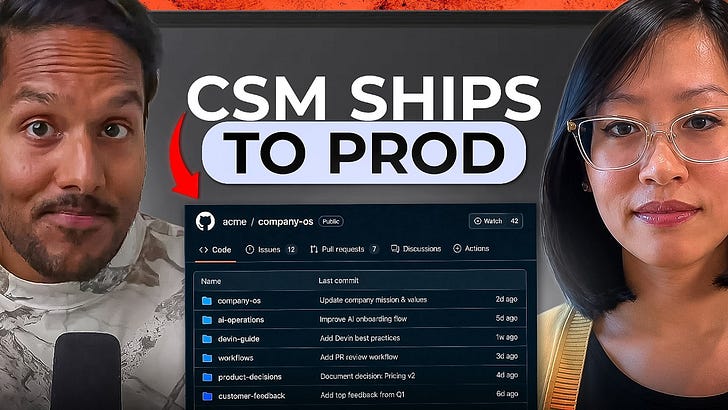 How to Build a Company OS in Claude Code with Jiaona Zhang, CPO at Laurel 24.06.2026 1u 7minToday’s episodeProduct teams have figured out AI for engineering. The PMs are using Claude. The engineers are in Cursor. If you’ve been reading this newsletter from the start, you’ve seen how the top 1% are using AI to 10x their output. But there are still teams at companies like Adobe, teams in sales, customer success, finance, who don’t have access to any of these tools. You ask them what AI to use for their next task, and you get a blank stare.That gap is the real problem. And it compounds every day.Jiaona Zhang “JZ” has built the fix. She is the CPO at Laurel, which just raised $100M in Series C, and she has led product at Airbnb, Dropbox, Webflow, and WeWork. Today she runs a product team that ships frontend and backend features end to end, without any engineering handoff.In this episode, she screen-shares everything. Laurel’s full Company OS built in GitHub, with skill files for every function from CS to legal to finance. The playbook to agent pipeline that turned 50-page docs into automated workflows. The daily Slack briefing that tells every person exactly what to do and which skill to use when. And a ton more.This is one of the densest episodes I’ve ever recorded. The knowledge per minute is as high as it gets.Don’t miss.....----Brought to you by:Ariso - Ship AI agents and features faster, with fewer regressionsBolt - Ship AI-powered products 10x fasterPendo - The #1 software experience management platformProduct Faculty - Get $550 off their #1 AI PM Certification with code AAKASH550C7Customer.io - Send smarter messages using your product data----If you want access to my AI tool stack - Dovetail, Arize, Linear, Descript, Reforge Build, Relay.app, Magic Patterns, Speechify, Bolt.new and Mobbin - become an annual subscriber ($150), and grab Aakash’s bundle.If you want access to my AI PM customizations - PM OS, Job Search OS, and Prompt Library - become a founding subscriber ($250).----Key Takeaways:1. Every company has a 1% who are AI-native and a 99% who do not know what to use when. The Company OS closes that gap by encoding the 1%'s workflows into skills that anyone can use when they open Claude.2. Build the ontology before you build the OS. Map every team's work to categories and tasks first. Color-code what should get more human time vs what gets automated. The OS is built from that work map.3. Even the friction of going to a different interface kills adoption. A separate agent tool in a new tab will not get used consistently. Deliver skills and automations inside Slack and email, where people already are.4. When AI adoption is everyone's responsibility, it is no one's responsibility. Dedicate one person full-time to AI Operations. Start with one person who demonstrates value. Every other function will want their own version within months.5. The Company OS turns a 50-page playbook into a set of agents. Write the playbook first. Then audit it. What requires a human? What can be automated? Build the skill files from what remains.6. The captain model replaces the handoff chain. Every feature has one owner end-to-end. The captain is whoever has the most critical skill for that feature's hardest problem.7. PMs at Laurel ship front-end and back-end features. Not just growth experiments or copy changes. Core product features deeply integrated with billing systems and time entry logic. One PM who identifies as a designer shipped one of these end-to-end last month.8. JZ went from hundreds of reports to 5 PMs and 4 designers. They ship more than ever. Adding people adds coordination cost. In a world where one PM can take a feature from discovery to production in a day, large teams cancel out their own capacity gains.9. The new PM interview is a screen share. JZ asks every candidate to show their actual screen. In 60 seconds she knows their level of AI skills.10. The PM fundamentals never changed. Problem space first. Know why and for whom you are building before you build. The speed changed dramatically. What you are supposed to be doing at the heart of it did not.----Related contentPodcasts:How a VP Uses Claude Without Producing Slop - YouTube | Spotify | AppleHow to Build a Team OS in Claude Code - YouTube | Spotify | AppleHow to Become a Builder PM - YouTube | Spotify | AppleNewsletters:I spent the last week building an OS in Claude CodeI spent 100s of hours building a PM OS for youHow to build product strategy in the age of AI----Where to find Jiaona ZhangLinkedIn - https://www.linkedin.com/in/jiaona/Reforge - https://www.reforge.com/profiles/jiaona-zhangLaurel - https://www.laurel.ai/Where to find Aakash:X - https://x.com/aakashguptaLinkedIn - https://www.linkedin.com/in/aagupta/Newsletter - https://www.news.aakashg.com---PS. Please subscribe on YouTube and follow on Apple & Spotify. It helps!If you want to advertise, email productgrowthppp at gmail. This is a public episode. If you'd like to discuss this with other subscribers or get access to bonus episodes, visit www.news.aakashg.com/subscribe
 -
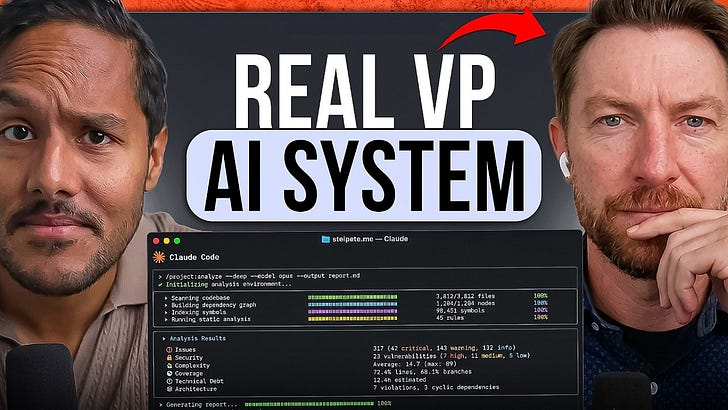 How a VP of Product Uses Claude Without Producing Slop | Matthew Wensing, Customer.io 09.06.2026 50minToday’s episodeThere are hundreds of guides on writing PRDs with Claude. Dozens on running user interviews. Almost nothing on how a VP of product actually uses it.Matt Wensing is VP of Product and Design at Customer.io. They crossed $100M ARR, just shipped an AI agent, and are one of the fastest growing companies in B2B SaaS right now. I asked him to show me his actual documents, his actual Slack threads, and the exact sessions where Claude helped him produce leadership grade output.What he showed me changed how I think about AI for leaders. Claude has the instincts of a brilliant new hire, it wants to deliver before it fully understands what you need, and at the VP level that gap shows up fast. Matt has spent months figuring out how to manage it, and in this episode he shows you everything.----Brought to you by:LogRocket - Find the bugs killing your conversion before your users do. I ran a head-to-head eval to see if that's true.----If you want access to my AI tool stack - Dovetail, Arize, Linear, Descript, Reforge Build, Relay.app, Magic Patterns, Speechify, Bolt.new and Mobbin - become an annual subscriber ($150), and grab Aakash’s bundle.If you want access to my AI PM customizations - PM OS, Job Search OS, and Prompt Library - become a founding subscriber ($250).----Key Takeaways:1. Take inventory before you open Claude - Before building anything, list every piece of raw material you already have. Zoom recordings, strategy docs, past presentations. The quality of what you feed Claude determines the quality of what comes out.2. Pivot content, do not write from scratch - Claude's best use case is transformation, not creation. Give it two inputs and ask it to reorganize one into the shape of the other. Matt calls this matrix multiplication.3. Build slides first - Build the visual story first. Screenshot the finished slides and feed them back into the same Claude session. Ask it to write a talk track that adds depth using all the context it already has, not one that just repeats the slide.4. Kill eager suggestions immediately - The moment Claude asks if you want it to generate the next thing, say stop. You control the pace. A 200-iteration session with a great deliverable beats saying yes to the first draft every time.5. Start sessions in the abstract - If you reveal the domain too early, Claude pattern matches to the nearest template. Keep it abstract. Build a clean mental model first. Reveal the domain only when the framework holds up on its own.6. Layer complexity in slowly - Start with the simplest version of the framework. Let Claude stabilize on the basics before you add exceptions. Dumping everything in at once produces a lost in the woods experience for both of you.7. AI alignment decks always backfire - When you one-shot an alignment deck, you flatten the problem. Senior executives have spent months living with the real complexity. They feel the thinness immediately, even when they cannot say why.8. Decompose the problem before building anything - Challenge yourself to explode a nasty problem into all its pieces before you touch Claude. Put those observations into the context window first. Then assemble the solution.9. The Slack scanner keeps leaders close to the ground - Customer.io built an AI scanner that monitors dozens of Slack channels and surfaces threads where a product person should be involved. It runs continuously without overwhelming. 10. Chiefys audits your strategy docs automatically - Chiefys is a Slack bot that holds Customer.io's ratified company documents and checks new work against all of them. It flags contradictions and stale documents so nothing goes invisible after you ship something new.----Related contentPodcastsPM’s Guide to Claude - YouTube | Spotify | AppleHow to Become a Builder PM - YouTube | Spotify | AppleWe Built an AI Product Manager in 58 mins - YouTube | Spotify | AppleNewslettersHow to Use Claude for WorkHow to Build Product Strategy with Claude CodeThe PM OS----Where to find Matthew Wensing:1:1 Video Consultation: https://intro.co/MattWensingLinkedIn: https://www.linkedin.com/in/wensing/X: https://x.com/mattwensingWhere to find Aakash:X: https://x.com/aakashguptaLinkedIn: https://www.linkedin.com/in/aagupta/Newsletter: https://www.news.aakashg.com---PS. Please subscribe on YouTube and follow on Apple & Spotify. It helps!If you want to advertise, email productgrowthppp at gmail. This is a public episode. If you'd like to discuss this with other subscribers or get access to bonus episodes, visit www.news.aakashg.com/subscribe
 -
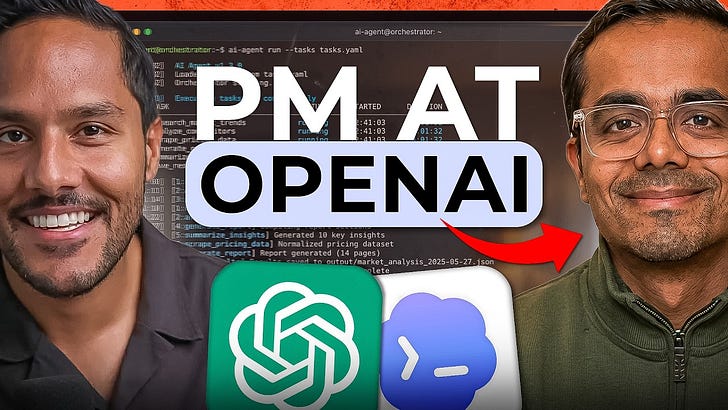 How to Use Codex Like an OpenAI PM | Abhi Muchhal, PM OpenAI (ex-Meta and Nubank) 03.06.2026 1u 7minToday’s episodeSix months ago, I told you Codex is the best way to use ChatGPT for PM work.Most of you tried it. Some of you stuck with it and very few of you are running it the way the people who built it actually run it.Today we get that inside look. Abhi Muchhal is an International Growth PM at OpenAI. Before that, Meta, Nubank, and a founder building on the OpenAI API. He is one of the people responsible for ChatGPT’s growth in India, Brazil, and Japan, markets that are now driving a meaningful share of OpenAI’s 900 million weekly active users.He opened his actual setup on camera. The harness. The automations. The prompts that actually work. And the ones that failed before he figured it out.----Brought to you by:Bolt.new - Ship AI-powered products 10x fasterProduct Faculty - Get $550 off their #1 AI PM Certification with code AAKASH550C7Customer.io - Send smarter messages using your product dataAriso - Ship AI agents and features faster, with fewer regressionsJira Product Discovery - Plan with purpose, ship with confidence----If you want access to my AI tool stack - Dovetail, Arize, Linear, Descript, Reforge Build, Relay.app, Magic Patterns, Speechify, Bolt.new and Mobbin - become an annual subscriber ($150), and grab Aakash’s bundle.If you want access to my AI PM customizations - PM OS, Job Search OS, and Prompt Library - become a founding subscriber ($250).----Key Takeaways:1. The harness is what separates Codex users from Codex runners - The connectors, the permissions model, and the skills layer are the three components that make Codex a system rather than a chat tool. Without all three, you are using an expensive autocomplete.2. Generic prompts hit the wrong data - Abhi's team had separate B2C and B2B tables that both matched "tell me about weekly active users." The generic query returned the wrong answer every time. Specificity is the skill, name the exact dashboard and the exact metric, looks simple but saves a lot of time when you scale.3. Three permission levels - Read tasks get full autonomy. Synthesis and drafts get full autonomy. Anything going to another human gets your eyes first. Treating permissions as binary, all control or all autonomy, breaks.4. The person who cares most builds the skill - One OpenAI growth team built a skill that automates their entire experiment review process. It writes the hypothesis, monitors the run, and prepares the review doc.5. Real automations run without you - Abhi runs three automations before he opens a single dashboard: a Slack triage, a 9:30AM self-refreshing growth dashboard pulling from 7-8 sources, and a weekly stakeholder update that writes its own first draft. He reviews, makes edits if needed, and sends.6. Prototype before you document - Build the working prototype first, then write the 10-question companion FAQ. Showing engineers something that runs changes the conversation from whether to build to how to build it.7. India is OpenAI's second largest market and under 10% of working adults are knowledge workers - The ChatGPT use case that drove US growth does not reach the same share of people in the markets driving the most new users. Building for the world means knowing how different the world actually is.8. The WhatsApp computer use loop ran in 68 seconds - Point Codex at the WhatsApp desktop app. It reads what you missed, identifies action items, checks your calendar, and types the draft in the composer. One tap to send. Every PM building for international markets should run this workflow at least once.9. Speaking evals is the key to breaking into a frontier lab - Name a capability you care about. Describe how you would measure it. Say how you would know if the model improved. You do not need 50 evals under your belt. You need to understand why they exist and what a good one measures.10. Building something real is non-negotiable for frontier lab applications - Abhi had a live Chrome extension running on the OpenAI API at the time of his application.----Related contentPodcasts:The Ultimate Guide to ChatGPT CodexHow PMs Ship 100K Lines of Code at OpenAIEvals are the new PRDNewsletters:OpenAI’s Claude Code KillerAI Agents Guide for PMsHow to Land a $300K+ AI PM Job----Where to find Abhi Muchhal:LinkedIn: https://www.linkedin.com/in/abhimuchhal/OpenAI:LinkedIn: https://www.linkedin.com/company/openai/Where to find Aakash:X: https://x.com/aakashguptaLinkedIn: https://www.linkedin.com/in/aagupta/Newsletter: https://www.news.aakashg.com---PS. Please subscribe on YouTube and follow on Apple & Spotify. It helps!If you want to advertise, email productgrowthppp at gmail. This is a public episode. If you'd like to discuss this with other subscribers or get access to bonus episodes, visit www.news.aakashg.com/subscribe
 -
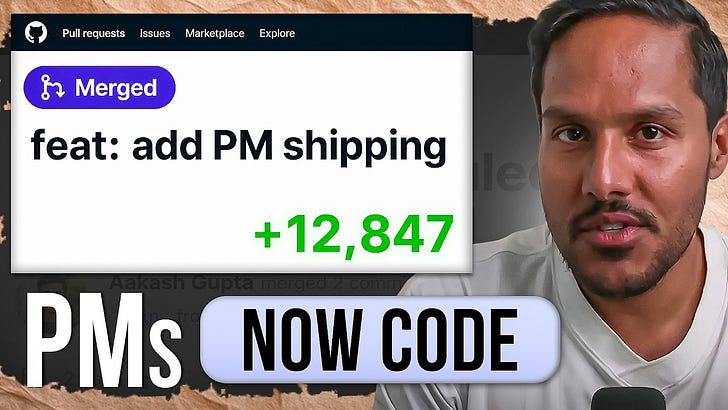 How PMs Ship 100K Lines of Code at OpenAI with Ryan Lopopolo, Member of Technical Staff 25.05.2026 1u 14minToday’s episodeMost companies are still debating whether PMs should ship code.OpenAI is already debating the best ways for PMs to ship code.They’re living in the future.The builder behind a lot of that harness engineering is Ryan Lopopolo. He wrote the OpenAI post on harness engineering and runs a frontier team where PMs, designers, and engineers all ship using the same system.The wild part for me? His PMs shipped around 100K lines of production code.Did they open the IDE? Hell no! Their coding happened through PRDs, tests, docs, and harness rules. The model did the typing.As someone who spent a decade in PM growth roles, I’ve seen how long it takes to move a feature from PRD in a doc to code in prod. For most companies, that latency is weeks.In Ryan’s world, it can be days, and the PM is inside the loop instead of watching from Jira. So I wanted to get to the bottom of this:* What does the harness look like when PMs can ship like that?* How do engineering teams set PMs up so they don’t ship slop?* What changes in the EPD trio when code is cheap, and validation is the bottleneck?That’s today’s episode, and I come with receipts as Ryan goes deep.----Check out the conversation on Apple, Spotify, and YouTube.Brought to you by:* Product Faculty - Get $550 off their #1 AI PM Certification with code AAKASH550C7* Bolt - Ship AI-powered products 10x faster* Customer.io - Send smarter messages using your product data* Ariso - Ship AI agents and features faster, with fewer regressions* Pendo - The #1 software experience management platform----* If you want access to my AI tool stack - Dovetail, Arize, Linear, Descript, Reforge Build, Relay.app, Magic Patterns, Speechify, Bolt.new and Mobbin - become an annual subscriber ($150), and grab Aakash’s bundle.* If you want access to my AI PM customizations - PM OS, Job Search OS, and Prompt Library - become a founding subscriber ($250).----Key Takeaways:1. Code is a liability, not an asset - Every engineering org was built around the assumption that code is expensive to produce, validate, and deploy. Codex inverts this. Code is now the cheapest part of the stack and the constraint moves to how clearly you describe the problem.2. The new constraint is product decisions per week - With code generation effectively free and parallel, the bottleneck is no longer keystrokes. It is the quality of the brief, the clarity of the architectural boundaries, and the speed of verification.3. A billion tokens a day is the new floor - Ryan's claim is that if you are not running this volume you are negligent. The math comes out to roughly $2K to $3K per engineer per month, which is trivial against the headcount cost of human-only execution.4. A single PR can burn 350 million tokens - One refactor that would have taken Ryan three weeks ran on Codex for 60 hours straight across three days. He gave it two prompts total after the initial spec. The output matched what he would have produced himself.5. The harness is the actual product - Codex CLI is the surface. The harness is everything that gets the agent the right context at the right phase. Pre-work, messy middle, and close. Each phase needs different context, different tools, and different verification.6. agents.md is forcibly injected context - This file lives in the repository root and is always loaded into the agent's context. Use it for the operating model and the non-negotiable rules. Everything else gets pulled in dynamically because context is a hard, scarce resource.7. The painted-door technique works inside the codebase - Ryan's team enforces package boundaries so a designer can paint a fake UI on top of stubbed APIs. Real usage signal, no backend cost. This only works because the architecture refuses to permit a ball of mud.8. The PM's PRD can become a shipped PR in one week - In Ryan's setup, the PM wrote a markdown PRD, the team reviewed it in a Monday meeting, and a working feature shipped to customers by the following week with zero PM-to-engineer back-and-forth.9. The Monday morning roadmap starts with legibility - The first move is making the repository legible to the agent. Write the implicit team decisions down in a documentation tree. Use @-mention Codex to keep that tree updated whenever a Slack thread surfaces a new guardrail.10. One agent beats multi-agent handoffs - The lossy friction of agent-to-agent handoffs costs more than it saves. The right answer is one agent with full addressability over design, backend, and frontend, powered by a model good enough to hold the whole task in context.----Where to find Ryan Lapopolo* X* LinkedIn* OpenAIRelated contentPodcasts:* How to Run Evals in Claude Code with Aparna Dhinakaran* How to Build a Full AI Dev Team in Claude Code with Gabor Mayer* This CPO Uses Claude Code to Run His Entire Work Life with Dave KilleenNewsletters:* PM’s Guide to Claude with Pawel Huryn* How to Become a Builder PM with Mahesh Yadav* How to Build a Team OS in Claude Code with Hannah Stulberg----PS. Please subscribe on YouTube and follow on Apple & Spotify. It helps!If you want to advertise, email productgrowthppp at gmail. This is a public episode. If you'd like to discuss this with other subscribers or get access to bonus episodes, visit www.news.aakashg.com/subscribe
 -
 How to Run Evals in Claude Code with Aparna Dhinakaran, Founder and CPO of Arize 22.05.2026 1u 19minToday’s episodeMany of the smartest AI teams I know are running their evals on Arize. Teams at Uber, Booking.com, Pepsi, and others.It’s become one of the most important skills for PMs. I already had on the CEO of Braintrust, Hamel Husain and Shreya Shankar, and Ankit Shukla.Today I’m adding to this knowledge base on evals with a masterclass on evals in Claude Code.Aparna Dhinakaran is the founder of Arize. She’s also their CPO. And she gives a masterclass in how to run all of your evals through Claude Code.So if you want to do AI evals like the best, like Uber, like Booking.com, check out this episode. For anyone in building in Claude Code, it’s a doozy.If a candidate did this in an interview, Aparna said she would hire them on the spot.----Check out the conversation on Apple, Spotify, and YouTube.Brought to you by:* Superhuman - The fastest email experience ever made* Sign up and get 1-month free of Superhuman Mail with my link: superhuman.com/akash (given by brand - Kartik)* Land PM Job - My 12-week AI PM + Job Search Course, first 10 enrollees get a FREE 30-min 1:1 consultation* Vanta - Automate your compliance. Close deals faster* Product Faculty - Get $550 off their #1 AI PM Certification with code AAKASH550C7* Bolt - Ship AI-powered products 10x faster----If you want access to my AI tool stack - Dovetail, Arize, Linear, Descript, Reforge Build, Relay.app, Magic Patterns, Speechify, and Mobbin - grab Aakash’s bundle.Do you want to become an AI PM? I’ve created a course for you. Starts soon.----Key Takeaways:1. Trace before you eval - A trace is the full step-by-step playback of what your agent did. Without it, you have no evidence base for evals. Every LLM call, every tool call, every intermediate output needs to be visible before you write a single eval.2. A span is your unit of evaluation - A span is one discrete step inside a trace. Evals run at the span level, not the trace level. "Did this specific scoring step get the priority right?" is a more useful question than "was the whole run good?"3. Instrumentation is now a one-command job - Claude Code's instrumentation skills can set up observability for your agent automatically. Arize Phoenix's skill looks at your codebase, identifies the LLM calls and tool calls, and wires them to the tracing layer. No engineering support required.4. The vibe eval is a draft, not a verdict - An LLM can suggest what your evals should test by looking at your traces. That suggestion will not know your bug-first policy, your comp logic, or your definition of "critical." Treat it as v0 and refine against your actual judgment.5. When evals fire, two things could be wrong - The agent produced a bad output. Or the eval is miscalibrated. Reading the flagged span yourself is the only way to know which one needs fixing. Both are normal. Both are good news.6. Evals drift and need regular realignment - Your priorities change. Your bug policy changes. Your product changes. An eval calibrated to last quarter will start misfiring this quarter. Regular alignment to human feedback is maintenance, not a failure.7. The self-improvement loop is already running at the best teams - Fetch all spans where evals fired. Group by failure category. Propose a specific prompt fix. Review and approve. Ship the new version. This loop runs on a schedule and requires a human at the approval step.8. Enterprise PMs: start with one internal agent - Not a customer-facing product. An internal tool that takes four hours off your week. Once you have it, you will naturally want to trace it. That is when observability starts to matter to you personally.9. The context graph is the enterprise unlock - Agents are only as useful as the context they have. Enterprise data lives in silos. The teams breaking through are building unified context layers that give one agent access to CRM, Gong, analytics, GitHub, and Slack.10. Product taste is still the alpha - Code is cheap now. Shipping speed is table stakes. The PMs who pull ahead are the ones with the sharpest judgment about what to build, and the loops that make their agents better every day.----Related contentPodcasts:* AI Evals with Hamel Husain and Shreya Shankar* Evals are the new PRD with Ankur Goyal* AI PM Crash Course with Aman KhanNewsletters:* AI Evals for PMs: Everything You Need to Know to Get Started in 2026* Your Complete AI PM Course & Career Roadmaps* AI PM’s Guide to LLM Judges----PS. Please subscribe on YouTube and follow on Apple & Spotify. It helps! This is a public episode. If you'd like to discuss this with other subscribers or get access to bonus episodes, visit www.news.aakashg.com/subscribe
 -
 Claude Code for Non-Technical PMs, with Andre Albuquerque 18.05.2026 1u 9minToday’s episodeThe market is looking tough for non-technical PMs.Every single week, my comments look exactly the same: brilliant product managers who have the vision, specs, and roadmap in mind, but have zero coding skills. They want to build, and while thousands of technical resources exist online, they make a flawed assumption: that you already know how to code.So when I invited Andre Albuquerque on my podcast, I had to ask him to share his setup. Andre is the founder of Builders Camp, a product school with 4,000+ students across 30 countries, who runs five businesses with Claude Code and has never been a developer.Live on the episode, he built a fully functional product from scratch to show how easily a non-technical PM can go from 0 to 1. He also walked me through CLAUDE.md architecture, custom multi-agent skills, and the bridge between Lovable and Claude Code (which, by the way, not many people are talking about).If you have been putting off Claude Code because it feels too technical or intimidating to set up, this episode is absolutely for you.----Check out the conversation on Apple, Spotify, and YouTube.Brought to you by:* Customer.io —* Amplitude — The market-leader in product analytics* Bolt — Ship AI-powered products 10x faster* Arize — Ship AI agents and features faster, with fewer regressions* Product Faculty — Get $550 off their #1 AI PM Certification with code AAKASH550C7----* If you want access to my AI tool stack - Dovetail, Arize, Linear, Descript, Reforge Build, Relay.app, Magic Patterns, Speechify, Bolt.new and Mobbin - become an annual subscriber ($150), and grab Aakash’s bundle.* If you want access to my AI PM customizations - PM OS, Job Search OS, and Prompt Library - become a founding subscriber ($250).----Key Takeaways:1. Non-technical PMs are stuck in Jira, Linear, and PowerPoints - Most European PMs are still product owners in disguise, paper-shuffling between strategy and engineering teams. The way out is to actually start building, not to lobby for more autonomy.2. Start with Lovable on a personal project - Build something for your family, your friends, yourself. The codebase does not need to be pretty. The point is the safety to make mistakes without breaking anything that matters.3. The Lovable + Claude Code bridge nobody documents - Connect both tools to the same GitHub repo. Write code in Claude Code with all its depth. QA visually in Lovable with its hosted preview. Publish from Lovable's button. The perfect transition layer.4. Lovable, Cursor, and Vercel are not competitors - Lovable bundles the IDE, the hosting, and the deployment in one product. Vercel exposes the hosting layer so you can run real branches with real preview URLs. Cursor is just an IDE with a generous free tier.5. Cursor has a free debugging agent - When Claude Code breaks, open a Cursor agent and paste the error. The free agent unsticks you instead of leaving you stuck at step zero.6. CLAUDE.md is your team's culture - Loaded automatically every session. The first rule should be "for every task, call the PM agent." When you notice yourself fixing the same issue twice, update CLAUDE.md so it never happens again.7. The PM agent never writes code - The PM orchestrator's only job is to decide which other agent should handle the work. The researcher investigates. The designer proposes. The engineer architects. The implementer writes.8. Do not copy famous people's skills wholesale - Going on LinkedIn and downloading 100 skills from product celebrities creates more confusion than value. Look at how your real team works. Write each role down as an agent.9. Fix the agent, not the feature - When something ships wrong, do not patch the output. Identify which agent in the pipeline failed, update its instructions, and run the pipeline again. The next session inherits the fix.10. The Monday morning move is exactly three steps - Get added as a collaborator on a low-risk repo. Pick the oldest ticket in the backlog. Push a branch and demo by Friday.----Related contentPodcasts:* Claude Code and agents with Gabor Meyer* n8n, Claude Code, and OpenClaw with Mahesh Yadav* Claude Code with Hannah StulbergNewsletters:* How to Build a Full AI Dev Team* How to Become a Builder PM* How to build a Team OS in Claude CodeP.S. Reply with “CLAUDE” and I’ll send you Andre’s actual CLAUDE.md template. He said we could share it.PS 2. Please subscribe on YouTube and follow on Apple & Spotify. It helps!If you want to advertise, email productgrowthppp at gmail. This is a public episode. If you'd like to discuss this with other subscribers or get access to bonus episodes, visit www.news.aakashg.com/subscribe
 -
 PM's Guide to Claude - When to use Chat vs Cowork vs Code, with Pawel Huryn 14.05.2026 1u 32minToday’s episodeWhen do you use Claude chat vs Cowork vs Code? No one has created a resource that helps you get the most out of the Claude ecosystem.Until now. I’ve brought back Pawel Huryn, the guest behind our most popular episode ever, the Complete Course on AI Product Management.Today we’re covering everything you need to know to get the most out of the Claude Ecosystem.Most PMs open Claude chat. Ask something. Get an answer. Close the tab. Tomorrow, same thing. Fresh context. Zero memory.The PM who tracked Anthropic’s 74 releases in 52 days stopped doing this entirely. He built a system where Claude organizes its own knowledge, extracts its own rules from data, promotes hypotheses when evidence confirms them, and demotes them when it does not. The system improves without him telling it what went wrong.I sat down with Pawel Huryn, creator of the Product Compass newsletter. He has defined 60+ PM skills, built a PM skills marketplace that hit 10,000 GitHub stars, and runs his entire content operation across Cowork, Claude Code, and Dispatch.In this episode, he walks through every screen live. Real files. Real agent workflows. Real self-improving knowledge bases.----Check out the conversation on Apple, Spotify, and YouTube.Brought to you by:* Bolt - Ship AI-powered products 10x faster* Amplitude - The market-leader in product analytics* Jira Product Discovery - Plan with purpose, ship with confidence* Product Faculty - Get $550 off their #1 AI PM Certification with code AAKASH550C7* Land PM Job - 12-week experience to master getting a PM job----If you want access to my AI tool stack - Dovetail, Arize, Linear, Descript, Reforge Build, Relay.app, Magic Patterns, Speechify, and Mobbin - grab Aakash’s bundle.I’m accepting applications for my third LandPMJob cohort. Join Me.----Key Takeaways:1. Stop using Claude Chat as your default. Cowork accesses real files, connects to Gmail and Slack via MCP, and runs parallel sub-agents. Chat does none of this.2. Skills are the highest ROI investment. Install marketplace baselines, iterate 5-6 times with specific feedback, and Claude rewrites from first principles until 99% accuracy.3. Progressive disclosure keeps context clean. Agent reads skill names and descriptions first. Loads full instructions only when the task matches. Hundreds of skills, minimal overhead.4. Your CLAUDE.md should route, not store. Project structure and pointers only. Domain knowledge lives in separate files the agent loads on demand.5. Build self-improving knowledge with three types. Rules are confirmed and applied by default. Hypotheses are tracked with evidence. Rejected patterns are kept to avoid retesting.6. The three-line self-improving prompt works for any domain. Review rules before starting. Apply confirmed rules. Update after feedback. Testing, marketing, strategy, whatever.7. Claude Code adds explorer view, hooks, subagents, and local MCP scoping. PMs need it once their system grows past 50 files.8. Every Product Compass infographic was built in Claude Code. HTML generation, component library, iteration through conversation, PNG export. Zero code written by the human.9. Use Agent Browser from Vercel instead of Chrome MCP. Chrome MCP screenshots every 0.5s and burns $100/hr. Agent Browser uses headless mode and is token-efficient.10. Dispatch lets you run multiple tasks from your phone. Start an infographic, check emails, analyze competitors. Each runs as a separate thread. Your system works while you live.----Where to find Pawel Huryn* LinkedIn* Product Compass Newsletter* PM Skills Marketplace on GitHub* [Quadathon - starts May 9th](VERIFY - Quadathon URL)Related contentPodcasts:* n8n Masterclass with Pawel Huryn* Claude Code PM OS with Dave Killeen* Claude Code Team OS with Carl VellottiNewsletters:* The complete Claude Cowork guide* How to use Claude Code like a pro* Build your PM operating system----PS. Please subscribe on YouTube and follow on Apple & Spotify. It helps!If you want to advertise, email productgrowthppp at gmail. This is a public episode. If you'd like to discuss this with other subscribers or get access to bonus episodes, visit www.news.aakashg.com/subscribe
 -
 How to Build a Full AI Dev Team in Claude Code | Guide from Google PM Gabor Meyer 30.04.2026 2u 15minCheck out the conversation on Apple, Spotify, and YouTube.Brought to you by:* Maven - Get a $675 discount off Gabor’s course with my code* Amplitude - The market-leader in product analytics* Testkube - The leading test orchestration platform* Land PM Job - My 12-week AI PM + Job Search Course starts Monday!* Product Faculty - Get $550 off their #1 AI PM Certification with code AAKASH550C7Today’s episodeHere’s the problem with most Claude Cost demos: they stop at the prototype.Nobody shows what happens next. You try to add a second feature. The first one breaks. The styling reverts to default. The code is so tangled that you spend more time debugging than you saved by generating.Gabor Mayer showed me what happens when you stop treating Claude Code like a magic prompt box and start treating it like a team.He is a PM at Google. He has not written production code in 15 years. But over the past several months, he has been building real mobile apps using 21 specialized Claude Code agents. Not prototypes that live in a demo. Apps that are on the App Store.In today’s episode, he walked through the entire workflow live and share all the resources free.If you want access to my AI tool stack - Dovetail, Arize, Linear, Descript, Reforge Build, DeepSky, Relay.app, Magic Patterns, Speechify, and Mobbin - grab Aakash’s bundle.Do you want to become an AI PM? I’ve created a course for you. Starts next week.Newsletter deep diveThank you for having me in your inbox. Here is the complete guide to building a full AI development team in Claude Code:* Why one-prompt vibe coding fails* The 21-agent team architecture* The spec-first workflow * From design to code without touching either* What changes when PMs actually buildSave this. The full 10-step playbook on one page. Everything below is the why and how behind each step. 1. Why one-prompt vibe coding failsEvery PM I know has built something with Bolt, Lovable, or Replit. The prototype looks great. It runs. It impresses people in a Slack message.Then you try to ship it to real users. And you hit a wall.Blocker 1 - Context compression silently destroys your specThis is the failure mode that nobody talks about in tutorials. When you give one agent one massive prompt, the model compresses context. Details get dropped. Not randomly. Strategically. The model decides what is “important” and what is not.In the episode, Gabor defined a complete color palette. Oranges, neutrals, specific accent tones. The agent received everything. The output used none of it. The layout was there. The structure was solid. But every color was a default.The reason is straightforward. When the context window is full, visual styling details are lower priority than functional logic. So the model drops them. Silently. Without warning. Without an error message. You just get generic output and wonder what went wrong.The fix is not better prompts. It is context engineering. Smaller, scoped tasks. Each agent gets only the context it needs for its specific job. The designer agent gets the brand guideline. The CTO agent gets the architecture spec. Neither gets the full 50-page document.Blocker 2 - AI-generated code compiles but is not maintainableA Reddit comment that hit home for Gabor - “Vibe coding is just the rebranding of unmaintainable, low-quality source code.”This is the real prototype-to-production gap. The code works today. You can demo it. You can push it to TestFlight. But the moment you touch it to add a feature, three other features break. No naming conventions. Circular references between modules. Zero comments explaining why anything was built the way it was.The fix is a dedicated code quality agent. Gabor calls his the Spaghetti Agent. It runs after every sprint and checks naming conventions, circular references, comment coverage, and structural debt. When he ran it on his codebase for the first time, it caught issues he never would have found manually.If you are building anything beyond a one-off demo, this agent is not optional. I covered similar quality patterns in my AI testing guide and my AI evals deep dive.Blocker 3 - No dependency mapping means cascading failuresWhen you build without organizing work into sprints, agents try to build features that depend on code that does not exist yet. Front-end components reference API endpoints that have not been created. Database queries call tables that have not been defined.The Atlassian MCP currently cannot create sprints directly in JIRA. That is a real limitation. Gabor uses tags as a workaround. He tags tickets as Sprint 1, Sprint 2, Sprint 3 and maps dependencies between them manually before starting the build. Without this step, the entire multi-agent workflow falls apart.Every PM who has gone from prototype to production with AI agents has hit at least one of these blockers. The ones who shipped figured out the workarounds. The ones who quit assumed the tools were the problem.Here is what the three blockers look like side by side, and what flips the moment you stop one-prompting and start running a team.2. The 21-agent team architectureYou do not need 21 agents to start. Three will get you surprisingly far. But understanding the full architecture shows you where the complexity lives and which roles to add as your projects grow.Here is the full roster: four clusters, 21 roles, and the markdown file pattern that makes them portable across every project you build next.2a. The core agents every PM needsThe System Analyst is the linchpin. It breaks down product requirements into technical specifications. It asks clarifying questions one at a time. It documents decisions in Confluence. It creates tickets in JIRA. Without this agent, every other agent operates on incomplete context.In the episode, the system analyst asked 14 clarifying questions before a single line of documentation was written. Vector DB choice. Usage limit mechanics. Conversation history handling. Search fallback strategy. API provider. Minimum iOS version. Screen count. Naming conventions. Each question one at a time so the answers stay deep.The prompt pattern that makes this work -“Please act like a good system analyst. Ask clarifying questions until you have a complete and comprehensive understanding. Ask questions one at a time. Do not start writing documentation until all questions are answered.”Two critical instructions. “One at a time” prevents the agent from dumping 25 questions at once. “Do not start writing” stops it from jumping ahead before the spec is complete. Different LLMs have different tendencies. Some love to start coding instantly. You need to explicitly constrain them. This is the same principle behind the prompt engineering techniques that work across any AI tool.The Spaghetti Agent handles code maintainability. Naming conventions. Circular references. Comment quality. Structural debt. Born from that Reddit comment. When Gabor ran it on his codebase for the first time, it caught problems he never knew existed.The UX Flow Architect creates clickable prototypes using Figma’s built-in prototyping arrows. This is a small but important detail. The early versions of this agent placed visual drawn arrows between screens instead of using Figma’s actual prototyping connections. The prototype looked like it had navigation. But when you clicked play, nothing happened. It took months of iteration to fix.Each agent has a specific Claude Code agent markdown file that defines its role, its constraints, and its interaction patterns. The setup mirrors how you would build a Claude Code Team OS for a human team.2b. The real blockers nobody warns you aboutThe Figma MCP color problem. When you connect Claude Code to Figma through the MCP and pass it your full specification, the screens look structurally correct but the colors are wrong. Not slightly wrong. Completely wrong. The model compressed the context and dropped your entire visual identity. The fix is to pass the brand guideline as a separate, focused input to the Designer Agent. Never bundle it with the functional spec.The Atlassian MCP sprint limitation. The MCP currently cannot create sprints directly in JIRA. Gabor uses tags as a workaround. Sprint 1, Sprint 2, Sprint 3. It works. But it means dependency mapping is a manual step in the system analyst prompt, not an automated feature.The consumer app vs Claude Code gap. An agent role you set up in the Claude consumer app does not automatically transfer to Claude Code. You need to define agents separately in both environments. The system analyst in your consumer app conversation is a different instance from the system analyst in your Claude Code agent folder. Your AI PM stack needs to account for this separation.The $200 Max plan economics. On the Max plan, a major build session uses roughly 10% of your monthly allocation. That means you get about 10 full build sessions per month. For a side project, that is plenty. For a production workflow with daily iterations, you need to be deliberate about when you run multi-agent sprints.2c. Why reusable agents beat fresh setupsEvery painful lesson, every edge case fix, every API workaround gets encoded into the agent markdown file. The next project starts from a position of strength. The Spaghetti Agent that took weeks to calibrate on project one is immediately useful on project two. The UX Flow Architect that took months to stop drawing fake arrows works correctly from day one on every subsequent project.This is the compound interest of building with agents. The first project is slow. The second is faster. By the fifth, your agent team is genuinely effective. Gabor’s Maven course walks through the full setup at maven.com/gabor/productbuilder.The 21 agents are not the point. The point is that every role on a software team can be replicated by a scoped, reusable AI agent. Start with three. Add roles when you hit friction.3. The spec-first workflowMost tutorials start with the terminal. Open Claude Code. Start prompting. Start coding.That is backwards. The workflow that actually ships production apps starts in the consumer app. On your phone. Possibly while walking your dog. The process maps cleanly to the PM OS framework that works for any complex project.3a. Define the system analyst role firstBefore you describe your app, you ask the LLM to define what a good system analyst does. This creates a behavioral framework that the agent will follow for the rest of the conversation.The prompt -“What is the difference between a good system analyst and a bad system analyst in a software development team? Be as detailed as possible.”The response gives you a blueprint. Requirement elicitation. Stakeholder management. Process modeling. Dependency documentation. You then instruct the agent to act like a good system analyst.This is the same principle behind AI agents for PMs. Define the role explicitly before assigning the task. It works in Claude Cowork the same way it works in Claude Code.3b. Dictate, do not typeThis is where superwhisper changes the game. In the episode, the app specification was dictated in a single long monologue. Technology stack (Flutter + Firebase). Data storage rules (device-only, no server-side user data). API key security (Firebase Secret Manager, never exposed to front-end). Usage limits (20,000 word cumulative cap with escalating cooldowns). Tone of voice (friendly but firm, like a 20-year referee friend). Vector database configuration (Vertex AI embeddings for IIHF rulebook and Situation Book).Typing that specification would have taken 30 minutes and produced half the detail. Dictating it took five minutes and captured every nuance. The longest dictation prompt in the history of this podcast.Here is the actual prompt, the five-step workflow it kicks off, and the two-word constraint - “one at a time” - that stops the agent from face-planting. The key rule - even if you ramble, even if you are not perfectly concise, the LLM will understand. You lose nothing by over-specifying. You lose everything by under-specifying. This applies whether you are building a prototype or shipping to production.3c. Documentation before designThe system analyst creates the full Confluence documentation before any design or code begins. Product overview. Technical architecture. AI agent specification. Data flow diagrams. API endpoint mapping.Without documentation, every agent operates on partial context. With documentation, every agent operates on the same source of truth. I covered this exact approach in my PRDs guide. The principle is identical whether your team is human or AI.The boring part of building is the specification. The exciting part is watching agents create screens and write code. But if you skip the boring part, the exciting part produces garbage. The PMs who understand product strategy already know this.4. From design to code without touching eitherOnce the specification is locked, the workflow shifts from the consumer app to three parallel tracks. This is where the 21-agent architecture pays off and where most of the real-world friction surfaces.Three tracks - design, tickets, build - running in parallel into four sprints. 72 minutes from idea to App Store submission. Here is the map. 4a. Design through Figma Make and Claude CodeStart in Figma Make. Go to Spotted in Prod. Take screenshots of apps you admire. Feed those into Figma Make to create a brand guideline. Typography. Color palettes. CTA buttons. Error states. Transitions.In the episode, two inspiration images produced a full brand guideline. One of them was a photo of a laptop cover. Figma Make derived custom colors from the image without manual hex entry.Claude Code then used the Figma MCP to build actual screens in Figma based on that style guide. Five screens appeared in real time. Each one matching the brand guideline. The Chrome DevTool MCP lets Claude Code visually verify designs in a browser, catching visual bugs the Figma MCP alone cannot detect.4b. Tickets with the full team reviewThe system analyst creates JIRA tickets. The entire agent team reviews every ticket before development starts. This is the step that separates production builds from demo builds. Same product launch discipline, different toolchain.Designer agent verifies screenshots are attached. Test Architect ensures test coverage. Spaghetti Agent sets naming expectations. Product Council confirms data storage policies. CTO Agent validates architecture. This maps to the AI observability principles I wrote about previously.4c. Sprint execution with the dependency mapping workaroundTickets organized into sprints using tags (Atlassian MCP workaround). Dependencies mapped. Database setup in Sprint 1. API in Sprint 2. Front-end in Sprint 3. Integration in Sprint 4.“Claude, start building. Go for Sprint 1. Once done, Sprint 2, then Sprint 3, and so on. If you have any questions, ask.”Multiple agents work in parallel. The coding phase is the fastest part. On the $200 Max plan, roughly 10% per session.Everything before the code is the hard part. Once those are right, the code practically writes itself. This is true whether you are shipping to production as a PM or managing an engineering team.5. What PMs gain by building with agentsIf agents can spec, design, code, and test, what is the PM actually doing?Making product decisions. The tools just got absurdly faster.Gain 1 - Firsthand understanding of agent behaviorWhen you interact with agents daily, you develop intuition for context window limits, hallucination patterns, and compression behaviors. That intuition directly improves your roadmap decisions. You stop over-scoping agent features because you know where agents break down. You stop under-investing in evals because you have seen what happens without them.Gabor has not written production code in 15 years. But he now understands agent behavior better than most PMs who have only read about it. That understanding compounds across every product decision.Gain 2 - A portfolio that proves competenceA working app on the App Store is undeniable proof. Password-protect a section showing the build process. Confluence docs. JIRA tickets. Agent architecture. That portfolio item says more than any certificate. It says you shipped.Gain 3 - Iteration speed that compoundsThe first build is the hard part. The UX Flow Architect alone took months. The Spaghetti Agent needed weeks of tuning.But once v1 ships, everything accelerates. New features take a morning. The reusable agent files carry forward every lesson. The PM who has shipped one app can ship the next in a fraction of the time. Not because the tools are better. Because their agents are better.Stack those three gains over a year and the gap between PMs who build and PMs who watch stops being a gap. It becomes a moat.You do not need to know how to code. You need a willingness to understand how software works and the patience to specify before you build. If you want to get started, my Claude Code guide walks through the full setup.Where to find Gabor Mayer* Maven course - Go from PM to AI Builder* LinkedIn* XRelated contentPodcasts:* My Claude Code PM OS with Dave Killeen* Claude Code OS Layer with Carl Vellotti* How to Design like OpenAI and Figma with Ed Bayes and Gui SeizNewsletters:* The complete guide to Claude Code* AI agents for PMs* How to build AI productsPS. Please subscribe on YouTube and follow on Apple & Spotify. It helps! This is a public episode. If you'd like to discuss this with other subscribers or get access to bonus episodes, visit www.news.aakashg.com/subscribe
 -
 How to Become a "Builder PM" with n8n, Claude Code, and OpenClaw | Mahesh Yadav (ex-Google, AWS, Meta, Microsoft; Founder LegalGraph AI) 20.04.2026 1u 36minToday’s episodeLinkedIn just changed the title of its product managers to product builders.What does it even mean to be a “builder PM”?Well, tools only get you so far. Learning Claude Code is helpful, but means nothing if you don’t have an understanding of the underlying first principles.That’s today’s episode.Mahesh Yadav created one of our most popular episodes, with over 35K views on YouTube, and now he’s back. Earlier, he taught you AI agents. Today, he’s touching you how to become a builder PM:If you want access to my AI tool stack - Dovetail, Arize, Linear, Descript, Reforge Build, DeepSky, Relay.app, Magic Patterns, Speechify, and Mobbin - grab Aakash’s bundle.I’m giving a free talk on how to get interviews at the top AI PM companies on Thursday, April 23rd 2026 @ 9:00AM PDT. Grab your seat.----Check out the conversation on Apple, Spotify, and YouTube.Brought to you by:* Maven - Build cohort-based courses that scale* Amplitude - The market leader in product analytics* Jira Product Discovery - Prioritize what matters with confidence* NayaOne - Airgapped cloud-agnostic sandbox to validate AI tools faster* Product Faculty - Get $550 off their #1 AI PM Certification with my link----Key Takeaways:1. Builder PM defined - A builder PM talks to customers, figures out what to build, and ships the first version to 10 customers without talking to any developer. The skill is knowing what to build, not knowing how to code.2. Four agent components - Every agent that works has intelligence (model), tools (actions), memory (session context), and knowledge (your company data). Every agent that disappoints is missing at least one.3. n8n for foundations - n8n is the best learning tool because you visually see every component of the agent architecture as separate nodes. Build your first multi-agent system and evaluation pipeline here.4. Claude Code ate three company types - Context companies, action companies, and evaluation companies all got replaced by one agentic loop inside Claude Code. The three pieces collapsed into one tool.5. Computer control is the real unlock - File system access plus bash commands equals full laptop capability. This is why Claude Code went from coding tool to work operating system.6. Long-horizon jobs changed the game - AI agents went from 3-minute tasks to 3-6 hour sustained jobs in six months. This turns Claude Code from assistant to autonomous worker.7. Continuous learning loops - Build a second agent that watches your corrections to the first agent's work. After five repeated patterns, it proposes a skill update. Your tools get better every day.8. OpenClaw pattern - Delegation through existing channels, full machine sandboxing, model-agnostic. Not a product but a pattern that Google and AWS will copy inside their ecosystems.9. AI PM interviews changed - At L5 and L6, product sense questions are being replaced with live building exercises and system design for AI architectures. Pull out Claude Code during the interview or you are already out.10. Compensation trajectory - From $120K at Microsoft to $1.3M at Google over 13 years, doubling every 18 months through AI-focused switches. Left because big companies kill innovation with six-week approval cycles.----Where to find Mahesh Yadav* LinkedIn* Maven CourseRelated contentPodcasts:* Claude Code Team OS with Carl Vellotti* OpenClaw + Claude Code with Naman Pandey* Claude Code OS with Dave KilleenNewsletters:* The complete context engineering guide* How to use Claude Code like a pro* Practical AI agents for PMs----PS. Please subscribe on YouTube and follow on Apple & Spotify. It helps!If you want to advertise, email productgrowthppp at gmail. This is a public episode. If you'd like to discuss this with other subscribers or get access to bonus episodes, visit www.news.aakashg.com/subscribe
 -
 How to Design like OpenAI and Figma 10.04.2026 53minToday’s episodeThe design process you learned is already dead.Most teams still follow the same linear pipeline. Low fidelity to high fidelity to handoff. Sketch it. Spec it. Ship it over the wall. That pipeline was built around a constraint that no longer exists. High fidelity used to be expensive. It is not anymore.I brought in two people who represent both sides of the new design infrastructure.Ed Bayes is a member of the design staff at OpenAI. He leads design on Codex, which just crossed 2 million weekly users with usage surging 3X since the start of the year. He spends 70-80% of his time coding. He still calls himself a designer.Gui Seiz is the Director of Product Design for AI at Figma. He leads design on all their AI features, including the Figma MCP server and Figma Make. His designers are now shipping PRs to production.----Check out the conversation on Apple, Spotify, and YouTube.Brought to you by:* Bolt: Ship AI-powered products 10x faster* Amplitude: The market-leader in product analytics* Pendo: The #1 software experience management platform* NayaOne: Airgapped cloud-agnostic sandbox* Product Faculty: Get $550 off their #1 AI PM Certification with my link----If you are trying to understand the new design workflow, this is the one episode to watch.If you want access to my AI tool stack - Dovetail, Arize, Linear, Descript, Reforge Build, DeepSky, Relay.app, Magic Patterns, Speechify, and Mobbin - grab Aakash’s bundle.I’m putting on a free webinar on Behavioral and AI PM interviews. Join me.----Key Takeaways:1. Code vs canvas is a false dichotomy - The best designers use both fluidly. Canvas for exploration, collaboration, and pixel-perfect craftsmanship. Code for interactions, responsive testing, and the last mile of polish. The question is what you are trying to learn, not which tool to commit to.2. High fidelity is no longer expensive - The entire linear design process existed because building something interactive required engineering resources. That constraint is gone. A functional wireframe takes the same time as a paper sketch.3. The Codex-Figma MCP makes handoff lossless - Import screens from a running React app into Figma with exact pixel values. Border radius, padding, shadows, all one to one. It is not a screenshot. It is a responsive, editable design artifact.4. The reverse direction works seamlessly - Make changes in Figma, paste a component link into Codex, and it updates your code automatically. No redline spec, no handoff document.5. Ed spends 70-80% of his time coding and still calls himself a designer - The medium changed but the mandate did not. Designers are still the voice of the user, still upholding craft. The tools expanded, the role stayed.6. Figma designers are shipping PRs to production - Teams that six months ago were AI curious are now banging down the door. Monetization designers who never wrote code are building technically complex prototypes.7. "Prototypes, not PRDs" is the emerging norm - PMs at OpenAI bring working prototypes to design reviews. They ship PRs to stress-test ideas before handing off to engineering.8. You do not need permission to start - Someone from OpenAI's GTM team built an iOS app with zero experience. Download Codex and build something for yourself tonight.9. Curiosity is the defining skill for this era - Not code proficiency, not design talent. The AI is an infinitely patient tutor. Ask questions. Build understanding alongside output.10. Total football is the mental model - Every player can play every position. Roles still have natural spikes. But the tool constraints that enforced rigid boundaries are dissolving.----Where to find Ed Bayes* LinkedIn* OpenAI* XWhere to find Gui Seiz* LinkedIn* Figma* XRelated contentPodcasts:* Xinran Ma - Design with AI* Carl Vellotti - Claude Code PM OS* Codex PM Guide with Carl VellottiNewsletters:* AI prototyping for PMs* The PM guide to Bolt* Codex PM guide----PS. Please subscribe on YouTube and follow on Apple & Spotify. It helps!If you want to advertise, email productgrowthppp at gmail. This is a public episode. If you'd like to discuss this with other subscribers or get access to bonus episodes, visit www.news.aakashg.com/subscribe
 -
 How to build a Team OS in Claude Code with Hannah Stulberg, PM @ DoorDash 07.04.2026 1u 10minToday’s episodeThe way PM teams are trending, one PM is going to support 20 people.Not just engineers. Designers. Analysts. Strategy partners. GTM. Sales. Support.You cannot answer everyone’s questions about everything. You cannot be in every Slack thread. You cannot be the bottleneck for context that already exists somewhere in a Google Doc no one can find.But you can give them a high-context, well-organized repo.Hannah Stulberg is a PM at DoorDash and a former Google PM. She has spent over 1,500 hours in Claude Code.She wrote the viral Claude Code for Everything series. Her setup is not a personal productivity system. She has structured her entire team’s context into a shared repo that everyone queries.Her strategy partner - completely non-technical - puts up pull requests every day. Her engineers query metric definitions without asking the analyst. Her designers pull product context without waiting on a PM.If you are building a team that runs on AI, this is the episode to watch.----Check out the conversation on Apple, Spotify, and YouTube.Brought to you by:* Bolt: Ship AI-powered products 10x faster* Jira Product Discovery: Plan with purpose, ship with confidence* Kameleoon: Leading AI experimentation platform* Amplitude: The market-leader in product analytics* Product Faculty: Get $550 off their #1 AI PM Certification with my link----If you want access to my AI tool stack - Dovetail, Arize, Linear, Descript, Reforge Build, DeepSky, Relay.app, Magic Patterns, Speechify, and Mobbin - grab Aakash’s bundle.I’m putting on a free webinar on Behavioral and AI PM interviews. Join me.----1. Build a Team OS, not a personal OS - A shared repo where every function checks in work. Engineers, designers, and analysts self-serve without asking the PM.2. Root CLAUDE.md is everything - Doc index, team roster with Slack IDs, channel map. Keep under one page or you burn context every session.3. Nested indexes save 97% of context - Every folder gets a navigation CLAUDE.md. A customer query used only 3% of the context window.4. Three token tiers - Always-loaded root (~500 tokens), folder indexes on navigation (200-500), content files on demand (1,000-10,000+).5. Split analytics by product area - Metrics, queries, schemas separated. Progressive loading prevents waste.6. Gate launches on repo updates - Feature not shipped until metrics, queries, schemas, and playbooks are checked in.7. Verified playbooks kill hallucinations - Analyst-audited methodology. Claude follows verified steps instead of inventing its own.8. Plan mode makes 10x docs - Shift+Tab twice. Five phases: load context, ask questions, build plan, push thinking, review agents.9. Split long docs across parallel agents - Each writes to a temp file. Orchestrating agent compiles. Prevents context overflow.10. The flywheel compounds daily - Automate one task, free time, improve the repo. After 1,500 hours still iterating every day.----Where to find Hannah Stulberg* LinkedIn* In the Weeds SubstackRelated contentPodcasts:* My Claude Code PM OS with Dave Killeen* Claude Code + Analytics with Frank Lee* Claude Code as PM OS with Carl VellottiNewsletters:* The ultimate guide to context engineering* Build your PM operating system* How to use Claude Code like a pro----PS. Please subscribe on YouTube and follow on Apple & Spotify. It helps!If you want to advertise, email productgrowthppp at gmail. This is a public episode. If you'd like to discuss this with other subscribers or get access to bonus episodes, visit www.news.aakashg.com/subscribe
Vergelijkbare podcasts


Populair in
Deze podcast verschijnt ook in de podcastlijsten van deze landen.


