
Dialectic
Jackson Dahl
0
Dialectic is a podcast that features conversational portraits of original people across technology, media, business, and creativity. Hosted by Jackson Dahl, each episode delves into the stories and insights of interesting individuals. The show aims to capture the unique perspectives and experiences of its guests.
Afleveringen
-
 59: Joe Gebbia - Design We Deserve 08.10.2026 1u 49minJoe Gebbia (Website, X, LinkedIn, Wikipedia) is the first U.S. Chief Design Officer, leading the National Design Studio. He is also the co-founder of Airbnb and Samara. The NDS and this role were created by executive order of President Trump in August 2025. I met Joe Washington, D.C, to reflect on the past year and talk about bringing the care and ambition of great product design to the digital services that every American uses. Joe & NDS just launched America.gov, their flagship project of the last year: the central entry point for how Americans get what they need from the government. Joe believes that design is how you respect and value the people who use a product or service. At Airbnb, that meant helping strangers feel comfortable in each other’s homes. In government, it means refusing to accept a low bar for the websites and processes that Americans use to interact with the government. We begin with CritBuns, Joe’s RISD project that taught him that design is as much about storytelling as it is about product. Then, we discuss what he learned about designing for trust at Airbnb and his initial work at DOGE, streamlining and digitizing the federal retirement process. Joe walks me through America.gov, a single, AI-powered front door to government services. We discuss the challenges of scale and designing for people who are skeptical of both government and AI, including what it means to pass the “grandma test.” We wrap up with why ambitious technologists should aspire to work in government and his collaboration with Airbnb co-founders Brian Chesky and Nathan Blecharczyk. I hope this conversation raises your expectations for the things we’ve learned to tolerate, and inspires you to think about how you might serve your community or your country. Full transcript & links at dialectic.fm/joe-gebbia --- Dialectic is presented by Notion. As new models and agents arrive constantly, Notion acts as a context and consolidation layer for all the ways you and your team work with AI: a command center or simply a resilience layer, so your context comes with you even if you switch models or agents. You can also work with agents right inside Notion and share skills with your team through the Skills API. Learn more at notion.com/dialectic. --- Timestamps: 0:00 Opening Highlights 1:26 Intro: Joe Gebbia 4:12 CritBuns & Why Design is Half Story 15:24 Airbnb, The Feeling of Belonging, & Designing for Trust 28:29 Public Service & Fixing Federal Retirement 42:16 Speed, Craft, and Respect 48:43 ND Studio Projects: TrumpRx, Trump Accounts, and Realfood.gov 56:18 America.gov: A New Front Door to Government 1:05:35 Trust, Privacy, and Government AI 1:15:30 America.gov’s Roadmap 1:19:54 Recruiting for ND Studio and Public Service 1:23:41 Reflecting on Year One & Passing the Grandma Test 1:31:05 A Ticking Clock Toward 2028 & Building Beyond One Administration 1:35:44 AI & Product Development 1:38:36 Closing Questions: Charles & Ray Eames, AirBnB Co-Founders, & Trust in People
 -
 58: Adam Mastroianni - Let Me Be Useful 01.10.2026 2u 6minAdam Mastroianni (Website, X) is an experimental psychologist and the writer of Experimental History. He earned his PhD in psychology at Harvard before leaving academia to pursue research and writing independently. I first came across Adam through “Good conversations have lots of doorknobs,” which remains one of my favorite essays on Substack. We talk about why psychology is stuck, why science needs people willing to look stupid, and how prestige can lead you toward a life you don’t want. From there, unpack Adam’s coffee bean test for figuring out what to do, getting “de-bogged,” and what improv teaches us about better conversations (or: create doorknobs). We also discuss writing that surprises its author, his upcoming book, The Strangest Idea in the World, and the prayer he says before publishing: “Let me be useful.” I hope you leave a little more willing to question what seems obvious, risk looking stupid, and spend your time in ways you actually enjoy. Transcript & links: https://dialectic.fm/adam-mastroianni --- Dialectic is presented by Notion. Notion is an AI-powered connected workspace where teams think together and create their best work. Notion AI works across your documents and context, while custom workers can automate recurring tasks and connect with your other tools. You can also explore Notion’s Knowledge Board, which evaluates how AI models perform on real knowledge-work tasks. Learn more at notion.com/dialectic. --- This episode is supported by Google. Google Antigravity is Google’s agentic development platform. Describe what you want to build, and its agents can plan the work, write and run code, and test the result, with plans and changes you can review along the way. Gemini 3.5 Transcribe turns audio into text with a choice of verbatim and Smart modes. Verbatim mode keeps fillers and false starts, and supports speaker labels and word-level timestamps to help you check the transcript against the recording. Smart mode removes filler words and repetitions and formats speech into readable text. I used Antigravity and Gemini 3.5 Transcribe to build a Mac app for producing and reviewing Dialectic transcripts. --- Timestamps: 04:33 Start: Why Psychology is Stuck & The Focus of Adam's Blog 14:43 The Scientific Virtues of Stupidity and Rebellion & Escaping the Prestige Trap 25:08 Patronage for Weirdos 33:53 Progress in Psychology 52:15 Figuring Out What to Do, The Coffee Bean Test, and Unpacking Adam's Day-to-Day 01:03:22 Getting De-bogged and Making Ideas Land 01:14:11 Conversational Doorknobs: Giving and Taking 01:22:23 Blogging, Community, and Rules we Invent 01:28:35 Writing Advice, Thick Art, Giving The Reader an Egg to Crack 01:44:03 Adam's First Book: The Strangest Idea in the World 01:53:23 Closing Questions
 -
 57: Immad Akhund - The Art of Irrational Effort 24.09.2026 2u 1minImmad Akhund (X, LinkedIn) is the co-founder and CEO of Mercury. He is also a prolific angel investor and co-hosts the Founders in Arms podcast. Mercury is a fintech banking platform used by one in three startups. It is Immad's fourth company in 20 years of entrepreneurship. Mercury is in the process of becoming an FDIC-insured bank and recently launched Mercury Books, AI-powered accounting software. Immad grew up in Pakistan, moved to London at nine, and left for San Francisco at 23 to become an entrepreneur "for real." Mercury is built on something rare in finance: a willingness to spend a disproportionate amount of energy on details, the kind of care Immad admits "seems irrational.” We start with a simple question (what is a bank?) and discuss why banking stayed bad for so long, what stays hard as AI makes software easy to build, and why Mercury's motto is "be extremely helpful." Entrepreneurship has shaped Immad's life, and he hopes Mercury can empower a generation of entrepreneurs. I hope you come away a little more annoyed by the mediocre things we've all learned to tolerate and inspired to put an irrational amount of care into making them better. https://dialectic.fm/immad-akhund --- Dialectic is presented by Notion. Notion is an AI-powered connected workspace where teams think together and create their best work. It works with all of your agents and keeps context across them and your team. Check out the new Notion Skills API. You can learn more at notion.com/dialectic. --- Timestamps: (0:00) Opening Highlights (1:50) Intro: Immad Akhund (4:16) Start: Banks and Why Immad Was Suited to Build One (20:30) What Traditional Banks Do Well & What Mercury Got Right (29:33) Why Mercury Wants a Bank Charter (35:57) What's Scarce When Software Is Easy (49:00) Becoming the Default for New Entrepreneurs (53:34) Product: 100 Little Things Better (1:06:51) The Right to Win (1:09:19) Brand as Care (1:15:19) Culture and Being Extremely Helpful (1:22:51) Command, Agents, and AI (1:34:26) Ambition, Investing, and Leading (1:46:54) Family, Pakistan, and America (1:52:56) Money, Freedom, and Energy (1:59:14) Outro
 -
 Independent Study: Personal Renewal by John W. Gardner (Speech) 16.09.2026 29minIndependent Study is a series of bonus episodes to accompany the interviews on Dialectic. I read essays and other writing that has influenced me. "Personal Renewal" was given as a speech by John W. Gardner to a group at McKinsey & Company in Phoenix, AZ on November 10, 1990. The transcript is available at PBS here. John W. Gardner was a public servant, educator, and public reformer. Learn more at PBS. This is one of my favorite things I've ever read. I hope you are similarly inspired. Transcript and audio for the also mentioned David Foster Wallace's "This is Water" available here, from Farnam Street. https://www.pbs.org/johngardner/sections/writings_speech_1.html
 -
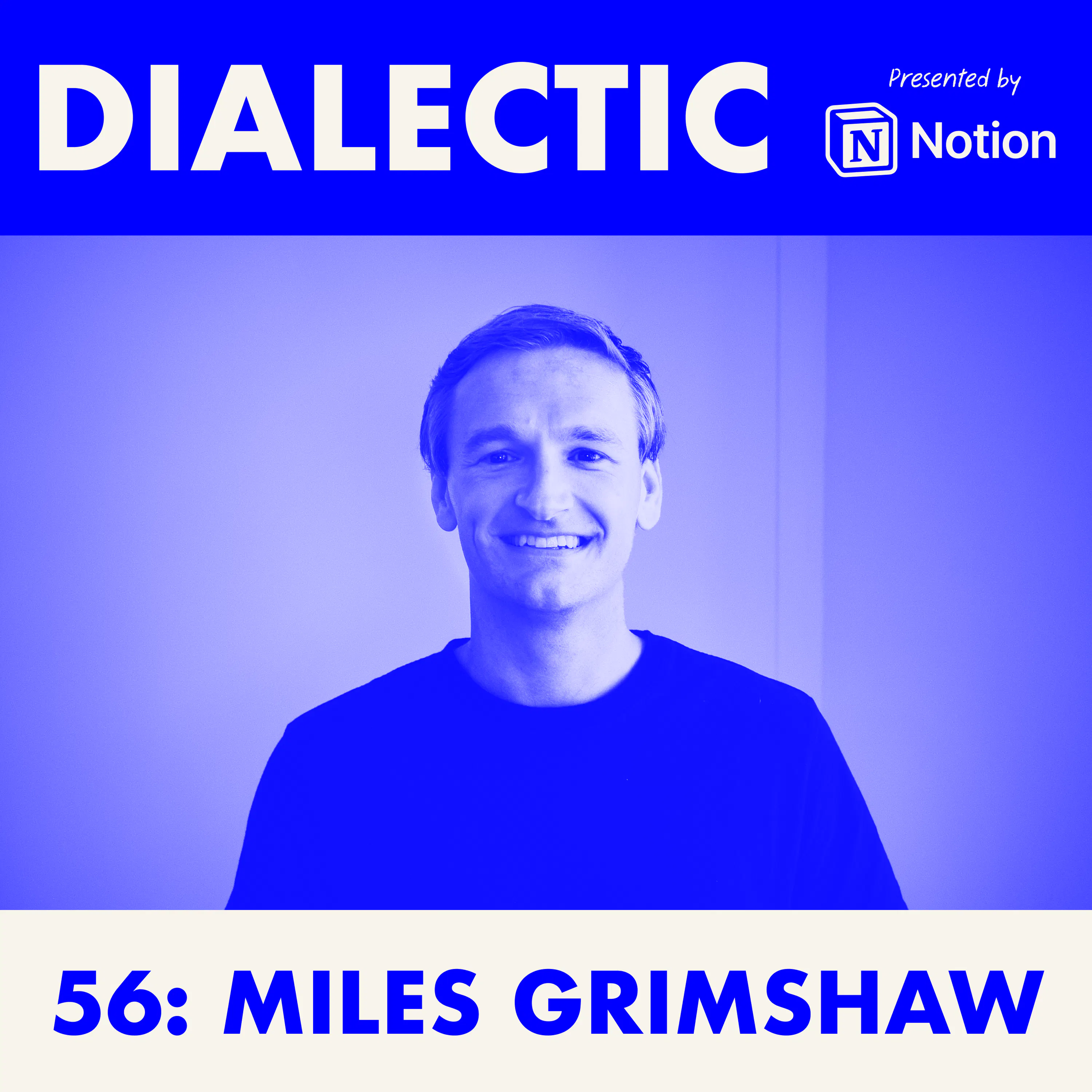 56: Miles Grimshaw - Back Down the Mountain 01.09.2026 1u 53minMiles Grimshaw (X, LinkedIn) is an investor at Thrive Capital. He’s spent most of his career there, there, partnering with founders at the early stages of company building, including Cursor, Turbopuffer, Chai Discovery, Mesh Optical, Revel, XDOF, Socket, Benchling, GitHub, and many more. Miles was also briefly an investor at Benchmark before returning to Thrive in 2024. The conversation focuses on Miles’ appetite for change and continuing to begin anew, again and again. That starts with “adventure racing” as a teenager, and continues through his career as an investor in search of world-changing companies. We talk about how Miles proactively puts himself in position to work with great founders in a style that resembles courtship, his disposition of impatient patience, and why he loves change. The latter includes the dramatic shift in his primary domain: software. As the underlying assumptions for software businesses change due to AI, what traits will great companies have? And what moats if any will persist? Is software investing over? Miles also talks through how great companies and founders go where they are looking, prioritizing customers that help you live in the future, the learned intuition of greatness, and joining the expedition squad alongside the founders Thrive partners with. Finally, we talk a bit about Thrive, his departure to and return from Benchmark, and endurance. I hope you are inspired to find an infinite game where you are excited to see the stone roll back down the hill and begin to push again. Transcript & links available at https://dialectic.fm/miles-grimshaw Disclaimer: This podcast is for informational purposes only. The views expressed are the speaker's own as of the recording date and are subject to change. Thrive funds and their affiliates have investments in certain companies discussed in this episode. References to those companies are illustrative, do not represent all investments made by Thrive, and should not be viewed as recommendations or indications of future investment performance. Past performance is not indicative of future results. --- Dialectic is presented by Notion. Notion is an AI-powered connected workspace where teams think together and create their best work. Notion's custom agents are AI teammates that handle recurring work across your tools. Learn more about their new developer platform and workers here. Notion is hiring across product, storytelling, design, engineering, and more. You can learn more at notion.com/dialectic. --- Timestamps (0:00) Opening Highlights (1:37) Intro: Miles Grimshaw (4:30) Infinite Games, Adventure Racing, and Starting Anew, Over and Over (11:01) Staying Hungry: Proactive Hunting and the Turbopuffer Story (17:35) Impatiently Patient: Courtship, Cursor, Recruiting, and Joining the Team (25:33) Loving Change: London to America, the Himalayas, and Learning New Sports (31:36) The Genetics of Companies: "What Is It?" and "Who Cares?" (38:08) House Cats & Tigers: Where Is the Founder Looking? (47:00) Confidence in Uncertainty and Customers That Pull You Into the Future (54:25) What Remains for Software: Moats, Cities, Wall-Clock Time, and the Barbell of Scale & Luxury (1:04:54) Craft, Trust, and Why Software Isn't Over (1:11:13) Intuition: Gradient Descent and Seeing Greatness Up Close (1:18:07) "I Don't Know" and "I'll Figure It Out" (1:22:12) Commitments, Not Bets: Closing People and Board Work (1:29:06) Joining Thrive, Being a Punk, and Music Studios over Jury Trials (1:36:18) Leaving for Benchmark and Returning to Thrive (1:43:18) Dream Bigger: Lessons from Josh, Teaching Agency to Kids, and Going the Distance (1:51:36) Outro
 -
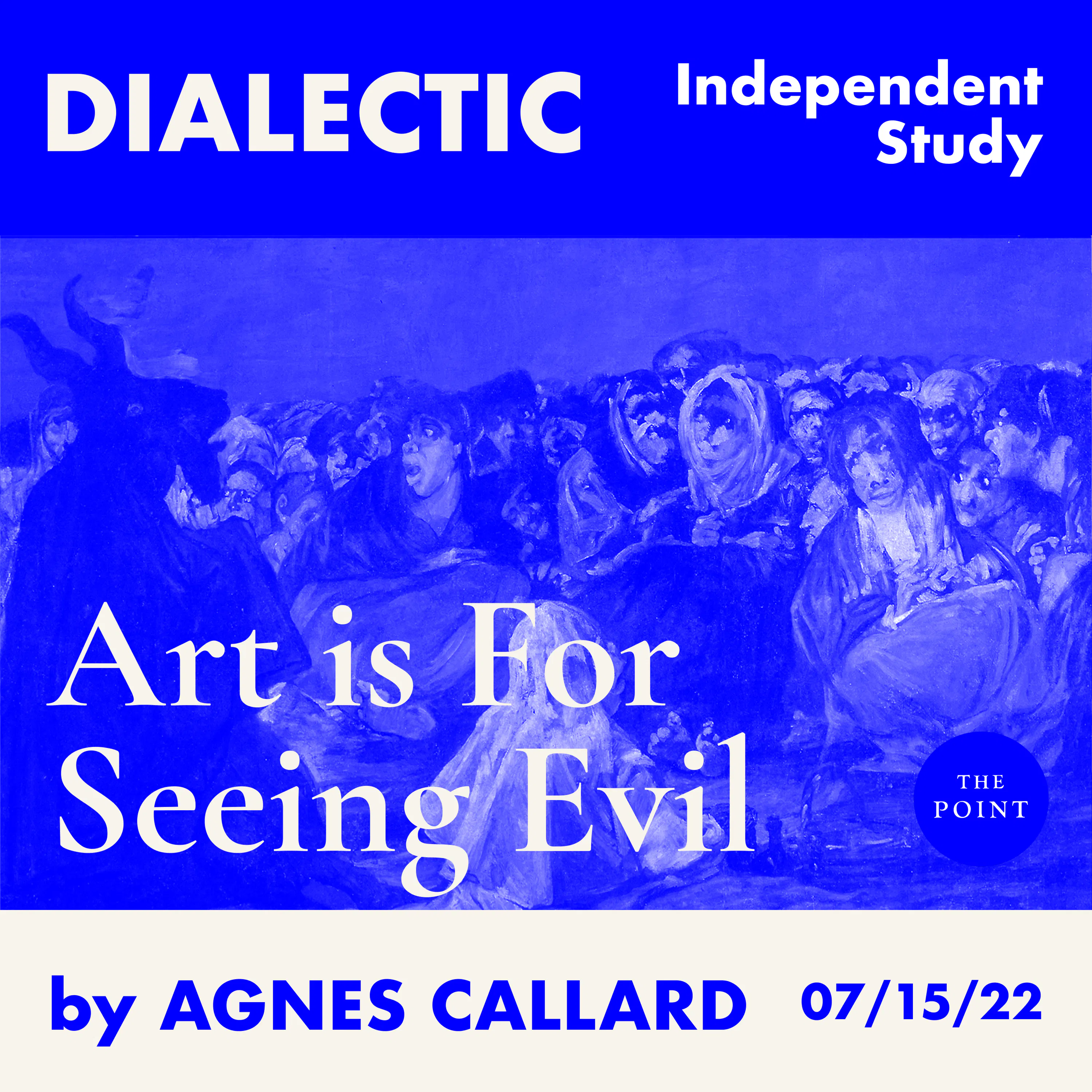 Independent Study: Art is For Seeing Evil by Agnes Callard (Essay) 25.08.2026 26min“Art is For Seeing Evil” was published by Agnes Callard for The Point Magazine on July 15, 2022. My thanks to Agnes and The Point for permission to share this audio version of her essay on Dialectic’s feed. https://thepointmag.com/examined-life/art-is-for-seeing-evil/ Agnes Callard (UChicago, Substack, X, Wikipedia) is a professor of philosophy at The University of Chicago, focused primarily on ancient philosophy and ethics. She also writes for The Point, The New York Times, and more. I particularly enjoyed her recent conversation with Derek Thompson on her theory of the “uni-context.” This essay was shared with me by Nan Ransohoff, (Ep. 51). I hope you enjoy it!
 -
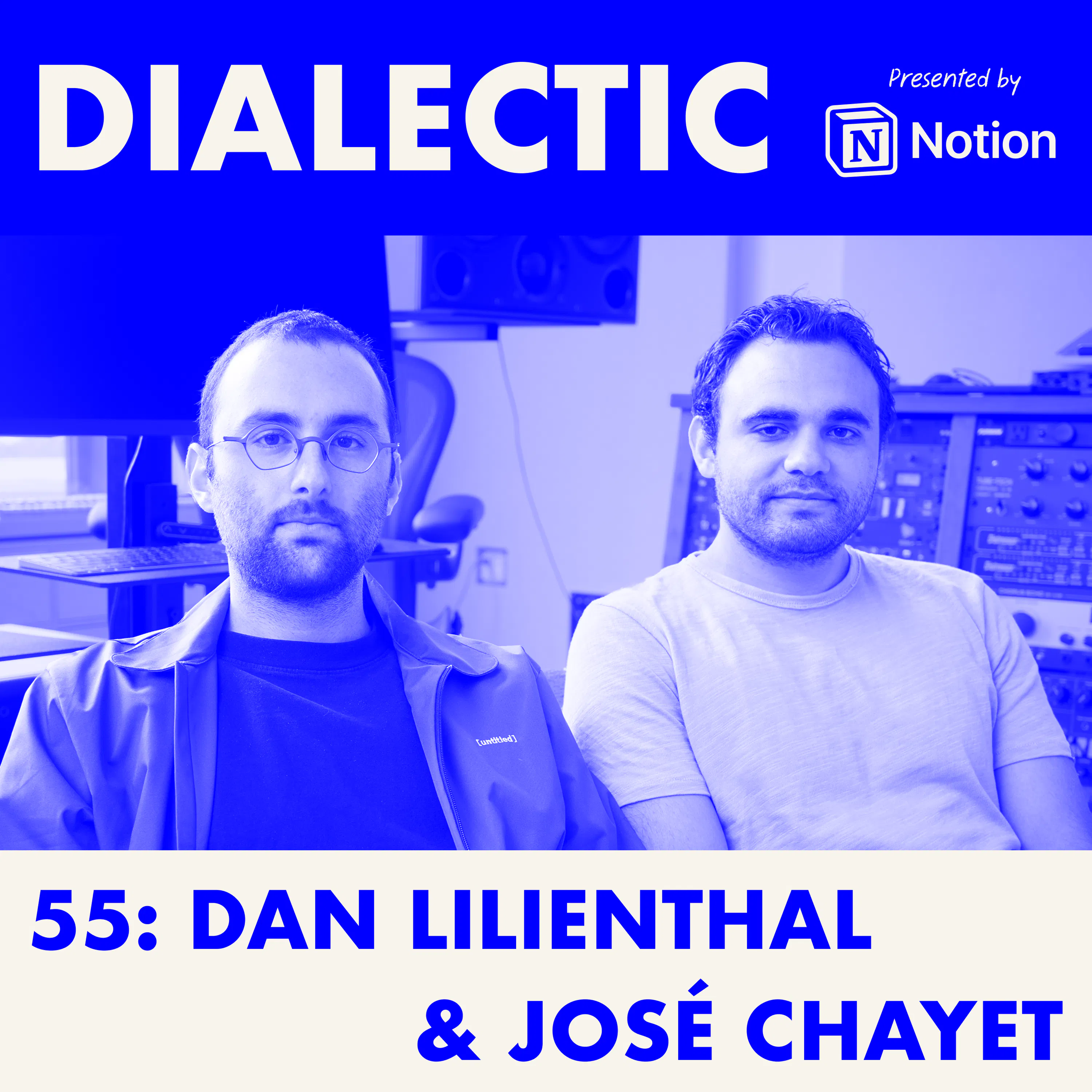 55: Dan Lilienthal & José Chayet - As [untitled] as it Comes 18.08.2026 2u 10minDan Lilienthal (X, LinkedIn) and José Chayet (X, LinkedIn) are childhood friends and cofounders of [untitled] (X, Instagram), a platform for musicians that they describe as a sacred place for work-in-progress music. It is where a song lives between recording and streaming. [untitled] is closer to the Photos app than to a social network: a private place to store, listen to, and slowly share demos, with no feed. Dan and José are not trained musicians, engineers, or designers, but they have built a product artists love by “method acting” their way into deep empathy. The platform has grown to 50K paying users and now allows artists to share unreleased music directly with fans. Lorde recently released XRAYS on [untitled]: 49 demos and works in progress from her album Virgin, creating a kind of museum behind the record. We discuss music as a form of communication and a connection to the divine; why they have resisted adding a feed; product inspirations like the iPod and Snapchat; how empathy and QA underpin their product philosophy; designing for 16-year-olds and superstars; AI as an instrument; which parts of the creative process are worth sharing; what it means for software to be sacred; and building a company with your best friend. I hope you’re inspired to consider what is sacred, share and live with the things you make, seek out music that inspires you, and stay untitled a little longer than is comfortable. Full transcript and all links: dialectic.fm/untitled This episode on [untitled]. - Dialectic is presented by Notion. Notion is an AI-powered connected workspace where teams think together and create their best work. You can learn more at notion.com/dialectic. - Timestamps: (0:00) Opening Highlights (1:24) Intro to Dan & José & Thanks to Notion (4:42) Start: Brackets, How Creativity Makes the World Bigger, and Music's Connection to the Divine (20:40) Duchamp, Music as a Set of Choices, and The Museum Behind the Work (27:52) [untitled]: A Medium for Music In-Progress (45:03) From a Better Dropbox to a Creativity Company (52:13) Empathy as a Product Philosophy and The Collaboration's Origins (1:01:04) Scaling the Sacred Place and Product Intuition (1:10:33) Lorde's XRAYS Drop and Designing for a Wide Range of Artists (1:17:26) 10K Unheard Songs and Whether Process Should be Seen (1:24:10) Brand, Trust, Alignment with Artists and the [studio] (1:30:54) The Word "Sacred" and Resisting the Feed (1:40:52) AI as an Instrument: Building Tools Artists Actually Want (1:49:27) Building a Company with Your Best Friend (1:56:31) Closing Questions: Dream Users, Rapid Fire Brackets, and Titles (2:08:52) Thanks Again to Notion
 -
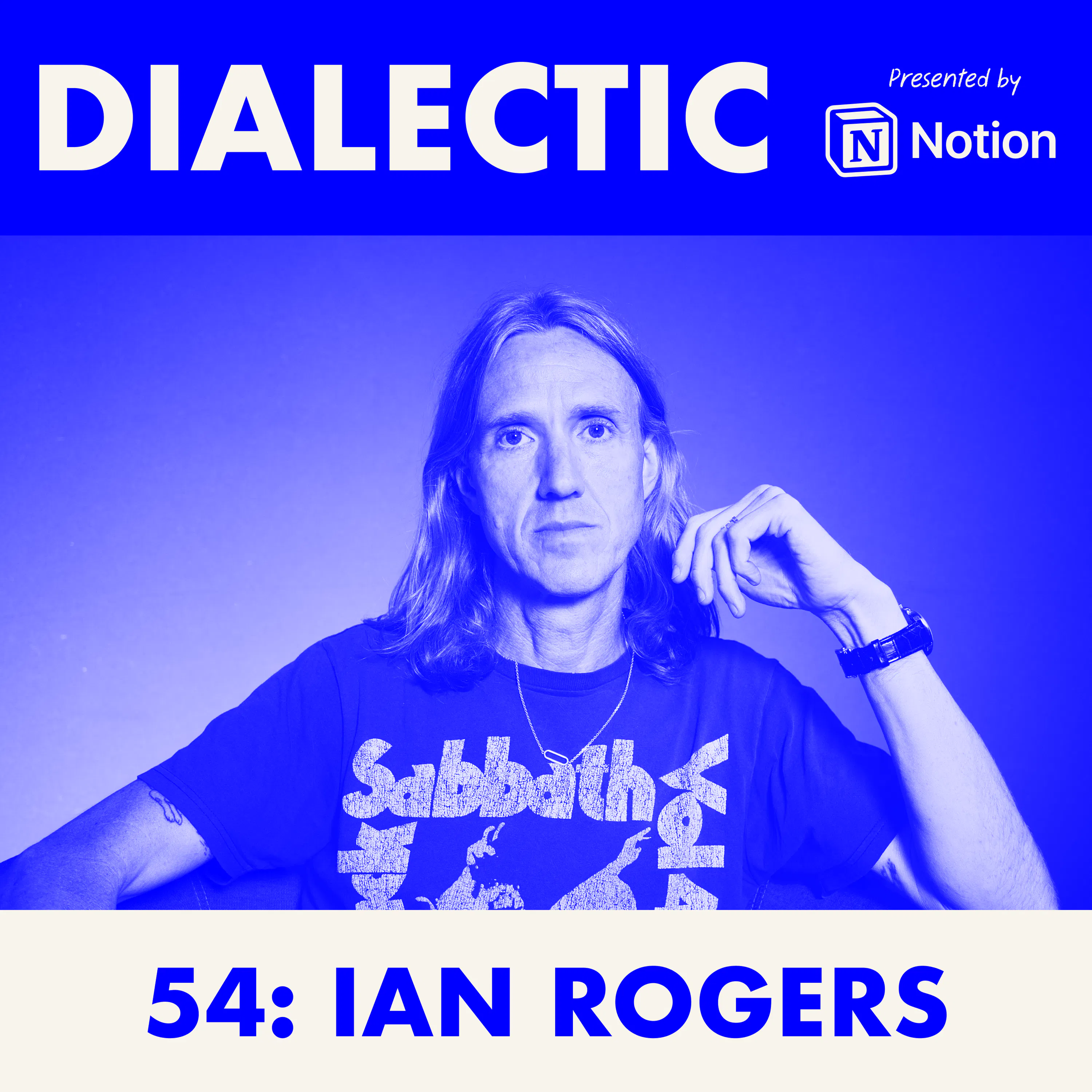 54: Ian Rogers - Never a Spectator 18.08.2026 2u 37minFull transcript and all links and references: dialectic.fm/ian-rogers. Ian and I made a playlist with albums/songs mentioned here (Apple, Spotify). Ian Rogers (X, LinkedIn) is Chief Human Agency Officer of Ledger, the Paris-based security company whose hardware wallets secure much of the world's crypto. He now focuses on how Ledger can enable us to work with AI agents while maintaining our secrets and value. His career has spanned music, culture, brand, and "the technolog(ies) people are going to hate next." He built and ran the Beastie Boys web presence in the 90s before working on music on the internet for over a decade: file sharing Nullsoft (Gnutella and WinAmp), early streaming at Yahoo!, direct-to-fan commerce at Topspin, Beats Music, and finally Apple, as an abbreviated list. He then joined LVMH as its first Chief Digital Officer, working with Bernard Arnault and its many Maisons to bring them into the internet era. More recently, he joined Ledger to improve its product experience, including collaborating with Tony Fadell to create Ledger's flagship form factor, Ledger Stax. Ian's roots are skateboarding and music, which formed alongside a punk rock ideology while growing up in Indiana in the 1980s. I am glad to have captured a long conversation that covers the many flavors of Ian, and the threads that have persisted through his many lives. That includes: individuality; being a participant, not a spectator; what makes a scene; building brands; trying to help Kanye; and why new culture is always being made—it's just that you have to find the 1% that's awesome. Also: ushering forward and translating frontier technologies; being pushed by Jimmy Iovine; why security matters in the AI era; why AIs aren't people; what he wants to automate; learning to fail; advice on relationships across work, parenting, and love; and a whole lot of love for music—from his 2026 pick Twisted Teens to his desert island albums to tea with Paul McCartney. I hope you're inspired to participate in the world and make great things. Thanks to our friends at Ledger for hosting me. --- Dialectic is presented by Notion. Notion is an AI-powered connected workspace where teams think together and create their best work. You can learn more at notion.com/dialectic. --- Timestamps (0:00) Opening Highlights (1:37) Intro to Ian & Thanks to Notion (5:22) Start: Tattoos, Individuality, and Punk Rock: Spectator vs Participant (16:44) What Makes a Scene? (25:24) New Culture, 99% of Everything is Garbage, Finding the 1% (40:09) Niche, Quality, and The Blockbuster vs. The Snowball (53:35) Brand, Selling Culture Before Product, and The Age of the Individual (1:08:12) Aggression, Patience, and Being Pushed (1:16:52) Translating New Technologies, Empowerment, and Agency (1:25:19) Interfaces, Ledger, Security, and Ideology (1:39:56) Ian's New Role: Chief Human Agency Officer (2:06:03) Seeing What is Real, Comfort Being Wrong, Chasing What's Fun and Cool (2:13:45) Lessons from Skateboarding and Favorite Albums (2:22:56) Working with Your Friends, Parenting, Love, and Remembering to Stay a Participant (2:35:47) Thanks Again to Notion
 -
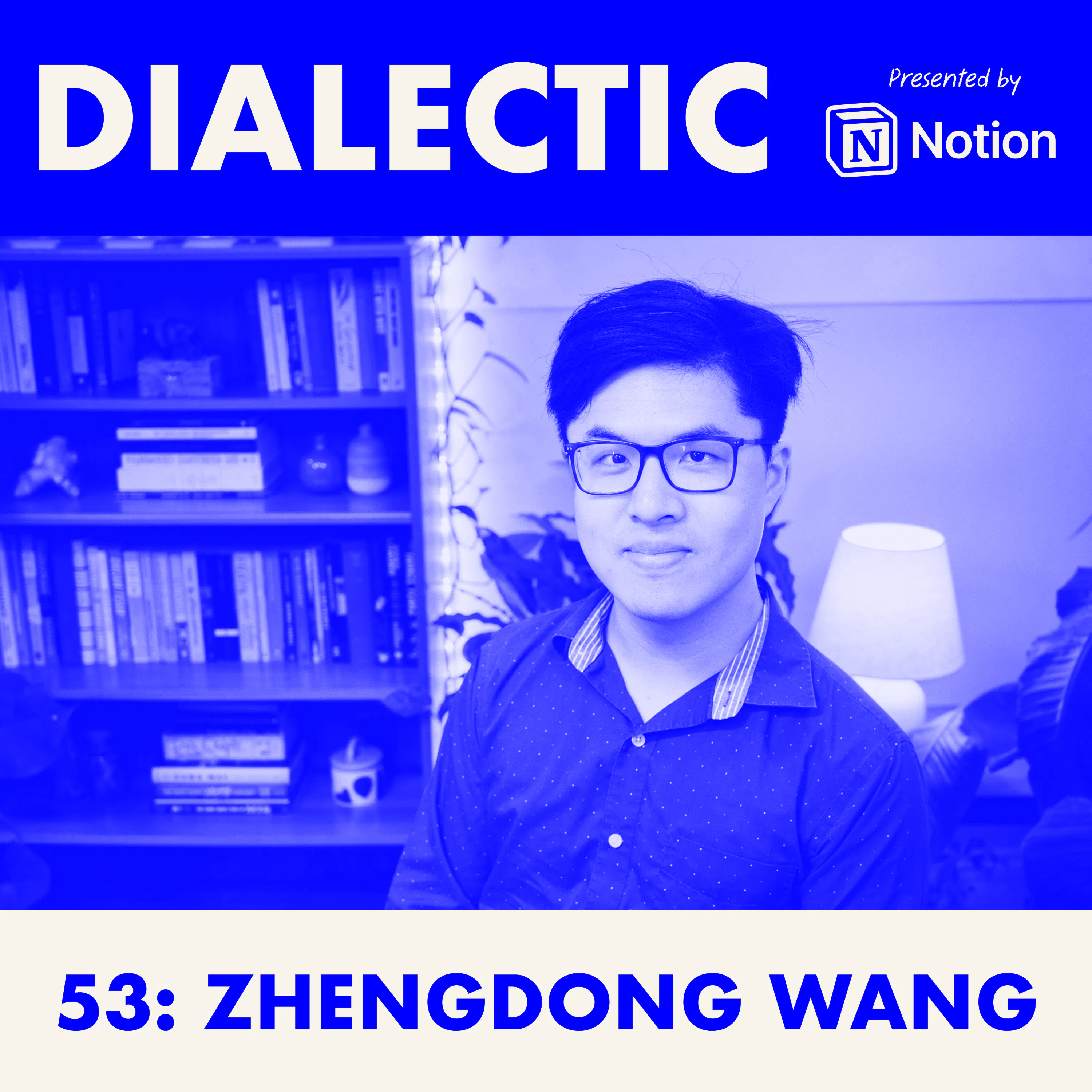 53: Zhengdong Wang - Feeling the Wave 29.07.2026 2u 7minZhengdong Wang (Website, X, LinkedIn) is an AI researcher based in London. He writes annual letters (inspired by Dan Wang), mainly about AI progress, and his 2025 letter blew me away and inspired me to meet him. In it, he describes his ‘compute theory of everything,’ and makes the case that it would be stranger if AI progress slowed down than if it continued. Put a different way, reading his letter helped me get closer to truly feeling the wave of AI progress. It took Zhengdong a long time to become “AGI-pilled,” despite years of feeling like he was late to AI and working as a research engineer for the last five. I talked to him about what it will take for the rest of us to see what he sees, and feel what he feels. We also discuss why AGI may be a hazier target than simply seeing AI progress as “the model does the eval,” and why recursive self-improvement may be both happening and less fantastical than it may seem. ZD makes the case that based on the rate of progress and scaling, skeptics will simply be proven right or wrong soon. We talk a bit through what narrative and political challenges the AI industry faces ahead of this transition. Then there are the implications of all of this—namely how AI progress accelerates the question of what we each value, how we will spend our time, and where we will find or create meaning. ZD takes a stab at some of those impossible questions and shares some other favorite miscellanea that is reflective of the range of his letters. I hope this conversation helps you feel the wave a bit yourself, and that you remember that, regardless of how much change lies ahead, we still get to make our meaning. We get to choose. Full transcript and all links: dialectic.fm/zhengdong --- Dialectic is presented by Notion. Notion is an AI-powered connected workspace where teams think together and create their best work. You can learn more at notion.com/dialectic. --- Timestamps: (0:00) Opening Highlights (1:16) Intro to Zhengdong & Thanks to Notion (4:33) Start: Why Research: "I Just Want to Know" (12:25) The Model Does the Eval: AGI as a Moving Target, RSI, and Laser Beams (33:17) The Compute Theory of Everything and Feeling the Wave (53:17) The Myths AI Needs, Competition vs. Power Concentration, and Whether Progress Is Inevitable (1:13:42) "Who Could Possibly Compete?": Post-AGI Meaning, Work, and Questing (1:29:28) Are You Having Fun? Vacations, Mattering, and How to Live (1:47:13) Annual Letters, Economist Obituaries, London, and Burke (2:06:33) Closing & Thanks to Notion
 -
 52: Jack Conte - Draw the Next Page 21.07.2026 1u 51minFull transcript and all links: dialectic.fm/jack-conte Jack Conte (Patreon, YouTube, YouTube Pt2, X, LinkedIn) is the co-founder and CEO of Patreon. He is also a lifelong artist and musician, who at his peak released 100 music videos per year between his bands Pomplamoose (a duo with wife Nataly Dawn) and Scary Pockets (a funk collective), and was a longtime YouTuber. Jack is not a tech CEO who happens to like music. He is an obsessive, prolific artist whose first conventional job is running Patreon. This has shaped him as a founder and executive, and his mission at Patreon is to build an enduring and truly creator-first company that empowers creators to earn a living from their work. We began with how he manages to do it all, where his energy comes from, and what it’s like to be “post-chaos.” Then, we talked about art, content, and commerce, Patreon’s model (that isn’t actually pure patronage), and why Silicon Valley undervalues art, brand, and narrative — and Patreon. Jack shared the benefits of a business model that is fully aligned with creators, why he hates the word influencer, and why he’s still the right man for the job after 13 years of leading Patreon. We also covered what great leadership looks like, building fans and community, filmmaking, authenticity (from Charlie Kaufman to Prince), and remembering to take risks until the very end. I hope you’re inspired to make things you are proud of and to draw the next page even when you have no business doing so. While I have you: I’d strongly recommend Jack’s recent SXSW talk on AI, creativity, and change. -- Dialectic is presented by Notion. Notion is an AI-powered connected workspace where teams think together and create their best work. Learn more about Notion's new developer platform and workers here. You can learn more at notion.com/dialectic. -- Timestamps: (0:00) Opening Highlights (1:38) Intro to Jack & Thanks to Notion (3:44) Start: Prolific Output, Energy, Juggling, Endurance, and Becoming Post-Chaos (22:04) Combining Creativity and Business and Art vs. Content (33:21) Advertising vs. Membership & Patronage vs. Patreon (44:06) Jack's First and Only Job, and Silicon Valley's Undervaluing of Creativity, Brand, and Storytelling (and Patreon) (55:17) Building for Creators First, Incentive Alignment, Trust, 100 Years of Patreon, and Why Jack is the Right CEO for Now (1:04:49) Leadership: Types of Ambition, Obsession, Self Reflection, Bias to Action, Learning from Others (1:12:59) Talent vs. Enthusiasm, Being Proud of What You Make, Making Fans and Being True, Managing Parasociality, and Community (1:28:30) Filmmaking, Labels and Collectives vs Individuals, Breaking Patterns, Creative Intimacy, Music, Patreon's Origin, Persistence, Lucid Dreaming, and Taking Risks (1:49:26) Thanks Again to Notion
 -
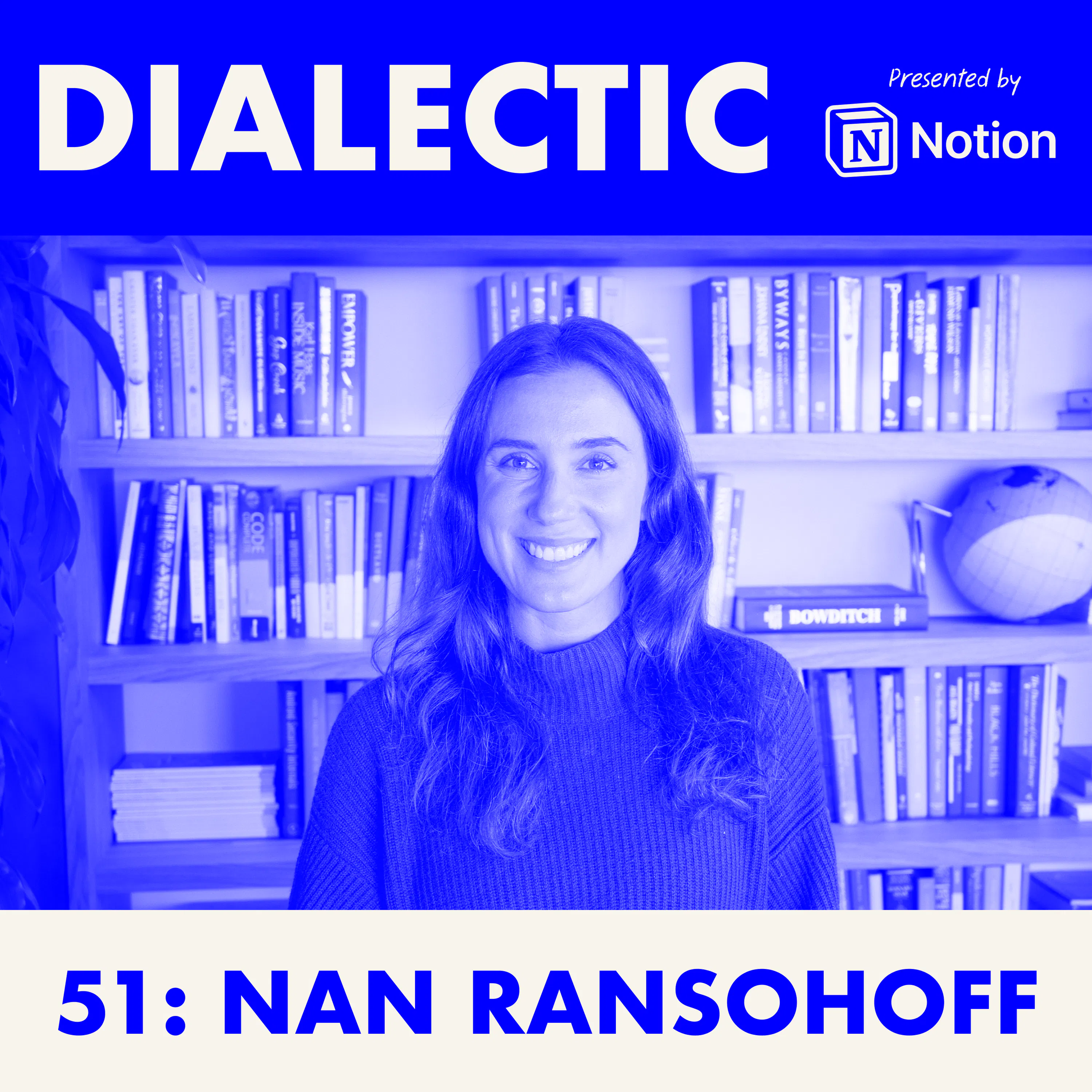 51: Nan Ransohoff - Power Laws for Philanthropy 14.07.2026 2u 11minNan Ransohoff (X, Substack, Website) is Head of Public Goods and former Head of Climate at Stripe. This includes Frontier (which she co-founded): an advance market commitment that accelerates carbon removal by guaranteeing demand for it before it exists. They also recently launched Intercept Fund, a new effort to end respiratory infections, led by Nan and Charlie Petty. Nan has written extensively about Stripe’s efforts and philanthropy broadly, including her call for general managers for the world’s pressing problems, and on what she calls the third wave of American philanthropy. We talk about what a "Nan" is and why we need GM’s: ambitious founder-like people who obsess over an outcome and work backwards from it, wearing whatever hat the problem requires. We discuss taste in big problems, slicing them up and making them tractable, and why vision is in short supply. We also discuss the coming wave of new philanthropic dollars (est. ~$40B/year), primarily driven by The OpenAI Foundation, Anthropic Founders, and Anthropic employee matching, and how the ecosystem will need to mature to effectively deploy this much capital. Nan also reflects on her unlikely turn toward philanthropy and what it felt like to get off the ladder of a specific kind of ambition. We wrap up with a range of miscellanea and some fun debates. I hope you are inspired to notice problems you can’t ignore, be optimistic and specific about the world you hope for, and choose an (unlikely) path that you are proud of. Transcript and all links: https://dialectic.fm/nan - Dialectic is presented by Notion. Notion is an AI-powered connected workspace where teams think together and create their best work. Watch here for more on Notion's new developer platform and workers. You can learn more at notion.com/dialectic. - Timestamps: (0:00) Opening Highlights (1:15) Intro to Nan (3:18) Thanks to Notion (4:53) Start: What is a Nan? Nerd-Sniped by Orphaned Problems (12:39) GMs, Seeing the Chessboard, and Working Backwards from Outcomes (18:55) Good Taste in Problems, Vision, and Good Finish Lines (35:43) Advance Market Commitments Tactically Solving Carbon Removal (41:35) Focus and Sketching Out or Slicing Up Messy Problems (49:39) Legibility, Public Rallying, and Ambition in Philanthropy (54:38) Third Wave Philanthropy and Hard to Quantify Problems (1:06:50) Risk Tolerance in Philanthropy and Scarcity of Funders and Allocators (1:15:22) The $40B Tidal Wave of New AI-Money and Why Start Now (1:19:53) Amount of Capital, Government Philanthropy, and Making Philanthropic Founders Rich (1:31:44) Nan's Mid-Career Inflection Point and Getting Off the Obvious Path (1:39:47) Grab-bag: Why Stripe Funds Public Goods, Making Things with Friends, Creative Partnership, Iceland Drone, and Scone Heads (1:49:39) Syllabi for the Squishy Topics & Study vs. Experience (1:57:01) Inputs & Outputs and GLPs for Attention (2:04:38) Closing: Interviewing Parents and Imagining an Obituary (2:09:58) Thanks Again to Notion
 -
 50: Tyler Cowen & Nabeel Qureshi - An Appetite For More 30.06.2026 1u 55minTyler Cowen (Website, X, Marginal Revolution, Conversations with Tyler) is an economist at George Mason University, leads the Mercatus Center, and is the author of many books including The Great Stagnation and Average Is Over. He has blogged nearly daily at Marginal Revolution for over 20 years, has interviewed hundreds of world-experts on Conversations with Tyler, and runs Emergent Ventures, a prolific grants program that has funded multiple Dialectic guests. Nabeel S. Qureshi (Website, X, Substack) is an entrepreneur, writer, and researcher. He runs a stealth startup. Previously, he was a Visiting Scholar at Mercatus and spent nearly eight years at Palantir. He writes some of my favorite essays, including "What Makes Art Great" and "Rented Virtue", and was previously a guest on Dialectic for episode 13: "The Will to Care." Tyler and Nabeel are good friends, and given how prolific Tyler is, I decided to use Nabeel as an entry point and interview them together. We discuss sacred commitments, AI acceleration, mentorship, friendship, and more, but I focused the majority of the conversation on art and aesthetics. Tyler and Nabeel are unlikely aesthetes given their day jobs, but in fact take art deeply seriously. They have a shared love for and similar tastes in art, music, and film, in particular. We discuss strange and beautiful art, aesthetic stagnation, and a wide range of favorites: The Beatles, Mozart, Mondrian, Springsteen, Lana Del Rey, Kanye West, Cassavetes, The Sopranos, Apichatpong Weerasethakul, and more. Please enjoy, and thank you for supporting, listening, and watching through fifty episodes of Dialectic. I can't wait for the next fifty! Transcript and all links: dialectic.fm/tyler-nabeel --- Dialectic is presented by Notion. Notion is an AI-powered connected workspace where teams think together and create their best work. Learn more about Notion's new developer platform and workers here. You can learn more at notion.com/dialectic. Timestamps: (0:00) Opening Highlights (1:18) Intro to Tyler & Nabeel (3:02) Thanks to Notion (4:38) Start: Sacred Commitments, AI, Markets, and Acceleration (20:23) How Art Moves Us (27:08) "Beauty," Strangeness, Great Art, Music, and The Beatles (44:09) Film, Critics, Learning to Appreciate Depth, More Music, "Lowbrow" Art (1:02:25) New Aesthetics, Sources of Inspiration, Optimism & Pessimism (1:11:22) The Internet & Twitter's Virtue, Group Chats, and Cities (1:21:35) Mentors, (Possibly Quitting) Writing Books, Friendship (1:34:54) Interviewing, Identifying Talent, and Agency (1:47:21) Closing Questions (1:53:38) Thanks Again to Notion
 -
 49: Jasmine Sun - Close Enough to See Clearly 18.06.2026 2u 37minJasmine Sun (Substack, X, LinkedIn) is an independent writer and journalist. She is a contributing writer for The Atlantic and also writes for other major publications, like The New York Times. She previously led core product at Substack. Jasmine focuses on Silicon Valley and AI, and is something of a participant observer, living among the strange and inspiring people pulling the future forward in San Francisco. In her writing, she plays to both sides: focusing on a more endemic audience with her newsletter while telling the broader world about what she learns in flagship pieces for major publications. Several of these anchor around memes that she thinks may deeply matter: “the permanent underclass,” “chinese peptides,” and “claude code psychosis,” to name a few. Jasmine has done many interviews about these individual topics, so I wanted to focus on her and her approach: playing to both audiences, her taste in questions and topics, doing both “serious” journalism and more personal writing, how going independent wasn’t so risky, what she admires in great writing, AI and her coming “AlphaGo moment,” China, and more. Please enjoy. --- Dialectic is presented by Notion. Notion is an AI-powered connected workspace where teams think together and create their best work. Learn more about Notion’s new developer platform and workers here. Check out Brian’s X/Twitter sync worker. You can learn more at notion.com/dialectic. Timestamps: (0:00) Opening Highlights (1:30) Intro to Jasmine (2:13) Thanks to Notion (3:24) Start: Being a "Historian of Vibe" and Learning to Look (15:00) Taste for Questions & The Depth Behind Memes (24:28) Translating Between Silicon Valley and The World (40:27) Substack vs. "Serious" Journalism and Integrity as a Writer (47:35) Integrity when Using AI and the AlphaGo Question (58:42) Strategy Across Publications & Maximizing an Idea's Reach (1:06:45) Going Independent, Risk, and Commercial Tradeoffs (1:24:35) Great Writing: Style, Voice, and Resisting Summary (1:35:35) Literary Inspirations, Favorite Essays, Writing vs. Thinking, and Getting Better (1:51:09) Writing to Publish, Authenticity, and Art (2:00:38) Grab Bag: China, Silicon Valley's Virtues and Problems, AI Transition, The Relational Economy, Parties, Debates, Self Belief, and More (2:35:16) Thanks Again to Notion Select Articles From Jasmine Silicon Valley is Bracing for a Permanent Underclass (NYT) ‘Chinese Peptides’ Are the Latest Biohacking Trend in the Tech World (NYT) Claude code psychosis (Substack) Notes on AI, labor, and China (Substack) America against china against america (Substack) The Human Skill That Eludes AI (The Atlantic)
 -
 48: Henri Stern - Principled Enough to Be Pragmatic 17.06.2026 1u 54minHenri Stern (X, LinkedIn) is the co-founder and CEO of Privy. Privy builds wallet infrastructure for developers, enabling them to let their users hold and use crypto, including stablecoins. Privy was acquired by Stripe in 2025, and remain an independent organization within the company. They work with large fintechs like Ramp and Klarna while also supporting some of the most notable crypto-native platforms like Hyperliquid. Henri also supports a number of other crypto efforts within Stripe. Henri is thoughtful, measured, and principled. Yet he is also pragmatic. He doesn’t like to play philosopher and yet he is one of my favorite people ask big questions about our future and our digital lives. Our conversation is anchored in the phrase at the bottom of Privy's website: "technical decisions are moral decisions." He and Asta Li started Privy to focus on user data privacy, and we talk about what digital privacy means and why it still matters. After realizing they were trying to serve the market something it didn’t want, Privy found an inflection point initially by enabling developers to embed crypto wallets in their apps. We talk about the painful decision to pivot, and later, to commit to both ends of the crypto market: hardcore, trading-oriented products and stablecoins as they flooded into traditional fintech infrastructure. We also talk about joining Stripe, what Crypto’s future looks like, and his level-headed mindset for our tumultuous future. All links and transcript available at dialectic.fm/henri-stern. --- Dialectic is presented by Notion. Notion is an AI-powered connected workspace where teams think together and create their best work. Learn more about Notion’s new developer platform and workers here. Check out Brian’s X/Twitter sync worker. You can learn more at notion.com/dialectic. --- Timestamps: 0:00 - Opening Highlights 1:40 - Intro to Henri 3:10 - Thanks to Notion 4:51 - Start: Technical Decisions are Moral Decisions 15:41 - Ambition, Startups, and Crypto 23:39 - Why Digital Privacy Matters: Self-Determination, Security, and Identity 41:52 - Embedded Wallets, the Pivot, and Privy's Core Bet 55:18 - Reinventing Around Stablecoins Without Abandoning Crypto-Natives 1:06:42 - Joining Stripe, Privy Today, and What Stripe Is Becoming 1:22:54 - Crypto's Future, Power Laws, Optimism and Pessimism 1:38:14 - Closing: Asta, Stripe's Leaders, Being French, and Never Compromising 1:52:48 - Thanks Again to Notion
 -
 47: Paul Scherer - A Friend That Brings Us Closer 27.05.2026 2u 16minPaul Scherer (X, LinkedIn) is the founder of Eigen (check out their beautiful website), where he’s building a mutual friend: an AI that brings people closer together and helps us belong. Paul grew up in a small town outside of Frankfurt, Germany, and dropped out of high school at seventeen to work on startups, including Augment. He recently raised $15M from Benchmark, with legendary partner Peter Fenton comparing him to the founders of Facebook, Twitter, Instagram, and Snapchat. I was introduced to him by Notion co-founder Akshay Kothari, who is an angel investor in Eigen. Dialectic guest Brie Wolfson has also been working with Paul, so I wanted to see what all the fuss was about, and why so many people I respect were so enamored with a kid who has yet to publicly launch a product. We start with Paul’s central influence: Michael Ende’s children’s novel, Momo, and the little girl who reminds a village to be present in the face of Time Thieves quietly pushing them to be more efficient. Then we talk about how even though the internet has shaped both of our lives and relationships, it increasingly feels that social media is making us feel both more connected and more alone. Paul explains what they are working on at Eigen, why we need an (AI) mutual friend, why it should be a single “person,” and why it feels less like engineering and more like parenting or growing someone/thing you don’t have complete control over. I also ask Paul about the pressures and psychology around being “blessed” by Silicon Valley’s powers that be, and why authenticity, or something like it, is in short supply. I hope you are inspired to be courageous in your convictions, even if they are strange, and to listen to the voice inside that so many of us stop listening to in adulthood. All links available at dialectic.fm/paul-scherer - Dialectic is presented by Notion. Notion is an AI-powered connected workspace where teams think together and create their best work. Learn more about Notion’s new developer platform and workers here. Inside Notion by Brie Wolfson & Camille Ricketts for Colossus. You can learn more at notion.com/dialectic. Timestamps: (0:00) Opening Highlights (1:13) Intro to Paul (2:33) Thanks to Notion (3:28) Start: 'Momo', Presence, Friendship, and Time (11:10) How the Internet Connects Us and Isolates Us, and Conflating Social and Media (25:12) A Future Where We Talk to AIs (33:55) Paul and Eigen are Building a Mutual Friend to Help Us Connect with Other Humans (48:01) Why Do We Need a Mutual Friend? And Making a Friend We Can Trust (1:16:53) Belonging, Building the team at Eigen, and Inventor as Outlaw (1:25:38) Managing the Psychology of Being a Promising Young Founder (1:36:53) Maintaining a High Bar, Fighting Entropy, and Influences (1:53:50) Self-belief, Authenticity, Seeing the Water (2:10:30) Courage, and a Final Question from a Mutual Friend (2:15:04) Thanks Again to Notion
 -
 46: Nicole Seah (Nix) - Loving What is Real 11.05.2026 1u 55minNicole Seah (X, Substack, LinkedIn), aka Nix, is a writer at Starting From Nix and investor at Costanoa Ventures. She recently launched New Ontologies, where she profiles founders and companies thinking ambitiously about the future. Her first piece is live now, on Ando: the team building a chat platform for the era of agents. Nicole balances identities with poise, moving between the literary and the practical. I spoke to her about different kinds of beauty and how it takes us out of ourselves, Nietzsche’s case for tolerating strangeness, and choosing reality over fantasy. Then we discuss duality and balancing intensity and lightness, and talk through Borges, Hesse, Miyazaki, Alyssa Liu, and Joan Didion. Nicole argues that freedom comes from not collapsing yourself into a single identity. I asked her about the drive behind New Ontologies, her obsession with techne, and Rebecca Solnit's "cosmology of self.” We then skate across a range of ideas, including memory, appetite and desire, and friendship and why other people’s unknowability is part of what makes them wonderful. I hope this conversation inspires you to look for and love what is real, to be patient with and attuned to the multiple people inside you, and to give freely with your creative life. Full transcript and all links and references: dialectic.fm/nix. - Dialectic is presented by Notion. Notion is an AI-powered connected workspace where teams think together and create their best work. Notion recently launched custom agents: helpful AI teammates that handle recurring work across your entire suite of tools. Automate you and your team’s repetitive tasks so you can focus on the deep work. Inside Notion by Brie Wolfson & Camille Ricketts for Colossus. You can learn more at notion.com/dialectic. Timestamps: 00:00 - Opening Highlights 01:14 - Intro to Nicole 02:04 - Thanks to Notion 03:48 - Start: Beauty — Effort, Attention, Strangeness 19:59 - Fantasy and Reality 29:41 - Multiple Identities, Intensity, and Lightness 49:08 - New Ontologies: Profiling Founders Building the Future 1:08:57 - Memory, Lineage, and Process 1:18:41 - Appetite and Honesty 1:23:47 - Friendship, Proximity, and The Unknowability of the Other 1:41:18 - Closing Notes: Solitude, Noticing, and Generosity 1:53:40 - Thanks Again to Notion
 -
 45: Nicholas Thompson - A Life of Long Form 28.04.2026 1u 54minNicholas Thompson (Website, X, LinkedIn, Wikipedia) is the CEO of The Atlantic, an elite distance runner, and the author of The Running Ground—a memoir about his father, his life, and the sport of running. Full transcript and all links at dialectic.fm/nick-thompson. Nick has led The Atlantic to tremendous subscriber growth and profitability since joining the then-money losing publication in early 2021. He was previously editor-in-chief of WIRED and editor of newyorker.com. He also co-founded The Atavist, wrote The Hawk and The Dove, and is a prolific interviewer, including his latest series, The Most Interesting Thing in AI. Nick is also the American record holder in the 50K, which he re-broke two days after we recorded this conversation (Exhales). We talked about the future of words in the age of AI, what makes a journalist, why legacy media institutions like The Atlantic are worth fighting for, and what great editing and coaching have in common. Then we turned to running and life: the small tailwinds that compound beyond what we can imagine, Nick’s trajectory—through a prodigious start, early career failure and African kidnapping, cancer at 30, and wild success since—to name a few beats, the trials and blessings of inheritance, and the versions of himself he may no longer have time to find. To close, Nick honors Scott Thompson’s memory by sharing how we might all be more like him and reflects on what drives aliveness. I hope you are inspired to get started, feel the wind at your back, clear unexpected hurdles, savor great words, raise your bar beyond what is reasonable, be grateful for those who came before and pay it forward to those who are next, and remember that there is always more waiting—for you, for me, for us. P.S. It’s unrelated to this conversation, but please read The Atlantic’s latest cover story and one of my favorite (and funniest) things I’ve read in ages. Caity Weaver on The Best Free Restaurant Bread in America. Long live long form writing. - Dialectic is presented by Notion. Notion is an AI-powered connected workspace where teams think together and create their best work. Notion recently launched custom agents: helpful AI teammates that handle recurring work across your entire suite of tools. Automate you and your team’s repetitive tasks so you can focus on the deep work. You can learn more at notion.com/dialectic. Timestamps: 0:00 Opening Highlights 1:17 Intro to Nick 2:24 Thanks to Notion 3:30 Start: Words, Reading, and Writing in an Automated World 18:39 Why Stories Matter and What Makes a Journalist 28:22 Media Institutions, The Atlantic, Democracy, Tech, and Power 44:21 Retaining Great Writers and The Virtues of Editors (and Coaches) 57:44 Magazines and America 1:05:57 Running, Motivation, Momentum, and Tailwinds 1:16:08 Aging, Fathers and Sons, Inheritance, and a Mother's Grace 1:31:00 Merging Machine-like Discipline and Wild Curiosity, The Boat that Never Touched Water, and Who We Might Still Become 1:44:11 Gratitude, Stalin's Daughter, Scott Thompson's Verve, and Feeling Most Alive 1:52:40 Closing and Thanks Again to Notion Key Links: The Running Ground - Nick Thompson Why I Run (excerpt from Running Ground) - Nick Thompson for The Atlantic Not Fade Away book - by Laurence Shames and Peter Barton Nick Thompson - Timeless (With Guarav Ahuja) Writer Evan Ratliff Tried to Vanish: Here's What Happened (Wired) John W. Gardner — "Personal Renewal" Speech Will the Humanities Survive Artificial Intelligence? - D. Graham Burnett for The New Yorker
 -
 44: Jared Weinstein - Within Earshot, Out of Camera Shot 20.04.2026 2u 50minJared Weinstein (LinkedIn, X) is an investor, advisor, civic leader, and founder of Overton. This is his first interview. Full transcript and all links at dialectic.fm/jared-weinstein. Jared spent his twenties in the George W. Bush White House, starting as a scheduling intern and rising to become the President's personal aide. He went on to Stanford GSB, consulted for Palantir in its early days, and was a founding partner of Thrive Capital in NYC, helping build it into one of the most respected venture firms in the world over eleven years. After leaving Thrive in 2022, Jared returned to Birmingham to focus on Overton, where he invests in local founders, leads civic initiatives including Small Magic — an early childhood language development program — and works to make his hometown the best version of itself. He also continues to invest in startups, serve on boards, and seed and advise new investors. By his own words, he is busier than ever. Despite his very serious resume, anyone who knows Jared will tell you that he radiates humanity. He has spent his career amplifying people and helping them become the best version of themselves. We trace the arc of his career, talk about what it's really like inside the Oval Office, what he admires about the President, and the unlikely pivots that led him beyond a prodigious start. We also discuss what he and Josh got right at Thrive in the early days, how high stakes environments can be psychologically safe, and how to support incredibly ambitious people. Then we talk about his theory of change for Birmingham, the work he is doing now, and his reflections on where he's been and what he'd like to be known for. I hope this conversation gives you a model for what it looks like to bring your full humanity into high-stakes work and inspires you to commit yourself to the people, institutions, and communities you believe in. - Dialectic is presented by Notion. Notion is an AI-powered connected workspace where teams think together and create their best work. Notion recently launched custom agents: helpful AI teammates that handle recurring work across your entire suite of tools. Automate you and your team’s repetitive tasks so you can focus on the deep work. You can learn more at notion.com/dialectic. - Timestamps 00:00 - Opening Highlights 01:40 - Intro to Jared 03:32 - Thanks to Notion 04:38 - Start: Being a "Friend" and Bringing Humanity to Serious Work 10:55 - From Duke to the West Wing 31:45 - Riding Shotgun with President Bush 59:27 - Starting Over Out West: Post-WH, Stanford, and Palantir 1:16:05 - Meeting Josh Kushner and Building Thrive Capital 1:44:37 - Founders, Humility, and the Three-Body Problem of Ego, Ambition, and Impact 2:06:41 - Leaving Thrive, Coming Home to Birmingham, and Overton 2:32:40 - Busier Than Ever: Mentors, Life in Acts, and What You Hope to Be Known For 2:49:11 - Thanks Again to Notion
 -
 43: Mario Gabriele - Reality is Story-Shaped 07.04.2026 1u 48minAll links and transcript at dialectic.fm/mario-gabriele Mario Gabriele (X) is a writer, investor, and analyst. He is founder of The Generalist and Partner at Hummingbird. He aims to bring the rigor of investment analysis with writing quality and style that is closer to the New Yorker. His profiles, deep dives, and briefings are amongst the highest quality writing in the technology business, and he interviews practitioners weekly on his podcast. Recently, he wrote the definitive (and nearly book-length) piece on Peter Thiel’s legendary investment outfit, Founders Fund, and profiled Microsoft’s Satya Nadella. I spoke to Mario about stories and the truths they hold or reveal. He is a writer first, and it shows in his prose, style, and depth. We also discussed the evolution of The Generalist’s content and business model, both of which he has experimented with ruthlessly. The subscription counts 160,000+ readers / listeners and is currently ranked as the #7 bestseller in Substack’s business rankings. He is also an investor focused on the technology world’s heroes: founders. Hummingbird, which he joined earlier this year, is known for its obsessive approach to understanding the minds, motivations, and worlds of the entrepreneurs it backs. We dive into the under-discussed elements that shape world-beaters, including the notion that ambition almost always comes from some level of pain. Across the conversation, we talk about how authenticity and evolution run across his career, and how he is at peace as someone who doesn’t know exactly who he is becoming. That generalist orientation continues to produce unlikely paths that surprise him. I hope this conversation inspires you to take stories seriously, to look for what's true beneath the polished surface, and to trust paths you didn't plan for. Dialectic is presented by Notion. Notion is an AI-powered connected workspace where teams think together and create their best work. Notion recently launched custom agents: helpful AI teammates that handle recurring work across your entire suite of tools. Automate you and your team’s repetitive tasks so you can focus on the deep work. You can learn more at notion.com/dialectic. Timestamps: (0:00) Opening Highlights (1:13) Intro to Mario (2:49) Thanks to Notion (3:58) Start: Stories, Truth, Writing, and the Story Beneath the Story (23:39) Failure, Authenticity, Comparative Advantage, and The Most Annoying Aphorism in the World (35:55) The Generalist's Style (45:20) Process, Goals, Vision, Experimentation, and Business Models (57:52) Investing: Energy, First Checks, Notecard-level Clarity, and Peter Thiel (1:07:46) Understanding Founders, Motivation, Good and Bad Fuel, and True Ambition (1:17:47) Hummingbird: Seeing the World as it Actually Is and How Stories Reveal Truth, Linguistics, Observation, Deciding to Join, and Evolution (1:29:32) Motivation, Raising the Bar, Ongoing Learning and Teachability, Status, Unlearning, Generous Products, and The Reward of Not Knowing (1:47:15) Thanks Again to Notion
 -
 42: Celine Nguyen - Nurturing Your Mind in Public 30.03.2026 2u 19minAll links and transcript available at dialectic.fm/celine-nguyen Celine Nguyen (Website, Substack, X) is a writer, software designer at Watershed, and literary critic. She writes personal canon, a newsletter about literature, design, art, and technology that has grown to tens of thousands of subscribers. She has also written for The Atlantic, Asterisk Magazine, and more. I discovered Celine with her reflection on two years of writing her newsletter, where she made the case for living a life of the mind, reading great things, and writing online: "After 2 years, I’m convinced that reading and writing are the most dignified and worthy activities that anyone can do—and, in fact, are activities that everyone should do." She also has written viral essays on research as a leisure activity and a case for reading Marcel Proust’s 3,000 page novel, In Search of Lost Time. In another favorite, she critically analyzes the mechanics of how great writers begin. Celine makes intellectual life and very serious books feel accessible and exciting rather than obligatory. We spoke about much of her writing, taking your intellectual growth seriously outside of academia, and how she has become an influencer in a good way. She believes you can expand the market for what you love, and her success is evidence that there is a market for more than the low-hanging fruit that dominates much of the internet. Celine sees reading and writing through the lens of becoming, and I was inspired to raise my own bar. I hope you can say the same. --- Dialectic is presented by Notion. Notion is an AI-powered connected workspace where teams create their best work. Notion recently launched custom agents: helpful AI teammates that handle recurring work across your entire suite of tools. Automate you and your team’s repetitive tasks so you can focus on the deep work. You can learn more at notion.com/dialectic, and check out their latest round of updates here. --- Timestamps: (0:00) Opening Highlights (1:35) Intro to Celine (4:25) Thanks to Notion (6:18) Start: Pursuing a Life of the Mind, Personal Curriculum, and Contextualizing the Present in History (24:53) Research as a Leisure, Self-Cultivation, and Calibrating Rigor (39:59) Effectiveness, Tools & Process, and Letting Output Drive Your Learning (59:35) Parasocially Influencing People to Do Good Things (Like Reading and Writing) (1:09:39) Drawing the Reader in and Expanding the Market for What You Love (and for Proust) (1:24:07) Aspiration, Posing, and Pretending Your Way into Enthusiasm (1:34:37) Preparation is Not Progress (1:46:07) Copying, Writing Process, Mechanics, and Design (1:57:25) Commitment, Finishing, Substack, Life Extension and Closing (2:18:31) Thanks Again to Notion
Vergelijkbare podcasts


Populair in
Deze podcast verschijnt ook in de podcastlijsten van deze landen.


