
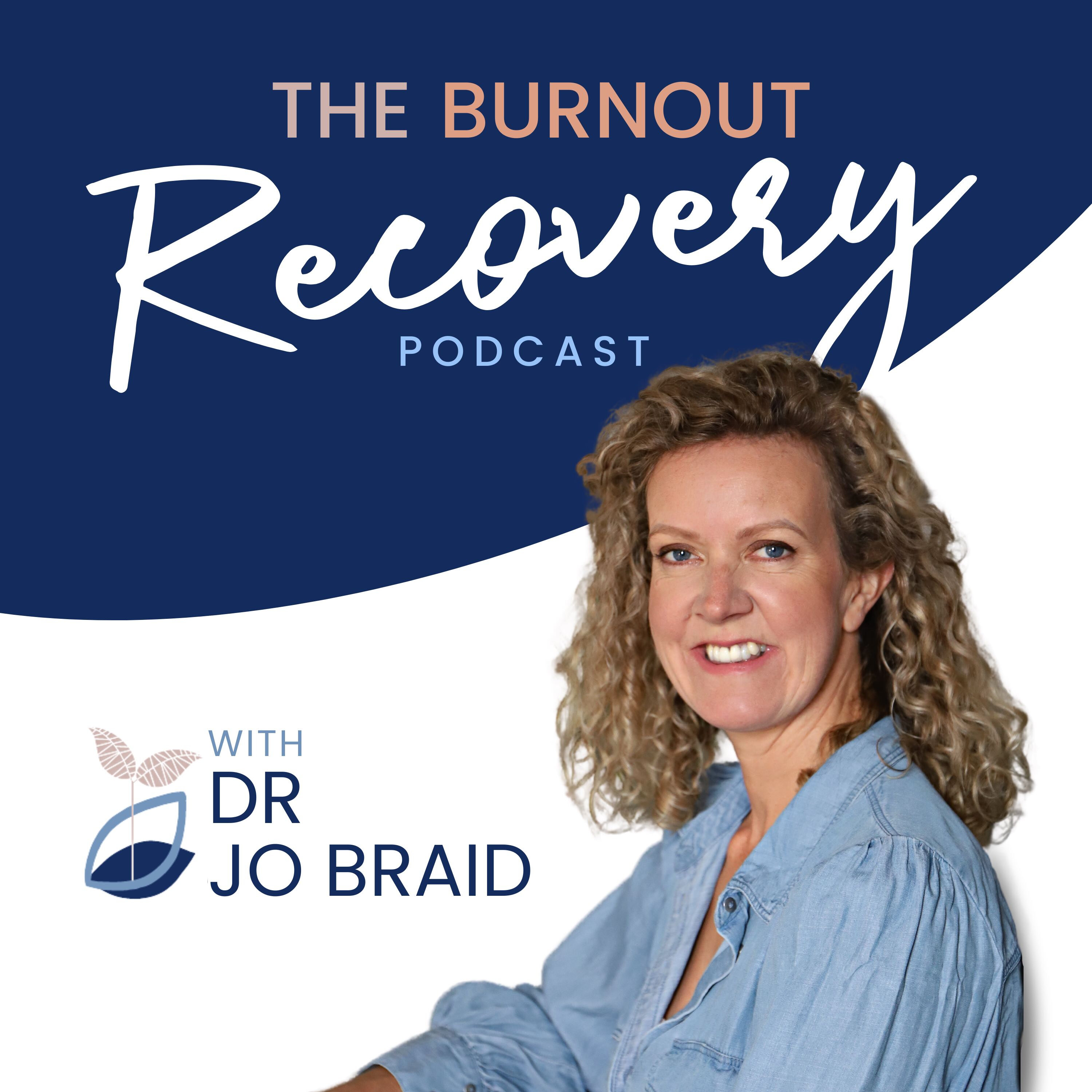
The Burnout Recovery Podcast
Dr Jo Braid
0
A podcast dedicated to helping healthcare professionals recover from burnout and build sustainable careers. Host Dr Jo Braid shares evidence-based strategies and real-world tools for thriving in healthcare, emphasizing that recovery has a ripple effect on patients, families, and communities. The show aims to transform healthcare from the inside out, one professional at a time.
Afleveringen
-
 Allowed to Take Up Space: The Self-Esteem Behind Every Boundary 29.09.2026 17minYou can know every script. You can know that no is a full sentence. And you can still say yes — because some quieter part of you doesn't believe you're allowed to say no. This week Jo goes underneath the boundaries series to look at the self-esteem doing the real work behind every hard conversation. THE SIGNAL → Self-esteem = your satisfaction, confidence and self-respect. Not fixed — trainable, like any other skill. → Four scenarios where it shows up: family, patients, colleagues, yourself. → A script is only half the equation. Words + self-esteem, not words instead of self-esteem. → Boundaries have two parts: the request, and the consequence. → The neuroscience: social disapproval activates the same pathway as physical pain (Eisenberger, UCLA). That's why willpower alone doesn't hold a boundary — but the circuitry is trainable. → Counterintuitive truth: weak boundaries look like closeness. Healthy ones are what actually build trust. THE RESET → Family: practise one small no this week, no justification, no rush to fill the silence. → Patients: "I want to give this the time it deserves — let's book you back in." Protecting quality of care, not abandoning it. → Colleagues: before saying yes, try "let me check and come back to you." → Yourself: end each day this week noticing where you spoke to yourself in a tone you'd never use with a colleague. Pick one scenario. Practise one boundary. Write down what you notice afterwards — that's your evidence file. RESOURCES No Is a Full Sentence, Jo's boundary scripts resource, is live now: drjobraid.com/store The Sunday Long Game newsletter: drjobraid.com/subscribeIG/FB: @burnoutrecoverydr | LinkedIn: Dr Jo BraidSee omnystudio.com/listener for privacy information.
 -
The Part-Time Paradox: Protecting the Time You Do Have 22.09.2026 12minYou cut your hours to protect your time, and that protected time can become the most raided time in your week. Dr Jo Braid shares what a real, full Monday looks like (home visit, clinical letters, her own coaching session, a board meeting) and why chosen switching feels like a rhythm while imposed switching feels like being pecked at. IN THIS EPISODE: Why so many clinicians go part-time, and where the inbox goes on their days off Why a "quick" email costs more than it looks, and why the enemy is the open loop, not the switch The rituals you already own for moving between roles: the drive, the school gate, the change of clothes THE RESEARCH: Shanafelt et al., Mayo Clinic Proceedings, 2016: emotional exhaustion and cutting hours (correlation, not causation) Micek et al., JAMA Network Open, 2023: part-time physicians and inbox time (US, one health service) TRY THIS: THE PROTECTED DAY CHARTER Name the zone and its edge: this zone is for ___ and ends when ___. Close the loop: one minute on where you left off and what's next. Guard the threshold: decide what earns an interruption and who covers the rest. REFLECT Which of your zones has a clear edge, and which one bleeds into the next? Is your self-care inside your day, or squeezed in around it? THIS WEEK Name your zones. Pick one blurry edge and give it a marker: a one-minute note, a walk, a timer. CONNECT: Instagram/Facebook: @burnoutrecoverydr LinkedIn: drjobraid The Sunday Long Game (weekly newsletter): drjobraid.com/subscribe Boundary Scripts for Clinicians: drjobraid.com/store Be human first, everything else will follow.See omnystudio.com/listener for privacy information.
-
200 Episodes: What This Podcast Was Actually For 15.09.2026 11minEpisode 200. That's the number today — but this one isn't really about the number. Four years ago, I started this podcast while on the inaugural Australian Clinical Entrepreneur Program, wanting to share coaching tools without anyone needing to be in a formal coaching relationship. Today's episode is a thank you to everyone who's pressed play since — and a reminder of what this whole thing was actually for. Burnout isolates us. It pulls us out of community right when we need it most. This podcast has always been a vehicle for something simple: helping people feel heard, and helping people learn to hear each other. In this episode: Why I started the podcast in October 2022, and how it's grown into keynotes, workshops, and coaching Catching up with fellow AUSCEP crew - Dr Amandeep Hansra and Dr Carlo Bellini - at the Creative Careers in Medicine Conference on the Gold Coast Two simple connection questions you can ask a colleague this week — no coaching qualification required: What is actually true here versus what you're assuming? What would you do if you weren't afraid of getting it wrong? A reflection question: when did someone last make you feel like a person, not a job title — and could you be that for someone else this week? Thank you for being part of this. It only exists because you keep listening — and sending it to someone else who needed it. Connect with me: IG/FB: @burnoutrecoverydr LinkedIn: Dr Jo Braid Weekly newsletter, The Sunday Long Game: drjobraid.com/subscribeSee omnystudio.com/listener for privacy information.
-
The Delegation Boundary — Why Doing It Yourself Is Costing You 08.09.2026 16minRegistrar to consultant, the job changes shape. Less doing, more being. So why do so many of us keep doing all of it anyway? A coaching story about chasing a patient's scan, a waiting room, and the guilt of asking someone else to help — and why that guilt is worth pushing through. THE SIGNAL 🩺 Patient sent back to the waiting room while the scan gets tracked down — laborious, repeated, patient after patient 🎯 "Top of registration": Sinsky & Bodenheimer on redistributing tasks to reduce burnout 🧠 The real cost of task-switching between admin and clinical thinking 😬 Why delegating can feel like guilt, not relief — and what that guilt is actually protecting THE RESET ✅ Sort your task list: "only I can do this" vs "this just always defaulted to me" ✅ Name the guilt out loud when you hand something off ✅ Run a Top of Registration Audit for one day ✅ Delegate one task this week, guilt and all The doing crowds out the being. Hand some of the doing back. 🔗 Get the words for the moment: No Is a Full Sentence, at drjobraid.com/store 📩 The Sunday Long Game, my weekly newsletter: drjobraid.com/subscribe 📱 Instagram/Facebook: @burnoutrecoverydr 💼 LinkedIn: Dr Jo Braid This episode is supported by MIGA www.miga.com.auSee omnystudio.com/listener for privacy information.
-
Do Boundaries Clock Off? What Really Happens on Leave 01.09.2026 14minIf you're still contactable, are you actually on leave? A watched moment on a family holiday — one work email, and the mood shifted for everyone. This episode looks at why accessibility during leave costs more than we think, and what to actually put in place before you go. THE SIGNAL 📧 One out-of-hours email, and the holiday brain switches off 🧠 Allostatic load: your body doesn't always know "quick" from "urgent" 🔬 Sinsky et al, JAMA Network Open 2024: inbox coverage predicts real detachment 🏥 Stanford Medicine wellbeing data: 100% found an Out of Office best-practice doc helpful; 77% found a "life outside work" grand rounds moment helpful THE RESET ✅ Name one delegate before you leave, not as you're walking out the door ✅ Update your out-of-office with their contact, not just "I'll reply when I'm back" ✅ Separate work email/phone — a physical barrier beats willpower ✅ Bring the culture piece to your team, not just yourself Hope is not a boundary. A named delegate is. 🔗 Get the words for the moment: No Is a Full Sentence, at drjobraid.com/store 📩 The Sunday Long Game, my weekly newsletter: drjobraid.com/subscribe 📱 Instagram/Facebook: @burnoutrecoverydr 💼 LinkedIn: Dr Jo Braid This episode is supported by MIGA. www.miga.com.auSee omnystudio.com/listener for privacy information.
-
No is a Full Sentence - The Boundaries Series Begins 25.08.2026 14minIn tennis, the ball is either in or out. No apology required. So why does saying no in real life feel so much harder? This episode kicks off a new 10-part series on boundaries — why they're so hard to hold, and how to actually do it, at work and at home. THE SIGNAL 🎾 In or out: clear, certain, no apology needed 🧠 Why ambiguity drains your prefrontal cortex 💭 The Zeigarnik effect: unset boundaries = active cognitive load 😬 The apology loop, and why it's a threat response, not politeness THE RESET ✅ Notice the apology loop before you try to change it ✅ The Line Audit: find where the rule is actually unclear ✅ One breath, one pause, before you answer a request ✅ Practise one boundary this week — no apology attached No is a full sentence. In or out. That's it. 🔗 Grab the boundary scripts you need in the moment: No Is a Full Sentence, at drjobraid.com/store 📩 Get The Sunday Long Game, my weekly newsletter: drjobraid.com/subscribe 📱 Instagram/Facebook: @burnoutrecoverydr 💼 LinkedIn: Dr Jo Braid This episode is supported by MIGA. www.miga.com.auSee omnystudio.com/listener for privacy information.
-
Beyond the Breaking Point — Recovery Strategies for Different Types of High Performers 18.08.2026 13minWhy does the same boundary tool work brilliantly for one person and fall flat for the next? In this episode Dr Jo Braid unpacks why recovery strategies aren't one-size-fits-all, and how to stop forcing yourself into someone else's system. Prompted by a recent workshop with a room of physios and occupational therapists, where one manager's search for focus time revealed just how differently people respond to the same list of tools: a closed door, a sign, headphones, do not disturb. All valid. None universal. Jo breaks down why strategy adherence depends on fit, not discipline, drawing on implementation science, occupational context across academic, clinical and business roles, and stress neuroscience from Dr Amy Arnsten's work at Yale. Then she runs the four pillars, Mindset, Support, Movement, Sleep, through a personality lens so you can find the version that's actually yours. This episode closes out The High Performer's Paradox series. You'll learn: – Why a recovery tool you've abandoned might be wrong for you, not a discipline failure – How academic, clinical and business burnout profiles differ – The neuroscience of why unfamiliar strategies are harder to sustain under stress – How to adapt one pillar this week to actually fit your wiring Connect with Jo: IG/FB: @burnoutrecoverydr LinkedIn: Dr Jo Braid Newsletter, The Sunday Long Game: https://drjobraid.com/subscribe New: 12 Boundary Scripts — real language for the moments you know you should say no. $47, or upgrade to the video masterclass for $97. drjobraid.com/store Produced by Propodcaststudio. Supported by MIGA.See omnystudio.com/listener for privacy information.
-
The Leadership Wellbeing Imperative: Why Your Team's Health Starts with Yours 11.08.2026 14minYour team can't help how they feel walking into an uncertain situation. But you have enormous influence over what you bring into the room. In this episode, Jo shares a real story from ward cover — a complex new patient, a team already bracing for the next few weeks, and the deliberate choice to show up supported rather than depleted. She unpacks why leader regulation is contagious (literally, neurologically), and gives you a practical way to lead through uncertainty without performing false confidence. You'll learn: Why emotional contagion means your mood shapes your team before you say a wordThe neuroscience of co-regulation and why a steady leader calms an uncertain roomA four pillars approach to protecting your own wellbeing before a known hard stretch, not afterA simple way to name uncertainty out loud that builds trust instead of eroding it Leaders need to be well to lead well. This episode shows you what that actually looks like. Resources mentioned: No Is a Full Sentence — 12 boundary scripts for clinicians, $47 (video masterclass upgrade $97): drjobraid.com/store The Sunday Long Game newsletter: drjobraid.com/subscribe Connect with Jo: Instagram/Facebook: @burnoutrecoverydr LinkedIn: Dr Jo Braid This episode is supported by MIGA.See omnystudio.com/listener for privacy information.
-
Ferocious Warmth: Why Great Leadership Needs Both Results and Relationships (with Tracey Ezard) 04.08.2026 48minWhat if the thing standing between good results and a thriving team is just one letter?This week I'm joined by Tracey Ezard — author, facilitator, and creator of Ferocious Warmth — who I met on faculty at a Women in Leadership course in Prato, Italy. Tracey has spent two decades studying what separates great teams from ones that just get by, working across health, education and hospitality. We talk about: The "drop one letter" shift — why "I'd like to challenge our thinking" lands completely differently to "your thinking," and the neuroscience of why it lowers defensiveness instead of raising itThe Two Rs: why chasing results without relationship skills caps your outcomes, and what changes when you build bothWhy "doctor" already means "leader" — whether you feel ready for that title or notHow multidisciplinary case conferences either open people up or shut them down, and the small, specific things senior clinicians do that make the differenceEarly warning signs of leadership burnout, and why energy management matters as much as time managementLeadership as your "second profession" — and how much time you're actually investing in itTracey's non-negotiable self-care practice (hint: it involves stairs) Tracey's story is a brilliant reminder that leadership skill isn't separate from clinical skill — it's part of the job description, whether or not it was ever taught. Resources:Connect with Tracey: LinkedIn (Tracey Ezard) and https://www.traceyezard.com/Grab a copy of Ferocious Warmth: https://www.traceyezard.com/books/ferocious-warmth/ As always, if this episode lands, share it with a colleague who needs to hear it — and I'll catch you next week.See omnystudio.com/listener for privacy information.
-
Industry Blind Spots: How Your Sector's Success Culture Fuels Burnout 28.07.2026 16minSame burnout. Completely different costumes. Why the pressures driving a librarian, a trainee, and an entrepreneur toward burnout look nothing alike on the surface, and what leaders miss when they assume their own experience is the template. Signal: → Burnout shows up differently by role even within the same institution (physicians, nurses, residents, researchers all differ) → ED trainee burnout risk climbs with seniority, not away from it → Boundary-setting entrepreneurs: 45% report low burnout vs 6% of non-boundary-setters → Mentor/peer access linked to ~50% higher resilience Reset: → Ask, don't assume, what a hard day looks like for someone in a different role → Build cross-role listening into leadership, not just same-lane check-ins → Protect recovery time as the floor, whatever the sector → Deliberate variety across your own work can be part of your own protection 🎙️ Resources: 📩 The Sunday Long Game: drjobraid.com/subscribe 🤝 Coaching waitlist: drjobraid.com/coaching 📱 @burnoutrecoverydr | LinkedIn: drjobraidSee omnystudio.com/listener for privacy information.
-
The Stress Spiral: When 'Sleep and Exercise' Isn't Enough 21.07.2026 14minYou're sleeping. You're exercising. You're doing all the things. So why do you still feel like you're white-knuckling through the week? In this episode, Dr Jo Braid explores why standard wellness advice can fall short for high performers — and what the science says is actually driving the stress spiral underneath. In this episode:— Why tracking recovery can make the stress response worse (Stanford research)— What allostatic load means and why sleep alone can't clear the debt— How rumination hijacks your resting brain (UCLA neuroscience)— Values distillation: getting from ten words to two— The difference between solo wellness and nervous system co-regulation— One action: take a one-week break from a tracking tool Connect with Dr Jo:IG/FB: @burnoutrecoverydrLinkedIn: drjobraidNewsletter: drjobraid.com/subscribeSee omnystudio.com/listener for privacy information.
-
Culture by Design: What Makes You Want to Turn Up to Work? 14.07.2026 16minCulture isn't something that happens to you. It's something you're already participating in — whether you lead a team, belong to one, or sit somewhere in between. This week, Dr Jo shares what a window taught her about workplace culture, why Appreciative Inquiry might be the most underused tool in healthcare teams, and how you can shape the environment around you — regardless of your job title. In this episode: Why small environmental details signal something much bigger about belonging What Appreciative Inquiry is (and why it's not toxic positivity) The neuroscience of deficit-focused workplaces — and what chronic "what's wrong here" culture does to your prefrontal cortex How a two-minute huddle can change the temperature of an entire day Culture by design vs. culture by default drift Researchers referenced: David Cooperrider (Appreciative Inquiry), Dr Kim Cameron (positive organisational scholarship), Dr Christina Maslach (lack of community as a burnout driver), Harvard Centre for Sleep and Cognition This week's action step: Try one appreciative question — with yourself or your team. When were we at our best? or What went well today? Just one. Notice what shifts. Connect with Jo: 📲 IG/FB: @burnoutrecoverydr 💼 LinkedIn: drjobraid 📩 Newsletter: drjobraid.com/subscribe 🤝 Coaching waitlist: drjobraid.com/coaching Supported by MIGA — medical indemnity for Australian healthcare professionals.See omnystudio.com/listener for privacy information.
-
Systems, Not Willpower: One Cardiologist's Approach to Burnout-Proofing a Big Career with Dr Jennifer Coller 07.07.2026 32minWhat does it look like to build a big clinical career and stay well doing it? This week Jo sits down with Dr Jennifer Coller — senior cardiologist, regional practitioner, and founder of Pulse Point Academy — to find out. Jen's burnout never stopped her showing up to work. But it quietly hollowed out everything outside of it. What changed wasn't willpower. It was systems, environment, and intentional design. In this episode: Why the clinicians most at risk are often the ones who care the most How Jen redesigned her environment to make sustainability the default The power of micro-recoveries over waiting for annual leave Identifying your personal yellow flags before you need them Women's heart health — the gaps that are still being missed About Dr Jennifer Coller: Senior cardiologist based in Shepparton, VIC, and founder of Pulse Point Academy — delivering accessible, evidence-based cardiovascular education to regional and rural clinicians across Australia. 🌐 pulsepointacademy.com.au Reflection question: Where are you relying on willpower to sustain something that probably needs a system? Connect with Jo: @BurnoutRecoveryDr | Dr Jo Braid on LinkedIn Subscribe to The Sunday Long Game newsletter — https://drjobraid.com/subscribe Free 25-minute coaching consultation — https://drjobraid.com/coaching Proudly supported by MIGA. www.miga.com.auSee omnystudio.com/listener for privacy information.
-
The Mid-Year Reset: 4 Signals You're Heading Toward Burnout (And What to Do About Each One) 30.06.2026 17minWe're halfway through 2026. And if your year has been relentless with very little genuine recovery built in — this episode is your reset. The most downloaded episode of this podcast ever is "How to Recover from Burnout" — over 2,100 listens. That question never stops being relevant. So today we go deeper. I share the four signals your mind and body send before you crash, and one concrete reset for each. No grand overhaul. Just tools you can use this week. 📸 Screenshot this: SIGNAL 1 — "I'm tired even after I sleep"RESET: 5 minutes of intentional rest before you leave work. No phone. No to-do list. Just stop. SIGNAL 2 — "My brain feels like it's running too many tabs"RESET: 3-minute brain dump. Everything unfinished out of your head and onto the page. SIGNAL 3 — "I'm doing everything and resenting all of it"RESET: One boundary this week. You know which one. SIGNAL 4 — "I don't remember why I chose this"RESET: Write down one moment this week where you made a difference. Just one. Start with the signal that made you uncomfortable when I named it. 🔗 Free 25-min consultation call: https://drjobraid.com/coaching 🔗 The Sunday Long Game newsletter: https://drjobraid.com/subscribe 📲 @theburnoutrecoverydoctor | Dr Jo Braid on LinkedIn🩺 Doctors Who Coach Doctors | https://www.doctorswhocoachdoctors.net/ Supported by MIGA: www.miga.com.auSee omnystudio.com/listener for privacy information.
-
Your Squad Strategy: Building the Support Network High Performers Actually Need 23.06.2026 16minHigh performers are exceptional at supporting others. They are often much less exceptional at being supported themselves. In this episode, Dr Jo Braid unpacks why professional isolation is so common in healthcare — and what to actually do about it. You'll hear: Why medical culture trains us to see help-seeking as weakness - The neuroscience of social connection and what chronic isolation does to your decision-making - The difference between a mentor, a coach, and a peer — and why you need all three - The three-column support audit tool - The debrief walk and why movement + connection is a different thing to either alone Research referenced: - Dr Matthew Lieberman (UCLA) — the social brain and reward pathways - Dr Amy Edmondson (Harvard) — psychological safety and team performance - JAMA research — one trusted person and burnout outcomes in physicians Action step this week: Do the support audit. Three columns: Mentor / Coach / Peer. Five minutes. Honest answers. Pick the most depleted column and identify one name. This podcast is supported by MIGA: www.miga.com.au Connect with Jo: 🎙 Newsletter — The Sunday Long Game: https://drjobraid.com/subscribe 📞 Free 25-min coaching consultation: https://drjobraid.com/coaching 📲 Instagram/Facebook: @TheBurnoutRecoveryDr 💼 LinkedIn: Dr Jo BraidSee omnystudio.com/listener for privacy information.
-
The 80% Rule: Why Peak Performers Need to Leave Something in the Tank 16.06.2026 17minYou've been told that high performance means giving everything you've got. But what if that's exactly what's burning you out? In this episode — part two of the four-part series The High Performer's Paradox — Dr Jo Braid unpacks the 80% rule: the counterintuitive idea that deliberately leaving something in the tank isn't a sign of weakness or laziness. It's one of the most strategic things a high performer can do.Drawing on sports science, neuroscience, and real-world clinical examples, Jo explores why chronically running at full capacity quietly destroys the very cognitive resources that make you exceptional at your job — and what to do instead.Whether you're in the emergency department, the boardroom, or building your own business, this episode will change how you think about capacity, reserve, and what sustainable high performance actually looks like. In This Episode: The Japanese concept of hara hachi bu — and why a 2,500-year-old eating principle has everything to do with burnout recoveryWhy operating at "100%" is often not 100% at all — and the patient safety implications that followThe neuroscience behind why cognitive decline under chronic overload is gradual, insidious, and easy to missThe Yerkes-Dodson performance curve — what it tells us about effort, output, and the ceiling we refuse to acknowledgeHow elite athletes use the 80/20 training split — and how it directly applies to your professional lifePractical tools across all four pillars: Sleep, Support, Mindset, and Movement Thanks to MIGA for sponsoring this episode: www.miga.com.au Connect with Dr Jo: Instagram / Facebook: @TheBurnoutRecoveryDoctorLinkedIn: www.linkedin.com/in/drjobraidNewsletter: The Sunday Long Game — weekly evidence-based strategies for burnout recovery → drjobraid.com/subscribeFree 25-minute coaching consultation → drjobraid.com/coachingSee omnystudio.com/listener for privacy information.
-
The High Performer's Paradox: Why Your Greatest Strength Becomes Your Biggest Risk 09.06.2026 21minIn this episode, Dr. Jo Braid kicks off a special four-part series exploring the patterns that drive high performers toward burnout - starting with one of the most confronting realisations in high performance: the qualities that make you exceptional can also be the ones that exhaust you. Drawing on personal experience in medicine and coaching, Jo shares how strengths like reliability, analytical thinking, and empathy each carry a shadow version that emerges under pressure - rigidity, emotional absence, and avoidance. The episode explores the neuroscience and psychology behind why this happens, referencing research from Dr. Ryan Niemiec, Dr. Thomas Curran, and Dr. Amy Arnsten. You'll walk away with a practical Strength-Shadow Mapping Exercise to identify where your own strengths are sitting right now - and the early warning signals that tell you when you're sliding past your optimal zone. This is the foundation episode of the series - don't skip it. Resources mentioned in this episode: VIA Character Strengths Free Assessment – www.viacharacter.org Dr. Ryan Niemiec – VIA Institute on Character, research on character strengths and the golden mean Dr. Thomas Curran – London School of Economics, research on perfectionism and burnout Dr. Amy Arnsten – Yale University, research on stress and the prefrontal cortex Connect with Dr. Jo Braid – @burnoutrecoverydr on socials Weekly Newsletter – https://drjobraid.comSee omnystudio.com/listener for privacy information.
-
The Growth Mindset Paradox: When You Forget You're Human 02.06.2026 15minWhen Dr. Jo received news that her podcast reached the top 3% globally, her first instinct was to credit grit and optimization—but the real truth was much more profound. In this heartfelt finale to our 10-episode block, we explore how healthcare workers become so focused on improving themselves that they lose connection to their own humanity. Discover why reconnecting with yourself as a human being—not just a healthcare provider—might be the missing piece in your burnout recovery. Learn practical tools for self-connection using the four pillars of Sleep, Support, Mindset, and Movement, and give yourself permission to matter beyond what you do for others. Resources: Dr. Kristin Neff's Self-Compassion research: self-compassion.org "The Body Keeps the Score" by Dr. Bessel van der Kolk Center for Mindful Self-Compassion: centerformsc.org Join Dr. Jo's newsletter for more burnout recovery insights https://drjobraid.com www.instagram.com/burnoutrecoverydr www.linkedin.com/in/drjobraidSee omnystudio.com/listener for privacy information.
-
The Organizational Burnout Audit: What Your Workplace Gets Wrong (And How to Fix It) 26.05.2026 14minIn this episode, Dr. Jo explores the organizational factors that drive burnout in healthcare and helping professions. While we've been told to focus on individual resilience and self-care, research shows that workplace systems and structures are the primary contributors to burnout. Dr. Jo shares real stories from healthcare workers struggling with systemic issues and provides a practical "System Check" framework to audit your own workplace. She emphasizes that while organizational change is crucial, you still have agency and power to make meaningful improvements in your own experience. This episode will help you understand why your individual efforts might not be enough and what you can do about it. Resources: Dr. Christina Maslach's Six Areas of Worklife Survey - Framework for assessing organizational burnout risk factors Mayo Clinic Program on Physician Well-Being - Research and resources on organizational interventions AMA STEPS Forward™ Practice Improvement Strategies - Evidence-based approaches to reducing physician burnout WHO Classification of Burnout - Official recognition of burnout as occupational phenomenon Dr. Jo's Sleep, Support, Mindset, Movement Framework - Individual protective factors for navigating challenging systems Website: https://drjobraid.com Instagram: www.instagram.com/burnoutrecoverydr LinkedIn: www.linkedin.com/in/drjobraidSee omnystudio.com/listener for privacy information.
-
Time Poverty: Why Healthcare Workers Never Have Enough Hours 19.05.2026 11minHealthcare workers are caught in a cycle of time poverty - never having enough hours to meet both work demands and personal needs. In this episode, Dr. Jo shares her real-time experience working a busy rehabilitation locum and how protecting lunch breaks actually improved cognitive clarity and efficiency. Research shows that time scarcity creates a "tunneling" effect that makes us less productive, not more. Learn practical strategies using the Sleep, Support, Mindset, and Movement framework to reclaim your time sovereignty and break free from the martyrdom narrative that's stealing your life outside of medicine. Resources: Journal of Medical Internet Research (2023) - Healthcare worker time pressure study Dr. Christine Sinsky's research with the American Medical Association on administrative burden Dr. Sendhil Mullainathan's behavioral economics research on scarcity mindset Join Dr. Jo's weekly newsletter for evidence-based burnout recovery strategies Connect on social media for ongoing support and community Action Step: Identify one hour in your day that you can reclaim and use it for something that feeds your soul. Reflection Question: If you had an extra hour every day, what would you do with it? (Think about you, not work!)See omnystudio.com/listener for privacy information.
Vergelijkbare podcasts


Populair in
Deze podcast verschijnt ook in de podcastlijsten van deze landen.
