
Matrix Podcast
Social Science Matrix
0
The Matrix Podcast features interviews with social scientists from UC Berkeley and beyond, along with recordings of panels and lectures. It is produced by Social Science Matrix, an interdisciplinary research center at the University of California, Berkeley. The podcast highlights current social science research and academic discussions.
Afleveringen
-
 Authors Meet Critics: "Normalizing Inequality: How Californians Make Sense of the Growing Divide" 22.09.2026 1u 8minRecorded on September 9, 2026 at the University of California, Berkeley, this Authors Meet Critics panel centered on the book Normalizing Inequality: How Californians Make Sense of the Growing Divide, by G. Cristina Mora, Professor of Sociology, and Tianna Paschel, Associate Professor of African American Studies. Professors Mora and Paschel were joined in conversation by UC Berkeley scholars Lisa García Bedolla, Vice Provost for Graduate Studies and Hitchcock Dean of the Graduate Division and Chancellor's Professor of Education, and Desmond Jagmohan, Assistant Professor of Political Science. Nicholas Vargas, Associate Professor of Ethnic Studies at UC Berkeley, moderated. The panel was co-sponsored by the UC Berkeley Institute of Governmental Studies, the School of Education, the Othering and Belonging Institute, and the Departments of Political Science and African American Studies. The Social Science Matrix Authors Meet Critics book series features lively discussions about recently published books authored by social scientists at UC Berkeley. For each event, the author discusses the key arguments of their book with fellow scholars. About the Book California has long been mythologized as the quintessential land of opportunity and reinvention — a place where anyone, regardless of origin, can forge a new life and realize their aspirations. Yet beneath this gilded narrative lies a starker reality: California ranks among the most unequal states in one of the world's most unequal countries, where the middle class finds itself increasingly squeezed. Economic inequality is not an anomaly but part of a broader global phenomenon, as disparities deepen across the world. While we know a lot about its contours, its evolution over time and its intersections with race and immigration, we understand far less about how ordinary people interpret and internalize it. In Normalizing Inequality, sociologists G. Cristina Mora and Tianna S. Paschel illuminate how middle-class Californians perceive and come to accept the inequalities that surround them. Drawing on extensive interviews and surveys, Mora and Paschel uncover a profound paradox at the heart of middle-class consciousness. They find that Californians are keenly aware of the systemic causes of inequality—they recognize policies engineered to benefit the wealthy, they acknowledge how structural racism makes it hard for some groups to get ahead—yet they consistently minimize these forces. Instead, they gravitate toward explanations rooted in individualism, moral character, and the idea that things are worse in other places. Racism and racial inequality in California become palatable when framed as "not as bad as the South." Immigrant exploitation, however severe, transforms into evidence of the American Dream fulfilled simply upon arrival. Economic pressures that displace others become surmountable through personal industriousness and forbearance. These beliefs about inequality grow more troubling still. Middle-class Californians sometimes blame disempowered people for their circumstances—acknowledging structural barriers facing homeless and undocumented populations while simultaneously faulting them for insufficient drive or criminal behavior that compounds their difficulties. When contemplating California's future, interviewees envision economic prosperity propelled by technological innovation, yet remain curiously unconcerned with how present inequalities might shape that tomorrow. Their imagined future is one where White and Asian American populations thrive, while Black, Latino, and economically marginalized Californians either vanish through displacement or fade into irrelevance. As respondents use these interpretive frameworks to make sense of inequality, they lean heavily on California's foundational narratives of opportunity, sanctuary and multiracial promise. Normalizing Inequality offers an incisive examination of how ordinary citizens make sense of inequality and, through that very process of sense-making, how they tolerate and passively reproduce the conditions they often claim to deplore. A transcript of this podcast is available at https://matrix.berkeley.edu/research-article/normalizing-inequality.
 -
 Benjamin Recht: "The Irrational Decision: How We Gave Computers the Power to Choose for Us" 14.05.2026 1u 21minRecorded on May 5, 2026, this video features a talk by Benjamin Recht, Professor of Electrical Engineering and Computer Sciences at UC Berkeley, focused on his book, The Irrational Decision: How We Gave Computers the Power to Choose for Us. Professor Recht was joined in conversation by Marion Fourcade, Professor of Sociology and Director of Social Science Matrix. This event was co-sponsored by the D-Lab; the Algorithmic Fairness and Opacity Group (AFOG); the Center for Science, Technology, Medicine & Society (CSTMS); and the UC Berkeley Departments of Sociology and Electrical Engineering and Computer Sciences. About the Book Mathematicians and engineers of the 1940s set out to design machines that could act as ideal rational agents in the face of uncertainty. In this pursuit, a cluster of foundational mathematical technologies — including information theory, linear programming, game theory, and neural networks — emerged as a foundation for a mathematical formalization of rationality, reshaping how we think about human decision-making itself. The Irrational Decision traces how a narrow mathematical framework for computing came to define rationality in economics, public policy, and popular culture. Recht's talk will discuss how these seminal computational methods have evolved into a robust discipline and industry, with success stories in accelerating computers, regulating pharmaceuticals, and deploying electronic commerce. These examples will highlight how automated decision systems excel in specific sweet spots with clear rules, well-defined goals, and well-constrained contexts. They will also show how, outside these narrow contexts, the rational program tends to absurdity. Given these strengths and limitations, the discussion will explore how to best harness 80 years of unfathomable computational progress while preserving human agency and judgment. About Benjamin Recht Benjamin Recht is a Professor in the Department of Electrical Engineering and Computer Sciences at UC Berkeley. He is the recipient of a Presidential Early Career Award for Scientists and Engineers, an Alfred P. Sloan Research Fellowship, the 2012 SIAM/MOS Lagrange Prize in Continuous Optimization, the 2014 Jamon Prize, the 2015 William O. Baker Award for Initiatives in Research, and the 2017 and 2020 NeurIPS Test of Time Awards. He is the author of three books: "Optimization for Modern Data Analysis" (2022), with Stephen J. Wright; "Patterns, Predictions, and Actions: Foundations of Machine Learning" (2022), with Moritz Hardt; and "The Irrational Decision: How We Gave Computers the Power to Choose for Us" (2026). A full transcript of this recording is available at https://matrix.berkeley.edu/research-article/benjamin-recht-the-irrational-decision-how-we-gave-computers-the-power-to-choose-for-us/
 -
 Incommunicable: Toward Communicative Justice in Health and Medicine 23.04.2026 1u 12minRecorded on April 9, 2026, this Authors Meet Critics panel features the book Incommunicable: Toward Communicative Justice in Health and Medicine, by Charles Briggs, the Alan Dundes Distinguished Professor and Distinguished Professor of Anthropology at UC Berkeley, co-director and graduate advisor of the UCB-UCSF Joint PhD Program in Medical Anthropology, and co-director of the Berkeley Center for Social Medicine. Professor Briggs was joined in conversation by Elinor Ochs, Distinguished Research Professor of Anthropology at UCLA, and Eric Snoey, Department of Emergency Medicine, Alameda Health System at Highland Hospital and Clinical Professor in Emergency Medicine at the UCSF School of Medicine. Armando Lara-Millán, Associate Professor in the Department of Sociology, moderated. The panel was co-sponsored by the UC Berkeley Department of Anthropology, the UC Berkeley School of Public Health, the Berkeley Center for Social Medicine, and the Center for Science, Technology, Medicine & Society. About the Book In Incommunicable, Charles L. Briggs examines the long-standing presumptions that medical discourse translates easily across geographic, racial, and class boundaries. Bringing linguistic and medical anthropology into conversation with Black and decolonial theory, he theorizes the failure in health communication as incommunicability, which negatively affects all patients, doctors, and healthcare providers. Briggs draws on W. E. B. Du Bois and the work of three philosopher-physicians — John Locke, Frantz Fanon, and Georges Canguilhem — to show how cultural models of communication and health have historically racialized people of color as being incapable of communicating rationally and understanding biomedical concepts. He outlines incommunicability through a study of COVID-19 discourse, in which health professionals defined the disease based on scientific medical knowledge in ways that reduced varieties of nonprofessional knowledge about COVID-19 to "misinformation" and "conspiracy theories." This dismissal of nonprofessional knowledge led to a failure of communication that eroded trust in medical expertise. Building on efforts by social movements and coalitions of health professionals and patients to craft more just and equitable futures, Briggs helps imagine health systems and healthcare discourses beyond the oppressive weight of communicability and the stigma of incommunicability. A transcript of this recording is available at https://matrix.berkeley.edu/research-article/incommunicable.
 -
 Authors Meet Critics: Trevor Jackson, "The Insatiable Machine: How Capitalism Conquered the World" 23.04.2026 1u 21minOn April 7, 2026, Social Science Matrix hosted an Authors Meet Critics panel on the book The Insatiable Machine: How Capitalism Conquered the World, by Trevor Jackson, Associate Professor of History at UC Berkeley. Professor Jackson was joined in conversation by Chenzi Xu, Assistant Professor of Economics at UC Berkeley, and Dylan Riley, Professor of Sociology at UC Berkeley. Abhishek Kaicker, Associate Professor of History, moderated. The Authors Meet Critics book series features lively discussions about recently published books authored by social scientists at UC Berkeley. For each event, the author discusses the key arguments of their book with fellow scholars. These events are free and open to the public. This event was co-sponsored by the UC Berkeley Departments of Economics, History, and Sociology. About the Book Today, virtually the entire world lives under the economic system called capitalism, and most people alive have never known another. But as the economic historian Trevor Jackson argues in this powerful book, it wasn't always capitalism, it didn't have to be capitalism, and capitalism didn't have to be this way. How did it happen? With a firm grasp on history and economics and a keen eye for the telling anecdote, Jackson explains the rise of capitalism from the discovery of the New World to the First World War. A fast-paced work of global history that explores the role of Chinese mulberry trees, Dutch tulips, and whale blubber — along with Spanish conquistadors, Mexican mine workers, and English bankers — The Insatiable Machine traces capitalism's development from the accidental construction of an international monetary system to the creation of banking, the emergence of a new form of slavery, fossil–fuel industrialization, and finally the global capitalist system spread by imperialism. A transcript for this recording is available at https://matrix.berkeley.edu/research-article/insatiable-machine
 -
 Matrix on Point: The U.S. Dollar Hegemony in Transition 23.04.2026 1uThe global dominance of the U.S. dollar has long shaped international trade, financial markets, and geopolitical power. Amid shifting global dynamics and the rapid development of stablecoins and other digital assets, new questions are emerging around the structure and evolution of dollar hegemony. How are technological innovation and geopolitical change reshaping the international monetary system, and what possibilities lie ahead? Recorded on April 8, 2026, this panel brought together scholars and industry voices to examine the foundation of U.S. monetary influence and the role of financial innovation in an evolving global economy. The panel featured Barry Eichengreen, George C. Pardee & Helen N. Pardee Chair and Distinguished Professor of Economics and Political Science at UC Berkeley, Rohan Kekre, Assistant Professor of Finance at UC Berkeley Haas, and Chenzi Xu, Assistant Professor of Economics at UC Berkeley. Brian Judge, Research Director for the UC Berkeley Program on Finance and Democracy at BESI, moderated. Matrix on Point is a discussion series promoting focused, cross-disciplinary conversations on today's most pressing issues. Offering opportunities for scholarly exchange and interaction, each Matrix On Point features the perspectives of leading scholars and specialists from different disciplines, followed by an open conversation. These thought-provoking events are free and open to the public. A transcript of this can be found at https://matrix.berkeley.edu/research-article/dollar-hegemony.
 -
 Julien Migozzi: "Algorithms of Distinction: Class, Credit Scores, and Property in South Africa" 01.04.2026 43minRecorded on March 18, 2026, this podcast features a lecture by Julien Migozzi, an economic geographer and Assistant Professor in Development Studies at the University of Cambridge. Dr Migozzi's lecture, "Algorithms of Distinction: Class, Credit Scores, and Property in South Africa," examined how 21st-century class dynamics become connected with data-driven stratification systems, focusing on the digital transformation of property markets. This talk was part of a symposium series presented by the UC Berkeley Computational Research for Equity in the Legal System (CRELS) training program (https://crels.berkeley.edu), which trains doctoral students representing a variety of degree programs and expertise areas in the social sciences, computer science and statistics. The talk was co-sponsored by Social Science Matrix, the Berkeley Economy and Society Initiative (BESI) Tech Cluster, and the UC Berkeley Department of Sociology. ABSTRACT How do persistent inequalities and rapid technological change shape class formation? Centred on South Africa, the most unequal country in the world, this presentation examines how contemporary class dynamics become intertwined with racialised, data-driven mechanisms of social sorting. Integrating computational analysis with in-depth fieldwork across the suburbs and corporate boardrooms of Cape Town, I demonstrate how digital, legal, and financial transformations have reorganized the housing market around a data imperative. Once based on racial categories to exclude the majority from urban property under apartheid, the market is now structured around credit scoring to allocate mortgages and sort the "good" from the "bad" home-seeker, encoding racial inequalities in seemingly colour-blind market outcomes. Thinking class from the realm of digitized markets, I document and theorize how the making of the South African middle-class rests upon the production of a "mortgaged periphery", where middle-income households earn their middle-class stripes by scoring "high enough" to access debt-leveraged homeownership in gated estates. In this suburban, post-apartheid space, physical fences and algorithmic barriers regulate the production and access to housing wealth, materialising class boundaries through asset ownership, capital gains, property aesthetics, and debt relationships. ABOUT THE SPEAKER Julien Migozzi is an economic geographer and an Assistant Professor in Development Studies at the University of Cambridge, after appointments at Oxford University and the École Normale Supérieure. At the intersection of geography, urban studies and economic sociology, Julien's research investigates how digital technologies affect markets, cities, and inequalities, with a particular interest in housing and financial markets. At Cambridge, Julien is teaching a course on digital capitalism. He is a coauthor of the Atlas of Finance (Yale University Press, 2024). A transcript of this talk is available at https://matrix.berkeley.edu/research-article/julien-migozzi.
 -
 California Spotlight: Higher Education Under Attack 03.03.2026 1u 6minHigher education is facing mounting pressures, from political intervention and financial challenges to attacks on academic freedom. These tensions are visible in the University of California system, where debates over funding, governance, labor, and public mission are increasingly shaping the future of public universities. Recorded on February 9, 2026, this panel brought together leading scholars to examine the forces challenging public higher education today. Drawing on areas spanning finance, policy, and labor, the discussion explored how these dynamics are shaping the UC System, and what is at stake for students, employees, the public, and the future of higher education. The panel featured Charlie Eaton, Associate Professor of Sociology at UC Merced; Katherine Newman, Chancellor's Distinguished Professor of Sociology and Public Policy at UC Berkeley and Provost and Executive Vice President of Academic Affairs at the University of California; and Juan Pablo Pardo-Guerra, Professor of Sociology at UC San Diego. The panel was moderated by Christopher Kutz, C. William Maxeiner Distinguished Professor of Law. The panel was co-sponsored by the UC Berkeley School of Education, the Center for Studies in Higher Education (CSHE), and the Departments of Anthropology, Geography, and Sociology. A transcript of this event can be found at https://matrix.berkeley.edu/research-article/higher-ed-under-attack.
 -
 Matrix Teach-In: Ula Taylor, "The Making of Frances M. Beal's Black Feminist House" 03.03.2026 42minRecorded on February 19, 2026, this video presents a lecture by Ula Taylor, Professor and Chair of the Department of African American Studies & African Diaspora Studies. The talk centered on Professor Taylor's current work in progress, an oral biography of Frances M. Beal. The talk was co-sponsored by the UC Berkeley Department of African American Studies and the Department of Gender and Women's Studies. A transcript of this talk is available at https://matrix.berkeley.edu/research-article/taylor-teach-in. About Matrix Teach-Ins Matrix Teach-Ins are a new series designed to bring UC Berkeley's most engaging social science lectures into a public setting. Instructors will share their favorite lesson, the one students remember long after the semester ends, as a stand-alone lecture reimagined for anyone curious to learn. Abstract In this talk, I am going to share with you snapshots into the making of Frances M. Beal's Black Feminist House. A house that she describes as being built by hindsight bricks, moments where she questioned, critiqued, or became angry about racism and gender oppression. The scenes are from a larger book-length project that explores how Beal became both a feminist and a radical during the 1960s and 70s. Understanding her intellectual and political evolution is important for 21st-century activists because I explore fatigue and failures alongside empowering sisterhood, pleasurable heterosexual sex, and disciplined study. By doing so, I aim to bring to the fore the exhaustion and exhilaration. About the Speaker Ula Taylor earned her doctorate in American History from UC Santa Barbara. She is the author of The Promise of Patriarchy: Women and the Nation of Islam, The Veiled Garvey: The Life and Times of Amy Jacques Garvey, co-author of Panther: A Pictorial History of the Black Panther Party and The Story Behind the Film and co-editor of Black California Dreamin: The Crisis of California African American Communities. Her articles on African American Women's History and feminist theory have appeared in the Journal of African American History, Journal of Women's History, Feminist Studies, SOULS, and other academic journals and edited volumes. In 2013 she received the Distinguished Professor Teaching Award for UC Berkeley. Only 5% of the academic senate faculty receive this honor, and she is the second African American woman in the history of the University to receive this award.
 -
 Matrix on Point: Corruption in America 03.03.2026 1uCorruption is a persistent challenge in America, shaping institutions, influencing policy, and eroding public trust. Understanding its roots, mechanisms, and consequences is essential for assessing the health of democratic governance. On February 3, 2026, Social Science Matrix brought together leading scholars from business, political science, and law to examine the many facets of corruption in the United States and the ways it is identified, constrained, and addressed. Co-sponsored by the UC Berkeley Departments of Economics and Political Science, this Matrix on Point panel featured Sarah Anzia, Chancellor's Professor of Public Policy and Political Science at UC Berkeley, Erwin Chemerinsky, Jesse H. Chopper Distinguished Professor of Law and Dean of the UC Berkeley Law School, and Ernesto Dal Bó, Phillips Girgich Professor of Business at the UC Berkeley Haas School. Sean Gailmard, Herman Royer Professor of Political Economy, moderated. A transcript of this podcast is available at https://matrix.berkeley.edu/research-article/corruption-in-america
 -
 "Some College" and the Social Function of Higher Education: An Interview with Sarah Payne 02.02.2026 30minWhat are the economic consequences of starting, but not completing college? On this episode of the Matrix Podcast, Sarah Harrington, Program Manager at Social Science Matrix, spoke with Sarah Payne, a sociologist who recently published a paper in Sociology of Education that examined what happens when students begin college but fail to graduate. "Although non-completion yields higher income than never attending college, it also increases financial hardship among more-disadvantaged groups through the mechanism of student debt," Payne wrote. "However, non-completers of most groups would have had greater income and experienced less financial hardship had they graduated." Payne is currently a Postdoctoral Research Associate at The Broad Center at Yale School of Management. She earned a PhD and an MA in sociology from UC Berkeley and bachelor's degrees from Wellesley College. She studies culture, inequality, and organizations, particularly in contexts of education and precarious work, using quantitative and qualitative methods. Her research investigates how racial inequality is produced, reproduced, and mitigated, as well as the meaning people make of it. She examines PK-12 schools, higher education, and work in early adulthood as contexts where these processes happen. She is particularly interested in inequality at the intersections of race, gender, and class, and in how subjectivity (selves, emotions, mental health, social psychology, agency), culture, and debt relate to racial inequality in organizations and society. Payne's work has been supported by the National Science Foundation Graduate Research Fellows Program and the Institute for Research on Labor and Employment at UC Berkeley. Prior to graduate school, Payne worked in PK-12 public education and college access, state government, and public interest organizing. She has been a middle school teacher and college counselor in Louisiana, and she co-founded College Beyond, a college persistence non-profit serving Pell-eligible undergraduates in the Greater New Orleans region. A full transcript of the recording is available at https://matrix.berkeley.edu/research-article/sarah-payne.
 -
 Alexis Madrigal: "To Know A Place" 16.12.2025 57minRecorded on December 4, 2025, this video features a Social Science Matrix Distinguished Lecture, "To Know a Place," presented by journalist and author Alexis Madrigal. Madrigal has long explored how technology, culture, and environment shape our lives; from his work co-founding The COVID Tracking Project to his books Powering the Dream and The Pacific Circuit. In this talk, Madrigal turns his attention to the question of how we come to know a place. Drawing on his background as a reporter, writer, and thinker of cities, landscapes, and histories, he explores different ways of writing about and understanding place, revealing how perspective, memory, and narrative inform the stories we tell about the world around us. About the Speaker Alexis Madrigal is a journalist in Oakland, California. He is the co-host of KQED's current affairs show, Forum, and a contributing writer at The Atlantic, where he co-founded The COVID Tracking Project. Previously, he was the editor-in-chief of Fusion and a staff writer at Wired. His latest book, The Pacific Circuit, came out in March 2025 from MCD x FSG. He is the proprietor of the Oakland Garden Club, a newsletter for people who like to think about plants. Madrigal authored the book Powering the Dream: The History and Promise of Green Technology. He has been a visiting scholar at UC Berkeley's Information School and UC Berkeley's Center for the Study of Technology, Science, and Medicine as well as an affiliate with Harvard's Berkman Klein Center for Internet & Society. He was born in Mexico City, grew up in rural Washington State, and went to Harvard. A transcript of this recording is available at https://matrix.berkeley.edu/research-article/alexis-madrigal.
 -
 Maximilian Kasy: "The Means of Prediction: How AI Really Works (and Who Benefits)" 16.12.2025 1u 7minRecorded on December 2, 2025, this video features a talk by Maximilian Kasy, Professor of Economics at the University of Oxford, presenting his book The Means of Prediction: How AI Really Works (and Who Benefits). This talk was part of a symposium series presented by the UC Berkeley Computational Research for Equity in the Legal System Training Program (CRELS), which trains doctoral students representing a variety of degree programs and expertise areas in the social sciences, computer science and statistics. The talk was co-sponsored by Social Science Matrix, the Berkeley Economy and Society Initiative (BESI) Tech Cluster, the Berkeley Institute for Data Science (BIDS), and the UC Berkeley Department of Economics. A transcript of this recording can be found at https://matrix.berkeley.edu/research-article/max-kasy. About the Book AI is inescapable, from its mundane uses online to its increasingly consequential decision-making in courtrooms, job interviews, and wars. The ubiquity of AI is so great that it might produce public resignation—a sense that the technology is our shared fate. As economist Maximilian Kasy shows in The Means of Prediction, artificial intelligence, far from being an unstoppable force, is irrevocably shaped by human decisions—choices made to date by the ownership class that steers its development and deployment. Kasy shows that the technology of AI is ultimately not that complex. It is insidious, however, in its capacity to steer results to its owners' wants and ends. Kasy clearly and accessibly explains the fundamental principles on which AI works, and, in doing so, reveals that the real conflict isn't between humans and machines, but between those who control the machines and the rest of us. The Means of Prediction offers a powerful vision of the future of AI: a future not shaped by technology, but by the technology's owners. Amid a deluge of debates about technical details, new possibilities, and social problems, Kasy cuts to the core issue: Who controls AI's objectives, and how is this control maintained? The answer lies in what he calls "the means of prediction," or the essential resources required for building AI systems: data, computing power, expertise, and energy. As Kasy shows, in a world already defined by inequality, one of humanity's most consequential technologies has been and will be steered by those already in power. Against those stakes, Kasy offers an elegant framework both for understanding AI's capabilities and for designing its public control. He makes a compelling case for democratic control over AI objectives as the answer to mounting concerns about AI's risks and harms. The Means of Prediction is a revelation, both an expert undressing of a technology that has masqueraded as more complicated and a compelling call for public oversight of this transformative technology. About the Speaker Maximilian Kasy received his PhD at UC Berkeley and joined Oxford after appointments at UCLA and Harvard University. His current research interests focus on social foundations for statistics and machine learning, going beyond traditional single-agent decision theory. He also works on economic inequality, job guarantee programs, and basic income. Kasy teaches a course on foundations of machine learning at the economics department at Oxford. Learn more at his website.
 -
 Matrix Teach-In: Seth Lunine 16.12.2025 1u 5minRecorded on November 17, 2025, this recording features a talk by Seth Lunine, Lecturer in the UC Berkeley Department of Geography, who presented a talk reflecting on his experiences with collaborative scholarship between UC Berkeley undergraduates and community-based organizations in Oakland's Fruitvale District. Lunine's courses are part of the American Cultures Engaged Scholarship (ACES) Program, which aims to transform how faculty's community-engaged scholarship is valued, to enhance learning for students through a combination of teaching and practice, and to create new knowledge that has an impact both in the community and the academy. In Fall 2024, students in Lunine's Geography 50AC: California collaborated with Canticle Farm and Restorative Media, two nonprofits located in the Oakland Fruitvale District. ACES students developed story maps to represent the spatial histories of the Canticle Farm site. To create these story maps, they analyzed historical newspaper articles, real estate promotions, archeological reports, and city planning documents, revealing legacies of Indigenous stewardship, the Brown Power movement, redlining, and criminalization that has shaped Canticle Farm. Another group of ACES students collaborated with the Executive Director of Restorative Media, an organization led by formerly incarcerated and systems-impacted people, to interview Canticle Farm stakeholders about their movement activism and life stories. This event was co-sponsored by the Berkeley Public Service Center, and presented as part of a new event series featuring talks by UC Berkeley lecturers and professors who earn praise from students for their teaching. The speakers are invited to deliver a favorite standalone lecture, reimagined for anyone curious to learn. A transcript of this talk is available at https://matrix.berkeley.edu/research-article/seth-lunine.
 -
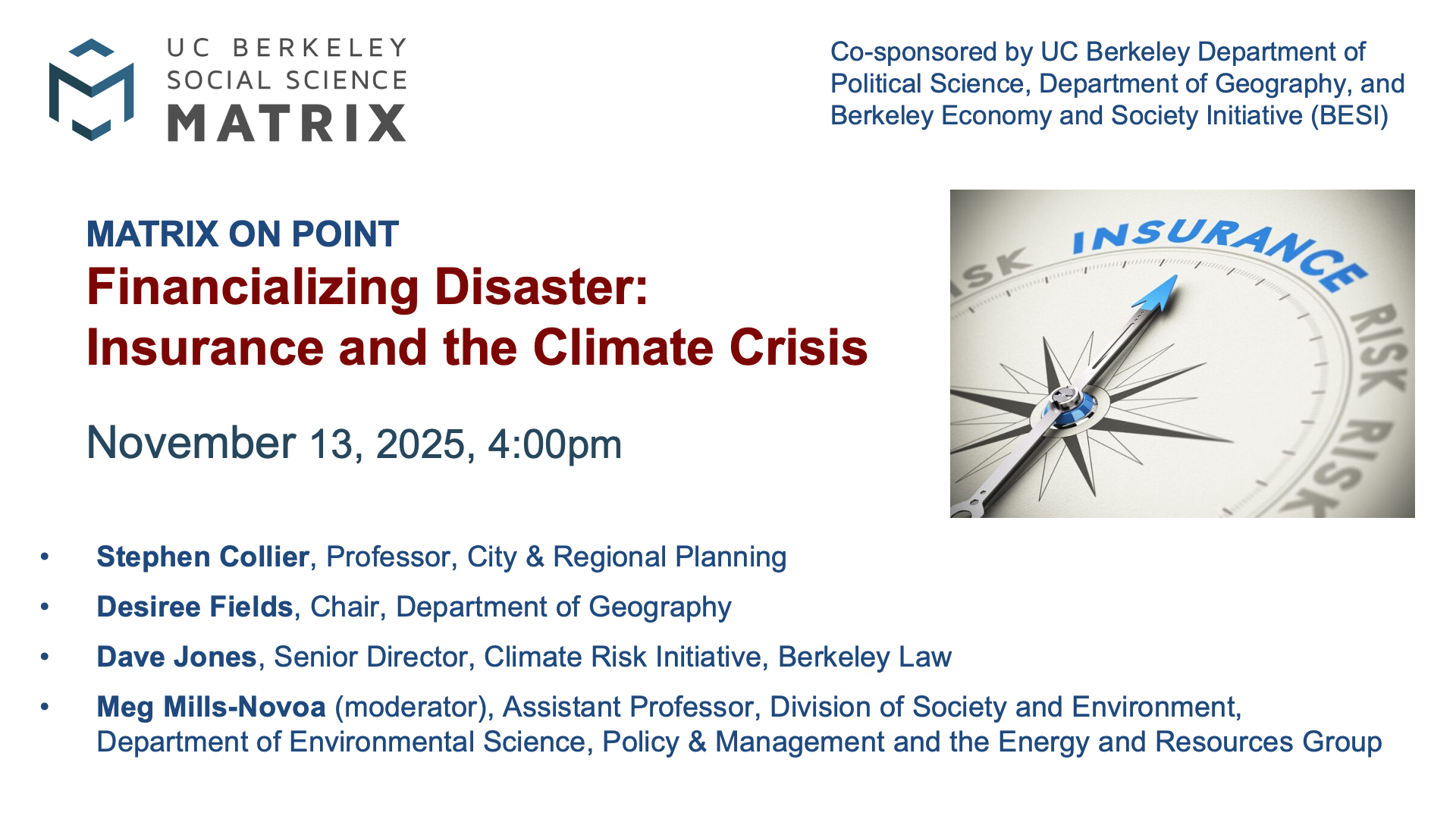 Matrix on Point: Financializing Disaster 15.12.2025 52minThe technical world of insurance is a critical lens through which to understand the escalating crises in climate change and housing. As climate risks intensify, both public and private homeowner insurance markets face unprecedented pressure, revealing the interconnections between housing affordability, wealth inequality, and the broader financialization of our communities. Recorded on November 13, 2025, this panel brought together experts to explore the intersection of insurance, housing, and climate. The panel featured Stephen Collier, Professor of City & Regional Planning at UC Berkeley; Desiree Fields, Associate Professor of Geography at UC Berkeley; and Dave Jones, Senior Director of the Climate Risk Initiative at UC Berkeley School of Law. Meg Mills-Novoa, Assistant Professor with a joint appointment to the Division of Society and Environment in the Department of Environmental Science, Policy & Management and the Energy and Resources Group, moderated. The panel was co-sponsored by UC Berkeley Department of Political Science, the Department of Geography, and the Berkeley Economy and Society Initiative (BESI). A transcript of this recording is available at https://matrix.berkeley.edu/research-article/financializing-disaster.
 -
 Matrix on Point: Spaces for Thriving 17.11.2025 1u 4minPhysical spaces profoundly influence community well-being. Understanding this relationship is crucial for leveraging planning and policy to foster equitable outcomes. Recorded on November 3, 2025, this panel brought together experts to explore how thoughtful planning and strategic policy can shift power toward communities, creating conditions where all can thrive. The discussion bridged diverse perspectives on environmental conservation, design psychology, and disability studies to illuminate steps toward more just and inclusive environments. The panel featured You-Tien Hsing, Professor of Geography at UC Berkeley; Sally Augustin, Lecturer at the UC Berkeley School of Public Health in the Interdisciplinary Center for Healthy Workplaces and Principal at Design With Science; and Karen Nakamura, Professor of Anthropology and Director of the Disability Studies Lab at UC Berkeley. Meredith Sadin, Associate Professor at the Goldman School of Public Policy and Senior Researcher at the UC Berkeley Possibility Lab, moderated. The panel was co-sponsored by the UC Berkeley Interdisciplinary Center for Healthy Workplaces, the Possibility Lab, the Center for Research on Social Change, the Department of Geography, and the Department of Anthropology. A video and transcript of this podcast are available at https://matrix.berkeley.edu/research-article/spaces-for-thriving
 -
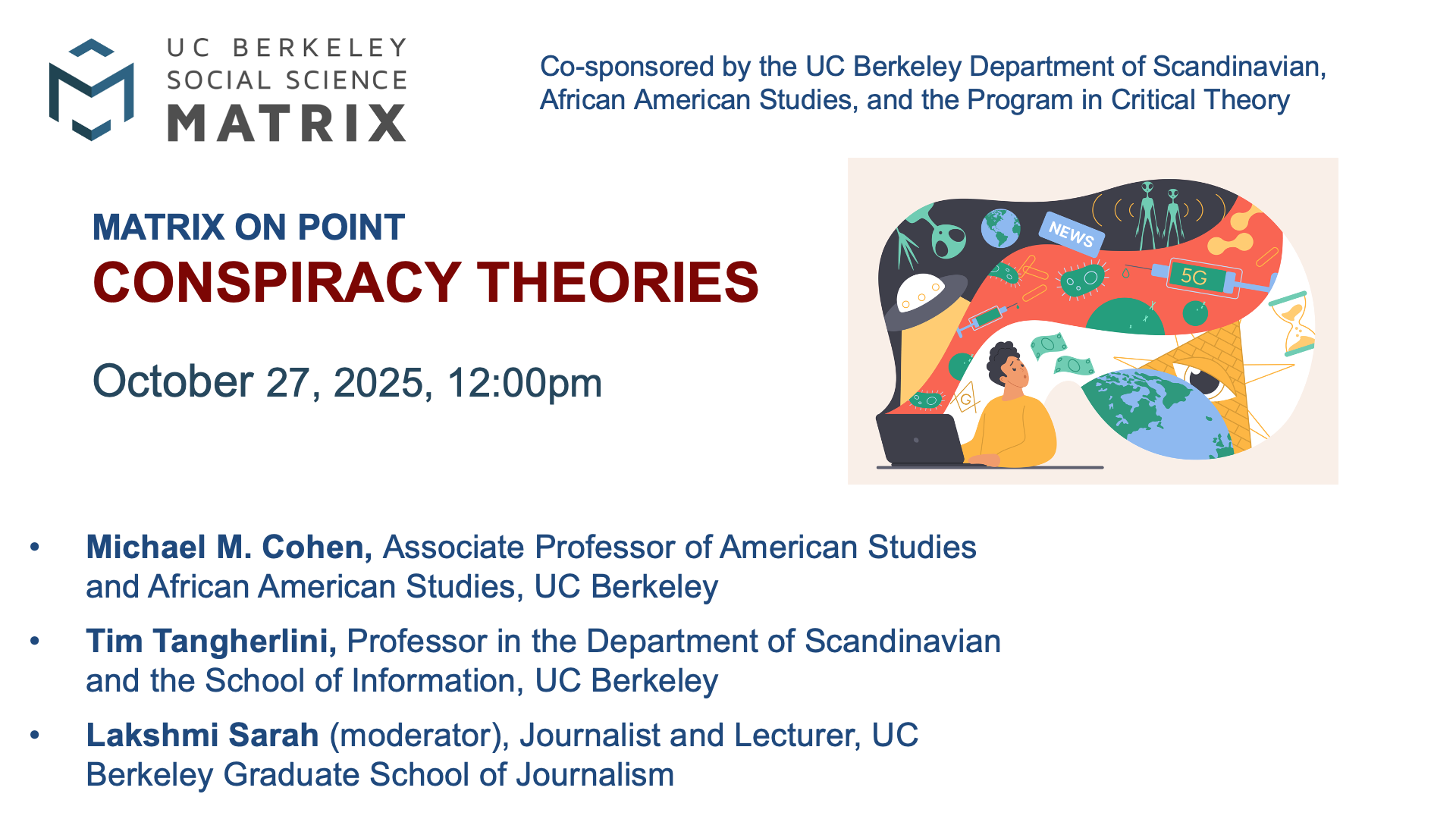 Matrix on Point: Conspiracy Theories 17.11.2025 1u 23minConspiracy theories are a pervasive and powerful force in contemporary society, shaping public discourse and influencing real-world events. Understanding their origins, spread, and impact is crucial in navigating today's information landscape. Recorded on October 27, 2025, this panel brought together experts to delve into the multifaceted world of conspiracy theories. Drawing on diverse academic perspectives, the discussion explored the nature of conspiracy theories, their societal implications, and how they are understood and addressed. The panel featured Michael M. Cohen, Associate Professor of American Studies and African American Studies at UC Berkeley, and Tim Tangherlini, Professor in the Department of Scandinavian and the School of Information at UC Berkeley. Lakshmi Sarah, journalist and lecturer at the UC Berkeley Graduate School of Journalism, moderated. Matrix On Point is a discussion series promoting focused, cross-disciplinary conversations on today's most pressing issues. Offering opportunities for scholarly exchange and interaction, each Matrix On Point features the perspectives of leading scholars and specialists from different disciplines, followed by an open conversation. These thought-provoking events are free and open to the public. This panel was co-sponsored by the UC Berkeley Department of Scandinavian, African American Studies, and the Program in Critical Theory. A video and transcript of this podcast is available at https://matrix.berkeley.edu/research-article/conspiracy-theories.
 -
 Engendering Blackness: Slavery and the Ontology of Sexual Violence 22.10.2025 1u 20minOn October 15, 2025, Matrix hosted an Authors Meet Critics panel on the book Engendering Blackness: Slavery and the Ontology of Sexual Violence, by Patrice Douglass, Assistant Professor of Gender and Women's Studies at UC Berkeley. Professor Douglass was joined in conversation by Salar Mameni, Associate Professor of Ethnic Studies at UC Berkeley, and Henry Washington, Jr., Assistant Professor of African American Studies at UC Berkeley. Courtney Desiree Morris, Associate Professor of Gender and Women's Studies at UC Berkeley, moderated. The event was co-sponsored by the Center for Race and Gender, the Department of Gender and Women's Studies, and the Department of Ethnic Studies. The Social Science Matrix Authors Meet Critics book series features lively discussions about recently published books authored by social scientists at UC Berkeley. For each event, the author discusses the key arguments of their book with fellow scholars. About the Book In this incisive book, Douglass interrogates the relationship between sexual violence and modern racial slavery and finds it not only inseverable but also fundamental to the structural predicaments facing Blackness in the present. Douglass contends that the sexual violability of slaves is often misappropriated by frameworks on sexual violence that privilege its occurrences as a question of ethics, sexual agency, and feminine orders of gendering. Rather, this book foregrounds Blackness as engendered by sexual violence, which forcefully (re)produces Blackness, corporeally and conceptually, as a condition that lacks the capacity to ontologically distinguish its suffering from what it means to be human. By employing and critically revising Black feminist theory and Afro-pessimism, Douglass reveals that engaging primarily with the sexualization of the slave forces theories of sexual violence to interrogate why this violence — one of the most prevalent under slavery — continues to lack a grammar of fundamental redress. There are no reparations struggles for the generational transfer of sexual violation and the inability of present frameworks to rectify the sexual stains of slavery lies precisely in the fact that what made this history possible continues to haunt arrangements of life today. "Engendering Blackness" urgently articulates the way our present understandings of Blackness and humanness are bound by this vexed sexual history. For a transcript of this panel, please see https://matrix.berkeley.edu/research-article/engendering-blackness.
 -
 Legitimation by (Mis)identification: Credit, Discrimination, and The Racial Epistemology of Algorithmic Expansion 21.10.2025 51minRecorded on September 22, 2025, this video features a talk by Davon Norris, Assistant Professor of Organizational Studies and Sociology (by courtesy) and Faculty Associate at the Stone Center for Inequality Dynamics at the University of Michigan. Professor Norris's research is broadly oriented to understanding how our ways of determining what is valuable informs patterns of inequality with an acute focus on racism and racial inequality. Often, this means he studies the history, construction, and operation of various ratings, scores, and rankings whether that be at the government level (i.e., government credit ratings) or individual level (i.e., consumer credit scores). Other work that comes out of this interest in valuation processes further probes questions related to finance and the role of credit and debt in shaping inequality. His research has been published in outlets such as Social Forces, Socio-Economic Review, Social Problems, and Sociological Forum, and has received awards from the Future of Privacy Forum and American Sociological Association. His work has been funded by the American Sociological Association. Davon received his Bachelor of Science in Accounting (2014), Master of Arts in Sociology (2018) and Ph.D. (2022) in Sociology all from The Ohio State University. This talk, "Legitimation by (Mis)identification: Credit, Discrimination, and the Racial Epistemology of Algorithmic Expansion," was presented as part of a symposium series presented by the UC Berkeley Computational Research for Equity in the Legal System Training Program (CRELS), which trains doctoral students representing a variety of degree programs and expertise areas in the social sciences, computer science and statistics. (Learn more at: https://crels.berkeley.edu/.) The event was co-sponsored by Social Science Matrix, the Berkeley Economy and Society Initiative (BESI) Tech Cluster, the Berkeley Institute for Data Science (BIDS), and the UC Berkeley Department of Sociology. Learn more at https://matrix.berkeley.edu. A transcript of this talk is available at https://matrix.berkeley.edu/research-article/davon-norris
 -
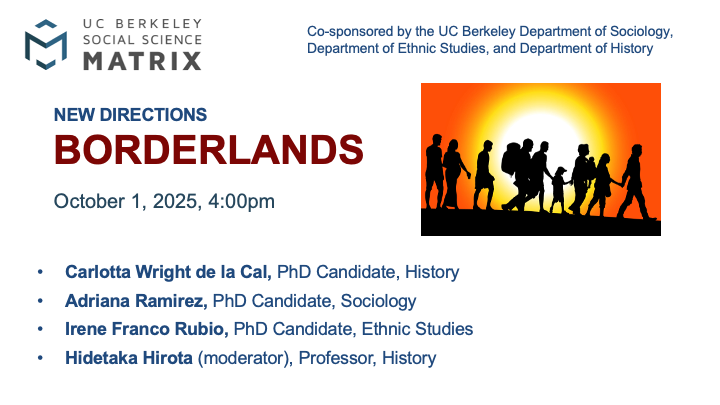 New Directions: Borderlands 21.10.2025 1u 3minBorders reflect the many social, historical, and political forces that shape global movement and identity. While borders often suggest fixed lines of division, the experiences within and around them increasingly influence national and global understandings of belonging, sovereignty, and human rights. Recorded on October 1, 2025, this panel together a group of UC Berkeley graduate students from the fields of history, sociology, and ethnic studies for a discussion on borders and their impact, particularly through the lens of migration, mobility, and resistance across the U.S.-Mexico border. The panel featured Carlotta Wright de la Cal, PhD Candidate in History; Adriana Ramirez, PhD Candidate in Sociology; and Irene Franco Rubio, PhD Candidate in Ethnic Studies. Hidetaka Hirota, Professor of History, moderated. The Social Science Matrix New Directions event series features research presentations by graduate students from different social science disciplines. This panel was co-sponsored by the UC Berkeley Department of Sociology, Department of Ethnic Studies, and Department of History. For a transcript of this podcast, visit https://matrix.berkeley.edu/research-article/borderlands.
 -
 Technology and China in the New Political Economy 12.06.2025 1u 24minThe innovation, use and experience, and exchange of new and emerging technologies today are influenced by the role that China plays in global politics and economy. Recorded on April 18, 2025, this Matrix on Point panel brought together experts of the Chinese political economy and law and society in a conversation to discuss the political, economic, security, and social dimensions and complexities of technology in China's internationalization during times of global tensions. Topics covered included the institutional foundations of China's technological development, technology governance and industrial policy, global technology competition, and legal technology and societal impacts in today's China. The panel featured Mark Dallas, Professor of Political Science and Science, Technology, and Society at Union College; Roselyn Hsueh, Professor of Political Science at Temple University and Visiting Scholar at the Berkeley Economy and Society Initiative; and Rachel E. Stern, Professor of Law and Political Science at UC Berkeley. AnnaLee Saxenian, Professor in the School of Information, served as chair and moderator. Matrix On Point is a discussion series promoting focused, cross-disciplinary conversations on today's most pressing issues. Offering opportunities for scholarly exchange and interaction, each Matrix On Point features the perspectives of leading scholars and specialists from different disciplines, followed by an open conversation. The panel was co-presented by the Berkeley Economy and Society Initiative, and co-sponsored by the Institute of International Studies (IIS), the UC Berkeley School of Information, and the Charles and Louise Travers Department of Political Science. This public panel is a part of the two-day Bringing the Sector Back In conference, also co-sponsored by the Institute of East Asian Studies and the Institute of Slavic, East European, and Eurasian Studies. A video recording of this panel is available on YouTube. A transcript of this recording can be found at https://matrix.berkeley.edu/research-article/tech-and-china
Vergelijkbare podcasts


Populair in
Deze podcast verschijnt ook in de podcastlijsten van deze landen.
