
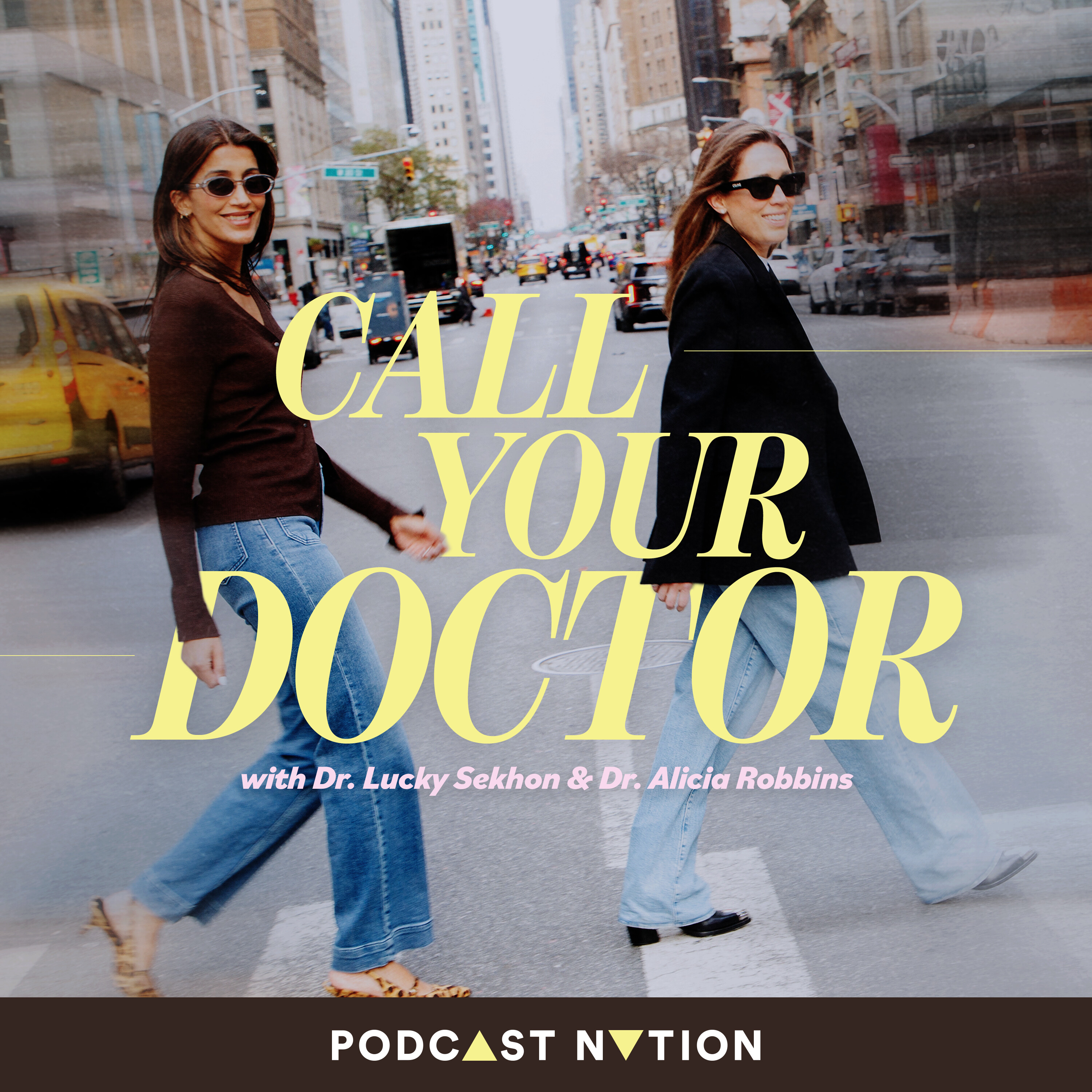
Call Your Doctor
Podcast Nation
1
Call Your Doctor is a women's health podcast hosted by Dr. Lucky Sekhon, a fertility specialist and OB/GYN, and Dr. Alicia Robbins, a perimenopause and hormone expert. They provide relatable, evidence-based advice on topics like hormones, egg freezing, perimenopause, sexual health, and aging. Each episode features honest conversations and actionable medical guidance for busy women. Listeners can submit questions via a voicemail hotline.
Afleveringen
-
 Beyond the Pink: Navigating Life, Health, and Breast Cancer with Medical Oncologist Dr. Eleonora Teplinsky 28.09.2026 58minBreast cancer is one of those diagnoses that almost every woman thinks about at some point. Maybe you’ve had a mammogram callback, maybe you found a lump, maybe your mother, sister, best friend, coworker, or you have been diagnosed. Or maybe you’ve wondered, what can I actually do to lower my risk? But here’s the thing - most of what women hear about breast cancer focuses on finding it and treating it, we hear much less about everything that comes before and after, and the after can be enormous. What happens to your fertility if you’re diagnosed before you’ve finished building your family? What happens when chemotherapy or hormone therapy puts you into a state of menopause a decade before you expected it? Can you ever take hormones again? Is pregnancy safe after breast cancer? And after treatment ends, and everyone tells you “you’re cancer free - go live your life”…what does that actually look like? Our guest today has made it her mission to talk about these exact issues. Dr. Eleonora Teplinsky is a board-certified medical oncologist specializing in breast and gynecologic cancers. She’s the head of the breast and gynecologic medical oncology department at Valley Health System in New Jersey, and a clinical assistant professor of medicine at the Icahn School of Medicine at Mount Sinai, which is where Dr. Sekhon and Dr. Robbins met and trained together. Dr. Teplinsky is also the host of Interlude podcast, a passionate women’s health advocate and author of Beyond the Pink: Navigating Life, Health, and Breast Cancer. Breast cancer is so much bigger than wearing a pink ribbon. In this episode, Dr. Lucky Sekhon and Dr. Alicia Robbins sit down with Dr. Teplinsky to discuss what women actually need to know about their risk, prevention, diagnosis, hormones, fertility, and what happens when treatment is done, but you’re still figuring out how to live in your body again. Breast health isn’t just something that we should start thinking about after there’s a problem. We should be evaluating our own risk, better understanding our family history, knowing what screening we need, and knowing what changes in our body deserve attention, as well as taking care of ourselves in a holistic way outside of just actual breast cancer treatment. For anyone listening who has been diagnosed with breast cancer, or loves someone who has, we hope this conversation makes clear that you’re allowed to care about more than just simply surviving. Follow @drteplinsky to hear more from her and find her book Beyond the Pink: Navigating Life, Health, and Breast Cancer here.IF YOU’RE TEXTING YOUR FRIENDS LIKE... You: When should I get my first mammogram? Also You: Will eating soy increase my risk of breast cancer?? 3AM You: Wait…can people with breast cancer not have children???? IF YOUR GOOGLE SEARCH HISTORY LOOKS LIKE THIS… What can I actually do to lower my risk of breast cancer? How often should I get mammograms? What are the misconceptions about breast cancer? Is all breast cancer the same? How does chemotherapy affect fertility? What are the treatment options for breast cancer? Does soy increase breast cancer risk? When should I consider risk preventing surgery? How early should I get a mammogram? Does menopausal hormone therapy cause cancer? What are the long-term risks of breast cancer? Is vaginal estrogen safe for someone with breast cancer? Can breast cancer happen in my 30s? When can I ask my doctor for a breast cancer risk assessment? What are symptoms of breast cancer, if any? Will chemotherapy make me go into early menopause? Can thermography replace mammograms in breast cancer screening? What’s the difference between freezing eggs and preserving embryos? How does family history play a role in breast cancer risk? Does alcohol play a role in breast cancer risk? YOU’VE COME TO THE RIGHT PLACE! Let’s continue the conversation! Leave us a voicemail with your questions at 754-CALLDOC (754) 225-5362. Nothing is off limits. Follow Us on Instagram: @callyourdoctorpodcast @lucky.sekhon @aliciarobbinsmd THANK YOU TO OUR SPONSORS!Instant Hydration: For a better way to stay hydrated, go to instanthydration.com/CALLYOURDOCTOR and use our promo code CALLYOURDOCTOR for over 40% off your first subscription order.Quince: Find the fall pieces you'll reach for most. Download the Quince app for app-exclusive offers, or go to quince.com/callyourdoctor. Get free shipping on your order and 365-day returns.OneSkin: Get 15% off OneSkin with the code CALLYOURDOCTOR at https://www.oneskin.co/CALLYOURDOCTOR #oneskinpodAlloy: Spoiler: you can feel amazing in menopause. Visit myalloy.com and use code CALLYOURDOCTOR for 20% off your first order!AirDoctor: Head to AirDoctorPro.com and use promo code CALLYOURDOCTOR and get up to $300 off ANY of their select AirDoctor models, plus you will get a 3-year warranty, absolutely FREE! All AirDoctor air purifiers come with a 30-day money back guarantee.Caraway: Right now, you can save up to $230 on the 12 piece cookware set vs buying the products individually. And you can find even more set savings when you shop Caraway’s full Kitchenware collection. Visit Carawayhome.com/callyourdoctor to take an additional 10% off your next purchase or use code callyourdoctor at checkout.Cozy Earth: Head to cozyearth.com and use my code CALLYOURDOCTOR for up to 20% off. See Privacy Policy at https://art19.com/privacy and California Privacy Notice at https://art19.com/privacy#do-not-sell-my-info.
 -
Healthcare Hacks: How to Get the Most Out of Your Doctor’s Appointment 21.09.2026 31minDoctor’s appointments can be intimidating. It’s a universal experience. And everyone wants to feel like their doctor is invested in them. As two doctors who are on the other side of things, we know how it feels when you walk into a sterile environment where you’re given a limited amount of time to be assessed and have all your questions answered. In today’s episode, Dr. Lucky Sekhon and Dr. Alicia Robbins are giving you all the hacks and practical tips on how to get the most out of your doctor’s appointments. It’s enough to be a patient dealing with a medical problem, but navigating the healthcare system and coordination of everything that needs to be done is no small feat and can leave you feeling overwhelmed and unsure. Most doctor appointments are 15 minutes, or even less, and we are here to help you be prepared to use every single moment of that visit wisely. Dr. Sekhon and Dr. Robbins share how you should prep for your appointment, what to prioritize when you’re actually there, and the questions you should ask before you walk out the door. This episode stresses the importance of knowing enough to be able to participate actively and proactively in your medical care. There are so many good doctors—you don’t go through years of grueling training without having a purpose or a reason behind it. Is it an optimal healthcare system? No. But this is all about being strategic, efficient, and maximizing as much as we can. You can get a lot more out of your experience and have better care if you are able to self-advocate, and today’s episode is really about giving you those tools. Plan it, be strategic, know your story, understand your options, speak up when something doesn’t make sense, and remember that your doctor has seen it all, so don’t be embarrassed to be vulnerable. And yes, crying IS normal! We hope this episode inspires you to take your health into your own hands. The best care isn’t a doctor dictating what happens to a passive patient, it’s a partnership. IF YOU’RE TEXTING YOUR FRIENDS LIKE... You: I have a doctor’s appointment tomorrow...I’m feeling nervous about it... Also You: What should I ask my doctor? Can I ask them about this health trend I saw on TikTok? 3AM You: Wait…do I only get 15 minutes with them? What should I prioritize??? IF YOUR GOOGLE SEARCH HISTORY LOOKS LIKE THIS… What should I bring to my doctor’s appointment? Is it normal to be anxious going into a doctor’s appointment? Should I bring up other health concerns at my annual check-up? How honest should I be with my doctor? Will my doctor be upset if I bring up medical advice I saw on social media? How do I advocate for myself without being confrontational? What questions should I ask my doctor before I walk out? Can I record my doctor’s appointment, or take notes? Do doctors get annoyed if you bring someone with you? How can I not be an annoying patient but still get the answers I’m looking for? What are the doctor red flags that I should lookout for? YOU’VE COME TO THE RIGHT PLACE! Let’s continue the conversation! Leave us a voicemail with your questions at 754-CALLDOC (754) 225-5362. Nothing is off limits. Follow Us on Instagram: @callyourdoctorpodcast @lucky.sekhon @aliciarobbinsmd THANK YOU TO OUR SPONSORS!Instant Hydration: For a better way to stay hydrated, go to instanthydration.com/CALLYOURDOCTOR and use our promo code CALLYOURDOCTOR for over 40% off your first subscription order.Quince: Find the fall pieces you'll reach for most. Download the Quince app for app-exclusive offers, or go to quince.com/callyourdoctor. Get free shipping on your order and 365-day returns.OneSkin: Get 15% off OneSkin with the code CALLYOURDOCTOR at https://www.oneskin.co/CALLYOURDOCTOR #oneskinpodAlloy: Spoiler: you can feel amazing in menopause. Visit myalloy.com and use code CALLYOURDOCTOR for 20% off your first order!AirDoctor: Head to AirDoctorPro.com and use promo code CALLYOURDOCTOR and get up to $300 off ANY of their select AirDoctor models, plus you will get a 3-year warranty, absolutely FREE! All AirDoctor air purifiers come with a 30-day money back guarantee.Caraway: Right now, you can save up to $230 on the 12 piece cookware set vs buying the products individually. And you can find even more set savings when you shop Caraway’s full Kitchenware collection. Visit Carawayhome.com/callyourdoctor to take an additional 10% off your next purchase or use code callyourdoctor at checkout. See Privacy Policy at https://art19.com/privacy and California Privacy Notice at https://art19.com/privacy#do-not-sell-my-info.
-
Answering Your Voicemails: Why Can’t I Get Pregnant? How Can I Support My Fertility as a Shift Worker? Does Perimenopause Look Different If I’ve Had a Hysterectomy? 14.09.2026 48minYou called? We answered. In this episode, Dr. Alicia Robbins and Dr. Lucky Sekhon are responding to voicemails sent in by listeners with questions about a variety of women’s health concerns. “How do I know if you have PMOS or Hypothalamic Amenorrhea (HA), or do I have both?” “I’ve done loads of testing to see if I had anything affecting my infertility and very little has been found, so why can’t I get pregnant?” “Is patch estrogen better than the pill for perimenopausal women who suffer from migraines with aura?” These are the kinds of nuanced questions we love—the topics you might be embarrassed to ask about, the symptoms you’re googling 17 times, and the questions you forgot to ask at your doctor’s appointment. Dr. Robbins and Dr. Sekhon navigate their answers to these callers by using actual stories from their real-life experiences as menopause and fertility experts. They explain what the clues are when diagnosing a patient with PMOS or HA, how having a hysterectomy could, or could not, affect perimenopause, and dive into the most frustrating thing that Dr. Sekhon sees couples go through—unexplained infertility. On the trending topic of Alix Earle finding out she’s a BRCA 2 carrier, Dr. Robbins shares what is important for women to know about BRCA gene mutations, and what the misconceptions are when it comes to taking the birth control pill and hormone therapy. For the women with thin uterine lining after ovulation, Dr. Sekhon explains what protocols she follows in her own practice to provide support and improve uterine lining thickness. Dr. Sekhon and Dr. Robbins also speak on their past struggles as shift workers, knowing how much stress this type of work puts on one’s physiology, and they give practical solutions on how someone can best optimize their fertility in these circumstances. If there’s one thing that the questions in this episode proved, it’s that reproductive health is rarely as simple as one symptom, one lab value, or one diagnosis. The context behind every individual’s situation matters. Thank you to everyone who called in. Keep leaving voicemails to be featured on a future episode! The Science Behind Sleep with Dr. Saema Tahir of @thenycsleepdoctorPCOS: The Hormonal Group Chat Gone WrongPMOS (formerly known as PCOS) Part 2: Connecting the Hormonal DotsYou Lost Your Period… Now What? Understanding Hypothalamic AmenorrheaIF YOU’RE TEXTING YOUR FRIENDS LIKE... You: My lab tests are all fine….why can’t I get pregnant? Also You: My iron levels are low….how can I increase them without eating red meat?? 3AM You: Wait…is working the night shift affecting my fertility???? IF YOUR GOOGLE SEARCH HISTORY LOOKS LIKE THIS… How do you know if you have PMOS or Hypothalamic Amenorrhea (HA)? Should I take out my ovaries? What are the risks? What is the truth about the BRCA 1 and BRCA 2 mutations? Can you be on the pill if you have BRCA gene mutations? What does it mean if you have a thin uterine lining after ovulation? What are the underlying risk factors of having a thin uterine lining? How can you treat migraines in perimenopause? Why do women get migraines in perimenopause? What is the recommended level of ferritin? Do I need to eat red meat to increase my iron levels? Does perimenopause look different if you had a hysterectomy? Is the lower dose patch estrogen better than the pill if you have migraines with aura? How can I support my fertility as a shift worker? Should I be taking Vitamin D and/or CoQ10? YOU’VE COME TO THE RIGHT PLACE! Let’s continue the conversation! Leave us a voicemail with your questions at 754-CALLDOC (754) 225-5362. Nothing is off limits. Follow Us on Instagram: @callyourdoctorpodcast @lucky.sekhon @aliciarobbinsmd THANK YOU TO OUR SPONSORS!Instant Hydration: For a better way to stay hydrated, go to instanthydration.com/CALLYOURDOCTOR and use our promo code CALLYOURDOCTOR for over 40% off your first subscription order.Quince: Find the fall pieces you'll reach for most. Download the Quince app for app-exclusive offers, or go to quince.com/callyourdoctor. Get free shipping on your order and 365-day returns.OneSkin: Get 15% off OneSkin with the code CALLYOURDOCTOR at https://www.oneskin.co/CALLYOURDOCTOR #oneskinpodAlloy: Spoiler: you can feel amazing in menopause. Visit myalloy.com and use code CALLYOURDOCTOR for 20% off your first order!AirDoctor: Head to AirDoctorPro.com and use promo code CALLYOURDOCTOR and get up to $300 off ANY of their select AirDoctor models, plus you will get a 3-year warranty, absolutely FREE! All AirDoctor air purifiers come with a 30-day money back guarantee.Caraway: Right now, you can save up to $230 on the 12 piece cookware set vs buying the products individually. And you can find even more set savings when you shop Caraway’s full Kitchenware collection. Visit Carawayhome.com/callyourdoctor to take an additional 10% off your next purchase or use code callyourdoctor at checkout. See Privacy Policy at https://art19.com/privacy and California Privacy Notice at https://art19.com/privacy#do-not-sell-my-info.
-
Ask Your Doctor: Does Hormone Therapy Cause Breast Cancer? Why Is My Libido So Low? When Should I Consider IVF? 07.09.2026 52minYour favorite podcast doctors are solo this week! Dr. Lucky Sekhon and Dr. Alicia Robbins are here to answer all of your burning women’s health questions in this listener Q&A. They asked you what you wanted to know about fertility, pregnancy, hormones, perimenopause, menopause—and you definitely delivered. In this rapid-fire Q&A, Dr. Sekhon and Dr. Robbins focus on answering the highest yield questions that they get online and in their practice. A reminder that nothing in this episode should be taken as individualized medical advice, but they hope their generalized advice inspires you to have a low threshold when it comes to asking your doctor questions and seeking out experts. “I have diminished ovarian reserve, should I stop trying naturally?” “What should I avoid after an embryo transfer?” “Why did my sleep quality suddenly decline when I entered my 40s?” “I’ve had two miscarriages, should I just do IVF?” These are real questions that women want answers to. Dr. Sekhon and Dr. Robbins address the multiple factors that are often overlooked when it comes to sleep issues, low libido, fertility testing, recurrent pregnancy loss, and so much more. They give you the inside scoop on what they tell their own patients, and the processes and tests they use to determine the cause of the problem. By the end of this episode, they hope you feel less alone in your health struggles, gain confidence to talk to your doctor about the symptoms you’re experiencing and feel more comfortable discussing taboo topics with your friend group. The common thread here is that women’s health is on a continuum, everything is interrelated, one person’s experience doesn’t tell the whole story, and context is so important when addressing health issues. IF YOU’RE TEXTING YOUR FRIENDS LIKE... You: Wait... my doctor wants me to try hormone replacement therapy... Also You: Does estrogen cause breast cancer? I’ve seen some rumors... 3AM You: Wait but if I do IVF...can ovarian stimulation put me at a higher risk for breast cancer??? IF YOUR GOOGLE SEARCH HISTORY LOOKS LIKE THIS… What is an AMH test and what can it tell you? Is my low AMH holding me back from trying naturally? Can you get pregnant during menopause? What is the difference between perimenopause and menopause? Can I exercise after an embryo transfer? Why did my sleep suddenly decline when I entered my 40s? Does it matter what time I take progesterone? Are cooling mattresses worth it? When should I consider IVF? Does hormone therapy cause breast cancer? What is an HSG? What tests do I need to get before deciding to do IVF? Are fibroids causing my infertility? What is Antiphospholipid Syndrome (ALPS) and is there a solution? What are the symptoms of perimenopause? Is coffee the cause of my miscarriage? Are there medications to help with low libido? Is sex therapy worth it? YOU’VE COME TO THE RIGHT PLACE! Let’s continue the conversation! Leave us a voicemail with your questions at 754-CALLDOC (754) 225-5362. Nothing is off limits. Follow Us on Instagram: @callyourdoctorpodcast @lucky.sekhon @aliciarobbinsmd THANK YOU TO OUR SPONSORS!Instant Hydration: For a better way to stay hydrated, go to instanthydration.com/CALLYOURDOCTOR and use our promo code CALLYOURDOCTOR for over 40% off your first subscription order.Quince: Find the fall pieces you'll reach for most. Download the Quince app for app-exclusive offers, or go to quince.com/callyourdoctor. Get free shipping on your order and 365-day returns.OneSkin: Get 15% off OneSkin with the code CALLYOURDOCTOR at https://www.oneskin.co/CALLYOURDOCTOR #oneskinpodAlloy: Spoiler: you can feel amazing in menopause. Visit myalloy.com and use code CALLYOURDOCTOR for 20% off your first order!AirDoctor: Head to AirDoctorPro.com and use promo code CALLYOURDOCTOR and get up to $300 off ANY of their select AirDoctor models, plus you will get a 3-year warranty, absolutely FREE! All AirDoctor air purifiers come with a 30-day money back guarantee.Caraway: Right now, you can save up to $230 on the 12 piece cookware set vs buying the products individually. And you can find even more set savings when you shop Caraway’s full Kitchenware collection. Visit Carawayhome.com/callyourdoctor to take an additional 10% off your next purchase or use code callyourdoctor at checkout. See Privacy Policy at https://art19.com/privacy and California Privacy Notice at https://art19.com/privacy#do-not-sell-my-info.
-
Raising the Standard for Women’s Care with Celebrity OB/GYN Dr. Thaïs Aliabadi 31.08.2026 53minIn this episode, Dr. Lucky Sekhon and Dr. Alicia Robbins are joined by renowned OB/GYN Dr. Thaïs Aliabadi, better known as Dr. A, to talk about what comprehensive women's healthcare should actually look like. Dr. A shares why she refuses to dismiss her patients' symptoms, why a Pap smear is only one small piece of an annual exam, and why these exams should be viewed holistically. The conversation takes a deeper look into breast cancer prevention after Dr. A opens up about her own experience discovering that her lifetime breast cancer risk was dramatically higher than she expected and how a breast MRI helped uncover early breast cancer in Olivia Munn after her initial imaging was negative. They also discuss the importance of pelvic ultrasound, what a Pap smear actually screens for, why endometriosis and PCOS can go undiagnosed for years, and how women can become better advocates for themselves without falling into the misinformation trap. Dr. A fervently speaks on why celebrity health stories can actually be powerful public health tools, how social media can both educate and mislead, and why finding a doctor who truly listens may be one of the most important things you can do for your health. Follow Dr. Thaïs Aliabadi - @drthaisaliabadi IF YOU’RE TEXTING YOUR FRIENDS LIKE... You: Wait... a Pap smear doesn't actually check my uterus or ovaries??? Also You: How do I know if I'm actually high-risk for breast cancer? 3AM You: Okay but what if my mammogram is normal and there's STILL something there??? IF YOUR GOOGLE SEARCH HISTORY LOOKS LIKE THIS… What does a Pap smear actually check for? Should I get a pelvic ultrasound? What is the Tyrer-Cuzick score? How do I calculate my lifetime breast cancer risk? What does dense breast tissue mean? Do I need a breast MRI? Can a mammogram miss breast cancer? What age should I start breast cancer screening? Can endometriosis be missed? How do you know if you have PCOS? Should I get my AMH tested? How do I advocate for myself at the doctor? YOU’VE COME TO THE RIGHT PLACE! Let’s continue the conversation! Leave us a voicemail with your questions at 754-CALLDOC (754) 225-5362. Nothing is off limits. Follow Us on Instagram: @callyourdoctorpodcast @lucky.sekhon @aliciarobbinsmd THANK YOU TO OUR SPONSORS!Instant Hydration: For a better way to stay hydrated, go to instanthydration.com/CALLYOURDOCTOR and use our promo code CALLYOURDOCTOR for over 40% off your first subscription order.Quince: Upgrade your everyday. Download the Quince app for app-exclusive offers, or go to quince.com/callyourdoctor. Get free shipping on your order and 365-day returns.Alloy: Your sex life doesn't have to change just because your hormones did. Visit myalloy.com and use code CALLYOURDOCTOR for $20 off your first order!AirDoctor: Head to AirDoctorPro.com and use promo code CALLYOURDOCTOR and get up to $300 off ANY of their select AirDoctor models, plus you will get a 3-year warranty, absolutely FREE! All AirDoctor air purifiers come with a 30-day money back guarantee.Caraway: Right now, you can save up to $230 on the 12 piece cookware set vs buying the products individually. And you can find even more set savings when you shop Caraway’s full Kitchenware collection. Visit Carawayhome.com/callyourdoctor to take an additional 10% off your next purchase. See Privacy Policy at https://art19.com/privacy and California Privacy Notice at https://art19.com/privacy#do-not-sell-my-info.
-
The Truth About Postpartum Psychosis with Dr. Katrina Furey 24.08.2026 45minTrigger Warning: This episode deals with intense and difficult topics regarding the Lindsay Clancy case. Postpartum psychosis and postpartum mental health have been a recent topic of online discussion during the past few weeks due to the highly publicized murder trial of Lindsay Clancy. In this episode, Dr. Alicia Robbins is joined by Dr. Katrina Furey, a Yale trained board certified reproductive psychiatrist, the founder of Sound Psychiatry, a private practice serving patients in Connecticut and Florida, and the founder of Repro Psych Academy, an online interdisciplinary continuing access platform built to close the gap in reproductive health education. She’s also a clinical instructor at Yale University and consults for Connecticut’s access, mental health, and substance use for moms program. Dr. Furey is a frequent media contributor on perinatal mental health and postpartum psychosis, with credits including CNN, Newsweek, The New York Post, and a recent live appearance on Court TV to discuss postpartum psychosis as it relates to the Lindsay Clancy trial. Dr. Robbins and Dr. Furey discuss the difference between postpartum psychosis and postpartum depression, how powerful hormonal and chemical shifts after childbirth can be, and what the warning signs look like in the days and weeks after delivery. They also connect over their concerns for both mothers and physicians due to the pitfalls of the healthcare system. Dr. Furey shares how her personal experience with postpartum, and the shame she went through, shifted her career projection. By the end of this episode, you’ll have a better understanding of how someone can go from being a perfectly capable, loving mother, to someone who is at risk of hurting their own children. Follow Dr. Katrina Furey - @drkatrinafurey Repro Psych Academy Postpartum Support International The National Maternal Mental Health Hotline and Alliance IF YOU’RE TEXTING YOUR FRIENDS LIKE... You: Have you heard about the Lindsay Clancy case? Also You: How could a mother hurt her own children?? 3AM You: Okay but how can I make sure that this never happens to me or someone I care about??? IF YOUR GOOGLE SEARCH HISTORY LOOKS LIKE THIS… What is the difference between postpartum depression, postpartum anxiety, postpartum OCD, and postpartum psychosis? Are intrusive thoughts normal? What are the warning signs of postpartum psychosis? Are people with postpartum psychosis aware of their actions? Why are mothers not more open about their postpartum experiences? Is it normal to feel shame for having bad mental health after childbirth? Should women with postpartum psychosis be hospitalized? What are delusions of control? Is postpartum psychosis genetic? What is the Edinburgh Postnatal Depression Scale (EPDS)? What are the tools used to diagnose postpartum illnesses? How much do environmental factors play a role in postpartum psychosis? What does the evidence show about treatment? What is ECT (electro convulsive therapy)? How should physicians go about treating postpartum psychosis and perinatal psychosis? What is the biology of postpartum psychosis? Is postpartum psychosis the same as schizophrenia? What resources exist to support mothers experiencing postpartum depression and anxiety? Is postpartum psychosis rare? What are the symptoms and characteristics of postpartum psychosis? What is the risk of postpartum psychosis? Does having bipolar disorder increase risk for postpartum psychosis? What are the treatment options for postpartum psychosis and postpartum depression? What is hypomania? YOU’VE COME TO THE RIGHT PLACE! Let’s continue the conversation! Leave us a voicemail with your questions at 754-CALLDOC (754) 225-5362. Nothing is off limits. Follow Us on Instagram: @callyourdoctorpodcast @lucky.sekhon @aliciarobbinsmd THANK YOU TO OUR SPONSORS!Instant Hydration: For a better way to stay hydrated, go to instanthydration.com/CALLYOURDOCTOR and use our promo code CALLYOURDOCTOR for over 40% off your first subscription order.Quince: Upgrade your everyday. Download the Quince app for app-exclusive offers, or go to quince.com/callyourdoctor. Get free shipping on your order and 365-day returns.Alloy: Your sex life doesn't have to change just because your hormones did. Visit myalloy.com and use code CALLYOURDOCTOR for $20 off your first order!AirDoctor: Head to AirDoctorPro.com and use promo code CALLYOURDOCTOR and get up to $300 off ANY of their select AirDoctor models, plus you will get a 3-year warranty, absolutely FREE! All AirDoctor air purifiers come with a 30-day money back guarantee.Caraway: Right now, you can save up to $230 on the 12 piece cookware set vs buying the products individually. And you can find even more set savings when you shop Caraway’s full Kitchenware collection. Visit Carawayhome.com/callyourdoctor to take an additional 10% off your next purchase. See Privacy Policy at https://art19.com/privacy and California Privacy Notice at https://art19.com/privacy#do-not-sell-my-info.
-
The Science Behind Sleep with Dr. Saema Tahir of @thenycsleepdoctor 17.08.2026 43minIf you feel like sleep suddenly hits differently in your 40s, you're not imagining it. You are now wide awake at 5AM, tossing and turning through the night, or waking up exhausted despite getting what should be enough hours of sleep. In this episode, Dr. Lucky Sekhon and Dr. Alicia Robbins are joined by quadruple board-certified sleep specialist Dr. Saema Tahir, also known as The New York Sleep Doctor, to break down what actually happens to sleep as women move through their 30s, 40s, and 50s. They explain why sleep quality matters just as much as sleep quantity, how estrogen and progesterone fluctuations can disrupt sleep during perimenopause, and why getting seven to nine hours doesn't necessarily mean you're getting restorative sleep. The conversation also tackles one of the most overlooked issues in women's health: sleep apnea. Dr. Tahir explains why irritability, brain fog, fatigue, mood changes, and poor sleep may actually be signs of an underlying sleep disorder. They discuss the truth about melatonin and why it's more of a timing medication than a sleep aid, and whether magnesium, ashwagandha, CBD and THC actually work. Follow Dr. Saema Tahir - @thenycsleepdoctor IF YOU’RE TEXTING YOUR FRIENDS LIKE... You: Why am I waking up at 5AM every single day now??? Also You: I'm getting 8 hours of sleep, so why am I STILL exhausted?? 3AM You: Okay but is this perimenopause... or do I have sleep apnea??? IF YOUR GOOGLE SEARCH HISTORY LOOKS LIKE THIS… Why can't I sleep in my 40s? Why do I wake up at 5AM every morning? Does perimenopause cause insomnia? Can estrogen affect sleep? Can progesterone help you sleep? How many hours of sleep do women need? What is sleep apnea in women? Can you have sleep apnea without snoring? Should women get a sleep study? Does melatonin actually help sleep? When should you take melatonin? Does magnesium help with sleep? Does THC affect REM sleep? Does alcohol ruin your sleep? Can poor sleep look like ADHD? YOU’VE COME TO THE RIGHT PLACE! Let’s continue the conversation! Leave us a voicemail with your questions at 754-CALLDOC (754) 225-5362. Nothing is off limits. Follow Us on Instagram: @callyourdoctorpodcast @lucky.sekhon @aliciarobbinsmd THANK YOU TO OUR SPONSORS!Instant Hydration: For a better way to stay hydrated, go to instanthydration.com/CALLYOURDOCTOR and use our promo code CALLYOURDOCTOR for over 40% off your first subscription order.Quince: Upgrade your everyday. Download the Quince app for app-exclusive offers, or go to quince.com/callyourdoctor. Get free shipping on your order and 365-day returns.Alloy: Your sex life doesn't have to change just because your hormones did. Visit myalloy.com and use code CALLYOURDOCTOR for $20 off your first order!AirDoctor: Head to AirDoctorPro.com and use promo code CALLYOURDOCTOR and get up to $300 off ANY of their select AirDoctor models, plus you will get a 3-year warranty, absolutely FREE! All AirDoctor air purifiers come with a 30-day money back guarantee.Caraway: Right now, you can save up to $230 on the 12 piece cookware set vs buying the products individually. And you can find even more set savings when you shop Caraway’s full Kitchenware collection. Visit Carawayhome.com/callyourdoctor to take an additional 10% off your next purchase. See Privacy Policy at https://art19.com/privacy and California Privacy Notice at https://art19.com/privacy#do-not-sell-my-info.
-
Hormones, Your Brain, and What Every Woman Should Know with Neurosurgeon Dr. Rupa Juthani 10.08.2026 48minIs brain health really determined by genetics, or are there everyday habits that can make a meaningful difference? In this episode, Dr. Lucky Sekhon and Dr. Alicia Robbins are joined by neurosurgeon Dr. Rupa Juthani to separate facts from fiction when it comes to protecting your brain. Together, they explore the lifestyle habits most strongly associated with long-term cognitive health, including nutrition, exercise, sleep, social connection, hearing protection, alcohol use, and emerging research on creatine. They explain why brain health is about far more than crossword puzzles, how chronic inflammation may influence cognitive decline, and why protecting your brain starts decades before symptoms ever appear. The conversation also tackles some of the biggest misconceptions surrounding brain imaging, dementia prevention, and wellness trends. They discuss whether everyone should get screening MRIs, what symptoms actually warrant brain imaging, why incidental findings can create unnecessary anxiety, and how to make evidence-based decisions without falling into fear. Dr. Juthani also shares her experience working in a male-dominated field. Follow Dr. Rupa Juthani - @braintumorsurgeonIF YOU’RE TEXTING YOUR FRIENDS LIKE... You: Okay... what can I actually do to lower my risk of dementia? Also You: Why am I hearing so much about creatine?? Should I be taking it even if I'm not trying to build muscle? 3AM You: Should I be getting brain MRIs just to make sure nothing's wrong??? IF YOUR GOOGLE SEARCH HISTORY LOOKS LIKE THIS… How can I reduce my risk of dementia? Does hearing loss increase dementia risk? Is creatine good for brain health? Can creatine help with brain fog? Does alcohol increase dementia risk? Should everyone get a screening brain MRI? When do headaches need brain imaging? Can sleep deprivation affect brain health? What diet is best for brain health? Do antioxidants help prevent dementia? Does social isolation increase dementia risk? What are the warning signs of a brain tumor? YOU’VE COME TO THE RIGHT PLACE! Let’s continue the conversation! Leave us a voicemail with your questions at 754-CALLDOC (754) 225-5362. Nothing is off limits. Follow Us on Instagram: @callyourdoctorpodcast @lucky.sekhon @aliciarobbinsmd THANK YOU TO OUR SPONSORS!Quince: Upgrade your everyday. Download the Quince app for app-exclusive offers, or go to quince.com/callyourdoctor. Get free shipping on your order and 365-day returns.Alloy: Your sex life doesn't have to change just because your hormones did. Visit myalloy.com and use code CALLYOURDOCTOR for $20 off your first order!AirDoctor: Head to AirDoctorPro.com and use promo code CALLYOURDOCTOR and get up to $300 off ANY of their select AirDoctor models, plus you will get a 3-year warranty, absolutely FREE! All AirDoctor air purifiers come with a 30-day money back guarantee.Caraway: Right now, you can save up to $230 on the 12 piece cookware set vs buying the products individually. And you can find even more set savings when you shop Caraway’s full Kitchenware collection. Visit Carawayhome.com/callyourdoctor to take an additional 10% off your next purchase. See Privacy Policy at https://art19.com/privacy and California Privacy Notice at https://art19.com/privacy#do-not-sell-my-info.
-
The Hidden Cause of Missing Periods, Infertility, & Pregnancy Loss with GYN Surgeon, Dr. Leigh Rose 03.08.2026 1u 1minIn this episode, Dr. Lucky Sekhon is joined by gynecologic surgeon Dr. Leigh Rosen to unpack Asherman's syndrome, also known as intrauterine adhesions. Together, they explain how scar tissue can develop inside the uterus after procedures like D&Cs, cesarean deliveries, fibroid surgery, or pregnancy-related complications, and why this often-overlooked condition can lead to infertility, recurrent miscarriage, implantation failure, lighter or absent periods, and pregnancy complications. They break down the difference between intrauterine adhesions and Asherman's syndrome, why the condition is frequently missed, and how hysteroscopy remains the gold standard for diagnosis. The conversation also explores what treatment actually looks like, from delicate hysteroscopic surgery to postoperative hormone therapy. They discuss why repairing the uterine lining often requires patience, multiple procedures, and close collaboration between fertility specialists and surgeons. Follow Dr. Leigh Rosen - @leighrosenmd IF YOU’RE TEXTING YOUR FRIENDS LIKE... You: Wait... my periods got way lighter after my D&C. Is that normal?? Also You: My embryos are healthy... so why won't they implant??? 3AM You: Could I have scar tissue in my uterus and not even know it??? IF YOUR GOOGLE SEARCH HISTORY LOOKS LIKE THIS… What is Asherman's syndrome? What are intrauterine adhesions? Can a D&C cause infertility? Why did my periods get lighter after a miscarriage? Can uterine scar tissue cause IVF failure? How is Asherman's syndrome diagnosed? Can uterine scar tissue be removed? Can you get pregnant after Asherman's syndrome? Can an IUD cause Asherman's syndrome? What causes recurrent implantation failure? YOU’VE COME TO THE RIGHT PLACE! Let’s continue the conversation! Leave us a voicemail with your questions at 754-CALLDOC (754) 225-5362. Nothing is off limits. Follow Us on Instagram: @callyourdoctorpodcast @lucky.sekhon @aliciarobbinsmd THANK YOU TO OUR SPONSORS!Quince: Upgrade your everyday. Download the Quince app for app-exclusive offers, or go to quince.com/callyourdoctor. Get free shipping on your order and 365-day returns.Alloy: Your sex life doesn't have to change just because your hormones did. Visit myalloy.com and use code CALLYOURDOCTOR for $20 off your first order!AirDoctor: Head to AirDoctorPro.com and use promo code CALLYOURDOCTOR and get up to $300 off ANY of their select AirDoctor models, plus you will get a 3-year warranty, absolutely FREE! All AirDoctor air purifiers come with a 30-day money back guarantee.Caraway: Right now, you can save up to $230 on the 12 piece cookware set vs buying the products individually. And you can find even more set savings when you shop Caraway’s full Kitchenware collection. Visit Carawayhome.com/callyourdoctor to take an additional 10% off your next purchase. See Privacy Policy at https://art19.com/privacy and California Privacy Notice at https://art19.com/privacy#do-not-sell-my-info.
-
Finally! Some GOOD news! 3 Women’s Health Wins You Should Know About 27.07.2026 29minFor years, women have been told their symptoms are "normal," dismissed, or left waiting years for answers. But what if that narrative is finally starting to change? In this episode, Dr. Lucky Sekhon and Dr. Alicia Robbins break down three major women's health updates that could have a real impact on how patients are diagnosed and treated. First, they unpack two groundbreaking studies showing that vaginal estrogen may dramatically reduce recurrent urinary tract infections (UTIs), hospitalizations, sepsis, and even mortality. Secondly, they share one of the most exciting developments in endometriosis research, a new saliva test that may one day help diagnose endometriosis without surgery. They explain how the test works, why traditional imaging often misses the disease, and why this could shorten the average decade-long delay many women face before getting diagnosed. Finally, they discuss updated ferritin guidelines and why so many women with heavy periods, fatigue, brain fog, or hair loss may have been told their iron levels were "normal" when they weren't. Plus, why prevention is becoming just as important as treatment, how new research is reshaping women's healthcare, and the simple questions every woman should consider asking at her next doctor's appointment. IF YOU’RE TEXTING YOUR FRIENDS LIKE... You: Wait... vaginal estrogen can actually prevent recurrent UTIs?? Also You: There's a saliva test to diagnose for endometriosis now??? 3AM You: Hold on... my iron was "normal," but no one ever checked my ferritin?? IF YOUR GOOGLE SEARCH HISTORY LOOKS LIKE THIS… What is vaginal estrogen? Does vaginal estrogen help prevent UTIs? Is vaginal estrogen safe after breast cancer? Can vaginal estrogen be used during perimenopause? How accurate is the endometriosis saliva test? Why does endometriosis take so long to diagnose? What is ferritin? What ferritin level is considered low? Can low ferritin cause hair loss? Can low ferritin cause fatigue and brain fog? When do you need IV iron instead of iron pills? YOU’VE COME TO THE RIGHT PLACE! Let’s continue the conversation! Leave us a voicemail with your questions at 754-CALLDOC (754) 225-5362. Nothing is off limits. Follow Us on Instagram: @callyourdoctorpodcast @lucky.sekhon @aliciarobbinsmd THANK YOU TO OUR SPONSORS!Rebound - Head to hellorebound.com/callyourdoctor to check your insurance or get matched with a therapist. #ad #Rebound #traumatherapyAlloy - Alloy is the only menopause platform with a scalp-to-lash hair care solution. Visit myalloy.com and use code CALLYOURDOCTOR for $20 off your first order!AquaTru - Head to AquaTru.com now and get 20% off your purifier using promo code CALLYOURDOCTOR.FODZYME - That’s ICanEatAgain.com/callyourdoctor for 30% off your first order. Finally, you can enjoy your favorite foods without the pain. Caraway - Right now, you can save up to $230 on the 12 piece cookware set vs buying the products individually. And you can find even more set savings when you shop Caraway’s full Kitchenware collection. Visit Carawayhome.com/CALLYOURDOCTOR to take an additional 10% off your next purchase or use code CALLYOURDOCTOR at checkout. See Privacy Policy at https://art19.com/privacy and California Privacy Notice at https://art19.com/privacy#do-not-sell-my-info.
-
The Myth of Clean Beauty with Dr. Michelle Wong of @labmuffinbeautyscience 20.07.2026 56minYou've swapped your skincare, tossed your deodorant, bought the "clean" beauty products, and spent hours reading ingredient labels... but are these changes actually improving your health or just increasing your anxiety? In this solo episode Dr. Lucky Sekhon is joined by cosmetic chemist and founder of Lab Muffin Beauty Science, Dr. Michelle Wong. She helps tackle some of the biggest myths surrounding clean beauty, endocrine disruptors, and fertility and unpacks why terms like "clean," "non-toxic," and "chemical-free" aren't scientific definitions. The conversation explores parabens, phthalates, aluminum, BPA, fragrances, deodorants, and organic products, while explaining how safety testing is performed and why so many studies are taken out of context on social media. They also discuss the Environmental Working Group (EWG), how misinformation spreads online, and practical tools for evaluating health claims before falling for fear-based marketing. Check out Dr. Michelle Wong on YouTube and Instagram. IF YOU’RE TEXTING YOUR FRIENDS LIKE... You: Wait... are parabens actually bad for fertility?? Also You: Should I throw away all my skincare and buy "clean" beauty products??? 3AM You: Okay... who can I actually trust when every expert says something different??? IF YOUR GOOGLE SEARCH HISTORY LOOKS LIKE THIS… Are parabens bad for fertility? What is clean beauty? Are preservatives harmful? Does aluminum in deodorant cause health problems? Are BPA-free products actually safer? Should I buy organic skincare? Is the Environmental Working Group reliable? What ingredients should I avoid while trying to conceive? Is spironolactone safe during pregnancy? How do I know if health advice online is trustworthy? Do detoxes actually remove toxins? Are "chemical-free" beauty products better? YOU’VE COME TO THE RIGHT PLACE! Let’s continue the conversation! Leave us a voicemail with your questions at 754-CALLDOC (754) 225-5362. Nothing is off limits. Follow Us on Instagram: @callyourdoctorpodcast @lucky.sekhon @aliciarobbinsmd THANK YOU TO OUR SPONSORS!Rebound - Head to hellorebound.com/callyourdoctor to check your insurance or get matched with a therapist. #ad #Rebound #traumatherapyAlloy - Alloy is the only menopause platform with a scalp-to-lash hair care solution. Visit myalloy.com and use code CALLYOURDOCTOR for $20 off your first order!AquaTru - Head to AquaTru.com now and get 20% off your purifier using promo code CALLYOURDOCTOR.FODZYME - That’s ICanEatAgain.com/callyourdoctor for 30% off your first order. Finally, you can enjoy your favorite foods without the pain. Caraway - Right now, you can save up to $230 on the 12 piece cookware set vs buying the products individually. And you can find even more set savings when you shop Caraway’s full Kitchenware collection. Visit Carawayhome.com/CALLYOURDOCTOR to take an additional 10% off your next purchase or use code CALLYOURDOCTOR at checkout. See Privacy Policy at https://art19.com/privacy and California Privacy Notice at https://art19.com/privacy#do-not-sell-my-info.
-
Toxic Chemicals and Your Fertility with Dr. Thalia Segal 13.07.2026 55minYou've probably seen the headlines: Microplastics are everywhere. Air pollution is hurting fertility. Throw out your cookware. Stop using perfume. Buy all organic. Suddenly it feels like getting pregnant requires living in a bubble and it's hard to know what's evidence-based versus fear-based marketing. In this episode, Dr. Lucky Sekhon is joined by reproductive endocrinologist Dr. Thalia Segal to separate fact from fiction when it comes to environmental exposures and fertility. Together, they unpack the latest research on microplastics, air pollution, wildfire smoke, endocrine-disrupting chemicals, fragrances, pesticides, and volatile organic compounds (VOCs), explaining what the evidence actually shows, and what it doesn't. They discuss how environmental toxins may impact egg quality, sperm health, embryo development, and IVF outcomes, and why making a few practical lifestyle changes can go much further than chasing expensive "detoxes" or wellness trends. IF YOU’RE TEXTING YOUR FRIENDS LIKE... You: Wait… are microplastics actually affecting fertility?? Also You: Do I seriously need to throw out all my Tupperware and cookware?? 3AM You: Okay... what's actually worth changing—and what's just fearmongering??? IF YOUR GOOGLE SEARCH HISTORY LOOKS LIKE THIS… Do microplastics affect fertility? Can plastics lower sperm count? Does air pollution affect IVF success? Can wildfire smoke affect fertility? Are non-stick pans toxic? Should I stop using plastic food containers? Do fragrances affect fertility? Should I buy organic while trying to conceive? What is the Dirty Dozen? Are bottled water bottles full of microplastics? How do IVF labs protect embryos? Do detoxes remove microplastics? YOU’VE COME TO THE RIGHT PLACE! Let’s continue the conversation! Leave us a voicemail with your questions at 754-CALLDOC (754) 225-5362. Nothing is off limits. Follow Us on Instagram: @callyourdoctorpodcast @lucky.sekhon @aliciarobbinsmd THANK YOU TO OUR SPONSORS!Rebound - Head to hellorebound.com/callyourdoctor to check your insurance or get matched with a therapist. #ad #Rebound #traumatherapyAlloy - Alloy is the only menopause platform with a scalp-to-lash hair care solution. Visit myalloy.com and use code CALLYOURDOCTOR for $20 off your first order!AquaTru - Head to AquaTru.com now and get 20% off your purifier using promo code CALLYOURDOCTOR.FODZYME - That’s ICanEatAgain.com/callyourdoctor for 30% off your first order. Finally, you can enjoy your favorite foods without the pain. Caraway - Right now, you can save up to $230 on the 12 piece cookware set vs buying the products individually. And you can find even more set savings when you shop Caraway’s full Kitchenware collection. Visit Carawayhome.com/CALLYOURDOCTOR to take an additional 10% off your next purchase or use code CALLYOURDOCTOR at checkout. See Privacy Policy at https://art19.com/privacy and California Privacy Notice at https://art19.com/privacy#do-not-sell-my-info.
-
Miscarriage, Recurrent Pregnancy Loss & Ectopic Pregnancy: Your Questions Answered 06.07.2026 50minA positive pregnancy test is supposed to be the beginning of an exciting chapter—but for nearly one in four pregnancies, it ends in loss. And despite how common miscarriage is, so many women are left feeling blindsided, isolated, and convinced they somehow did something wrong. In this episode, Dr. Lucky Sekhon and Dr. Alicia Robbins answer the questions every woman has about miscarriage, recurrent pregnancy loss (RPL), and ectopic pregnancy. They explain what actually causes miscarriage, why most early pregnancy losses are due to chromosomal abnormalities—not anything you ate, lifted, or stressed about. The conversation also takes a deep dive into ectopic pregnancy explaining what it is, why it can become life-threatening, the warning signs that should never be ignored, and how doctors diagnose and treat it with medication or surgery. Finally, they discuss what physical and emotional recovery after pregnancy loss really looks like, when it's safe to try again, and why hope is still incredibly justified, even after recurrent miscarriages. IF YOU’RE TEXTING YOUR FRIENDS LIKE... You: Why did this happen... did I do something wrong? Also You: How many miscarriages before doctors actually start testing? 3AM You: Okay... how do I know this isn't an ectopic pregnancy??? IF YOUR GOOGLE SEARCH HISTORY LOOKS LIKE THIS… What causes a miscarriage? Is miscarriage my fault? When should I see a fertility specialist after miscarriage? What is recurrent pregnancy loss? How many miscarriages before testing? Can sperm cause miscarriage? What is an ectopic pregnancy? What are the warning signs of an ectopic pregnancy? How is an ectopic pregnancy treated? When can I try to get pregnant after a miscarriage? Can I get pregnant after an ectopic pregnancy? Does having a miscarriage affect future fertility? How do you emotionally recover after pregnancy loss? YOU’VE COME TO THE RIGHT PLACE! Let’s continue the conversation! Leave us a voicemail with your questions at 754-CALLDOC (754) 225-5362. Nothing is off limits. Follow Us on Instagram: @callyourdoctorpodcast @lucky.sekhon @aliciarobbinsmd THANK YOU TO OUR SPONSORS!Rebound - Head to hellorebound.com/callyourdoctor to check your insurance or get matched with a therapist. #ad #Rebound #traumatherapyAlloy - Alloy is the only menopause platform with a scalp-to-lash hair care solution. Visit myalloy.com and use code CALLYOURDOCTOR for $20 off your first order!AquaTru - Head to AquaTru.com now and get 20% off your purifier using promo code CALLYOURDOCTOR.FODZYME - That’s ICanEatAgain.com/callyourdoctor for 30% off your first order. Finally, you can enjoy your favorite foods without the pain. Caraway - Right now, you can save up to $230 on the 12 piece cookware set vs buying the products individually. And you can find even more set savings when you shop Caraway’s full Kitchenware collection. Visit Carawayhome.com/CALLYOURDOCTOR to take an additional 10% off your next purchase or use code CALLYOURDOCTOR at checkout. See Privacy Policy at https://art19.com/privacy and California Privacy Notice at https://art19.com/privacy#do-not-sell-my-info.
-
Your Brain on Hormones: What Every Woman Should Know About Mood & Mental Health 29.06.2026 56minEver feel like you become a completely different person the week before your period? Maybe you're suddenly overwhelmed with anxiety, rage, irritability, insomnia, or intrusive thoughts, and then your period arrives and it's like a switch flips. If you've ever wondered whether it's "just PMS" or something more, you're not alone. In this episode, Dr. Lucky Sekhon and Dr. Alicia Robbins sit down with reproductive psychiatrist Dr. Sarah Oreck to unpack the complex relationship between hormones and mental health. Together, they discuss between PMS and PMDD, and the role of estrogen, progesterone, serotonin, dopamine, and GABA in mood regulation. The conversation also dives into PMDD treatment options, including SSRIs, birth control pills, lifestyle interventions, supplements, and the viral Pepcid-and-Allegra trend that's taken social media by storm. Beyond the menstrual cycle, they explore how hormones affect mental health during pregnancy, postpartum, and perimenopause, including postpartum depression, anxiety, intrusive thoughts, and the newest FDA-approved treatment for postpartum depression. IF YOU’RE TEXTING YOUR FRIENDS LIKE... You: Why do I feel completely fine one week and then want to quit my job the next??? Also You: Is this PMS... or is this something more serious? 3AM You: Wait... do hormones actually affect serotonin and anxiety or is that just something people say??? IF YOUR GOOGLE SEARCH HISTORY LOOKS LIKE THIS… What is PMDD? What's the difference between PMS and PMDD? Why am I so emotional before my period? Can hormones affect anxiety and depression? Should I test my hormone levels for PMDD? Can birth control help PMDD? Do SSRIs work for PMDD? Does Pepcid help PMDD? What is Zurzuvae? Can perimenopause cause anxiety and insomnia? What is reproductive psychiatry? YOU’VE COME TO THE RIGHT PLACE! In today’s chat we cover: [08:00] Meet reproductive psychiatrist Dr. Sarah Oreck & the mission behind Mavida Health [11:00] Why specialized women's mental healthcare is so difficult to access [12:00] PMS vs. PMDD: what's the difference? [13:00] Premenstrual exacerbation vs. true PMDD [13:30] Why PMDD can feel life-altering [14:00] Hormone testing myths & why lab results often don't explain symptoms [14:30] Progesterone sensitivity and the latest PMDD theories [15:00] Why PMDD symptoms can worsen during perimenopause [16:00] Cycle tracking, spreadsheets & identifying hormonal patterns [17:00] Estrogen, progesterone & their effects on the brain [17:30] Serotonin, dopamine, GABA & mood regulation [18:00] PCOS, depression, anxiety & the mental health connection [19:00] How PMDD is actually diagnosed [21:00] The most effective lifestyle interventions for PMDD [21:30] Alcohol, caffeine, nutrition, exercise & symptom management [22:00] Calcium, magnesium, chasteberry & supplement evidence [22:30] Why PMDD diagnosis is still largely clinical [23:30] SSRIs for PMDD: how they work & when they're appropriate [24:00] Continuous vs. luteal-phase SSRI treatment [25:00] Birth control pills and PMDD: who benefits and who doesn't [26:00] Why there's no single "best" birth control pill [27:00] The viral Pepcid + Allegra PMDD trend explained [28:00] Histamine, mast cells & emerging PMDD research [29:00] Why women are desperate for better answers [30:00] Pregnancy and mental health: what nobody talks about [31:00] Why pregnancy can trigger anxiety and depression [32:00] Morning sickness, chronic symptoms & emotional health [33:00] Postpartum depression vs. postpartum anxiety [34:00] Fertility treatment, miscarriage & pregnancy-related anxiety [35:00] Red flags that suggest postpartum depression [36:00] Feelings of guilt, hopelessness & loss of functioning [36:30] Therapy, SSRIs & postpartum treatment options [37:00] Zurzuvae: the first FDA-approved postpartum depression pill [39:00] Why insurers are covering postpartum depression treatment [40:00] Personal postpartum stories from Dr. Lucky and Dr. Alicia [42:00] Difficulty bonding with a baby & why it's more common than people realize [44:00] Perimenopause, mood swings, insomnia & irritability [45:00] Why hormonal transitions amplify existing vulnerabilities [46:00] Hormone therapy vs. psychiatric medications during perimenopause [47:00] What women with PMDD should expect in perimenopause [48:00] The importance of symptom tracking and self-advocacy [50:00] What OB/GYNs and primary care providers should know about women's mental health [51:00] ADHD in women and why symptoms often emerge during perimenopause [52:00] Overhyped mental health trends: ketamine, psychedelics & "silver bullet" thinking [53:00] PCOS and mental health: the connection we still don't fully understand [54:00] The biggest myths about psychiatric medications [55:00] Resources for women looking for specialized support Let’s continue the conversation! Leave us a voicemail with your questions at 754-CALLDOC (754) 225-5362. Nothing is off limits. Follow Us on Instagram: @callyourdoctorpodcast @lucky.sekhon @aliciarobbinsmd See Privacy Policy at https://art19.com/privacy and California Privacy Notice at https://art19.com/privacy#do-not-sell-my-info.
-
You Lost Your Period… Now What? Understanding Hypothalamic Amenorrhea 22.06.2026 50minYou’re exercising, eating “clean,” staying productive, checking all the wellness boxes… and then one day your period just disappears. Maybe it’s been three months. Maybe six. Maybe your doctor told you to “just relax” and it’ll come back. But what if your missing period is actually your body trying to tell you something important? In this episode, Dr. Lucky Sekhon and Dr. Alicia Robbins break down hypothalamic amenorrhea (HA) which is a surprisingly common but often overlooked condition where the brain essentially presses pause on ovulation and menstruation in response to stress, under-fueling, overtraining, or low energy availability. The conversation explores the hidden ways modern wellness culture can contribute to HA, from restrictive “clean eating” and intermittent fasting to burnout, perfectionism, chronic anxiety, and the pressure to constantly optimize. They unpack how hypothalamic amenorrhea differs from PCOS, the labs and imaging every woman should ask for, and why missing your period is about far more than fertility, it’s also a warning sign for your bones, heart, metabolism, and long-term health. IF YOU’RE TEXTING YOUR FRIENDS LIKE... You: Wait… I haven’t had a period in four months. Is that bad??? Also You: My doctor just told me to “eat more and stress less”… but what does that actually mean?? 3AM You: Okay but can working out too much or eating too healthy really make your period disappear??? IF YOUR GOOGLE SEARCH HISTORY LOOKS LIKE THIS… What is hypothalamic amenorrhea? Why did my period suddenly stop? Can stress make you lose your period? Can you have hypothalamic amenorrhea at a normal weight? What’s the difference between HA and PCOS? Can GLP-1 medications affect your menstrual cycle? How long can you go without a period before it’s dangerous? What labs should be checked for hypothalamic amenorrhea? Can hypothalamic amenorrhea cause infertility? Can missing your period cause bone loss? How do you recover from hypothalamic amenorrhea? Will my period come back if I eat more? YOU’VE COME TO THE RIGHT PLACE! In today’s chat we cover: [04:30] Introducing hypothalamic amenorrhea (HA): what it is & why it matters [05:30] The classic HA patient story: doing everything “right” but losing your period [06:30] Why HA is more common than most women realize: who actually gets HA [08:15] The evolutionary explanation: why the brain shuts down ovulation [09:00] The hormonal command chain—how the hypothalamus, pituitary & ovaries communicate [10:30] GnRH, FSH, LH & the domino effect behind ovulation [11:00] Low energy availability, under-fueling & over-exercising [11:45] GLP-1 medications, appetite suppression & unintended consequences [12:30] Burnout, chronic anxiety & psychological stress as real biological triggers [13:30] Why birth control pills can mask hypothalamic amenorrhea [16:00] The dangerous culture of celebrating period loss in elite sports & ballet [17:00] Why women with HA don’t always “look” unhealthy [18:00] The lab workup: FSH, LH, estradiol, progesterone & what doctors are looking for [19:00] Why “I eat really clean” can be a red flag [20:00] Body image, weight-loss culture & why we need to stop commenting on women’s bodies [22:38] Diagnosing HA: pregnancy, PCOS, thyroid disease & prolactinomas [24:30] Prolactin, pituitary tumors & why repeat testing matters [26:40] The progesterone challenge test: what it can (and can’t) tell you [27:55] HA vs. PCOS: why they’re almost hormonal opposites [28:14] Mixed cases: when women can have both PCOS and HA [29:27] The exact labs every woman should ask for if her period disappears [30:09] Why missing your period is a warning sign for bone health [30:46] Osteopenia, stress fractures & building peak bone mass [31:57] The impact of low estrogen on cardiovascular, metabolic & brain health [33:56] Recovery: why “eat more and stress less” isn’t enough advice [34:19] Carbohydrates, energy balance & restoring hypothalamic function [35:00] Exercise reduction, hormone replacement & protecting long-term health [36:00] Why transdermal estrogen may be better than birth control pills for HA [38:00] The emotional side of recovery & rebuilding your relationship with your body [39:00] Fertility and HA: why the system is suppressed, not broken [40:30] Why Clomid and letrozole often don’t work for HA [41:00] Injectable fertility medications, ovulation induction & IVF considerations [43:00] Pulsatile GnRH pumps [44:00] Experimental therapies: low-dose naltrexone, kisspeptin & neurokinin B research [45:00] Cognitive behavioral therapy, perfectionism & addressing the mental health component [47:45] The biggest takeaways: why HA is often missed & how to advocate for yourself Let’s continue the conversation! Leave us a voicemail with your questions at 754-CALLDOC (754) 225-5362. Nothing is off limits. Follow Us on Instagram: @callyourdoctorpodcast @lucky.sekhon @aliciarobbinsmd See Privacy Policy at https://art19.com/privacy and California Privacy Notice at https://art19.com/privacy#do-not-sell-my-info.
-
Get to Know Us: The Real Women Behind the White Coat 15.06.2026 40minYou hear them answer your questions every week, but how did Dr. Lucky Sekhon and Dr. Alicia Robbins end up here in the first place? What drew them to medicine? And what happens when two physicians take a break from talking about symptoms and studies to talk about themselves? In this special episode, Dr. Lucky and Dr. Alicia pull back the curtain and share the personal stories that shaped their careers, their friendship, and the way they practice medicine today, and reflect on the winding paths that led them to become advocates for women's health. The conversation explores the realities of balancing ambition with family life, the pressure to "do it all," and how their perspectives on wellness, aging, and success have evolved over time. They open up about building businesses, finding confidence in their 40s, navigating their own health challenges, and the importance of female friendships, creativity, and making space for joy outside of productivity. Plus: the supplements they actually take, the wellness trends they're cautiously optimistic about, the health habits they're still working on, and the one thing they wish every woman knew before turning 40. IF YOU’RE TEXTING YOUR FRIENDS LIKE... You: Wait… how did these two become fertility and menopause doctors in the first place?? Also You: Okay but are doctors actually following all of their own health advice?? 3AM You: Is it normal to hit your 40s and suddenly want to reinvent your entire life??? IF YOUR GOOGLE SEARCH HISTORY LOOKS LIKE THIS… How do doctors choose their specialty? What made Dr. Lucky go into fertility medicine? What inspired Dr. Alicia to focus on perimenopause? What is lifestyle medicine? Do doctors struggle with burnout too? How do you balance career and motherhood? Are female friendships actually good for your health? Why do women feel more confident in their 40s? YOU’VE COME TO THE RIGHT PLACE! In today’s chat we cover: [01:26] Personal style & fashion icons [06:16] What a perfect, unplugged Saturday actually looks like [07:37] Burnout, becoming homebodies & learning to rest [08:43] Dr. Lucky's path to medicine & why she almost rebelled against it [09:54] The fertility research internship that changed everything [10:40] Dr. Alicia's trip to Haiti & discovering a passion for women's health [12:28] The patient who inspired Dr. Alicia's focus on perimenopause [14:07] The "aha moment" that changed her career forever [14:54] The extra education that medical training doesn't provide [15:25] The challenges of navigating healthcare—even as a doctor [16:37] Have they ever ignored their own medical advice? [16:50] Stress, overwork & the pressure to be "perfect" [18:30] Alcohol, balance & being realistic about healthy living [19:47] Why female friendships are one of the best forms of self-care [21:30] The supplements they actually take: magnesium, creatine, vitamin D & more [22:27] Menstrual migraines, magnesium & what's worked for Dr. Lucky [23:07] Protein, muscle building & health in your 40s [24:46] Their biggest health fears as they get older [25:32] GLP-1s, insulin resistance & changing perspectives on medicine [26:02] Evidence-based vs. evidence-informed healthcare [28:58] The viral Allegra + Pepcid PMDD trend: overhyped or worth trying? [31:36] What they wish someone had told them at 35 [31:52] Body image, diet culture & why being strong matters more than being thin [33:28] The wellness creators they actually trust [34:54] The best part about getting older: confidence, clarity & not caring what people think [37:50] Why they started this podcast—and what they hope listeners take away Let’s continue the conversation! Leave us a voicemail with your questions at 754-CALLDOC (754) 225-5362. Nothing is off limits. Follow Us on Instagram: @callyourdoctorpodcast @lucky.sekhon @aliciarobbinsmd See Privacy Policy at https://art19.com/privacy and California Privacy Notice at https://art19.com/privacy#do-not-sell-my-info.
-
The Truth About Diminished Ovarian Reserve: IVF Expectations & Menopause Risk – Part 2 08.06.2026 46minIn Part 2 of this DOR deep dive, Dr. Lucky Sekhon and Dr. Alicia Robbins tackle the questions women ask most after receiving a low ovarian reserve diagnosis. They break down what IVF and egg retrievals actually look like when you have DOR, why fewer eggs doesn't necessarily mean worse outcomes, and how fertility specialists tailor treatment protocols to maximize success. They explain concepts like priming, embryo banking, egg freezing versus embryo freezing, and why social media narratives around "fried eggs" and minimal stimulation IVF often don't align with the evidence. The conversation also explores the connection between diminished ovarian reserve, premature ovarian insufficiency (POI), and early menopause. They discuss the emotional impact of fertility treatment, comparison culture, donor eggs, and why a low AMH should be viewed as information—not a prediction of your future. IF YOU’RE TEXTING YOUR FRIENDS LIKE... You: Okay, but if I only get a few eggs during IVF, does that mean the cycle failed? Also You: My AMH is low... does this mean I'm going through menopause soon??? 3AM You: Should I freeze my eggs right now even if I'm not ready for kids yet? IF YOUR GOOGLE SEARCH HISTORY LOOKS LIKE THIS… Can you have a successful IVF cycle with low AMH? How many eggs is normal with DOR? What is embryo banking? Should I freeze eggs or embryos? Does low AMH mean early menopause? What is primary ovarian insufficiency (POI)? Can AMH predict menopause? Can low AMH improve? What hormone replacement should women with POI take? Can you get pregnant after premature menopause? Do donor eggs work? What is the difference between DOR and POI? YOU’VE COME TO THE RIGHT PLACE! In today’s chat we cover: [08:00] Why IVF expectations need to be different for women with DOR [11:00] Defining success when ovarian reserve is low [11:15] Priming protocols explained [12:50] Minimal stimulation IVF: what patients are being told [13:45] The myth that fertility medications "fry your eggs" [14:30] When lower-dose IVF protocols may make sense [15:00] Why many women with DOR need multiple retrieval cycles [15:45] Embryo banking and planning for future children [16:30] Egg freezing vs. embryo freezing [17:30] Why embryos provide more information than frozen eggs [18:00] The emotional toll of fertility comparison culture [19:00] Why comparing retrieval numbers can be harmful [20:00] Fertility, luck, and the randomness of reproduction [20:45] DOR, perimenopause, menopause & the ovarian aging spectrum [21:15] A patient story about premature ovarian insufficiency (POI) [22:00] Why DOR and POI exist on a continuum [23:00] POI is more than a fertility diagnosis [24:00] Bone health, cardiovascular health & estrogen loss [25:00] Can AMH predict menopause? [26:00] What low AMH means in your 40s vs. your 20s [26:45] Research on AMH and menopause timing [27:30] Can low AMH ever improve? [28:00] Birth control pills and falsely suppressed AMH levels [28:45] Why low AMH is a signal—not a sentence [30:00] Recognizing symptoms of POI and early menopause [30:30] Why women with POI are often undertreated [31:00] Hormone replacement therapy vs. birth control pills [32:00] Why physiologic estrogen replacement matters [33:00] Brain health, mood, heart health & bone health in POI [33:30] Osteopenia, osteoporosis & early estrogen loss [34:00] DEXA scans, vitamin D & weight-bearing exercise [35:00] The emotional impact of POI [35:30] Mental health support and online communities [36:00] Donor eggs and future family building [37:00] Why menopause does not prevent pregnancy with IVF [38:00] Listener question: "My AMH is 0.5 and I'm single. Should I freeze my eggs?" [40:00] Why fertility planning doesn't have to happen overnight [40:30] Listener question: "Both my embryos were abnormal. Should I keep trying?" [42:00] Knowing when to continue treatment and when to pivot [42:30] Listener question: "I'm 24 with an AMH of 0.3. Should I be worried?" [43:00] Why proactive planning beats panic [44:00] Final takeaways: Your AMH is a starting point, not a prediction [45:00] Why DOR doesn't define your worth, your fertility, or your future Let’s continue the conversation! Leave us a voicemail with your questions at 754-CALLDOC (754) 225-5362. Nothing is off limits. Follow Us on Instagram: @callyourdoctorpodcast @lucky.sekhon @aliciarobbinsmd See Privacy Policy at https://art19.com/privacy and California Privacy Notice at https://art19.com/privacy#do-not-sell-my-info.
-
Low AMH, High Anxiety: Let's Talk About Diminished Ovarian Reserve (DOR) - Part 1 01.06.2026 51minGetting told you have “low AMH” or diminished ovarian reserve can feel devastating, especially when you’re young, still getting regular periods, and suddenly being told your biological clock is “running out.” For many women, it spirals into panic, shame, obsessive Googling, and the terrifying feeling that your body is somehow failing you. In part one of this series, Dr. Lucky Sekhon and Dr. Alicia Robbins break down what diminished ovarian reserve actually means, what fertility markers like AMH and FSH can — and cannot — tell you, and why context matters so much more than a single lab result. They explain the critical difference between egg quantity and egg quality, why low AMH does not automatically mean infertility, and how ovarian reserve changes over time. The conversation explores the emotional weight of fertility diagnoses, what IVF can realistically look like with DOR, the many factors that may influence ovarian reserve and why so many women internalize blame for something that is often far beyond their control. They also unpack the growing fertility wellness industry and the social media marketing targeting vulnerable women desperate for answers. Tune in next week for part two to dive into patient questions around DOR and IVF, early menopause, and making a plan that is right for you and your family. IF YOU’RE TEXTING YOUR FRIENDS LIKE... You: Wait… my AMH is HOW low??? Also You: Does this mean I’m running out of eggs already?? 3AM You: Okay but why did my doctor make it sound like I’m basically infertile now??? IF YOUR GOOGLE SEARCH HISTORY LOOKS LIKE THIS… What is diminished ovarian reserve? What does low AMH actually mean? Can you get pregnant naturally with low AMH? Does low AMH mean poor egg quality? Can stress cause diminished ovarian reserve? Can endometriosis lower AMH? Should I freeze my eggs if I have DOR? Does DOR mean early menopause? Can ovarian reserve improve? YOU’VE COME TO THE RIGHT PLACE! In today’s chat we cover: [01:00] Burnout & trying to “do it all” [03:00] How girls are socialized to tolerate discomfort [06:15] What diminished ovarian reserve (DOR) actually means [07:05] Why low AMH is NOT a fertility sentence [07:40] Dr. Lucky opens up about her own fertility journey & IVF experience [11:30] Defining ovarian reserve, AMH & antral follicle count (AFC) [13:00] Why AMH has to be interpreted based on age [15:30] FSH explained: what elevated levels actually mean [17:00] Egg quantity vs. egg quality [18:00] How fertility doctors evaluate embryo quality [19:00] Why ovarian aging is not linear [20:00] Menopause, follicle depletion & the biology of ovarian aging [21:00] Genetics, viral triggers & possible causes of DOR [22:00] Longevity science, accelerated aging & ovarian decline [23:00] Irregular cycles, ovulation & fertility warning signs [24:00] Idiopathic DOR: when there’s no clear explanation [25:00] Why blaming stress or childhood trauma for DOR can feel harmful [27:00] Age, genetics & family history of early menopause [29:00] BRCA mutations & ovarian reserve [30:00] Endometriosis, ovarian surgery & fertility preservation [31:00] Fragile X, Turner mosaicism & autoimmune testing [32:00] Plastics, BPA, pesticides & environmental toxin concerns [33:00] Chemotherapy, radiation & fertility preservation [34:00] Mold exposure & fertility myths online [35:00] Smoking, vaping & ovarian aging [36:00] Fertility wellness scams & the truth about “fixing” DOR [37:00] Why timing & treatment strategy matter most [38:00] CoQ10: the evidence, dosing & who may benefit [39:30] Lifestyle medicine, inflammation & fertility health [41:00] DHEA supplements: hype vs. evidence [43:00] Ovarian PRP explained & why it remains experimental [45:00] Supplement stacks, fertility marketing & social media misinformation [46:00] Rapamycin, longevity science & ovarian aging research [48:00] Why more research is still needed on ovarian longevity treatments [49:00] Part one recap & what’s coming in next week’s episode [50:00] Dr. Lucky’s message for anyone newly diagnosed with DOR Let’s continue the conversation! Leave us a voicemail with your questions at 754-CALLDOC (754) 225-5362. Nothing is off limits. Follow Us on Instagram: @callyourdoctorpodcast @lucky.sekhon @aliciarobbinsmd See Privacy Policy at https://art19.com/privacy and California Privacy Notice at https://art19.com/privacy#do-not-sell-my-info.
-
"You Have an Ovarian Cyst” … Now What? 25.05.2026 44minGetting told you have an ovarian cyst can feel terrifying — especially when the message comes through a patient portal with zero explanation. Suddenly you’re spiraling, Googling ovarian cancer symptoms at 2AM, and wondering whether surgery is inevitable. But here’s the reality: most ovarian cysts are completely benign and many resolve on their own. In this episode, Dr. Lucky Sekhon and Dr. Alicia Robbins break down the different types of ovarian cysts, what they actually mean, and how doctors determine whether a cyst is something to watch, treat, or remove surgically. They explain the key difference between simple and complex cysts, why the type matters more than the size, and what symptoms should never be ignored. The conversation also dives into endometriomas, dermoid cysts, ovarian torsion, fertility preservation, and why some cysts can impact egg quantity or egg quality over time. They unpack the nuance behind “watchful waiting,” discuss when surgery truly makes sense, and explain why many women feel dismissed or anxious when they’re told to “just monitor it.” Plus: a much-needed reality check about ovarian cancer fears, why most cysts are not cancer, and how ovarian cysts are evaluated differently after menopause. IF YOU’RE TEXTING YOUR FRIENDS LIKE... You: Wait… I have an ovarian cyst?? Should I be freaking out??? Also You: Why did my doctor say we’re just “watching it” instead of removing it?? 3AM You: Okay but HOW do they know it’s not ovarian cancer??? IF YOUR GOOGLE SEARCH HISTORY LOOKS LIKE THIS… What is an ovarian cyst? What’s the difference between a simple and complex cyst? Can ovarian cysts go away on their own? Can ovarian cysts affect fertility? Can ovarian cysts cause torsion? When do ovarian cysts need surgery? What size ovarian cyst is dangerous? Can ovarian cysts be cancerous? Should I freeze my eggs if I keep getting ovarian cysts? What symptoms of ovarian torsion feel like? YOU’VE COME TO THE RIGHT PLACE! In today’s chat we cover: [01:21] Medical misinformation online & fertility “experts” on social media [09:16] Why hearing “you have a cyst” causes so much anxiety [11:01] What ovarian cysts actually are [11:29] Functional cysts, corpus luteum cysts & normal ovulation [12:40] Simple cysts vs. complex cysts [12:58] Endometriomas (“chocolate cysts”) explained [13:20] Dermoid cysts & the wild things they can contain [14:44] PCOS and why “polycystic ovaries” is a misleading name [15:27] What radiologists look for on ultrasound [16:57] CA-125, MRI imaging & ovarian cancer red flags [20:24] Endometriomas, endometriosis & fertility concerns [23:37] Egg freezing considerations before cyst surgery [25:53] Dermoid cysts, ovarian torsion & emergency symptoms [29:59] “Watchful waiting” — why many cysts don’t need surgery [35:17] Ovarian cysts after menopause [39:20] Listener question: “I have a 4cm cyst — should I panic?” [40:43] Listener question: “Can I still get pregnant with one ovary?” Let’s continue the conversation! Leave us a voicemail with your questions at 754-CALLDOC (754) 225-5362. Nothing is off limits. Follow Us on Instagram: @callyourdoctorpodcast @lucky.sekhon @aliciarobbinsmd See Privacy Policy at https://art19.com/privacy and California Privacy Notice at https://art19.com/privacy#do-not-sell-my-info.
-
PMOS (formerly known as PCOS) Part 2: Connecting the Hormonal Dots 18.05.2026 32minPCOS has a new name! What was Polycystic Ovary Syndrome (PCOS) is now Polyendocrine Metabolic Ovarian Syndrome (PMOS). Read more about this name change here: https://www.endocrine.org/news-and-advocacy/news-room/2026/pcos-name-changePMOS is often treated like a fertility problem — but for millions of women, it impacts so much more than just getting pregnant. Acne that won’t respond to skincare. Weight gain that feels impossible to control. Hair thinning, facial hair growth, irregular periods, anxiety, depression, insulin resistance… and years of feeling dismissed by doctors who only focus on one symptom at a time. In part two of their PMOS deep dive, Dr. Lucky Sekhon and Dr. Alicia Robbins unpack what it’s actually like to live with PMOS long-term. This week, they explore the real symptoms women experience, why weight management with PMOS is physiologically different, and how the condition affects mental health, metabolism, cardiovascular health, and even cancer risk over time. They also break down what treatment should actually look like and long-term action plans. Most importantly, this episode is about reframing PMOS as the lifelong hormonal and metabolic condition it truly is — not just something women are told to worry about when they want a baby. IF YOU’RE TEXTING YOUR FRIENDS LIKE... You: Why is it SO much harder for me to lose weight than everyone else? Also You: Wait… could my acne and hair loss actually be hormonal? 3AM You: If I’m not trying to get pregnant right now… do I still need to treat my PCOS??? IF YOUR GOOGLE SEARCH HISTORY LOOKS LIKE THIS… Why is PCOS weight loss so difficult? Does PCOS cause insulin resistance? Why do women with PCOS get facial hair? Can PCOS cause hair thinning? Do I need treatment for PCOS if I’m not trying to conceive? What are the long-term risks of PCOS? Can PCOS increase cancer risk? Should I take Metformin for PCOS? Are GLP-1 medications helpful for PCOS? Does birth control “mask” PCOS? What supplements actually help PCOS? What doctor should manage PCOS long-term? Can PCOS affect mental health? YOU’VE COME TO THE RIGHT PLACE! In today’s chat we cover: [02:24] Why PCOS conversations often stop at fertility [04:02] The emotional and physical symptom burden of PCOS [05:14] Acne, hirsutism, and hair thinning explained [07:18] Depression, anxiety, and body image struggles with PCOS [08:01] Why weight loss with PCOS is physiologically harder [08:52] Long-term risks: diabetes, endometrial cancer & cardiovascular health [11:16] Birth control, spironolactone & hormonal treatment options [14:16] Metformin, GLP-1s & managing insulin resistance [15:20] Lifestyle changes that actually help PCOS [18:00] Inositol, berberine & supplement myths [22:09] Listener questions: weight stigma, long-term care & treatment goals [28:06] How PCOS changes during perimenopause and aging Let’s continue the conversation! Leave us a voicemail with your questions at 754-CALLDOC (754) 225-5362. Nothing is off limits. Follow Us on Instagram: @callyourdoctorpodcast @lucky.sekhon @aliciarobbinsmd See Privacy Policy at https://art19.com/privacy and California Privacy Notice at https://art19.com/privacy#do-not-sell-my-info.
Vergelijkbare podcasts


Populair in
Deze podcast verschijnt ook in de podcastlijsten van deze landen.


