
Deleuze Modeste.
Dario Eryu
0
Deleuze Modeste is a podcast about the philosophy of Gilles Deleuze. It argues that since his death in 1995, his ideas have often been misinterpreted, oversimplified, or exploited commercially. The show aims to cut through that noise and return to Deleuze's work with humility and curiosity. Rather than adding to the marketing around his legacy, it engages with his concepts directly and thoughtfully.
Afleveringen
-
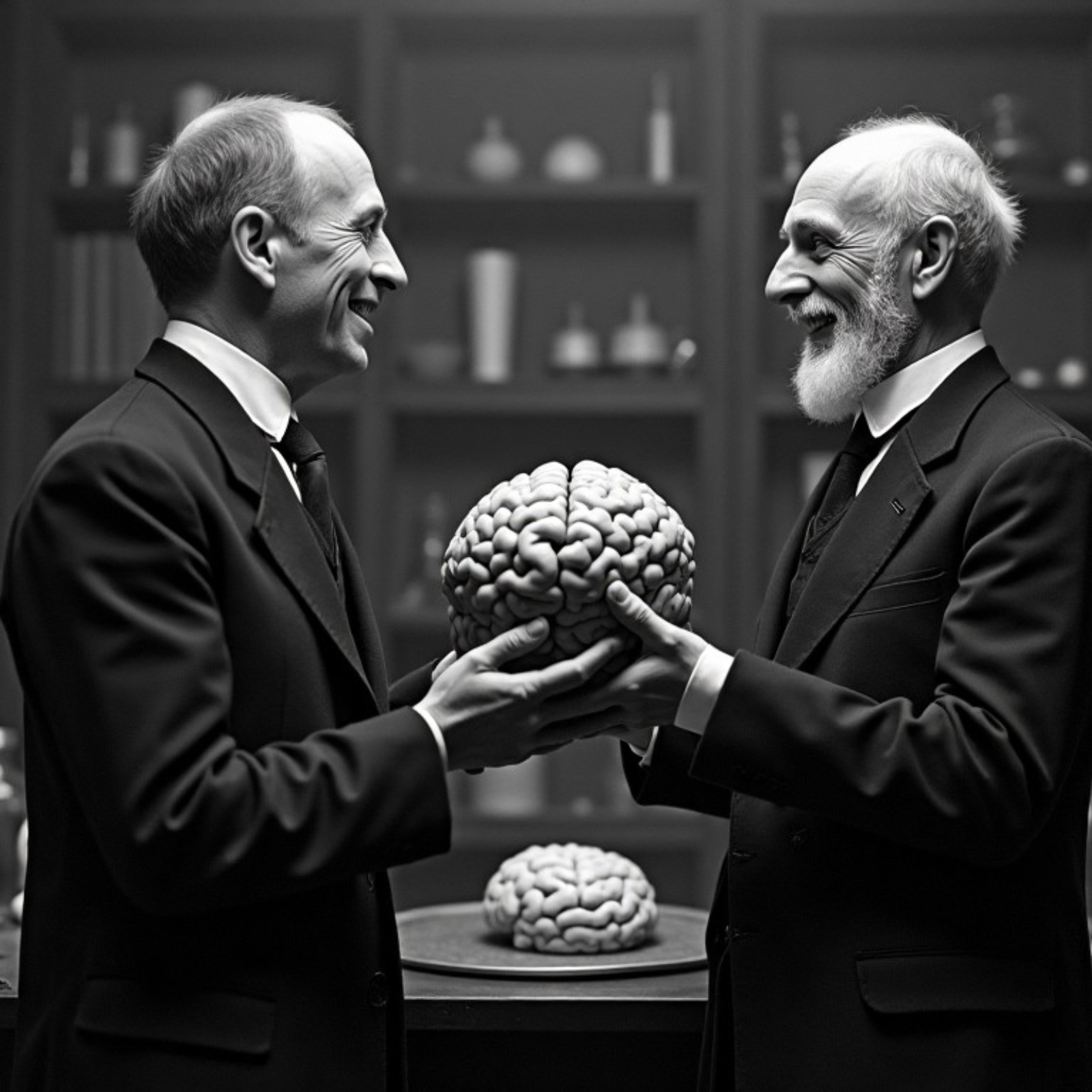 Podcast 11.25. The becoming subject of the brain, part 4. 11.09.2025 36minThe brain as becoming subject. The brain is not static, it evolves over time. Its centers must be located in time, not space. A very Bergsonian concept. Here we will explore Hugh Jackson and Constantin von Monaco as interpreted by Gilles Deleuze, and learn that the brain becomes, mutates, and this occurs as event through time and memory.Companion notes here: https://www.deleuzemodeste.com/copie-de-vers-un-neurologie-crystaline-1
 -
 Podcast 11.25. The becoming subject of the brain, part 3. 26.08.2025 33minLooking at the first perspective of the brain - specifically neurons biology. But we are staying with Deleueze's reasoning, and therefore this podcast will fix some errors from the last one and try to do a definitive analysis of the brain in the classical image of thought.
 -
 Podcast 10.25. The becoming subject of the brain, part 2. 26.08.2025 47minHere we are following at St. Denis, a sceance from 1984 and one of the last regarding cinema and the brai .
 -
 Podcast 09.25. The becoming subject of the brain. 23.08.2025 47minWe are still victims of a very poor and outdated image of thought. What is the brain? Where is memory stored? Where is my soul located? Or my spirit? Where do my emotions come from? We continue to adhere to classical and long outdated images of thought. So we will look into the becoming subject of the brain and hopefully deterritorialize much of what we take for granted.
 -
 Podcast 08.25. Introduction: Smooth Walls & Dark Matter. Capture in the age of ultra-liberalism. 27.04.2025 33minIn any case, let's return to our main objective: how to capture,dissect, remove, and add intensive components in order to createnew areas of discernment and becoming. Revitalize a concept,give it new life.In a way, the concept of “Black Hole - White Wall” is relative to theera of Milles Plateau's publication, perhaps to a time when thefactory, let alone the corporation, represented a primary means ofcontrol over the socius, extracting the desire for profit whilemaintaining sufficient rigidity to guarantee a high level of control.Once a subject identifies and assumes a binary identity, it sinksinto the black hole of subjectivity, ensuring that its uncoded flowswill always have a limit and that the machinery of capitalism canthus continue to turn safely.This concept was our fish, which we attempted to open up,understand its living components, analyze them, see what is stillvital and which components could be refreshed, what new futuresthis refreshed concept could have. Only a Sicilian fisherman couldperhaps understand the perverse joy of attempting such anoperation.It is certain that Deleuze often operated in the same way, but, as hementioned, the philosophy of his time was saturated with thehistory of philosophy, so that, from a certain point of view, thebastardization of past philosophers constituted a “line of flight”toward something new.
 -
 Podcast 07.25. Introduction: Microfascism in the Age of Obama, Part 6.. 27.04.2025 43minIn A Thousand Plateaus, Deleuze and Guattari diagnose fascism not merely as a macropolitical event—an authoritarian seizure of the state—but as an immanent, molecular process within subjectivities, institutions, and everyday social arrangements. Microfascism, the insidious desire for order, hierarchy, and security at the level of desire itself, operates beneath and beyond official political structures. This first episode examines how, under the Obama presidency—a period often mythologized as a triumph of liberal democracy—microfascist tendencies intensified rather than dissipated. Far from a mere reactionary backlash, these tendencies emerged within the very mechanisms of governance, media, and neoliberal discourse, forming what Deleuze and Guattari might call an "abstract machine" of control that modulated political affect. Through a rigorous analysis of the post-2008 terrain, we trace the molecular flows that conditioned new forms of subjectivation, complicity, and repression, laying the groundwork for the escalation of authoritarian tendencies in the years that followed.
 -
 Podcast 06.25. Introduction: Microfascism in the Age of Obama, Part 5. 23.04.2025 31minIn A Thousand Plateaus, Deleuze and Guattari diagnose fascism not merely as a macropolitical event—an authoritarian seizure of the state—but as an immanent, molecular process within subjectivities, institutions, and everyday social arrangements. Microfascism, the insidious desire for order, hierarchy, and security at the level of desire itself, operates beneath and beyond official political structures. This first episode examines how, under the Obama presidency—a period often mythologized as a triumph of liberal democracy—microfascist tendencies intensified rather than dissipated. Far from a mere reactionary backlash, these tendencies emerged within the very mechanisms of governance, media, and neoliberal discourse, forming what Deleuze and Guattari might call an "abstract machine" of control that modulated political affect. Through a rigorous analysis of the post-2008 terrain, we trace the molecular flows that conditioned new forms of subjectivation, complicity, and repression, laying the groundwork for the escalation of authoritarian tendencies in the years that followed.
 -
 Podcast 05.25. Introduction: Microfascism in the Age of Obama, Part 4. 21.04.2025 31minIn A Thousand Plateaus, Deleuze and Guattari diagnose fascism not merely as a macropolitical event—an authoritarian seizure of the state—but as an immanent, molecular process within subjectivities, institutions, and everyday social arrangements. Microfascism, the insidious desire for order, hierarchy, and security at the level of desire itself, operates beneath and beyond official political structures. This first episode examines how, under the Obama presidency—a period often mythologized as a triumph of liberal democracy—microfascist tendencies intensified rather than dissipated. Far from a mere reactionary backlash, these tendencies emerged within the very mechanisms of governance, media, and neoliberal discourse, forming what Deleuze and Guattari might call an "abstract machine" of control that modulated political affect. Through a rigorous analysis of the post-2008 terrain, we trace the molecular flows that conditioned new forms of subjectivation, complicity, and repression, laying the groundwork for the escalation of authoritarian tendencies in the years that followed.
 -
 Podcast 04.25. Introduction: Microfascism in the Age of Obama, Part 3. 22.03.2025 16minIn A Thousand Plateaus, Deleuze and Guattari diagnose fascism not merely as a macropolitical event—an authoritarian seizure of the state—but as an immanent, molecular process within subjectivities, institutions, and everyday social arrangements. Microfascism, the insidious desire for order, hierarchy, and security at the level of desire itself, operates beneath and beyond official political structures. This first episode examines how, under the Obama presidency—a period often mythologized as a triumph of liberal democracy—microfascist tendencies intensified rather than dissipated. Far from a mere reactionary backlash, these tendencies emerged within the very mechanisms of governance, media, and neoliberal discourse, forming what Deleuze and Guattari might call an "abstract machine" of control that modulated political affect. Through a rigorous analysis of the post-2008 terrain, we trace the molecular flows that conditioned new forms of subjectivation, complicity, and repression, laying the groundwork for the escalation of authoritarian tendencies in the years that followed.
 -
 Podcast 03.25. Introduction: Microfascism in the Age of Obama, Part 2. 19.03.2025 36minIn A Thousand Plateaus, Deleuze and Guattari diagnose fascism not merely as a macropolitical event—an authoritarian seizure of the state—but as an immanent, molecular process within subjectivities, institutions, and everyday social arrangements. Microfascism, the insidious desire for order, hierarchy, and security at the level of desire itself, operates beneath and beyond official political structures. This first episode examines how, under the Obama presidency—a period often mythologized as a triumph of liberal democracy—microfascist tendencies intensified rather than dissipated. Far from a mere reactionary backlash, these tendencies emerged within the very mechanisms of governance, media, and neoliberal discourse, forming what Deleuze and Guattari might call an "abstract machine" of control that modulated political affect. Through a rigorous analysis of the post-2008 terrain, we trace the molecular flows that conditioned new forms of subjectivation, complicity, and repression, laying the groundwork for the escalation of authoritarian tendencies in the years that followed.
 -
 Podcast 02.25. Introduction: Microfascism in the Age of Obama, Part 1. 18.03.2025 27minIntroduction: Microfascism in the Age of ObamaIn A Thousand Plateaus, Deleuze and Guattari diagnose fascism not merely as a macropolitical event—an authoritarian seizure of the state—but as an immanent, molecular process within subjectivities, institutions, and everyday social arrangements. Microfascism, the insidious desire for order, hierarchy, and security at the level of desire itself, operates beneath and beyond official political structures. This first episode examines how, under the Obama presidency—a period often mythologized as a triumph of liberal democracy—microfascist tendencies intensified rather than dissipated. Far from a mere reactionary backlash, these tendencies emerged within the very mechanisms of governance, media, and neoliberal discourse, forming what Deleuze and Guattari might call an "abstract machine" of control that modulated political affect. Through a rigorous analysis of the post-2008 terrain, we trace the molecular flows that conditioned new forms of subjectivation, complicity, and repression, laying the groundwork for the escalation of authoritarian tendencies in the years that followed.
 -
 Podcast 01.25. Hello world, 16.03.2025 12minWelcome to Deleuze Modeste, a podcast dedicated to rediscovering the true genius of Gilles Deleuze. Since his passing in 1995, Deleuze’s philosophy has been subject to misinterpretation, oversimplification, and even commercial exploitation. His radical ideas—once so original and profound—are too often reduced to buzzwords, drained of their true power.This podcast seeks to cut through the noise. Deleuze Modeste is an instrument for learning, an invitation to approach his work with humility and curiosity. Rather than adding to the marketing machine that distorts his legacy, we aim to engage with his ideas simply, directly, and thoughtfully. Let’s return to Deleuze as he was—challenging, brilliant, and deeply transformative.
Vergelijkbare podcasts


Populair in
Deze podcast verschijnt ook in de podcastlijsten van deze landen.
