
The TechWolf Podcast
TechWolf
0
The TechWolf Podcast explores how technology is reshaping HR, cutting through vendor hype around AI agents, skills, and integrations. Host Julius Schelstraete talks with business practitioners and thought leaders about the "skills-based organization" — what it really means, whether it is realistic, and where the roadblocks lie. Episodes focus on practical, real-life use cases rather than marketing promises. The show takes a critical, down-to-earth look at skills-based HR and what it takes to make it work.
Afleveringen
-
 “Peel back the onion. It’s really not doom and gloom.” | Former CHRO Susan Youngblood on what the data says about AI and jobs 13.10.2026 30minThe AI bills are arriving, and some companies are already asking who should lose access. Meanwhile, the headlines say AI is wiping out entry-level jobs, and the labor data says otherwise. Susan Youngblood, a former CHRO who rolled out AI across a 9,000-person customer service organization, separates what is happening from what is being reported. She also explains why HR leaders who wait to be invited into the AI conversation will be cleaning up its consequences instead.Timestamps:03:10; How progressive companies redesign entry-level roles for AI-fluent hires04:32; The hiring data the media keeps getting wrong05:56; What separates companies pulling ahead on AI from those stuck in pilots07:51; Two questions that expose fake AI adoption09:31; The token bill arrives: who keeps AI access, and who loses it13:10; Every agent needs a named human owner15:22; What rolling out AI to 9,000 people taught her about HR’s real job19:17; When the CFO asks if a human is cheaper than an agent23:30; Her prediction: token budgets in your comp package25:02; AI whitewashing and the layoffs that weren’t about AI
 -
 The AI org-chart experiment | BCG's Julie Bedard on accountability, error rates and token spend 24.09.2026 42minRoughly a third of companies now talk about AI as a teammate or an employee, and between a fifth and a third say it has already carried over into the org chart. The argument for doing it has always been familiarity: give people a human reference point and they will use the thing. Julie Bedard and her co-authors tested that with 1,200 to 1,300 managers in HR and finance, all reviewing the identical document, with only the stated author changed. Adoption intent did not move. Personal accountability dropped, escalations rose, and reviewers who thought an AI employee wrote the work caught fewer errors and passed them on.Timestamps:03:08 - BCG's 10/20/70, and the 70% nobody budgets for05:44 - The experiment: one document, three different "authors"08:59 - The finding that killed the familiarity argument11:27 - "Our governance systems haven't caught up with agents"17:25 - Reviewers caught fewer errors and escalated more23:34 - Test track versus New York City at rush hour27:56 - Token-based competition, and why usage is the wrong thing to reward36:04 - The first 90 days for a CHRO or a chief AI officer
 -
 Who owns work redesign, and what has to be true first | Accenture's Matthew Morgan on skills technology, ownership, and the questions nobody asks 27.08.2026 35minEvery leadership team is now asking which work goes to agents. Almost nobody has answered the harder question sitting underneath it: who owns the answer. The business owns the process, IT owns the deployment, talent owns the skills data, and total rewards owns the pay bands, which means any one of them acting alone produces a redesign that falls over within a quarter. Matthew Morgan, Managing Director for Talent Reinvention at Accenture, has spent twenty-five years in job architecture and skills data, and he is watching four client organizations run at this problem right now. He came in with a sharper starting point than most: stop leading with skills, and start with tasks.Timestamps:01:05 - HR’s moment to lead, and why it is still playing catch-up03:10 - What “talent reinvention” means, and how it differs from transformation06:23 - Why tasks, not skills, are the language your business already speaks09:22 - What has to be true before a skills technology works at your company11:29 - Where to draw the line between redesigning work and just automating tasks14:26 - The four-legged stool: who actually owns work redesign16:36 - Agents in the org chart: what Matt has and has not seen in practice19:58 - Cloudflare’s 20% layoff and the sellers, builders, measurers split30:37 - The three questions to answer before you buy any AI tool
 -
 “It's not a super sexy problem, but it's the foundation of everything.” | Ian Bailie, Synopsys' VP of People Strategy, on a best-of-breed skills stack 03.08.2026 42minMost companies chase a skills strategy and end up with a portal nobody opens. Ian Bailie has built this twice, once at Cisco a decade ago, the hard way, and now at Synopsys, a 40-year-old company that just doubled in size and absorbed a $35 billion acquisition. His take is blunt: stop turning skills into an HR project. Lead with what AI is doing to the actual work, fix your job architecture first, and give people a reason to care before you ever ask them to touch a profile.Timestamps00:45 — The Kyle Forrest question: how to actually get HR, IT and finance in one room02:30 — Why “we're HR, and we have the solution” is the wrong way in06:00 — Doing this at Cisco 10 years ago, before the tech existed07:50 — The Synopsys stakes: doubled size, a $35B acquisition, 40 years of legacy11:30 — 3,000 people, one job title: when job architecture is too simple15:00 — Why he refused to buy another skills portal22:00 — One taxonomy, three platforms: Degreed, Avature, BetterWorks27:40 — Automate, augment, human-only: reading the task data31:00 — Giving people the agency over how AI changes their job38:30 — HR's moment, and the risk of missing it
 -
 “Nothing’s being asked of HR that hasn’t been asked before.” | Deloitte's Kyle Forrest on zero-based work, spotting fake AI agents, and what the CHRO job becomes by 2030 22.07.2026 51minEvery vendor at every conference is selling you an agent. Most of them are selling you a workflow with a chat window. Kyle Forrest runs Deloitte’s Future of HR practice and its Next Generation CHRO Academy, and he spends his weeks in the room with CHROs trying to separate the real from the rebranded. In this episode, he lays out the test for a genuine agent, why “make HR strategic” has been the same ask since the 1980s, and what it actually costs a leader to redesign a function that includes their own job.Timestamps:02:00 - The knowledge walking out the door as boomers retire09:36 - Can HR’s “unique AI moment” and “nothing new here” both be true?15:37 - The three types of HR function, and why “be strategic” is a lazy demand24:00 - Stagility: 75% of workers want stability, 85% of execs want agility28:09 - 42% of workers say no one is measuring AI’s impact on them31:45 - AI assisted, augmented, powered: telling people where their role is headed33:19 - Zero-based work: should this work even exist?40:55 - The BS test for a real agent versus a workflow with a chat window47:10 - The trend Kyle wants you to push back on: pre-built agents
 -
 “What took us months now takes minutes.” | Cotality CHRO Kendra Angier on building a skills engine, engaging the C-suite, and her 12-24mo strategy 26.06.2026 41minMost skills programs never make it out of the spreadsheet. Cotality's CHRO spent nine months trying to hand-build a skills taxonomy before she killed it and started over. In this episode, Kendra Angier explains how she rebuilt the workforce-intelligence stack around dynamic data, pulled her COO, CTO, and CFO into the buying decision, and earned an 80% employee NPS on skills along the way. It's a candid look at what actually moves a skills strategy from theory to Monday-morning reality.Timestamps00:50 - Why she rejects the idea that AI is killing early talent02:43 - The Cotality rebrand, and what it demands from the workforce06:09 - The case for a 12-24 month horizon, not a ten-year plan08:36 - How she got the CFO, COO and CTO to fund skills13:42 - The nine-month taxonomy that nearly broke the team21:22 - “What took us months now takes minutes”25:47 - Why the change-management risk beats the data risk38:17 - From chief HR officer to chief work officer
 -
 AstraZeneca’s 4-year Odyssey with skills intelligence | Lara Martinez, Global Director of Talent Intelligence, on why agility beats the SBO label 17.06.2026 38minEveryone wants a “skills-based organization.” Almost no one has built one. At AstraZeneca, Global Director of Talent Intelligence Lara Martinez Gonzalez has spent four years connecting a tangle of recruitment systems, development platforms, and job architecture into one language for the workforce, and she’s blunt about how hard it has been. In this episode, she argues skills is a data problem, not an HR project, explains why she refuses to say the word “skills” in front of business leaders, and shows where the value has actually landed so far. Plus the trap that cost her almost a year, and the company she’s seen get closest to skills-native.Timestamps:00:57 — The one skills claim leaders should push back on02:05 — Four years of skills work, told as an Odyssey05:46 — How to pick which problem to solve first10:48 — Why she drops the word “skills” in business meetings16:30 — Reading the market: from skills to tasks20:19 — Who should own tasks: HR or the business?21:54 — The honest ROI: “still squeezing the lemon”31:32 — Her 90-day advice to peers two years in
 -
 "Tell me about your strategy. Skills can wait." | Sandoz's Workforce Intelligence Lead on the one move that flips SWP from push to pull 25.05.2026 38minMost strategic workforce plans never make it past the CHRO's desk. The horizon is five years, the work is detailed, and the business leader you need in the room would rather talk about anything else. Felipe Hessel runs Workforce Intelligence at Sandoz, and he's worked out how to flip that dynamic, getting executives to pull SWP towards them rather than dodge it. In this conversation, he walks through his six-step framework, the contracting move that earns him the right to ask about critical roles, and the agents he built that cut his own SWP cycle time by 60%.Timestamps01:11 - Why HR's role in AI transformation isn't what most people think04:30 - The three-legged stool of transformation is missing a leg07:33 - The four legs of Workforce Intelligence: analytics, SWP, skills, AI11:02 - The 90-day playbook for a new Workforce Intelligence role12:57 - How to flip a sceptical CEO from push to pull on a 5-year workforce plan18:11 - The six-step SWP framework, from contracting to course correction23:51 - Why investing in workforce tech without integration is a trap28:45 - The AI claim every business leader should push back on32:46 - 2030 prediction: HR as a product organization
 -
"Sellers close deals 14% faster." | Special Episode: Workday’s Josh Tarr & TechWolf CEO Andreas De Neve on Revenue-Linked Skills Strategy. 29.04.2026 11minWhen your sales team closes deals 14% faster, the "skills gap" stops being an HR problem and starts being a revenue solution. In this Special Episode, TechWolf CEO Andreas joins Josh from Workday to discuss the messy, high-stakes reality of transforming a 20,000-person organization. They move past the buzzwords to discuss why 75% of skills profiles usually fail and how Workday used AI to achieve a 91% skill acceptance rate from their employees.Timestamps:00:00 - Highlights: why 75% of skills data is usually "dead" on arrival.01:29 - Fast & Thoughtful: Defining the Workday x TechWolf partnership.02:20 - The "Less than 20%" Problem: Why most job profiles are missing the point.04:38 - 3 Years of Mistakes: What I’d tell my past self about data strategy.06:08 - The AI Pivot: Moving from "Internal Mobility" to "Workforce Planning."08:18 - Precision Hiring: Identifying the "Critical 12" skills for every role.08:50 - The 14% ROI: How skills-based hiring directly impacts sales velocity.09:44 - Scaling to 20,000: The rollout of the Skills Suggestion App.10:42 - 91% Acceptance: How to actually get employees to own their skills data.
-
 "There would actually be a people shortage" | McKinsey’s Sven Smit & Anu Madgavkar on AI, Agents, Robots, and the $100-Trillion Economy. 15.04.2026 53minThe world is bracing for mass unemployment, but McKinsey Global Institute researchers Sven Smit and Anu Madgavkar suggest we might actually face a labor shortage. As agents and robots move from theory to the office floor, the real friction isn't just the tech; it's our inability to learn as fast as the machines. This episode challenges the "soft skills" myth and explains why your AI strategy will fail if it lives in the IT budget.Timestamps07:05 – Why 80% automation might still lead to a labor shortage.11:50 – The "Happy AI" trap: Why adding tools isn't the same as productivity.19:20 – The blurring lines between knowledge workers and physical labor.22:57 – Why "Soft Skills" are a dangerous trap for the next generation.36:53 – Tasks vs. Workflows: The secret to 80% productivity gains.49:08 – The Budget Error: Why AI belongs in the business P&L, not IT.
 -
"Skills are just a lazy proxy for work." | A transparent debate with FM’s Mike Manning & Preethi Gowda on why business problems must dictate talent data. 23.03.2026 35minIt is rare to hear two leaders from the same organization move past the corporate script and into a "healthy debate" about the very foundation of their work. In this episode, Mike Manning (VP, HR Data & Innovation) and Preethi Gowda (Global People Insights Lead) from FM do exactly that. While Preethi advocates for the proactive power of layering skills with knowledge and ability , Mike challenges the "skills revolution" as a lazy proxy for understanding the actual tasks that drive revenue. They don't always agree on the terminology, but they are perfectly aligned on the outcome: if HR doesn't speak the language of the P&L, it isn't doing its job.01:31 – The positive start: Mike and Preethi’s differing takes on a world without skills data.08:22 – Sparring over "The Skill-Based Organization" vs. the reality of the job.13:01 – Mike’s wake-up call: "You lost me when you called me an HR professional".18:10 – The SIPOC Framework: A Six Sigma approach to talent.28:15 – Case Study: How Preethi and Mike’s joint investigation saved $3M by slowing down hiring.43:04 – The collaborative "Hard Question" for our next guest.
-
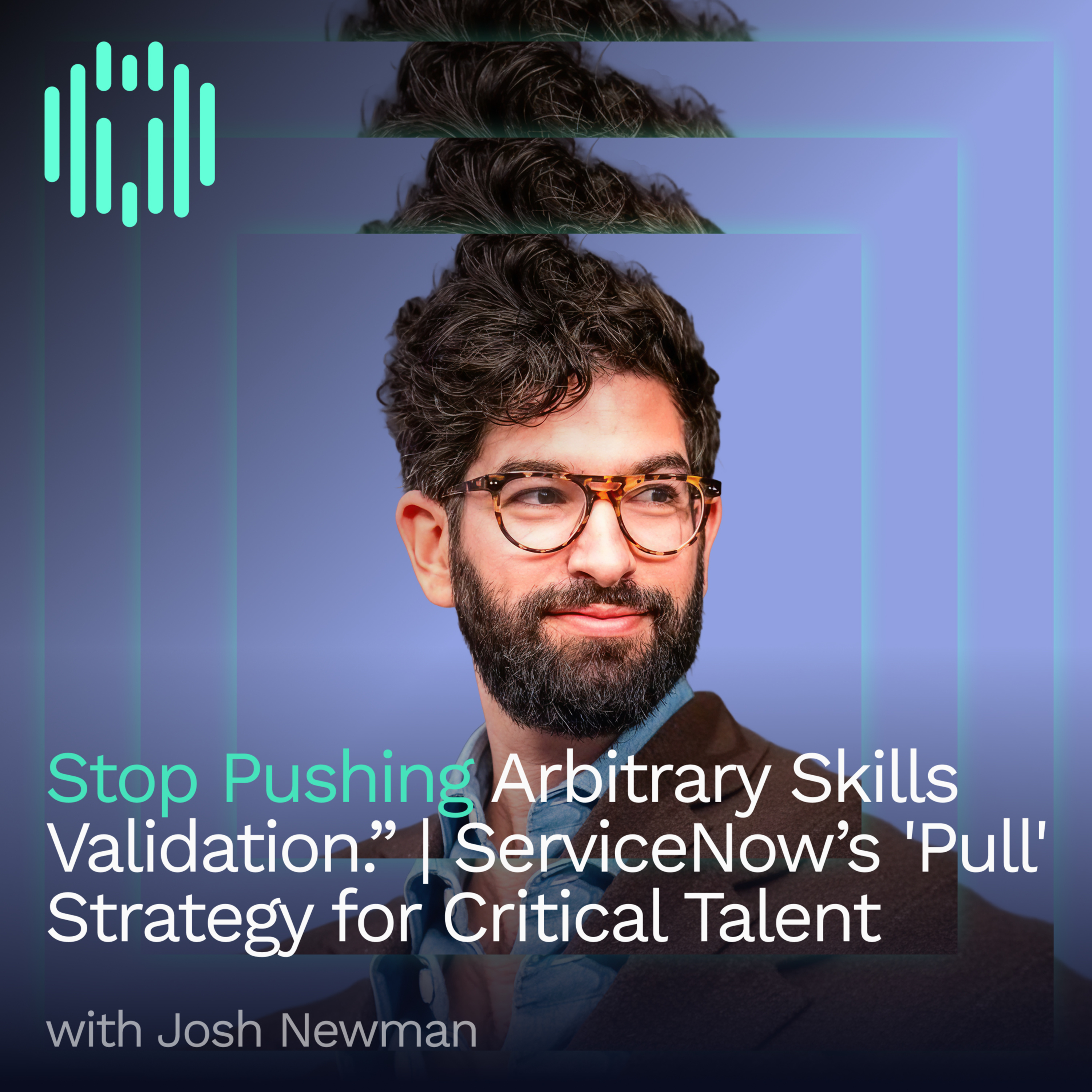 "Stop pushing skills validation on everyone." | Why ServiceNow uses 'pull' talent strategies to find critical engineers. 09.03.2026 30minMost HR leaders are obsessed with "skilling" their workforce, but they’re ignoring the tasks that actually make up the work. Josh Newman, VP of Workforce Skills at ServiceNow, argues that skills data is essentially dead weight unless it’s tied to specific business processes and AI impacts. In this episode, Josh breaks down how ServiceNow is moving beyond simple taxonomies to create a "Talent Signature", a dynamic data layer that predicts who is ready for a promotion before they even raise their hand.01:05 – Why AI makes HR more human, not less.02:30 – Why redesigning HR won't be automatic and will take a "shitload of work."04:00 – Defining the "AI-Native" organization and operationalizing intelligence.05:25 – The "Talent Signature": Building the data layer for individual understanding.06:30 – How ServiceNow uses intelligence to close the "Readiness Gap."07:45 – Identifying "Forward Deployed Engineers" through capability adjacencies.10:15 – The "Pull vs. Push" strategy: Why arbitrary skills validation fails.12:20 – The 6-Layer Workforce Intelligence Stack (Strategy to Skills).14:35 – Why ServiceNow chose TechWolf: The API and dynamic data layer.16:25 – Measuring success: Infrastructure health vs. business-specific metrics.18:50 – The next horizon: Integrating LLMs and organizational redesign.20:15 – Josh’s question for the next guest (The Skills Skeptic).
 -
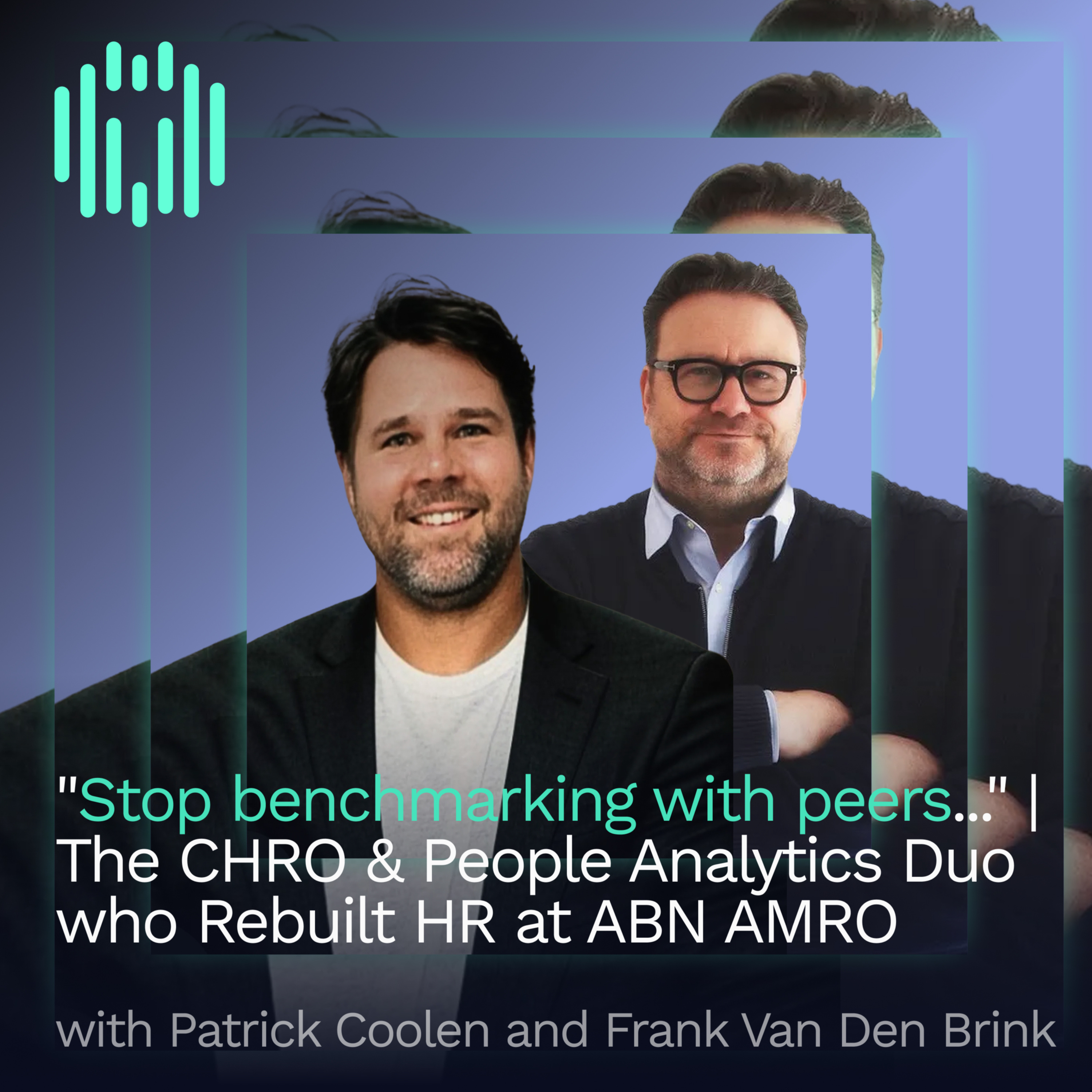 "Stop benchmarking your peers..." | Lessons from a CHRO & People Analytics duo (xABN Amro) on data-driven workforce strategy 24.02.2026 44minMost organizations are pouring millions into AI tools while their actual workforce strategy remains stuck in 2010. We talk about "efficiency," but we’re failing to measure the return on investment or the impact on the people actually doing the work. In this episode, Frank and Patrick from KennedyFitch break down why the "efficiency trap" is a race to the bottom and how HR leaders must shift from managing headcounts to architecting organizational capabilities.Timestamped Topics01:06 – The AI Metrics Gap: Addressing whether board-level AI objectives are enterprise-wide or just "siloed in HR and IT." 03:51 – "Not yet": Frank’s direct take on why companies haven't actually updated their scorecards for the GenAI era. 06:33 – The Human Quotient: Why the return on investment (ROI) for technology is lagging behind the speed of adoption. 08:26 – The Next-Gen CHRO Search: How the leadership profile is shifting toward "digital dexterity" and strategy execution. 11:39 – Evidence-Based HR: Why the new breed of CHRO must move past being a "jack of all trades" to become a data-driven architect. 15:45 – The Skepticism Trap: Why HR leaders often reject skills data because it isn't properly contextualized with business growth. 17:54 – Cracking the SWM Nut: A systematic breakdown of Strategic Workforce Management—from demand mapping to supply analysis. 20:15 – The Demand Struggle: Why identifying "workforce demand" is the hardest part of the strategy (and why tools can't do it for you). 24:59 – Beyond Headcount: Moving the conversation from "size and FTEs" to organizational capabilities and leadership types. 29:04 – Stop Copying Benchmarks: Patrick’s warning against "social influence" and why you should build your own practice instead of testing what others do. 32:20 – "The Heat of the Moment": Why the value of an HR roadmap is only proven during a crisis or major shift, not two years later. 34:59 – Task Intelligence vs. Hype: Moving from high-level "AI will automate 20% of work" to granular, actionable employee-level data. 38:45 – The "Co-Pilot" Philosophy: Positioning AI as a partner to navigate complexity rather than a tool for simple replacement. 41:15 – The Three-Signal Filter: Balancing the Voice of the Business, the Voice of the Market, and the Voice of the Employee. 44:10 – Deducting Complexity: The final mandate for CHROs to provide vision and direction in an "intense world of complexity."
 -
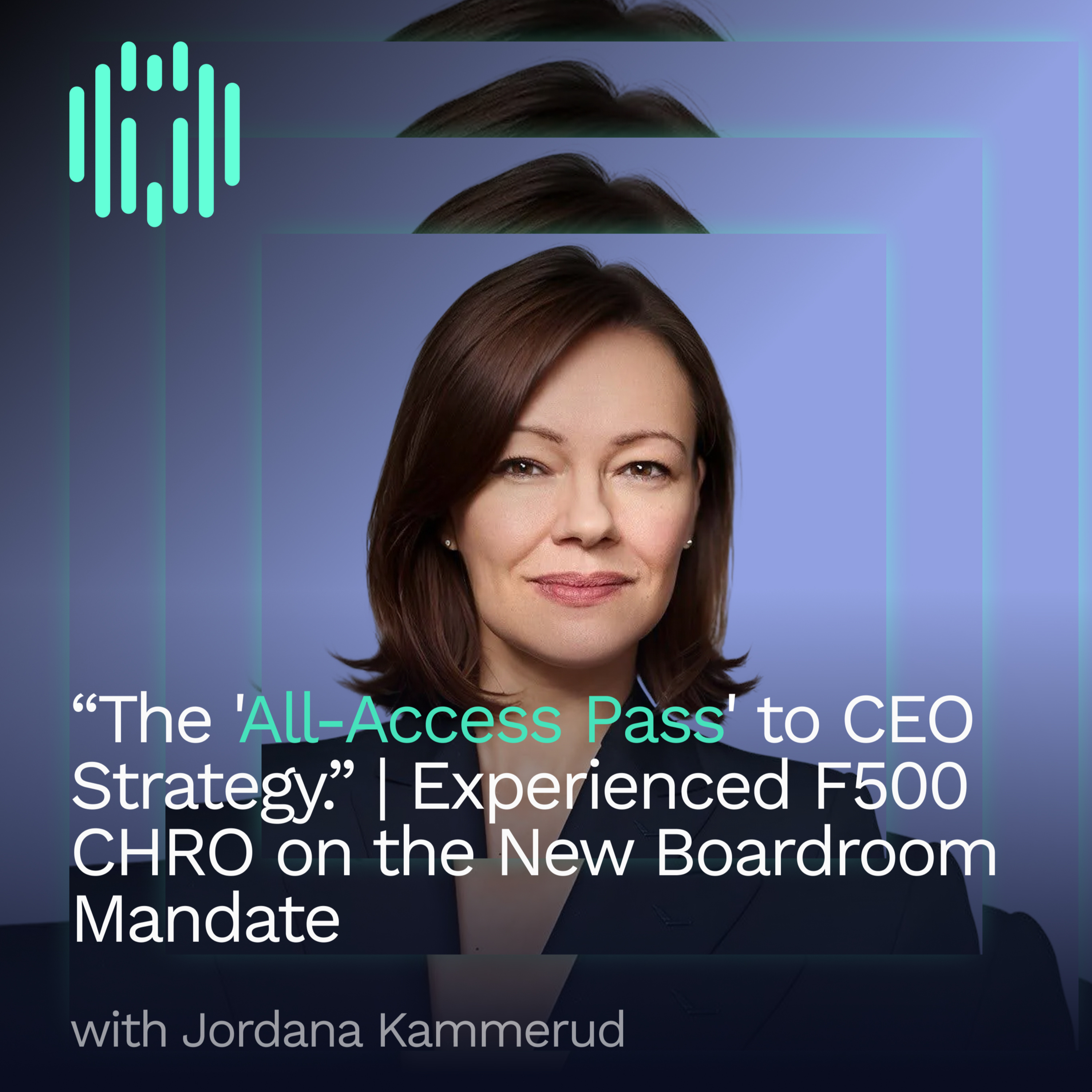 “The 'All-Access Pass' to CEO Strategy.” | Experienced F500 CHRO, Jordana Kammerud, on the New Boardroom Mandate 10.02.2026 41minMost organizations are "dabbling" with AI while the technology's capability doubles every four months. Jordana Kammerud (Experienced F500 CHRO) and Mik Wornoo (Co-founder, TechWolf) argue that we’ve reached a turning point: the "Oppenheimer moment" of workforce transformation, where HR must either step up as a business strategist or watch the organization succumb to the weight of outdated role-based systems. This episode breaks down the three horizons of work intelligence and how to build a trust-based "all-access pass" to the CEO's agenda.In this episode, we discuss:00:00 – The Fortune 500 Perspective: Introducing Jordana Kammerud.01:04 – Why Skills Strategies Failed (Until Now): Moving past legacy systems that "died under their own weight."03:43 – The End of Role-Based Talent Management: Why traditional job architectures are no longer viable in 2026.04:14 – The "Go Deep" Mandate for CHROs: Why leaders must personally master AI tools to shepherd transformation.05:42 – Exponential Acceleration: Understanding the shift from AI doubling every 7 months to every 4 months.07:04 – The Early Adopter Program: Co-creating the future of workforce intelligence with TechWolf.08:23 – The "Secret Sauce" of CEO Trust: How data-driven insights solidify the CHRO-CEO bond.12:14 – The "All-Access Pass": Defining the CHRO as a business leader first, functional expert second.14:52 – HR’s Oppenheimer Moment: Facing the reality of 50% displacement in early careers.18:03 – Maintaining Humanity at Scale: Balancing "synthetic empathy" with real-world human judgment.22:09 – From Black Coffee to Million Permutations: Reimagining career pathing through a "rich tapestry" of skills.26:15 – The Three Horizons of Work Intelligence: A tactical framework for present and future AI ROI.30:19 – Squelching vs. Cultivating Curiosity: How to protect innovation in an automated workforce.33:54 – The Boardroom Question: "Is the caliber of our workforce better or worse than last quarter?"36:49 – The Closing Question: Jordana’s query for the next global HR leader.
 -
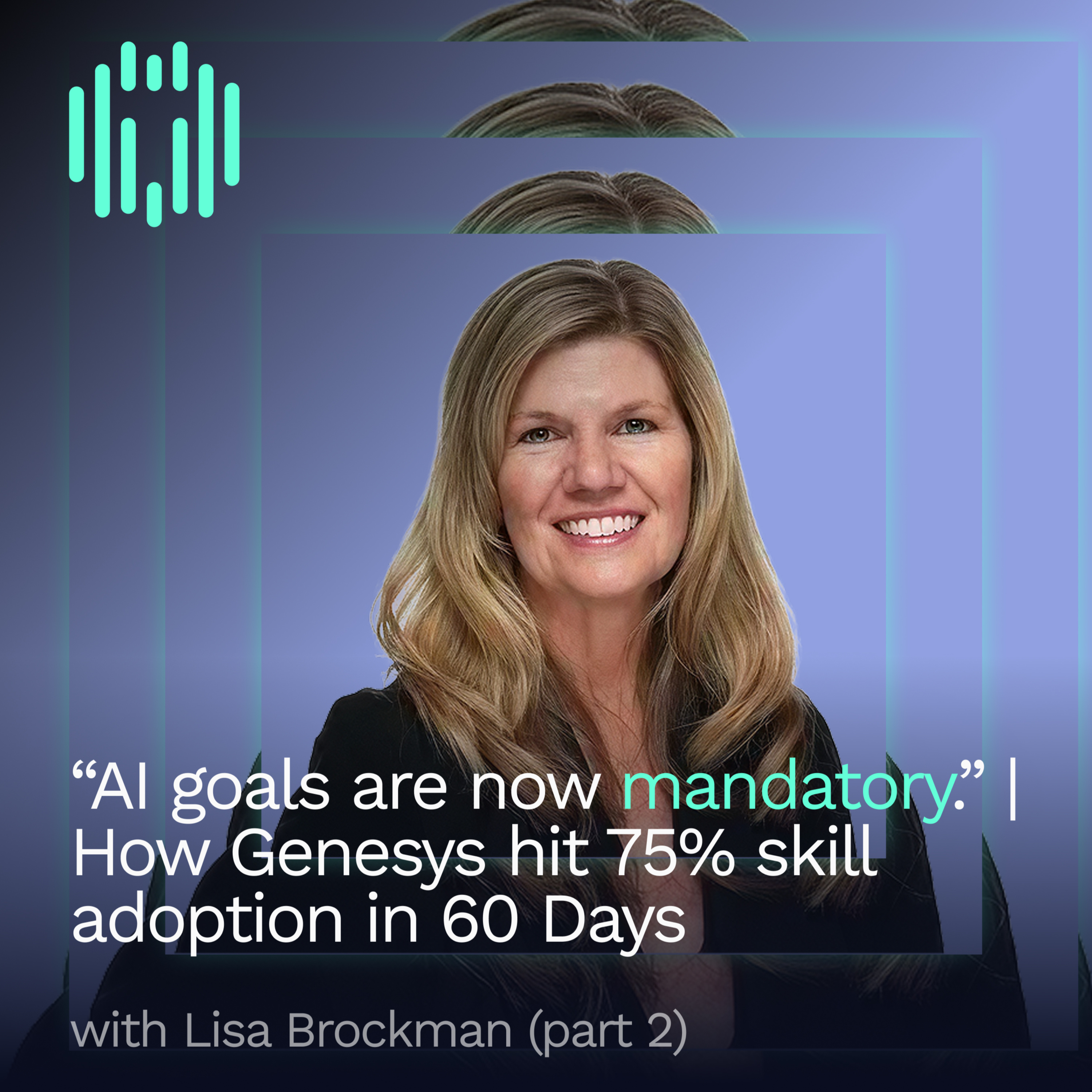 “AI goals are now mandatory.” | How Genesys hit 75% skill adoption in 60 Days with Lisa Brockman (Part 2) 02.02.2026 12minLisa Brockman, Talent Director at Genesys, returns to prove that skills-based transformation isn't a multi-year "maybe"—it’s a 60-day "must". After launching an AI-driven pilot to 2,000 employees in November, Genesys saw 75% of users validate their skills almost immediately.But they aren't stopping at data collection. In this episode, Lisa reveals why Genesys is making AI-specific goals mandatory for every single employee starting this February. She breaks down the shift from manual, static spreadsheets to a dynamic "Data Presence" where opportunities now find the employees. This is the blueprint for moving past the "manual trap" and building a workforce that is actually ready for the AI era.
 -
 “People don’t care about skills.” | Genesys’ Lisa Brockman on the Internal-First Mobility Playbook (Part 1) 20.01.2026 12minMost organizations spend 18 months building manual skill taxonomies only to realize the data was stale before it was even finished. Lisa Brockman (Talent Management Director at Genesys) realized that if employees don’t trust the data, they won’t use the marketplace, leaving leadership to hire externally for skills they likely already own. In this PART 1 episode with Lisa, we break down how to move from "manual and messy" to a scalable, AI-driven skills strategy that actually fuels internal mobility.The Breakdown01:51 – The 18-month mistake: Why manual skill mapping isn't scalable.03:04 – AI Mindset: Shifting from "nice-to-have" to "must-have" for AI readiness.05:22 – The "So What?" Factor: Connecting skills to gigs, roles, and learning.07:44 – Why Workday Skills Cloud needs a "clean fuel" source to drive Career Hub adoption.09:30 – Change Management: Why HR can’t push this alone.
 -
 "Your business case isn't big enough. The best ones have these two elements" | SAP SuccessFactors' CRO on the revenue-first skills strategy 12.01.2026 24minMost companies are using AI to do the same boring work faster. They’re chasing "efficiency" while completely ignoring the fact that the work itself needs to be redesigned. Jan Duthoo (CRO, SAP SuccessFactors) joins us to explain why your business case for skills is likely too small, why L’Oreal and Safran used the exact same technology for opposite reasons, and how to stop "boiling the ocean" with HR tech.Timestamps:04:12 – Why SAP’s own revenue grew when they stopped "selling and forgetting."08:45 – The L’Oreal Paradox: Using skills to decrease internal mobility.12:30 – The Business Case: Moving from "efficiency" to "work redesign."18:15 – Why your HR project needs to fail faster (and smaller).22:40 – The "Car on Steroids": How SAP and TechWolf actually fit together.28:05 – The COVID Moment: Can CHROs reclaim their seat at the executive table?
 -
 “Skills tech is useless without this” | Advent Health’s culture-first playbook for skills transformation 05.01.2026 20minMost organizations buy the software and hope the culture follows. Advent Health did the exact opposite. Marquita and Mary Beth spent two years building a "culture of curiosity" before flipping the switch on their technology. In this live episode from Workday Rising, they break down why skills have a five-year shelf life and how to move your workforce from "episodic learning" to a dynamic, self-driven engine.Episode Highlights02:15 – The 9 critical skills for the 2030 workforce.06:40 – Why the "shelf life" of a skill is shorter than you think.11:20 – "Pull" vs. "Push": Moving away from mandatory training.18:45 – The Psychological Safety gap: Why employees hide their weaknesses.24:10 – The ROI of curiosity in a healthcare talent shortage.
 -
 "If We Do Nothing, We Lose." | HSBC’s Blueprint for Future Competitive Advantage 03.12.2025 34minIs your workforce plan looking in the rear-view mirror, or is it predicting your next market win? Rob Etheridge, Group Head of Workforce Strategy at HSBC, argues that most organizations are drowning in "use cases" while missing the bigger picture: future competitive advantage. In this episode, Rob reveals why he rejected the "4,000 skills" taxonomy, why buying more HR tech won't solve your talent gap, and how HSBC is building a "Blueprint" to secure its future.⏱️ Timestamps00:00 – 01:22 | Setting the stage01:22 – 03:33 | Why skills-based workforce planning actually matters03:33 – 06:29 | Business triggers for HSBC’s skills-led transformation06:29 – 11:40 | From abstract concept to actionable blueprint11:40 – 16:59 | Why HSBC partnered with TechWolf16:59 – 23:53 | Early wins: taxonomy, pilots & proof points23:53 – 27:32 | Choosing the right pilot area27:32 – 30:11 | Storytelling and stakeholder buy-in30:11 – 32:19 | Looking one year ahead32:19 – 33:27 | Rob’s question for the next guest
 -
 “AI Could Turn White-Collar Work Into the New Assembly Line.” | Former IBM CHRO Diane Gherson on the Future of HR (LIVE from Workday Rising) 25.11.2025 19minIn this episode of the TechWolf Podcast, Julius Schelstraete sits down with Diane Gherson, former CHRO of IBM and current independent director at TechWolf. From her vantage point as one of the most influential HR leaders of the past decade, Diane shares a candid, strategic, and urgent message for HR executives navigating AI, workforce intelligence, and the shift to skills-based organizations.Diane recounts IBM’s pioneering journey toward AI-inferred skills and internal mobility, explains why today’s moment mirrors the historic shift triggered by Frederick Winslow Taylor, and warns that without intentional leadership, AI could push organizations toward a dehumanized, assembly-line model of white-collar work. This episode offers clarity, challenge, and concrete direction for any leader shaping the future of talent.00:08 — Welcome + introducing Diane Gherson02:00 — Uniquely human skills vs. durable skills: what truly matters05:20 — IBM’s journey to AI-inferred skills and internal mobility09:45 — Why Diane joined the TechWolf board12:10 — The “Frederick Winslow Taylor moment”: history repeats with AI17:00 — The rise of AI-serving jobs (annotators, auditors, trainers)20:30 — HR’s urgent role: redesigning work before AI redesigns it23:45 — Reality check: entry-level roles down 50% since 201926:00 — How HR can zoom out and align with business value creation29:20 — Skills as a board-level metric: assessing workforce caliber33:00 — How Diane keeps up with AI and HR trends (and who she follows)35:10 — Diane’s question for the next guest, Lisa BrockmanKey TakeawaysSkills ≠ the whole story — durable human capabilities like context-setting, situational awareness, and organizational intuition remain irreplaceable.IBM’s early skill-based model proved the value: AI-inferred skills fueled mobility, training, and strategic workforce planning long before the market caught up.We’re entering a “Frederick Winslow Taylor moment” — AI could standardize white-collar work the way scientific management standardized the assembly line.HR must lead system-level redesign — not just productivity gains, but sustainable talent ecosystems, career pathways, and future leadership pipelines.Entry-level talent is already under pressure — openings are at 50% of 2019 levels; HR must address this before long-term capability erodes.Boards now expect clarity on “caliber of workforce” — skills data is becoming a board-level strategic metric.
Vergelijkbare podcasts


Populair in
Deze podcast verschijnt ook in de podcastlijsten van deze landen.
