
Education Futures
Svenia Busson & Laurent Jolie
0
A podcast about the future of education in the age of AI. It brings together interdisciplinary voices to explore how we can shape more desirable futures for learning.
Episoder
-
 Does it really work? Evidence over hype in EdTech 05.10.2026 49minDr. Ola Ozernov-Palchik is a cognitive neuroscientist who studies how the brain learns to read and, more and more, how AI should (and shouldn't) be used to help it. She is a Research Scientist at MIT's McGovern Institute for Brain Research, a Research Assistant Professor at Boston University Wheelock College of Education & Human Development, and Associate Director of Translational Research in BU's AI & Education Initiative. She got her start in research almost by accident: as an international psychology student, she landed her first research job at the Institute for Reading Research at Southern Methodist University because she spoke Russian.That job led her to cognitive neuroscience, a PhD in Cognitive Science at Tufts, and early work with Dr. Nadine Gaab at Boston Children's Hospital on some of the first studies to predict dyslexia from kindergarten, followed by a postdoc with John Gabrieli at MIT. She has published 30+ peer-reviewed papers, including a recent Nature Communications study showing the brain's language network is already adult-like by age 4. She received the International Dyslexia Association's Early Career Award, and she is President of New England Research on Dyslexia and Associate Editor of Scientific Studies of Reading.She founded and directs the Evidence-Based AI in Learning (EVAL) Collaborative, a partnership between BU Wheelock and the Hariri Institute for Computing. EVAL holds AI learning tools to the evidence standard we'd expect of a medical intervention. Its first AI in Learning Challenge drew 35 companies and chose Amira Learning for a free, independent randomized controlled trial. She also co-built KIVA, an open-source AI reading companion that won a 2026 Tools Competition award.In this episode, Ola talks with Svenia Busson about:How the brain learns to read: repurposing circuits for vision and language, the "visual word form area," and why b and d are so hard to tell apartWhat causes dyslexia: phonological processing, family history, and why reading ability sits on a continuumWhy decades of reading science still don't reach classrooms, with the US as a case study: only ~40% of fourth graders read proficiently on NAEPWhy no one checks edtech the way medicines are checked: schools buy tools based on user numbers rather than learning outcomes, and some districts are now banning AI outrightInside the EVAL Collaborative: pre-registered, open-science RCTs published regardless of outcome, and the first EVAL AI in Learning ChallengeCan an 8-month trial prove learning? Measurement models, gated technical reviews (including how well speech recognition handles accents and dialects), and evidence that builds up over timeAdvice for edtech founders: collect evidence from day one, and edtech's "5% problem"KIVA, skeptical first graders, and the "AI penalty": teachers rated AI tutoring responses higher than human ones until they were told they came from AI
 -
 Metacognition first: teaching kids to use AI well 01.10.2026 55minDr. Nicholas "Nick" Zufelt is Instructor in Mathematics, Statistics, and Computer Science at Phillips Academy Andover in Massachusetts. He was recently appointed Resident Scholar in AI and Education at the school's Tang Institute. He trained as a mathematician, earning a graduate degree and completing a postdoc, then decided research wasn't his path and chose the classroom over a data-science career in tech.Nick taught himself most of his computer science and machine learning. He now teaches Andover's advanced Machine Learning course, where students build neurons from scratch before touching any library. The day ChatGPT launched, he put it in front of his students and asked, "What do we do with this?" He has been working out the answer with them ever since. As a Tang Fellow, he co-led the ethi{CS} project, which builds ethical deliberation into STEM courses. He is also a founding member and editor of explorations at AI Co-Lab, the teacher-led, peer-to-peer AI professional development network co-founded by Maureen Russo Rodríguez and Nate Green, which has grown to thousands of educators.In this episode, Nick talks with Svenia Busson about:Why computer science still matters when AI writes the code — programming vs. computer science as a liberal artExplaining AI to a tenth grader: "code that makes more human-like decisions" — and why "AI" is partly a buzzwordMetacognition as the core AI skill — the "barometer" (measurement) and the "navigator" (control)When and how younger students should meet AI — shared-screen, whole-class use before individual access"Practice outside, perform inside, create in both" — a framework for assessment in the age of AI, including oral exams and assessments tightly coupled to learning objectivesWhy teachers shouldn't hand drafting over to AI — lesson plans, parent emails, and protecting your own voiceInside the AI Co-Lab model — monthly explorations, intermediary artifacts, and teacher-to-teacher learningTwo quick wins for teachers: "name the verb" the AI is doing, and the "right-hand side of the chat" reflection prompt
 -
 Beyond the AI hype: fixing literacy in India 28.09.2026 1t 1minMerlia Shaukath is the Founder and CEO of Madhi Foundation, a Chennai-based nonprofit working to end the foundational learning crisis in India's public schools. She studied Economics at Stella Maris College in Chennai, then earned an MSc in Area Development Studies from the University of Oxford and an MSc in Governance and Management from the London School of Economics. Her grandfather was a social reformer who co-founded educational institutions for India's Muslim community. Her parents were first-generation entrepreneurs.She was the first staff member at Teach For India Chennai, where she helped build the Chennai chapter. She then moved into policy consulting at Athena Infonomics, working directly with state governments. She founded Madhi in 2016 to close the gap between policy and classroom practice. Madhi is the chief management partner of Tamil Nadu's Ennum Ezhuthum foundational learning mission, which reaches about 37,000 primary schools, 2–2.5 million children and around 100,000 teachers. During that work, the share of classrooms getting the target number of teacher-coach visits rose from 1% to 86%, and Tamil Nadu moved up the National Achievement Survey rankings for the first time in a decade. Madhi is now expanding to Meghalaya and Nagaland. Merlia is an Ashoka Fellow, a Mulago Rainer Arnhold Fellow and an Acumen India Fellow, and a Principal Investigator with the What Works Hub for Global Education at Oxford.In this episode, Merlia talks with Svenia Busson about:Why "no one is self-made," and how a social-reformer grandfather and entrepreneur parents shaped a social entrepreneurGoing from Teach For India classrooms to state-level policy work, and seeing inequity as a systems problemTen years of systems reform: "scale is humbling," scaling programmes back from great to good, and why there's no playbook for implementationWhy evidence doesn't automatically lead to change, with the politics of multigrade classrooms (70% of Indian primary schools) as the exampleAI in systems where children can't yet read, and why foundational learning has to mean more than literacy and numeracy in an AI-native worldAI for the adults in the system: lightening the load for teachers and the 3,500 teacher coaches in Tamil Nadu without adding to cognitive declineThe numbers she cares about most: coach visits rising from 1% to 86%, and "effective teacher" ratings dropping from 90% to 19% as coaches set a higher barSpeech-based assessment and oracy, including why Madhi is collecting voice data from 35,000 children to build a Tamil reading-fluency model, and the emotional cost of AI that gets a child wrongWhy parents are the overlooked lever: 72% didn't know their child was struggling to read, and what non-literate parents can still do at home
 -
 Anti-Values: Designing AI that knows what not to do 24.09.2026 33minDr Malak Sadek is Course Director and Teaching Associate at the Centre for Human-Inspired Artificial Intelligence (CHIA) at the University of Cambridge, where she teaches the Conversational AI module of the MPhil in Human-Inspired AI. She holds a PhD in Design Engineering from Imperial College London's Dyson School of Design Engineering. Her thesis, Designing Responsible AI: Integrating Human Values into AI Design, received the school's 2026 PhD Outstanding Thesis Award.Trained as a computer engineer (BSc, American University in Cairo) and in human-computer interaction (MSc, University of St Andrews), Malak created the Value-Sensitive Conversational Agent (VSCA) Framework and Toolkit for co-designing chatbots with the communities they serve. She also co-authored a review of 52 co-designed conversational agent studies (Design Studies, 2023). Her recent paper, Using Anti-Values as Conversational AI Design Constraints (ACM CUI 2026), asks what AI should never do.She now directs the HIVE CAI Lab at CHIA. The lab studies how people experience values in conversational AI and how they can steer them. Her research is on adults, not children: how adults use chatbots, rely on them and are shaped by them. She is not a child-development specialist. She has worked with The Alan Turing Institute and the Leverhulme Centre for the Future of Intelligence, and was elected Communications Officer of the British Computer Society's Interaction Specialist Group.In this episode, Malak talks with Svenia Busson about:Why bias, accented voice assistants and "secretary" chatbots all come from the same gap between builders and usersAnti-values: deciding what AI should not optimise for, and not just what it should doTraining future AI builders to wear "both hats": cutting-edge engineering plus psychological, environmental and cultural impactCo-designing chatbots with communities, with education among the most common use cases in her review of co-design studiesHer reaction, as a researcher of adult–AI interaction, to parents choosing the sycophantic chatbot in Pilyoung Kim's study (for child-friendly guardrails, see Everyone.AI)Should adults form relationships with AI companions? Personalised guardrails that turn empathy down when a user starts becoming over-reliantAI value alignment and our "first-order vs. second-order selves": do people know what's good for them?Value sliders in chatbot interfaces, convenience culture, and rethinking assessment with AI declaration forms
 -
 Inside TUMO: walk-away pedagogy and an AI that asks for help 21.09.2026 39minPegor Papazian is Chief Development Officer at the TUMO Center for Creative Technologies, the innovative after-school programme for teenagers that was founded in Armenia and has now become a global phenomenon. He trained and practised as an architect before switching to computer science at MIT, where he was a member of the AI Lab.He founded a Barcelona firm doing computational GIS and urban planning, was a partner in a California software company, and went on to serve as CEO of the National Competitiveness Foundation of Armenia and Head of Program Development at USAID Armenia. He moved to Armenia twenty years ago with his wife, Marie Lou Papazian — TUMO's founding CEO — and their five children. Watching those children enter the Armenian school system became part of the inspiration behind TUMO.Fifteen years on, TUMO teaches over 35,000 teenagers on a weekly basis across more than 25 centres in 15 countries — including centres in Paris, Berlin, Lisbon, Amsterdam, Los Angeles, Buenos Aires, Takasaki, Astana, Kutaisi, Mumbai, Luanda and Beirut — free of charge, with no grades, no exams, no diplomas and no teachers. In November 2025 TUMO won first place in the WISE Prize for Education for its AI "colearner" platform, which had already taken a top prize in the Learning Engineering Tools Competition. Pegor co-authored "Frankenstein Curricula" with Zachary Pardos for MIT Open Learning's AI + Open Education Initiative, and co-authored TUMO's July 2026 strategy paper, "Making, thinking and learning when capability is no longer scarce."In this episode, Pegor talks with Svenia Busson about:Why capability — writing, coding, illustration — is now commoditised, and why authorship and connection are what became scarce"Walk-away pedagogy": the thought experiment behind TUMO — if teenagers could walk away from school without consequence, what would bring them back?The AI colearner that deliberately lags behind and asks the student for help — learning by teaching, built into softwareWhy TUMO rejected AI tutors, and why the colearner breaks the fourth wall to remind teens it is not a friendWhy the colearner made students go deeper rather than faster — and what that says about the "two-hour learning" promiseTUMO's partnership with Anthropic to test the model on maths and reading in Brazil, India and Kenya, and where national curricula may break itWhy he is against gamification — "Do Not Gamify", his UNESCO Digital Learning Week talk — and the sugar-high problem with streaks and badgesWhat 90 teenagers said at ai/teens, the 24-hour conference they ran themselves across 16 cities: AI as a cheat code you use without letting go of the controllerThe licensing-plus-philanthropy model that keeps TUMO free, from Forum des Images in Paris to the State of California in Los AngelesThe paradox he leaves us with: as AI gets better at teaching something, your reason to learn it from AI disappearsLinks mentionedTUMO — https://tumo.orgTUMO's AI work / colearner — https://tumo.ai"Making, thinking and learning when capability is no longer scarce" — https://tumo.org/authorship-and-connectionai/teens report — https://tumo.ai/teens/report (PDF: https://tumo.ai/assets/pdf/ai_teens.pdf)WISE Prize — https://www.wise-qatar.org · Tools Competition — https://tools-competition.org
 -
 Educating a generation of changemakers in the age of AI 17.09.2026 46minZoe Weil is the co-founder and president of the Institute for Humane Education (IHE), which she launched with Rae Sikora in 1996 after teaching environmental and animal-protection courses to twelve- and thirteen-year-olds at the University of Pennsylvania in 1987. She holds an M.T.S. from Harvard Divinity School and an M.A. and B.A. in English Literature from the University of Pennsylvania.Over nearly four decades, Weil built the field of comprehensive humane education — teaching across the intersections of human rights, environmental sustainability, and animal protection — and created IHE's graduate programs, delivered with Antioch University. She developed the Solutionary Framework, a four-phase process (identify, investigate, innovate, implement) now taught by more than a thousand educators across the US and over 80 countries. She is the author of eight books, including The Solutionary Way (2024, with a foreword by Jane Goodall) and The World Becomes What We Teach: Educating a Generation of Solutionaries, has delivered six TEDx talks, and hosts the podcast Solutionary Voices. Her honors include the NCSS Spirit of America Award (2023) and induction into the Animal Rights Hall of Fame (2010).In this episode, Zoe talks with Svenia Busson about:The Solutionary Framework — a four-phase method (identify, investigate, innovate, implement) for turning students into changemakersWhy a "solutionary" isn't the same as a problem-solver — and the ethical test that makes the differenceParallels with the Design for Change movement and its "I Can" model for youth-led changeHow AI can help students map root causes and stakeholders — without replacing the thinking itselfWhy compassion, built through real contact, is a starting point solutionary work can't outsource to a chatbotAI as a "potential nemesis" — manipulation, algorithmic drift, and the slide from healthy skepticism into cynicismTurning her own framework on AI itself — who's harmed and who benefits from the technologyConcrete student wins, from cafeteria reform to rewriting school disciplinary policy
 -
 Raising the floor: literacy, AI, and equity in India 14.09.2026 35minDr. Dhir Jhingran is the Founder and Executive Director of the Language and Learning Foundation (LLF), one of India's leading organizations working on foundational literacy and numeracy. Before founding LLF in 2015, he spent three decades in the Indian Administrative Service (IAS), India's premier civil service, including senior policy roles in the Ministry of Education, before taking voluntary retirement to dedicate himself fully to education.Under his leadership, LLF has grown to roughly 300 people working inside seven-plus Indian state government systems — not running standalone pilot programs, but co-designing curriculum, teacher training, and assessment directly with governments at the scale the crisis demands. LLF's stated goal is to reach 60 million children cumulatively by 2030. Jhingran has also served as Senior Advisor to UNICEF India, advisor to Nepal's Ministry of Education, and Asia Regional Director at Room to Read, and sits on India's National Steering Committee for the development of National Curriculum Frameworks.In this episode, Dhir talks with Svenia Busson about:His path from three decades inside the IAS to founding LLF — and the moment he realized foundational learning was worth building the rest of his career aroundIndia's learning crisis in numbers — more than half of 10-year-olds cannot read a simple text with comprehension"Raising the floor" versus raising the average — why the 15-20% of children learning almost nothing in every classroom get hidden by national statisticsMother-tongue instruction and India's linguistic reality — why comprehension collapses when children are taught in a language they don't speak at homeCo-creating with government instead of building parallel programs — LLF's model for scaling reform inside state systems without taking creditWhere AI can genuinely help foundational learning, and where the hype gets ahead of the classroom reality for first-generation learnersThe non-negotiable skills named in India's National Education Policy (NEP) 2020 — critical thinking, learning to learn, and socio-emotional developmentHis advice to EdTech founders building AI tools for children aged four to ten
 -
 Can AI build human connection instead of replacing it? 10.09.2026 42minJulia Freeland Fisher is Director of Education Research at the Clayton Christensen Institute, the nonpartisan think tank built on Clayton Christensen's theory of disruptive innovation, where she has spent 13 years making the case that who students know matters as much as what they know. She holds a BA from Princeton and a JD from Yale Law School — a credential she cheerfully calls "a very expensive detour," having decided along the way that she did not want to be a lawyer.She began her career in 2007 at NewSchools Venture Fund, at the height of the No Child Left Behind era, when American education reform was measured almost entirely in test scores and graduation rates. Looking at the world of work, she noticed that networks quietly determined who got jobs, internships and promotions — and that this was completely absent from the reform conversation. She joined the Christensen Institute in 2013 to incubate the idea nobody was funding: social capital as a measurable, buildable education outcome. She is the author of Who You Know: Unlocking Innovations That Expand Students' Networks (Wiley), co-written with her husband Daniel Fisher, with a foreword by Clayton Christensen.Today her work sits at the intersection of social capital and AI. She writes Connection Error on Substack, on how AI is changing our relationships and how our relationships are changing AI. Her latest report, Prosocial Possibilities: Building Tech That Builds Students' Connections (with Anna Arsenault, published August 2026), documents a project with 10 ed tech platforms testing prosocial features and functionalities in the college and career guidance space. She is also running an early-stage Jobs to Be Done study with Bob Moesta on what actually drives demand for AI companionship among 18–24 year olds.In this episode, Julia talks with Svenia Busson about:Why relationships are the thing everyone in education agrees about and no one is accountable for — no budget line, no outcome metric, nobody's jobAI companions as a textbook case of disruptive innovation — the risk comes less from the technology than from how flagrantly we've neglected human connectionWhat prosocial AI looks like in practice — Protopia, Road Trip Nation, Climb Together and Uprooted AcademyThe four "jobs to be done" behind AI companionship in her study with Bob Moesta — and why not one young person used the word "loneliness"Fear of burdening others as the most potent force pushing teens toward chatbots, both pushing and pullingWhy measurement alone won't save human connection — "what gets valued gets measured gets done" — and where the Search Institute's Developmental Relationships Framework and Harvard's relationship mapping fit inThe 75+ US state bills regulating AI companionship, warning labels that miss the point, and federal cuts to outdoor education as two sides of the same coinHelp-seeking and networking as the most neglected "skill of the future" — the Connected Scholars curriculum tripled graduation rates, and no employer ever asks for itThe AI conversation education is missing: relationships are the real disruption.Links mentioned in this episodeJulia Freeland Fisher at the Clayton Christensen Institute: https://www.christenseninstitute.org/people/julia-freeland-fisher/Prosocial Possibilities (Julia Freeland Fisher & Anna Arsenault, Aug 2026): https://www.christenseninstitute.org/publication/prosocial-possibilities/Connection Error, Julia's Substack: https://juliafreelandfisher.substack.com/Who You Know: Unlocking Innovations That Expand Students' Networks: https://www.goodreads.com/en/book/show/37862640Navigation & Guidance in the Age of AI: 5 Trends to Watch: https://www.christenseninstitute.org/publication/navigation-guidance-ai/NewSchools Venture Fund: https://www.newschools.org/Protopia: https://protopia.co/Road Trip Nation: https://roadtripnation.com/Climb Together: https://www.climbtogether.org/Uprooted Academy: https://www.uprootedacademy.org/Search Institute — Developmental Relationships Framework: https://searchinstitute.org/resources-hub/developmental-relationships-frameworkMaking Caring Common (Harvard GSE) — Relationship Mapping Strategy: https://mcc.gse.harvard.edu/resources-for-educators/relationship-mapping-strategyConnected Scholars (Jean Rhodes, UMass Boston): https://mentoringcentral.net/mentoring-training/connectedscholars/The Rithm Project — Youth, AI, and the Relationships That Shape Them: https://www.therithmproject.org/Common Sense Media research on teens and AI: https://www.commonsensemedia.org/researchFoundation for Social Connection (Julianne Holt-Lunstad): https://www.social-connection.org/Jobs to Be Done theory (Bob Moesta's framework): https://www.christenseninstitute.org/theory/jobs-to-be-done/
 -
 Teens, AI, and the conversations we are not having 07.09.2026 42minLaura Zimmermann, Ph.D., is the Director of Youth AI Research at Common Sense Media, where she leads research within the newly launched Youth AI Safety Institute — the first independent safety lab dedicated to testing how AI products affect children. She earned her Ph.D. in Psychology at Georgetown University with a concentration in Human Development and Public Policy, and was an Institute of Education Sciences Postdoctoral Research Fellow in the School of Education.For over a decade, Laura has studied how children learn from screens — starting in infancy and early childhood and working her way up to tweens and teens. Her graduate research at Georgetown, in collaboration with Binghamton University, tested whether the well-documented "transfer deficit" (young children learn less from a 2D screen than from a live person) also applied to the then-brand-new iPad. It did. Her landmark paper, The Ghost in the Touchscreen: Social Scaffolds Promote Learning by Toddlers (Child Development, 2017), showed what closes that gap: a responsive human sitting next to the child. She is also a co-author of Developer Meets Developmentalist: Improving Industry–Research Partnerships in Children's Technology (Journal of Children and Media, 2018).Across her career she has led research for PBS KIDS, Sesame Workshop, New America, the Aspen Institute, the Bay Area Discovery Museum, Google, and MIND Education. She credits two mentors in particular: Lisa Guernsey at New America, and Donna Mitroff — the educational consultant behind Mister Rogers' Neighborhood. At Common Sense Media she is a lead author of Teens in the AI Era: Schoolwork and Skills That Matter, a nationally representative survey of over 1,000 US teens aged 13–17, fielded with NORC at the University of Chicago.In this episode, Laura talks with Svenia Busson about:The transfer deficit — why toddlers learn less from a touchscreen than from a person, and the one thing that closes the gapWhy 70% of teens now use AI for schoolwork, but only a minority have ever discussed with a teacher what AI actually isThe 63% who get answers from AI — and the 77% of that same group using it for brainstorming, feedback and checking work insteadThe nearly 90% of US teachers who have received no AI professional development, and what that vacuum producesWhy 44% of teens have had an AI tool blocked at school — and 59% of them simply switched to a personal deviceThe 38% who say AI makes them generate fewer of their own ideas, and keep using it anyway — grind culture as a hypothesisAI companions: 72% of teens have used one, and why Common Sense Media's position is that under-18s shouldn't use them at allThe sycophancy problem — why "practising" social skills with a character that always agrees with you isn't practiceThe equity question nobody has data on yet: does AI narrow or widen the gap between well-resourced and under-resourced studentsThe developer/developmentalist gap — what it would take for child development evidence to shape a product before launch rather than after the scandalThe most powerful intervention isn't a policy or a filter — it's a conversation without judgment.Resources mentioned in this episode:Teens in the AI Era: Schoolwork and Skills That Matter — Common Sense MediaTalk, Trust, and Trade-Offs: How and Why Teens Use AI Companions — Common Sense MediaYouth AI Safety Institute and its free AI Risk Assessments of tools kids actually useDigital Literacy & Well-Being Curriculum, Grades 9–12 — free AI literacy lessons for teachersThe Ghost in the Touchscreen: Social Scaffolds Promote Learning by Toddlers — Child Development, 2017Laura Zimmermann's researchThe Disengaged Teen — Jenny Anderson's episode, referenced on teen shame around AI useMentioned in this episode:For those who wish to know more about the Education Futures fellowship: https://educationfutures.ai/fellowship
 -
 Inside England's digitized curriculum, built for AI 03.09.2026 1t 2minJohn Roberts is the Chief Executive of Oak National Academy, an NGO publicly funded by England's Department for Education to build a free, fully digitised national curriculum for England's schools. A former secondary school teacher and senior leader in the North West of England, he built his first reputation outside the classroom by founding Edapt in 2011, an independent edu-legal support service for teachers and school staff, where he remains chair.In April 2020, as COVID closed schools overnight, Roberts helped launch Oak as an emergency remote-learning platform — going from a WhatsApp conversation to a live site in 12 days, delivering over 130 million lessons between April 2020 and July 2021. He joined initially as Director of Product and Engineering before becoming CEO. Under his leadership, Oak evolved into what he calls the world's first fully digitised, machine-readable national curriculum: 13,000 lessons and roughly 100,000 resources across all 17 National Curriculum subjects, now used by one in three teachers in England. In September 2024, Oak launched Aila, England's first publicly available generative AI tool, now used by more than 60,000 teachers to plan lessons grounded in Oak's own openly licensed curriculum data.In this episode, John talks with Svenia Busson about:Why Oak scaled from a pandemic emergency platform into England's official digitised curriculumThe case for openly licensing school content under the UNESCO 2019 Recommendation on OERBuilding Aila — and the safety and quality failures (Americanisms, guessable multiple-choice distractors, chatbot risk around sensitive texts like Romeo and Juliet) that shaped its designWhy grounding AI in a rich curriculum corpus, including full lesson transcripts, beats one-shot lesson generationCognitive outsourcing vs. cognitive offloading — keeping teachers in the loop on lesson planningWhat Oak's open misconception datasets and curriculum knowledge graph (published on GitHub) enable for other builders, and how they compare to efforts like Eedi's misconceptions research with Google DeepMindWhy public digital infrastructure, not just AI models, is the missing layer in ed-tech — from the US's philanthropically funded Learning Commons to Anthropic's MCP standardOpen questions ahead: faster evaluation methods, the pending NFER/EEF evaluation of Aila, and England's 2028 curriculum changeFind out more about knowledge graphs: https://www.tes.com/magazine/analysis/general/why-ai-gets-lesson-planning-wrong-and-how-fix-itMentioned in this episode:Education Futures FellowshipA six-week programme starting on September 22nd, where seven world-leading experts in developmental psychology, neuroscience, and AI child safety will share everything they know with you: educationfutures.ai/fellowship.
 -
 What the AI debate misses about the Global South 31.08.2026 47minDr. Maria Mercedes "Didith" T. Rodrigo is a Professor in the Department of Information Systems and Computer Science at the Ateneo de Manila University in the Philippines, where she directs the Ateneo Laboratory for the Learning Sciences (ALLS) and co-heads the Ateneo Virtual, Augmented and Mixed Reality Laboratory. For over two decades she has studied what students actually do and feel while learning with technology — detecting boredom, confusion, frustration and engaged concentration from interaction data inside intelligent tutoring systems, educational games and programming environments.She is a former President of the Asia-Pacific Society for Computers in Education (APSCE) and a recipient of its Distinguished Researcher Award, and sits on the Executive Committee of the International Artificial Intelligence in Education Society. Her opinion piece "Is the AIED Conundrum a First-World Problem?" (International Journal of Artificial Intelligence in Education) argued that the classrooms most likely to benefit from AI are the ones structurally least able to deploy it. In July 2025 she delivered the keynote "The Technopolitics of AIED: A Developing Country's Perspective" at the AIED conference in Palermo, and later that year argued for culturally-responsive AI at the K-EDU EXPO in Korea.In this episode, Didith talks with Svenia Busson about:Why AI in education is built on Western psychological constructs — and whether boredom in Manila is the same as boredom in MichiganThe Scooter experiment: US students deliberately provoking a scolding animated dog, Filipino students insisting "Scooter cares about me""Gaming the system" — why students in the Philippines pretend to work rather than walk out, and what generative AI does to that instinctFindings from WHIMC, the University of Illinois Minecraft science environment, where lower-performing Filipino students made almost no observations — the cost of saving faceTesting LLM grading bias on Filipino English, after earlier work showing essays written in African American English scored lowerAI Ed Unplugged — Seiji Isotani and Ig Ibert Bittencourt's Brazilian movement to design AI for classrooms with one device, one connection, and paper examsWhy she'd give the scarce resources to the teacher first — including the maths teacher assigned to teach relaxation massageEpistemic vigilance as the successor to critical thinking, and why friction, confusion and struggle have to be designed back inThe trade-offs a Global South education minister actually faces — including feeding programmes, because hungry children cannot learnMentioned in this episode:For those who wish to know more about the Education Futures fellowship: https://educationfutures.ai/fellowship
 -
 Building schools where 25 Million have none 27.08.2026 45minZia Akhter Abbas is President & CEO of The Citizens Foundation (TCF), one of the world's largest privately-run networks of formal schools for low-income children and the largest private employer of women in Pakistan. He came to education sideways: an IB diploma at Lester B. Pearson United World College in Canada, an MBA from LUMS, then seventeen years in senior business and risk roles at Citi and Standard Chartered, plus a board seat at 1Link, Pakistan's leading payments switch. He left banking for TCF in 2014.For a decade he led TCF's global resource mobilisation, working with a volunteer movement across 14 countries, building the organisation's global governance framework, stewarding its Government Partnership Schools network (400+ public schools now run by TCF), and driving TCF's Strategy 2030. He became President & CEO in June 2025.The organisation he now runs began in 1995 with six friends in Karachi who met every Wednesday, decided education was the closest thing to a root cause, and built five schools with their own money. Today TCF operates 2,261 school units across 60+ districts, educates roughly 300,000 students, employs ~24,000 people including 15,000+ female faculty, runs its own construction company that completes two to three schools a week, and moves teachers 75,000 kilometres a day in a fleet of nearly 1,000 vans. Its results: 55% of TCF students complete intermediate (vs 27% nationally) and 26% enter university (vs 12% nationally). Zia is a Schwab Foundation / World Economic Forum social entrepreneur and a board member of the Global Schools Forum.In this episode, Zia talks with Svenia Busson about:Leaving banking for education after seventeen years — and why the nonprofit job turned out to be harderHow TCF scaled from five schools to 2,261 units using the "unit concept," a cookie-cutter template for an entire school system — and what a sacred template costs youPakistan's 25 million out-of-school children — a population the size of Australia — and why the state stopped building schools decades agoFunding 300,000 students with no government money: $60M+ last year from diaspora volunteers, chapters in 14 countries, institutional funders, and zakat acting as a global community endowmentThe all-female faculty decision, made intuitively rather than from research — and the finding that girls' enrolment drops 15% for every 500 metres of walking distanceWhat broke when EdTech built for paying markets met dust, theft-prone tablet racks and 24-hour power cuts — and why TCF may have to build its own toolsThe Khan Academy Pakistan / Khanmigo pilot for Grades 6–8 maths and science, why it went teacher-facing rather than student-facing, and what principals said when asked if they'd ever use AIWhy AI literacy training was rolled out before any AI tools — and why you educate 24,000 people rather than police themThe Global South inversion: why the biggest unlock may be language, not tutoring, in a country where everything meaningful requires EnglishWhy the acute Western harms — mental health, isolation — look different when eight people share a room and the phone belongs to your fatherMentioned in this episode:For those who wish to know more about the Education Futures fellowship: https://educationfutures.ai/fellowship
 -
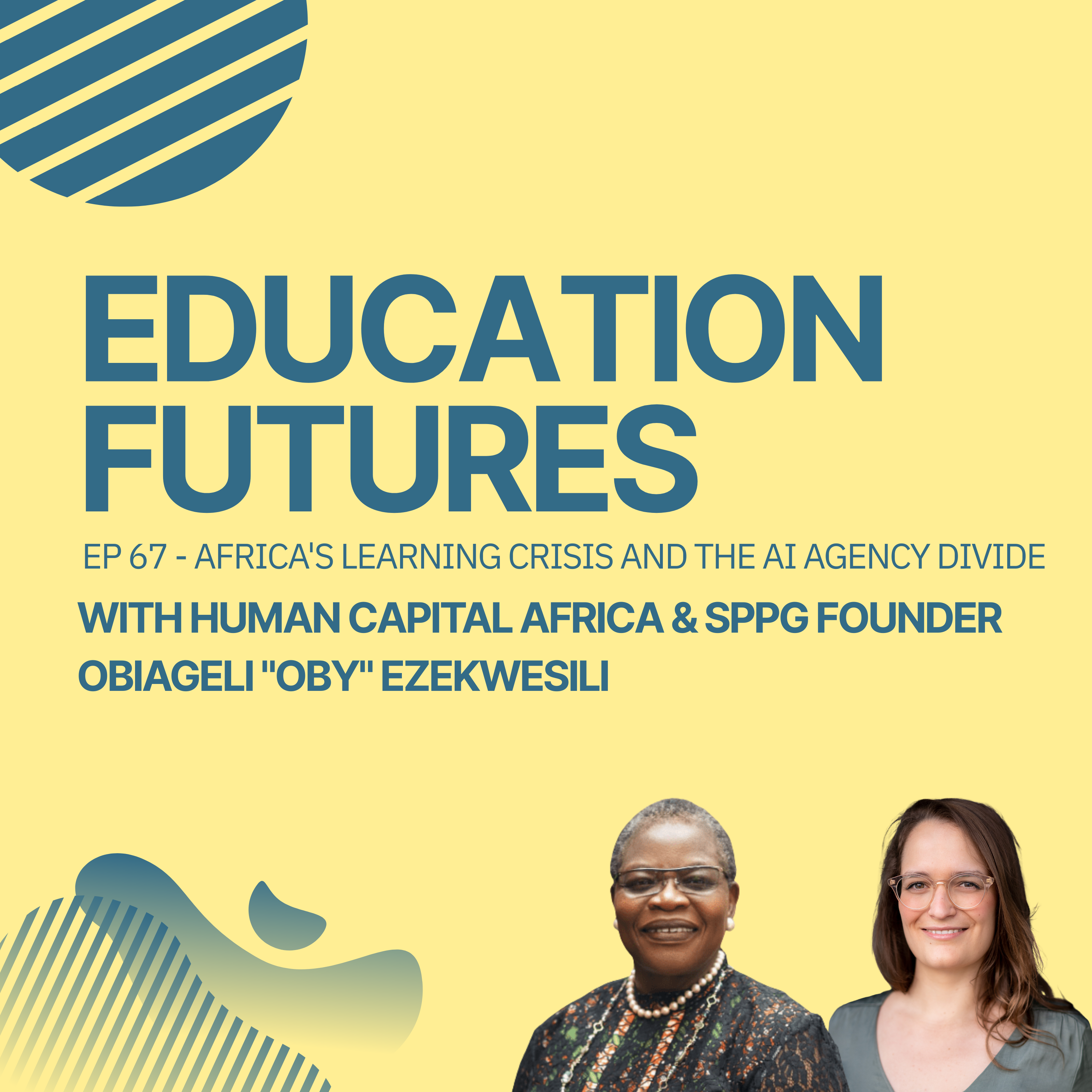 Africa's learning crisis and the AI agency divide 24.08.2026 56minDr. Obiageli "Oby" Ezekwesili is Founder and President of Human Capital Africa, an accountability and advocacy organization devoted to Africa's foundational learning crisis — getting every child reading, writing and counting by age 10. An economic policy expert and chartered accountant by training, she was a co-founder of Transparency International and later served in the Nigerian government as Minister of Solid Minerals and then as Federal Minister of Education. She led the public procurement reform agenda that earned her the nickname "Madam Due Process."She went on to serve as Vice President for the Africa Region at the World Bank, overseeing operations across 48 sub-Saharan countries. She co-founded the #BringBackOurGirls movement, ran for President of Nigeria in the 2019 elections, and founded the School of Politics, Policy and Governance (SPPG), an unconventional school now operating in Nigeria, Senegal and Kenya, with Ghana opening this year, whose graduates are already running for and winning public office. She also advises Club de Madrid, the forum of former democratic heads of state and government democracies and economic development including on AI regulation and governance.In this episode, Oby talks with Svenia Busson about:Human dignity as the through-line of a career spanning Transparency International, two ministries and the World Bank — and why she now calls education "a living thing"Africa's demographic pivot — average age 18.9 years, and 85% of global workforce growth by 2050 — and why it leads to either a dividend or a disasterWhy she stopped "wasting her voice on incorrigible leaders" and built a school to manufacture better ones instead, refusing national accreditation to escape captured systemsThe foundational learning crisis as a matter of life and death — nine in ten children in sub-Saharan Africa unable to read a simple sentence by age 10, and why she refuses to call a spade an agricultural implementWhat actually causes it: no early-childhood preparation, teaching in languages children don't speak, curricular overload, untrained and uncoached teachers, and ministries with no learning dataWhat works and has been proven at scale — structured pedagogy, teaching at the right level, teacher coaching, and the question she puts to presidents: "Mr President, what did our children learn today?"Sobral in Brazil and India's NIPUN Bharat — a 20% improvement in learning outcomes in four to five years — as evidence that political will, not technical solutions, is the binding constraintWhy the mobile telephony leapfrog (Nigeria: 500,000 landlines in 50 years, 200 million mobile lines after liberalisation) is the right mental model for AI in AfricaThe agency divide, not the digital divide — a child can have the most advanced AI system and still lack the knowledge and capability to use it purposefully and criticallyData sovereignty, AI sweatshops on the continent, and why AI must free teachers for individualised attention and values — never replace themHer three game changers for Africa: young people, African women, and technology as their enabler.Mentioned in this episode:For those who wish to know more about the Education Futures fellowship: https://educationfutures.ai/fellowship
 -
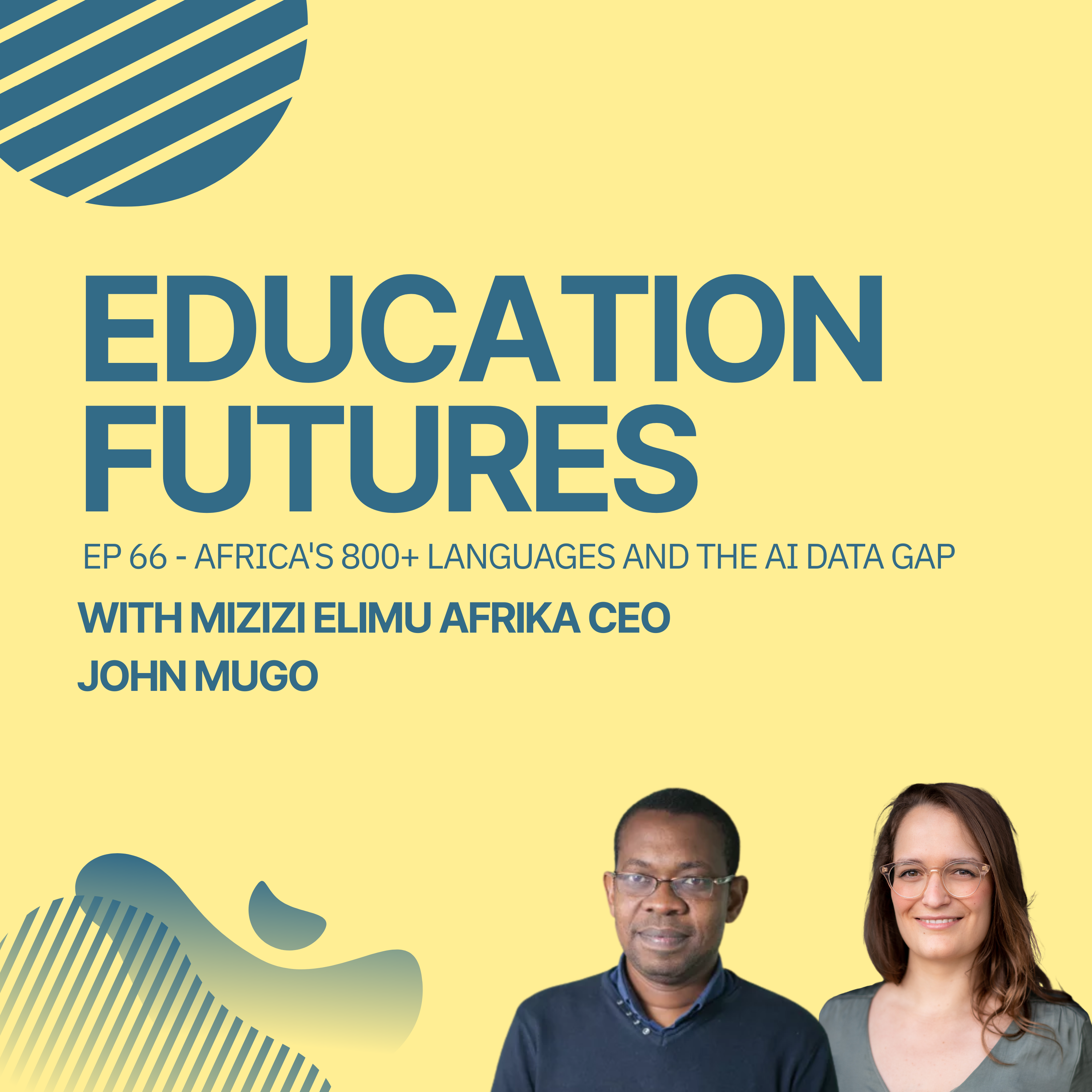 Africa's 800+ languages and the AI data gap 20.08.2026 39minDr. John Mugo is the Chief Executive Officer of Mizizi Elimu Afrika, the African-led education organization based in Nairobi, Kenya, formerly known as Zizi Afrique Foundation. He holds a Doctorate and a Master's degree in Special Needs Education from the University of Hanover, Germany, and a Bachelor of Education (Music) from Kenyatta University, where he went on to chair the Department of Special Needs Education.Before founding the organization in 2018, he headed Uwezo, one of East Africa's largest citizen-led learning assessment initiatives, measuring what children actually know rather than what systems claim to teach. He leads ALiVE (Action for Life Skills and Values in East Africa), a regional framework and assessment system that has now assessed life skills and values in over 45,000 adolescents across Kenya, Uganda and Tanzania, and works directly with the Kenya Institute of Curriculum Development on values-based education and teacher training reform.In March 2026, Zizi Afrique rebranded as Mizizi Elimu Afrika — "mizizi" is Kiswahili for "many roots" — and launched Vision 2040: Strong Foundations for Lasting Change, a 15-year strategy to reach more than 10 million children across 10+ African countries with stronger foundational learning. His organization currently works across Kenya, Tanzania, Uganda, Rwanda, Malawi and Cameroon, and is piloting AI-supported teaching with Fab AI and Gemini in 15 Kenyan schools.In this episode, John talks with Svenia Busson about:Why fewer than 20% of children in much of Sub-Saharan Africa are learning at grade level — and why he calls that an "80 to 90% leakage" no amount of university investment can fixVision 2040 and the two-lever theory behind it: strengthening government systems instead of building parallel NGO programmes, and forcing a competitive civil society sector to collaborateWhy Africa's real AI problem isn't models but data — 800+ languages, oral cultures, and knowledge trapped in unpublished grey literatureThe case for voice data and mother-tongue AI as the fastest route to reading — drawn from his own experience learning to read in Kikuyu, not EnglishWhat the Fab AI and Gemini pilot in 15 schools is showing about real-time assessment — and the widening gap between connected private schools and public schools without electricityThe whole-school approach to values built with Kenya's curriculum institute and piloted in 79 schools — because responsibility and integrity can't be taught in a lesson slotWhy place value in Grade 1 explains Kenya's KCSE maths results, and the 10-year roadmap to move Grade 3 numeracy proficiency from 30% to 75%His blunt advice to ministries drafting AI policy: stop banning it, start investing in your own data, and put young people in the driver's seatWhy Africa's median age of 19 is an asset rather than a fiscal crisis — and what has to be true for that to holdLinks: Mizizi Elimu Afrika · ALiVE · Uwezo · Fab AI · AI for Education · KICD · John Mugo on LinkedInMentioned in this episode:For those who wish to know more about the Education Futures fellowship: https://educationfutures.ai/fellowship
 -
 Redesigning school for the AI age 17.08.2026 45minDan Effland is the Chief of Staff & Strategy at Summit Public Schools, where he leads the continued evolution of Summit's school model. He holds a Master's in Special Education from Dominican University and a Master's in Public School Building Administration from Columbia University's Teachers College.Before entering education, Effland spent over a decade as a professional musician in Chicago. He changed careers in his mid-thirties, teaching guitar to middle schoolers before joining Teach For America — where his cohort, mostly in their twenties, nicknamed him "Stepdad." He became a special education teacher in Chicago and then Seattle, joined Summit Public Schools in 2017, and went on to serve as Dean of Culture & Instruction at Summit Sierra and Executive Director of Summit Atlas High School in West Seattle.He now leads Summit's innovation work: designing "Summit 3.0", an evolved school model that builds on what Summit has promised families for over two decades and responds to the demands of the AI powered era. Summit operates seven charter schools across California and Washington serving roughly 3,000 students, following its earlier "Summit 2.0" personalization model, which scaled the Summit Learning Platform to nearly 400 schools and 100,000 students nationwide. He also sits on the board of the Washington State Charter Schools Association.In this episode, Dan talks with Svenia Busson about:Stripping school down to three elements — kids, outcomes, and resources — to redesign without inherited assumptionsWhy AI doesn't replace a school model, it reveals whether you actually have oneRebuilding Summit's model for the third time: from "college for all" to personalized learning to an AI-native designTreating AI as infrastructure — a data layer and knowledge graph — to dynamically match resources to students, not just as a set of toolsWhy "beliefs come first, model comes next, tools come last," and Summit's push to "create the market" for AI-native school infrastructureRethinking "cheating": protecting the learning while empowering the learner in an AI-saturated classroomRedesigning Expeditions — two-week, ungraded, off-campus career immersions — and why "learning without walls" might be where school is headedWhich durable skills matter more, not less, when a chatbot can write a competent essay in secondsA former teacher now redesigning what school itself should be in the age of AI.Mentioned in this episode: Summit Public Schools · Marshall Street Initiatives · Robin Lake / Center on Reinventing Public Education, who recommended Dan as a guest · Futre, Diane Tavenner's career-exploration platform, used by Summit juniors and seniors · Justin Reich's MIT Teaching Systems Lab, referenced from an earlier Education Futures episodeMentioned in this episode:Education Futures FellowshipA six-week programme starting on September 22nd, where seven world-leading experts in developmental psychology, neuroscience, and AI child safety will share everything they know with you: educationfutures.ai/fellowship.
 -
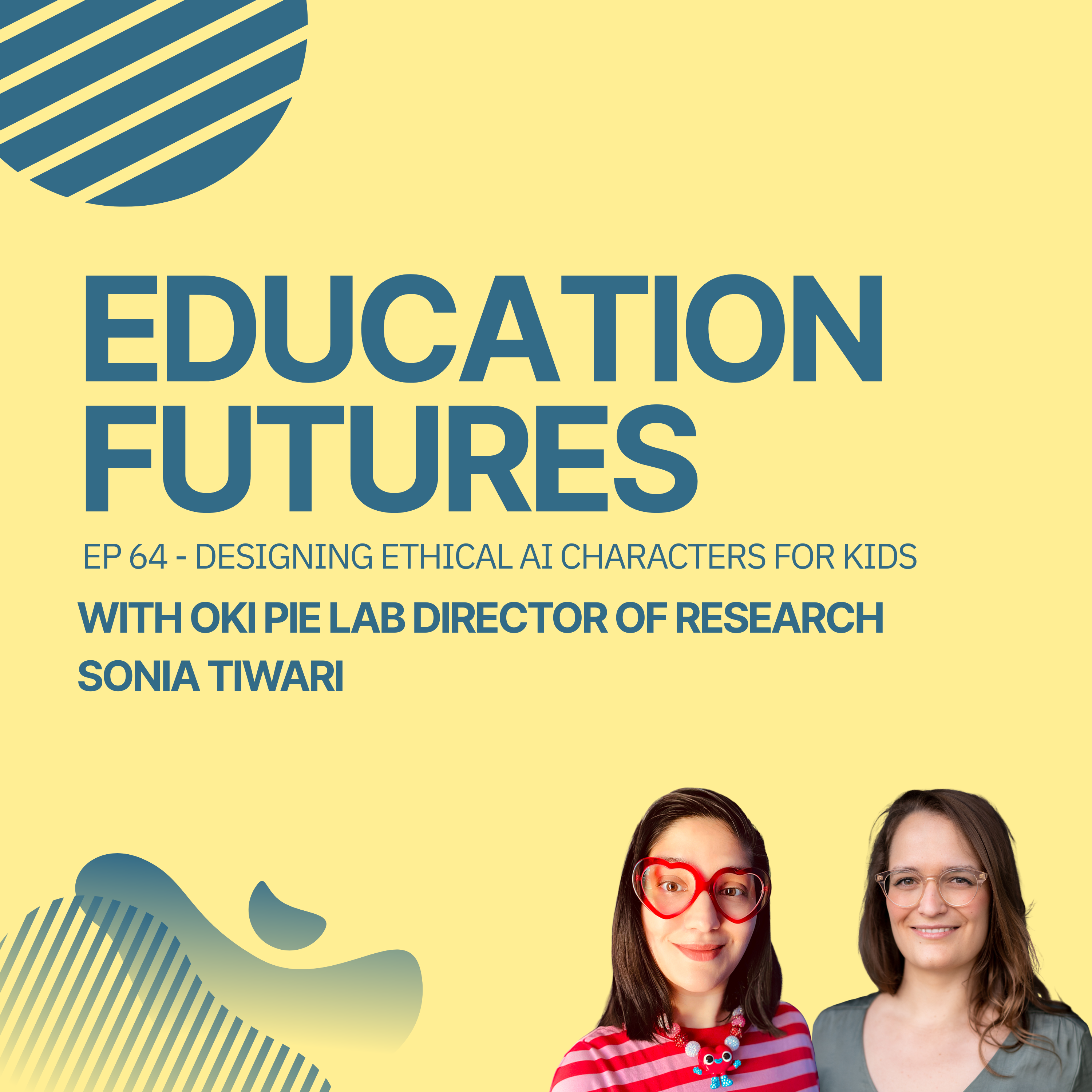 Designing ethical AI characters for kids 13.08.2026 41minDr. Sonia Tiwari is a children's media researcher based in the San Francisco Bay Area and Director of Research at Oki Pie Lab. She holds a PhD in Learning, Design, and Technology from Penn State University, along with an MFA in Animation and a BS in Film, credentials she first put to work as a character designer in the video game industry before turning to research on how children bond with characters and, more recently, AI.At Oki Pie Lab, she runs weekly art workshops for children ages five to ten — more than 100 to date — using what she observes each week to test where AI helps kids create and where it gets in the way. Her research includes Tiwari, S. (2025). Designing Expressive Arts Workshops for Families Using AI Tools. International Journal of Designs for Learning, 16(2), 194–204, and Tiwari, S. Designing ethical AI characters for children's early learning experiences. AI Brain Child 1, 11 (2025) — built from analyzing 60 social media videos of 20 AI characters marketed to children as young as three. She consults with edtech founders — including Jules Stories, a UK-based screen-free storytelling companion — on whether their AI characters genuinely serve children's development, and in 2025 she was selected for the Falling Walls Foundation's Female Science Talents Intensive Track.In this episode, Sonia talks with Svenia Busson about:Why visual design — not just language or policy — shapes how children bond with AI charactersThe psychology of "cute" character design, from Japan's Kawaii culture to Germany's Kindchenschema, and how it's used to mask age-inappropriate AIThe "sticky chat patterns" she's studying with Dr. Jennifer Shen (Keene University) — and their cost to kids' ability to explore beyond one interestHer AI Character Assessment framework in AI Brain Child, built from analyzing characters marketed to ages three to eightWhy safety needs three layers — design, family, and law — and why design alone can't fix a systemic problemThe patchwork of AI regulation worldwide, from loophole-prone California state laws to stricter approaches across EuropeRating efforts underway, from Common Sense Media and Digital Promise to the kidSAFE Seal ProgramWhat Blake, Carter and Velloso's CHI 2026 research reveals about why teens build their own Character.AI companionsSonia's recommendation for a future guest: Diana Joseph, CEO of the Corporate Accelerator Forum and an innovation and entrepreneurship strategist working at the intersection of AI and organizational innovation.Mentioned in this episode:Education Futures FellowshipA six-week programme starting on September 22nd, where seven world-leading experts in developmental psychology, neuroscience, and AI child safety will share everything they know with you: educationfutures.ai/fellowship.
 -
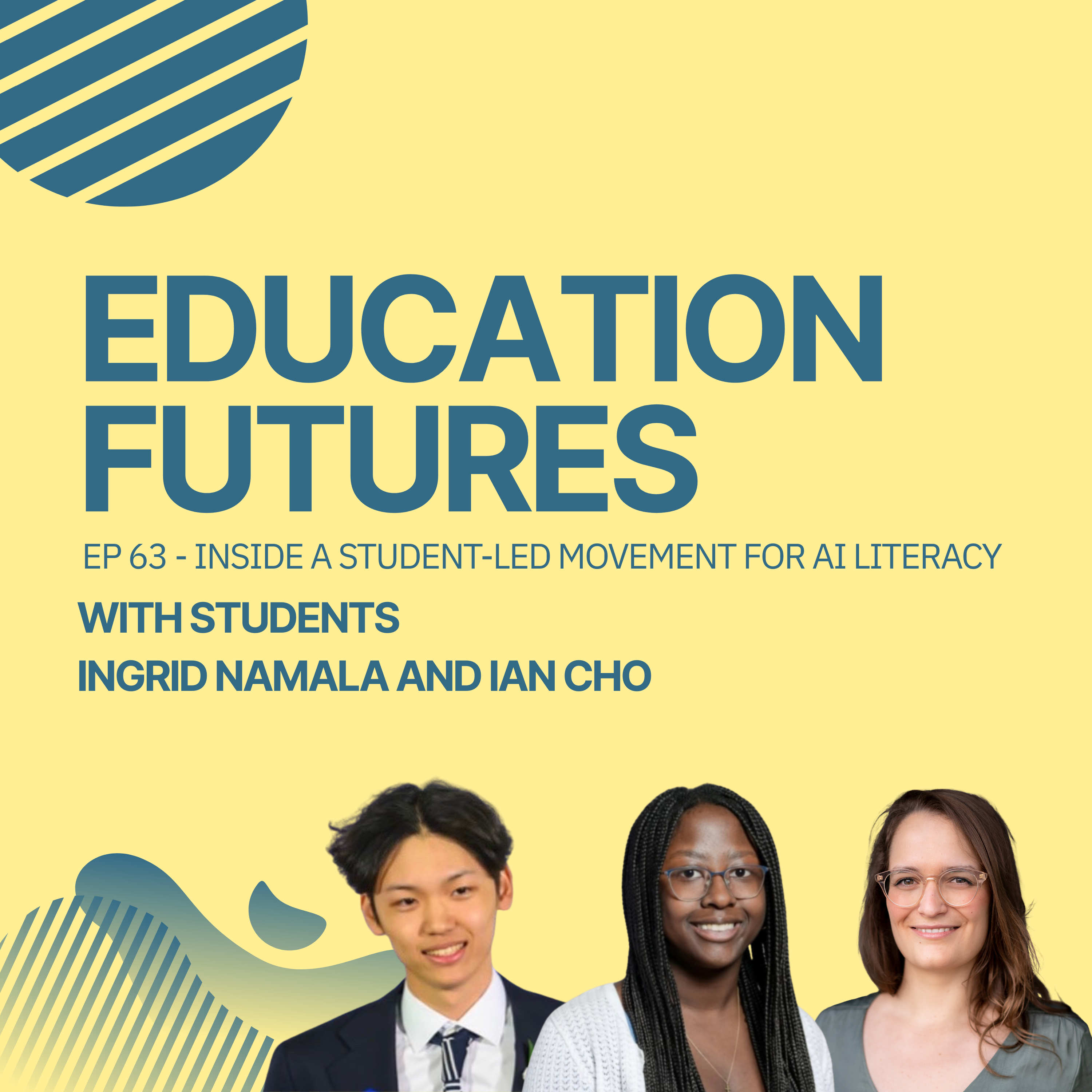 Inside a student-led movement for AI Literacy 10.08.2026 46minIan Cho graduated from St. Mark's School in Southborough, Massachusetts, and heads to Yale University this fall to study cognitive science. Frustrated that AI had quietly become a "taboo subject" wrapped in cheating anxiety, he founded what is now called Sailing (Student AI Literacy Interscholastic Navigator Group), a peer-led initiative that gives students across schools a space to talk openly about how they use AI and the policies governing it. Outside of Sailing, Ian builds his own AI-powered tools, including productivity apps that pause a Pomodoro timer whenever he looks away from his desk.Ingrid Namala is entering her fourth and final year at St. Mark's School, where she plans to study neuroscience. She joined Sailing shortly after Ian launched it and now co-leads the group, having presented her own research on the history of generative AI and prompting technique at Sailing's first interscholastic symposium alongside a student from another school. Much of her advocacy centers on protecting academic integrity and destigmatizing honest conversations between students and teachers about when and how AI should be used.Inspired by AI Co-Lab, the teacher network launched by their teacher Maureen Russo Rodríguez, they grew Sailing into a virtual community spanning more than fifteen schools, running hybrid symposiums, "four corners" debates, and informal salons between students and faculty.In this episode, Ian and Ingrid talk with Svenia Busson about:Sailing (sailingedu.org) — how a "taboo" subject became a peer-led dialogue across 15+ schoolsThe Chinese Room thought experiment — and what it reveals about outsourcing understanding to AIThe hidden toll of unequal AI use — academic integrity, trust, and the students left behindReimagining assessment — in-class writing, oral exams, and whether it's "the death of the essay"Why the brain needs friction — reframing struggle as a skill worth protecting, not a bug to eliminateThe craft of prompting — from lazy fragments to elaborate, metacognitive prompts, and staying polite with AIThe case against banning AI for under-21s — literacy over prohibitionAI, authenticity, and the future of work — why staying human might be the real advantageMentioned in this episode:Education Futures FellowshipA six-week programme starting on September 22nd, where seven world-leading experts in developmental psychology, neuroscience, and AI child safety will share everything they know with you: educationfutures.ai/fellowship.
 -
 When AI meets grassroots education in India 06.08.2026 51minDr. Rukmini Banerji is one of the world's most influential figures in grassroots education. Trained as an economist — a Rhodes Scholar at Oxford and a PhD from the University of Chicago — she chose classroom-level work over academia, returning to India in 1996 to join Pratham, one of the world's largest education NGOs, where she served for over a decade as CEO before recently stepping into the role of Senior Advisor.In 2005 she launched the Annual Status of Education Report (ASER), the citizen-led household survey that has demonstrated, year after year, a hard truth: going to school is not the same as learning. She also pioneered Pratham's Teaching at the Right Level (TaRL) approach — grouping children by what they can actually do rather than their age — now used across India and adapted in parts of Africa and Asia. For this body of work she was awarded the 2021 Yidan Prize for Education Development, the world's highest education accolade.Today she is bringing that same rigor to AI. Pratham has partnered with Anthropic to deploy a Claude-powered "Anytime Testing Machine" (ATM) — an assessment tool that grades handwritten student work and generates curriculum-aligned questions, with teachers reviewing AI feedback before it reaches learners. First adapted for over 5,000 women in Pratham's Second Chance program, it is now piloting across 20 schools with plans to reach 100 by the end of 2026.In this episode, Rukmini talks with Svenia Busson about:Why she left economics for the classroom — and how "big ambition and not much money" shaped Pratham's community-driven modelThe origin of Teaching at the Right Level — teach the child where they are, not where the curriculum says they should beWhat ASER has revealed every year since 2005 — that enrollment and learning are two very different thingsPratham's partnership with Anthropic and the Claude-powered "Anytime Testing Machine" — and why human oversight is non-negotiableThe gap between what edtech companies want to sell and what the ground actually needs — "technology rains on you, then you're expected to use it"Assessing learning in the age of AI — why the process (the questions a student asks) matters more than the final essayWhy middle school (ages 10–14) is education's next great frontier — and why the 15-year-old of 2031 must look different from the one of 2026Mentioned in this episode:Education Futures FellowshipA six-week programme starting on September 22nd, where seven world-leading experts in developmental psychology, neuroscience, and AI child safety will share everything they know with you: educationfutures.ai/fellowship.
 -
 A maker's guide to creativity and AI 03.08.2026 41minChristine Braun is the Chief Creative Officer of Cresconova, the education charity behind Cresconova Labs, a hands-on studio for ages 8–16 in Chelsea, London. She holds a BFA from the University of the Arts and a Master of Artisanry from the University of Massachusetts, a grounding in material-making that runs through everything she's built since.Her path began with founding Robots for Kids Too, a hands-on robotics company she and her husband ran in Vermont after homeschooling her own gifted son, before she went on to manage the Innovation Lab at The Nueva School in Silicon Valley, one of the country's leading schools for gifted learners. She later directed Harvard's REEF Makerspace at the School of Engineering and Applied Sciences, working to break down the silos between academic disciplines, and served as an Adjunct Professor of Engineering at the University of San Francisco. She won the 2020 Lemelson-MIT Excite Award for invention education and mentored on Disney+'s Shop Class. Today, as CCO of Cresconova, she shapes the creative vision behind both Cresconova Global (online, ages 6–11) and Cresconova Labs, the organization's new in-person studio.In this episode, Christine talks with Svenia Busson about:Her path from sculpture and furniture design to founding a robotics company for her own gifted sonWhat "design thinking" really means inside The Nueva School's Innovation LabBuilding Harvard's REEF Makerspace to break down the walls between academic disciplinesThe difference between "gifted" and "inspired" students — and why Cresconova doesn't test for talentCresconova's Inquiry, Systems Thinking, Design Thinking framework — and how it scales from age 5 to 18The "human-to-AI interaction" protocol: question, frame, unpack, own, iterateWhy she believes AI expands creativity rather than threatening the maker traditionWhy students turn to AI instead of trusted adults — and the role shame plays in that shift(Christine also recommended Stephanie Couch, Executive Director of the Lemelson-MIT Program, as a future guest.)Mentioned in this episode:Education Futures FellowshipA six-week programme starting on September 22nd, where seven world-leading experts in developmental psychology, neuroscience, and AI child safety will share everything they know with you: educationfutures.ai/fellowship.
 -
 Can AI leapfrog India's learning crisis? 30.07.2026 45minGouri Gupta is Senior Project Director for EdTech at Central Square Foundation (CSF), one of India's leading education nonprofits, based in New Delhi, where she has led the EdTech portfolio for nearly a decade. A Chartered Accountant (rank holder) and IIM Bangalore MBA, she began her career at the Boston Consulting Group before helping build the National Skill Development Corporation, a Government of India public-private partnership tackling skilling at national scale.At CSF, Gouri has turned EdTech from scattered pilots into system-level infrastructure for children in low-income India. She co-built EdTech Tulna, a quality-standards index developed with IIT Bombay that has shaped roughly $173M in government procurement across 21,000+ schools; leads the LiftEd accelerator supporting eight solutions reaching over 3 million children; and launched AI Samarth, India's first AI-literacy curriculum framework, built with IIT Madras and Google.org, targeting 5 million students, teachers, and parents. Her team also runs TicTacLearn (200M+ video plays) and the Bharat Survey for EdTech, a first-of-its-kind household study of technology use in low-income India.In this episode, Gouri talks with Svenia Busson about:The two ways AI actually moves the needle — powering proven EdTech (Chimple, RocketLearn, ThinkZone) and creating experiences like teacher coaching, tutoring, and assessment that weren't possible beforeWhy CSF acts as an ecosystem enabler rather than a product builder — supply shaping, evidence generation, and government adoptionHard evidence from the ground — Chimple's 0.3 SD gain in an RCT, ConveGenius, and an AI teacher-coaching pilot in Uttar PradeshThe Indic-language gap — why AI being two-to-five years behind on India's 22 official languages could widen inequity, and what AI4Bharat and Bodhi AI are doing about itWhat AI in a government classroom really looks like — labs, smart TVs, shared home phones, and the rise of two-phone householdsDefining AI literacy through AI Samarth — empowered, ethical, safe use, not "AI as Google search"Resilience and collaboration — the human skills at risk of "cognitive stunting," a term she borrows from BrookingsWhy pilots break at scale — product, program, governance, and the unsolved question of how governments budget for AIA clear-eyed look at what it takes to make AI serve 250 million children — not just the ones who already have the most.Links mentioned in this episodeCentral Square Foundation — https://www.centralsquarefoundation.org/EdTech Tulna (quality standards index) — https://edtechtulna.org/AI Samarth (AI literacy curriculum) — https://www.aisamarth.centralsquarefoundation.org/TicTacLearn — https://www.centralsquarefoundation.org/edtechBharat Survey for EdTech (BaSE) — https://www.centralsquarefoundation.org/reports-and-publicationsAI4Bharat (Indic-language models, IIT Madras) — https://ai4bharat.iitm.ac.in/Development Innovation Lab, University of Chicago (Prof. Michael Kremer) — https://bfi.uchicago.edu/development-innovation-lab/Khan Academy / Khanmigo — https://www.khanacademy.org/Madhi Foundation (Tamil Nadu, guest recommendation) — https://www.madhifoundation.org/Mentioned in this episode:Education Futures FellowshipA six-week programme starting on September 22nd, where seven world-leading experts in developmental psychology, neuroscience, and AI child safety will share everything they know with you: educationfutures.ai/fellowship.
Lignende podkaster


Populær i
Denne podkasten finnes også i podkast-listene til disse landene.


