
Corrosion Chronicles
Materials Technology Institute
0
An original podcast series from the Materials Technology Institute, focused on materials in the processing industry and the experts within the community.
Episoder
-
 FRP Flange Design 02.09.2026 55minIn this episode, co-hosts Heather Allain and Marc Cook welcome Bruce Hebb, senior engineer at RPS Composites Inc., for a deep dive into fiber-reinforced plastic (FRP) flange design and the factors that influence performance and reliability. Bruce explains the differences between full-face, raised-face and lap joint, or Vanstone, flange configurations, including how gasket selection, bolt torque and load distribution can affect sealing and stress on FRP components. The conversation explores current ASME design standards, the importance of proper construction methods and the challenges engineers face when specifying and evaluating FRP flanges. Bruce also discusses an ongoing MTI project focused on developing a standardized design procedure for lap joint flanges using finite element analysis and physical testing, with the goal of providing end users and fabricators with clearer, more consistent guidance for designing and building reliable FRP flange systems. This episode is sponsored by Tricor Metals and Rolled Alloys. Corrosion Chronicles is produced by Association Briefings.
 -
 Understanding FMECA, RCA, and Value Engineering 05.08.2026 1t 9minIn this episode, co-hosts Heather Allain and Marc Cook welcome Maria Jose Oestergaard to explore three essential reliability and continuous improvement tools: Failure Modes, Effects, and Criticality Analysis (FMECA), Root Cause Analysis (RCA), and Value Engineering (VE). Maria Jose explains when to use each methodology, how to define the scope of an analysis, and the importance of assembling the right team and documenting findings throughout the process. She also discusses common triggers for implementing these tools, how organizations can leverage the results to improve performance, and when it makes sense to rely on internal expertise versus outside consultants. This episode is sponsored by Tricor Metals and Rolled Alloys. Corrosion Chronicles is produced by Association Briefings.
 -
 The Science of Bonded Liners 01.07.2026 53minIn this episode, Michael Krauss, sales director at Knight Material Technologies, joins co-hosts Heather Allain and Marc Cook to discuss bonded lining systems and the materials considerations that influence long-term performance. Michael explains the different types of fabric backings, adhesives, and their ideal applications, while outlining best practices for installing bonded sheets and verifying bond integrity through pull-off testing and nondestructive evaluation methods. The conversation also highlights MTI research on cap strips and current work examining temperature ramp rates for bonded liners, offering practical insights for engineers and plant operators seeking to improve reliability and extend equipment life. This episode is sponsored by Tricor Metals and Rolled Alloys. Corrosion Chronicles is produced by Association Briefings. Show notes Polymer Cap Strip Welding Project Final Report - https://access.mti-global.org/record/900?v=pdf FEA Based Analysis of Thermal Ramp Rate Effects on Thermoplastic Liner Adhesion (445) - https://www.mti-global.org/communities/community-home/librarydocuments?LibraryKey=7e6c78de-dcd7-4090-b9d8-019bb284a855
 -
 SEM & EDS in Failure Analysis: Let the Sample Tell the Story 03.06.2026 1t 2minIn this episode, failure analysis expert Tedd Anastas of Anastas Technical Services and Brent Moore of Moore Analytical join co-host Heather Allain and guest host Andrew Rentsch, Materials Engineer at Huntsman Corporation, for a practical discussion on scanning electron microscopy (SEM), energy dispersive spectroscopy (EDS), and their role in failure analysis and materials investigations. The conversation explores how SEM differs from optical microscopy, how SEM paired with EDS can reveal important chemical and microstructural clues, and why EDS results are often best treated as qualitative indicators rather than precise quantitative measurements. Tedd and Brent discuss detection limits, normalized compositions, false positives, fatigue striations, fracture surface interpretation, contaminants, inclusions, non-metallic materials, sputter coating, and elemental mapping. Along the way, they share case study examples, practical investigation tips, and a few unexpected detours involving dinosaur eggs and wig hair. This episode is sponsored by Tricor Metals and Rolled Alloys. Corrosion Chronicles is produced by Association Briefings.
 -
 Providing Materials Expertise to Process Commercialization 06.05.2026 1t 5minIn this episode, Richard Clapp, retired principal consultant from DuPont, joins co-hosts Heather Allain and Marc Cook for a discussion on the role of materials expertise in process commercialization. Drawing on decades of industry experience, Richard outlines the three primary types of process commercialization and the institutional challenges companies often face when scaling new processes from the bench to production. The conversation explores how impurities, feedstock variability, and solids handling can introduce unexpected complications, as well as why engineers tend to take conservative approaches to materials recommendations during commercialization efforts. Richard also breaks down common “show stoppers” and explains the importance of the three C’s—corrosion, compatibility, and clean-up—when evaluating process systems. Additional topics include corrosion testing at both bench and pilot scale, the subtle but important differences that can exist between seemingly identical plants, considerations when using toll manufacturers for pilot operations, and practical advice for organizations navigating process commercialization projects. This episode is sponsored by Tricor Metals and Rolled Alloys. Corrosion Chronicles is produced by Association Briefings.
 -
 Hydrofluoric Acid and Anhydrous Hydrogen Fluoride - Part 2 01.04.2026 42minIn this episode, the second installment of a two-part series, Bert Jennings, owner of Jennings Materials Consulting in Spring, Texas, rejoins co-hosts Heather Allain and Marc Cook to continue their discussion on hydrofluoric acid (HF) and anhydrous hydrogen fluoride (AHF) service. Building on Part 1, the conversation shifts to detection, materials, and real-world application. Bert outlines key NDE techniques for identifying cracking and hydrogen blistering, then dives into weld practices and the importance of proper stress relief in carbon steel systems. The group also explores alternative materials, including austenitic stainless steels, ceramics, and glass, along with a “learn from failures” story that highlights the consequences of small oversights. The episode wraps with insights on nickel alloys, welding challenges, and the role of FRP and fluoroplastics—reinforcing that success in HF service depends on both material selection and execution. This episode is sponsored by Tricor Metals and Rolled Alloys. Show Notes Related reference for MTI members: MS-4 Materials Selector for Hazardous Chemicals: Hydrogen Fluoride and Hydrofluoric Acid Non-members: Visit the MTI bookstore. Corrosion Chronicles is produced by Association Briefings.
 -
 Hydrofluoric Acid and Anhydrous Hydrogen Fluoride - Part 1 04.03.2026 42minIn this episode, the first installment of a two-part series, Bert Jennings, owner of Jennings Materials Consulting in Spring, Texas, joins co-hosts Heather Allain and Marc Cook for a technical discussion on hydrofluoric acid (HF) and anhydrous hydrogen fluoride (AHF) service. Bert begins by outlining where HF is commonly used and addressing common industry tropes and misconceptions about how the fluid behaves in process environments. He explains what “anhydrous” truly means in practical terms, including how dry anhydrous hydrogen fluoride must be and why strict moisture control is essential. The conversation dives into the unique hazards associated with HF, particularly in carbon steel systems. Bert discusses hydrogen blistering, hydrogen-assisted stress corrosion cracking (HASCC), and the influence of hardness on material performance. He also examines how residual elements in carbon steel can affect corrosion resistance and cracking susceptibility, highlighting why small compositional differences can lead to significant performance impacts in HF service. The episode concludes with practical considerations for materials selection, inspection, and risk mitigation, setting the stage for deeper exploration in Part 2 of the series. This episode is sponsored by Tricor Metals and Webco Industries. Show Notes Related reference for MTI members: MS-4 Materials Selector for Hazardous Chemicals: Hydrogen Fluoride and Hydrofluoric Acid Non-members: Visit the MTI bookstore. Corrosion Chronicles is produced by Association Briefings.
 -
 Corrosion and Wear Materials Solutions 04.02.2026 54minIn this episode, Robert Freed, Ph.D., FASM, Associate Director at the Materials Technology Institute, joins co-hosts Heather Allain and Marc Cook for a practical, materials-focused discussion on corrosion and wear. Robert helps clarify the differences between abrasion, adhesive wear, erosion, and cavitation, and explains how these damage mechanisms commonly show up in industrial equipment such as extruders and other high-wear components. The conversation explores key variables that influence wear performance, how wear can accelerate corrosion, and why factors like particle size matter. Robert also walks through methods for evaluating and ranking materials, including relevant ASTM wear tests, metals lab analysis, and the pros and cons of different overlay solutions—such as laser cladding, thermal spray, and weld overlay—as well as non-metallic options. The episode closes with insight into MTI-led research projects and practical considerations for selecting materials and processes to manage wear in demanding operating environments. This episode is sponsored by Tricor Metals and Webco Industries. Corrosion Chronicles is produced by Association Briefings.
 -
 Eddy Current Testing (ECT) of Heat Exchanger Tubes 07.01.2026 54minIn this episode, Evan Lowrance, Corporate NDT Engineer at Webco Industries, and Jonathan Konerza, Tubing Division Manager at Sentinel Integrity Solutions, join co-hosts Heather Allain and Marc Cook for an in-depth look at eddy current testing (ECT) of heat exchanger tubes. Together, they break down how ECT works, the differences between internal and external testing, and how factors like magnetism and material conductivity influence test results. The conversation explores how eddy current testing compares to IRIS testing, what types of defects ECT is best suited to detect, and where its limitations exist. Evan and Jonathan also discuss the importance of reference standards, technician qualification, and tailoring inspection programs to expected degradation mechanisms. The episode wraps with practical insight into evaluating NDE providers and recognizing warning signs that testing may not be delivering reliable results. This episode is sponsored by Tricor Metals and Webco Industries. Corrosion Chronicles is produced by Association Briefings.
 -
 Column Internals 03.12.2025 1t 1minIn this episode, Danny Mock, managing partner for M10 Process Equipment, Inc., joins co-hosts Heather Allain and Marc Cook to take listeners inside the world of column internals and the fundamentals that drive mass-transfer performance. Danny breaks down what mass-transfer equipment is and how internals efficiency is evaluated, offering practical insight into design considerations that influence reliability and long-term operation. He discusses the importance of selecting materials with appropriate corrosion allowances, how internals are attached and supported, and what engineers should know about bolted fasteners, dissimilar metals, tray flatness, and the risks associated with creep and thermal expansion. The conversation also covers column fires, static charge generation, and the role of random packing in modern column design. Whether you're troubleshooting existing towers or designing new equipment, this episode provides a comprehensive look at the details that matter most inside a process column. This episode is sponsored by Tricor Metals and Webco Industries. Corrosion Chronicles is produced by Association Briefings.
 -
 Explosion Cladding 05.11.2025 52minIn this episode, Mukesh Ahlavadi, Global Director of the Chemicals Market at NobelClad, joins co-hosts Heather Allain and Marc Cook to explore the world of metal cladding and its critical role in modern engineering applications. Together, they provide an overview of hot roll bonding versus explosion cladding, examining the key drivers behind each process and why industries turn to cladding for enhanced material performance and corrosion resistance. Mukesh walks through essential fabrication considerations, including the use of batten strips, interlayers, and post-cladding operations, while sharing insights into heat treatment, forming clad plate, and lessons learned from a 1990s clad failure. Listeners will gain a clear understanding of how explosion cladding was discovered, the mechanics of the process, and how the distinctive wave pattern at the clad interface reflects quality and bonding integrity. This episode is sponsored by Tricor Metals and Webco Industries. Corrosion Chronicles is produced by Association Briefings.
 -
 Gasketed Joints 01.10.2025 1tIn this episode, Kevin Ganschow, materials & corrosion consultant at Mechanical Materials Engineering, LLC, joins co-hosts Heather Allain and Marc Cook to unpack the intricacies of gasketed joints. The discussion begins with a foundational look at flange assemblies as systems before diving into key factors such as gasket stress, bolt reuse, and lubrication. Kevin highlights best practices for bolted joint assembly and integrity programs, emphasizing the importance of assembler training, flange tagging, and condition assessment. The episode also explores advanced considerations including joint relaxation, hot tightening, hot bolting, and bolt relaxation, offering practical insights for engineers and operators aiming to enhance reliability and safety in their systems. This episode is sponsored by Tricor Metals and Webco Industries. Corrosion Chronicles is produced by Association Briefings.
 -
 How a Materials Lab Works 03.09.2025 54minIn this episode, Jennifer Larimore and Avery Boyer, Materials Engineers at Chemours, join co-hosts Heather Allain and Marc Cook to share an inside look at how a materials lab works. Jennifer and Avery walk through the step-by-step process of analyzing samples—from sectioning, cleaning, reviewing documentation and photographing through the final wrap up of documenting and communicating findings to the customer. They discuss analysis methods like nondestructive evaluation, XRF identification, hardness, fracture testing, polishing and metallography to uncover critical material properties. The discussion also explores the importance of turning technical findings into clear, actionable recommendations. Throughout the conversation, the guests highlight how these practices help solve real-world challenges, prevent failures, and ensure long-term reliability. This episode is sponsored by Tricor Metals and Webco Industries. Corrosion Chronicles is produced by Association Briefings.
 -
 Materials Selection During Project Execution 06.08.2025 37minIn this episode, Cathleen Shargay, Advisor of Materials and Welding Engineering at Becht, joins co-hosts Heather Allain and Marc Cook to explore the complexities of materials selection during project execution. The conversation covers a wide range of essential topics, from understanding what materials selection diagrams (MSDs) are and how they interface with process engineering, to evaluating life cycle cost inputs and establishing design life. Cathleen also unpacks how MSDs relate to Integrity Operating Windows (IOWs) and Corrosion Control Documents (CCDs), and how these tools work together to support informed decision-making. The episode dives into strategies for managing excursions, assessing corrosion circuits, and understanding the consequences of material failure. Finally, the discussion looks ahead to how artificial intelligence is beginning to shape materials selection and analysis in the future of engineering. This episode is sponsored by Tricor Metals and Webco Industries. Corrosion Chronicles is produced by Association Briefings.
 -
 High Temperature Hydrogen Attack 02.07.2025 39minIn this episode, Nate Sutton, materials engineer at Equity Engineering, joins co-hosts Heather Allain and Marc Cook for a deep dive into high-temperature hydrogen attack (HTHA) and the evolving guidance used to evaluate and mitigate its risks. Nate shares his firsthand insights on the origins and evolution of Nelson curves, the role of post-weld heat treatment, and the recent development of time-dependent curves still under review by API. The discussion also explores the role of advanced non-destructive examination (NDE) techniques, MTI’s contributions to HTHA detection and assessment, and how fitness-for-service decisions are made under high-stakes conditions. This episode is sponsored by Tricor Metals and Webco Industries. Corrosion Chronicles is produced by Association Briefings.
 -
 NDE of In-service Equipment 04.06.2025 55minIn this episode, Ana Benz, Chief Engineer at IRISNDT, joins co-hosts Heather Allain and Marc Cook for a deep dive into selecting non-destructive examination (NDE) techniques based on expected damage mechanisms. Ana shares insights on recent advancements in radiography, field-based hardness testing, and imaging of hardness indents to assess effectiveness. The conversation also explores proper surface cleaning for inspections, the use of chemical composition analysis to detect degradation from galvanic corrosion, and the role of Integrity Operating Windows (IOWs). Additional topics include remote monitoring applications and innovations in remote inspection technology. Corrosion Chronicles is produced by Association Briefings.
 -
 Abrasion and Erosion 07.05.2025 56minIn this episode, Murray Pearson, Director, HPM Technology Development, Metals at Hatch, joins hosts Heather Allain and Marc Cook to delve into the intricacies of abrasion, erosion, and erosion corrosion. They explore the impact of these phenomena on various equipment types, the materials responsible for these damages, and effective strategies for equipment protection. Topics include impingement effects, methods for evaluating material suitability such as plant coupon testing, ongoing MTI research initiatives, factors influencing abrasion rates, and advanced NDE techniques for equipment assessment. Corrosion Chronicles is produced by Association Briefings.
 -
 Fabrication Considerations for Duplex Stainless Steels 02.04.2025 46minIn this episode, Ben Sprengard, managing director of innovation at Enerfab, sits down with co-hosts Heather Allain and Marc Cook to discuss fabrication considerations for duplex stainless steels. They explore key topics, including property comparisons to austenitic stainless steels, forming, machining, welding, phase transformation during cooling, welding QC, solution annealing, QC for duplex fabrication, in-service inspection, and heat exchanger specifics. Corrosion Chronicles is produced by Association Briefings.
 -
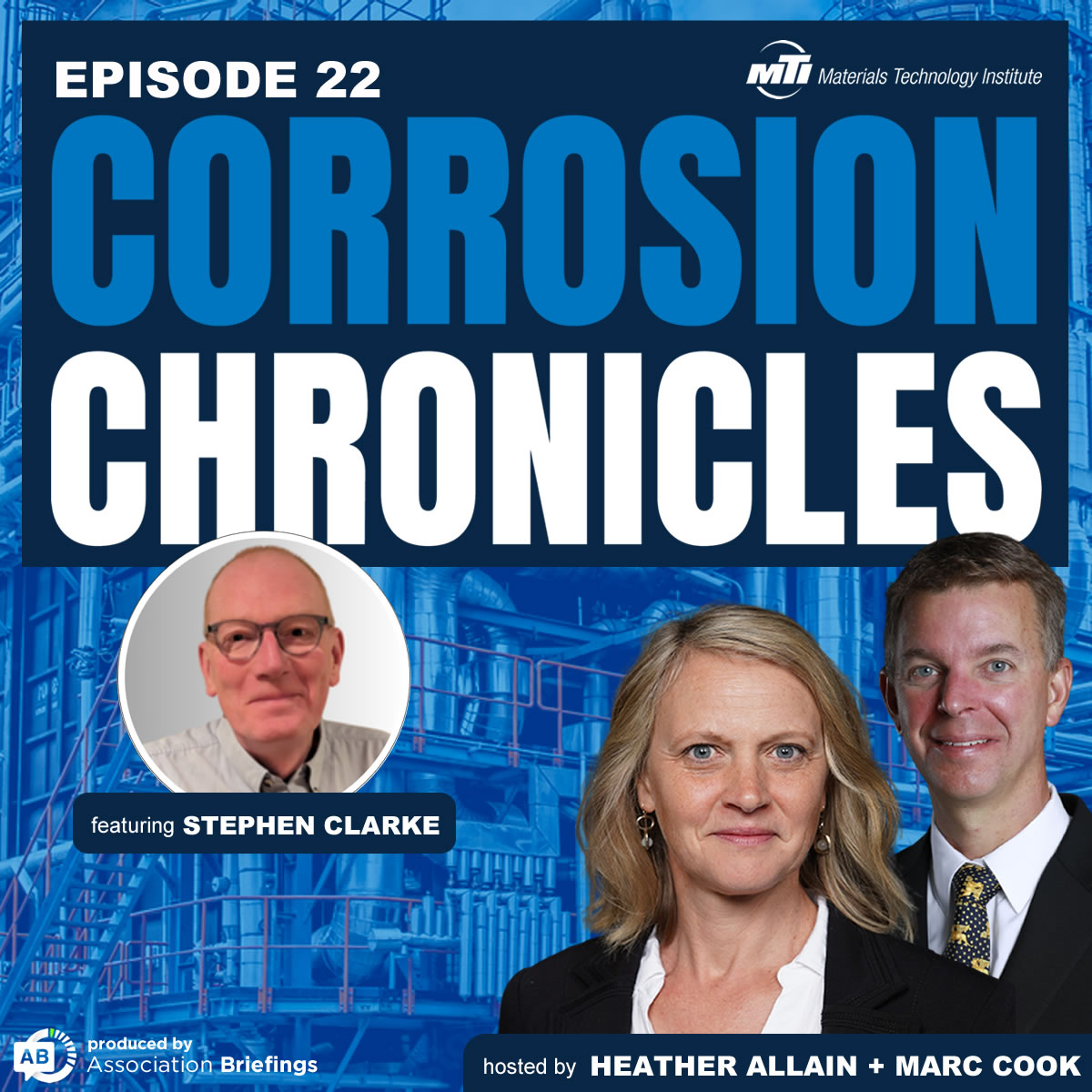 Mining and mineral processing 05.03.2025 50minIn this episode, Steven Clarke joins co-hosts Heather Allain and Marc Cook to dive into the world of mining and mineral processing. They break down the differences between hydrometallurgy and pyrometallurgy, explore various leaching methods, and discuss solvent extraction and electrowinning. The conversation highlights how water and ore contaminants impact material compatibility, the challenges of abrasion resistance, and what new materials the mining industry could benefit from. Corrosion Chronicles is produced by Association Briefings.
 -
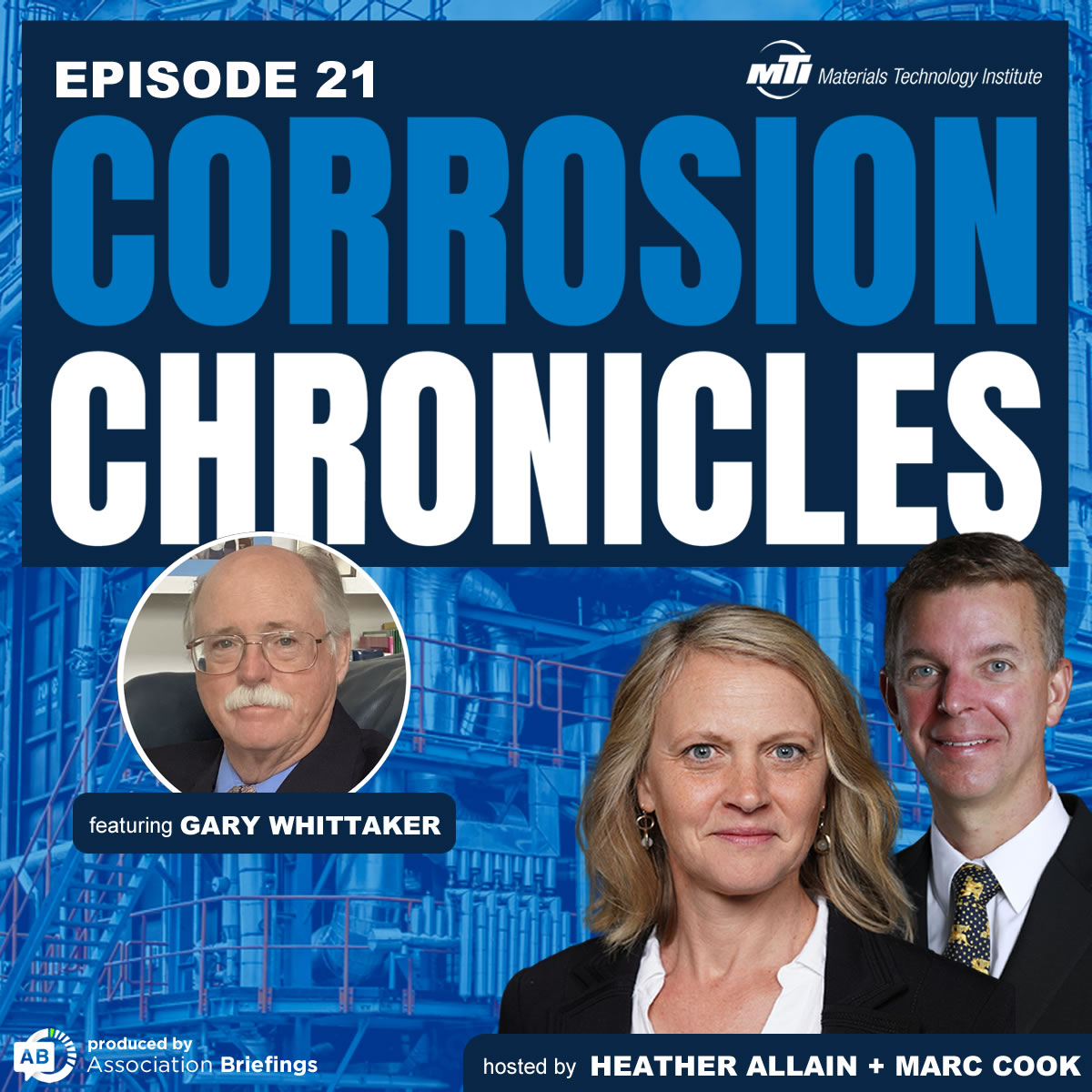 Failure Analysis and Incident Response 05.02.2025 46minIn this episode, Gary Whittaker, retired Engineering Fellow from Eastman Chemical and MTI Fellow, sits down with co-hosts Heather Allain and Marc Cook to recount some past failures he was involved in failure analysis on. They chat about: an API storage tank that leaked and contaminated a nearby river, some Nickel-Chrome-Moly alloy piping with stress cracking found due to indications on an associated clad vessel, and some Nickel-Moly alloy piping with stress cracking. Corrosion Chronicles is produced by Association Briefings.
Lignende podkaster


Populær i
Denne podkasten finnes også i podkast-listene til disse landene.
