
Openwork: Inside the Watch Industry
Collective Horology
0
Openwork is a weekly podcast that offers an unfiltered look behind the scenes of the watch industry, hosted by Asher Rapkin and Gabe Reilly, co-founders of Collective Horology. It avoids press releases, hype, and sponsored content, focusing on how the industry actually works. Available on major podcast platforms.
Episoder
-
 MING's Very Big Year – And What Comes Next – Episode 94 21.09.2026 44minRecorded live at Geneva Watch Days, this episode of Openwork sits down with Ming CEO Praneeth Raj Singh to unpack one of the strongest product runs in independent watchmaking: the Polymesh, Iris, Starfield, Lightning, and Comet. Hosts Gabe Reilly and Blake Buettner ask how much of it was planning versus luck, and Praneeth explains the shift from pandemic-era scramble launches to a more deliberate cadence, plus why Ming's graveyard of killed ideas is bigger than its actual catalog. Praneeth gets specific on how Ming decides what to build and what to cut, including how a failed 3-kilometer dive watch indirectly produced the Bluefin's case construction and 600-meter water resistance. He talks through the tension between moving fast and giving platforms like the 37 Series more room to breathe, how Ming manages production partners as capacity gets squeezed by larger brands, and why some projects stay dead while others resurface years later in new form. Praneeth also previews Ming's 10th anniversary in 2026: an expansion of the Superleggera lightweight collection into a chronograph, and the brand's first non-round case. Openwork is a weekly podcast about how the watch industry actually works. An unfiltered look behind the scenes — no press releases, no hype, and no sponsored takes. Hosted by Asher Rapkin and Gabe Reilly, co-founders of Collective Horology. Available on Apple Podcasts, Spotify, YouTube Music, or wherever you get your podcasts. You can find us online at collectivehorology.com. To get in touch with suggestions, feedback or questions, email [email protected].
 -
 The Unsung Watches – Geneva Watch Days 2026 – Episode 93 14.09.2026 1t 3minGabe and Asher kick off Episode 93 with news: Collective is now an authorized Ressence retailer. Then they get into the week's biggest story out of Geneva Watch Days 2026: Breitling's Gallet relaunch, its inherited distribution network, the debt behind the bet, and why it beats the usual sub-$5,000 heritage revival. The rest of the episode is Collective's annual rundown of the watches nobody else is covering: the Laurent Ferrier Classic Moon Dusk and its lumed double-moon phase, Singer Track's new V72 chronograph in gold panda dial, and the Atelier Wen x William Messina Inflection, a real collaboration with a Chinese-calligraphy and Arabic numeral dial. They close with three more: the Urwerk UR-1001 Amadeus, a one-of-one engraved pocket watch that tracks centuries and millennia; the Marco Tedeschi MT 1.1, a crownless skeleton tourbillon from the watchmaker behind Kross Studios; and the Fears Brunswick 39 Perpetual Calendar, built on a customized Sellita and Dubois Dépraz module. Gabe and Asher use it to make the case that movement choice, not movement brand, should determine a watch's value.Fears Brunswick 39 Perpetual Calendar – Interview with Nicholas Bowman-Scargill and Lee Yuen-Rapati: https://collectivehorology.com/blogs/articles-reviews/the-fears-brunswick-39-perpetual-calendar Openwork is a weekly podcast about how the watch industry actually works. An unfiltered look behind the scenes — no press releases, no hype, and no sponsored takes. Hosted by Asher Rapkin and Gabe Reilly, co-founders of Collective Horology. Available on Apple Podcasts, Spotify, YouTube Music, or wherever you get your podcasts. You can find us online at collectivehorology.com. To get in touch with suggestions, feedback or questions, email [email protected].
 -
 Geneva Watch Days 2026 – Bigger, Better, and Collector-focused – Episode 92 03.09.2026 53minGabe Reilly and Blake Buettner record live from Geneva Watch Days to discuss the show’s atmosphere, the growth of independent watchmaking, and what Blake’s new role at Collective means for future content. We break down major trends: independents gaining mainstream traction, the rising accessibility of creative watchmaking, and the cross-pollination of materials and techniques between affordable and high-end brands. And of course, we highlight standout releases, including Ming’s 57.05 Comet worldtimer with its dynamic dial and tiered lugs as well as Bulgari’s surprising collaboration with Vianney Halter. We also react to Tudor’s North Flag release and explain why Geneva Watch Days continues to matter — especially for collectors — as it expands across the city and preserves its more relaxed, collector-focused vibe. Openwork is a weekly podcast about how the watch industry actually works. An unfiltered look behind the scenes — no press releases, no hype, and no sponsored takes. Hosted by Asher Rapkin and Gabe Reilly, co-founders of Collective Horology. Available on Apple Podcasts, Spotify, YouTube Music, or wherever you get your podcasts. You can find us online at collectivehorology.com. To get in touch with suggestions, feedback or questions, email [email protected].
 -
 Collection Reset – Working in Watches Changed How We Buy – Episode 91 24.08.2026 50minBreitling relaunches Gallet on September 3rd. Openwork hosts Gabe Reilly and Asher Rapkin unpack Georges Kern's play: chronographs at 3,000–5,000 CHF, an exploration story aimed at Bremont, Longines, and Tudor, sold in Breitling boutiques. Plus Universal Genève and Breitling's return to Watches & Wonders. Then a listener question: how has working in the industry changed our collecting? It starts with selling nearly everything to help fund Collective Horology — what survived, what still stings (the Urwerk collaboration, the MB&F LM101, the Lange Odysseus), and rebuilding from an empty watch box. What came back is different: neo-vintage tool watches, Holthinrichs, Ming, Singer. Buying on the merits instead of the hype, why an Aquanaut lands differently outside collector context, and the freedom that comes from retailing independent watches. Openwork is a weekly podcast about how the watch industry actually works. An unfiltered look behind the scenes — no press releases, no hype, and no sponsored takes. Hosted by Asher Rapkin and Gabe Reilly, co-founders of Collective Horology. Available on Apple Podcasts, Spotify, YouTube Music, or wherever you get your podcasts. You can find us online at collectivehorology.com. To get in touch with suggestions, feedback or questions, email [email protected].
 -
 We Sued to Stop Tariffs – And Rolex Is Reshaping Retail – Episode 90 10.08.2026 43minIn Episode 90 of Openwork, Collective Horology co-founders Gabe Reilly and Asher Rapkin reveal that they've sued the U.S. federal government over the tariffs squeezing the watch industry and small businesses nationwide. They explain why they joined the suit alongside co-plaintiff Burlap Barrel, how the latest Section 301 tariffs continue to limit access to independent watches, and why it's the volatility of trade policy — not just the cost — that makes it so hard for small businesses to plan and grow. The guys then dig into the numbers: the latest Swiss watch export data (up more than 11% year over year in June 2026, with the U.S. driving growth as China slides), the "bullwhip effect" tariffs are having on imports, and fresh quarterly earnings from Richemont, Swatch Group, and LVMH — where jewelry is powering the luxury recovery while watchmaking hangs tougher. Finally, they turn to the shifting Rolex and pre-owned market, where Rolex's share of secondary-market value has hit a seven-year low even as its Certified Pre-Owned program grows into a juggernaut. They close on the retail arms race reshaping the industry — Bucherer's giant new Rolex flagship in New York, fresh boutiques nationwide, and what the rise of big-box players like Watches of Switzerland and the 1916 Company means for family-owned dealers. Openwork is a weekly podcast about how the watch industry actually works. An unfiltered look behind the scenes — no press releases, no hype, and no sponsored takes. Hosted by Asher Rapkin and Gabe Reilly, co-founders of Collective Horology. Available on Apple Podcasts, Spotify, YouTube Music, or wherever you get your podcasts. You can find us online at collectivehorology.com. To get in touch with suggestions, feedback or questions, email [email protected].
 -
 The Watch Switzerland Can't Make – Karel Bachand (Barrelhand) – Episode 89 27.07.2026 1t 1minA quick news note: On Friday, July 24, Collective, along with New York spice importer Burlap & Barrel, filed a lawsuit in the U.S. Court of International Trade challenging the federal government's latest Section 301 tariffs. We'll dig into the details on our next episode. In the meantime, you can read more here. On this episode of Openwork, Gabe Reilly and Asher Rapkin talk with Karel Bachand, founder and chief engineer of Barrelhand, the San Francisco brand rethinking American watchmaking. Karel reverse-engineered an Urwerk as a teenager and cut his teeth on microgravity devices at NASA Ames before building Monolith — a mechanical watch designed from first principles as an aerospace tool, and one that couldn't be made in Switzerland. The conversation digs into the question the industry avoids: after sixty years of luxury and heritage, what does a watch brand look like when it picks substance over story? Karel breaks down building an American supply chain from scratch, why decentralized manufacturing beats bringing it all in-house, and why a mechanical movement — not quartz or digital — is the right call for the harsh reality of a spacewalk. It's also a frank take on collector blind spots, like the assumption that a modified Sellita movement is a cop-out instead of a deliberate, reliability-driven choice, and on growing the independent watch community by drawing in people from outside it. Explore Karel's work at barrelhand.com. Openwork is a weekly podcast about how the watch industry actually works. An unfiltered look behind the scenes — no press releases, no hype, and no sponsored takes. Hosted by Asher Rapkin and Gabe Reilly, co-founders of Collective Horology. Available on Apple Podcasts, Spotify, YouTube Music, or wherever you get your podcasts. You can find us online at collectivehorology.com. To get in touch with suggestions, feedback or questions, email [email protected].
 -
 The Rise of Tudor – How Rolex Wins by Letting Tudor Dare – Episode 88 13.07.2026 47minHow did Tudor go from a brand you couldn't even buy in the United States to a half-billion-dollar powerhouse selling 300,000 watches a year? In this episode of Openwork, Gabe Reilly and Asher Rapkin trace the rise of Tudor — from its wilderness years in the shadow of Rolex to the 2009 reinvention that produced the Heritage Chrono, the Black Bay, the Pelagos, and an in-house movement. Along the way they unpack the ETA supply crisis, the 2008 financial crash, and Rolex's move upmarket that opened the door for Tudor to walk through. But this isn't the usual "poor man's Rolex" conversation. Gabe and Asher argue that Tudor's real role is stranger and smarter than that: the gonzo laboratory where Rolex tests every material, case size, and business model it's too disciplined to try itself. Tudor is the black sheep by design — the pressure-release valve that lets Rolex stay conservative while quietly backfilling the market it left behind as prices climbed. So where does it go from here? With 260-plus boutiques, celebrity wrists, and a brand that's broken into mainstream culture, Tudor looks like a company on the path to a billion dollars. The question is whether it gets there on brand alone — and whether a watch that exists relative to Rolex can ever truly stand on its own. Openwork is a weekly podcast about how the watch industry actually works. An unfiltered look behind the scenes — no press releases, no hype, and no sponsored takes. Hosted by Asher Rapkin and Gabe Reilly, co-founders of Collective Horology. Available on Apple Podcasts, Spotify, YouTube Music, or wherever you get your podcasts. You can find us online at collectivehorology.com. To get in touch with suggestions, feedback or questions, email [email protected].
 -
 Bonus: Reviving the U.S. Watch Industry – Josh Shapiro (J.N. Shapiro) – Episode 41 06.07.2026 1tTo mark 250 years of American independence, we're revisiting one of our favorite conversations: our sit-down with Josh Shapiro, the American independent watchmaker behind the Resurgence — the only watch that currently meets the U.S. Federal Trade Commission's standard for "Made in America." It's a fitting week to ask a question that feels newly urgent in an era of tariffs and reshoring: what would it actually take to bring watchmaking back to the United States at scale? Josh takes us from the industry's staggering height — when American factories employed over 100,000 people and produced millions of chronometer-grade watches a year, so far ahead that the Swiss crossed the Atlantic in 1876 to study our methods and race to catch up — through the forces that dismantled it: the pivot from pocket watches to wristwatches, an aggressive Swiss cartel, Depression-era trade deals, and a postwar collapse that was already terminal long before the quartz crisis delivered the final blow. Along the way he explains why the single hardest thing to rebuild isn't machinery or capital, but people, and why "Swiss Made" and "Made in America" are two very different promises. Told through the lens of building the Resurgence in his Los Angeles workshop — the CNC machines, the $150,000 balance-staff breakthrough, the North Dakota jeweler he coaxed out of retirement — this is a clear-eyed look at the slow, deliberate work of rebuilding an industry from the roots up, and what any of us can do to support it. Openwork is a weekly podcast about how the watch industry actually works. An unfiltered look behind the scenes — no press releases, no hype, and no sponsored takes. Hosted by Asher Rapkin and Gabe Reilly, co-founders of Collective Horology. Available on Apple Podcasts, Spotify, YouTube Music, or wherever you get your podcasts. You can find us online at collectivehorology.com. To get in touch with suggestions, feedback or questions, email [email protected].
 -
 The Analog Boom – Watch Sales Surge to Start 2026 – Episode 87 29.06.2026 50minThis week we're proud to welcome Bamford London to the Collective line card. George Bamford is the OG of modern collaborative watchmaking, but it's his own designs — the D300 Ceramic Diver, the Monopushers, the GMTs — that pulled us in: pieces that read as instantly recognizable without ever aping the usual suspects, built from forged carbon, ceramic, and titanium, at a genuinely accessible price. They also slot perfectly into the decade-plus renaissance in English design and watchmaking. Then we get into the real subject of the episode, which is almost the opposite of Bamford's forward-looking material science: the rise of analog culture, and why it's quietly driving one of the strongest stretches the US watch market has ever seen. US watch sales jumped nearly 30% in the first five months of 2026 — and that's sell-through reported by retailers, not sell-in. We felt it in our own business, posting our biggest sales month ever before June was even over. But the more interesting question is why, and we make the case that this moment is fundamentally different from the COVID boom. That run was narrow and speculative: a handful of steel sports references, mania, watches as assets to flip. What's happening now is broad-based and rooted in the intrinsics — design, handwork, the human connection between the person who cut the dial and the object on your wrist. The three segments leading the way tell the story: neo-vintage and vintage, independent brands, and the $50,000-and-up tier where handcraft lives. We zoom out from there, because watches are riding a much bigger wave. Vinyl now outsells CDs, with most of Gen Z owning records — and plenty of buyers who don't even own a turntable, which tells you the object itself is the point. Film cameras are back in production, analog synths are having a moment, and a real backlash is building against a digital licensing economy where you rent your media instead of owning it. We get into what that physical, patient, you-actually-own-it impulse means for collecting, why automating the hunt drains the fun out of it, and where neo-vintage reissues might go in 2026 and 2027. Openwork is a weekly podcast about how the watch industry actually works. An unfiltered look behind the scenes — no press releases, no hype, and no sponsored takes. Hosted by Asher Rapkin and Gabe Reilly, co-founders of Collective Horology. Available on Apple Podcasts, Spotify, YouTube Music, or wherever you get your podcasts. You can find us online at collectivehorology.com. To get in touch with suggestions, feedback or questions, email [email protected].
 -
 Bonus: The Watches of Armin Strom – Claude Greisler (Co-founder & Master Watchmaker) – Episode 86 22.06.2026 35minWe're on summer hours, but we wanted to keep something in your feed as much as we can — so this one comes from our Watches Of podcast, a conversation Gabe recorded in person with Claude Greisler of Armin Strom. Claude is one of the brand's two modern co-founders and its master watchmaker, and he made the trip out to Los Angeles for Open House, where a full spread of the Armin Strom collection was on the tables. Before the watches, the two sat down for a wide-ranging talk about how he got here. Claude's path is what makes this one worth your time. He grew up in a family of watchmakers, trained for the better part of a decade across Swiss watchmaking, restoration, and movement construction, and cut his teeth on high complications at Christophe Claret. But unlike so many of his peers, he never put his own name on a dial. Instead, with his childhood friend Serge Michel, he took over Armin Strom: a legendary local watchmaker whose vision was a single, clear idea — the movement should be the star of the watch. That conviction is the spine of the conversation, from the decision to become a true in-house manufacturer to the brand's signature complications and its philosophy of transparent mechanics. This is also, at heart, an Openwork episode. What we keep coming back to on this show is the power of a clear, strong brand identity, and Armin Strom is a near-perfect case study: a watchmaker who walked away from the obvious move to inherit a brand with a reason for being, then re-engineered it from scratch. Along the way, Claude demystifies resonance — what it actually is, and why Armin Strom's approach to it is so distinct — using a couple of analogies that made it click for Gabe, and probably will for you too. We'll be back next week with a regularly scheduled episode. Openwork is a weekly podcast about how the watch industry actually works. An unfiltered look behind the scenes — no press releases, no hype, and no sponsored takes. Hosted by Asher Rapkin and Gabe Reilly, co-founders of Collective Horology. Available on Apple Podcasts, Spotify, YouTube Music, or wherever you get your podcasts. You can find us online at collectivehorology.com. To get in touch with suggestions, feedback or questions, email [email protected].
 -
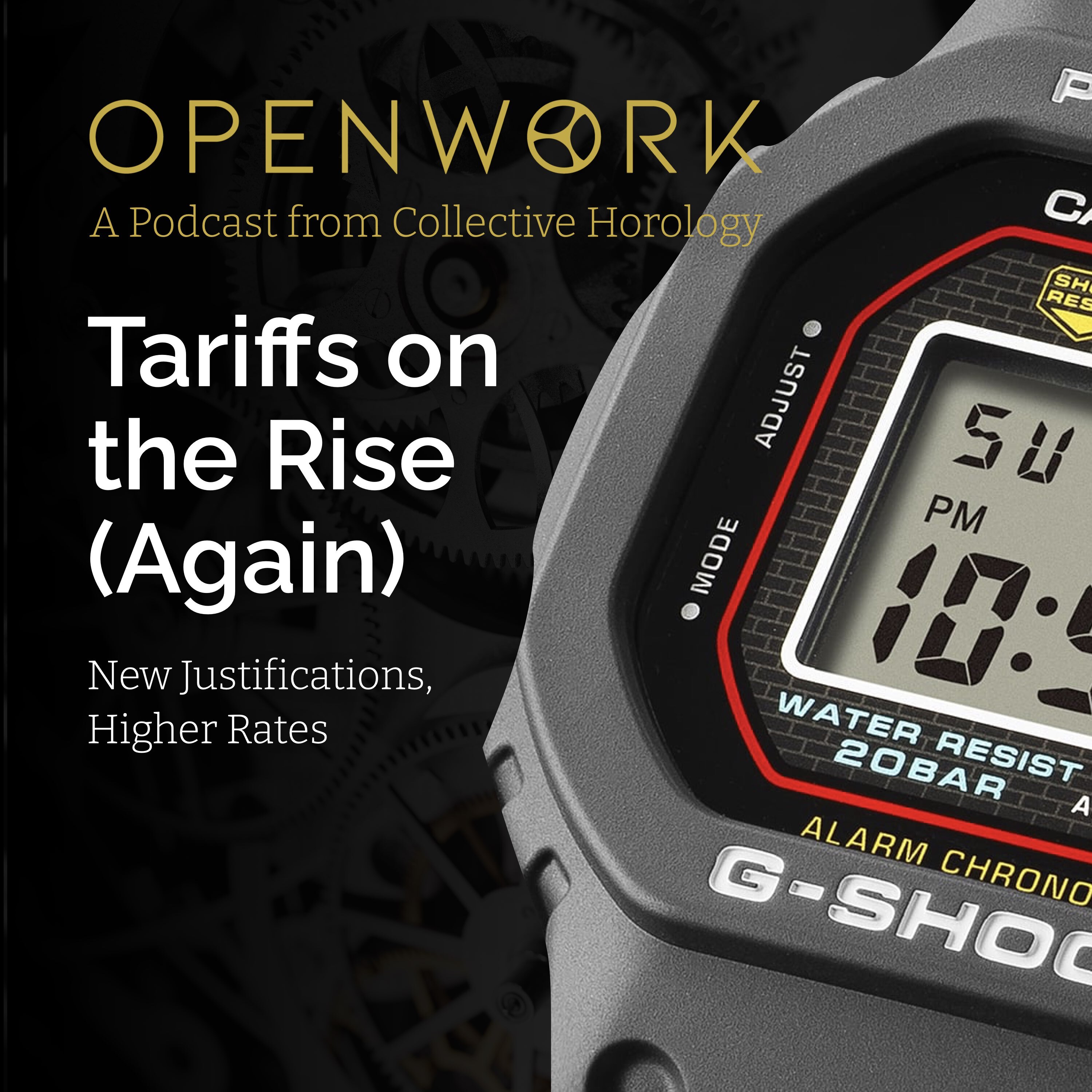 Tariffs on the Rise (Again) – New Justifications, Higher Rates – Episode 85 15.06.2026 45minGabe heads to Las Vegas for one of the largest trade shows in the watch and jewelry world — a B2B behemoth that's quietly making a bigger play for watches than ever before. He breaks down what the show gets right, where it falls short of the events collectors actually obsess over, and the one brand on the floor that genuinely stopped him in his tracks across every price point imaginable. Then the conversation turns to the topic everyone assumed was behind us. Tariffs didn't go away — they just changed costume. Gabe and Asher trace the legal shell game playing out right now: what got struck down, the new justifications being rolled out to take its place, and the deadline this summer that could send rates climbing all over again. If you thought the worst was over, this is the segment to hear. Underneath the legal maneuvering are some genuinely serious accusations being leveled at brands the guys know personally — claims they can say, with absolute certainty, simply aren't true. It's a conversation about what's being said versus what's real, what it means for prices and the collectors who love this hobby, and why there's still far more to look forward to than to fear. Openwork is a weekly podcast about how the watch industry actually works. An unfiltered look behind the scenes — no press releases, no hype, and no sponsored takes. Hosted by Asher Rapkin and Gabe Reilly, co-founders of Collective Horology. Available on Apple Podcasts, Spotify, YouTube Music, or wherever you get your podcasts. You can find us online at collectivehorology.com. To get in touch with suggestions, feedback or questions, email [email protected].
 -
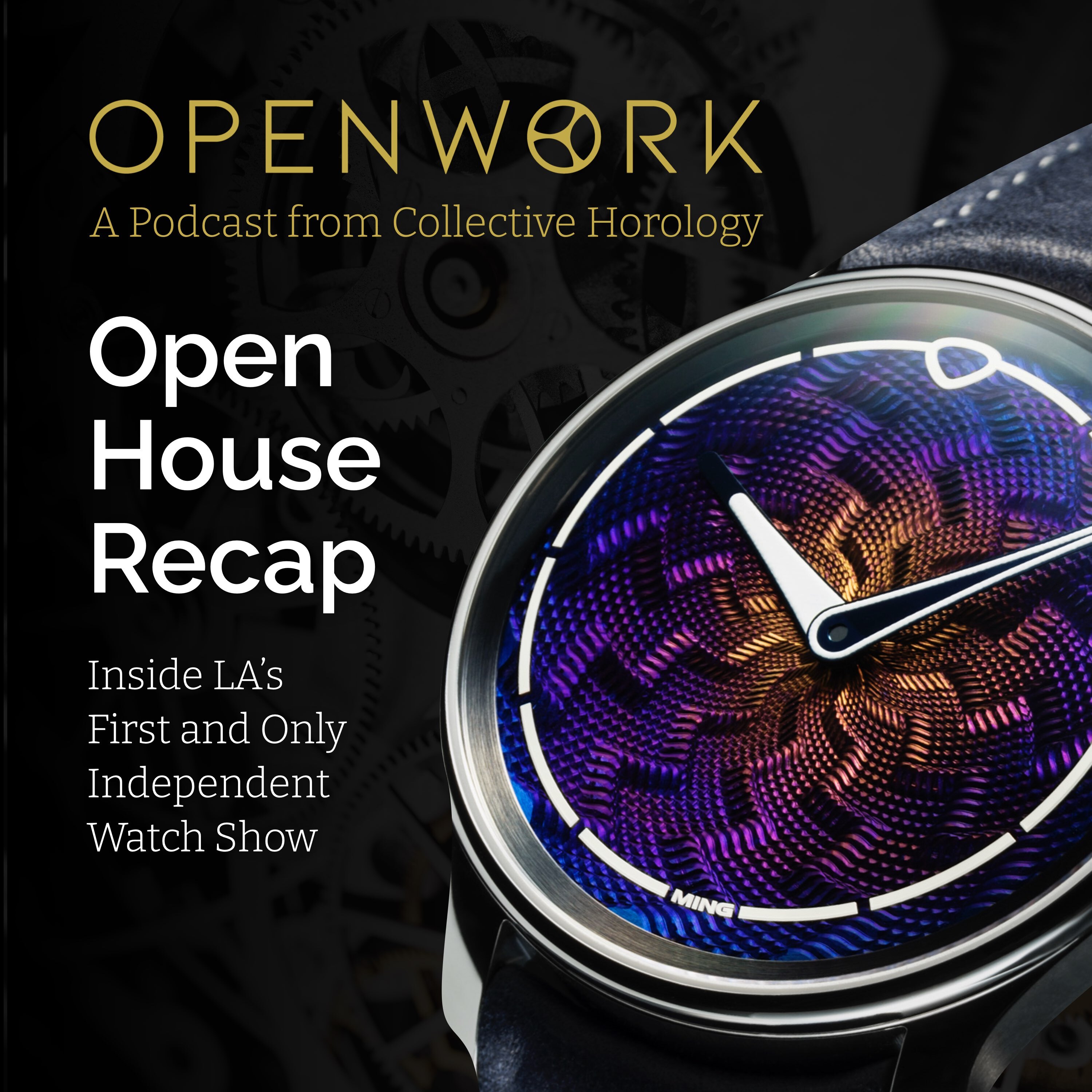 Open House Recap – Inside LA's First and Only Independent Watch Show – Episode 84 08.06.2026 30minMorning after Open House 2026 — the biggest event Collective Horology has ever thrown. Now in its third year at The Aster in Hollywood, the fair pulled 400+ people through the door, a line down the street, a closed RSVP, and attendees who flew in from as far as Boston. Gabe and Asher dig into why a show built entirely around esoteric, left-of-center independents draws such a self-selecting crowd: not casual passersby, but a curious, informed audience that knows exactly what it's looking at. Every brand got an identical table this year, which Asher argues strips everything away but the watch — a half-million-dollar Armin Strom repeater feet from a sub-$20K Fears or MING that more than holds its own. Gabe relays Ariel Adams' surprise that Collective lets brands talk directly to clients, something most retailers avoid for fear of being cut out. The reason is the whole advantage of independent retail: when you choose every brand you carry, you trust them — the same camaraderie that had competing watchmakers breaking bread together after the show. Big thanks to everyone who came out, to the brands who flew halfway around the world, and to operations lead Ellie, whose execution made the day run. Openwork is a weekly podcast about how the watch industry actually works. An unfiltered look behind the scenes — no press releases, no hype, and no sponsored takes. Hosted by Asher Rapkin and Gabe Reilly, co-founders of Collective Horology. Available on Apple Podcasts, Spotify, YouTube Music, or wherever you get your podcasts. You can find us online at collectivehorology.com. To get in touch with suggestions, feedback or questions, email [email protected].
 -
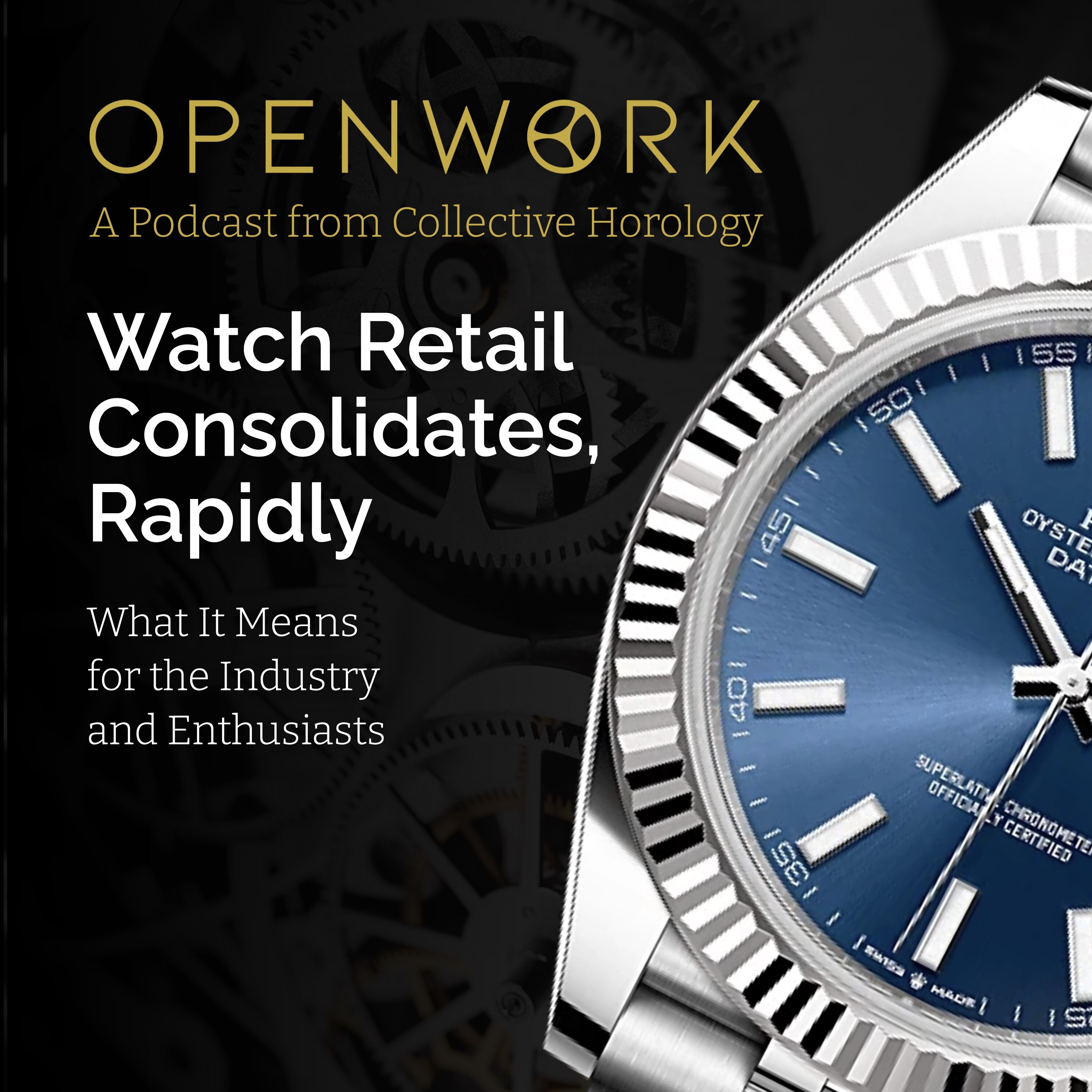 Watch Retail Consolidates, Rapidly – What It Means for the Industry and Enthusiasts – Episode 83 01.06.2026 49minWhile preparing to speak on a panel about the rapidly changing state of American watch retail, Gabe stumbles onto an annual industry report that ranks the largest jewelry and watch retailers by revenue — and what he finds stops him cold. The company sitting at the very top of the list is one neither he nor Asher had ever heard of: a quiet giant operating thousands of doors in plain sight. And the name long assumed to rule American watch retail? It's quietly been overtaken. This week, Gabe and Asher dig into what the numbers actually reveal — an industry consolidating faster than most enthusiasts realize, on both the retail floor and the brand side. They trace how one retailer went from almost nothing to the brink of a billion dollars in a single decade, why brick-and-mortar still rules even in an online-first world, and how a single dominant brand quietly pulls the strings behind some of the biggest players. Along the way, a long-held assumption gets turned on its head: the position everyone once considered the safest bet in watch retail may now be the most exposed. The bigger question hanging over all of it — as the giants get bigger and the old rules fall away, is any of this good for the people who actually love watches? Gabe makes his case, Asher pushes back, and they map out where the independents, including businesses like their own, might fit in a landscape that looks nothing like it did just a few years ago. Openwork is a weekly podcast about how the watch industry actually works. An unfiltered look behind the scenes — no press releases, no hype, and no sponsored takes. Hosted by Asher Rapkin and Gabe Reilly, co-founders of Collective Horology. Available on Apple Podcasts, Spotify, YouTube Music, or wherever you get your podcasts. You can find us online at collectivehorology.com. To get in touch with suggestions, feedback or questions, email [email protected].
 -
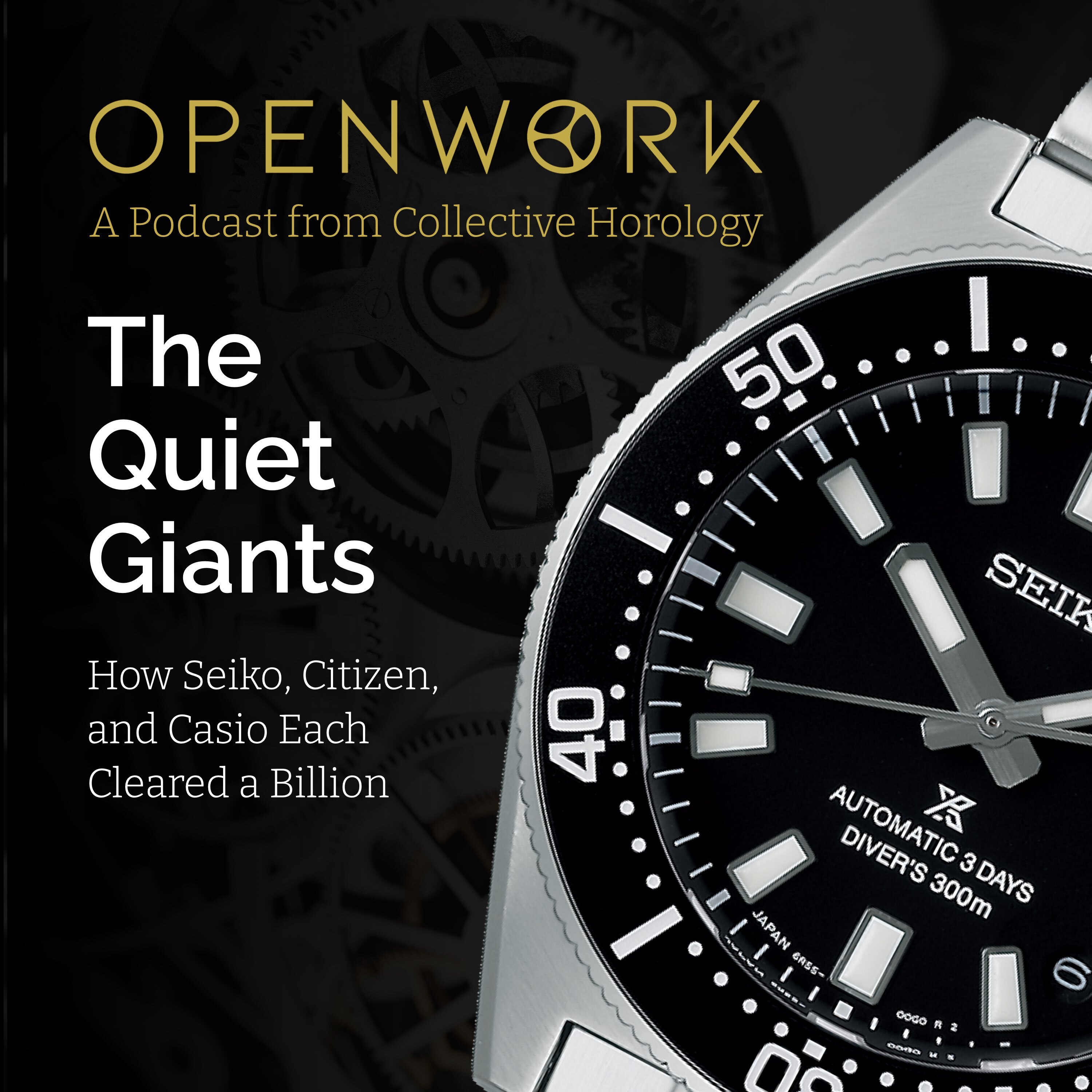 The Quiet Giants – How Seiko, Citizen, and Casio Each Cleared a Billion – Episode 82 25.05.2026 58minSeiko, Citizen, and Casio each pulled in over a billion dollars in revenue last year — in most cases record-breaking, and all three landing neck and neck around $1.3 billion with healthy 9–14% net margins. That's remarkable on its own. It's stunning when you remember it happened in the same sub-$5,000 segment that's been punishing the Swiss. While Swatch Group struggles and the broader industry hunts for its footing, Japan's big three are quietly having their strongest year in decades. We dig into why. The short version: they're counter-positioned to everything that's currently working against Swiss luxury. A weak yen against a punishingly strong franc, a value-and-reliability pitch instead of a luxury-and-heritage one, a technology focus (spring drive, solar, high-accuracy quartz, the entire G-Shock universe) at the exact moment tastes drift away from vintage reissues, and diversified distribution into markets like Latin America and India that the Swiss lean on far less. We also get into how different these three businesses actually are under the hood — Casio's pivot to watches as a majority of revenue, and Citizen's sprawling structure spanning La Joux-Perret, Miyota, Bulova, Frédéric Constant, Alpina, Arnold & Son, and Angelus — and why Seiko still doesn't get half the respect it deserves. Before all that, we welcome Niton and the Niton Prima to Collective, and put a final cap on the AP x Swatch launch — the crowds, the resellers, the injuries, and Nick Hayek's remarkably flip BBC interview — a moment that revealed real cultural relevance for AP and a real crisis-management failure for Swatch. Openwork is a weekly podcast about how the watch industry actually works. An unfiltered look behind the scenes — no press releases, no hype, and no sponsored takes. Hosted by Asher Rapkin and Gabe Reilly, co-founders of Collective Horology. Available on Apple Podcasts, Spotify, YouTube Music, or wherever you get your podcasts. You can find us online at collectivehorology.com. To get in touch with suggestions, feedback or questions, email [email protected].
 -
 Royal Flop? – AP x Swatch: Brand Building or Crisis Management? – Episode 81 18.05.2026 57minWe recorded today's episode on May 13, just a few days before the AP Swatch Royal Pop went on sale. We discuss the decision-making and implications of this project for both companies' brands and businesses, and for many reasons, we consistently question why AP in particular would partner with Swatch on this project. On the positive side, we do point out Swatch's competencies in production, distribution, marketing, and retail of these kinds of products. Sadly though, today's events — store closures, out-of-control crowds, and even fist fights — undermine that case, and only serve to underscore our skepticism in this project and the points we discuss on today's episode. In sum, the botched on-sale has turned this project from an exercise in brand building to one in crisis management — certainly not what AP or Swatch had in mind. Across the conversation, we work through the collaboration from three angles: brand, product, and business. We dig into Ilaria Resta's stated rationale — putting watchmaking into mainstream culture and protecting "rare watchmaking savoir-faire" — and the curious decision to direct the donated proceeds to AP's own foundation rather than a third party. We examine the form factor itself (a pendant rather than a wristwatch), what it says about AP's attempt to protect the Royal Oak while capitalizing on its cultural cachet, and whether this project actually solves a problem AP has — or whether it amplifies the access issues that already define the brand's relationship with potential customers. We also turn the lens on Swatch. Unlike Moonswatch and the Blancpain Scuba, the Royal Pop is the first time Swatch has borrowed equity from outside the group, and we unpack why this looks like a near-perfect outcome for Swatch and a much harder calculus for AP. Along the way we draw comparisons to Moonswatch's cultural footprint, debate which direction "borrowed interest" actually flows in these collaborations, and float a few alternative ideas — including an AP-coded Flick Flack — that might have served the stated mission better than what landed on shelves this weekend. Openwork is a weekly podcast about how the watch industry actually works. An unfiltered look behind the scenes — no press releases, no hype, and no sponsored takes. Hosted by Asher Rapkin and Gabe Reilly, co-founders of Collective Horology. Available on Apple Podcasts, Spotify, YouTube Music, or wherever you get your podcasts. You can find us online at collectivehorology.com. To get in touch with suggestions, feedback or questions, email [email protected].
 -
 How Watches Get Allocated – It's Not Just Spend History – Episode 80 11.05.2026 54minWhy do some watches always seem to go to the same people? Listener Terry wrote in with a question we hear constantly: how do brands and authorized dealers actually decide who gets the most in-demand pieces? Is it spend, celebrity, genuine interest, or something else? Gabe and Asher walk through the five allocation models that govern how hot watches move from manufacturer to wrist — closed-door allocations, customer pre-sales, first come first serve, lotteries, and order windows — and the trade-offs each one creates. The conversation starts upstream. Decisions about how many Breitling Cosmonauts or MING Starfields a given retailer receives are made long before any customer walks in the door. From there, Gabe and Asher get into the human factors most cynical takes on this stuff miss: taste fit, follow-through on prior commitments, how someone treats the staff, whether they refer other clients, and yes — purchase history, but as one input among several. They share Collective's own framework for allocating limited pieces, where 10% of a 20-piece run still means saying no to most of the people who want one, and they're honest about why none of the five models really solves the underlying problem. Also: Collective Horology's third annual Open House is Saturday, June 6 in Hollywood, with 14 independent brands in attendance — register at collectivehorology.com/openhouse. Openwork is a weekly podcast about how the watch industry actually works. An unfiltered look behind the scenes — no press releases, no hype, and no sponsored takes. Hosted by Asher Rapkin and Gabe Reilly, co-founders of Collective Horology. Available on Apple Podcasts, Spotify, YouTube Music, or wherever you get your podcasts. You can find us online at collectivehorology.com. To get in touch with suggestions, feedback or questions, email [email protected].
 -
 Against All Odds – How Richemont, LVMH and Swatch Recovered in Q4 2025 – Episode 79 04.05.2026 50minIf you'd told Gabe and Asher on August 7th — the day the U.S. announced a 39% tariff on Switzerland — that the holding companies would close out 2025 with their watch businesses up, they wouldn't have believed it. But that's what happened. Richemont's watch division grew 7% year over year. Swatch Group posted 7.2%. LVMH's watches and jewelry held flat while fashion softened around it. The top line says remarkable resilience. The bottom line tells a more complicated story. Profits are largely flat. Currency and tariff drag is real. And the recovery is being driven by a strategic shift toward what Richemont and LVMH call "permanent luxury" — fewer watches, made at the higher end, with more specialized supply chains. That shift is a tale of two cities for suppliers: brutal under $10K, a quiet boon at the high end. Gabe and Asher dig into what it means for independents, why the Sellita movement Asher saw in Geneva shows how the market adapts, and whether the grand reorganization of the industry is creating a system that's harder for new brands to break into. The episode closes on Swatch Group, where ISS has backed activist Steven Wood for a board seat. Asher takes the hypothetical seat and lays out what he'd change: less obsession with covering price points, more focus on creative point of view, and real activation of the R&D and supplier capabilities Swatch already owns. Openwork is a weekly podcast about how the watch industry actually works. An unfiltered look behind the scenes — no press releases, no hype, and no sponsored takes. Hosted by Asher Rapkin and Gabe Reilly, co-founders of Collective Horology. Available on Apple Podcasts, Spotify, YouTube Music, or wherever you get your podcasts. You can find us online at collectivehorology.com. To get in touch with suggestions, feedback or questions, email [email protected].
 -
 Breitling vs. Richemont – Opposite Bets on an Industry in Flux – Episode 78 27.04.2026 53minA grand reorganization of the luxury watch business is happening in front of us, and nowhere is it more visible than in the diverging strategies of two holding companies making opposite bets on the future. Gabe and Asher unpack the contrast between Breitling, which under Georges Kern has quietly reconstituted itself as a private-equity-backed challenger group — bulking up through the acquisitions of Universal Genève and Gallet — and Richemont, the industry stalwart now actively slimming down, shedding Baume & Mercier and quietly walking Montblanc away from serious watchmaking. The conversation digs into what each move actually signals. Universal Genève's relaunch with full collections at Vacheron and Jaeger-LeCoultre price points, distributed through curated Breitling network partners, looks like a textbook play for cross-shop market share at the high end. Gallet's entry into the brutal sub-$5,000 segment is harder to explain — unless you read it as Kern building a fully diversified holding company with a long-term IPO in mind, willing to plant a flag in a difficult category before the cycle turns. Richemont's behavior reads as the inverse philosophy: get fit, exit segments where the math doesn't work, and protect margin around Cartier and the houses that still command pricing power. Along the way, Gabe and Asher get into the JLC management buyout rumors swirling out of Geneva, why the Mark Newson Memovox travel clock is the most genuinely interesting thing the brand has done in years, what Monbtlanc's absence from Watches and Wonders actually means, and why the agility of a young holding company is a real strategic asset that the legacy giants can't easily replicate. Market share is up for grabs in a way it hasn't been in a generation — and the next few years are going to redraw the map. Openwork is a weekly podcast about how the watch industry actually works. An unfiltered look behind the scenes — no press releases, no hype, and no sponsored takes. Hosted by Asher Rapkin and Gabe Reilly, co-founders of Collective Horology. Available on Apple Podcasts, Spotify, YouTube Music, or wherever you get your podcasts. You can find us online at collectivehorology.com. To get in touch with suggestions, feedback or questions, email [email protected].
 -
 The Sleepers of Watches and Wonders 2026 – Our Favorite Releases from Geneva – Episode 77 21.04.2026 58minGabe and Asher are back from Geneva, lightly jet-lagged after roughly 30 meetings across three days at Watches and Wonders. Rather than rehash the releases everyone already covered, this episode is dedicated to the watches they think didn't get the attention they deserved. The rule: hands-on only. Four picks each, plus a few honorable mentions. The list spans a revived historical brand delivering a striking jump hour in a Geneva-sealed movement, a sophomore release whose gearing is literally re-cut so the date numerals sit evenly on the dial instead of bunching up at the double digits, a beloved grand date finally scaled down to wear properly on a smaller wrist, and a half-million-dollar resonance minute repeater with a second chiming mode designed, essentially, to show off. Elsewhere: a cushion-cased diver that wears nothing like its spec sheet, a brand that took everything in-house and cut its average price by 30 to 40% — a direction almost no one else is moving — and a pilot's watch that refuses to follow the obvious template, with a gradient dial lifted straight from RAF aircraft livery. Honorable mentions include a chaotic mainstream release neither of them can stop thinking about, and a side quest into neo-vintage territory. Openwork is a weekly podcast about how the watch industry actually works. An unfiltered look behind the scenes — no press releases, no hype, and no sponsored takes. Hosted by Asher Rapkin and Gabe Reilly, co-founders of Collective Horology. Available on Apple Podcasts, Spotify, YouTube Music, or wherever you get your podcasts. You can find us online at collectivehorology.com. To get in touch with suggestions, feedback or questions, email [email protected].
 -
 Is Watches and Wonders Dead? – Long Live Geneva Watch Week – Episode 76 16.04.2026 45minGabe and Asher bring a firsthand report from Watches and Wonders 2026 in Geneva, jet‑lagged but watch‑fueled. They walk listeners through the week’s key impressions: a general sense of underwhelming novelties from the big brands, alongside impressive investments in booth design and production value. The episode zeroes in on Audemars Piguet’s controversial, fully walled booth and strict queuing system, a move the hosts find off‑putting in a community event. In contrast, they highlight the energy downtown — the Beau Rivage, Time to Watches, Chronopolis and one‑off brand showings — where independents are generating excitement. Notable moments include Moser’s playful Reebok collaboration, Credor’s surprising standalone presence, and the growing prominence of independent makers in the Palexpo and around Geneva. The hosts also praise brands and spaces that created calm, focused environments for hands‑on encounters, such as Berneron’s art‑gallery meeting. Overall the episode frames the week as a snapshot of an industry in flux: shifts in where the action takes place, evolving brand strategies, pressures from costs and logistics, and a renewed appetite for independent creativity. Gabe and Asher close by promising a follow‑up with their favorite unsung watches of the week. Openwork is a weekly podcast about how the watch industry actually works. An unfiltered look behind the scenes — no press releases, no hype, and no sponsored takes. Hosted by Asher Rapkin and Gabe Reilly, co-founders of Collective Horology. Available on Apple Podcasts, Spotify, YouTube Music, or wherever you get your podcasts. You can find us online at collectivehorology.com. To get in touch with suggestions, feedback or questions, email [email protected].
Lignende podkaster


Populær i
Denne podkasten finnes også i podkast-listene til disse landene.


