
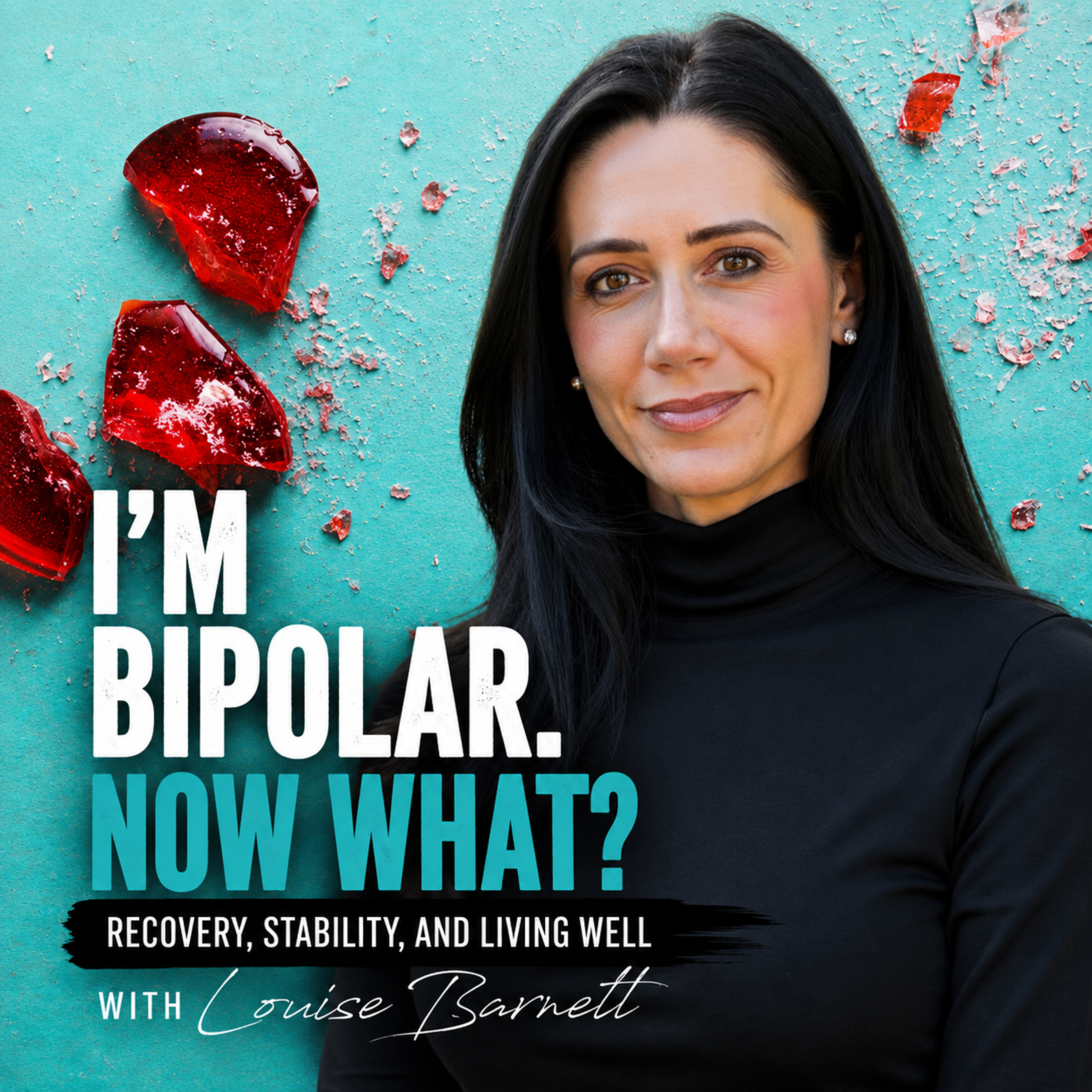
I'm Bipolar. Now What? Recovery, Stability, and Living Well.
Louise Barnett
0
I'm Bipolar. Now What? is a podcast for people living with bipolar disorder who are figuring out what comes next. Host Louise Barnett, a Jay Shetty Certified Life Coach and author of Tainted Love: A Bipolar Memoir, shares lived experience alongside practical tools for addiction, recovery, stability, and living well. Episodes cover honest conversations about bipolar disorder, medication, therapy, routines, relationships, sobriety, and building a life worth living. The show emphasizes that recovery, stability, and living well are possible.
Episoder
-
 133. The FOUR Types of Bipolar Disorder: What’s Actually the Difference? And Why it Matters 21.09.2026 38minThe FOUR Types of Bipolar Disorder: What's Actually the Difference?Bipolar I, Bipolar II, Cyclothymia… what do these diagnoses actually mean? And is Bipolar II really a milder form of Bipolar I? (Spoiler alert: NO!)In this episode of I'm Bipolar. Now What?, Louise breaks down the four diagnostic categories of bipolar disorder, explains the specific criteria for each, and shares her personal experience living with Bipolar I.In this episode, we cover:The four types of bipolar disorder and what distinguishes each diagnosis.The specific diagnostic criteria for mania, hypomania, and major depression.Can Bipolar II turn into Bipolar I?Hypomania vs. mania vs. psychosis: What's the difference, and can one escalate into another?Why Bipolar II is NOT simply a milder version of Bipolar I.What to do if you think you might be bipolar.How to support someone you love who may be experiencing symptoms of bipolar disorder—without trying to diagnose them yourself.Why understanding your own warning signs and mood patterns is so important.Whether you're newly diagnosed, have been living with bipolar disorder for years, or love someone who is, this episode is here to help you better understand bipolar disorder and feel less alone.Because the goal isn't to become terrified of every good mood or productive day. It's learning the difference between feeling good and becoming unwell.
 -
132. Bipolar: The Male Perspective & Marriage 14.09.2026 1t 1minWhat does bipolar disorder look like in men? And what role can a spouse play in helping someone build and protect stability?This conversation brings together two perspectives we need more of: men speaking openly about living with bipolar disorder, and honest conversations about what it means to love someone who lives with it.In this episode of I’m Bipolar. Now What?, I reconnect with Ken Walsh, five years after we first met through sharing our stories of mental health and recovery.Since then, Ken has made an incredible career transition. After 25 years in corporate leadership, he left that world to become a licensed mental health counselor. His perspective combines professional training with deeply personal lived experience: Ken lives with bipolar II disorder, is in long-term recovery from addiction, and has experienced profound loss, including losing both his mother and sister to suicide and his best friend to an overdose.Together, we have an honest conversation about what bipolar II actually looks like, particularly for men, and the vulnerability it can take to acknowledge you’re struggling and ask for help.We also dig into a side of bipolar that doesn’t get talked about nearly enough: the role of the spouse. What does healthy support actually look like? How can a partner recognize changes, encourage treatment, and help protect stability without becoming responsible for managing someone else’s bipolar disorder?In this episode, we talk about:Ken’s experience living with bipolar II disorderMen’s mental health and the stigma around vulnerabilityAddiction, sobriety, and long-term recoveryThe role spouses and partners can play in bipolar stabilitySupporting someone without becoming responsible for their treatmentLearning to recognize your loved one’s individual patternsCommunication, accountability, and trust within a relationshipGrief after losing loved ones to suicide and overdoseResilience and rebuilding a life after profound lossWhy vulnerability can be one of our most powerful tools for healingGet In Touch with Ken:KEN WALSH, LMHC: Licensed Mental Health Counselor| Recovery Advocate | SpeakerEmail: [email protected] | Phone: 508-330-2279Psychology Today: https://www.psychologytoday.com/us/therapists/ken-walsh-east-greenwich-ri/1740102LinkedIn: https://www.linkedin.com/in/ken-walsh-pmp-ri/?skipRedirect=trueGet in Touch with Louise:www.louisebarnett.com
-
131. I Couldn’t Manage My Bipolar Until I Got Sober 07.09.2026 36minFor years, I treated my bipolar disorder and my relationship with alcohol like two completely separate problems. It took me six years after my Bipolar I diagnosis to understand just how connected they were.In this episode, I’m talking about addiction, sobriety, and why getting sober didn’t cure my bipolar disorder, but gave me the clarity I needed to finally learn how to manage it.In this episode:Why I used alcohol to numb the lows, fuel the highs, and escape realityHow being highly functioning kept me from recognizing I had a problemWhy success and functioning don’t necessarily mean you’re okayWhy I continued drinking for six years after my Bipolar I diagnosisThe connection between my addiction and bipolar disorderWhat sobriety gave me that I had arguably never had before: clarityWhy getting sober did not cure my bipolar disorderThe eight-month depression I experienced three years into sobrietyWhy stability doesn’t mean being symptom-freeLearning to ask “What do I need?” instead of “What the fuck is wrong with me?”Why treating bipolar disorder requires looking at the whole personThe Six Pillars of Bipolar Stability that help me manage my disorder todaySobriety didn’t fix my mental health. It removed something that had been masking, amplifying, and complicating what was already happening inside my brain. And for me, that changed everything.🎧 I’m Bipolar. Now What?Real talk, real tools, real support for recovery, stability, and living well with bipolar disorder.📖 Tainted Love: A Bipolar Memoir publishes October 6.More: www.louisebarnett.com
-
130. The 1st Mood Tracking App for Bipolar Disorder: Steadyline with creator and founder Ravi Mishra 24.08.2026 41minMy guest today is Ravi Mishra.Ravi has been living with bipolar disorder for more than a decade. His journey began with childhood trauma and years of depression before he was diagnosed with bipolar disorder in 2015.A severe manic episode that required hospitalization became the first major turning point in his life. While rebuilding from that experience, he also faced the devastating loss of his mother.Years later, despite building a successful career as a software engineer, Ravi experienced another profound depressive episode in 2022 that fundamentally changed the way he viewed his illness.Ravi came to accept that while he couldn’t control having bipolar disorder, understanding it was something he could control.By consistently tracking his moods, sleep, medications, and daily patterns, he developed the self-awareness to recognize early warning signs and reduce the severity and impact of future episodes.That experience—and the frustration of trying to explain months of sleep, medication, and daily patterns in a short doctor’s appointment—inspired Ravi to create Steadyline, a mood-tracking app built specifically from his lived experience with bipolar disorder.The app helps people track what actually changes over time and turns those patterns into a clearer report they can use themselves or share with their clinician. It can also pull in sleep data through Apple Health, helping users see connections between sleep, mood, medication, and other daily patterns.In this episode, Ravi shares his story—from trauma, mania, hospitalization, grief, and depression to acceptance, self-awareness, and stability. We talk about recognizing early warning signs, understanding our individual patterns, and how tracking what is happening in our lives can give us valuable information about what may be happening in our brains.Because while we may not be able to control having bipolar disorder, the more we understand ourselves, the better equipped we can be to manage it.Learn more about Steadyline: steadylines.appInstagram: @steadyline.appiOS App: Steadyline Bipolar TrackerWebsite:https://steadyline.appiOS:https://apps.apple.com/us/app/steadyline-bipolar-tracker/id6763089476Android:https://play.google.com/store/apps/details?id=com.ravimishra.samapp
-
129. Six Pillars to Bipolar Stability 17.08.2026 49minWhen I was diagnosed with Bipolar I disorder, I thought medication was supposed to fix it.It changed my life—but it wasn’t the whole answer.In this episode of I’m Bipolar. Now What?, I’m breaking down the Six Pillars to Bipolar Stability that I’ve built over the last decade: medication, therapy + coaching, sobriety, lifestyle, emotional regulation, and nervous-system regulation.These aren’t six ways to cure bipolar disorder. They’re six ways I support my bipolar brain—and the framework I come back to whenever I start feeling “off.”We’re talking about why sleep matters so damn much, why sobriety is the hill I will die on, what emotional regulation actually looks like, why your nervous system belongs in the bipolar conversation, and how I use a simple Six-Pillar Audit to figure out where things might be getting shaky.Because recovery, for me, stopped being about trying to become someone who wasn’t bipolar.It became about learning how to live really fucking well as someone who is.Get the Six Pillars + my recommended resources:louisebarnett.comTainted Love: A Bipolar Memoir releases October 6, 2026.
-
128. Why a Diagnosis Doesn't Need to Change Your Story with Candace Schoner 10.08.2026 43minWhat happens when life asks you to reinvent yourself over and over again?In this episode, I sit down with Candace Schoner to talk about living with Parkinson's disease, ADHD, PTSD, and dyslexia—and why a diagnosis doesn't have to define the rest of your story.Candace shares the emotional reality of receiving a Parkinson's diagnosis, the daily strategies that help her manage a chronic condition, and how she learned to pivot instead of giving up. We also explore the role of therapy, movement, writing, and self-awareness in building a meaningful life, even when circumstances aren't what you expected.We discuss her new book, Recipes for a Happier Life, Apron Optional, her work founding Voices for Mental Health, and why embracing simplicity and authenticity can be some of the most powerful forms of resilience.Whether you're living with a chronic illness, navigating a mental health diagnosis, supporting someone you love, or simply facing an unexpected life transition, this conversation is a reminder that hope isn't about having an easy life—it's about choosing how you respond.In this episode, we discuss:Living with Parkinson's disease, ADHD, PTSD, and dyslexiaThe emotional impact of receiving a life-changing diagnosisFinding purpose after an unexpected life pivotTherapy, movement, and self-care as tools for resilienceWriting as a path to healingBuilding a nonprofit to advocate for mental healthWhy authentic living matters more than perfectionIf this episode resonates with you, please subscribe, leave a review, and share it with someone who could use a little hope today.GET IN TOUCH:https://voicesformentalhealth.org/
-
127. Getting Sober is Hard. Bipolar Disorder Makes it Harder. (Collaboration with Dr. Casey & Addiction Medicine Made Easy Podcast) 03.08.2026 42minYou can look put-together, build a big career, and still be drowning the moment the door closes. That tension sits at the heart of our conversation with Louise Barnett, host of I'm Bipolar. Now What? Podcast and author of Tainted Love: A Bipolar Memoir. Dr. Casey hosted Louise on his Podcast Addiction Medicine Made Easy, where she walks us through what it feels like when bipolar I disorder first shows up, why it can take years to get the right diagnosis, and how shame quietly pushes people toward secrecy, self-harm, and substance use.We talk honestly about addiction and bipolar disorder as a linked story, not two separate problems. Louise explains how alcohol and drugs played different roles across the mood spectrum: amplifying the invincible energy of mania, then numbing the crash of depression. She also shares what it meant to be “high functioning” in public while blacking out at night, and why appearance and performance can accidentally protect the illness from being seen.The most practical part of this conversation is what stability looks like now. Louise breaks down the pillars that keep her regulated, including medication, therapy, lifestyle, sobriety, nervous system regulation, and emotional regulation, plus the boundaries that protect her energy as a parent and a creator. She leaves us with a simple, powerful invitation: find your people and start telling the truth, one safe step at a time.Subscribe for more conversations at the intersection of mental health and addiction recovery, and if this resonates, share it with a friend and leave a rating or review.To learn more about Louise's work: https://www.louisebarnett.com/To contact Dr. Grover: [email protected] learn more about the podcast: https://www.addictionmedicinemadeeasy.com/
-
126. There's a Reason Your Meds Aren't Working: Pharmacogenetic Testing with Kristen Ruth Davis 27.07.2026 1t 1minWhat if the reason your psychiatric medications haven't worked isn't that you're "too complicated"... but because they're the wrong medications for your genetics?In this episode, Louise sits down with mental health advocate, speech-language pathologist, Founder of the I’m Not Crazy project, and author Kristen Ruth Davis, whose life changed after pharmacogenetic (PGx) testing finally matched her with medications her brain could actually use.Despite growing up in a loving family with two physician parents, attending Duke University, and doing everything "right," Kristen spent years battling treatment-resistant depression, multiple psychiatric hospitalizations, involuntary holds, self-harm, electroconvulsive therapy (ECT), and countless medication trials that left her believing there was something fundamentally wrong with her.Then genetic testing changed everything.Together, Louise and Kristen unpack why some antidepressants fail, why treatment-resistant depression deserves a deeper conversation, and why pharmacogenetic testing should be a standard part of psychiatric care—not a last resort. They also discuss the dangers of trial-and-error prescribing, the stigma surrounding mental illness, the importance of trusting patients, and why praise and validation can become powerful tools in recovery.The conversation ends with a thought-provoking question: What does "crazy" actually mean?Whether you're living with depression, bipolar disorder, supporting someone you love, or simply curious about the future of personalized mental health care, this episode offers hope—and a reminder that sometimes the problem isn't the person. It's the treatment.In this episode, we discuss:Treatment-resistant depressionPharmacogenetic (PGx) testing and personalized psychiatryWhy SSRIs and SNRIs don't work for everyonePsychiatric hospitalization and involuntary holdsSelf-harm and suicidal ideationElectroconvulsive therapy (ECT)Medication stigma and shameThe importance of patient advocacyWhy "crazy" deserves a new definitionIf you or someone you know is struggling with depression or suicidal thoughts, please reach out to a trusted mental health professional or local crisis services. You don't have to do this alone.Learn more about Kristen and the I'm Not Crazy Project:Website: https://imnotcrazyproject.orgInstagram: @imnotcrazy.projectFacebook: /imnotcrazyprojectLinkedIn: Kristen Ruth DavisTikTok: @kristenruthwrites
-
125. The Most Dangerous Lie About Mental Health with JeNoah Lee 13.07.2026 59minIn this episode of Unmasking Sobriety & Mental Health, Louise sits down with JeNoah Lee — a 20-year-old entrepreneur, fashion creator, and mental health advocate whose life was shaped by severe racial bullying at just 10 years old.What began as emotional trauma and suicidal ideation became the catalyst for something bigger: healing, therapy, self-discovery, and ultimately a mission to create change.JeNoah opens up about:The invisible damage of racial bullyingWanting to change who he was to fit inThe role therapy played in saving his lifeHow fashion became his outlet for healingWhy mental health warning signs are often missedWhat parents need to know when their child is strugglingThis conversation is raw, powerful, and necessary — especially for parents, young people, and anyone who has ever felt like they didn’t belong.Because sometimes survival is just the beginning.Connect with JeNoah:Instagram: @whoisjenoahleeLinkedIn: JeNoah LeeWebsite: whoisjenoahlee.com
-
124. This Will Change How You Think About Recovery with Jeanne Foot 29.06.2026 53minWhat if recovery isn’t about addiction at all… but about the human experience?In this episode of Unmasking Sobriety & Mental Health, I sit down with Jeanne Foot, founder of The Recovery Concierge, to challenge everything we think we know about healing.Jeanne shares how her own journey through trauma, suicidal ideation, and traditional recovery led her to discover a deeper truth: abstinence isn’t the goal—emotional sobriety is.Together, we unpack:Why willpower alone rarely creates lasting changeHow trauma lives in the nervous systemWhy healing must go beyond the mind and into the bodyThe role of attachment wounds in addiction, relationships, and identityWhat it actually means to redesign your life in recoveryThis conversation is for anyone who has ever felt stuck, masked, or like the outside looked “fine” while the inside was falling apart.Because recovery isn’t just for addiction.It’s for all of us.More from Jeanne:https://therecoveryconcierge.com/https://www.read.ai/pp - FREE RESOURCESInstagram: https://www.instagram.com/therecovery_concierge/LinkedIn: https://www.linkedin.com/in/jeanne-foot-the-recovery-concierge/Facebook: https://www.facebook.com/therecoveryconcierge/ Jeanne’s Podcast, Naturally High:On Apple: https://podcasts.apple.com/us/podcast/naturally-high/id1585263254On Spotify: https://open.spotify.com/show/7LWUXpejsTxwYvzXOPHshA
-
123. When the Diagnosis is Wrong with Ginger Smith 15.06.2026 46minIn this powerful episode, Louise sits down with Ginger Smith, author of Dementia Denied, to explore a story that challenges everything we think we know about mental health, diagnosis, and recovery.A retired speech-language pathologist who worked alongside neurologists at Stanford and UCSF, Ginger spent her professional life helping others understand the brain. But her most profound lesson came when her own mind was called into question.Diagnosed with dementia and placed on hospice, Ginger was never expected to recover. But she did.In this conversation, Ginger opens up about surviving an abusive childhood, living with bipolar disorder and complex PTSD, and finding her way through addiction to 35 years of sobriety. She shares what it was like to be misdiagnosed, to lose everything—including relationships and stability—and to slowly rebuild a life grounded in truth.Together, Louise and Ginger explore trauma, resilience, neuroplasticity, and the possibility of healing—even when the odds say otherwise.This is a conversation about questioning assumptions, reclaiming your story, and discovering what’s still possible when everything seems lost.Dementia Denied: https://www.amazon.com/DEMENTIA-DENIED-Surviving-Diagnosis-Reclaiming-ebook/dp/B0F2WGRV6CFacebook: https://www.facebook.com/trek1937 IG: @Gingersmith104
-
122. Parental Alienation, Narcissistic Abuse, and the Path to Sobriety with Alicia 01.06.2026 54minIs it possible that anyone else is living this insane double life? 💔For years, Alicia was living a reality that many women secretly recognize: A Master’s degree and a career on the outside, but a "war zone" of a divorce on the inside.To cope with the narcissistic abuse, financial intimidation, and the agony of parental alienation, Alicia turned to wine as a sedative. It wasn’t a choice; it was survival. But as the "mommy wine culture" took hold, she found herself losing the very things she was fighting for—including her kids and her sense of self.Today, Alicia is 6 years sober, a She Recovers® Professional, and a light for women trapped in the same cycle. In our latest episode, she shares: ✨ Surviving high-conflict divorce and legal abuse. ✨ The truth about "drinking AT" your pain. ✨ How she rebuilt her life from rock bottom to a successful coaching practice.🎧 Tap the link in bio to hear Alicia’s incredible story of reclamation.Parental Alienation, Narcissistic Abuse, Substance Use Disorder, She Recovers, High-Conflict Divorce, Mommy Wine Culture, Recovery Coaching, Financial Abuse.
-
121. The High-Achiever’s Mask: Radical Awareness with Ellen Frazier 18.05.2026 1tWhat happens when you’re #1 on the leaderboard but #0 in your own heart?Ellen Frazier spent over 20 years perfecting the role of the "Powerhouse." As a top-tier mortgage professional and entrepreneur, she knew exactly how to perform, how to excel, and how to win. But for decades, that success was fueled by a "forced confidence" and a sophisticated relationship with alcohol that allowed her to stay in the race while ignoring her own soul.In this episode, the founder of Booze Free Babes pulls the mask off the high-achieving lifestyle. We explore the dangerous intersection of "Success" and "Survival," and how Ellen finally chose radical self-awareness over social performance.Inside the conversation:The "Star" Program: How being programmed for excellence at a young age created a lifelong need to "excel" even in rehab.Sophisticated Lies: The specific ways high-performing women use status, diet, and busy-ness to deny their addiction.The Gender Gap in Power: Moving away from being "directed" by men in recovery to finding your own agency within a female sisterhood.Self-Parenting: The moment Ellen stopped looking for external validation and started believing she was worthy of her own protection.The ROI of Sobriety: Why quitting drinking was the ultimate business move for her clarity, her relationships, and her bank account.This is a deep dive into who you actually are when you stop performing and start living.Connect with Ellen Frazier:Website: EllenFrazier.comInstagram: @boozefreebabeschsFacebook: ecfrazierLinkedIn: ellen-frazierTikTok: @theellenfrazier
-
120. Manic About Healing: Rewriting the Bipolar Narrative with Ana 04.05.2026 56min"I am not going to end up like this."In 2006, Ana sat in a psychiatric ward, clouded by the haze of medication and the weight of a Bipolar 1 diagnosis. As she looked at the walls around her, she didn't just see a hospital; she saw her mother’s life—decades of suicidal ideation, depression, and a future dictated by a "permanent" chemical imbalance.In that moment, Ana made a choice that defied medical convention: She refused to accept that her diagnosis was a life sentence.In this episode, we sit down with Ana, a Bipolar Healing Coach who has moved from the trauma of 10 hospitalizations to a life of stability and self-mastery. We dive deep into the parts of bipolar disorder people rarely talk about: the hallucinations, the grandiosity, and the terrifying reality of setting a bedroom on fire during a manic episode.The Root Cause: Why bipolar is often a symptom of a severely dysregulated nervous system and unresolved childhood trauma.The Myth of the "Cure": What Ana tried (energy healing, homeopathy, yoga) and why she eventually looked toward neuroscience and polyvagal theory.The Power of Partnership: How finding a secure attachment helped her stabilize and heal her abandonment wounds.The "Nervous System" Shift: How understanding neuroplasticity allowed her to catch mania and depression before they took over.Medication & Tapering: A candid look at her experience with Lithium and the journey of training the brain to stay on the tracks.Ana is now dismantling the belief that you can only "manage" bipolar. She is living proof that through somatic experiencing and shadow work, you can rebuild your relationship with yourself and find true peace.Facebook: Bipolar Healing Coach AnaInstagram: @bipolar.healing.coach"Healing isn't just about fixing what's broken; it's about grieving the stories we were told so we can finally write our own."
-
119. Anonymous' Story: Two Ways Out: Breaking the Silence Around Suicide 27.04.2026 1t 1minShe shares her lived experience with PTSD, dissociation, and suicidal thinking — and the moment she realized there were only two ways out.Today’s guest is the founder of My Truth Memoir Writing Services, where she helps others tell their stories with honesty, compassion, and courage.But her work didn’t begin as a profession. It began as survival.After a tragic loss in childhood and years of silently carrying trauma, she was later diagnosed with PTSD and panic disorder — conditions that shaped her inner world while she continued to build a life on the outside. For more than twenty years, she worked as a special education teacher, raised three children, and did what so many people do: she kept going.Until she couldn’t anymore.In this deeply personal conversation, she shares the lived reality of dissociation, panic, generational trauma, and the moment she realized she believed there were only two ways out.Her memoir, Two Ways Out: A Memoir of Then and Now, was written to break the silence around suicide and normalize the conversations so many people are afraid to have.We talk about what it means to lose yourself — and how you begin to find your way back.This episode is about survival. About truth. And about choosing to stay.If you’ve ever struggled in silence, or loved someone who has, this conversation will remind you that you are not alone.
-
118. A Parent Took My 12-Year-Old to a Dive Bar—What Would You Do? 20.04.2026 18minMy 12-year-old daughter ended up at a dive bar—and I didn’t know until it was too late.In this episode, I share what happened, how I handled it, and the bigger questions it raises about parenting, trust, and letting go.No judgment. No perfect answers.Just the reality of navigating moments that don’t come with a playbook.
-
117. Palliative Care: When the Outcome is Decided 13.04.2026 55minPalliative Care: When the Outcome Is Already DecidedWhat happens when healing is no longer the goal?In this episode, I sit down with Anne, a licensed psychotherapist and palliative care social worker, to explore the emotional and psychological realities of end-of-life care—where addiction, mental health, and dignity intersect in ways we rarely talk about.Through powerful real-life stories, we unpack what it means to support someone when the outcome is already known… when sobriety isn’t always possible… and when the focus shifts from fighting to acceptance.This conversation challenges everything we think we know about recovery, control, and what it means to truly care for someone.If you’ve ever struggled with letting go, with needing to “fix,” or with redefining what healing looks like—this episode will stay with you.Get in Touch with Anne:TikTok: AnnefrontlmftWebsite: www.annefront.comSubstack: Annefrontlmft.substack.com
-
116. The Other Side of Bipolar: The war inside a “stable” mind 30.03.2026 23minToday, on World Bipolar Awareness Day, Tainted Love: A Bipoplar Memoir has a cover.It captures something I don’t even fully have words for yet.Presale is live. 🤍100% of presale revenue is being donated to the Depression and Bipolar Support Alliance (DBSA)—and I’m personally matching it.Link to Amazonwww.louisebarnett.com March 30 is International Bipolar Awareness Day, a day dedicated to increasing understanding of a condition that is often misunderstood.When people think of bipolar disorder, they tend to imagine dramatic extremes—manic highs or devastating lows. But there is another side that people rarely talk about.In this episode, Louise reads a powerful excerpt from her memoir about the quieter, more complicated reality of living with bipolar while medicated and seemingly stable. Three years into treatment, standing beside the steadiest partner she has ever known, she finds herself confronting a difficult truth: sometimes the hardest battle isn’t surviving the storm—it’s learning how to live in the calm without destroying it.This episode explores the internal war many people with bipolar disorder experience, even when everything on the outside appears steady.
-
115. Terry's Story: Breaking the Groundhog Day Loop 16.03.2026 49minBreaking the Groundhog Day Loop with Terry | Walking SoberWhat if recovery begins with something as simple as showing up for yourself?In this episode, I’m joined by Terry, the founder of Walking Sober, a growing community built around the idea that healing doesn’t have to be complicated—it can start with putting one foot in front of the other.After seven years of sobriety, Terry began hosting Sunday morning walks along the downtown hike-and-bike trail in Austin, Texas. There’s no pressure, no fixing, and no lectures—just movement, conversation, and the quiet power of being alongside others who are choosing an alcohol-free life.Our conversation explores how drinking can quietly become a habit loop we barely notice—until one day we do. Terry shares how journaling helped him begin to see the patterns in his own life, the moment awareness cracked open, and why the movie Groundhog Day became a powerful metaphor for the cycle so many of us find ourselves living.We talk about the rebellion that can come with early sobriety, the influence of voices like Holly Whitaker and Laura McKowen, and the tipping point when you realize: whatever those people have in their lives, I want some of that too.Terry also reflects on childhood experiences, grief, therapy, and why recovery is often about much more than alcohol itself. Over time, he began to build a recovery practice that worked for him—one rooted in curiosity, movement, and learning how to get back up when life knocks you down.Because, as Terry says, the goal isn’t perfection.It’s practice.And one day, almost without noticing, you wake up and realize you’re free.In this episode we talk about:How habits form without our awarenessThe moment you start to see the pain in your own patternsWhy Groundhog Day is such a powerful recovery metaphorFinding inspiration from people a few steps aheadCreating space in your life for the good things to growWhy recovery is about more than just alcoholWhat “Keep Walking” really meansLace up your shoes and come walk with us.Get in touch with Terry: Website: WalkingSober.org YouTube: https://www.youtube.com/@walkingsoberFacebook: facebook.com/walkingsoberclub
-
114. The Day I Woke Up Behind Bars 21.02.2026 28minMarch, 2015.Days after standing on the edge of an overpass, I woke up in a psychiatric hospital with no memory of how I got there — and no idea my life was about to change forever.In this episode, I share the story of my psychiatric hospitalization, the memories that resurfaced while I was there, and the moment a doctor finally gave a name to the chaos I had lived with for most of my life: Bipolar I disorder.This is the story of what it feels like to break — and what it feels like to finally be seen.If you’ve ever wondered whether you’re broken or why your mind feels like it’s working against you, this episode is for you.You are not alone. And you are not beyond help.
Lignende podkaster


Populær i
Denne podkasten finnes også i podkast-listene til disse landene.
