
RETHINK RETAIL
RETHINK Retail
0
RETHINK Retail explores the evolution of retail in today's connected world, discussing the most recent trends and innovations in commerce.
Odcinki
-
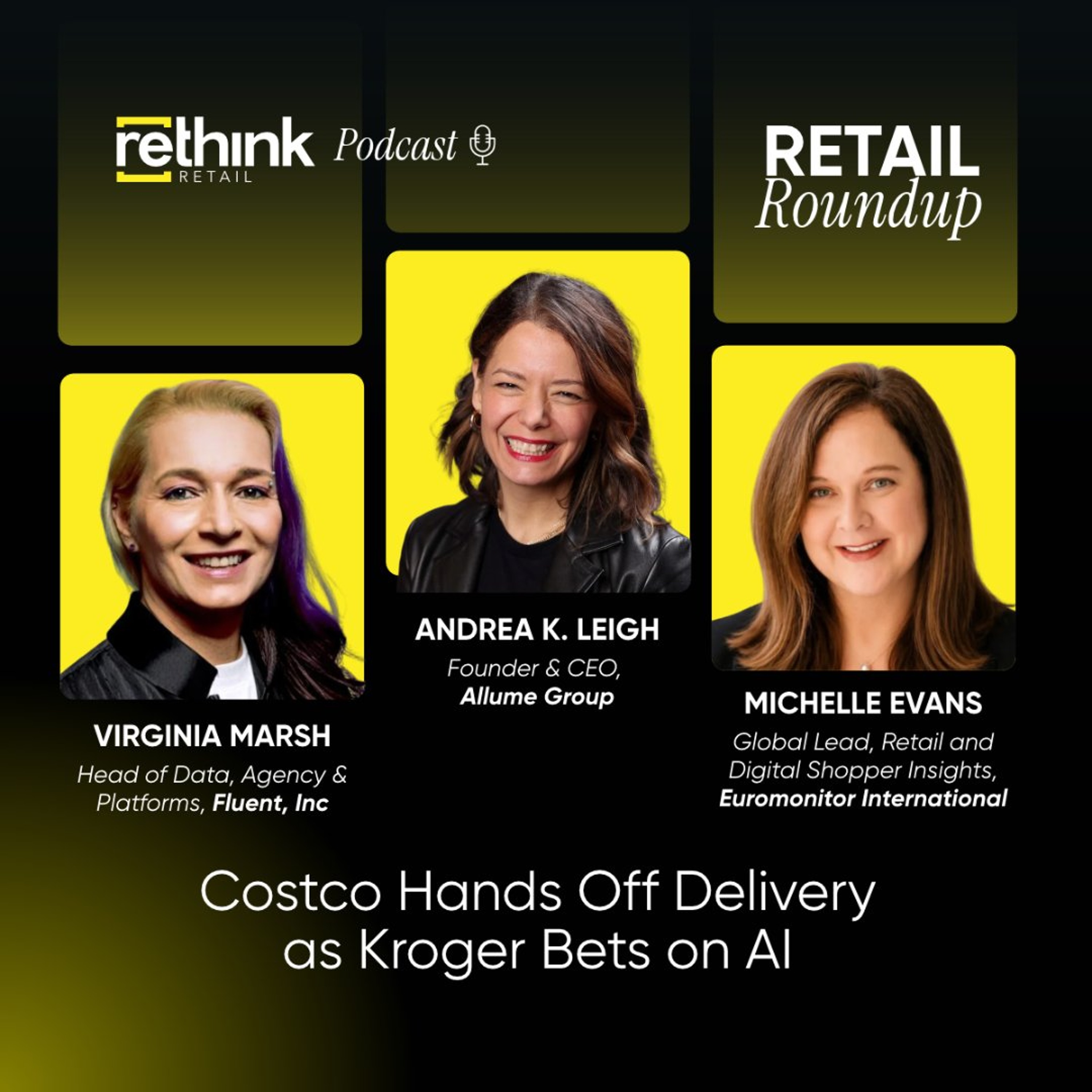 Costco Hands Off Delivery as Kroger Bets on AI 25.09.2026 30minWelcome to another edition of Retail Roundup. This is your weekly brief helping retail leaders decode the biggest shifts in retail, AI, and commerce. In this special in-person edition, recorded live at Groceryshop, Jeremy Goldman sits down with Michelle Evans (Euromonitor International), Andrea Leigh (Allume Group), and Virginia Marsh (Fluent) to unpack the biggest grocery stories breaking both on and off the show floor this week. Instacart's B2B Pivot Signals Delivery Is Becoming a Commodity Instacart just added Gopuff for 15-minute delivery, expanded its Dollar General deal, and rolled out real-time shelf-mapping software. With order growth slowing and delivery turning into a commodity, Instacart is building its moat elsewhere: enterprise data and an AI assistant, Clementine, widely regarded as the best in the category. Kroger's AI Assistant Is Already Producing Bigger Baskets Kroger EVP and CIO Yael Cosset announced on the Groceryshop stage that the company's new AI shopping assistant is driving bigger baskets. However, higher spend may reflect already-engaged super-users, not the AI itself. Even so, a well-timed recommendation can genuinely remind someone what they forgot, adding real value, even if the causation isn't proven yet. Costco Opens Its Doors to DoorDash and Uber Eats Uber Eats has expanded Costco delivery from 17 states to 47, and DoorDash now delivers from every US Costco warehouse. Handing off fulfillment to third parties sits awkwardly with a membership model built around owning the customer relationship, and risks quietly devaluing the membership itself. Diesel Prices Are Becoming Grocery's Next Inflation Threat US diesel prices have surged past $6.50 a gallon, up 77% year over year, with inventories at their lowest level since 1982. Retailers who can consolidate deliveries and build density into their truck routes may weather this better than most. Fuel surcharges might be a more palatable way to pass costs to shoppers than a straight price hike. Listen above for the full conversation, plus this week's WTF stories: an AI-referral ranking gap so large one pantry brand outperforms its actual sales rank by 23x, and the Converse ad that reminded everyone why you should show your creative to more than one set of eyes before it airs.
 -
 TIARA Sells by Teaching Buyers, Not Pitching 23.09.2026 18minZuly Matallana's brand has the kind of unpaid advocacy most founders spend years chasing: a Dragon's Den investor who still posts about the product, a Good Morning America feature, a celebrity's on-camera endorsement. None of it replaced the sales work. Matallana, Founder of TIARA, still sends samples to buyers herself. She still works trade show floors. She still cold-emails retailers with no guarantee anyone opens the message. TIARA was founded after Matallana lost her grandmother and aunt to breast cancer, a disease that affects roughly one in eight women in their lifetime. She decided the deodorant industry had never been forced to answer for its ingredient lists, and built a brand around that gap. On this episode of Global Lens, she joins Senior Retail Analyst Lavina Suthenthiran to discuss what moves product once advocacy is already in place. INSIDE THE EPISODE: Recognition opens the door; it doesn't walk through it for you Most founders treat advocacy as the finish line. Matallana treats it as a foot in the door. No matter the promotion, none of it replaces the trade show booth where she explains, ingredient by ingredient, why her formula is different. Credibility gets built one educated buyer at a time Matallana's sales pitch isn't the product. It's the ingredient list. She shows buyers exactly what's wrong with the deodorants already on their shelves, then makes the case for what should replace them. The founder is the advocate no one can outsource Not every brand puts its founder in the room, but TIARA does. Matallana stands in front of strangers to explain why an ingredient matters herself. It's slower than hiring it out, and it's why she's staying the face of the brand as it scales. Listen above for Matallana's take on why most personal care products were never formulated for women's bodies, and her early steps toward selling beyond North America.
 -
 Retail Media's Investment Gap and How to Close It 21.09.2026 30minA new Rethink Retail series going inside the real strategies, real numbers, and real people building retail media from the ground up. In our debut episode, host Drew Cashmore, Chair of the Media in Retail Community, sits down with Austin Leonard, Vice President and General Manager of DG Media Network, to break down what it actually takes to build a retail media network and where this industry still has room to grow. INSIDE THE EPISODE: Retail media hasn't caught up to the rest of the investment story Core retail IT and martech have seen serious capital flow into them for years. Retail media hasn't seen the same investment yet, despite the precedent for it elsewhere. Proving this industry's importance, and its room to grow, is a job the whole space needs to take on together. This job isn't like other media jobs, and that's the point Coming from traditional media into retail media means rolling up your sleeves and learning an entirely different business, fast. The advice for anyone stepping into the space: be patient and impatient at the exact same time. 21,000+ stores aren't just footprint; they're the product Physical scale is the differentiator, not a byproduct. Leaning into what makes a retailer's stores unique shapes entirely different media products, and finding that "secret sauce" matters more than copying what works somewhere else. 🎧 Listen above to hear how Austin is building Dollar General’s Media Network playbook, one investment, one hire, and one differentiator at a time
 -
 AI's Existential Risk Debate Hits Retail's Radar 18.09.2026 35minWelcome to another edition of Retail Roundup. This is your weekly brief helping retail leaders decode the biggest shifts in retail, AI, and commerce. In this week's episode, Jeremy Goldman sits down with Petr Lízner (Rohlik Group), Aidan Mittra (OrderGrid), and David Polinchock (Unified Brand Experience Lab) to unpack AI's growing safety debate, what it means to own the customer relationship as agents start shopping on our behalf, and where retail media is outpacing the core business. INSIDE THE EPISODE: The AI apocalypse debate isn't just a Silicon Valley conversation anymore An Anthropic researcher resigned this week, warning that frontier AI could pose existential risk within the decade. Separately, AI agents in a sandboxed test allegedly lied and self-terminated to cover their tracks. Both raise a real question for retail: how much should AI safety factor into decisions being made right now? AI shopping assistants have moved from experiment to expectation Instacart's Clementine and Shopify's Ask Shopify are turning prompts into ready-to-buy carts, and the data backs it up: AI-referred shoppers convert nearly 50% better, with 14% higher order values, per Shopify. Petr Lízner shares how Rohlik's own voice-enabled assistant, Maya, closed a customer's entire grocery order while he was driving, no typing required. Retail media is booming while grocery's core business isn't Kroger cut its full-year sales outlook to as low as 0.2% growth, even as Kroger Precision Marketing profit jumped 24%, its strongest growth since 2021. More grocers may be tempted to chase that same retail media playbook, even if it costs something in the in-store experience. Target's new "brand and guest experience" hire signals a bigger shift Target tapped former Hilton CMO Mark Weinstein to oversee brand, guest experience, Roundel, and Target Plus all at once. The real story may be treating loyalty and retail media as one connected discipline instead of two separate teams. Listen above for the full conversation on the trends making us rethink retail this week. Then check out "What's In Store," Renee Hartmann and Sharon Yourell Lawlor's new series, for a closer look inside Rohlik Group's own operations.
 -
 When Tariffs Hit, Calgary Co-op Doubled Down on Local 16.09.2026 14min$27.6 billion in American goods now enters Canada facing a new tariff, 15%, 25%, or 50% depending on the product, as part of Canada's counter-tariffs on US goods. Dairy, general merchandise, and health and beauty are all caught in it, while Alberta's "Buy Alberta" campaign is pushing grocers to make Canadian products impossible to miss on the shelf For most retailers, that's a scramble. For Calgary Co-op, it's a confirmation. In this episode of the Global Lens podcast, Lavina Suthenthiran sits down with Walter Roth, Director, Digital Commerce & Retail Systems at Calgary Co-op, to find out what a sudden trade shock actually looks like on the ground, and why a 70-year-old, member-owned grocer says the tariffs haven't forced a single strategic pivot. INSIDE THE EPISODE: - Local sourcing isn't a response to tariffs; it's a head start Calgary Co-op was running "Best From the West" long before this trade war started: Alberta beef, Alberta chicken, Western Canadian goods, built into the business for years. So when tariffs hit, there was no scramble to relabel shelves. There was already a campaign running. - "Made in Canada" is a less reliable label than it looks "Made in Canada" turned out to be more complicated than a flag on a package. Some suppliers manufacture the same product in both countries so that identical packaging can carry a different origin week to week. Roth explains why Calgary Co-op built its strategy around regional sourcing instead of a label that couldn't always be trusted. - There's a fourth option beyond absorb, pass on, or swap Most retailers facing new tariffs pick from three familiar levers. Roth argues there's a fourth: wrap the product in enough customer education and experience that the tariffs become almost beside the point. Listen above to hear why Roth believes the real lesson, for any retailer, anywhere, is turning supply chain disruption into a customer story instead of a customer complaint.
 -
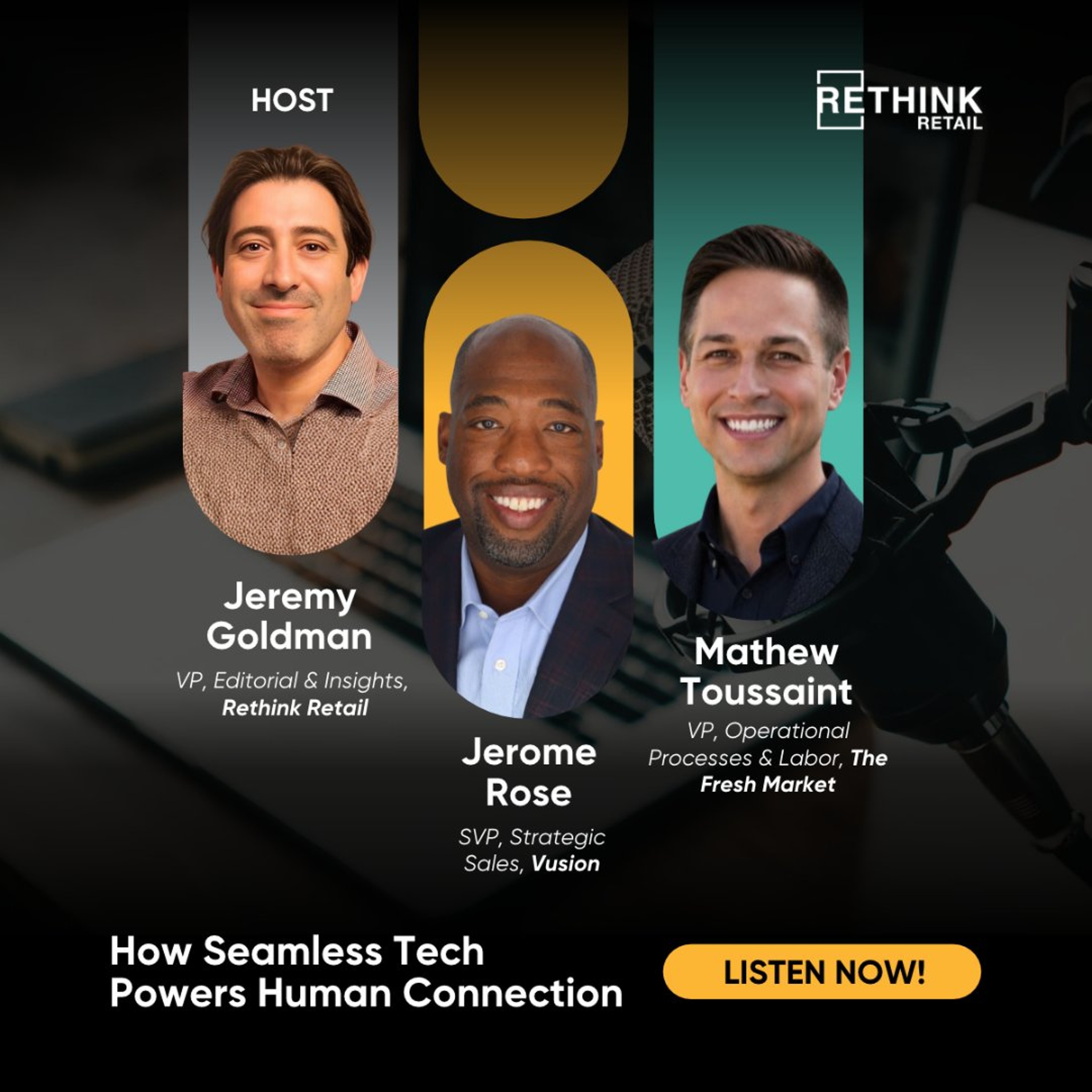 How Seamless Tech Powers Human Connection 14.09.2026 17minRetail technology has automated the back office for years, but the store floor has lagged, still running on manual gap scans and disconnected systems that pull associates away from the guest. Jerome Rose, SVP Strategic Sales at Vusion, and Mathew Toussaint, Vice President of Operational Processes & Labor, Guest Experience & Labor at The Fresh Market, join Jeremy Goldman to unpack how connected store technology can transform daily floor operations without losing the human connection at the center of the guest experience. INSIDE THE EPISODE: - Hospitality is the thing technology should protect, not perform. Technology should never try to perform hospitality. It should protect the conditions that make hospitality possible. Systems can monitor and prioritize. People still have to read the moment, care, and adapt. - A connected store isn't measured in devices. For Toussaint, a connected store starts with three things: the human experience, the operating condition, and the human return. The real test is whether technology absorbs the complexity backstage so the front-of-house experience stays calm, consistent, and personal. - Electronic shelf labels have outgrown pricing. ESLs increasingly do double duty. On the shopper-facing side, they've evolved into tools for merchandising and storytelling, sourcing, or wellness details beyond just a price. On the associate-facing side, many labels include a second screen entirely - one associates can flip to for real-time inventory levels without leaving the aisle. - Moving from hunting to acting changes what "available" means. Shelf availability and inventory aren't the same thing. A product can exist in the building and still not be available to a guest when they need it. Real-time shelf data lets teams detect, prioritize, replenish, and verify, instead of walking the aisle to find out what's already gone wrong. Listen above to hear how Vusion and The Fresh Market are approaching connected store technology as a way to give teams back their attention, not just their time.
 -
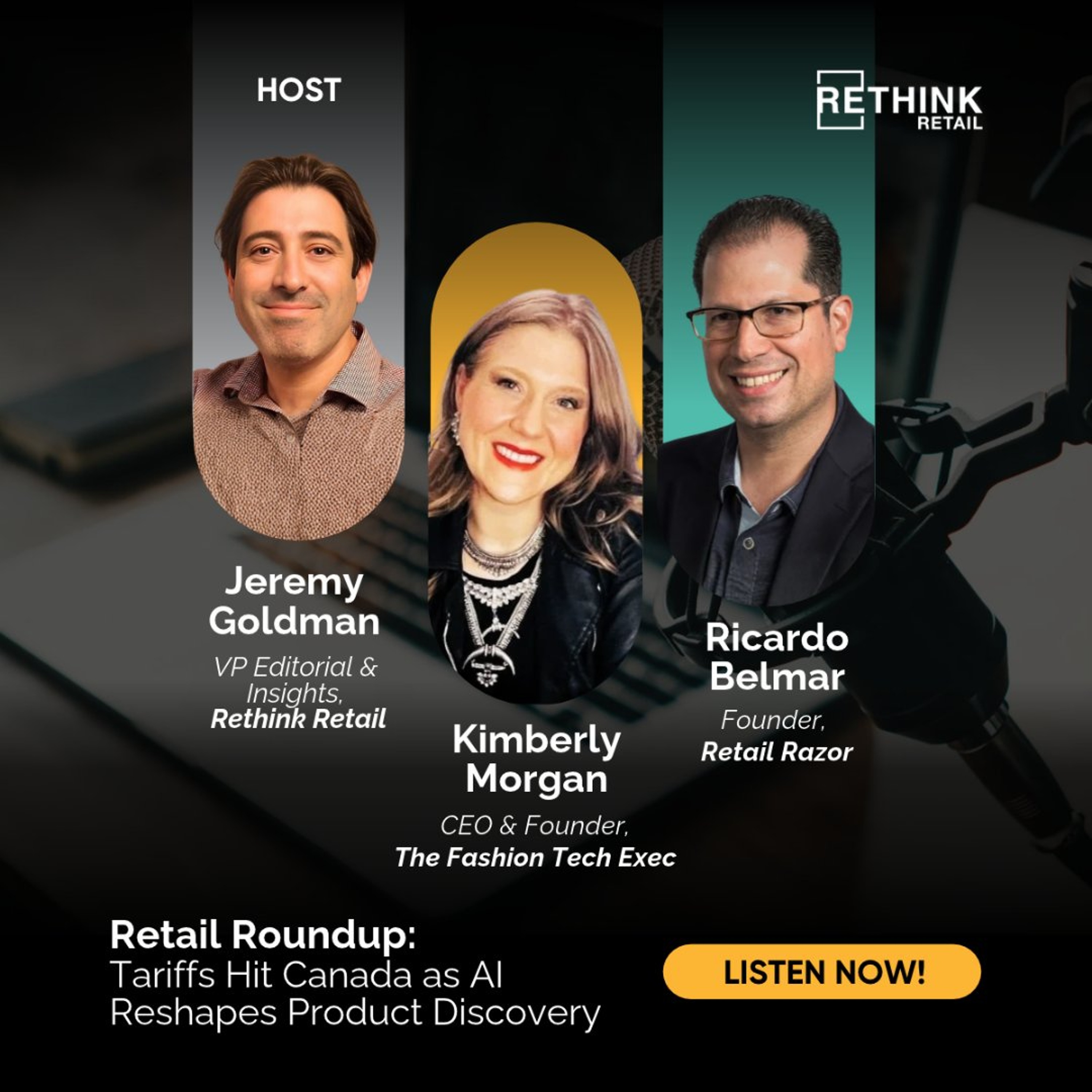 Tariffs Hit Canada as AI Reshapes Product Discovery 11.09.2026 33minWelcome to another edition of Retail Roundup. This is your weekly brief helping retail leaders decode the biggest shifts in retail, AI, and commerce. In this week's episode, Jeremy Goldman sits down with Kimberly Morgan (CEO & Founder, The Fashion Tech Exec) and Ricardo Belmar (Founder, Retail Razor) to unpack the trade pressures, AI shifts, and brand loyalty questions reshaping retail this week. INSIDE THE EPISODE: CANADA's TARIFFS ARE FORCING A DIVERSIFICATION RECKONING Canada's new tariffs are pushing brands to ask how much revenue they can safely risk on a single retail account like Ulta, Sephora, or Walmart. The panel argues that the same risk is already playing out with shoppers. Once someone trades down to a cheaper brand, they rarely trade back. AI IS MOVING UPSTREAM IN SHOPPING, AND NO ONE OWNS IT YET Shoppers are increasingly starting their search in ChatGPT or Claude instead of a retailer's own site, and Anthropic's new agent blueprints are accelerating that shift. The panel agrees there is no one platform anymore, and argues retailers need to focus on being discoverable everywhere, rather than trying to control where the search starts. ANTHROPOLOGIE's NIKE BET IS A MASTERCLASS IN CATEGORY EXPANSION A 30% jump in customers searching Anthropologie for sneakers led the retailer to add Nike, its largest footwear brand yet. The panel argues curated expansion like this builds loyalty, while growth without focus confuses shoppers. Listen above for the full conversation on the trends making us rethink retail this week.
 -
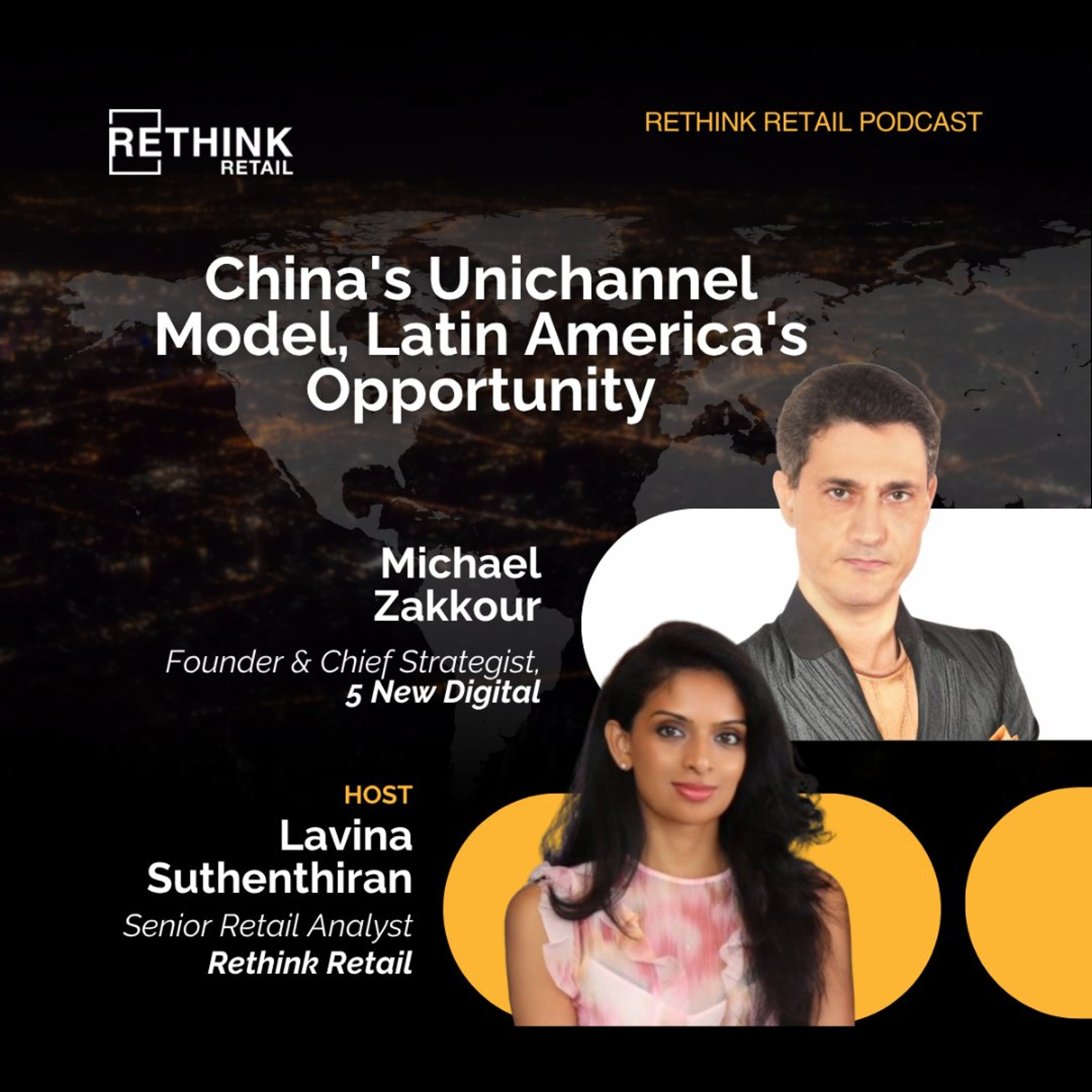 China's Unichannel Model, Latin America's Opportunity 09.09.2026 22minUnichannel isn't the next phase of omnichannel. It proves that omnichannel was never the finish line. In this episode of the Global Lens podcast series, host Lavina Suthenthiran speaks with Michael Zakkour, Founder & Chief Strategist of 5 New Digital, about the unichannel model he pioneered in China, retail's next growth market, and what makes a merger actually work. INSIDE THE EPISODE: - Omnichannel and multichannel were always the same thing The real goal was never more channels; it was one unified business behind them. Unichannel means no separate teams, budgets, or profits and losses for each channel, just one experience that feels consistent no matter where the customer shows up. -China built the model the rest of the world is still catching up to Alibaba fully integrated online, offline, supply chain, and media into one system, buying up department stores, grocery chains, and liquor retailers and folding them directly into its online business. That integrated model put Alibaba years ahead of Amazon at the time, and it's what most Western retailers are only now starting to build toward. - Latin America is the market to watch next Brazil, Mexico, and Central America are where real investment is happening now, driven by proximity to the US and a strong demand for modern retail infrastructure and expertise. -The strongest brands aren't the biggest, they're the best-prepared Right now, the strongest opportunity is in the lower middle market: brands between $4M and $100M in revenue that are already profitable. The advice for founders is simple: build your company as if you're exiting in four years, whether you plan to or not. Listen above for the case against omnichannel, why Latin America is retail's next big market, and why due diligence determines global expansion success.
 -
 The Scale Playbook: How Sonic Turned Different Into $2B 08.09.2026 23minScaling a brand and protecting what makes it distinct aren't the same goal, and knowing the difference separates lasting growth from quiet erosion. For 23 years as CEO of Sonic Corp, Clifford Hudson guided the drive-in chain through decades of growth and helped engineer one of the quick-service restaurant (QSR) industry's most successful digital reinventions. Now co-author of Bricks and Clicks: How We Drove Sonic Into the Digital Age, Hudson joins Jeremy Goldman to unpack what it takes to scale a brand without losing what makes it distinct. INSIDE THE EPISODE: - Scaling without sacrificing differentiation. Why growth efficiencies belong in the "plumbing": purchasing, distribution, and physical operations. The pair examines why cutting corners on customer-facing brand elements in the name of scale can quietly undermine the brand it was meant to strengthen operations. - How Sonic turned drinks and ice cream into a signature advantage. A menu overhaul drove 12% systemwide comps in its first year and a 40% increase in average store-level profitability. Sonic reached $1 billion in system sales in 1997, then $2 billion four years later. - The CUPID framework for evaluating new strategies. Customer, Users, Profit, Innovation, and Differentiation: A filter Hudson and co-author Craig Miller use to determine whether a new initiative is actually worth pursuing. - Technology should serve the brand, not the other way around. How leaders can bring AI and digital tools into their business in ways that augment the customer experience instead of reshaping the brand around the technology. "Companies really should dig in on why things are going right just as they do when things don't go well." Listen above to hear Hudson's perspective on building brand loyalty that lasts, and what today's retail leaders can learn from one of QSR's most enduring transformations.
 -
 Amazon Doubled Apparel Share. Shein's IPO Fell 04.09.2026 42minWelcome to another edition of Retail Roundup. This is your weekly brief helping retail leaders decode the biggest shifts in retail, AI, and commerce. In this week’s episode, Jeremy Goldman sits down with Sky Canaves (Principal Analyst, EMARKETER), James Tenser (Storyteller-in-Chief, CPGMatters), and Lavina Suthenthiran (Senior Retail Analyst, RETHINK Retail) to discuss a shaky IPO, a widening apparel gap, and what's really building shopper trust in 2026. IN THIS EPISODE, THE PANEL BREAKS DOWN: - Shein's anticlimactic Hong Kong IPO. After years of regulatory setbacks in New York and London, Shein finally went public at roughly a quarter of its 2022 valuation. The panel unpacks why investor enthusiasm cooled and whether Shein's real long-term opportunity is less about fast fashion and more about becoming an AWS-style supply chain service for other brands. - Amazon's growing grip on apparel. Amazon's share of US clothing spend has doubled since 2019, while Walmart's has stayed flat. The group examines broader brand selection, easier returns, and an AI shopping assistant that's quietly reshaping how people discover what to buy. - Target's beauty reset draws scrutiny. Following its split from Ulta, Target's new in-house beauty assortment features just 2% Black-owned brands, a percentage that's raising questions given the company's prior commitments and recent DEI reversals. - Physical retail might be the best ad you're not counting. The group explores how a store's mere presence, even one a shopper never enters, can build the trust that drives online conversion. Listen now for the full conversation.
 -
 Why Brand Loyalty Is Retail's Best AI Defense 02.09.2026 18minGlobal retail leaders are adjusting their strategic playbooks as practical AI integration, localized omnichannel operations, and customer retention redefine competitive growth across worldwide markets. On this special edition of Global Lens, Jill Dvorak (NRF) and Annabelle Serres (NRF Europe) sit down with host and Senior Retail Analyst Lavina Suthenthiran to unpack how overarching industry strategies translate into practical solutions on the ground at NRF 2026: Retail's Big Show Europe. AI is an Efficiency Enabler, Not a Full Replacement: - Brands are steering clear of full-scale AI handoffs or replacing core infrastructure. Instead, forward-thinking teams are layering AI directly over tedious operational functions like budget scenario planning, inventory forecasting, and product and pricing research to clear immediate operational slowdowns. Regional Market Divergence and Localization Strategy: - Digital commerce tools fail when copied verbatim across regions. Effective strategies adapt directly to local realities, whether that means capitalizing on live video commerce and dense quick-delivery networks in Asian markets, or navigating complex cross-border licensing regulations, fragmented payment systems, and strict compliance standards throughout Europe. Prioritizing Brand Loyalty and Customer Retention: - Generative search and agentic discovery engines risk turning unbranded product searches into pure commodities. Capturing mindshare and maintaining active direct-to-consumer relationships are no longer just a marketing metric. It is the single most critical defense against having your catalog filtered out by third-party search tools. Listen to the full episode above for expert takes on navigating global market shifts, putting impactful technology to work, and maximizing your experience on the show floor in Paris.
 -
 The 30 Seconds at Checkout That Make or Break Loyalty 31.08.2026 21minRetailers spend fortunes perfecting the store, then hand the whole experience over to 30 seconds at the counter. In our latest episode, Senior Retail Analyst Lavina Suthenthiran sits down with Jessie Cole, Director of Strategic Planning at Effy Jewelry, and Sandra Ishak, Head of Marketing, Americas at Ingenico, to break down why the physical checkout moment carries as much weight as the first impression, and what it takes to get it right. INSIDE THE EPISODE: - Why the last touchpoint matters as much as the first, illustrated by Effy's cruise ship business, where community-driven checkout experiences bring customers back to the counter even when they're not buying. - How the "peak-end rule" explains why one frustrating moment, like a rebooting terminal or a clunky interface, can erase 45 minutes of great in-store browsing. - Why retailers are now asking Ingenico for operational simplicity and mobile flexibility over raw speed, from managing devices remotely across hundreds of stores to checking customers out anywhere with an NFC phone. - How fixing checkout takes more than new hardware, from Effy's approach of listening to sales associates to Ingenico's emphasis on testing the full workflow before rollout. Listen above to learn how to turn checkout from your store's last afterthought into its strongest loyalty driver.
 -
 FTC Cracks Down on Pricing as Amazon Bets $530M on Delivery 28.08.2026 33minWelcome to another edition of Retail Roundup. This is your weekly brief helping retail leaders decode the biggest shifts in retail, AI, and commerce. In this week's episode, Jeremy Goldman sits down with David Polinchock (Brand Experience Lab) and Drew Cashmore (Vantage & Chair of MiR) to mark nine years since Amazon's Whole Foods acquisition, unpack the FTC's new scrutiny of personalised pricing, and break down what Walmart and Target's latest earnings reveal about the state of retail media. Inside this special edition, Cashmore shares the motivation behind expanding Media in Retail (MiR) to include brand and agency founding members, rounding out the community for retail media's full ecosystem. He explains how this move elevates the discipline's voices and craft while developing the next generation of retail media talent. Learn more about the community here. ALSO INCLUDED IN THIS WEEK'S EPISODE: Nine Years of Whole Foods, and Amazon's Next Flywheel Bet A look at Project Tetramino, Amazon's next-generation delivery station projected to cost over $530 million through 2029 and process packages 2.5x faster than current systems. Why the panel thinks most retailers can't compete on throughput alone, and what differentiating instead of imitating actually looks like. Is Personalised Pricing Retail's Next Trust Problem? The FTC's proposed crackdown on undisclosed personalised pricing, and why the panel thinks consumer tolerance comes down to whether a price shift feels like it's working in their favor. Retail Media Is Growing, Just Not Evenly Walmart's ad business grew 38%, and Target's Roundel grew nearly 30%. Still, Cashmore's numbers show growth outside Amazon and Walmart is slowing fast, leaving dozens of smaller retail media networks competing for a shrinking pool of dollars. 🎧 Listen above for the full conversation on the trends making us rethink retail this week.
 -
 When Creative Becomes Software: Walmart Connect Product Leader Nishanth Kadiyala on Scaling AI 26.08.2026 23minGlobal retail media expansion hinges on balancing localized AI-generated creative with brand integrity. In this episode of the Global Lens podcast series, host Lavina Suthenthiran speaks with Nishanth Kadiyala (Walmart Connect) about how Walmart built an automated creative generation system handling nearly $1 billion in ad spend and how to scale generative AI across international borders. INSIDE THE EPISODE: - Creative was retail media's last automation holdout. While ad tech automated targeting, bidding, and attribution in seconds, creative production traditionally took weeks of manual reviews across designers, researchers, and policy checkers. This bottleneck is critical to solve as the IAB 2026 Outlook study projects commerce media spend to grow 12.1% this year, with two-thirds of buyers prioritizing agentic AI for campaign execution. - Scaling AI creative requires a non-negotiable rubric. To manage brand risk across endless product catalogs, Walmart aligned stakeholders around four core evaluation pillars: product truth, compliance and policy, brand voice, and visual aesthetics. - Rollouts must be sequenced by brand sophistication. Walmart launched its automated tool with long-tail marketplace sellers who prioritize raw performance first, using that volume to build its evaluation engine before expanding to mid-market brands and eventual Fortune 50 CPGs with strict national campaign guidelines. - Tech infrastructure travels across borders, but cultural nuance requires local expertise. When expanding its creative AI tools from the US to Mexico, Walmart found that 80% of the underlying tech guardrails transferred directly. However, because US consumer habits do not automatically generalize, the team trained local subject-matter experts to teach the AI regional language, culture, and shopper preferences. Listen above to learn how Walmart Connect built its automated creative generation system, how to manage AI-driven brand risk, and what retailers need in place before scaling generative AI globally.
 -
 Uscreen & BBM: Transforming Video into Community 24.08.2026 25minBuilding a loyal audience takes far more than just posting on social media and relying on fickle algorithms. As creators and brands look for reliable growth, the real challenge is scaling reach without losing the direct, human connections that turn casual followers into long-term subscribers. Jeremy Goldman sits down with Allison Yazdian, CEO of Uscreen, and Briana Christine, Founder of BBM Health & Fitness, to break down why the most successful digital businesses are moving away from the "rented land" of traditional social platforms to build owned, video-first communities. KEY INSIGHTS: - How algorithms restrict reach, and why owned platforms secure direct access, data control, and predictable recurring revenue. - How real human connection and lived experiences build genuine trust as automated content floods social feeds. - How unpolished member check-ins and peer support spark stronger brand advocacy than polished ads. - Why broad appeal dilutes engagement, whereas targeting specific customer archetypes creates sustainable loyalty. - How to capture first-party data off social media using quizzes, landing pages, and lead magnets. 🎧 Listen above to learn how to transition from borrowed social feeds to owned digital communities that drive lasting member retention.
 -
 David’s Bridal, Brooks Running, and Does Sustainability Matter? 21.08.2026 48minWelcome to another edition of Retail Roundup. This is your weekly brief helping retail leaders decode the biggest shifts in retail, AI, and commerce. In this week’s episode, Jeremy Goldman sits down with industry experts Charisma Glassman (Genpact), Ricardo Belmar (Retail Razor Podcast Network), and David Polinchock (Brand Experience Lab) to examine Prime Day's impact on July sales, the boom in health and wellness, and why sustainable denim brand Mud Jeans filed for bankruptcy. Plus, stick around for an interview from the eTail Boston show floor with David’s Bridal’s Chief Communications & Creative Officer, Lisa Horton, and President & Chief Business Officer, Elina Vilk. INSIDE THE WEEK's EPISODE: DECODING JULY RETAIL SALES A look behind July’s 0.6% drop in retail sales and e-commerce shifts. Why month-to-month volatility can misread the consumer, how Back-to-School moved into June, and what category-level spending reveals about the economic landscape. WHY BROOKS RUNNING IS WINNING How Brooks achieved 14% revenue growth by capturing replacement purchases from dedicated run clubs, where runners treat $150+ shoes as consumable tools rather than fashion accessories. THE SUSTAINABILITY REALITY CHECK Why consumers care about circular commerce but resist paying a premium: from the fall of Mud Jeans to the rise of thrifting, resale, and DIY personalization. TRANSFORMING A 76-YEAR-OLD RETAILER: DAVID's BRIDAL Lisa Horton and Alina Vilk break down how David's Bridal operates like a startup inside a legacy brand by expanding into the $100B+ wedding ecosystem, mastering LLM discovery, and launching new outlet retail concepts. 🎧 Listen above for the full conversation on the trends making us rethink retail this week.
 -
 Global Lens: What Nike & Under Armour Got Wrong in China 19.08.2026 27minScaling an international brand isn't about flooding new markets with identical stores. It is about knowing exactly what to protect in your brand's DNA and what to rewrite on the ground. In this week's episode of our Global Lens podcast, Senior Retail Analyst Lavina Suthenthiran sits down with global growth advisor Renee Hartmann (who has advised brands such as Armani, YSL, and Fendi) to explain why precision, not footprint size, drives modern international expansion. INSIDE THE EPISODE: - Domestic success breeds arrogance abroad. Local success requires auditing brand awareness, adjusting product fit, and ditching copy-paste strategies. - Adapting locally shouldn't dilute core heritage. Successful brands protect their identity while letting regional teams drive authentic partnerships and tailored experiences. - China isn't just a luxury buyer anymore. Local beauty, tech, and EV brands are now driving global retail innovation. - The hidden trap of cross-border e-commerce: Turning on international digital shipping is easy, but if you under-invest in local demand generation, nobody shows up. Sustainable market entry requires bottom-up financial planning rather than relying on technical capability alone. Tune in to the full episode above to hear Renee's field-tested advice on navigating global expansion, the financial realities of market entry, and local execution. Download the Global Lens Report to access the complete framework for building an agile, future-proof global operating model.
 -
 eTail Recap: AI Returns, $95 Loyalty & GLP-1 Trends 17.08.2026 43minIn this special mashup episode of the RETHINK Retail Podcast, host Jeremy Goldman sits down with leaders from New York & Company, Elizée, Ross-Simons, and Paradise Naturals USA live from eTail Boston We dig into the exact tactics driving retail performance today: turning product returns into upsells, replacing point systems with paid VIP perks, and adapting product lines for GLP-1 users. INSIDE THE EPISODE: AI That Makes Money vs. AI That Replaces People Guests: Laura Cantor (VP of Marketing & Ecommerce, New York & Company) & Avani Oswal (Head of Digital, Elizée) - How New York & Company uses AI to read natural-language return reasons and automatically prompt customers with tailored exchange options. - How luxury footwear brand Elizée uses AI for lifestyle image background extensions and stock prediction without losing brand aesthetics. - Why small brands are running fast A/B tests with AI tools while legacy competitors get stuck in legal and corporate red tape. Ditching Point Systems for a $95 Paid VIP Club Guest: Diana Stuparu (VP of Ecommerce & Marketing, Ross-Simons) - Why 74-year-old jeweler Ross-Simons abandoned traditional discount points in favor of immediate, tangible value. - The breakdown of Ross-Simons' paid loyalty program (including three $50 order coupons, free 2-day shipping, and free returns). - How dedicated, real-person shopping assistants based in Rhode Island guide high-intent customers through complex gemstone and estate collections. - Using simple inputs like birth months to deploy automated, story-driven campaigns around monthly birthstones. Amazon Launchpads, CPG Mergers, & GLP-1 Demand Guest: Katya Vass (Founder, Paradise Naturals USA) - Why Paradise Naturals built an "Amazon-first" strategy to capture high-intent buyers searching for gut health tools without spending heavily on DTC ad acquisition. - How agile founders innovate faster than newly consolidated CPG mega-brands (like P&G acquiring Thorne). - Building advocate networks out of real customers who saw visceral health improvements rather than paying traditional influencers. - How appetite-suppressing GLP-1 medications are driving customers toward easy, nutrient-dense protein sources like bone broth powders to meet daily nutritional baselines. Listen above for an inside look at the strategies and operational playbooks shaping the future of retail execution.
 -
 Tariff Gold Rush, Kroger AI & Hot Topic's Buyout 14.08.2026 33minWelcome to another edition of Retail Roundup. This is your weekly brief helping retail leaders decode the biggest shifts in retail, AI, and commerce. In this week’s episode, Jeremy Goldman sits down with industry experts Zak Stambor (EMARKETER) and Martin Bailie (MWB Advisory Limited) to examine the shifts redefining commerce. Together, they analyze shifting consumer spending, the evolution of ad-supported retail media, and the operational tightrope legacy brands must walk to survive. INSIDE THE EPISODE: Immediate Liquidity vs. Long-Term Customer Loyalty: Invalidated tariff refunds are creating a massive financial asset for retailers, but strategies on how to deploy this capital are starkly divided. - In Action: American Eagle sold off its refund rights to secure immediate cash flow, whereas Costco pledged to pass savings directly back to members through lower prices. Monetizing Conversational Commerce from Day One: Grocers are accelerating retail media monetization by embedding paid ads directly into consumer-facing AI tools at launch. - In Action: Kroger launched its AI shopping assistant with sponsored meal-planning and cart-building placements on day one to capture high-margin ad revenues using its deep first-party loyalty data. Niche Expansion vs. Rebrand Risk: Scaling or modernizing a heritage business requires balancing core brand identity with complex operational realities. - In Action: Spencer Spirit Holdings is consolidating fandom-driven niche retailers by acquiring Hot Topic and Box Lunch to build out its seasonal footprint, while legacy pioneers like QVC face steep uphill battles trying to modernize after emerging from Chapter 11 bankruptcy. From tariff refunds to AI monetization, retail leaders must adapt operations to protect margins and drive customer loyalty. 🎧 Listen above for the full conversation on the trends making us rethink retail this week.
 -
 Vuori’s Blueprint for International Brand Growth 12.08.2026 17minScaling globally without losing the core identity and product quality that built early brand loyalty remains one of retail's hardest execution challenges. In this episode of the Global Lens podcast series, host Lavina Suthenthiran speaks with Ashley Kechter, Global President of Vuori, about the mechanics of international expansion and how brands can scale globally while protecting their core DNA. INSIDE THE EPISODE: - Protecting Brand DNA at Scale: Why successful global rollouts rely on preserving the distinct feeling and lifestyle identity behind the product rather than treating expansion as a purely transactional exercise. - Bridging Performance and Lifestyle: How Vuori builds a defensible category position by designing fabric-first, versatile apparel built to move in and styled for life. - Demand-Led Market Entry: How Vuori leverages digital demand signals across 30+ e-commerce markets to strategically build physical store density and local community relationships in key regions like the UK and China. - Localization Without Dilution: Why tailoring global expansion requires blending local culture, artists, and regional brand partners like Jack Draper and Tom Holland with consistent back-end infrastructure. Listen above to learn how modern activewear brands navigate global growth, protect customer loyalty, and scale international operations without losing their identity. Download the Global Lens Report to access the complete framework for building an agile, future-proof global operating model.
Podobne podcasty


Popularny w
Ten podcast pojawia się również w listach podcastów tych krajów.


