
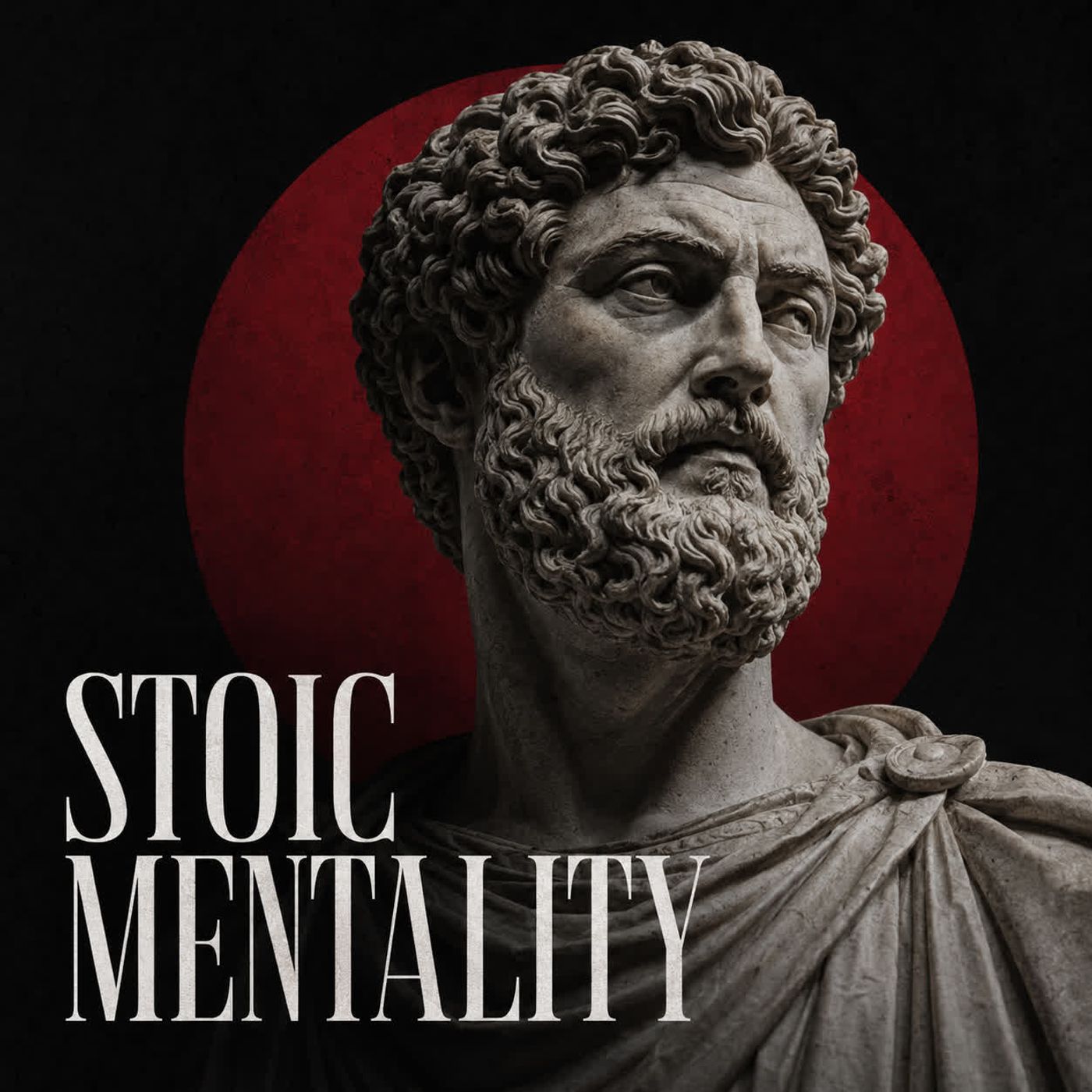
Stoic Mentality
OBOMEDIA ENTERTAINMENT
0
Stoic Mentality is a daily podcast that offers practical guidance on applying Stoic philosophy to modern life. It breaks down principles from Seneca, Epictetus, and Marcus Aurelius into actionable insights for managing stress, improving decision-making, and building emotional resilience. New episodes are published every morning at 8:00 AM, providing a short dose of wisdom to start the day with clarity and focus. The podcast is aimed at anyone seeking personal growth, mental fortitude, and a more purposeful life.
Odcinki
-
 The Demolition Trap: What Are You Building? 18.09.2026 24minThe 60,000 Thoughts You Don't ChooseYou have 60,000 to 80,000 thoughts each day, yet you choose almost none of them. These thoughts, often installed before age seven, drive 95% of your decisions and reactions, making choices for you in the gap between one thought and the next. What if the greatest threat to your life isn't external events, but the mental weather you mistake for reality?In this episode, we explore the Stoic understanding of the mind's architecture and how it shapes our lives. We delve into how ancient wisdom, confirmed by modern neuroscience, offers a third option beyond obeying or suppressing emotions, and how this simple practice can lead to profound freedom.Person: Marcus AureliusPerson: EpictetusTopic: StoicismConcept: ProsocheConcept: Proairesis- Marcus Aurelius, who governed an empire across three continents, identified his own scattered attention as his greatest enemy.- Epictetus, born into slavery, taught that the capacity to choose how you respond to events (proairesis) is the one thing no circumstance can take from you.- Most people cycle between two options for strong emotions: obey or suppress, which neuroscience confirms amplifies the emotion.- Naming an emotion with precision reduces activity in the amygdala and activates the prefrontal cortex, responsible for rational evaluation.- The thoughts driving 95% of your decisions were installed before you were seven years old, before you had the cognitive vocabulary to evaluate them.To listen to this podcast ad-free and access premium episodes, try our subscription with a 30-day free trial at obomedia.com.© 2026 OBOMEDIA. All rights reserved.This episode and its content (audio, text, and related materials) are the exclusive property of OBOMEDIA and are protected by applicable copyright laws. Reproduction, distribution, editing, or commercial use, in whole or in part, without prior written permission from OBOMEDIA is prohibited. For permissions, licensing, and business inquiries: [email protected].
 -
The 60,000 Thoughts You Don't Choose 17.09.2026 23minThe Broken Dial: How to Stop Obsessing Over What Isn't YoursYou're lying awake at 2 AM, jaw tight, replaying an argument from six months ago or rehearsing one that hasn't happened yet. This isn't analysis; it's the illusion of control, a loop that consumes real minutes and energy. What if the very act of obsessing is preventing you from building what you truly want?In this episode, we explore the Stoic concept of the dichotomy of control, a survival strategy built under maximum pressure by a man who had no external freedom. Discover how distinguishing between what is and isn't yours to manage can unlock inner freedom and redirect your finite energy.Person: EpictetusPeriod: RomanStatus: SlaveTopic: Dichotomy of ControlOrgan: Human Brain- The human brain consumes approximately twenty percent of the body's total energy.- Epictetus was a Roman slave with no legal standing or power over his life.- The obsession does not feel like suffering; it feels like work.- The dichotomy of control identifies two categories: what is up to us and what is not.- Every thought has a metabolic cost, charging you in a currency you do not get back.To listen to this podcast ad-free and access premium episodes, try our subscription with a 30-day free trial at obomedia.com.© 2026 OBOMEDIA. All rights reserved.This episode and its content (audio, text, and related materials) are the exclusive property of OBOMEDIA and are protected by applicable copyright laws. Reproduction, distribution, editing, or commercial use, in whole or in part, without prior written permission from OBOMEDIA is prohibited. For permissions, licensing, and business inquiries: [email protected].
-
The Broken Dial: How to Stop Obsessing Over What Isn't Yours 16.09.2026 24minMarcus Aurelius' Secret: The Anger You BuildMarcus Aurelius, the most powerful man in the known world, wrote down his failures every morning in private notebooks, never meant for publication. Two thousand years later, these became known as the Meditations, raising a profound question: if absolute power couldn't shield him from internal struggles, what is the true nature of our own challenges?In this episode, we explore the Stoic understanding of anger, examining how our nervous system reacts to perceived threats, whether a tiger in the jungle or an inconsiderate driver. We delve into the crucial "middle step" between an event and our emotional response, a gap that Stoics like Marcus Aurelius and Epictetus learned to widen.Topic: Stoic philosophyAuthor: Marcus AureliusPeriod: Roman EmpireConcept: The gap between event and responseKey figures: Epictetus- Marcus Aurelius, commander of the largest empire, wrote daily about losing his temper and impatience.- The Meditations were private notebooks, not intended for publication or legacy.- The nervous system responds to a car cutting you off with the same chemistry as a predator.- Epictetus, born into slavery, taught that others' actions belong to them, your interpretation belongs to you.- Stoics distinguished between discomfort, frustration, and anger, with anger containing a judgment you build.To listen to this podcast ad-free and access premium episodes, try our subscription with a 30-day free trial at obomedia.com.© 2026 OBOMEDIA. All rights reserved.This episode and its content (audio, text, and related materials) are the exclusive property of OBOMEDIA and are protected by applicable copyright laws. Reproduction, distribution, editing, or commercial use, in whole or in part, without prior written permission from OBOMEDIA is prohibited. For permissions, licensing, and business inquiries: [email protected].
-
Marcus Aurelius' Secret: The Anger You Build 15.09.2026 24minThe 10 Silent Traps Stealing Your Life (And How to Escape)Imagine a bucket in the corner of a room, dripping steadily, a sound so constant it becomes unheard. This image reveals a profound truth: we often adjust to things that slowly erode our lives, tolerating them until they become part of the furniture. What have you stopped seeing because you've become too good at tolerating it?In this episode, we explore ten quiet, domestic traps identified by the Stoics that don't require a catastrophe to spring. These are the subtle erosions that live in Sunday evenings and postponed conversations, revealing where the true weight in our lives comes from.Topic: Stoic philosophyAuthor: EpictetusPeriod: First centuryFocus: Internal control vs. external conditionsConcept: The gap between choice and need- Epictetus, born a slave, built a philosophical framework around the idea that some things depend on you, and everything else does not.- The suffering in a three-year unhappy job is not the job itself, but the unexamined choice to stay.- Ten years of staying in the wrong place represents a quantifiable loss of 182 hours per year, or close to eight full working days.- The most common objection to change is "my situation is complicated," despite Epictetus having no legal freedom yet maintaining internal control.- The Stoics used a four-step sequence for being stuck, starting with the hard recognition of what you are tolerating.To listen to this podcast ad-free and access premium episodes, try our subscription with a 30-day free trial at obomedia.com.© 2026 OBOMEDIA. All rights reserved.This episode and its content (audio, text, and related materials) are the exclusive property of OBOMEDIA and are protected by applicable copyright laws. Reproduction, distribution, editing, or commercial use, in whole or in part, without prior written permission from OBOMEDIA is prohibited. For permissions, licensing, and business inquiries: [email protected].
-
The 10 Silent Traps Stealing Your Life (And How to Escape) 14.09.2026 21minStop Giving These 10 Things Away: Protect Your Inner Life NowGenerosity can become a slow internal theft: peace, time, dignity and emotional energy are finite and often siphoned away in small, invisible withdrawals. If Marcus Aurelius needed a daily reminder to guard his inner ground while running an empire, how much more urgent is it for someone managing an average Tuesday? Which of the ten things you're handing over today can you reclaim before the well runs dry?In this episode, we lay out ten specific things you should stop giving away and why clarity matters more than blame. We trace how small, repeated concessions erode your life and ask the central question you'll hear again and again: who is drinking from your pitcher?Person: Marcus AureliusPerson: SenecaTopic: Ten things you should stop giving awayEvent: Daily Stoic reminders to protect inner lifePeriod: Ancient Stoic examples compared to modern life- Marcus Aurelius began each morning reminding himself he could only control how he met what was coming.- Seneca observed people lose time in small pieces-moments and hours that add up unnoticed.- The transcript lists peace of mind, time, dignity, and emotional energy as finite resources being given away.- The metaphor of a pitcher is used to show some people draw and never check if it refills.- The episode frames ten specific things to stop giving away, starting with peace of mind.To listen to this podcast ad-free and access premium episodes, try our subscription with a 30-day free trial at obomedia.com.© 2026 OBOMEDIA. All rights reserved.This episode and its content (audio, text, and related materials) are the exclusive property of OBOMEDIA and are protected by applicable copyright laws. Reproduction, distribution, editing, or commercial use, in whole or in part, without prior written permission from OBOMEDIA is prohibited. For permissions, licensing, and business inquiries: [email protected].
-
Stop Giving These 10 Things Away: Protect Your Inner Life Now 13.09.2026 22minThings Good People Give Away (That Destroy Them)You've been doing something your entire life that slowly erodes your peace, and the most disorienting part is that you do it because you are a good person. The better you are, the more damage you tend to cause yourself through generosity given without limits. What are these ten things that, once surrendered, leave you exhausted in ways you cannot fully explain?In this episode, we explore the paradox of good people who give away essential resources, leading to their own depletion. We discuss how figures like Marcus Aurelius and Seneca approached setting limits and preserving their mental peace amidst constant demands, and how this ancient wisdom applies to the "pre-exhaustion" many feel today.Topic: Self-preservationAuthor: The StoicsConcept: Drawing a line between what belongs to you and what does notChallenge: Giving without limitsConsequence: Erosion of mental peace- Good people tend to give away ten specific things without thinking.- The last item on the list of ten things is the one that will hit hardest.- Marcus Aurelius asked himself daily: what in this situation is actually mine to control?- Seneca focused on "small disappearances" of time, not grand losses.- Mental peace is a resource that, like any other, runs out.To listen to this podcast ad-free and access premium episodes, try our subscription with a 30-day free trial at obomedia.com.© 2026 OBOMEDIA. All rights reserved.This episode and its content (audio, text, and related materials) are the exclusive property of OBOMEDIA and are protected by applicable copyright laws. Reproduction, distribution, editing, or commercial use, in whole or in part, without prior written permission from OBOMEDIA is prohibited. For permissions, licensing, and business inquiries: [email protected].
-
Things Good People Give Away (That Destroy Them) 12.09.2026 24minThe Silence You Chase: What Stoics Knew About ApprovalHave you ever changed your opinion just because someone frowned, not because you were wrong, but because the silence felt unbearable? This episode explores the quiet, exhausting effort spent managing others' perceptions of you, an energy cost the Stoics understood over two thousand years ago. What does it truly mean to act from your own values when external approval is not guaranteed?In this episode, we delve into the ancient wisdom of Stoicism, revealing what figures like Marcus Aurelius and Epictetus understood about the human need for validation. Discover how to distinguish between external events and your opinion of them, and learn the practice of equanimity that allows you to move forward without letting external signals dictate your decisions.Author: Marcus AureliusPeriod: Ancient RomeConcept: EquanimityOrigin: NecessityTopic: External Validation- Marcus Aurelius, an emperor, filled his private journals with the difficulty of remaining undisturbed by others' opinions.- He wrote, "The disturbance does not come from things. It comes from the opinion we hold about things."- Epictetus, who began as a slave, understood that the only territory no one can take is one's own judgment.- The need for external validation can behave like a neurological reward loop, a dependency.- When your inner sense of value depends on external confirmation, you are outsourcing your most important judgment.To listen to this podcast ad-free and access premium episodes, try our subscription with a 30-day free trial at obomedia.com.© 2026 OBOMEDIA. All rights reserved.This episode and its content (audio, text, and related materials) are the exclusive property of OBOMEDIA and are protected by applicable copyright laws. Reproduction, distribution, editing, or commercial use, in whole or in part, without prior written permission from OBOMEDIA is prohibited. For permissions, licensing, and business inquiries: [email protected].
-
The Silence You Chase: What Stoics Knew About Approval 11.09.2026 19minHow to Build Daily Confidence Like a Stoic EmperorEvery morning, a voice inside your head delivers a verdict before you even get out of bed: "Not ready yet." This internal dialogue can shape your entire day and, ultimately, your life. What if the feeling of readiness never comes?In this episode, we explore how the Stoics, including Marcus Aurelius and Epictetus, approached the concept of confidence. They understood that confidence is not a precondition for action but a result of it. How can we apply their wisdom to cultivate daily confidence in our own lives?Person: Marcus AureliusPerson: EpictetusTopic: StoicismConcept: Confidence as a skillConcept: Internal dialogue- Marcus Aurelius reminded himself daily of who he wanted to be.- Epictetus argued that it’s not what happens to you that disturbs you, but your interpretation of it.- Confidence grows with action and atrophies without it.- The fear of failure does not disappear before taking action; you must act while feeling fear.- True confidence does not rely on external approval or validation.To listen to this podcast ad-free and access premium episodes, try our subscription with a 30-day free trial at obomedia.com.© 2026 OBOMEDIA. All rights reserved.This episode and its content (audio, text, and related materials) are the exclusive property of OBOMEDIA and are protected by applicable copyright laws. Reproduction, distribution, editing, or commercial use, in whole or in part, without prior written permission from OBOMEDIA is prohibited. For permissions, licensing, and business inquiries: [email protected].
-
How to Build Daily Confidence Like a Stoic Emperor 10.09.2026 23minWinning the Argument: Why Your Peace Matters MoreHave you ever felt the frustration of presenting a flawless argument only to have the other person change the subject or twist your words? This moment reveals a crucial distinction: being right is not the same as winning an argument. The Stoics understood this well, emphasizing that the true battle lies within ourselves, not in convincing others. What if the key to peace is recognizing when to step back?In this episode, we explore the Stoic perspective on arguments and the importance of maintaining your inner peace. We discuss how to identify the types of people who are not worth engaging with in conflict and how to protect your energy in conversations that feel more like traps than discussions. What can we learn from the Stoics about navigating these challenging interactions?Person: EpictetusEvent: Development of Stoic philosophyKey Figure: Marcus AureliusConcept: Control over responseProfile: Types of people not worth arguing with- The first type is the person who always needs to win, rewriting rules to avoid admitting errors.- Emotional manipulators shift from facts to feelings, turning logic into aggression.- Stoics teach that the goal is not to defeat others but to maintain your own stability.- Engaging with certain individuals can lead to exhaustion without resolution.- Recognizing when to disengage is essential for preserving your mental energy.To listen to this podcast ad-free and access premium episodes, try our subscription with a 30-day free trial at obomedia.com.© 2026 OBOMEDIA. All rights reserved.This episode and its content (audio, text, and related materials) are the exclusive property of OBOMEDIA and are protected by applicable copyright laws. Reproduction, distribution, editing, or commercial use, in whole or in part, without prior written permission from OBOMEDIA is prohibited. For permissions, licensing, and business inquiries: [email protected].
-
Winning the Argument: Why Your Peace Matters More 09.09.2026 23minMastering Your Anger: The Stoic Path to Inner FreedomHave you ever felt that tightness in your chest when someone makes a comment that hits too close to home? In this episode, we explore the critical moment between feeling provoked and how you choose to respond. What if the key to mastering your anger lies in understanding that your reaction is not automatic, but a skill you can develop?In this episode, we delve into the Stoic philosophy surrounding anger and the space between stimulus and response. We discuss how figures like Marcus Aurelius and Epictetus approached their emotions and the importance of recognizing that our judgments shape our reactions. How can we learn to navigate our anger in a way that leads to inner freedom?Person: Marcus AureliusPerson: EpictetusTopic: Anger ManagementEvent: Stoic PhilosophyPeriod: Ancient Rome- Marcus Aurelius wrote about his failures, not just victories, in his private journal.- Epictetus, a slave, taught that disturbance comes from our judgments, not the events themselves.- Chronic irritation can lead to elevated cortisol and disrupted sleep.- The Stoics believed that anger has two phases: the signal and the story we tell ourselves.- Most people react automatically, failing to recognize the space for choice between stimulus and response.To listen to this podcast ad-free and access premium episodes, try our subscription with a 30-day free trial at obomedia.com.© 2026 OBOMEDIA. All rights reserved.This episode and its content (audio, text, and related materials) are the exclusive property of OBOMEDIA and are protected by applicable copyright laws. Reproduction, distribution, editing, or commercial use, in whole or in part, without prior written permission from OBOMEDIA is prohibited. For permissions, licensing, and business inquiries: [email protected].
-
Mastering Your Anger: The Stoic Path to Inner Freedom 08.09.2026 21minAre You Wasting Your Life on Worry That Isn't Real?Imagine lying awake at 2 AM, your mind racing with scenarios that may never happen, while your body reacts as if danger is imminent. This is the paradox of worry: it feels like preparation, yet it often leads to unnecessary suffering and exhaustion. Are you trapped in a cycle of anxiety that distracts you from the present moment?In this episode, we explore the nature of worry through the lens of Stoicism and modern neuroscience. We discuss how the mind struggles to differentiate between real threats and imagined fears, leading to a cycle of anxiety that consumes your time and energy. What can we learn from the Stoics about managing our thoughts and focusing on what truly matters?Field: WorryValue: Chronic worry can lead to physical and mental exhaustion.Field: StoicismValue: Stoics understood the difference between useful and unproductive worry.Field: AuthorValue: Marcus Aurelius emphasized the importance of focusing on the present moment.Field: Mental CostValue: Chronic worry can feel like running twenty browser tabs simultaneously.Field: Physical CostValue: Elevated cortisol from worry can disrupt immune function and digestion.- Worry often generates the sensation of control, not actual control.- The mind can spend days rehearsing scenarios that never occur.- Useful worry prompts action; unproductive worry leads to paralysis.- The Stoics called the governing faculty "hegemonikon," which includes your choices and values.- Caring about the future is appropriate, but excessive worry is counterproductive.To listen to this podcast ad-free and access premium episodes, try our subscription with a 30-day free trial at obomedia.com.© 2026 OBOMEDIA. All rights reserved.This episode and its content (audio, text, and related materials) are the exclusive property of OBOMEDIA and are protected by applicable copyright laws. Reproduction, distribution, editing, or commercial use, in whole or in part, without prior written permission from OBOMEDIA is prohibited. For permissions, licensing, and business inquiries: [email protected].
-
Are You Wasting Your Life on Worry That Isn't Real? 07.09.2026 21minWhen Silence Speaks: 10 Stoic Lessons for Inner ControlHave you ever felt the slow disappearance of someone who was once fully present in your life? This episode delves into the painful experience of silence and the instinct to search for answers that may not exist. What if the real lesson lies not in the pain itself, but in how we choose to respond to it?In this episode, we explore ten Stoic lessons that can help you regain control over your emotions and thoughts when faced with the silence of absence. We’ll discuss the common mistakes people make in these moments and how to shift from reaction to thoughtful response. What can you learn from the Stoics about navigating the complexities of human relationships and your own emotional landscape?Field: StoicismTopic: Emotional ControlEvent: Navigating AbsenceAuthor: Marcus Aurelius, EpictetusPeriod: Ancient Philosophy- Silence often leads to a loop of searching for answers that may not exist.- The Stoics emphasized the importance of separating events from personal interpretations.- Amor fati encourages acceptance of reality as a foundation for growth.- Reacting to silence can widen the emotional gap rather than close it.- The quality of your life depends on how you use the space between stimulus and response.To listen to this podcast ad-free and access premium episodes, try our subscription with a 30-day free trial at obomedia.com.© 2026 OBOMEDIA. All rights reserved.This episode and its content (audio, text, and related materials) are the exclusive property of OBOMEDIA and are protected by applicable copyright laws. Reproduction, distribution, editing, or commercial use, in whole or in part, without prior written permission from OBOMEDIA is prohibited. For permissions, licensing, and business inquiries: [email protected].
-
When Silence Speaks: 10 Stoic Lessons for Inner Control 06.09.2026 21minWhat If Your Desires Are Holding You Back From Freedom?Imagine feeling a life just out of reach, one that seems to taunt you with its proximity. What if the life you think you deserve is not the same as the life you have actually earned? This episode delves into a profound Stoic question that challenges our understanding of desire and character, revealing the inconvenient truths that many avoid confronting.In this episode, we explore the tension between our desires and the character we cultivate. We discuss how the Stoics, particularly Epictetus, understood the difference between what is within our control and what is not. Are you ready to confront the gap between your aspirations and your reality?Person: EpictetusDate: First centuryLocation: Ancient RomeStatus: Philosopher and former slaveTopic: Stoicism and personal freedom- Epictetus was born into slavery and became a prominent Stoic philosopher.- He argued that true freedom comes from within, regardless of external circumstances.- The Stoics believed that desire should not dictate our sense of worth.- Marcus Aurelius wrote nightly reminders to himself about living virtuously.- The balance between desire and character is crucial for personal growth.To listen to this podcast ad-free and access premium episodes, try our subscription with a 30-day free trial at obomedia.com.© 2026 OBOMEDIA. All rights reserved.This episode and its content (audio, text, and related materials) are the exclusive property of OBOMEDIA and are protected by applicable copyright laws. Reproduction, distribution, editing, or commercial use, in whole or in part, without prior written permission from OBOMEDIA is prohibited. For permissions, licensing, and business inquiries: [email protected].
-
What If Your Desires Are Holding You Back From Freedom? 05.09.2026 25minWhat If Your Worries Were Never Yours to Control?What if most of the things keeping you awake at night were never yours to control in the first place? Imagine the liberation that comes from realizing that the burdens you carry may not even belong to you. This episode dives into the uncomfortable yet freeing truth about worry and the Stoic wisdom that can transform your perspective on mental suffering.In this episode, we explore the nature of worry and how it often stems from our mind's misguided threat detection system. We discuss the insights of Marcus Aurelius and other Stoics who understood that suffering arises not from events themselves, but from our judgments about those events. How can recognizing this distinction change the way you approach your daily challenges?Person: Marcus AureliusTopic: Stoicism and WorryEvent: Journaling practices during a plagueConcept: Dichotomy of controlPractice: Premeditatio malorum- Marcus Aurelius wrote in his private journal to manage his mental state amid crises.- The Stoics observed that most worries are not based on real threats.- Worrying often consumes time without yielding useful information.- The dichotomy of control separates what is within our power from what is not.- Premeditatio malorum helps individuals confront their fears and realize they can handle worst-case scenarios.To listen to this podcast ad-free and access premium episodes, try our subscription with a 30-day free trial at obomedia.com.© 2026 OBOMEDIA. All rights reserved.This episode and its content (audio, text, and related materials) are the exclusive property of OBOMEDIA and are protected by applicable copyright laws. Reproduction, distribution, editing, or commercial use, in whole or in part, without prior written permission from OBOMEDIA is prohibited. For permissions, licensing, and business inquiries: [email protected].
-
What If Your Worries Were Never Yours to Control? 04.09.2026 23minAre You Really Broken, or Just Untrained in Emotion?What if the feeling of being broken is just a sign that you never learned how to navigate your emotions? Many carry the belief that something is fundamentally wrong with them, like a flaw in their very being. But what if this belief is a lie rooted in a lack of instruction rather than a true defect?In this episode, we delve into the concept of emotional training and how many of us have internalized responses that lead us to feel inadequate. We explore the Stoic perspective on self-examination and the importance of understanding our emotional patterns. What if the key to feeling whole lies not in fixing ourselves, but in learning how to engage with our emotions differently?Field: Emotional TrainingTopic: StoicismStatus: OngoingPeriod: ModernEvent: Self-Examination- Many people feel broken due to unlearned emotional skills.- The Stoics emphasized the importance of self-examination for true freedom.- Emotional responses often stem from childhood adaptations to unsafe environments.- Understanding emotional patterns is not enough; practice is essential for change.- The narrative of being "broken" can cost us significantly in our adult lives.To listen to this podcast ad-free and access premium episodes, try our subscription with a 30-day free trial at obomedia.com.© 2026 OBOMEDIA. All rights reserved.This episode and its content (audio, text, and related materials) are the exclusive property of OBOMEDIA and are protected by applicable copyright laws. Reproduction, distribution, editing, or commercial use, in whole or in part, without prior written permission from OBOMEDIA is prohibited. For permissions, licensing, and business inquiries: [email protected].
-
Are You Really Broken, or Just Untrained in Emotion? 03.09.2026 24minWho Holds the Power: You or Your Pain?Have you ever considered that the real power lies not in what others have done to you, but in how much control you give them over your thoughts? Every time you replay a hurtful moment, you hand over your peace of mind to someone else. What if the key to reclaiming your power is understanding this dynamic?In this episode, we delve into the profound insights of Stoicism, exploring how figures like Marcus Aurelius, Epictetus, and Viktor Frankl confronted their pain and the choices they made in response. We’ll unpack the uncomfortable truth that the anger we hold onto often serves us more than we realize, and how we can shift our perspective to regain control over our emotional responses. What can we learn from their experiences that applies to our own lives today?Person: Marcus AureliusPerson: EpictetusPerson: Viktor FranklTopic: StoicismEvent: Emotional Response to Pain- Marcus Aurelius wrote reminders to himself about maintaining composure while governing an empire.- Epictetus emphasized that feelings are responses to the stories we build around events.- Viktor Frankl found meaning in suffering during his time in a Nazi concentration camp.- The Stoics believed that holding onto anger is like drinking poison and waiting for someone else to suffer.- The dichotomy of control distinguishes between what is yours (thoughts, judgments) and what is not (others' actions, outcomes).To listen to this podcast ad-free and access premium episodes, try our subscription with a 30-day free trial at obomedia.com.© 2026 OBOMEDIA. All rights reserved.This episode and its content (audio, text, and related materials) are the exclusive property of OBOMEDIA and are protected by applicable copyright laws. Reproduction, distribution, editing, or commercial use, in whole or in part, without prior written permission from OBOMEDIA is prohibited. For permissions, licensing, and business inquiries: [email protected].
-
Who Holds the Power: You or Your Pain? 02.09.2026 22minWhen Did You Stop Trusting Your Own Voice?Have you ever paused before speaking, feeling a familiar tug of doubt that silences your thoughts? This moment, seemingly trivial, often marks the beginning of a gradual erosion of self-trust. What if the real question isn't what caused you to stop speaking up, but how many times you chose silence before you even realized it?In this episode, we explore the subtle yet profound impact of self-censorship and the Stoic philosophy that sheds light on our internal struggles. We delve into the concept of the hegemonikon, the ruling faculty that governs our decisions, and how it can be influenced by external factors. How can we reclaim our voice and trust our own judgment once again?Field: PhilosophyAuthor: EpictetusTopic: Self-TrustPeriod: First CenturyConcept: Hegemonikon- The moment you stop trusting your voice often feels unremarkable and silent.- Confidence erosion is usually gradual, not a single dramatic event.- The Stoics believed that your internal judgment should be entirely your own.- Silence can become a default response, making it harder to speak up over time.- The concept of proairesis emphasizes the importance of choosing your response.To listen to this podcast ad-free and access premium episodes, try our subscription with a 30-day free trial at obomedia.com.© 2026 OBOMEDIA. All rights reserved.This episode and its content (audio, text, and related materials) are the exclusive property of OBOMEDIA and are protected by applicable copyright laws. Reproduction, distribution, editing, or commercial use, in whole or in part, without prior written permission from OBOMEDIA is prohibited. For permissions, licensing, and business inquiries: [email protected].
-
When Did You Stop Trusting Your Own Voice? 01.09.2026 25minUnmasking the 10 Silent Habits Sabotaging Your LifeHave you ever felt that something is off, yet everything seems fine on the surface? The Stoics warned us that the quiet, daily habits we ignore can slowly hollow us out, much like a frog that adapts to gradually rising water. What are the ten silent habits that might be sabotaging your life without you even realizing it?In this episode, we explore the subtle yet powerful habits that can undermine your well-being and productivity. From the pressures of a busy schedule to the dangers of fragmented attention, we delve into how these seemingly innocuous behaviors can lead to a life that feels functional but is far from fulfilling. Are you ready to uncover the hidden patterns that may be holding you back?Field: Life HabitsValue: Silent SabotageField: Stoic PhilosophyValue: Marcus Aurelius, Seneca, EpictetusField: Attention MechanismValue: Fragmented FocusField: Stress ResponseValue: Chronic Cortisol LevelsField: Sleep QualityValue: Chronic Sleep Debt- Many people mistake busyness for productivity, leading to chronic stress and cognitive decline.- The brain normalizes sustained harm, making it difficult to recognize when something is wrong.- Attention is a key mechanism in constructing a fulfilling life, yet many train themselves for distraction.- The frog analogy illustrates how gradual changes can go unnoticed until it's too late.- The question shifts from "how much time am I spending?" to "who am I becoming through my habits?"To listen to this podcast ad-free and access premium episodes, try our subscription with a 30-day free trial at obomedia.com.© 2026 OBOMEDIA. All rights reserved.This episode and its content (audio, text, and related materials) are the exclusive property of OBOMEDIA and are protected by applicable copyright laws. Reproduction, distribution, editing, or commercial use, in whole or in part, without prior written permission from OBOMEDIA is prohibited. For permissions, licensing, and business inquiries: [email protected].
-
Unmasking the 10 Silent Habits Sabotaging Your Life 31.08.2026 24minReclaim Your Morning: The Stoic Path to Daily MasteryWhat if the first moments of your day could shape your entire life? Most people wake up and immediately surrender their minds to the chaos of notifications and external demands, missing a crucial opportunity for self-direction. How can you reclaim those precious seconds to cultivate a life that truly belongs to you?In this episode, we explore the transformative power of morning habits rooted in Stoic philosophy. Discover how figures like Marcus Aurelius and Epictetus approached their mornings with intention, choosing their thoughts before the world could impose its will. What can we learn from their practices to reclaim our own mornings and, ultimately, our lives?Field: Stoic PhilosophyTopic: Daily HabitsKey Figure: Marcus AureliusKey Figure: EpictetusConcept: Self-Mastery- The average person reaches for their phone within thirty seconds of waking.- Neuroscience shows the brain is in a receptive state immediately after waking.- Marcus Aurelius wrote personal reflections each morning to set his intentions.- Seneca emphasized physical exercise as a form of self-mastery and discipline.- Decision fatigue limits our ability to make deliberate choices throughout the day.To listen to this podcast ad-free and access premium episodes, try our subscription with a 30-day free trial at obomedia.com.© 2026 OBOMEDIA. All rights reserved.This episode and its content (audio, text, and related materials) are the exclusive property of OBOMEDIA and are protected by applicable copyright laws. Reproduction, distribution, editing, or commercial use, in whole or in part, without prior written permission from OBOMEDIA is prohibited. For permissions, licensing, and business inquiries: [email protected].
-
Reclaim Your Morning: The Stoic Path to Daily Mastery 30.08.2026 22minWhy Being Always Available Makes You Less ValuableHave you ever noticed how the more accessible something is, the less special it becomes? Imagine a restaurant that serves your favorite dish every single day. At first, it feels like a treat, but eventually, it loses its allure. This episode dives into the uncomfortable truth about our relationships and the patterns we fall into that diminish our value. Why do we keep making ourselves available, and what does it cost us?In this episode, we explore a timeless lesson from Stoic philosophy about the dangers of being perpetually accessible. We discuss how this behavior can lead to a lack of appreciation from others and the importance of setting boundaries. What if the key to being valued lies in embracing uncertainty and scarcity in our relationships?Field: PhilosophyAuthor: EpictetusKey Concept: Personal AuthorityKey Insight: Value of ScarcityHistorical Context: Stoicism- The Stoics believed that being always available diminishes our value in relationships.- Epictetus, a former slave, taught that true freedom comes from not being at the disposal of others.- Constant availability can stem from a fear of being unwanted if we say no.- Genuine urgency in relationships arises from uncertainty, not accessibility.- Marcus Aurelius emphasized the importance of protecting one's focus and attention.To listen to this podcast ad-free and access premium episodes, try our subscription with a 30-day free trial at obomedia.com.© 2026 OBOMEDIA. All rights reserved.This episode and its content (audio, text, and related materials) are the exclusive property of OBOMEDIA and are protected by applicable copyright laws. Reproduction, distribution, editing, or commercial use, in whole or in part, without prior written permission from OBOMEDIA is prohibited. For permissions, licensing, and business inquiries: [email protected].
Podobne podcasty


Popularny w
Ten podcast pojawia się również w listach podcastów tych krajów.
