
New Books in European Politics
New Books Network
0
This podcast is a channel on the New Books Network, an academic audio library dedicated to public education. Each episode features scholars discussing their recently published research with another expert in their field. The network offers over 150 channels and more than 28,000 episodes. Listeners can explore the full catalog on the New Books Network website and subscribe to a free weekly Substack newsletter.
Episódios
-
 Debarati Sanyal, "Arts of the Border: Fugitive Bodies at Europe’s Edges" (Fordham, 2025) 12.09.2026 46minArts of the Border: Fugitive Bodies at Europe’s Edges (Fordham, 2025) investigates the consequences of unfolding catastrophes across the world and the displacement they continue to produce. Through recent narratives and media representations of the refugee “crisis” at Europe’s edges, it tells a new story about those on the move, the technologies unleashed on them at borders, the racialized and colonial histories that inform these technologies, and the artistry with which migrants and allies bear witness to displacement. The book reorients us toward the creativity and movement of migrants themselves– their “arts of the border”—as well as toward the political force of the arts that represent them, whether in literature, documentary film, or art installations. Sanyal proposes kino-aesthetics as a framework for capture and fugitivity at borders. From kino—to set in motion—and aesthetics— relating to sensory perception—kino-aesthetics conveys the force of bodies in motion and the image in its circulation. The book examines the simultaneity of capture and escape at thresholds of illegalization, from airport detention zones to Calais’s “jungle” and the Euro-African border at Ceuta and Melilla. What emerges throughout these case studies is a portrayal of border violence in its racial and colonial forms as well as an archive of refusal, fugitivity, and un-bordered imagining. Guest Debarati Sanyal is Professor of French, Director of the Center for Interdisciplinary Critical Inquiry, and currently holds the Zaffaroni Family Chair of Undergraduate Education. Affiliated with the Designated Emphasis in Critical Theory, the Berkeley Interdisciplinary Migration Initiative, the Center for Race and Gender, and the Institute of European Studies, her teaching and research interests span 19th -21st-century French and Francophone literature, memory studies, aesthetics and bio/necropolitics, critical human rights and refugee studies. She is a recipient of the UC Berkeley Distinguished Teaching Award (2012) and a Guggenheim Fellowship (2021-2022). She is currently co-PI on the Mellon-funded A Counter-Imaginary in Authoritarian Times (2024-2027). Besides Arts of the Border, Dr. Sanyal has authored Memory and Complicity: Migrations of Holocaust Remembrance (Fordham, 2015), translated into French as Mémoire et Complicité: Au Prisme de la Shoah (PUV, 2019); and The Violence of Modernity: Baudelaire, Irony and the Politics of Form (Johns Hopkins, 2006). She has guest-edited “Time and Politics in Contemporary Critique: Entanglements and Aftermaths” (Critical Times, 2018), ha also co-edited, with Éric Fassin, Demos Anxiety: Genealogies, Rhetorics, and Politics of Great Replacement (forthcoming in Patterns of Prejudice); with Damon Young and Mario Telò, Proximities: Reading with Judith Butler (Representations 2022), and, with Michael Rothberg and Max Silverman, Noeuds de mémoire: Multidirectional Memory in Postwar French and Francophone Culture (Yale French Studies 118-119). Host Gina Stamm is Associate Professor of French at The University of Alabama, with research concentrated on the environmental humanities and speculative literatures of the 20th and 21st centuries, from Surrealism to contemporary science fiction and feminist utopias, in Metropolitan France and the francophone Caribbean. Their monograph Posthumanist Ecology in Global French Surrealism is forthcoming in 2027 from Northwestern University Press.
 -
Robert Shum, "Democracy or Carbon Oligarchy?: Climate and Energy Politics between Crisis and Decarbonization" (Palgrave Macmillan, 2026) 05.09.2026 25minDemocracy or Carbon Oligarchy?: Climate and Energy Politics between Crisis and Decarbonization (Palgrave Macmillan, 2026) tackles a critical question. Why has the world struggled so much to coordinate policy to address climate change, despite political and scientific consensus? Despite landmark agreements and expanding knowledge, emissions have fallen unevenly and progress has repeatedly stalled or reversed. Democracy or Carbon Oligarchy? explains that failure by focusing on domestic politics: how institutions distribute power, how interest groups exploit “access points,” and why countries with similar wealth and technology diverge. Moving beyond arguments about mere political will, it situates energy and climate outcomes within the institutional architectures of industrialized oil super-producers: the United States, Canada, the United Kingdom, and Norway. Shum advances a neopluralist theory of climate politics, arguing that policy is shaped by the strategic capture of institutional venues by carbon-intensive interests. He shows how separation of powers, federalism, party systems, and electoral rules configure opportunities for a de facto carbon oligarchy. By mapping where binding decisions are made and who can reach them, the book offers a generalizable framework for diagnosing blockages, explaining cross-national variation, and identifying leverage points for sustaining ambitious climate policy over time.
-
Ukrainian Men Fleeing Conscription: A Discussion with Writer Dan Storyev 27.08.2026 48minOur conversation focuses on a groundbreaking article by Dan Storyev recently published in The Nation: “Millions of Ukrainian Men Are Fleeing a Cruel Conscription System.” Storyev was on the ground in Odesa to report firsthand for this piece, drawing on encounters with Ukrainian men in flight from the officers of the Ukrainian state agency, known as TCR, in charge of mobilizing fighting-age men for the war in Ukraine against Russia’s invading army. It’s an important story, yet one, as he told me, that few outlets in the Western press want to publish. And as we note, Russia also is experiencing great difficulties in conscripting men for this war. Storyev is a Russian-American writer and the co-author, with Maria Kuznetsova, of the forthcoming book How to Survive Authoritarianism: A Russian’s Phrasebook for Everyday Live in America (W.W. Norton), to be published in September.
-
Denialism: Polish Style 22.08.2026 1h 9minHolocaust distortion in Poland involves reshaping or minimizing facts about the Holocaust, often emphasizing Polish victimhood while obscuring instances of local collaboration, participation, or indifference. It appears in political rhetoric, memory laws, public commemorations, and attacks on critical scholarship. YIVO’s Poland vs. Holocaust History series examines these dynamics and situates the Polish case within a broader European context. Elżbieta Janicka focuses on the case of the former German Nazi death camp Treblinka, the place of murder and (un)rest of nearly one million Jews from several European countries, the majority from Poland. While keeping in mind that “Treblinka” is as an umbrella term for the forced labor camp Treblinka I (1941-1944), the extermination camp Treblinka II (1942-1943), and a railway station at Treblinka the village, Janicka examines symbolic topography, such as the symbols and narratives that are imprinted into these sites under the auspices of the Treblinka Museum. Regarding the unrestricted Polish bottom-up and top-down fight to “conquer the space” of the Holocaust and make it symbolically profitable for Poland, Janicka raises the question: Why doesn’t the present Polish strategy of “promoting Polish martyrdom upon the Jewish one” trigger an international scandal and condemnation? Janicka argues that while Polish cultural institutions do not deny the Holocaust itself, they practice a form of denialism by obscuring the reality of Polish involvement in the Holocaust. This lecture fits into a broader debate about Polish public institutions that promote a counter-history of the Holocaust and have at their disposal extraordinary means of propaganda both within Poland and abroad. This lecture originally took place on February 19, 2026.
-
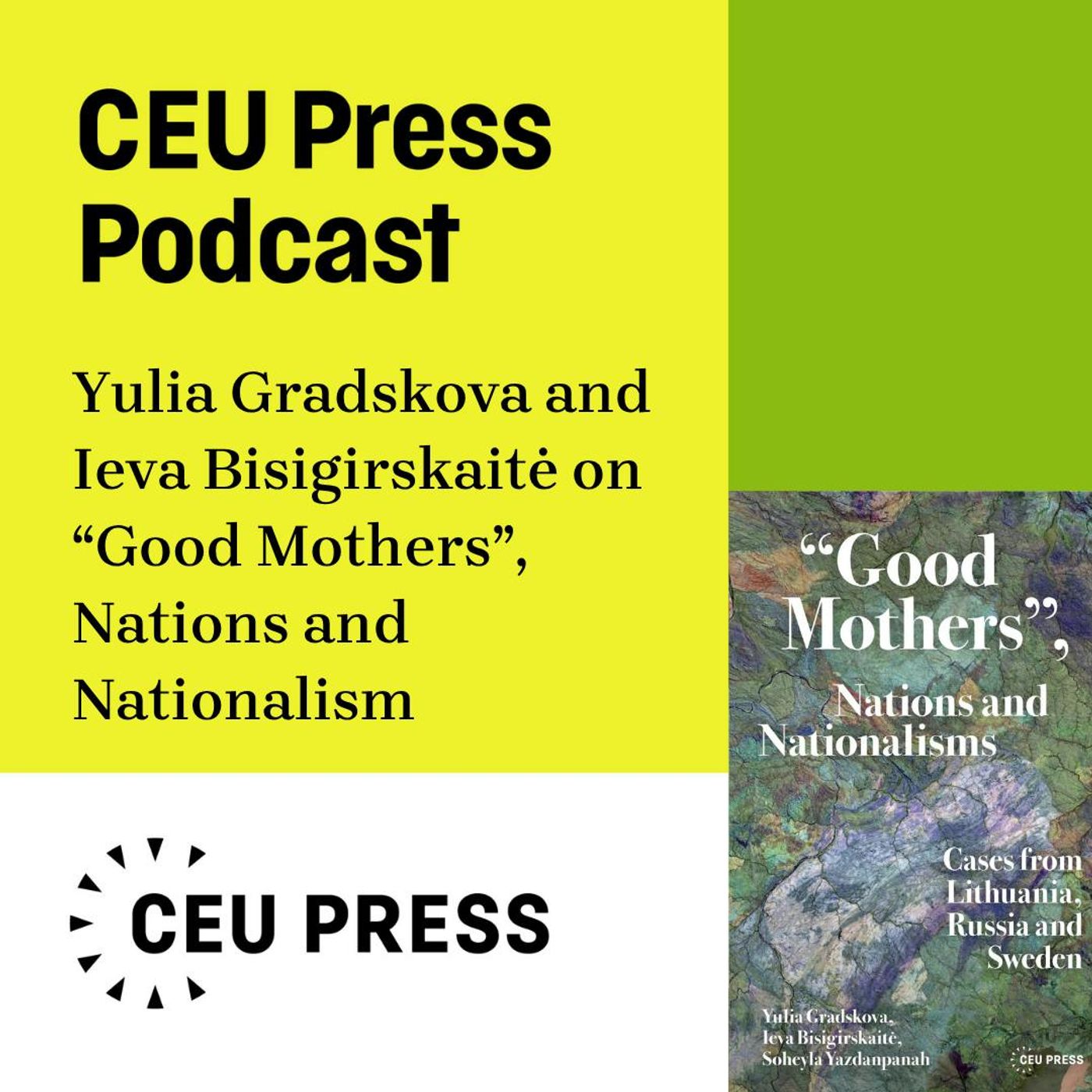 Yulia Gradskova et al., "Good Mothers, Nations and Nationalisms: Cases from Lithuania, Russia and Sweden" (CEU Press, 2026) 13.08.2026 54minIn this episode, host Andrea Talabér (CEU Press, 2026) talks with Yulia Gradskova and Ieva Bisigirskaitė, two of the three authors behind Good Mothers, Nations and Nationalisms: Cases from Lithuania, Russia and Sweden. Together with Soheyla Yazdanpanah, they explore what nationalists mean by "good mothers," demographic anxiety, and maternal activism in Lithuania, Russia and Sweden. You can purchase a copy here. The CEU Press Podcast delves into various aspects of the publishing process: from crafting a book proposal, finding a publisher, responding to peer review feedback on the manuscript, to the subsequent distribution, promotion and marketing of academic books. We also talk to series editors and authors, who will share their experiences of getting published and discuss their series or books. Interested in CEU Press’s publications? Click here to find out more: Stay tuned for future episodes and subscribe to our podcast to be the first to be notified.
 -
Bridget Hourican on Frank Callanan's "James Joyce: A Political Life" (Princeton UP, 2026) 12.08.2026 57minThe young James Joyce (1882–1941) was forged in the smithy of Irish political controversies, and he took into his European exile a depth of political insight unrivalled among his fellow modernists. In this biography of Joyce in his youth and early exile James Joyce: A Political Life (Princeton UP, 2026), acclaimed Irish historian and biographer Frank Callanan reveals a Joyce who is markedly more politically conscious, informed and complex than the Joyce of Richard Ellmann’s classic account. Written in a sparkling style and rich with historical insights, Callanan’s deeply researched biography is the first sustained account of how Joyce’s Irish and European political and cultural context shaped his life, thought, and writings.Joyce was eight years old in 1890 when the O’Shea divorce scandal tore Irish nationalism apart, leading to the split in the Irish Parliamentary Party, the death of nationalist leader Charles Stewart Parnell, and a long, bitter period dominated by the anti-Parnellites. This was the Ireland that Joyce grew up in and rebelled against, and which determined his literary direction. Callanan uncovers a Joyce who was a highly original and dissenting Irish nationalist, who refused to avow or vaunt his nationalism and whose understanding was refined by the experience of living in multicultural Trieste with its fraught ethnic politics and differing models of statehood. Callanan’s Joyce is as heroic as Ellmann’s defiantly modernistic artist but in a more interesting way—a writer who didn’t lack political conviction but whose views didn’t yield to the expectations of his time.Energizing, witty, profound, and elegant, James Joyce: A Political Life is a magisterial biography that will transform how readers look at Joyce and his politics. Frank Callanan (1956–2021) was an Irish barrister and historian. His books include The Parnell Split, 1890–91, a narrative of the last year of Parnell’s life, and T. M. Healy, a biography of Parnell’s principal adversary in the Split. He wrote the entries on Parnell, Healy, John Dillon and Conor Cruise O’Brien for the Dictionary of Irish Biography and edited The Literary and Historical Society 1955–2005, a history of the debating society of University College Dublin, to which James Joyce belonged. He also wrote and produced, with Ruán Magan, the 2022 documentary 100 Years of Ulysses. Morteza Hajizadeh is a Ph.D. graduate in English from the University of Auckland in New Zealand. His research interests are Cultural Studies; Critical Theory; Environmental History; Medieval (Intellectual) History; Gothic Studies; 18th and 19th Century British Literature. YouTube Channel: https://www.youtube.com/user/a48266/videos
-
Giulio Boccaletti, "The Environmental Republic: Why Citizens Will Save the World" (Princeton UP, 2026) 07.08.2026 1h 26minRepublicanism is arguably the most powerful political idea in history, an extraordinary feat of human imagination that balances individual liberty with collective responsibility. The Environmental Republic: Why Citizens Will Save the World (Princeton University Press, 2026) reclaims this idea as the path to sustaining our life together on a changing planet, reframing our relationship to the environment not as a constraint on liberty but as its republican foundation. Giulio Boccaletti argues that we must renew our commitment to freedom and civic responsibility through popular sovereignty. He presents the environmental republic as a necessary alternative to blind faith in technocratic management, the shallow moralizing and apocalyptic rhetoric of some activists, and the disingenuous skepticism of vested interests. Our environmental challenges are not simply about “agreeing on the facts” or living within technical limitations—they reflect a deeper failure of political institutions. Drawing on the history of ideas and real-world examples, Boccaletti presents a political framework that places our relationship to our surroundings at the heart of how we exercise our voice, coordinate collective action, and define development itself. Offering hope in an anxious age of rising authoritarianism and widespread pessimism, The Environmental Republic challenges the false choice between environmental protection and human freedom, showing how place-based institutions can deliver both sustainability and human development through true self-governance. Giulio Boccaletti is an author whose writings on natural resources security have been translated into several languages. He has held international leadership positions in the private and not-for-profit sectors. He is the scientific director of the Euro-Mediterranean Center on Climate Change, one of Europe’s largest research institutions focused on Earth science and transition economics, and cofounder of Chloris Geospatial, a space-tech company specializing in Earth observations. His books include Water: A Biography, and his work has been featured in acclaimed PBS series such as H2O: The Molecule That Made Us, Human Footprint, and The Future of Nature. Morteza Hajizadeh is a Ph.D. graduate in English from the University of Auckland in New Zealand. His research interests are Cultural Studies; Critical Theory; Environmental History; Medieval (Intellectual) History; Gothic Studies; 18th and 19th Century British Literature.
-
Georgia Kernell, "Inside Parties: How Party Rules Shape Membership and Responsiveness" (Cambridge UP, 2025) 06.08.2026 48minInside Parties: How Party Rules Shape Membership and Responsiveness (Cambridge UP, 2025) by Georgia Kernell examines how party rules determine how parties select candidates, nominate leaders, and set policy goals. Most research on party organisation pays very little attention to what happens within political parties; this book addresses this gap by examining how internal party rules and procedures shape party membership and political responsiveness. Drawing on an original dataset of party statutes covering 65 political parties across 20 parliamentary democracies, the book offers one of the most comprehensive studies of party organisation to date. The book develops a formal model of party membership and tests these hypotheses using cross-national surveys, member studies, experiments, and computer simulations of projected vote shares. The book finds that a party's level of decentralisation - the degree to which it incorporates rank and file members into decision making - determines which voters it best represents. Decentralised parties may attract more members to campaign for the party, but they do so at the cost of adopting more extreme positions that pull them away from moderate voters. The book challenges our understanding of inner-party democracy, it reveals that Parties that are more internally democratic don't necessarily end up being more representative or responsive to the electorate as a whole. This novel and comprehensive research is an indispensable resource not only for party scholars but also for anyone working on comparative politics and multi-method research. And for anyone who wants to sneak a peek into the "secret garden" of party organisation. Satyaki Barua is a PhD student in Political Science at the University of Hyderabad. His research focuses on party organisation, party institutionalisation, and political mobilisation, particularly examining the interactions between the state, society, and political parties in India and South Asia. Outside of academia, Satyaki enjoys watching and discussing movies, as well as practising Hindustani classical music.
-
The Resurgence of War and the Collapse of Arms Control 31.07.2026 32minHow the nuclear guardrails were dismantled. What arms control actually did (risk management, predictability, geography), how it unravelled from the 2000s onward, and why its collapse matters more now as we see a resurgence of strategic instability and armed conflict.
-
Anna Lively, "Revolutionary Connections: Russia and Ireland, 1905-1923" (Oxford UP, 2026) 28.07.2026 21minAnna Lively is a historian of modern Ireland, Britain, and Russia. Awarded her PhD in History from the University of Edinburgh in 2022, she is currently a Leverhulme Early Career Fellow in History at the University of Strathclyde. Prior to this she held the Roy Foster Irish Government Research Fellowship in the History and Culture of Ireland at Hertford College, University of Oxford, and was a Teaching Fellow in Modern History at the University of Aberdeen. She has published in multiple journals on the centenary of the Russian Revolution of 1917 and on the Irish Save the Children Fund. From the late nineteenth century, Ireland featured prominently in Russian liberal, conservative, and radical debates about land politics, self-determination, and empire. Equally, Irish commentators from across the political spectrum used Russia as a lens onto questions of imperialism, anti-imperialism, and socialism. But while the Irish and Russian revolutionary contexts are well-studied in isolation, their myriad political, social, and cultural entanglements are not.Drawing on extensive Russian and Irish archival accounts, newspapers, diaries, letters, memoirs, literary, and visual sources, Revolutionary Connections: Russia and Ireland, 1905-1923 (Oxford UP, 2026) looks in both directions at Irish responses to Russian revolutionary change and at representations of Ireland in Russian-language texts from the 1905 Russian Revolution to the end of the Irish Civil War in 1923. The result is a unique account of international engagement in revolutionary Russia and Ireland and of how Ireland was imagined beyond the Anglophone world. This mutual, if selective and conditional, engagement reflected wider technological changes in news communication and the expansion of international news agencies. Diasporic networks, including in Britain and the US, helped to shape Russo-Irish relations and Irish publications and political actors engaged with different parts of the Russian empire, including Ukraine, Finland, and Poland.Through five thematic chapters, the book considers Russo-Irish relations from contrasting and often overlooked angles, including Irish eyewitness experiences on the Eastern front during World War One and religious perspectives. Using a transnational methodology and expansive source base, the book offers a fresh angle on the entangled history of revolutions in the early twentieth century and the translation of news and ideas across borders. Revolutionary Connections: Russia and Ireland, 1905–1923 will be published in September 2026 with Oxford University Press
-
 Mikuláš Pešta, "Student Internationalism and the Global Cold War: The International Union of Students in Socialist Prague" (Bloomsbury, 2026) 24.07.2026 41minIn this episode of the CEU Review of Books Podcast, I sat down with Mikuláš Pešta to talk about his new book, Student Internationalism and the Global Cold War: The International Union of Students in Socialist Prague (Bloomsbury, 2026). During our discussion we touched upon how the International Union of Students ended up being headquartered in Prague, the organisation's various activities, and the life of the Secretariat, amongst other topics. You can purchase the book from Bloomsbury here. The book is also available Open Access here. The CEU Review of Books Podcast Series explores the questions that affect us all through in-depth talks with researchers, policy makers, journalists, academics and others. We showcase the most current research linked to Central Europe through these discussions. At the CEU Review of Books, we encourage an open discussion that challenges conventional assumptions to foster a vibrant debate. Visit our website to read our latest reviews, long reads and interviews.
 -
Kurt Warner, "False Idols: How Diversion is Destroying Democracy" (Vernon Press, 2024) 21.07.2026 39minFalse Idols: How Diversion is Destroying Democracy (Vernon Press, 2024) examines how modern forms of diversion shape civic life and weaken democratic responsibility. Drawing on the ancient Roman idea of “bread and circuses,” Kurt Warner explores how contemporary society is saturated with distractions that keep citizens focused on what is immediate, pleasurable, profitable, or spectacular, rather than on what is politically and socially meaningful. The conversation introduces listeners to the book’s central concern: how celebrity culture, consumerism, economic pressures, sports, politics, art, music, literature, the internet, social media, and video games can become “false idols.” These forces do not merely entertain us; they influence how we think, what we value, and how we understand our responsibilities to one another. A key point of discussion is the book’s comparison between ancient Rome and the contemporary United States. Warner uses “bread and circuses” to consider how societies become complacent when citizens are absorbed by basic needs and entertainment while civic duty fades into the background. The episode also explores the book’s opening narrative, which follows an ordinary man, Chris, through a day filled with advertising, media, branding, and social pressure. This scene illustrates one of the book’s central arguments: distraction is often woven into everyday life before people have noticed its influence. Warner’s background in psychotherapy adds an important dimension to the discussion. 'False Idols' connects personal awareness with civic awareness, asking how people can recognize the forces directing their attention and reclaim the ability to think critically. Ultimately, this episode invites listeners to reflect on the relationship between attention and democracy. 'False Idols' asks what it would mean to wake up from the collective daze of distraction and choose more meaningful forms of civic, ethical, and social engagement. Key Themes and Context: “Bread and circuses” in the modern world - One of the book’s central ideas is that Juvenal’s famous phrase “bread and circuses” remains relevant today. Warner uses it to examine how entertainment, consumption, and everyday distraction can draw citizens away from civic responsibility. The many forms of diversion- The book considers a wide range of modern distractions, including celebrity worship, money, sports, politics, art, music, literature, the internet, social media, and video games. Together, these examples show how distraction can operate across culture, politics, economics, and everyday life. Democracy and civic duty - At the heart of the book is a concern with democracy. Warner argues that distraction becomes dangerous when it weakens civic engagement and allows people to avoid the difficult work of political and ethical responsibility. Critical thinking as resistance - The later chapters of 'False Idols' focus on critical thinking as a way of resisting manipulation and recovering agency. The book invites readers to examine not only what they consume, but also how their attention, values, and judgments are shaped. The psychological dimension of distraction - Warner’s background in psychotherapy informs the book’s attention to emotion, avoidance, and self-awareness. Distraction is presented not only as a social or political problem, but also as something that affects how individuals relate to themselves and others. Vernon Press – Bridging Scholarly Ideas and Global Readership Vernon Press stands out as a bilingual independent publisher of scholarly books in the humanities and social sciences. Their mission is crucial — to provide a home for ideas of international importance and to embrace scholarship from underrepresented voices and perspectives. Through its diverse catalog, Vernon Press engages with global readers, contributing to academic and public discourse. Dessy Vassileva, the Marketing & Design expert at Vernon Press, brings a 360º multidisciplinary approach to her work at Vernon Press.
-
Democratic Backsliding and Resistance: Poland’s Civil Society, Electoral Strategies, and Institutional Levers 12.07.2026 1h 6minThis week on Democracy Dialogues, Frances Cayton speaks with four experts on Polish politics about the success of Poland’s opposition coalition in 2023, and the headwinds that democracy continues to face today. What challenges do parties and civil society face in building pro-democracy electoral coalitions? If victorious, how do these challenges affect post-election governance and efforts at pursuing democratic renewal? This episode brings together politicians, political scientists, and civil society leaders who each played a critical role in the 2023 elections to examine what made Poland’s pro-democracy mobilization possible, the gains the 2023 coalition has achieved since entering power, and the challenges it continues to face in pursuing democratic renewal.This episode was originally recorded as a part of the Lessons from Global Democratic Resistance panel series. The series brings together frontline activists, civic leaders, institutional actors, and field‑informed scholars to examine how democratic actors have resisted, responded to, and learned from democratic backsliding across countries. The series aims to identify practical lessons and comparative insights for those defending democracy today and is organized in collaboration with the Ash Center for Democratic Governance and Innovation at Harvard University; Perry World House at the University of Pennsylvania; the Kellogg Institute for International Studies at the University of Notre Dame; the Democratic Futures Project at the University of Virginia; Stanford’s Center on Democracy, Development and the Rule of Law; and the Carnegie Endowment for International Peace. Mikołaj Cześnik, Director of the Institute of Social Science at SWPS University, Chairman of the Council of the Stefan Batory Foundation Michał Wawrykiewicz, Member of the European Parliament (MEP). Co-Founder of the civic initiative Wolne Sady (Free Courts) Marek Tatała, President and Co-Founder of the Economic Freedom Foundation Dominika Lasota, Student and Activist in the Youth Climate Strike Poland, Co-Founder of Inicjatywa WSCHÓD Frances Cayton is a PhD Candidate in Government at Cornell University. Her research focuses on questions surrounding democratic backsliding, civil society, and political communication.
-
Jonathan Schneer, "Nine Days in May: The General Strike Of 1926" (Oxford UP, 2026) 01.07.2026 1h 15minIn May, 1926, nearly three million British workers downed tools to support nearly one million of their countrymen, miners whose employers meant to lengthen their working day and cut their pay. This General Strike brought the country to a grinding halt - which, according to Conservative Prime Minister Stanley Baldwin, represented a threat not merely to the nation but to the parliamentary system itself. For nine days, the world's best organized working class confronted the world's most powerful, and self-confident, government. And yet the outcome was never in doubt, for Britain's most important trade-union leaders thought as Baldwin did, although they kept saying they were engaged in a wages dispute only. Really, they feared winning even more than they feared losing. In Nine Days in May: The General Strike of 1926 (Oxford University Press, 2026), award-winning author and historian Jonathan Schneer mines hitherto untapped archival sources to explain why and how the Strike came about, why and how it was waged and countered, why and how it ended. In addition to government reports and TUC reports, he uses reports of undercover agents and spies, "special" constables sworn in for the duration of the Strike, volunteer strike-breakers, Communist agitators, trade-union leaders and rank-and-file members of trade unions; also, of course, the papers of politicians of all parties. This is a tale of Shakespearian dimensions, replete with tragic heroes and villains and buffoons and opportunists and double-dealers, and contending, evenly matched, forces - both of which meant to do their duty whatever the cost. There may never be another general strike in Britain, but the General Strike of 1926 was one for the ages, illuminating the human condition. Jonathan Schneer is Professor Emeritus of History at the Georgia Institute of Technology. Caleb Zakarin is CEO and Publisher of New Books Network.
-
AI, Algocracy, and Democracy's Challenging Road Ahead with Andrew Sorota 12.06.2026 45minLike many people, I've been following the developments of AI, testing out new models and following the deluge of news stories about the fight for supremacy. Much has been written about the existential and economic risks posed by AI, but the political implications of superintelligent systems have often been sidelined. In the United States and elsewhere, AI companies steam ahead with little regulation or oversight. Meanwhile, politicians appear flatfooted and unsure about the best way to integrate AI into the government to make democracies stronger and more responsive to the needs and will of the people. AI will undeniably change how governments work, but how can we ensure that democracy and individual rights are safeguarded amidst the most transformative technological revolution in more than a century? Today I'm speaking with Andrew Sorota, Head of Research for the Office of Eric Schmidt. Andrew has written extensively about the relationship between democracy and artificial intelligence. His writing has appeared in outlets like the New York Times and Noema magazine. Andrew will dispel many myths about AI, where he looks to call bullshit on the idea that democracy is a system heading fast into the dustbin of history. Follow Andrew Sorota on LinkedIn "This Is No Way to Rule a Country" in the New York Times "Rescuing Democracy From The Quiet Rule Of AI" in Noema Andrew Sorota is currently Head of Research for the Office of Eric Schmidt. Caleb Zakarin is CEO and Publisher of the New Books Network.
-
Brexit Britain: 10 Years on from the Referendum 09.06.2026 53minAnniversaries provide opportunities to take stock and reflect. It is now ten years since voters in the United Kingdom cast their ballots in a referendum on whether the UK should Leave or Remain in the European Union. The subsequent decade has seen much churn and change in British politics. Join Tim Haughton and guests Maria Sobolewska, Charlotte Galpin and Monika Brusenbauch Meislova for a discussion of the causes, process and consequences of that decision made on 23 June 2016. Maria Sobolewska is Professor of Political Science at the University of Manchester. Among her many publications is the book, Brexitland, co-written with Rob Ford, which won the 2022 WJM Mackenzie Prize for the best book published in political science. Monika Brusenbauch Meislova is Associate Professor in the Department of International Relations and European Studies at Masaryk University in Brno in the Czech Republic. Monika has published extensively on many aspects of Brexit in a host of academic journals including Political Quarterly, British Politics, Journal of Legislative Studies, Europe-Asia Studies, the British Journal of Politics and International Relations, European Security and the Journal of Common Market Studies. Charlotte Galpin is Associate Professor in German and European Politics at the University of Birmingham. She has published widely on these aspects of Brexit, including in the British Journal of Politics and International Relations, the International Feminist Journal of Politics, the Journal of Common Market Studies, and Social Movement Studies. Tim Haughton is Professor of Comparative and European Politics and a Deputy Director of CEDAR at the University of Birmingham. He has published articles on David Cameron’s referendum pledge and a review article on Brexit, Ruling Divisions. The People, Power, Politics podcast brings you the latest insights into the factors that are shaping and re-shaping our political world. It is brought to you by the Centre for Elections, Democracy, Accountability and Representation (CEDAR) based at the University of Birmingham, United Kingdom. Transcript here
-
Andrew Demshuk, "The Filthiest Village in Europe: Grassroots Ecology and the Collapse of East Germany" (Cornell UP, 2026) 30.05.2026 1h 29minThe Filthiest Village in Europe: Grassroots Ecology and the Collapse of East Germany (Cornell University Press, 2026) traces how a community shrouded by "industrial fog," at the brink of gaping coal pits, became a symbol that galvanized grassroots ecology—campaigns by diverse local actors that exposed environmental and economic crises East Germany's political system could not resolve. Notoriously known by the late 1980s as "the filthiest village in Europe," Mölbis suffocated downwind from the massively polluting carbochemical Espenhain plant. Applying a myriad of private collections, interviews, and untapped archival sources, Andrew Demshuk reveals how pastors, parents, officials, inspectors, workers, and spies negotiated ossified party structures whose inability to reform was showcased by ever-worsening environmental conditions. After peaceful protests a few kilometers north in Leipzig triggered a revolution, pre-1989 grassroots players launched innovative reconstruction programs with financial and organizational expertise from West Germans. Together, they transformed Europe's filthiest village into a healthy place to live and imbued it with new symbolism, turning it into a sign of hope. The political will and social engagement that saved Mölbis and rejuvenated the surrounding wasteland can inform how to revitalize other postindustrial "filthy places" in our world today. Andrew Demshuk (he/him) is a Professor of History at the American University in Washington D.C. His research focuses on post-1945 German and Polish history with an emphasis on how grassroots human stories can help to explain big political developments. Jenna Pittman (she/her), is a PhD student in the Department of History at Duke University. She studies modern European history, political economy, and Germany from 1945-1990.
-
Damien Van Puyvelde, "The DGSE: A Concise History of France's Foreign Intelligence Service" (Georgetown UP, 2026) 27.05.2026 57minFrance is a leading intelligence power, but we know very little about its premier intelligence agency: the Direction Générale de la Sécurité Extérieure (DGSE). Damien Van Puyvelde's latest book, The DGSE: A Concise History of France's Foreign Intelligence Service (Georgetown University Press, 2026), examines France's foreign intelligence service from its rebranding as the DGSE in 1982 to the present. It covers the legacies of the Second World War, how decolonization and the Cold War shaped the organization, the organization's workforce and leadership, as well as public and (pop) cultural perceptions and representations of intelligence in France. The emergence of the DGSE, following the election of socialist President Mitterrand, opened an era of change, marked by a series of reorganizations and new threats over the horizon. Some readers will recall the Rainbow Warrior fiasco, when DGSE operators sank Greenpeace's flagship, causing the death of a photographer in 1985. Others will be more familiar with the popular TV show The Bureau, which portrays the lives of non-official cover DGSE officers operating in contemporary hotspots. These vignettes, just like much of the media coverage, paint a misleading portrait of the DGSE as a group of dedicated but reckless officers. Van Puyvelde shows how France's leading intelligence agency has successfully adapted to political and security requirements from the late Cold War to today's international security threats.
-
Why Elected Leaders Subvert Democracy 26.05.2026 35minWhen we think about threats to democracy, we often imagine dramatic breakdowns—military coups, constitutional crises, or sudden collapses. But today, a common danger is slower and less visible: democratic erosion driven by elected leaders themselves. Across different regions, presidents and prime ministers are weakening institutions, undermining accountability, and reshaping the rules of the game from within. Why is this happening now, and why do voters sometimes tolerate it? In this episode, CEDAR host Temitayo Odeyemi speaks with Susan Stokes about her article in the Journal of Democracy, “Why Elected Leaders Subvert Democracy,” and what it reveals about the changing nature of democratic backsliding in the twenty-first century. Drawing on this work, as well as her recent book The Backsliders: Why Leaders Undermine Their Own Democracies (Princeton University Press, 2025), the conversation explores how rising inequality, shifting party systems, and deepening polarisation create openings for backsliding leaders, and how strategies such as “democratic trash talk” can erode public trust in institutions. Susan Stokes is the Tiffany and Margaret Blake Distinguished Service Professor and Director of the Chicago Center on Democracy at the University of Chicago. Her research focuses on democratic theory, distributive politics, and comparative political behaviour. Temitayo Odeyemi is a Research Fellow in Democratic Resilience at the University of Birmingham’s Centre for Elections, Democracy, Accountability and Representation (CEDAR). The People, Power, Politics podcast brings you the latest insights into the factors that are shaping and reshaping our political world. It is brought to you by the Centre for Elections, Democracy, Accountability and Representation at the University of Birmingham, United Kingdom. Join us to better understand the forces that promote and undermine democratic government around the world. Transcript here
-
Carlos Martins, "Fascism: Beyond Hitler and Mussolini" (Desassossego, 2022) 18.05.2026 1h 17minCarlos Martins joins the New Books Network to discuss his book Fascism: Beyond Hitler and Mussolini (Desassossego, 2022) (in Portuguese Fascismos: Para Além de Hitler e Mussolini), a comparative study of fascist movements across Europe and beyond. Working from a rigorous definition of fascism based on its ideological content, Martins examines eight case studies, analysing these specific manifestations of fascism to identify what they had in common and what separated them. In this conversation, we discuss the problem of defining fascism, the distinctions between fascism and populism and why Martins argues that not every dictatorship or radical right movement should automatically be classified as fascist. The discussion also turns to the Portuguese case, including the Estado Novo, National Syndicalism and the debate surrounding Salazarism’s relationship to European fascism. At a moment when the word “fascism” is increasingly invoked in public debate, Martins makes the case for conceptual precision without losing sight of fascism’s historical adaptability and political force. The result is a wide-ranging conversation about ideology, political modernity and the uses, and misuses, of language.
Podcasts similares


Popular em
Este podcast também aparece nas paradas de podcasts destes países.
