
Chronicles from a Caribbean Cubicle Podcast
Francis Wade
0
This podcast explores the unique challenges facing Caribbean companies in strategic planning and productivity improvements. Host Francis Wade offers provocative insights and solutions to break out of historical norms. The episodes are audio editions of his articles from The Gleaner, a Jamaican newspaper. The podcast aims to stimulate new thinking for Caribbean businesses.
Episódios
-
 The One Diagnostic Step Every Failed AI Rollout Skipped 05.08.2026 9minThere are two ways a board loses confidence in a CEO’s AI strategy. One is watching a rushed rollout blow up in public. The other is watching nothing happen, quarter after quarter, while rivals pull ahead. Leaders treat these as opposite sins — one of recklessness, one of paralysis. They are the same sin wearing two costumes.Consider a government vehicle-inspection office. For years, getting a car certified meant a wasted morning: unexplained queues, arbitrary waits, a process nobody could explain and everybody dreaded. The clerks weren’t the problem. They were as trapped in the system as the drivers standing in line. When the office was finally redesigned, the fix didn’t come from the counter staff working harder. It came from above — from leadership finally treating the process itself as something to be mapped, tested, and rebuilt. Decades of avoidable frustration turned out to be a leadership failure wearing a service-counter disguise.That’s the pattern behind almost every stalled or embarrassing AI rollout today: cause and effect get separated. The department that visibly breaks is rarely the one that made the mistake. The quarter where the failure shows up is rarely the quarter where it was made. That lag is exactly why the rushed CEO and the frozen CEO can’t see they share a cause. Skip the diagnosis, and the bill arrives later — as a scrapped pilot, a quiet rollback, or a board that’s run out of patience. Each time, it looks like an isolated, unrelated event. It isn’t.The Proof Is Piling UpThis isn’t a resource problem, and it isn’t confined to one company, sector, or country.Starbucks spent nine months running an AI tool meant to automate beverage-inventory counts across its North American stores, before quietly retiring it after the system kept miscounting and mislabeling items, such as confusing similar milk types. Ford has been rehiring and promoting more than 350 experienced engineers after automated quality-control systems failed to capture the expertise of veteran employees. Commonwealth Bank of Australia replaced dozens of customer-service staff with an AI voice bot, then had to reverse the job cuts when the system couldn’t keep up and call volumes climbed. IBM automated large parts of its HR function, discovered the tool could resolve routine requests but stumbled on anything requiring judgment, and announced plans to triple its U.S. entry-level hiring soon after. A widely cited MIT study found that 95% of enterprise generative AI pilots fail to deliver measurable returns.None of these were companies short on capital, talent, or enthusiasm. Every one of them had the AI capability. What none of them had was a diagnosis of the underlying process before the tool was chosen.What Got LostThat’s understandable, in a way. Most companies today are wide open to AI because their own stakeholders are demanding they keep up. A new tool appears, it gets deployed, and results get measured afterward. That works fine when the change is as simple as installing a new printer. It fails the moment the process underneath is genuinely complex — which is most of the time. What’s missing is the step where the existing process gets mapped, stress-tested for bottlenecks, and redesigned before automation is even on the table.Both the rushed CEO and the frozen CEO would benefit from the identical corrective move — not “go faster,” not “go slower,” but insert the diagnostic step neither is in the habit of taking.If that sounds obvious, it’s worth asking why so many organizations quietly abandoned it. Process management — mapping, testing, and redesigning core operations — was standard executive discipline in the 1990s, built on Total Quality Management, Lean, and the Theory of Constraints. Somewhere along the way, leadership teams let it lapse. The lesson hasn’t gone anywhere; it’s just been sitting unused. Years before generative AI, executives attempting Robotic Process Automation without first doing this work were warned by experts that skipping it was a recipe for failure. The warning was accurate then. It’s still accurate now, just louder.There’s a second reason the step feels skippable: nearly every executive has personally felt AI work well. Ask ChatGPT or Claude a question on your phone, and an articulate, confident answer arrives in seconds. That experience quietly convinces leaders that AI should transform every part of the business with the same ease. But personal productivity gains and enterprise-wide transformation are not the same category of problem. Real organizational change requires the unglamorous work of scoping, staffing, and sequencing multi-year projects. There is no shortcut from a good chatbot answer to a redesigned supply chain.One Reveal Worth AddingIn other podcast I have drawn a sharp line between planning and strategy: planning extrapolates from what you’re already doing, while strategy forces a real choice that involves tradeoffs. Most AI “strategies” are actually AI plans — lists of tools to deploy, extrapolated from what competitors are doing, with no binding constraint identified and no real choice made. A genuine AI strategy starts by asking which single process constraint, if resolved, would unlock the most value — and works backward from there. Everything else is activity dressed up as strategy.The Actual FixThe CEOs who rush and the CEOs who freeze are both missing the same discipline — not courage, not caution, but the willingness to slow down at the exact moment everyone else is speeding up. The rushed CEO skips the diagnosis to look decisive. The frozen CEO avoids it to look careful. Neither has done the work.The fix isn’t a faster rollout or a longer pause. It’s a process that’s been mapped and stress-tested before a single tool gets chosen. Boards don’t ultimately reward the leader who moved first or the one who moved last. They reward the one who knew where to look before moving at all.PS: 5 Prompts to Use With Your Favorite LLMCopy these into Claude, ChatGPT, or your assistant of choice to apply the article to your own organization.* Find your lag. “Walk me through a recent failure or slowdown in my organization. Help me trace it backward — what department, decision, or process choice from 12–24 months ago might actually be the root cause, even if it doesn’t look connected on the surface?”* Spot your substitute behavior. “I’m about to approve/reject an AI tool for [describe the process]. Before I decide, ask me questions that test whether I’ve actually mapped this process and identified its bottleneck — or whether I’m just reacting to pressure to ‘do something.’”* Run a mini process diagnosis. “Here’s how [a specific process] works today, step by step: [describe it]. Identify the most likely bottleneck, and tell me what would need to be true for automating this process to actually help rather than just move the bottleneck somewhere else.”* Test for real strategy vs. planning. “Here’s my current AI roadmap: [paste it]. Using Roger Martin’s distinction between planning and strategy, tell me honestly whether this is a strategy — with a real choice and a clear binding constraint — or a plan that’s just a list of tools.”* Pressure-test your own excuse. “I’m the CEO/leader in this situation: [describe whether you’re moving fast or holding back on AI]. Play devil’s advocate and challenge me on whether my current pace is actually a disguised way of avoiding a proper process diagnosis.” This is a public episode. If you'd like to discuss this with other subscribers or get access to bonus episodes, visit longtermstrategy.substack.com/subscribe
 -
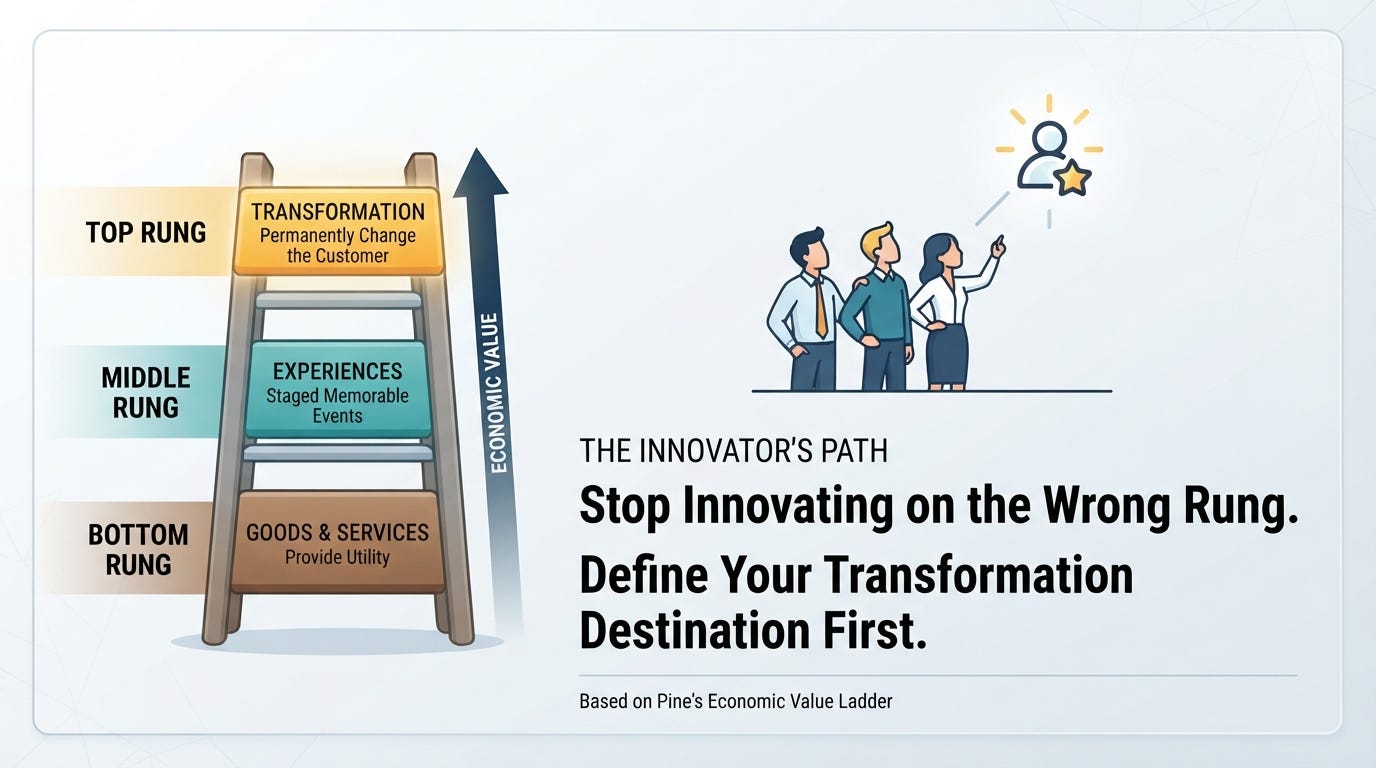 The Missing Rung: Why Your Innovation Efforts Remain Uninspiring and Empty 16.07.2026 12minThe Missing Rung: Why Your Innovation Efforts Remain Uninspiring and Empty As the person responsible for driving innovation in your organisation, you have probably sat through a version of this conversation more than once. The leadership team agrees that a new category is needed. Everyone nods. A workshop is scheduled. Consultants are hired, sticky notes are deployed, and three months later the team resurfaces with a list of incremental improvements dressed up in the language of transformation. Nothing changes. The cycle repeats.This is not a talent problem. It is not a budget problem. It is not even a creativity problem — though it will feel like one. It is a navigation problem. And the reason it keeps recurring is that most organisations begin every innovation effort from the same invisible assumption: that they already know what kind of thing they are trying to become. They don’t. And without that clarity, no workshop, no consultant, and no off-site retreat will produce a genuinely new category. You will keep generating better versions of what you already are.There is a framework that changes this calculus entirely. It arrived quietly, in a new book by Joe Pine — the same strategist who gave executives The Experience Economy twenty-five years ago and reshaped the way the world thought about what companies actually sell.What a Category Actually IsBefore you can design a new category, you need a precise definition of what a category is. In business, a category is not a filing label or a market segment. It is a space in people’s minds — the mental frame that allows a customer to understand what a product is, where it belongs in their life, and why it matters. “Smartphone,” “microwave oven,” and “streaming service” are all categories that someone invented. Each one began as an answer to a need that customers had not yet been able to name.Category design — the deliberate act of creating a new mental frame rather than competing inside an existing one — is widely discussed and rarely achieved. Most executives who attempt it eventually conclude that it requires a creative leap they cannot engineer. That conclusion, it turns out, is wrong. What it actually requires is a ladder.The Ladder Most Executives Have Only Seen Half OfPine’s original insight, from The Experience Economy, was that organisations don’t just sell things — they offer value at different levels, and those levels form a hierarchy. At the bottom are commodities: undifferentiated raw inputs where price is everything. Above that are products: manufactured goods with consistent specifications. Above that are services: activities performed on behalf of the customer. And above that are experiences: carefully staged events that engage customers emotionally and memorably.Every hotel in the world, for example, offers a blend of products and services — a room, a meal, a concierge. A smaller number have moved up to experiences: the Marriott’s flagship properties with their signature design and curated atmosphere. Sandals, in the Caribbean, built an entire brand around the all-inclusive experience category. Each of these companies moved up Pine’s ladder deliberately, and each time they did, they left their competitors arguing about price on the rung below.Here is what Pine’s original framework did not include — and what his new book, Transformation Economy, now adds. There is a fifth rung. Above experience sits transformation: an offering that does not merely engage or delight the customer, but permanently changes them. Not their situation. Not their environment. Them — their skills, their identity, their capabilities, their trajectory.This rung exists in every industry. In most, it is unnamed, unclaimed, and therefore available. It is the most defensible category a company can occupy, and the hardest to copy, because transformation is not a feature. It is a relationship with a long-term outcome.Rung Invisibility: The Hidden Reason Innovation StallsMost companies have never asked which rung they currently occupy. They operate without a precise definition of their own offering type, which means that when they sit down to innovate, they have no fixed starting point. Call it rung invisibility: you cannot climb toward a destination you cannot see.This is the innovator’s dilemma in its most structural form. It is not that successful companies refuse to innovate — it is that they keep innovating on the wrong rung. They add features to products, extend services, improve experiences, and call it transformation. The ladder makes the distinction visible. Once you can see the rungs, you can locate yourself accurately, name the next rung, and build toward it with precision.Waiting With a Destination in ViewIn 2007, Andrew Ng began uploading his Stanford computer science lectures to the internet. The vision was clear: university-quality education, accessible to anyone, anywhere, free. What was not yet ready was the road. Broadband penetration was uneven. Streaming infrastructure was immature. Mobile adoption had not reached the scale required. The concept of learning via video had not yet been normalised for a mass audience.Ng spent five years building precursors, testing formats, and watching the infrastructure mature. When Coursera launched in 2012, it was not because the idea had finally arrived — it was because the enabling conditions had. MasterClass followed a similar logic: the transformation offering was clear (learn directly from the world’s best practitioners, not just their subject matter), but the model required cinematic production quality and broadband capable of delivering it at scale. Both companies launched not when they were ready, but when the world was.This is a categorically different posture from running innovation workshops. It is not luck. It is not serendipity. It is the discipline of naming a destination — a specific rung, a specific transformation offering — and then building the long-term strategy around the conditions that will make the climb viable. Pine himself waited over twenty-five years to write Transformation Economy. As he has said, the world simply wasn’t ready before now.Corporate Inspiration at Its FinestAs a leader, you have probably tried to inspire your organisation through personal energy — motivating speeches, bold vision statements, off-site retreats designed to generate momentum. When the results are mixed, the temptation is to conclude that you need more charisma, a better facilitator, or a more compelling narrative. You don’t. What you need is a structure that does the inspiring for you.This is what Pine’s ladder offers when it is embedded in a corporate strategy: inspiration that lives in the architecture of the plan itself. Aspirational but credible. Fact-based. Free of hyperbole. Specific enough to span a decade without losing its force. When employees understand not just what the company does today but which rung it is climbing toward — and what conditions the organisation is watching for — they engage differently. The destination gives their work a direction that no workshop can manufacture.Steve Jobs was explicit, in at least one public interview, that Apple’s strategy was to wait — to define the destination clearly and hold it until the technology matured enough to make the climb possible. Inside Apple, the roadmap to the iPhone and iCloud gave those who knew it something to work toward that transcended any individual product cycle. That kind of inspiration is structural, not charismatic. It is replicable. And it begins with locating yourself honestly on the ladder.What to Do NextEvery organisation, without exception, can do this. The transformation rung exists in your industry. It is almost certainly unnamed. The fact that it is unclaimed is not a warning — it is an invitation.The work begins with three questions. What rung does your organisation currently occupy — precisely, not aspirationally? What would a transformation offering look like in your sector: what would it permanently change about your customer? And what enabling conditions — technological, cultural, regulatory, infrastructural — are not yet mature, but are on their way?The EndPoint Method offers one systematic approach to answering these questions within a long-term strategy process. But the starting point is available to any leadership team willing to look at the ladder honestly and ask where they are.Innovation is not a creativity problem. It is a navigation problem. Pine’s ladder is the instrument. The fifth rung is waiting.PS — Five Prompts to Take This FurtherUse these with any AI assistant (Claude, ChatGPT, or similar). Replace the bracketed text with your own details.Prompt 1 — Locate your rung “I work in [industry]. Our core offering is [brief description]. Using Joe Pine’s five-rung ladder — commodities, products, services, experiences, transformations — help me identify which rung we currently occupy and what evidence supports that assessment. Be precise, not flattering.”Prompt 2 — Define the transformation offering “In the [industry] sector, what would a genuine transformation offering look like? Define it using Pine’s standard: an offering that permanently changes the customer themselves, not merely their situation or experience. Give me three specific examples of what this could mean for a company like [company type].”Prompt 3 — Map the enabling conditions “The transformation offering I want to build is [brief description]. What external conditions — technological, cultural, regulatory, or infrastructural — are not yet mature enough to support this at scale? Which of these are likely to mature in the next five to fifteen years, and what signals should I be watching for?”Prompt 4 — Diagnose your innovation process “My organisation runs [describe your current innovation process — workshops, sprints, planning cycles]. Using the concept of rung invisibility — the idea that companies cannot innovate toward a destination they cannot see — identify the specific points in our process where the absence of a named transformation rung is likely to be causing us to recycle existing assumptions.”Prompt 5 — Draft the strategic narrative “Help me write a one-page internal strategic narrative for my leadership team that: names our current rung on Pine’s ladder, defines the transformation offering we are building toward, identifies the two or three enabling conditions we are watching, and explains why this is a navigation strategy rather than a creativity exercise. Tone: direct, credible, free of consultant language.”P.S. The LTSP26 Conference is open for registration on the conference website and on on Linkedin. https://www.linkedin.com/events/7475287796359028737. Part of the lineup will feature Category Cathy, an interactive AI persona with unique knowledge of work by experts like Joe Pine, author of Transformation Economy. This is a public episode. If you'd like to discuss this with other subscribers or get access to bonus episodes, visit longtermstrategy.substack.com/subscribe
 -
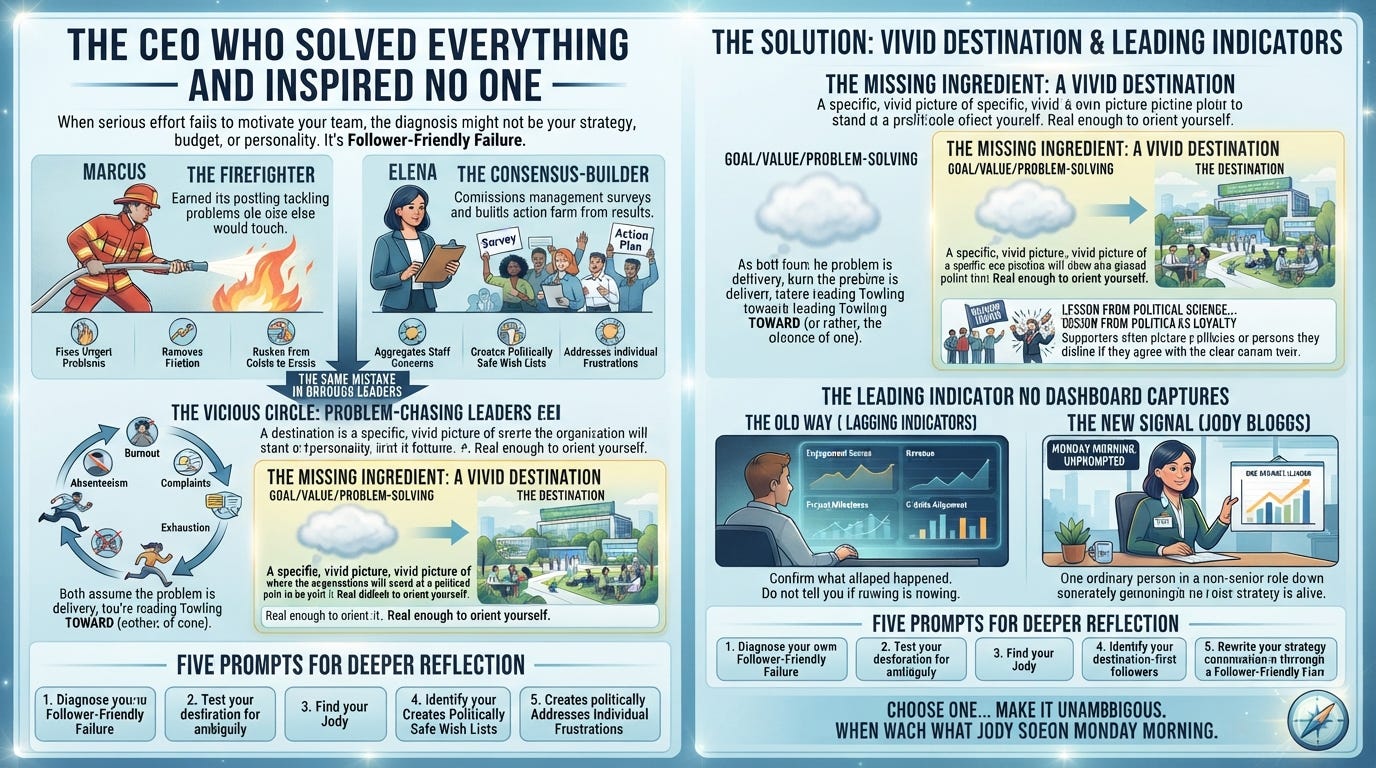 The CEO Who Solved Everything - But Inspired No-one 10.07.2026 11minTranscriptThe CEO Who Solved Everything — and Inspired No OneYou are putting in serious effort to motivate your team — and it still isn’t working. The hours are long, the intent is genuine, and the results are stubbornly flat. Before you blame your communication strategy, your budget, or your personality, consider a different diagnosis entirely.Two fictional CEOs illustrate the problem.Marcus is a decisive firefighter. He earned his position by tackling the problems nobody else would touch, and he has been doing the same thing ever since. Elena takes a more consultative path. She commissions engagement surveys, listens carefully to what staff say, and builds action plans from the results.Yet both are looking at the same uncomfortable numbers: absenteeism climbing, burnout reports rising, and employees quietly asking each other, “Where exactly are we headed?” Both assume the problem is in the delivery — the messaging, the resources, the rollout. They are looking in the wrong place.The actual diagnosis is a pattern called “Follower-Friendly Failure.”The Same Mistake in Different ClothesFollower-Friendly Failure is the attempt to build organisational momentum by removing friction. Fix the complaints. Address the survey results. Solve the urgent problems. The instinct is generous — leaders genuinely want to make things better for their people — but the strategy is structurally flawed.Marcus and Elena look like opposites: urgent problem-solver versus consensus-builder. But they are making the same error in different packaging. Their failure is not in how they lead. It is in what they are leading toward — or rather, the absence of any clear answer to that question.Elena’s approach is particularly instructive. Aggregating staff concerns produces a politically safe wish list, not a strategy. It assumes that resolving individual frustrations will compound into collective motivation. It won’t. Addressing one round of complaints simply surfaces the next round. The circle is vicious, and staff eventually exhaust themselves chasing problems that regenerate faster than they are solved.The missing ingredient is not smarter problem-solving. It is a destination.In this context, a destination is not a goal, a value, or a problem to be solved. It is a specific, vivid picture of where the organisation will stand at a defined point in the future — real enough that an ordinary person can orient themselves toward it.What Political Science Reveals About LeadershipResearch on voter behaviour offers an unexpected window into how destination-clarity functions as a loyalty mechanism. Studies of Donald Trump’s coalition have consistently found that roughly 25–35% of his supporters privately dislike specific policies, find aspects of his persona difficult, and disagree with particular decisions. They back him anyway.The reason is not charisma, party loyalty, or agreement with the plan. It is agreement with the destination. These voters know where he says the country is going, and that clarity holds them even when the specific steps, or personal foibles do not.The organisational parallel is direct. Every leadership group contains a subset of destination-first followers — people who will tolerate management friction, imperfect policies, and even a leader they find personally disagreeable, provided they can see clearly where the organisation is headed. Marcus and Elena have no mechanism for reaching this group because neither has named a destination unambiguous enough to reach them.This is what Dr. Riel Miller, a UNESCO senior adviser, calls Futures Literacy: the capacity to use the future as a resource for acting in the present. It requires holding the future genuinely open — treating several possible destinations as real — until a single, unambiguous endpoint is chosen. Once that commitment is made, something shifts. Inspiration and discretionary effort are not manufactured through communication techniques. They are released.This distinction matters more than most leadership development programmes acknowledge. Charisma, communication skill, and policy competence are all useful. But none of them substitute for a destination that employees can inhabit in their imagination before they inhabit it in realityThe Leading Indicator No Dashboard CapturesExecutives searching for evidence that a strategy is working typically reach for lagging indicators: engagement scores, C-suite alignment, project milestones, revenue shifts. These confirm what has already happened. They do not tell you whether the organisation is actually moving.There is a better signal, and it costs nothing to detect.Consider an employee — call her Jody — who works in a mid-level, non-senior role. Her department has been identified as high-leverage: it sits in the 20% of organisational effort that drives 80% of strategic results, directly connected to a 15-year destination the company has committed to.Without a clear destination, that leverage is invisible to Jody. She spends Monday doing what she did the Monday before. This is not apathy. It is a rational response to ambiguity. When no clear endpoint exists, the safest professional behaviour is to replicate what worked yesterday. Jody is not the problem. The missing destination is.With one — a specific, unambiguous endpoint she can picture and act toward — something different happens. On Monday morning, unprompted by her manager, she spends three hours doing something she has never done before: taking deliberate actions aligned with where the organisation says it is going. Not because she was told to. Because she can see the destination and has decided to move toward it.Notice what did not cause this shift: not a town hall, not a revised KPI framework, not a team-building exercise. The destination did the work. Her manager’s job, once the destination is clear, is largely to stay out of the way.That behaviour — one ordinary person in a non-senior role doing something genuinely novel in alignment with the stated direction — is the leading indicator that a strategy is alive. Engagement surveys can score well while this signal is completely absent. The signal’s presence means the destination has landed. Its absence means it has not, regardless of what the dashboard reads.When enough Jodys emerge across an organisation, the needle moves. Not because leadership pushed harder, communicated more cleverly, or solved one more urgent problem. But because ordinary people with real jobs decided, on their own initiative, that the destination was worth moving toward.The practical implication is uncomfortable for leaders trained in comprehensive planning: resist the pressure to make the destination inclusive. A destination designed not to alienate anyone ends up directing no one. Choose one. Make it unambiguous. Then watch what Jody does on Monday morning.Five Prompts for Deeper ReflectionUse these with any AI assistant (or as journaling prompts) to apply the ideas in this article to your own leadership context.Prompt 1 — Diagnose your own Follower-Friendly Failure“Here is how I currently try to motivate my team: [describe your approach]. Based on the distinction between problem-fixing and destination-setting, identify where my current approach might be producing Follower-Friendly Failure. What am I likely missing, and what would a clearer destination look like in my specific context?”Prompt 2 — Test your destination for ambiguity“Here is our current strategic vision or mission statement: [paste it]. Assess whether this constitutes a genuine, unambiguous destination that an ordinary employee could act toward on Monday morning — or whether it is a wish list, a values statement, or a problem-solving agenda in disguise. Then suggest what a sharper destination might say instead.”Prompt 3 — Find your Jody“Our organisation has articulated the following strategic direction: [describe it]. Help me identify what a ‘Jody Bloggs’ signal would look like in our context — that is, what specific, observable, novel behaviour by a non-senior employee would indicate that our destination has genuinely landed, rather than merely been communicated.”Prompt 4 — Identify your destination-first followers“The article describes a subset of followers who are loyal to a destination rather than to a leader’s personality or specific policies. Thinking about my own team or organisation, help me profile what this group might look like: how would I identify them, what do they need from a destination to engage, and how might I be inadvertently failing to reach them with my current communication?”Prompt 5 — Rewrite your strategy communication through a Futures Literacy lens“Here is how I typically communicate our strategy to staff: [paste an example — a town hall script, an all-staff email, a strategic summary]. Rewrite this using Futures Literacy principles: remove problem-solving language, eliminate wishlist elements, and replace them with a single unambiguous destination that an ordinary employee could picture and act toward. Show me the before and after side by side.” This is a public episode. If you'd like to discuss this with other subscribers or get access to bonus episodes, visit longtermstrategy.substack.com/subscribe
 -
 Where AI Belongs in Strategy — and Where It Will Wreck You 15.06.2026 12minIn the early 1980s, McKinsey told my employer at the time, AT&T, that the global market for mobile phones would top out at roughly 900,000 subscribers by 2000.The actual number was 100 million.A decade later, AT&T paid $11.5 billion for McCaw Cellular to claw its way back into the market it had walked away from.Hundreds of America’s brightest minds had read the same report, nodded at the same conclusion, and missed by two orders of magnitude. The forecast was polished, confident, and built entirely on data from the past. It was, in today’s vocabulary, trendslop — and it predated AI by half a century.If you sit at the top of a company anywhere in the world, you are now being asked to make similar bets with a tool that produces trendslop on demand. A recent Harvard Business Review article, “Researchers Asked LLMs for Strategic Advice. They Got ‘Trendslop’ in Return”, called out the pattern directly. Ask a large language model for strategic advice and you get confident, polished output that sounds insightful — until you look closely and realise it could have been written by a competent intern in an afternoon.The good news: your instincts about AI are right. It can sharpen your strategy work. It can also wreck it.The bad news: no settled playbook yet tells you which is which.The Iron Rule You Already KnowAs a young internal consultant at AT&T, I learned a discipline that has aged better than most of the company’s 1990s forecasts: Don’t automate what you haven’t baselined.The same idea runs through every quality programme Toyota exported to factory floors around the world. Before you mechanise a process, you map it. You measure it. You understand its variation. Only then do you bring in the machine.The current rush to “put AI into strategy” ignores this rule. Most executive teams cannot describe how their own strategy actually gets made. Strategy creation happens once every two or three years. It rarely gets documented. Institutional memory leaks out with every senior departure. No baseline exists.Then the LLM is invited in. And it produces — predictably — trendslop.The problem isn’t the AI. The problem is that the iron rule was broken before the model was ever prompted.Where AI Helps, Where It HarmsThe EndPoint Method I use breaks strategy work into six stages: build a Snapshot of where you are today; pick a Target Year fifteen to thirty years out; generate Scenarios for that future; pick one scenario and translate it into numbers; Backcast milestones from that endpoint to the present; and only then build a Short-Term Strategy Map for the first two years.Across more than sixty engagements, I have watched AI’s effect on each stage. The pattern is now clear.AI is a net positive in exactly one stage: the Snapshot. Here, the work is synthesis — pulling together what is already known about your organisation, your market, and your competitive position. The LLM reads documents fast, finds patterns across them, and surfaces contradictions in your own data that the room had stopped seeing. It augments without replacing.AI is destructive in two stages, and they happen to be the most consequential: Picking a Target Year, and Picking-and-Translating a Single Scenario into Numbers.These are the moments of commitment. They demand differentiation — a stance that sets your firm apart from the average. An LLM, by design, gives you the average. It will hand you a target year that mirrors what every other company in your sector has chosen. It will quantify your scenario the way every scenario in its training data has been quantified. Use it here and you sleepwalk into the same future as your competitors.The remaining three stages — Generating Scenarios, Backcasting, and Short-Term Strategy Mapping — are mixed. AI helps when used as a sparring partner. It harms when used as a decision-maker.The FixOver the past year, my team has run strategic planning retreats with AI integrated at chosen moments and in a deliberate way — never as the source of commitment.The pattern that works is consistent. The group defines the issue and its causes manually first — sometimes a recent trend, sometimes a decade-long problem. Only then is the LLM brought in, with a sharp prompt. For example: “Given the persona we have just described and the specific belief they hold, what three scenarios could shift their attitude?”Within seconds, the group absorbs the conventional wisdom and moves past it. The LLM expands ideas, synthesises inputs, and surfaces blind spots the room could not see on its own. It is never asked to commit, to judge, to prioritise, or to own a tradeoff.Decompose your strategy work. Insert AI only where it adds value. Keep human commitment, judgement, and ownership intact.What This Quarter Looks LikeThe executives who win the AI moment in strategy will not be the ones who feed their hardest questions to an LLM and hope for the best. They will be the ones who honour AT&T’s iron rule and Toyota’s philosophy of automation: baseline first, then mechanise.So here is the work in front of you this quarter.Do not ask the LLM where to take your company. Ask it to help you see what you already have. Build the Snapshot. Map your strategy-making process for the first time. Document the institutional memory before it walks out the door.Only then, and only at the stages where it adds value, bring AI into the room.Your suspicion was right on both counts. AI can improve the process. AI can also do damage. Baseline first. Then, and only then, automate.Five Prompts to Take This Further1. Diagnose your current practice. “Describe how strategy actually gets made in our company today — who initiates it, what inputs feed it, how decisions get committed to, and where the process is undocumented. Then identify three places where we are currently asking AI to do work we have never baselined.”2. Audit your strategy document for trendslop. “Here is our current strategy document [paste]. Identify every statement that could plausibly appear in any company’s strategy document in our industry. Highlight the language that is generic, average, or undifferentiated — and explain why each phrase fails to set us apart.”3. Build a working Snapshot. “Read these three documents: last year’s plan, our most recent board minutes, and our latest competitor analysis [attach]. Surface every contradiction between them, every unexamined assumption, and every gap in evidence. Do not propose solutions — only surface what is already there.”4. Sharpen a scenario with an opposing view. “We are considering [X scenario] as the future our strategy is built around. Argue against it. Give me the five strongest reasons a sceptical board member would push back on this scenario, and the historical analogies they might cite.”5. Pressure-test your commitment. “Here is the single scenario we have chosen and the numbers we have attached to it [paste]. Identify the three commitments we are implicitly making that the rest of the document does not acknowledge. Where would this strategy break if our chosen Target Year arrived three years later than expected?”P.S. The impact of AI on strategy creation is forcing its way into our thinking every day. You wish you could keep up, but so much is changing so quickly that it's hard. The good news is that this is the theme of our September 15-17, 2026 strategy conference. Save the date in your calendar! This is a public episode. If you'd like to discuss this with other subscribers or get access to bonus episodes, visit longtermstrategy.substack.com/subscribe
 -
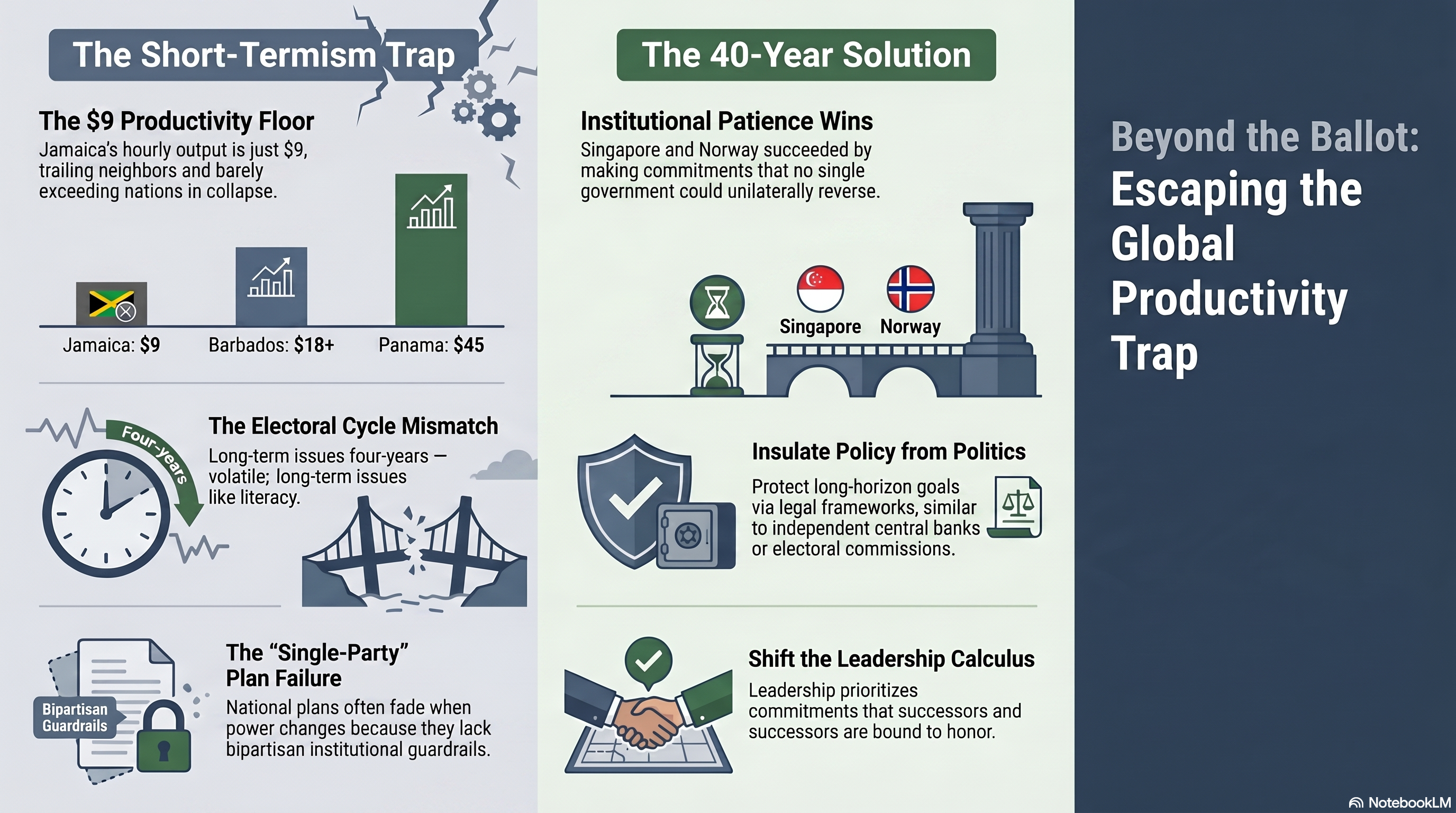 The Productivity Trap No Election Can Fix 08.06.2026 11minThere’s a number most government leaders would rather not think about. For Jamaica, it’s nine dollars.That’s the country’s productivity measured as output per hour worked — US$9. Barbados, a neighboring island economy, produces more than twice that. Panama produces five times as much. Most strikingly, Jamaica’s hourly output is only marginally ahead of Haiti’s — a country that has experienced decades of political collapse and natural disaster.The numbers are sobering. But they are not unique to Jamaica. Across the developing world, governments face a version of the same arithmetic: their economies are generating far less per hour of human effort than they should, the gap is wide, and it has been wide for decades.What is less often discussed is the role that government itself plays in perpetuating that gap.The Largest Economic Actor in the RoomIn many developing economies, government directly produces somewhere between 15 and 20 percent of GDP through goods and services. That makes it the single largest economic actor in the country — larger than any company, sector or industry.But its true influence extends much further. Government shapes the entire environment in which the other 80-plus percent of economic activity takes place, through four distinct levers: macroeconomic stability, institutional quality, infrastructure and public goods, and the signals and expectations it sends to investors, businesses and citizens about the future.That fourth lever is the most underestimated. When a government is unpredictable, inconsistent or widely distrusted, it suppresses private investment and enterprise far beyond anything that shows up in its own budget. Conversely, a government that signals credible, long-term commitment to stability and growth creates a multiplier effect on every dollar the private sector deploys.Jamaica has made genuine, internationally recognized progress on the first lever. Its fiscal turnaround since 2013 has been studied by other nations as a model of discipline. Debt ratios have fallen. Inflation has been tamed. And yet GDP growth has not followed at the pace the data might suggest it should. The reason is that macroeconomic stability, while necessary, is not sufficient. The other three levers matter just as much — and progress on those fronts is slower and harder to sustain across electoral cycles.Why Elections Are the Wrong Unit of TimeThe deeper problem is structural. Governments, by design, operate on four- or five-year cycles. The problems that most constrain developing economies — workforce quality, institutional trust, infrastructure, behavioral norms — compound over decades. They cannot be fixed within a single term. Often they cannot be fixed within a generation.Take literacy. Jamaica’s literacy rate trails comparable peer countries by five or more percentage points — a gap that has been building since the 1960s. That gap is a direct and stubborn drag on workforce productivity. Closing it requires sustained investment and policy consistency across twenty or thirty years, not one budget cycle. The same logic applies to institutional quality, infrastructure and public trust. These are slow variables. They respond to patient, consistent effort — not to whoever won the last election.This is not pessimism. It is arithmetic.The Countries That Played the Long GameTwo examples are instructive, and they have been cited often precisely because they are so striking.Singapore in the early 1960s had a GDP per capita comparable to Jamaica’s. It was a small, resource-poor island with a mixed population, uncertain regional relationships and no obvious competitive advantages. Today it is among the wealthiest and most productive nations on earth.Norway had oil. So did Nigeria, Angola, and Venezuela. The difference was that Norway resisted the temptation to spend its resource windfall immediately and instead built institutional structures — including a sovereign wealth fund now worth over a trillion dollars — designed to distribute wealth across generations rather than electoral cycles.Both Norway and Singapore have populations of around five to six million — comparable in scale to many Caribbean and Central American nations. Scale was not destiny. What separated them was institutional patience: the willingness to make commitments that no single government could unilaterally reverse.The Design Flaw in Most Development PlansMany developing nations have tried long-term national development planning. The typical failure mode is nearly always the same: the plan belongs to one party. When the government changes, the plan either changes with it or quietly fades from view.Jamaica’s Vision 2030 — an ambitious plan built around the aspiration to become “the place of choice to live, work, raise families and do business” — started with a bipartisan commitment, but has largely followed this pattern in recent years. It is rarely invoked by either major political party today. Its successes have not been studied. Its failures have not been honestly diagnosed.Trinidad and Tobago offers a cautionary parallel. Multiple governments there have attempted national development plans under single-party mandates. Without cross-party commitment, each plan has been vulnerable to revision or abandonment when power changed hands. The structural challenges — growth, productivity, crime — remain largely unresolved.The evidence from countries that have succeeded suggests a different architecture is required. Long-term national commitments need to be insulated from ordinary political interference — protected by cross-party agreement, legal frameworks and institutional norms in the same way that independent central banks or electoral commissions are protected. The goal is not to remove politics from policy. It is to place the most consequential long-horizon commitments beyond the reach of short-term political calculation.This is not a utopian idea. It has been done — in countries that once looked very much like Jamaica does today.The Immediate Return on Patient ThinkingThere is a paradox worth naming. Patient, long-horizon thinking doesn’t only produce results over decades. It produces its first results immediately — in the minds of the leaders who adopt it.The moment a government leader genuinely shifts from “what can I deliver before the next election?” to “what structural commitment can I make that a successor will be bound to honor?” — that shift is itself a form of progress. It changes which conversations happen, which trade-offs get made, which investments get prioritized. Institutional culture changes before the metrics do.For any leader in the public sector who recognizes the structural arithmetic above, the question is not whether to think long. It is whether to do so quietly or loudly.Either way, the calculus is the same. The countries that changed their trajectories did not do it in four years. They did it by making four-year decisions that pointed consistently in the same direction for forty.Only the nations — and the institutions — willing to make and protect patient commitments have a realistic chance of closing the gaps that actually matter.5 Prompts to Put These Ideas to WorkThe arguments in this article become more useful when applied to your own institution. These prompts are designed for use with any AI assistant (Claude, ChatGPT, Gemini, etc.). Work through them in order — each builds on the last.Prompt 1 — Reflect “I lead [describe your ministry, agency or department] in Jamaica. The article I just read argues that government influences GDP through four levers: macroeconomic stability, institutional quality, infrastructure and public goods, and public signals and expectations. Ask me a series of questions to help me identify which of these levers my organization influences most directly — and where the biggest performance gaps are.”Prompt 2 — Reflect “Here is my organization’s current strategic plan: [paste it]. Review it against this standard: which commitments are genuinely structural — meaning they require ten or more years to fully realize — and which are short-term fixes unlikely to outlast the current administration? Then identify what is missing from the long-term column.”Prompt 3 — Apply “Jamaica’s literacy gap has been building since the 1960s and is described as a ‘stubborn contributor’ to low productivity. Help me identify the equivalent stubborn contributors in my sector — the slow-moving structural gaps that no single government can fix alone. What data would I need to make this diagnosis rigorously, and what would a credible 20-year improvement trajectory look like?”Prompt 4 — Create “Using Singapore and Norway as reference points — both small nations that made long-horizon institutional commitments that outlasted individual governments — help me draft a one-page strategic hypothesis for my organization. It should answer: what is the single most important structural commitment my institution could make today that would still be bearing fruit in 2040? Start by asking me three questions about my organization’s current situation.”Prompt 5 — Master “The article argues that Jamaica’s Vision 2030 failed partly because it lacked cross-party commitment — and that durable long-term plans must be insulated from political interference the way electoral commissions are. Help me design a cross-party commitment framework for one specific policy priority in my sector. What institutional mechanisms would make it durable enough to survive a change of government? What would have to be true politically, legally and culturally for this to hold?” This is a public episode. If you'd like to discuss this with other subscribers or get access to bonus episodes, visit longtermstrategy.substack.com/subscribe
 -
 The Two Meetings That Turn Long-Term Strategy Into Motion 05.05.2026 17minMost top executives can generate urgency around a quarterly target. The mechanisms are familiar: dashboards, deadlines, compensation levers. People move.But ask those same executives to build genuine momentum toward a grand aspiration which needs a fifteen-year horizon, and something strange happens. They show up. They nod. They wait for the pressure to pass.This isn’t insubordination. It’s a rational response to a broken process. And if you’ve ever led a strategic planning cycle that produced a polished document nobody touched again, you already know the symptom. The question is whether you’ve correctly diagnosed the cause.The Real Problem Is Sequence, Not AmbitionCEOs who struggle to activate major aspirations or breakthrough results typically frame it as a people problem — their teams aren’t bold enough, disciplined enough, or strategically literate enough. Frequently, they apply pressure to fix the problem and become too directive. They hope their personal energy fills the void.Perhaps just as often, they do the opposite and become too passive. In this mode they back off, hoping organic energy fills the void. It rarely does.Neither framing is quite right. In the end, CEO’s migrate towards short-term goals because they don’t have a reliable way to maintain both short-, mid-, and long-term momentum.The deeper issue is that most organizations try to do too much in a single planning meeting. Effective accomplishment of all three phases at the same time requires two distinct meetings, held weeks apart, each demanding a different posture from the leader. Getting the sequence right changes what the plan is, who owns it, and how fast it can move.Clarifying Misconceptions About Long HorizonsBefore the two meetings make sense, two widespread beliefs need to be addressed: the first is that long-range planning is inherently vague, and therefore not worth taking seriously. Mistake 1) This is a problem for CEOs who truly have big aspirations, because long-range planning calls for the decades needed to make breakthrough goals realistic and credible to stakeholders. Without adequate time, executives play the game mentioned before. They show up, nod, and wait for the pressure to disappear.This view of long-range planning being vague is understandable but technically wrong. The planning tools appropriate for year one of a strategy are genuinely different from those suited to year twenty-five — but that doesn’t mean the far end of the horizon is a guess. It just needs to be equipped in the right way.For example, the Rolling Wave Technique leads to the use of different methods, mindsets and discussions for short- and long-term phases. It provides operational details in the short term, and higher-altitude targets and milestones in the long term.Neither end is more rigorous than the other. They are rigorous in different ways. The confusion exists because precious few use the technique. It’s just not taught in most business schools as a component of corporate strategy.Mistake 2) The second faulty belief is that long-term aspirations don’t matter. To explain why this is so wrong, consider a historical example.Medieval cathedral builders routinely committed to projects spanning two to three centuries. No individual craftsman who broke ground would see the finished nave. Yet construction continued across generations, through plagues and political upheaval, because the aspiration was large enough to give the work meaning — and specific enough to give it credible direction. Floor plans existed. Proportions were specified. Progress was measurable even when the endpoint was a lifetime away.This points to a counterintuitive truth: the grander the ambition, the more likely it is to unlock discretionary effort — the creativity and energy people typically reserve for pursuits they actually care about. Modest, short-term goals produce compliance. In corporate life, these tend to be overwhelmingly financial.Transformative goals, properly constructed, produce ownership. The audacity of a well-chosen endpoint is itself a management tool, one that most corporations never pick up.With these misconceptions cleared up, here are the details of both meetings and how they are conducted.Meeting One: The CEO Goes QuietThe first meeting has one non-negotiable design principle: the CEO sponsors but does not lead. Or facilitate.This is harder than it sounds. Most executives who have reached the top of an organization have done so partly through the force of their vision. They arrive at planning sessions having already formed views about where the company should go. The instinct is to share those views early — to inspire the team with a compelling picture of the future and let the session fill in the details.Resist it. Completely.The goals of this first meeting are for the executive team to construct the long-range aspiration themselves and define the means to accomplish it. That means choosing a target year — somewhere between fifteen and thirty years out — and then building the assumptions, scenarios, and numbers required to define what success looks like at that point. It’s followed by the use of the Rolling Wave Technique to lay out a plan for the entire horizon, with more details in closer than later years.Facilitators can guide the process. The CEO’s role is to hold the space while that process unfolds, tolerating the discomfort of an outcome they did not pre-select and cannot entirely predict.What makes this worthwhile is what it produces: genuine co-ownership. Every figure the team debated, they will later defend. Every scenario they stress-tested, they trust because they built it. A strategic target and plan defined by the CEO and handed to the team is a document. A strategy the team constructed is a commitment — and the difference shows up in execution, not in the planning room.For example, one team member assumes a technology shift in five years. Another assumes fifteen. Both assumptions are driving their instincts about investment and timing, silently, in every meeting they attend. Naming those beliefs, debating them, and converting them into dated claims is one of the most underrated outputs of a well-run long-range planning session. It also reveals where the team’s consensus is genuine and where it is merely polite.Meeting Two: The CEO Becomes an InstigatorSeveral weeks after the first meeting — long enough for the plan to feel real, not so long that momentum fades — the CEO calls a second session. It has a single agenda item, framed as a question:“Using the same logic we built together, how much faster could we realistically get there?”The phrasing matters more than it might appear. This is not a demand for “twice the output in half the time” — the kind of arbitrary stretch target that produces creative accounting and quiet cynicism. It is an invitation to apply the team’s own reasoning to a compression problem. They set the destination and the pathway. Now they are being asked whether the chosen route is as efficient as it could be.And because the team built the original logic, they are the only people positioned to answer the question credibly. They know which assumptions were conservative. They know where interdependencies between units create natural leverage — and where they create drag. They know which technologies on the industry’s horizon could compress a transition the plan assumed would take a decade. They know where the plan padded timelines because of organizational inertia rather than genuine constraint.That collective intelligence almost never gets activated, because the question that unlocks it is almost never asked. Unfortunately, leaders tend to apply pressure before the team has built the logic, which means compression becomes a negotiation rather than an analysis. The two-meeting sequence reverses that order — and the difference in what the team produces is striking.The best version of this second meeting doesn’t only produce a revised plan. It produces a set of credible acceleration options: specific conditions under which the timeline compresses, specific investments or decisions that could trigger those conditions, and an honest accounting of what would have to be true for the faster scenario to hold. The team leaves not just aligned, but strategically fluent in a way that one-off retreats almost never achieve.Case in point: Before 2017, one of my clients in the Jamaican financial sector had never put a date to an assumption: “the average local customer is not ready for online services.”When I challenged them to place a date on the moment when 50% of the population would reach that threshold, they predicted: 2028. They wove that date into their plan.Three years later when the COVID-19 pandemic arrived, that plan was simply accelerated (i.e. compressed) to be implemented within months rather than a decade. They were lucky.The Resilience DividendThere is a benefit to this process that rarely appears in planning frameworks: the organization becomes significantly harder to surprise.An executive team that has jointly built a long-range plan, surfaced its embedded assumptions, dated them, stress-tested scenarios, and explored acceleration options has essentially pre-thought a wide range of futures. When the external environment forces their hand — a market disruption, a technology shift, a crisis that compresses years into months — they are not improvising. They are activating a version of something they already worked through. The decisions feel fast because they had already built the internal logic needed to respond. This is not a theoretical benefit. Organizations routinely discover, under pressure, that their plans contained a faster path they simply hadn’t chosen to pursue yet. The companies best positioned to accelerate in a crisis are the ones that already knew, in principle, how acceleration was possible — because they had asked themselves exactly that question before one was forced on them.The slow work of building shared logic, it turns out, is what makes rapid response possible. Resilience isn’t built in the crisis. It’s built in the room, in the meeting before the meeting, when the CEO is quiet enough to let the team think.Why This Rarely Happens — and What to Do About ItThe reason most aspirations which require long-term strategies end up stalling is that the people accountable for executing them never felt genuinely accountable for creating them. The CEO’s vision, however compelling, remains the CEO’s vision. Rollout becomes performance. Compliance replaces conviction. And when conditions change, there is no one in the room who feels responsible for updating the logic — because the logic was never theirs.The two-meeting structure addresses this not through a motivational technique but through a structural one. Ownership is built in at the design stage. The compression question in the second meeting then activates that ownership, rather than challenging it.The process asks something genuinely difficult of the CEO: to be quiet and patient at the moment when they most want to speak, and to ask a question — rather than issue an instruction — at the moment when they most want to apply pressure. Both moves feel counterintuitive. Both, consistently, work.Begin with the meeting where you say less than you ever have before. What comes next will surprise you.Use These LLM Prompts to Apply This FrameworkCopy any of the following into an AI assistant to put the ideas in this article to work for your organization.1. Pressure-test your current strategy “Here is our current strategic plan: [paste or summarize]. Using the Rolling Wave principle from the article I just read, identify where our plan conflates short-, mid-, and long-term planning into a single approach. What assumptions are we treating as facts? Which ones should have a specific date attached to them?”2. Prepare for Meeting One “I am a CEO preparing to run a long-range planning session where my role is to facilitate, not lead. Our industry is [X]. Help me design a 3-hour agenda that guides my executive team to construct a 20-year aspiration themselves, without me imposing a conclusion. Include the questions I should ask — and the ones I should resist asking.”3. Surface your team’s hidden assumptions “Here are the key assumptions embedded in our strategy: [list them]. For each one, challenge me to convert it from an open-ended belief into a dated, falsifiable claim. Then identify which assumptions, if wrong, would most significantly change our direction or timeline.”4. Run the compression question “Here is a summary of our long-range plan: [paste summary]. Assume the logic is sound. Now help me identify: which parts of this plan are paced by genuine external constraints, and which are paced by internal inertia or conservative thinking? Where could the timeline realistically compress — and what would have to be true for that to happen?”5. Build your resilience map “Based on the strategic plan below [paste], identify the three to five external disruptions — technology shifts, market changes, regulatory moves — most likely to force an acceleration of our timeline. For each, describe what an already-prepared organization would do in the first 90 days, versus one that had never considered the scenario.”The original version of this article was published in the Jamaica Gleaner. This is a public episode. If you'd like to discuss this with other subscribers or get access to bonus episodes, visit longtermstrategy.substack.com/subscribe
 -
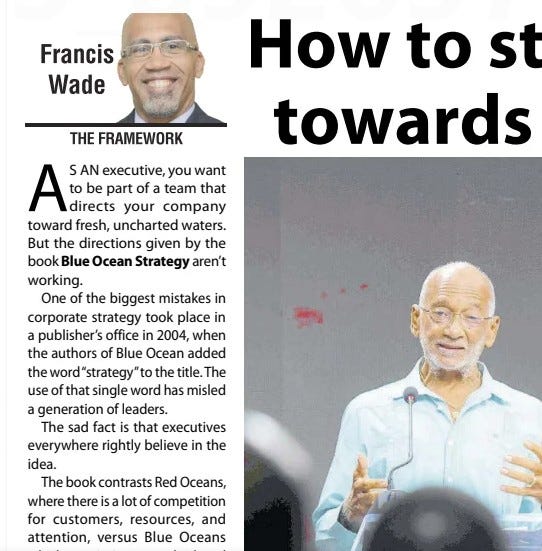 Blue Ocean Strategy Has a Flaw Nobody Talks About 30.04.2026 15minThere is a book on the shelf of almost every serious executive in the world. It has sold over four million copies, been translated into 46 languages, and spawned an entire consulting industry. Its central idea is so compelling that once you hear it, you cannot unhear it.The book is Blue Ocean Strategy (BOS), published in 2004 by W. Chan Kim and Renée Mauborgne. The central idea: stop fighting competitors for the same shrinking pool of customers. Create new market space where competition is irrelevant. Stop swimming in a Red Ocean of blood and churn. Find your Blue Ocean.Every executive who has heard this wants it. The aspiration is sound. The problem is that the book quietly fails to deliver what its title promises - and that failure has cost organizations time in over two decades of strategy retreats.The Word That Did the DamageThe most consequential editorial decision in modern management publishing happened when the authors agreed to put the word “Strategy” in the title.That single word changed how executives read the book. Strategy implies a plan. A method. A set of steps you can follow to get from where you are to where you want to be. Executives arrived at the book expecting operational guidance. What they received instead was one of the most elegant collections of business case studies ever assembled — and no instructions for replication.Consider the cases. Cirque du Soleil, the book’s showcase story, reinvented the circus by eliminating animals and creating a sophisticated adult entertainment category. Yellow Tail wine made wine approachable for beer drinkers by stripping out complexity and jargon. NVIDIA opened its graphics processors to general computing and created an entirely new category of accelerated processing. Taylor Swift reinvented the artist’s relationship to fans, catalog ownership, and brand extension.Each case is vivid. Each pattern is compelling. But each story was crafted long after the journey was complete.That is the problem. Every case in the book is retrospective. The authors identified companies that had already succeeded, mapped their moves, and presented the pattern. What they did not — and perhaps could not — provide is a repeatable method for how your company executes a similar move from scratch, in your industry, with your constraints, before the outcome is known.This is not a minor gap. It is the structural flaw that separates the book’s promise from its delivery. And it helps explain why boardrooms around the world have produced beautiful strategy canvases (as the book instructs) and returned to fighting the same competitive battles the following Monday morning.The Tool That Starts in the Wrong PlaceThere is a deeper problem, and it lives inside the book’s primary diagnostic instrument — the Eliminate, Reduce, Raise, Create grid, known as the ERRC.To use the ERRC grid, you map what your industry currently does across every competitive factor, then decide what to eliminate, reduce, raise, and create. Every factor you analyze is defined in relation to what competitors already do. The entire diagnostic starts with your rivals.Here is the irony: a framework designed to help you escape competition requires you to think about competition first. If your strategic imagination is anchored to what already exists, you have not left the Red Ocean. You have only rearranged your position within it. The book’s primary tool quietly undermines its central promise.The Pattern the Book IgnoresSet aside the tool problem for a moment. Assume your team finds its Blue Ocean. You create uncontested market space, grow rapidly, and establish genuine differentiation. What happens next?Blue Ocean Strategy is largely silent on this question. And the answer, drawn from its own case studies, is uncomfortable.Cirque du Soleil created its blue ocean in the 1980s and spent nearly four decades defending it. New competitors entered experiential entertainment. Costs rose. The company took on debt to fund global expansion. In June 2020, it filed for bankruptcy protection.Netflix invented streaming video and watched Disney, Amazon, Apple, and dozens of others flood the same space within a decade. Uber redefined urban transportation and has spent most of its existence losing money as imitators replicated its model in every major market.These are not execution failures. They are the inevitable result of treating a blue ocean as a destination rather than a phase.Every competitive advantage has an expiry date. The timeline varies — years, sometimes decades — but the sequence never changes. You create uncontested space. Competitors notice. Imitators arrive. Margins compress. The blue ocean turns red. This is not misfortune. It is the entirely predictable lifecycle of any strategic advantage, and it has been predictable for a long time.That is the core of what Blue Ocean Strategy leaves out: a theory of time.The book is written as though the strategic challenge is finding the right space. It is not. The deeper challenge is understanding that every space you find is already aging from the moment you enter it — and that long-term survival depends on building the next blue ocean while the current one is still profitable enough to fund it.A framework called the Three Horizons Framework, developed by Hodgson, Curry and others, addresses precisely this gap. It argues that organizations must simultaneously protect today’s advantage, develop tomorrow’s opportunity, and explore the possibilities that will matter in five to ten years. Not sequentially. Simultaneously. Because by the time your current advantage is visibly declining, it is already too late to begin building its replacement.Blue Ocean Strategy asks: where should we compete? The Three Horizons Framework asks: for how long, and what comes next? The first question without the second is not a strategy. It is a plan with no second act — which is exactly what Cirque du Soleil, Netflix, and Uber each discovered in turn.The Company That Proved Both PointsWawa is a food retailer based in the northeastern United States. It operates convenience stores, fuel stations, and quick-service restaurants — three of the lowest-margin, highest-failure-rate business categories in existence. It is also, by most available measures, one of the most successful blue ocean practitioners in American business history.In 2009, facing a world where supermarkets, fast casual chains, and fuel retailers were all converging on its territory, Wawa’s leadership formally applied the Blue Ocean tools. The strategy canvas and ERRC grid structured their analysis and were genuinely useful. They identified that their weakest offering — food service — was also their highest-potential opportunity for differentiation.What followed was systematic reinvention. Wawa repositioned from a convenience store that also sold food into a quality quick-service restaurant that also sold fuel and convenience items. Fresh bread baked on premises. Customizable meals made to order. High-quality coffee at accessible prices. Touchscreen ordering kiosks. A store layout redesigned with food at the center.The results are measurable. An average 7-Eleven generates roughly US$30,000 to $35,000 in weekly revenue per store. Wawa averages US$116,000. That gap — more than three times the category standard — is what genuine blue ocean execution produces in real dollars.Perhaps more telling is what the broader industry makes of Wawa’s performance. QSR 50, the standard industry ranking of quick-service restaurants, does not include Wawa in its listings. The reason given is that Wawa sells fuel and packaged goods, which technically classifies it as a convenience store rather than a restaurant. If Wawa were included, it would rank first in per-store sales — ahead of McDonald’s, Chick-fil-A, and Panera Bread. The most effective blue ocean practitioner in American retail is invisible to the industry supposed to be tracking it. That is what genuine category creation actually looks like.But here is the detail that the book’s framework cannot account for, delivered in the words of Wawa’s own former CEO Howard Stoeckel: “We’re paranoid when it comes to success and we’re always reinventing ourselves.”Not proud. Not secure. Paranoid.Wawa has reinvented itself across more than two centuries — from dairy farming to grocery retail to convenience stores to fuel to quick-service restaurants. Each reinvention happened before the previous model was exhausted. In 2012, Stoeckel announced that Wawa was no longer a convenience store. It was, he declared, “a leading quick-service restaurant and leader in the fast-casual-to-go space that also sells gas and convenience items.” No such category existed at scale at the time. Competitors scoffed. Customers gradually came to see it exactly that way.That move — naming a new space and teaching the market to recognize it before rivals could claim it — is not in the Blue Ocean book. It belongs to a separate body of thinking about category design, developed by writers including Christopher Lochhead, Eddie Yoon, and Nicolas Cole. Their argument is direct: whoever names the new category can dominate it for decades to come. Language is key. The market does not automatically recognize new value — someone has to hand it the vocabulary.What Executives Should Actually DoBlue Ocean Strategy offers the right aspiration. The ambition to escape a competitive space rather than simply fight better within it is correct, and the book makes that case more compellingly than almost anything else in the management canon.But aspiration without method produces what most organizations have experienced: a retreat, a strategy canvas, a renewed sense of possibility, and no change the following quarter.The complete system looks something like this. Use BOS to identify where genuine value innovation is possible — where you can create new demand rather than compete for existing demand. Apply a long-horizon lens from the moment you make your move, treating your new blue ocean as inherently temporary and building the next opportunity while the current one is still strong. Invest as much in naming and framing your new category as you do in designing it — because a blue ocean no one can describe is a blue ocean no one will defend.The book is not wrong. It is incomplete. Read it for the vision it provides so clearly. Then build the method around it that it never supplies.PS — Going Deeper: Five Prompts for Your AI AssistantThe arguments in this article can be taken further using any AI tool. Here are five prompts to continue the thinking:* “Map my company’s current strategy against the Three Horizons Framework by Hodgson and Curry. Ask me questions about our current business, emerging threats, and what’s already replacing us in the market.”* “Using Blue Ocean Strategy’s ERRC grid as a starting point, help me identify where my industry’s assumptions are so deeply embedded that we have stopped questioning them.”* “Give me five examples of companies that created a genuine blue ocean, then failed to build the next one before their advantage decayed. What was the warning signal they missed in each case?”* “Help me write a category definition statement for my business — not what we do, but what new space we are creating and why we should own it.”* “Based on Wawa’s reinvention story, design a set of questions I can bring to my next strategy retreat to test whether we are building our next blue ocean or simply defending the current one.” This is a public episode. If you'd like to discuss this with other subscribers or get access to bonus episodes, visit longtermstrategy.substack.com/subscribe
 -
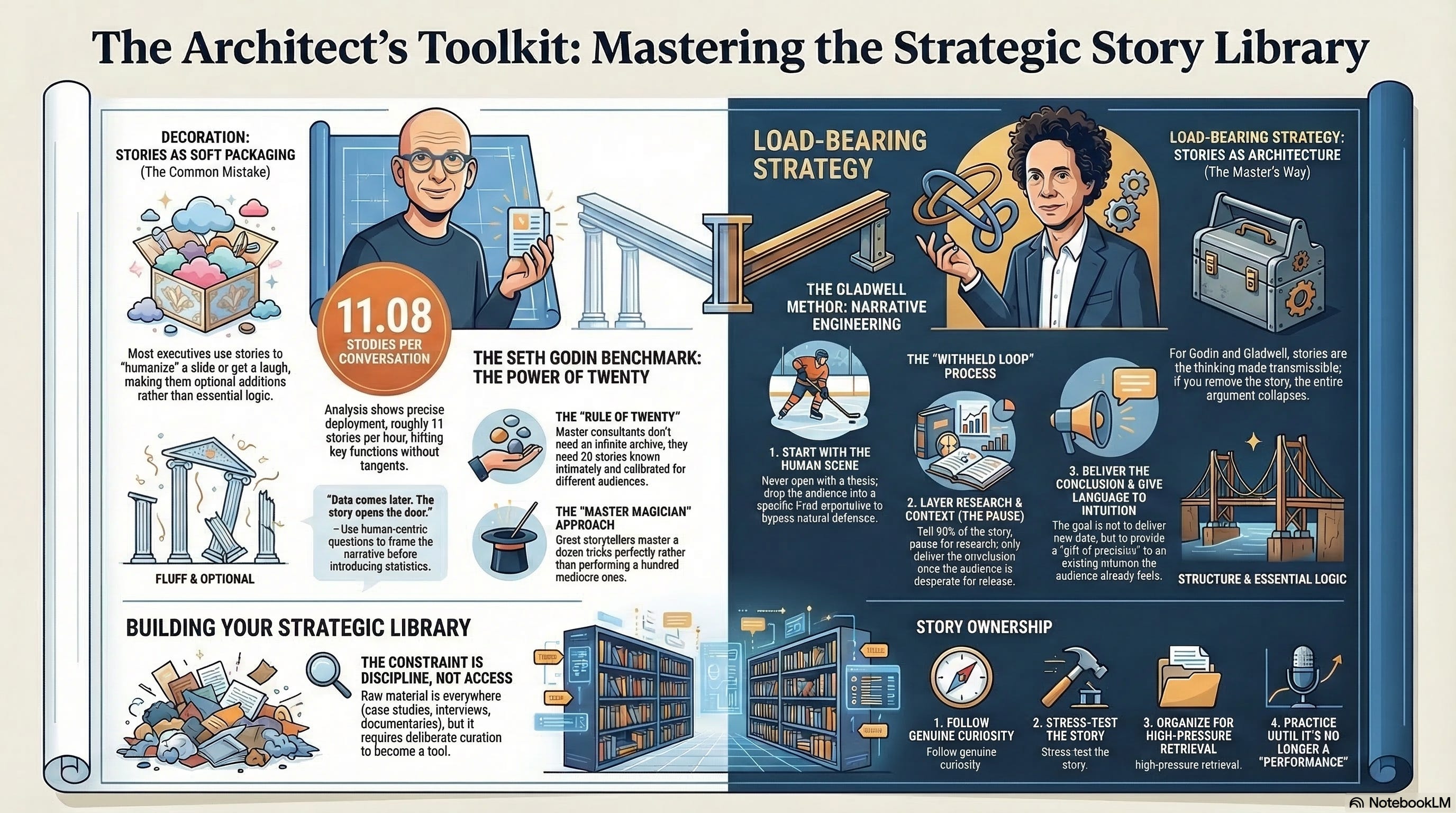 The Moment I Realised My Story Library Was Embarrassingly Small 06.04.2026 11minThere is a specific kind of professional humiliation that doesn’t arrive with a bang. It sneaks in quietly, while you’re nodding, performing competence, convinced the conversation is going well.Mine arrived fifty minutes into a live podcast recording with Seth Godin.I was mid-interview. The mic was hot. And somewhere between his twelfth and thirteenth story, I heard myself say — out loud, on the record — “I don’t know how that magic works, because I don’t have anywhere near as many stories.”Not to a colleague afterward. Not in a private debrief. To Seth. Live. While we were still recording.That sentence has followed me since.What I Watched Happen in One HourIn sixty minutes, Seth Godin moved through fourteen distinct stories. Not anecdotes he was winging. Not tangents. Fourteen purposeful, precisely deployed narratives — each one doing specific work, each one landing cleanly and then stepping aside.A hospital crib factory in Buffalo. A Walmart auditorium in Arkansas. A Google homepage with two links. A grease-covered piece of equipment that nobody had touched in a decade.Every single one hit. Every single one served a function.And I sat there with my small, carefully curated collection of retreat-tested stories — organised around a single argument about time horizons — and realised I had been confusing a handful of tools with an actual toolkit.That’s not a library. That’s a filing cabinet with three folders.The Research I Did AfterThe interview shook me enough to investigate. What exactly was Seth doing, and how consistently was he doing it?With AI assistance, I pulled and analysed twelve recent Seth Godin interviews. Across all of them, he averaged 11.08 stories per conversation — 133 stories in total. His most recent book, This is Strategy, contains 87 stories.So I asked him directly: “Is your list of stories infinite?”His answer was more useful than I expected. “No,” he said. “And the best consultants carry around twenty stories.”Twenty. Not two hundred. Not a bottomless archive. Twenty stories — known intimately, deployable on demand, calibrated for different rooms and different audiences. He compared it to master magicians: the great ones haven’t perfected a hundred tricks. They’ve mastered around a dozen, and they know exactly when to use each one.Twenty stories. That’s the target. And most of us — including me, before that interview — couldn’t name five that we genuinely owned.What Gladwell Does That Most Strategists Don’tMalcolm Gladwell — bestselling author of The Tipping Point, Outliers, and Blink — operates on a similar principle, and his method is almost shamelessly transparent once you see it.He never opens with a thesis. Never. There is always a human scene first. A hockey player’s birth month. A recipe for ketchup. A single moment of lived experience that drops you into a specific world before you’ve had time to raise your defenses.Only once your attention is captured does he pull back to reveal the larger pattern.And then — this is the part most people miss — he withholds the ending deliberately. He tells ninety percent of the story, pauses to layer in research, context, and argument, and only then closes the loop. By the time he delivers the conclusion, you’ve been waiting for it. You feel the release.None of that is improvised. It is a deliberate system, engineered to do one specific thing: name what the audience already senses, but cannot articulate.Seth described this in our conversation with a fundraising example. A skilled fundraiser, he said, doesn’t open with statistics about hunger. They open with a question: “What was it like at your dinner table growing up?” The data comes later. The story opens the door.Both men are doing the same thing: uncovering the story that gives language to something the audience already intuitively knows. Seth calls this “profound” — not the delivery of new information, but the gift of precision to an existing intuition.That is a fundamentally different job than most executives think storytelling does.The Real Problem With How Strategists Use StoriesMost executives use stories as decoration. They drop one in to break up a dense presentation, to humanise a slide, to get a laugh after a difficult section.That’s not what Godin and Gladwell are doing. Their stories aren’t decoration. They’re load-bearing. Remove them and the entire argument collapses.The distinction matters enormously in strategy work. When you’re trying to shift how an organisation thinks about time, risk, or change — data alone does not move people. People need a narrative frame before they can absorb an argument. Stories aren’t the soft packaging around the hard thinking. They are the thinking, made transmissible.Which means the question isn’t whether you have stories. Everyone has stories. The question is whether you have the right ones — ones that will actually land with your specific audience, in your specific context, under pressure.Right now, most senior professionals cannot answer that question with any confidence.Building the LibraryHere is the uncomfortable truth: the gap Seth exposed cannot be closed by reading more books, attending more conferences, or taking another course.It requires a different kind of discipline — one that is specific, deliberate, and ongoing.Start with genuine curiosity. Not with what you think you should know, but with what actually pulls your attention. The stories that stick with you across months and years are telling you something about what you uniquely see that others miss. That’s the foundation.Then do the work: find stories worth keeping, stress-test whether they will land with your audiences, organise them so they are retrievable under pressure — not just vaguely remembered — and practise the telling until it no longer feels like performance.The raw material is everywhere. Platforms built for deliberate curation of strategic content exist precisely for this purpose. Decades of interviews, documentaries, case studies, and executive conversations are available to anyone willing to approach them with intention rather than passive consumption.The constraint isn’t access. The constraint is discipline.Seth’s number is twenty. Yours might be fewer. But you need to know which stories they are — you need to own them, not just have encountered them — and most of us, if we’re honest, are nowhere close.The Sentence That Changed My PracticeI didn’t plan to be candid on that podcast. The confession about my own story gap wasn’t scripted vulnerability. It was the involuntary, real-time recognition of a professional blind spot I had been carrying for years without knowing it.That’s how these things tend to arrive. Not in a structured self-assessment. Not in a performance review. In the middle of a live conversation with someone who has simply done the work you haven’t.The question isn’t whether you’re a good strategist. You may well be exceptional at frameworks, diagnosis, and execution planning.The question is whether your stories can do what Seth Godin’s stories do — open a door, name what your audience already senses, and make your argument not just understandable but felt.If you’re not sure, that uncertainty is your answer.Start building the library.P.S. — The Curation Problem Has a Starting PointIf the article resonated, part of your next step is finding the right raw material — stories worth adding to your library, told by people who actually know how to tell them.That’s exactly what StratCinema was built for. It’s a curated video platform for strategy professionals — not an algorithm feeding you whatever keeps you scrolling, but a deliberately assembled collection of interviews, case studies, and executive conversations selected because they carry genuine strategic weight.Think of it as the opposite of YouTube’s recommendation engine.If you’re serious about building your story library with intention, it’s a useful place to start: StratCinema.orgP.P.S. — Five Prompts to Go Deeper (Use These With Any LLM)The ideas in this article are a door. These prompts help you walk through it.1. Audit Your Current Story Library “I’m a [role] working with [type of clients/organisations]. I want to identify the strategic stories I currently rely on. Help me audit them by asking me questions one at a time — what the story is, what argument it supports, and whether it would land with different audience types.”2. Reverse-Engineer a Master Storyteller “Analyse how Seth Godin uses stories in his writing and speaking. What structural patterns does he use consistently? Give me five specific techniques I can practise, with an example of each.”3. Find Stories Hidden in Your Own Experience “I’m going to describe three professional situations I’ve been in. For each one, help me identify whether there’s a story worth keeping — one that names something an audience already senses but can’t articulate. Ask me to describe the first situation.”4. Build a Story for a Specific Strategic Argument “I need to make the argument that [insert your strategic point] to an audience of [insert audience]. Don’t give me data or frameworks. Help me find or construct a story that opens a door to this idea — something human and specific that lands before I introduce the argument.”5. Design Your Personal Twenty-Story Repertoire “Seth Godin says the best consultants carry around twenty stories. Help me design mine. Based on my work in [field/industry], what categories of stories should I have in my library? Give me a framework for organising them by purpose — not by topic — so I can retrieve the right one under pressure.”These work best when you treat the LLM as a thinking partner rather than a search engine. Push back on its answers. Ask it to go deeper. The prompts are a start — the conversation is the work. This is a public episode. If you'd like to discuss this with other subscribers or get access to bonus episodes, visit longtermstrategy.substack.com/subscribe
 -
 Your Mission-Driven Organization Deserves Better Strategy Tools 18.03.2026 12minPicture a familiar scene in a non-profit organization. A hotel conference room. Flip charts on easels. A two-day offsite that everyone has blocked out on their calendar and quietly dreaded.The exercises begin. Strengths, weaknesses, opportunities, threats. Stakeholder maps. Priority matrices. The team engages dutifully, filling in the boxes, generating the language that planning retreats are supposed to generate.Then comes the afternoon slump - and it is not just fatigue from the morning’s work. Something more specific has happened. The conversation has drifted away from the reason the organisation exists. Words like “competitive positioning” and “market capture” are appearing on the sticky notes, and they feel borrowed - like wearing a suit that belongs to someone else.Nobody says anything. Everyone is willing the process to work.A document emerges by the final session. The board receives it at the next meeting. And within a few months, it occupies a shelf or a folder, largely untouched.This is not a story about poor facilitation or disengaged leadership. It is a story about using the wrong instrument for the job.Where These Frameworks Actually Come FromManagement strategy as a discipline has a particular genealogy. The models that dominate executive education - the competitive analyses, the positioning matrices, the market share battles - were developed with a specific type of organisation in mind: businesses that survive or collapse based on their ability to outperform rivals and make profits.The evidence is in the curriculum. Academic research suggests that the vast majority of MBA case material is drawn from industries where competition is the central organising tension. The mental model underneath most strategy training treats the world as a contest. There is a prize. There are opponents. The goal is to win more than you lose.That framing is genuinely useful for firms operating in those conditions. The urgency of a competitor threatening your revenue is real, and tools designed around that urgency have genuine motivating power.But take those same tools into a cooperative, a trade association, a government agency, or a development organisation, and something goes wrong almost immediately. (The same applies to a monopoly.) The animating force - the rival who might take what is yours - does not exist in the same way. Frameworks engineered around that force become awkward, like running software on a system it was never designed for.The afternoon energy drop at your retreat was not a morale problem. It was the sound of a square peg meeting a round hole.The Timeframe Problem Nobody Talks AboutThe mismatch runs deeper than vocabulary, though.Competitive strategy is built around a particular relationship with time - specifically, a short one. The frameworks that dominate business education are oriented toward near-term results: quarterly performance, annual targets, the speed of response to a market threat. Mission-driven organisations often operate under an entirely different time logic. A land trust working to preserve ecosystems, a credit union serving underbanked communities, a health institution building public capacity - these organisations are answerable to timescales that most competitive strategy tools cannot even see.When a long-horizon organisation runs its strategy through a short-horizon framework, something gets quietly distorted. The institution begins optimising for the measurable and the near-term, while the foundational commitments - the ones that justify the organisation’s existence - drift into the background.The Co-operative Group in the United Kingdom offers a sobering case study. Once among the most significant member-owned enterprises in the world, the Co-op entered the 2010s in serious trouble. An investigation into its near-collapse revealed a decade of decisions shaped by competitive growth logic: major retail acquisitions, banking mergers, rapid diversification across sectors. The goal had been scale - more market presence, more revenue streams, more assets.What the organisation had not been tracking with the same rigour was whether any of this expansion was coherent with what a cooperative is actually for. Its governance was member-based. Its legitimacy came from community trust. Its identity was inseparable from a set of values about how business ought to be conducted.By the time a £1.5 billion hole appeared in the banking arm, the institution had been operating with someone else’s strategy for years. The tools it had borrowed rewarded growth metrics. They had no mechanism for asking whether growth was serving the mission - or consuming it.The same drift appears in organisations across every sector. * A humanitarian agency that chases high-visibility donor projects at the expense of quiet, unglamorous long-term work. * A professional body that adds revenue streams until its membership can no longer articulate what the body stands for. * A regional development authority that reports on outputs while the underlying social fabric it was created to strengthen continues to fray.In each case, the damage is slow and largely invisible inside the planning documents that caused it.Planning Built Around PurposeWhat these organisations need is not a modified version of competitive planning. They need a process that begins with a different assumption — that strategy is about protecting and advancing a purpose across time, not about positioning against opponents.* Such a process starts with an honest reckoning with the present. Before any direction is set, the organisation needs to understand where it actually stands - not just financially, but in terms of mission integrity. How is trust held among the people the organisation serves? When has the institution historically drifted from its purpose, and what triggered those moments? What resources - financial, relational, reputational - are genuinely available?* From that foundation, a long horizon is established. Somewhere between fifteen and thirty years is typically productive. This might feel uncomfortably distant, but the distance is the point. It shifts the planning conversation away from quarterly anxieties and toward the questions that actually define an institution’s legacy.* With a target horizon in place, the team explores a range of possible futures rather than committing to a single premature forecast. The world in twenty-five years will be shaped by forces that cannot be predicted with precision - demographic shifts, technological change, political reconfigurations, ecological pressures. Scenario thinking does not pretend otherwise. It builds the capacity to navigate uncertainty rather than deny it, and it asks the organisation to identify which kind of future best allows its mission to flourish.* From a single chosen scenario, the planning process works backwards. If the organisation needs to be in a certain condition twenty-five years from now, what does the ten-year mark look like? The five-year mark? What must be in place, and by when? What are the big tradeoffs which need to be made? This backward mapping turns an inspiring long-term vision into a logical chain of necessary steps, each grounded in the one that follows it.* Only after that work is complete does it make sense to design a short-term action plan - because now there is a genuine strategic context for it. Immediate decisions are no longer just reactive. They serve something larger. Here, further tradeoffs must be made.The Question Underneath the QuestionThe mechanics matter, but the conceptual shift matters more.Competitive strategy is structured around the question: How do we beat them? Purpose-driven strategy is structured around a different one: How do we remain who we are, and do what we exist to do, across the years ahead?These produce very different conversations - different discussions at leadership retreats, different criteria for investment decisions, different definitions of success that get embedded in the culture over time.Cooperatives, civil society organisations, public institutions, and social enterprises are not inferior versions of private companies. They are different kinds of institutions altogether, built on different social contracts, accountable to different stakeholders, and serving purposes that exist precisely because markets and competitive logic have limits.The strategy process these organisations use should reflect that - not apologise for it.When the next retreat in your non-profit ends with a document that finally stays off the shelf, it will be because the planning process started from the right place: not how do we win, but how do we endure, and why does it matter that we do.—————————————P.S. Here are some LLM prompts you can use for further investigation.Go Deeper: Five Prompts for Further ExplorationThe argument in this article points to a gap — between the strategy tools most executives have been given and the organisations they are actually leading. The five prompts below are designed for use with any AI assistant (Claude, ChatGPT, Gemini, or similar). Each one picks up where the article leaves off. Copy, paste, and adapt the parts in brackets to your own context.Prompt 1: Diagnose Your Own OrganisationFor the reader who finished the article thinking — “this is us.”I lead a [cooperative / government agency / NGO / family business / religious institution / statutory body] in [country/region]. Based on the argument that most strategy frameworks were designed for competitive, profit-first organisations, help me diagnose whether my organisation has been using the wrong strategy tools.Ask me five diagnostic questions — one at a time, waiting for my answer before moving to the next — that will reveal whether our strategy process is genuinely built around our mission and long time horizon, or whether we have been borrowing competitive frameworks that don’t fit.After my five answers, give me an honest assessment of where we stand, and identify the single most dangerous misfit between the tools we are using and the organisation we actually are.Prompt 2: Rebuild the Co-op’s Strategy — Non-CompetitivelyFor the reader who found the Co-operative Group case study instructive and wants to go deeper.The UK Co-operative Group’s near-collapse in 2013 has been attributed to governance failure and poor management. But a different diagnosis is possible: the Co-op was a mission-first, member-owned organisation that had adopted competitive private-sector strategy logic — chasing scale, acquisitions and market presence — instead of building strategy around what a cooperative is uniquely positioned to do.Assume you are a strategy advisor brought in to the Co-op in 2005, before the Britannia merger and the Verde pursuit. Using only non-competitive strategy tools — scenario planning, category design, mission integrity analysis, and long-horizon thinking — build the outline of the strategic conversation the Co-op’s leadership should have been having. What questions should have been on the table? What 20-year opportunity was sitting unclaimed? What slow-moving threats should have been named? What would a purpose-first Co-op strategy for 2005–2030 have looked like?Prompt 3: Design a Purpose-First Strategy RetreatFor the reader who is planning — or dreading — their next strategic planning offsite.I need to design a two-day strategy retreat for the leadership team of a [describe your organisation type and size]. Our previous retreats have used standard frameworks — SWOT analysis, competitive positioning, priority matrices — and the resulting plans have consistently ended up on shelves.The core problem is that those frameworks were designed for profit-first, competitor-facing businesses. We are a mission-first organisation with a long time horizon and no direct rival whose defeat would constitute success.Design a full two-day retreat agenda that replaces competitive frameworks with purpose-built alternatives. Include: the opening question that reframes the entire conversation; how to run a scenario planning session for a non-technical audience; how to do backward mapping from a 25-year horizon to a 90-day action plan; and how to end the retreat with commitments that will actually survive contact with the following Monday morning.Prompt 4: Make the Internal Case for Long-Term ThinkingFor the reader who agrees with the argument but now has to convince a board or senior team that doesn’t.I have read an argument that mission-driven organisations — cooperatives, government agencies, NGOs, religious institutions, family businesses — are systematically underserved by MBA-derived strategy frameworks because those frameworks were built for competitive, profit-first firms. I agree with this argument. My organisation is [describe it briefly].The problem is that my board and senior leadership are not yet convinced. Several members have strong private-sector or MBA backgrounds and default to competitive strategy language. Others simply don’t see the urgency of changing our planning approach.Help me build the internal case. Give me: three concrete examples of organisations like ours that failed — or significantly underperformed — because they used competitive strategy frameworks that didn’t fit; three compelling questions I can put to the board that will expose the mismatch without triggering defensiveness; and the single most persuasive one-paragraph argument I can make for why this matters now, not eventually.Prompt 5: Apply Category Design to a Non-Competitive OrganisationFor the reader intrigued by the article’s reference to category design as an alternative strategic tool.Category design is a strategy framework developed primarily for technology and consumer companies. Its core idea is that instead of competing within an existing market, an organisation defines and dominates an entirely new category — changing what problem it is seen to solve and becoming the obvious answer to a question that previously wasn’t being asked.I want to explore whether category design can be applied to a non-competitive organisation. My organisation is [describe: sector, size, core mission, approximate age, geographic context].Walk me through a category design thinking process adapted for a mission-first organisation. Specifically: What category does my organisation currently occupy in the minds of the people it serves — and is that the right one? What problem could we redefine ourselves as the unique solution to? What would it mean for us to own a category rather than compete within one? And what is the 10-year version of success if we got this right?A note on how to use these prompts: each one is a starting point, not a single exchange. The most productive approach is to begin the conversation, push back on the AI’s first response, add specifics about your own organisation, and treat the output as a thinking partner rather than a finished answer. Prompt 3 in particular benefits from iteration — run it once, then ask the AI to make the agenda harder, more honest, or more specific to your sector. This is a public episode. If you'd like to discuss this with other subscribers or get access to bonus episodes, visit longtermstrategy.substack.com/subscribe
 -
 When Excellence Breeds Failure: Why Your Best Team Might Be Building Your Worst Disaster 24.02.2026 10minPicture this: A talented leadership team. Top-tier credentials. Flawless execution. Every metric trending green. And yet, five years later, the company is fighting for survival—or worse, gone entirely.This isn’t a story about incompetence. It’s something far more insidious. It’s about intelligent people trapped inside a system that rewards them for making precisely the wrong choices.The Athletic Metaphor That Explains EverythingWant to see this pattern in pure form? Look at how different sports organizations develop talent.Jamaica’s MVP Track Club has produced Olympic champions and world record holders whose careers span decades. Athletes like Shelly-Ann Fraser-Pryce and Elaine Thompson-Herah didn’t just win races—they sustained excellence well into their thirties, their bodies intact, their bank accounts healthy.Meanwhile, the American collegiate athletics system—the NCAA—operates like a different species entirely. Talented high schoolers arrive with Olympic potential. Four years later, many flame out, never to compete internationally again. Bodies broken. Dreams abandoned.Here’s what makes this fascinating: NCAA coaches aren’t incompetent. These are world-class professionals running billion-dollar programs with access to cutting-edge sports science. They track everything—times, splits, recovery metrics, nutrition, biomechanics.Yet they’ve built a machine designed to extract maximum performance over four years, regardless of what happens afterward. The system optimizes perfectly—for conference championships, television contracts, recruitment rankings. And in the process, it systematically destroys the very athletes who make those outcomes possible.MVP asked a different question entirely: What does success look like measured over a fifteen-year career instead of a four-year scholarship? The answer required sacrificing immediate gratification—forgoing certain meets, accepting slower progression, resisting the pressure to peak too early.The NCAA doesn’t fail because its people are stupid. It fails because every incentive, every measurement, every reward structure points them toward short-term glory and long-term destruction. And every dashboard they monitor confirms they’re doing exactly what they’re supposed to do—right up until the athlete graduates broken.Now here’s the uncomfortable question: Is your company running the NCAA playbook?The Corporate Version of Athletic DestructionCorporate history is littered with smart people making decisions that looked brilliant on every spreadsheet while quietly demolishing the foundation beneath them.Consider the financial sector meltdowns of recent decades. Before the 2008 crisis, before Enron, before the savings and loan disasters of the 1980s, things looked spectacular. Quarterly earnings beat expectations. Risk models showed green lights. Executives earned accolades for innovative financial engineering.The long-term destruction was being created from day one. Not by people too stupid to see it, but by systems designed never to look for it.Why Intelligence Doesn’t Protect YouThe trap works like this: The CEO who sacrifices this quarter’s numbers to protect next decade’s foundation doesn’t get applauded at the board meeting. They get questioned. Their judgment gets doubted. Their compensation takes a hit.Meanwhile, the executive who delivers short-term wins—even by mortgaging the future—gets promoted, celebrated, interviewed by business publications.This isn’t a failure of intelligence, discipline, or execution. It’s a design flaw in how success gets measured.The answer isn’t working harder within the existing framework. It’s redesigning the framework itself. That requires confronting existential questions about what you’re actually optimizing for—and having the courage to challenge metrics that everyone agrees are “obviously” correct.Three Techniques to Surface Hidden DisastersHere are practical methods to force your leadership team to see beyond the quarterly mirage:* The Pre-Mortem ExerciseGather your strategy team. Give them one instruction: Assume your current initiative has failed catastrophically fifteen years from now. Write the detailed story of exactly how and why.Not vague organizational hand-wringing like “we didn’t execute well enough.” A specific, uncomfortable narrative that traces the chain of consequences from today’s confident decision to tomorrow’s wreckage.The discipline is in the specificity. “We lost market share” is useless. “We optimized our pricing algorithm for immediate margin expansion, which slowly trained our best customers to view us as a commodity, which eroded pricing power, which forced us into a desperate discount spiral that destroyed brand equity and made us vulnerable to a well-funded competitor who simply waited us out” is useful.* The Second-Order Impact MapMost strategy discussions evaluate immediate effects and stop there. “This restructuring reduces overhead by 18%.” Applause. Meeting adjourned.The second-order map refuses to stop. It forces the room to keep pulling the thread: That cost reduction eliminates redundancy. Which reduces organizational resilience. Which means the next market shock hits harder. Which forces emergency measures. Which creates exactly the kind of chaos that drives your best people to competitors. Who use them to build what you should have built.Keep pulling until the consequences become uncomfortable enough to reconsider the decision.* The Twenty-Years-Later Role PlayIdentify the youngest person in your leadership team. They become a time traveler.It’s twenty years in the future. A new generation of leaders asks them: “What was it like in that 2026 strategy session? What did your team decide?”They respond with two scenarios. First, the courage scenario: “We confronted the hardest questions. We acknowledged uncomfortable truths. We made decisions that hurt short-term but protected long-term. Here’s how it played out.”Second, the cowardice scenario: “We pretended things we knew weren’t true. We optimized for looking good rather than being good. We told ourselves comfortable lies. Here’s the price we paid.”The technique works because it makes abstract future consequences feel visceral and immediate.The Choice That Defines LeadershipEvery organization faces the same fundamental question: Are you building an MVP or running an NCAA program?Are you optimizing for sustainable excellence or spectacular quarterly performance? Are you protecting the foundation or mining it for short-term gains?The smartest people in the room will keep making the worst decisions until the room itself gets redesigned. Until the metrics change. Until the incentives shift. Until the questions being asked force long-term consequences into immediate view.The techniques exist. The choice is whether you have the courage to use them.P.S. Five Prompts for Deeper ReflectionUse these with your preferred AI to explore how these patterns might be operating in your specific context:* “I’m a [your role] at a [your industry] company. We’re currently optimizing for [your key metric]. Help me identify what long-term value we might be destroying in the process. Be brutally specific about the chain of consequences I’m not seeing.”* “Run a pre-mortem analysis: It’s 2040, and the strategy we implemented in 2025 has failed catastrophically. Write the detailed story of how our decision to [your current initiative] led to our downfall. Don’t hold back on uncomfortable specifics.”* “I need a second-order impact map. Our first-order effect from [your decision] is [immediate outcome]. Help me trace at least five levels deeper into the consequences, particularly the ones that would take years to surface but would be devastating when they do.”* “Create a dialogue between my 2025 self and my 2045 self. The older version has lived through the consequences of [current strategic choice]. What would they tell me that I’m not willing to hear right now?”* “Analyze my industry through the NCAA vs MVP lens. Who in my competitive landscape is running the short-term optimization playbook? Who’s building for decades? What specific metrics distinguish them? What would it cost me to switch approaches?” This is a public episode. If you'd like to discuss this with other subscribers or get access to bonus episodes, visit longtermstrategy.substack.com/subscribe
 -
 The Strategy Handoff Crisis: Why Your Successor Can’t Think Like You Do 16.02.2026 13minCompanies obsess over documenting financial controls. They create detailed procedure manuals for operations. Yet when it comes to transferring strategic thinking between executives, most organizations fail spectacularly.The problem isn’t a lack of documentation. It’s documenting the wrong things entirely.The Six-Month Struggle Every Incoming Executive FacesHere’s a scenario playing out in boardrooms worldwide: A seasoned executive departs. Their replacement inherits comprehensive transition materials—market analyses, strategic frameworks, financial models, implementation roadmaps, organizational diagrams, and risk assessments.The incoming leader dedicates weeks to reviewing everything. They schedule meetings with key stakeholders. They take copious notes. They ask intelligent questions.Six months later, they’re still struggling to make strategic calls with the confidence their predecessor demonstrated. They hesitate where the former leader acted decisively. They miss contextual nuances that seem obvious in hindsight.What went wrong?Nothing and everything. The documentation was thorough. The transition process followed best practices. But the handoff materials contained polished conclusions instead of strategic thinking itself.This represents a fundamental misunderstanding about how strategic capability actually transfers between leaders.What Your Transition Documents Are Actually MissingThose transition binders look impressive. They contain everything a rational person would consider important: competitive threat assessments organized by market segment, positioning frameworks with detailed differentiation matrices, three-scenario financial projections, milestone-dependent implementation schedules, and comprehensive risk mitigation plans.The critical gap? None of these materials explain how the organization arrived at its current strategic direction.The genesis moment goes undocumented. Was the strategic pivot triggered by nearly losing a major client? Did a competitor’s unexpected move force a rethink? Did a board member ask an uncomfortable question that wouldn’t go away?The discovery process remains invisible. What initial research contradicted long-held assumptions? Which sacred cows got sacrificed? When did the leadership team realize their comfortable worldview was dangerously wrong?The human drama gets erased. That intense multi-day retreat where Finance and Operations clashed over resource priorities? Forgotten. The skeptical VP who opposed the initiative before becoming its most passionate advocate? Airbrushed out. The moment someone finally said what everyone was thinking but nobody wanted to acknowledge? Lost forever.Most leadership teams justify these omissions with variations of: “That’s just internal politics. It’s unprofessional. The new executive needs our decisions, not our dirty laundry.”This thinking is precisely backwards.Why Messy Origin Stories Create Strategic OwnershipConsider two incoming executives facing the same strategic direction.Executive A receives polished slide decks explaining the final strategic framework. Clean. Professional. Complete.Executive B receives the full origin story: the triggering incident, the initial resistance, the data that changed minds, the fierce debates, the breakthrough moments, the implementation battles.Three months later, both executives face pressure to abandon elements of the strategy. Market conditions have shifted. Key stakeholders are pushing for different priorities. Quick wins from alternative approaches look tempting.Executive A, having only received conclusions, treats the strategy as inherited wisdom. They lack emotional investment. When challenged, they can recite the framework but can’t defend its foundations. They become susceptible to any argument that sounds reasonable because they never witnessed why alternative approaches were rejected.Executive B, understanding the battle scars, responds differently. They know which assumptions were tested and survived. They understand which stakeholder concerns were addressed and how. They recognize which seductive alternatives were explicitly considered and rejected, and why. This knowledge creates conviction.The messiness isn’t an embarrassing artifact to hide. It’s the mechanism that transforms a successor from a strategy executor into a strategy guardian.Without origin stories, you’re handing someone a map without teaching them how to read terrain. They can follow the route you marked, but they can’t navigate when conditions change.How Mental Models Beat Exhaustive AnalysisThe second critical gap involves transferring strategic thinking patterns rather than strategic conclusions.Your comprehensive transition documents provide analysis. What incoming executives actually need are the model that generated that analysis.Consider a healthcare organization undertaking strategic transformation. Traditional handoff approach: a 200-page document detailing market research, competitive positioning, customer segmentation, channel strategy, technology roadmap, and financial projections.Alternative approach: “We’re becoming the Netflix of healthcare.”That single sentence does more strategic work than 200 pages ever could. It instantly conveys: subscription relationships over transactional interactions, integrated digital experiences instead of fragmented touchpoints, platform thinking rather than service delivery, customer lifetime value over point-of-sale margins.An incoming executive who internalizes this pattern can make hundreds of subsequent decisions aligned with strategic intent—without referring back to documentation. The pattern provides a mental model for evaluating new opportunities, prioritizing resources, and making trade-offs.Analysis answers specific questions. Patterns teach strategic thinking.Most transition documents fail here because outgoing executives don’t explicitly name the strategic patterns they’re using. These frameworks remain implicit—obvious to the departing leader but invisible to their successor.Creating Genuine Strategic UrgencyThe third missing element is the diagnostic story that explains why the current strategy became necessary.Generic problem statements fill transition documents: “Market conditions are evolving.” “We need to maintain competitive advantage.” “Customer expectations are changing.”These platitudes don’t create urgency. They create checkbox compliance.Contrast that with a genuine diagnostic story: “Our analysis revealed we were Blockbuster in 2005. We had dominant market share, strong brand recognition, and profitable operations. We were also completely vulnerable. While we defended a dying business model, our industry’s Netflix equivalent was growing 40% annually. Our window for strategic response was roughly 18 months before our competitive position would become unrecoverable.”That’s a diagnostic story with teeth. It explains why inaction represented an existential threat, not merely a missed opportunity. It creates urgency by making the stakes visceral and the timeline concrete.Start Building Your Strategic Story Library TodayMost executives struggle to capture these three story types because they haven’t developed pattern recognition for what makes strategic stories effective. You need exposure to dozens of transformation cases before your mind identifies the underlying structures.The solution? Deliberate practice with real business transformation narratives.Start by studying how successful leaders explain their strategic pivots. Look for moments when executives describe “how we nearly missed this” or “why we became the [X] of our industry.” These moments contain the raw material for powerful strategic stories.But finding quality transformation case studies scattered across YouTube and business media takes time—time most executives don’t have. That’s why platforms like StratCinema.org exist: to curate business transformation stories specifically for strategists developing this narrative fluency. Instead of algorithm-driven suggestions that keep you watching but not learning, you get carefully selected case studies that build pattern recognition.Your next leadership transition deserves better than polished slide decks. It requires origin stories that create ownership, pattern stories that transfer mental models, and diagnostic stories that sustain urgency. Document these with the same rigor you apply to financial controls, and your successor won’t just execute your strategy—they’ll defend and evolve it.P.S. Use AI to Capture Your Strategic StoriesDon’t have time to craft these stories from scratch? Modern AI tools can help you extract and structure the strategic narratives already in your head. Here are three sets of prompts—one for each story type—that you can use with any large language model to develop handoff materials that actually transfer strategic thinking.Origin Story Prompts“I need to document how our [specific strategic initiative] actually came together. Help me structure an origin story by asking me questions about: What triggered our initial concern? What was the ‘oh s**t’ moment that made this urgent? Who were the initial skeptics and what convinced them? What data or insights contradicted our assumptions? What internal conflicts emerged during planning? Which alternatives did we seriously consider and reject? What breakthrough moment changed our approach? Walk me through these questions one at a time, then help me shape my answers into a compelling narrative that shows future leaders why this strategy emerged and what obstacles we overcame.”Pattern Story Prompts“Our strategy can be summarized as ‘[our approach]’ but I need to articulate the mental model behind it. Help me identify the pattern we’re following by asking: What successful company or strategy are we emulating? What’s our ‘[X] of [Y]’ statement? What core principle guides our decision-making? What trade-offs does this pattern naturally suggest? What does this pattern tell us to prioritize versus ignore? If someone internalized this pattern, what decisions would they make differently? Help me craft a concise pattern statement that transfers strategic intuition, not just strategic conclusions. Make it memorable enough that leaders can apply it without consulting documentation.”Diagnostic Story Prompts“I need to explain why our strategy was necessary—not just beneficial. Help me create a diagnostic story that conveys genuine urgency by asking: What complacent narrative were we telling ourselves before? What data revealed our vulnerability? What competitor or market shift threatened our position? What timeline were we facing? What would failure have looked like? What historical business failure does our situation resemble? Help me structure this into a narrative that makes inaction feel existential, not merely suboptimal. The goal is to transfer the visceral urgency we felt when we realized we had to transform.” This is a public episode. If you'd like to discuss this with other subscribers or get access to bonus episodes, visit longtermstrategy.substack.com/subscribe
 -
 Why Your 2050 Strategy Must Start Today: Lessons from a 15-Year Failure 11.02.2026 13minWill your organization survive the next 25 years? More importantly, are the decisions you’re making today planting the seeds of future irrelevance?The US Coast Guard wrestled with these questions and discovered something counterintuitive: to truly understand today’s challenges, you need to view them from 25 years in the future. Their Project Evergreen initiative proved this—but only after failing spectacularly for 15 years first.The Expensive Lesson: Brilliant Strategy, Zero ImplementationImagine pouring 15 years into strategic planning. Your organization assembles the best minds, conducts sophisticated scenario workshops, and produces detailed roadmaps. The forecasts are prescient. The analysis is sharp. The strategies are comprehensive.Then everything hits reality and dies on impact.This was Project Evergreen’s painful trajectory. Every strategic plan they delivered landed, in their words, “like most additional work at an office with an already full plate: dead on arrival.” Inbox after inbox received these plans. Nearly all went unimplemented.The Coast Guard had built “isolated, independent cogs” that required “considerable effort to forcefully engage into the many turning mechanisms” of actual organizational planning. Picture trying to force a rigid gear into machinery that’s already running—that’s what executing these strategies felt like for frontline teams.Why did meticulously crafted strategies produce such dismal results?The Question That Poisoned 15 Years of PlanningFor a decade and a half, Project Evergreen asked what seemed like a perfectly reasonable question: “What should the Coast Guard do?”If you’ve sat through strategic planning sessions, this probably sounds familiar. It’s typically the first question on the agenda. What should we do about artificial intelligence? How should we respond to digital transformation? What’s our climate change strategy?The problem isn’t obvious at first glance. This question appears logical, even necessary. But it creates a fatal dynamic.When you ask “What should we do?” you’re asking workshop participants—typically senior strategists and consultants—to prescribe solutions. These prescriptions then get handed down to implementers who weren’t in the room and didn’t shape the solutions. As the Coast Guard discovered, “the ideal people to do the job might not be in the room.”This creates what I call supply-side strategy: strategists manufacture solutions and push them onto implementers. Those solutions arrive as rigid directives disconnected from operational reality.The fundamental flaw isn’t that strategists are separated from implementers—there are simply too many implementers to fit in a retreat. The flaw is the question itself.Present-Forward Thinking: Perfect for Tactics, Fatal for TransformationThat innocent-sounding question—”What should we do?”—invisibly locks your thinking into a present-forward orientation.Present-forward thinking starts with today. It analyzes current problems, extrapolates existing trends, and prescribes solutions based on incremental projections. This approach works brilliantly for everyday management. It’s ideal for hitting quarterly targets, solving operational problems, and managing predictable challenges.But for 25-year transformation? It’s disastrous.Why? Because present-forward thinking generates tactical responses to current conditions. It can’t account for fundamental shifts in your organization’s operating environment. It can’t help you prepare for demands that don’t yet exist. It treats the future as a slightly modified version of today.Case in point: In 2001, Kodak had abundant, recent evidence that digital photography was no threat to traditional business. The present-forward mindset dominated the thinking of executives and blocked the possibilities.Managers use present-forward thinking each day because it’s the default mode for problem-solving. But that’s exactly why it fails for long-range strategy. This familiar mode becomes invisible, and organizations apply it to challenges it was never designed to address.The Cognitive Shift That Changed EverythingAfter 15 years of failure, the Coast Guard discovered the fundamental shift required: from present-forward to future-back thinking.This framework, developed by strategy theorists Mark Johnson and Josh Suskewicz, represents a complete cognitive reorientation. Instead of starting with today’s problems and projecting forward, you start with 2050’s probable demands and work backward.The new question becomes: “What demands will the organization face?”This isn’t semantic trickery. It’s a fundamentally different way of thinking about strategy.When the Coast Guard made this shift, they began identifying what they call “robust strategic needs”—outcomes required by specific long-term futures, each demanding particular strategic responses.Here’s the critical difference: prescriptive solutions constrain implementers. Strategic needs empower them.Prescriptions say “do this.” Strategic needs say “accomplish this outcome”—and then trust implementers to craft solutions suited to their specific contexts and the evolving reality they’re navigating.How Future-Back Thinking Works in PracticeProject Evergreen now runs workshops that map multiple plausible 2050 scenarios. They explore various futures the Coast Guard might face—different geopolitical landscapes, climate conditions, technological capabilities, maritime threats.Then something critical happens. As the project team explained: “The solution space had to be left to the people who were actually going to implement the solution.”Instead of receiving detailed instructions, implementers receive strategic needs. They’re asked to “deconstruct and then reconstruct” these needs for their specific operational contexts.This approach works because objectives spanning 25 years can’t be prescribed with any accuracy. The future will unfold in unexpected ways. Game-changing strategies require flexible frameworks that can adapt as conditions evolve. Strategic needs provide that framework. Rigid tactical plans don’t.The result: Project Evergreen became what they call a “backdoor strategic contributor”—guiding organizational direction without constraining operational flexibility.The 2025 Payoff from 2050 ThinkingHere’s where this approach delivers immediate value.Future-back thinking reveals which of today’s “urgent” priorities are actually superfluous. When you clearly understand the demands your organization will face in 25 years, some current problems simply fade in importance. The larger perspective exposes which fires are worth fighting and which will burn out on their own.This prevents wasting resources on solutions that won’t address actual long-term demands.It also transforms implementer motivation. Instead of following someone else’s prescriptions, teams gain the autonomy to design solutions matched to their reality. That autonomy—the flexibility to meet strategic needs in contextually appropriate ways—creates genuine engagement and inspiration.Applying This to Your OrganizationConsider your organization’s long-range planning through this lens.The present-forward approach asks: “What should we do about immediate challenges?” This generates aspirational goals—”become industry leader,” “achieve digital transformation,” “reach carbon neutrality”—often disconnected from implementation reality. These sound impressive in board presentations but provide little practical guidance for teams expected to deliver them.The future-back approach asks: “What demands will our organization face in 2050?” This identifies strategic needs that divisions must customize for their contexts.For example, rather than prescribing “implement AI across all functions, ”you might identify a strategic need for “decision-making capabilities that scale with data complexity.” Different departments can then develop solutions suited to their unique challenges—customer service might deploy conversational AI, logistics might focus on predictive routing, finance might build automated risk assessment.A flexible framework instead of a rigid mandate.The Counterintuitive TruthThe Coast Guard’s expensive lesson offers a counterintuitive truth: you need tomorrow’s perspective to understand today’s priorities.Organizations that begin with present-forward thinking remain trapped in tactical responses to current conditions. They mistake busy-work for strategy. They confuse detailed plans with transformation.Organizations that embrace future-back thinking gain something more valuable: clarity about which current actions actually matter for long-term survival.That 25-year horizon isn’t about predicting the future perfectly. It’s about developing the perspective to distinguish signal from noise in the present.The question isn’t whether your organization will face existential demands by 2050. It will. The question is whether you’re building the strategic foundation today to meet those demands—or whether you’re sowing the seeds of irrelevance while obsessing over quarterly results.The answer starts with asking a different question.Source: Project Evergreen’s Long-Range Strategic Planning, United States Naval Institute This is a public episode. If you'd like to discuss this with other subscribers or get access to bonus episodes, visit longtermstrategy.substack.com/subscribe
 -
 The YouTube Strategy School: Why Your MBA Didn’t Teach You Strategic Thinking 08.02.2026 14minAnnie’s hands trembled as she reread the email from her CEO. “Let’s talk about developing your strategic capabilities.”She’d just earned her MBA with honors, landed a promotion to Chief Marketing Officer, and crushed her Strategic Planning course with an A-. Now, three weeks before Christmas, her boss wanted to discuss her lack of strategic thinking.The meeting went poorly.“You’re just not being strategic enough,” he said, arms crossed.“Can you give me specific examples?” Annie asked, pulling out her notebook.He waved his hand vaguely. “It’s hard to explain. I just know it when I see it.”She pressed for details. He offered hollow phrases about “seeing the big picture” and “thinking long-term.” Nothing concrete. Nothing actionable. By the time she left his office, both were frustrated.Now it’s January. Annie sits at her desk, surrounded by expensive textbooks and highlighted case studies, completely lost. She can recite Porter’s Five Forces backward. She built financial models that made her professors weep with joy. Yet somehow, she’s failing at the very thing her degree promised to teach.The brutal irony? Her CEO can’t articulate what strategic thinking actually is because he developed the skill unconsciously, through years of pattern recognition. Annie can’t demonstrate it because her MBA systematically removed the very experiences that build strategic intuition.They’re both trapped. And neither understands why.The MBA’s Fatal FlawAnnie isn’t alone in this predicament. Across boardrooms worldwide, formally trained managers struggle to translate their academic frameworks into real strategic insight. They possess intellectual tools but lack the deeper capability that separates strategic thinkers from strategic memorizers.Here’s what business schools won’t tell you: becoming genuinely strategic isn’t about learning more frameworks. It’s about understanding that strategy professionals operate in three distinct seasons—and most never experience the first two.Season 3: Creation and MobilizationThis is the visible season. Senior leaders gather to craft corporate strategy over one to three months. PowerPoint decks multiply. The C-Suite debates market positioning. Consultants bill impressive hours. This is what most people imagine when they picture “strategic work.”Season 2: Focused Skill BuildingBetween major strategic initiatives, professionals identify capability gaps and target specific learning. They read journals, attend workshops, and study new frameworks. MBA programs excel at teaching a few basic Season 2 skills.Season 1: Curiosity-Driven ExplorationThis is the secret season. The forgotten season. The season where strategic intuition actually develops.And it’s completely absent from formal business education.Warren Buffett’s Secret CurriculumTo understand why Season 1 matters so profoundly, consider how Warren Buffett transformed Katherine Graham from overwhelmed newspaper heiress into one of America’s most respected CEOs.In 1963, 46-year old Graham suddenly inherited control of The Washington Post after her husband’s death. She’d been a housewife with zero business experience. Now she faced a company, competitors, and boardroom dynamics she didn’t understand. Terrified but determined, she reached out to Buffett for guidance.What happened next reveals everything about how strategic thinking actually develops.Buffett didn’t send her to business school. He didn’t recommend management textbooks. He didn’t even explain financial statements, despite being one of the world’s greatest investors.Instead, according to researcher Cedric Chin, Buffett quietly assembled a curated collection of annual reports from diverse companies across multiple industries. Then he sat with Graham and walked her through them, one by one.But here’s the crucial detail: they didn’t analyze balance sheets or scrutinize financial ratios. They discussed stories. Why did this CEO make that decision? What pattern do you notice across these three retail failures? How did this manufacturer navigate technological disruption?Over months of discussing hundreds of these narratives, Graham developed something more valuable than financial expertise. She built a mental library of business patterns—a sixth sense for recognizing strategic situations before they fully materialized.The result? A powerful 28-year tenure that transformed The Washington Post into a media powerhouse.Any MBA professor would dismiss Buffett’s approach as unscientific, inefficient, and impossible to grade. Yet it produced extraordinary results. Why?The Ill-Structured Domain ProblemCorporate strategy isn’t like chess. Chess has clearly defined rules, limited possible moves, and objective evaluation of positions. Master chess by studying enough positions and you’ll reliably improve.Strategy operates differently. It’s what cognitive scientists call an “ill-structured domain”—a field where:* The rules constantly change* Problems arrive with incomplete information* Multiple valid solutions often exist* Varying contexts determine which frameworks apply* Pattern recognition trumps analytical rigorIn ill-structured domains, you don’t become expert by memorizing frameworks. You develop expertise through massive exposure to varied cases, gradually building intuition about what patterns matter and which don’t.This is why Annie’s MBA, for all its rigor, failed her. Business schools teach Season 2 skills in Season 2 format: structured, analytical, framework-driven. But strategic intuition develops in Season 1, through unstructured, curiosity-driven exploration of countless business stories.Her professors taught her to dissect strategies. Buffett’s method taught Graham to recognize them in the wild.Annie’s Accidental DiscoveryOver the Christmas holidays, Annie found herself doing something she normally avoided: falling down a YouTube rabbit hole.It started innocently. She’d always wondered why Apple’s iPhone crushed Blackberry, Nokia, and Ericsson—giants that seemed untouchable until they weren’t. A Google search led her to a documentary video. That led to another. And another.Four hours later, having watched 21 videos spanning mobile phone history, product launches, and CEO interviews, she emerged with a strange new capability. She could now answer a question she’d never consciously considered: “What would I have done differently as CMO at Nokia?”But immediately, guilt set in. Had she just wasted an evening on the digital equivalent of binge-watching reality TV or TikTok? Shouldn’t she be reading the Harvard Business Review journal articles sitting in her queue?What Annie didn’t realize: she’d accidentally stumbled into Season 1 learning.That “wasted” evening accomplished something her expensive Strategic Planning course never could. By immersing herself in multiple failure narratives, she began building the pattern recognition library that expert strategists draw from automatically.One case study teaches frameworks. Twenty-one interconnected stories start building intuition.Building Your Own Season 1 PracticeThe transformation Annie needs won’t come from reading one more business book or taking another certification course. She needs to deliberately create her Season 1 practice.Here’s what that looks like:Consume voraciously, but with purpose.Watch YouTube documentaries about business failures. Read long-form narratives about company transformations. Follow industry evolution stories across decades. The key isn’t passive consumption—it’s exposing yourself to enough varied cases that patterns start emerging naturally.Ask the practitioner’s question.Don’t just absorb stories. Constantly ask: “What would I have done as CMO/CEO/strategist/consultant in this situation?” This active engagement transforms entertainment into training.Seek variety over depth initially.Early in Season 1, breadth matters more than depth. Sample retail failures, tech disruptions, manufacturing transformations, and service industry evolution. Cross-industry patterns are often more valuable than industry-specific expertise.Let curiosity lead.Unlike Season 2’s targeted learning, Season 1 works best when you follow genuine interest. That four-hour YouTube session worked for Annie because she authentically wanted to understand mobile phone competition.Connect consumption to creation.Eventually, Season 1 exposure fuels Season 2 learning, which prepares you for Season 3 execution. But the sequence matters. Don’t rush to application before you’ve built sufficient pattern recognition.The Real Competitive AdvantageWhen Annie returns to her next major strategic initiative—her next Season 3 moment—she’ll show up differently. Not because she learned new frameworks, but because she’s developed strategic peripheral vision.She’ll recognize patterns her CEO can’t articulate but knows when he sees. She’ll spot familiar dynamics in unfamiliar situations. She’ll propose approaches that feel intuitively right, even if she can’t immediately explain why.This is what her boss meant by “strategic thinking.” Not framework mastery. Pattern fluency.And her company becomes the ultimate beneficiary. Now they have a CMO who brings genuine strategic intuition to every discussion—the kind of thinking that can’t be faked, purchased, or crammed before a meeting.It just has to be grown, season by season, story by story.———————————P.S. You are invited to share in my compilation of strategy-related YouTube videos at StratCinema.orgP.P.S. This article is based on a column I wrote for the Jamaica Gleaner. P.P.P.S. Here are some LLM prompts you can use for further learning.Here are instructions and 5 prompts for readers developing strategic fluency:Before Using These PromptsCopy and paste this context into your LLM to get better responses:“I’m developing strategic intuition by studying business cases, company failures, and industry transformations—an approach called Season 1 learning. Unlike traditional MBA education that focuses on frameworks, I’m building pattern recognition by exposing myself to many varied business stories. I’ll be sharing cases I’ve consumed (YouTube videos, articles, books, documentaries) and asking you to help me extract strategic insights and patterns. Your role is to help me think like a practitioner who must make decisions under uncertainty, not like an academic analyzing what already happened. Push me to identify what I would have done differently and what patterns I’m noticing across multiple cases.”Prompt 1: The Practitioner’s Debrief“I just watched/read [title/description of case]. Here’s what happened: [2-3 sentence summary].Now help me process this as a strategist-in-training:* What was the critical decision point where things could have gone differently?* If I were [specific role: CMO/CEO/Head of Product] at that moment, what information would I have lacked that seems obvious in hindsight?* What would I have needed to believe or notice to make a better choice?* What’s one pattern here that might appear in completely different industries?”Prompt 2: Cross-Case Pattern Recognition“I’ve now consumed [number] cases about [general theme: tech disruption/retail transformation/product failures/etc.]. Here are brief descriptions of 3-5 of them: [list cases with 1-sentence descriptions].Help me identify:* What strategic pattern appears in at least 3 of these cases?* What does this pattern look like in its early stages, before the outcome is obvious?* When this pattern appears, what are the hard-to-see warning signs?* What would ‘seeing this pattern early’ have enabled in each case?* In what completely different context might I encounter this same pattern?”Prompt 3: The Mental Library Builder“I want to add this case to my ‘mental library’ of strategic patterns: [describe case].Help me catalog it effectively:* What’s the one-sentence ‘pattern name’ I should remember this case by?* What are the 2-3 specific details that make this pattern recognizable in real-time?* Which other cases in my library does this connect to or contradict?* If I’m in a strategy meeting and this pattern is emerging, what question should I ask to test if it’s really present?* What’s the ‘inverse’ of this pattern—what does success look like when someone navigates this well?”Prompt 4: The Scenario Transfer“I just studied how [Company X] failed at [situation]. Now help me practice transferring this insight:Imagine I’m [specific role] at a company in a completely different industry—say [name specific industry]—and I’m seeing these three signals: [describe 3 current business signals].* Could the pattern from [Company X]’s failure be emerging here?* What would I need to investigate to confirm or rule out this pattern?* If it IS the same pattern, what would I do in the next 30/90/180 days?* What would cause me to be wrong about this pattern applying?* What other patterns from my library might explain these signals better?”Prompt 5: The Strategic Intuition Audit“I’ve been doing Season 1 learning for [time period]. I’ve consumed approximately [number] cases covering [list topic areas].Help me audit what strategic intuition I’m actually building:* Based on what I’ve described, what are the 3-4 patterns I seem to be recognizing most readily?* What types of strategic situations am I probably still blind to?* Where are the gaps in my mental library? (What industries, failure modes, or strategic contexts am I under-exposed to?)* Given my role as [your actual role], which 5 specific case types should I prioritize consuming next to build practical pattern recognition?* How would I know if I’m moving from ‘consuming cases’ to ‘recognizing patterns in real-time’?”How to Use These PromptsStart with Prompt 1 after every case you consume. Use Prompt 2 weekly after you’ve accumulated several cases. Deploy Prompt 3 when a case feels particularly instructive. Use Prompt 4 monthly to practice transferring insights to your actual work context. Run Prompt 5 quarterly to ensure your Season 1 practice is building genuine strategic intuition, not just entertainment consumption. This is a public episode. If you'd like to discuss this with other subscribers or get access to bonus episodes, visit longtermstrategy.substack.com/subscribe
 -
 The YouTube Strategy School: Why Your MBA Didn’t Teach You Strategic Thinking 19.01.2026 14minAnnie’s hands trembled as she reread the email from her CEO. “Let’s talk about developing your strategic capabilities.”She’d just earned her MBA with honors, landed a promotion to Chief Marketing Officer, and crushed her Strategic Planning course with an A-. Now, three weeks before Christmas, her boss wanted to discuss her lack of strategic thinking.The meeting went poorly.“You’re just not being strategic enough,” he said, arms crossed.“Can you give me specific examples?” Annie asked, pulling out her notebook.He waved his hand vaguely. “It’s hard to explain. I just know it when I see it.”She pressed for details. He offered hollow phrases about “seeing the big picture” and “thinking long-term.” Nothing concrete. Nothing actionable. By the time she left his office, both were frustrated.Now it’s January. Annie sits at her desk, surrounded by expensive textbooks and highlighted case studies, completely lost. She can recite Porter’s Five Forces backward. She built financial models that made her professors weep with joy. Yet somehow, she’s failing at the very thing her degree promised to teach.The brutal irony? Her CEO can’t articulate what strategic thinking actually is because he developed the skill unconsciously, through years of pattern recognition. Annie can’t demonstrate it because her MBA systematically removed the very experiences that build strategic intuition.They’re both trapped. And neither understands why.The MBA’s Fatal FlawAnnie isn’t alone in this predicament. Across boardrooms worldwide, formally trained managers struggle to translate their academic frameworks into real strategic insight. They possess intellectual tools but lack the deeper capability that separates strategic thinkers from strategic memorizers.Here’s what business schools won’t tell you: becoming genuinely strategic isn’t about learning more frameworks. It’s about understanding that strategy professionals operate in three distinct seasons—and most never experience the first two.Season 3: Creation and Mobilization This is the visible season. Senior leaders gather to craft corporate strategy over one to three months. PowerPoint decks multiply. The C-Suite debates market positioning. Consultants bill impressive hours. This is what most people imagine when they picture “strategic work.”Season 2: Focused Skill Building Between major strategic initiatives, professionals identify capability gaps and target specific learning. They read journals, attend workshops, and study new frameworks. MBA programs excel at teaching a few basic Season 2 skills.Season 1: Curiosity-Driven Exploration This is the secret season. The forgotten season. The season where strategic intuition actually develops.And it’s completely absent from formal business education.Warren Buffett’s Secret CurriculumTo understand why Season 1 matters so profoundly, consider how Warren Buffett transformed Katherine Graham from overwhelmed newspaper heiress into one of America’s most respected CEOs.In 1963, 46-year old Graham suddenly inherited control of The Washington Post after her husband’s death. She’d been a housewife with zero business experience. Now she faced a company, competitors, and boardroom dynamics she didn’t understand. Terrified but determined, she reached out to Buffett for guidance.What happened next reveals everything about how strategic thinking actually develops.Buffett didn’t send her to business school. He didn’t recommend management textbooks. He didn’t even explain financial statements, despite being one of the world’s greatest investors.Instead, according to researcher Cedric Chin, Buffett quietly assembled a curated collection of annual reports from diverse companies across multiple industries. Then he sat with Graham and walked her through them, one by one.But here’s the crucial detail: they didn’t analyze balance sheets or scrutinize financial ratios. They discussed stories. Why did this CEO make that decision? What pattern do you notice across these three retail failures? How did this manufacturer navigate technological disruption?Over months of discussing hundreds of these narratives, Graham developed something more valuable than financial expertise. She built a mental library of business patterns—a sixth sense for recognizing strategic situations before they fully materialized.The result? A powerful 28-year tenure that transformed The Washington Post into a media powerhouse.Any MBA professor would dismiss Buffett’s approach as unscientific, inefficient, and impossible to grade. Yet it produced extraordinary results. Why?The Ill-Structured Domain ProblemCorporate strategy isn’t like chess. Chess has clearly defined rules, limited possible moves, and objective evaluation of positions. Master chess by studying enough positions and you’ll reliably improve.Strategy operates differently. It’s what cognitive scientists call an “ill-structured domain”—a field where:* The rules constantly change* Problems arrive with incomplete information* Multiple valid solutions often exist* Varying contexts determine which frameworks apply* Pattern recognition trumps analytical rigorIn ill-structured domains, you don’t become expert by memorizing frameworks. You develop expertise through massive exposure to varied cases, gradually building intuition about what patterns matter and which don’t.This is why Annie’s MBA, for all its rigor, failed her. Business schools teach Season 2 skills in Season 2 format: structured, analytical, framework-driven. But strategic intuition develops in Season 1, through unstructured, curiosity-driven exploration of countless business stories.Her professors taught her to dissect strategies. Buffett’s method taught Graham to recognize them in the wild.Annie’s Accidental DiscoveryOver the Christmas holidays, Annie found herself doing something she normally avoided: falling down a YouTube rabbit hole.It started innocently. She’d always wondered why Apple’s iPhone crushed Blackberry, Nokia, and Ericsson—giants that seemed untouchable until they weren’t. A Google search led her to a documentary video. That led to another. And another.Four hours later, having watched 21 videos spanning mobile phone history, product launches, and CEO interviews, she emerged with a strange new capability. She could now answer a question she’d never consciously considered: “What would I have done differently as CMO at Nokia?”But immediately, guilt set in. Had she just wasted an evening on the digital equivalent of binge-watching reality TV or TikTok? Shouldn’t she be reading the Harvard Business Review journal articles sitting in her queue?What Annie didn’t realize: she’d accidentally stumbled into Season 1 learning.That “wasted” evening accomplished something her expensive Strategic Planning course never could. By immersing herself in multiple failure narratives, she began building the pattern recognition library that expert strategists draw from automatically.One case study teaches frameworks. Twenty-one interconnected stories start building intuition.Building Your Own Season 1 PracticeThe transformation Annie needs won’t come from reading one more business book or taking another certification course. She needs to deliberately create her Season 1 practice.Here’s what that looks like:Consume voraciously, but with purpose. Watch YouTube documentaries about business failures. Read long-form narratives about company transformations. Follow industry evolution stories across decades. The key isn’t passive consumption—it’s exposing yourself to enough varied cases that patterns start emerging naturally.Ask the practitioner’s question. Don’t just absorb stories. Constantly ask: “What would I have done as CMO/CEO/strategist/consultant in this situation?” This active engagement transforms entertainment into training.Seek variety over depth initially. Early in Season 1, breadth matters more than depth. Sample retail failures, tech disruptions, manufacturing transformations, and service industry evolution. Cross-industry patterns are often more valuable than industry-specific expertise.Let curiosity lead. Unlike Season 2’s targeted learning, Season 1 works best when you follow genuine interest. That four-hour YouTube session worked for Annie because she authentically wanted to understand mobile phone competition.Connect consumption to creation. Eventually, Season 1 exposure fuels Season 2 learning, which prepares you for Season 3 execution. But the sequence matters. Don’t rush to application before you’ve built sufficient pattern recognition.The Real Competitive AdvantageWhen Annie returns to her next major strategic initiative—her next Season 3 moment—she’ll show up differently. Not because she learned new frameworks, but because she’s developed strategic peripheral vision.She’ll recognize patterns her CEO can’t articulate but knows when he sees. She’ll spot familiar dynamics in unfamiliar situations. She’ll propose approaches that feel intuitively right, even if she can’t immediately explain why.This is what her boss meant by “strategic thinking.” Not framework mastery. Pattern fluency.And her company becomes the ultimate beneficiary. Now they have a CMO who brings genuine strategic intuition to every discussion—the kind of thinking that can’t be faked, purchased, or crammed before a meeting.It just has to be grown, season by season, story by story.P.S. You are invited to share in my compilation of strategy-related YouTube videos at StratCinema.orgP.P.S. This article is based on a column I wrote for the Jamaica Gleaner. P.P.P.S. Here are some LLM prompts you can use for further learning.Here are instructions and 5 prompts for readers developing strategic fluency:Before Using These PromptsCopy and paste this context into your LLM to get better responses:“I’m developing strategic intuition by studying business cases, company failures, and industry transformations—an approach called Season 1 learning. Unlike traditional MBA education that focuses on frameworks, I’m building pattern recognition by exposing myself to many varied business stories. I’ll be sharing cases I’ve consumed (YouTube videos, articles, books, documentaries) and asking you to help me extract strategic insights and patterns. Your role is to help me think like a practitioner who must make decisions under uncertainty, not like an academic analyzing what already happened. Push me to identify what I would have done differently and what patterns I’m noticing across multiple cases.”Prompt 1: The Practitioner’s Debrief“I just watched/read [title/description of case]. Here’s what happened: [2-3 sentence summary].Now help me process this as a strategist-in-training:What was the critical decision point where things could have gone differently?If I were [specific role: CMO/CEO/Head of Product] at that moment, what information would I have lacked that seems obvious in hindsight?What would I have needed to believe or notice to make a better choice?What’s one pattern here that might appear in completely different industries?”Prompt 2: Cross-Case Pattern Recognition“I’ve now consumed [number] cases about [general theme: tech disruption/retail transformation/product failures/etc.]. Here are brief descriptions of 3-5 of them: [list cases with 1-sentence descriptions].Help me identify:What strategic pattern appears in at least 3 of these cases?What does this pattern look like in its early stages, before the outcome is obvious?When this pattern appears, what are the hard-to-see warning signs?What would ‘seeing this pattern early’ have enabled in each case?In what completely different context might I encounter this same pattern?”Prompt 3: The Mental Library Builder“I want to add this case to my ‘mental library’ of strategic patterns: [describe case].Help me catalog it effectively:What’s the one-sentence ‘pattern name’ I should remember this case by?What are the 2-3 specific details that make this pattern recognizable in real-time?Which other cases in my library does this connect to or contradict?If I’m in a strategy meeting and this pattern is emerging, what question should I ask to test if it’s really present?What’s the ‘inverse’ of this pattern—what does success look like when someone navigates this well?”Prompt 4: The Scenario Transfer“I just studied how [Company X] failed at [situation]. Now help me practice transferring this insight:Imagine I’m [specific role] at a company in a completely different industry—say [name specific industry]—and I’m seeing these three signals: [describe 3 current business signals].Could the pattern from [Company X]’s failure be emerging here?What would I need to investigate to confirm or rule out this pattern?If it IS the same pattern, what would I do in the next 30/90/180 days?What would cause me to be wrong about this pattern applying?What other patterns from my library might explain these signals better?”Prompt 5: The Strategic Intuition Audit“I’ve been doing Season 1 learning for [time period]. I’ve consumed approximately [number] cases covering [list topic areas].Help me audit what strategic intuition I’m actually building:Based on what I’ve described, what are the 3-4 patterns I seem to be recognizing most readily?What types of strategic situations am I probably still blind to?Where are the gaps in my mental library? (What industries, failure modes, or strategic contexts am I under-exposed to?)Given my role as [your actual role], which 5 specific case types should I prioritize consuming next to build practical pattern recognition?How would I know if I’m moving from ‘consuming cases’ to ‘recognizing patterns in real-time’?”How to Use These PromptsStart with Prompt 1 after every case you consume. Use Prompt 2 weekly after you’ve accumulated several cases. Deploy Prompt 3 when a case feels particularly instructive. Use Prompt 4 monthly to practice transferring insights to your actual work context. Run Prompt 5 quarterly to ensure your Season 1 practice is building genuine strategic intuition, not just entertainment consumption. This is a public episode. If you'd like to discuss this with other subscribers or get access to bonus episodes, visit longtermstrategy.substack.com/subscribe
 -
 The Uncomfortable Truth: Good Leadership and the Transformational Non-Obvious 29.12.2025 11minThe Uncomfortable Truth About Good LeadershipTwo CEOs retired recently from similar-sized companies. Their departures couldn’t have been more different—and neither could the legacies they left behind.Michael’s farewell was everything you’d expect from a beloved leader. The board praised his “collaborative leadership style” in glowing terms. His team genuinely mourned his departure. Government officials attended his retirement celebration. By every visible measure, he’d been a success.Sally’s exit was more muted. The board called her tenure “necessary but difficult.” Several executives had departed during her five years at the helm. Her farewell event was notably subdued compared to the celebration Michael received.But here’s where the story gets interesting.Six months after Michael left, his company announced a major restructuring that eliminated the divisions he’d protected for a decade. Millions of dollars in shareholder value evaporated. Within a year, 50% of the workforce was gone.Six months after Sally left, her company reported record profits from the strategic pivot she’d championed over fierce internal opposition. When an unexpected crisis hit shortly after her departure, the organization adapted with unusual speed and turned the disaster into an opportunity.The pattern reveals an uncomfortable truth about leadership that most of us would rather not confront.The Questions Leaders Ask ThemselvesEach executive had been asking themselves fundamentally different questions throughout their tenure. These questions were invisible to outsiders and perhaps even unconscious to the leaders themselves. But they had profound effects on performance and organizational capability.Michael achieved unanimous board approval and high satisfaction scores by proposing only moves people were comfortable with. His instinct was always to adjust proposals until opposition disappeared. Board meetings were harmonious. His team was content. Everyone liked working with him.Sally generated regular conflict by advocating for positions she might be wrong about—market exits, controversial partnerships, challenging restructuring efforts. She created tension in boardrooms and pushed her team beyond their comfort zones.Michael was beloved. Sally was respected. And only one of them transformed their company.In the day-to-day reality of organizational life, we’d all prefer to work with a Michael. It’s just easier. Less stressful. More comfortable. But when you step back and look at the big picture, the Sallys of the world achieve something fundamentally different—they build organizations capable of thriving in uncertain futures.From Management Excellence to Leadership ImpactThe irony is that Michael rose through conventional management success. He delivered immediate results. He worked long hours. He built people’s skills. Everyone appreciated his collaborative style, and he accumulated a long list of admirers throughout his career.But what made him an excellent manager became deadly when he stepped into the CEO role.His “nice guy” instinct—so valuable when managing projects and building teams—became a liability when leading organizational transformation. He sought comfort over conflict. He adjusted strategies until opposition disappeared. Board meetings remained harmonious, but no one challenged weak ideas. Everyone was smiling while the company slowly lost its competitive edge.Only after his retirement did the damage emerge in stark financial terms and workforce devastation.Sally took a different path. She prepared for C-suite roles deliberately—hiring executive coaches, engaging in intensive leadership development, and training herself to ask a fundamentally different question: “What am I willing to be wrong about?”This wasn’t just a philosophical exercise. She actively sought out perspectives that challenged her thinking, including using AI tools to stress-test her assumptions and identify blind spots in her reasoning.As CEO, she pushed for market exits, restructures, and strategic pivots that sparked genuine debate. Board meetings became intellectually rigorous rather than comfortable. Her management team was forced to think independently rather than seek consensus.When that crisis hit after her departure, the company was ready. Years of her tough choices—the re-engineering projects, the technology integration, the market repositioning—had already built adaptive capacity into the organization’s DNA. The crisis didn’t create team strength. It revealed the resilience her uncomfortable decisions had forged.What Transformed Sally’s LeadershipA former vice president who worked under Sally explained the shift this way: “Sally never asked what we were willing to do. She told us what she believed we could do, then demanded proof. At first we resisted—some of us vocally. But eventually, we became more than we thought possible. We discovered capabilities we didn’t know we had.”That insight became the foundation of Sally’s leadership philosophy: people don’t discover their capacity through comfort. They discover it by confronting challenges they initially believe are beyond them.This realization required Sally to make a conscious decision about what kind of leader she would be. She stopped optimizing for board approval and started advocating for market reality. She stopped asking what people would volunteer and started demanding what they could become.It wasn’t about being difficult for its own sake. It was about holding up a mirror to the organization’s potential and refusing to settle for the comfortable status quo.Three Principles for Transformational LeadershipFrom this fundamental insight, Sally developed three operating principles that guided her leadership decisions:Advocate for what others won’t see. Not the obvious moves everyone agrees on, but the non-obvious plays that data suggests and comfort resists. This means being willing to be the voice in the room that says, “I know we’ve always done it this way, but here’s what the market is actually telling us.”Demand what others won’t give. Not what people volunteer to do, but what you genuinely believe they’re capable of becoming. This requires a deep confidence in human potential combined with the courage to ask for more than people think they can deliver.Test what others won’t risk. Not consensus-driven certainties, but hypotheses you’re willing to be wrong about. This means running controlled experiments with strategic bets, learning from failures, and iterating quickly rather than waiting for perfect information.These principles aren’t about being contrarian or difficult. They’re about recognizing that transformation—real transformation—requires someone to push beyond the boundaries of organizational comfort.The Legacy QuestionHere’s the question every leader should be asking: Ten years from now, will your successor be building on your legacy or repairing what you avoided?The companies thriving in 2035 won’t be led by consensus-builders like Michael, despite how beloved they were. They’ll be led by leaders like Sally—people willing to make boards and teams uncomfortable in service of genuine transformation.This isn’t an abstract theoretical point. It’s playing out in real time across industries. The organizations that thrived through the pandemic weren’t those with the most harmonious cultures—they were those whose leaders had already pushed them to build adaptive capacity through uncomfortable changes.Your Next MoveThis week, starting tomorrow, challenge yourself to do something concrete: Choose one strategic position you believe in but haven’t voiced because it risks discomfort.Don’t ask yourself if the board will like it. Don’t wonder if your team will resist it. Instead, ask yourself: Am I willing to be wrong about this?If the answer is yes—if you genuinely believe it’s worth testing even though you might be wrong—then you have your next leadership move.Because here’s the final uncomfortable truth: the farewell speech that will eventually be given at your retirement is already being written. Every decision you make today, every time you choose comfort or conflict, consensus or transformation, is adding another line to that speech.Managers chase comfort and celebrate short-term wins. Leaders pursue transformation by demanding more than people thought they could give—and building organizations capable of thriving long after they’re gone.The question isn’t whether you’ll be liked or loved. The question is whether you’ll be needed—because you built something that couldn’t have existed without your willingness to make people uncomfortable in pursuit of something greater.What will your legacy be?—————————————This article is based on a column published in the Jamaica Gleaner. This is a public episode. If you'd like to discuss this with other subscribers or get access to bonus episodes, visit longtermstrategy.substack.com/subscribe
 -
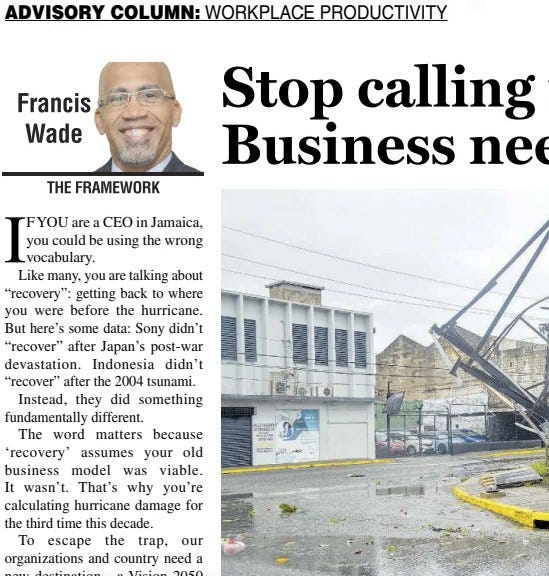 Stop Calling It Recovery: Why Your Business Needs a Different Word 22.12.2025 11minWhen disaster strikes, the language leaders choose reveals everything about their future.In late October 2024, Hurricane Melissa tore through Jamaica as a Category 4 storm, causing widespread devastation. Within days, business leaders across the island were using the same word: “recovery.” Getting back to where they were before the hurricane hit.But here’s the problem with that word—and why it matters far beyond Jamaica’s shores.“Recovery” assumes your old business model was viable. For most organizations, it wasn’t. That’s why they’re calculating hurricane damage for the third time this decade, why they’re responding to their fourth supply chain crisis in two years, why they’re addressing the same vulnerabilities again and again.The word matters because it shapes the destination. And if that destination is simply “back to normal,” you’re planning to fail in exactly the same way next time.The Recovery TrapLet me be direct: If your post-crisis strategic plan looks like “restore operations to pre-crisis levels,” you’re planning to fail again.Recovery language creates a dangerous illusion. It suggests there was a golden era you need to return to—a time when the business was humming, customers were happy, and growth was steady. Then the crisis hit and disrupted everything.But that’s fiction.The truth most leaders know but won’t say out loud: Your business had fundamental vulnerabilities long before the crisis made them visible. The hurricane, the pandemic, the market shock—it didn’t create your problems. It revealed them.You already knew your supply chain was too dependent on a single source. You already knew your physical infrastructure couldn’t handle severe weather. You already knew your cash reserves were too thin. You already knew your team’s digital capabilities were years behind competitors.The crisis just made these truths undeniable.So when you talk about “recovery,” what are you actually recovering to? A fragile business model? An outdated strategy? An eroded competitive position? A workforce unprepared for what’s coming?That’s not a plan. That’s a delusion.What Transformation Actually Looks LikeLet’s look at what organizations that escaped this trap actually did.Sony, Post-War Japan: When Sony emerged from the devastation of World War II, they didn’t try to rebuild Japan’s pre-war electronics industry. That industry was based on cheap labor and imitation of Western products. Instead, Sony’s founders asked a different question: “What could Japan become if we built for the world that’s coming?”They invested in miniaturization technology when everyone said radios had to be large. They pioneered the transistor radio when the market didn’t exist. While Japan was rebuilding roads, they built global distribution networks.Sony didn’t recover. They transformed into something their pre-war selves couldn’t have imagined.The defining moment came in 1955 when Bulova proposed a massive deal that would have guaranteed immediate revenue. Co-founder Akio Morita refused: “If we accept, they will be promoting the Bulova name. In five years, no one will remember Sony. But if I spend 50 years selling Sony-branded products, I will build a brand that lasts for decades.”That’s the difference between recovery thinking and transformation thinking.Indonesia, Post-Tsunami: After the 2004 tsunami devastated Aceh province, killing over 160,000 people in Indonesia alone, the government didn’t just rebuild the fishing villages that were destroyed. They relocated entire communities to higher ground, created early warning systems that didn’t exist before, and diversified local economies away from single-industry dependence.The new Aceh wasn’t a recreation of the old one. It was designed for a future where tsunamis would happen again—but with radically different outcomes.New Orleans, Post-Katrina (A Counter-Example): What happens when you choose recovery over transformation? Look at New Orleans after Hurricane Katrina in 2005.The city spent billions rebuilding in the same flood-prone areas, restoring the same vulnerable levee systems, recreating the same economic dependencies. Twenty years later, the city remains vulnerable to the same threats. The recovery was successful. The transformation never happened.That’s the cost of choosing the wrong word—and the wrong destination.The Question That Changes EverythingHere’s what transformational thinking looks like in practice:Instead of asking “How do we get back to normal?” you ask a different question: “If we were building this business from scratch today, knowing what we know about technology, climate, markets, and geopolitics, what would we build?”This isn’t theoretical. Jamaica is facing exactly this choice right now.Since 2009, Jamaica has been working toward Vision 2030 Jamaica—a national development plan with the ambitious goal of achieving developed-country status by 2030. It was a bold, comprehensive framework covering everything from education to economic policy to social development.But as Prime Minister Andrew Holness acknowledged in late 2024, many of its original aspirations are now beyond reach. Jamaica won’t become a developed country in the remaining years of the plan.Yet Vision 2030 did something crucial: it demonstrated that long-term thinking is possible, even in a country accustomed to short-term crisis management. It planted the seeds of what comes next.Vision 2050: Transformation, Not RestorationWhat Jamaica needs now—and what your organization likely needs too—is a Vision 2050.Not a recovery plan. Not a restoration strategy. A transformation roadmap.A Vision 2050 should be hard-hitting enough that it forces uncomfortable questions. What does a mid-century resilient organization look like in a world of climate chaos, technological disruption, and geopolitical instability? What capabilities must we build? What dependencies must we eliminate? What assumptions must we abandon?It should be detailed enough that you can work backward to inform today’s decisions. If we need X capability in 2050, what must we start building in 2025? If Y vulnerability will be fatal in 2040, what must we eliminate now?And it should be transformative, not restorative. The goal isn’t to get back to 2024. The goal is to leapfrog to something that would have been impossible to imagine in 2024.The Opportunity Crisis CreatesHere’s the paradox: Crisis is the only time most organizations have permission - the full freedom - to transform.In normal times, there’s too much momentum, too many stakeholders invested in the status quo, too many reasons to optimize rather than revolutionize. Crisis breaks that inertia. It creates a brief window where fundamental change becomes possible—even expected.Hurricane Melissa offers Jamaica this opportunity. Your next crisis—and there will be one—offers it to you also.The question is whether you’ll use it for recovery or transformation.Recovery is easier. It’s more comfortable. It doesn’t require you to question fundamental assumptions or abandon familiar approaches. You can point to what existed before and say “let’s get back to that.”Transformation is harder. It requires admitting that what you’re losing wasn’t worth preserving in its current form. It demands imagination about futures that don’t yet exist. It means making irreversible decisions based on incomplete information.But only one of these approaches positions you for the world that’s actually coming.The Fork in the RoadEvery organization facing disruption stands at a fork in the road. One path leads back. One path leads forward. They’re labeled with different words.One sign says “Recovery.”The other says “Transformation.”The choice reveals everything about what comes next—and whether you’ll be having this same conversation after the next crisis hits.Choose the right word. It determines your destination.——————————-This article is based on a column published in the Jamaica Sunday Gleaner Business Section by Francis Wade This is a public episode. If you'd like to discuss this with other subscribers or get access to bonus episodes, visit longtermstrategy.substack.com/subscribe
 -
 Why Your Strategic Plan Is Probably Just an Expensive Wish List 08.12.2025 11minTranscriptAsk most CEOs about their strategic plan and you’ll hear about vision statements, multi-year roadmaps, and quarterly KPIs. What you won’t hear is the one thing that actually matters: What do we believe has to be true for this to work?That missing question—the absence of a testable hypothesis—is why most strategic plans gather dust while organizations spin their wheels solving the same problems year after year.Dianne McIntosh and Jamaica’s Citizens Security Secretariat (CSS) discovered this the hard way. Their story reveals how treating strategy like a scientific experiment—not a sacred document—can unlock progress that seemed impossible.The Problem with Most Strategic PlansHere’s the uncomfortable truth: calling something a “strategic plan” doesn’t make it strategic.Most planning exercises produce elaborate action lists. Deploy new technology. Improve customer service. Expand into new markets. These aren’t strategies-they’re activities. And activities without an underlying theory about why they’ll work are just expensive guesses dressed up in PowerPoint.Real strategy requires what Dr. Peter Compo describes as a central rule: a single guiding choice that directly addresses the system’s bottleneck—the critical constraint standing between you and your aspiration. A true strategy is not a laundry list of initiatives but a clear, testable bet about how overcoming that bottleneck will unlock progress. The central rule can then be tested, adapted, or abandoned as evidence accumulates.Why don’t more leaders think this way? Because genuine strategic thinking is genuinely hard. It demands:Making peace with incomplete informationCommitting to multi-year time horizonsAccepting you might be wrongFollowing evidence even when it contradicts your initial beliefsMost executives understandably retreat to the comfort of detailed plans and busy work. At least that feels like progress.When Reality Breaks Your Beautiful PlanWhen Jamaica formed the CSS to tackle violent crime, they followed the standard playbook: multi-sectoral coordination, justice reform, community programs. Their flagship initiative? Train 99,000 parents of at-risk youth through the Parenting Commission.It was comprehensive. It was ambitious. It was wrong.The program failed spectacularly—burning through a million euros in EU funding before collapsing under the weight of insufficient capacity and entrenched behavioral patterns. The target was fantasy, not strategy.This is where most organizations double down on the original plan or blame “execution failures.” The CSS did something different: they admitted their hypothesis was flawed and went looking for a better one.The Question That Changed EverythingTony Anderson, then Commissioner of Police, posed a challenge that redirected their entire approach: “When are you going to do something about the few schools producing most of our criminals?”That question sent McIntosh’s team into Jamaica’s education data for the first time. What they found confirmed Anderson’s instinct—but revealed something far more important.The data exposed the bottleneck: children leaving primary school reading at Grade Two level, many traumatized, seeking achievement and belonging in criminal gangs instead of classrooms.This wasn’t about parenting programs. The constraint was literacy and unaddressed trauma in the education system itself.Suddenly, the CSS had a testable hypothesis: If we close learning gaps and treat trauma in vulnerable schools, we can predictably reduce the pipeline of youth into criminality.That’s a hypothesis you can build experiments around. That’s a hypothesis that points to specific interventions. That’s a hypothesis that, if wrong, tells you exactly where your assumptions broke down.The Scientific Approach to StrategyThe CSS’ turnaround demonstrates a replicable four-step process:First: Treat Your Plan as a Temporary HypothesisStop calling it “the strategy” and start calling it “our current best guess.” The CSS abandoned their parenting program quickly because they viewed it as a testable assumption, not a political commitment. This requires intellectual humility—and organizational culture that rewards learning over face-saving.Second: Let Data Reveal the True ConstraintThe CSS didn’t commission a new consulting study. They analyzed existing school inspection reports and educational outcomes data. The constraint revealed itself: students trapped in learning failure, falling further behind each year.Theory of Constraints teaches that every system has one primary bottleneck limiting performance. Your job isn’t solving every problem—it’s identifying which constraint actually matters, then exploiting it relentlessly.Third: Build a Cause-Effect Model You Can MeasureThe CSS formalized their new hypothesis as the Inter-Ministerial School Support Strategy (IMSSS). Success became concrete: move a child from Grade One to Grade Four reading level in ten weeks.This shift is critical. Unlike short-term police operations that yield immediate metrics, social development requires years to show results. But intermediate indicators—reading level improvements, trauma treatment completion—let you track whether your hypothesis is working long before final outcomes appear.You’re not waiting five years to discover you were wrong. You’re testing assumptions continuously.Fourth: Institutionalize the Learning ProcessBorrowing from Tony Blair’s UK government, the CSS established itself as a delivery coordination center—managing the “science of delivery” across multiple ministries.Why does this matter? Because one-off experiments don’t create lasting capability. You need institutional mechanisms that turn hypothesis testing into organizational DNA.Does Your Plan Have a Hypothesis?Most strategic documents hide their assumptions rather than stating them explicitly. You can fix this today with a simple diagnostic.Take your current strategic plan and ask an AI to analyze it using these prompts:What’s our stated long-term objective?What are our top five proposed actions?What cause-and-effect chain connects these actions to that objective? (State it explicitly: “We believe X leads to Y because of Z”)What’s the implicit hypothesis? (“The constraint preventing our success is...”)Are these actions surgical interventions testing our hypothesis—or just business-as-usual activities we hope will help?Can you state our central strategic hypothesis in one clear, testable sentence?If the AI can’t find a clear hypothesis, neither can your team. You’re operating on hope, not strategy.The Ultimate TestAfter running this analysis, ask yourself one question McIntosh would recognize:“If we executed this plan perfectly and still failed to achieve our goals, would we know exactly which assumption was wrong?”If you can’t answer “yes”—if you can’t pinpoint the specific cause-effect belief that would be disproven—then you don’t have a strategic hypothesis. You have a prayer disguised as a plan.But if you can articulate what would have to be true, what evidence would prove you wrong, and what you’d learn from failure—then you’re thinking scientifically.The CSS didn’t contribute to reducing Jamaica’s violent crime by 40% through willpower or resources. They did it by treating strategy as science: form a hypothesis, design experiments, follow the evidence, adjust ruthlessly.Your constraints are different. Your bottleneck isn’t literacy or trauma. But your challenge is identical: stop planning and start hypothesizing.The evidence is waiting to tell you what’s actually true. The only question is whether you’re ready to listen.This article was inspired by my regular column in the Jamaica Gleaner. This is a public episode. If you'd like to discuss this with other subscribers or get access to bonus episodes, visit longtermstrategy.substack.com/subscribe
 -
 Why Your Strategic Vision Falls Flat 24.11.2025 8minAs a senior executive, you’ve delivered passionate presentations about your organization’s strategic vision. You’ve crafted compelling narratives about transformation, growth, and impact. Yet somehow, your message resonates in the boardroom but dies somewhere between middle management and the frontlines.Sound familiar?Most executives communicate like it’s 1995 - a pre-digital world. They craft one message and assume it will resonate equally across all levels of the organization. Unfortunately, they remain trapped in a predictable pattern: the C-Suite is energized, department heads are cautiously optimistic, supervisors are skeptical, and frontline staff are mentally planning their next vacation.This enthusiasm gap has killed more strategic initiatives than market downturns, budget cuts, or competitive threats combined.But what if you could access an AI assistant that never tires of brainstorming and never judges your half-formed ideas? Some executives are already discovering this secret weapon. What follows are three 10-minute prompting strategies that require only copying, pasting, and customization. By the end, you’ll have created a new Super Colleague who works for free.The Level-Specific TranslatorYour strategic passion resonates at the top, wavers in the middle, and completely dissolves at lower organizational tiers. One-size-fits-all messaging simply cannot work when you’re speaking to executives worried about market position, managers concerned about operational changes, and frontline employees focused on daily workflows.Start with this basic prompt:“I need to communicate our strategic initiative to different levels of my organization. Here’s our core message: [INSERT YOUR MESSAGE]. Please create 4 versions tailored for: 1. Senior executives (focus on strategic impact) 2. Middle managers (focus on operational changes) 3. Supervisors (focus on team implications) 4. Frontline staff (focus on daily work impact). For each level, address their specific concerns and use language they relate to.”To deepen this approach, upload relevant strategic documents, previous planning frameworks, and organizational assessments. But go further.Great communication begins with genuine empathy for your audience. Modern tools like Jobs to Be Done and Design Thinking can take you into your staff’s actual experience. Once there, you can tap into deeper motivations than just “getting a paycheck.”Feed these insights into your AI and ask it to generate multiple message options. This gives you choices rather than hoping your first attempt works.The Resistance DetectorEven with perfect messaging, you should expect skepticism. While employees nod politely in meetings, their real objections remain unspoken, quietly sabotaging your efforts. You’re fighting invisible resistance because people won’t voice their true concerns publicly.Use your AI to anticipate objections before they derail your initiative:“I’m rolling out strategic initiatives in my [TYPE OF ORGANIZATION]. Based on typical employee concerns, what are the likely unstated objections from: 1. Middle managers worried about implementation 2. Supervisors concerned about their teams 3. Frontline staff skeptical about change. For each group, identify their top 3 unspoken concerns and suggest how I should address them in my communication.”Feed in data from employee surveys, focus groups, and engagement metrics. Your AI Super Colleague will analyze every piece simultaneously—a feat no human consultant can match.Expect some surprises. You’ll also receive specific strategies to address lurking issues before they become problems, helping you craft proactive responses rather than reactive damage control.The Tactical Action GeneratorIf you’ve gained traction with the above methods, congratulations—but you’re far from finished. Strategic success relies on thousands of individuals taking specific actions that fall well outside business-as-usual operations.That’s the entire point of strategic transformation.Now you need concrete activities that departments can integrate into their operational plans:“Our organization is pursuing [INSERT SPECIFIC STRATEGIC GOAL]. We are a [TYPE OF ORGANIZATION] with departments including [LIST DEPARTMENTS]. For each department, create 3-5 specific actions they can take in the next 90 days that directly contribute to this goal. Make sure each action is SMART and requires minimal additional resources.”The specific answers won’t be perfect, but they’ll accelerate your thinking exponentially. You’ll move from abstract strategy to concrete tactics in minutes rather than months.Beyond Traditional ConsultingSkeptics might argue these are questions leadership teams discuss regularly. True—but we know that fresh perspective can shake up stale thinking considerably. Your AI Super Colleague brings unlimited patience, vast knowledge synthesis, and zero political agenda to strategic planning.Unlike human consultants who deliver recycled frameworks, AI generates organization-specific insights. Unlike internal brainstorming that gets trapped in groupthink, AI challenges assumptions. Unlike expensive advisory relationships that drain budgets, AI provides unlimited strategic thinking support.The transformation isn’t just about better communication—it’s about democratizing access to strategic thinking tools that were previously available only to organizations with massive consulting budgets.Start TodayYour AI Super Colleague is waiting, ready to transform how you bridge the gap between strategic vision and organizational reality. While others struggle with the same old enthusiasm gaps and communication breakdowns, you can become the leader who finally cracks the code on organization-wide alignment.The prompts are here. The technology is accessible. The choice is yours. Why not start today?This article was inspired by my recent column in the Jamaica Gleaner. This is a public episode. If you'd like to discuss this with other subscribers or get access to bonus episodes, visit longtermstrategy.substack.com/subscribe
 -
 Beyond the Annual Planning Checklist 18.11.2025 9minTranscriptImagine you lead a government ministry, department, or agency. As you approach the season for submitting annual reports and corporate plans, you realize something is missing. The very reason you entered public service is being lost in paperwork.This challenge isn’t unique to any single country—it’s a global phenomenon affecting government leaders worldwide, whether they’re working within established national development frameworks or considering creating one.A Case Study in National Vision: Jamaica’s ExperienceTo understand this dynamic, consider Jamaica’s Vision 2030—one of the world’s most comprehensive national development plans. For over 16 years, more than one hundred government organizations have submitted detailed annual plans to parent ministries, creating a rigorous process that private sector executives often admire. It represents a remarkable achievement in sustained strategic execution.Dr. Wesley Hughes, the plan’s architect, originally envisioned something transformational. In his forward to the Vision 2030 document, he wrote: “Today, our children have access to technologies that were once considered science fiction. They seek opportunities to realize their full potential. This Plan is to ensure that, as a society, we do not fail them.”Hughes continued: “We have a duty to ourselves, to the sacrifices of past generations and to the hopes of future generations, to preserve the best of our country and to transform the worst. The outcome in 2030 is dependent on the decisions we make today.”However, as insiders know, even the most well-intentioned national frameworks can become sources of bureaucratic dread rather than inspiration. How does this happen, and what can leaders worldwide learn from this experience?The National Vision Compliance TrapThe primary problem—whether in Jamaica or any country with strategic planning processes—is that organizations typically complete their internal plans before “aligning” them with the national vision. Compliance checking becomes the final step rather than the foundational starting point.This approach is fundamentally backwards, like deciding to travel somewhere before determining why the journey matters.Consequently, civil servants feel constrained rather than inspired by their national development framework. For countries without established national plans, this offers a crucial lesson: the implementation process matters as much as the vision itself.Universal Principles for Government LeadersWhether you’re operating within an existing national framework or considering developing one, the solution involves reclaiming strategic voice through fundamental questions:“What does our country need from this organization to accomplish our national vision?”“What game-changing outcomes aren’t explicitly captured in current planning but have become critical?”“What goals should influence the next (or first) iteration of national planning?”Reconnect with Original PurposeStudy Dr. Hughes’ approach as a model. He didn’t lead the creation of Vision 2030 Jamaica as a bureaucratic compliance exercise—he crafted it as a covenant with future generations. Government leaders worldwide can apply this principle by:* Returning staff to the original purpose behind strategic frameworks.* Connecting teams with the deeper reasons they joined public service.* Making inspirational founding documents part of organizational culture.* Recognizing that most public servants want to accomplish more than mere survival.From Following to Leading: The Jamaica Model and BeyondJamaica’s experience offers both cautionary tale and opportunity. The country now stands at a unique inflection point—with remaining years in the Vision 2030 timeline that could become its finest contribution to national development.This mirrors a broader truth: research shows humans overestimate short-term potential while underestimating long-term possibilities. Strategic initiatives often build momentum gradually, achieving exponential impact toward their timeline’s end.For countries without national development plans, Jamaica’s experience suggests several critical design principles:* Start with inspirational purpose, not compliance requirements, and convert these into frequent practices.* Build implementation processes that energize rather than drain participants.* Create feedback loops that celebrate progress toward transformational goals.* Design planning cycles that connect daily work to generational impact.The Global Leadership ChoiceWhether you’re working within Jamaica’s Vision 2030, another country’s national framework, or considering developing strategic planning processes, the fundamental choice remains the same.The question isn’t whether you have authority to lead transformational change—you do. The question is whether you have courage to use it.Right now, government leaders across the globe face this choice. Will you spend your tenure perfecting compliance reports? Or will you use strategic planning as foundation for breakthrough leadership?Dr. Hughes helped design Vision 2030 to prevent society from failing its children. His vision applies universally: every government leader has opportunity to ensure their work serves future generations rather than mere bureaucratic efficiency.Lessons for Countries Without National PlansJamaica’s experience offers valuable insights for nations considering comprehensive strategic planning:* Start with inspirational architecture like Hughes created—connect planning to generational responsibility.* Design implementation processes that inspire rather than constrain participants.* Build momentum systems that recognize long-term strategic initiatives often achieve greatest impact at timeline’s end.* Create cultural integration that makes strategic thinking part of daily organizational life.History won’t remember executives who filed the most thorough paperwork. It will remember those who transformed their area of responsibility when game-changing leadership mattered most.The choice, and the legacy, are yours—whether you’re building on Jamaica’s model or creating your own path toward national transformation.This article was inspired by my recent Jamaica Gleaner column. This is a public episode. If you'd like to discuss this with other subscribers or get access to bonus episodes, visit longtermstrategy.substack.com/subscribe
 -
 When Good News Becomes a Business Risk 10.11.2025 8minTranscriptWhen Good News Becomes a Business Risk: How Falling Crime Can Disrupt Your StrategyA Shift Few Leaders ExpectFalling crime rates are usually celebrated as a sign of progress. Safer communities, stronger economies, and a brighter future—what’s not to like? Yet for business leaders, this kind of change can also be profoundly disruptive. If your company has been operating for decades in an environment shaped by insecurity, what happens when that reality suddenly shifts?Jamaica offers a striking example. For years, high levels of violence defined everyday life and business practices. Many firms adapted, building their operations on an assumption of danger. Now, crime is falling. If this trend proves durable, the very foundations of corporate strategy in the country could be shaken.The same dynamic applies globally. Whether it’s crime, inflation, regulation, or even cultural norms, long-standing conditions shape business models. When those conditions change, the leaders who cling to old assumptions often suffer the most.Beyond Skepticism: Could the Change Be Real?History encourages caution. In Jamaica, crime dipped after the 2010 “Dudus crackdown,” when nearly a hundred criminals were eliminated or fled. The effect was temporary; crime rebounded. Understandably, leaders today hesitate to celebrate.But current indicators suggest something different. The Citizens Security Plan (CSP), launched in 2020, has applied coordinated interventions across policing, communities, and schools. These are not random shifts but measurable, systemic efforts. According to Dianne McIntosh of the Citizens Security Secretariat (CSS), the downward trend was predicted and intentional, not accidental.If this approach is sustainable, Jamaica may be entering a new era. For business leaders, that requires more than casual observation—it demands strategic reconsideration.When Old Assumptions Become DangerousExecutives often claim to have “a long-term plan.” Sometimes it exists only in their heads; other times it’s reduced to lofty mission statements. But when tested, many leadership teams struggle to articulate a coherent strategy. That’s manageable when conditions remain stable. It’s perilous when they change.Falling crime isn’t just a social good—it’s an economic shock. Studies suggest that Jamaica’s high crime rate has shaved 2–4% off annual GDP growth. If that burden is lifted, the economy could expand in ways that reward some sectors while destabilizing others.Consider Colombia. Between 2002 and 2010, murders and kidnappings plummeted. While the country as a whole benefited, one sector suffered: private security. With half a million armed guards—more than the army and police combined—the industry had thrived on fear. When violence declined, demand collapsed. Firms that assumed the old reality would last indefinitely faced sudden disruption.The same could happen anywhere. Companies built on entrenched conditions may discover that their core business model no longer fits.Lessons from a Pandemic SurpriseThis pattern isn’t limited to crime. In 2017, a financial services client dismissed the idea that their country was ready for online banking. They imagined digital adoption as a distant event.In discussions, I encouraged them to carve out an actual timeline: a 10-year goal. Then the COVID-19 pandemic hit. Overnight, physical branches closed, and the digital future arrived.Fortunately, the company had at least sketched out a plan. They accelerated it, shifting in months what they thought would take a decade. Those without foresight were left scrambling.The lesson is clear: change rarely arrives on schedule. Leaders who prepare for disruption—whether it comes from crime rates, technology, or global crises—are positioned to adapt. Those who rely on yesterday’s success become their own worst enemy.Why Foresight Matters NowHarvard professor Clay Christensen once observed that organizations grow addicted to what made them successful. They defend the familiar rather than exploring the new. This is comforting but risky.If crime falls sustainably, a country like Jamaica will experience profound change. Real estate values could climb. Tourism could expand. Consumer confidence could rise. Yet industries tied to fear—private security, certain insurance products, or defensive real estate designs—may shrink.Globally, the principle is the same: whenever a long-standing challenge begins to ease, leaders must ask, what happens to us if the world really does change?Turning Good News into Strategic AdvantageFalling crime is an undeniable win for society. But for business leaders, it’s also a challenge. The question is not whether to celebrate, but whether to adapt.Here are three steps to consider:* Validate the DataDon’t rely on rumors or short-term headlines. Understand the leading indicators, the policies behind them, and whether the change is likely to last.* Stress-Test Your ModelAsk how your operations, costs, and markets would shift if the old assumptions disappeared. If your business relies on high levels of fear, inflation, or any entrenched condition, prepare alternatives.* Rebuild Before You’re Forced ToWaiting until the change is undeniable often means it’s too late. Instead, use foresight to redesign your company around the future that could emerge.The Bottom LineA safer society is a gift. But it is also a test of leadership. True foresight requires seeing risks where others see only triumph.The companies that thrive will be those willing to let go of outdated assumptions and embrace a new normal—even when the news is good.This article was inspired by my recent Jamaica Gleaner column. This is a public episode. If you'd like to discuss this with other subscribers or get access to bonus episodes, visit longtermstrategy.substack.com/subscribe
Podcasts similares


Popular em
Este podcast também aparece nas paradas de podcasts destes países.
