
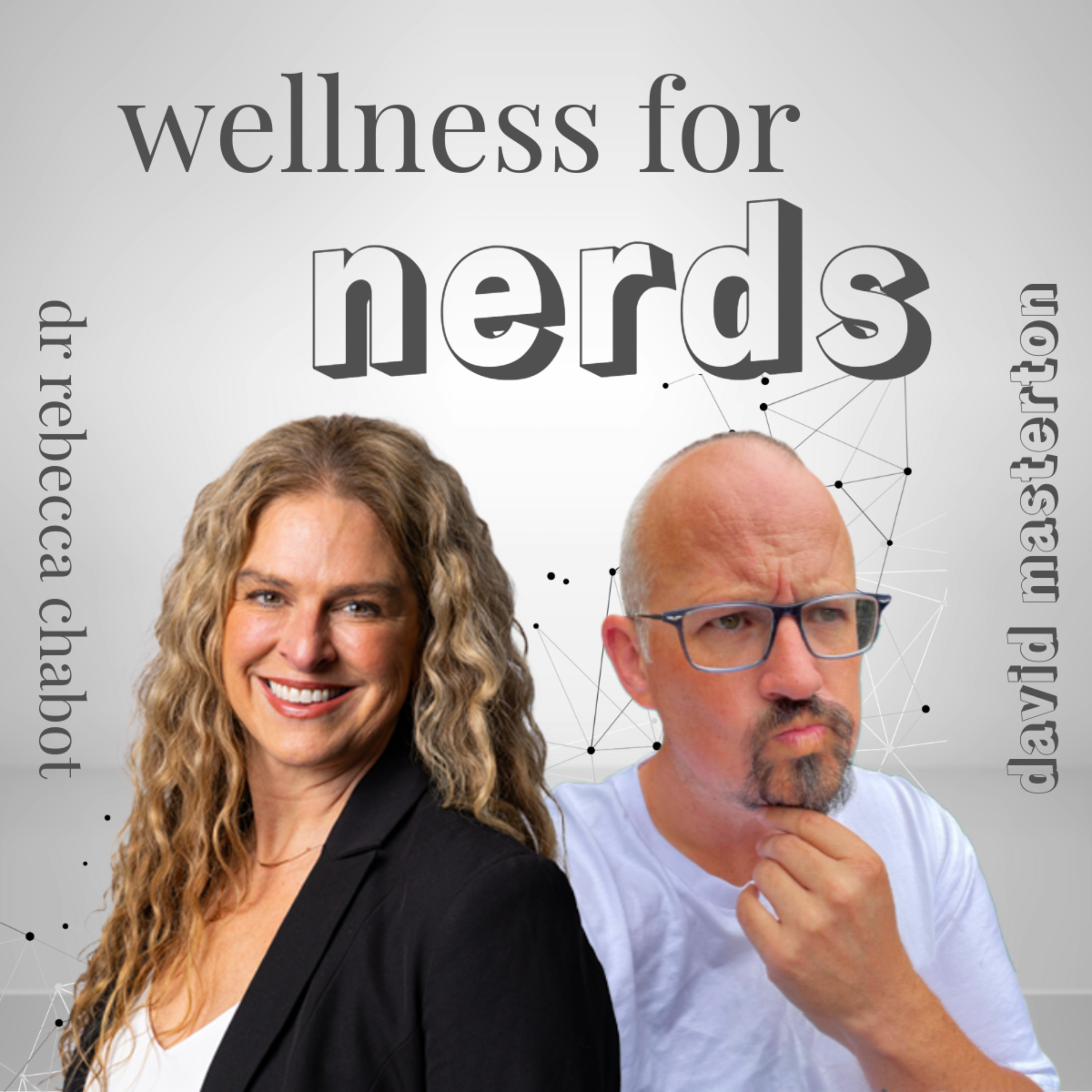
wellness for nerds
david masterton and dr rebecca chabot
0
Science-backed wellness for high performers, hosted by Dr Rebecca Chabot and David Masterton. They translate real research on stress, busyness, habits and performance into practical tools. Expect honest stories, occasional dad jokes, and zero guru-speak. Aimed at business owners, knowledge workers, scientists, and parents. Recorded in Tasmania, with new video episodes weekly.
Episódios
-
 ADHD and Relationships: Are You Talking AT Them? | E11 28.09.2026 24min"I won the debate. I lost their heart." The finale of our ADHD series: what ADHD does to relationships, romantic, family and work.David opens up about the unhealed version of himself: ADHD, anxious attachment, highly sensitive to rejection and to injustice. When he felt unseen, he'd use logic and evidence to prove why he was hurt, and keep going until the message landed. Two relationships like that, one common denominator. Rebecca adds the other side: hyperfocus can make your work day or your latest research the only topic in the room, and conversation is meant to be a dance, not a monologue. She also asks the question this show exists for. Is the intense start to an ADHD romance actually backed by data, or is it just the honeymoon phase, turned up?They land on two practical tools. Rebecca's: if you tend to talk at people, take a breath and let them speak (and if they change the subject, that's your cue). David's: ask yourself, am I talking to prove, or talking to understand? The label is awareness, not an excuse.THE ADHD SERIESPart 1: Meditation and the busy brain (E8) [link]Part 2: Cold water, yoga and your nervous system (E9) [link]Part 3: Habits, focus and procrastination (E10) [link]Part 4: ADHD and relationships (this episode)(02:12) Rejection sensitivity and attachment styles(04:14) When hyperfocus makes one topic the only topic(07:24) Won the debate, lost their heart(08:51) ADHD shows up differently: son vs daughter(11:33) Is that backed by data?(13:28) Conversation is a dance(17:58) Awareness, not an excuse(22:03) Talking to prove or talking to understand?Dr Rebecca Chabot:https://drrebeccachabot.com https://purewellnesstasmania.comDavid Masterton: https://158lab.com.auWellness for Nerds shares general information and personal experience. It is not individual medical or mental-health advice.
 -
ADHD and Habits: Focus, Phones and Procrastination | E10 19.09.2026 23minPhone on silent didn't work. Phone in another room did. Habits, focus, and why David's procrastination was always fear. Part 3 of 4 in our ADHD series.Rebecca starts with what a habit actually is: an automated behaviour your subconscious runs so your conscious mind is free for the new stuff. Which means bad habits are automated too, and changing one takes real effort. Her tools are small and tweakable: get the phone out of the room, set a timer, give yourself a reward at the end, and reduce the friction (a yoga mat left out in the lounge gets used; one in the cupboard does not). David explains elastic time, why a plank lasts forever and hyperfocus eats three hours, and what Thom Hartmann's Hunter in a Farmer's World taught him about the ADHD need to feel alive.Then the honest bit. David has been performance-managed for the boring parts of every job he's had, so he built an AI to carry them and negotiated his hours around the times his brain actually works. He never rewarded himself for anything. His procrastination was fear, so he beat it with a bigger fear: tight deadlines. Rebecca's answer is the distinction the whole episode turns on: are you running from something, or running towards it? Same finish line, completely different energy.THE ADHD SERIESPart 1: Meditation and the busy brain (E8) [link]Part 2: Cold water, yoga and your nervous system (E9) [link]Part 3: Habits, focus and procrastination (this episode)Part 4: ADHD and relationships (E11) [coming soon](01:22) What a habit actually is(06:09) The phone goes in another room(06:51) Elastic time and the ADHD rhythm(09:15) Hunter in a Farmer's World(11:40) How AI removes the micro-barriers(15:43) Reduce the friction: leave the yoga mat out(18:32) Procrastination is fear(20:30) Running from vs running towardsBook David mentions: ADHD: A Hunter in a Farmer's World by Thom HartmannDr Rebecca Chabot: https://drrebeccachabot.com https://purewellnesstasmania.comDavid Masterton: https://158lab.com.auWellness for Nerds shares general information and personal experience. It is not individual medical or mental-health advice.
-
ADHD and Your Nervous System: Cold Water and Yoga | E9 14.09.2026 21minCold water, yoga, a five-second cold shower: they all train the same thing, your nervous system's tolerance for stress. Part 2 of 4 in our ADHD series. Last week was the mind, this week is the body.Rebecca explains hormetic stress: a small, controlled dose of a stressor, like cold water, that trains your nervous system to regulate when the uncontrolled stress arrives. She covers the safety check that comes first (not if you're already at your tipping point, not with a heart condition), the shower version anyone can do, and why yoga is really breath training under pressure. David explains why he jumps into freezing water at sunrise, why he still hasn't done yoga, and his rule for knowing when a challenge is right for you: curiosity vs urgency. You cannot be curious and triggered at the same time.The back half is about telling "I'm afraid" apart from "this is not for me", which David reckons are cousins in the same bloodline. Rebecca makes the case that self-awareness is a trainable skill, with the story of a client who only noticed a year-long toothache once he sat still. And whether you start with the mind or the body, both roads end up at the same place.THE ADHD SERIESPart 1: Meditation and the busy brain (E8) [link]Part 2: Cold water, yoga and your nervous system (this episode)Part 3: Habits, focus and procrastination (E10) [link]Part 4: ADHD and relationships (E11) [coming soon](03:01) Hormetic stress: controlled stress that builds tolerance(04:24) The safety check first(05:41) Five seconds of cold shower, and yoga as breath training(09:51) Curiosity vs urgency(11:42) Self-awareness as a skill: the year-long toothache(15:21) "This is not for me" vs "I'm afraid"(17:01) Your intuition isn't in your head(20:07) Mind first or body first?Rebecca's yoga and breathwork classes: https://purewellnesstasmania.comDr Rebecca Chabot: https://drrebeccachabot.com | https://purewellnesstasmania.comDavid Masterton: https://158lab.com.auWellness for Nerds shares general information and personal experience. It is not individual medical or mental-health advice
-
ADHD and Meditation: Can a Busy Brain Actually Do It? | E8 07.09.2026 29minTHE ADHD SERIESPart 1: Meditation and the busy brain (this episode)Part 2: Cold water, yoga and your nervous system (E9) Part 3: Habits, focus and procrastination (E10) Part 4: ADHD and relationships (E11) "My brain never switches off, so I can't meditate." Rebecca hears it constantly from clients with ADHD, and her answer is: neither does anyone's. Every human brain thinks. That is the job. This is Part 1 of 4 in our ADHD series.Rebecca explains what meditation actually is (observing thoughts, not stopping them), how to use an anchor like the breath or a word and keep reining your attention back, and why 10 minutes a day every day beats an hour once a week. She also asks the uncomfortable question: is "my brain's too busy" a reason, or a cop-out? David, diagnosed and unmedicated, describes what it was like to chase nothingness in his head and fail, how observing without judgement started leaking into his everyday life, and how he meditates now: no timer, no journal, one hand on his heart at Cornelian Bay. He also played with a matchbox car for the entire recording, which tells you everything.The back half gets into traits vs diagnosis, why everyone sits somewhere on the spectrum, a friend whose ADHD was noticeably worse the day after drinking, and Rebecca's book-in-progress idea of treating your own life as an experiment.(02:19) Every brain thinks. Meditation is observing, not stopping(05:16) "Is that you copping out?"(06:57) David: diagnosed, unmedicated, chasing nothingness(10:55) How long? 10 minutes a day, every day(14:23) Everyone is on the spectrum somewhere(16:34) Traits vs diagnosis(21:31) Your life as an experiment: Rebecca's book(25:12) How David meditates nowWant help getting started with meditation? Rebecca works one-on-oneDr Rebecca Chabot: https://drrebeccachabot.com | https://purewellnesstasmania.comDavid Masterton: https://158lab.com.auWellness for Nerds shares general information and personal experience. It is not individual medical or mental-health advice
-
Netflix Isn't Recovery (You're Just Soothing) | E7 31.08.2026 26minYou scrolled through your lunch break. You watched two hours of Netflix to switch off. Neuroscientists say that isn't recovery, it's just soothing, because your brain is still being stimulated the whole way through. This episode is the practical follow-on to last week: what real recovery actually looks like, especially at work.Rebecca explains why workplace culture starts at the top, and the first thing she asks a leader who wants wellness for their team: what are YOU doing? She makes the case for sustainable high performance, building the strength to function well inside stress rather than just enduring it, and why recovery has to be built in or you are simply depleting. Then the reframe that lands hardest: the difference between soothing and recovering. David owns up to TikTok as his poison of choice, and asks the question that cracks the whole thing open: what do you actually do for play?The back half gets properly nerdy. Why so many people cannot sleep, and what overstimulation has to do with it. Why writing by hand imprints on the brain in a way typing does not. What it means when your hobbies are all screens too, which Rebecca points out is exactly David's situation. And how to earn your scroll by treating it as the reward rather than the recovery. It ends where you would not expect a corporate wellness episode to end: looking out a bus window, sitting on a swing, and doing handstands on the beach.(01:44) Culture starts at the top(12:41) The lunch-break test(15:07) Netflix and scrolling aren't recovery(15:31) What to do instead(19:20) Pen and paper beats typing(20:40) Why you can't sleep: overstimulation(22:46) Earn your scroll(23:15) The bus window storyDr Rebecca Chabot: https://drrebeccachabot.comhttps://purewellnesstasmania.comDavid Masterton: https://158lab.com.auWellness for Nerds shares general information and personal experience. It is not individual medical or mental-health advice.
-
Why Burnout Is a Prevention Problem | E6 22.08.2026 24minBurnout is a real clinical diagnosis, and it builds quietly over months or years before it ever announces itself. By the time you feel it, the cleanup is expensive. So this episode is about prevention, the same way you'd prevent a cyberattack.Fresh off Hobart's CyberCon, Rebecca draws the parallel: organisations invest in cyber prevention because reacting after an incident costs data, money and trust, and some of the damage is irreparable. Your nervous system works the same way. The good news is that recovery isn't a long-term sacrifice you make for future-you. Build a little into every day and your focus, decisions and performance improve now. David riffs on "how long is a moment?" and the art of stealing 5 to 15 seconds of real recovery (sun on your face, walking from the car), while Rebecca explains why the scale of a single day, your circadian rhythm and cortisol, is the right place to start.Then the practical bit: steal ten minutes of your lunch break to walk, get outside, or connect with someone about something other than work. Small steps, made daily, beat one big bold change.(00:47) The cyber-wellness parallel(01:20) Burnout is a real diagnosis(07:48) Recovery pays off now, not just someday(10:33) How long is a moment?(14:44) Goals vs daily habits(15:40) Circadian rhythm and the scale of a day(19:58) Steal 10 minutes of your lunch breakDr Rebecca Chabot:https://drrebeccachabot.com | https://purewellnesstasmania.comDavid Masterton: https://158lab.com.auWellness for Nerds shares general information and personal experience. It is not individual medical or mental-health advice.
-
There Is No One Authentic Self | E5 15.08.2026 24min"Fake it till you make it" gets one thing wrong: new behaviour feels fake because it's unfamiliar, not because it's inauthentic. That awkwardness when you try something new isn't fraudulence, it's neuroplasticity doing its job.Following on from last week's identity episode, Rebecca challenges the idea that there's one authentic self you're supposed to find, and David asks what we're actually faking when we fake it (spoiler: confidence, because confidence is currency). Along the way: authenticity used as a hall pass for rude behaviour, why a regulated nervous system comes before alignment, oversharing as a masking mechanism, and the one authenticity check no one else can run for you: your intention.(03:24) "I'm just expressing my truth": the hall pass problem(03:42) There is no single authentic self(08:39) Regulate first, then find what's aligned(10:35) "Fake it till you make it": debunked(12:35) What we're really faking is confidence(17:51) Called to share vs oversharing(19:58) Intention: the real authenticity checkDr Rebecca Chabot: https://drrebeccachabot.com | https://purewellnesstasmania.comDavid Masterton: https://158lab.com.auWellness for Nerds shares general information and personal experience. It is not individual medical or mental-health advice.
-
Strong Identity, Loosely Held | E4 08.08.2026 24minYour identity protects you, until it starts breaking you. Fresh off her TEDx Hobart talk "Strong Identity Loosely Held", Dr Rebecca Chabot unpacks why a rigid identity keeps your nervous system in permanent defense, and what it costs you.David brings the stranded-island test (who are you without the job, the possessions, the star sign?) and the uncomfortable truth that the old identity has to die before the new one shows up. Rebecca brings the best analogy of the episode: crabs, which grow by shedding the shell that used to protect them, and staying soft under a rock while the next one forms. The skill underneath it all: adaptive self-awareness, hearing yourself clearly enough to change before burnout forces you.(02:55) Who am I without the labels?(06:20) Strong Identity Loosely Held: the TEDx thesis(08:39) What a rigid identity does to your nervous system(13:11) Practising discomfort: stress tolerance(17:23) The old identity has to die first(18:28) The crab and the shell(21:44) Adaptive self-awarenessDr Rebecca Chabot: https://drrebeccachabot.com | https://purewellnesstasmania.comDavid Masterton: https://158lab.com.auWellness for Nerds shares general information and personal experience. It is not individual medical or mental-health advice.
-
Why You're Always "Busy" (and How to Stop) | E3 31.07.2026 25min"Busy" has become a handshake: a badge of honour that hides what we actually feel. Problem is, your brain is listening every time you say it.This week we pick apart the busyness script: why "how are you?" "busy!" is really a social dance, why Rebecca made a conscious decision years ago to never answer with "busy", and what the research says about language literally programming your brain (spoiler: "fake it till you make it" gets it backwards; you're not faking, you're programming). Plus a 10-second grounding practice from Eckhart Tolle you can do in any meeting, and David's favourite pattern-interrupt: asking people what made them smile.Try it this week: next time someone asks how you are, don't say busy. Tell us what you said instead.Resources: Brené Brown: Atlas of the Heart(00:00) The busy epidemic(03:24) Why Rebecca never says "busy"(07:24) Successful ≠ busy(10:28) The hands-and-feet grounding practice(12:51) Interrupting the busy script(21:37) You can't lie to your brainDr Rebecca Chabot: https://drrebeccachabot.com https://purewellnesstasmania.comDavid Masterton: https://158lab.com.auWellness for Nerds shares general information and personal experience. It is not individual medical or mental-health advice.
-
What Chronic Stress Does to Your Brain | E2 31.07.2026 31minChronic stress takes your brain's decision-maker offline, turns everything into a crisis, and fogs your memory. This week we get into what's actually happening in your head, and the trainable skill that reverses it.Rebecca breaks down the difference between acute and chronic stress and what an always-on nervous system does to the prefrontal cortex (decisions), amygdala (reactivity) and hippocampus (memory). David shares how he fixed his road rage: not with breathing hacks in the car, but with journaling, meditation and getting honest about what was underneath. Plus: the carpenter-and-sawdust test for whether you're productive or just busy, and the "Mississippi technique" for putting a gap between stimulus and response.Your challenge this week: when something pushes your buttons, count your Mississippis before you respond. Tell us how many you needed.(00:00) Peace & Performance(03:04) Busy is not high performance(08:36) Acute vs chronic stress(09:40) What chronic stress does to your brain(21:42) David's road rage story(25:58) The stimulus-response gap(29:07) The Mississippi techniqueDr Rebecca Chabot: https://drrebeccachabot.com | https://purewellnesstasmania.comDavid Masterton: https://158lab.com.auWellness for Nerds shares general information and personal experience. It is not individual medical or mental-health advice.
-
Science-Backed Wellness, No Woo Required | E1 30.07.2026 26minA PhD scientist and a recovering corporate high performer walk into a podcast. Welcome to Wellness for Nerds: real science, honest stories, zero woo.In episode one we introduce ourselves properly: how a panel about performing at a high level without losing your peace turned into this show; Rebecca's path from biochemistry to a PhD in ecology to translating science for the rest of us; David's 4.5 years of conscious healing after realising he was financially full but emotionally empty; why we called it Wellness for Nerds; and the story of teaching the science of happiness to a room of cancer survivors.If you're a high performer who rolls their eyes at the word "wellness" — this show is for you. New episodes weekly, in video on Spotify and YouTube.Dr Rebecca Chabot: https://drrebeccachabot.com | https://purewellnesstasmania.comDavid Masterton: https://158lab.com.auWellness for Nerds shares general information and personal experience — it's not individual medical or mental-health advice..
Podcasts similares


Popular em
Este podcast também aparece nas paradas de podcasts destes países.
