
Circularity.fm
Patrick Hypscher
0
Circularity.fm is a podcast focused on understanding, building, and managing circular business models. Most episodes showcase a specific organization operating in the circular economy, whether a startup, established SME, or corporate business unit. The interviews cover both founding and funding circular ventures as well as transforming linear businesses into circular ones across the globe. It highlights real-world experiences from Europe, North America, South America, Asia, Africa, and Australia.
Episódios
-
 Take-Back Obligation: How DERIX Makes It Work 29.09.2026 32minFor DERIX, the take-back obligation is both a commitment to circularity and an economic advantage. Antonia Görg, Project and Sustainability Manager at DERIX, and Markus Steppler, Managing Director at DERIX, explain how the timber construction company has built a take-back obligation into its contracts. What you'll hear in this episode: • How DERIX's take-back obligation works, from the contract to the return of timber elements • How returned timber is assessed, priced and either reused or remanufactured • Why DERIX sees take-back as a future source of timber and plans to use material from other manufacturers as well The conversation also covers the product data needed to reuse timber in the future, how take-back is connected to carbon credits, and the challenge of building a return system before large volumes of material start coming back. This is the first episode of our B2B Take-Back series.
 -
 Scaling Circular Construction with Digitalization 22.09.2026 33minHow can digitalization help scale circular construction? In this episode of circularity.fm, Kilian Eckle, founder of RoofUz, and Timo Walraven, researcher at the University of Applied Sciences Utrecht, discuss how digital twins, building data, standardization, and modular construction can make circular construction more economically feasible. What you’ll hear: • How digital twins can be used to identify and compare buildings with potential for rooftop extensions • Why standardization, modular construction, and bundling similar buildings can improve the financial feasibility of projects • How building data can connect projects across a city and help planners and owners l Using rooftop extensions as a case, the conversation looks at how digitalization can support more standardized processes, better project economics, and the transfer of knowledge between construction projects.
 -
 Circular Construction: Environmental, Economic and Social Aspects 15.09.2026 30minHow can rooftop extensions create housing that is ecologically regenerative, socially valuable, and profitable? In this episode of circularity.fm, Dirk Hengst, founder of Denk.mal.Bau., and Lewin Fricke from TRIQBRIQ talk about their rooftop extension project in Dresden. The conversation covers: • The project's economic, social, and environmental dimensions. • Material choices designed for a healthy, low-carbon home. • How construction can support rooftop extensions, renovation, adaptive reuse, and dismantling for reuse. You’ll gain insight into the additional benefits of this approach to construction, as well as the challenges involved. This is the second episode of our Rooftop Extension series.
 -
 The Business Case for Rooftop Extension 08.09.2026 32minWhat is the business case for rooftop extensions? Thijs Müller, Co-founder of Creative City Solutions, and Didier Mignery, Founder of UpFactor, explain how adding housing on top of existing buildings can address several challenges at once: housing shortages, energy renovation and urban land use. This episode covers: • When rooftop extensions make economic sense, and the technical, regulatory and financial complexities involved • How revenue from additional homes can help finance energy renovations and upgrades to existing buildings • The advantages of modular timber construction and designing for deconstruction The episode also looks at the potential scale of rooftop extensions, and the role of regulation, data and stakeholder engagement in making them more viable and scalable. This is the first episode of the “Rooftop Extension” series.
 -
 Designing Germany's Circular Textile EPR System 24.08.2026 40minWhat are the system-wide recommendations for Germany’s Textile EPR scheme to influence companies' design and portfolio decisions? Carina Hofmann-Wellenhof talks about CIRCULAR REPUBLIC’s System Design Report for Germany’s textile EPR, developed with 20 organisations and more than 50 stakeholders across the textile value chain. She explains the main recommendations for designing the system, from the structure of PROs to eco-modulation and recycling incentives. What you'll hear in this episode: -Why Germany should combine competing PROs with centralised functions -Recycling quotas and content targets for textile-to-textile recycling -How eco-modulation, collection and R&D funding could influence the development of a more circular textile system This conversation also looks at the role of EU-level harmonisation, the economics of virgin materials and the next steps in Germany’s legislative process. This is the final episode of the Textile EPR series.
 -
 Unpacking the EPR Legislation for Textiles 18.08.2026 44minWill the EPR regulation create incentives for a more circular textile industry? Alexander Sustal, Lawyer at Redeker Sellner Dahs, explains how Extended Producer Responsibility (EPR) will change the economics of textile collection, sorting and recycling in Germany. The episode covers the status quo, the actors and financing flows an EPR scheme introduces, and the wider legal questions an EPR scheme raises. What you'll hear in this episode: • How the current market based system for used textiles is financed, why it is under pressure, and what an EPR scheme changes about who carries responsibility and who pays. • The roles of producers, Producer Responsibility Organisations (PROs), registries and supervising authorities, and how fees are collected, calculated and distributed among them. • Why eco modulation links fees to eco design criteria such as durability, repairability and recycled content, and why the level of the fees may matter as much as the criteria themselves. The episode also covers end of waste criteria, and harmonisation across Member States.
 -
 Textile Collection, Sorting & Recycling: The challenges we need to overcome 11.08.2026 30minHow can Europe build a commercially viable circular textile system? In this episode, Louisa Hoyes, who has worked on building up textile circularity for the past 7 years, explains why building a circular textile system requires much more than advances in recycling technology. What you'll hear in this episode: • Why collection, sorting and recycling should be designed as one connected value chain rather than separate industries. • The commercial challenges of scaling textile circularity, including infrastructure investment, feedstock quality, demand for recycled fibres, and business model innovation. • How Extended Producer Responsibility (EPR) can accelerate investment, improve traceability, and support fibre-to-fibre recycling. The episode also covers emerging recycling technologies, collaboration across the textile value chain, and the expected timeline for scaling Europe's textile circularity infrastructure.
 -
 How Textile EPR Will Influence Brands’ Business Model 04.08.2026 18minFrom a brand's point of view, how should extended producer responsibility (EPR) be designed so that circularity pays off? Philipp Bonaventura from Schöffel explains where circular design already works, why the economics hold it back, and what the system needs to change. What you'll hear in this episode: • Why the barrier is economic, not technical: low collection volumes, weak sorting, and repair that doesn't cover its cost • How designing for repair differs from designing for recycling, and why material choice decides what can be recovered • Which fees reward durable, repairable products, and why harmonised rules across Europe matter The episode also covers what counts as a circular product, and why quality comes before recycled content. This is the second episode of the Textile EPR series.
 -
 Textile EPR in Germany: What Brands Need to Know 28.07.2026 20minHow can extended producer responsibility (EPR) pay for the infrastructure that circular textiles need? This is the first episode of the Textile EPR series. We talk to Lisa Oelze from Messe München about why textiles has become the most unsettled waste stream in Europe, and Jelica Ramirez from GRS PRO Textil about how extended producer responsibility will work in Germany. What you'll hear in this episode: • What the EU Waste Framework Directive actually changes for textiles • How a producer responsibility organisation works, and why Germany's competitive model differs from France • What's still undecided in German law, and why brands shouldn't wait for it The episode also covers why EPR money stays inside Europe while used clothing keeps leaving it.
 -
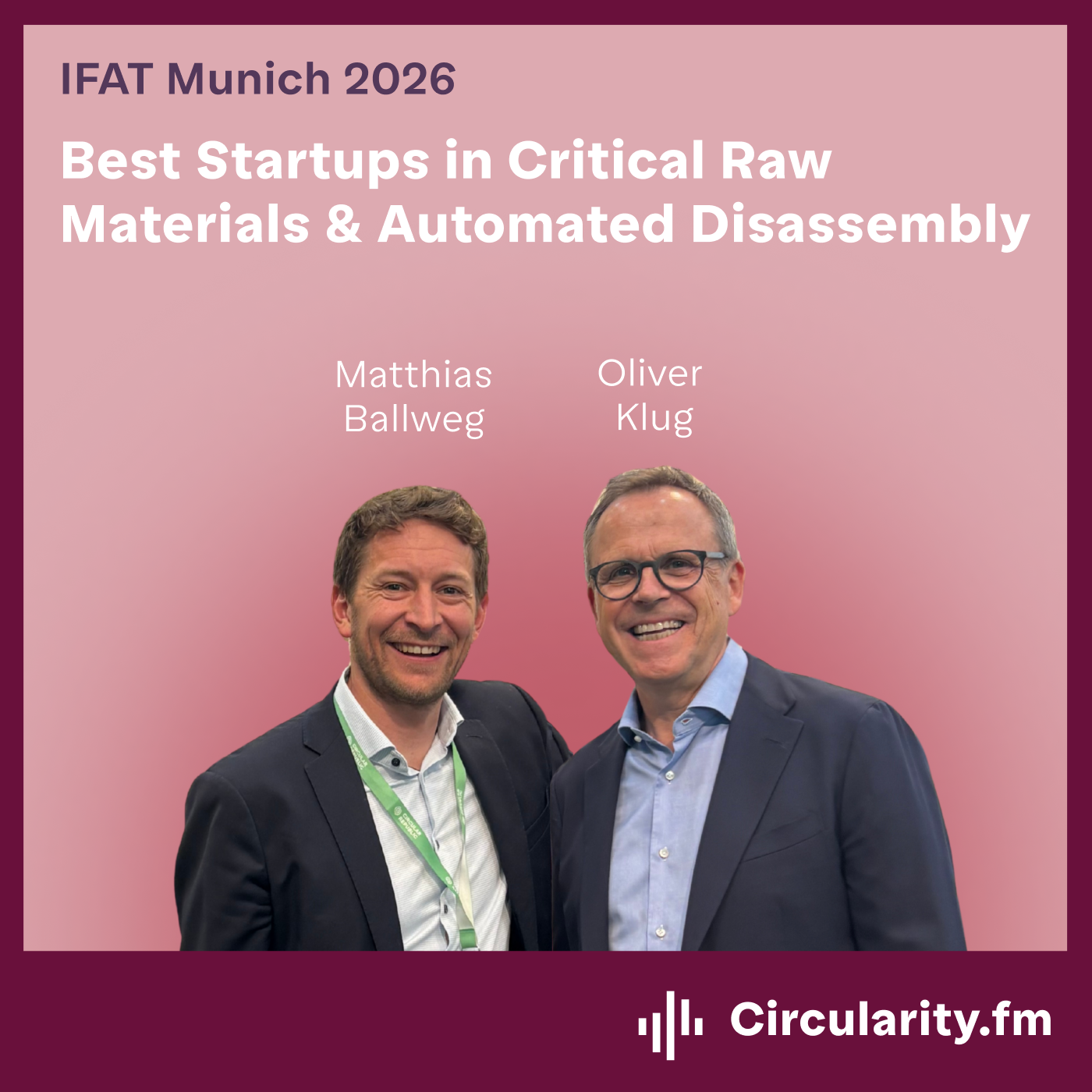 Best Startups in Critical Raw Materials & Automated Disassembly 07.07.2026 26minWhich startups are solving Europe’s two key circular economy challenges: automated disassembly and critical raw materials recovery? This episode covers the Circular Technology Award, launched by Circular Republic and Knorr-Bremse, to back startups working in both fields. Matthias Ballweg, co-founder of Circular Republic, and Oliver Klug, Chief Strategy and Transformation Officer at Knorr-Bremse, explain why they created the award, what they learned from the applicants, and why they paired prize money with proof-of-concept partnerships instead of funding alone. What you’ll hear in this episode: • Why automated disassembly is finally viable, and what the robots can now do that they couldn’t five years ago. • How two very different approaches recover critical raw materials in Europe: hydrogen to reclaim rare earth magnets, and low-temperature salts to pull metals from electronic scrap. • What corporates like Knorr-Bremse look for before adopting a startup’s technology. The four winning startups then present what they’ve built: Xavier Kohll from R3 Robotics and Tomaso Manca from Hiro Robotics winners in automated disassembly, Carlo Burkhardt from HyProMag and Fred White from DEScycle winners in critical raw materials recovery. This is the final episode of the IFAT Munich 2026 series, recorded live at the fair.
 -
 Circular Economy Startup Landscape 2026 30.06.2026 22minWhich areas of circular economy are attracting the most startup activity in Europe, and which ones are being left behind? Leonhard Teichert, Program Lead at Circular Republic, presents the findings of the Circular Economy Startup Landscape 2026. Bruno Rudnik, Managing Partner at SEF Ventures and host of the startup area at IFAT, adds the investor's view on financing and scaling hardware startups in this space. What you'll hear in this episode: • Where European circular startup activity is concentrated and where the map is almost empty: the sectors that are overcrowded and the ones nobody is building in yet. • What drives corporate adoption of new technology. • What founders building hardware-based circular solutions should know: when to talk to an investor, capital structure, customer sequencing, and how corporates actually make adoption decisions. This is the third episode in the IFAT Special series, recorded live at the IFAT Munich 2026
 -
 BDI & BCG Study: Where Circularity Pays Off 23.06.2026 37minWhat is the economic potential of circularity? The Federal Association of the German Industries (BDI) asked Boston Consulting Group (BCG) to answer that for German industry. The report's authors, Claas Oehlmann of the BDI's Circular Economy Initiative and Alexander Meyer zum Felde of BCG, walk through the findings, with Nadine Braun of E.ON bringing the view from a company perspective. What you'll hear in this episode: • What the report found: in five sectors covering most of German industry, circular business models could double annual value creation, from 60 to 125 billion euros, by 2045. • Whether that number survives cannibalisation. If a car gets refurbished, that's one new car not sold, so does the potential still hold once you subtract the lost sales? • What companies can do today, without waiting for new regulation, and what still holds them back. Besides exploring the macroeconomic impact of the circular economy, the episode also looks at where circularity pays off for a company. This is the second episode of the IFAT Munich 2026 series, recorded live at the fair.
 -
 Circular Sovereignty Forum 16.06.2026 19minCan Europe secure the critical raw materials it needs without stepping back from global trade? Recorded at the Circular Sovereignty Forum at IFAT Munich, with Susanne Kadner of Circular Republic, João Merico of the Ellen MacArthur Foundation, and Roland Gauß of EIT Raw Materials, on the link between circularity, geopolitics, and supply security. What you'll hear in this episode: • What companies actually want from EU regulation: predictability above all. First movers need to know the rules they invested in will not be reversed by the next reform. • Why recycling alone will not close the gap. Reuse, leasing, and product as a service have to scale alongside it, even when fast innovation cycles make reusing yesterday's components harder. • Why venture money is shifting toward Europe as US green subsidies are rolled back, and where Europe still loses ground on a level playing field. The episode also covers Europe's urban mines and the secondary raw materials in them, and the case for diversifying supply rather than concentrating it on single suppliers. This is the first episode in the Circularity.fm IFAT special, recorded at IFAT.
 -
 Startup Collaboration: How to Build Win-Win Partnerships 02.06.2026 24minWhy do startups and corporates need each other, and what makes the partnership work? Florian Fehr, Managing Director of NEEW Ventures, joins Patrick at IFAT and interviews three founders: Rajiv Singhal from Grensol, Stefan Delinde from Minimise, and Gary Lewis from Resourcify about their businesses and what makes a startup-corporate partnership work. What you'll hear in this episode: • Why startups and corporates operate at different speeds, and why that difference is the point of the collaboration • Three founders, three completely different business models built around partnering with corporates • What Florian calls the "secret sauce" of a partnership that works The episode also covers how NEEW Ventures operates as both venture builder and bridge maker for EEW. This is the final episode of the series Incineration in the Circular Economy, produced in sponsoring partnership with NEEW Ventures.
 -
 Sustainability Reporting: Turning ESG into Decisions 26.05.2026 55minHow does ESG reporting influence how a company is financed, run, and perceived? in this episode, Fabian Böhmer, Head of Sustainability at EEW, joins Patrick to discuss how ESG reporting can serve bankability, reputation, and internal decision-making. What you'll hear: • Why the business case matters in sustainability, and what happens when ecological, social, and economic dimensions are treated as one balanced system rather than competing priorities • What CSRD, ESRS, and the EU taxonomy actually require, and the difference between treating them as a reporting burden and using them as a strategic tool • How to make sustainability work land internally with different functions: the language that gets operations, finance, and the board on board The episode also covers how green bonds and ESG-linked credit conditions are reshaping the cost of capital, and why focus matters more than completeness when reporting to multiple stakeholders. This is the fifth episode of the series Incineration in the Circular Economy, sponsored by NEEW Ventures.
 -
 100th Episode: Key Lessons from Six Years of Circularity.fm 22.05.2026 19minWhat are the learnings after 100+ conversations with circular economy experts? For our 100th Episode Special, Celinne de Paula from the Circularity.fm team takes over as host and interviews Patrick Hypscher on what six years of conversations with founders, investors, and professionals has taught him. What you'll hear in this episode: • The skills needed to make circular projects succeed • The overlooked levers within the circular economy • How the circular landscape has evolved since 2020 This special also covers what led Patrick to start the podcast, and what's next for Circularity.fm. Dear listeners, thanks for listening to the show!
 -
 Carbon Capture: How Waste-to-Energy Cuts CO2 19.05.2026 28minHow does carbon capture actually work, and what does it take to make it commercial? Jörn Jakob, Director Innovation at EEW, and Eike Diedecke, who oversees the carbon capture pilot at the Delfzijl site, share what they are learning from the pilot project. What you'll hear in this episode: • Where the CO2 in waste actually comes from, and the impact of different waste compositions • How the capture process works step by step • What needs to fall into place for carbon capture to scale The episode also covers why EEW chose the Netherlands as the first pilot site, and where the team is looking for partners on capture technology and CO2 utilisation. This is the fourth episode in "Incineration in the Circular Economy," a series sponsored by NEEW Ventures.
 -
 Waste as a Resource: How Data and AI Cut Recycling Costs 12.05.2026 29minWhat is the value of knowing what's in your waste stream? Wasteer founder Benedict von Spankeren talks about how data and AI improve profitability and prevent dangerous accidents for waste management companies. What you'll hear in this episode: • The economic gap between recycling and waste-to-energy margins, and what this means for market entry and finding customers. • How dynamic pricing changes the business: moving away from flat fees and charging suppliers based on the actual energy value of their waste. • The difficulty of passing on carbon taxes, and why plants now need proof of exactly which supplier delivered what. The episode also discusses the challenge of getting experienced crane operators to actually use new technology on the floor. This is the third episode in "Incineration in the Circular Economy," a series sponsored by NEEW Ventures.
 -
 Waste Incineration: Its Role in Circular Economy 05.05.2026 34minWhat role does waste incineration play in the circular economy and in the transition away from fossil fuels? Sebastian Siewers, Head of Energy at EEW, talks about the contribution of waste-to-energy plants to the circular economy, and the energy system. What you'll hear in this episode: • The business model behind waste to energy: where the revenue comes from, what drives costs, and why CO2 is becoming a major factor. • What grid flexibility means, why it has become more important than total energy supply, and how negative pricing hours in Germany have more than doubled since 2023. • Why heat and steam are local infrastructure products and how German municipalities are starting to plan around them. This is the second episode in "Incineration in the Circular Economy," a series sponsored by NEEW Ventures.
 -
 Waste Incineration: How Waste-to-Energy Really Works 28.04.2026 37minDo you know how a waste-to-energy plant actually turn household waste into electricity, heat, and steam? Philipp Böhm, Managing Director of NEEW Ventures walks through the full process at a plant in Premnitz, from the truck pulling up at the gate to energy entering the grid. What you'll hear in this episode: • How waste companies make money: they don't buy their fuel. They charge producers to take it off their hands. • Why no one knows what's actually in the waste once it hits the bunker, and why that's a real operational problem. • What comes out the other end: enough electricity for 40,000 homes, heat for a nearby city, and steam for surrounding industry, from a single plant. This is the first episode in "Incineration in the Circular Economy," a series sponsored by NEEW Ventures.
Podcasts similares


Popular em
Este podcast também aparece nas paradas de podcasts destes países.
