
YaleCourses
YaleCourses
0
YaleCourses provides access to lectures and academic programs from Yale University, including complete sets from the Open Yale Courses initiative. The channel aims to train a broadly based, highly disciplined intellect without prescribing how it will be used. Students can also find complementary syllabi, transcripts, and other resources on the Open Yale Courses website. The podcast offers a window into the core of the university's classrooms and academic offerings.
Episódios
-
 23. The Second Law of Thermodynamics and Carnot's Engine 18.09.2026 1h 17minFor more information about Professor Shankar's book based on the lectures from this course, Fundamentals of Physics: Mechanics, Relativity, and Thermodynamics, visit http://bit.ly/1jFIqNu.Fundamentals of Physics (PHYS 200)Why does a dropped egg that spatters on the floor not rise back to your hands even though no laws prohibit it? The answer to such irreversibility resides the Second Law of Thermodynamics which explained in this and the next lecture. The Carnot heat engine is discussed in detail to show how there is an upper limit to the efficiency of heat engines and how the concept of entropy arises from macroscopic considerations.00:00 - Chapter 1. Recap of First Law of Thermodynamics and Macroscopic State Properties13:22 - Chapter 2. Defining Specific Heats at Constant Pressure and Volume26:01 - Chapter 3. Adiabatic Processes43:57 - Chapter 4. The Second Law of Thermodynamics and the Concept of Entropy59:02 - Chapter 5. The Carnot Engine Complete course materials are available at the Yale Online website: online.yale.eduThis course was recorded in Fall 2006. Learn more about your ad choices. Visit megaphone.fm/adchoices
 -
 System Examples to Test Your Understanding | Connected Leadership with Peter Boyd 18.09.2026 4minWhat separates a true system from a pile of parts? Walk through everyday examples like a car, a tree, and a rugby game to apply Donella Meadows' simple test for recognizing when something is a system rather than just stuff or silos.Key topics:- Quick review of what defines a system- Cars and car parts: system versus collection- Natural and human-made systems side by side- Why a rugby game stays the same game with different players- Meadows' four questions for identifying a system📚 About the Course:This course is designed to maximize your ability to create change at the individual, team and system levels. Through study, reflection, and deploying practical tools, you will establish a firm connection between your clearly articulated Purpose, effective Priorities, visualized Potential for success, and pathway to maximized Progress. But, what does that mean in practice?When you take this course, you will:Improve your ability to get the most out of life: Learn a simple practice to reflect on your purpose, clarify priorities, visualize your potential, and maximize your effectiveness at progressing towards your goals.Strengthen your leadership toolkit: Tap into your unique leadership style and strengths and join or create a community of others to maximize your potential as a team.Create change through systems thinking: Become a more effective agent of positive change and appreciate the power and complexity of system thinking.Course Takeaways:Improve your ability to get the most out of lifeStrengthen your leadership toolkitPractice and apply systems thinking to plan for change📺 Watch the full playlist on YouTube: https://www.youtube.com/playlist?list=PLh9mgdi4rNezZEnhZC8dS3AvTnzOiB0Ij🎓 Enroll on Coursera for assessments and a certificate: https://www.coursera.org/learn/connected-leadership🌐 Explore more learning opportunities on Yale Online: https://online.yale.edu/courses/connected-leadership Learn more about your ad choices. Visit megaphone.fm/adchoices
 -
 23. Edward P. Jones, The Known World (cont.) 18.09.2026 53minThe American Novel Since 1945 (ENGL 291)In this second lecture on The Known World, Professor Hungerford addresses Edward P. Jones's ambitious and ambivalent relation to literacy. Jones shows us the power of narrative to bring together the fragmentation of the world, but is at the same time deeply aware of the fragility of text, all of the ways it can be destroyed, misinterpreted, abused, or lost. The son of an illiterate mother, Jones--who, it seems, composed and memorized large portions of The Known World before setting anything down in print--models a form of literary self-consciousness infused with the moral dilemmas of slavery and freedom that is unique among contemporary novels.00:00 - Chapter 1. Meditations on the Difficulty of Writing: The Right-to-Left Directionality of Creation13:43 - Chapter 2. The Fragile Power of Text: Insubstantiality of Freedom20:45 - Chapter 3. The Complicity of Creation24:58 - Chapter 4. The Durability of Plastic Arts: Augustus's Carving and Alice's Weaving33:32 - Chapter 5. Edward P. Jones's Authorial Project: Weaving Unity into the Fragmented Modern NarrativeComplete course materials are available at the Open Yale Courses website: http://open.yale.edu/coursesThis course was recorded in Spring 2008. Learn more about your ad choices. Visit megaphone.fm/adchoices
 -
 13. Lorentz Transformation 18.09.2026 1h 15minFor more information about Professor Shankar's book based on the lectures from this course, Fundamentals of Physics: Mechanics, Relativity, and Thermodynamics, visit http://bit.ly/1jFIqNu.Fundamentals of Physics (PHYS 200)This lecture offers detailed analysis of the Lorentz transformations which relate the coordinates of an event in two frames in relative motion. It is shown how length, time and simultaneity are relative.00:00 - Chapter 1. Describing an Event with Two Observers33:58 - Chapter 2. The Relativity of Simultaneity41:57 - Chapter 3. Time Dilation53:41 - Chapter 4. The Twin Paradox01:00:02 - Chapter 5. Length ContractionComplete course materials are available at the Yale Online website: online.yale.eduThis course was recorded in Fall 2006. Learn more about your ad choices. Visit megaphone.fm/adchoices
 -
 23. Democratic Statecraft: Tocqueville's Democracy in America 18.09.2026 57minIntroduction to Political Philosophy (PLSC 114)Professor Smith discusses the moral and psychological components of the democratic state in the context of Tocqueville's Democracy in America. He goes on to explore the institutional development of the democratic state, the qualities of the democratic individual, and the psychological determinants of the democratic character. The ethic of self-interest is addressed, understood as an antidote to an ethic of fame and glory. Finally, Tocqueville is presented as a political educator and his views on the role of statesmen in a democratic age are expounded.00:00 - Chapter 1. Moral and Psychological Features of the Democratic State04:32 - Chapter 2. Moral and Psychological Features of the Democratic State: Compassion15:17 - Chapter 3. Moral and Psychological Features of the Democratic State: Anxiety22:19 - Chapter 4. Moral and Psychological Features of the Democratic State: Self-Interest33:44 - Chapter 5. Democratic StatecraftComplete course materials are available at the Open Yale Courses website: http://open.yale.edu/courses This course was recorded in Fall 2006. Learn more about your ad choices. Visit megaphone.fm/adchoices
 -
 System Purpose Through Iceberg and Inference | Connected Leadership with Peter Boyd 18.09.2026 10minWhy does your system exist, and what really drives it? Apply the ladder of inference and the iceberg model to climb above assumptions and descend below the surface events to reveal patterns, structures, and the deepest beliefs that shape your system.Key topics:- The ladder of inference and bringing other voices in- The iceberg model: events, patterns, structure, mental models- Mapping your system across the four iceberg layers- A common cold example of going deeper- Causal loops and the chicken-crossing-the-road system📚 About the Course:This course is designed to maximize your ability to create change at the individual, team and system levels. Through study, reflection, and deploying practical tools, you will establish a firm connection between your clearly articulated Purpose, effective Priorities, visualized Potential for success, and pathway to maximized Progress. But, what does that mean in practice?When you take this course, you will:Improve your ability to get the most out of life: Learn a simple practice to reflect on your purpose, clarify priorities, visualize your potential, and maximize your effectiveness at progressing towards your goals.Strengthen your leadership toolkit: Tap into your unique leadership style and strengths and join or create a community of others to maximize your potential as a team.Create change through systems thinking: Become a more effective agent of positive change and appreciate the power and complexity of system thinking.Course Takeaways:Improve your ability to get the most out of lifeStrengthen your leadership toolkitPractice and apply systems thinking to plan for change📺 Watch the full playlist on YouTube: https://www.youtube.com/playlist?list=PLh9mgdi4rNezZEnhZC8dS3AvTnzOiB0Ij🎓 Enroll on Coursera for assessments and a certificate: https://www.coursera.org/learn/connected-leadership🌐 Explore more learning opportunities on Yale Online: https://online.yale.edu/courses/connected-leadership Learn more about your ad choices. Visit megaphone.fm/adchoices
 -
 3. Socratic Citizenship: Plato's Crito 18.09.2026 54minIntroduction to Political Philosophy (PLSC 114)In the Apology, Socrates proposes a new kind of citizenship in opposition to the traditional one that was based on the poetic conception of Homer. Socrates' is a philosophical citizenship, relying on one's own powers of independent reason and judgment. The Crito, a dialogue taking place in Socrates' prison cell, is about civil obedience, piety, and the duty of every citizen to respect and live by the laws of the community.00:00 - Chapter 1. Was Socrates Guilty or Innocent?02:22 - Chapter 2. The Socratic Citizen09:39 - Chapter 3. Principled DIsobedience to the Law24:07 - Chapter 4. Crito's Apology: "Companion Dialogue"42:22 - Chapter 5. Applying Lessons from Fourth-Century Athens to Our World TodayComplete course materials are available at the Open Yale Courses website: http://open.yale.edu/courses This course was recorded in Fall 2006. Learn more about your ad choices. Visit megaphone.fm/adchoices
 -
 24. Samson Agonistes (cont.) 18.09.2026 51minMilton (ENGL 220)In the final lecture of the course, the analysis of Samson Agonistes comes to a conclusion with an exploration of the poem's sexual imagery. Milton's choice of subject matter is puzzled over, as are the ethics of his tragic hero, particularly when compared to the heroes of Milton's previous epics. The poem is positioned as a means by which Milton ultimately resolves the poetic, religious, and career-related crises of his earlier poem, "The Passion," and the compelling relationship between the corpus and the poet's biography is revisited one final time.00:00 - Chapter 1. Introduction02:07 - Chapter 2. Why Did Milton Choose Samson for the Subject of his Final Work?35:32 - Chapter 3. Final Thoughts on MiltonComplete course materials are available at the Open Yale Courses website: http://open.yale.edu/coursesThis course was recorded in Fall 2007. Learn more about your ad choices. Visit megaphone.fm/adchoices
 -
 7. Kepler's Laws 18.09.2026 1h 18minFor more information about Professor Shankar's book based on the lectures from this course, Fundamentals of Physics: Mechanics, Relativity, and Thermodynamics, visit http://bit.ly/1jFIqNu.Fundamentals of Physics (PHYS 200)The focus of the lecture is problems of gravitational interaction. The three laws of Kepler are stated and explained. Planetary motion is discussed in general, and how this motion applies to the planets moving around the Sun in particular.00:00 - Chapter 1. Review of Conservative and Non-conservative Forces09:19 - Chapter 2. Kepler's 3 Laws20:16 - Chapter 3. Deriving the Nature of Gravitational Force35:57 - Chapter 4. Derive Orbital Period (T) and Speed (v) in Space49:47 - Chapter 5. Law of Conservation of Energy Far from Earth Surface57:37 - Chapter 6. Reference Potential Energy at Infinity or Earth SurfaceComplete course materials are available at the Yale Online website: online.yale.eduThis course was recorded in Fall 2006. Learn more about your ad choices. Visit megaphone.fm/adchoices
 -
 2. Vectors in Multiple Dimensions 18.09.2026 1h 13minFor more information about Professor Shankar's book based on the lectures from this course, Fundamentals of Physics: Mechanics, Relativity, and Thermodynamics, visit http://bit.ly/1jFIqNu.Fundamentals of Physics (PHYS 200)In this lecture, Professor Shankar discusses motion in more than one dimension. Vectors are introduced and discussed in multiple dimensions. Vector magnitude and direction are also explained. Null vectors, minus vectors, unit and velocity vectors are discussed along with their properties. Finally, several specific problems are solved to demonstrate how vectors can be added, and problems of projectile motion are expounded.00:00 - Chapter 1. Review of Motion at Constant Acceleration04:45 - Chapter 2. Vector Motion 2D Space: Properties22:57 - Chapter 3. Choice of Basis Axis and Vector Transformation38:20 - Chapter 4. Velocity Vectors: Derivatives of Displacement Vectors43:40 - Chapter 5. Derivatives of Vectors: Application to Circular Motion54:00 - Chapter 6. Projectile MotionComplete course materials are available at the Yale Online website: online.yale.eduThis course was recorded in Fall 2006. Learn more about your ad choices. Visit megaphone.fm/adchoices
 -
 13. The Sovereign State: Hobbes' Leviathan 18.09.2026 53minIntroduction to Political Philosophy (PLSC 114)Hobbes' most famous metaphor, that of "the state of nature," is explained. It can be understood as the condition of human life in the absence of authority or anyone to impose rules, laws, and order. The concept of the individual is also discussed on Hobbesian terms, according to which the fundamental characteristics of the human beings are the capacity to exercise will and the ability to choose. Hobbes, as a moralist, concludes that the laws of nature, or "precepts of reason," forbid us from doing anything destructive in life.00:00 - Chapter 1. Hobbes on Individuality09:49 - Chapter 2. Hobbes' Skeptical View of Knowledge14:11 - Chapter 3. The State of Nature23:14 - Chapter 4. Pride and Fear: Passions that Dominate Human Nature29:09 - Chapter 5. The Laws of NatureComplete course materials are available at the Open Yale Courses website: http://open.yale.edu/courses This course was recorded in Fall 2006. Learn more about your ad choices. Visit megaphone.fm/adchoices
 -
 22. Repeated games: cheating, punishment, and outsourcing 18.09.2026 1h 22minGame Theory (ECON 159)In business or personal relationships, promises and threats of good and bad behavior tomorrow may provide good incentives for good behavior today, but, to work, these promises and threats must be credible. In particular, they must come from equilibrium behavior tomorrow, and hence form part of a subgame perfect equilibrium today. We find that the grim strategy forms such an equilibrium provided that we are patient and the game has a high probability of continuing. We discuss what this means for the personal relationships of seniors in the class. Then we discuss less draconian punishments, and find there is a trade off between the severity of punishments and the required probability that relationships will endure. We apply this idea to a moral-hazard problem that arises with outsourcing, and find that the high wage premiums found in foreign sectors of emerging markets may be reduced as these relationships become more stable.00:00 - Chapter 1. Repeated Interaction: The Grim Trigger Strategy in the Prisoner's Dilemma (Continued)29:21 - Chapter 2. The Grim Trigger Strategy: Generalization and Real World Examples37:56 - Chapter 3. Cooperation in Repeated Interactions: The "One Period Punishment" Strategy53:09 - Chapter 4. Cooperation in Repeated Interactions: Repeated Moral Hazard01:13:53 - Chapter 5. Cooperation in Repeated Interactions: ConclusionsComplete course materials are available at the Yale Online website: online.yale.eduThis course was recorded in Fall 2007. Learn more about your ad choices. Visit megaphone.fm/adchoices
 -
 Introduction to Systems and Systems Thinking | Connected Leadership with Peter Boyd 18.09.2026 8minDiscover how the four Ps of connected leadership scale from self and team to the wider systems that shape our lives. This introduction defines what a system is, why systems thinking matters, and how it equips you to tackle problems too complex for simple linear fixes.Key topics:- Applying the four Ps at the system level- Defining a system as interacting elements with a shared purpose- Examples of community, industry, explicit, and implicit systems- Why systems thinking matters for tackling big challenges- Humility, leverage, and the power of small changes over time📚 About the Course:This course is designed to maximize your ability to create change at the individual, team and system levels. Through study, reflection, and deploying practical tools, you will establish a firm connection between your clearly articulated Purpose, effective Priorities, visualized Potential for success, and pathway to maximized Progress. But, what does that mean in practice?When you take this course, you will:Improve your ability to get the most out of life: Learn a simple practice to reflect on your purpose, clarify priorities, visualize your potential, and maximize your effectiveness at progressing towards your goals.Strengthen your leadership toolkit: Tap into your unique leadership style and strengths and join or create a community of others to maximize your potential as a team.Create change through systems thinking: Become a more effective agent of positive change and appreciate the power and complexity of system thinking.Course Takeaways:Improve your ability to get the most out of lifeStrengthen your leadership toolkitPractice and apply systems thinking to plan for change📺 Watch the full playlist on YouTube: https://www.youtube.com/playlist?list=PLh9mgdi4rNezZEnhZC8dS3AvTnzOiB0Ij🎓 Enroll on Coursera for assessments and a certificate: https://www.coursera.org/learn/connected-leadership🌐 Explore more learning opportunities on Yale Online: https://online.yale.edu/courses/connected-leadership Learn more about your ad choices. Visit megaphone.fm/adchoices
 -
 What do you lose all track of time doing? | Connected Leadership 18.09.2026 6minWork through the first P of the framework by using the purpose worksheet to question and confirm what matters most. Reflect on the fork in the road, your long and short horizons, your moments of flow, and the bigger why behind it all.Key topics:- Identifying your current fork in the road- Long-term and short-term horizons for your future- Csikszentmihalyi's flow at work, play, and in childhood- Naming the big why behind your one wild and precious life- Condensing answers into a single impact statement📚 About the Course:This course is designed to maximize your ability to create change at the individual, team and system levels. Through study, reflection, and deploying practical tools, you will establish a firm connection between your clearly articulated Purpose, effective Priorities, visualized Potential for success, and pathway to maximized Progress. But, what does that mean in practice?When you take this course, you will:Improve your ability to get the most out of life: Learn a simple practice to reflect on your purpose, clarify priorities, visualize your potential, and maximize your effectiveness at progressing towards your goals.Strengthen your leadership toolkit: Tap into your unique leadership style and strengths and join or create a community of others to maximize your potential as a team.Create change through systems thinking: Become a more effective agent of positive change and appreciate the power and complexity of system thinking.Course Takeaways:Improve your ability to get the most out of lifeStrengthen your leadership toolkitPractice and apply systems thinking to plan for change📺 Watch the full playlist on YouTube: https://www.youtube.com/playlist?list=PLh9mgdi4rNezZEnhZC8dS3AvTnzOiB0Ij🎓 Enroll on Coursera for assessments and a certificate: https://www.coursera.org/learn/connected-leadership🌐 Explore more learning opportunities on Yale Online: https://online.yale.edu/courses/connected-leadership Learn more about your ad choices. Visit megaphone.fm/adchoices
 -
 What does a Rubik's Cube teach us about leadership? | Connected Leadership 18.09.2026 12minA reflective close to the Connected Leadership journey, revisiting the four Ps (purpose, priorities, potential, progress) plus perseverance across self, team, and system. Through Christiana Figueres's stubborn optimism and a memorable Rubik's Cube analogy, this final lesson sends you off with scaffolding to keep building your leadership.Key topics:- Recap of the four Ps across self, team, and system- Perseverance and stubborn optimism for wicked problems- Confident, curious humility and learning from others- Memorable images and frameworks from the course- The Rubik's Cube analogy for self, team, and system layers- Closing gratitude and the next step in your leadership journey📚 About the Course:This course is designed to maximize your ability to create change at the individual, team and system levels. Through study, reflection, and deploying practical tools, you will establish a firm connection between your clearly articulated Purpose, effective Priorities, visualized Potential for success, and pathway to maximized Progress. But, what does that mean in practice?When you take this course, you will:Improve your ability to get the most out of life: Learn a simple practice to reflect on your purpose, clarify priorities, visualize your potential, and maximize your effectiveness at progressing towards your goals.Strengthen your leadership toolkit: Tap into your unique leadership style and strengths and join or create a community of others to maximize your potential as a team.Create change through systems thinking: Become a more effective agent of positive change and appreciate the power and complexity of system thinking.Course Takeaways:Improve your ability to get the most out of lifeStrengthen your leadership toolkitPractice and apply systems thinking to plan for change📺 Watch the full playlist on YouTube: https://www.youtube.com/playlist?list=PLh9mgdi4rNezZEnhZC8dS3AvTnzOiB0Ij🎓 Enroll on Coursera for assessments and a certificate: https://www.coursera.org/learn/connected-leadership🌐 Explore more learning opportunities on Yale Online: https://online.yale.edu/courses/connected-leadership Learn more about your ad choices. Visit megaphone.fm/adchoices
 -
 Win Over the People Who Can Make or Break Your Work | Connected Leadership 18.09.2026 5minA stakeholder 2x2 helps you plan how to engage the people and organizations around your work. This lesson maps influence against support and shows what to do with champions, blockers, fans, and naysayers.Key topics:- Mapping stakeholders by influence and support- Strategy for influential blockers in the top left- Jobs to do for influential champions in the top right- Two-way communication with lower-influence fans- Why you may be worrying too much about naysayers- Watching for marginalized voices that deserve more weight📚 About the Course:This course is designed to maximize your ability to create change at the individual, team and system levels. Through study, reflection, and deploying practical tools, you will establish a firm connection between your clearly articulated Purpose, effective Priorities, visualized Potential for success, and pathway to maximized Progress. But, what does that mean in practice?When you take this course, you will:Improve your ability to get the most out of life: Learn a simple practice to reflect on your purpose, clarify priorities, visualize your potential, and maximize your effectiveness at progressing towards your goals.Strengthen your leadership toolkit: Tap into your unique leadership style and strengths and join or create a community of others to maximize your potential as a team.Create change through systems thinking: Become a more effective agent of positive change and appreciate the power and complexity of system thinking.Course Takeaways:Improve your ability to get the most out of lifeStrengthen your leadership toolkitPractice and apply systems thinking to plan for change📺 Watch the full playlist on YouTube: https://www.youtube.com/playlist?list=PLh9mgdi4rNezZEnhZC8dS3AvTnzOiB0Ij🎓 Enroll on Coursera for assessments and a certificate: https://www.coursera.org/learn/connected-leadership🌐 Explore more learning opportunities on Yale Online: https://online.yale.edu/courses/connected-leadership Learn more about your ad choices. Visit megaphone.fm/adchoices
 -
 Why does it never feel like you set your own priorities? | Connected Leadership 18.09.2026 5minWhy does it never feel like you get to set your own priorities? Explore the imbalance between fixed time and exploding demands on attention, then learn Stephen Covey's rocks, pebbles, and sand analogy for fitting what matters most into your jar.Key topics:- The fixed supply of quality attention- Growing demand: population, devices, always-on culture- How rising influence amplifies time pressure- Covey's rocks, pebbles, and sand analogy- Putting your biggest priorities in the jar first📚 About the Course:This course is designed to maximize your ability to create change at the individual, team and system levels. Through study, reflection, and deploying practical tools, you will establish a firm connection between your clearly articulated Purpose, effective Priorities, visualized Potential for success, and pathway to maximized Progress. But, what does that mean in practice?When you take this course, you will:Improve your ability to get the most out of life: Learn a simple practice to reflect on your purpose, clarify priorities, visualize your potential, and maximize your effectiveness at progressing towards your goals.Strengthen your leadership toolkit: Tap into your unique leadership style and strengths and join or create a community of others to maximize your potential as a team.Create change through systems thinking: Become a more effective agent of positive change and appreciate the power and complexity of system thinking.Course Takeaways:Improve your ability to get the most out of lifeStrengthen your leadership toolkitPractice and apply systems thinking to plan for change📺 Watch the full playlist on YouTube: https://www.youtube.com/playlist?list=PLh9mgdi4rNezZEnhZC8dS3AvTnzOiB0Ij🎓 Enroll on Coursera for assessments and a certificate: https://www.coursera.org/learn/connected-leadership🌐 Explore more learning opportunities on Yale Online: https://online.yale.edu/courses/connected-leadership Learn more about your ad choices. Visit megaphone.fm/adchoices
 -
 19. Democracy and Participation: Rousseau's Discourse 18.09.2026 48minIntroduction to Political Philosophy (PLSC 114)The discussion on the origins of inequality in the Second Discourse continues. This lecture focuses on amour-propre, a faculty or a disposition that is related to a range of psychological characteristics such as pride, vanity, and conceit. The Social Contract is subsequently discussed with an emphasis on the concept of freedom and how one's desire to preserve one's freedom is often in conflict with that of others to protect and defend their own. General will becomes Rousseau's solution to the problem of securing individual liberty.00:00 - Chapter 1. "Amour-Propre": The Most Durable Cause of Inequality20:15 - Chapter 2. Civilization and Its DIscontents32:06 - Chapter 3. The Social ContractComplete course materials are available at the Open Yale Courses website: http://open.yale.edu/courses This course was recorded in Fall 2006. Learn more about your ad choices. Visit megaphone.fm/adchoices
 -
 Self-Awareness and the Johari Window | Connected Leadership with Peter Boyd 18.09.2026 5minThe Johari window is a classic 2x2 that helps leaders expand their open and free area while shrinking blind spots and masks. This lesson explains the four quadrants and how to use the model to grow emotional intelligence in yourself and your team.Key topics:- The Johari window: arena, mask, blind spot, and unknown- Expanding the open and free area appropriately- Reducing your mask to build trust and shared norms- Narrowing blind spots through feedback and assessments- Cultural considerations in self-disclosure- Sketching your own arena and your team's📚 About the Course:This course is designed to maximize your ability to create change at the individual, team and system levels. Through study, reflection, and deploying practical tools, you will establish a firm connection between your clearly articulated Purpose, effective Priorities, visualized Potential for success, and pathway to maximized Progress. But, what does that mean in practice?When you take this course, you will:Improve your ability to get the most out of life: Learn a simple practice to reflect on your purpose, clarify priorities, visualize your potential, and maximize your effectiveness at progressing towards your goals.Strengthen your leadership toolkit: Tap into your unique leadership style and strengths and join or create a community of others to maximize your potential as a team.Create change through systems thinking: Become a more effective agent of positive change and appreciate the power and complexity of system thinking.Course Takeaways:Improve your ability to get the most out of lifeStrengthen your leadership toolkitPractice and apply systems thinking to plan for change📺 Watch the full playlist on YouTube: https://www.youtube.com/playlist?list=PLh9mgdi4rNezZEnhZC8dS3AvTnzOiB0Ij🎓 Enroll on Coursera for assessments and a certificate: https://www.coursera.org/learn/connected-leadership🌐 Explore more learning opportunities on Yale Online: https://online.yale.edu/courses/connected-leadership Learn more about your ad choices. Visit megaphone.fm/adchoices
 -
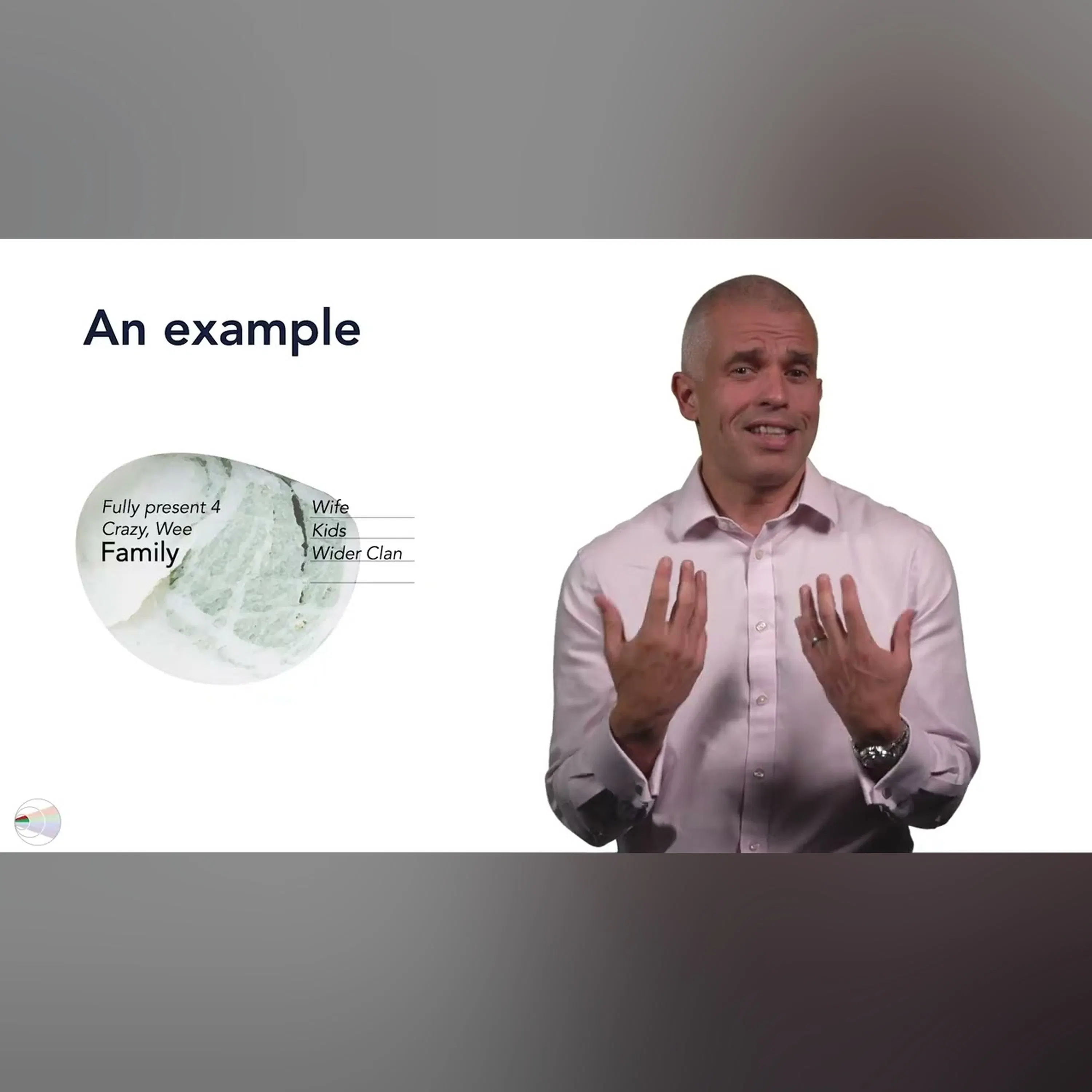 Why your brain can only hold 3 to 5 priorities | Connected Leadership 18.09.2026 5minGo deeper on the rocks that should fill your jar by tying them to purpose, naming them with care, and limiting your list to a memorable three to five. Includes the research behind the magic number and a personal example for crafting a vivid rock name.Key topics:- Linking rocks to your sense of purpose- Rocks as arenas of time, not targets- Naming rocks with powerful nouns and adjectives- Why three to five priorities fit working memory- Elaborating what's inside each rock- Comparing rocks with a buddy📚 About the Course:This course is designed to maximize your ability to create change at the individual, team and system levels. Through study, reflection, and deploying practical tools, you will establish a firm connection between your clearly articulated Purpose, effective Priorities, visualized Potential for success, and pathway to maximized Progress. But, what does that mean in practice?When you take this course, you will:Improve your ability to get the most out of life: Learn a simple practice to reflect on your purpose, clarify priorities, visualize your potential, and maximize your effectiveness at progressing towards your goals.Strengthen your leadership toolkit: Tap into your unique leadership style and strengths and join or create a community of others to maximize your potential as a team.Create change through systems thinking: Become a more effective agent of positive change and appreciate the power and complexity of system thinking.Course Takeaways:Improve your ability to get the most out of lifeStrengthen your leadership toolkitPractice and apply systems thinking to plan for change📺 Watch the full playlist on YouTube: https://www.youtube.com/playlist?list=PLh9mgdi4rNezZEnhZC8dS3AvTnzOiB0Ij🎓 Enroll on Coursera for assessments and a certificate: https://www.coursera.org/learn/connected-leadership🌐 Explore more learning opportunities on Yale Online: https://online.yale.edu/courses/connected-leadership Learn more about your ad choices. Visit megaphone.fm/adchoices
Podcasts similares


Popular em
Este podcast também aparece nas paradas de podcasts destes países.

