
RiskMasters | Trailblazing Risk Leadership
Julien Haye | Strategic Risk Leadership Expert | Author of The Risk Within
0
Join Julien Haye, Chief Risk Officer and author of The Risk Within, for insights on risk management from leaders and board directors. This CPD-accredited podcast explores strategic risk, enterprise risk, and leadership challenges. Each episode delivers thought-provoking conversations on leadership, resilience, and governance in collaboration with Risk.net.
Episódios
-
 ISO 31000: The Evolution of Risk Management 19.09.2026 5minWhat was ISO 31000 originally designed to achieve, and how did the international risk management standard develop?In this RiskMasters — The Download extract, Grant Purdy, who was directly involved in the development of ISO 31000, explains the origins of the standard and its relationship with organisational decision-making.Grant traces ISO 31000 back to the Australian and New Zealand standard AS/NZS 4360, first published in 1995 and subsequently updated in 1999 and 2004. The objective was to bring greater consistency to different approaches to risk assessment and risk treatment while producing information that decision-makers could understand and use.As other countries began adopting AS/NZS 4360, Grant and his colleagues approached the International Organization for Standardization (ISO) about developing an international standard. What followed was a four-year process of discussion and compromise as different countries brought their own perspectives on risk management.Grant explains why the resulting ISO 31000 framework sought to integrate risk management and decision-making, but also why he believes this contributed to a distinction that continues to shape the profession.In his view, different philosophies of risk management have subsequently developed. He characterises the ISO 31000 approach as increasingly focused on decision support, while describing COSO and IRM approaches as placing greater emphasis on risk identification, governance and reporting.That distinction leads to a fundamental question for risk leaders: is risk management primarily a process for identifying and reporting risk, or should its ultimate purpose be to improve organisational decisions?The origins and history of ISO 31000How ISO 31000 evolved from AS/NZS 4360The original purpose of risk assessment and risk treatmentWhy risk information should support organisational decision-makingHow the international risk management standard was developedThe role of compromise in international standardsGrant Purdy's perspective on different philosophies of modern risk managementThis extract is taken from the full CPD-accredited RiskMasters conversation with Grant Purdy exploring ISO 31000, risk management, uncertainty, risk matrices, governance and better decision-making.Listen to the full conversation on Apple Podcasts, Spotify or at aevitium.com.
 -
 ISO 31000, Risk Management & Better Decision-Making with Grant Purdy 12.09.2026 45minIn this episode of RiskMasters, I speak with Grant Purdy about risk management, uncertainty and the relationship between risk and better decision-making.Grant has spent almost five decades working in risk and decision-making. He was a nominated expert involved in the development of ISO 31000, contributed to ISO Guide 73 and helped shape ISO/IEC 31010.He is also co-author, with the late Roger Estall, of Deciding, a practical guide designed to help people make better decisions.Our conversation examines how risk management has evolved, why Grant believes parts of the profession have become disconnected from decision-making, and what boards, executives and risk professionals can do differently.“Certainty is a total illusion. It can never be achieved. Sufficient certainty is as good as we can get.” – Grant Purdy🎯 What You Will LearnWhy risk management should ultimately improve decision-makingHow to make decisions without waiting for impossible certaintyWhy identifying and monitoring assumptions strengthens governanceWhere risk matrices and risk appetite can create false confidenceHow AI can support judgement without replacing accountability🕒 Episode Highlights01:23 - What ISO 31000 was originally trying to achieveGrant traces the development of ISO 31000 from AS/NZS 4360 and explains why creating useful information for decision-making was central to the original approach.06:03 - Where risk management lost its wayWe discuss the different philosophies that emerged around risk management and why Grant believes the profession needs to reconnect risk with decision support.10:29 - Uncertainty, assumptions and sufficient certaintyGrant explains why decisions require clarity about purpose, opportunity, desired outcomes and the assumptions on which they depend.16:08 - The danger of seeking certaintyWhy waiting for complete information can produce analysis paralysis, missed opportunities and delayed action.21:10 - What risk matrices can and cannot tell usGrant explains why a useful prioritisation tool can become misleading when organisations treat it as a form of quantitative analysis.24:20 - Governance, regulation and decision-makingA provocative discussion about the relationship between standards, regulation and consultancy, and why governance should ultimately be concerned with how decisions are made.32:49 - Why well-governed organisations still make poor decisionsWe explore unclear purpose, hidden assumptions, predetermined outcomes, insufficient challenge and weak monitoring.36:49 - AI and the future of decision supportGrant considers how AI can broaden context, challenge bias and surface assumptions, alongside the dangers of allowing technology to substitute for human judgement.41:01 - The future of the risk professionWhy Grant believes risk professionals should broaden their capabilities and become facilitators of better organisational decisions.44:02 - Better decisions begin with purposeGrant closes with the principle at the heart of his approach to decision-making.🎧 Listen now on:Apple Podcasts: [ADD LINK]Spotify: [ADD LINK]Other platforms available👤 About Grant PurdyGrant Purdy has almost five decades of experience working in risk management and decision-making. He chaired the Standards Australia and Standards New Zealand risk management committee for ten years and was a nominated expert involved in developing ISO 31000.Grant on LinkedIn: https://www.linkedin.com/in/grant-purdy-4ba1925/Learn more about Deciding: https://www.sufficientcertainty.com/book📚 Related ResourcesFrom Approval to Impact: Repositioning Risk Appetite Strategic Uncertainty Governance Risk Impact Assessment: What Actually Drives Decision Quality When Delay Changes the Decision Itself 🎓 Download your CPD certificate:The CPD Group - Accreditation: #501335
 -
 Navigating the Gray Rhino: 5 Stages of Risk 05.09.2026 3minHow do leaders move from recognising a Gray Rhino to actually doing something about it?In this RiskMasters — The Download, Michele Wucker, author of The Gray Rhino and You Are What You Risk, explains the five stages of the Gray Rhino framework and how they can help leaders assess where they are in responding to visible, high-impact risks.The five stages are denial, muddling, diagnosing, panic and action.Michele explains why diagnosing represents an important shift. Rather than simply acknowledging the risk, leaders begin asking how quickly it is developing, how significant it could become, what solutions are available, what resources are required and who needs to be involved.The framework also considers where other stakeholders sit within those five stages. A response may depend on people who have not yet recognised the urgency of the risk or who lack the authority to act.The conversation explores why panic can be a double-edged sword. It can finally create momentum, but it can also lead to poor decisions. Having a plan matters, but so do the mechanisms and decision authority required to implement it.Michele also introduces the idea of a “crash of rhinos”, where several significant risks interact or arrive together, alongside smaller “baby rhinos” that may develop into larger threats.The five stages of the Gray Rhino frameworkHow leaders move from recognition and diagnosis to actionWhy stakeholders may be at different stages of respondingHow panic can lead to action but also poor decisionsWhy multiple risks can develop into a “crash of rhinos”The Gray Rhino framework provides a practical way for risk leaders to assess not only the risks they face, but how prepared their organisations and key stakeholders are to respond. Effective action requires diagnosis, planning, decision authority, and continued tracking and adjustment.This extract is taken from the full RiskMasters conversation with Michele Wucker on the Gray Rhino, risk management, behavioural risk and strategic decision-making.Listen to the full RiskMasters episode on Apple Podcasts, Spotify or at aevitium.com.
 -
 Cultural Differences in Risk Management 15.08.2026 5minRisk culture, cultural differences, leadership, and risk management are closely connected to how people perceive and respond to risk.In this RiskMasters — The Download segment, Horst Simon draws on his international experience to explore how cultural worldviews influence risk behaviour inside organisations. He discusses three broad perspectives, guilt versus innocence, honour versus shame, and power versus fear, and explains why organisations operating across cultures need to consider these differences when developing risk policies and processes.The conversation also explores how generational differences influence attitudes towards work, organisations, mobility, and risk, creating another important consideration for leaders building an effective risk culture.Listeners will gain insight into:• How cultural differences can influence risk management decisions• Why the same risk policy may be interpreted differently across cultures• How cultural worldviews shape attitudes towards responsibility and consequences• Why generational differences matter when building risk culture• How global organisations can consider human behaviour within risk frameworksThis extract is taken from the full RiskMasters interview with Horst Simon on risk culture, people risk, leadership, operational risk, and the future of risk management, available on Apple Podcasts, Spotify, and at aevitium.com.
 -
 Applying the Gray Rhino: From Recognition to Action 08.08.2026 5minHow can risk leaders apply the Gray Rhino framework to risks their organisations already recognise?In this RiskMasters — The Download, Michele Wucker, author of The Gray Rhino and You Are What You Risk, explains how she applies the Gray Rhino concept to risk management, risk identification and decision-making.Her starting point is straightforward: organisations usually already know what their Gray Rhinos are.They may involve succession, organisational culture, competitive pressures, finance and liquidity, regulation or other strategic risks. Michele’s approach starts by taking a fresh look at those known risks and assessing honestly how effectively the organisation is responding.She explains how applying the Gray Rhino framework moves beyond identifying risk. Decision-makers need to understand who is affected, who has the power to act, how different risks interact and whether information flows effectively between frontline teams, management and the board.The conversation also explores psychological safety, behavioural risk and risk culture. Michele explains why organisations need channels that allow people throughout the business to communicate what they see and ensure important risk signals reach those empowered to act.The discussion then considers the relationship between quantitative risk management and behavioural factors, including how risks are interpreted, communicated and priced.How Michele Wucker applies the Gray Rhino frameworkMoving from risk identification to actionHow stakeholders and interconnected risks shape risk decisionsWhy psychological safety strengthens information flowHow behavioural risk complements quantitative risk managementThe Gray Rhino concept provides a practical framework for addressing high-probability, high-impact risks that are already visible. Michele shows how leaders can use it to examine organisational responses, improve risk communication and move from recognising a threat towards informed action.This extract is taken from the full RiskMasters conversation with Michele Wucker on the Gray Rhino, risk management, behavioural risk and strategic decision-making.Listen to the full RiskMasters episode on Apple Podcasts, Spotify or at aevitium.com.
 -
 Risk Management, Leadership & Organisational Resilience with Freddy Gielen 03.08.2026 49minWhat determines whether an organisation remains resilient when it comes under real pressure?In this episode of RiskMasters, Julien Haye is joined by Freddy Gielen, Executive Partner at Reply, to explore why organisational resilience is fundamentally a leadership and organisational design challenge rather than simply a matter of governance frameworks or regulatory compliance.Drawing on more than three decades advising financial institutions, regulators and boards across Europe, Freddy shares the recurring patterns he observes across organisations, explaining why resilience rarely fails through a single decision but instead erodes through rational trade-offs, fragmented accountability and unnoticed ambiguity.Together, they discuss the relationship between risk management, operational resilience, governance, leadership, and organisational resilience, challenging conventional thinking about how resilient organisations are built.In this episode, you'll learn:Why resilience is a leadership capability rather than simply a control functionWhy governance frameworks can appear robust yet struggle under stressThe difference between documented capability and operational capabilityHow weak signals become diluted as they move through organisationsWhy transformation often relocates organisational friction instead of removing itWhy ambiguity in ownership, data and governance creates systemic riskHow regulatory change exposes organisational capacity constraintsWhy resilience often competes with growth, speed and short-term performanceWhether you are a Chief Risk Officer, risk leader, operational resilience professional, compliance executive, board member or governance practitioner, this episode offers practical insights into strengthening resilience in complex organisations.⏱️ Episode Highlights01:15 – Why organisational resilience is a design choice, not a technical problem08:39 – The gap between documented capability and operational resilience17:53 – Why transformation relocates organisational friction23:53 – How weak signals become diluted through escalation29:57 – When mature governance frameworks fail under stress39:31 – Why ambiguity creates systemic organisational risk45:19 – Why resilience competes with organisational success📚 Related ResourcesOrganisational Silos: The Hidden Cost of Fragmented Governance Discover how fragmented accountability, disconnected decision-making and organisational silos create hidden vulnerabilities that only emerge under stress.How Functional Silos Weaken Risk Identification and Escalation Explore why weak signals become diluted as they move through organisations and how governance structures influence escalation and decision-making.Psychological Safety in Risk Management Learn why challenge, escalation and speaking up are essential to organisational resilience and effective risk leadership.🎓 Download your CPD certificate:The CPD Group – Accreditation: #501296
 -
 The Hidden Risk of Ambiguity: Why Small Gaps Become Systemic Failures 25.07.2026 5minMost organisations look for major risks.Frédéric Gielen argues that the biggest threats often begin with something much smaller.Ambiguity.In this RiskMasters: The Download, Frédéric explains why unclear ownership, fragmented data, and poorly defined responsibilities rarely create immediate problems but become systemic vulnerabilities when organisations come under stress.He also explores another overlooked challenge. During periods of regulatory change, organisations often focus on budgets and implementation deadlines while underestimating their ability to absorb change.We explore:Why ambiguity creates systemic organisational riskHow unclear ownership compounds under stressThe relationship between governance, data, and resilienceWhy organisations run out of capacity before budgetHow regulatory change exposes organisational constraintsRisk rarely grows because of a single failure.It often develops where ambiguity, governance, and organisational capacity quietly intersect.---Music by Lexin_Music via Pixabay, used under the Pixabay Content License.
 -
 When Mature Governance Fails Under Stress 18.07.2026 4minStrong governance frameworks are essential.Clear responsibilities, documented escalation processes, and defined governance structures help organisations operate consistently.Yet these same structures can become obstacles during disruption.In this RiskMasters: The Download, Frédéric Gielen explores why governance frameworks that appear mature on paper may struggle when organisations come under stress.Drawing on decades advising financial institutions, regulators, and boards, he explains how fragmented accountability, sequential decision-making, and misalignment between legal entity governance and operational governance can reduce organisational resilience when rapid decisions are required.We explore:Why mature governance frameworks can fail under stressHow fragmented accountability slows decision-makingThe tension between legal entity governance and operational governanceWhy governance structures should evolve for resilienceThe relationship between governance effectiveness and organisational resilienceEffective governance is not only about clear structures.It is about ensuring those structures continue to support timely decisions when organisations face uncertainty and disruption.
 -
 Organisational Resilience Beyond Frameworks: Why Design Matters More Than Documentation 11.07.2026 6minOrganisational resilience is often associated with governance frameworks, policies, and documented controls.These remain essential.However, resilience is rarely determined by documentation alone.In this RiskMasters: The Download, Frédéric Gielen explains why organisational resilience depends on organisational design, decision-making, and behaviours that continue to operate effectively under pressure.Drawing on decades of experience advising regulators and financial institutions across Europe, he argues that resilience rarely disappears through a single failure. Instead, it gradually weakens through rational trade-offs that appear reasonable when viewed individually but collectively reduce organisational control. The discussion also explores the difference between documented capability and operational capability. Many organisations develop comprehensive governance frameworks, recovery plans, and resilience documentation. Under stress, however, those same organisations often discover that decision-making, escalation, and accountability do not operate as expected. Another key insight is that resilience should be viewed as a design choice rather than a technical exercise. Governance frameworks provide structure, but organisational resilience depends on transparency, redundancy, accountability, and the ability of the organisation to adapt when disruption occurs. The extract covers:Organisational resilience and governanceRisk frameworks and governance frameworksOrganisational design and resilienceDocumented versus operational capabilityDecision-making under stressRational trade-offs and organisational fragilityThis extract is taken from the full RiskMasters conversation with Frédéric Gielen discussing organisational resilience, governance, leadership, and the structural choices that determine how organisations perform under pressure. This episode will be released on August 1st 2026.
 -
 Compliance Beyond Rules: Why Principles and Harm Matter More 04.07.2026 5minCompliance is often defined through rules, regulation, and control frameworks.The challenge is not the absence of rules. It is how those rules are interpreted and applied in practice.In this RiskMasters bonus episode, Jennifer Geary and Natalie McManus explore the difference between rules-based compliance and principles-based compliance, and why starting with harm leads to better decisions.The discussion focuses on a shift in sequence.Compliance processes typically begin with the question: what does the rule require.In practice, decisions are shaped earlier, when potential outcomes and risks are considered.Starting with harm changes how compliance operates.It requires organisations to consider impact before interpretation, and to apply rules in context rather than in isolation.This creates a shift in how compliance decisions are made:• decisions are anchored in potential harm rather than rule interpretation• rules are applied in context rather than followed mechanically• judgement is exercised earlier in the decision process• supervision is balanced with trust and capability• compliance supports outcomes as well as adherenceThe extract also highlights the role of supervision.Organisations can increase control through oversight, automation, and monitoring.This reduces the risk of error. It also increases cost and can reduce flexibility.Alternatively, organisations can invest in judgement, enabling individuals to act as their own control.The balance between supervision and autonomy becomes a risk decision.For organisations, this changes how compliance supports governance and risk management.Compliance is not only about meeting regulatory requirements. It is about how those requirements are interpreted, prioritised, and embedded in decision-making.This includes how harm is identified, how rules are applied in context, and how judgement is developed across the organisation.Strengthening these capabilities improves how organisations manage compliance risk, support decision-making, and align outcomes with regulatory intent.This extract is taken from the RiskMasters episode with Jennifer Geary and Natalie McManus, discussing principles-based compliance, decision-making, and the role of the Chief Compliance Officer.
 -
 Integrating Compliance into the Risk Management Lifecycle 27.06.2026 6minCompliance frameworks typically include risk assessment, monitoring, reporting, governance, and policy.The challenge is not the absence of these components. It is how they connect in practice.In this RiskMasters bonus episode, Natalie McManus explains the IMPACT Wheel and how it reframes compliance as a continuous system aligned to the risk management lifecycle.The discussion focuses on how compliance moves from periodic activity to real-time decision support.Risk assessment is often treated as an annual or cyclical exercise. In practice, it occurs continuously, whenever new information, regulatory change, or operational risk emerges.The IMPACT Wheel connects risk identification, measurement, action, monitoring, and correction into a single integrated process.This creates a shift in how compliance operates:risk assessment becomes continuous and real-timemonitoring reflects current conditions, not predefined plansactions are taken based on live informationissues are surfaced through multiple channelsinsight feeds back into decision-makingThe model is designed to be flexible and organisation-agnostic.It allows compliance, audit, and control functions to operate as a connected system rather than separate activities.Simplicity is a core principle. Clear models are easier to apply, easier to scale, and more likely to influence behaviour.For organisations, this changes how compliance supports governance and risk management.It shifts compliance from a structured framework to an integrated capability embedded in decision-making.This includes how risk is assessed in context, how monitoring adapts to change, and how information flows across the organisation.This extract is taken from the RiskMasters episode with Jennifer Geary and Natalie McManus, discussing the IMPACT Wheel, compliance frameworks, and the integration of compliance into the risk management lifecycle.
 -
 Chief Compliance Officer Skills: Data, AI, and Leadership Capability 20.06.2026 5minThe Chief Compliance Officer role is often defined through technical expertise, regulatory knowledge, and control frameworks.In practice, the effectiveness of compliance leadership depends on something broader.In this RiskMasters extract, Jennifer Geary and Natalie McManus explore how the capabilities required for high-performing Chief Compliance Officers are evolving in response to increasing complexity, data availability, and organisational pressure.The discussion highlights how compliance is no longer limited to interpreting rules or maintaining frameworks. It is increasingly defined by how leaders apply judgement, influence decisions, and integrate compliance into business operations.A central theme is the distinction between technical capability and leadership effectiveness.While data and AI are reshaping compliance functions and enabling new forms of monitoring and insight, they do not determine how compliance performs in practice.The extract identifies the core capabilities shaping modern compliance leadership:• the ability to interpret and apply data in context• the judgement to act under uncertainty• the influence required to shape decisions across the organisation• the curiosity to ask better questions• the empathy needed to build alignment and drive changeThis creates a shift in how the Chief Compliance Officer role is understood.Compliance is no longer a purely technical discipline. It is a leadership function operating at the intersection of governance, risk management, and decision-making.The discussion also introduces the concept of “flair”.This reflects the ability to bring compliance to life within the organisation, through how rules are interpreted, how messages are communicated, and how compliance is embedded into day-to-day operations.For organisations, this has practical implications.Enterprise risk management, compliance frameworks, and governance structures provide the foundation. The effectiveness of compliance depends on how these are applied in real situations.This includes:• how compliance is integrated into decision-making• how leaders balance technical accuracy with practical judgement• how influence is exercised across functions• how ambiguity is managed in complex environmentsStrengthening these capabilities improves how organisations anticipate issues, respond to risk, and align compliance with strategic objectives.This extract is taken from the RiskMasters episode with Jennifer Geary and Natalie McManus, exploring the Chief Compliance Officer role, compliance leadership, and the future of governance and decision-making.
 -
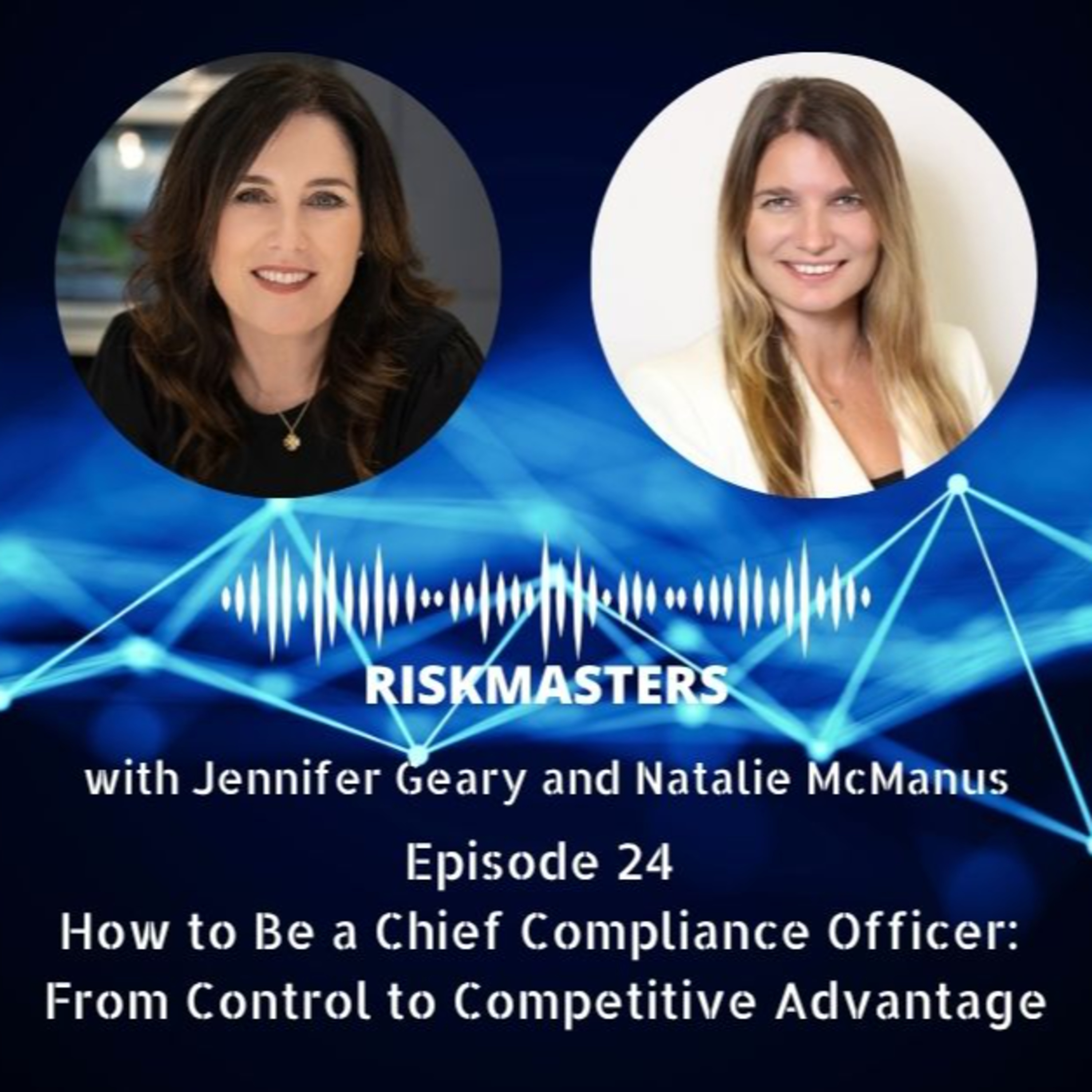 Chief Compliance Officer role explained. Jennifer Geary and Natalie McManus explore compliance leadership, strategy, and decision-making. 16.06.2026 57minIn this RiskMasters episode, Julien Haye speaks with Jennifer Geary and Natalie McManus, co-authors of How to Be a ChiefCompliance Officer.The conversation explains the Chief Compliance Officerrole as a leadership discipline rather than a control function.It explores how compliance leadership shapesdecision-making, supports strategy, and embeds culture across the organisation.Drawing on practical experience, the discussion reframescompliance as a capability that enables sustainable performance, trust, and long-term value.🧠 What Does a Chief Compliance Officer Do?A Chief Compliance Officer ensures that an organisationoperates within regulatory expectations while enabling effective decision-making.The role combines governance, culture, and advisoryinfluence to shape how organisations manage risk, interpret rules, and minimise harm.In practice, this means embedding compliance into strategy,operations, and everyday decisions rather than applying it after the fact.🎯 What You’ll LearnWhy every senior leader operates as a compliance leader inpractice How compliance mindset improves escalation and decisionquality What defines the Chief Compliance Officer role today How compliance leadership creates competitive advantage Why most compliance programmes fail to influence decisions How the IMPACT Wheel connects compliance into a system ⏱️ Episode Highlights00:02 – Introduction and framing of the CCO role00:54 – Compliance as leadership and social purpose05:34 – Misconceptions about the Chief Compliance Officer11:55 – Compliance as competitive advantage in practice26:49 – The IMPACT Wheel explained41:25 – First 90 days as a Chief Compliance Officer46:23 – Future capabilities: data, AI, and human judgement📚 Related ResourcesFrom Approval to Impact: Repositioning Risk Appetite as a Board ToolUnderstand how governance frameworks influence real business outcomesWhat Would Change if Risk Identification Was Treated as a Strategic Advantage?Reframe how organisations surface and act on emerging risksPsychological Safety in Risk ManagementWhy escalation, culture, and speaking up define effective governance🎓 Download your CPD certificate:The CPD Group – Accreditation: #501232
 -
 Risk Culture, Governance and Operational Resilience in Crisis Management 08.06.2026 6minRisk culture plays a central role in operational resilience, particularly in environments shaped by uncertainty and rapid change.In this segment, Bruce McIndoe explains why governance structures in risk management and crisis management often appear robust but struggle under real conditions.He highlights how organisations rely on defined roles, escalation paths, and reporting structures, yet face challenges in speed, integration, and decision-making when ambiguity increases.The discussion explores how culture influences whether early warning signals are surfaced, how oversight shapes behaviour, and how operational resilience depends on the ability to act before information is fully validated.Listeners will gain insight into:How risk culture influences operational resilience and crisis responseWhy governance structures provide confidence but not always effectivenessHow speed and integration become critical under pressureWhy oversight can delay escalation when certainty is prioritisedWhat this means for enterprise risk management and decision-makingEnterprise risk management, crisis management, and governance frameworks often emphasise structure, reporting, and control.Operational resilience depends on how organisations behave when conditions are uncertain.This includes:how early signals are surfacedhow ambiguity is treated in decision-makinghow quickly teams can act across functionsStrengthening these capabilities improves business resilience and response effectiveness.This extract is taken from the full RiskMasters interview with Bruce McIndoe on operational resilience, risk management, and crisis decision-making.
 -
 Operational Resilience, Enterprise Risk Management & Crisis Management: Why Early Signals Fail 30.05.2026 7minEarly warning signals in operational risk, enterprise risk management (ERM), and crisis management environments are often present before disruption becomes visible.In this segment, Bruce McIndoe explains why these signals frequently fail to trigger action. He highlights how ambiguity, fragmentation, and competing interpretations prevent organisations from recognising signals as decision-relevant.The discussion provides a practical lens on how risk monitoring and business continuity planning (BCP) can be strengthened by improving signal interpretation and escalation.What You Will LearnListeners will gain insight into:• Why early warning signals are often identified but not acted upon• How enterprise risk management and crisis management processes interpret signals differently• Why ambiguity prevents signals from becoming decision-relevant• How fragmentation across functions delays escalation• What this means for chief risk officers and business resilience leadersWhy This MattersMany organisations invest in risk monitoring, enterprise risk management, and business continuity planning to strengthen resilience.These capabilities depend on more than detection.Operational resilience requires organisations to interpret signals under uncertainty, prioritise action, and respond before disruption escalates.This is a critical capability for leaders responsible for risk management, crisis management, and business resilience.Full EpisodeThis extract is taken from the full RiskMasters interview with Bruce McIndoe on operational resilience, enterprise risk management, and crisis decision-making.
 -
 Operational Resilience vs Risk Reporting: What Leaders Get Wrong 23.05.2026 7minMost organisations believe strong risk reporting indicates strong operational resilience.In this segment, Bruce McIndoe challenges that assumption. Drawing on his experience in enterprise risk management (ERM), crisis management, and business continuity planning (BCP), he explains why reporting and monitoring provide visibility but do not determine whether an organisation can continue to operate under disruption.The discussion explores how operational resilience depends on the ability to interpret emerging signals, connect information across functions, and act before conditions escalate.What You Will LearnListeners will gain insight into:• Why risk reporting and risk monitoring do not reflect operational resilience• How enterprise risk management frameworks can create visibility without readiness• Why early signals in crisis management and BCP environments are often not acted upon• How fragmentation across functions limits business resilience• What this means for chief risk officers and senior leadersWhy This MattersMany organisations continue to strengthen risk management frameworks, monitoring processes, and reporting structures.These improve oversight and support governance.Operational resilience depends on a different capability: the ability to recognise emerging disruption, make decisions under uncertainty, and maintain continuity when conditions change.This distinction is critical for leaders responsible for enterprise risk management, crisis management, and business continuity.Full EpisodeThis extract is taken from the full RiskMasters interview with Bruce McIndoe on operational resilience, enterprise risk management, and crisis decision-making.
 -
 Operational Resilience, Risk Management and Crisis Decision-Making with Bruce McIndoe 16.05.2026 53minIn this episode of RiskMasters, I speak with Bruce McIndoe, founder of iJET and WorldAware, and a global expert in operational resilience, crisis management, and risk management in complex environments.With decades of experience across intelligence systems, NASA programmes, and Global 2000 advisory, Bruce brings a practical perspective on how operational risk, organisational fragmentation, and leadership decision-making interact under pressure.This conversation focuses on a critical but often misunderstood reality: operational resilience is not a reporting outcome. It is a capability that determines whether organisations can detect early signals, coordinate effectively, and act before disruption escalates into crisis.🎯 What You Will LearnHow operational resilience differs from traditional risk management frameworksWhy operational risk builds through fragmentation, not isolated failures How crisis management fails when coordination breaks down under pressure Why early warning signals are often visible but not acted upon How human judgement remains critical in interpreting ambiguous risk signals Practical ways to strengthen coordination across functions and improve resilience 🕒 Episode Highlights02:30 — Risk reporting vs operational resilienceWhy risk registers and heat maps create governance clarity but fail to indicate whether the organisation can continue to operate under disruption.07:15 — How disruption actually emerges in operational risk environmentsWhy crises do not appear as clear, linear events, but develop through fragmented and ambiguous signals across functions.10:55 — Intelligence fusion and missed early warning signalsHow operational risk signals exist across silos, but are rarely connected early enough to inform decision-making.14:40 — Crisis management and behavioural breakdownsWhy organisations do not follow plans under pressure and instead fall back on coordination, relationships, and decision habits.25:15 — Governance structures and operational resilience limitsHow governance frameworks provide oversight but struggle to operate effectively in fast-moving, uncertain conditions.47:20 — The hardest truth about resilience and risk managementWhy resilience cannot be delegated and depends on real organisational capability, not documentation.💡 Key Insight“Resilience cannot be delegated, and it cannot be faked. It shows up in how organisations coordinate and make decisions when conditions change.”👤 About Bruce McIndoeBruce McIndoe is the founder of iJET, later WorldAware, and a recognised expert in operational resilience, crisis management, and global risk intelligence.He has spent decades helping organisations strengthen their approach to operational risk and crisis management by improving early warning capabilities, cross-functional coordination, and decision-making under pressure.Find Bruce on Linkedin: https://www.linkedin.com/in/mcindoe/📚 Related ResourcesPsychological Safety in Risk Leadership From Approval to Impact: Repositioning Risk Appetite Strategic Risk Identification as a Capability Strategic Uncertainty Governance Risk Capacity and Operational Decision-Making 🎓 Download your CPD certificate:The CPD Group – Accreditation #501195
 -
 Risk Culture, Risk Ownership and Decision-Making Under Pressure 09.05.2026 7minRisk culture, risk ownership, leadership, and risk management become visible through how organisations make decisions under pressure.In this RiskMasters — The Download segment, Leroy Roberts explores how unclear ownership, weak support structures, and slowing decisions create decision drag and increase organisational risk exposure. The discussion focuses on how chief risk officers, boards, and leadership teams can strengthen risk management by improving risk ownership, operational clarity, and leadership support.The conversation also explores why organisations often believe existing governance and escalation processes are sufficient, while underlying control gaps continue to create operational and strategic risk.Listeners will gain insight into:• How risk ownership influences decision-making and control effectiveness• Why decision drag signals weakening risk culture• How leadership support strengthens risk management outcomes• Why delegation without support increases operational and strategic risk• How organisations can strengthen control through clearer accountability and decision cadenceThis extract is taken from the full RiskMasters interview with Leroy Roberts on risk culture, leadership, risk management, operational risk, and governance, available on Apple Podcasts, Spotify, and at aevitium.com.
 -
 Decision Drag: Risk Culture, Risk Ownership and Decision-Making Signals 02.05.2026 5minRisk culture, risk management, and risk ownership become visible through how decisions are taken in practice.In this RiskMasters — The Download segment, Leroy Roberts explores decision drag as an early signal of weakening control, showing how slowing decisions and unclear risk ownership affect risk management outcomes and leadership effectiveness. For chief risk officers, board directors, and risk leaders, this provides a practical way to observe risk culture and control in real time.The discussion focuses on how decision-making behaviour reflects the strength of governance and highlights why delays, escalation patterns, and ownership clarity are critical indicators of operational risk.Listeners will gain insight into:• How risk culture shapes risk decision-making and control• Why decision drag signals changes in risk ownership and accountability• How leadership behaviour influences escalation and decision clarity• How chief risk officers and boards can observe risk management effectiveness through decision patternsThis segment is extracted from the full RiskMasters interview with Leroy Roberts on risk culture, leadership, risk management, and operational risk, available on Apple Podcasts, Spotify, and at aevitium.com.
 -
 What Boards and Chief Risk Officers Often Miss About Risk Culture 25.04.2026 4minRisk culture, risk decision-making, and operational risk are deeply connected, yet often managed separately.In this RiskMasters — The Download segment, Leroy Roberts explores how risk culture operates as a control mechanism shaping risk management, leadership decisions, and governance outcomes. For chief risk officers, board directors, and operational risk leaders, the discussion offers a practical lens on how culture influences control effectiveness long before formal incidents emerge.Listeners will gain insight into:How risk culture strengthens risk management and decision-makingWhy behavioural signals can act as early indicators in operational riskHow chief risk officers and board directors can view culture through a control lensWhy governance effectiveness depends on how decisions and escalation work in practiceThis extract is taken from the full RiskMasters interview with Leroy Roberts on risk culture, leadership, operational risk, and risk decision-making, available on Apple Podcasts, Spotify, and at aevitium.com.
Podcasts similares


Popular em
Este podcast também aparece nas paradas de podcasts destes países.
