
The Bangkok Podcast
Greg Jorgensen & Ed Knuth
0
Since 2010, Greg Jorgensen and Ed Knuth have been exploring Bangkok, sharing their experiences of the city's culture, food, and people. Each week they discuss topics relevant to expats, visitors, and anyone curious about life in Thailand's capital. The podcast offers insights into the city's hidden corners and fascinating characters.
Epizódy
-
 AI Helps Us Find Hidden Meaning in the Art of the Late, Great Khun Pichai [S8.E61] 15.09.2026 39minGreg begins by discussing the late Bangkok street artist Khun Pichai, whose intricate and cryptic sidewalk scribbles across the capital attained a devoted cult following over the years, with sightings of his mysterious, sprawling artworks treated like discovered treasures. If you don't know who Khun Picha was, watch this excellent short documentary to get an idea. Many people dismissed Khun Pichai's art as "crazy" or "nonsense" but we think there was something else there. So, we harnessed the power of AI to give us some insight, and perhaps find details that we simply were not able to see. Ed reflects on the artist's complex background, observing that Khun Pichai seemed to possess a rich internal life that found raw expression through public city surfaces. Next, Greg walks through the artificial intelligence interpretations of several individual pieces - find them on our website if you'd like to follow along. The software explains that the seemingly chaotic drawings actually repurpose utility meter readouts, bureaucratic paperwork, radio schematics, and Thai consonants treated like algebraic variables. Ed points out that Khun Pichai famously considered his sketches to be investigative notes and evidence rather than conventional art, demonstrating an intensely focused technical mindset. Moving forward, Greg shifts the focus to other Bangkok subjects evaluated by artificial intelligence. Greg explains how the software analyzed a city map, attributing notorious traffic congestion to modern roadways that haphazardly traced ancient canals rather than planned survey grids (no surprise, but still pretty on the money). Ed and Greg then explore the program's evaluation of longtail boat mechanics, highlighting why repurposed car engines and long propeller shafts remain ideal for narrow waterways. Greg concludes the exercise by sharing an artificial intelligence comparison of Lumphini and Benjakitti parks, contrasting early European landscape ideals with contemporary ecological design. While using the cold, inhuman logic of an AI to analyze the warm, squishy creativity that flowed from a human mind might seem a bit gauche, AI is nonetheless a powerful tool that can uncover hidden details.
 -
 Vic Levitin Talks About Starting From Scratch in Thailand [S8.E60] 08.09.2026 48minMoving to Thailand can be a disorienting, discombobulating experience, even if you're on your own. Now imagine doing it with 9 hours to prepare. That's what Vic Levitin and his family did, but the unknown and unplanned turned into something great - though not without its speed bumps. Greg begins the interview by asking Vic about his sudden relocation to Koh Samui, where he lives full time. Vic explains that although he previously pitched moving to Asia, his wife opposed it until a war broke out in their home country. This crisis forced them to pack and fly to Thailand on incredibly short notice. Next, Vic describes the severe stress of their initial weeks living in limbo. He notes that their mindset shifted from temporary vacationers to permanent residents only when they purchased a couch, symbolizing their commitment to a new life. Vic then discusses how his family integrated by joining Thai boxing, enrolling their children in an international school where they quickly learned English, and building a supportive community of expatriates and locals. Later, Vic highlights the peace of escaping the corporate grind, though he acknowledges the financial pressures of raising a family abroad. He also shares his past experience running a company that released sterile mosquitoes to combat tropical diseases. Following the interview, Greg and Ed reflect on the sheer intensity of relocating an entire family overnight. Greg compares the chaotic packing process to a stressful game show challenge. Ed and Greg express admiration for how Vic and his wife managed the psychological leap from merely escaping a conflict to intentionally building a grounded home. They agree that committing to buying heavy furniture was the ultimate turning point in his journey.
 -
 Bangkok's Roads: The History Behind the Names (S8.E59) 01.09.2026 39minGreg begins by discussing a suggestion from their friend Scott to explore the origins of well-known street names in Bangkok. After briefly touching on familiar spots like Khaosan Road and Lumpini Park, Greg dives into the history of Sukhumvit Road. He notes it was originally a dirt track before being formally constructed and named after the fifth chief of the Department of Highways, who was notably the first Thai person to graduate from the storied MIT. They then confront a bit of trivia - is Sukhumvit actually the longest road in Thailand? Ed digs around online and finds that Phetkasem Highway is actually significantly longer than Sukhumvit. Next, Greg brings up Wireless Road, explaining that it earned its name because it housed the very first radio telegraph station in Thailand. He mentions there is even a small museum built on the original foundations. Following this, Greg explains that the nearby Saladaeng area got its name from a red pavilion located at an old railway station. Continuing their discussion, Greg reveals that Asok Road has ties to a famous Buddhist emperor named Ashoka, though it was officially named after a local landowner known as Asok Montri. He then shares that Phetchaburi Road is surprisingly named after a royal aunt rather than the province itself. Finally, Ed wraps up the historical segment by noting that Songwat Road translates to being drawn by a king, while the lengthy name Borommaratchachonnani honors a supreme royal mother.
 -
 Photographer Dax Ward on Capturing Bangkok's Abandoned Beauty [S8.E58] (Classic ReCast) 25.08.2026 51minGreg interviews Dax Ward, an adventurous photographer best known for his beautiful photos of dilapidated buildings and abandoned places. Dax begins by explaining that he was a very late starter to photography, getting a DSLR for the first time in 2015. After a random trip to the airplane graveyard down Ramkhamhaeng Road, he developed an affinity for shooting forgotten and abandoned places. As it turns out, Thailand (and Bangkok in particular) are perfect places for this style of photography due to the number of unfinished construction projects from the financial crisis of the late 1990s. Additionally, there seem to be a surprising number of new business ventures in the area that fail for whatever reason or another, so there seems to be an endless supply of possible sites for Dax's style of photography. The guys discuss how Dax discovers and gains access to his locations. It's surprising what a couple hundred baht here and there will do to the attitude of many Thai security guards! Dax then details his research methods and how he manages to build a compelling story around each set of photographs, something that many other photographers don't bother with. In a world where almost everyone has the technology in their pocket to take a decent photo, Thailand is lucky to have an intrepid, creative photographer like Dax to show us how to do things right. Don't forget that Patrons get the ad-free version of the show as well as swag and other perks. And we'll keep our Facebook, Twitter, and LINE accounts active so you can send us comments, questions, or whatever you want to share.
 -
 A Peek Into Bangkok's Thriving Bluegrass Music Scene [S8.E57] 18.08.2026 46minIn another example of a thriving subculture in Bangkok you wouldn't expect to see, Greg and Ed interview Sunny Sachdev, a Thai Indian banjo player who is part of the informal network of musicians that drive Bangkok's local bluegrass music scene. Check out their page here. Sunny explains that he discovered the genre through a video recommendation online and immediately felt drawn to the banjo, despite having no prior musical background. Sunny details how he connected with the local community by attending a jam session at the Srinakarin Night Market. He shares the history of bluegrass, noting its origins in the Appalachian region as a blend of immigrant folk traditions and African instruments. Sunny then describes the unique local subculture, which includes a strong passion for vintage clothing, cowboy attire, and antique instruments salvaged from overseas. Ed brings up the communal aspect of the music, and Sunny explains how jam sessions are highly inclusive, acoustic circles that eliminate typical stage fright. Sunny also highlights a specific bluegrass festival he organizes to bring these diverse musicians together. Following the interview, Greg and Ed reflect on how fascinating it is to see such a niche American subculture thriving organically in Thailand. Ed mentions how teaching music history gave him a newfound appreciation for the genre, overcoming his past snobbery. Greg concludes their discussion by emphasizing that bluegrass represents true community music, designed to be shared collaboratively rather than just performed on a stage.
 -
 The Devil's in the Details: Playing the Expat Insurance Game [S8.E56] 11.08.2026 37minInspired by recent discussion among friends, and Greg's switch to a new provider, the boys tackle the enduring issue of health insurance as an expat. There are many companies, many plans, and many pitfalls. Which one do you choose? Ed begins by outlining the main geographic areas of coverage an expatriate must consider, which include coverage in Thailand, in their home country, and during international travel. He notes that many young people mistakenly skip buying health insurance, and while Thai medical care is relatively inexpensive, he strongly advises against going completely uninsured. Next, Greg shares his personal journey, explaining how he transitioned from an excellent corporate policy to a global plan that excluded the United States due to its exorbitant costs. Ed brings up his own strategy, stating that he currently relies on a basic Thai government plan for minor health issues but desperately needs to find a policy that covers major catastrophic events. Greg then reveals that advancing in age caused his insurance premiums to drastically increase, which recently forced him to switch to a more affordable plan that only covers him within Thailand. He advises that many companies are willing to negotiate higher deductibles for lower premiums to help cover major disasters. Later, Ed confesses he frequently travels back to America without any medical coverage, acknowledging the financial risk. He points out that an artificial intelligence program informed him that top Thai hospitals offer world class success rates for major surgeries, proving local healthcare is a smart choice for aging expatriates and coverage in the States might not be necessary.
 -
 Weird Explorer's Jared Rydelek on Asia's Strangest Fruits [S8.E55] 04.08.2026 49minGreg interviews Jared Rydelek, the creator of the Weird Explorer YouTube channel. Jared explains that his day job is a contortionist, but his lifelong vegetarianism sparked a deep fascination with rare fruits. He shares how this hobby evolved into a channel where he travels the globe to taste unique produce, discovering a surprisingly vast subculture of fruit enthusiasts. Jared notes that there are tens of thousands of edible fruits worldwide, far beyond the limited variety found in typical grocery stores. Next, Greg asks Jared about his favorite fruits in Thailand. Jared highlights the snake fruit, noting that the Thai variety differs significantly from those in neighboring countries. He also expresses a strong preference for the yellow mangosteen. The conversation then takes an amusing turn when Jared recounts his encounters with fake or molded fruits. He describes tracking down a highly sought-after fruit only to realize it was a clever fake, eventually learning that seeking out older female vendors in local markets is the best way to find authentic and rare produce. A few other fruit-centric stories follow - who knew there could be so many different characters and wild hijinks in the fruit subculture? Following the interview, Ed expresses admiration for Jared, noting that while he personally lacks the motivation to hunt down obscure foods, he respects the passion involved. Greg concludes by praising Jared for his dedication to exploring niche subcultures and promoting the area where agricultural and cultural knowledge overlap.
 -
 Saying Too Much: Dealing With Self-Censorship in Thailand [S8.E54] (Classic ReCast) 28.07.2026 37minGreg and Ed tackle the uncomfortable topic of self-censorship in Thailand, especially as it pertains to the podcast itself, and the churning, roiling issue of what you can say, when, and how, which seem to be in the news every day. Although it is unfortunate, the reality of working and living in Thailand is that the laws and culture are not the same as back home in the U.S. and Canada. Obviously, this means no discussion of the monarchy, and Ed explains how he always advises visiting friends to simply avoid discussion of the monarchy and royal family in pretty much any context. This is good advice for all foreigners in Thailand actually. Second, the boys concur that although they do criticize the government broadly, they make sure not to name specific politicians or policymakers. Although technically no law forbids it, strong and pointed criticism of the Thai government has a way of ending up poorly for the critic, from sudden problems with your visa to (in extreme cases) outright disappearance. On a podcast that is not centered on political issues, it just ain't worth the risk, and while the guys feel comfortable critiquing the government broadly, that's about as far as they are willing to go. Last, Greg and Ed discuss Thailand's defamation laws, which work differently than the laws back home where 'truth' is more or less an absolute defense. In Thailand, even if you say something true, you can be found guilty of violating another person's privacy. As Ed put it, Thailand has a 'mind your own business' culture, as opposed to the 'speak truth to power' culture we have back home. All this being said, the guys admit that self-censorship is fairly rare and not really a problem for a podcast focused on the serious (and sometimes silly) aspects of living in Thailand as a foreigner. Don't forget that Patrons get the ad-free version of the show as well as swag and other perks. And we'll keep our Facebook, Twitter, and LINE accounts active so you can send us comments, questions, or whatever you want to share.
 -
 Crackdown! Is Thailand Becoming a Rule of Law Society? [S8.E53] 21.07.2026 33minAfter a recent wave of news headlines highlighting government crackdowns on things as varied as fake paternity scams and cheating civil servants, Greg and Ed begin by asking whether Thailand is finally enforcing the rule of law in any meaningful way. Greg points to changes in visa policy, noting that authorities reduced visa-free stays after discovering widespread abuse from visitors working illegally. Next, Ed brings up the crackdown on illegal nominee company ownership, pointing to cases where foreign nationals set up front businesses using fake Thai shareholders to bypass local laws. Moving to healthcare scandals, Ed highlights an investigation into multiple hospitals involving a birth record scam where foreign women paid local men to falsely claim paternity. Greg then transitions to a massive cheating scandal in the civil service, where thousands of local officials face dismissal after paying bribes to pass government employment exams. Next, the conversation turns to a tragic nightclub fire, which Greg uses to illustrate that while strict laws exist on paper, consistent enforcement remains a persistent problem without public pressure. Finally, Greg shares a personal experience to show that enforcement efforts may indeed be increasing. He describes how an immigration officer conducted an unexpected spot check at his office to verify his employment, forcing him to appear in person at the immigration bureau to prove his status, something he has never experienced during his decades in the country. The guys conclude that something certainly SEEMS different about recent law enforcement efforts, but only time will tell if real change is afoot.
 -
 Strange Bedfellows: Prof. Khemthong on the Buddhism and Politics [S8.E52] 14.07.2026 42minEd interviews K. Khemthong Tonsakulrungruang, a constitutional lawyer and professor from Chulalongkorn University whose work bridges law and Buddhism. After Ed shares his own background as an American lawyer, the two men begin by discussing the modern relevance of Buddhist teachings. K. Khemthong explains that Buddhist mindfulness practices are more important than ever for combating the overwhelming distractions of smartphones and social media. They touch upon how both traditional and secular meditation retreats are increasingly popular for people seeking mental clarity in a chaotic world. Next, Ed brings up Khemthong's academic focus, prompting a fascinating story about a former student who researched local political movements. The guest recounts how Thai protest leaders have historically invoked Buddhist concepts to justify anti-democratic actions. He explains that this political ideology emphasizes the purity of a leader's intentions rather than the strict legality of their actions, meaning that acting with a benevolent mind can supposedly excuse technically illegal political moves. Finally, the conversation shifts to the intersection of religion and constitutional law in Thailand. They discuss how various iterations of the Thai constitution have handled the country's religious identity. K. Khemthong notes that while the government guarantees freedom of religion, it also holds a special duty to promote Buddhism. The interview concludes with an agreement that the state maintains a delicate, pragmatic balance to honor the nation's primary faith without marginalizing minority religions.
 -
 In the Know: A Few Deep Cut Reasons to Love Expat Life in Bangkok [S8.E51] 07.07.2026 31minGreg and Ed explore the small, unexpected joys of being an expat living in Thailand. Ed begins the main discussion by sharing his amusement over miscommunications regarding his job. Despite teaching university-level political science, Thai people frequently assume he is a basic English teacher, an error he enjoys correcting. Next, Greg discusses how he enjoys getting opted out of annoying situations due to his nationality. He notes that being a foreigner often grants him a free pass from sitting through tedious formal rituals or dealing with telemarketers who assume he does not speak Thai. Ed then brings up the relief of geographical distance from his home country, explaining that living overseas allows him to avoid participating in stressful family drama back in America. Greg relates to this, adding that it lets him prioritize his immediate family. Continuing the conversation, Greg brings up his appreciation for the language barrier, which acts as a natural shield allowing him to completely tune out noisy local advertisements and background chatter. Next, Ed notes that he gets a surprising amount of unearned respect and admiration from locals simply for being an American citizen. Finally, Greg concludes the topic by admitting he loves taking advantage of low fashion expectations for foreigners, happily running errands in comfortable, unkempt clothing without feeling self-conscious about his appearance. Thanks, skeezeballs!
 -
 Realtor Tracy Leelalumlert Dives Deep Into Bangkok's Condo Market [S8.E50] 30.06.2026 47minOn the heels of a recent episode where Greg and Ed opined on the nuances of the tricky Bangkok property market, this time they have a real, er… real estate pro on to get into things from her POV - Tracy Leelalamlert from Aspire Real Estate. Greg begins by discussing with Tracy whether buying a condo in the city is a good investment. Tracy explains that it depends on the buyer's purpose, noting that rental properties typically yield around four percent annually. Next, Ed brings up the issue of transparency in the Thai property market. Tracy confirms that unlike Western countries, Thailand lacks public records of actual sale prices, meaning buyers must do their own research or hire valuation companies to find accurate market values. The conversation then shifts to the massive oversupply of empty condos. Greg wonders why prices do not decrease to meet demand. Tracy points out that wealthy Thai owners often feel no financial pressure to sell, preferring to pass properties down to their children rather than lower the asking price. She also mentions that wealthy foreign buyers sometimes buy units simply to safely park their money outside their home countries, an isue certainly not unique to Thailand. Later, Ed asks if a foreigner should rent or buy a place. Tracy strongly recommends renting for the flexibility it offers, reserving buying for those making a long-term commitment. Greg and Ed wrap up the episode by reflecting on the interview, agreeing that Tracy handled their tough questions well and understands the complicated local market about as well as anyone can - and that's saying a lot!
 -
 Thai Games: From Playgrounds to Cards to Beetle Fighting [S8.E49] (Classic ReCast) 23.06.2026 41minThanks to a suggestion from a listener Greg and Ed discuss the fascinating topic of games that are common - if not unique - to Thailand. Both guys have some familiarity with some games played in public such as 'takraw,' but many of the others are part of this strange world called 'Thai culture' that the guys apparently don't actually know that well. Greg begins with a children's game in which one child sings a song while counting by syllable on another child's hand. When the singer stops on a finger, that finger is taken out of the game. The child with the last finger in is the winner. Greg even plays a cute clip of a video of the game. Next, Greg explains a Thai game very similar to the Western game of 'jacks,' which although relatively unplayed by children back home, still lives on in a Thai derivative. The boys then go deep into the Thai version of chess, called makruk (หมากรุก), which utilizes the same board and pieces but with modifying moving rules for each piece. This game is a quite famous pastime of Thai motorcycle riders, who can often be seen playing the game on the side of the road while awaiting customers. It should be noted that Ed's friend - a noted chess lover - was broken by makruk, giving up in frustration after trying to tame the wild beast. Greg continues with several more Thai games, from the crazy sport of takraw, which is kind of like soccer and volleyball mixed together with a wicker ball, to bizarre practices such as beetle fighting, popular in the Northeast, and a game where you throw seeds with your knees. We also check in with a friend of Greg's who owns Golden Goblin Games to hear about the role-playing side of things. Don't forget that Patrons get the ad-free version of the show as well as swag and other perks. And we'll keep our Facebook, Twitter, and LINE accounts active so you can send us comments, questions, or whatever you want to share.
 -
 Eight Specific Things That Bother Greg About Bangkok Driving [S8.E48] 16.06.2026 32minInspired by an unusually long commute, the boys decide to discuss a list of things - very specific things - that bother Greg while he drives his trusty silver Honda around Bangkok. Greg begins by sharing his first major annoyance with Bangkok drivers, which is their complete disregard for pedestrian crosswalks, forcing people to sprint across the road. Next, he brings up the severe impatience at intersections, where drivers wedge themselves into perpendicular traffic even when there is no room, entirely blocking the flow. Following this, Greg expresses his frustration with luxury malls reserving premium parking spaces exclusively for 'supercars', a practice both hosts find incredibly elitist and ridiculous. After all, how do you define 'super'? Greg thinks his Honda is pretty super, but he bets the guard at Icon Siam will disagree. The conversation then shifts to the tendency of local drivers to swing out into the second lane and make wide left turns. Greg admits he has actually started doing this himself as a defensive tactic against blind corners and weaving motorcycles. After that, he points out the dangerous and aggressive driving habits of delivery workers in heavily modified, caged pickup trucks. The list continues - hazards lights at intersections, customized license plates, and finally the one rule to rule them all - if everyone actually followed the traffic laws in Bangkok, it would probably be way more dangerous. Ed concludes by noting Greg has done an excellent job of explaining why he (Ed) rarely drives in Bangkok!
 -
 Conflict & Legacy: Journalist Denis Gray Discusses His New Memoir [S8.E47] 09.06.2026 43minIn this episode, Greg interviews legendary foreign correspondent Denis Gray about his memoir, Lost Horizons. Denis details his fascinating life story, beginning with his family's escape from communist Czechoslovakia and his father's subsequent intelligence work for the CIA. After graduating from Yale, Gray served in the U.S. Army during the Vietnam War, an intense experience that inspired his transition into journalism with the Associated Press. The next few decades saw Denis covering critical global conflicts, focusing heavily on the Indochina wars. He highlights the extreme challenges of reporting on the Khmer Rouge genocide from the Thai-Cambodian border, noting how a lack of visual media at the time left these historical atrocities largely forgotten by the wider world. Greg and Ed then discuss the immense psychological weight of Gray's memories. Ed expresses a mix of awe and relief, admitting he is glad he never had to face such immense dangers himself. Ultimately, both hosts agree that Gray's career represents a rare, vanishing breed of war correspondence, emphasizing the vital importance of preserving these profound, first-hand historical accounts. For a more visual discussion, see a video of Dennis' book launch and Q&A at the Foreign Correspondent's Club here in Bangkok.
 -
 Thai Style vs Western Style: The Diverse Art of Storytelling [S8.E46] 02.06.2026 36minWith Ed unavailable this week, Greg welcomes his friend John as co-host to talk about storytelling. Specifically, the difference between how westerners tell stories, and how Thais tell stories. This is especially apropos to John, as he is the creator of Bangkok Stories, an event that, unsurprisingly, showcases the talents of locals who tell tales for an audience. The discussion is at turns funny, insightful and sometimes dark, as Greg and John analyze storytelling styles to see what they tell us about the cultures behind them. Ultimately, as Thai culture is not a "look at me" one, this informs how eager most Thais are at getting up in front of strangers to talk. Add to this the concept of losing face and/or displeasing family members and those perceived of being of a higher status, and you have a complex mix of inspirations and motivations. Greg sees a parallel in how difficult it is for him and Ed to find Thai guests to come on the show. Obviously English-language proficiency is a big barrier, but they have asked many over the years who are reluctant in case they say something disagreeable and lose face, which could bring shame on them, their family - or worse - their boss. This eventually leads into a discussion of the ongoing Psi-Scott drama, which sees the taboo against shaming families with public accusations taken to a disturbing extreme.
 -
 Foreign Fool: A Conversation with Author Alan Platt [S8.E45] (Classic ReCast) 26.05.2026 32minWhen it comes to characters, Bangkok has them in droves - people who have been places, eaten things, talked to people, and lived adventures that would make your mother put her hand to her mouth and proclaim, "Oh my" with a frightened little squeak. On this episode of the Bangkok Podcast we're happy to have one of these epic characters on the show with us - Mr Alan Platt, who, as it happens, has just released a book about his adventures entitled Foreign Fool. Now I know what you're thinking, and it's the same thing we think when we hear self-published book by a farang in Bangkok, and that is, "Oh, yes, another one for the dusty back section of Asia Books, along with all the stories about hard-boiled detectives, heart-of-gold prostitutes, and love gone bad." But no - that's not what this book is about at all. In fact, take it from me (Greg), who has read the book - this is one hell of a fun read, and is actually - get this - really well written. From Saigon to Bangkok to Panama to London to Honolulu, Foreign Fool tells of, as Alan puts it, the bumbling misadventures of a doofus. I'll just let the first two paragraphs of the first chapter say it themselves: In Saigon, many years after the war was over, long after the city was declared safe for tourists and when even the hookers were becoming almost discreet, I was kidnapped. That does sound a bit dramatic, I admit. Technically, it was more an abduction. But however one puts it, any mention of that sort of thing floods the mind with images of some poor guy being jumped by thugs, bundled into the trunk of a car and splattered across the tabloids with a screech of tires and the burning of rubber. None of that happened to me. I was kidnapped on a bicycle. Alan discusses how he went from sunning his broke ass on a Los Angeles beach to the top of the New York ad world, how the book took shape, and a few of the stories - both in the book and not - that keep him looking ahead to the next trip. Buy Foreign Fool on Amazon.
 -
 When Owners Don't Own: Thailand's Thorny Nominee Issue [S8.E44] 19.05.2026 45minThe issue of Thai nominees has heated up in the past little while, with daily news stories about crackdowns, changing laws, and foreigners running scared (or just running). The discussion begins with Ed outlining the basic framework of the Thai Foreign Business Act, explaining how it restricts foreigners from owning more than forty-nine percent of companies in certain restricted sectors. He details how this legal hurdle gave rise to the widespread use of Thai nominees, where Thai citizens are paid to hold fifty-one percent of the shares on paper, allowing the foreigner to maintain operational control. Next, Ed brings up the legal gray area surrounding this practice. He clarifies that while having genuine Thai business partners is perfectly fine, using fake nominee shareholders who possess no actual financial stake or voting power is strictly illegal under Thai law. Greg then steers the conversation toward recent government crackdowns on this practice. He discusses how authorities have been aggressively targeting blatant abuses of the nominee system, specifically focusing on certain foreign-owned businesses in tourist hotspots like Phuket and parts of Bangkok. Ed subsequently highlights the massive risks that foreigners take when utilizing these shady corporate structures. He points out that because the Thai nominee legally owns the majority of the company, the foreign investor has almost zero legal recourse if the nominee suddenly decides to seize control of the assets or the business bank accounts. Finally, Greg wraps up the topic by suggesting legitimate alternatives to the nominee route. He points out that foreign entrepreneurs should instead look into the Board of Investment promotion or the US-Thai Treaty of Amity, both of which offer legal pathways to complete foreign ownership without the associated risks.
 -
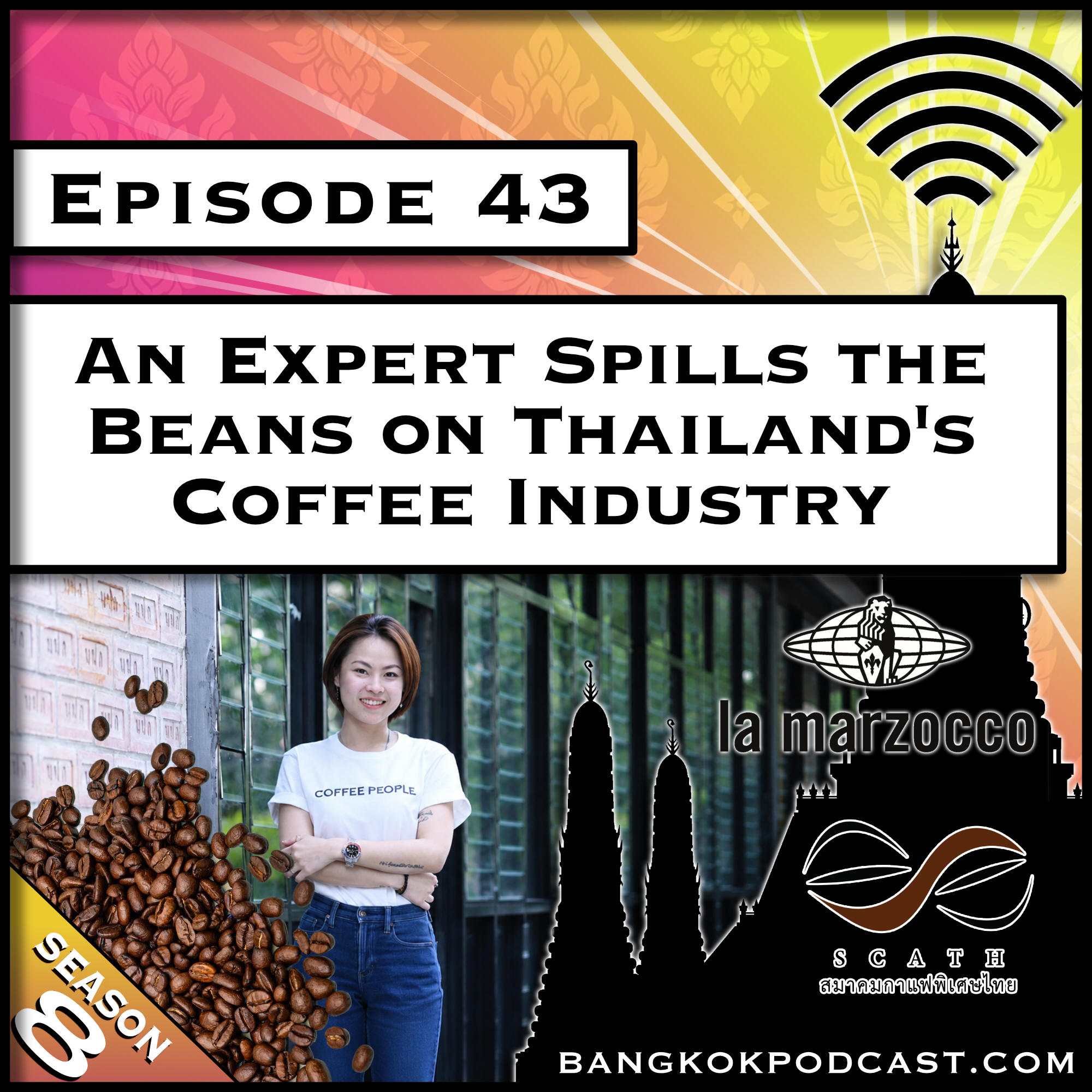 An Expert Spills the Beans on Thailand's Coffee Industry [S8.E43] 12.05.2026 46minGreg begins his interview with coffee fan, aficionado and expert Noon by exploring her background as the former president of the Specialty Coffee Association of Thailand and her current role managing Lamarzocco, the high-end coffee machine retailer. Noon explains her deep dive into coffee quality and traces the rapid evolution of the Thai coffee industry over the past fifteen years. She points out that Thailand is highly unique because it both produces and consumes its own coffee, which creates incredibly short communication lines between rural farmers and urban cafe owners. Next, Noon breaks down the agricultural history, explaining how early royal projects replaced opium crops with disease-resistant but less flavorful hybrid beans, prompting modern farmers to pivot toward higher-quality varieties. The conversation then shifts to the different historical waves of coffee culture. Noon describes the progression from basic instant coffee to the cafe culture popularized by major chains, followed by the artisanal third wave, and finally the current fourth wave that focuses heavily on the science and exact consistency of brewing. She notes that high-end machines are crucial for maintaining this modern standard. Following the interview, Ed and Greg discuss Noon's insights. Ed admits that he is relatively new to the coffee scene and shares his mild frustration with overly expensive, pretentious coffee shops. Greg agrees, reflecting on his own habits and acknowledging that while massive chains offer reliable consistency, they simply cannot match the nuanced quality and dynamic energy of the booming specialty coffee market in Thailand. But that's the great thing about coffee - it's a drink that can fit into almost any social or cultural situation.
 -
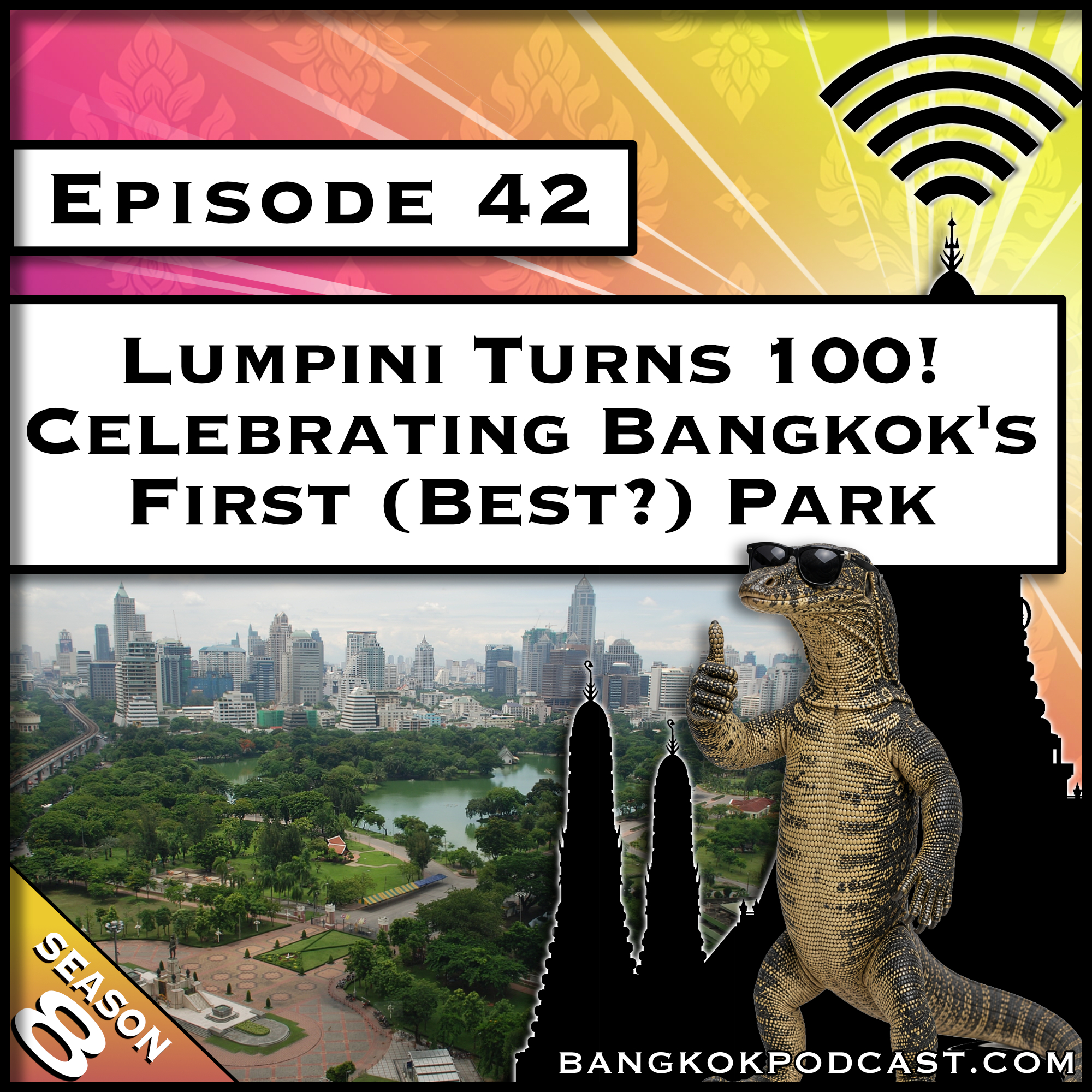 Lumpini Park Turns 100! Celebrating Bangkok's First (Best?) Park [S8.E42] 05.05.2026 42minGreg and Ed discuss the 100th 'birthday' of Lumpini Park. The guys begin by highlighting the improvements in the park over the last several years. More and cleaner bathrooms, landscaping, and an adjacent 'hawker center' are some of the highlights. Greg then reviews the different facilities that populate the 142 acre park, such as a fitness center, swimming pool, and even a lesser known library, one of the first in Thailand to be truly open to the public. The show then shifts to a walk-and-talk in the park itself, recorded a few days before. With its proper roof and organized layout, the Hawker Center is a definite upgrade over random street vendors but in the end is just another Bangkok market. The boys tell some funny Lumpini-centric stories about their early days in Bangkok and their great memories of the park, before a discussion of the soft power possibilities of the park's famous monitor lizards. Next, they check out the status of the Green Mile, the long walkway from lower Sukhumvit and Benjakitti Park to Lumpini Park itself. There is now a twisting walkway leading down into Lumpini, suitable for bike riders. The guys walk over Wireless Road and note that the path seems wide open all the way to Benjakitti. Both guys celebrate the realization of a long dream of Bangkok cyclists: riding through Benjakitti Park, up onto the Green Mile, and then down into Lumpini Park without once having to dismount! It might have taken decades, but that dream is finally a reality. :)
Podobné podcasty


Obľúbený v
Tento podcast sa objavuje aj v rebríčkoch podcastov týchto krajín.
