
Space Nuts: Astronomy Insights & Cosmic Discoveries
Professor Fred Watson and Andrew Dunkley
0
Join Professor Fred Watson and Sci-Fi Author Andrew Dunkley on Space Nuts as they delve into astronomy, space travel, and cosmic mysteries. Explore groundbreaking discoveries and listener Q&A in captivating discussions. Two episodes a week with news and explainer focused editions on Thursdays and a Listener Q&A focused edition on Mondays.
Epizódy
-
 Navigating the Cosmic Questions: Gravity Assists, Neutrinos, and Time Dilation Explained 21.09.2026 30minSpace Nuts: Q&A on BepiColombo, Neutrinos, and Time DilationIn this Q&A edition of Space Nuts, hosts Andrew Dunkley and Professor Fred Watson dive into a series of intriguing listener questions that span topics from the nuances of orbital velocity to the enigmatic world of neutrinos and the complexities of time dilation. Join them as they unravel these cosmic queries with their signature blend of insight and humour.Key topics- Larry from Nebraska asks about the BepiColombo mission and the relationship between gravitational assists and orbital velocity, prompting a discussion on how spacecraft navigate the solar system.- Eduardo explores the nature of neutrinos, questioning whether they are affected by gravity and whether they can be trapped by black holes.- Shumo presents a thought-provoking idea about using high-energy gamma rays or neutrinos as interstellar beacons, leading to a discussion on the potential for advanced civilisations to communicate through unconventional means.- Colin from Adelaide raises questions about time dilation effects as depicted in the science fiction movie "Project Hail Mary," specifically the implications of travelling close to the speed of light and the resulting age differences upon return to Earth.Timestamps00:00 - Introduction to the Q&A format and listener interactions01:20 - Larry's question about BepiColombo and gravitational assists10:30 - Eduardo's inquiry on neutrinos and black holes18:45 - Shumo's question about interstellar beacons using gamma rays or neutrinos26:00 - Colin's confusion about time dilation in "Project Hail Mary"32:15 - Discussion on the implications of time dilation and relativityBecome a supporter of this podcast: https://www.spreaker.com/podcast/space-nuts-astronomy-insights-cosmic-discoveries--2631155/support.
 -
 Why Venus May Have Lost Its Moon Forever 17.09.2026 33minSponsor Link:This episode of Space Nuts is brought to you with the support of NordVPN. your first stop for online privavcy. To check out our special offer with a 30 day money back guarantee, visit www.nordvpn.com/spacenutsSpace Nuts: Venus’s Missing Moon, Satellite Pollution, and Space Force Uniform ControversySpace Nuts covers three very different space stories in this episode, ranging from planetary science to the consequences of satellite reentry and a controversial military uniform design. Andrew Dunkley and Professor Fred Watson also field listener questions on orbital mechanics, neutrinos, alien communication, and time dilation.The discussion is broad, but the main thread is clear: how real-world physics shapes everything from Venus’s history to the future of spaceflight and even the look of space-age uniforms.Key topicsVenus is Earth-like in size, mass, and gravity, but unlike Earth it has no moon, and the episode explores whether it may once have had one.Fred explains a modeling study led by Stephen Kane suggesting a Venus moon could have spiraled inward, crossed the Roche limit, and been torn apart by tidal forces.The team discusses what evidence might remain if Venus once consumed a moon, including possible chemical fingerprints in the atmosphere or surface.Satellite pollution is examined through the lens of reentering spacecraft, especially the growing number of Starlink reentries and their impact on the upper atmosphere.The European Space Agency’s jet-based chase of two reentering Cluster spacecraft, Tango and Samba, is described as an effort to measure reentry byproducts directly.The conversation raises concerns about aluminium oxides, atmospheric chemistry, and whether repeated reentries could have broader consequences such as ozone depletion.The final main story looks at proposed United States Space Force uniforms and why the design drew immediate comparisons to World War II-era fascist aesthetics and Starship Troopers.Andrew and Fred note how uniform design can shape perception, and why the new concept feels divisive rather than inspiring.Timestamps00:00 - Intro and setup for the episode00:41 - Venus, satellite pollution, and Space Force uniforms preview04:40 - Venus as Earth’s twin and why it has no moon08:21 - Modeling a missing Venusian moon09:20 - Gravitational tug-of-war and moon migration toward Venus11:44 - Conditions for a moon to survive around Venus12:43 - Possible traces of an ancient moon impact16:06 - Satellite pollution from reentering spacecraft17:16 - Starlink reentries and atmospheric contamination18:14 - ESA’s jet chase of reentering Cluster spacecraft20:06 - Observing Tango and Samba during controlled reentry21:45 - Why the atmospheric consequences could become controversial23:12 - Wood as a potentially more benign spacecraft material24:16 - Space Force uniforms and the first visual reaction25:34 - Starship Troopers and deliberate fascist design cues27:29 - Why the proposed uniforms feel unsettlingBecome a supporter of this podcast: https://www.spreaker.com/podcast/space-nuts-astronomy-insights-cosmic-discoveries--2631155/support.
 -
Your Questions Answered: The Mysteries of Jupiter and the Sun 14.09.2026 32minSponsor Link:This episode of Space Nuts is brought to with the support of NordVPN. To grab our special NordVPN deal, simply visit www.nordvpn.com/spacenuts ....take control of your online privacy because no-one else is going to do it for you!Space Nuts: Q&A on Mitsubishi's Role in Telescope Manufacturing, Jupiter's Storms, and Gravitational WavesIn this Q&A episode of Space Nuts, hosts Andrew Dunkley and Professor Fred Watson tackle a range of fascinating listener questions, from the involvement of Mitsubishi Heavy Industries in telescope manufacturing to the mysteries of Jupiter’s storms and the nature of gravitational waves. Join them as they delve into these cosmic queries with their signature wit and expertise.Key topics- Thomas from Canberra asks about Mitsubishi Heavy Industries and their role in the manufacturing of telescope hardware at Siding Spring Observatory. Fred Watson explains the engineering behind the Anglo-Australian Telescope and the significance of its construction.- Young listener Emily poses a question about Jupiter's Great Red Spot, prompting a discussion on the dynamics of storms and atmospheric patterns on the gas giant.- Butch from the UK inquires about the Parker Solar Probe and its mission to study the sun, as well as the advancements in solar observation technology.- Trent from North Georgia wonders if gravitational waves are slowed down by passing through matter, leading to an insightful explanation of how these waves interact with the fabric of spacetime.- The episode wraps up with a lively discussion on the role of artificial intelligence in astronomy and its implications for the future of scientific research.Timestamps00:00 - Introduction to the Q&A format and listener interactions01:20 - Thomas's question about Mitsubishi Heavy Industries and Siding Spring Observatory10:30 - Emily's question about storms on Jupiter18:45 - Butch's inquiry on the Parker Solar Probe and solar missions26:00 - Trent's question about gravitational waves and their speed32:15 - Discussion on artificial intelligence in astronomy and its impact40:00 - Closing remarks and listener engagementBecome a supporter of this podcast: https://www.spreaker.com/podcast/space-nuts-astronomy-insights-cosmic-discoveries--2631155/support.
-
 The Dark Matter Hint That Could Rewrite Physics 10.09.2026 30minSpace Nuts: Dark matter clues, Saturn’s new decagon, Mars and Titan missions.Andrew Dunkley and Professor Fred Watson cover a packed astronomy episode that moves from a tentative dark matter signal to a newly spotted ten sided storm pattern on Saturn. They also dig into two upcoming sample return style missions, one to Mars and one to Titan, before finishing with listener questions about Jupiter’s Great Red Spot, solar missions, gravitational waves, and AI in astronomy.Key topicsIn this episode, Andrew and Fred discuss the Lux-Zeppelin underground detector result, where researchers saw a low-energy flash that might be consistent with dark matter, though the signal is still far short of discovery level.Fred explains why dark matter is inferred from galaxy rotation and gravitational lensing, and why direct detection experiments need to be buried deep underground and shielded from background noise.The discussion covers Fred’s own migraine aura experience, including the zigzag visual pattern he describes as a brain-based phenomenon that affects both eyes.In this episode, they celebrate an outback astronomy success story involving Trevor Barry of Broken Hill, whose long-term Saturn observations helped connect amateur and professional work on planetary atmospheres.Fred explains Saturn’s famous north polar hexagon and the newly reported south polar decagon, noting that the southern feature appears to have formed only since 2023.They cover China’s Tianwen-3 Mars sample return plans, including the narrowing of candidate landing sites from 86 to 12 and the mission’s focus on clay-rich terrain that may preserve signs of ancient life.Fred and Andrew also discuss NASA’s Dragonfly mission to Titan, including the chosen region near Selk crater, the expected 3.3-year primary mission, and why Titan’s dense atmosphere makes rotorcraft flight more practical there than on Mars.Timestamps00:00 - Pre-show timing and getting ready to go live00:49 - Welcome to Space Nuts and what’s coming up02:23 - Fred joins the show and mentions recovering from knee surgery03:17 - First story: a possible dark matter detection at Lux-Zeppelin05:28 - Why dark matter is hard to detect directly06:56 - Underground detectors and the LZ experiment in South Dakota08:50 - The flash event and why it is only a hint, not a discovery11:44 - The 2.6 sigma result and what that means statistically13:55 - Trevor Barry and the discovery of Saturn’s south polar decagon16:23 - Saturn’s north polar hexagon and why the south is unusual17:49 - The decagon’s possible recent formation and what comes next21:26 - China’s Tianwen-3 Mars sample return mission23:40 - Candidate landing sites narrowed down and why clays matter25:20 - NASA’s Dragonfly mission to Titan26:03 - Why the Titan landing region near Selk crater is scientifically interesting27:31 - Dragonfly’s three point three year primary mission and Titan’s chemistry29:09 - Listener shout-outs and wrapping the first halfBecome a supporter of this podcast: https://www.spreaker.com/podcast/space-nuts-astronomy-insights-cosmic-discoveries--2631155/support.
 -
Cosmic Q&A: From Redshift to the Moon's Hidden Temperatures 07.09.2026 30minSpace Nuts: Q&A on the Swift Satellite, Redshift, and Hypothetical White HolesIn this engaging Q&A edition of Space Nuts, hosts Andrew Dunkley and Professor Fred Watson dive into a myriad of intriguing questions posed by listeners. From the fate of the Swift satellite to the mysteries of redshift and the speculative nature of white holes, this episode covers a wide range of cosmic curiosities.Key topics include:- The fate of the Swift satellite and the challenges faced by the Link mission meant to boost its orbit.- An exploration of redshift and the implications of energy loss in distant light.- Insights into the temperature variations on the Moon and the potential for human habitation beneath its surface.- A thought-provoking discussion on the hypothetical merger of black holes and white holes, and what that could mean for our understanding of the universe.Join Andrew and Fred Watson as they tackle these questions with their signature blend of humour and expertise, providing listeners with a deeper understanding of the cosmos.00:00 - This is where the audience asks us questions, we scratch our heads01:20 - Do you always record on the same day and time02:56 - What are your thoughts on the red dots as seen by James Webb Telescope06:33 - A spacecraft called Link will boost the decaying orbit of the Swift satellite14:08 - Is distant light redshifted? What happens to the lost energy16:18 - Professor Fred Watson discusses Apollo 13 problems in Q and A edition17:19 - Fenton from Minnesota has a question about the temperature on the moon23:13 - European astrobiologist working on Roslyn Franklin rover on Mars26:03 - Fred Watson asks what would happen if a white hole merged with a black holeBecome a supporter of this podcast: https://www.spreaker.com/podcast/space-nuts-astronomy-insights-cosmic-discoveries--2631155/support.
-
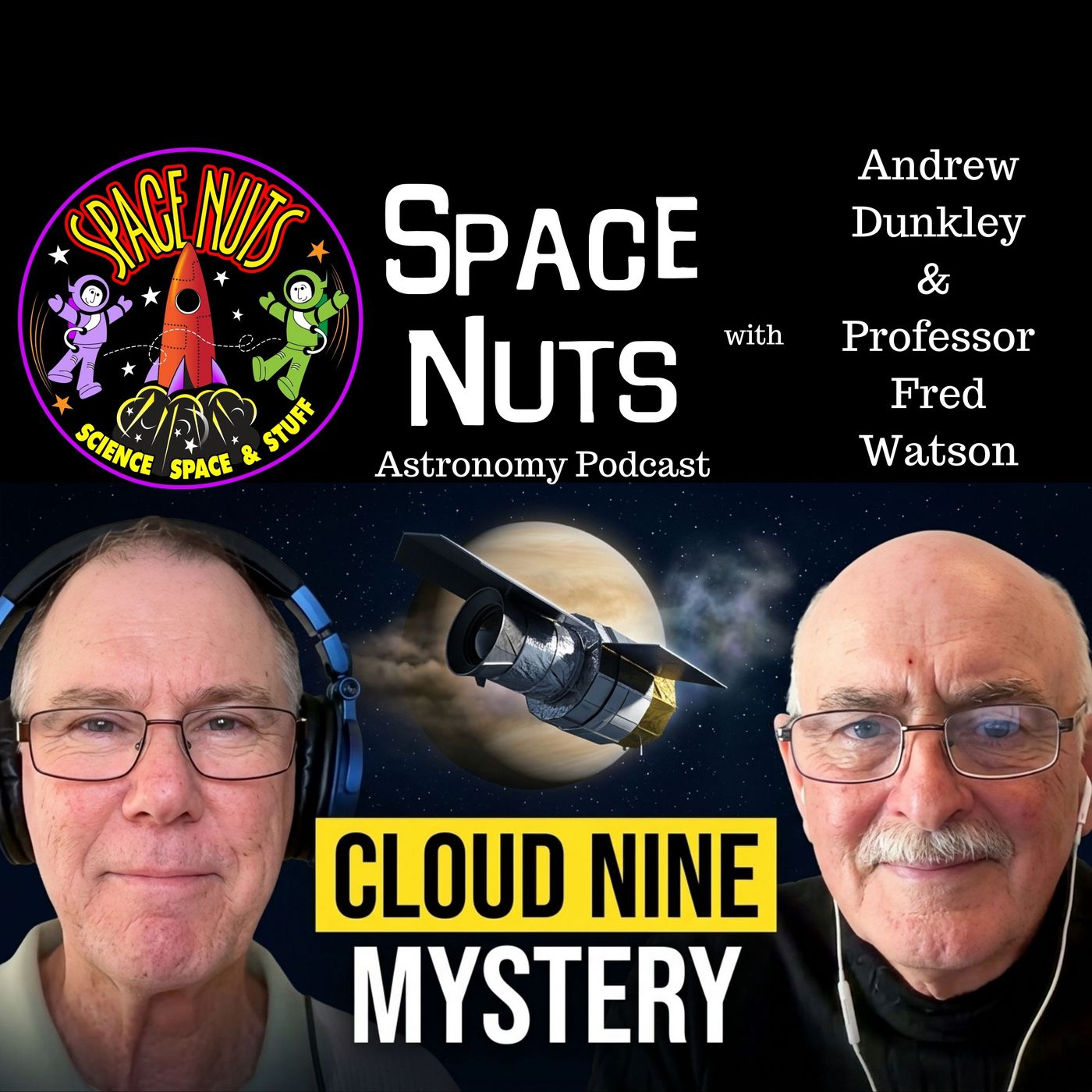 The Starless Galaxy That Shouldn’t Exist - But Does 03.09.2026 38minSpace Nuts: Spanish Eclipse, Nancy Grace Roman Launch, Cloud Nine, and Venus's Mysterious CloudsAndrew Dunkley and Professor Fred Watson cover four big astronomy stories in this episode, from Fred’s trip to view a sunset eclipse in Spain to the launch of the Nancy Grace Roman Space Telescope. They also unpack a starless dwarf galaxy called Cloud Nine and a new way of thinking about the strange dark material in Venus’s clouds.Guests and speakersAndrew Dunkley - Host, frames the news, asks listener questions, and guides the discussion.Professor Fred Watson - Astronomer at large, explains the eclipse, the Roman telescope, Cloud Nine, and Venus’s clouds.Key topicsIn this episode, Fred recounts the Spanish eclipse expeditionThe eclipse was only 9 degrees above the western horizon at totality, making the viewing conditions unusually challenging.He and Marnie led a 16-person tour through France, Spain, and Switzerland before settling near Santander in northern Spain.They staked out a viewing site 2 kilometers from the hotel, set up a gazebo, and had to tie it down to a car to keep it from blowing away.The weather looked threatening, but a hole opened in the cloud just before totality, giving them a clear view of the corona.Fred described the yellowish corona, pink hydrogen clouds, and the crowd of around 2,000 people.We discuss the Nancy Grace Roman Space Telescope launchAndrew watched the launch live after being nudged by his own brain at the right moment.Fred noted the launch was flawless, with 27 Merlin motors firing.The telescope is headed for the L2 Lagrange point, about 1.5 million kilometers away.Roman is a 2.4-meter Hubble-class telescope but with 100 times the field of view.Its wide-angle infrared design should enable major surveys of dark matter, dark energy, and exoplanets via its coronagraph.Fred explains why Cloud Nine mattersCloud Nine is described as a starless dwarf galaxy about 14 million light years away.It lies near Messier 94 and was studied using the Gran Telescopio Canarias and its Hypercam instrument.The deep exposure was 2.36 hours, yet the team found no convincing stellar population.Fred says theory suggests the gas may be too hot to cool and collapse into stars because of the ultraviolet background radiation after reionization.He says Cloud Nine may be the first strong example of a galaxy predicted by standard cosmology but never before clearly identified.Venus’s clouds are still puzzling astronomersFred explains that Venus appears yellowish because we see the top of its cloud layer, especially in visible light.In ultraviolet, Venus shows dramatic global cloud patterns caused by an as-yet unidentified absorber.The new study uses radiative transfer modeling to constrain what the unknown absorber could be.The team compares Venus’s cloud droplets to cigarette smoke, tiny particles that look light-colored when dispersed but could become dark sludge in bulk.The result suggests the absorber must be very efficient, very concentrated, or both, but it is not being claimed as evidence of life.Become a supporter of this podcast: https://www.spreaker.com/podcast/space-nuts-astronomy-insights-cosmic-discoveries--2631155/support.
 -
Waves, Signals, and Cosmic Aromas: A Q&A Journey Through Space 31.08.2026 37minIn this intriguing Q&A episode of Space Nuts, hosts Andrew Dunkley and Professor Jonti Horner tackle a variety of cosmic queries from listeners. Join them as they explore the fascinating world of radio telescopes and how they produce images from radio waves, delve into the complexities of gravitational waves, and ponder the sounds and smells of space.Key topics include:- How photographic images are generated from radio telescopes, despite only receiving radio waves, and the fundamental principles behind this technology.- A deep dive into gravitational waves, their impact on space, and how LIGO detects these minute disturbances in the fabric of spacetime.- An imaginative discussion on what sounds might exist in space and the potential smells one could encounter beyond Earth’s atmosphere, including the curious idea of cosmic fragrances.Join Andrew and Jonty as they demystify these concepts, providing clarity and insights into the wonders of astronomy and space science.00:00 - Space Nuts aims to answer questions from the audience about astronomy and space science01:37 - Were the pyramids built by aliens or were they built by humans04:26 - How is a photographic image produced from a radio telescope and not an optical telescope12:36 - Dean: I often hear about gravity waves and I have a hard time visualising20:15 - Andrew Dunkley: I think ideas become easier to explain over time22:45 - Our next question comes from David from Port Washington, New York30:37 - Several volcanoes have blown up since we've been to them32:08 - The metropolitan area of Auckland contains 53 volcanoes35:02 - If you could take a big inhale, what would space smell like36:22 - If you would like to send us some questions, please do through our websiteBecome a supporter of this podcast: https://www.spreaker.com/podcast/space-nuts-astronomy-insights-cosmic-discoveries--2631155/support.
-
 SpaceX Hit the Moon, and the Real Problem Is Just Beginning 27.08.2026 45minSpace Nuts: Moon impact, Roman Observatory launch, and Neptune’s odd moonsAndrew Dunkley is joined by Professor Jonti Horner, Professor of Astrophysics at the University of Southern Queensland, for a wide-ranging astronomy update. They cover SpaceX’s out-of-control rocket body hitting the Moon, the imminent launch of the Nancy Grace Roman Observatory, and a new result that may explain the strange origin of some of Neptune’s moons.We discuss why lunar impacts matter far beyond the Moon itself, how Roman will study exoplanets and dark energy, and why clay minerals on Neptune’s small moons are such a big clue about a violent early solar system.Key topicsSpaceX’s rocket body impacted the Moon after being left in a long, uncontrolled orbitWhy lunar impacts are a real concern for future habitats, infrastructure, and Apollo heritage sitesThe sheer scale of human-made objects that have already hit or landed on the MoonElon Musk’s vision for lunar factories, rail-gun launches, and large-scale off-Earth manufacturingWhy the same company could end up both creating the risk and needing to solve itThe Nancy Grace Roman Observatory launching around 9 months ahead of scheduleRoman’s 2.4 metre mirror, 300 megapixel wide-field camera, and hydrazine-fueled journey to L2How Roman will study dark energy, gravitational lensing, exoplanets, and free-floating planetsNew James Webb observations of Neptune’s moons showing clay-type minerals on Larissa and GalateaWhy those clays suggest a much older, more violent system shaped by Triton’s capture and moon-to-moon collisionsTimestamps:00:00 - Studio prep, muting phones, and getting ready to record01:53 - Episode intro: SpaceX lunar impact, Roman Observatory, and Neptune moons03:00 - Jonti Horner joins the show04:26 - SpaceX rocket body crashes into the Moon07:03 - Predicted impact plume and expected crater size08:54 - Korean spacecraft Danuri captures post-impact images10:19 - Why Moon impacts matter for future lunar bases11:47 - Protecting Apollo landing sites and lunar archaeology12:15 - More than 3,000 human-made objects have hit the Moon14:32 - Law, responsibility, and the problem of cleanup beyond Earth16:07 - Musk’s plans for Moon factories and Starlink-style expansion18:12 - Rail guns, Optimus robots, and scaling lunar industry19:34 - SpaceX’s own industry could be threatened by its own debris21:24 - Balancing commercial benefits and environmental costs23:46 - The Nancy Grace Roman Observatory launch approaches26:03 - Roman’s orbit, hydrazine fuel, and five-year mission plan27:57 - From WFIRST to Roman: how the telescope evolved29:23 - Roman’s mirror, 300 megapixel camera, and survey power30:14 - Exoplanets, microlensing, and the coronagraph33:29 - Roman’s launch status and the excitement ahead34:17 - Neptune’s moons and the role of TritonBecome a supporter of this podcast: https://www.spreaker.com/podcast/space-nuts-astronomy-insights-cosmic-discoveries--2631155/support.
 -
From Diamond Rain to Rogue Planets: Unpacking Cosmic Curiosities 24.08.2026 37minSponsor Link:This episode of Space Nuts is brought to you with the support of NordVPN. Protect your online activities with a special deal at www.nordvpn.com/spacenuts.In this Q&A episode of Space Nuts, hosts Andrew Dunkley and Professor Jonti Horner tackle a variety of fascinating questions from listeners. From the intriguing phenomenon of planetary atmospheres that may rain diamonds and sapphires, to the complexities of satellite approvals and the possibility of planets forming without a star, this episode is packed with cosmic insights.Key topics include:- Nick from Perth asks about the science behind the claims of diamond and sapphire rain on distant planets, prompting a discussion on spectral analysis and the nature of scientific reporting.- Sandy from Melbourne raises concerns about the recent FCC approval for Reflect Orbital's satellite, leading to an exploration of the regulatory landscape surrounding space launches and the implications for global cooperation.- Rennie from California queries whether planets can form without a sun, which sparks a deep dive into the theories surrounding rogue planets and the role of dark matter in planetary formation.Join Andrew and Jonty as they navigate these thought-provoking questions, shedding light on the mysteries of the universe and the ever-evolving field of astronomy.00:00 - This is a Q and A episode and in this particular show we're answering audience questions01:00 - Professor Jonty Horner joins us to discuss astrophysics01:29 - The heat stays a bit longer than summer and the cold stays too much past winter02:55 - Nick in Perth has a question regarding planetary atmospheres11:29 - Scientists are extrapolating from what they know about planets' interior12:49 - Andrew Dunkley: Question comes from Sandy in Melbourne, Australia14:51 - FAA proposing to circumvent environmental laws for commercial launches and spacecraft reentries21:54 - Fast developing industry with no regulation developed around it25:20 - Space Nuts Q and A edition with Andrew Dunkley and Jonty Horner25:38 - Can planets form without a sun because dark matter would be the gravity33:41 - You can send in your Space Nuts questions via our websiteBecome a supporter of this podcast: https://www.spreaker.com/podcast/space-nuts-astronomy-insights-cosmic-discoveries--2631155/support.
-
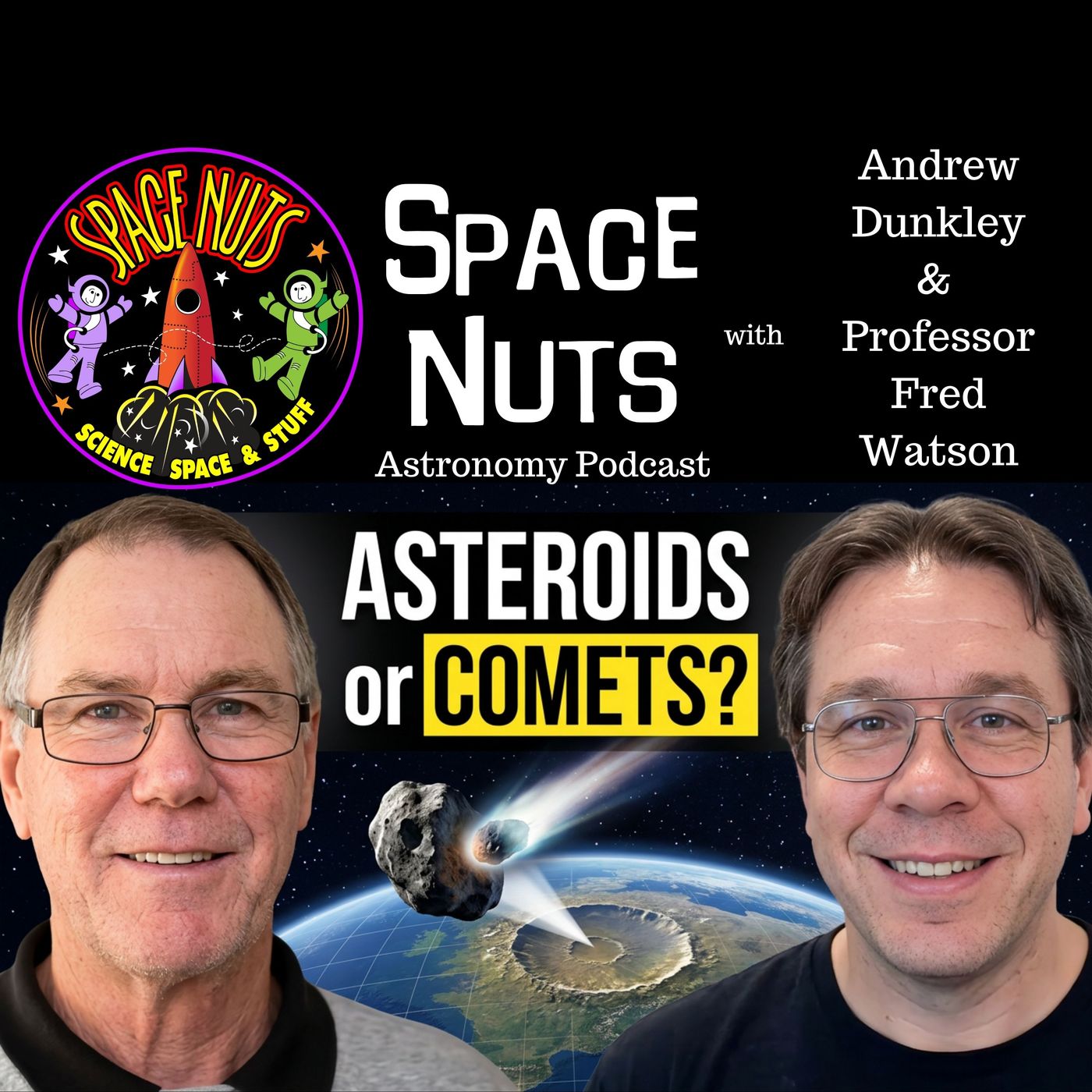 How One Dinosaur-Killing Impact May Have Triggered Global Firestorms 20.08.2026 43minSponsor Link:This episode of Space Nuts is brought to you with the support of NordVPN. Secure your online presence and enjoy a special deal at www.nordvpn.com/spacenuts. Asteroid or comet, dinosaur impact firestorms, crater discovery, and Q&A on exoplanets and satellitesAndrew Dunkley is joined by Professor Jonti Horner of the University of Southern Queensland for two tightly related Space Nuts conversations. The first explores how astronomy keeps blurring the lines between asteroids and comets, what new research says about the dinosaur-killing impact, and a surprising crater found by an amateur astronomer planning a trip. The second is a listener Q&A covering exotic exoplanet weather, space regulation, and whether planets can form without a star.Key topicsIn this episode, Andrew and Jonti explain why astronomy often uses tidy labels for objects that sit on a continuum, especially when the line between asteroid and comet gets blurry.They discuss near-Earth object 1998 SH2, which appears to have comet-like activity despite looking asteroid-like for decades.Jonti breaks down how outgassing can nudge a small body off its predicted path, revealing non-gravitational forces.The dinosaur-killing impact is revisited with new modelling suggesting the first hours after impact may have included global firestorms, not just long-term climate collapse.The show covers the terminology debate around meteor, meteorite, fireball, bolide, asteroid, and comet impact.A Canadian amateur astronomer, Joel LePointe, is credited with spotting a likely impact crater while planning a camping and hiking trip using satellite imagery.The newly identified crater near Lake Marcel in northern Quebec is described as about 390 million years old and roughly 25 kilometers wide.Become a supporter of this podcast: https://www.spreaker.com/podcast/space-nuts-astronomy-insights-cosmic-discoveries--2631155/support.
 -
Exploring Moons with Atmospheres, Hot Jupiters, and the Mysteries of Black Holes 17.08.2026 34minSponsor Link:This Q&A episode of Space Nuts is brought to you with the support of NordVPN. When you decide to get serius about your security online, do what we did and get NordVPN. We have a special deal for you too, chck out the details at www.nordvpn.com/spacenutsIn this episode of Space Nuts, hosts Andrew Dunkley and Professor Fred Watson delve into a captivating Q&A session, tackling a range of intriguing questions from listeners. From the possibility of moons having atmospheres to the mysteries surrounding hot Jupiters and the fascinating realm of black holes, this episode promises to ignite your curiosity about the cosmos.Key topics include:- Chris from Exmouth wonders if moons can have atmospheres and if they can share these with their parent planets, leading to a discussion on Titan and Pluto's unique characteristics.- An anonymous listener poses a thought-provoking question about 'secret astronomy' and the potential for military satellite technology to advance our understanding of the universe.- Fenton from Minnesota asks about the likelihood of rocky planets existing in solar systems with hot Jupiters, prompting a discussion on planetary migration and the diversity of solar systems.- Ed raises a classic black hole question regarding the merger of black holes and the concept of mass escaping, leading to an exploration of gravitational waves and their implications.Join Andrew and Fred Watson as they navigate these fascinating topics, providing insights and sparking further exploration into the wonders of space.00:00 01:18 04:13 05:37 11:35 16:34 20:35 27:11 31:31Become a supporter of this podcast: https://www.spreaker.com/podcast/space-nuts-astronomy-insights-cosmic-discoveries--2631155/support.
-
 The Galaxy’s Sugary Center Could Change How Life Began 13.08.2026 27minThis episode covers three very different astronomy stories and then moves into a lively Q&A with listener questions. Andrew Dunkley and Professor Fred Watson discuss a possible sugary molecule in the center of the Milky Way, the risk lunar landers may contaminate ice that could preserve clues to life’s origins, and a new way to track lost dogs using satellite connectivity. The second half of the episode answers questions about moons with atmospheres, secret astronomy, hot Jupiters, and black hole mergers.Key topicsIn this episode, Fred Watson explains an update from Peter Verweyen on MOND, now referred to as Aether Scalar Tensor Theory, and how it relates to dark matter and dark energy debates.We discuss the detection of erythrulose, a sugar molecule found in interstellar gas clouds near the center of the Milky Way, and why this matters for prebiotic chemistry.Fred describes how molecules like sugar can form in cold molecular clouds before stars and planets exist, making some ingredients for life surprisingly common.We discuss a new study warning that rocket exhaust from future lunar landings could contaminate ice in permanently shadowed craters at the Moon’s south pole.The Moon’s polar ice may contain ancient prebiotic molecules delivered by comets, asteroids, and dust, making it a possible time capsule for the chemistry that led to life.We discuss the practical and ethical problem that landers have to use rocket engines, and those exhaust plumes may spread methane and other organics across the lunar surface very quickly.Fred shares how satellite-based direct-to-cell or direct-to-mobile systems could help locate lost dogs in remote places without cell coverage.We discuss how this kind of tracking builds on existing GPS pet trackers, and how it could be useful in wilderness areas, while also noting the limits and concerns in national parks.Timestamps(00:00) Start of the episode and what’s coming up(03:12) MOND update and the new AEST name(07:10) A sugary molecule in the center of our galaxy(09:51) Why sugar can form in deep space before stars exist(12:24) Why lunar landings could contaminate the Moon’s ice(14:54) The Moon as a time capsule for prebiotic molecules(16:24) Methane exhaust and rapid contamination risk(18:37) Should the Moon be protected like a national park?(20:28) Satellite tracking for lost dogs in remote areas(24:52) Direct-to-mobile satellite technology explained(25:44) The Judas goat program and invasive species controlBecome a supporter of this podcast: https://www.spreaker.com/podcast/space-nuts-astronomy-insights-cosmic-discoveries--2631155/support.
 -
Cosmic Queries: Understanding Black Holes, Galactic Centres, and Mars Days 10.08.2026 36minIn this engaging Q&A episode of Space Nuts, join host Andrew Dunkley and astronomer Fred Watson Watson as they tackle a variety of fascinating questions from listeners. From the peculiarities of Martian days to the mysteries of black holes and the galactic centre, this episode is filled with enlightening discussions that are sure to spark curiosity about the cosmos.In this episode:- John asks about the implications of Mars' longer day length on human biology and potential adaptations for future colonists.- Dan inquires about the growth of black holes, exploring how quickly they can develop into supermassive entities and what happens when there’s nothing left to consume.- Young Thomas, just 11 years old, poses several intriguing questions about the galactic centre, including whether it can swallow all stars and planets in the galaxy, and the limits of a black hole's gravitational reach.- Paul reflects on historical discoveries in astronomy, specifically how Harlow Shapley determined our Sun's position within the Milky Way, challenging the long-held belief that it was at the centre.Join Andrew and Fred Watson as they explore these thought-provoking questions and more, encouraging listeners to continue their journey of exploration and discovery in the universe.Become a supporter of this podcast: https://www.spreaker.com/podcast/space-nuts-astronomy-insights-cosmic-discoveries--2631155/support.(00:00) This is a Q and A edition where we take audience questions(02:16) When and if Mars is populated with humans, how would we work with longer day(08:50) Andrew: How astronauts deal with gravity when they land on Earth(11:47) Dan from the Gold coast has some questions about black holes(12:51) Fred: How fast do black holes grow? Dan asks fundamental astrophysics question(18:17) Fred asks five questions about black holes from Thomas Reid, 11(22:03) Thomas asks if black holes can swallow up all stars and planets(24:31) Final question comes from Paul from Las Vegas(26:42) It was actually 1919 when that discovery was made(34:24) We continue to receive great questions from great listeners and long may it continue
-
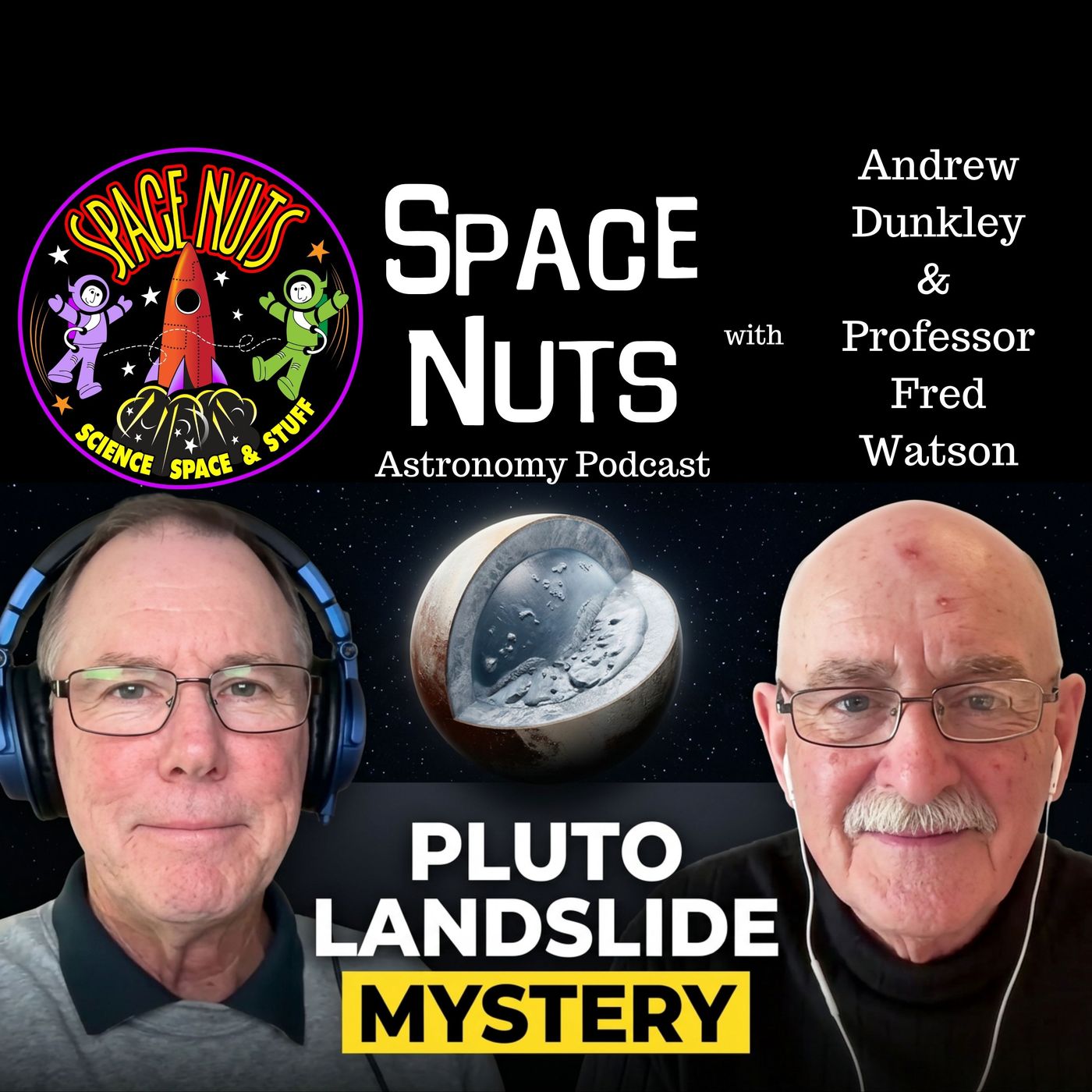 The Hidden Impact of Landslides on Pluto’s Surface — What Scientists Are Discovering 07.08.2026 32minLandslides on Pluto and China's SpaceX-like Rocket Recovery SuccessDiscover the intriguing discovery of landslides on Pluto, explained through recent image analysis from the New Horizons spacecraft, and learn how these features provide clues about the dwarf planet's geological activity. Plus, explore China's recent achievement in rocket recovery, mimicking SpaceX's successful landing techniques with innovative net capture technology, signaling a significant step forward in space debris management and reusability.Fred Watson and Andrew Dunkley discuss recent scientific findings on landslides around Sputnik Planitia on PlutoHow climate change on Earth is increasing landslide activity, and how similar processes might be happening on other worldsThe significance of the 2015 flyby of Pluto by the New Horizons spacecraft and what it revealed about planetary geologyDetails of China's recent successful rocket booster recovery using a net and its potential impact on space launch economicsComparison between China's new net capture method and SpaceX's chopsticks system for booster recoveryThe rapid advancement of Chinese space capabilities, including lunar and space station missionsThe broader context of international space race dynamics and the race to return humans to the MoonUAP Study Group Led by Avi Loeb and the Search for Extraterrestrial PhenomenaGet an inside look at the White House-formed UAP science advisory council led by Harvard's Avi Loeb, emphasizing scientific rigor in studying unidentified anomalous phenomena. The discussion covers the composition of the council, the importance of unbiased research, and the challenges of interpreting mysterious aerial objects observed over the years.The formation and purpose of the UAP Science Advisory Council, chaired by Avi LoebThe diverse backgrounds of experts involved, including physicists, military personnel, computer scientists, and psychologistsHow modern technology and data are transforming the study of UAPs, with government and military reports analyzed over decadesThe debate over the nature of UAPs: natural phenomena, advanced human technology, or potential extraterrestrial originsThe cultural and political implications of gaps in understanding these phenomena and the importance of scientific methodologyReader comments reflecting skepticism and intrigue about the investigations and the sensationalism surrounding UAP researchBecome a supporter of this podcast: https://www.spreaker.com/podcast/space-nuts-astronomy-insights-cosmic-discoveries--2631155/support.
 -
From Dark Matter to Dormant Comets: Your Astronomy Questions Answered 04.08.2026 32minIn this enlightening Q&A episode of Space Nuts, join host Andrew Dunkley and astronomer Fred Watson Watson as they field a range of intriguing questions from listeners. From the hypothetical concept of dark matter stars to the mysteries of dormant comets and the mechanics of gravitational slingshots, this episode is packed with engaging discussions that spark curiosity in the cosmos.In this episode:- An exploration of dark matter stars: What are they, and how could they hypothetically shine without fusion?- Understanding dormant comets: What defines them, and how can we identify these ancient celestial bodies?- The mechanics behind gravitational slingshots: How do spacecraft gain speed from planetary gravity, and what role does the planet's rotation play?- The rise of smart telescopes: Are these automated devices a boon for budding astronomers, or do they undermine traditional astrophotography?- Personal experiences with smart telescopes and their impact on learning and engagement in astronomy.Resources & Links:- [Dark Matter and Dark Energy Overview](NASA) - Insights into these elusive components of the universe.- [NASA's Comet Research](NASA Comet Missions) - Discoveries and ongoing studies of comets in our solar system.- [Gravitational Slingshots Explained](NASA's Gravitational Assist) - How spacecraft use gravity to navigate the solar system efficiently.Join Andrew and Fred Watson as they unravel the complexities of space science, encouraging listeners to explore the universe and engage with the wonders of astronomy. Don't forget to submit your questions for future episodes!Become a supporter of this podcast: https://www.spreaker.com/podcast/space-nuts-astronomy-insights-cosmic-discoveries--2631155/support.(00:00) This is Space Nuts and we've got questions from our audience(01:57) Frederick: Greens Goddess started following me some time ago(02:47) Casey from Colorado says dark matter stars could be incredibly bright(09:13) Our next question comes from Michael about dark matter(10:27) What's a dormant comet and how do you detect them(16:28) Just wondering if you could explain the orbital mechanics behind Slingshots(22:32) Smart telescopes allow beginners to dive straight into astrophotography(28:56) Jason: Is there a privacy infringement there? Maybe, yeah(30:03) Astronomer Fred Watson answers your Space Nuts questions(32:16) Space Nick Nuts podcast available at Apple Podcasts and Spotify
-
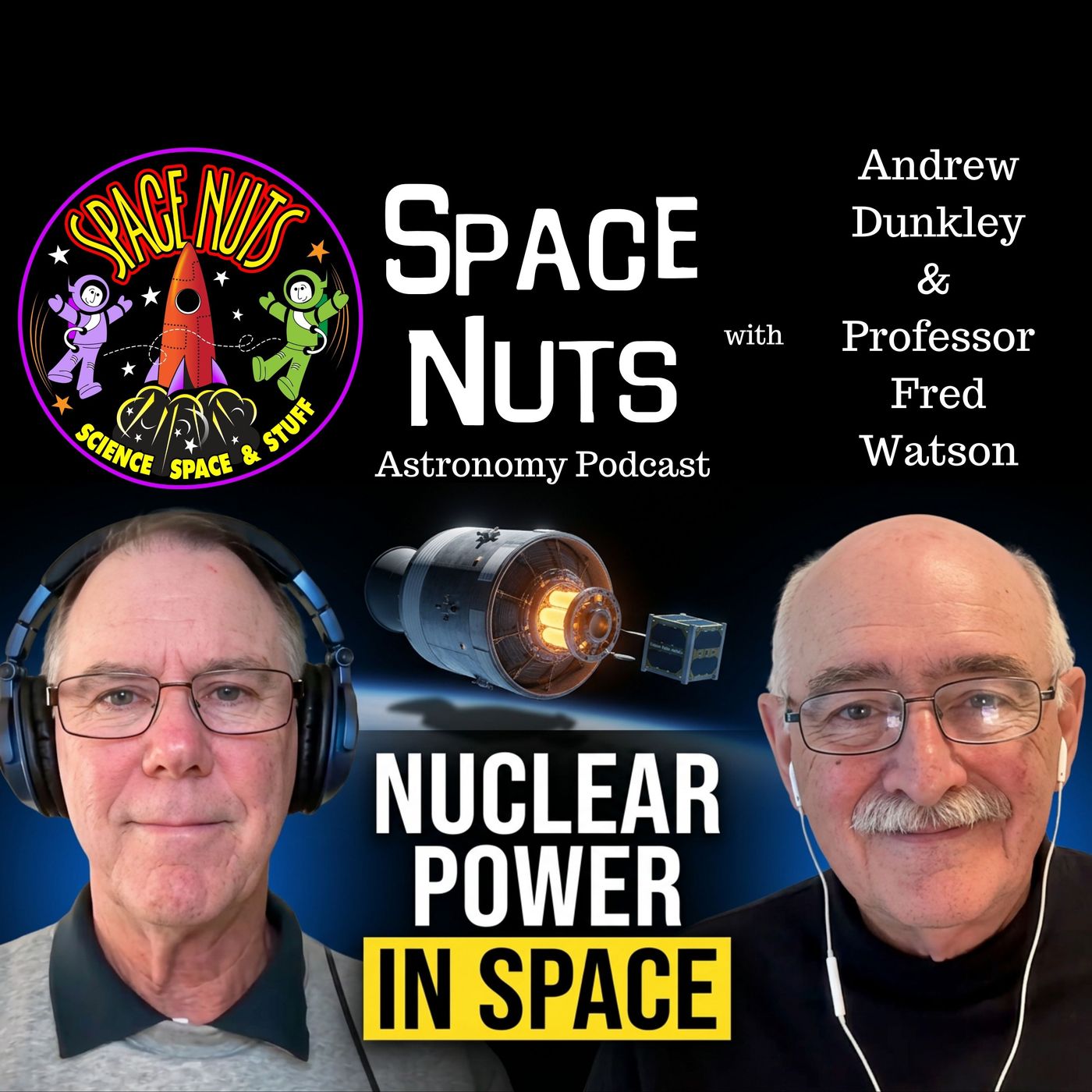 SpaceX Tests Space-Ready Nuclear Power Using Tritium-Driven CubeSat 01.08.2026 41minSponsor Link:NordVPN - Safeguard your online activity with our exclusive offer for Space Nuts listeners. Visit www.nordvpn.com/spacenuts for details.From SpaceX Nuclear Experiments to Galactic DiscoveriesJoin host Andrew Dunkley and astronomer Fred Watson as they explore some of the most fascinating topics in space science, from innovative nuclear power tests in space to the expanding boundaries of our galaxy. Whether you're an astrophotography enthusiast or a space policy advocate, this episode delivers insights that broaden your cosmic perspective.In this episode:SpaceX's recent CubeSat launch featuring a tritium-based nuclear power source for space applicationsThe potential and safety considerations of nuclear energy in space missionsThe possibility of nuclear weapons detection in space using neutron sensors and passive radiation monitoringThe intriguing hypothesis of dark matter stars and their potential signaturesThe mystery surrounding Earth's dust origins—cosmic spherules and their unknown sourcesNew research indicating our galaxy's spiral arms are about 10% longer than previous estimates, based on light echoes from gamma ray burstsThe rise of smart telescopes and their role in making astrophotography more accessible for amateursTimestamps:(00:00) Introduction and overview of today's headlines(02:00) SpaceX's CubeSat with tritium power source—what's happening?(04:33) Nuclear power in space: Safety and future applications(11:03) Detecting nuclear weapons in space: Challenges and innovations(22:45) Earth's dust origins: Micro-meteorites and cosmic spherules explainedResources & Links:SpaceX's CubeSat nitrogen launch storyBeta-voltaic nuclear power technologyNASA's Chandra X-ray ObservatoryUniverse Today article on Milky Way mappingJames Webb Space Telescope and dark matter researchScience Advances publication on Earth's micrometeoritesConnect with Fred Watson:LinkedInTwitterEnjoying the show? Support us on Patreon and leave a review on your favorite podcast platform.Thanks for tuning in and keep looking up!Become a supporter of this podcast: https://www.spreaker.com/podcast/space-nuts-astronomy-insights-cosmic-discoveries--2631155/support.
 -
The Cosmic Q&A: Redshift, Dark Matter & the Shape of the Universe 27.07.2026 31minSponsor Link:NordVPN - Protect your online privacy with our special offer for Space Nuts listeners. Visit www.nordvpn.com/spacenuts for details.In this engaging Q&A episode of Space Nuts, join Andrew Dunkley and Professor Fred Watson as they tackle a variety of intriguing questions from listeners. From the mysteries of redshift and the perplexing concept of dark photons to the vastness of deep space astronomy and the ongoing expansion of the universe, this episode is brimming with thought-provoking insights and scientific discussion.In this episode:- Understanding redshift: What does it mean for the energy of light from distant galaxies, and how does it relate to the universe's expansion?- A deep dive into dark photons: What are they, and how might they help explain dark matter and dark energy?- Clarifying deep space astronomy: Why do we observe light from distant galaxies as it was billions of years ago, and how does this relate to our understanding of cosmic history?- Exploring the universe's expansion: What is it expanding into, and what shapes might it take?- The implications of cosmic observations for our understanding of the universe's structure and evolution.Resources & Links:- [NASA's Cosmic Microwave Background](https://map.gsfc.nasa.gov/universe/uni_cmb.html) - Understanding the remnants of the Big Bang.- [Large Hadron Collider](https://home.cern) - The world's largest particle physics laboratory.- [Dark Matter and Dark Energy Overview](https://www.nasa.gov/feature/dark-energy-and-dark-matter) - Insights from NASA on these enigmatic components of the universe.Join Andrew and Fred Watson as they navigate the complexities of space science, encouraging curiosity and exploration of the cosmos. Don't forget to send in your questions for future episodes!Become a supporter of this podcast: https://www.spreaker.com/podcast/space-nuts-astronomy-insights-cosmic-discoveries--2631155/support.(00:00) This is a Q and A edition of Space Nuts(01:14) Question from Roger: Does red shift of galaxies contribute to universe expansion(07:53) Roger Stern: Well, generally speaking, you do get alternative views on this(08:33) Fred Watson uses term dark photon to describe hypothetical dark particles(13:29) Fred: I still can't get my head around deep space astronomy(22:03) If the universe is expanding, what is it expanding into(28:08) If you have questions for Space Nuts, please send them via email
-
 How Scientific Discoveries at Mars Are Bringing Us Closer to Detecting Alien Life 23.07.2026 31minDiscoveries on Mars, the Hubble Tension, and Dark Photons - Space Nuts EpisodeJoin Andrew Dunkley and Professor Fred Watson as they explore the latest developments in space science—from evidence of complex organic molecules found by the Perseverance rover on Mars that may hint at past life, to the ongoing mystery of the Hubble tension that challenges our understanding of the universe's expansion. Plus, a deep dive into the elusive concept of dark photons and their potential role in explaining dark matter.Key Topics:The significance of complex carbon molecules detected in Martian rocks by Perseverance and their implications for extraterrestrial lifeThe challenges and prospects of returning samples from Mars and the influence of upcoming Chinese missionsUnderstanding the Hubble tension: different measurements of the universe's expansion rate and what they could mean for new physicsThe role of gravitational wave observations in refining the Hubble constant and resolving cosmological discrepanciesAn introduction to dark photons: what they are and their potential connection to dark matter and dark energyThe nature of cosmic redshift, light travel time, and how we look back in cosmic historyThe possibility of the universe expanding into higher dimensions or higher-dimensional multiversesThe shape and boundaries of the universe: flat, spherical, or saddle-shaped?Resources & Links:Science Advances Paper on Martian Organic MoleculesNASA Perseverance RoverCosmological Parameters and Hubble TensionLarge Hadron Collider Official SiteDark Photons and Dark Matter — University of CaliforniaBiteStop Streaming ServiceConnect with Fred Watson:Professor Fred Watson - LinkedInProfessor Fred Watson - TwitterNote:Stay tuned for future episodes where we continue exploring mysteries of the cosmos, and don't forget to visit our website to send questions or feedback!Become a supporter of this podcast: https://www.spreaker.com/podcast/space-nuts-astronomy-insights-cosmic-discoveries--2631155/support.
 -
Galactic Queries: Black Hole Lifespans, Lunar Impacts & Sun-Seeking Missions 20.07.2026 34minSponsor Link:NordVPN - Secure your online presence with our exclusive offer for Space Nuts listeners. Check out www.nordvpn.com/spacenuts for details.In this engaging Q&A episode of Space Nuts, Andrew Dunkley and Professor Fred Watson dive into listener inquiries that span the cosmos. From the intriguing concept of black hole evaporation to the mysteries of Jupiter's atmosphere and the latest on the Artemis 2 mission, this episode is packed with fascinating insights and scientific discussions.In this episode:- The mechanics of black hole evaporation and how cosmic microwave background radiation affects their lifespan.- An exploration of Jupiter's thin atmosphere and how it compares to the dense atmospheres of moons like Titan and planets like Venus.- Insights into the Artemis 2 mission and the implications of visual observations of meteorite impacts on the moon's far side.- A look ahead at upcoming solar missions and the cutting-edge technology being deployed to study our sun.- The significance of cosmic rays and their impact on human perception in space.Resources & Links:- [Parker Solar Probe](https://www.nasa.gov/content/parker-solar-probe) - NASA's mission to study the sun's outer atmosphere.- [Artemis Program](https://www.nasa.gov/specials/artemis/) - NASA's initiative to return humans to the moon.- [The Cosmic Microwave Background](https://map.gsfc.nasa.gov/universe/uni_cmb.html) - Understanding the remnants of the Big Bang.- [Titan and Its Atmosphere](https://solarsystem.nasa.gov/planets/titan/overview/) - NASA's insights into Saturn's largest moon.Join Andrew and Fred Watson as they unravel the complexities of space science and encourage curiosity about the universe. Don't forget to send in your questions for future episodes!Become a supporter of this podcast: https://www.spreaker.com/podcast/space-nuts-astronomy-insights-cosmic-discoveries--2631155/support.(00:00) Andrew Dunkley takes audience questions on this week's Space Nuts(02:53) If black holes are colder than cmb, how much does this lengthen(09:12) Fred: Does Jordy have an unusually thin atmosphere for a rocky planet(10:48) Titan has a much higher atmospheric pressure than our own planet Jordy(17:16) Michael from Switzerland claims Artemis 2 astronauts saw meteorite flashes on moon(24:55) Houston has had a main B undervolt problem(25:07) Final question today comes from somebody who forgot to tell us their name(34:04) Andrew Dunkley: Thanks for your company. Bye. You're listening to the Space Nuts podcast
-
 The Black Hole Discovery Revealing the Loudest Gravitational Wave Ever Recorded 16.07.2026 40minSponsor Link:NordVPN...protect yourself and save with our specoial deal Visit www.nordvpn.com/spacenuts for details.Revealing the Secrets of Space and the Cosmos: Insights from Space NutsJoin Andrew Dunkley and Professor Fred Watson as they explore the fascinating universe—from a historic telescope in Melbourne to the latest discoveries in black hole physics and our own solar system. This episode offers a blend of awe-inspiring science, historical stories, and future possibilities that make astronomy accessible and thrilling.In this episode:The extraordinary history and restoration of the Melbourne Telescope, crafted in 1869, and its cultural significance.The record-breaking detection of the loudest gravitational wave from colliding black holes and what it reveals about event horizons.China's ambitious plans to expand its space station, including new modules and a cutting-edge space telescope.Recent insights into a star passing close to our solar system, potentially disturbing comet orbits and shaping our cosmic history.Upcoming solar observatories, including the ESA's Solar Orbiter and the Chinese Shun Tian telescope.The incredible speed of the Parker Solar Probe and future missions to study the Sun's atmosphere.How scientists analyze lunar impacts and cosmic rays using imagery and human eye observations.The long-standing mystery of Earth's atmosphere and the role of tectonic cycles in its stability.Resources & Links:The Melbourne Telescope's History and Restoration (Note: Placeholder, search for Melbourne Telescope history)LIGO and Virgo Gravitational Wave ObservatoryNASA's Parker Solar ProbeESA's Solar OrbiterChinese Space Station and ModulesThe Daniel K. Inouye Solar TelescopeFiz.org Physics Articles on Black Holes and Gravitational WavesThe Gaia Mission and Star OrbitsPreprint Article on Black Hole Gravitational WavesConnect with Fred Watson:LinkedInTwitterFeel inspired by space science's latest breakthroughs and historic stories, knowing that curiosity drives understanding. With a confident yet approachable tone, this episode pushes the boundaries of knowledge while making complex ideas understandable and engaging for all.Become a supporter of this podcast: https://www.spreaker.com/podcast/space-nuts-astronomy-insights-cosmic-discoveries--2631155/support.
Podobné podcasty


Obľúbený v
Tento podcast sa objavuje aj v rebríčkoch podcastov týchto krajín.


