
New Books in Middle Eastern Studies
Marshall Poe
0
This podcast is a channel on the New Books Network, an academic audio library dedicated to public education. In each episode, scholars discuss their recently published research with another expert in their field. The podcast focuses on Middle Eastern studies, covering a wide range of topics related to the region. Listeners can explore over 150 channels and browse thousands of episodes on the New Books Network website.
Epizódy
-
 Mehmet Çelik, "Empire and Nation in the City: Rusçuk from Ottoman Rule to Bulgarian Statehood" (Syracuse UP, 2026) 15.09.2026 51minIn this episode, we speak with Dr. Mehmet Çelik about his new book, Empire and Nation in the City: Rusçuk from Ottoman Rule to Bulgarian Statehood, published by Syracuse University Press in 2026. The book tells the story of Rusçuk — known today as Ruse, in northern Bulgaria — a cosmopolitan port city on the Danube that, within the span of just fifteen years, passed through three entirely different political systems: a modernized Ottoman provincial administration, a Russian military provisional government, and a newly independent Bulgarian national state. Through this one city, Çelik offers a striking new account of how empires end and nations begin — and how much continuity lies beneath the surface of what looks like rupture.
 -
Relative Strangers: Romani Kinship and Palestinian Difference 05.09.2026 54minExamining how memory, intergenerational transmission, and kinship work together, Relative Strangers (U Toronto Press, 2024) sheds light on Romani life in Palestine. Arpan Roy presents an ethnographic portrait of Dom Romani communities living between Palestine and Jordan, zooming in on everyday life in working-class neighborhoods, and under conditions of perpetual war and instability. The book focuses on how Doms are able to sustain ethnic difference through kinship, even when public performances of difference are no longer emphasized – a kind of alterity that is neither visible by obvious markers like race or religious difference, nor detected by the antennas of the state. Drawing on long-term ethnographic fieldwork in Jerusalem, Ramallah, and Amman, Roy makes a case for such alterity for Romani people and other groups in the region. Analysing intimate ethnographic scenes through anthropological theories of kinship, psychoanalysis, social theory from the Global South, and more, the book reveals how alterity in the Middle East does not adhere to rigid identitarian categories. Support our show by becoming a premium member! https://newbooksnetwork.supportingcast.fm/middle-eastern-studies
-
Elizabeth Anne Davis, "Artifactual: Forensic and Documentary Knowing" (Duke UP, 2023) 02.09.2026 1h 2minIn Artifactual: Forensic and Documentary Knowing (Duke University Press, 2023), Elizabeth Anne Davis explores how Cypriot researchers, scientists, activists, and artists process and reckon with civil and state violence that led to the enduring division of the island, using forensic and documentary materials to retell and recontextualize conflicts between and within the Greek-Cypriot and Turkish-Cypriot communities. Davis follows forensic archaeologists and anthropologists who attempt to locate, identify, and return to relatives the remains of Cypriots killed in those conflicts. She turns to filmmakers who use archival photographs and footage to come to terms with political violence and its legacies. In both forensic science and documentary filmmaking, the dynamics of secrecy and revelation shape how material remains such as bones and archival images are given meaning. Throughout, Davis demonstrates how Cypriots navigate the tension between an ethics of knowledge, which valorizes truth as a prerequisite for recovery and reconciliation, and the politics of knowledge, which renders evidence as irremediably partial and perpetually falsifiable. Elizabeth Anne Davis is Professor of Anthropology at Princeton University. * This episode is part of a special collaboration between the New Books Network and the Society for the Anthropology of Europe, a section of the American Anthropological Association. Together, we’re highlighting exciting new work in Europeanist anthropology—featuring authors from across the field, including winners of the William A. Douglass Book Prize and contributors to the European Anthropology in Translation series published by Berghahn Books. Support our show by becoming a premium member! https://newbooksnetwork.supportingcast.fm/middle-eastern-studies
-
Robin Whelan, "Serving the Christian State in Late Antiquity" (Cambridge UP, 2026) 24.08.2026 1h 9minHow did the state become Christian in late antiquity? Many scholars have traced the Christianization of the Roman world in the centuries following the conversion of the emperor Constantine in 312 CE. Robin Whelan, however, turns his attention away from the usual suspects in such accounts-emperors, empresses, bishops, ascetics, and other holy people-to consider a surprisingly understudied set of late ancient Christians: those who served the state as courtiers, bureaucrats, and governors. By tracing the requirements of regimes, the expectations of subjects, and patterns of engagement with churches and churchmen, he argues that that those who served the state in late antiquity could be seen-and indeed, could see themselves-as distinctly Christian authority figures-just as much as the emperors and kings whom they served, and the bishops and ascetics whom they governed. Serving the Christian State in Late Antiquity (Cambridge University Press, 2026) is also available as Open Access on Cambridge Core. New books in late antiquity is presented by Ancient Jew Review Robin Whelan is Reader in Mediterranean History at the University of Liverpool. Michael Motia teaches in Classics and Religious Studies at the University of Massachusetts Boston Support our show by becoming a premium member! https://newbooksnetwork.supportingcast.fm/middle-eastern-studies
-
Emily Sibley, "The Poetics of Incivility: Satire and Subversion in Modern Arab Culture" (Cornell UP, 2026) 20.08.2026 40minThe Poetics of Incivility: Satire and Subversion in Modern Arab Culture (Cornell UP, 2026) explores impolite modes of expression—satire, crude humor, and rudeness—as a critical lens for both aesthetic innovation and sociopolitical critique. In the Arab world—from Cairo's Tahrir Square and the thoroughfares of Beirut to war-torn Gaza—political demands have been framed by satirical cartoons and graffiti or in subversive poetry and song. Emily Sibley shows that these forms of resistance are not new to Arab culture but return to mid-nineteenth-century debates over literary propriety. In case studies concerning women's education in 1850s' Beirut, the satirical press in colonial Egypt, colloquial theater in the era of decolonization, street art and graphic novels during and after the 2011 Egyptian protests, Sibley follows the threads of an expressive culture that announces and celebrates its own impropriety. Concluding with analyses of Gaza poetry on the internet as a space where the stakes of incivility are acutely visible, The Poetics of Incivility offers a timely consideration of incivility as an aesthetic resource for authors and artists engaging with some of the most controversial issues of their times—and ours. Emily Sibley is Senior Research Associate at Whitman College. Support our show by becoming a premium member! https://newbooksnetwork.supportingcast.fm/middle-eastern-studies
-
Amihai Mazar and Nava Panitz-Cohen, "Tel Rehov: A Bronze and Iron Age City in the Beth-Shean Valle" (The Institute of Archaeology, The Hebrew University, 2020) 17.08.2026 40minThis interview with Professor Amihai Mazar was conducted by Željko Stanojević for the New Books Network. The conversation focuses on Tel Reḥov: A Bronze and Iron Age City in the Beth-Shean Valley, especially Volume V, where the report turns from architecture and pottery to smaller objects and scientific evidence that help reconstruct life at the site. Amihai Mazar is a leading archaeologist of ancient Israel. His research examines the Bronze and Iron Ages, archaeology and biblical history, ancient Near Eastern art and architecture, and historical geography. Tel Reḥov is especially important because it offers a rich archaeological sequence from the Beth-Shean Valley and evidence for the social, economic, and environmental history of northern Israel. Volume V is particularly revealing because it asks what can be learned from material that might appear secondary beside monumental architecture. Its first part examines clay, bone, stone and gypsum vessels; grinding stones and other stone implements; metal objects and metallurgical evidence; beads; objects connected with textile production; scale weights; and lithics. Together, these finds illuminate household work, craft activity, exchange, measurement, and technology. The volume also analyzes the spatial distribution of finds in a distinctive group of ninth-century BCE buildings in Area C. Archaeology is also about understanding where objects were found and how groups of finds functioned together. Distribution patterns can help reconstruct activities within buildings and suggest how work, storage, production, and daily routines were organized. It also includes Assyrian-period burials and later Islamic-period material, showing the site's long history. The second part of Volume V brings natural-science methods directly into the archaeological interpretation. Radiometric dating contributes to chronology. Studies of animal and fish remains, molluscs, and botanical material offer evidence for diet, agriculture, environment, trade, and the use of local and non-local resources. A soil-flotation project recovers small botanical remains that might otherwise disappear from the archaeological record. These studies show how modern archaeology depends on collaboration between excavators and natural-science specialists. One striking example is the paleomagnetic study of tilted walls in Area C, Stratum V. Instead of treating damaged architecture only as a descriptive feature, the researchers used physical evidence to investigate seismic destruction. This demonstrates a central strength of Volume V: interpretation is built by combining objects, context, chronology, biological remains, geology, and physical-science methods. Our discussion with Professor Mazar therefore uses Volume V to ask a larger question: how do small finds and scientific analyses change the historical picture created by excavation? The volume shows that understanding an ancient city requires more than identifying buildings or connecting archaeological horizons with historical narratives. It requires reconstructing technologies, food systems, craft production, movement of goods, environmental conditions, patterns of use within buildings, and the events that transformed them. Željko Stanojević is a host with the New Books Network and President of the Institute for Hebrew Language and Literature, Belgrade. He is also Founder and Editor-in-Chief of the European Hebrew Journal, an international Diamond Open Access journal supporting research in Hebrew, biblical, Jewish, linguistic, historical, and related studies. He also coordinates the European Hebrew Journal International Online Conference, New Discoveries and New Directions in Biblical, Hebrew, and Theological Studies. Authors of recent academic books are welcome to contact him regarding possible New Books Network interviews. Support our show by becoming a premium member! https://newbooksnetwork.supportingcast.fm/middle-eastern-studies
-
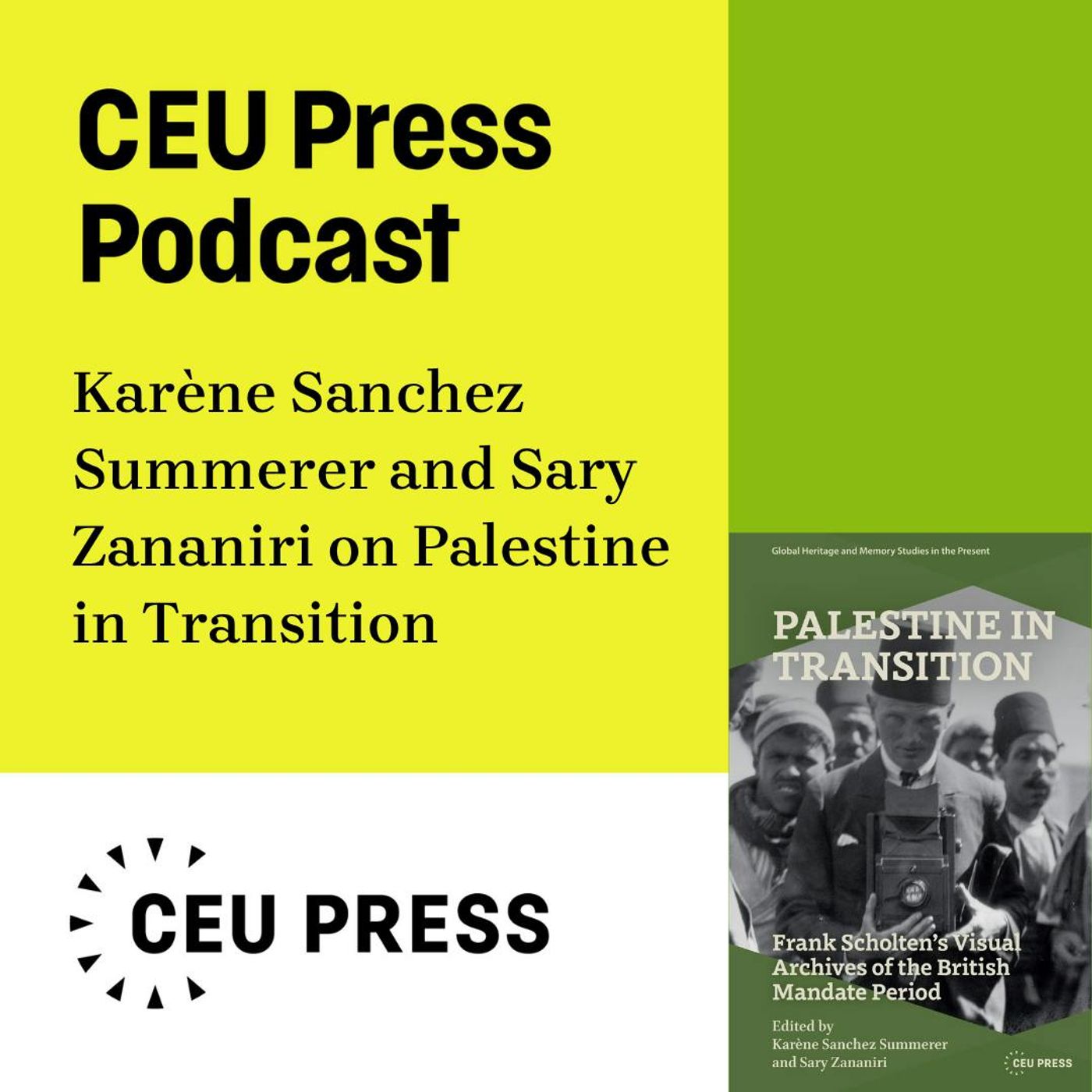 Karène Sanchez Summerer and Sary Zananiri eds., "Palestine in Transition: Frank Scholten's Visual Archive of the British Mandate Period" (CEU Press, 2026) 17.08.2026 43minIn this episode, host Andrea Talabér (CEU Press) talks with Karène Sanchez Summerer and Sary Zananiri, the editors of Palestine in Transition: Frank Scholten's Visual Archive of the British Mandate Period. They discuss who Frank Scholten was, the breadth and depth of the images he took in Palestine, and the archival holdings themselves. You can browse Frank Scholten’s images here. Follow the City Sarha Instagram account to be updated on when the app exploring Jerusalem’s modern cultural history will launch. You can purchase a copy here. The book is also available Open Access here. The CEU Press Podcast delves into various aspects of the publishing process: from crafting a book proposal, finding a publisher, responding to peer review feedback on the manuscript, to the subsequent distribution, promotion and marketing of academic books. We also talk to series editors and authors, who will share their experiences of getting published and discuss their series or books. Interested in CEU Press’s publications? Click here to find out more. Stay tuned for future episodes and subscribe to our podcast to be the first to be notified. Support our show by becoming a premium member! https://newbooksnetwork.supportingcast.fm/middle-eastern-studies
 -
Zvi Yehuda and Marian Scheuer Sofaer, "The Expulsion of Jews from Iraq, 20th Century: The Agonies of Redemption" (Brill, 2024) 15.08.2026 49minIn this episode we spoke with Marian Scheuer Sofaer, Esquire, and Dr. Einav Yehuda-Shnaidman about The Expulsion of Jews from Iraq, 20th Century: The Agonies of Redemption (Brill, 2024), by Dr. Zvi Yehuda, and translated by Sofaer. Dr. Zvi Yehuda, born in Iraq in 1936, immigrated to Israel as a teenager during Operation Ezra and Nehemiah and went on to complete a PhD in History at the Hebrew University of Jerusalem, later founding and heading the research institute at the Babylonian Jewry Heritage Center. He began to write the book in 1984, in a conversation with former Knesset Speaker Shlomo Hillel, and grew into a forty-year project of archival research across Israel, the United Kingdom, France, the United States, and Iraq, conducted in Hebrew, English, French, German and Judeo-Arabic. Yehuda passed away before he could complete editing the English translation; his daughter, Dr. Einav Yehuda-Shnaidman, together with Sofaer, brought the English edition to completion. The book situates the modern Iraqi Jewish community within a more discontinuous history than is often assumed. Yehuda's research identified a substantial gap, from the fourteenth through the eighteenth centuries, in which no functioning Jewish community existed in Iraq; the community that flourished into the twentieth century instead descended from waves of immigration beginning after 1740, drawing Jews from Kurdistan, Iran, and Europe, and developing its own distinct Judeo-Arabic dialect. Following Israel's establishment and victory in 1948, Sofaer and Yehuda-Shnaidman described the systematic persecution that followed: mass dismissals of Jews from government employment, punitive import-export regulations, and new restrictions on real estate and mortgages. Yehuda-Shnaidman emphasized that Prime Minister Nuri al-Said was a central architect of this policy, proposing to the United Nations a plan to force Iraq's Jews to leave within four months, stripped of citizenship and property—a plan ultimately abandoned only after Jordan refused to allow the deportation convoys to cross its territory. Central to Yehuda's research is his conclusion that the expulsion was not, as long assumed, a response to Zionist activity, but a deliberate, state-directed policy to remove Iraq's Jews and seize their assets. The book also overturns the long-standing claim that bombs thrown at Jewish targets in Baghdad in 1950–51 were planted by Zionists to encourage emigration; evidence uncovered only in 2013 by an Iraqi journalist instead implicates Arab extremists, and points to the wrongful execution of Jews framed for the attacks. Altogether, the book documents the expulsion and dispossession of some 150,000 Jews from Iraq, part of the roughly one million Jews forced from Muslim-majority countries across the twentieth century—a history Yehuda insisted be established on primary evidence rather than inherited assumption. Support our show by becoming a premium member! https://newbooksnetwork.supportingcast.fm/middle-eastern-studies
-
Hossam el-Hamalawy, "Counterrevolution in Egypt: Sisi's New Republic (Verso Books, 2026) 14.08.2026 1h 35minCounterrevolution in Egypt: Sisi's New Republic (Verso Books, 2026) is a rare and comprehensive examination of the structures, hierarchies, and methods of the military, police, and intelligence agencies. Drawing on meticulous research, it reveals the strategies deployed to suppress the revolutionary wave, from propaganda and surveillance to mass arrests, torture, and extrajudicial killings. El-Hamalawy traces the power dynamics within these institutions to show how their uneasy unity was both a response to the revolution and a determinant of its eventual fate. Hossam el-Hamalawy is a journalist and socialist from Cairo, who was among the organisers of the 2011 uprising. He has been involved in the labour movement and the fight against police brutality in Egypt. He holds a PhD in political science from Freie Universität Berlin and is the recipient of the 2011 Anna Politkovskaya Journalism Award. He publishes a weekly newsletter on Egyptian politics at 3arabawy.substack.com. Alec Fiorini is a PhD student at Queen Mary University London's Centre for Labour, Sustainability and Global Production (CLaSP) researching the political economy of nitrogen fertilizer supply chains. Support our show by becoming a premium member! https://newbooksnetwork.supportingcast.fm/middle-eastern-studies
-
Younus Y. Mirza, "The Islamic Mary: Maryam Through the Centuries" (Fortress Press, 2025) 12.08.2026 47minMary, the mother of Jesus, has been historically revered throughout the Islamic tradition. This began already in the Qur'an, where she is called by the name "Maryam." The Islamic Mary: Maryam Through the Centuries (Fortress Press, 2025) examines the varied appearances of Maryam in different Islamic cultural and theological contexts. The chapters in this history extend from Maryam's scriptural mentions in the Qur'an and the biography of the Prophet Muhammad, her appearances in medieval debates regarding prophecy, citations of her virtuous model in Sufi discussions of piety, presentations in art and film, through to her role in modern interfaith relations. Younus Y. Mirza is the Founding Director of the Barzinji Institute for Global Virtual Learning at Shenandoah University. He defended his dissertation in Arabic and Islamic Studies from Georgetown University and has taught at Millsaps and Allegheny Colleges. His research focuses on the relationship between the Bible and the Qur’an and the shared stories between them Morteza Hajizadeh is a Ph.D. graduate in English from the University of Auckland in New Zealand. His research interests are Cultural Studies; Critical Theory; Environmental History; Medieval (Intellectual) History; Gothic Studies; 18th and 19th Century British Literature. YouTube Channel: here Support our show by becoming a premium member! https://newbooksnetwork.supportingcast.fm/middle-eastern-studies
-
Daniel Majchrowicz, "A Journey to Mecca and London: The Travels of an Indian Muslim Woman, 1909–1910" (Indiana UP, 2025) 10.08.2026 56minDescended from Mughal nobility, Akhtar al-Nisa Begum Nawab Sarbuland Jung grew up in Hyderabad in southern India, where she lived a quiet, private, and privileged life at the heart of the state's royal court. In 1896, at the age of 20, she married Nawab Muhammad Hamidullah Khan Sarbuland Jung, a prominent lawyer and the scion of a leading Muslim reformist movement. In 1909, the wealthy couple embarked on a four-month journey through the Middle East and Europe, performing the hajj in Mecca and sitting for tea with the future king and queen of England. A Journey to Mecca and London: The Travels of an Indian Muslim Woman, 1909–1910 (Indiana University Press, 2025) provides the first full English translation of Begum Sarbuland's Urdu travel diary from this journey, of which only three original copies remain. Originally intended for circulation among friends and family and later published, her informal entries not only reveal the everyday practices of an Indian woman of her time, but also detail her impressions and reactions as she explored the world alongside her husband. As Begum Sarbuland encountered other women and Muslims during her travels, those encounters shaped her reassessment of her own identity as a Muslim woman. Her observations hold continued significance for readers interested in critical questions about gender, Islam, and identity. Daniel Majchrowicz has thoroughly annotated his translation and paired it with rich appendices, including a biographical sketch of Begum Sarbuland and excerpts from Hamidullah Khan's own accounts of their journey. Engagingly written and enriched with years of original research, archival work, and family interviews, A Journey to Mecca and London restores the nearly forgotten narrative of one of India's first Muslim women travel writers to its rightful place in Indian and Islamic history. Support our show by becoming a premium member! https://newbooksnetwork.supportingcast.fm/middle-eastern-studies
-
Gianluca Fantoni, "Soldiers, Angels, and Avengers: A History of the Jewish Brigade" (McGill-Queen's UP, 2026) 07.08.2026 1hSoldiers, Angels, and Avengers: A History of the Jewish Brigade (McGill-Queen's University Press, 2026) tells the compelling story of the Jewish Brigade Infantry Group (JBG), a five-thousand-strong military unit, recruited primarily from the Jewish population of Palestine, and the only exclusively Jewish military unit to fight under the British flag during the Second World War. Gianluca Fantoni reconstructs the military and human experience of the brigade in Italy and investigates its enduring and controversial place in memory and public debate. Formed in 1944, the JBG saw combat in the final stages of the Italian campaign, where its soldiers fought with distinction against German forces. After the war, many of its members – who often had little or no military training, and included artists, scientists, and farmers – engaged in clandestine efforts to smuggle Holocaust survivors and weapons into Palestine, laying the groundwork for the future Israeli state. Others sought retribution against Nazis and collaborators in acts that revealed both the trauma of genocide and the desire for justice. Far more than a conventional military history, Soldiers, Angels, and Avengers is both a critical study of the political uses of history and a vivid, passionate narrative that brings to life the men and women of the brigade. Accessible and engaging, this book offers readers a rare lens through which to understand the intersections of war, memory, and politics in twentieth-century Europe. Roberto Mazza is currently a visiting scholar at the Buffett Institute for Global Affairs at Northwestern University. He is the host of the Jerusalem Unplugged Podcast and to discuss and propose a book for interview can be reached at [email protected]. Blusky and IG: @robbyref Support our show by becoming a premium member! https://newbooksnetwork.supportingcast.fm/middle-eastern-studies
-
Muslims and the Minority Question across the Indian Ocean: A Conversation With Roy Bar Sadeh 05.08.2026 1h 5minIn this conversation, we are entering an Indian Ocean world connected by steamships, telegraphs, pilgrimage routes, and print. From Bombay and the Gulf to Cairo and Mecca—and onward to Moscow and Geneva—merchants, scholars, activists, and political exiles debated a question that still feels urgent: how can different communities live together without being reduced to permanent majorities and minorities? Bombay sits near the center of our story. Under British rule, it was a major imperial port. But it was also a meeting place where Indian Ocean merchants financed publications, hosted traveling scholars, and helped ideas cross borders. At the same time, British censuses and representative politics produced a striking paradox. South Asia contained the world’s largest Muslim population, yet Muslims were increasingly classified as a political minority within India. Dr. Roy Bar Sadeh is a historian of modern South Asia and the broader Islamic world, joining the University of Oxford in September 2026 as an Associate Professor in the Faculty of History and at St Antony’s College. He is currently a Lecturer at the University of Manchester. His many articles and forthcoming book with University of Chicago Press, Muslims and the Minority Question: A Global History of South Asia, 1856–1947, follow the people who refused to accept that minority label as their political destiny. Along the way, we’ll talk about food and language, Gulf pearl merchants and printing presses, rival plans for Mecca, an unlikely Soviet-Saudi partnership, and the search for protection beyond the nation-state. Host: Dr. Ahmed Y. AlMaazmi, an assistant professor of history at New York University Abu Dhabi. Co-host: Dr. Mohammed Alsudairi, a Lecturer of Politics and International Relations of the Arabic-speaking world at the Centre for Arab and Islamic Studies at the Australian National University. Support our show by becoming a premium member! https://newbooksnetwork.supportingcast.fm/middle-eastern-studies
-
Paulina Banas, "Visualizing Egypt: European Travel, Book Publishing, and the Commercialization of the Middle East in the Nineteenth Century" (American University in Cairo Press, 2025) 02.08.2026 49minFollowing Napoleon Bonaparte’s 1798 campaign in Egypt, new possibilities of travel and improvements in printing technology saw an emergence of publishing ventures in France and Britain dedicated to the production of albums and travel accounts featuring images of Muslim Egypt and Islamic architecture and catering to a growing European fascination with the East. In her debut book, Visualizing Egypt: European Travel, Book Publishing, and the Commercialization of the Middle East in the Nineteenth Century (American University in Cairo Press, 2025) Paulina Banas analyzes the context and process of production of these highly illustrated publications, from their conceptualization to the finished product and its afterlife, from marketing to the sales of these books, and from circulation to their reception by nineteenth-century audiences. By tracing the long, arduous, and often risky publishing journeys of the makers of these books, including publishers, writers, and artists, such as the Frenchman Émile Prisse d’Avennes, Banas reveals a complex terrain of changing market demands, collaborations, and conflicting views, and the unsettled authorship of these works, prompting us to think more profoundly about artistic and intellectual exchange in the world of nineteenth-century Orientalist book production. Visualizing Egypt considers nineteenth-century book illustrations on Egypt and the “Orient” not merely as expressions of enduring ideology and colonial propaganda, but as representations shaped by the often-overlooked commercial exigencies of the growing publishing industry and the reckless competition within it. Paulina Banas is an Assistant Professor of Art History at The University of Alabama at Birmingham, where she teaches course on Islamic world arts, 19th century European visual culture, and cross-cultural encounters between Europe and the Middle East. Saman Nasser holds an M.A. in history from James Madison University, where he currently works as an educational staff. Support our show by becoming a premium member! https://newbooksnetwork.supportingcast.fm/middle-eastern-studies
-
Mikhail Pelevin, "Love, Honour and God: Pashto Writings of Early Modern Times" (Brill, 2025) 31.07.2026 30minIn this episode of New Books Network, I speak with Mikhail Pelevin about his book Love, Honour and God: Pashto Writings of Early Modern Times (Iran and the Caucasus Monographs, vol. 5, Brill, 2025). Love, Honour and God is a survey of three centuries of Pashto literary and educational writing, from roughly 1530 to 1830, the period Pelevin identifies as classical in the history of Pashto letters. Moving from the earliest, now-lost administrative "Daftar" of Shaykh Mali through the sectarian mystical poetry of Bayazid Ansari's Roshani movement, the Sunni traditionalist manuals of Akhund Darweza, and the towering figures of Khushhal Khan Khatak and ʿAbd al-Rahman Momand (Rahman Baba). This book reconstructs a written tradition that has been persistently marginal to both regional and Western scholarship. Pelevin frames this history through what he calls the dissolution of the Persophonie and the slow emergence of Pashto as a written language in the shadow of, and eventually alongside with the dominant Persian literary cosmopolis. Rather than reading this as a proto-nationalist story imposed retroactively, he traces a much older and more specific discourse of Pashtun self-identity — descent, language, custom, and religion, articulated by the authors themselves, long before any colonial or nationalist framework existed to name it. What makes the book distinctive is its insistence on working from the Pashto texts as primary sources in their own right, rather than as illustrations for arguments made in Persian chronicles, in colonial-era administrative writing, or in the historiography of "Pashtun tribal society" that has tended to treat literary production as peripheral to political and military history. Pelevin is explicit about this reversal: he wants to shift attention from the political to the poetical. Qaseem Ahmadzai holds a master's degree in intellectual history from Södertörn University, Sweden. His research focuses on postcolonial theory, historiography, and non-Western intellectual traditions, with particular attention to Afghanistan and the broader Pashto-Persephone worlds. Support our show by becoming a premium member! https://newbooksnetwork.supportingcast.fm/middle-eastern-studies
-
Murat C. Yildiz, "The Ottoman World of Sports: Refashioning Bodies, Men, and Communities in Late Imperial Istanbul" (U Texas Press, 2026) 31.07.2026 1hThe history of sports in Turkey is deeply contested. Over the decades, journalists, pundits, non-professional historians, sports scholars, and everyday people have offered competing narratives about the origins of modern sports in the late Ottoman Empire. In The Ottoman World of Sports: Refashioning Bodies, Men, and Communities in Late Imperial Istanbul (University of Texas Press, 2026), Murat Cihan Yıldız tells the story of how Istanbul’s Muslims, Christians, and Jews—gymnastics teachers, football coaches, weightlifters, journalists, athletes, and fans—created a gendered and class-stratified civic project that promoted athletics as a source of fun, beauty, and moral education. Influenced by the emerging global vogue for organized sports, all boys from the expanding middle class of the late nineteenth- and early twentieth-century imperial capital were expected to exercise and compete on the playing field in order to develop into moral men. Yet even as the embrace of modern athletics transcended ethnoreligious divisions, it did not erase them. Drawing on a wide range of archival research in multiple languages, Yıldız shows that sportsmen created new communal boundaries in team affiliations, fandom, and sports media. Adeptly reconstructing Istanbul’s imperial culture as it was experienced more than a century ago, The Ottoman World of Sports recovers a lived imperial culture whose defining features were shaped by its multiethnic, multireligious, and multilingual sportsmen. Support our show by becoming a premium member! https://newbooksnetwork.supportingcast.fm/middle-eastern-studies
-
Lisa Blaydes and Samuel Helfont eds., "Ba‘thist Iraq Through Archives: Reflections, Explorations, and Opportunities" (Stanford UP, 2026) 29.07.2026 37minThe opening of Iraq's Ba'th Party archives revolutionized the study of Iraqi politics and history, offering scholars unprecedented access to the inner workings of one of the world's most impenetrable autocracies. Ba‘thist Iraq Through Archives: Reflections, Explorations, and Opportunities (Stanford University Press, 2026) edited by Dr. Lisa Blaydes and Dr. Samuel Helfont brings together leading scholars to take stock of what we have learned from over a decade of research using the Ba'thist archives, contributing to a new understanding of Iraq's history, with wider implications for understanding authoritarianism in general. The contributors show how research in these unique archives challenges previous assumptions about Ba'thist Iraq and the workings of authoritarian regimes. Their chapters provide fresh insights into how Saddam Hussein's regime functioned both at the elite level and through everyday bureaucratic practices, shedding light on state power, social relations, and international politics of the Middle East. The volume also critically reflects on the ethical questions posed by the archives, including their origins, the impact of their removal from Iraq, and access barriers for local scholars. Rich in empirical detail yet framed by cutting-edge theoretical questions, this book demonstrates how the Iraqi archives have reshaped debates about authoritarianism, governance, repression, and state-society relations well beyond the Iraqi case. This interview was conducted by Dr. Miranda Melcher whose book focuses on post-conflict military integration, understanding treaty negotiation and implementation in civil war contexts, with qualitative analysis of the Angolan and Mozambican civil wars. You can find Miranda’s interviews on New Books with Miranda Melcher, wherever you get your podcasts. Support our show by becoming a premium member! https://newbooksnetwork.supportingcast.fm/middle-eastern-studies
-
Samantha Iyer, "Agrarian Superpower: Food, Development, and the Global Ascendancy of the United States" (Columbia UP, 2026) 25.07.2026 43minThe United States’ superpower status is often associated with its industrial, financial, and military might. Yet its global power after the Second World War hinged in part on something often seen as backward: agriculture. In contrast to Britain, the predominant global power of the nineteenth century, which depended on its current and former colonies for food and raw materials, the United States produced vast agricultural surpluses. During the 1950s, an era of decolonization and rising Cold War competition, the United States became the dominant exporter of food staples to industrializing nations in the Third World through its massive food aid program. Through the lens of food and agriculture, Agrarian Superpower: Food, Development, and the Global Ascendancy of the United States (Columbia University Press, 2026) by Dr. Samantha Iyer offers new ways to understand the roots of the post–Second World War global order and the US position in it. Samantha Iyer traces how two former British territories and agricultural competitors of the United States, India and Egypt, became two of the largest importers of US food aid. She investigates the origins and consequences of the US-centric postwar food regime by examining changes in the production, distribution, and consumption of agricultural surpluses from the late nineteenth century to the early 1970s. Bringing together life in villages, towns, and cities with national, imperial, and international affairs, Dr. Iyer demonstrates that food aid was the expression of a changed political, economic, and ecological world that the United States did not create alone. Drawing on sources in Arabic, French, Urdu, and English, Agrarian Superpower is a groundbreaking comparative history of food, agriculture, and development. This interview was conducted by Dr. Miranda Melcher whose book focuses on post-conflict military integration, understanding treaty negotiation and implementation in civil war contexts, with qualitative analysis of the Angolan and Mozambican civil wars. You can find Miranda’s interviews on New Books with Miranda Melcher, wherever you get your podcasts. Support our show by becoming a premium member! https://newbooksnetwork.supportingcast.fm/middle-eastern-studies
-
Eamonn Gearon, "The Arab Bureau: The Story of Britain's Most Ingenious Intelligence Unit" (Hurst, 2026) 23.07.2026 48minMany of us have watched the classic 1962 movie Lawrence of Arabia, the somewhat fictionalized work based on the life of T. E. Lawrence during the Arab Revolt and the First World War. But Lawrence was part of the Arab Bureau, an effort to better understand and influence the region as Britain fought the Ottoman Empire for control of the Middle East. Chastened by their intelligence failures at Gallipoli and Kut al-Amara, the British tried to do something unthinkable: Actually learn how local communities operated, and ensure that propaganda was culturally authentic. It’s the subject of The Arab Bureau: The Story of Britain's Most Ingenious Intelligence Unit (Hurst, 2026), a new book from Eamonn Gearon which he calls the first in-depth investigation into what this intelligence agency did. Eamonn is a global historian, specialising in the Middle East and North Africa and the history of intelligence, whose books also include The Arab Revolt. His doctoral research uncovered previously unknown Arabic documents which shed new light on British intelligence work in the region. You can find more reviews, excerpts, interviews, and essays at The Asian Review of Books, including its review of The Arab Bureau. Follow on Twitter at @BookReviewsAsia. Nicholas Gordon is an editor for a global magazine, and a reviewer for the Asian Review of Books. He can be found on Twitter at @nickrigordon. Support our show by becoming a premium member! https://newbooksnetwork.supportingcast.fm/middle-eastern-studies
-
Martin Shaw, "The New Age of Genocide: Intellectual and Political Challenges After Gaza" (Agenda Publishing, 2025) 22.07.2026 1h 12minThe Israeli destruction of Gaza has returned the idea of genocide to the center of world politics, with sharp conflicts between the protesters and lawyers who invoke it and the governments and media that deny it. The New Age of Genocide: Intellectual and Political Challenges After Gaza (Agenda Publishing, 2025), by the foremost sociological theorist of genocide, Martin Shaw, defends the idea against thinkers who have questioned it, and argues that it is essential to the understanding of mass atrocities. It maintains that Gaza has opened a new age in which the West not only fails to prevent, but also participates in genocide. As well as discussing the genocide idea, the book analyses the Gaza genocide in the context of the longer histories of the problem, both globally and in Palestine. Further chapters deal with "forgotten genocides," the attempted Russian elimination of Ukraine, and the history of British complicity. Support our show by becoming a premium member! https://newbooksnetwork.supportingcast.fm/middle-eastern-studies
Podobné podcasty


Obľúbený v
Tento podcast sa objavuje aj v rebríčkoch podcastov týchto krajín.

