
The Discover India Podcast by Professor Pankaj Jain: Bhārat Darśan
Prof Pankaj Jain
0
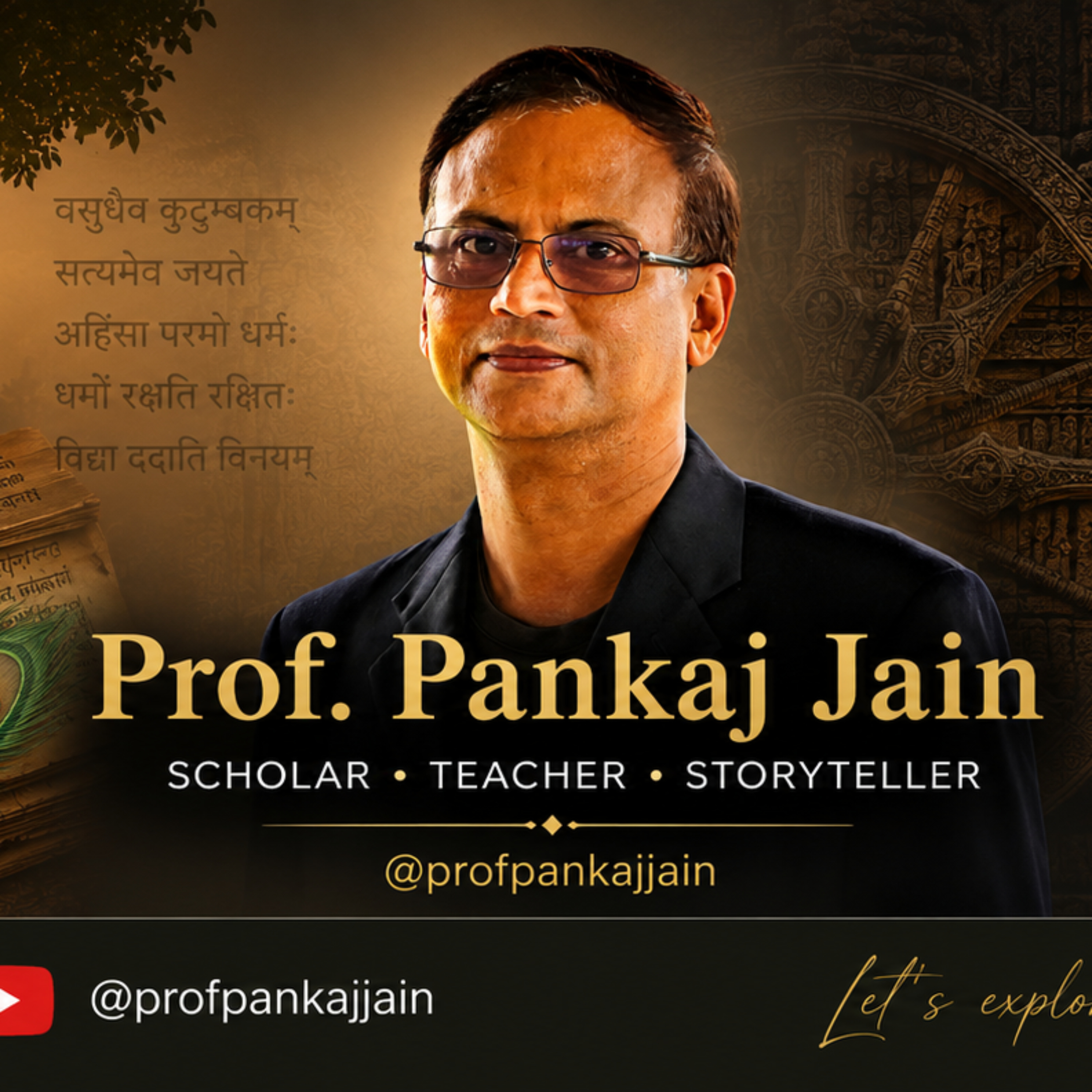
Bhārat Darśan: The Discover India Podcast explores Indian culture, classical music, sustainability, and Hindu, Buddhist, and Jain studies. Hosted by Dr. Pankaj Jain, director of The India Centre at FLAME University, the show also covers film and diaspora studies. Episodes feature conference presentations and webinars on topics like religion, ecology, and Bollywood.
Epizódy
-
 Inception and Turīya: Four States of the Self in the Māṇḍūkya Upaniṣad 10.10.2026 1minIn Christopher Nolan’s Inception (2010), Dom Cobb goes down: dream inside dream inside dream. Then he has to scramble back up, never sure which layer is real.The Māṇḍūkya Upaniṣad, the shortest of the principal Upaniṣads at just 12 verses, maps the same territory differently. It counts four quarters of the self:जाग्रत् · jāgrat: wakingस्वप्न · svapna: dreamingसुषुप्ति · suṣupti: deep sleepतुरीय · turīya: “the fourth”Turīya is not a deeper dream level. The text describes it as the awareness present through all three states. The word itself is a count: turīya is related to Sanskrit catur, “four,” a cousin of Latin quattuor and English four.Nolan’s answer to “which layer is real?” is a spinning top. The Upaniṣad’s answer is simpler: the one watching the top was never asleep.A note on framing: the text’s date is debated, different schools of Vedānta read it very differently, and the film does not draw on it. This is a comparison of two similar questions, not a claim of influence.If you could witness your own deep sleep, who would be doing the witnessing?Watch the short on YouTube: https://youtube.com/shorts/yUwfnJCb2kcMore from Prof. Pankaj Jain: linktr.ee/ProfPankajJain#Sanskrit #Inception #Upanishad #Consciousness #IndianPhilosophy #DiscoverIndia
 -
Yantra & Yama: The Sanskrit Root That Ties Machines to Morality 07.10.2026 1minAI labs have been meeting religious leaders to ask how a machine can learn right from wrong. Sanskrit tied those two ideas together long ago, in a single root: √yam, "to hold, to restrain."From it come yantra (machine, instrument, literally "a tool for holding"), and yama, niyama and saṃyama, the graded restraints of Patañjali's Yoga Sūtras. Even Jantar Mantar, the 18th-century stone observatories of Jaipur and Delhi, carries the word: jantar is yantra, worn smooth by everyday speech.In this short decode, Prof. Pankaj Jain (Indologist; Director, The India Centre, FLAME University) traces how one Sanskrit root built a vocabulary for both the instrument and the conscience.A note: this is a linguistic connection, not a claim that Sanskrit "predicted" AI, and it takes no position on AI consciousness.Sources: Monier-Williams, A Sanskrit-English Dictionary (s.v. yantra, yam, yama); Patañjali, Yoga Sūtras 2.29–2.32 and 3.1–3.4; Washington Post (April 2026) and New York Times (September 2026) reporting on AI companies and religious leaders.▶️ Watch on YouTube: https://youtube.com/shorts/sa--UgWwPGc?feature=share🎧 All episodes: pod.link/profpankajjain
-
The Ragas Behind Bollywood's Greatest Songs — Best of the Raag Series 03.10.2026 23minBefore this channel decoded Sanskrit words hiding in English, it spent two years decoding the classical ragas hiding inside Bollywood's biggest songs — a 63-episode webinar series with tabla and sitar scholar Shri Manoj Govindraj. This is the best of it: eight ragas, eight unforgettable film songs, and the 500-year-old music theory neither soundtrack ever credited.Every song in this episode is sung live by Manoj on harmonium — Durga, Malgunji, Deskar, Brindavani Sarang, Tilang, Gara, Bihag, Madmadh Sarang — with the one idea that makes each raga recognizable by ear, then the Bollywood song that was quietly built on it.Chapters00:00 Cold open00:26 Raag Durga — "Hum Intezaar Karenge" (Bahu Begum, 1967)02:46 Raag Malgunji — "Jeevan Se Bhari Teri Aankhen" (Safar, 1970)05:40 Raag Deskar — "Jyoti Kalash Chhalke" (Bhabhi Ki Chudiyan, 1961)10:00 Raag Brindavani Sarang — "Jiya Jab Jhoome"12:16 Raag Tilang — "Kaise Kahen Hum Pyar Ne" (Sharmilee, 1971)15:51 Raag Gara — "Mohe Panghat Pe" (Mughal-e-Azam, 1960)18:34 Raag Bihag — Bihag and Maru Bihag, sung back to back20:47 Raag Madmadh Sarang — "Laut Ke Aaja Mere Meet" (Rani Roopmati, 1959)23:00 OutroThe video version, with the Devanagari title cards for each raga, is on YouTube: Discover India with Professor Pankaj Jain. All 63 full episodes of the Raag series are in the playlist there.Prof. Pankaj Jain — scholar of Indian religions, Jain studies and Indology; Director, The India Centre, and Head of Humanities & Languages, FLAME University. With tabla/sitar scholar Shri Manoj Govindraj.
-
The Matrix ← Māyā: Reality Isn't What You Think 01.10.2026The Matrix ← Māyā. The highest-grossing sci-fi film of its era asks "what is real?" — a question Sanskrit philosophy put at its center 2,500 years earlier. The word is माया · māyā: not "nothing is real," but the creative power by which infinite consciousness appears as a finite world. The film's answer is the red pill — wake up to a different reality. The Upaniṣadic answer runs the other way: the consciousness watching the illusion was never trapped by it. And the Wachowskis reached for the same texts — Revolutions ends on a chant from the Bṛhadāraṇyaka Upaniṣad, asato mā sad gamaya, "lead me from the unreal to the real." A scholar's quick decode from the Bhārat Darśan film-philosophy series.
-
Pitru Paksha: A Pause for Where You Came From (Shraddh, Explained) 29.09.2026 1minIf you grew up in an Indian home, you probably touch a book to your forehead when your foot brushes it. Nobody taught you that. And yet, somebody did.In this short episode, Prof. Pankaj Jain reflects on Pitṛ Pakṣa (Pitru Paksha), the fortnight of the ancestors. It falls between Bhagwan Gaṇeśa's visarjan and Maa Durgā's arrival, when many Hindu families pause to remember those who came before them.In this episode:What pitṛ means, and why it's a cousin of Latin pater and English fatherThe quiet rite of śrāddha: water from cupped hands, rice on a leaf, a crow called down to eatWhy śrāddha comes from śraddhā, faith, whose old sense is "to place your heart somewhere"Why a fortnight called "inauspicious" is really asking us to look backIt was never a pause for the dead. It's a pause for where you came from.📅 Pitṛ Pakṣa 2026: September 27 – October 10 (Mahālaya / Sarva Pitṛ Amāvasyā), per most North Indian calendars. Traditions vary by region and family; follow your own family's practice.📖 Read more: Prof. Jain's Times of India essay on Pitṛ Pakṣa and śrāddha https://timesofindia.indiatimes.com/blogs/the-india-centre/from-present-to-past-the-philosophy-of-hindu-rituals-for-ancestors-pit-e1-b9-9b-pak-e1-b9-a3a-and-sraddha/▶️ Watch on YouTube: https://youtube.com/shorts/78UWxtVsek0?feature=share🎧 All episodes: pod.link/profpankajjainDiscover India: Decoded · Bhārat DarśanHeritage and memory, not theology.
-
The Sixth Sense ← Sākshi: Who Is the "I" That Sees? 26.09.2026 1minThe Sixth Sense ← Sākshi. Cole Sear sees what others can't — but the film never asks what the "I" that sees actually is. Sanskrit philosophy names it: साक्षी · sākshi, the witness — the awareness that observes thought, emotion, and the body without being affected by any of them. Cole is burdened by what he sees; the Upaniṣads point the other way: what if you are the seeing itself? A scholar's quick decode from the Bhārat Darśan film-philosophy series.
-
Hanuman Is a "Forest-Being" — What the Title Hanuman Ansh Really Says (Vānara, Decoded) 22.09.2026 1minYou saw Hanuman Ansh. The boy talking to a tree, the pot that never runs dry — both are explained by the title.Ansh, aṃśa, is a fragment. Hanuman is a vānara: vana + nara, forest + person — a forest-being. Greek andr- means "person" too; android is "person-shaped." Cousins from one ancestor, not a borrowing.The pot, read as a way to live rather than a miracle: nothing stored, nothing withheld, plenty from passing it on. That is annadāna. The same Himalayan hills saw the Chipko movement in the 1970s. Devotion, not policy — dharma as right relationship with everything that breathes, grows, and flows.Two hedges: vānara = vana + nara is the traditional gloss, and other derivations exist; and Hanuman Ansh is a devotional film, not an environmental one — it makes no claim about Uttarakhand's present ecological pressures, and neither does this episode. No spoilers.Hanuman Ansh (2026), dir. Vishal Chaturvedi. Discover India: Bhārat Darśan with Dr. Pankaj Jain.#HanumanAnsh, #NeemKaroliBaba, #vānara, Sanskrit etymology, dharma, ecology, annadāna, Chipko, Indian knowledge systems.
-
Volkswagen Is Half a Sanskrit Word — But Not the Half You Think 19.09.2026 1minVolkswagen means "the people's car," and one half of that name is cousin to a Sanskrit word — just not the half most people guess. Wagen and वाहन (vāhana) descend from the same ancestral root meaning "to carry," which also gave Latin vehere and English vehicle. Volks and Sanskrit लोक (loka), on the other hand, mean nearly the same thing and sound nearly the same, and are completely unrelated. A sound law worked out by Jacob Grimm — yes, that Grimm — is what decides it. Cousins from a shared ancestor, never borrowings.From Discover India: Decoded with Prof. Pankaj Jain.
-
Gaṇeśa and ‘Republic’ Share the Same Sanskrit Word 14.09.2026 1minGaṇeśa’s name doesn’t mean “remover of obstacles” — that title came later. Gaṇa + īśa: lord of the many. The samelittle word gave India gaṇita (mathematics), the ancient gaṇa-saṅgha assemblies, and gaṇatantra — the modern word for republic, honored every Gaṇatantra Divas. On the one day that is both Ganesh Chaturthi and Hindi Diwas, a scholar’s quick decode of the word that runs from the Veda to the Constitution.#GaneshChaturthi #GaneshChaturthi2026#GanpatiBappaMorya #Ganesha #HindiDiwas #Sanskrit #Ganeshotsav #Ganpati#IndianKnowledgeSystems #Etymology #Rigveda #DiscoverIndiaDecoded
-
The Highest-Grossing Film in History Has a Sanskrit Title 13.09.2026 1minThe biggest film franchise on earth carries a Sanskrit name, and its director himself said so back in 2007, calling it an incarnation of one of the Hindu gods taking flesh. Notice the vocabulary: incarnation, flesh. That is Christian language, borrowed because English had nothing closer. But avatāra never meant a picture, or a face, or a blue alien. It breaks into ava, "down," and the root tṝ, "to cross over" — a crossing down, a descent. The same root gives tīrtha, a ford in a river and so a place of pilgrimage, and Tīrthaṅkara, the Jain title for one who makes the crossing possible. Its cousins reach as far as Latin trans, hiding inside transit and translate. Three lives of one word: the divine crossing down, a man crossing into a body built for another world, and you, every day, crossing into a screen. A scholar's quick decode. (Box-office rankings here are the standard unadjusted count.)#Avatar #Tirthankar #Tirtha
-
The Complete Life of Mahavira: Prince to Tirthankara — Full Documentary 08.09.2026 53minHe was born a prince — and walked away from everything. This is the complete life of Mahāvīra, the 24th Tīrthaṅkara of Jain dharma: his birth and renunciation, the twelve years of austerity that led to kevala jñāna, the philosophy of anekāntavāda and ahiṃsā, his nirvāṇa — and the 2,500-year story that followed, from the Jain councils and the Digambara–Śvetāmbara divide to temple art, the global diaspora, and Gandhi's nonviolence.A scholar's full documentary, assembled from the 12-part Bhārat Darśan biography series. Released for Paryushana 2026.Prof. Pankaj Jain — scholar of Indian religions, Jain studies, and Indology; Director, The India Centre, FLAME University. Watch the full film and browse sourcing notes on the Bhārat Darśan YouTube channel (@profpankajjain).
-
Krishna's Name Literally Means "The Dark One" — Here's Why That Matters 04.09.2026 1minKṛṣṇa is not a title or a metaphor — in Sanskrit it is simply the word for dark. Born at midnight, in the dark fortnight, on its eighth night: the name is the birth chart. And instead of softening that name, the tradition multiplied it — Śyāma, Ghanaśyāma, dark as the monsoon that ends the heat. This Janmashtami, a scholar's quick decode of the god whose name made darkness beautiful.Which name for him did you grow up hearing at home — Krishna, Kanha, Śyāma, something else? Tell me below.
-
Arise, Walk, Arrive: Three Sanskrit Lines That Map a Whole Life 30.08.2026 8minThree lines of Sanskrit, from three different texts written centuries apart: "Arise, awake" (Kaṭha Upaniṣad), "keep walking — caraiveti" (Aitareya Brāhmaṇa), and "you alone are my refuge — gatistvam" (Bhavānī Aṣṭakam). Read together, in order, they stop being scattered quotes and become a single map of a life: wake, walk, arrive.I trace all three back to their sources — including what Vivekananda's famous rendering leaves out — and follow the two Sanskrit threads that tie them together: uttiṣṭha, "stand up," and the root √gam, "to go," behind both caran and gati.SOURCES & NOTESKaṭha Upaniṣad 1.3.14 · Caraiveti Sūkta, Aitareya Brāhmaṇa (Rohita narrative; verse ordering and numbering vary across editions) · Bhavānī Aṣṭakam, traditionally attributed to Ādi Śaṅkarācārya.On the yuga sequence: the ladder in this verse runs Kali → Dvāpara → Tretā → Kṛta, the reverse of the familiar declining order. That is what the verse does. Here the yugas are postures of a person — lying down, stirring, standing, walking — not ages of the world. Read figuratively.Vivekananda's "Arise, awake, and stop not till the goal is reached" is his rendering of the Kaṭha verse, not a literal translation.WATCHVideo version on YouTube ▸ [LINK]MORECourses, writing and scholar-led journeys ▸ https://linktr.ee/ProfPankajJainABOUTProf. Pankaj Jain — scholar of Indian religions, Hindu ecology and Indology. Director, The India Centre, and Head of Humanities & Languages, FLAME University.
-
Raksha Bandhan and Sanskrit Day Are the SAME Day — That’s Not a Coincidence 28.08.2026 1minRaksha Bandhan and World Sanskrit Day fall on the same day this year — and it's not a coincidence. Rakṣā-bandhana literally means "the bond of protection" (rakṣ, to guard + bandhana, to bind) — and the same full moon, Śrāvaṇa Pūrṇimā, is the day the old Sanskrit schools began their study year, which is why it's now World Sanskrit Day.The thread that protects a person and the day that protects a language — a quick scholar's decode.🔗 Watch/listen: https://youtube.com/shorts/ki1wwoeAWnQ?feature=shareBeyond your siblings — who (or what) deserves a rakṣā thread from you this year?#DiscoverIndia #RakshaBandhan #WorldSanskritDay #Sanskrit
-
Onam: “Kerala’s Biggest Festival Celebrates a ‘Demon’ King — Here’s Why” 26.08.2026 1minKerala’s biggest festival honors Mahābali — a king the texts call an asura, whom the people call their greatest ruler. Vāmana’s three steps, a kingdom surrendered, and one wish granted: to come home once a year. Onam — whose very name descends from the star Śrāvaṇa — is that homecoming. A scholar’s quick decode.#Onam2026 #Thiruvonam #Onam #Mahabali #Maveli #Kerala #Vamana #avatarthreesteps #Trivikrama #pookalam meaning #Shravana #Onamsadya #BaliChakravarthi #Sanskritetymology #BharatDarshan #profPankaj Jain #decodeIndia #disoverindia
-
Why India Has Two Official Names — in One Sentence of the Constitution 15.08.2026 1min“India, that is Bharat, shall be a Union of States.” The Constitution’s very first sentence carries two names — one born from a river seen from outside (Sindhu → Hindu → Indos → India), one from a lineage remembered from within (Bharata, from the root bhṛ: to bear, to carry). This Independence Day, a scholar’s quick decode of what each name actually says.#IndiathatisBharat#Bharatmeaning#Indianameorigin#Article1ConstitutionofIndia#Sindhu#Hindu #Indos #India,#Bharata #bharatavarsha #rigvedachanting #Bharatas #bhriSanskritroot#Independence Day2026#15August #ConstituentAssembly1949 #VishnuPuranaBharataverse #bharatDarshan
-
Homer and the Rigveda Use the Same Word for Fame — Kléos & Śravas 06.08.2026 1minEnglish took one word from Homer's Odyssey — odyssey, "the long journey out." But the word that poem is really about has a Sanskrit twin.Greek kléos and Sanskrit श्रवस् (śravas) are the same inherited word, from a root meaning "to hear": fame was never what you achieved, it was what was said about you. Homer's kléos áphthiton and the Rigveda's श्रवः अक्षितम् (śrávaḥ ákṣitam) both reach for "imperishable fame" — a line scholars since 1853 have read as one both traditions inherited from a common ancestor. Then the root parts ways. Greek built it into names — Hēraklês, Periklês, Sophoklês. Sanskrit built it into श्रुति (śruti), "that which is heard" — the name for the Vedas themselves.This is heritage and language, not policy: shared inheritance, not borrowing in either direction. Full sources and the honest scholarly debate (Kuhn 1853; Watkins 1995; and the contested reconstruction of the phrase) are in the pinned notes on the YouTube version.Discover India: Decoded — Bhārat Darśan, with Prof. Pankaj Jain.
-
Friendship Day & the Gita: What Krishna Teaches Us About True Friends 02.08.2026 1minOn Friendship Day, we turn to the oldest wisdom on what real friendship means — the Bhagavad Gita.Krishna didn't rescue Arjuna from the battlefield or hand him easy answers. He stayed beside him in the chaos and helped him find his own clarity. And Sudama, the poor Brahmin who arrived with nothing but a fistful of rice, left with everything — because true friendship keeps no ledger.In this episode, Prof Pankaj Jain unpacks what these timeless stories teach us about loyalty, presence, and the friends who see us clearly and stay anyway.Happy Friendship Day. 🧡🎧 Follow for more on the Gita, Sanatan wisdom, and Indian culture.#BhagavadGita #FriendshipDay #Krishna #Spirituality #IndianCulture
-
The Hymn That Takes Away Everything You Depend On | Gatistvam, Decoded 31.07.2026 1minNot your father. Not your mother. Not your wealth. Not even your knowledge. The Bhavani Ashtakam — traditionally attributed to Adi Shankaracharya — opens by stripping away everything we lean on, and ends every single verse the same way: gatistvam gatistvam tvameka Bhavani. You alone are my refuge.The real surprise sits inside one word. "Gati" comes from the Sanskrit root for "to go" — and it holds three meanings in one breath: the way you travel, the goal you move toward, and the shelter you finally reach. So "You are my gati" says: my way, my destination, my refuge. Everything I lean on can be taken. The one thing that can't — that's my gati.This is Part 3 of 3 in the Arise · Walk · Arrive series — three Sanskrit calls from three layers of the tradition. You woke. You walked. This is where you arrive.▶ Part 1 — ARISE (Uttishthata Jagrata): https://youtube.com/shorts/TCa9ZzeO7Ew▶ Part 2 — WALK (Charaiveti): https://youtube.com/shorts/WxFhBPDDOX4?feature=share▶ Watch on YouTube: https://youtube.com/shorts/tjwQVGyPkag?feature=shareSources note: the Bhavani Ashtakam is traditionally attributed to Adi Shankaracharya; the stotra corpus under his name is vast, and individual authorship is debated by scholars. Bhavani is a form of the Divine Mother (Parvati/Durga).
-
"Guru" Doesn't Mean Teacher. It Means Heavy. | Guru Purnima, Decoded 28.07.2026 5minYou say it constantly — tech guru, business guru — but the Sanskrit word guru doesn't mean teacher. It means HEAVY, and it shares an ancient root with the English word gravity. This Guru Purnima, a scholar's decode of the word, the day, and the guru–śiṣya paramparā: how India transmitted entire libraries mouth-to-ear for a thousand years before printing, why the archetypal guru is a compiler named Vyāsa, why Buddhists and yogis honor the same full moon, and what a civilization that put gratitude on the calendar understood about teachers that credentials can't capture.A note on sources: "guru = heavy" is the linguistic root (Sanskrit guru and Latin gravis share a Proto-Indo-European ancestor); the traditional "gu = darkness, ru = dispeller" explanation comes from later texts and is presented as tradition. This is heritage and language, not policy.Watch the video version and find all platforms: https://linktr.ee/ProfPankajJainDiscover India: Bhārat Darśan with Prof. Pankaj Jain — decoding Indian civilization, one word at a time.
Podobné podcasty


Obľúbený v
Tento podcast sa objavuje aj v rebríčkoch podcastov týchto krajín.
