
The Bible Standard - Re-Discover the Truth.
Christadelphians Talk
0
This podcast features conversations from Christadelphians Talk, exploring various topics related to the Bible and its teachings. Each episode focuses on 'true Bible teaching,' aiming to help listeners re-discover the truth found in Scripture. The discussions cover a range of biblical subjects and doctrines from a Christadelphian perspective. It serves as a resource for those seeking deeper understanding of the Bible.
Epizódy
-
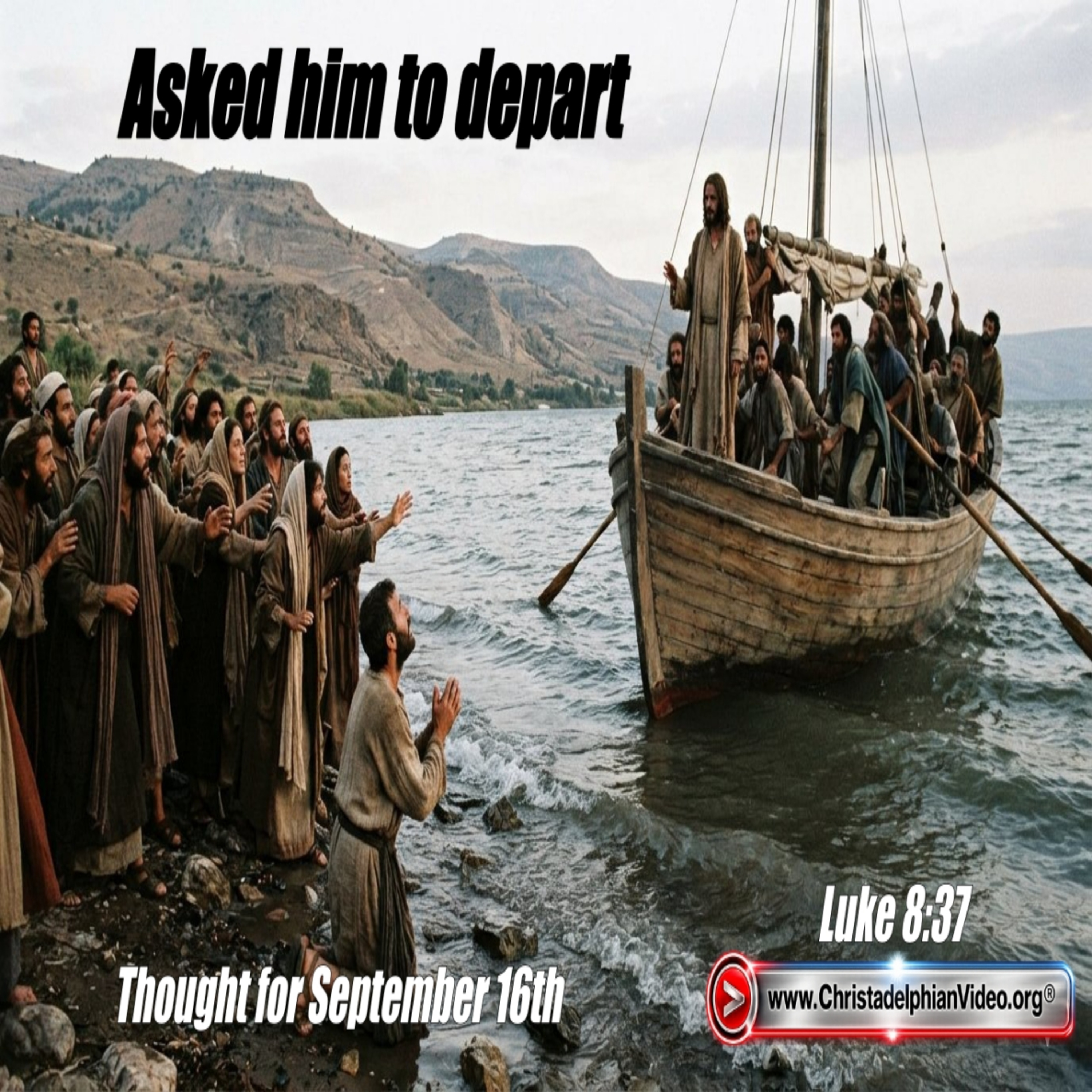 'They asked him to depart' Luke 8:37 16.09.2026 4minWe read of a remarkable miracle today in Luke ch. 8., the healing of a man who had become totally deranged in mind. He was well known, owned a house and lived in the city before he became insane. Jesus did many miracles in many different ways but this healing was particularly challenging to those who knew the man and lived in his city. Jesus came to “the country of the Gerasenes and this man, in his insane state, now lived among the tombs, “When he saw Jesus, he cried out and fell down before him and said with a loud voice, ‘What have you to do with me, Jesus, Son of the Most High God?” [v.28] His insane mind led him to perceive who Jesus really was! There was nothing to be gained by Jesus explaining that such a state of mind was not caused by an ‘evil spirit’ taking over control of the mind; this belief had arisen as a result of the Greek conquest; this was what the Greeks superstitiously believed: the Old Testament shows that no such beliefs were held in earlier years.A dramatic healing occurs! The supposed ‘demons’ are ‘seen’ to be in the pigs because they madly rush down the slope and drown in the waters of Galilee. Now eating pork, even touching their carcases was ‘unclean’ under the law God gave to Moses [Lev. 11 v.7,8]; obviously those keeping the pigs had no regard for the law! The event was a challenge to the “people (who) went out to see what had happened, and they came to Jesus and found the man from whom the demons had gone, clothed and in his right mind, and they were afraid.” [v.35]Every other healing Jesus did resulted in many more to come for healings but not here! “All the people of the surrounding country of the Gerasenes asked him to depart from them for they were seized with great fear. [v.37] We suspect they were afraid of other things that might happen that would cause a further loss of livelihood. The reasons are not entirely different today for those who believe in evolution rather than a Creator who will hold them responsible for how they live their lives. Those who believe in a Creator have at least some responsibility! Recall what we read last week in Ezekiel in chapter 3. “If I say to the wicked, ’You shall sure die,” God says to Ezekiel, “and you give him no warning, nor speak to warn … he shall die for his iniquity but his blood I will require at your hand. But if you warn the wicked … you will have delivered your soul” [ch. 3 v.18,19] Any words we attempt to speak or write must be done in love. Jesus told his hearers to “love your enemies, and pray for those who persecute you.” [Matt 5 v.44]. We do not want Jesus “to depart” from us.
 -
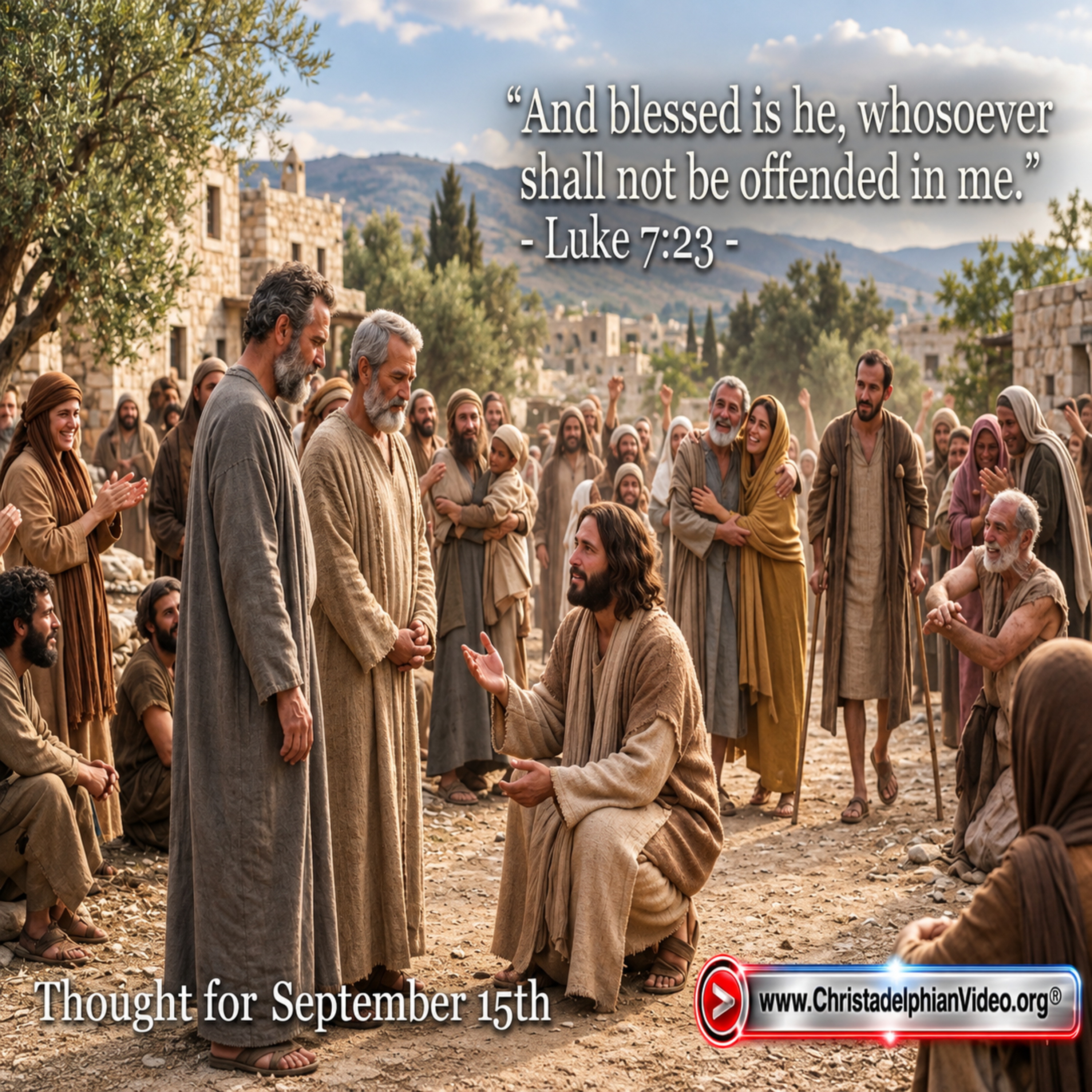 “BLESSED IS THE ONE WHO is not offended in me …” Luke 27:23 15.09.2026 4minAs usual, all our chapters are full of meaningful lessons: first, Hezekiah after his life is extended 15 years is succeeded by a 12 yr old son, Manasseh who turns out to be a very bad king. We wonder about the role of Hephzibah, his mother in this. The spirituality of whom we marry is very important. Her name is apparently of Phoenician origin, meaning, ‘delight of Baal.’ Again the spirit takes Ezekiel to Jerusalem and gives him insight into God’s reaction because of his full awareness of the minds of those living there. God always has such knowledge! Awesome! Ezekiel learns, “But as for those whose heart goes after their detestable things and their abominations, I will bring their deeds upon their own heads, declares the Lord GOD.” [Ch. 11 v.21] And today?In Luke (Ch. 7) we read how messengers come to Jesus from John the Baptist. Our Lord has been doing many remarkable miracles, but when he brings to life again a young man who is being carried out to his burial, “fear seized them all, and they glorified God, saying, ‘A great prophet has arisen among us!’ and ‘God has visited his people!’ And this report about him spread through the whole of Judea and all the surrounding country. The disciples of John reported all these things to him. And John, calling two of his disciples to him, sent them to the Lord, saying, “Are you the one who is to come, or shall we look for another?” [v.16-19]The way Jesus answers him is instructive – and challenging! John evidently had certain expectations of the Messiah’s work – and what was happening did not fit these. We look back at ch. 4 and see how Jesus quoted from a scroll of Isaiah when in the Synagogue, v.17-19. It is now instructive to note how Jesus responds to these messengers, “”Go and tell John what you have seen and heard: the blind receive their sight, the lame walk, lepers are cleansed, and the deaf hear, the dead are raised up, the poor have good news preached to them. And blessed is the one who is not offended by me.” [v.22-23]He is telling John to check out and “believe all that the prophets have spoken”! These are the words of Jesus we will read in ch. 24 v.25, when, after his resurrection he speaks to 2 disciples on the road to Emmaus. This is a lesson for us as we anticipate the return of our Lord and our expectations are increasing! We must take a lesson from the quandary of John the Baptist and look to “all that the prophets” have written! Are they not like pieces of a jigsaw! We have more and more pieces that seem to fit, but there are still others we are not sure about: events yet to come, maybe very soon, will make the picture clearer and clearer.
 -
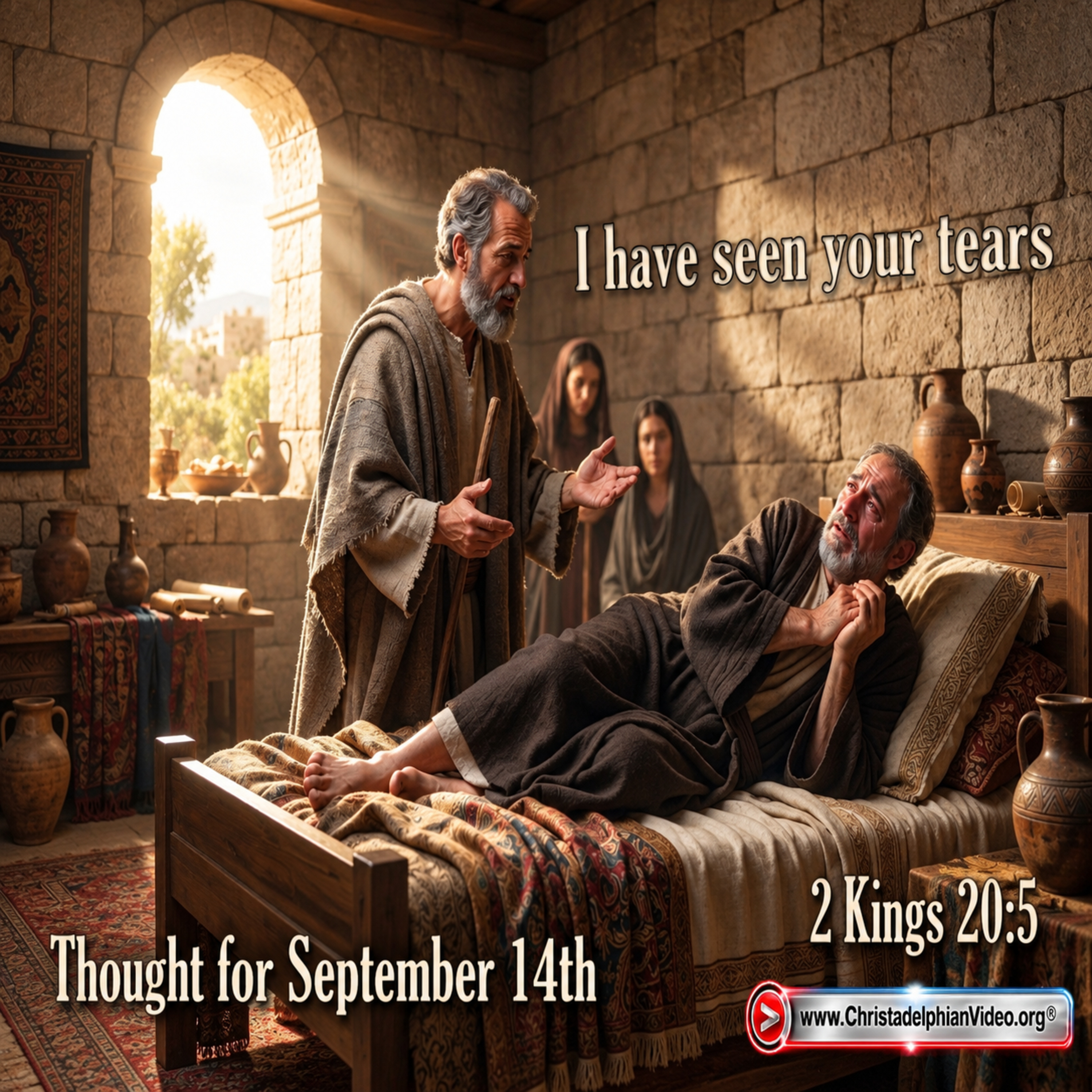 “I HAVE SEEN YOUR TEARS” (2 Kings 20:5) 14.09.2026 4minWe read and thought yesterday about the anxieties of King Hezekiah over the Assyrian invasion and the potential fall of Jerusalem. The king appealed to Isaiah to seek the help of the LORD. Later he went into the Temple and “prayed before the LORD” [2 Kings 19 v.15] himself. There is a progression in his approach to God – do we have the same experience as we seek to get closer to our Creator and His Son our Saviour? It is natural that we should if we are truly spiritually minded.. Today in ch. 20 we read of Hezekiah’s illness, one that he is told, will be fatal; Isaiah comes with this message, “Set your house in order for you shall not recover” [v.1] He makes an impassioned prayer to the LORD, “I have walked before you in faithfulness and with a whole heart, and have done what is good in your sight.” [v.3] His prayer is heard and answered – “I have heard your prayer; I have seen your tears. Behold, I will heal you” [v.5] God hears and sees all things in the lives of those who truly seek to serve him. We should each meditate on whether we could utter such an impassioned prayer if we found ourselves in a life threatening situation – when we feel we still have work we can do in serving our Lord. It may not be a health situation as with Hezekiah. Our world, especially in some parts, increasingly threatens us; potentially there could be extreme difficulties. In our prayers could we say we have serve him with “our whole heart.”? This week we will read in Ezekiel how the prophet is told of God’s impending judgements, “Thus says the Lord GOD: None of my words will be delayed any longer…” [12 v.28] The time is coming, we do not know how soon, when God will be saying the same about our godless world. In Luke today we read the challenging words of Jesus, “Why do you call me, ‘Lord, Lord’ and do not do what I tell you” [6 v.46] Let us not be guilty of reading God’s word but then failing to put into practice what we read. We can talk and preach about it – and exhort each other – but this must not be only an outward show. We are all building the “house” of our life: Jesus said, “the one who hears (reads) my words … I will show you what he is like: he is like a man building a house who dug deep and laid the foundation on the rock …” [v.48] A lot of sweat and tears are involved in such earnest building: so in our building, can our Lord say to you, and me, “I have seen your tears.”
 -
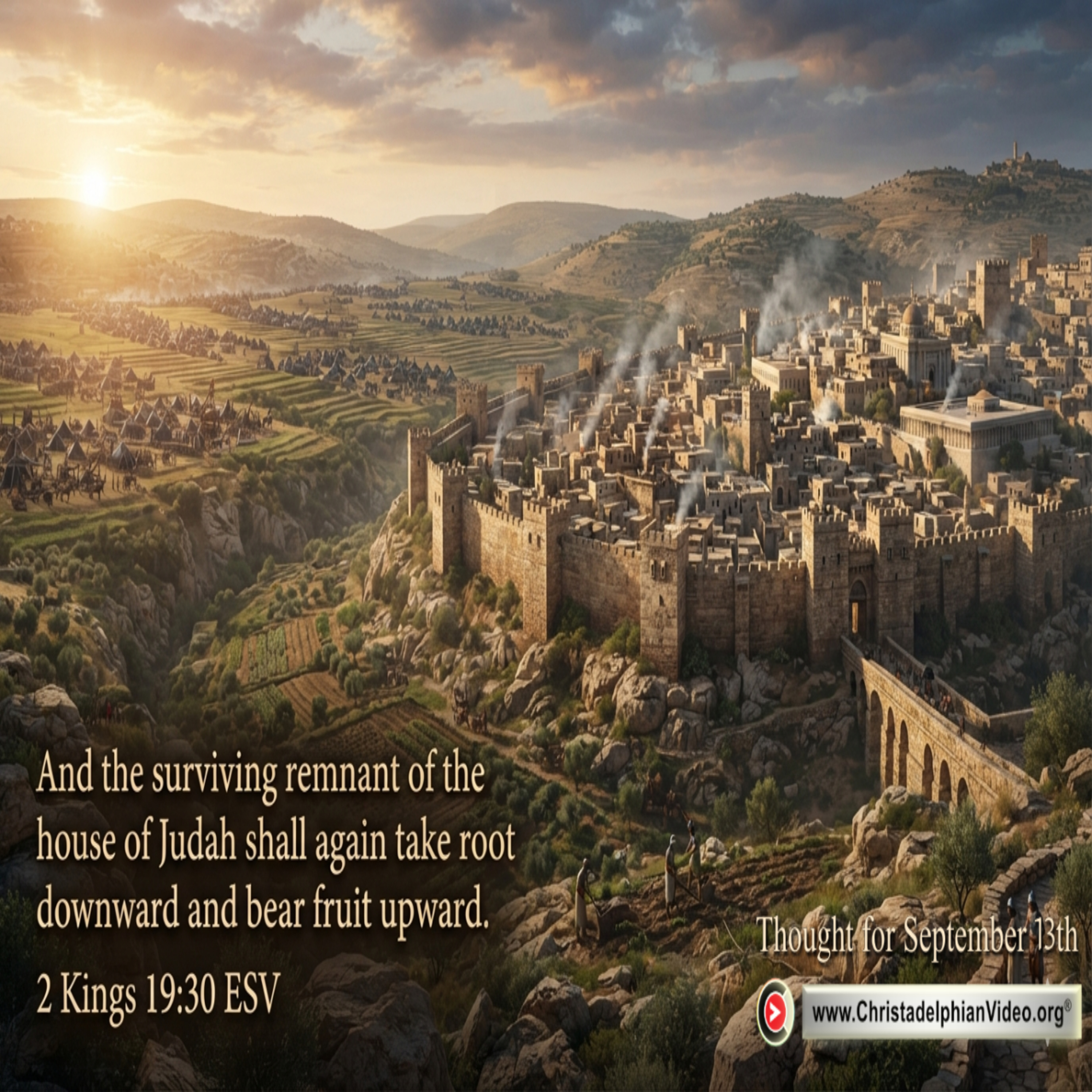 “THE SURVIVING REMNANT” 13.09.2026 4minToday’s chapter 19 of 2nd Kings brings Isaiah onto the scene. King Hezekiah in his great distress at the conquests of the Assyrians and now their presence outside the walls of Jerusalem sends his secretary and senior priests to the prophet, with a message saying, “It may be that the LORD your God heard all the words of the Rabshakeh,” adding, “therefore lift up your prayer for the remnant that is left” [v.4]Isaiah’s response is very positive; “Say to your Master, ‘Thus says the LORD: Do not be afraid because of the words that you have heard with which the servants of the king of Assyria have reviled me. Behold, I will put a spirit in him, so that he shall hear a rumour and return to his own land, and I will make him fall by the sword in his own land.'” [v.6,7] This happens, but as the Assyrians depart they say, “Thus shall you speak to Hezekiah king of Judah: ‘Do not let your God in whom you trust deceive you by promising that Jerusalem will not be given into the hand of the king of Assyria. ‘Behold, you have heard what the kings of Assyria have done to all lands, devoting them to destruction. And shall you be delivered?” [v.10,11] History is full of human boasting like this, but “The word of the LORD” comes to Isaiah over this (v.21-28) that the LORD is “aware of their raging against me”[v.27] Within a generation or two the Assyrians fade into history and Nineveh is a heap of ruins to this day – the Babylonians then become the main enemy, but in time Babylon too becomes a heap of ruins, as it is today. Then Isaiah conveys a remarkable long term prophecy. “ … the surviving remnant of the house of Judah shall again take root downward and bear fruit upward. For out of Jerusalem shall go a remnant, and out of Mount Zion a band of survivors. The zeal of the LORD will do this.” [v.30,31] We witness the resilience of the “surviving remnant” today. We can read in Isaiah’s book, the prophecy the LORD gives him, how “in that day the Lord will extent his hand a second time to recover the remnant that remains of his people … and gather the dispersed of Judah from the four corners of the earth” [11 v.11,12] We are witnessing that event and are in awe of the climax when God “shall strike the earth with the rod of his mouth, and with the breath of his lips he shall kill the wicked.” [v.4] Soon, in Luke’s gospel, we will come to Jesus’ awesome words predicting this. How awesome the fate of the great Assyrian army, because they reviled God! (185,000 died – v.35) How awesome the fate awaiting at least some who do so today! Let us do the opposite. And what is the opposite?.
 -
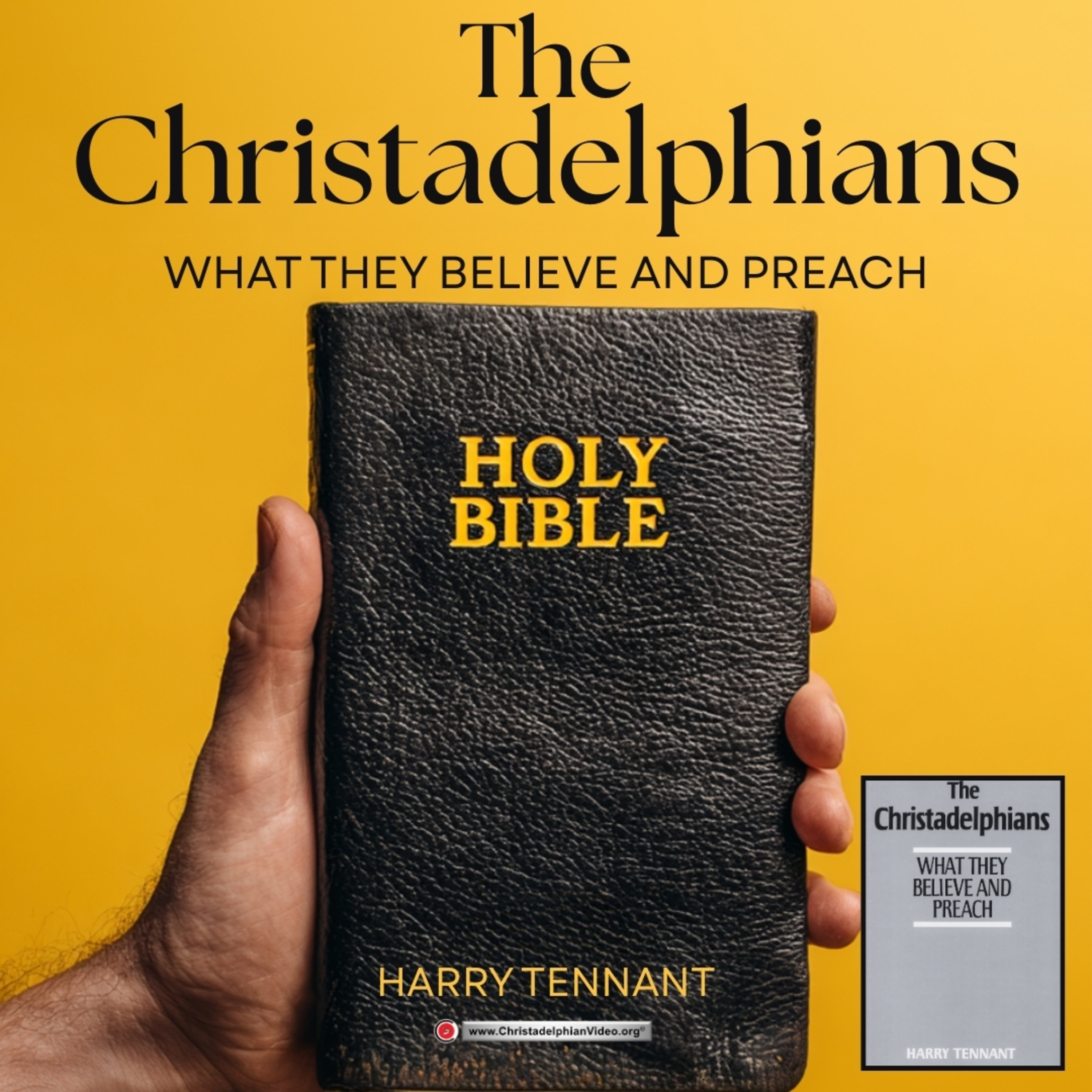 The Christadelphians:#22 'Walking with God' 13.09.2026 37min[Actual, provable Bible Truth] Walking with God is not a single moment of decision but a lifelong journey of faith. Salvation is a process—from being a servant of sin to becoming a son of God—and it is completed only at the return of Christ, when the faithful are granted immortality. This is the powerful, scriptural reality that transforms everyday life into a pilgrimage towards the Kingdom.This thought-provoking and expositional video, Chapter 22 of our series on the Philadelphiaians, delves deep into the nature of discipleship. It explores what it truly means to "walk with God," using the lives of Enoch and Noah as our foundation. We unpack the profound truth that the disciple is a sojourner, a traveler following the narrow way, with the Bible as our infallible compass.The journey is marked by both wonderful peace and purposeful testing. We explore how the "peace of God which passes all understanding" coexists with the "tribulation" that shapes our character for eternity. This outstanding presentation reveals that our trials are not punishments but the divine refining fire, preparing us for the Kingdom.Through constant prayer, daily reading of the whole Bible, and a humble submission to God's will, we find the strength to endure. The video also highlights the inseparable link between the Old and New Testaments, showing the unity of God's plan from Genesis to Revelation. It is a reassuring and challenging call to examine our own walk and to hold fast to the hope set before us.**Chapters:**00:00 - Introduction: The Journey of Salvation01:50 - The Process: From Servant to Son02:48 - The Pilgrim Aspect: Walking with God03:08 - Scriptural Examples: Enoch and Noah05:45 - Guidance: The Path and the Signposts07:43 - The Bible: Our Traveller's Compass10:13 - The Whole Council of God13:49 - God's Personal Care and Protection17:05 - The Conditions for Blessing20:20 - Peace, Joy, and Abiding Assurance23:16 - The Refining Fire: Trials and Character27:54 - The Divine Order of Progression30:57 - God's Faithfulness in Temptation32:05 - The Power of Prayer35:41 - Conclusion: Our Anchor of Hope**Bible Verse Category:**📖 Romans 2:7 & 16📖 1 Corinthians 1:18📖 Genesis 5:22-24, 6:9, 17:1📖 Micah 6:8📖 Psalm 23:4, 119:105📖 2 Timothy 3:15-17📖 John 14:21-23, 10:27-29📖 2 Corinthians 4:17-18, 6:16-18📖 Hebrews 12:5-11, 13:5-6📖 James 1:2-4, 12📖 Romans 8:28, 35-37📖 Hebrews 6:18-20Tags: Christadelphian, Walking with God, Bible Study, Discipleship, Salvation, Biblical Truth, Faith Journey, Christian Living, Bible Reading, Prayer, Tribulation, Kingdom of God, Scriptural Exposition, Bible Verses, Philadelphiaians, Christian Doctrine, Hope, FaithWe are a Christadelphian team, Brothers and sisters of Christ, and we're passionate about delivering powerful, Scripture-based content to strengthen and inspire your faith journey. If this presentation resonated with you, help spread the encouragement—share it with a friend today!
 -
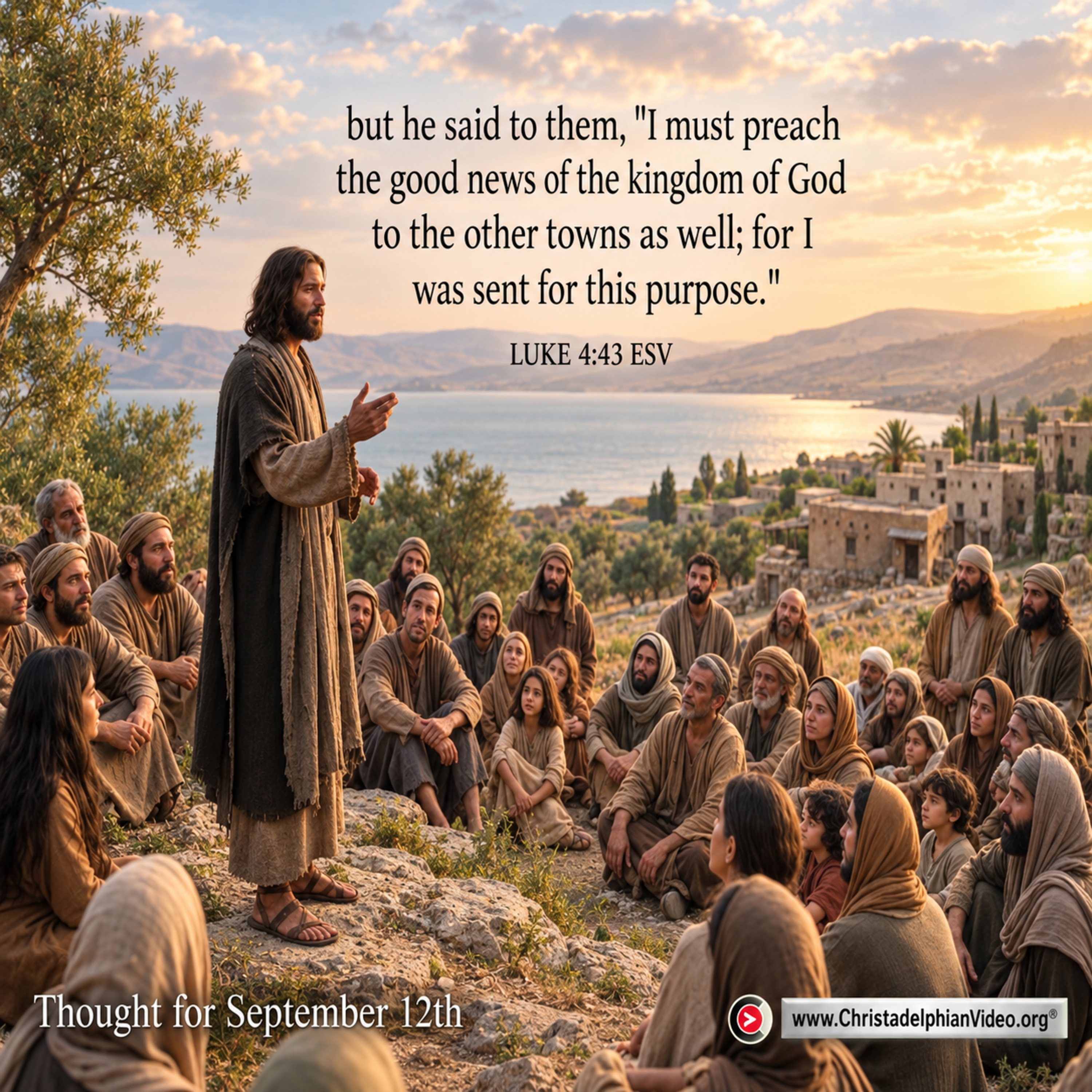 “THE GOOD NEWS OF THE KINGDOM” 12.09.2026 4minHow hard it is to hear or find any “good news” these days! All nations and kingdoms appear to be in disarray especially in the Middle East, only Israel stands firm. The nations think that their destiny is entirely in their own hands, but God’s purpose is being worked out and dedicated Bible students diligently watch events trying to see more clearly how the various prophecies apply. We read in 2 Kings 18 of the faith of the good king Zedekiah in Jerusalem, standing firm against the boasting of the invading Assyrians (which is called Iraq is today). We will read tomorrow of how the prophet Isaiah comes on the scene and, through God’s spirit, sees and says what God will cause to happen because Hezekiah is a spiritually minded king.In contrast, the prophet Ezekiel (ch.8) is caused to be carried in vision to Jerusalem and made aware of the abominations taking place in the Temple; for him, it is the opposite kind of news of what will soon happen! Ezekiel is told that God is so angry that, when trouble comes, “though they cry in my ears with a loud voice, I will not hear them.” [v.18]In Luke’s gospel (ch.4) we read how Jesus travels to many places and heals many, and “the people sought him and came to him, and would have kept him from leaving them, but he said to them, ‘I must preach the good news of the kingdom of God to the other towns as well; for I was sent for this purpose.” [v.42,43] Those who really listened were few, most were fascinated by seeing miracles or being miraculously fed but the really important work of Christ was proclaiming, “The good news of the kingdom of God.” This was not as many have imagined over the centuries up until today – a ’sky kingdom’ but, as in the ‘Lords’ prayer, ‘Thy will be done on earth” – What wonders “Isaiah … saw … it shall come to pass in the latter days … the house (temple) of the LORD shall be established … and all nations shall flow to it …” [Isaiah 2 v.1,2] Jesus came to bring this wondrous message of God’s ultimate purpose for the earth – to happen when he returns. Let us ever more surely make this our hope and expectation and share it with anyone who will listen.
 -
 Why does God allow suffering? 11.09.2026 43minA @Christadelphians Video:Pleased to present in collaboration with the Bible Unlocked team, this thought-provoking presentation from the sixth season of Bible Unlocked Live, A foundational series, “Why You Should Believe the Bible,” revealing how faith is built on a rock-solid foundation of evidence and reason. They hold a webinar each week....Find out more @ https://www.bibleunlocked.com/ [Inspiring] Why does a loving God allow suffering? It’s one of the most profound and emotionally challenging questions of the human experience. In this thought-provoking and insightful exposition, we delve into the Bible’s honest and comprehensive answer to this age-old dilemma. We explore with Caleb Osborn how Scripture does not shy away from this topic; instead, entire books like Job, Ecclesiastes, and Lamentations are dedicated to wrestling with pain and loss. We examine the origin of suffering in Genesis, its three key purposes in our lives today, and the profound truth that God is not distant from our pain. Most importantly, we look forward to the wonderful hope of Revelation, where God promises to wipe away every tear and eliminate suffering forever.This is an outstanding and revealing study that provides real comfort and a scriptural framework for understanding our trials.*Chapters:*00:00 - Introduction: The Challenge of Suffering02:10 - The Bible Doesn't Shy Away from the Question04:00 - The Origin of Suffering (Genesis 3)07:00 - Purpose #1: To Expose the Effects of Sin09:30 - Purpose #2: To Highlight Our Need for God12:00 - Purpose #3: To Develop Faithful Character14:20 - God’s Empathy: He is Afflicted with Us16:00 - Jesus: Our High Priest Who Understands18:30 - The End of the Story: No More Curse20:40 - Q&A: Sin, Suffering, and Repentance24:00 - Q&A: Jesus Felt Forsaken (Psalm 22)27:00 - Q&A: The Hope of the Kingdom29:00 - Conclusion*Bible Verses Referenced:*📖 Genesis 3:16-19📖 Romans 6:21📖 Psalm 107:10-13📖 Romans 8:20-22📖 Romans 5:3-5📖 Hebrews 12:11📖 1 Peter 1:6-7📖 Isaiah 63:9📖 Hebrews 4:15📖 Revelation 21:3-4📖 Revelation 22:3📖 Luke 13:1-5📖 Psalm 22:1, 24📖 Hebrews 2:9-10*Tags:*Bible study, why does God allow suffering, problem of evil, Christadelphians, Bible teaching, book of Job, Genesis 3, Romans 8, Christian apologetics, faith under trial, hope in suffering, purpose of pain, God's love, Kingdom of God, Bible explanation, scripture studyWe are a Christadelphian team, Brothers and sisters of Christ, and we're passionate about delivering powerful, Scripture-based content to strengthen and inspire your faith journey. If this presentation resonated with you, help spread the encouragement—share it with a friend today!
 -
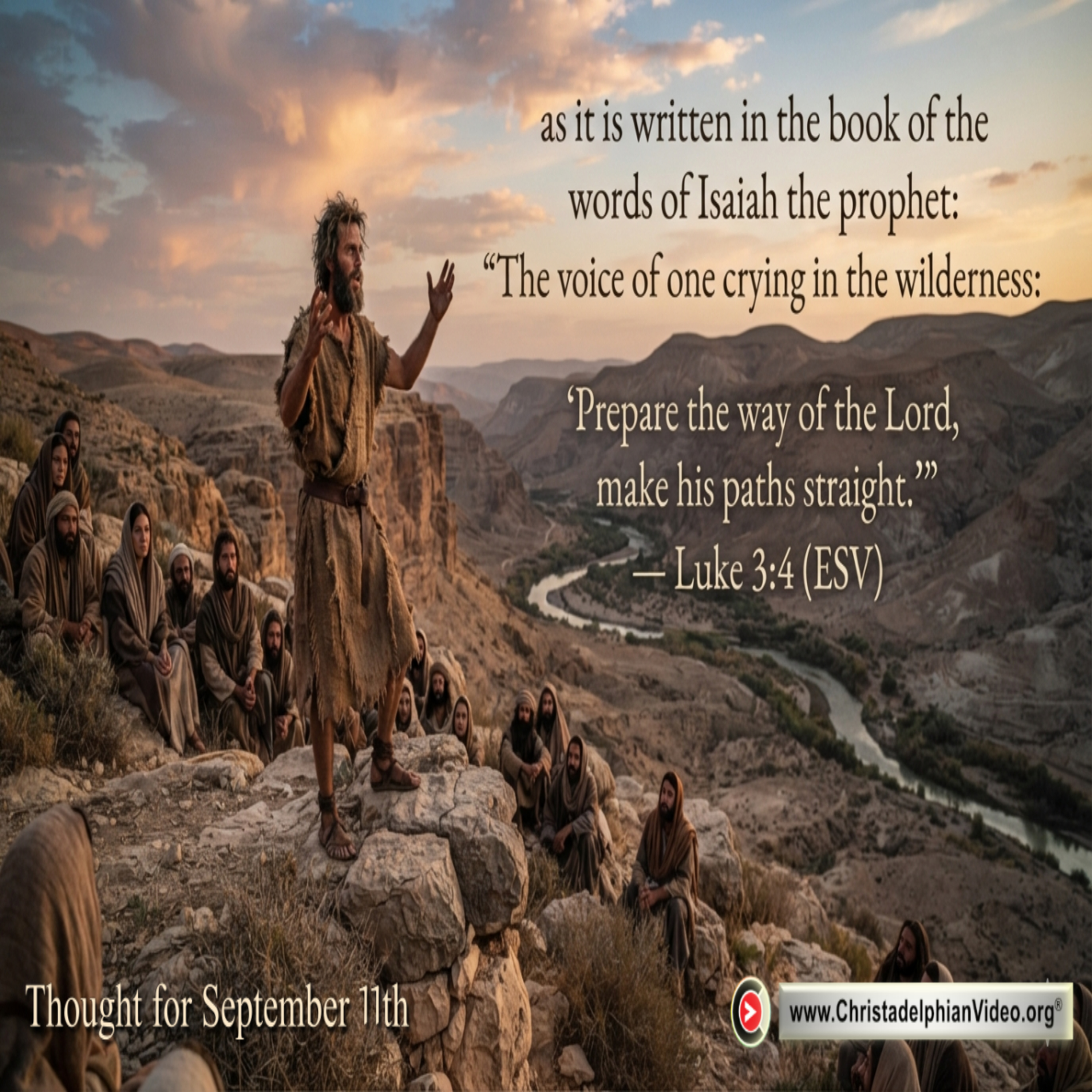 “CRYING IN THE WILDERNESS” 11.09.2026 4minThe world is a spiritual wilderness today. We read today of when John the Baptist appeared on the scene and that he was a “voice crying in the wilderness” [Luke 3 v.4] – it was a spiritual wilderness then too, there had been no prophet from God for about 400 years – since the days of Malachi. Today there has been no message from God that people have taken serious notice of since the Bible was translated and printed and became available in all major languages, this was at least 400 years ago. People “listened” to God’s “voice” then and the world underwent a spiritual reformation; but deafness set in again more and more with each generation until today, nearly all are totally ‘deaf.’We saw significant parallels in our Ezekiel reading (ch.7) today. The 10 northern tribes that made up the kingdom of Israel, as distinct from Judah in the south, had become so wicked that they were all in the process of being taken away into captivity: the southern kingdom was soon to follow. However, God’s words through Ezekiel, could be his words to the great majority today. It seems no one was listening to Ezekiel – and it’s the same today, so few are seriously listening.“Behold the day! Behold it comes! Your doom has come” [v.10] wrote Ezekiel, adding, “Violence has grown up into a rod of wickedness” [v.11] He continues, “The time has come; the day has arrived. Let not the buyer rejoice, nor the seller mourn, for wrath is upon all …” [v.12] “When anguish comes they will seek peace, but there shall be none. Disaster comes upon disaster….” [v.25,26] Thankfully, wonderfully, there is an end coming to the disasters that will surely multiply in today’s world’. Those who know God’s word and have established a relationship with him, will know where to “seek peace” and that “the prince of peace” will return “and the government shall be upon his shoulder” [Isa. 9 v.6] and “the wilderness” will be no more – but only those who have heard (by reading and thinking and believing) “the voice crying in the wilderness” will experience the everlasting wonders that “that day” will bring. Are you listening? What effect is it having on your heart?
 -
 The Canadian C-9 Bill what it means for Christians with Bible Scholar Ted Hodge. 10.09.2026 10minA @Christadelphians Video: [Prophecy being fulfilled!] In this thought-provoking and revealing episode of the Watchman Report, we examine Canada’s Bill C-9—a law that, on the surface, addresses rising anti-Semitism, yet in reality places believers in a more precarious position. Could this be another sign that secular society is moving further from God, Christ, and the Bible? We provide an insightful and expositional analysis of this legislation, exploring how the removal of the religious defence for "wilful promotion of hatred" could potentially criminalise the very expression of biblical truth. This is an outstanding and wonderful resource for those seeking to understand how current events align with scriptural prophecy.*Summary*Join us as we dissect the Canadian government's Bill C-9, which came into effect in July 2026. While it includes positive steps to combat anti-Semitism, we reveal the alarming removal of the "good faith" religious defence. We discuss the ambiguity of new definitions like "detestation" and "vilification," and ask the crucial question: does this law threaten the believer's ability to publicly declare the whole counsel of God? We break down the biblical standard on hate, demonstrating that God hates wickedness while still loving the sinner, and we challenge the government's narrowing of what constitutes acceptable speech. This is essential viewing for every Bible student.*Chapters*00:00 - Introduction & The Watchman Report Mandate00:46 - Examining Bill C-9: The Good and the Bad01:39 - New Hate Crime Offences Listed02:19 - The Removal of the Religious Defence03:10 - The Government’s New Definition of Hatred04:23 - Applying the Law: Leviticus 20:1305:46 - The "Hallmarks of Hate" Examined07:19 - The Scriptural Teaching on Hate08:36 - Government Position & The Believer's Response09:48 - Conclusion & Call to Action*📖 Bible Verse Category*- 📖 Leviticus 20:13 – The scripture dealing with abomination.- 📖 Psalm 5:5 & 11:5 – God hates wickedness and the wicked.- 📖 Psalm 139:21-22 – The believer’s hatred of evil.- 📖 Matthew 5:44-45 – Loving our enemies.- 📖 John 3:16 – God’s love for the world.**Tags**Bible Prophecy, Bill C-9, Canada, Religious Freedom, Hate Speech Laws, Christadelphian, Watchman Report, Biblical Standard, Prophecy Fulfilled, Secularism, Christian Persecution, End Times, God’s Law, Truth, Bible StudyWe are a Christadelphian team, Brothers and sisters of Christ, and we're passionate about delivering powerful, Scripture-based content to strengthen and inspire your faith journey. If this presentation resonated with you, help spread the encouragement—share it with a friend today!
 -
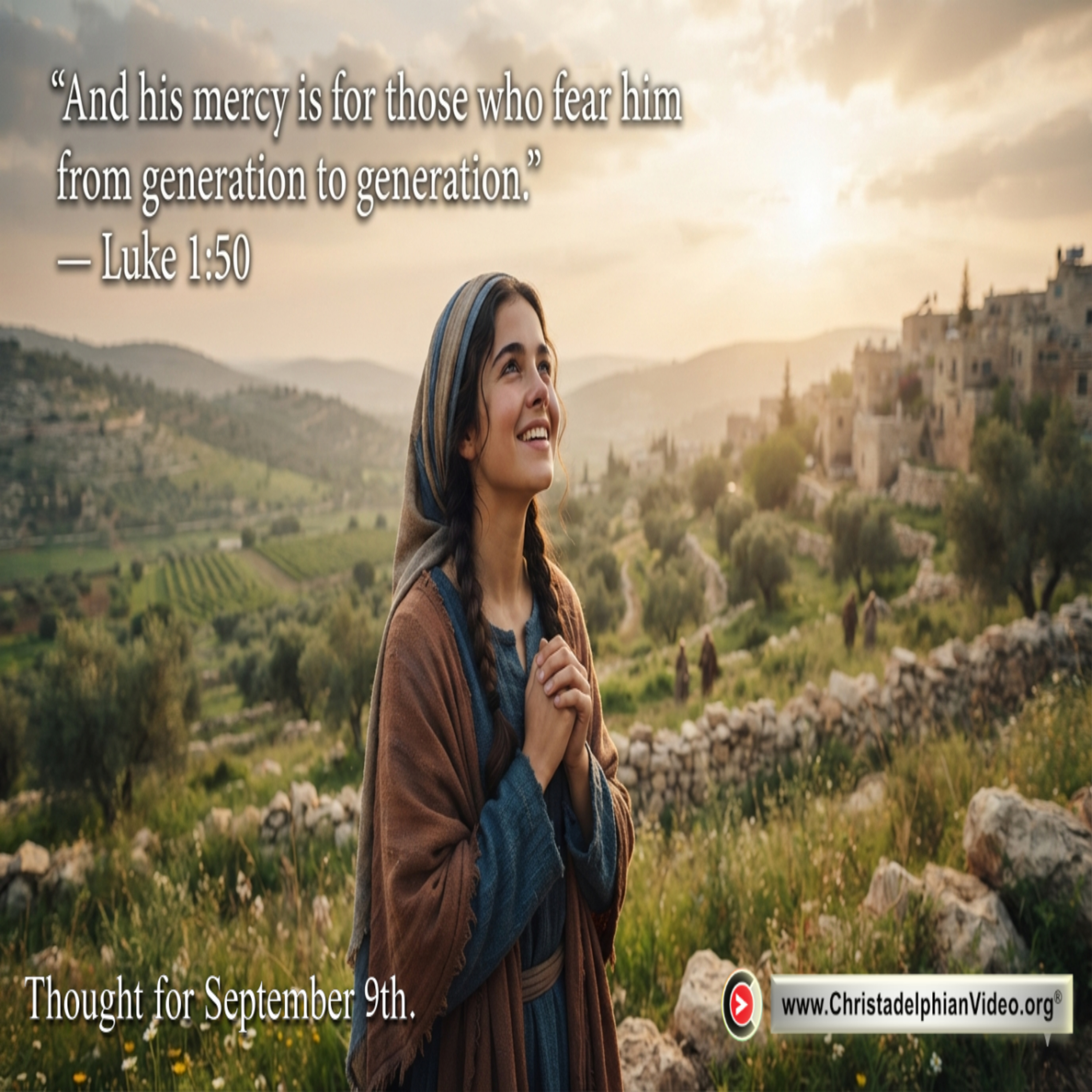 Thought for September 9th. “HIS MERCY IS FOR THOSE WHO …” 09.09.2026 4minWhat a depressing account we have today in 2 Kings 15! It lists a succession of godless kings in the northern kingdom of Israel and makes us think of the world in which we live! If we listen to or watch the news – there is a complete lack of good news on every hand – so it seems that people ‘bury’ their minds in the sports news. Similarly, in Ezekiel 5, we read the acted parables the prophet has to perform to indicate how “fire will come out into all the house of Israel” [v.4] and the LORD’s comment in v.13, “Thus shall my anger spend itself, and I will vent my fury upon them …” And we meditate with awe and fear in our minds on the ways the Creator will vent his fury more and more on the utterly godless world of the 21st Century.In contrast, it is uplifting to read the 80 verses of the first chapter of Luke. The author says that “it seemed good to me … having followed all things closely for some time past to write an orderly account … that you may have certainty …” [v.3,4] Through Luke’s writings, we, in these last days, “may have certainty” too! After compiling his gospel Luke put together an orderly account of the Acts of the Apostles after their Lord ascended to heaven. This contained so many historical references that the sceptics of the 19th and 20th Centuries were sure they would uncover flaws in Luke’s records as more and more ancient details came to light through archaeological and other discoveries – but none have come to light! What Luke has recorded includes major planks for the foundations of our faith.Today’s chapter includes the testimony of Mary before Jesus was born, she was inspired to say how her “spirit rejoices in God my Saviour” and that “his mercy is for those who fear him” [v.47,50]. May we truly rejoice and “fear him” – that is – be in awe of him. We especially pray that we may experience his mercy and gain strength from him as our godless world disintegrates more and more in coming days, months and years – if years yet remain? We are going to have a need to even more earnestly take to heart the words of the Master, “and when you hear of wars and tumults, do not be terrified, for these things must first take place …” [Luke 21 v.9] May we all fully realise and know in our hearts that “his mercy is for those who fear him – but who learn – not to fear the world!
 -
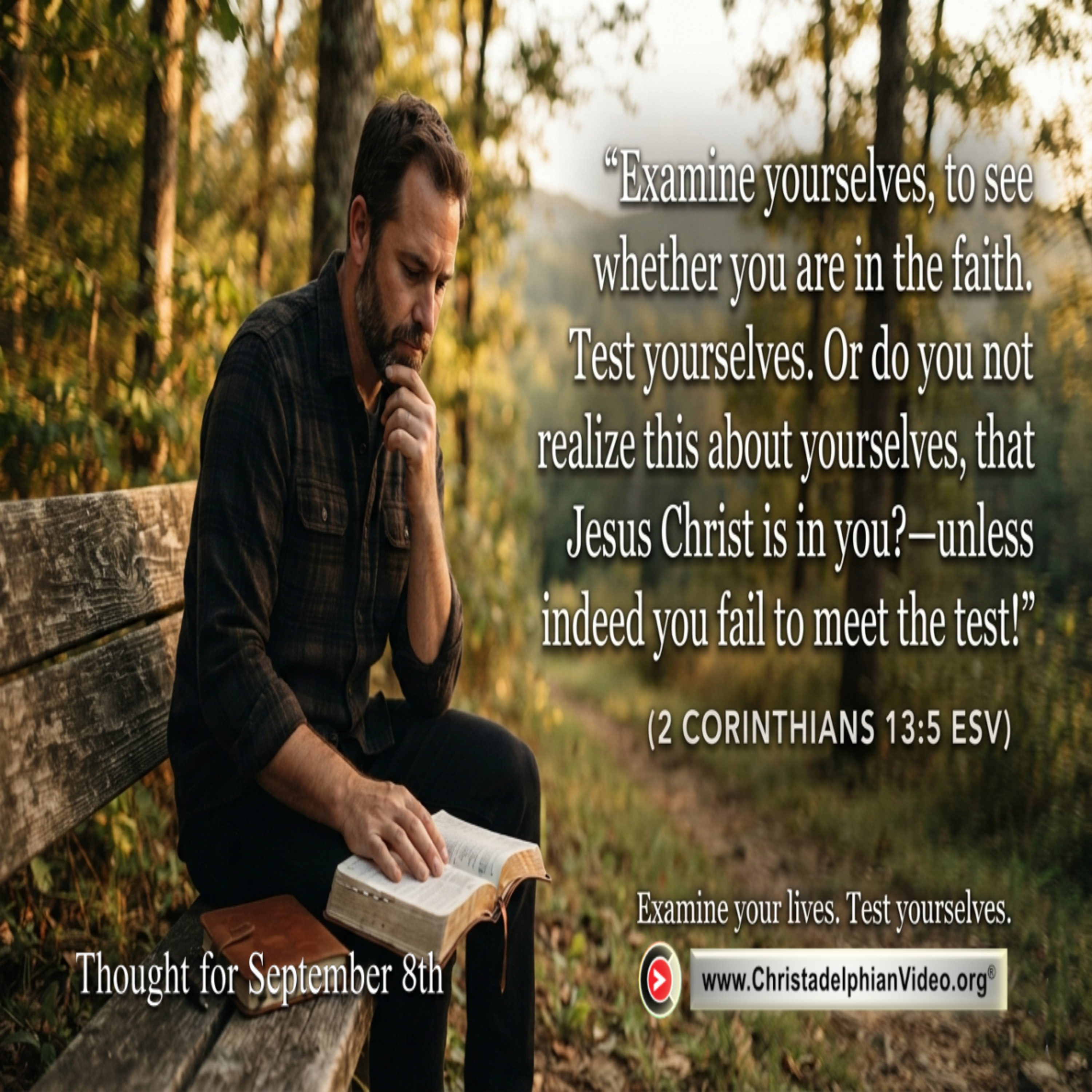 Thought for September 8th. “EXAMINE YOURSELVES … TEST YOURSELVES” 08.09.2026 4minToday we completed reading Paul’s second letter to the believers at Corinth; he is still anxious about them, his letter expresses many concerns. Let us recognise that correcting faults in our life in Christ is a personal responsibility. The concept of endless ‘grace abounding’ that exists among many who see themselves as Christians is dangerous. Let us carefully note the points Paul makes as he brings his letter to a conclusion. “Examine yourselves, to see whether you are in the faith” [13 v.5]. And so also must we. Let us fully realize that Christ, by his spirit, is present among believers and sees their actions, knows their minds and that this knowledge will be the ‘foundation’ for his right judgment on the day of judgment. Paul is developing the points he made in his first letter when he said, “Let a person examine himself … and so eat … and drink” [1 Cor. 11 v.28] when he or she comes to the table of remembrance to have fellowship. This self-examination is not only when we come together to the table of the Lord; in v.3 of this last chapter Paul stresses, “Christ is … not weak … but is powerful among you.” Christ sees their thoughts and actions (and, of course, ours). Paul stresses the need to, “Test yourselves. or do you not realize this about yourselves, that Jesus Christ is in you? – unless you fail to meet the test.” [v.5] Let us realize the sense he is “in us – and that we meet all the tests the ungodly world around us, puts on us.?When we were baptised we entered into a wonderful spiritual relationship with him, we were no longer our own; Paul expressed his own feeling to the Galatians, “It is no longer I who live, but Christ who lives in me.” [2 v.20]. Let us realize the reality of this, our Saviour is watching over us, this is both wonderful and awesome. Paul completes his message to the Corinthians by writing; “finally brothers (& sisters) Rejoice … comfort one another, agree with one another, live in peace, and the God of love and peace will be with you.” [v.11] It is the same today, our “peace” and teamwork together, means we will also fully have divine fellowship: remember Jesus said, “where two or three are gathered in my name, there am I among them.” [Matt 18 v.20] How wonderful! It is beyond our human comprehension. Let us appreciate the full meaning of the final verse of Paul’s letter, “The grace of the Lord Jesus Christ and the love of God and the fellowship of the Holy Spirit be with you all” Let us try ever harder to sense that “fellowship” as we “EXAMINE” and “TEST OURSELVES” every day.
 -
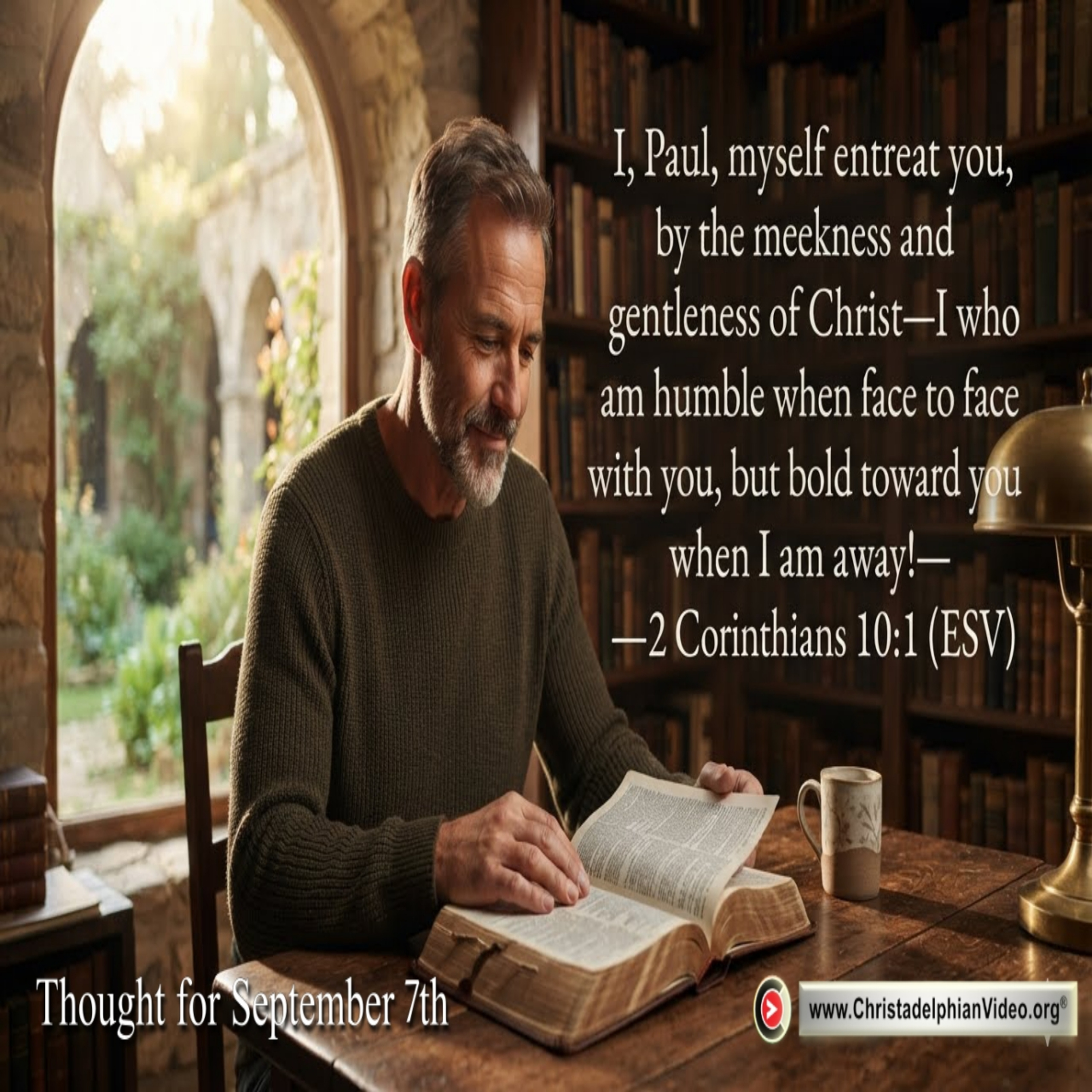 Thought for September 7th. “THE MEEKNESS AND GENTLENESS OF CHRIST” 07.09.2026 5minOur world is full of distractions; these seem to increase every year! This is especially so for the young; at every twist and turn of daily life they encounter “voices” “words” and messages clamouring for their attention. These “voices” might come via iPads, mobile phones or whenever they turn on their Laptop. The words of Paul to the Corinthians we read today can be applied to the present situation. The church in Corinth had been established for some years and the believers were being distracted by some who were full of their own self-importance and were creating problems. We read, “I Paul, myself entreat you, by the meekness and gentleness of Christ” [10 v.1]. This was the Christ-like attitude Paul had toward the genuine heart-motivated believers there, but it was a challenge to have it toward those who envied his popularity and sought to undermine his work for the Lord; we remember how our Lord responded to those who were envious of his popularity. Paul was putting into practice what Christ had said, “Come to me all you who labour and are heavy laden … Take my yoke upon you, and learn from me, for I am gentle and lowly of heart…” [Matt. 11 v.28,29] We see how Paul expresses his distress at the attitude of many in Corinth who were not doing this. It is the same today: God’s words get wilfully distorted. Paul writes, “I am afraid that as the serpent deceived Eve by his cunning, your thoughts will be led astray from a sincere and pure devotion to Christ. For if someone comes and proclaims another Jesus than the one we proclaimed, or if you receive a different spirit from the one you received, or if you accept a different gospel from the one you accepted, you put up with it readily enough” [11 v.3,4] Tragically the ‘Christian’ world has seen so many different gospels over the centuries, it is only the regular and prayerful reading of God’s word, so wonderfully preserved, that provides the foundation for us to truly walk in Christ’s footsteps – and, at the same time, to be motivated to develop the spirit of “meekness and gentleness.” This should apply equally as much when we seek to “destroy arguments and every lofty opinion raised against the knowledge of God”[10 v.5] May we find that, on at least some occasions, “the soft answer” [Prov. 15 v.1] can penetrate the hard hearts we encounter.Finally, note how this chapter ends; “it is not the one who commends himself who is approved, but the one whom the Lord commends.” May the Lord commend you on that day for being faithful to his word, and in turning from this world’s distractions to daily read and meditate on his word knowing they provide an essential foundation for all you think and do..
 -
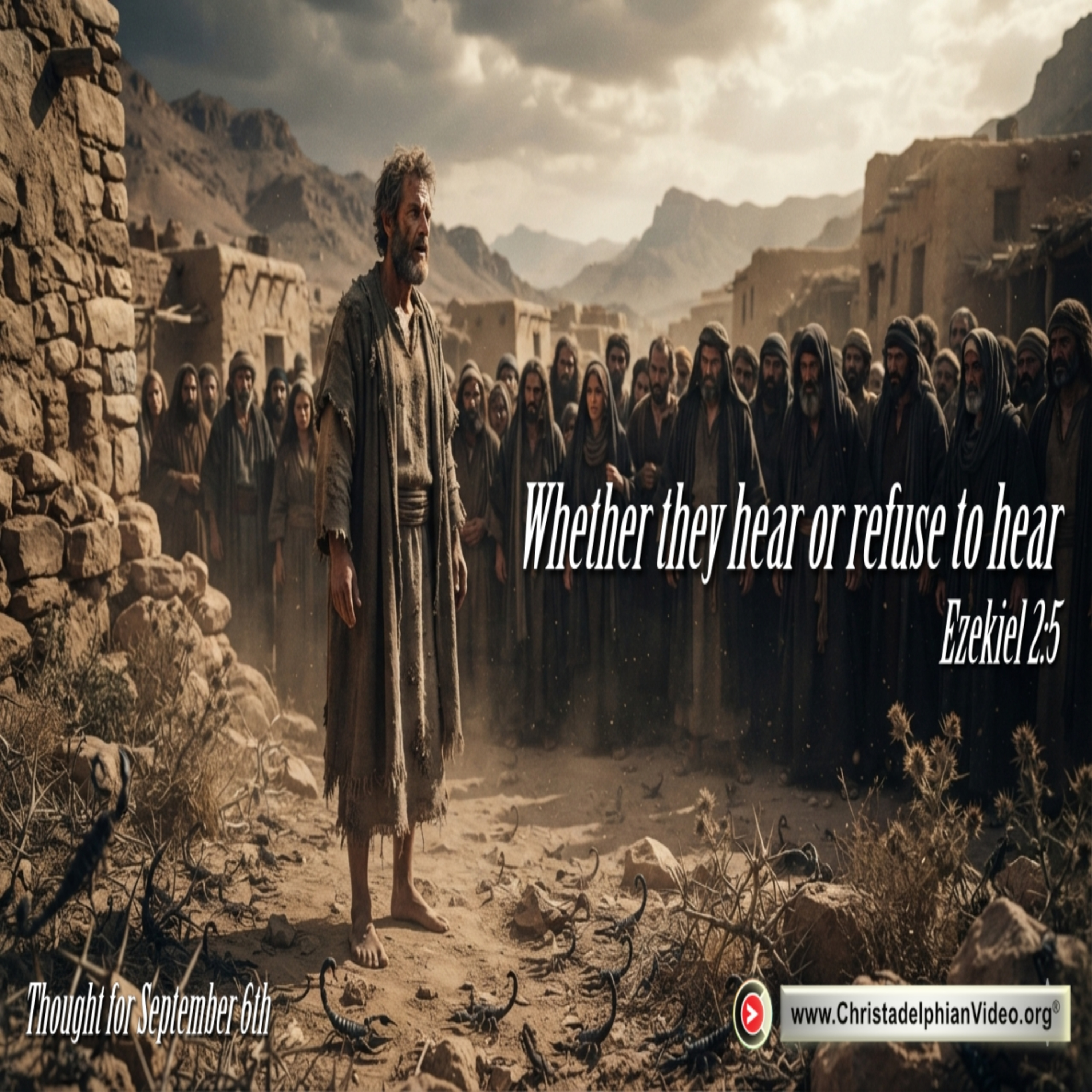 Thought for September 6th. “WHETHER THEY HEAR OR REFUSE TO HEAR” 07.09.2026 4minYesterday we started reading the intriguing prophecy of Ezekiel. He is in Babylon with those taken captive there before Jerusalem fell, along with King Jehoiachin. This is recorded in 2 Kings 24 v.12-15. It is in “the fifth year of the exile” [Ezek 1 v.2,3] that “the word of the LORD came to Ezekiel … and the hand of the LORD was upon him there.” It maybe he was sent by the LORD to join the exiles. There are many varied prophecies and visions that the LORD reveals to him climaxing with a vision in his final 9 chapters of a wondrous temple that will come into being in the ultimate future of the world. In today’s chapter he is told to preach to the exiles, and their attitude to his message have a number of comparisons with attitudes today. He is told, “I send you to the people of Israel, to nations of rebels who have rebelled against me.”[v.3] He is told, “The descendants also are impudent and stubborn … And whether they hear or refuse to hear … they will know that a prophet has been among them … Be not afraid of them … nor be dismayed at their looks …” [[v.4-6]We see a real comparison with the situation and attitudes today when there is an inclination to give up on efforts to witness about the word of God. But the final “ingathering” (see Matt. 22 v.9,10) must be completed and “the labourers are few” [Matt 9 v.27]. The vast majority we preach to “refuse to hear” – but we recall the parable of Jesus about the final ingathering before his return when the “master said to the servant, ‘Go out to the highways and hedges and compel people …. “ [Luke 14 v.23] and these words, we feel, have an application to us today. Let us renew our efforts in the area in which we live.So let us take the lesson of the LORD’s instructions to Ezekiel to heart in whatever situation we are in and make known God’s word in these last days so that “whether they hear or refuse to hear” – we can really feel we are carrying out our responsibility before God. This is an essential part of our “sowing” – noting the point Paul makes in today’s 9th chapter of 2nd Corinthians. “whoever sows sparingly will also reap sparingly, and whoever sows bountifully will also reap bountifully” [v.6] so, while Paul is not applying this primarily to preaching, let us take (and create) opportunities to sow the word of God in the ears of the those with whom we have contact so that “they will know that a prophet has been among them” and we show we are heeding Paul’s words to “abound in every good work”[v.8]
 -
 The Christadelphians:#21 'Why should i not be baptised?' 06.09.2026 35min[Actual, provable Bible Truth]We delve into a truly thought-provoking question that lies at the very heart of the Gospel: "Why should I not be baptised?" This presentation is an outstanding expositional journey through the Scriptures, revealing the divine thread of a coming Kingdom and a King who will reign in righteousness. We explore the profound promises made to Abraham and David, and see how they find their ultimate fulfilment in the Lord Jesus Christ. This is not merely history; it is the insightful blueprint of God's purpose with the earth.The narrative takes us from the prophetic blessings upon Judah, through the unwavering covenants, to the spectacular vision of Daniel. We witness the kingdoms of men, represented by the great metallic image, and the wonderful stone—cut out without hands—that will smash the old world order and establish a Kingdom that will never be destroyed. This stone is Christ, the King to whom all authority belongs. The exposition of Daniel's interpretation is simply outstanding, revealing the certain sequence of history and the glorious climax awaiting us.The presentation culminates in a powerful, scripture-filled anthem for the coming age. We witness the King on His throne in Zion, bringing peace, justice, and the knowledge of God to all nations. This is the hope that sustained the faithful for millennia and it is the reality we are called to embrace. This video is more than a study; it is a revealing call to understand our place in God's grand design and to respond to the King who is coming.**Chapters:**00:00 - Introduction: The Question of the King01:22 - The Promise to Judah: He Whose Right It Is03:19 - The Covenant with Abraham: The Promised Seed04:15 - The Royal Promise to David: An Everlasting Throne06:31 - The Hope in Babylon & Daniel's Vision08:45 - Daniel Interprets the King's Dream11:08 - The Kingdoms of Men Revealed13:08 - The Stone: Christ the King16:05 - A Symphony of Scripture: The Kingdom Established24:12 - Conclusion: The Call to Action**Bible Verse Category:**📖 Genesis 49:10📖 Genesis 22:17-18📖 2 Samuel 7:12📖 1 Chronicles 17:14📖 Ezekiel 21:27📖 Daniel 2:44📖 Matthew 21:42📖 Acts 3:21📖 2 Samuel 23:3-5📖 Psalm 89:26-27📖 Psalm 72📖 Isaiah 9:6-7📖 Isaiah 24:23📖 Isaiah 2:3-4📖 Jeremiah 3:17📖 Jeremiah 23:5-6📖 Zechariah 14:9📖 Luke 1:32-33📖 Matthew 16:27📖 2 Thessalonians 1:7-10📖 Revelation 5:9-10📖 Revelation 20:6📖 Revelation 11:15-18**Tags:**Christadelphians, Bible Truth, Kingdom of God, Jesus Christ, Prophecy, Daniel, Baptism, Biblical Exposition, End Times, Second Coming, Gospel, Bible Study, Faith, Hope, Salvation, Israel, King David, Abrahamic Covenant, Stone KingdomWe are a Christadelphian team, Brothers and sisters of Christ, and we're passionate about delivering powerful, Scripture-based content to strengthen and inspire your faith journey. If this presentation resonated with you, help spread the encouragement—share it with a friend today!
 -
 Thought for September 5th. “BRINGING HOLINESS TO COMPLETION” 05.09.2026 5minFollowing Christ is a journey – what a wonderful journey it should be! In today’s 3 chapters in 2nd Corinthians we see how Paul opens out more and more to them the wonder and challenges of this journey. We are reminded of Solomon’s ‘vision’ that “the path of the righteous is like the light of dawn, which shines brighter and brighter until …” [Prov. 4 v.18]! Yes, until the “full day” comes, when faith is turned to sight. Is the path you are treading, shining brighter and brighter? Are you “bringing holiness to completion”?The increasing spiritual darkness around us – should make the brightness of our path more evident! But sadly, ‘official’ Christianity is showing ever more clearly that God “has blinded their eyes and hardened their heart, lest they see with their eyes, and understand with their heart, and turn …” [John 12 v.40]. The ‘evidence’ was there for them to ‘see’ in the days of Jesus but their minds refused to accept what their eyes saw! They were unable to “turn.” And today! The contrast between “light” and “darkness” has grown really great; those in darkness have convinced themselves there never was a Creator.We are challenged to clearly understand what Paul means! He says, “while we are still in this tent, we groan, being burdened – not that we would be unclothed, but that we would be further clothed, so that what is mortal may be swallowed up by life.” [5 v.4] The more we are “further clothed” in our minds, the pathway before us will become increasingly clear and bright. “We are always of good courage”, says Paul, “and we would rather be away from the body and present with the Lord” [v.8] Those who believe their “soul” is immortal usually misunderstand Paul’s meaning. Mortality will be “swallowed up” when Christ returns as Paul explained in detail in 1 Cor. Ch. 15 also when he stated his expectation of what is “laid up for me” in 2 Tim 4 v.7,8. We will be physically “at home with the Lord” when he returns. Paul challenges them (and us) to be more and more spiritually “at home” with him now so that when we “appear before the judgement seat of Christ (when) … each one … receive(s) what is due for what he has done in the body …” [v.10] This means what he has done in “the body” of Christ – as Paul made clear in Ephesians 1 v.22,23.Chapter 6 in today’s readings ends by making the Corinthians aware of God’s promises of the life to come in his kingdom as recorded in the Old Testament (he quotes from Lev. 26 v.12 and Isaiah 52 v.11). Ch. 7 starts, “Since we have these promises, beloved, let us cleanse ourselves from every defilement … bringing holiness to completion in the fear (awe) of God”. He tells them to “widen your hearts” [6 v.13] How “wide” is your heart?. Our readings are the essential ‘food’ for our hearts; God’s scriptures are a foundation ingredient if our hearts are to really become wide and so see “the path” really clearly so that we anticipate the “full day” with the greatest eagerness.
 -
 Thought for September 4th. “OUR INNER NATURE IS BEING RENEWED DAY BY DAY” 04.09.2026 4minThis statement by Paul in today’s readings [2 Cor. 4 v.16] really sums up what we aim to achieve by reading portions of God’s word every day. Of course this depends on the spirit with which we read. Many face the challenge each day of finding adequate time to read; and then have little or no time for meditation on what they have read. But it is important to make an effort to do this for it multiplies in our minds the effectiveness of our reading. In this ever more godless world many have times of difficulty and frustration to face and overcome. Note what Paul says next; “for this slight momentary affliction is preparing for us an eternal weight of glory beyond all comparison” [v.17]. Nearly all have some positive things in their daily experiences and if we highlight these in our minds they are invaluable in preventing worldly concerns from dominating our thoughts. It is God’s word that helps most of all – but that depends how we read it, how receptive our minds are – what we look for! We try to demonstrate this in the daily thoughts we circulate. We all experience things which tend to frustrate us, but Paul says, “we do not lose heart” [v.16] and, as we see his list of afflictions, ours are nothing in almost every case! The reason why Paul did not lose heart was because he did not look on “the things that are seen but to the things that are unseen. For the things that are seen are transient, but the things that are unseen are eternal.” [v.18] Let’s try harder to follow his way of thinking. We have climbed a few mountains in our younger days and, for much of the time we climbed surrounded by clouds, but then, suddenly there is a break in the clouds and we realise both how much we have climbed, but greater still, we marvel at the vista of the distant scene that suddenly unfolds. Is not progress in the believer’s life like this? Now Jeremiah is an exception to the general experience of “light affliction” and as we completed reading his Lamentations today we noted his lament; “we get our bread at the peril of our lives …the joy of our hearts has ceased” [5 v.9,15] and we think this could be happening at times to some of our brethren in Iran and in one or two parts of Africa and maybe, even amongst those in Sri Lanka whom the Govt there is trying to force to return to their homeland. For all these, Paul’s words are really full of meaning and it is vital and they know it is vital that their “inner nature is being renewed day by day.” They may sometimes feel somewhat as Paul felt, “We are afflicted in every way, but not crushed; perplexed, but not driven to despair … struck down, but not destroyed” [4 v.8,9] Let us include them in our prayers – sensing how it helps in the renewal of our own inner nature, remembering what we read in ch. 1, v.11.
 -
 Thought for September 3rd. “…HELP US BY PRAYER” 03.09.2026 4minWe started reading 2nd Corinthians today: the opening chapter needs to be read slowly, carefully, as Paul makes so many points. He shows the inter-reaction of events and the great value of prayers in all the difficulties they and he are experiencing. “For as we share abundantly in Christ’s suffering, so, through Christ, we share abundantly in comfort too.” [1 v.5] It is, writes Paul “the Father of mercies and God of all comfort, who comforts us in all our affliction … [v.3,4] This is a comfort we have a responsibility to pass on to others.Let us meditate and reflect on the inter-reaction of events we have personally experienced. The more we have been active in the service of Christ, the more clearly we will perceive this. In Paul, the Corinthians saw the most outstanding example of service. “The afflictions we experienced,” writes Paul, was such that “we were so utterly burdened beyond our strength that we despaired of life itself.” [v.8] But Paul then came to realize, “that was to make us rely not on ourselves but on God ….” [v.9]“On him we have set our hope that he will deliver us again” [v.10] Then Paul makes an appeal that we should specially take notice of. He tells the Corinthians, “You also must help us by prayer so that many will give thanks on our behalf for the blessing granted us by the prayers of many.” [v.11]Many are aware today through the almost instant communication the internet provides of the desperate situations some Iranian believers have experienced. There are also Pakistani believers who are experiencing persecution, and a few truth seekers who have felt it wise to return to Afghanistan. Let us help them by prayer.Also, may we, as Paul writes in his 2nd chapter, spread “the fragrance of the knowledge of him everywhere. For we are the aroma of Christ to God among those who are being saved …” [v.14,15] The world is ‘smelling’ ever more evil, as the darkness becomes ever darker, but then the light should be even more evident!It is a tragedy, as we will read tomorrow in ch. 4, that “the god of this world has blinded the minds of the unbelievers, to keep them from seeing the light of the gospel …” [v.4] But, what a wondrous blessing we have that “God, who said, ‘Let light shine out of darkness’, has shone in our hearts to give the light of the knowledge of the glory of God in the face of Jesus Christ.” [v.6] That ‘light’ shone physically as creation began countless aeons ago, but the wondrous fact for us is, as we will read in ch. 5, “if anyone is in Christ, he is a new creation.” [v.17] May all those who are part of that “new creation” help one another by prayer.
 -
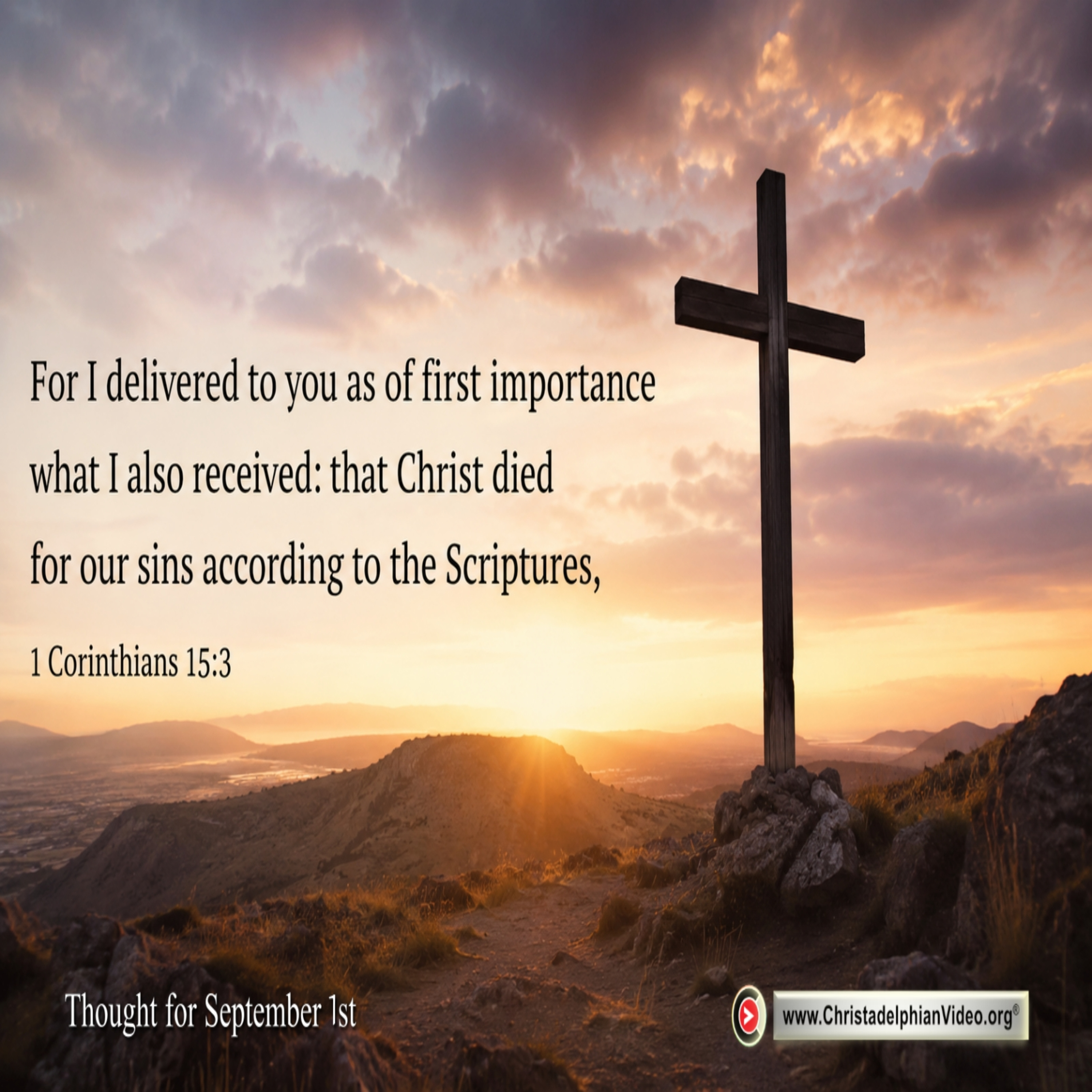 thought for September 1st. “OF FIRST IMPORTANCE” 01.09.2026 5minPossibly the most heart moving chapter for us in Scripture is today’s 15th chapter in 1st Corinthians – of course, that depends on how ‘alive’ our heart is! Paul writes on the absolute certainty that the resurrection of Christ really happened. It is the foundation of “the gospel in which you stand and by which you are being saved.”]v.1,2] He reminds these former idol-worshippers that “I delivered to you as of first importance what I also received: that Christ died for our sins … that he was raised the third day …” [v.3,4] This gave real meaning to their lives, as it does to ours. We can say that if we have real conviction of this event, that conviction becomes the ‘engine’ of the ‘thought processes’ that transform the way we see the meaning of life. How well that ‘engine’ is functioning is evidenced by the priorities we have in daily and weekly life. The people of Corinth had formerly been idol worshippers, they had believed they had a ‘soul’ that was immortal that it was a blessing when it escaped from their body at death to then lead some sort of immortal existence! There are still some relatively primitive people today who believe this, but far more significant at the moment is the Islamic conviction, from the Qur’an, that the souls of martyrs go directly to paradise – a conviction that is surely a significant factor in the minds of those who commit the atrocities we are witnessing in the world at the moment.Paul goes on to list those who were witnesses that Christ rose from the dead; on one occasion “he appeared to more than five hundred brothers at one time, most of whom are still alive” [v.6]. We reflect the thinking of the Roman Centurions – their thinking was effectively challenged through their contact with Jesus, at least some were convinced of his divine powers, see Matt 8 v.5-13; Luke 3 v.3-6. A Centurion and others with him saw “what took place (at the crucifixion) and they were filled with awe and said, “Truly this was the Son of God!” [Matt 27 v.54]Then of course Acts 10 has the account of the conversion of the Roman Centurion Cornelius – and many with him. Surely the impact of these experiences was the reason why there were so many followers of Christ in Rome in A.D. 63 whom the emperor Nero sought to put to death, according to Roman historians, e.g. Tacitus, circa AD 110. They saw the events of Calvary as “of first importance” – it transformed their thinking, as it did all those who had witnessed him alive after his resurrection – creating the conviction of their own hope of resurrection! Those alive at his return, and surely that includes some (many?) alive today who truly believe these things are “of first importance” and are baptised, they, says Paul, “shall all be changed in a moment, in the twinkling of an eye at the last trumpet … and put on immortality.” [v.51,53] All with this conviction of belief and expectation, will, as Paul expresses it at the end of this chapter, “be steadfast, immovable, always abounding in the work of the Lord …”
 -
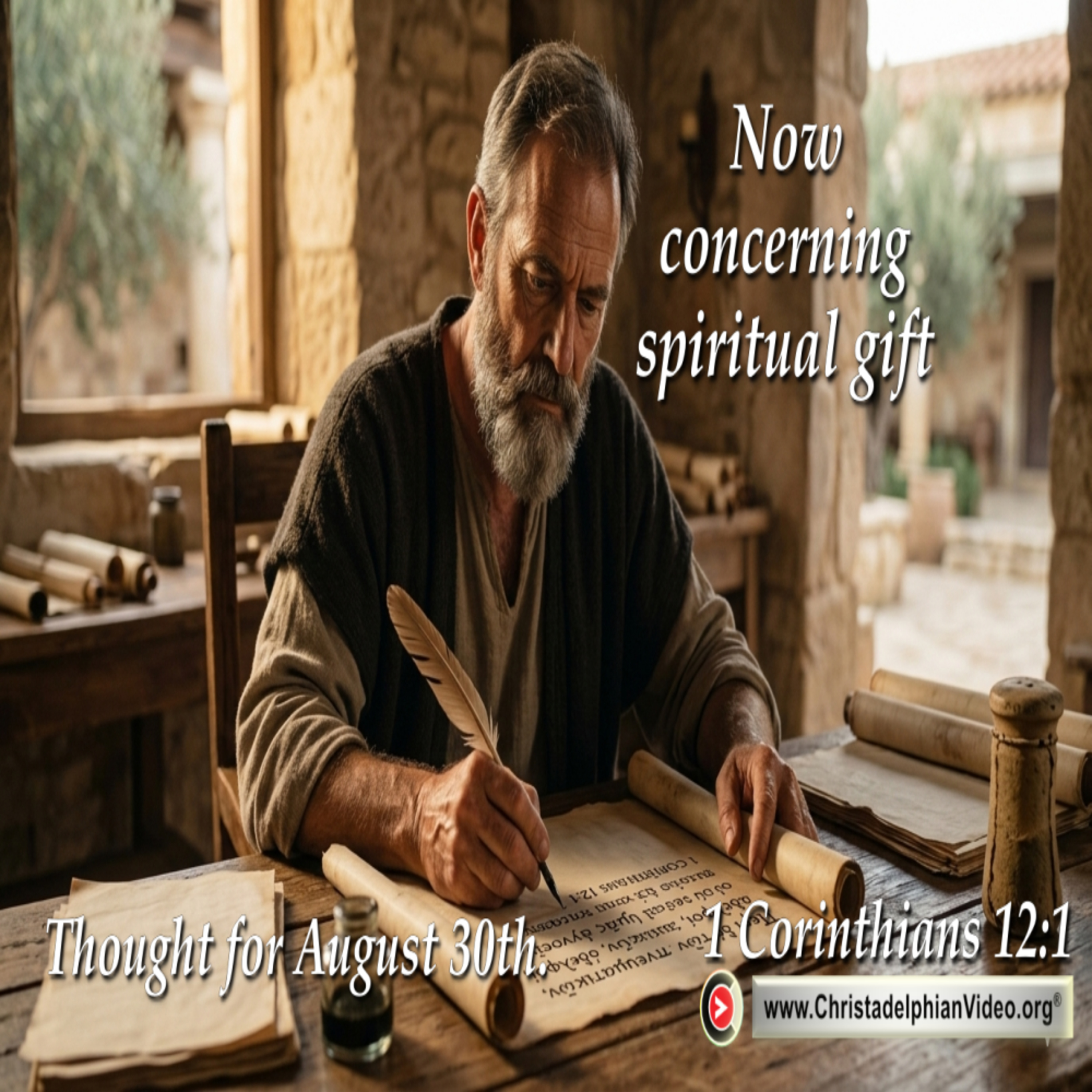 Thought for August 30th. “NOW CONCERNING SPIRITUAL GIFTS …” 30.08.2026 4minWe now come to a special part of Paul’s letter to the Corinthians, these are chapters 12 to 14, and the first two are for today and they start, “Now concerning spiritual gifts ….” And Paul seeks to put their understanding of these gifts into a godly perspective. Paul first makes the point, “When you were pagans you were led astray…” [v.2] At that time they had experienced all kinds of trances and ecstasy, as can still be observed among some primitive peoples today, being seen as ‘gifts’ from their imagined gods. Paul tells them that, as members of Christ, “there are varieties of gifts … and there are varieties of service, but it is the same God who empowers them all in everyone” [v.4-6]. These are to be used “for the common good”. [v.7] – not in competition. These gentiles in Corinth had no Bible to read, and so “through the Spirit … one is given … the utterance of wisdom … another the utterance of knowledge …” The gift of tongues is mentioned last – and Paul counsels them to “earnestly desire the higher gifts” [v.31] adding, “and I will show you a still more excellent way.” This brings us to the marvellous exposition he gives on the value of love. In ch. 13. One can “have all faith … but have not love” then, says Paul, “I am nothing” [v.2,1] In ch. 12 Paul had made the point, which we might fail to stress, “”Now you are the body of Christ and individually members of it.” Collectively, together we make up “the body of Christ.” For, says Paul, “the body does not consist of one member but of many.” [v.14] Believers must team together as parts of Christ’s body of believers, using the individual abilities they have been given for the common good – above all, to display and practise the collective character of Christ. In that way, our children who have not yet accepted Christ will be influenced – and of course, unbelievers – if they are seekers, will be attracted. Head knowledge is essential, but is only half of “the body” – our hearts are the other half! A body is “dead” if it has no heart: Head and heart team together to produce faith The end of ch. 13 sums it all up, “So now faith, hope and love abide … but the greatest of these is love.” To finish, let us meditate on that verse: in the kingdom age, hope will be fulfilled and turn into sight, so faith will not be needed. The one thing that will “abide” is “love.” That will be the all-embracing spirit of mind in that wondrous time, how vital we develop it now if we aim, by His grace, to be there.
 -
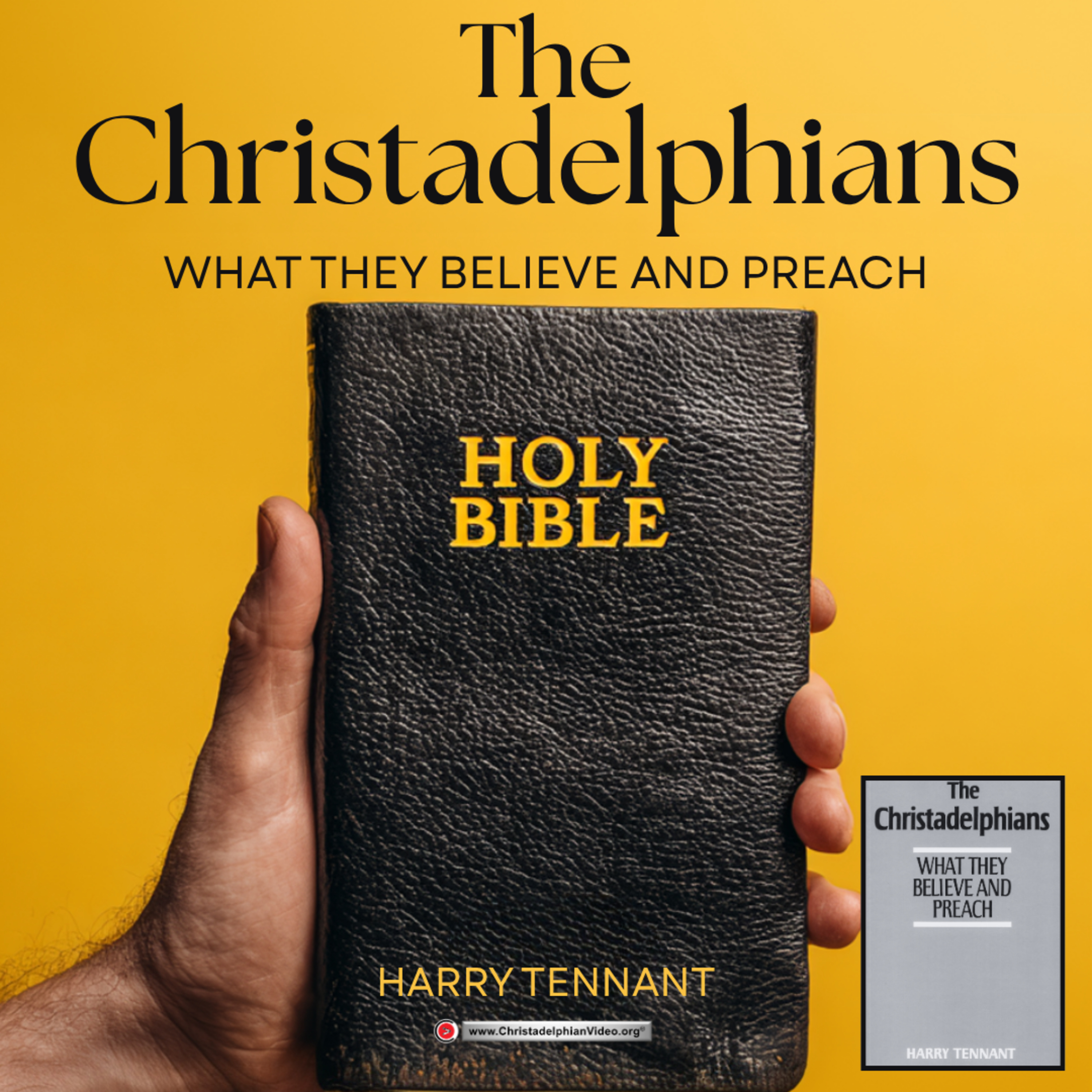 The Christadelphians: #20 Repentance and conversion 30.08.2026 35minA @Christadelphians Video: [Inspiring] In this thought-provoking and outstanding exposition, we delve into one of the most revealing themes of Scripture – the identity of God’s promised King and the establishment of His eternal Kingdom on earth. From the ancient prophecies given to Judah and David, to Nebuchadnezzar’s magnificent dream and the powerful symbolism of the stone cut without hands, this presentation weaves together the golden thread of Biblical promise. It is a wonderful, insightful journey that uncovers how the coming King – Jesus Christ – will reign from Jerusalem, bring peace to the nations, and fulfil the covenant made to Abraham. Whether you are new to these truths or have long cherished them, this video will strengthen your faith and inspire a deeper commitment to the hope of the Gospel.We invite you to watch, reflect, and share in the joy of God’s unfolding purpose.**📖 Bible Verses Referenced** - 📖 Genesis 49:10 - 📖 Genesis 22:17-18 - 📖 1 Chronicles 17:11-14 - 📖 2 Samuel 7:12 - 📖 Ezekiel 21:27 - 📖 Daniel 2:44, 2:31, 8:20-21 - 📖 Psalm 118:22-23 - 📖 Acts 3:21 - 📖 2 Samuel 23:3-5 - 📖 Psalm 89:26-27 - 📖 Psalm 72 - 📖 Isaiah 9:6-7, 24:23, 2:3-4 - 📖 Jeremiah 3:17, 23:5-6 - 📖 Zechariah 14:9 - 📖 Luke 1:32-33 - 📖 Matthew 16:27, 25:31, 21:42 - 📖 2 Thessalonians 1:7-10 - 📖 Revelation 5:9-10, 20:6, 11:15-18 **Chapters** 00:00 – Introduction: The Failure of Human Kingdoms 01:25 – The Promise to Judah (Genesis 49:10) 03:19 – Abraham’s Seed and the Coming King 03:41 – God’s Covenant with David (1 Chronicles 17) 05:27 – The Essential Elements of the Royal Promises 06:31 – Daniel and Nebuchadnezzar’s Impossible Dream 09:21 – The Vision of the Great Statue 10:45 – Interpretation: Four World Empires Revealed 13:08 – The Stone Cut Without Hands – Christ the King 16:30 – A Scriptural Tapestry: Christ’s Eternal Reign 24:12 – Conclusion: The Certainty of God’s Kingdom on Earth 35:16 – Closing Reflection and Call to Action **Tags** Christadelphians, Bible study, Kingdom of God, Jesus Christ King, Bible prophecy, book of Daniel, Nebuchadnezzar’s dream, stone cut without hands, Davidic covenant, repentance and conversion, biblical exposition, end times, God’s promises, Abrahamic covenant, Jerusalem throne, second coming, inspirational Bible teachingWe are a Christadelphian team, Brothers and sisters of Christ, and we're passionate about delivering powerful, Scripture-based content to strengthen and inspire your faith journey. If this presentation resonated with you, help spread the encouragement—share it with a friend today!
Podobné podcasty


Obľúbený v
Tento podcast sa objavuje aj v rebríčkoch podcastov týchto krajín.
